
The Early Days of Automatic Floorplan Design Martin








- Slides: 30
The Early Days of Automatic Floorplan Design Martin D. F. Wong Department of Electrical and Computer Engineering University of Illinois at Urbana-Champaign ISPD 2016 1
Floorplan Design Pack modules on a rectangular chip to optimize total area and interconnect cost. Module: – Hard modules – Soft modules Connectivity: A 1 B A C 10 C 2 B D 5 D 2
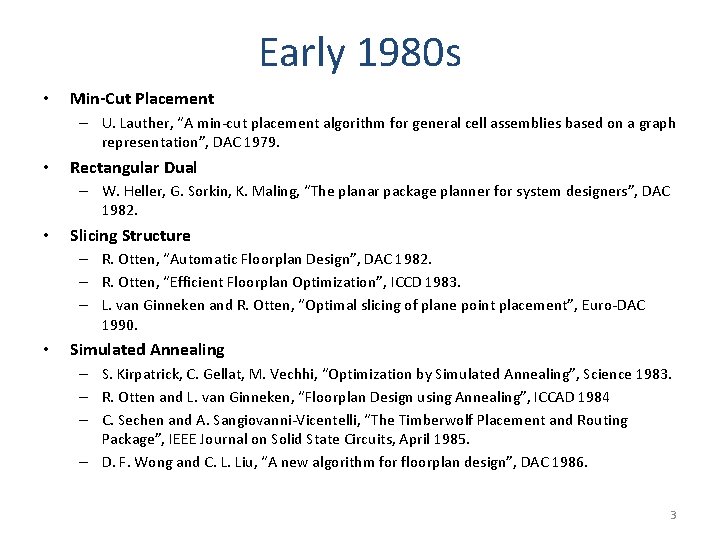
Early 1980 s • Min-Cut Placement – U. Lauther, “A min-cut placement algorithm for general cell assemblies based on a graph representation”, DAC 1979. • Rectangular Dual – W. Heller, G. Sorkin, K. Maling, “The planar package planner for system designers”, DAC 1982. • Slicing Structure – R. Otten, “Automatic Floorplan Design”, DAC 1982. – R. Otten, “Efficient Floorplan Optimization”, ICCD 1983. – L. van Ginneken and R. Otten, “Optimal slicing of plane point placement”, Euro-DAC 1990. • Simulated Annealing – S. Kirpatrick, C. Gellat, M. Vechhi, “Optimization by Simulated Annealing”, Science 1983. – R. Otten and L. van Ginneken, “Floorplan Design using Annealing”, ICCAD 1984 – C. Sechen and A. Sangiovanni-Vicentelli, “The Timberwolf Placement and Routing Package”, IEEE Journal on Solid State Circuits, April 1985. – D. F. Wong and C. L. Liu, “A new algorithm for floorplan design”, DAC 1986. 3
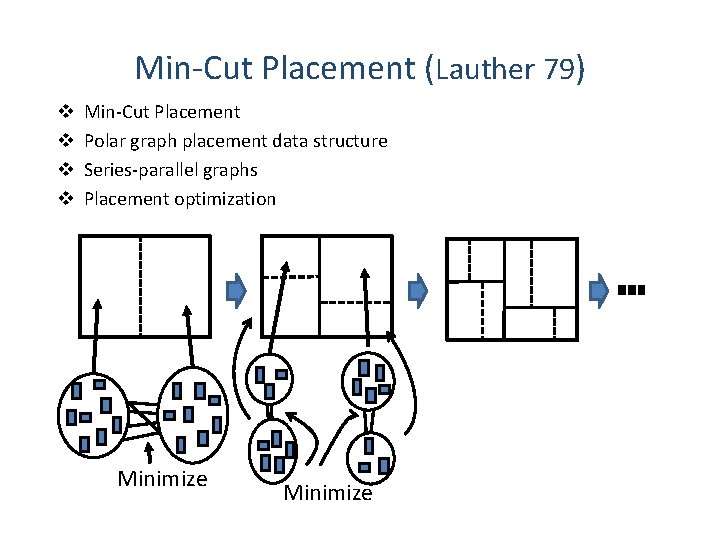
Min-Cut Placement (Lauther 79) v v Min-Cut Placement Polar graph placement data structure Series-parallel graphs Placement optimization Minimize
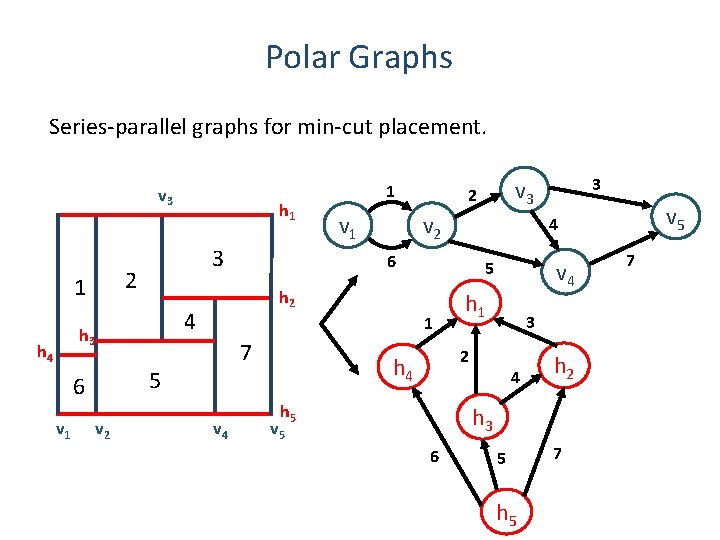
Polar Graphs Series-parallel graphs for min-cut placement. v 3 3 2 1 v 2 v 2 1 7 v 4 h 1 3 2 h 4 h 5 4 h 2 h 3 v 5 6 v 5 4 5 h 2 5 6 v 1 3 v 3 2 6 4 h 3 h 4 h 1 1 5 h 5 7 7
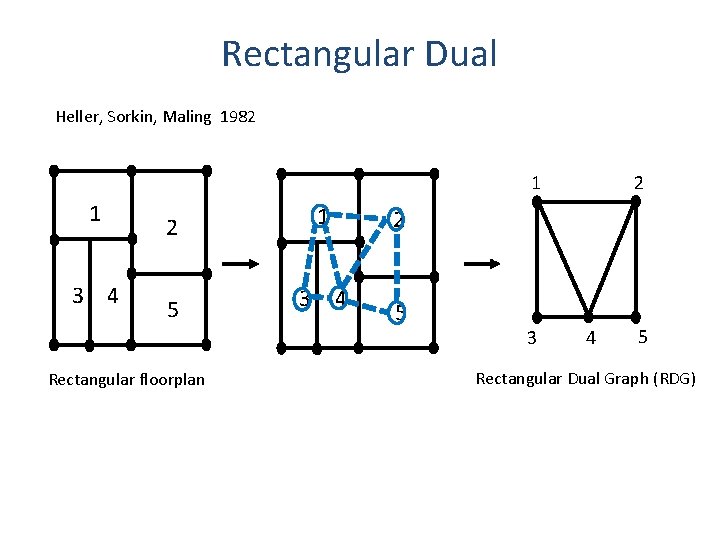
Rectangular Dual Heller, Sorkin, Maling 1982 1 1 3 4 2 1 5 3 4 Rectangular floorplan 2 2 5 3 4 5 Rectangular Dual Graph (RDG)
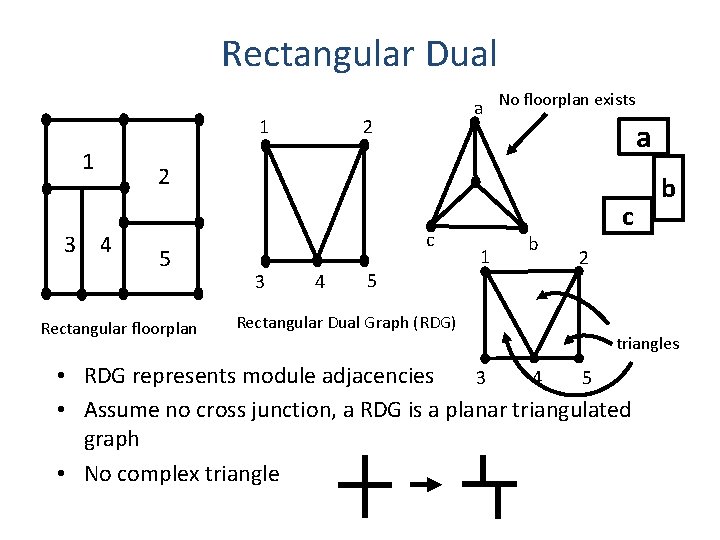
Rectangular Dual 1 1 3 4 a No floorplan exists 2 2 5 Rectangular floorplan c 3 4 5 Rectangular Dual Graph (RDG) 1 b c a b 2 triangles • RDG represents module adjacencies 5 3 4 • Assume no cross junction, a RDG is a planar triangulated graph • No complex triangle
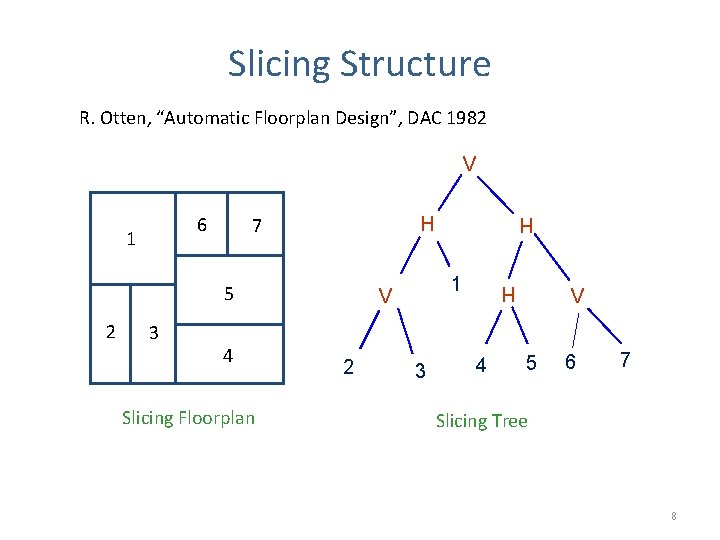
Slicing Structure R. Otten, “Automatic Floorplan Design”, DAC 1982 V H 5 2 3 4 Slicing Floorplan 1 V 2 3 H 1 7 H 6 4 V 5 6 7 Slicing Tree 8
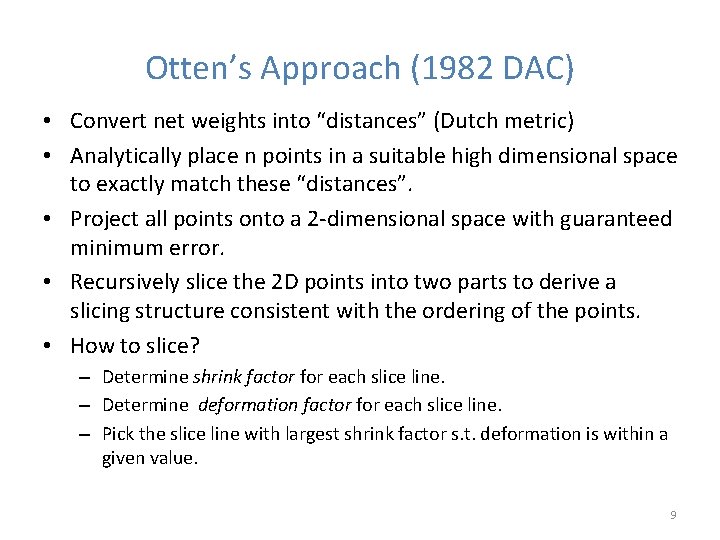
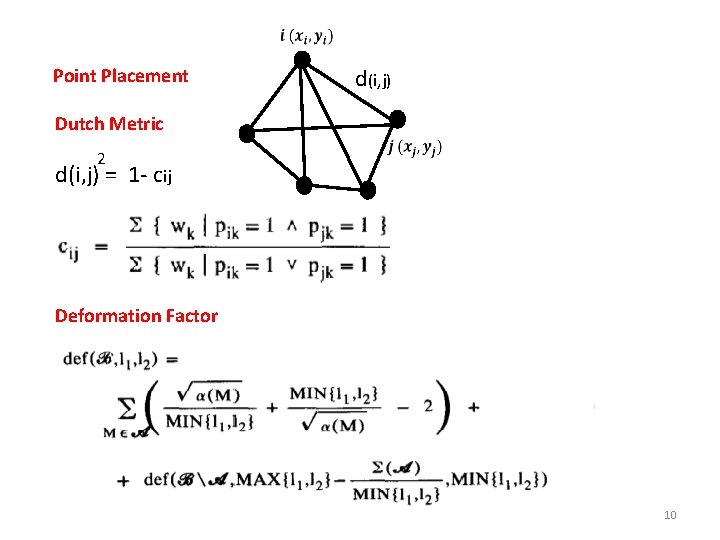
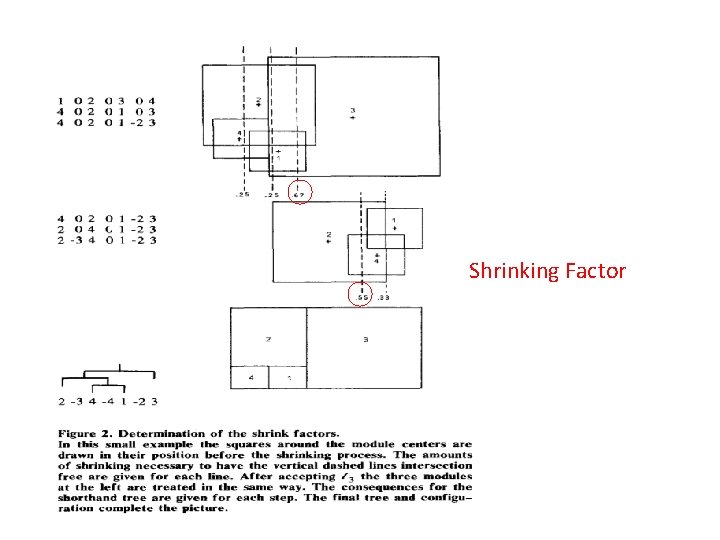
Otten’s Approach (1982 DAC) • Convert net weights into “distances” (Dutch metric) • Analytically place n points in a suitable high dimensional space to exactly match these “distances”. • Project all points onto a 2 -dimensional space with guaranteed minimum error. • Recursively slice the 2 D points into two parts to derive a slicing structure consistent with the ordering of the points. • How to slice? – Determine shrink factor for each slice line. – Determine deformation factor for each slice line. – Pick the slice line with largest shrink factor s. t. deformation is within a given value. 9
Point Placement d(i, j) Dutch Metric 2 d(i, j) = 1 - cij Deformation Factor 10
Shrinking Factor
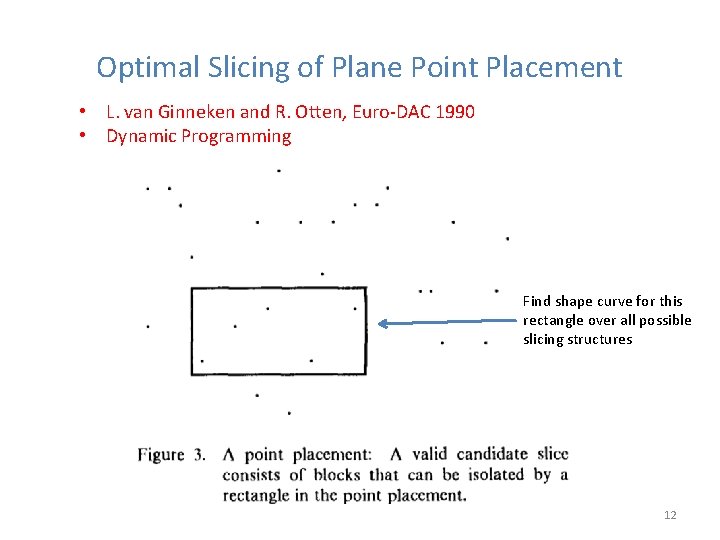
Optimal Slicing of Plane Point Placement • L. van Ginneken and R. Otten, Euro-DAC 1990 • Dynamic Programming Find shape curve for this rectangle over all possible slicing structures 12
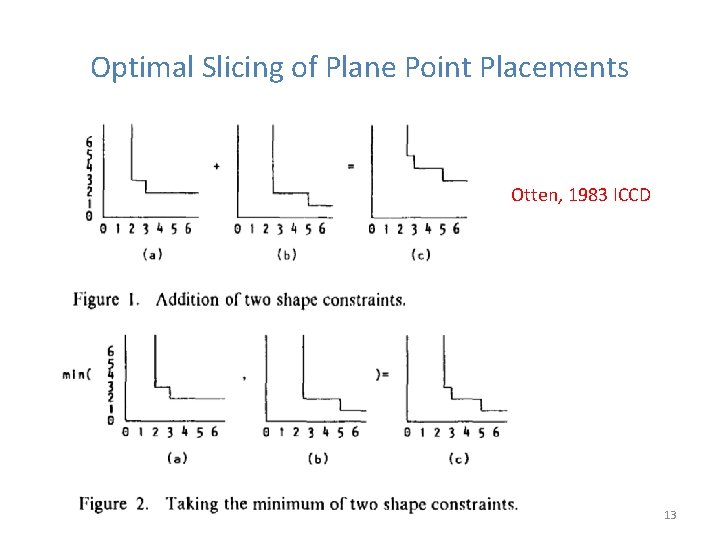
Optimal Slicing of Plane Point Placements Otten, 1983 ICCD 13
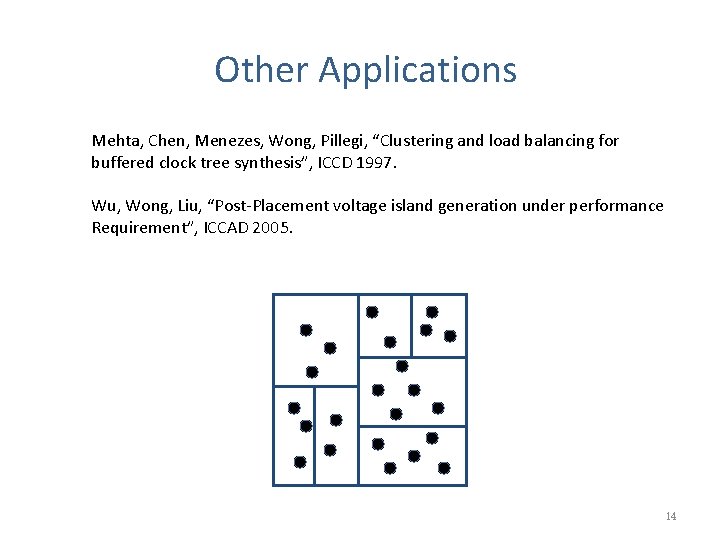
Other Applications Mehta, Chen, Menezes, Wong, Pillegi, “Clustering and load balancing for buffered clock tree synthesis”, ICCD 1997. Wu, Wong, Liu, “Post-Placement voltage island generation under performance Requirement”, ICCAD 2005. 14
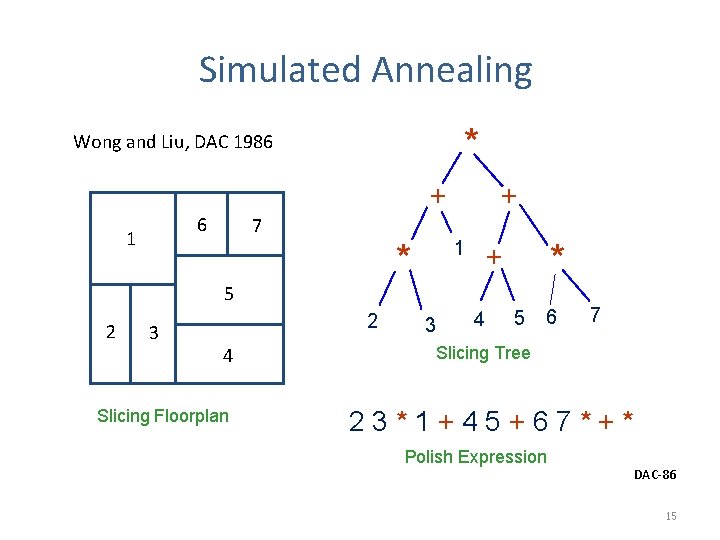
Simulated Annealing * Wong and Liu, DAC 1986 + * 5 2 3 2 4 Slicing Floorplan 1 3 * + 1 7 + 6 4 5 6 7 Slicing Tree 23*1+45+67*+* Polish Expression DAC-86 15
DAC-86 16
Wong-Liu Algorithm DAC-86 17
Wong-Liu Algorithm DAC-86 18
How good are slicing floorplans? 19
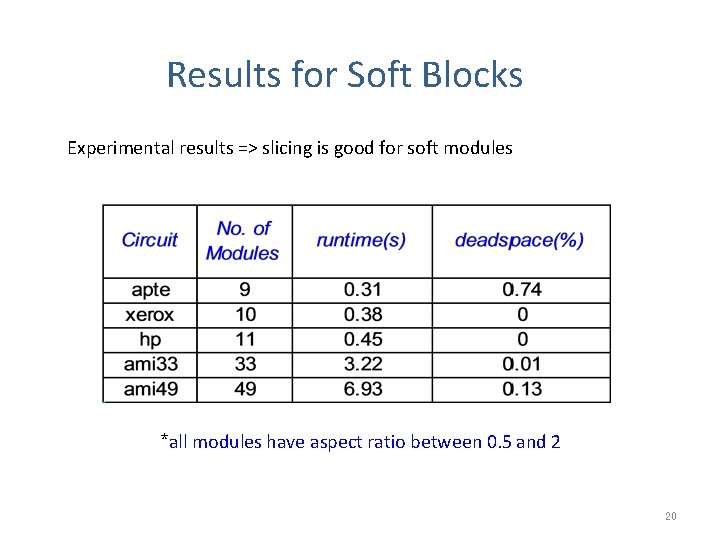
Results for Soft Blocks Experimental results => slicing is good for soft modules *all modules have aspect ratio between 0. 5 and 2 20
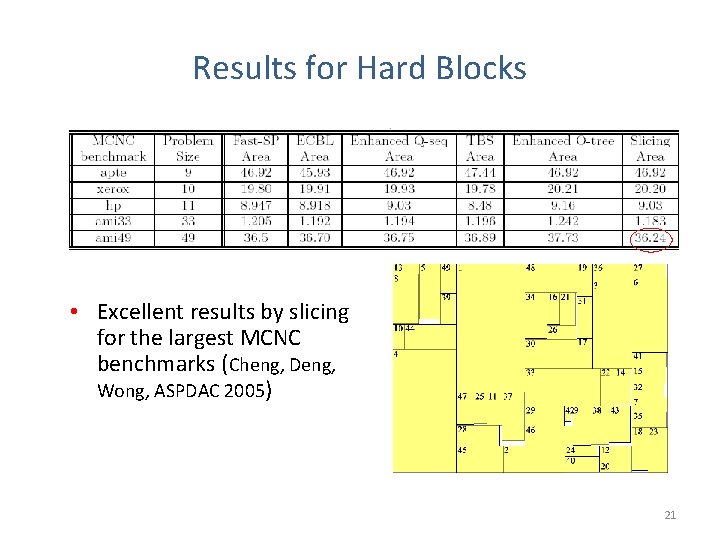
Results for Hard Blocks • Excellent results by slicing for the largest MCNC benchmarks (Cheng, Deng, Wong, ASPDAC 2005) 21
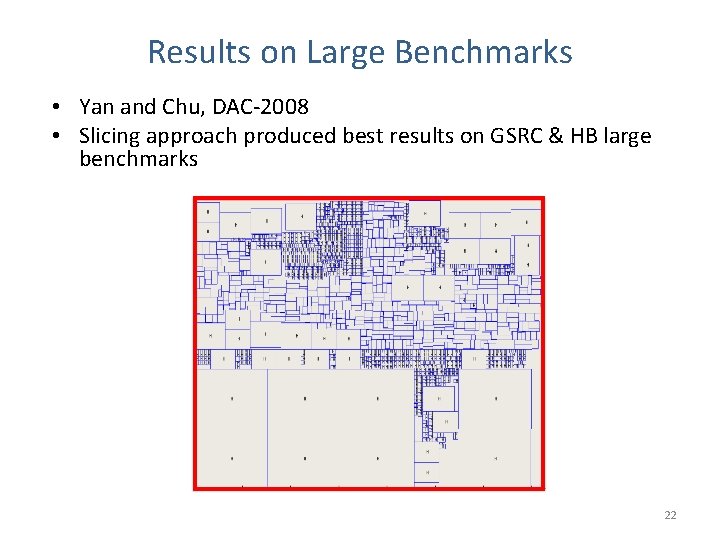
Results on Large Benchmarks • Yan and Chu, DAC-2008 • Slicing approach produced best results on GSRC & HB large benchmarks 22
Can we mathematically explain these excellent empirical results? 23
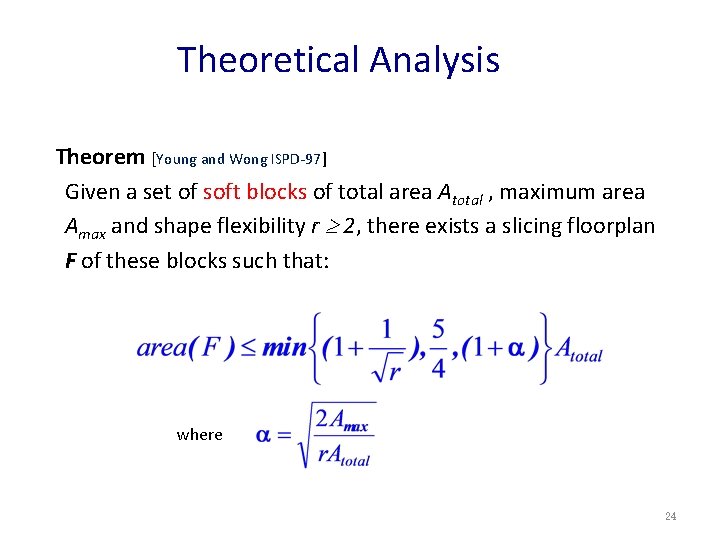
Theoretical Analysis Theorem [Young and Wong ISPD-97] Given a set of soft blocks of total area Atotal , maximum area Amax and shape flexibility r 2, there exists a slicing floorplan F of these blocks such that: where 24
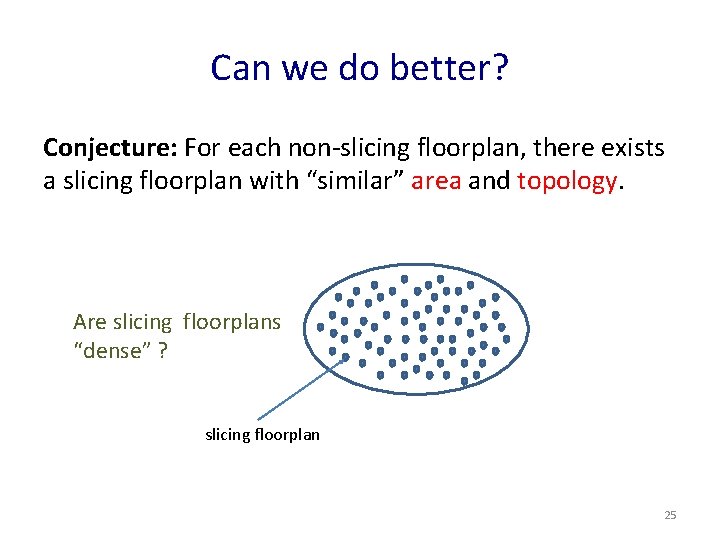
Can we do better? Conjecture: For each non-slicing floorplan, there exists a slicing floorplan with “similar” area and topology. Are slicing floorplans “dense” ? slicing floorplan 25
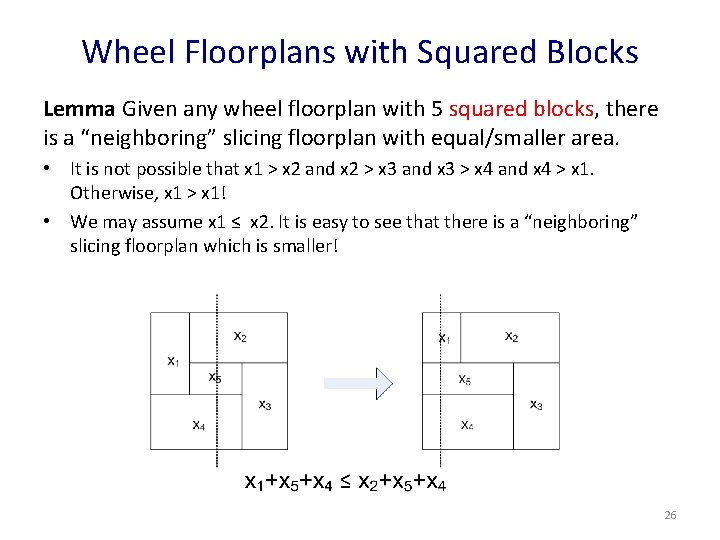
Wheel Floorplans with Squared Blocks Lemma Given any wheel floorplan with 5 squared blocks, there is a “neighboring” slicing floorplan with equal/smaller area. • It is not possible that x 1 > x 2 and x 2 > x 3 and x 3 > x 4 and x 4 > x 1. Otherwise, x 1 > x 1! • We may assume x 1 ≤ x 2. It is easy to see that there is a “neighboring” slicing floorplan which is smaller! 26
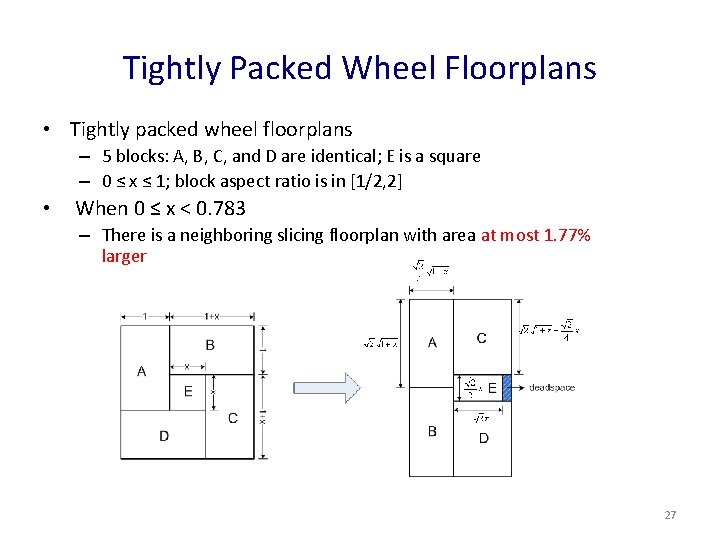
Tightly Packed Wheel Floorplans • Tightly packed wheel floorplans – 5 blocks: A, B, C, and D are identical; E is a square – 0 ≤ x ≤ 1; block aspect ratio is in [1/2, 2] • When 0 ≤ x < 0. 783 – There is a neighboring slicing floorplan with area at most 1. 77% larger 27
Tightly Packed Wheel Floorplans • When 0. 783 ≤x≤ 1 – The neighboring slicing floorplan can be packed with zero dead-space 28
Slicing Tree is a “Complete” Floorplan Representation Theorem (Lai & Wong, DATE 2001) • Each slicing tree gives a maximally compact placement • Conversely, each maximally compact placement can be obtained from a slicing tree 1 3 + * 2 1 4 2 * 5 6 7 3 1 7 6 + + * 5 4 7 6 2 5 3 4
Conclusions • Presented a brief survey of floorplan design work in early 1980 s. • Prof. Otten’s work had great impact on the early part of my career. • Congratulations on the ISPD Life Time Achievement Award! 30


























