THE CIVIL WAR The Union Dissolves Chapter 11

- Slides: 96
THE CIVIL WAR The Union Dissolves Chapter 11 Section 1
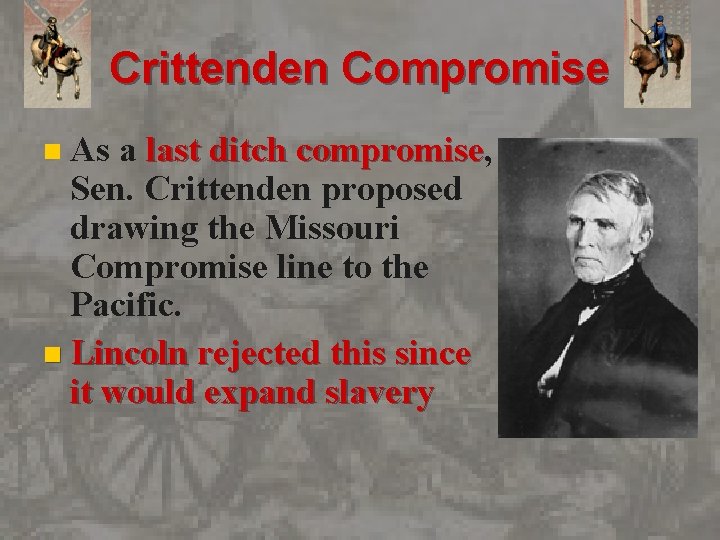
Crittenden Compromise As a last ditch compromise, compromise Sen. Crittenden proposed drawing the Missouri Compromise line to the Pacific. n Lincoln rejected this since it would expand slavery n
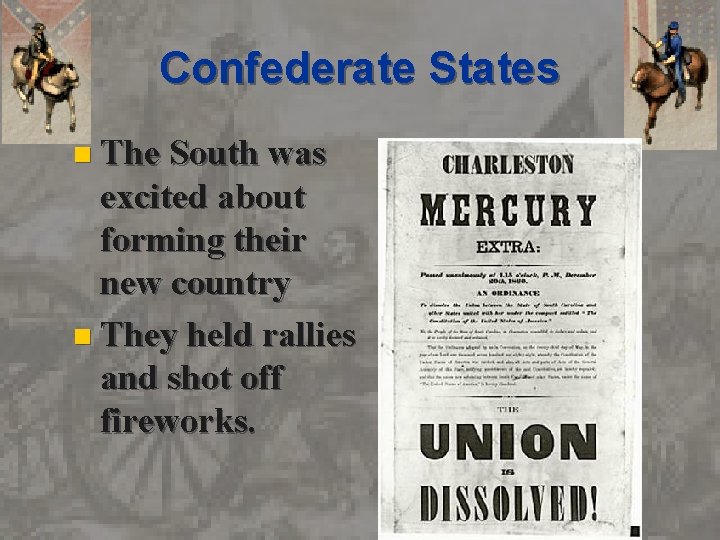
Confederate States n The South was excited about forming their new country n They held rallies and shot off fireworks.
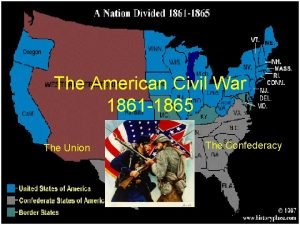
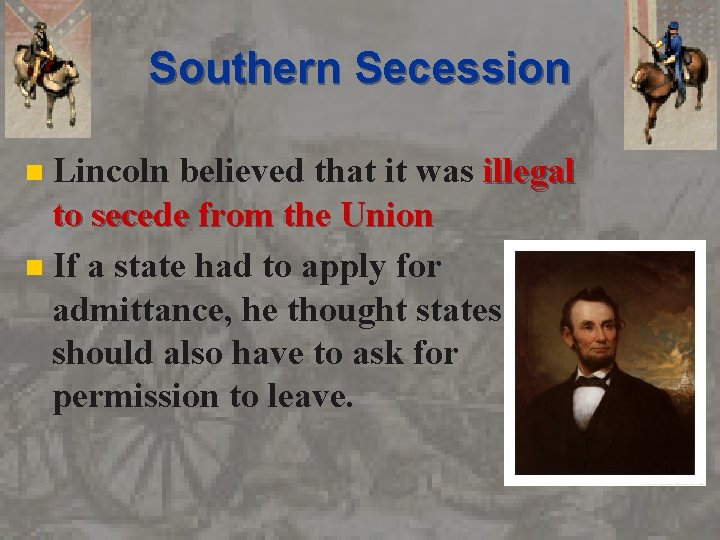
Southern Secession Lincoln believed that it was illegal to secede from the Union n If a state had to apply for admittance, he thought states should also have to ask for permission to leave. n
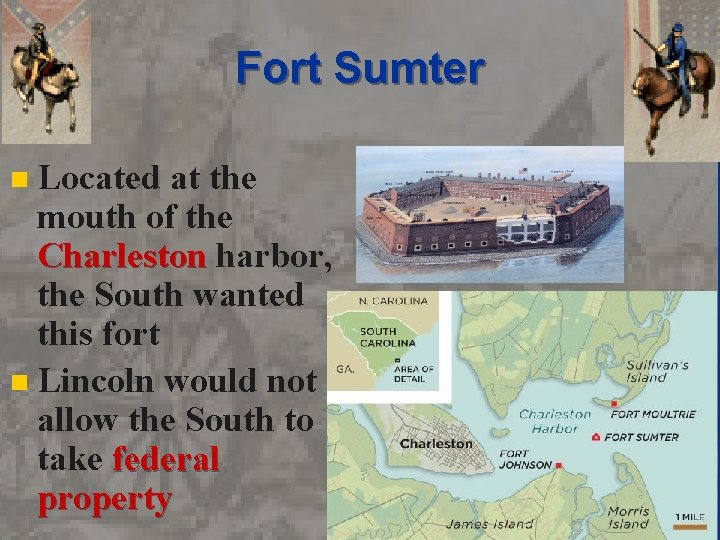
Fort Sumter Located at the mouth of the Charleston harbor, the South wanted this fort n Lincoln would not allow the South to take federal property n
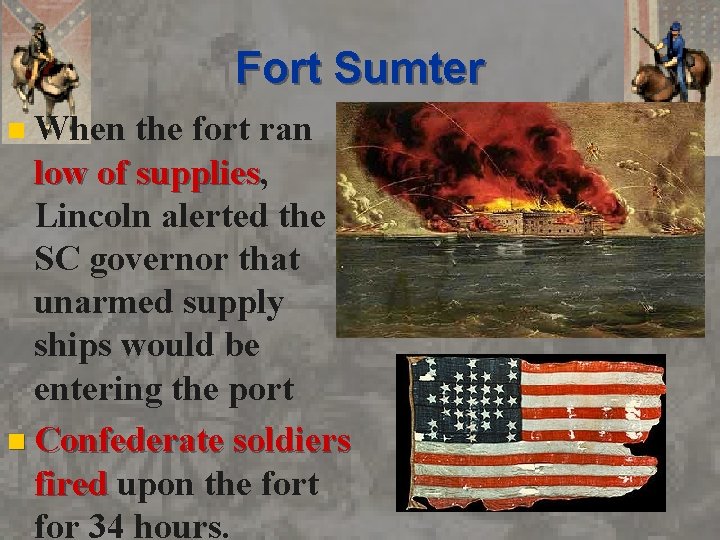
Fort Sumter When the fort ran low of supplies, supplies Lincoln alerted the SC governor that unarmed supply ships would be entering the port n Confederate soldiers fired upon the fort for 34 hours. n
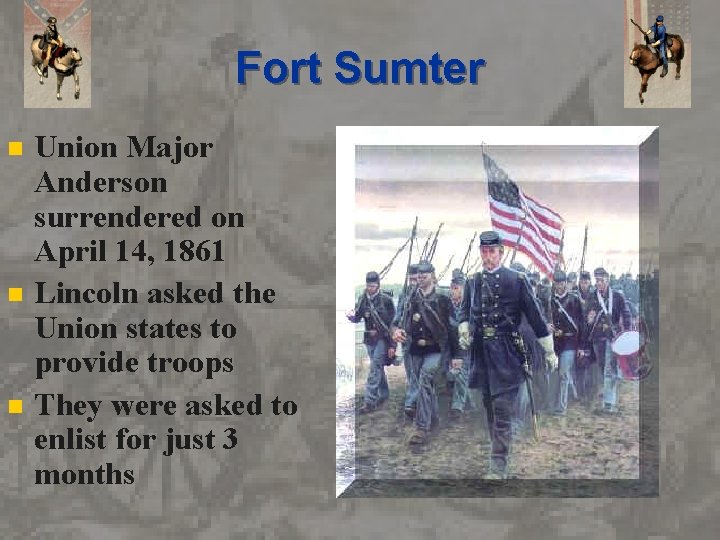
Fort Sumter n n n Union Major Anderson surrendered on April 14, 1861 Lincoln asked the Union states to provide troops They were asked to enlist for just 3 months
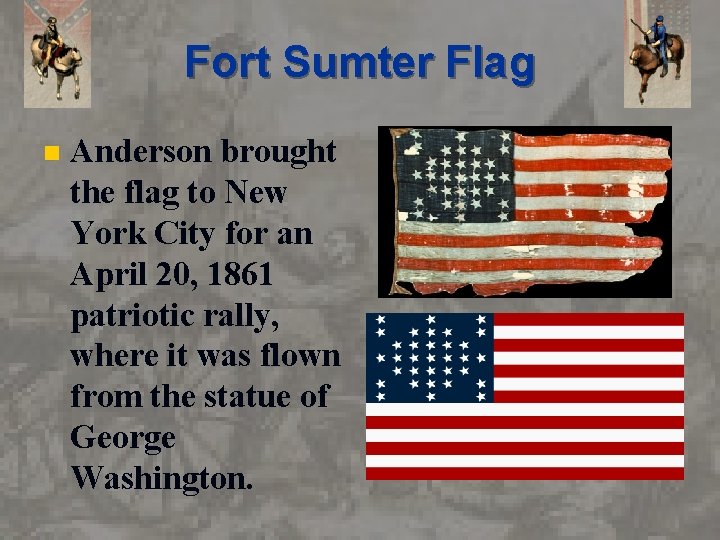
Fort Sumter Flag n Anderson brought the flag to New York City for an April 20, 1861 patriotic rally, where it was flown from the statue of George Washington.
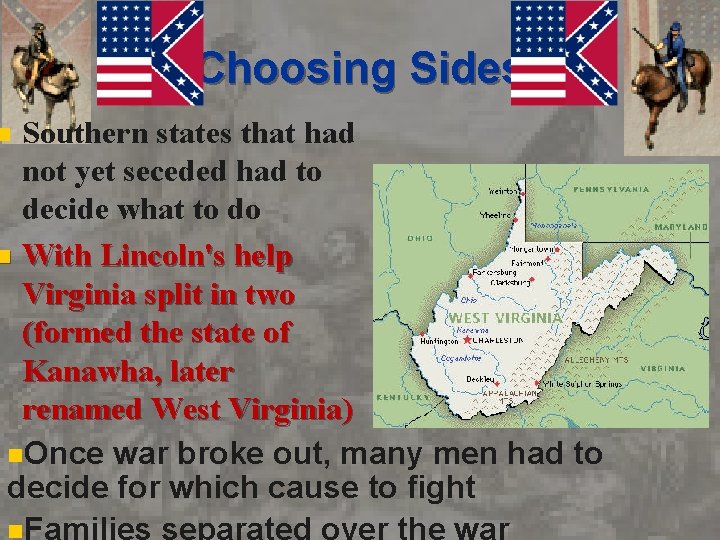
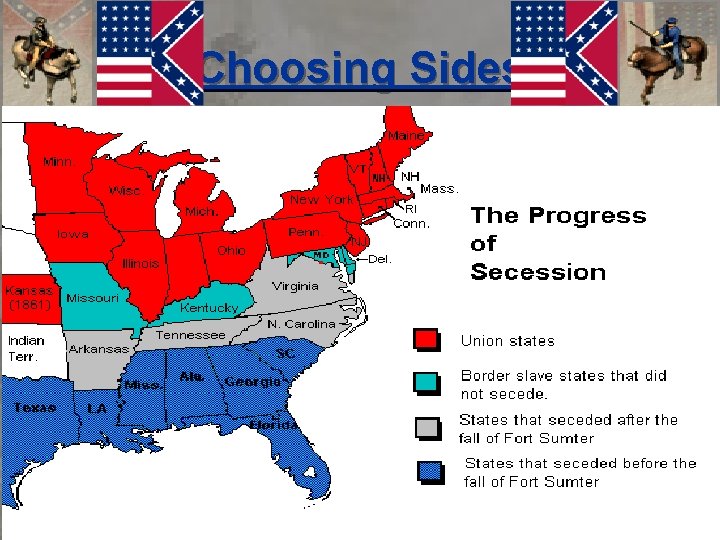
Choosing Sides Southern states that had not yet seceded had to decide what to do n With Lincoln's help Virginia split in two (formed the state of Kanawha, later renamed West Virginia) n. Once war broke out, many men had to decide for which cause to fight n
Choosing Sides
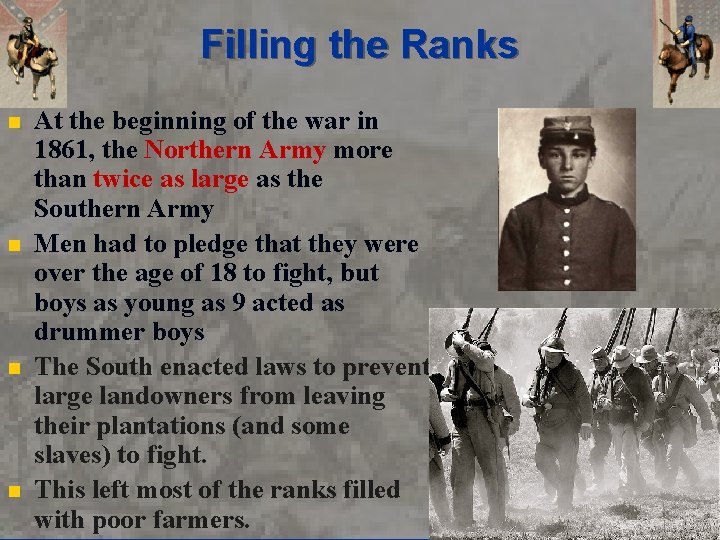
Filling the Ranks n n At the beginning of the war in 1861, the Northern Army more than twice as large as the Southern Army Men had to pledge that they were over the age of 18 to fight, but boys as young as 9 acted as drummer boys The South enacted laws to prevent large landowners from leaving their plantations (and some slaves) to fight. This left most of the ranks filled with poor farmers.
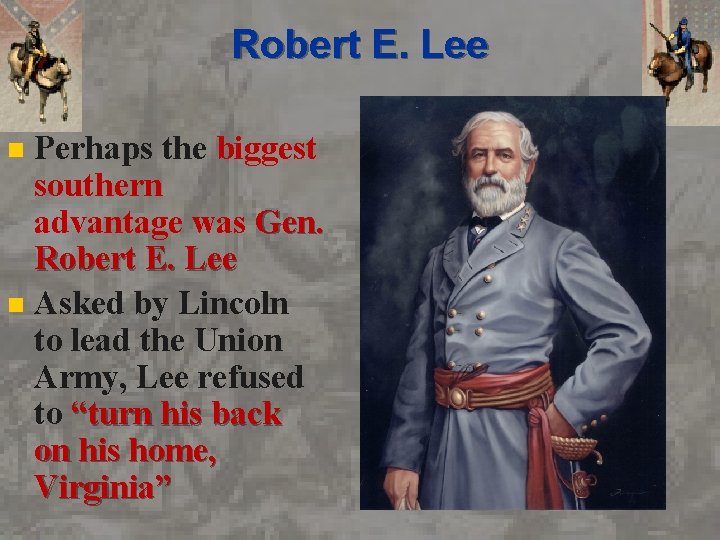
Robert E. Lee Perhaps the biggest southern advantage was Gen. Robert E. Lee n Asked by Lincoln to lead the Union Army, Lee refused to “turn his back on his home, Virginia” n
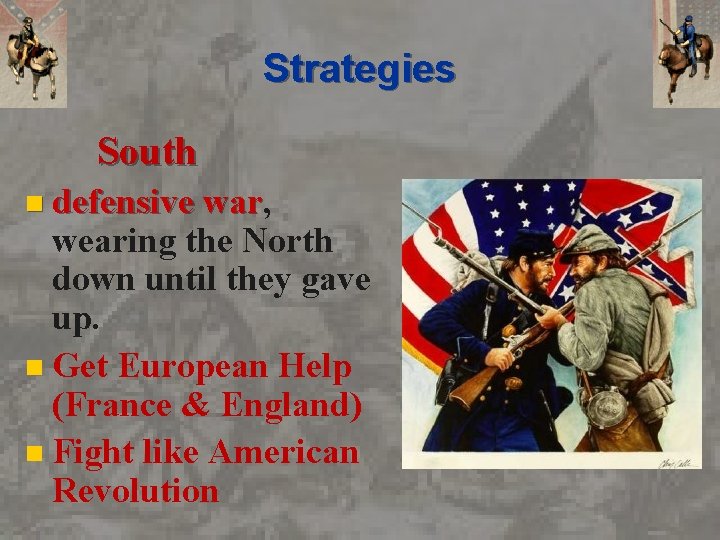
Strategies South n defensive war, war wearing the North down until they gave up. n Get European Help (France & England) n Fight like American Revolution
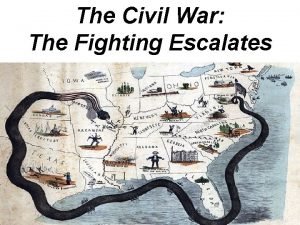
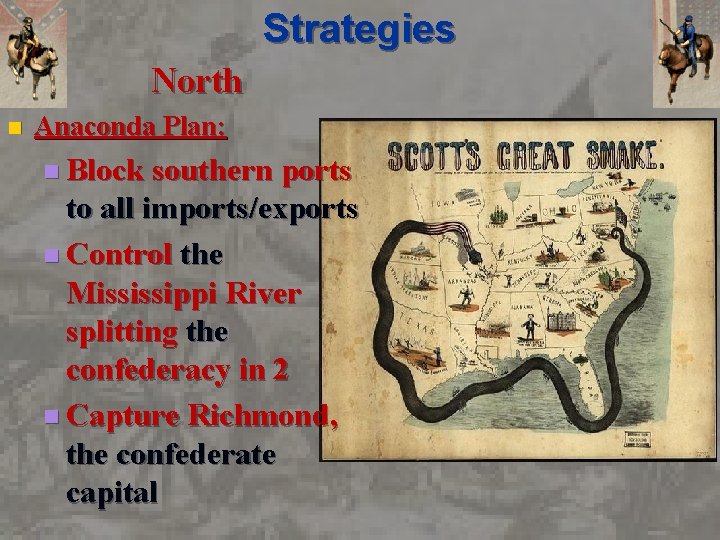
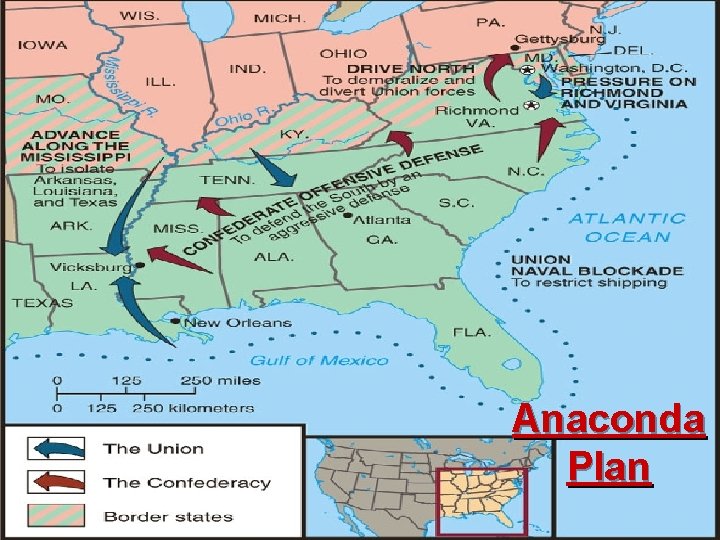
Strategies North n Anaconda Plan: n Block southern ports to all imports/exports n Control the Mississippi River splitting the confederacy in 2 n Capture Richmond, the confederate capital
Anaconda Plan
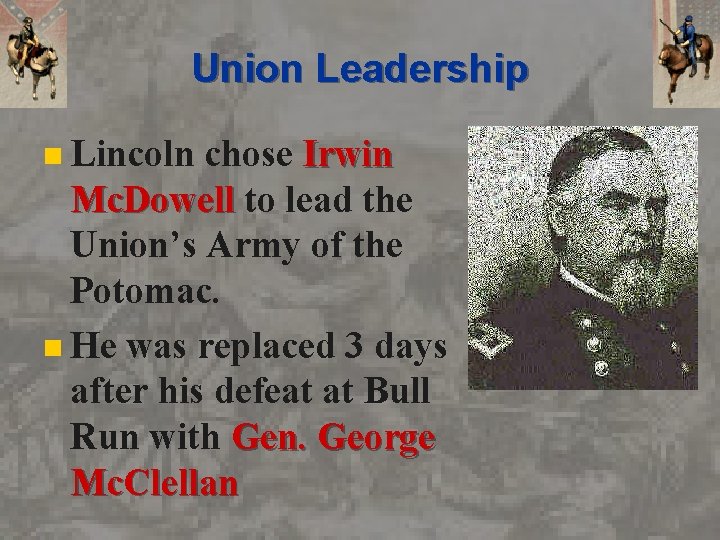
Union Leadership n Lincoln chose Irwin Mc. Dowell to lead the Union’s Army of the Potomac. n He was replaced 3 days after his defeat at Bull Run with Gen. George Mc. Clellan
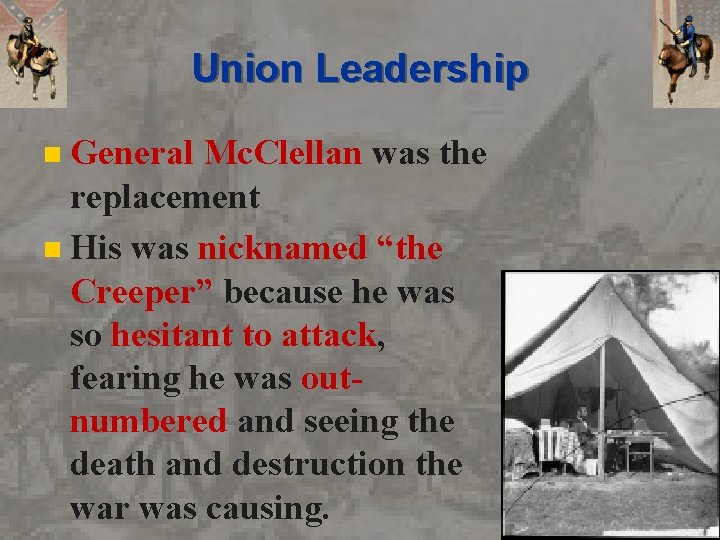
Union Leadership General Mc. Clellan was the replacement n His was nicknamed “the Creeper” because he was so hesitant to attack, fearing he was outnumbered and seeing the death and destruction the war was causing. n
Union Leadership After 5 months of fighting, Mc. Clellan withdrew even though he out-numbered and out-powered the confederate army n One of his men found Lee’s plans wrapped around some cigars. n He had the plans for the next battle at Antietam Creek n
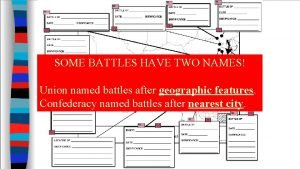
1 st Battle of Bull Run/Manassas n Most Civil War battles are called by 2 different names n The North named the battle after the nearest river n The South named the battle after the nearest town n The first battle of the war was near the town of Manassas and Bull Run River
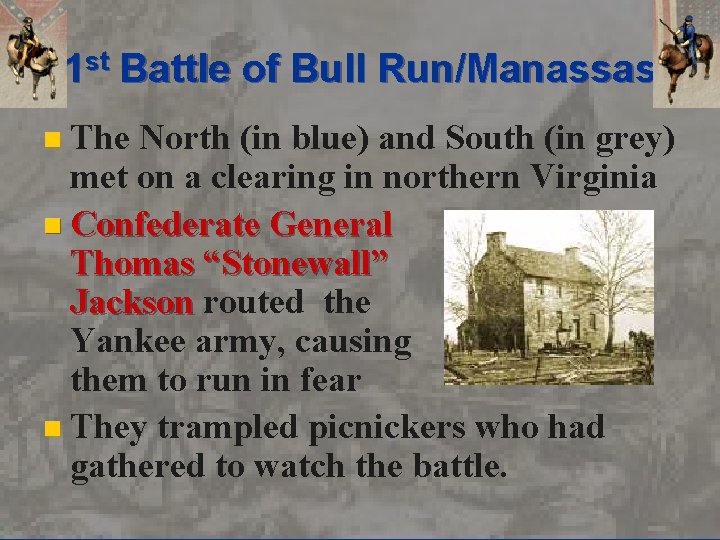
1 st Battle of Bull Run/Manassas The North (in blue) and South (in grey) met on a clearing in northern Virginia n Confederate General Thomas “Stonewall” Jackson routed the Yankee army, causing them to run in fear n They trampled picnickers who had gathered to watch the battle. n
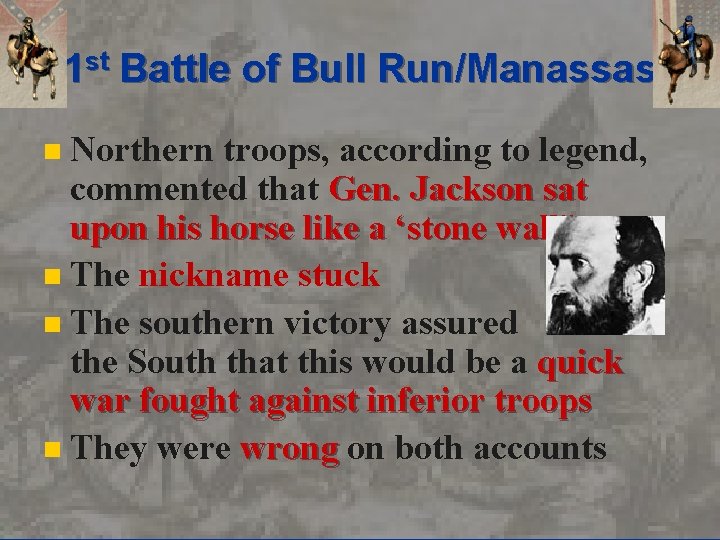
1 st Battle of Bull Run/Manassas Northern troops, according to legend, commented that Gen. Jackson sat upon his horse like a ‘stone wall” n The nickname stuck n The southern victory assured the South that this would be a quick war fought against inferior troops n They were wrong on both accounts n
Antietam Creek n Even with the plans, Mc. Clellan’s hesitancy costs him the battle n He could never break through Confederate lines even though he knew where they were n It was the bloodiest single day of the Civil War with about 22, 000 dead and wounded.
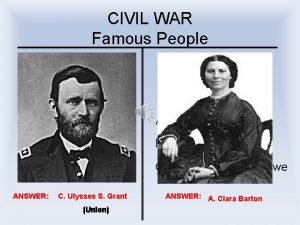
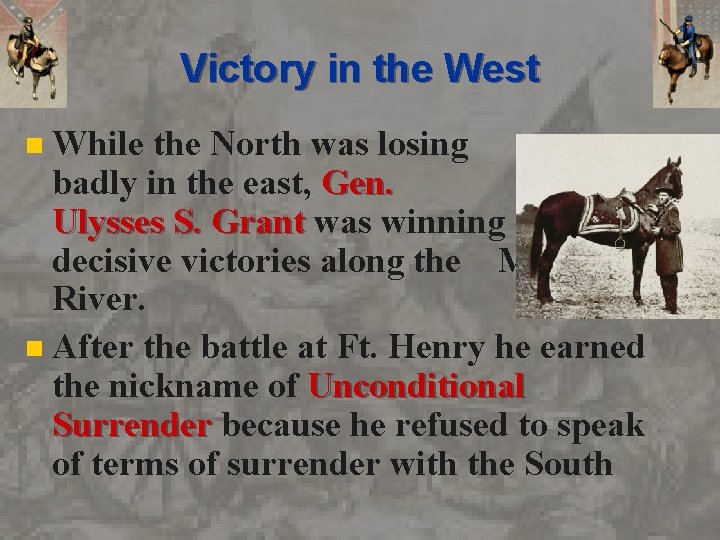
Victory in the West While the North was losing badly in the east, Gen. Ulysses S. Grant was winning decisive victories along the Mississippi River. n After the battle at Ft. Henry he earned the nickname of Unconditional Surrender because he refused to speak of terms of surrender with the South n
Shiloh/Pittsburg Landing The South surprised Union troops at Shiloh on April 6, 1862 n Their rebel yell was eerie n As they ran in retreat, they met Union reinforcements n Under Gen. Grant, they regrouped n It ended in a draw with almost 25, 000 casualties in the 2 day battle. n
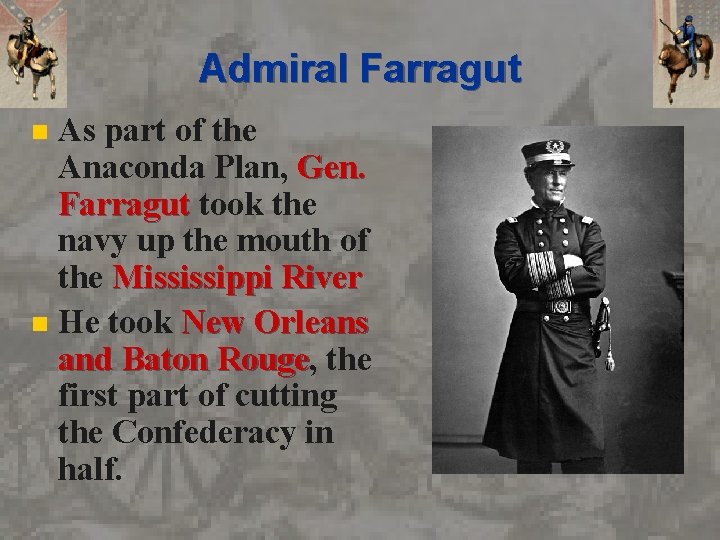
Admiral Farragut As part of the Anaconda Plan, Gen. Farragut took the navy up the mouth of the Mississippi River n He took New Orleans and Baton Rouge, Rouge the first part of cutting the Confederacy in half. n
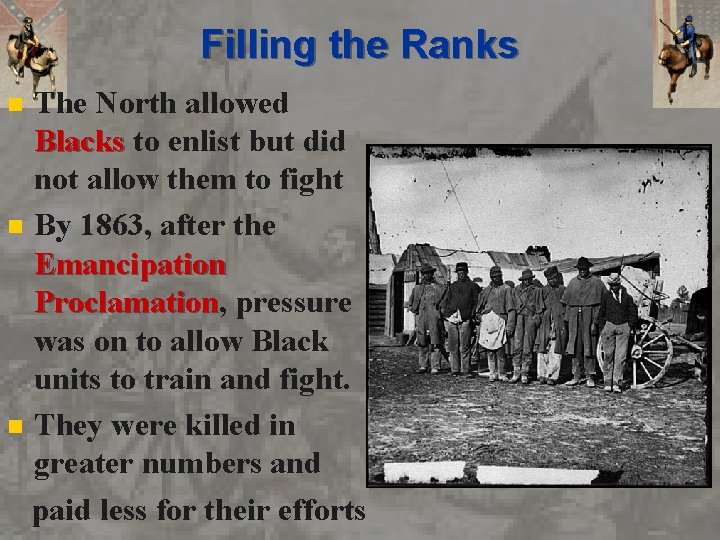
Filling the Ranks The North allowed Blacks to enlist but did not allow them to fight n By 1863, after the Emancipation Proclamation, Proclamation pressure was on to allow Black units to train and fight. n They were killed in greater numbers and paid less for their efforts n
Filling the Ranks n Wealthy people, in both North and South, could pay a substitute to take their place in the Army. n Conscription, Conscription forced service, was first used in the South. n The North began conscription in 1862
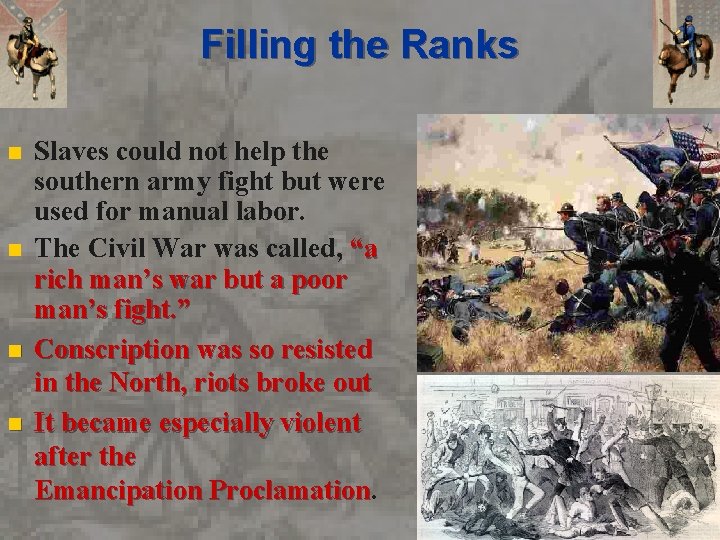
Filling the Ranks n n Slaves could not help the southern army fight but were used for manual labor. The Civil War was called, “a rich man’s war but a poor man’s fight. ” Conscription was so resisted in the North, riots broke out It became especially violent after the Emancipation Proclamation
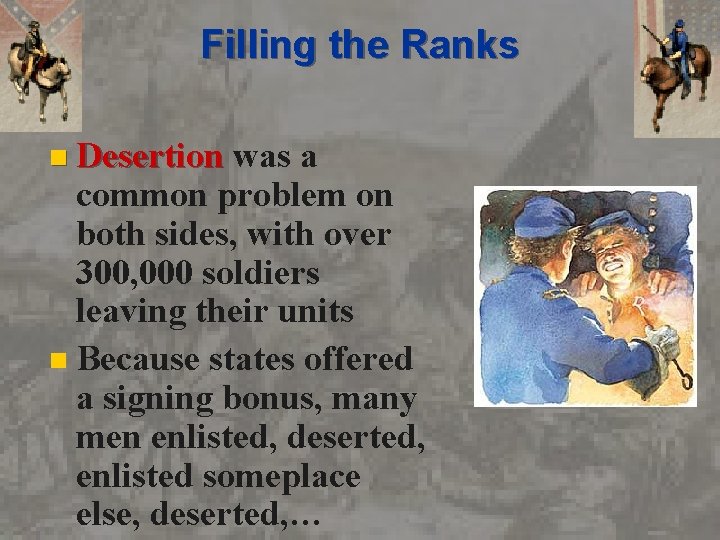
Filling the Ranks n Desertion was a common problem on both sides, with over 300, 000 soldiers leaving their units n Because states offered a signing bonus, many men enlisted, deserted, enlisted someplace else, deserted, …
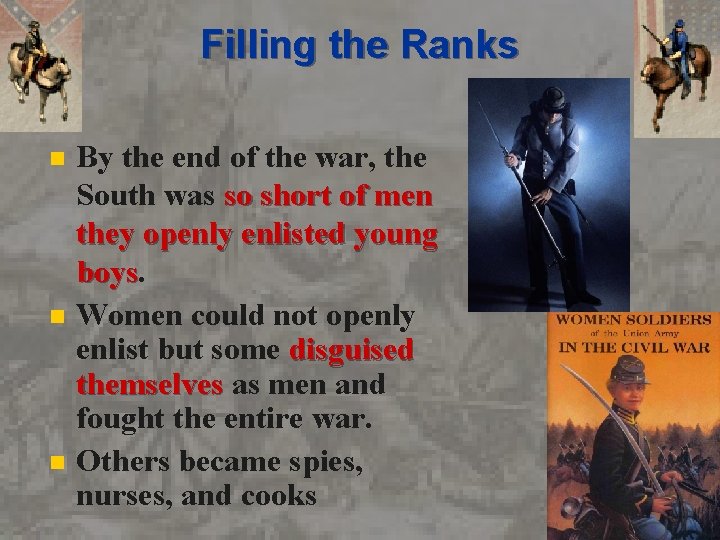
Filling the Ranks n n n By the end of the war, the South was so short of men they openly enlisted young boys Women could not openly enlist but some disguised themselves as men and fought the entire war. Others became spies, nurses, and cooks
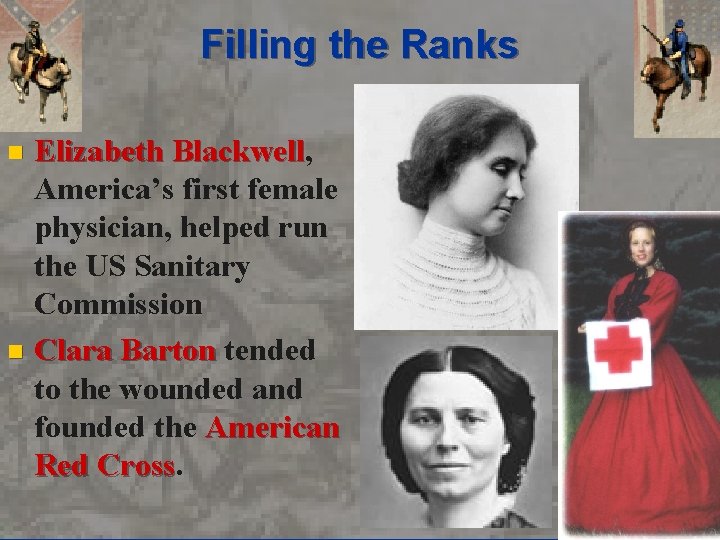
Filling the Ranks Elizabeth Blackwell, Blackwell America’s first female physician, helped run the US Sanitary Commission n Clara Barton tended to the wounded and founded the American Red Cross n
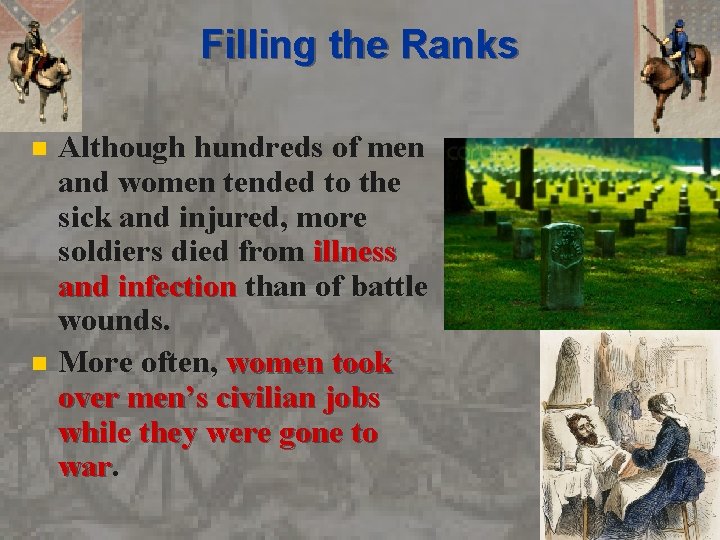
Filling the Ranks n n Although hundreds of men and women tended to the sick and injured, more soldiers died from illness and infection than of battle wounds. More often, women took over men’s civilian jobs while they were gone to war
The Civil War Politics of War Chapter 11 Section 2
Britain’s Neutrality The South was depending on Britain and/or France to come to their aid & renew the cotton trade n Britain found other sources for cotton and stockpiled surpluses before the war began n Food crops, wheat and corn from the North, had replaced cotton as America’s most important exports n For these reasons, Britain chose to remain neutral in the war between the states. n
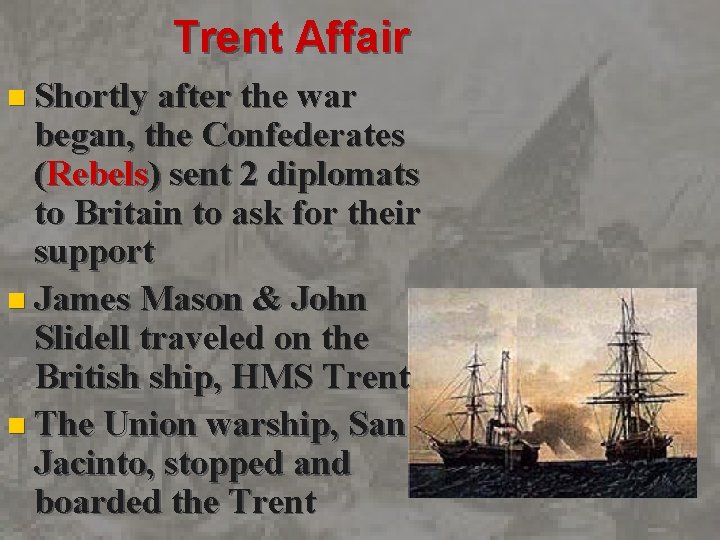
Trent Affair n Shortly after the war began, the Confederates (Rebels) sent 2 diplomats to Britain to ask for their support n James Mason & John Slidell traveled on the British ship, HMS Trent n The Union warship, San Jacinto, stopped and boarded the Trent
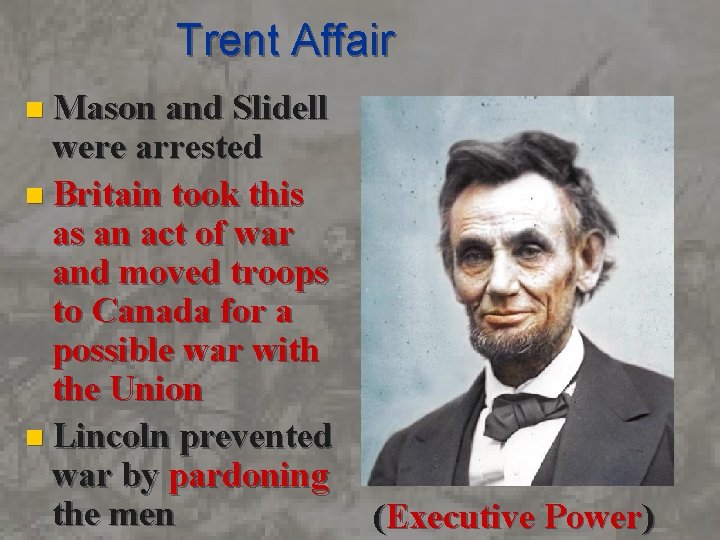
Trent Affair n Mason and Slidell were arrested n Britain took this as an act of war and moved troops to Canada for a possible war with the Union n Lincoln prevented war by pardoning the men (Executive Power)
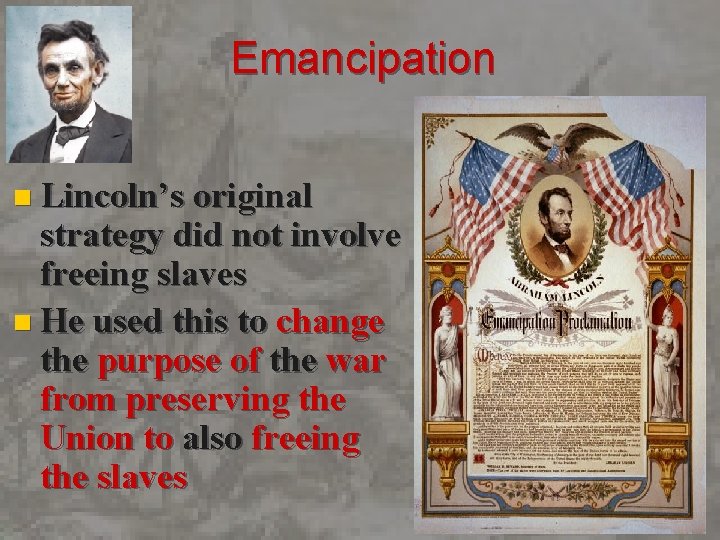
Emancipation n Lincoln’s original strategy did not involve freeing slaves n He used this to change the purpose of the war from preserving the Union to also freeing the slaves
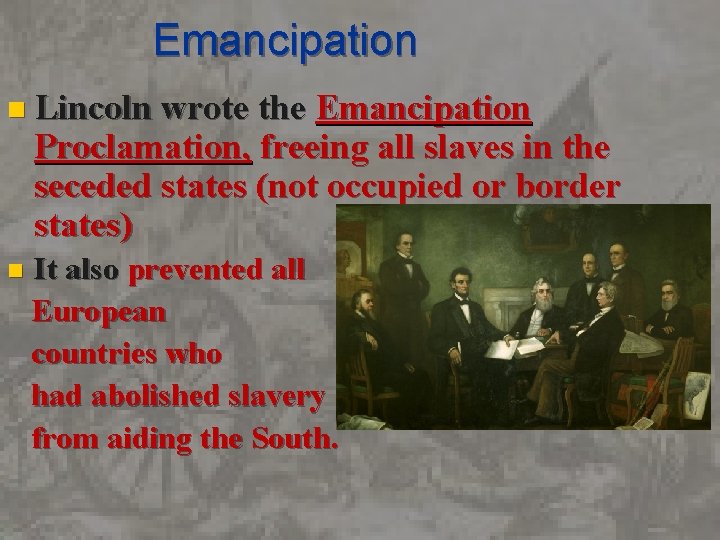
Emancipation n Lincoln wrote the Emancipation Proclamation, freeing all slaves in the seceded states (not occupied or border states) n It also prevented all European countries who had abolished slavery from aiding the South.
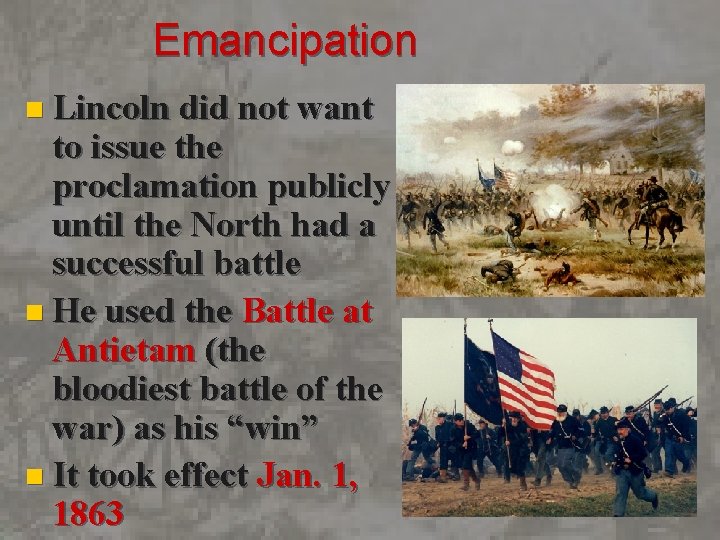
Emancipation n Lincoln did not want to issue the proclamation publicly until the North had a successful battle n He used the Battle at Antietam (the bloodiest battle of the war) as his “win” n It took effect Jan. 1, 1863
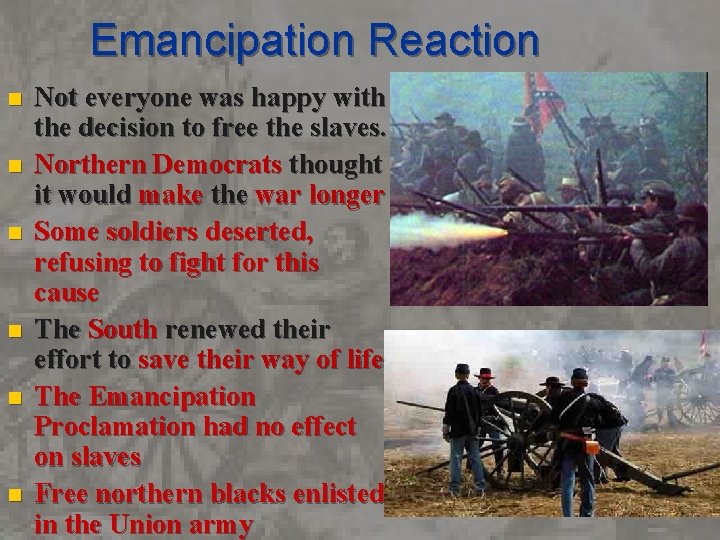
Emancipation Reaction n n n Not everyone was happy with the decision to free the slaves. Northern Democrats thought it would make the war longer Some soldiers deserted, refusing to fight for this cause The South renewed their effort to save their way of life The Emancipation Proclamation had no effect on slaves Free northern blacks enlisted in the Union army
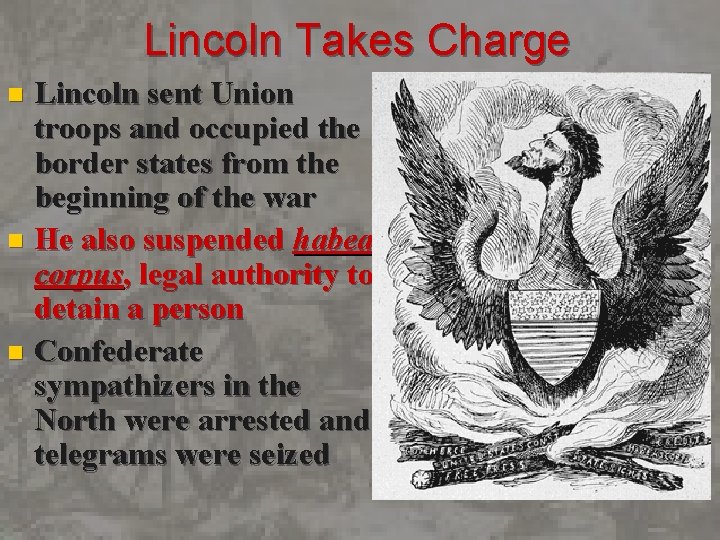
Lincoln Takes Charge Lincoln sent Union troops and occupied the border states from the beginning of the war n He also suspended habeas corpus, legal authority to detain a person n Confederate sympathizers in the North were arrested and telegrams were seized n
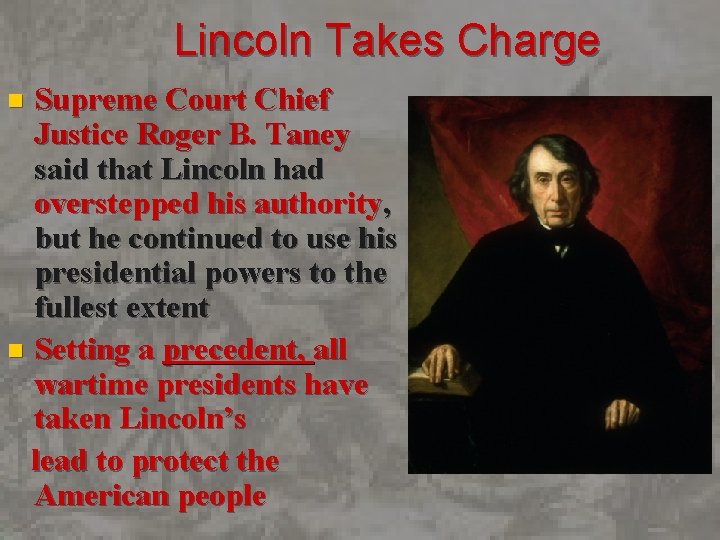
Lincoln Takes Charge Supreme Court Chief Justice Roger B. Taney said that Lincoln had overstepped his authority, but he continued to use his presidential powers to the fullest extent n Setting a precedent, all wartime presidents have taken Lincoln’s lead to protect the American people n
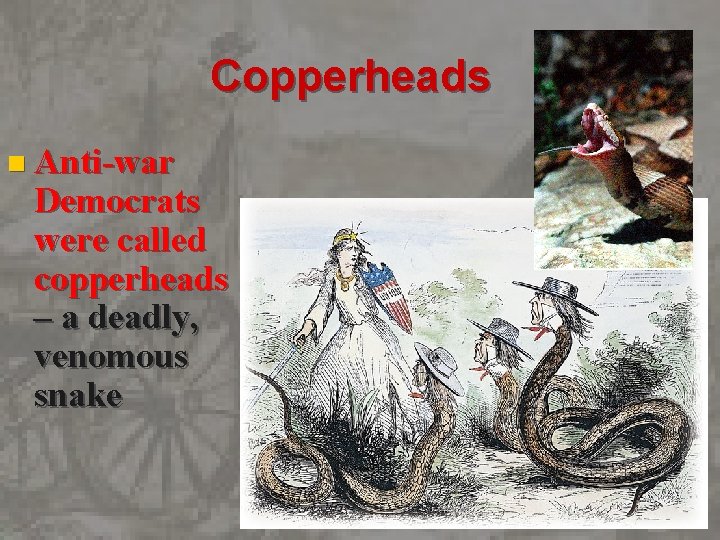
Copperheads n Anti-war Democrats were called copperheads – a deadly, venomous snake
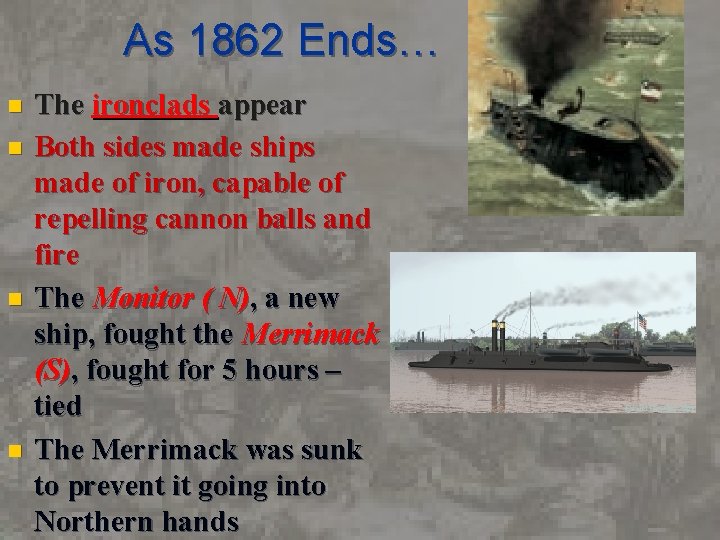
As 1862 Ends… n n The ironclads appear Both sides made ships made of iron, capable of repelling cannon balls and fire The Monitor ( N), a new ship, fought the Merrimack (S), fought for 5 hours – tied The Merrimack was sunk to prevent it going into Northern hands
The Civil War Chapter 11 Section 3 Life During Wartime
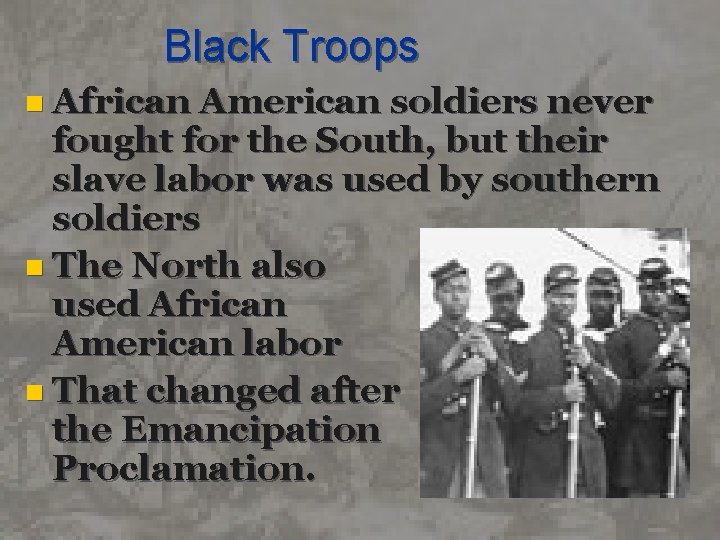
Black Troops n African American soldiers never fought for the South, but their slave labor was used by southern soldiers n The North also used African American labor n That changed after the Emancipation Proclamation.
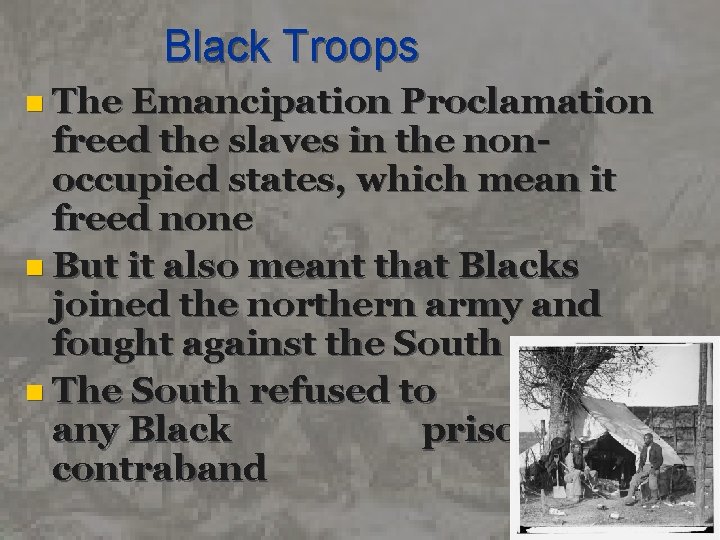
Black Troops n The Emancipation Proclamation freed the slaves in the nonoccupied states, which mean it freed none n But it also meant that Blacks joined the northern army and fought against the South n The South refused to return any Black prisoner contraband
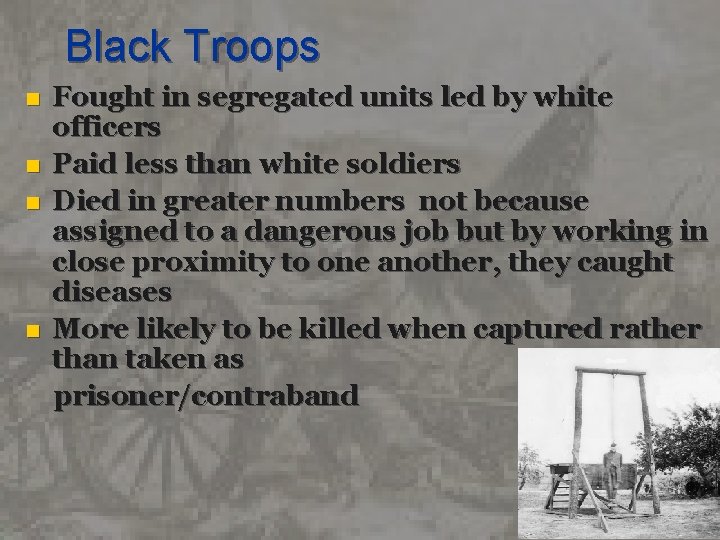
Black Troops n n Fought in segregated units led by white officers Paid less than white soldiers Died in greater numbers not because assigned to a dangerous job but by working in close proximity to one another, they caught diseases More likely to be killed when captured rather than taken as prisoner/contraband
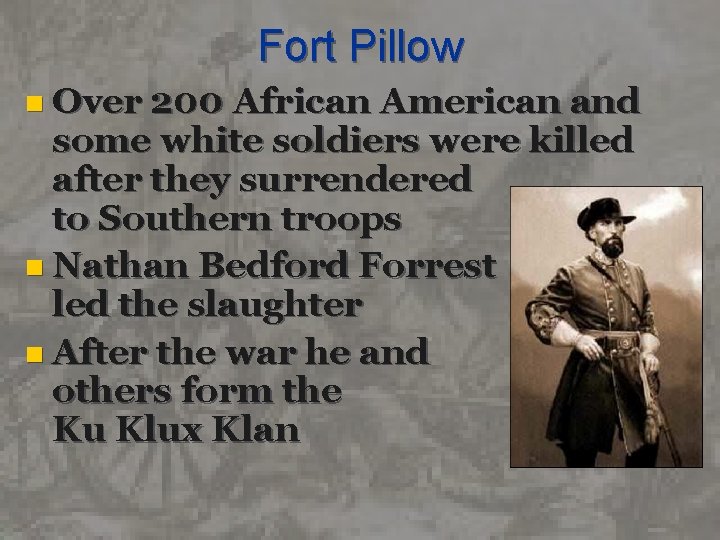
Fort Pillow n Over 200 African American and some white soldiers were killed after they surrendered to Southern troops n Nathan Bedford Forrest led the slaughter n After the war he and others form the Ku Klux Klan
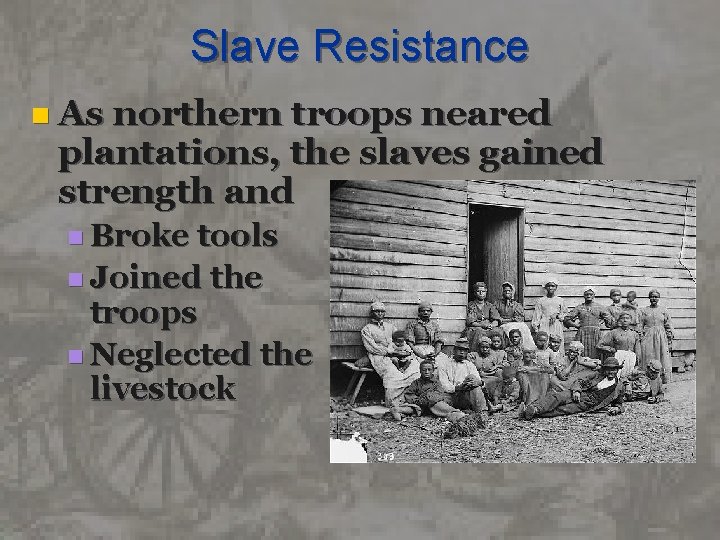
Slave Resistance n As northern troops neared plantations, the slaves gained strength and n Broke tools n Joined the troops n Neglected the livestock
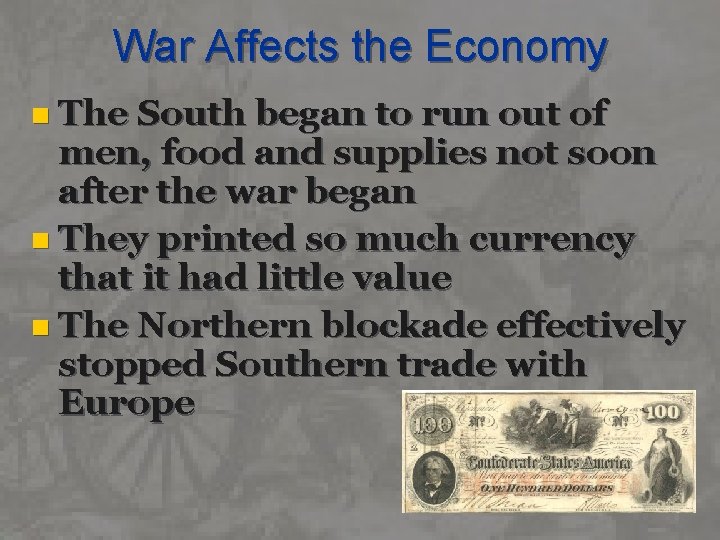
War Affects the Economy n The South began to run out of men, food and supplies not soon after the war began n They printed so much currency that it had little value n The Northern blockade effectively stopped Southern trade with Europe
Northern Economy n The North suffered but not nearly as bad as the South n Inflation was worse in the North – 80% by the end of the war n Industries that supplied the military boomed n Machinery took the place of workers drafted into the GAR
Women in the Workplace n Women took on many of the jobs and duties of the men who left to fight n They were paid less, one of many ways business owners made tremendous profits during the war n Northerners paid the first income tax to pay for the war
Soldiers Suffer n Soldiers’ rations included hardtack, beans, bacon fat and, if lucky, a few bones from which to suck the marrow n They had ticks, lice, dysentery, and diarrhea on a regular basis due to poor hygiene
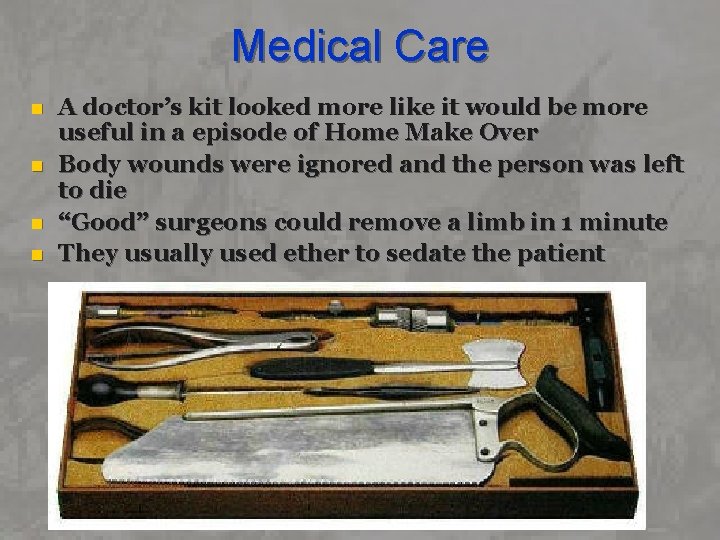
Medical Care n n A doctor’s kit looked more like it would be more useful in a episode of Home Make Over Body wounds were ignored and the person was left to die “Good” surgeons could remove a limb in 1 minute They usually used ether to sedate the patient
Medical Care Once soldier’s received care, the worst was to come n Not knowing about germs and bacteria, doctors and nurses regularly examined wounds without washing between patients n Gangrene and other infections passed from man to man n Surgery was usually done outdoors n
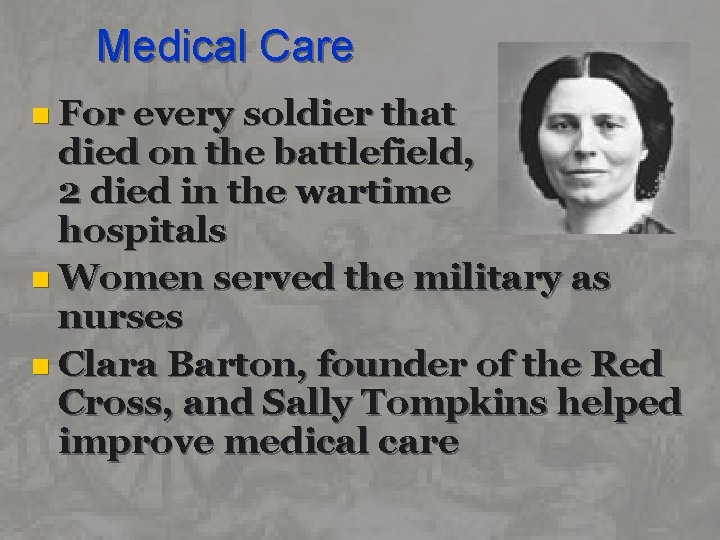
Medical Care n For every soldier that died on the battlefield, 2 died in the wartime hospitals n Women served the military as nurses n Clara Barton, founder of the Red Cross, and Sally Tompkins helped improve medical care
Prisoners n Until the Union began using black soldiers, both sides regularly exchanged soldiers rather than keep them in camps n When the Confederacy refused to swap black soldiers, the North stopped the exchange program n Neither side was equipped to keep thousands of prisoners
Prison Camps n Both sides treated their captives terribly n Ft. Delaware and Elmira prisons in the North and Libby and Andersonville prisons in the South saw mortality rates over 25% n Poor nutrition and poor hygiene led to scurvy, dysentery and other fatal diseases
Andersonville Prison, GA n n n Henry Wirz was placed in charge of the camp at Andersonville Built to handle 10, 000, it eventually had over 33, 000 prisoners Their only water was a stream which ran through where the horses grazed, filled with manure There were no buildings to house prisoners, only tents and lean-tos Guards, some as young as 12, surrounded the camp on watchtowers Anyone who got near the fence, the dead zone, was shot immediately
Andersonville Prison, GA n n n Although he camp was operational for less than a year, over 12, 000 died Survivors were transferred from the camp to other camps in the South The Commandant, Henry Wirz, was tried for war crimes in 1865 The North really wanted him to provide information about Gen. Lee and Pres. Davis but he did not Wirz was hung in Washington DC and after his death was treated as a martyr (victim)
The Civil War Chapter 11 Section 4 The North Takes Charge
1863 n In 1863, the war shifted in favor of the North n Gen. Grant leads Army of the Potomac n Important victories in the East n Total war n South will not receive help from Europe n War of attrition
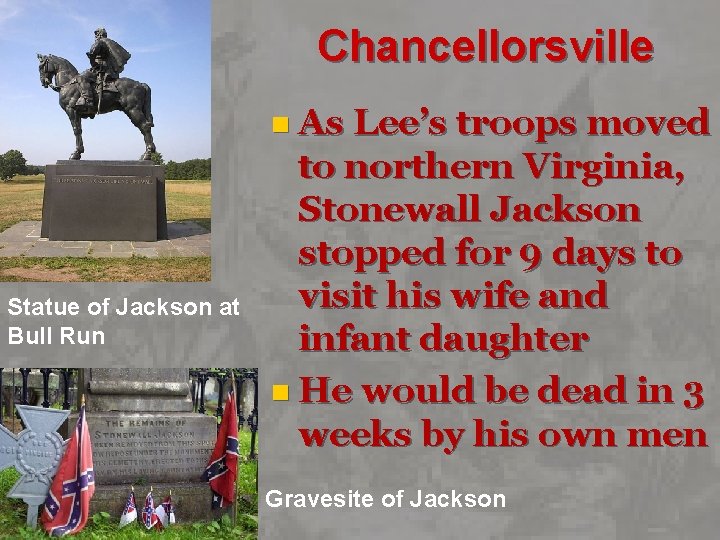
Chancellorsville n As Lee’s troops moved Statue of Jackson at Bull Run to northern Virginia, Stonewall Jackson stopped for 9 days to visit his wife and infant daughter n He would be dead in 3 weeks by his own men Gravesite of Jackson
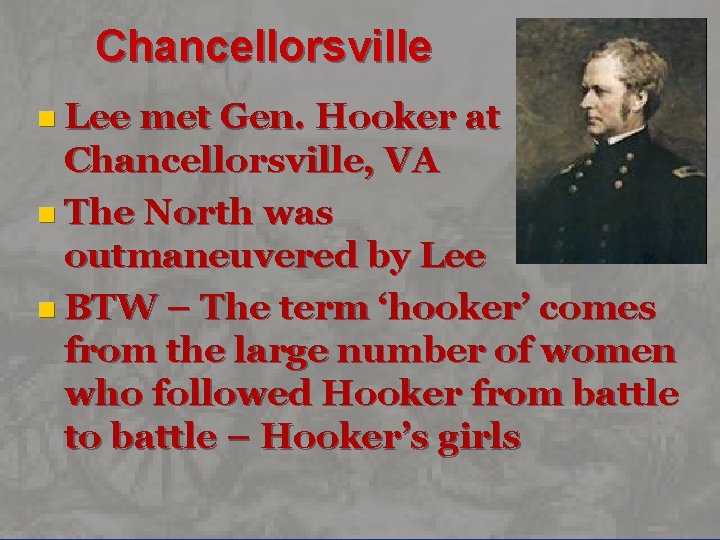
Chancellorsville n Lee met Gen. Hooker at Chancellorsville, VA n The North was outmaneuvered by Lee n BTW – The term ‘hooker’ comes from the large number of women who followed Hooker from battle to battle – Hooker’s girls
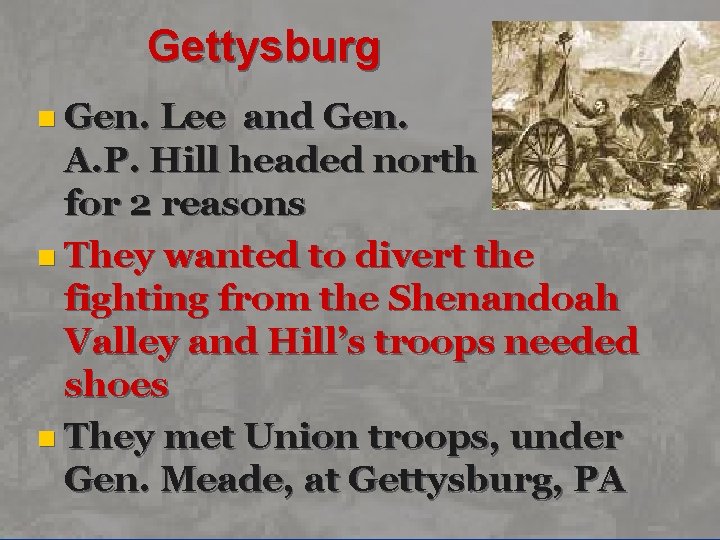
Gettysburg n Gen. Lee and Gen. A. P. Hill headed north for 2 reasons n They wanted to divert the fighting from the Shenandoah Valley and Hill’s troops needed shoes n They met Union troops, under Gen. Meade, at Gettysburg, PA
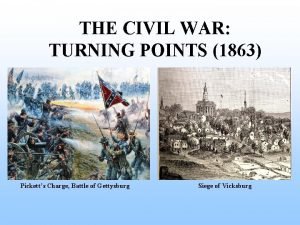
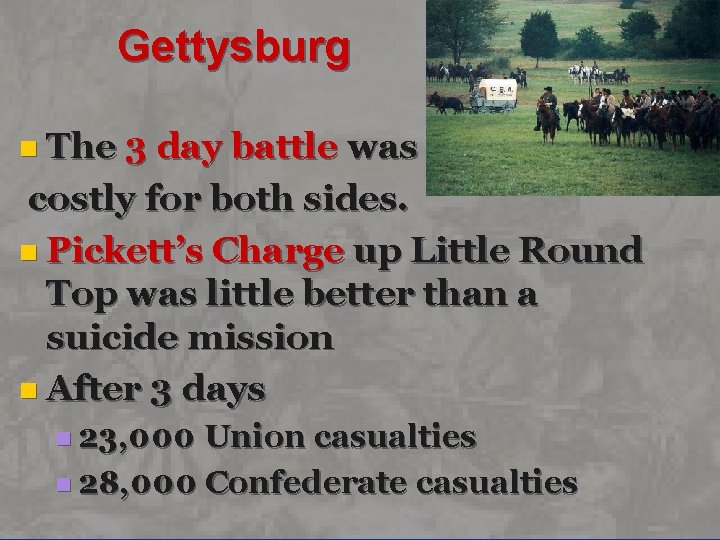
Gettysburg n The 3 day battle was costly for both sides. n Pickett’s Charge up Little Round Top was little better than a suicide mission n After 3 days n 23, 000 Union casualties n 28, 000 Confederate casualties
Gettysburg n Lee retreated, never to enter the North again n The Union victory at Gettysburg was the turning point of the war n They will continue to win important victories until the South surrenders
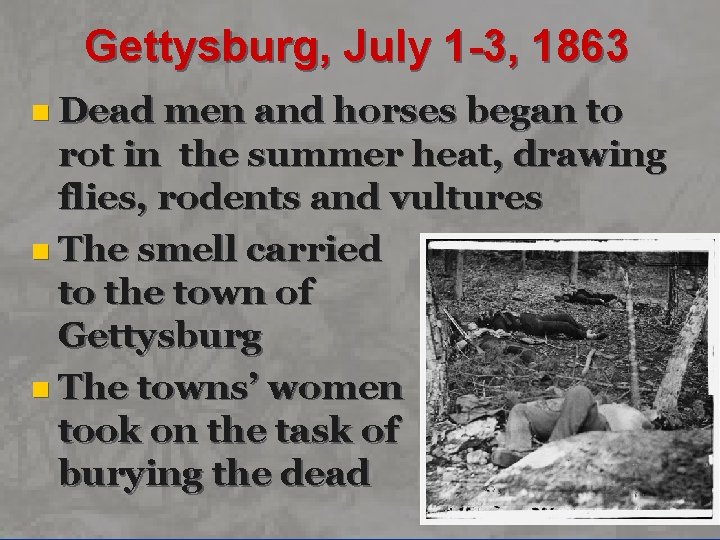
Gettysburg, July 1 -3, 1863 n Dead men and horses began to rot in the summer heat, drawing flies, rodents and vultures n The smell carried to the town of Gettysburg n The towns’ women took on the task of burying the dead
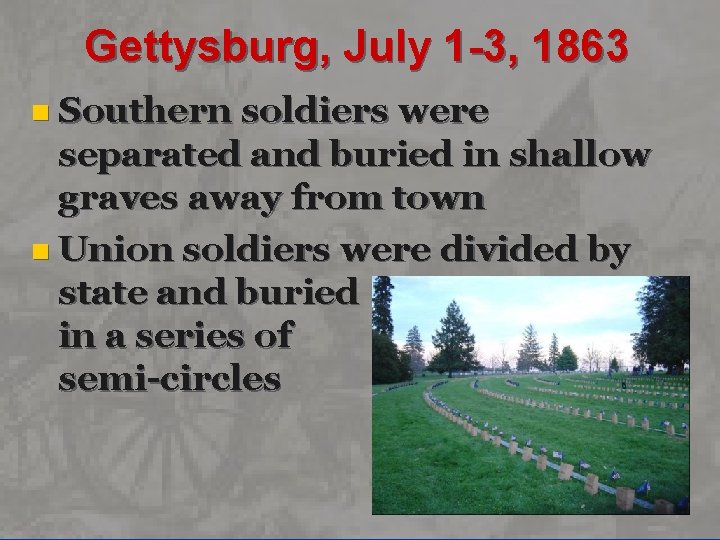
Gettysburg, July 1 -3, 1863 n Southern soldiers were separated and buried in shallow graves away from town n Union soldiers were divided by state and buried in a series of semi-circles
Gettysburg Address, Nov 1863 n Lincoln came to dedicate the cemetery n He was the 2 nd speaker that day, speaking for only about 2 minutes n He used the speech to re-focus attention to the Declaration of Independence – “all men are created equal”
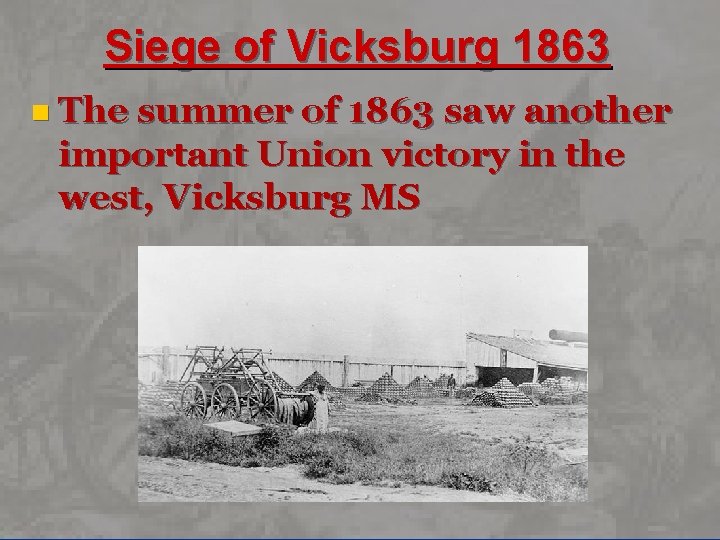
Siege of Vicksburg 1863 n The summer of 1863 saw another important Union victory in the west, Vicksburg MS
Siege of Vicksburg 1863 n Vicksburg is an overlook on the Mississippi River n It was one of the last areas that prevented the Union from controlling the entire river and successfully dividing the South n Grant laid siege to the town, firing into it for hours each day
Siege of Vicksburg 1863 n The mostly women, elderly and children in the town sought refuge in the caves along the river n Their food supply gone, they ate dogs, horses, mules and rats before surrendering the day after the victory at Gettysburg, July 4
Conditions in the South, 1863 n The South was quickly running out of men, arms, food, uniforms and other necessary supplies n They hoped that a long war would cause the North to stop fighting n The Gettysburg Address made it very clear that the North was not giving up
Conditions in the South, 1863 n Southerners were asked to grow food crops rather than cash crops (cotton and tobacco) n Rebels deserted in greater numbers n Jefferson Davis and the Confederate Constitution left little room to lead effectively
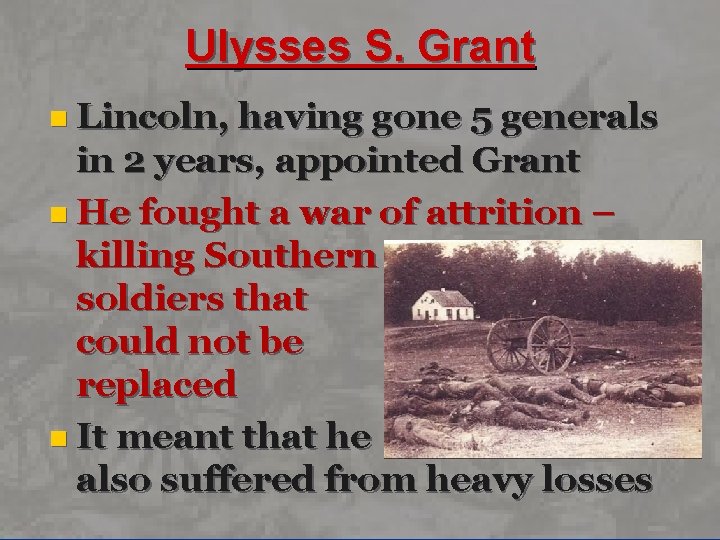
Ulysses S. Grant n Lincoln, having gone 5 generals in 2 years, appointed Grant n He fought a war of attrition – killing Southern soldiers that could not be replaced n It meant that he also suffered from heavy losses
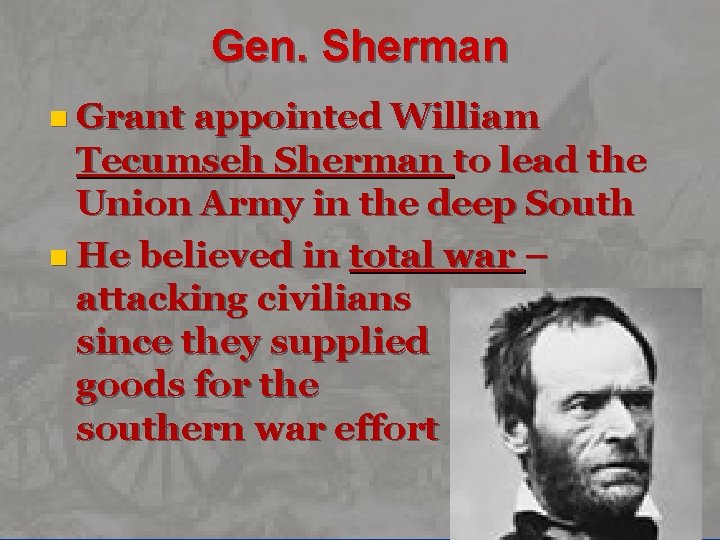
Gen. Sherman n Grant appointed William Tecumseh Sherman to lead the Union Army in the deep South n He believed in total war – attacking civilians since they supplied goods for the southern war effort
Grant v. Lee n Grant’s war of attrition was devastating to the southern army n Grant knew that he could replace each of his dead soldiers, the South could not
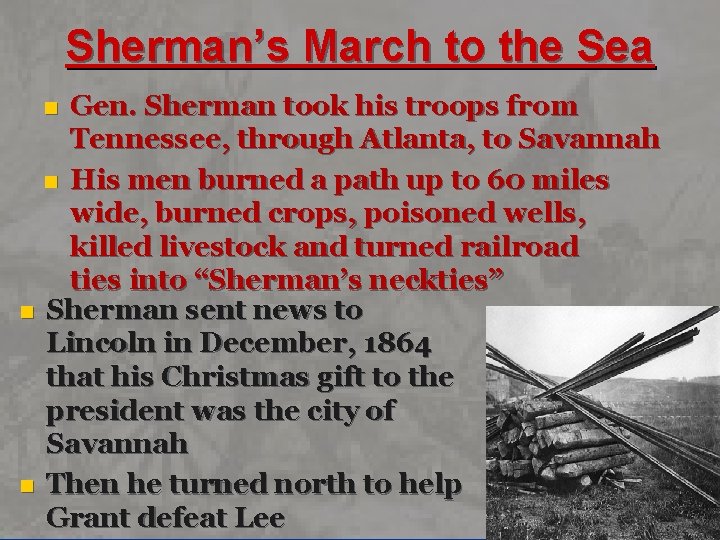
Sherman’s March to the Sea Gen. Sherman took his troops from Tennessee, through Atlanta, to Savannah n His men burned a path up to 60 miles wide, burned crops, poisoned wells, killed livestock and turned railroad ties into “Sherman’s neckties” n Sherman sent news to Lincoln in December, 1864 that his Christmas gift to the president was the city of Savannah n Then he turned north to help Grant defeat Lee n
Election 1864 n Democrats – Gen. Mc. Clellan n Republicans – Pres. Lincoln n Democrats were tired of war, the costs, and death n Republicans looked for a candidate who would appeal to Democrats, Andrew Johnson
Election 1864 n Johnson was a Southerner who never owned slaves n He was raised extremely poor, resenting the planter class n He looked down upon the slave class
Election 1864 n Lincoln needed a few victories before the election or he felt he would loose. n Sherman’s sacking of Atlanta and Farragut’s control of the Mississippi River accomplished that n Absentee ballots from the Union army put Lincoln over the top
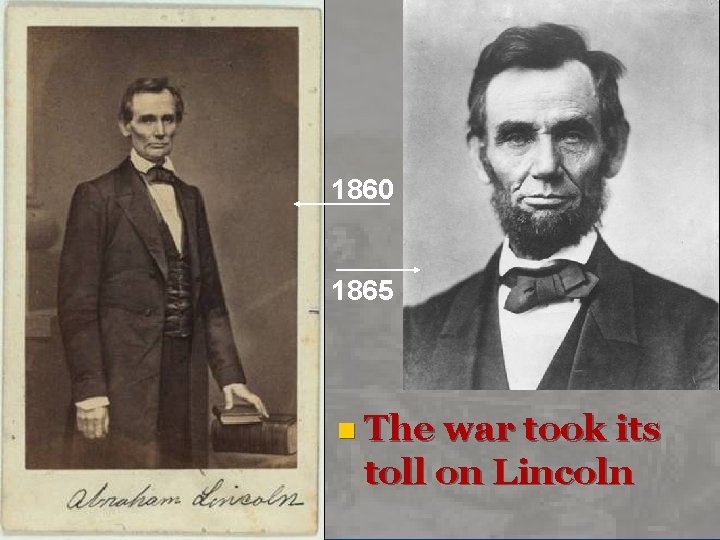
1860 1865 n The war took its toll on Lincoln
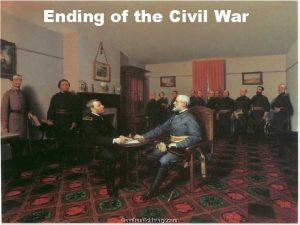
Appomattox Court House n In April 1865, Lee knew he had no choice but to surrender n His men begged him not to do this, but he replied that it would only kill them all if he continued to fight n Jefferson Davis set fire to Richmond to prevent Grant from occupying it
Appomattox Court House n Lee said, “There is nothing left me to do but to go and see General Grant, and I would rather die a thousand deaths. ” April 9, 1865 n Grant was generous with his terms of surrender, allowing the rebels to take their animals and personal items with them
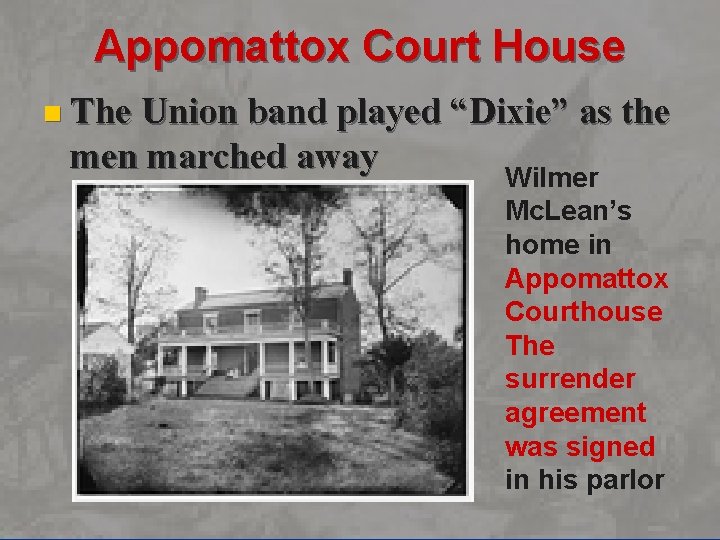
Appomattox Court House n The Union band played “Dixie” as the men marched away Wilmer Mc. Lean’s home in Appomattox Courthouse The surrender agreement was signed in his parlor
The Civil War Chapter 11 Section 5 The Legacy of War
The War Ends n With the end of the war changes will affect n The economy n Social structure n Labor market n Politics n Technology
Political Changes n The federal government assumed control over the seceded states and no state has seceded again n The war increased the power of the federal government and the president
Economic Changes n n n The federal gov’t took additional responsibility for subsidizing (paying for) railroads National Bank Act, 1863, which chartered banks, set requirements for loans & required banks to be inspected Conscription caused a labor shortage in the North, filled by women and automation Northern industries had to re-focus to compete in a peacetime economy The South lost its labor force and trading partners Since most of the fighting took place in the South, land was destroyed, livestock wiped-out, cities burned and their railroads destroyed
Societal Changes n n n Slavery is over Congress passed the 13 th Amendment outlawing slavery Matthew Brady chronicled the war with hundreds of photos, beginning photojournalism. The Civil War is the first photographed war. Jefferson Davis was arrested, tried and found not guilty He lived to be an old man General Lee lost his family home when it was turned into Arlington National Cemetery
Societal Changes n Lee went on to become the president of Washington University, now Washington and Lee University n Clara Barton took her war experience and founded the Red Cross n Grant (Northern Hero) was elected president in 1868.
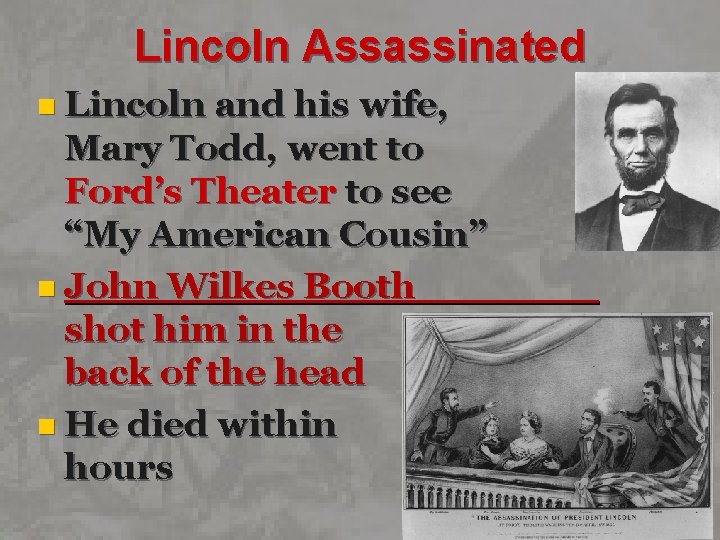
Lincoln Assassinated n Lincoln and his wife, Mary Todd, went to Ford’s Theater to see “My American Cousin” n John Wilkes Booth shot him in the back of the head n He died within hours
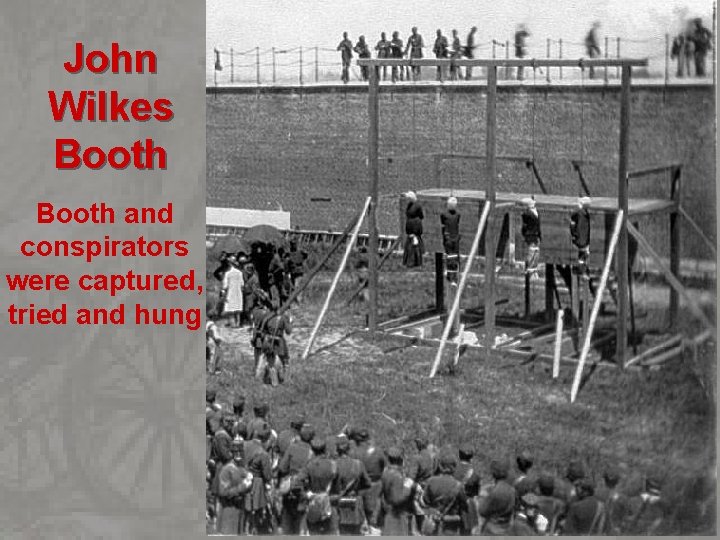
John Wilkes Booth and conspirators were captured, tried and hung