The Adjusting Process Chapter 3 1 Copyright 2012


- Slides: 66
The Adjusting Process Chapter 3 1 Copyright © 2012 Pearson Education, Inc. Publishing as Prentice Hall.
Learning Objectives Differentiate between accrual and cash-basis accounting Define and apply the accounting period concept, revenue recognition and matching principles, and time period concept Explain why adjusting entries are needed Journalize and post adjusting entries 2 Copyright © 2012 Pearson Education, Inc. Publishing as Prentice Hall.
Learning Objectives Explain the purpose of and prepare an adjusted trial balance Prepare the financial statements from the adjusted trial balance Understand the alternate treatment of unearned revenues and prepaid expenses (see Appendix 3 A, located at myaccountinglab. com) 3 Copyright © 2012 Pearson Education, Inc. Publishing as Prentice Hall.
1 Differentiate between accrual and cash-basis accounting 4 Copyright © 2012 Pearson Education, Inc. Publishing as Prentice Hall.
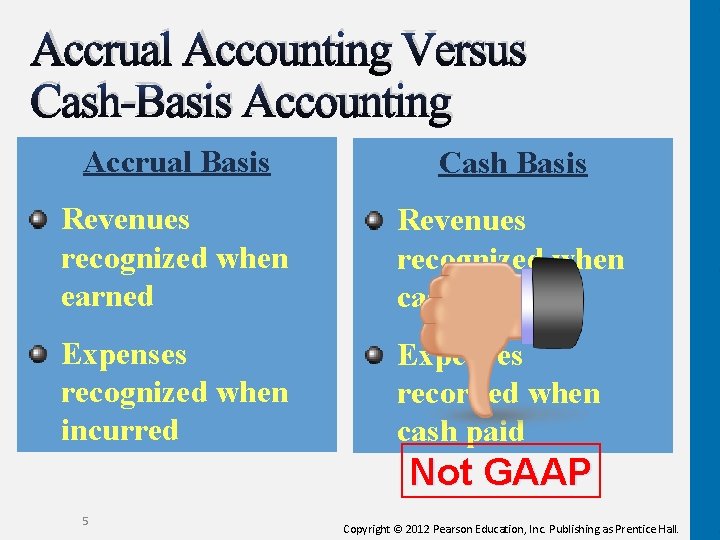
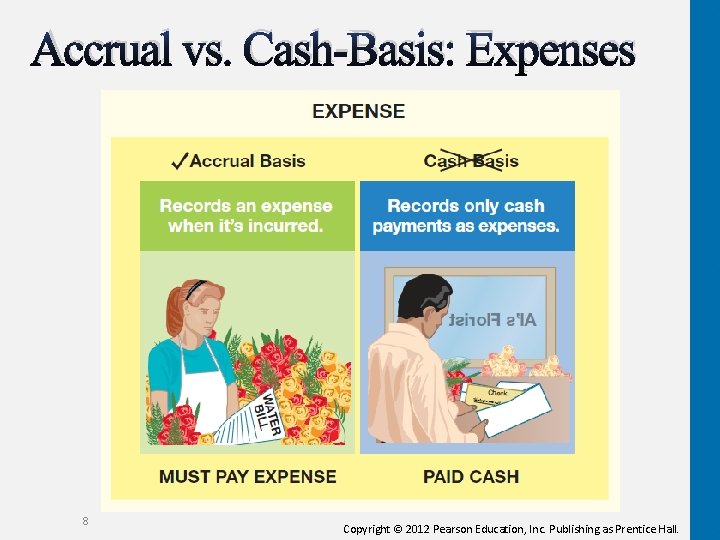
Accrual Accounting Versus Cash-Basis Accounting Accrual Basis Cash Basis Revenues recognized when earned Revenues recognized when cash received Expenses recognized when incurred Expenses recorded when cash paid Not GAAP 5 Copyright © 2012 Pearson Education, Inc. Publishing as Prentice Hall.
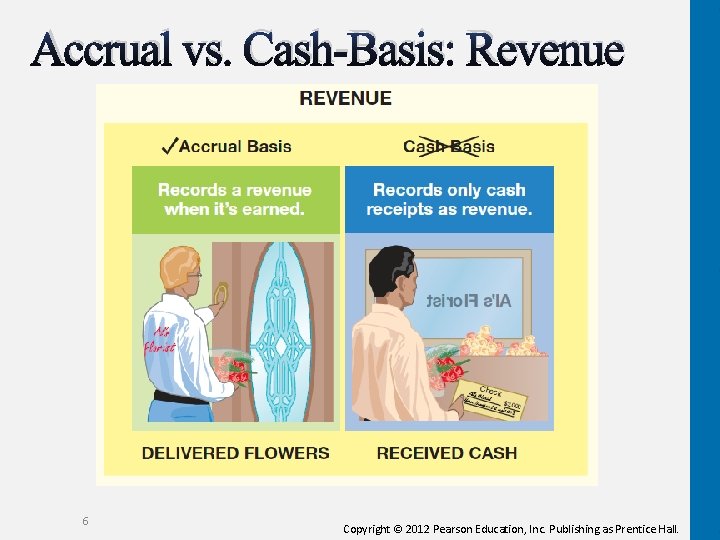
Accrual vs. Cash-Basis: Revenue 6 Copyright © 2012 Pearson Education, Inc. Publishing as Prentice Hall.
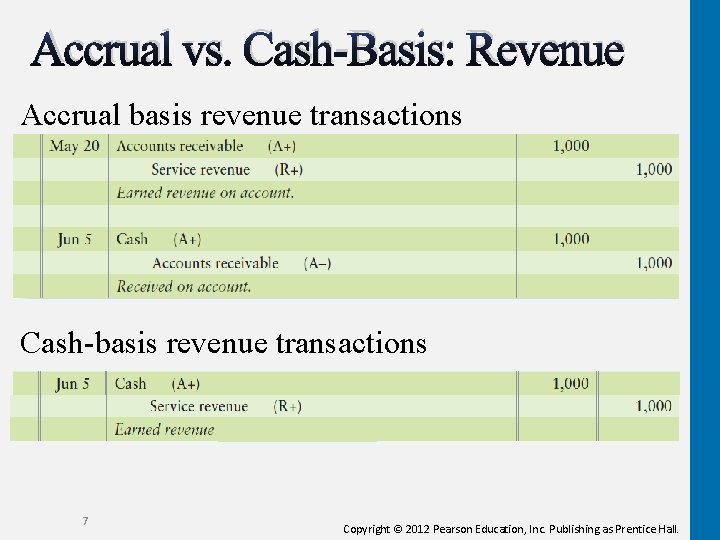
Accrual vs. Cash-Basis: Revenue Accrual basis revenue transactions Cash-basis revenue transactions 7 Copyright © 2012 Pearson Education, Inc. Publishing as Prentice Hall.
Accrual vs. Cash-Basis: Expenses 8 Copyright © 2012 Pearson Education, Inc. Publishing as Prentice Hall.
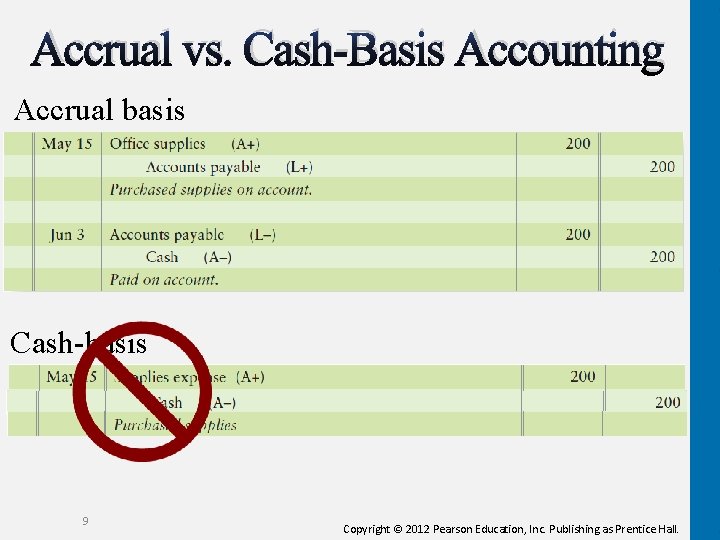
Accrual vs. Cash-Basis Accounting Accrual basis Cash-basis 9 Copyright © 2012 Pearson Education, Inc. Publishing as Prentice Hall.
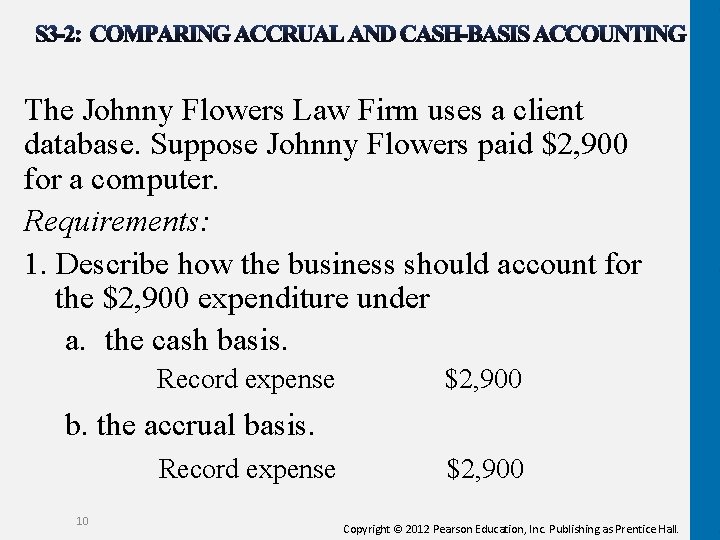
The Johnny Flowers Law Firm uses a client database. Suppose Johnny Flowers paid $2, 900 for a computer. Requirements: 1. Describe how the business should account for the $2, 900 expenditure under a. the cash basis. Record expense $2, 900 b. the accrual basis. Record expense 10 $2, 900 Copyright © 2012 Pearson Education, Inc. Publishing as Prentice Hall.
S 3 -2: COMPARING ACCRUAL AND CASH-BASIS ACCOUNTING The accrual basis is more realistic because the computer is an asset and it will benefit the business for more than one year. To record the cost of the computer as an expense is unrealistic. 11 Copyright © 2012 Pearson Education, Inc. Publishing as Prentice Hall.
2 Define and apply the accounting period concept, revenue, and matching principles 12 Copyright © 2012 Pearson Education, Inc. Publishing as Prentice Hall.
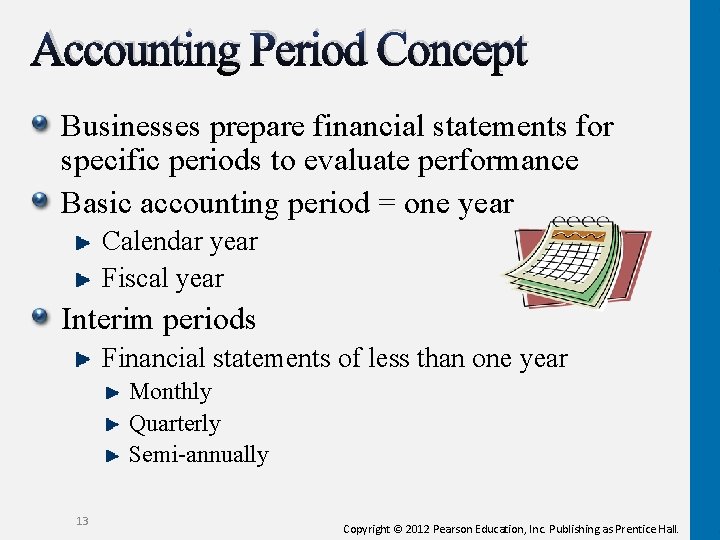
Accounting Period Concept Businesses prepare financial statements for specific periods to evaluate performance Basic accounting period = one year Calendar year Fiscal year Interim periods Financial statements of less than one year Monthly Quarterly Semi-annually 13 Copyright © 2012 Pearson Education, Inc. Publishing as Prentice Hall.
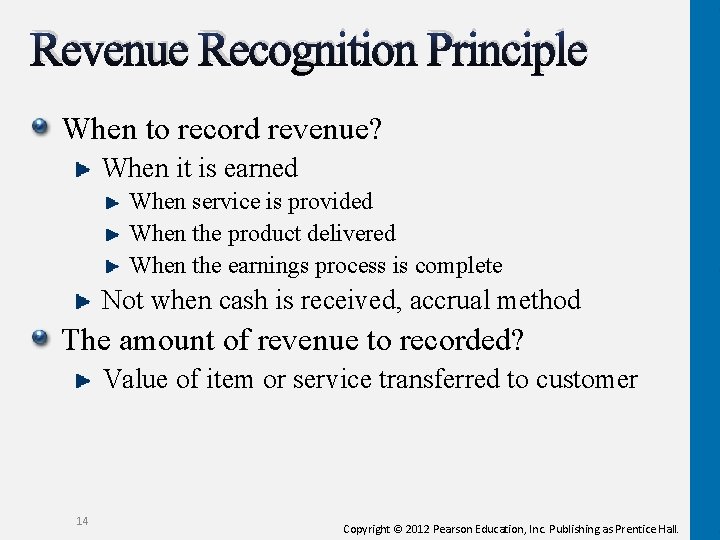
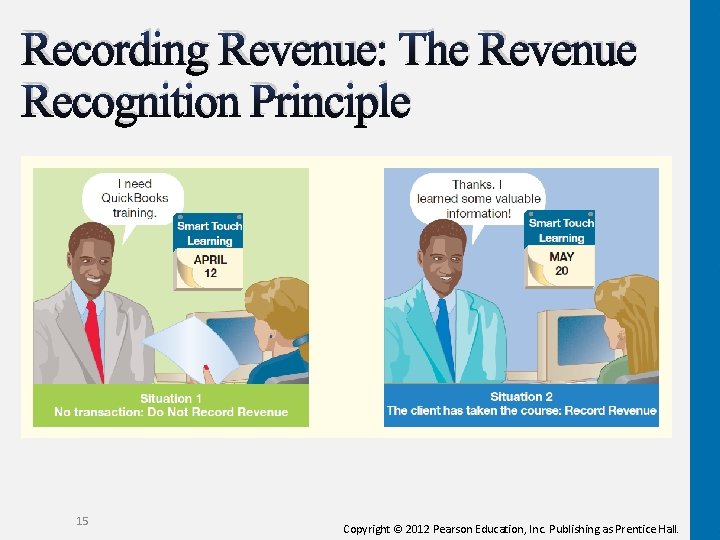
Revenue Recognition Principle When to record revenue? When it is earned When service is provided When the product delivered When the earnings process is complete Not when cash is received, accrual method The amount of revenue to recorded? Value of item or service transferred to customer 14 Copyright © 2012 Pearson Education, Inc. Publishing as Prentice Hall.
Recording Revenue: The Revenue Recognition Principle 15 Copyright © 2012 Pearson Education, Inc. Publishing as Prentice Hall.
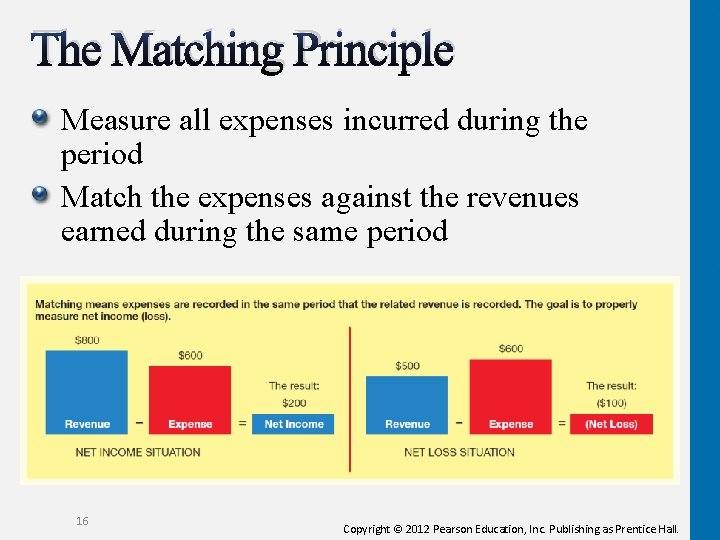
The Matching Principle Measure all expenses incurred during the period Match the expenses against the revenues earned during the same period 16 Copyright © 2012 Pearson Education, Inc. Publishing as Prentice Hall.
The Time-Period Concept Requires that accounting information be reported at regular intervals Accounts are updated at the end of each accounting period 17 Copyright © 2012 Pearson Education, Inc. Publishing as Prentice Hall.
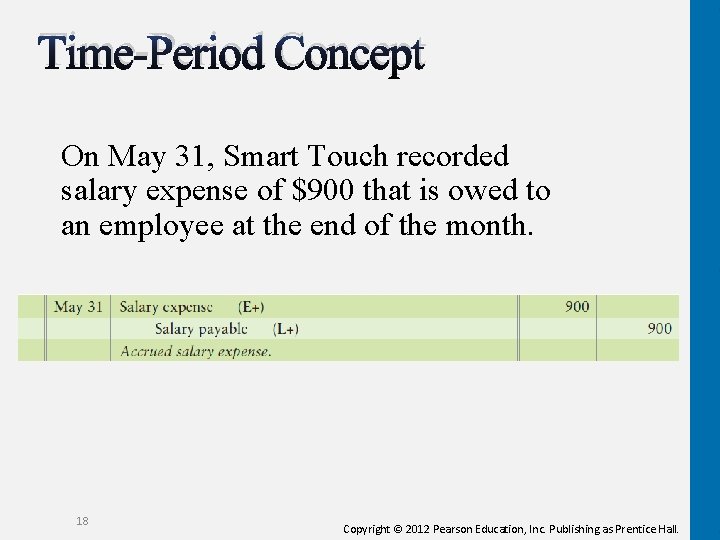
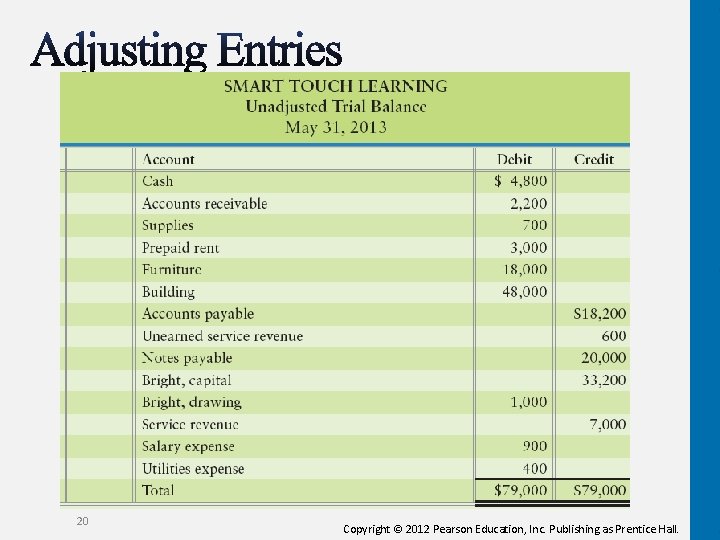
Time-Period Concept On May 31, Smart Touch recorded salary expense of $900 that is owed to an employee at the end of the month. 18 Copyright © 2012 Pearson Education, Inc. Publishing as Prentice Hall.
3 Explain why adjusting entries are needed 19 Copyright © 2012 Pearson Education, Inc. Publishing as Prentice Hall.
20 Copyright © 2012 Pearson Education, Inc. Publishing as Prentice Hall.
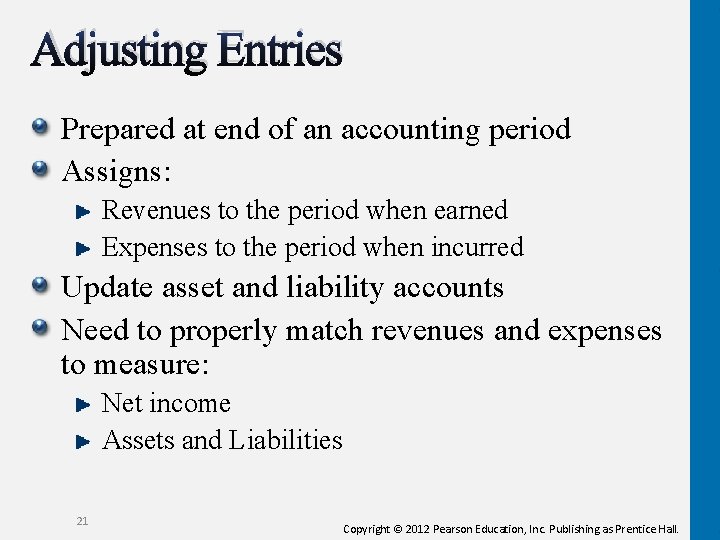
Adjusting Entries Prepared at end of an accounting period Assigns: Revenues to the period when earned Expenses to the period when incurred Update asset and liability accounts Need to properly match revenues and expenses to measure: Net income Assets and Liabilities 21 Copyright © 2012 Pearson Education, Inc. Publishing as Prentice Hall.
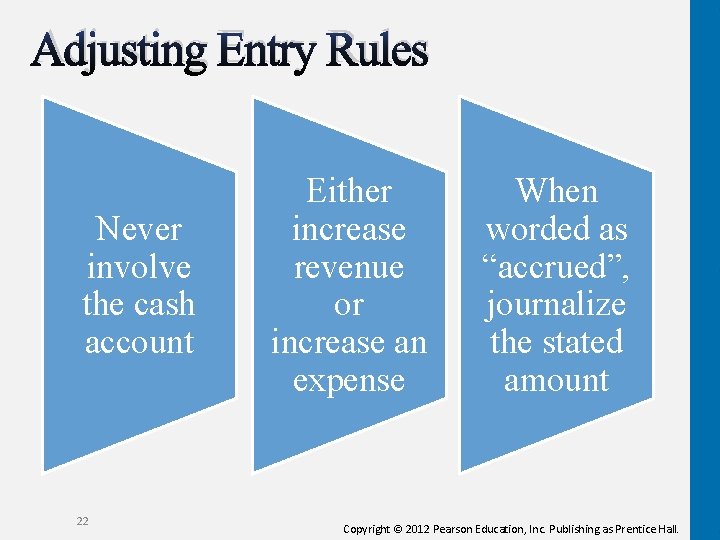
Adjusting Entry Rules Never involve the cash account 22 Either increase revenue or increase an expense When worded as “accrued”, journalize the stated amount Copyright © 2012 Pearson Education, Inc. Publishing as Prentice Hall.
4 Journalize and post adjusting entries 23 Copyright © 2012 Pearson Education, Inc. Publishing as Prentice Hall.
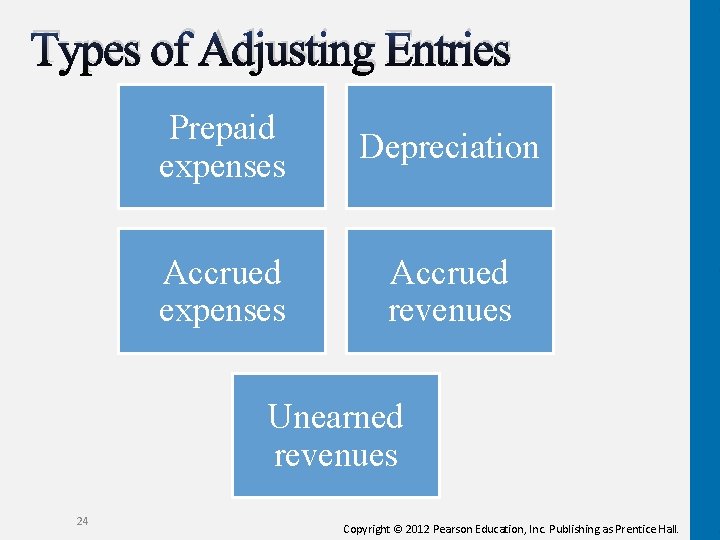
Types of Adjusting Entries Prepaid expenses Depreciation Accrued expenses Accrued revenues Unearned revenues 24 Copyright © 2012 Pearson Education, Inc. Publishing as Prentice Hall.
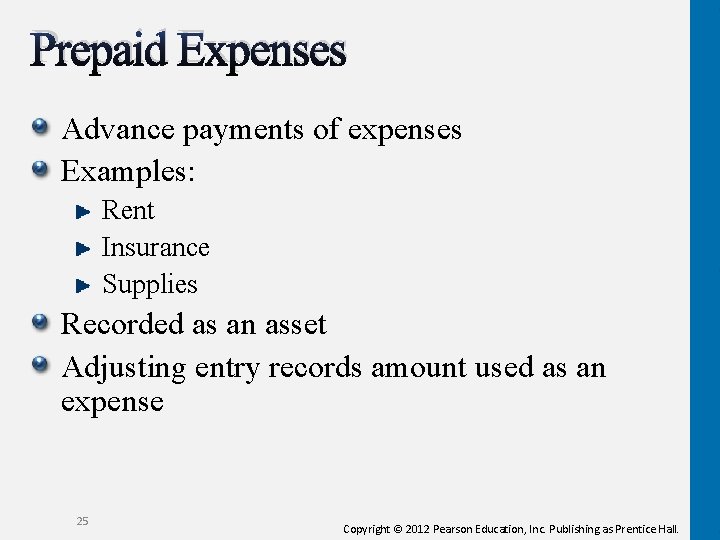
Prepaid Expenses Advance payments of expenses Examples: Rent Insurance Supplies Recorded as an asset Adjusting entry records amount used as an expense 25 Copyright © 2012 Pearson Education, Inc. Publishing as Prentice Hall.
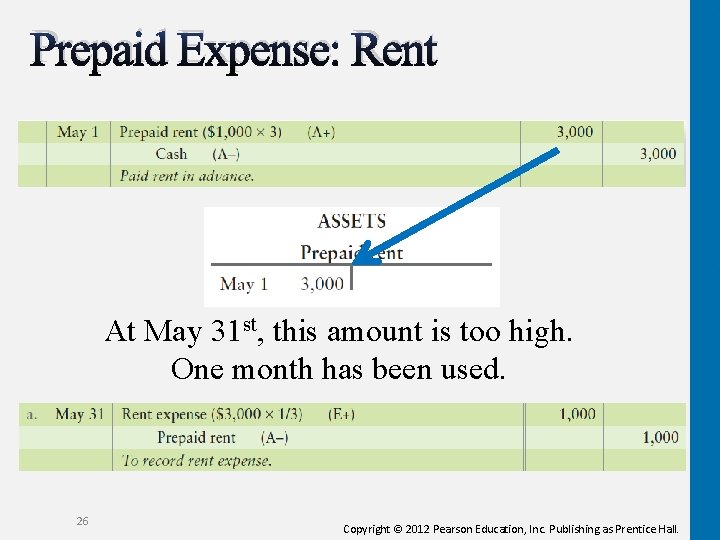
Prepaid Expense: Rent At May 31 st, this amount is too high. One month has been used. 26 Copyright © 2012 Pearson Education, Inc. Publishing as Prentice Hall.
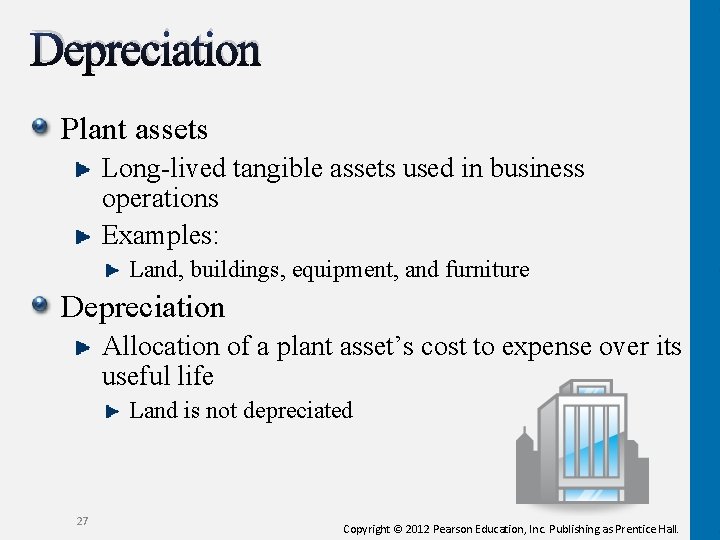
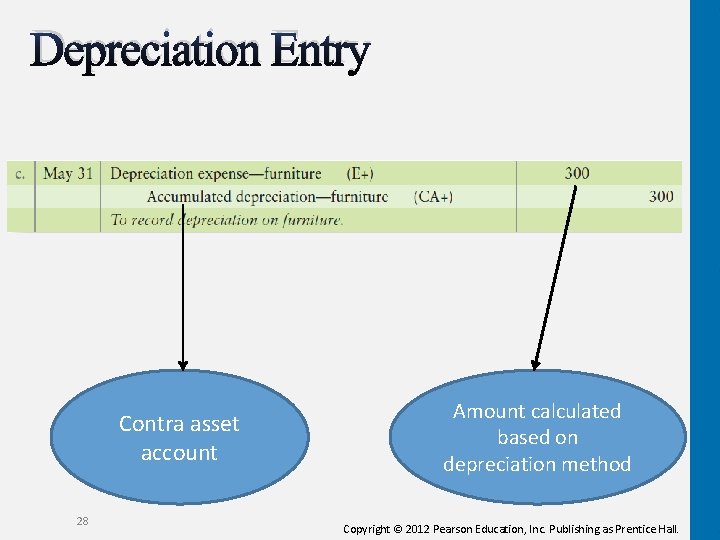
Depreciation Plant assets Long-lived tangible assets used in business operations Examples: Land, buildings, equipment, and furniture Depreciation Allocation of a plant asset’s cost to expense over its useful life Land is not depreciated 27 Copyright © 2012 Pearson Education, Inc. Publishing as Prentice Hall.
Depreciation Entry Contra asset account 28 Amount calculated based on depreciation method Copyright © 2012 Pearson Education, Inc. Publishing as Prentice Hall.
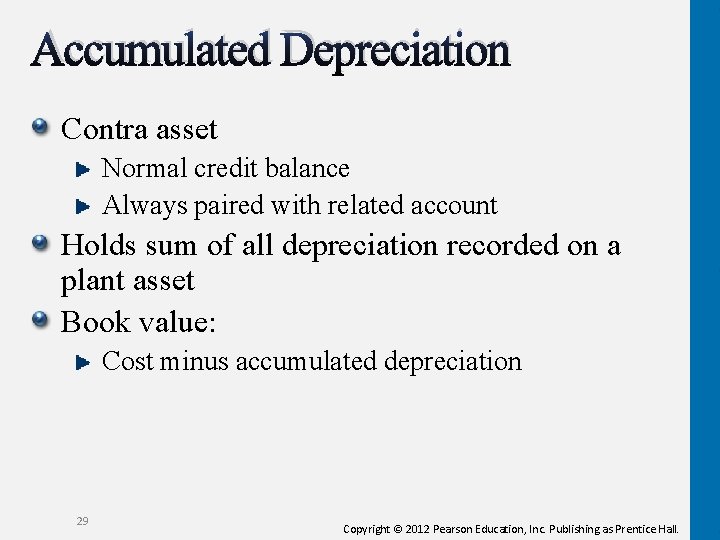
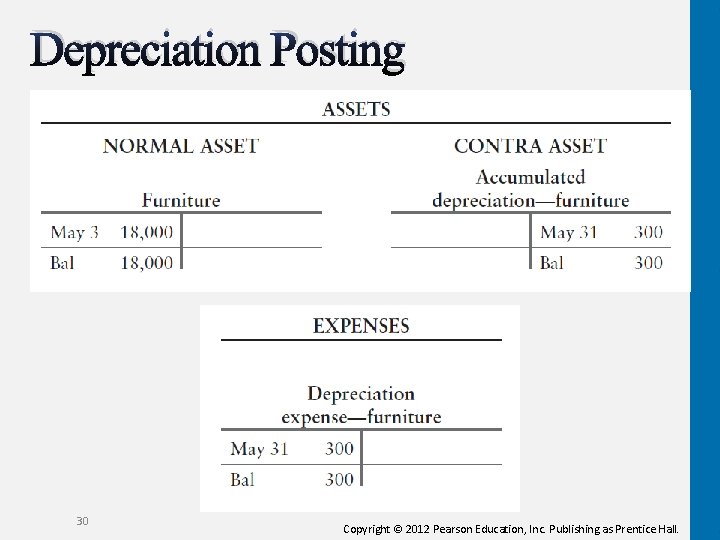
Accumulated Depreciation Contra asset Normal credit balance Always paired with related account Holds sum of all depreciation recorded on a plant asset Book value: Cost minus accumulated depreciation 29 Copyright © 2012 Pearson Education, Inc. Publishing as Prentice Hall.
Depreciation Posting 30 Copyright © 2012 Pearson Education, Inc. Publishing as Prentice Hall.
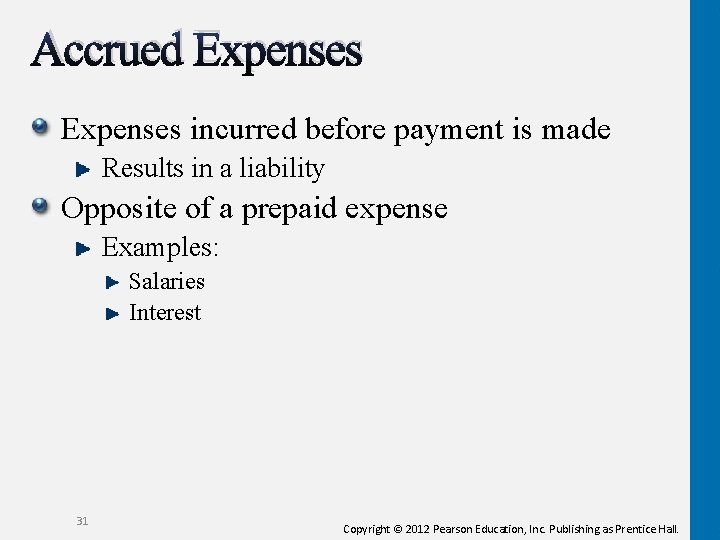
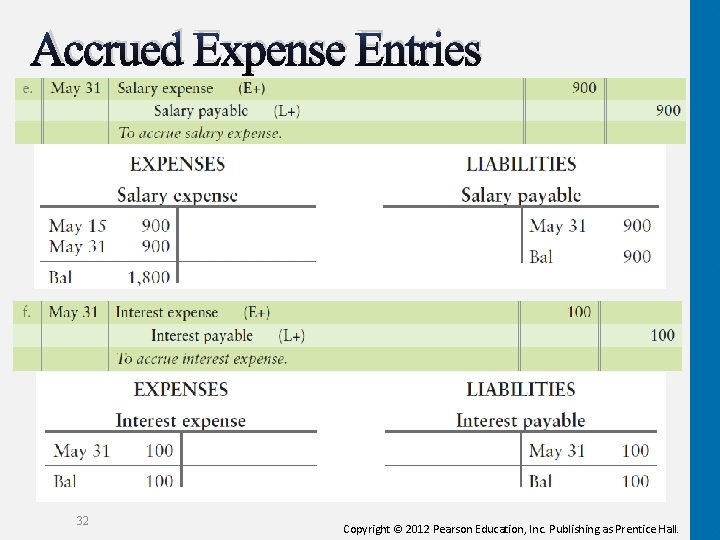
Accrued Expenses incurred before payment is made Results in a liability Opposite of a prepaid expense Examples: Salaries Interest 31 Copyright © 2012 Pearson Education, Inc. Publishing as Prentice Hall.
Accrued Expense Entries 32 Copyright © 2012 Pearson Education, Inc. Publishing as Prentice Hall.
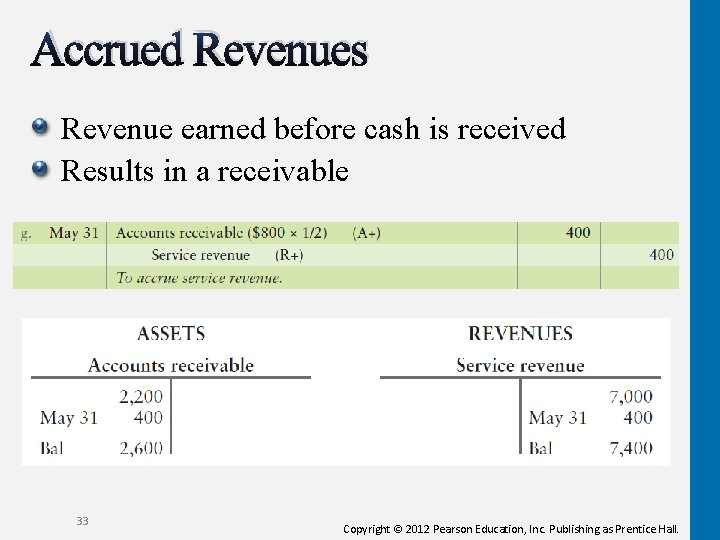
Accrued Revenues Revenue earned before cash is received Results in a receivable 33 Copyright © 2012 Pearson Education, Inc. Publishing as Prentice Hall.
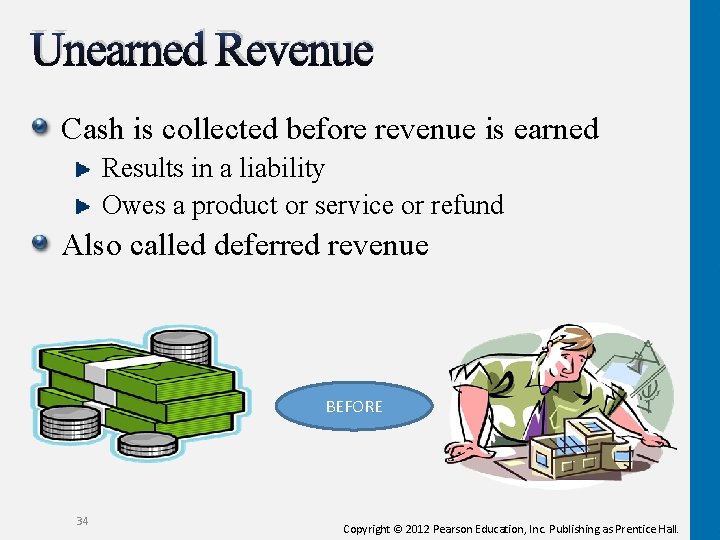
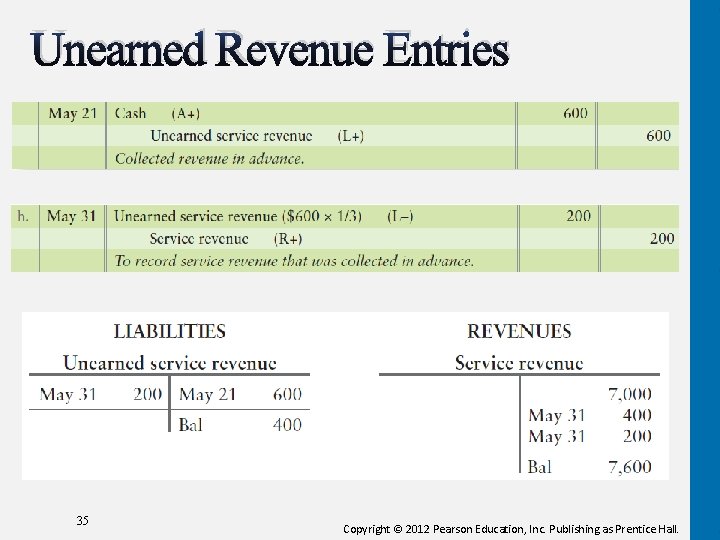
Unearned Revenue Cash is collected before revenue is earned Results in a liability Owes a product or service or refund Also called deferred revenue BEFORE 34 Copyright © 2012 Pearson Education, Inc. Publishing as Prentice Hall.
Unearned Revenue Entries 35 Copyright © 2012 Pearson Education, Inc. Publishing as Prentice Hall.
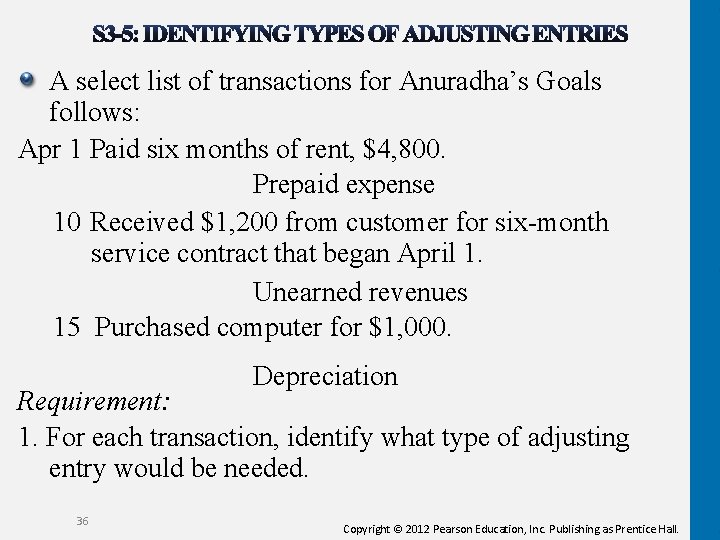
A select list of transactions for Anuradha’s Goals follows: Apr 1 Paid six months of rent, $4, 800. Prepaid expense 10 Received $1, 200 from customer for six-month service contract that began April 1. Unearned revenues 15 Purchased computer for $1, 000. Depreciation Requirement: 1. For each transaction, identify what type of adjusting entry would be needed. 36 Copyright © 2012 Pearson Education, Inc. Publishing as Prentice Hall.
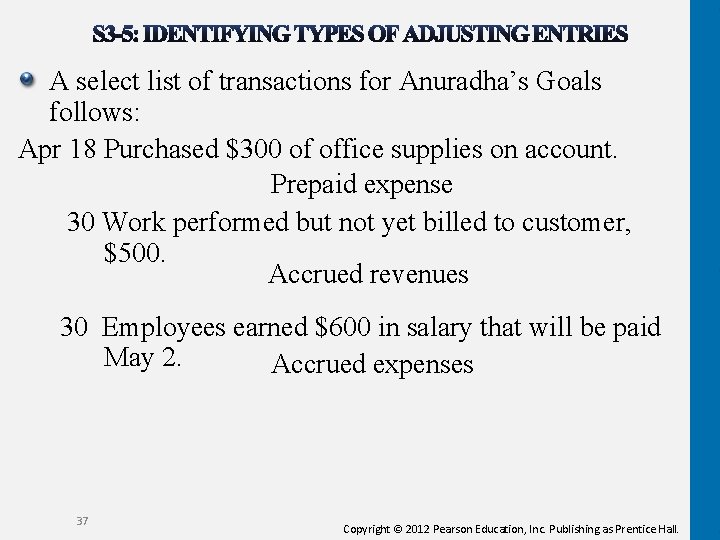
A select list of transactions for Anuradha’s Goals follows: Apr 18 Purchased $300 of office supplies on account. Prepaid expense 30 Work performed but not yet billed to customer, $500. Accrued revenues 30 Employees earned $600 in salary that will be paid May 2. Accrued expenses 37 Copyright © 2012 Pearson Education, Inc. Publishing as Prentice Hall.
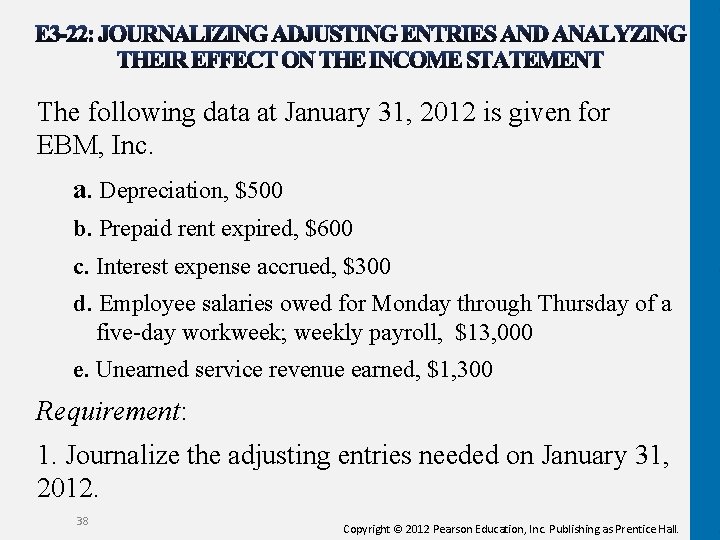
The following data at January 31, 2012 is given for EBM, Inc. a. Depreciation, $500 b. Prepaid rent expired, $600 c. Interest expense accrued, $300 d. Employee salaries owed for Monday through Thursday of a five-day workweek; weekly payroll, $13, 000 e. Unearned service revenue earned, $1, 300 Requirement: 1. Journalize the adjusting entries needed on January 31, 2012. 38 Copyright © 2012 Pearson Education, Inc. Publishing as Prentice Hall.
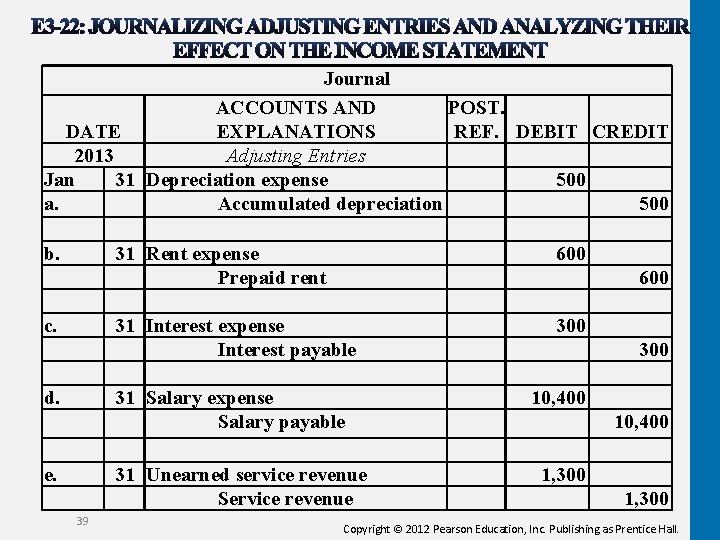
Journal ACCOUNTS AND POST. DATE EXPLANATIONS REF. DEBIT CREDIT 2013 Adjusting Entries Jan 31 Depreciation expense 500 a. Accumulated depreciation 500 b. c. d. 31 Rent expense Prepaid rent 600 31 Interest expense Interest payable 300 600 31 Salary expense Salary payable e. 31 Unearned service revenue Service revenue 39 300 10, 400 1, 300 Copyright © 2012 Pearson Education, Inc. Publishing as Prentice Hall.
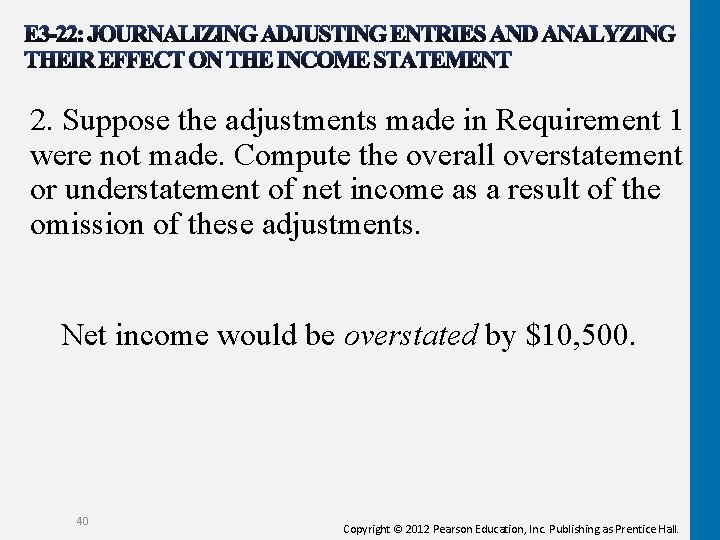
2. Suppose the adjustments made in Requirement 1 were not made. Compute the overall overstatement or understatement of net income as a result of the omission of these adjustments. Net income would be overstated by $10, 500. 40 Copyright © 2012 Pearson Education, Inc. Publishing as Prentice Hall.
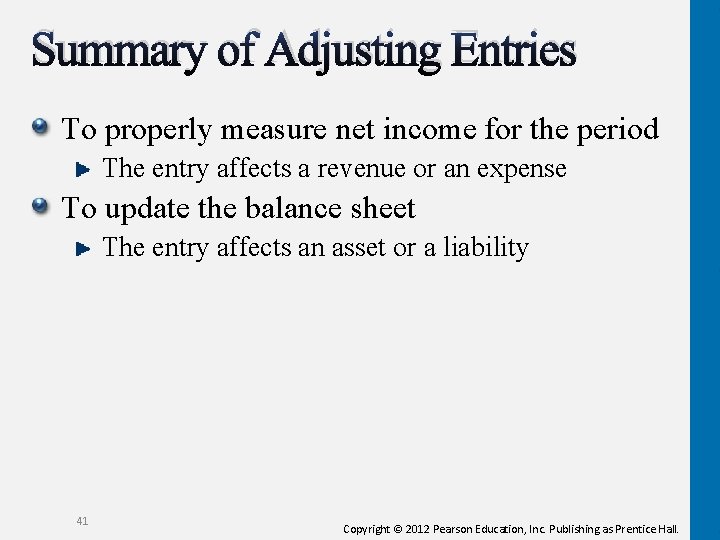
Summary of Adjusting Entries To properly measure net income for the period The entry affects a revenue or an expense To update the balance sheet The entry affects an asset or a liability 41 Copyright © 2012 Pearson Education, Inc. Publishing as Prentice Hall.
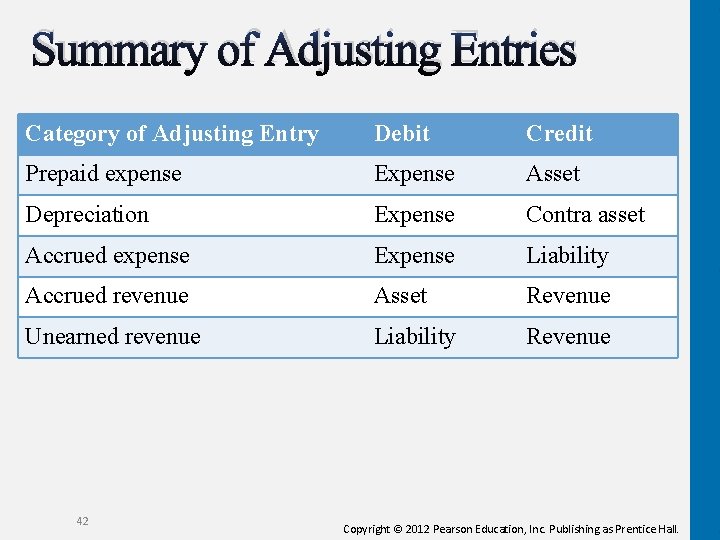
Summary of Adjusting Entries Category of Adjusting Entry Debit Credit Prepaid expense Expense Asset Depreciation Expense Contra asset Accrued expense Expense Liability Accrued revenue Asset Revenue Unearned revenue Liability Revenue 42 Copyright © 2012 Pearson Education, Inc. Publishing as Prentice Hall.
5 Explain the purpose of and prepare an adjusted trial balance 43 Copyright © 2012 Pearson Education, Inc. Publishing as Prentice Hall.
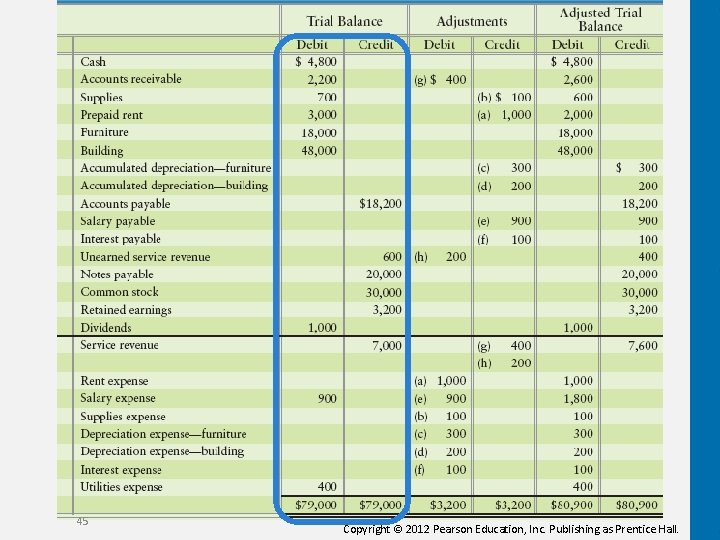
Adjusted Trial Balance Prepared after adjusting entries are posted Useful step in preparing financial statements Often appears on a work sheet Tool accountants use at end of period 44 Copyright © 2012 Pearson Education, Inc. Publishing as Prentice Hall.
45 Copyright © 2012 Pearson Education, Inc. Publishing as Prentice Hall.
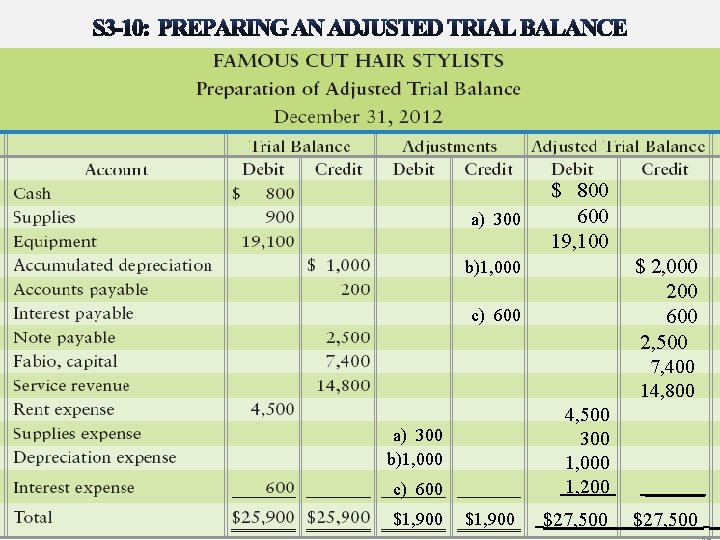
a) 300 $ 800 600 19, 100 $ 2, 000 200 600 2, 500 7, 400 14, 800 b)1, 000 c) 600 4, 500 300 1, 000 1, 200 a) 300 b)1, 000 c) 600 $1, 900 $27, 500 ______ $27, 500 Copyright © 2012 Pearson Education, Inc. Publishing as Prentice Hall.
6 Prepare the financial statements from the adjusted trial balance 47 Copyright © 2012 Pearson Education, Inc. Publishing as Prentice Hall.
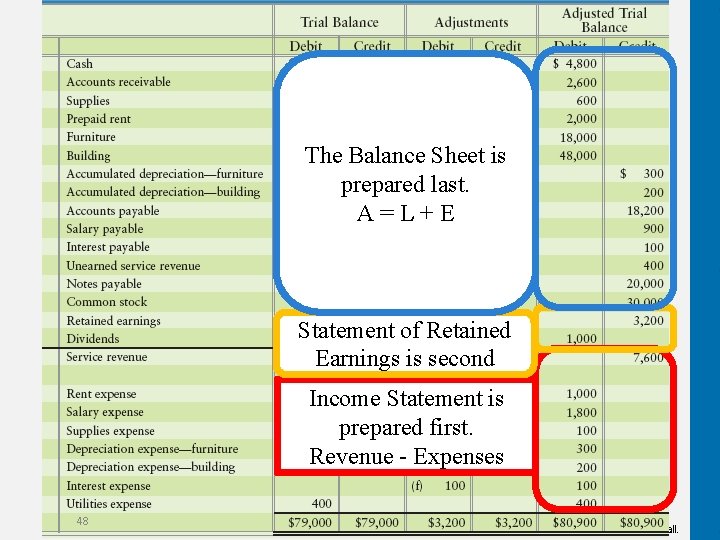
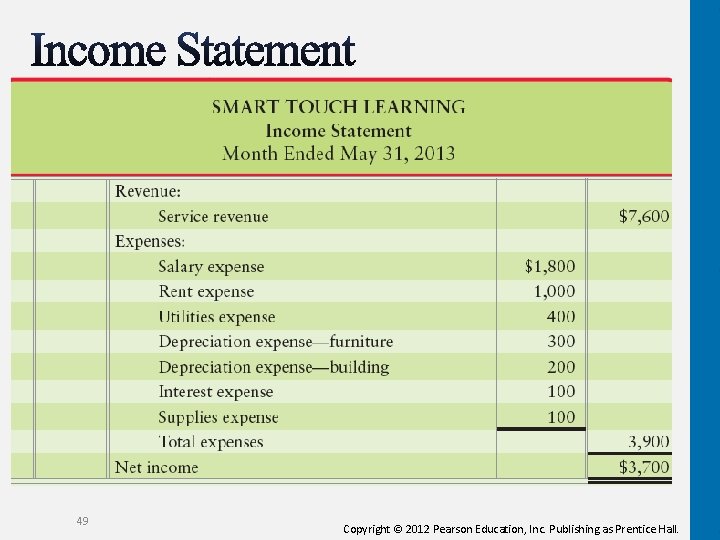
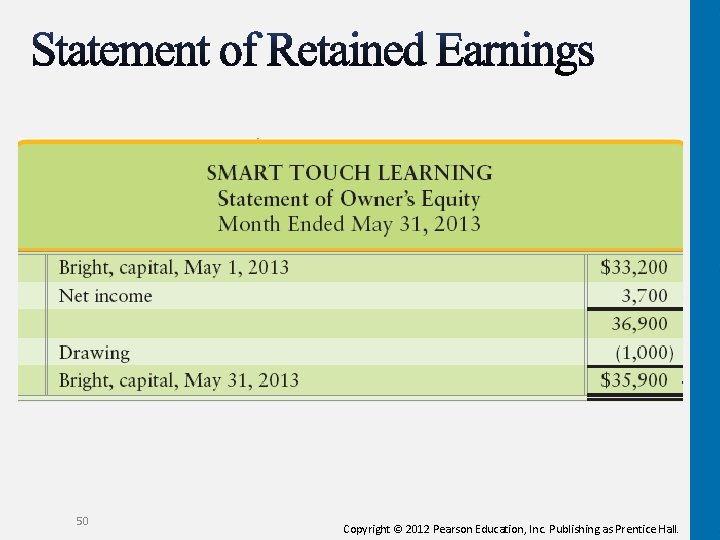
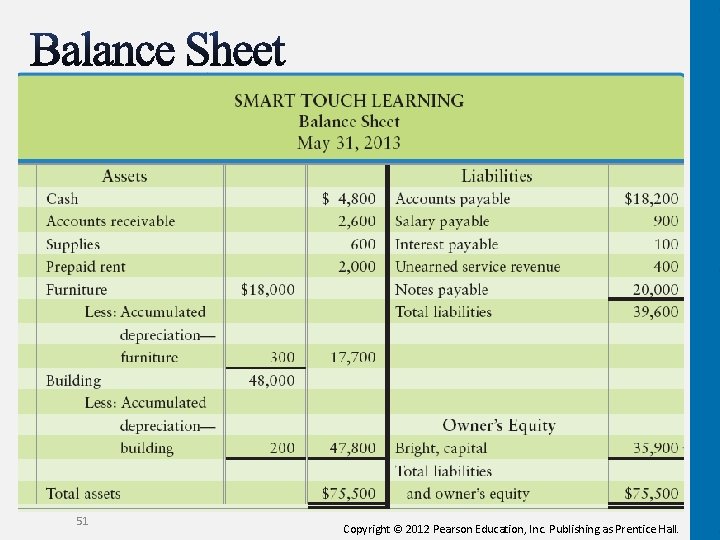
The Balance Sheet is prepared last. A=L+E Statement of Retained Earnings is second Income Statement is prepared first. Revenue - Expenses 48 Copyright © 2012 Pearson Education, Inc. Publishing as Prentice Hall.
49 Copyright © 2012 Pearson Education, Inc. Publishing as Prentice Hall.
50 Copyright © 2012 Pearson Education, Inc. Publishing as Prentice Hall.
51 Copyright © 2012 Pearson Education, Inc. Publishing as Prentice Hall.
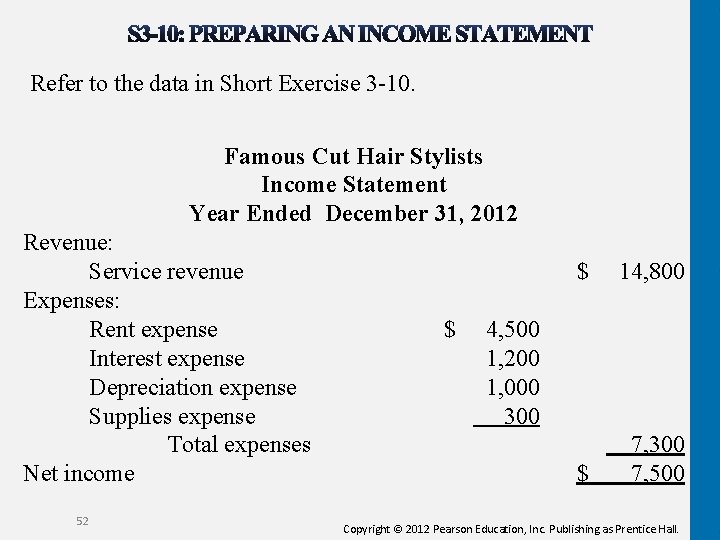
Refer to the data in Short Exercise 3 -10. Famous Cut Hair Stylists Income Statement Year Ended December 31, 2012 Revenue: Service revenue Expenses: Rent expense Interest expense Depreciation expense Supplies expense Total expenses Net income 52 $ $ 14, 800 $ 7, 300 7, 500 4, 500 1, 200 1, 000 300 Copyright © 2012 Pearson Education, Inc. Publishing as Prentice Hall.
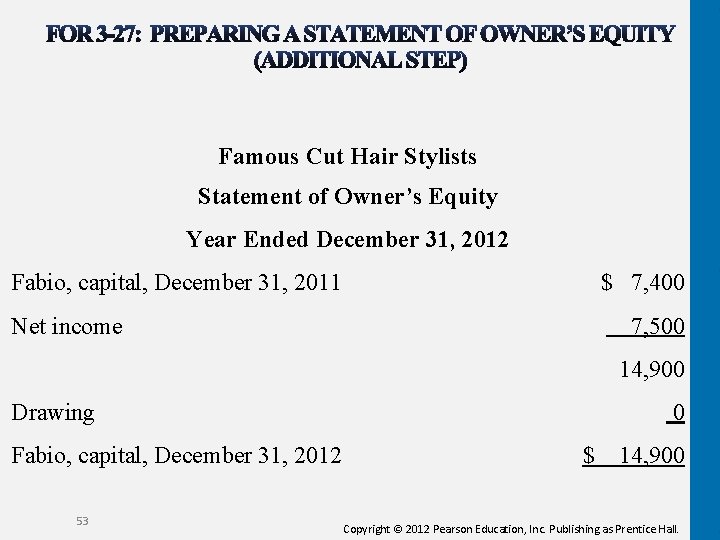
Famous Cut Hair Stylists Statement of Owner’s Equity Year Ended December 31, 2012 Fabio, capital, December 31, 2011 $ 7, 400 Net income 7, 500 14, 900 Drawing Fabio, capital, December 31, 2012 53 0 $ 14, 900 Copyright © 2012 Pearson Education, Inc. Publishing as Prentice Hall.
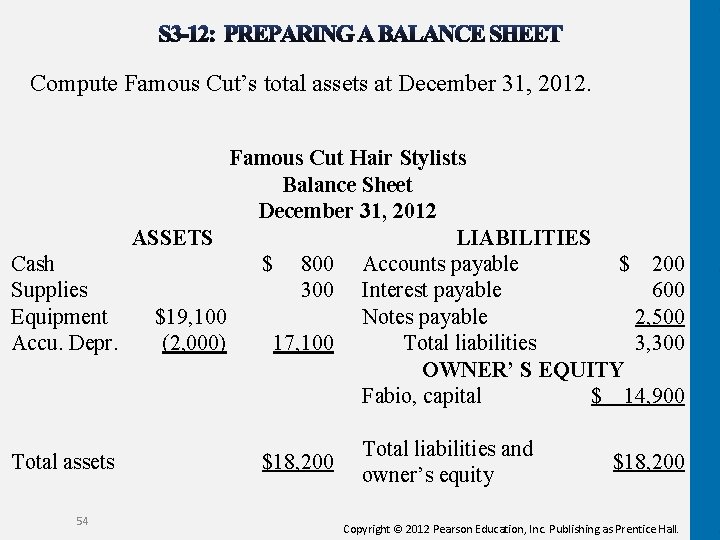
Compute Famous Cut’s total assets at December 31, 2012. Famous Cut Hair Stylists Balance Sheet December 31, 2012 ASSETS LIABILITIES Cash $ 800 Accounts payable $ 200 Supplies 300 Interest payable 600 Equipment $19, 100 Notes payable 2, 500 Accu. Depr. (2, 000) 17, 100 Total liabilities 3, 300 OWNER’ S EQUITY Fabio, capital $ 14, 900 Total assets 54 $18, 200 Total liabilities and owner’s equity $18, 200 Copyright © 2012 Pearson Education, Inc. Publishing as Prentice Hall.
7 55 Copyright © 2012 Pearson Education, Inc. Publishing as Prentice Hall.
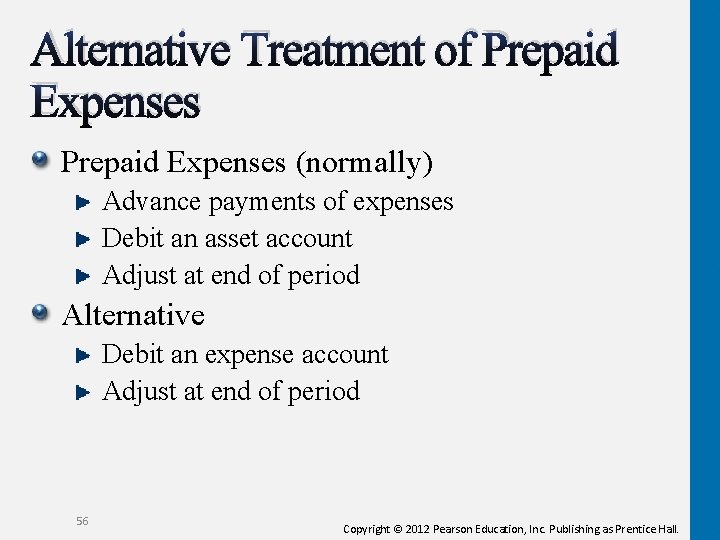
Alternative Treatment of Prepaid Expenses (normally) Advance payments of expenses Debit an asset account Adjust at end of period Alternative Debit an expense account Adjust at end of period 56 Copyright © 2012 Pearson Education, Inc. Publishing as Prentice Hall.
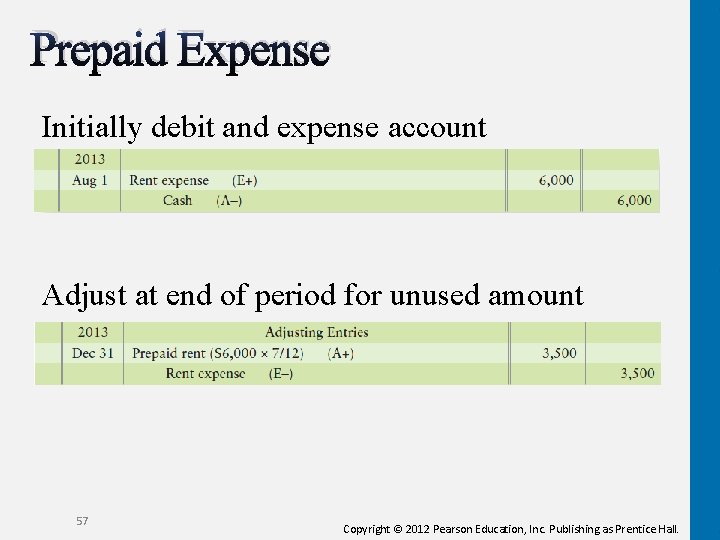
Prepaid Expense Initially debit and expense account Adjust at end of period for unused amount 57 Copyright © 2012 Pearson Education, Inc. Publishing as Prentice Hall.
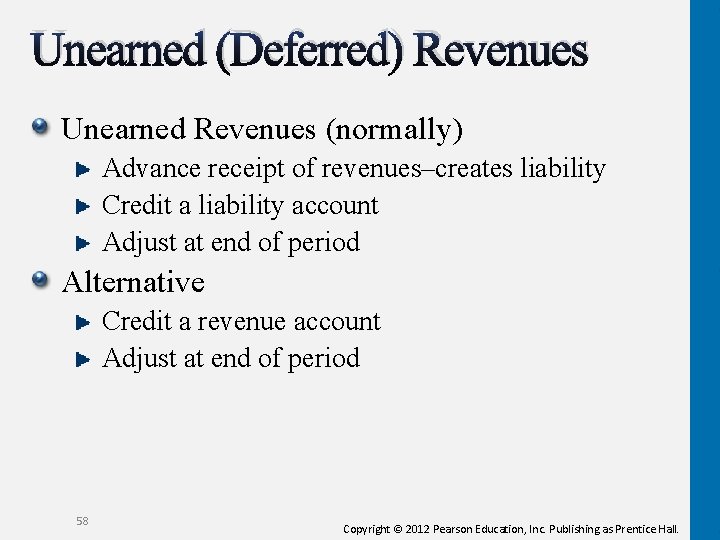
Unearned (Deferred) Revenues Unearned Revenues (normally) Advance receipt of revenues–creates liability Credit a liability account Adjust at end of period Alternative Credit a revenue account Adjust at end of period 58 Copyright © 2012 Pearson Education, Inc. Publishing as Prentice Hall.
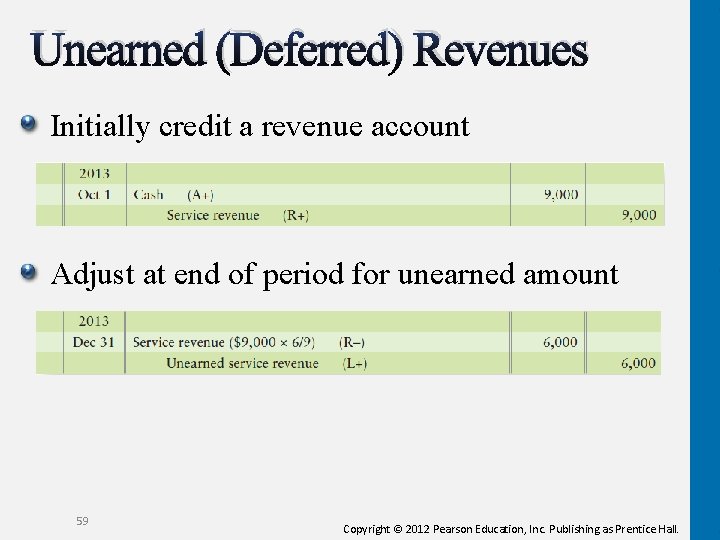
Unearned (Deferred) Revenues Initially credit a revenue account Adjust at end of period for unearned amount 59 Copyright © 2012 Pearson Education, Inc. Publishing as Prentice Hall.
Chapter 3 Summary Cash-basis accounting and accrual accounting are different. Accrual accounting records revenues and expenses when they are earned/incurred. Cash-basis accounting records revenues and expenses when cash is received or paid. The principles guide us as to when (the time period and accounting period concepts) and how (the revenue recognition and matching principles) to record revenues and expenses. 60 Copyright © 2012 Pearson Education, Inc. Publishing as Prentice Hall.
Chapter 3 Summary We adjust accounts to make sure the balance sheet shows the value of what we own (assets) and what we owe (liabilities) on a specific date. We also adjust to make sure all revenues and expenses are recorded in the period they are earned or incurred. Adjusting journal entries either credit a revenue account or debit an expense account, but they NEVER affect the Cash account. 61 Copyright © 2012 Pearson Education, Inc. Publishing as Prentice Hall.
Chapter 3 Summary The adjusting process has two purposes: 1. To capture all transactions that should be reported in the period shown on the income statement. Every adjustment affects a revenue or an expense. 2. To update the balance sheet so that all accounts are properly valued. Every adjustment affects an asset or a liability (but never the Cash account). 62 Copyright © 2012 Pearson Education, Inc. Publishing as Prentice Hall.
Chapter 3 Summary The adjusted trial balance includes all the transactions captured during the period on the trial balance plus/minus any adjusting journal entries made at the end of the period. The adjusted trial balance gives us the final adjusted values that we use to prepare the financial statements. 63 Copyright © 2012 Pearson Education, Inc. Publishing as Prentice Hall.
Chapter 3 Summary The financial statements must be prepared in order: 1. income statement 2. statement of retained earnings 3. balance sheet, third. It is important for accountants to prepare accurate and complete financial statements as other people rely on the data to make decisions. 64 Copyright © 2012 Pearson Education, Inc. Publishing as Prentice Hall.
65 Copyright © 2012 Pearson Education, Inc. Publishing as Prentice Hall.
Copyright All rights reserved. No part of this publication may be reproduced, stored in a retrieval system, or transmitted, in any form or by any means, electronic, mechanical, photocopying, recording, or otherwise, without the prior written permission of the publisher. Printed in the United States of America. 66 Copyright © 2012 Pearson Education, Inc. Publishing as Prentice Hall.