
Adjusting Entries Definition Journal entries prepared to update
- Slides: 29
Adjusting Entries
Definition • Journal entries prepared to update the balances of certain accounts and subsequently record unrecognized accounts • Prepared to split the real and nominal components of a particular account • Prepared in compliance with the Time-Period Concept and the Matching Principle
• Real Component – The portion of the account balance that should be reported to the Balance Sheet • Nominal Component – The portion of the account balance that should be presented to the Income Statement
• Time-Period Concept – The life of an entity can be divided into various periods, usually in years. • Matching Principle – Expenses incurred should be matched with revenues generated in a particular period. – Only those revenues generated and expenses incurred for a particular period should be presented in the income statement.
Types of Adjustments • Adjustments for – Accruals • Accruals of income • Accruals of expense – Deferrals • Prepayment of expense • Precollection of income – Depreciation – Uncollectible Accounts
Accruals • As a concept of accrual basis in accounting, income should be recorded when earned and expenses should be recorded when incurred, regardless of whether cash is received or paid.
Accruals • Accrued Income – Income already earned but not yet collected – An asset account which has a similar nature with Accounts Receivable • Accrued Expense – Expense already incurred but not yet paid – A liability account which has a similar nature with Accounts Payable
Accruals • Accrued Income Illustration #1 – On December 31, 2011, service income that is unbilled amounts to 15, 000 – As of year-end, unrecorded rent revenue amounts to 10, 000
Accruals • Accrued Income Illustration #2 – On June 1, 2011, the business entered into a contract where it will render services for 1 year from June 2011 to May 2012 for a contract price of 60, 000. The payment will be received on May 2012. What is the adjusting entry on December 31, 2011?
Accrual • Accrued Income Illustration #3 – On September 30, 2011, the business loaned money in the amount of 100, 000. it carries a 6% interest and due on March 31, 2012. Payment of principal and interest will be on March 31, 2012. What will be the adjusting entry on December 31, 2011?
Accrual • Accrued Expense Illustration #1 – As of year-end, unpaid salaries amount to 6, 000. Prepare the necessary adjusting entry. – As of December 31, 2011, unpaid electricity bill amounts to 8, 000. prepare the required adjusting entry.
Accrual • Accrued Expense Illustration #2 – The company pays its 50 employees 2500 each per week for a 5 -day work week from Monday to Friday. Salary is paid every Friday. December 31 falls on a Tuesday. What is the adjusting entry to be made?
Accrual • Accrued Expense illustration #3 – The business borrowed 250, 000 from a bank on July 31, 2011. the loan carries an 8% interest. Principal and interest is payable on July 31, 2012. Prepare the adjusting entry on December 31, 2011.
Deferrals • In accounting parlance, these pertains to advance payments or collections of cash. In relation to adjusting entries, it may pertain to prepaid expenses or precollected income.
Deferrals • Prepaid Expense – This pertain to items already paid for but not yet used. As a concept, it is generally acceptable for an entity to recognize such as an asset. However some businesses record it initially as an expense. Therefore, a business may account for such under the: • Asset method, or the • Expense Method
Deferrals • Prepaid Expense Illustration #1 – The company entered into a 3 year insurance contract on May 31, 2011 and paid the contract price of 36, 000. Prepare the entries on May 31 and December 31 using the: • Asset method • Expense method
Deferrals • Prepaid Expense Illustration #2 – The company leased an office space on September 30, 2011 and paid 6 months advance rent in the amount of 60, 000. Prepare the entries on September 30 and December 31 using: • Asset method • Expense method
Deferrals • Prepaid Expense Illustration #3 – The company bought supplies amounting to 15, 000 on March 15, 2011. On December 31, 2011, supplies remaining amount to P 6, 000. Prepare the journal entries on March 15 and December 31 using: • Asset method • Expense method
Deferrals • Precollected Income – These pertains to cash already received from customers for services to be rendered in the future. Such is generally accounted for by recognizing a liability. However, some firms record this by recognizing a revenue immediately. A business therefore accounts for such under: • Liability method, or • Revenue Method
Deferrals • Precollected Income Illustration #1 – Flavio, a blacksmith, received 5, 000 from Lizardo on June 1, 2011 for him to create 5 swords. On December 31, 2011, he was able to finish 3 swords. Prepare the journal entries on June 1 and December 31 using the: • Liability method • Revenue method
Deferrals • Precollected Income Illustration #2 – On August 1, 2011, Ator Nee, a lawyer, received 50, 000 from a client for legal services to be rendered from September 1, 2011 to January 31, 2012. Prepare the entries for August 1 and December 31 under the: • Liability method • Revenue method
Depreciation • It is the reduction in the value of an asset due to usage and passage of time. • Applicable to all property, plant and equipment except for Land. • The most common method used in computing for depreciation is the straight line method
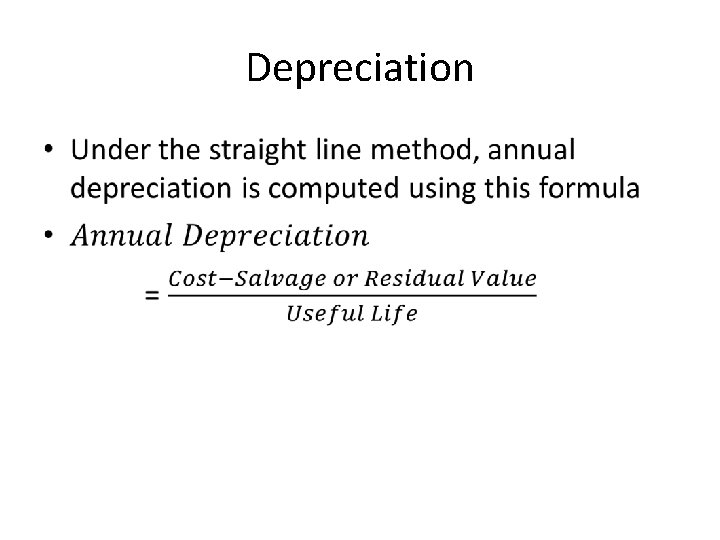
Depreciation •
Depreciation • Depreciation Illustration #1 – The company purchased equipment amounting to 50, 000 on May 31, 2011. useful life is 9 years and residual value is 5, 000. • • How much is the depreciation expense on 2011? How much is the depreciation expense on 2012? How much is the accumulated depreciation on 2012? What is the book/carrying value of the equipment on 2012?
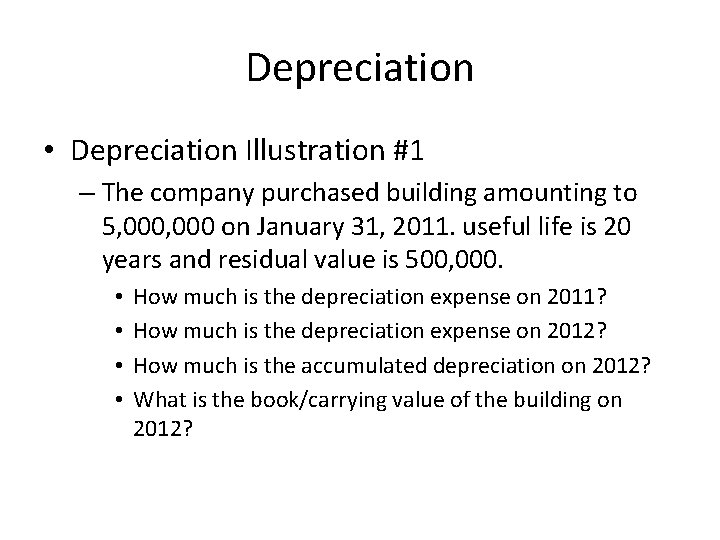
Depreciation • Depreciation Illustration #1 – The company purchased building amounting to 5, 000 on January 31, 2011. useful life is 20 years and residual value is 500, 000. • • How much is the depreciation expense on 2011? How much is the depreciation expense on 2012? How much is the accumulated depreciation on 2012? What is the book/carrying value of the building on 2012?
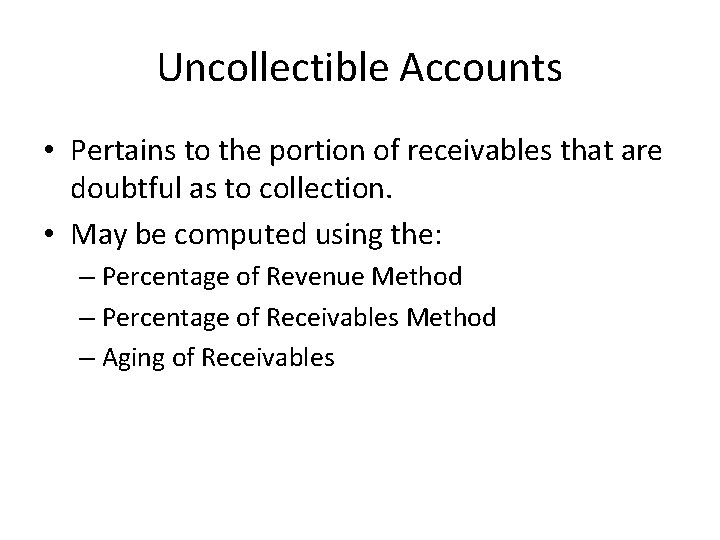
Uncollectible Accounts • Pertains to the portion of receivables that are doubtful as to collection. • May be computed using the: – Percentage of Revenue Method – Percentage of Receivables Method – Aging of Receivables
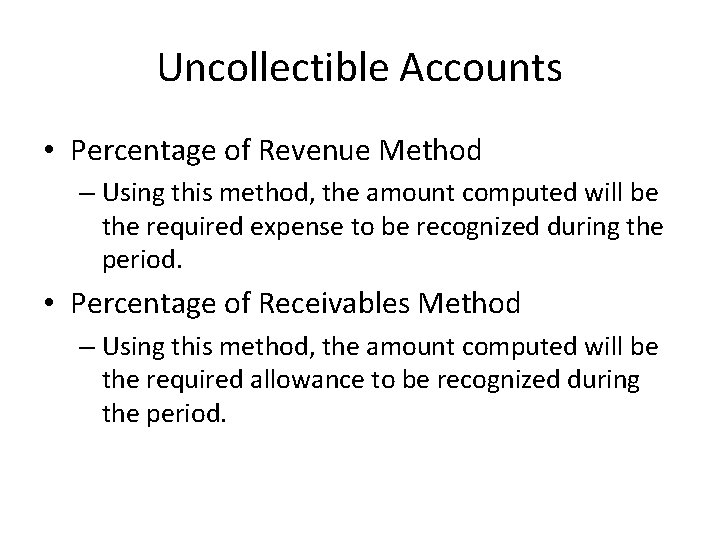
Uncollectible Accounts • Percentage of Revenue Method – Using this method, the amount computed will be the required expense to be recognized during the period. • Percentage of Receivables Method – Using this method, the amount computed will be the required allowance to be recognized during the period.
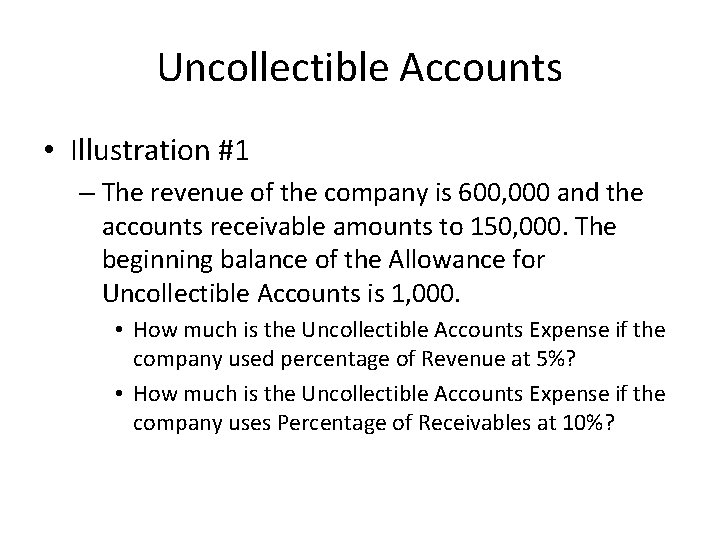
Uncollectible Accounts • Illustration #1 – The revenue of the company is 600, 000 and the accounts receivable amounts to 150, 000. The beginning balance of the Allowance for Uncollectible Accounts is 1, 000. • How much is the Uncollectible Accounts Expense if the company used percentage of Revenue at 5%? • How much is the Uncollectible Accounts Expense if the company uses Percentage of Receivables at 10%?
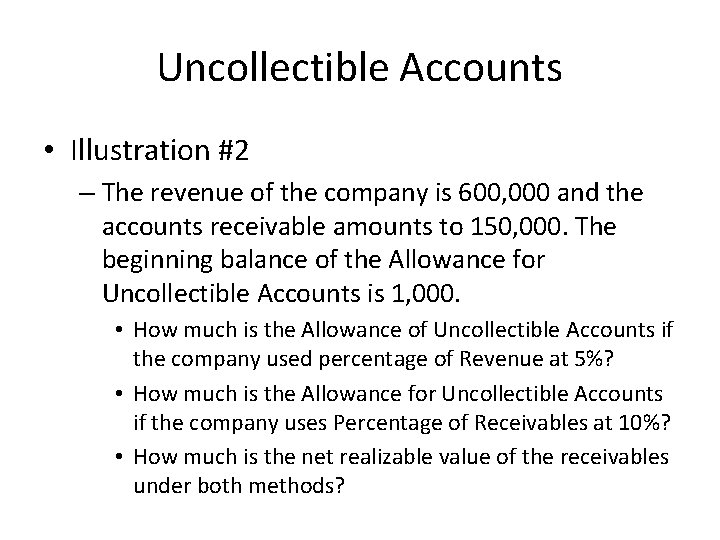
Uncollectible Accounts • Illustration #2 – The revenue of the company is 600, 000 and the accounts receivable amounts to 150, 000. The beginning balance of the Allowance for Uncollectible Accounts is 1, 000. • How much is the Allowance of Uncollectible Accounts if the company used percentage of Revenue at 5%? • How much is the Allowance for Uncollectible Accounts if the company uses Percentage of Receivables at 10%? • How much is the net realizable value of the receivables under both methods?