
Chapter 3 Adjusting entries Cash versus accrual basis
Chapter 3 Adjusting entries
Cash versus accrual basis Adjusting entries are journal entries usually made at the end of an accounting period to allocate income and expenditure to the period in which they actually occurred. There are 7 accounts that need adjusting entries. - Unearned revenue or Revenue received in advance - Accrued revenue - Prepaid expense - Accrued expense
- Supplies expense or supplies used - Depreciation of fixed assets - Bad debts expense or Doubtful account
Adjusting and reversing entries 1. Unearned revenues or Revenue received in advance Unearned revenue refers to money received for a service that has yet to be fulfilled. Unearned revenue can be thought of as a "prepayment" for services which a person or company is expected to produce to the customers. As a result of this prepayment, the company now has a liability equal to the revenue earned until deliver of service.
2. Accrued revenue is revenue that has been incurred but not yet received such as interest revenue or rent revenue. They are recorded as assets. Accrued revenue differs from account receivable in that the latter involves revenues gained from direct operations of the company such as service revenue gained from providing visa application service, whereas the former involves revenues gained from other sources.
3. Prepaid Expense refers to expenses paid in cash and recorded as assets before they are used. It is regarded as an asset. 4. Accrued expense is the expense which has been incurred but not yet paid. Such expense is considered liability. 5. Supplies expense or supplies used Supplies expense refers to the cost of consumables used during a reporting period. They are considered as an expense.
6. Depreciation expense of fixed assets A company typically owns fixed assets such as an office, a computer, furniture a motor coach, and a van. Because these assets provide service for a number of years, each is recorded as a fixed asset in the year it is acquired. The value of these assets is reduced overtime and these reduced value is regarded as a non-cash expense which does not affect the amount of cash held by the business.
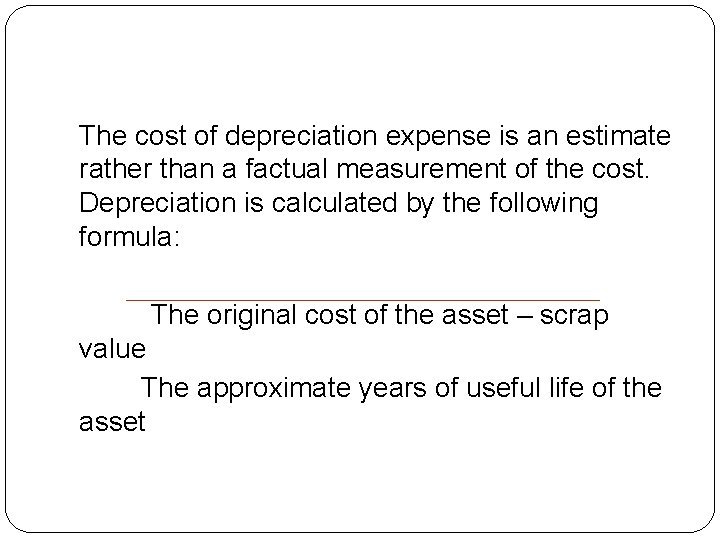
The cost of depreciation expense is an estimate rather than a factual measurement of the cost. Depreciation is calculated by the following formula: The original cost of the asset – scrap value The approximate years of useful life of the asset
The relevant aspect of depreciation expense is accumulated depreciation which refers to the total amount of depreciation for a fixed asset that has been charged to expense since that asset was acquired and made available for use. The accumulated depreciation account is an asset account with a credit balance; this means that it appears on the balance sheet as a reduction from the gross amount of fixed assets reported.
8. Bad debts expense or Doubtful account The term bad debts refers to accounts receivable that will not be collected. However, bad debts can also refer to notes receivable that will not be collected. They are regarded as expenses. The associated account of bad debts expense is ‘allowance for bad debts expense’ which is a contra current asset account associated with accounts receivable.
Worksheets A work sheet is a multiple-column form that may be used in the adjustment process and in preparing financial statements. As its name suggests, the work sheet is a working tool. A work sheet is not a permanent accounting record; it is neither a journal nor a part of the general ledger. The work sheet is merely a device used to make it easier to prepare adjusting entries and the financial statements. However, the use of a work sheet is optional.
- Slides: 11