Take the poll Visit www pollev comleaderly Lead








- Slides: 42
Take the poll! Visit www. pollev. com/leaderly
Lead From Where You Are Jo Miller
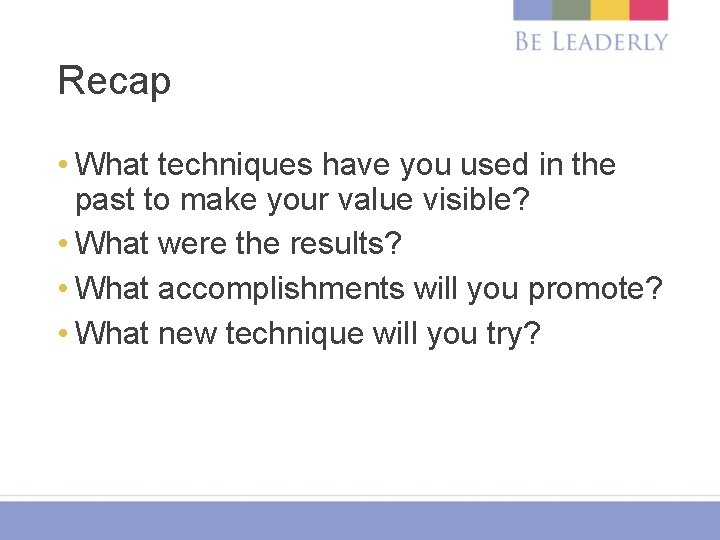
Recap • What techniques have you used in the past to make your value visible? • What were the results? • What accomplishments will you promote? • What new technique will you try?
Our behavior teaches people how to treat us
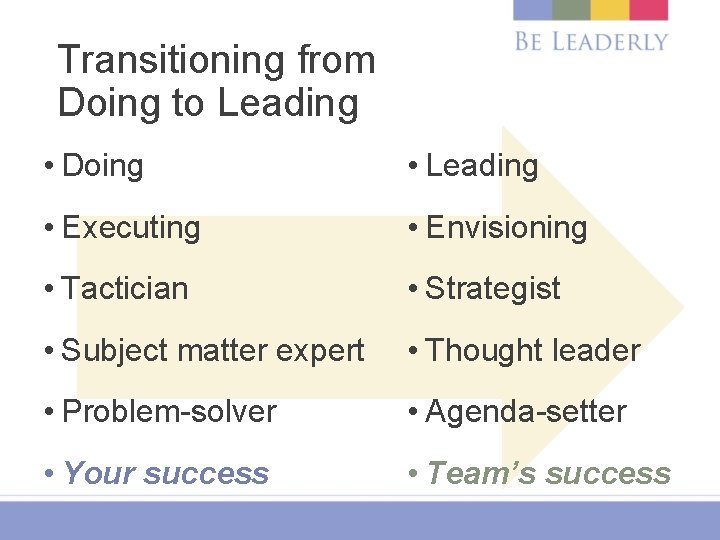
Transitioning from Doing to Leading • Doing • Leading • Executing • Envisioning • Tactician • Strategist • Subject matter expert • Thought leader • Problem-solver • Agenda-setter • Your success • Team’s success
In this session • Transitioning from Tactician to Strategist • Qualities of a Leader • Leading From Where You Are • Managing Up
Transitioning from Tactician to Strategist
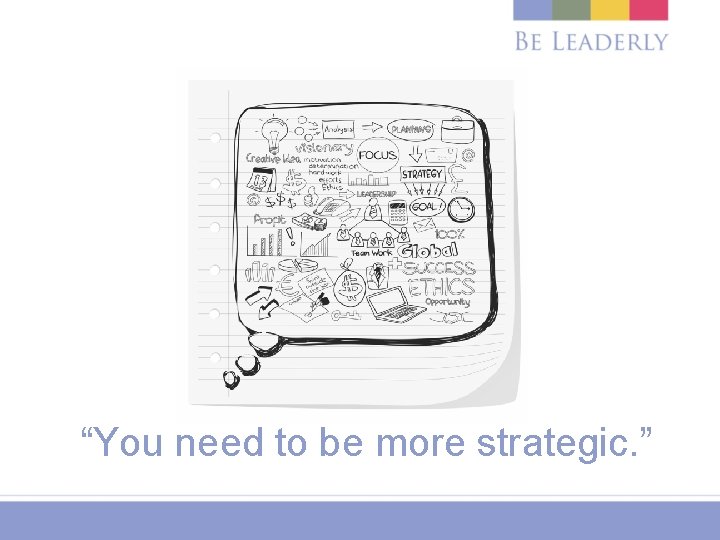
“You need to be more strategic. ”
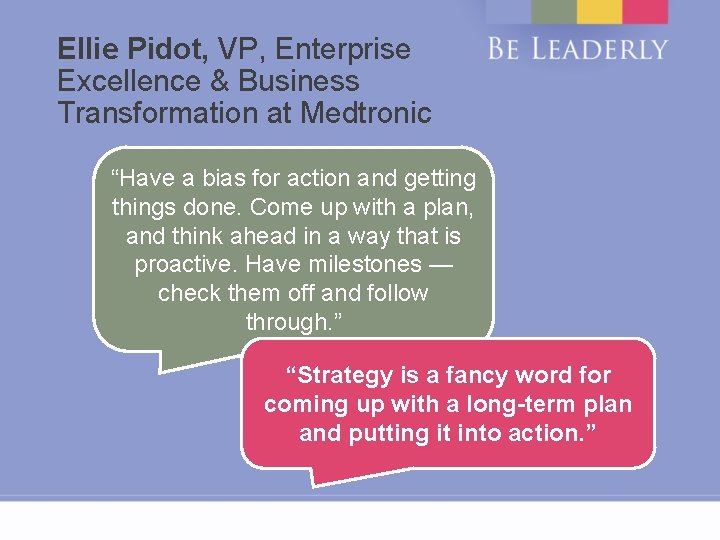
Ellie Pidot, VP, Enterprise Excellence & Business Transformation at Medtronic “Have a bias for action and getting things done. Come up with a plan, and think ahead in a way that is proactive. Have milestones — check them off and follow through. ” “Strategy is a fancy word for coming up with a long-term plan and putting it into action. ”
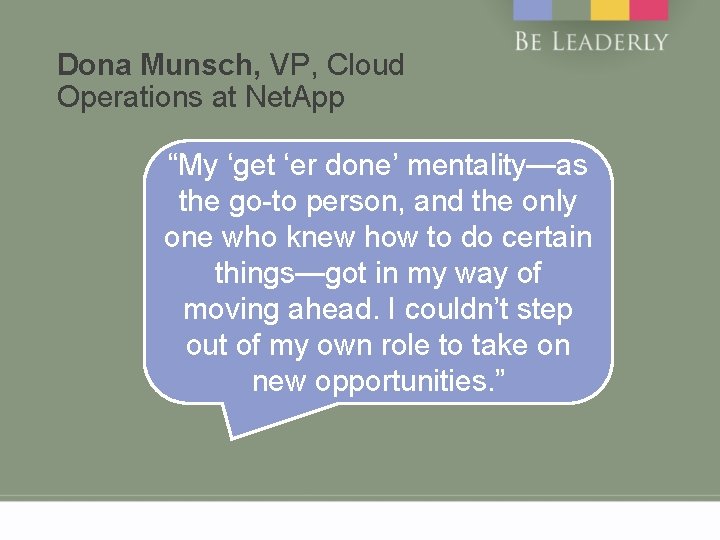
Dona Munsch, VP, Cloud Operations at Net. App “My ‘get ‘er done’ mentality—as the go-to person, and the only one who knew how to do certain things—got in my way of moving ahead. I couldn’t step out of my own role to take on new opportunities. ”
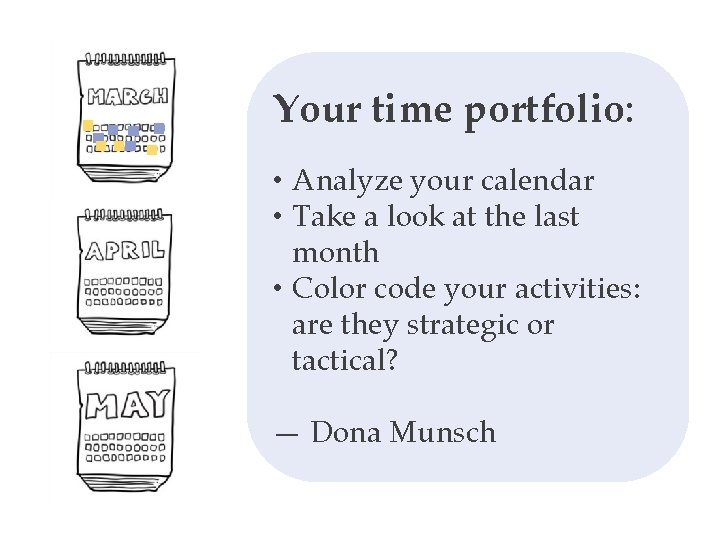
Your time portfolio: • Analyze your calendar • Take a look at the last month • Color code your activities: are they strategic or tactical? — Dona Munsch
Your Time Portfolio 1. Which activities will you let go of? 2. What will you do more of?
Qualities of a Leader
There’s more than one type of leader. • What’s your signature style?
Leading From Where You Are
” 84 percent of U. S. employees are ‘matrixed’ to some extent today” – meaning, they work on multiple teams every day. ” (Mc. Kinsey, 2016)
“Do not rely on positional power. Saying ‘do this because I said so’ is the weakest form of leadership. ” — Jody Mahoney, SVP Business Development and Industry Partners, Anita Borg Institute
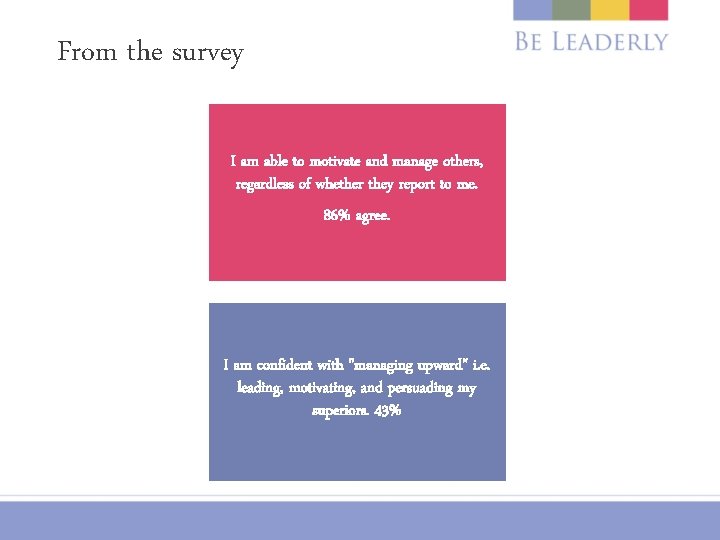
From the survey I am able to motivate and manage others, regardless of whether they report to me. 86% agree.
I asked 16 leaders… “What skills do you most appreciate seeing in employees who step up and lead without authority? ”
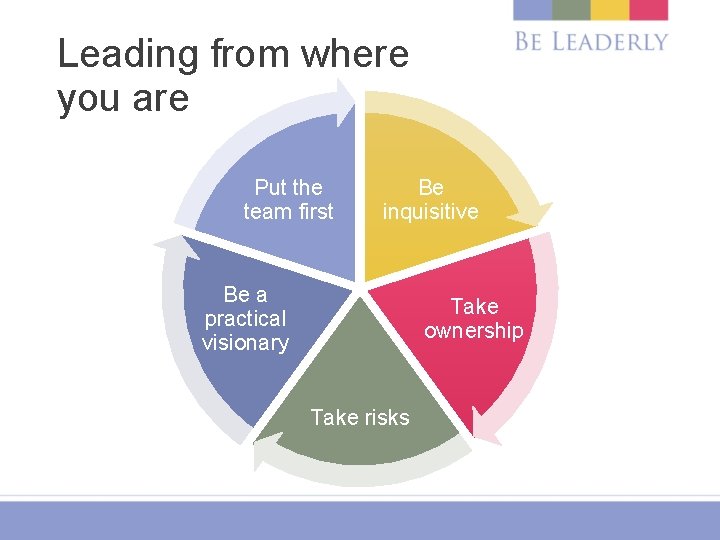
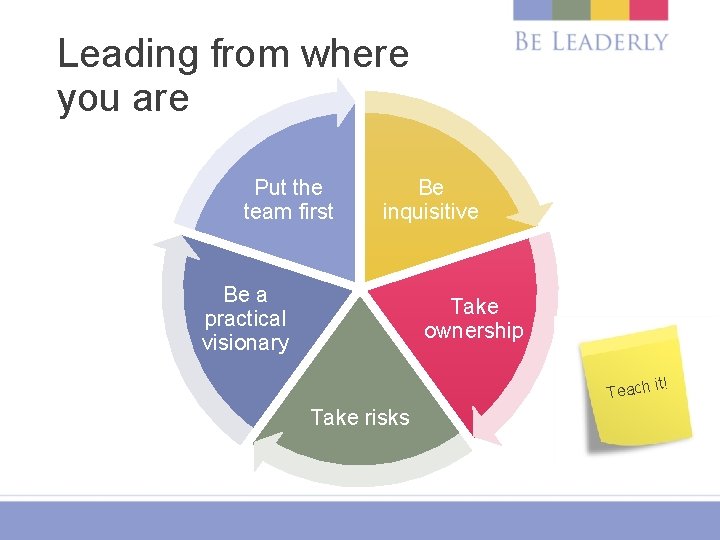
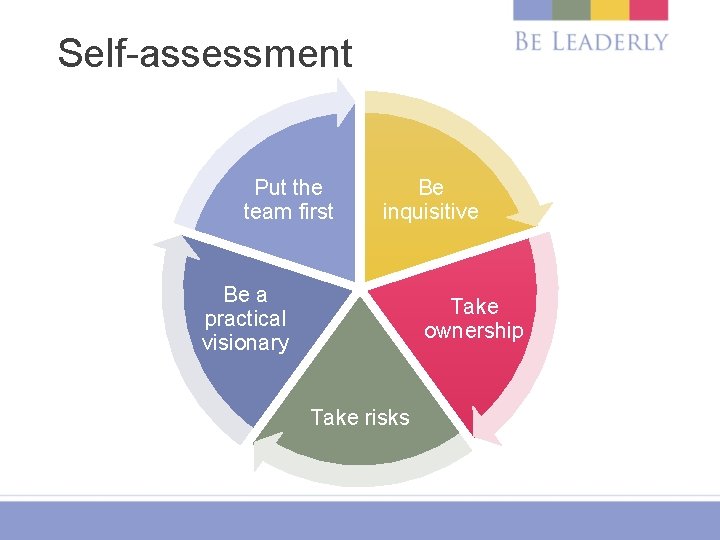
Leading from where you are Put the team first Be inquisitive Be a practical visionary Take ownership Take risks
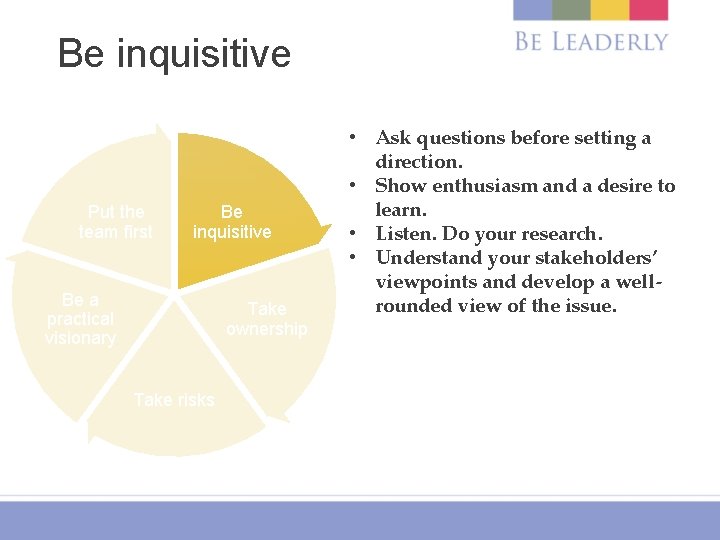
Be inquisitive Put the team first Be inquisitive Be a practical visionary Take ownership Take risks • Ask questions before setting a direction. • Show enthusiasm and a desire to learn. • Listen. Do your research. • Understand your stakeholders’ viewpoints and develop a wellrounded view of the issue.
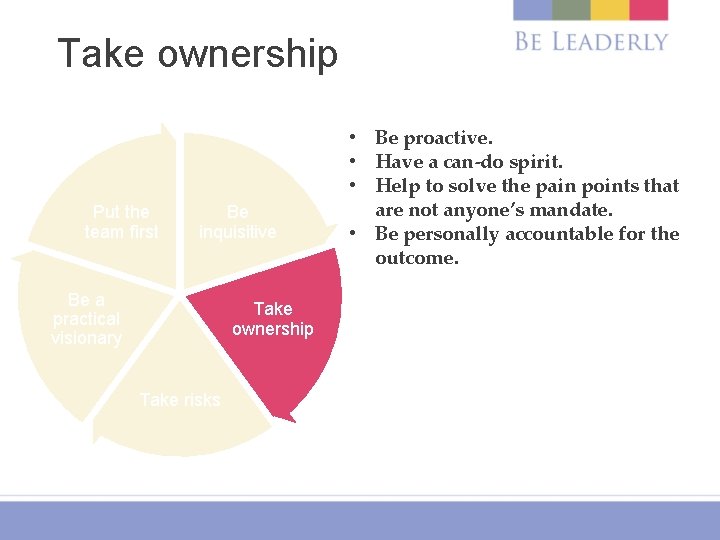
Take ownership Put the team first Be inquisitive Be a practical visionary Take ownership Take risks • Be proactive. • Have a can-do spirit. • Help to solve the pain points that are not anyone’s mandate. • Be personally accountable for the outcome.
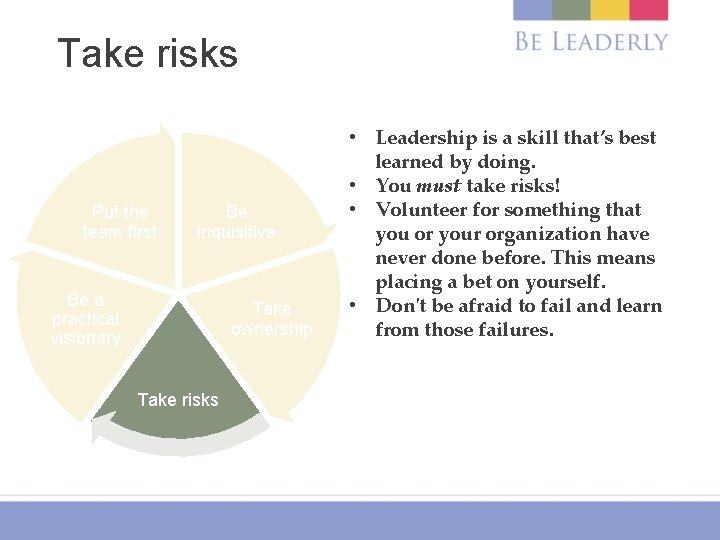
Take risks Put the team first Be inquisitive Be a practical visionary Take ownership Take risks • Leadership is a skill that’s best learned by doing. • You must take risks! • Volunteer for something that you or your organization have never done before. This means placing a bet on yourself. • Don't be afraid to fail and learn from those failures.
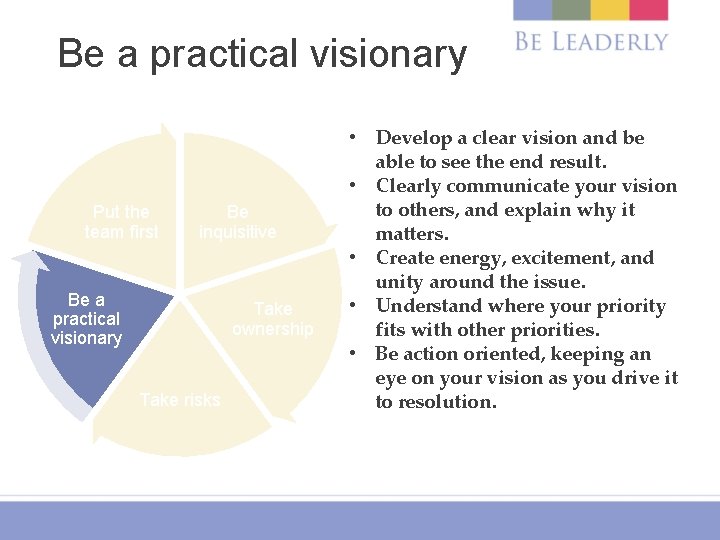
Be a practical visionary Put the team first Be inquisitive Be a practical visionary Take ownership Take risks • Develop a clear vision and be able to see the end result. • Clearly communicate your vision to others, and explain why it matters. • Create energy, excitement, and unity around the issue. • Understand where your priority fits with other priorities. • Be action oriented, keeping an eye on your vision as you drive it to resolution.
The Cause Effect “Hyper-successful projects have at their core a palpable cause. Rallying teams around this shared sense of purpose means tapping into their hearts. When the entire team builds collective identity around a common cause, the project transcends ‘work’ and becomes a mission. ” — Deloitte
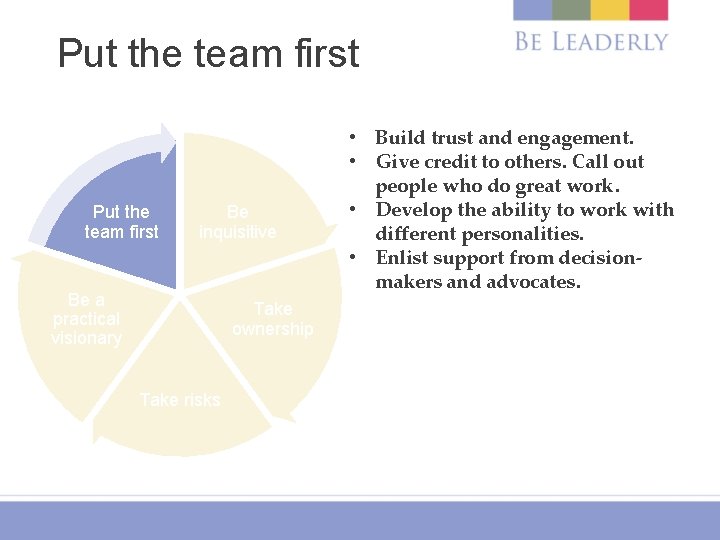
Put the team first Be inquisitive Be a practical visionary Take ownership Take risks • Build trust and engagement. • Give credit to others. Call out people who do great work. • Develop the ability to work with different personalities. • Enlist support from decisionmakers and advocates.
Leading from where you are Put the team first Be inquisitive Be a practical visionary Take ownership Teach Take risks it!
Self-assessment Put the team first Be inquisitive Be a practical visionary Take ownership Take risks
From the survey I am able to motivate and manage others, regardless of whether they report to me. 86% agree. I am confident with "managing upward" i. e. leading, motivating, and persuading my superiors. 43%
Leading Your Leaders
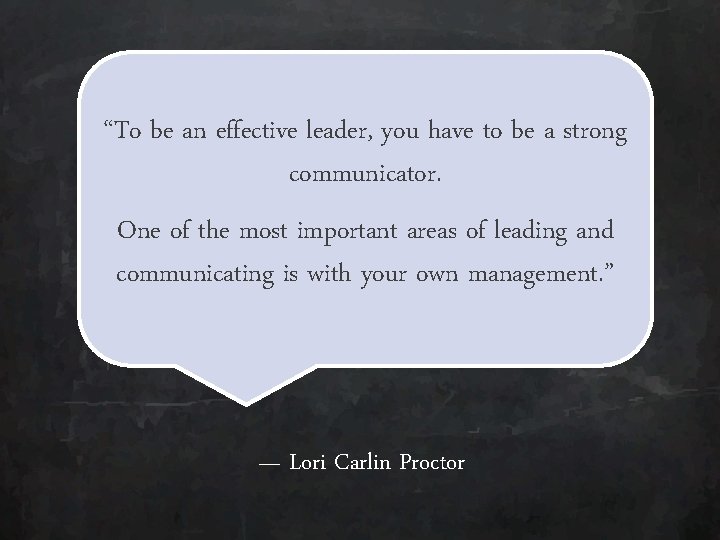
“To be an effective leader, you have to be a strong communicator. One of the most important areas of leading and communicating is with your own management. ” — Lori Carlin Proctor
1) Understand your leaders and their goals
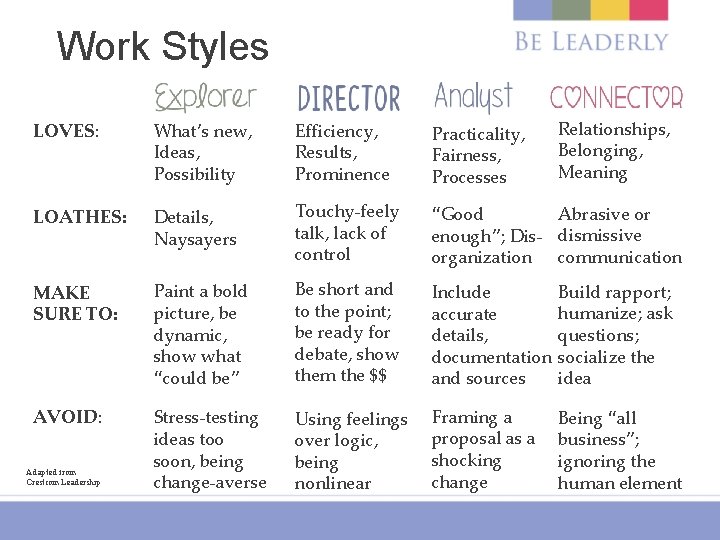
Work Styles Relationships, Belonging, Meaning LOVES: What’s new, Ideas, Possibility Efficiency, Results, Prominence Practicality, Fairness, Processes LOATHES: Details, Naysayers Touchy-feely talk, lack of control Abrasive or “Good enough”; Dis- dismissive organization communication MAKE SURE TO: Paint a bold picture, be dynamic, show what “could be” Be short and to the point; be ready for debate, show them the $$ Include accurate details, documentation and sources Build rapport; humanize; ask questions; socialize the idea AVOID: Stress-testing ideas too soon, being change-averse Using feelings over logic, being nonlinear Framing a proposal as a shocking change Being “all business”; ignoring the human element Adapted from Crestcom Leadership
See The World Through Their Eyes… I’m passionate about… I’m responsible for… My workstyle is… I tend to say “Yes” to… You could really wow me by… My stresses & pressures include… Name:
2) Communicate persuasively
Pick it, Productize it, Pitch it!
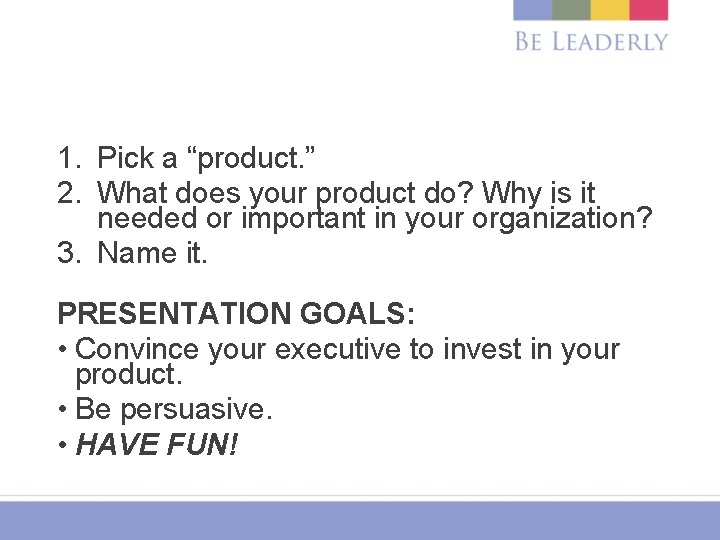
1. Pick a “product. ” 2. What does your product do? Why is it needed or important in your organization? 3. Name it. PRESENTATION GOALS: • Convince your executive to invest in your product. • Be persuasive. • HAVE FUN!
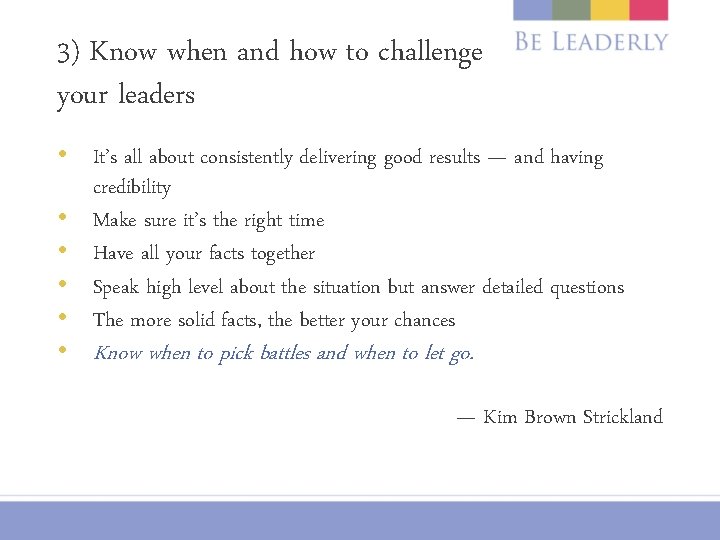
3) Know when and how to challenge your leaders • It’s all about consistently delivering good results — and having credibility • Make sure it’s the right time • Have all your facts together • Speak high level about the situation but answer detailed questions • The more solid facts, the better your chances • Know when to pick battles and when to let go. — Kim Brown Strickland
The key is having a good case and not backing down if at first they don’t agree. Be politely persistent. — Kim Brown Strickland
In this session • Transitioning from Tactician to Strategist • Qualities of a Leader • Leading From Where You Are • Managing Up
If you want to leave a lasting leadership legacy: L 3