
Hitech bank robbery Erik Poll Digital Security Radboud
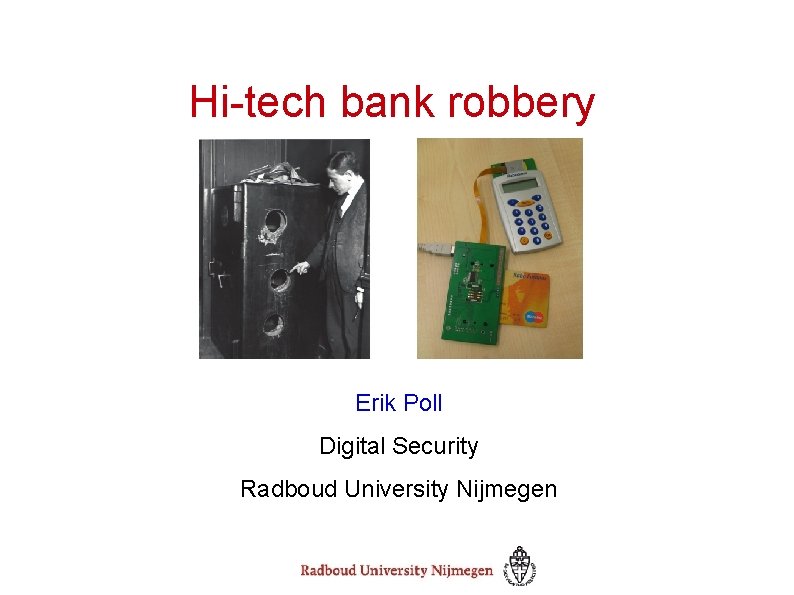
Hi-tech bank robbery Erik Poll Digital Security Radboud University Nijmegen
Overview • Some historical anecdotes & trends in e-banking fraud 1. skimming 2. EMV (het nieuwe pinnen) 3. online banking • incl. some of our own research on more rigorous design and analysis Joint work Ph. D students Joeri de Ruiter and Fides Aarts, and MSc students Arjan Blom, Jordi van den Breekel, Georg Chalupar, Anton Jongsma, Robert Kleinpenning, Peter Maandag, and Stefan Peherstorfer. Are there any lessons to be learnt for other fields? Erik Poll 2

Skimming
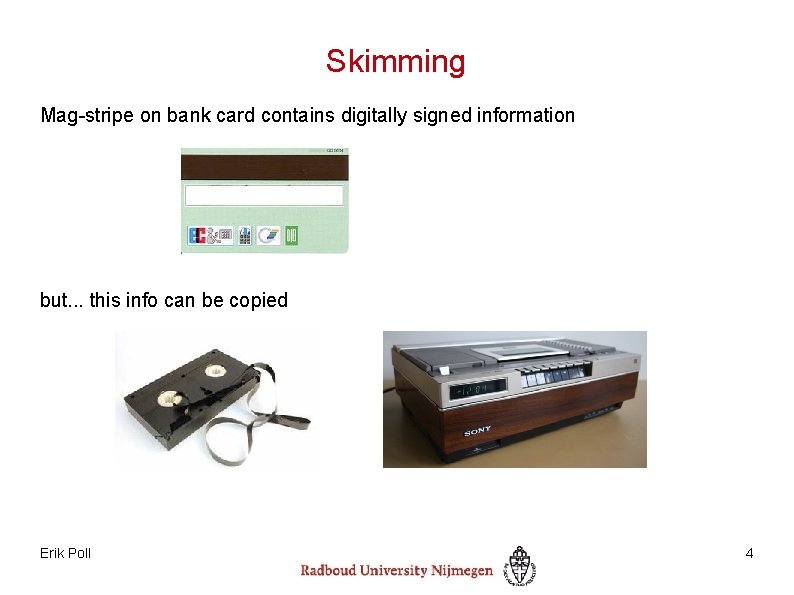
Skimming Mag-stripe on bank card contains digitally signed information but. . . this info can be copied Erik Poll 4
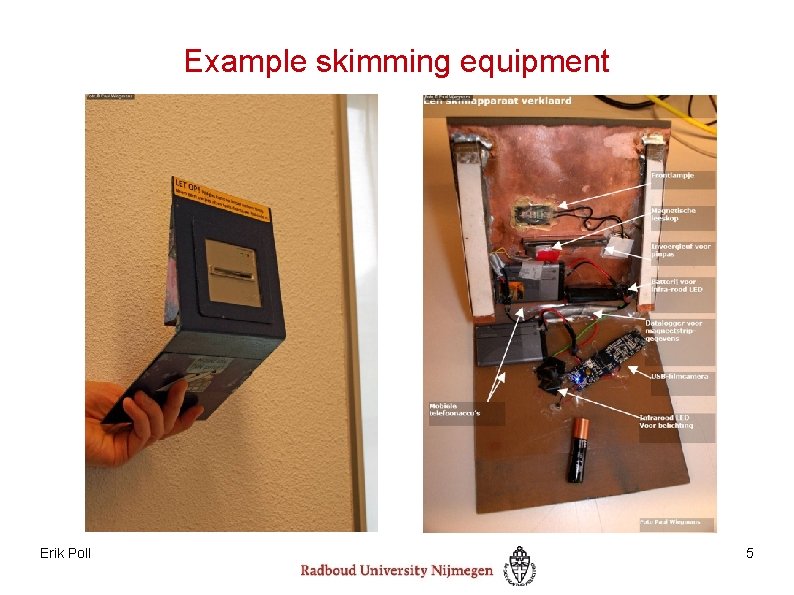
Example skimming equipment Erik Poll 5
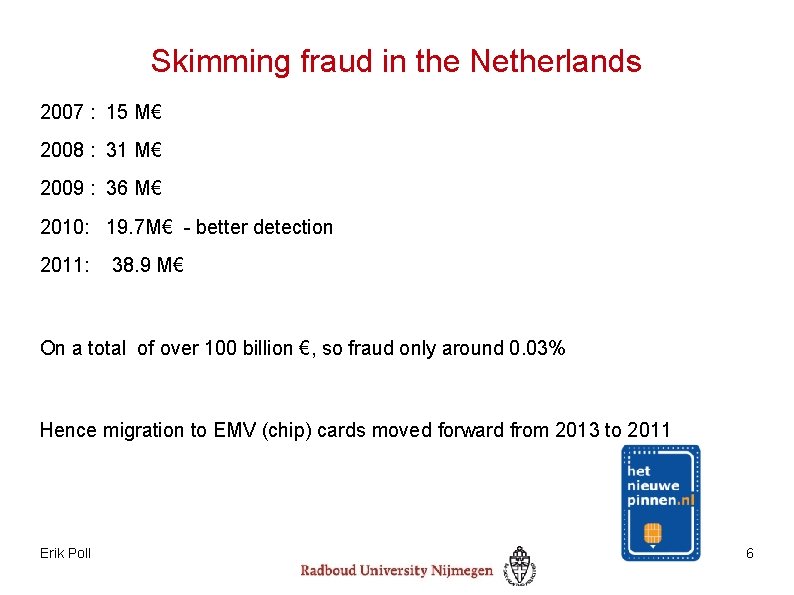
Skimming fraud in the Netherlands 2007 : 15 M€ 2008 : 31 M€ 2009 : 36 M€ 2010: 19. 7 M€ - better detection 2011: 38. 9 M€ On a total of over 100 billion €, so fraud only around 0. 03% Hence migration to EMV (chip) cards moved forward from 2013 to 2011 Erik Poll 6
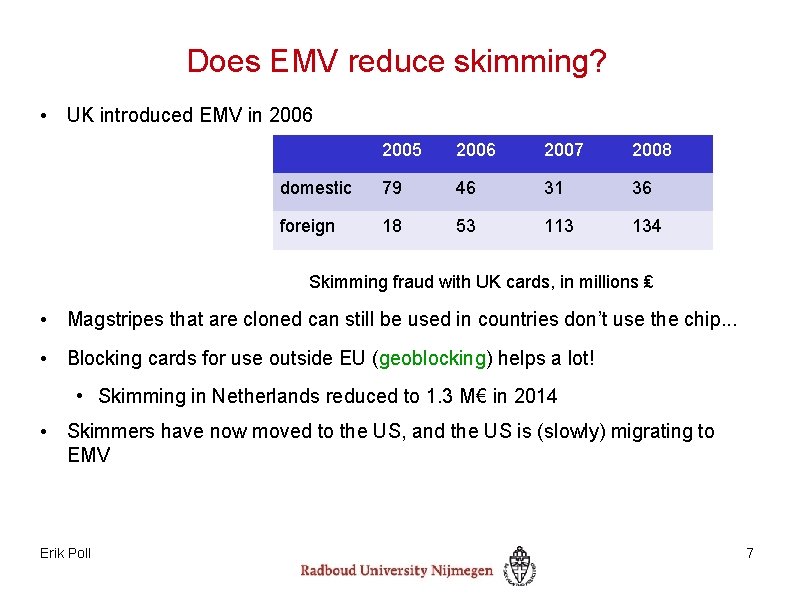
Does EMV reduce skimming? • UK introduced EMV in 2006 2005 2006 2007 2008 domestic 79 46 31 36 foreign 18 53 113 134 Skimming fraud with UK cards, in millions ₤ • Magstripes that are cloned can still be used in countries don’t use the chip. . . • Blocking cards for use outside EU (geoblocking) helps a lot! • Skimming in Netherlands reduced to 1. 3 M€ in 2014 • Skimmers have now moved to the US, and the US is (slowly) migrating to EMV Erik Poll 7
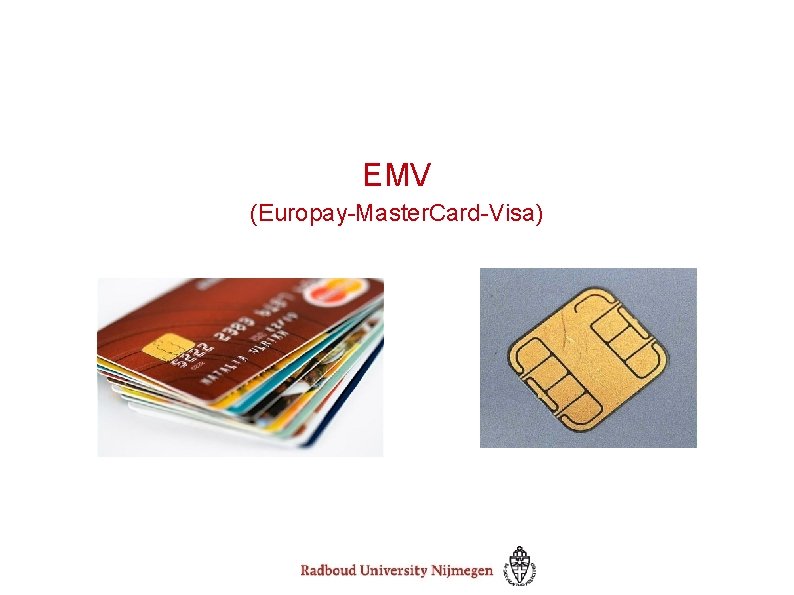
EMV (Europay-Master. Card-Visa)
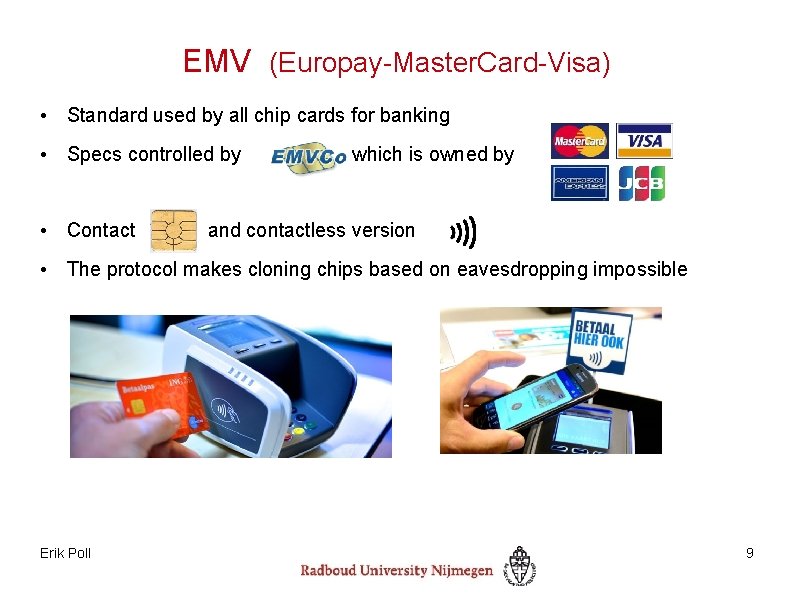
EMV (Europay-Master. Card-Visa) • Standard used by all chip cards for banking • Specs controlled by • Contact which is owned by and contactless version • The protocol makes cloning chips based on eavesdropping impossible Erik Poll 9
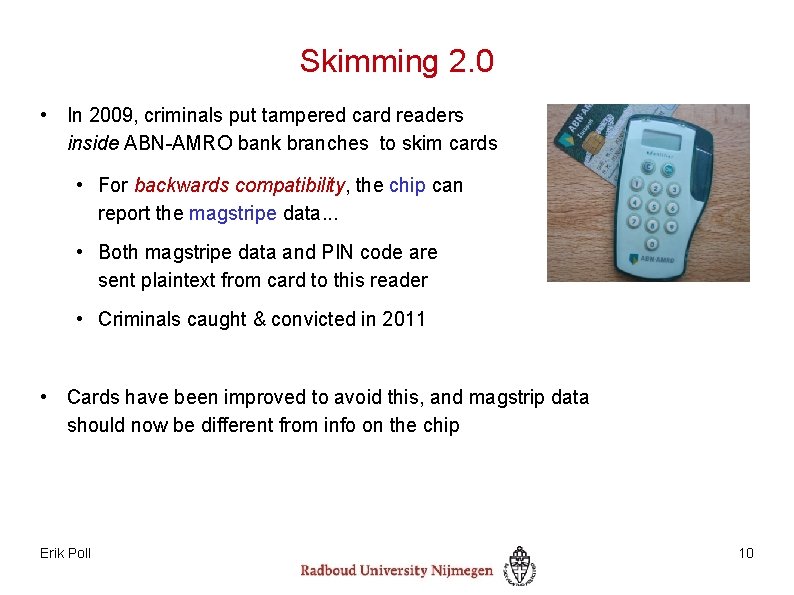
Skimming 2. 0 • In 2009, criminals put tampered card readers inside ABN-AMRO bank branches to skim cards • For backwards compatibility, the chip can report the magstripe data. . . • Both magstripe data and PIN code are sent plaintext from card to this reader • Criminals caught & convicted in 2011 • Cards have been improved to avoid this, and magstrip data should now be different from info on the chip Erik Poll 10
Problem: complexity EMV is not a protocol, but a ‘protocol toolkit suite’ with lots of configuration options • Original EMV specs : 4 books, > 700 pages • 3 types of cards (SDA, DDA, CDA), 5 authentication mechanism (online PIN, offline encrypted PIN, signature, none), 2 types of transactions (offline, online), . . • Additional EMV contactless specs: another 10 books, > 2000 pages • yet more modes and options. . Sample sentence “If the card responds to GPO with SW 1 SW 2 = x 9000 and AIP byte 2 bit 8 set to 0, and if the reader supports q. VSDC and contactless VSDC, then if the Application Cryptogram (Tag '9 F 26') is present in the GPO response, then the reader shall process the transaction as q. VSDC, and if Tag '9 F 26' is not present, then the reader shall process the transaction as VSDC. ” Erik Poll 11
Complexity: example protocol flaw Terminal can choose to do offline PIN • ie. terminal asks the card to check the PIN code The response of the card is not authenticated • ie. it is not cryptographically signed or MAC-ed so the terminal can be fooled by a Man-in-the-Middle attack The transaction data will reveal the transaction was PIN-less, bank back-end will know the PIN was not entered so the [Stephen Murdoch et al. , Chip & PIN is broken, FC’ 2010] Erik Poll 12
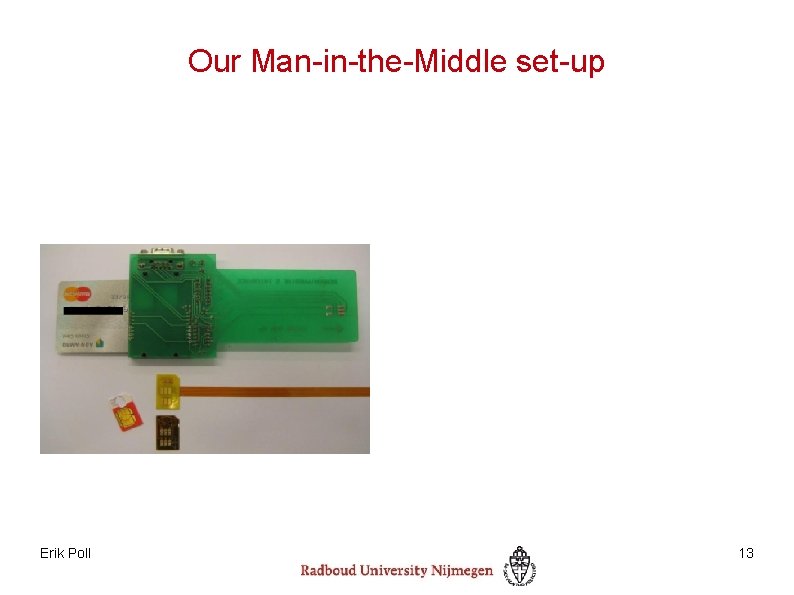
Our Man-in-the-Middle set-up Erik Poll 13
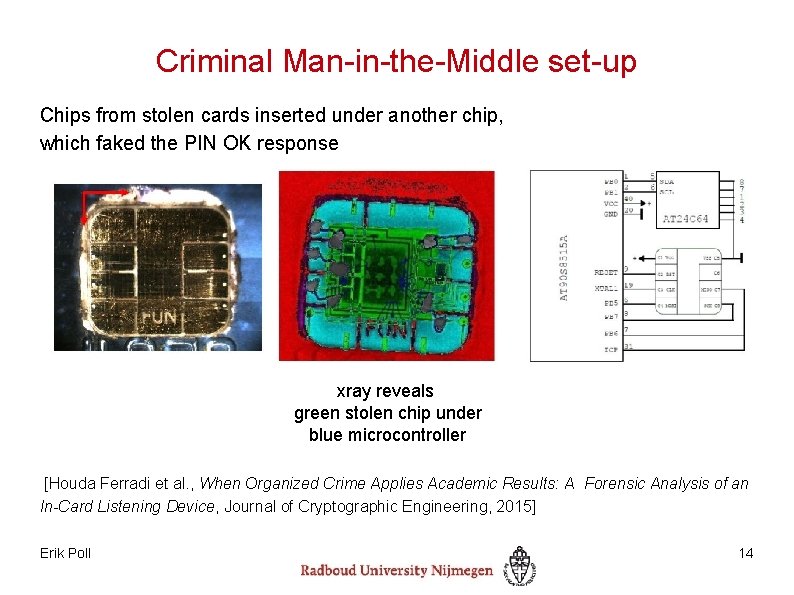
Criminal Man-in-the-Middle set-up Chips from stolen cards inserted under another chip, which faked the PIN OK response xray reveals green stolen chip under blue microcontroller [Houda Ferradi et al. , When Organized Crime Applies Academic Results: A Forensic Analysis of an In-Card Listening Device, Journal of Cryptographic Engineering, 2015] Erik Poll 14
Complexity of EMV specs • Moral of the story: specs too complex to understand • long documents • little or no discussion of security goals or design choices • little abstraction or modularity • Who really takes responsibility for ensuring these specs are secure? EMVCo, the credit card companies behind EMVCo, or individual banks? • Can we provide some scientific rigour? Erik Poll 15
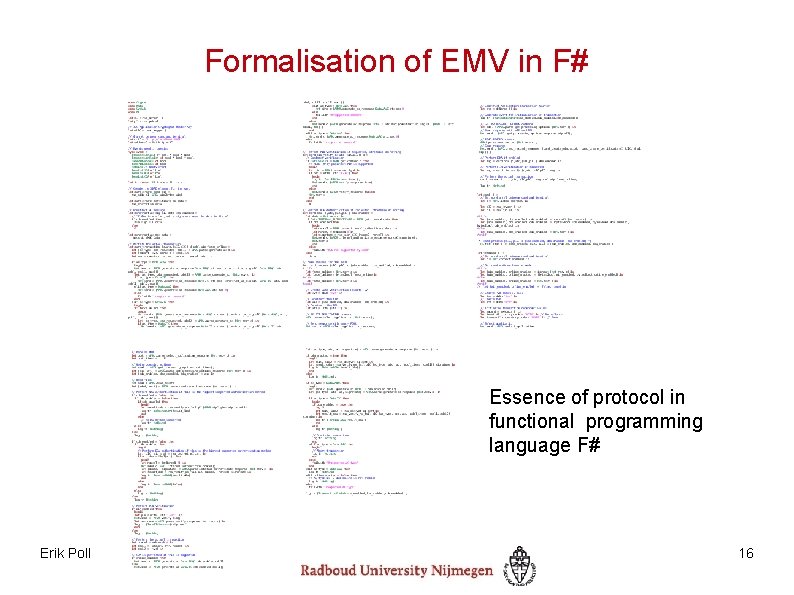
Formalisation of EMV in F# Essence of protocol in functional programming language F# Erik Poll 16
Formal Analysis of EMV • Essence of EMV (all variants!) can be formalized in less than 700 lines of F# code • This model be analysed for security flaws using Pro. Verif tool • No new attacks found, but existing attacks inevitably (re)discovered [Joeri de Ruiter and Erik Poll, Formal Analysis of the EMV protocol suite, TOSCA 2012] This still leaves the question if the software implementing these standards is correct! Erik Poll 17
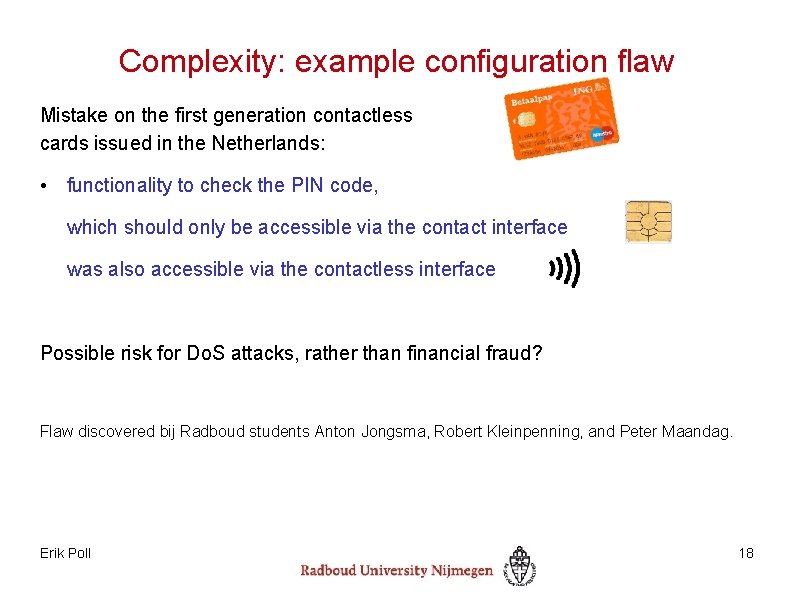
• A Security Evaluation and Proof-of-Concept Relay Attack on Dutch EMV Contactless Transac Complexity: example configuration flaw Mistake on the first generation contactless cards issued in the Netherlands: • functionality to check the PIN code, which should only be accessible via the contact interface was also accessible via the contactless interface Possible risk for Do. S attacks, rather than financial fraud? Flaw discovered bij Radboud students Anton Jongsma, Robert Kleinpenning, and Peter Maandag. Erik Poll 18
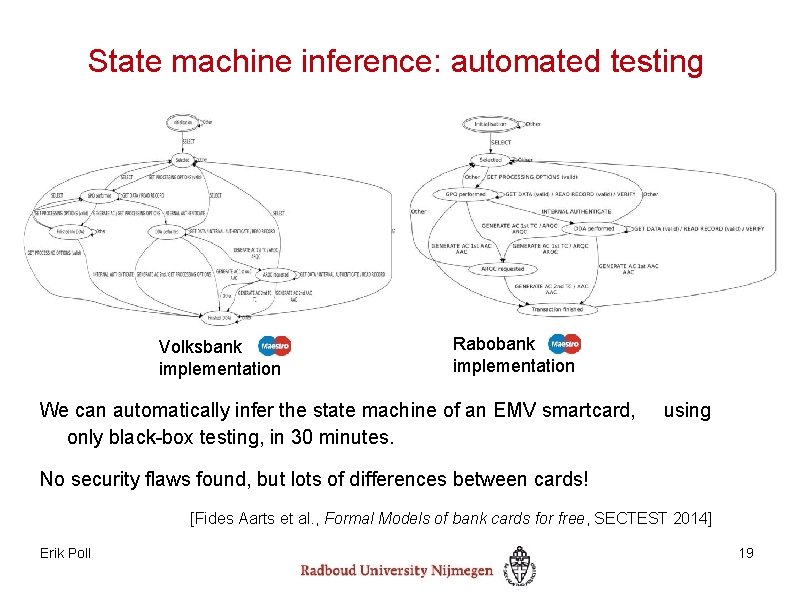
State machine inference: automated testing Volksbank implementation Rabobank implementation We can automatically infer the state machine of an EMV smartcard, only black-box testing, in 30 minutes. using No security flaws found, but lots of differences between cards! [Fides Aarts et al. , Formal Models of bank cards for free, SECTEST 2014] Erik Poll 19
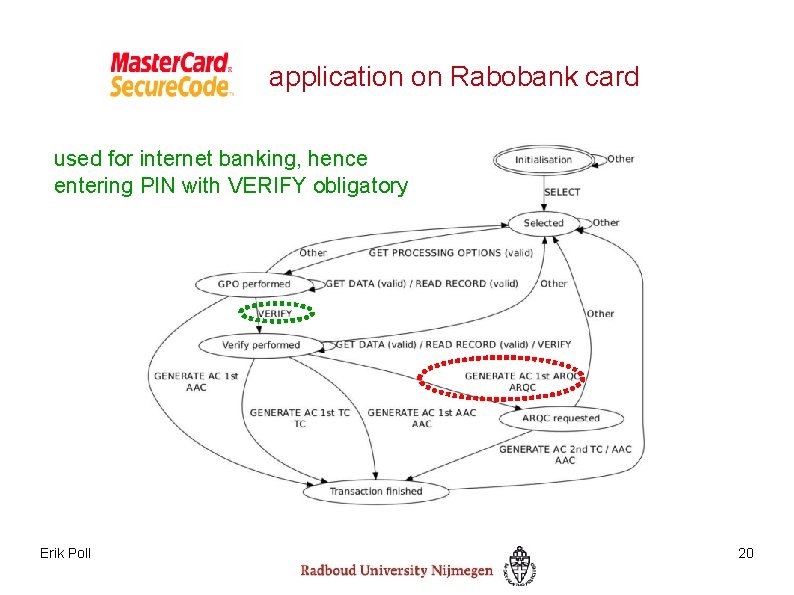
application on Rabobank card used for internet banking, hence entering PIN with VERIFY obligatory Erik Poll 20
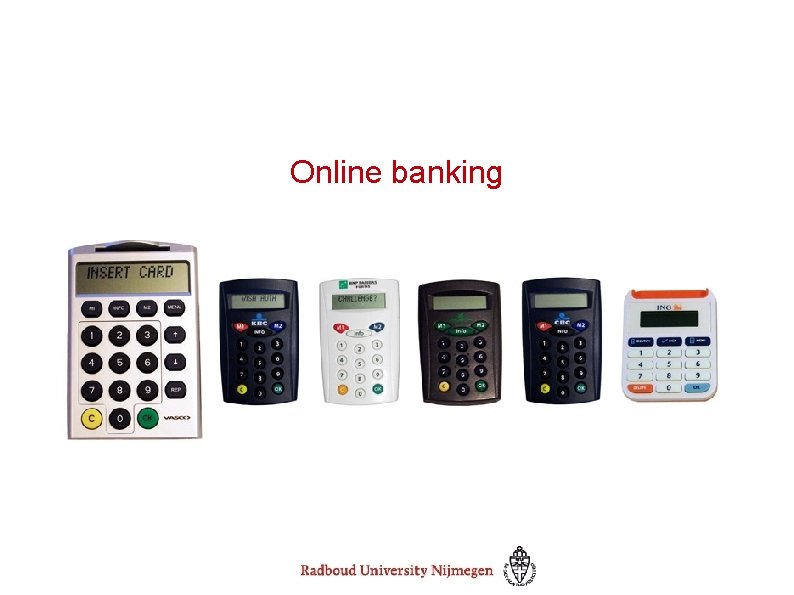
Online banking
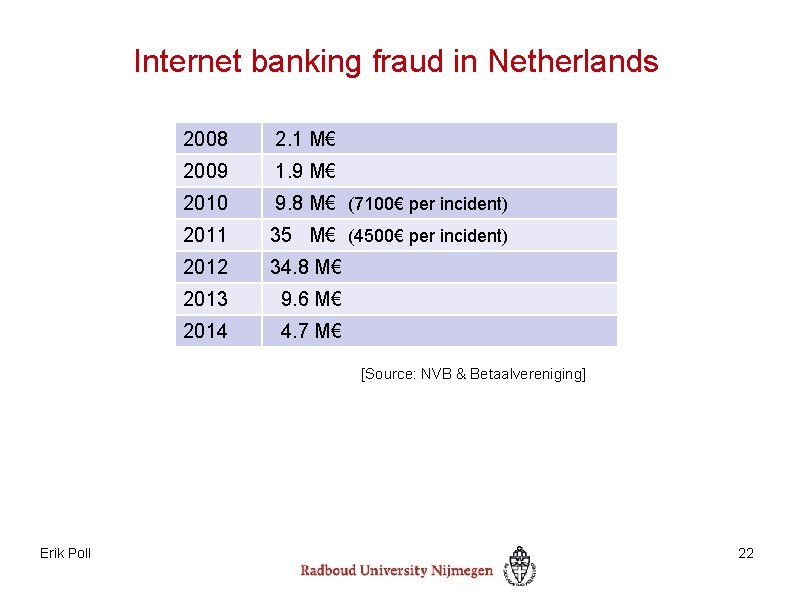
Internet banking fraud in Netherlands 2008 2. 1 M€ 2009 1. 9 M€ 2010 9. 8 M€ (7100€ per incident) 2011 35 M€ (4500€ per incident) 2012 34. 8 M€ 2013 9. 6 M€ 2014 4. 7 M€ [Source: NVB & Betaalvereniging] Erik Poll 22
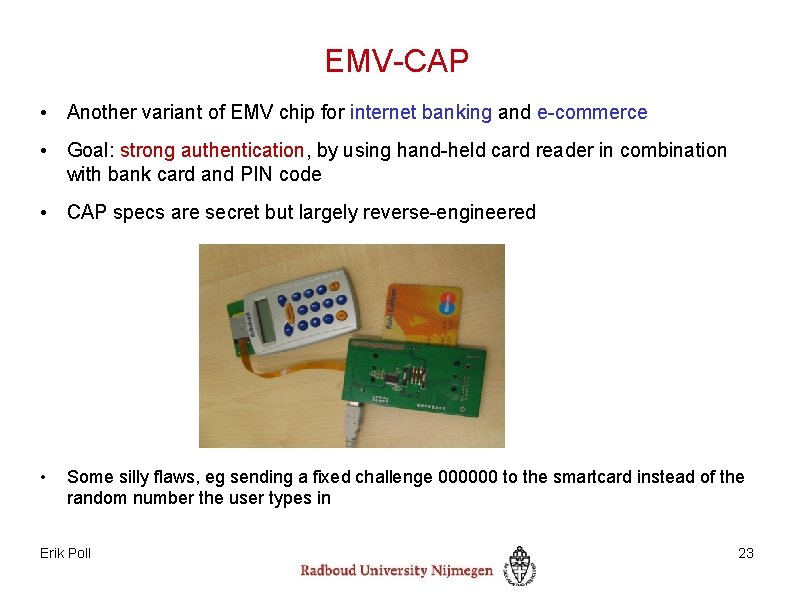
EMV-CAP • Another variant of EMV chip for internet banking and e-commerce • Goal: strong authentication, by using hand-held card reader in combination with bank card and PIN code • CAP specs are secret but largely reverse-engineered • Some silly flaws, eg sending a fixed challenge 000000 to the smartcard instead of the random number the user types in Erik Poll 23
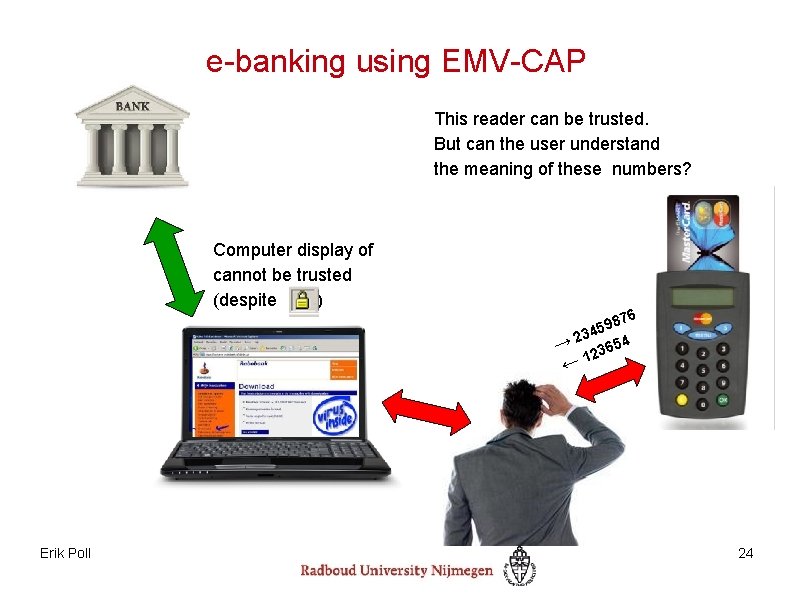
e-banking using EMV-CAP This reader can be trusted. But can the user understand the meaning of these numbers? Computer display of cannot be trusted (despite ) 876 9 5 34 → 2 23654 1 ← Erik Poll 24
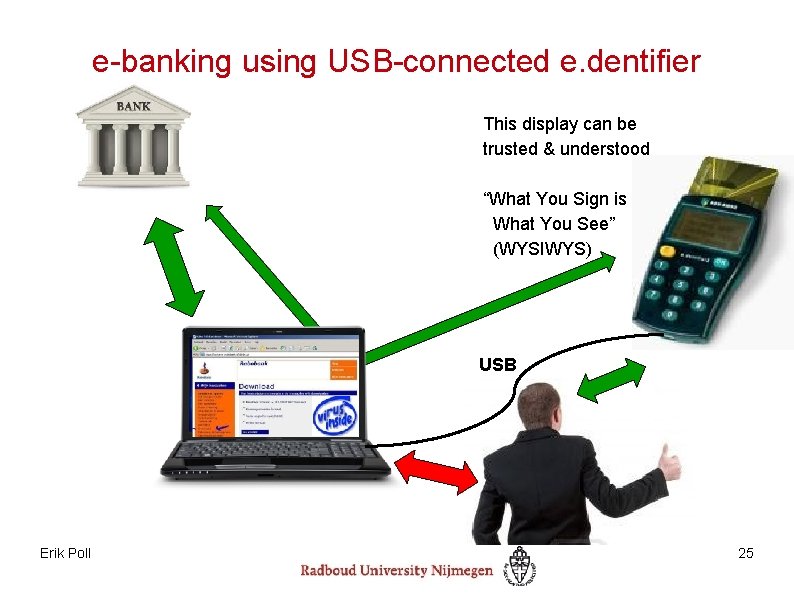
e-banking using USB-connected e. dentifier This display can be trusted & understood “What You Sign is What You See” (WYSIWYS) USB Erik Poll 25
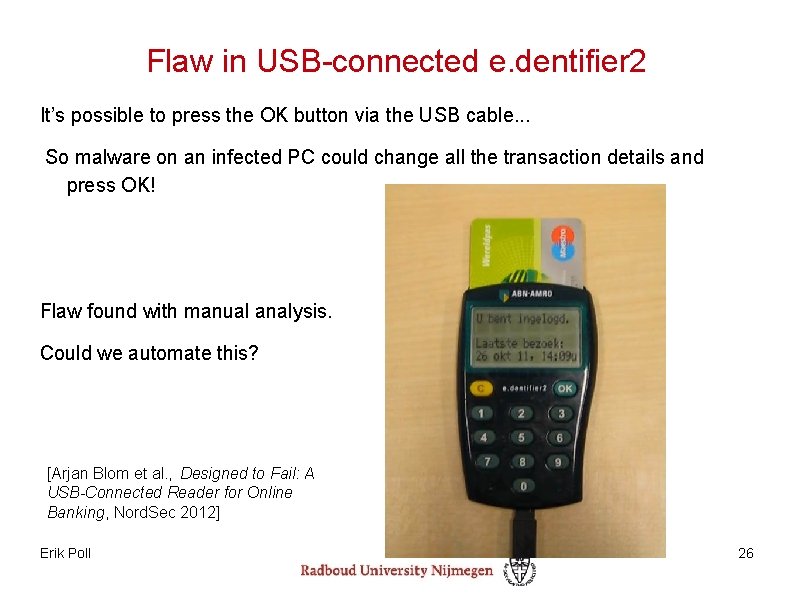
Flaw in USB-connected e. dentifier 2 It’s possible to press the OK button via the USB cable. . . So malware on an infected PC could change all the transaction details and press OK! Flaw found with manual analysis. Could we automate this? [Arjan Blom et al. , Designed to Fail: A USB-Connected Reader for Online Banking, Nord. Sec 2012] Erik Poll 26
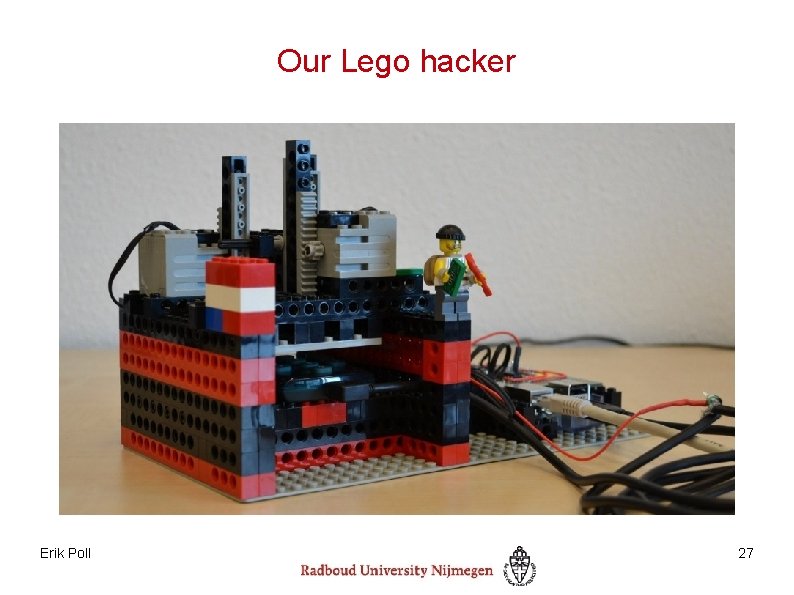
Our Lego hacker Erik Poll 27
Erik Poll 28
Our Lego hacker Erik Poll 29
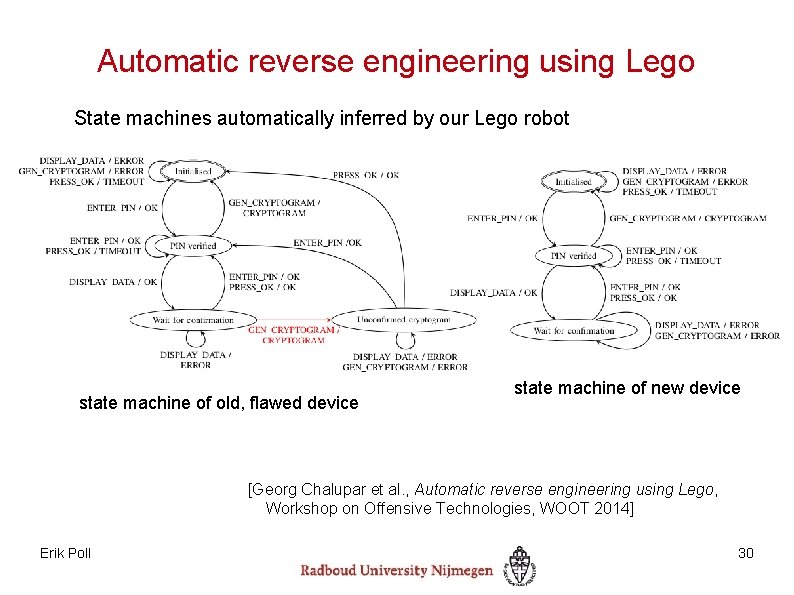
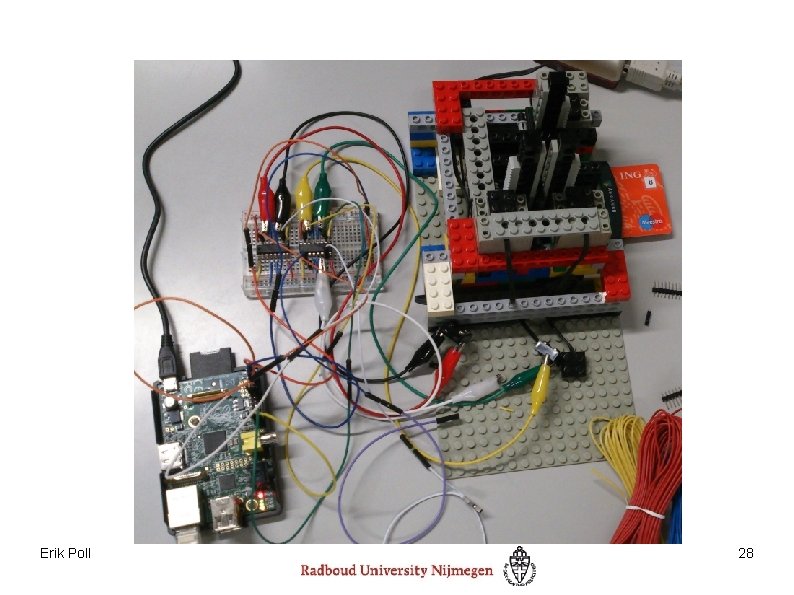
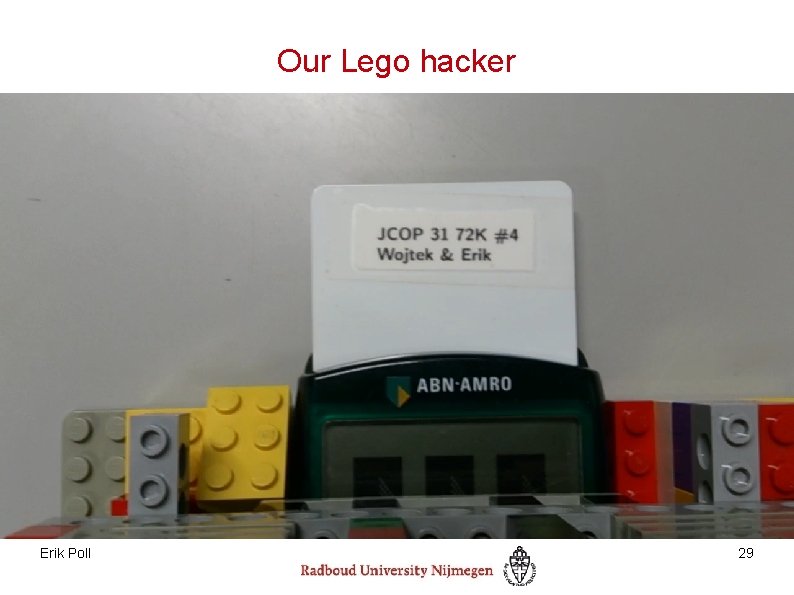
Automatic reverse engineering using Lego State machines automatically inferred by our Lego robot state machine of old, flawed device state machine of new device [Georg Chalupar et al. , Automatic reverse engineering using Lego, Workshop on Offensive Technologies, WOOT 2014] Erik Poll 30
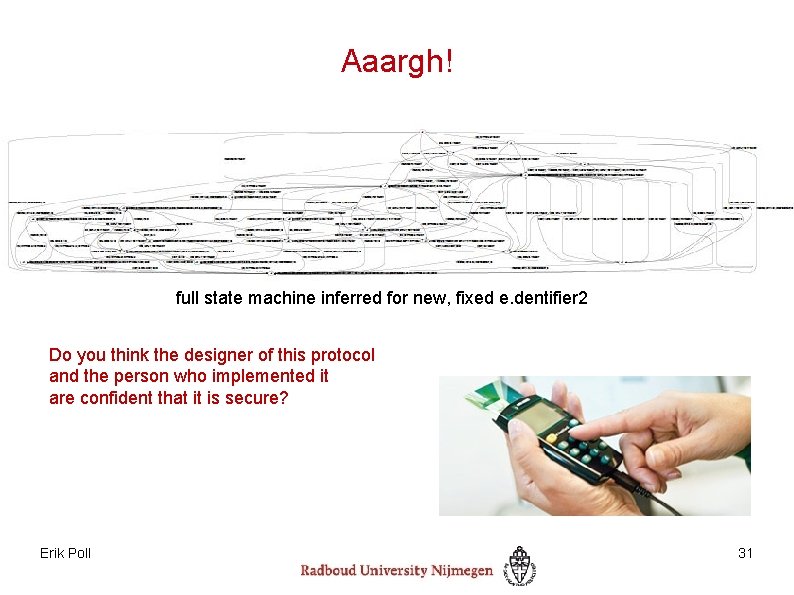
Aaargh! full state machine inferred for new, fixed e. dentifier 2 Do you think the designer of this protocol and the person who implemented it are confident that it is secure? Erik Poll 31

Conclusions
Conclusions • Banking products are not always as secure as you would hope or expect. • Not so clear who is taking responsibility for checking them. • Master. Card and Visa? EMVCo? Individual banks? Their suppliers? The Dutch or European Central Bank? • Trend: from prevention to better detection & quick reaction. • Complexity is bad! • Assurance of security is hard! How to prevent design, programming & configuration flaws? Erik Poll 33
Conclusions • Technical security flaws are not always serious risks. Criminals are very creative with ‘low-tech’ attacks. The real issue: can attacker find a good business model? • The bottleneck in internet banking fraud: recruiting money mules • Maybe ransomware is more lucrative? • Banks are an interesting target for cybercriminals, BUT. . . banks can measure fraud and use this to decide on improvements! For other organisations this can be much harder! Erik Poll 34
- Slides: 34