
4 6 15 Jim Crow Laws DO NOW

- Slides: 23
4 -6 -15 Jim Crow Laws DO NOW: Give one example of a Jim Crow Law AGENDA ANALYZE & APPLY DATA INTERPRET & DRAW CONCLUSIONS USING MULTIMEDIA SUMMARIZE & GENERALIZE NOTES ORGANIZE & CLASSIFY DATA IN WORKBOOKS PROJECTSINVENT/CONNECT/COMPARE/CONTRAST
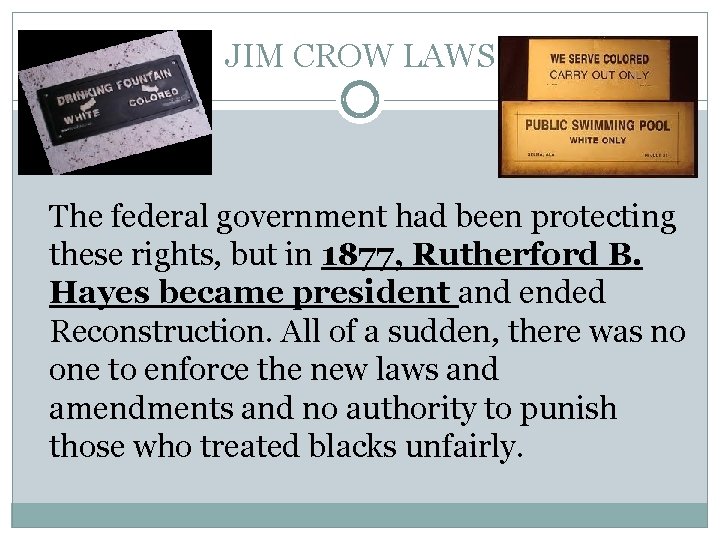
JIM CROW LAWS The federal government had been protecting these rights, but in 1877, Rutherford B. Hayes became president and ended Reconstruction. All of a sudden, there was no one to enforce the new laws and amendments and no authority to punish those who treated blacks unfairly.
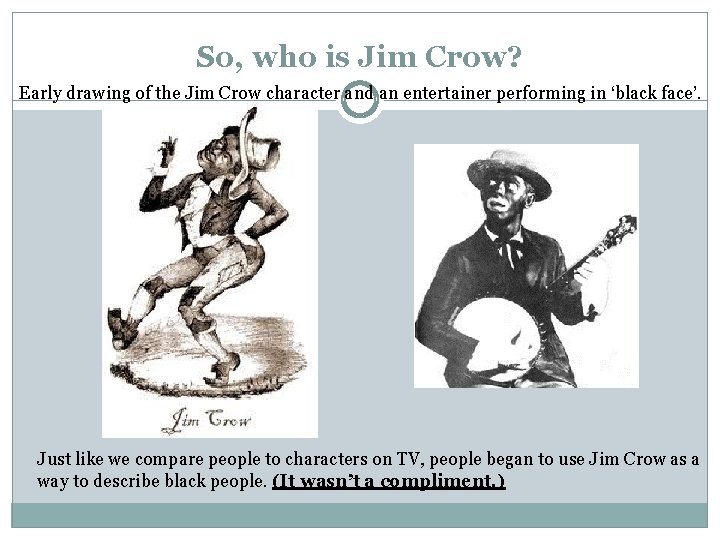
So, who is Jim Crow? Early drawing of the Jim Crow character and an entertainer performing in ‘black face’. Just like we compare people to characters on TV, people began to use Jim Crow as a way to describe black people. (It wasn’t a compliment. )
Black Codes �Segregation is when people are separated by race. �The Black Codes limited the rights and freedoms of black people.
Jim Crow Laws �Education �Marriage and Family �Public Accommodation �Voting Rights �Transportation
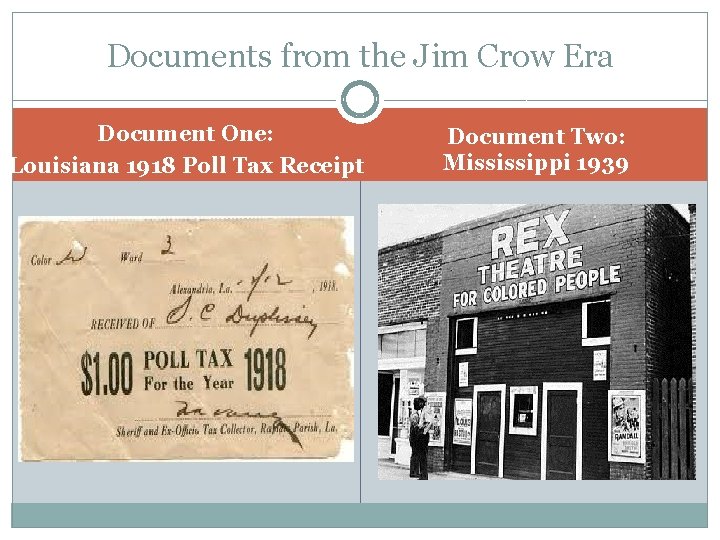
Documents from the Jim Crow Era Document One: Louisiana 1918 Poll Tax Receipt Document Two: Mississippi 1939
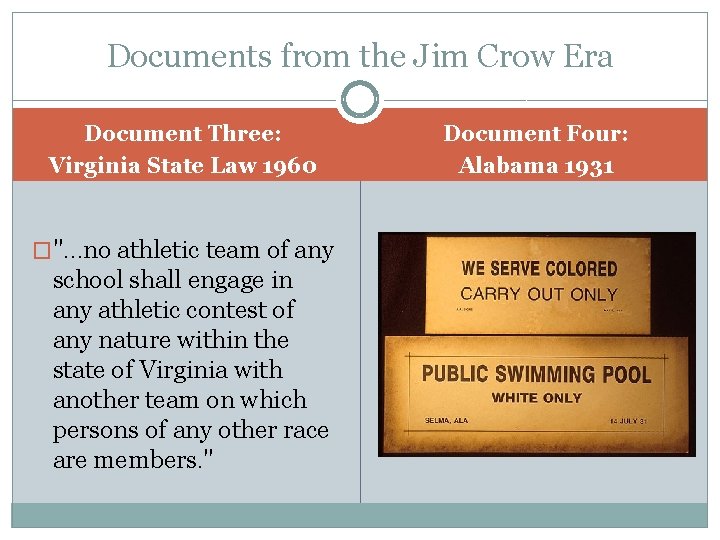
Documents from the Jim Crow Era Document Three: Virginia State Law 1960 �"…no athletic team of any school shall engage in any athletic contest of any nature within the state of Virginia with another team on which persons of any other race are members. " Document Four: Alabama 1931
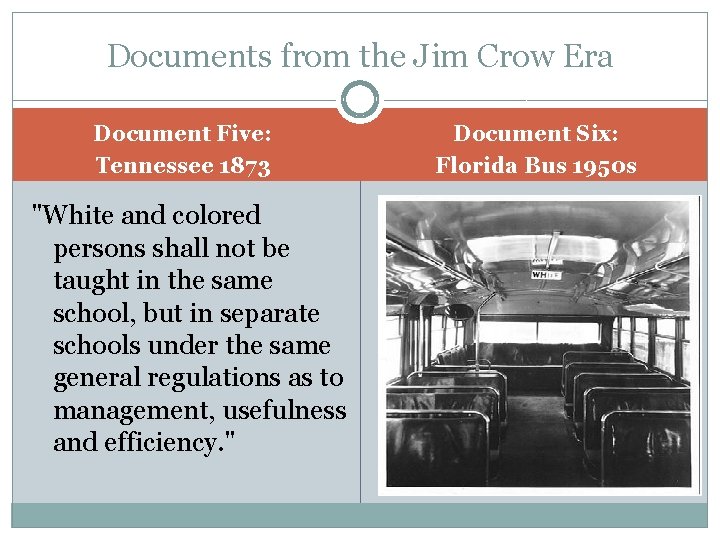
Documents from the Jim Crow Era Document Five: Tennessee 1873 "White and colored persons shall not be taught in the same school, but in separate schools under the same general regulations as to management, usefulness and efficiency. " Document Six: Florida Bus 1950 s
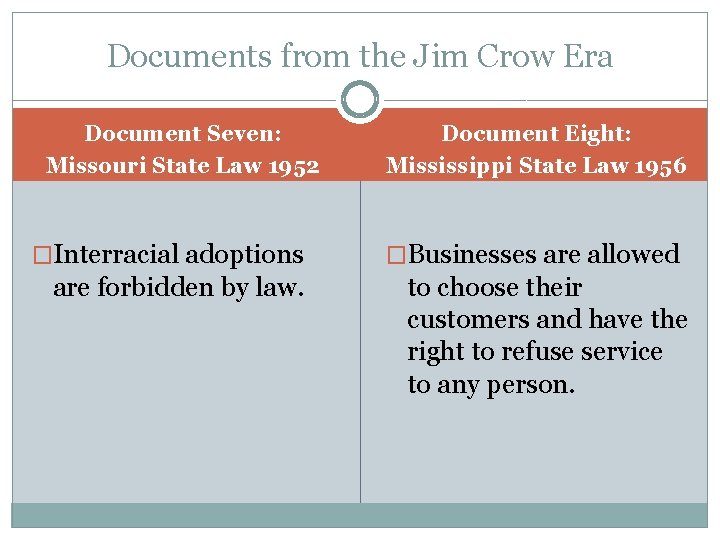
Documents from the Jim Crow Era Document Seven: Missouri State Law 1952 �Interracial adoptions are forbidden by law. Document Eight: Mississippi State Law 1956 �Businesses are allowed to choose their customers and have the right to refuse service to any person.
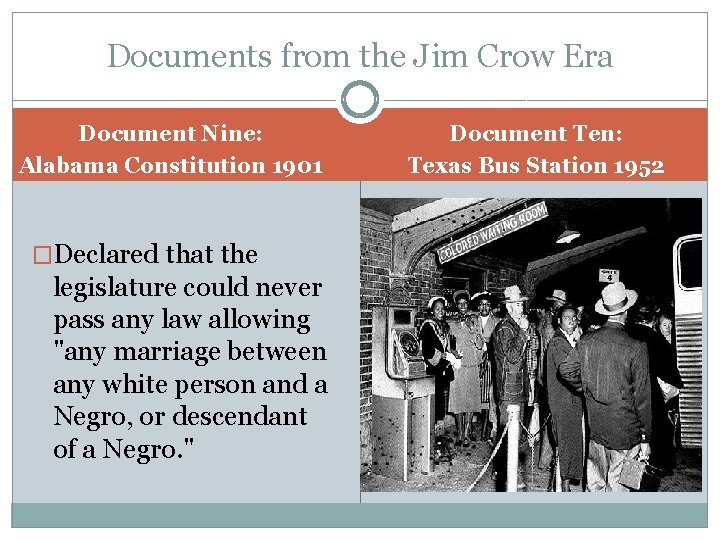
Documents from the Jim Crow Era Document Nine: Alabama Constitution 1901 �Declared that the legislature could never pass any law allowing "any marriage between any white person and a Negro, or descendant of a Negro. " Document Ten: Texas Bus Station 1952
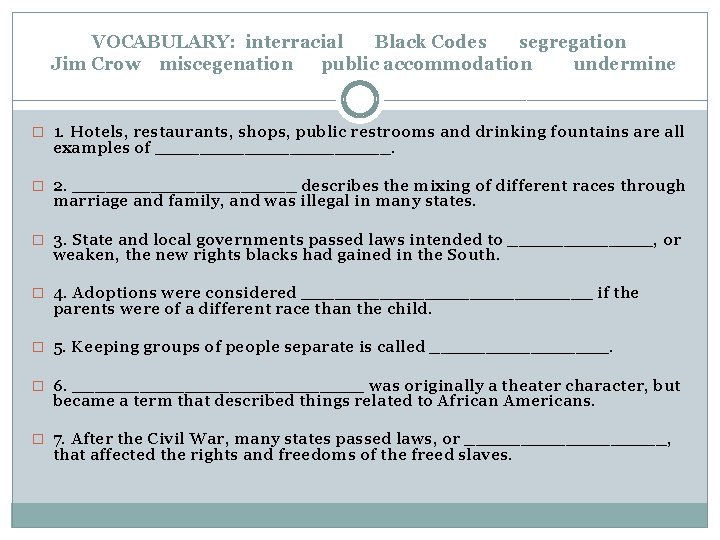
VOCABULARY: interracial Black Codes segregation Jim Crow miscegenation public accommodation undermine � 1. Hotels, restaurants, shops, public restrooms and drinking fountains are all examples of ___________. � 2. __________ describes the mixing of different races through marriage and family, and was illegal in many states. � 3. State and local governments passed laws intended to _______, or weaken, the new rights blacks had gained in the South. � 4. Adoptions were considered _____________ if the parents were of a different race than the child. � 5. Keeping groups of people separate is called ________. � 6. _____________ was originally a theater character, but became a term that described things related to African Americans. � 7. After the Civil War, many states passed laws, or _________, that affected the rights and freedoms of the freed slaves.
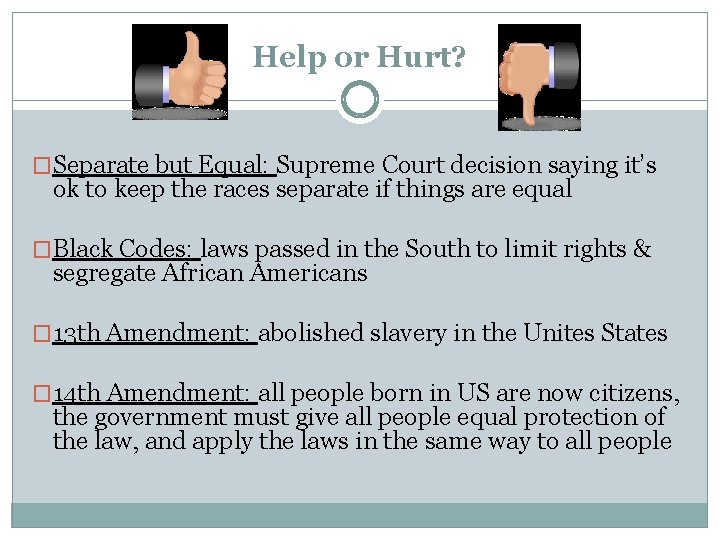
Help or Hurt? �Separate but Equal: Supreme Court decision saying it’s ok to keep the races separate if things are equal �Black Codes: laws passed in the South to limit rights & segregate African Americans � 13 th Amendment: abolished slavery in the Unites States � 14 th Amendment: all people born in US are now citizens, the government must give all people equal protection of the law, and apply the laws in the same way to all people
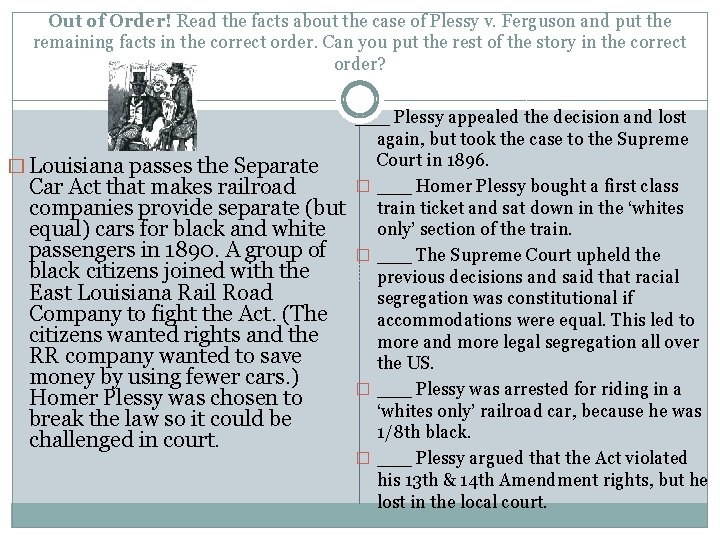
Out of Order! Read the facts about the case of Plessy v. Ferguson and put the remaining facts in the correct order. Can you put the rest of the story in the correct order? � Louisiana passes the Separate Car Act that makes railroad companies provide separate (but equal) cars for black and white passengers in 1890. A group of black citizens joined with the East Louisiana Rail Road Company to fight the Act. (The citizens wanted rights and the RR company wanted to save money by using fewer cars. ) Homer Plessy was chosen to break the law so it could be challenged in court. ___ Plessy appealed the decision and lost again, but took the case to the Supreme Court in 1896. � ___ Homer Plessy bought a first class train ticket and sat down in the ‘whites only’ section of the train. � ___ The Supreme Court upheld the previous decisions and said that racial segregation was constitutional if accommodations were equal. This led to more and more legal segregation all over the US. � ___ Plessy was arrested for riding in a ‘whites only’ railroad car, because he was 1/8 th black. � ___ Plessy argued that the Act violated his 13 th & 14 th Amendment rights, but he lost in the local court.
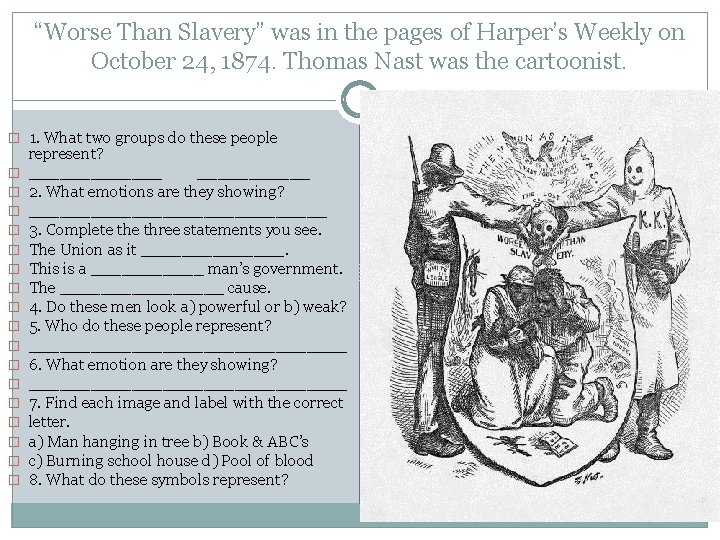
“Worse Than Slavery” was in the pages of Harper’s Weekly on October 24, 1874. Thomas Nast was the cartoonist. � 1. What two groups do these people � � � � � represent? _______ 2. What emotions are they showing? _______________ 3. Complete three statements you see. The Union as it _______. This is a ______ man’s government. The ________ cause. 4. Do these men look a) powerful or b) weak? 5. Who do these people represent? ________________ 6. What emotion are they showing? ________________ 7. Find each image and label with the correct letter. a) Man hanging in tree b) Book & ABC’s c) Burning school house d) Pool of blood 8. What do these symbols represent?
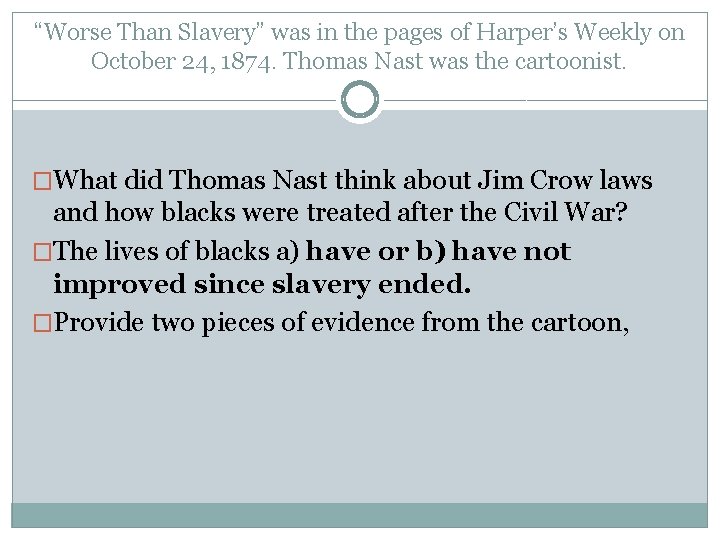
“Worse Than Slavery” was in the pages of Harper’s Weekly on October 24, 1874. Thomas Nast was the cartoonist. �What did Thomas Nast think about Jim Crow laws and how blacks were treated after the Civil War? �The lives of blacks a) have or b) have not improved since slavery ended. �Provide two pieces of evidence from the cartoon,
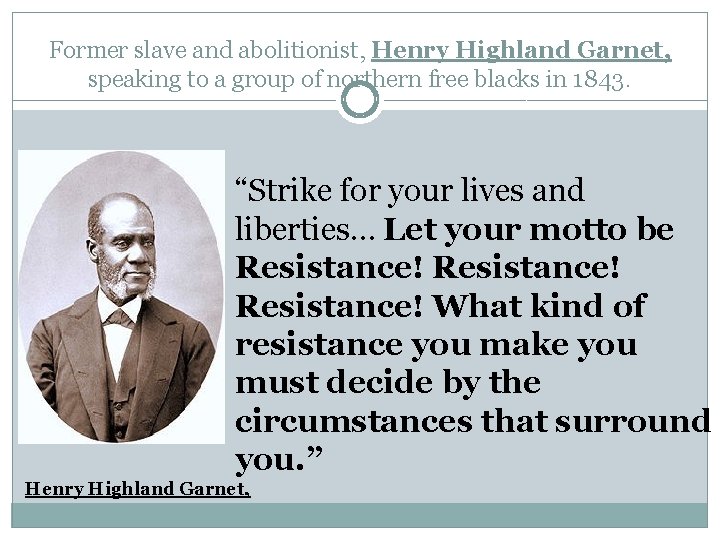
Former slave and abolitionist, Henry Highland Garnet, speaking to a group of northern free blacks in 1843. “Strike for your lives and liberties… Let your motto be Resistance! What kind of resistance you make you must decide by the circumstances that surround you. ” Henry Highland Garnet,
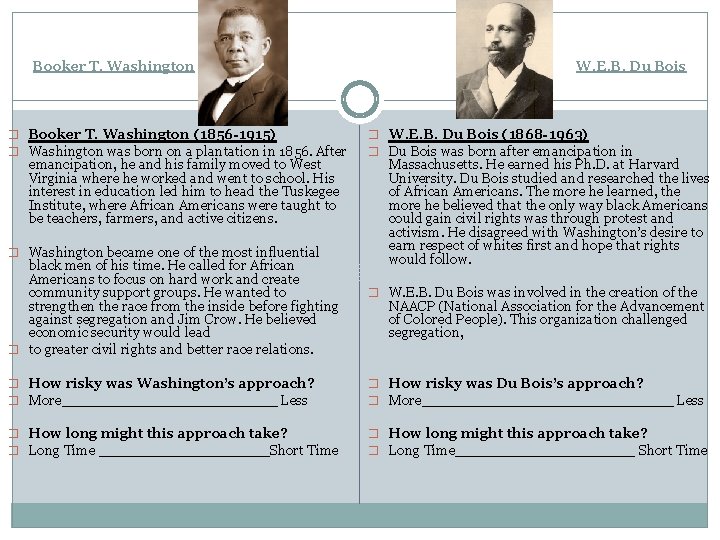
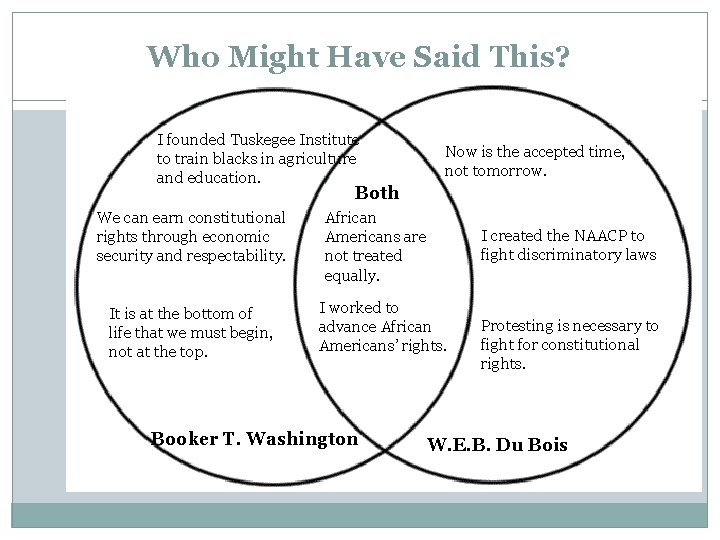
Booker T. Washington � Booker T. Washington (1856 -1915) � Washington was born on a plantation in 1856. After emancipation, he and his family moved to West Virginia where he worked and went to school. His interest in education led him to head the Tuskegee Institute, where African Americans were taught to be teachers, farmers, and active citizens. � Washington became one of the most influential black men of his time. He called for African Americans to focus on hard work and create community support groups. He wanted to strengthen the race from the inside before fighting against segregation and Jim Crow. He believed economic security would lead � to greater civil rights and better race relations. W. E. B. Du Bois � W. E. B. Du Bois (1868 -1963) � Du Bois was born after emancipation in Massachusetts. He earned his Ph. D. at Harvard University. Du Bois studied and researched the lives of African Americans. The more he learned, the more he believed that the only way black Americans could gain civil rights was through protest and activism. He disagreed with Washington’s desire to earn respect of whites first and hope that rights would follow. � W. E. B. Du Bois was involved in the creation of the NAACP (National Association for the Advancement of Colored People). This organization challenged segregation, � How risky was Washington’s approach? � More____________ Less � How risky was Du Bois’s approach? � More______________ Less � How long might this approach take? � Long Time __________Short Time � How long might this approach take? � Long Time__________ Short Time
Who Might Have Said This? I founded Tuskegee Institute to train blacks in agriculture and education. Now is the accepted time, not tomorrow. Both We can earn constitutional rights through economic security and respectability. It is at the bottom of life that we must begin, not at the top. African Americans are not treated equally. I created the NAACP to fight discriminatory laws I worked to advance African Americans’ rights. Booker T. Washington Protesting is necessary to fight for constitutional rights. W. E. B. Du Bois
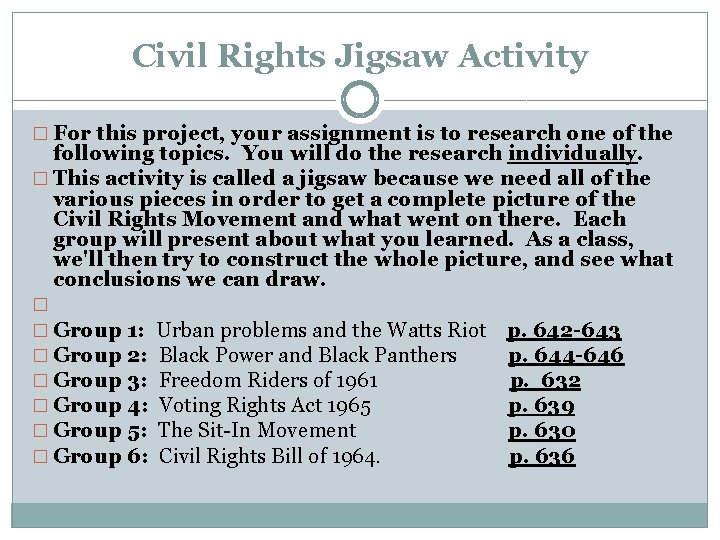
Civil Rights Jigsaw Activity � For this project, your assignment is to research one of the following topics. You will do the research individually. � This activity is called a jigsaw because we need all of the various pieces in order to get a complete picture of the Civil Rights Movement and what went on there. Each group will present about what you learned. As a class, we'll then try to construct the whole picture, and see what conclusions we can draw. � � Group 1: � Group 2: � Group 3: � Group 4: � Group 5: � Group 6: Urban problems and the Watts Riot p. 642 -643 Black Power and Black Panthers p. 644 -646 Freedom Riders of 1961 p. 632 Voting Rights Act 1965 p. 639 The Sit-In Movement p. 630 Civil Rights Bill of 1964. p. 636
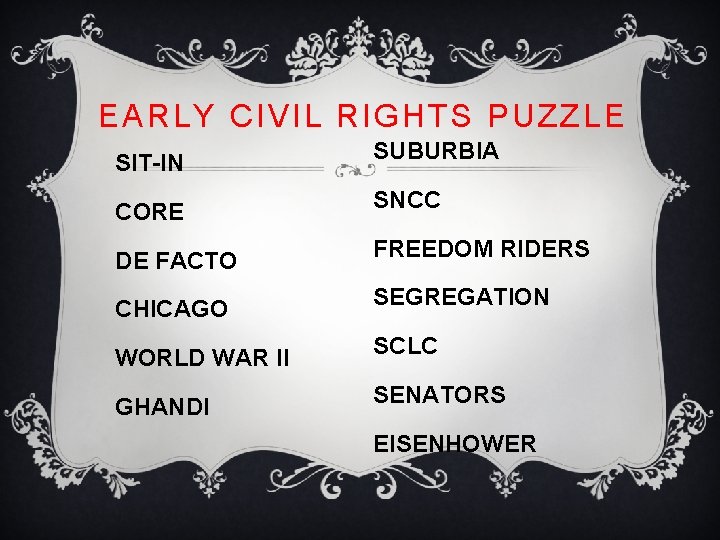
EARLY CIVIL RIGHTS PUZZLE SIT-IN SUBURBIA CORE SNCC DE FACTO FREEDOM RIDERS CHICAGO SEGREGATION WORLD WAR II SCLC GHANDI SENATORS EISENHOWER
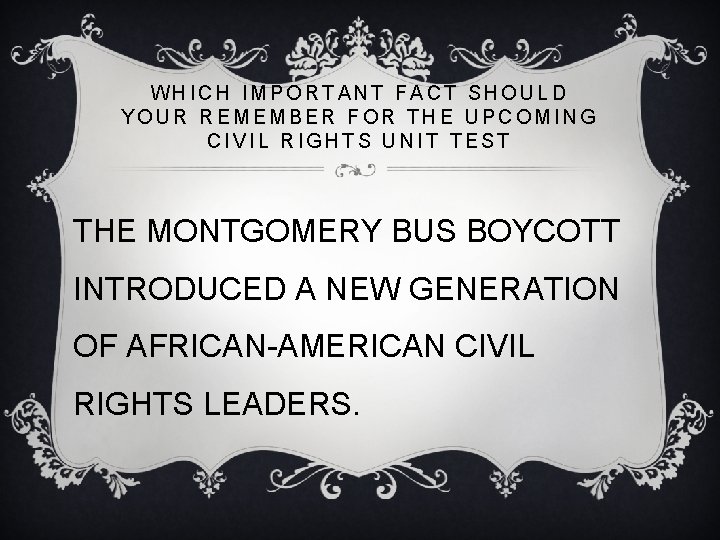
WHICH IMPORTANT FACT SHOULD YOUR REMEMBER FOR THE UPCOMING CIVIL RIGHTS UNIT TEST THE MONTGOMERY BUS BOYCOTT INTRODUCED A NEW GENERATION OF AFRICAN-AMERICAN CIVIL RIGHTS LEADERS.
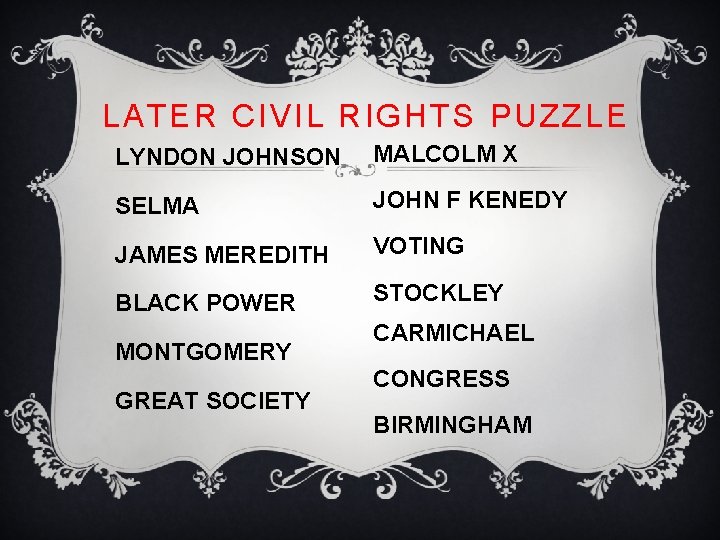
LATER CIVIL RIGHTS PUZZLE LYNDON JOHNSON MALCOLM X SELMA JOHN F KENEDY JAMES MEREDITH VOTING BLACK POWER STOCKLEY MONTGOMERY GREAT SOCIETY CARMICHAEL CONGRESS BIRMINGHAM
LATER CIVIL RIGHTS PUZZLE ONE OF THE LASTING LEGACIES OT EH CIVIL RIGHTS MOVEMENT WAS THAT THOUSANDS OF AFRICAN-AMERICANS WERE ABLE TO VOTE FOR THE FIRST TIME.