Report from the DOE ADS White Paper Working



- Slides: 52
Report from the DOE ADS White Paper Working Group Stuart Henderson Fermilab October 26, 2011
The White Paper In June 2010 DOE Office of Science tasked a Working Group with producing a White Paper assessing accelerator and target technology for Accelerator-Driven Systems (ADS) • The White Paper was intended to make a hard-nosed assessment, addressing • § § § • the technical requirements for ADS the current status and readiness of accelerator and spallation target technology the R&D necessary to meet the requirements …and to answer two underlying questions: § § Do the advances that have been made in Accelerator Technology in the last 10 -15 years change the practicality of ADS for processing waste and generating electricity? Is the technology to the point where a demonstration program is warranted? S. Henderson
The White Paper “Accelerator and Target Technology for Accelerator Driven Transmutation and Energy Production” http: //www. science. doe. gov/hep/files/pdfs/ADSWhite Paper. Final. pdf Hamid Aït Abderrahim, SCK-CEN • John Galambos, ORNL • Yousry Gohar, ANL • Stuart Henderson*, FNAL • George Lawrence, LANL, retired • Tom Mc. Manamy, ORNL • Alex Mueller, CNRS-IN 2 P 3 *Co-chairs • S. Henderson • • • Sergei Nagaitsev, FNAL Jerry Nolen, ANL Eric Pitcher*, LANL Bob Rimmer, TJNAF Richard Sheffield, LANL Mike Todosow, BNL
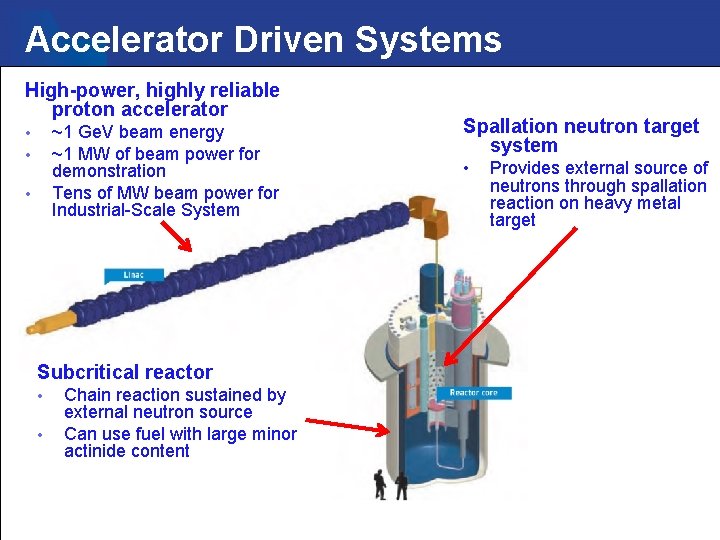
Accelerator Driven Systems High-power, highly reliable proton accelerator ~1 Ge. V beam energy ~1 MW of beam power for demonstration Tens of MW beam power for Industrial-Scale System • • • Subcritical reactor • • Chain reaction sustained by external neutron source Can use fuel with large minor actinide content S. Henderson Spallation neutron target system • Provides external source of neutrons through spallation reaction on heavy metal target
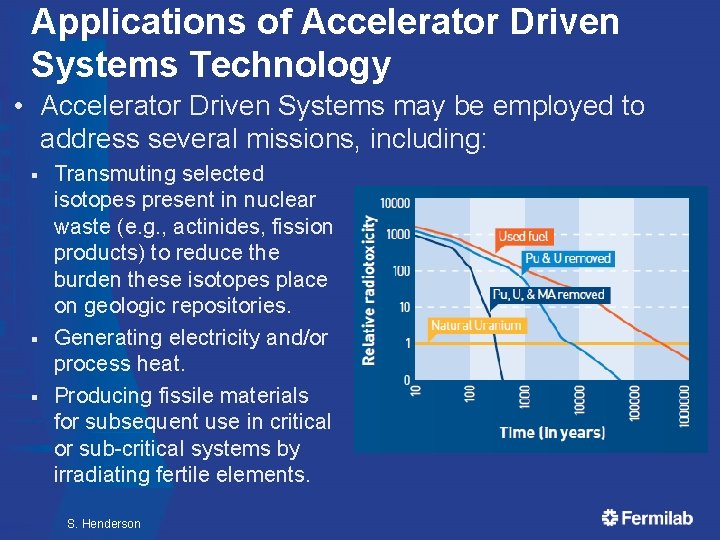
Applications of Accelerator Driven Systems Technology • Accelerator Driven Systems may be employed to address several missions, including: § § § Transmuting selected isotopes present in nuclear waste (e. g. , actinides, fission products) to reduce the burden these isotopes place on geologic repositories. Generating electricity and/or process heat. Producing fissile materials for subsequent use in critical or sub-critical systems by irradiating fertile elements. S. Henderson
Finding There active programs in many countries, although not in the U. S. , to develop, demonstrate and exploit accelerator-driven systems technology for nuclear waste transmutation and power generation. S. Henderson
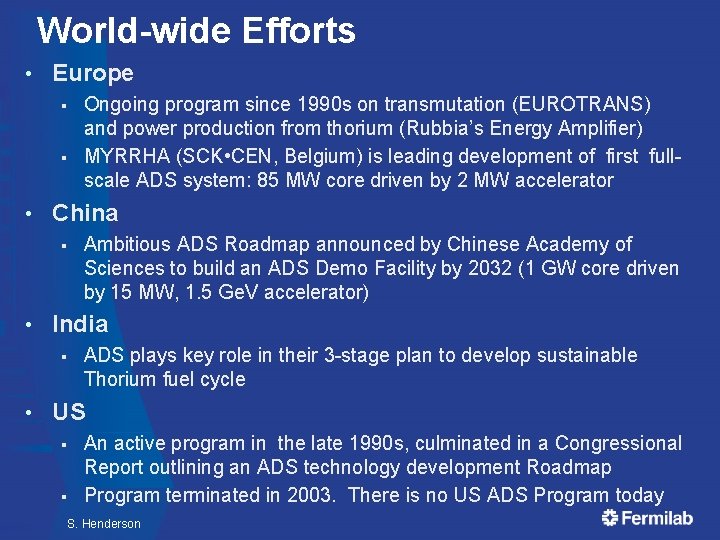
World-wide Efforts • Europe § § • China § • Ambitious ADS Roadmap announced by Chinese Academy of Sciences to build an ADS Demo Facility by 2032 (1 GW core driven by 15 MW, 1. 5 Ge. V accelerator) India § • Ongoing program since 1990 s on transmutation (EUROTRANS) and power production from thorium (Rubbia’s Energy Amplifier) MYRRHA (SCK • CEN, Belgium) is leading development of first fullscale ADS system: 85 MW core driven by 2 MW accelerator ADS plays key role in their 3 -stage plan to develop sustainable Thorium fuel cycle US § § An active program in the late 1990 s, culminated in a Congressional Report outlining an ADS technology development Roadmap Program terminated in 2003. There is no US ADS Program today S. Henderson
Finding Accelerator-driven sub-critical systems offer the potential for safely burning fuels which are difficult to incorporate in critical systems, for example fuel without uranium or thorium. S. Henderson
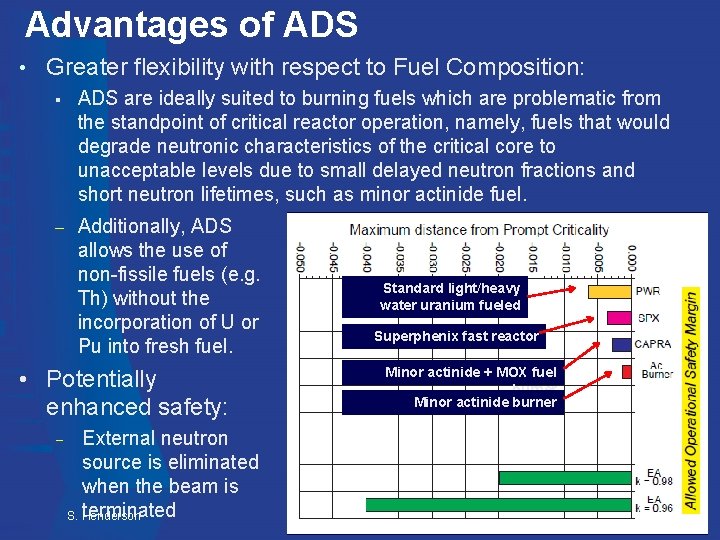
Advantages of ADS • Greater flexibility with respect to Fuel Composition: § ADS are ideally suited to burning fuels which are problematic from the standpoint of critical reactor operation, namely, fuels that would degrade neutronic characteristics of the critical core to unacceptable levels due to small delayed neutron fractions and short neutron lifetimes, such as minor actinide fuel. – Additionally, ADS allows the use of non-fissile fuels (e. g. Th) without the incorporation of U or Pu into fresh fuel. • Potentially enhanced safety: − External neutron source is eliminated when the beam is terminated S. Henderson Standard light/heavy water uranium fueled Superphenix fast reactor Minor actinide + MOX fuel burner Minor actinide burner
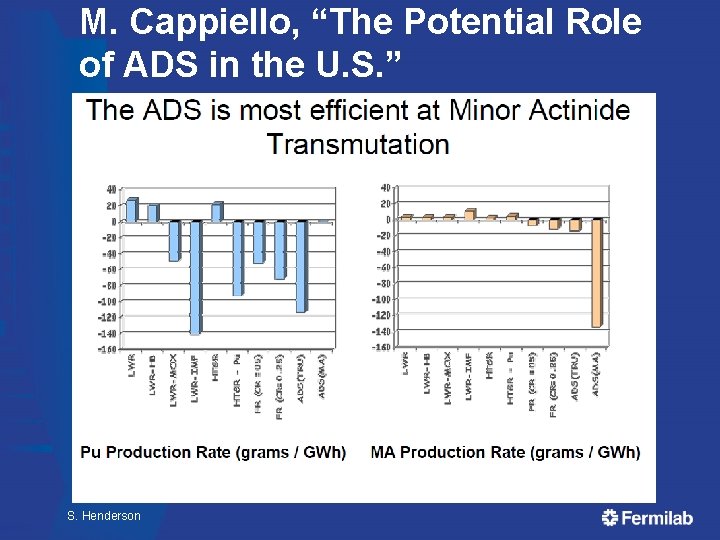
Finding Accelerator driven subcritical systems can be utilized to efficiently burn minor actinide waste. S. Henderson
M. Cappiello, “The Potential Role of ADS in the U. S. ” S. Henderson
Power Production • • A facility for transmutation of waste generates substantial power; process heat can be utilized to produce another form of energy (e. g. biofuels) or used to generate electrical power that far exceeds the that required to operate the accelerator Many proposed ADS concepts for power production utilize thoriumbased fuel to take advantage of some of its benefits, including § § § • • greater natural abundance, proliferation resistance, and relative to U-based fuel, significantly reduced production of transuranics which are a major source of radiotoxicity and decay heat. An ADS system based on Th-fuel would not require incorporation of fissile material into fresh fuel, and could operate almost indefinitely in a closed fuel cycle. Expanded use of thorium-based fuels is actively pursued in some countries with large reserves of thorium, principally India, Norway and China. These programs are investigating whether ADS can speed up the deployment of the 233 U-Th fuel cycle by breeding 233 U, which does not exist in nature. S. Henderson
Finding Accelerator driven subcritical systems can be utilized to generate power from thoriumbased fuels S. Henderson
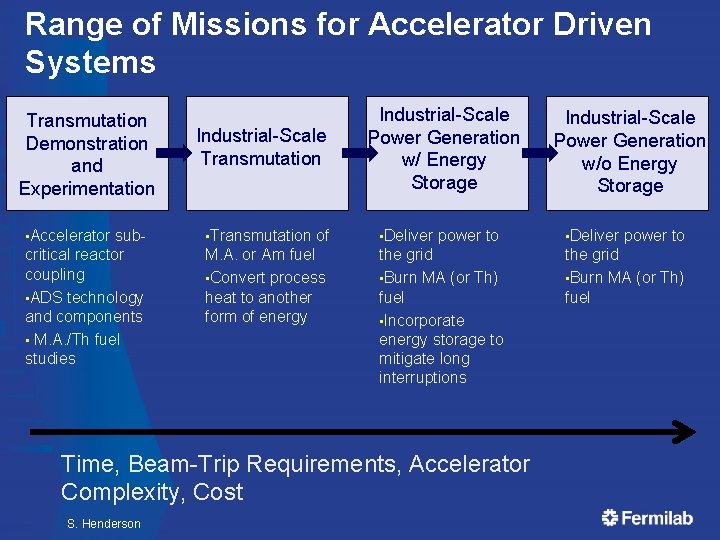
Finding The missions for ADS technology lend themselves to a technology development, demonstration and deployment strategy in which successively complex missions build upon technical developments of the preceding mission. S. Henderson
Range of Missions for Accelerator Driven Systems Transmutation Demonstration and Experimentation • Accelerator subcritical reactor coupling • ADS technology and components • M. A. /Th fuel studies Industrial-Scale Transmutation • Transmutation of M. A. or Am fuel • Convert process heat to another form of energy Industrial-Scale Power Generation w/ Energy Storage • Deliver power to the grid • Burn MA (or Th) fuel • Incorporate energy storage to mitigate long interruptions Time, Beam-Trip Requirements, Accelerator Complexity, Cost S. Henderson Industrial-Scale Power Generation w/o Energy Storage • Deliver power to the grid • Burn MA (or Th) fuel
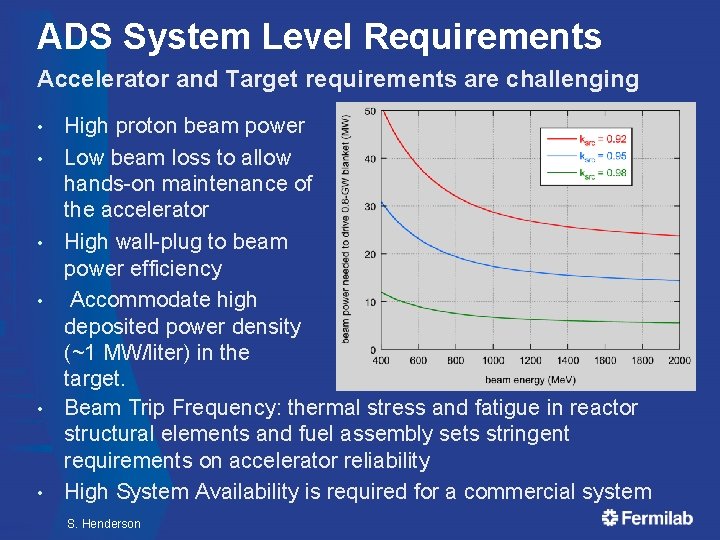
ADS System Level Requirements Accelerator and Target requirements are challenging • • • High proton beam power Low beam loss to allow hands-on maintenance of the accelerator High wall-plug to beam power efficiency Accommodate high deposited power density (~1 MW/liter) in the target. Beam Trip Frequency: thermal stress and fatigue in reactor structural elements and fuel assembly sets stringent requirements on accelerator reliability High System Availability is required for a commercial system S. Henderson
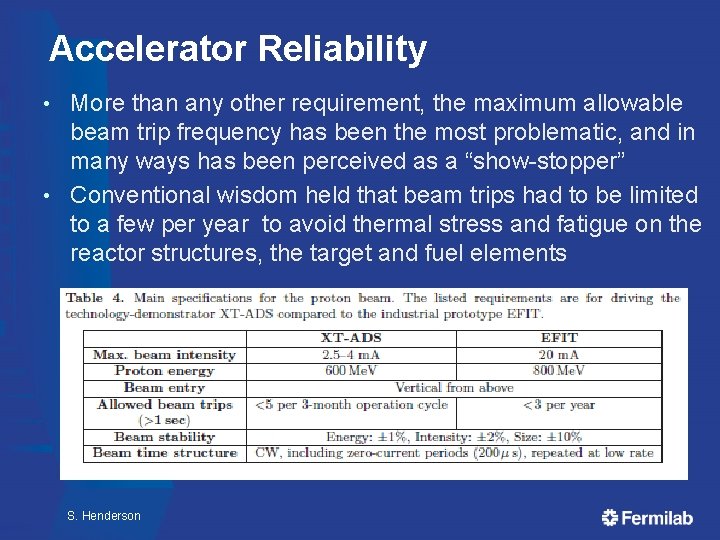
Accelerator Reliability More than any other requirement, the maximum allowable beam trip frequency has been the most problematic, and in many ways has been perceived as a “show-stopper” • Conventional wisdom held that beam trips had to be limited to a few per year to avoid thermal stress and fatigue on the reactor structures, the target and fuel elements • S. Henderson
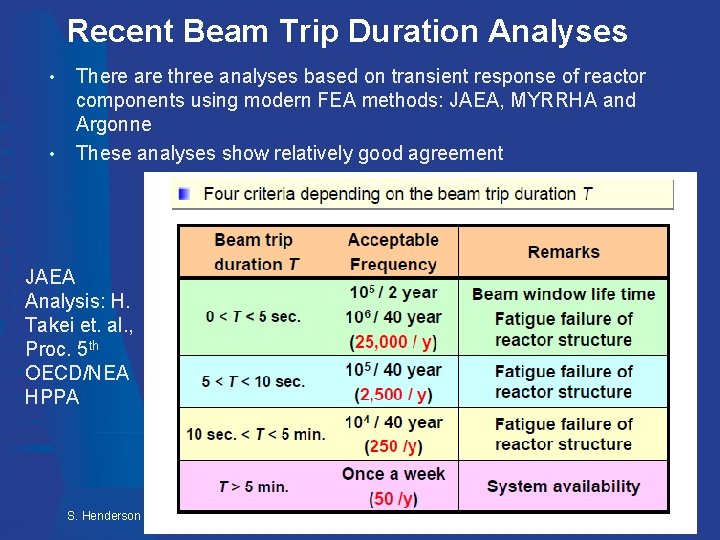
Recent Developments Re: Beam Trip Requirements Three analyses based on transient response of reactor components using modern FEA methods are in good agreement: JAEA, MYRRHA and Argonne National Laboratory • These new analyses result in ~2 order of magnitude relaxation of requirements for “short” trips and ~1 order of magnitude relaxation for “long” trips • Updated Beam-Trip Rate requirements, while still very challenging, appear manageable with i) modern linac architecture, ii) appropriate redundancy and iii) utilization of reliability engineering principles • More work is required to bring these components together with high reliability at > 10 times the beam power of today’s accelerators, but “getting from here to there” is achievable • S. Henderson
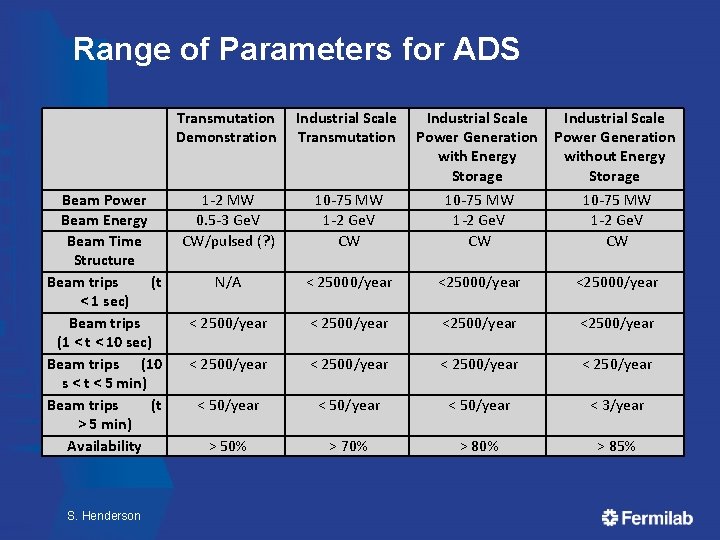
Range of Parameters for ADS Beam Power Beam Energy Beam Time Structure Beam trips (t < 1 sec) Beam trips (1 < t < 10 sec) Beam trips (10 s < t < 5 min) Beam trips (t > 5 min) Availability S. Henderson Transmutation Demonstration Industrial Scale Transmutation Industrial Scale Power Generation with Energy Storage Industrial Scale Power Generation without Energy Storage 1 -2 MW 0. 5 -3 Ge. V CW/pulsed (? ) 10 -75 MW 1 -2 Ge. V CW N/A < 25000/year <25000/year < 2500/year <2500/year < 250/year < 50/year < 3/year > 50% > 70% > 85%
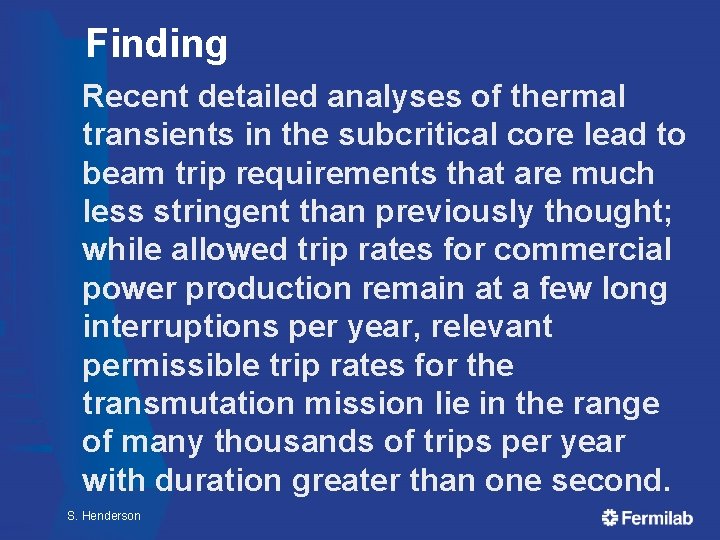
Finding Recent detailed analyses of thermal transients in the subcritical core lead to beam trip requirements that are much less stringent than previously thought; while allowed trip rates for commercial power production remain at a few long interruptions per year, relevant permissible trip rates for the transmutation mission lie in the range of many thousands of trips per year with duration greater than one second. S. Henderson
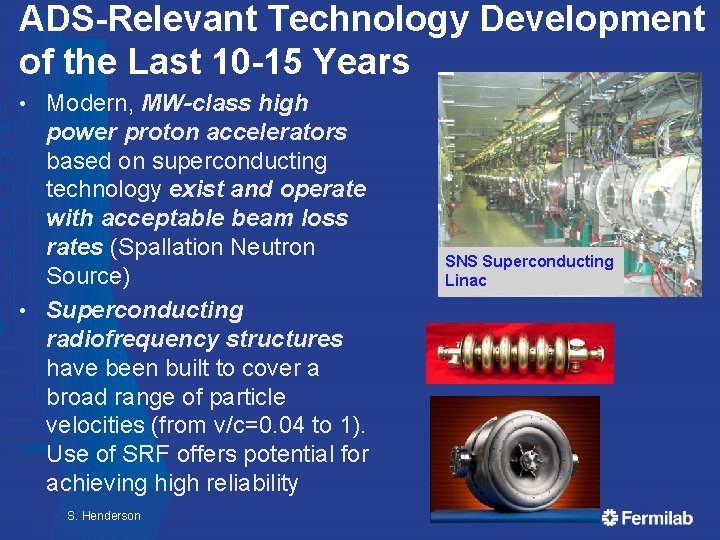
ADS-Relevant Technology Development of the Last 10 -15 Years Modern, MW-class high power proton accelerators based on superconducting technology exist and operate with acceptable beam loss rates (Spallation Neutron Source) • Superconducting radiofrequency structures have been built to cover a broad range of particle velocities (from v/c=0. 04 to 1). Use of SRF offers potential for achieving high reliability • S. Henderson SNS Superconducting Linac
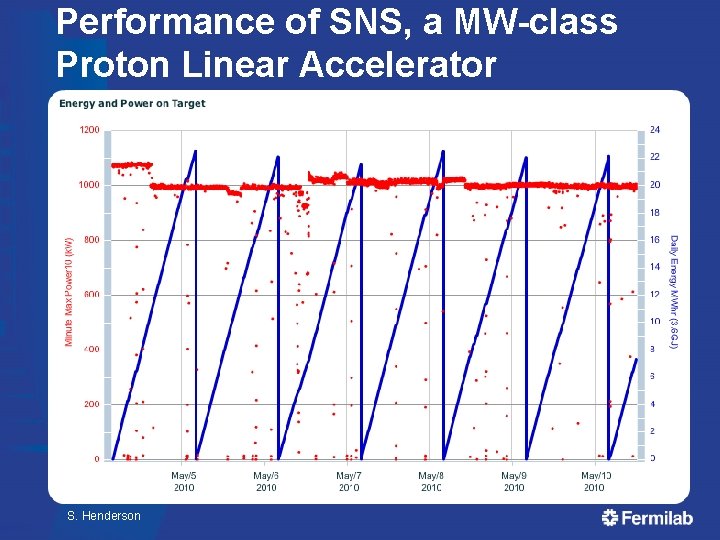
Performance of SNS, a MW-class Proton Linear Accelerator S. Henderson
Finding Superconducting radio-frequency accelerating structures appropriate for the acceleration of tens of MW of beam power have been designed, built and tested; some structure types are in routinely operating accelerator facilities. S. Henderson
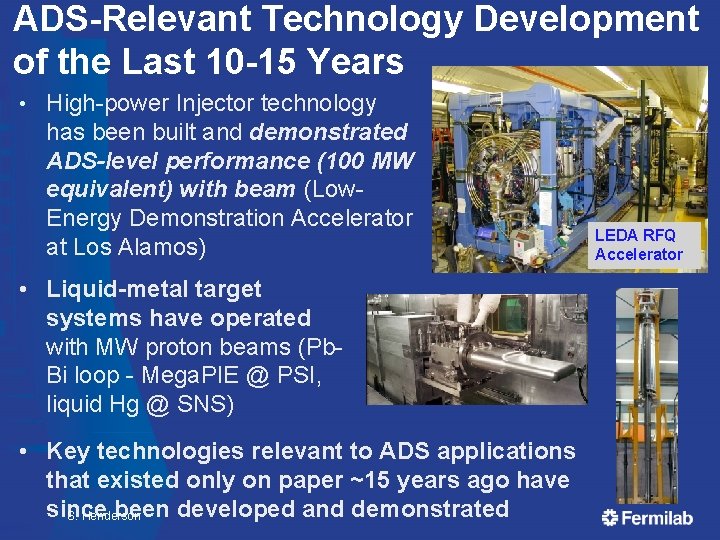
ADS-Relevant Technology Development of the Last 10 -15 Years • High-power Injector technology has been built and demonstrated ADS-level performance (100 MW equivalent) with beam (Low. Energy Demonstration Accelerator at Los Alamos) • Liquid-metal target systems have operated with MW proton beams (Pb. Bi loop - Mega. PIE @ PSI, liquid Hg @ SNS) • Key technologies relevant to ADS applications that existed only on paper ~15 years ago have since been developed and demonstrated S. Henderson LEDA RFQ Accelerator
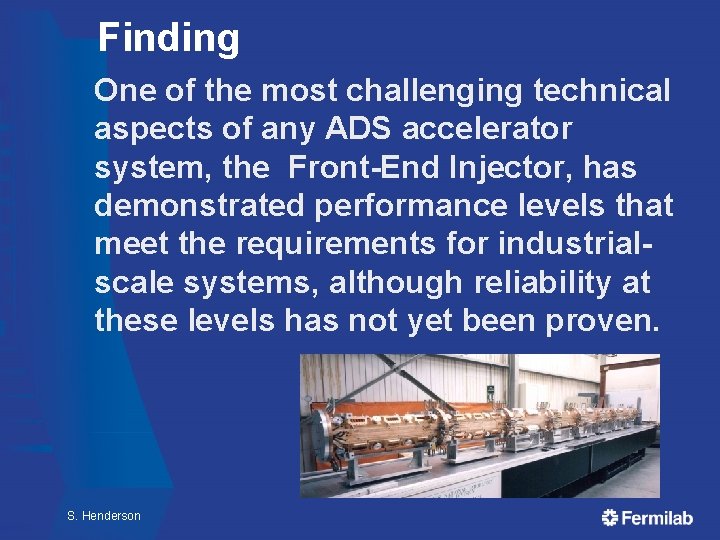
Finding One of the most challenging technical aspects of any ADS accelerator system, the Front-End Injector, has demonstrated performance levels that meet the requirements for industrialscale systems, although reliability at these levels has not yet been proven. S. Henderson
Finding Spallation target technology has been demonstrated at the 1 -MW level, sufficient to meet the “Transmutation Demonstration” mission. S. Henderson
Accelerator Technology Choices In the range of 5 -10 MW, both cyclotron (at its limits) and linear accelerator technology are applicable. Perhaps FFAGs will be capable someday. • For beam power in excess of ~10 MW, only SC RF linac technology appears to be practical • Various studies have concluded that SC RF technology has far greater beam power potential than cyclotron technology, and that it is the technology of choice for the > 10 MW beam power required to drive GW-level subcritical cores • Further, SCRF has the capability for achieving very high reliability as it lends itself to implementing a robust independently-phased RF cavity system. It is that latter technology that has the potential for fault tolerance and rapid fault recovery, making use of built-in online spare cavities. • S. Henderson
Finding For the tens of MW beam power required for most industrialscale ADS concepts, superconducting linear accelerator technology has the greatest potential to deliver the required performance. S. Henderson
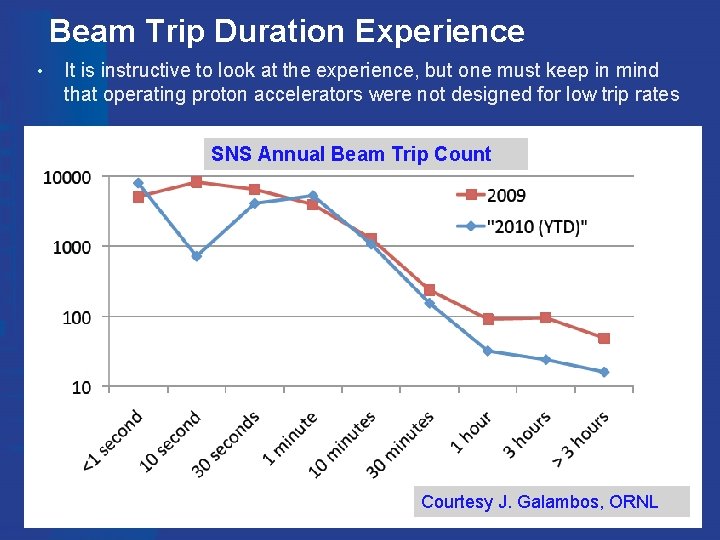
Beam Trip Duration Experience • It is instructive to look at the experience, but one must keep in mind that operating proton accelerators were not designed for low trip rates SNS Annual Beam Trip Count S. Henderson Courtesy J. Galambos, ORNL
Finding Ten to one-hundred fold improvement in long-duration beam trip rates relative to those achieved in routine operation of existing high power proton accelerators is necessary to meet industrial-scale ADS application requirements. S. Henderson
Finding With appropriate scaling at each step along a technology demonstration path, there are no obstacles foreseen that would preclude the deployment of spallation targets at a power level (10 to 30 MW) needed to meet the application of ADS at an industrial scale. S. Henderson
Finding The technology available to accelerator designers and builders of today is substantially different from, and superior to, that which was utilized in early ADS studies, in particular in the design which was considered in the 1996 National Research Council report. S. Henderson
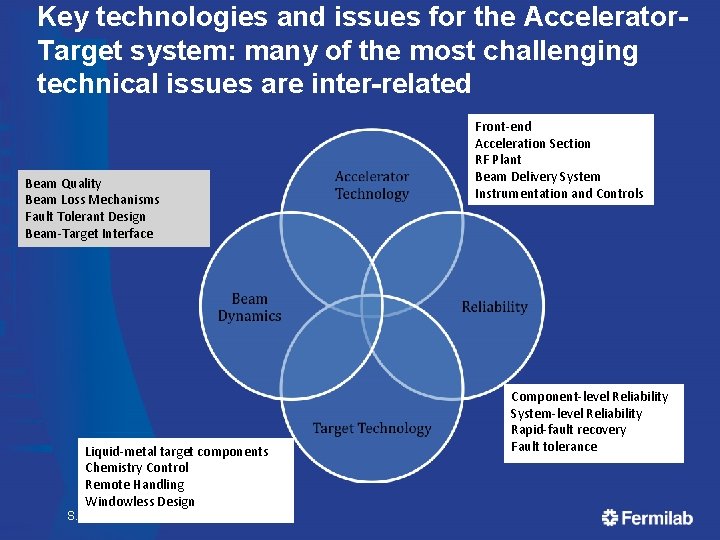
Key technologies and issues for the Accelerator. Target system: many of the most challenging technical issues are inter-related Beam Quality Beam Loss Mechanisms Fault Tolerant Design Beam-Target Interface Liquid-metal target components Chemistry Control Remote Handling Windowless Design S. Henderson Front-end Acceleration Section RF Plant Beam Delivery System Instrumentation and Controls Component-level Reliability System-level Reliability Rapid-fault recovery Fault tolerance
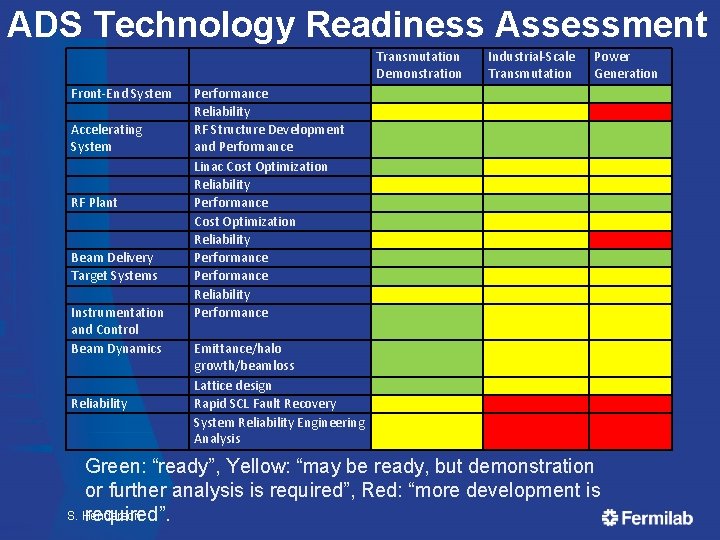
ADS Technology Readiness Assessment Transmutation Demonstration Front-End System Accelerating System RF Plant Beam Delivery Target Systems Instrumentation and Control Beam Dynamics Reliability Industrial-Scale Transmutation Power Generation Performance Reliability RF Structure Development and Performance Linac Cost Optimization Reliability Performance Reliability Performance Emittance/halo growth/beamloss Lattice design Rapid SCL Fault Recovery System Reliability Engineering Analysis Green: “ready”, Yellow: “may be ready, but demonstration or further analysis is required”, Red: “more development is S. Henderson required”.
Finding Technology is sufficiently well developed to meet the requirements of an ADS demonstration facility; some development is required for demonstrating and increasing overall system reliability. S. Henderson
Finding For Industrial-Scale Transmutation requiring tens of MW of beam power many of the key technologies have been demonstrated, including frontend systems and accelerating systems, but demonstration of other components, improved beam quality and halo control, and demonstration of highly-reliable sub-systems is required. S. Henderson
Conclusions on ADS requires challenging technology • Tremendous developments in the last 10 -15 years suggest that it is sufficiently well developed to meet the requirements of an ADS demonstration facility • For Industrial-Scale Systems requiring tens of MW of beam power many of the key accelerator technologies have been demonstrated, but further development is required • There is not an ADS R&D Program in the U. S. An ADS Research Program would be consistent with • § § the transmutation R&D needs articulated in the Nuclear Energy R&D Roadmap (2010), and the broad RD&D priorities articulated in the MIT “Future of the Nuclear Fuel Cycle” Report (2010). S. Henderson
Project X as a National Resource with Application Beyond HEP
Project-X Beyond HEP We recognize that a multi-MW high energy proton accelerator is a national resource, with potential application that goes beyond particle physics • Such facilities are sufficiently expensive that the U. S. will not invest in multiple facilities with duplicative capabilities • We are engaging the potential user communities for utilization of high power proton beams beyond HEP • We would like to explore your interests and ideas for potential uses of such a facility •
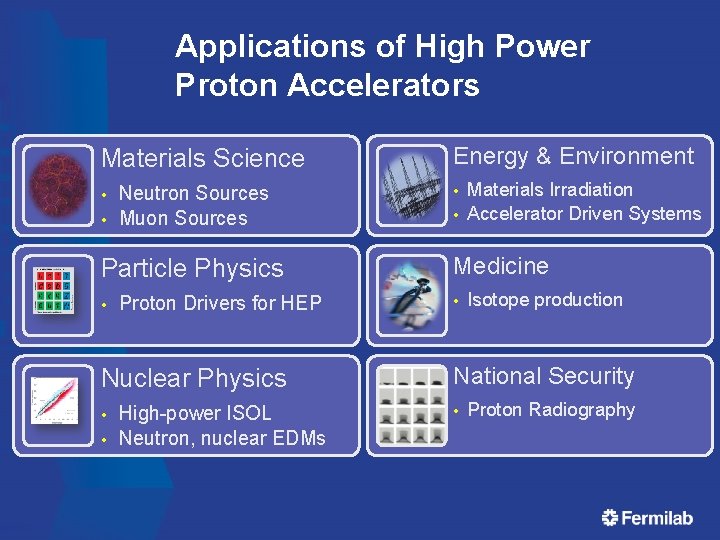
Applications of High Power Proton Accelerators Materials Science Energy & Environment • Neutron Sources • Muon Sources • Particle Physics Medicine • Proton Drivers for HEP Materials Irradiation • Accelerator Driven Systems • Isotope production Nuclear Physics National Security High-power ISOL • Neutron, nuclear EDMs • • Proton Radiography
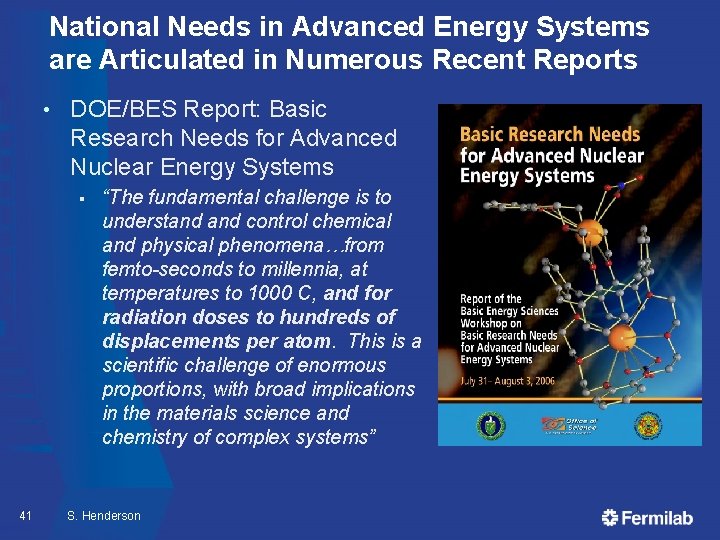
National Needs in Advanced Energy Systems are Articulated in Numerous Recent Reports • DOE/BES Report: Basic Research Needs for Advanced Nuclear Energy Systems § 41 “The fundamental challenge is to understand control chemical and physical phenomena…from femto-seconds to millennia, at temperatures to 1000 C, and for radiation doses to hundreds of displacements per atom. This is a scientific challenge of enormous proportions, with broad implications in the materials science and chemistry of complex systems” S. Henderson
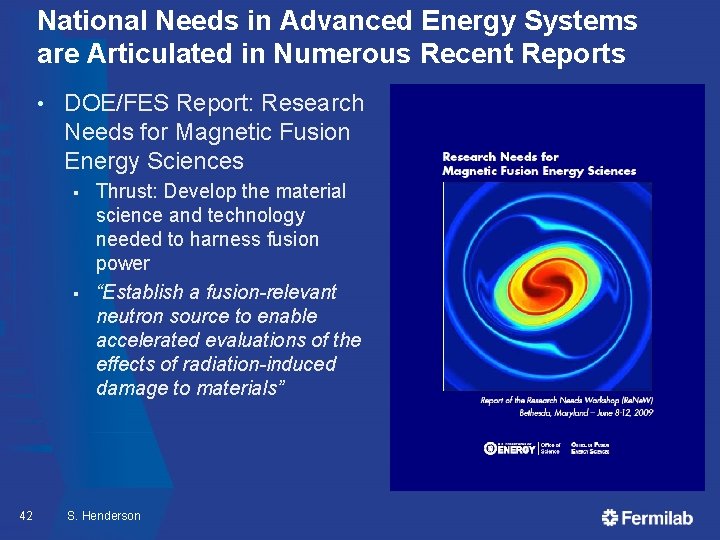
National Needs in Advanced Energy Systems are Articulated in Numerous Recent Reports • DOE/FES Report: Research Needs for Magnetic Fusion Energy Sciences § § 42 Thrust: Develop the material science and technology needed to harness fusion power “Establish a fusion-relevant neutron source to enable accelerated evaluations of the effects of radiation-induced damage to materials” S. Henderson
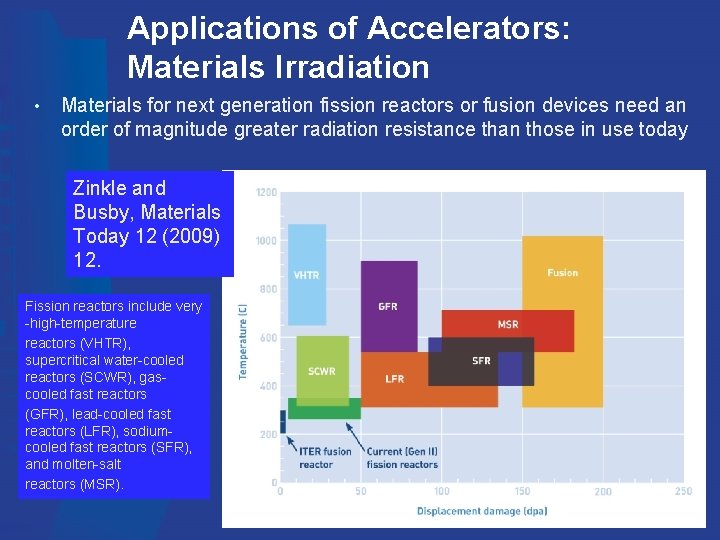
Applications of Accelerators: Materials Irradiation • Materials for next generation fission reactors or fusion devices need an order of magnitude greater radiation resistance than those in use today Zinkle and Busby, Materials Today 12 (2009) 12. Fission reactors include very -high-temperature reactors (VHTR), supercritical water-cooled reactors (SCWR), gascooled fast reactors (GFR), lead-cooled fast reactors (LFR), sodiumcooled fast reactors (SFR), and molten-salt reactors (MSR).
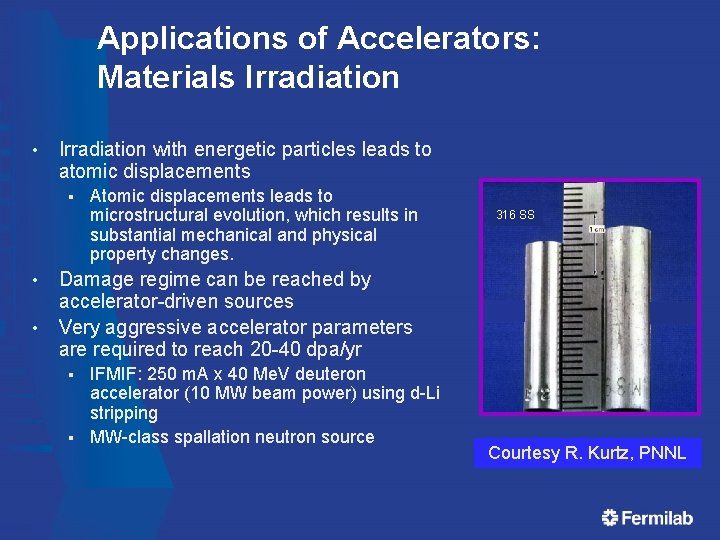
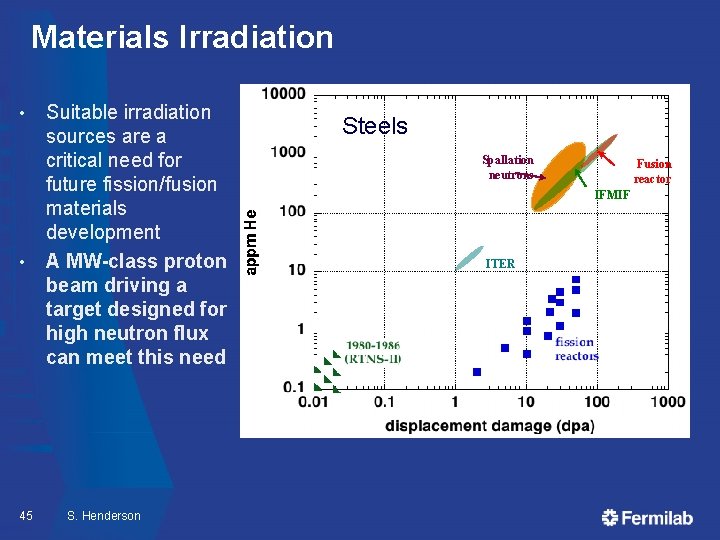
Applications of Accelerators: Materials Irradiation • Irradiation with energetic particles leads to atomic displacements § • • Atomic displacements leads to microstructural evolution, which results in substantial mechanical and physical property changes. 316 SS Damage regime can be reached by accelerator-driven sources Very aggressive accelerator parameters are required to reach 20 -40 dpa/yr § § IFMIF: 250 m. A x 40 Me. V deuteron accelerator (10 MW beam power) using d-Li stripping MW-class spallation neutron source Courtesy R. Kurtz, PNNL
Materials Irradiation • • 45 Suitable irradiation sources are a critical need for future fission/fusion materials development A MW-class proton beam driving a target designed for high neutron flux can meet this need S. Henderson Steels Spallation neutrons Fusion reactor IFMIF ITER
Role of Project X in Nuclear Energy • The Project X CW Linac is ideally suited to power a facility with focus on: § § § • • Materials Irradiation Target system and subcritical assembly technology development and demonstration Demonstration of transmutation technologies and support for fuel studies A properly designed high power target station can serve the nuclear energy user community It is important to understand the needs of this community
S. Henderson
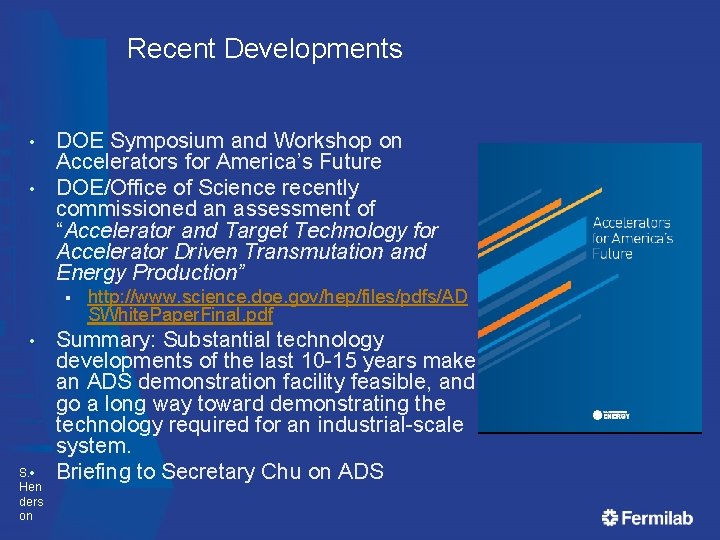
Recent Developments DOE Symposium and Workshop on Accelerators for America’s Future • DOE/Office of Science recently commissioned an assessment of “Accelerator and Target Technology for Accelerator Driven Transmutation and Energy Production” • § http: //www. science. doe. gov/hep/files/pdfs/AD SWhite. Paper. Final. pdf Summary: Substantial technology developments of the last 10 -15 years make an ADS demonstration facility feasible, and go a long way toward demonstrating the technology required for an industrial-scale system. S. • Briefing to Secretary Chu on ADS • Hen ders on
Recent Developments US DOE “Nuclear Energy R&D Roadmap” cracks the door open (slightly) regarding externally-driven transmutation systems • MIT Fuel Cycle Report (2010) makes the case for R&D on “advanced fast reactor concepts, ” ”novel applications and innovative concepts” and “fast neutron flux materials test facilities” • Project-X offers a powerful platform upon which to build an R&D program directed at nuclear technology development • • S. Hen ders on Question for you: What do you see as opportunities for using high-power proton beams to further nuclear energy and technology in the US?
Recent Beam Trip Duration Analyses • • There are three analyses based on transient response of reactor components using modern FEA methods: JAEA, MYRRHA and Argonne These analyses show relatively good agreement JAEA Analysis: H. Takei et. al. , Proc. 5 th OECD/NEA HPPA S. Henderson
Accelerator Technology - Requirements Transmutation Demonstration (MYRRHA [5]) Industrial Scale Facility driving single subcritical core (EFIT [10]) Industrial Scale Facility driving multiple subcritical cores (ATW [11]) Beam Energy [Ge. V] 0. 6 0. 8 1. 0 Beam Power [MW] 1. 5 16 45 Beam current [m. A] 2. 5 20 45 Uncontrolled Beamloss Fractional beamloss at full energy (ppm/m) < 1 W/m < 0. 7 < 0. 06 < 0. 02 S. Henderson
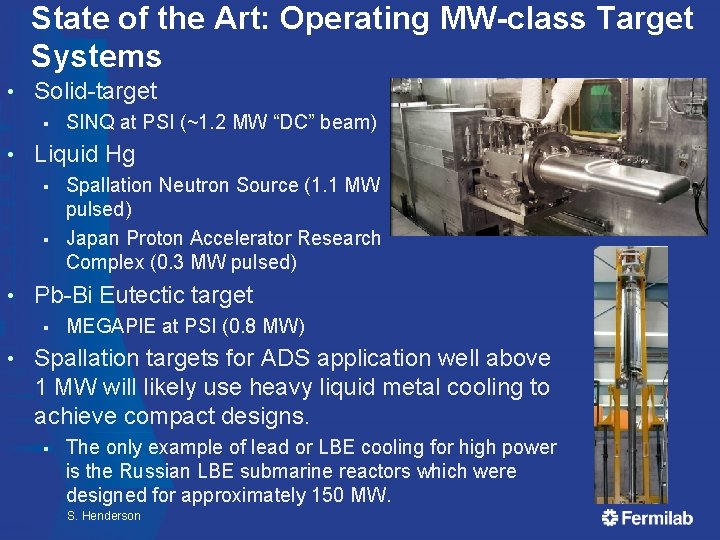
State of the Art: Operating MW-class Target Systems • Solid-target § • Liquid Hg § § • Spallation Neutron Source (1. 1 MW pulsed) Japan Proton Accelerator Research Complex (0. 3 MW pulsed) Pb-Bi Eutectic target § • SINQ at PSI (~1. 2 MW “DC” beam) MEGAPIE at PSI (0. 8 MW) Spallation targets for ADS application well above 1 MW will likely use heavy liquid metal cooling to achieve compact designs. § The only example of lead or LBE cooling for high power is the Russian LBE submarine reactors which were designed for approximately 150 MW. S. Henderson