R 2 An ApplicationLevel Kernel for Record and

- Slides: 42
R 2: An Application-Level Kernel for Record and Replay Zhenyu Guo, Xi Wang, Jian Tang, Xuezheng Liu, Zhilei Xu, Ming Wu, M. Frans Kaashoek, and Zheng Zhang Microsoft Research Asia, Tsinghua University, MIT CSAIL 1
What & Why? • What – Record one run and Replay it for debugging • Why – Difficult to reproduce some bugs with re-executing • E. g. with specific network message orders – Hard to apply comprehensive analysis with no interference at runtime • E. g. , predicate checking at every write on variable “state” 2
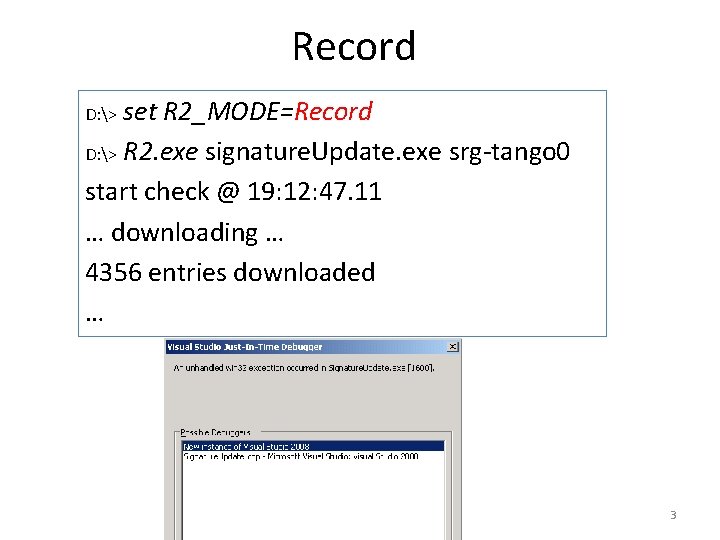
Record set R 2_MODE=Record D: > R 2. exe signature. Update. exe srg-tango 0 start check @ 19: 12: 47. 11 … downloading … 4356 entries downloaded … D: > 3
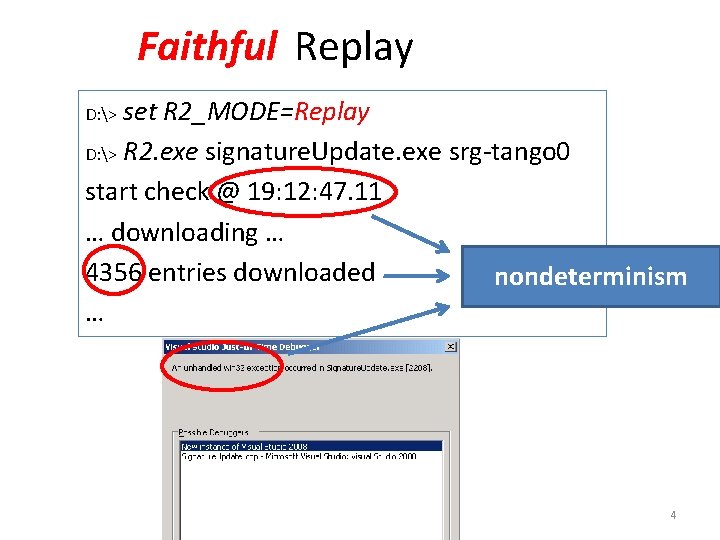
Faithful Replay set R 2_MODE=Replay D: > R 2. exe signature. Update. exe srg-tango 0 start check @ 19: 12: 47. 11 … downloading … 4356 entries downloaded nondeterminism … D: > 4
State of the art • Virtual machine approaches – George et al, Re. Virt: Enabling Intrusion Analysis through Virtual-Machine Logging and Replay, OSDI’ 02 – Replay application and the operating system – Difficult to deploy • Library approaches – Dennis et al, Replay debugging for distributed applications, USENIX’ 06 – Replay application only – Easy to deploy and lightweight – Cannot replay challenging system applications (e. g. , with asynchronous I/O) 5
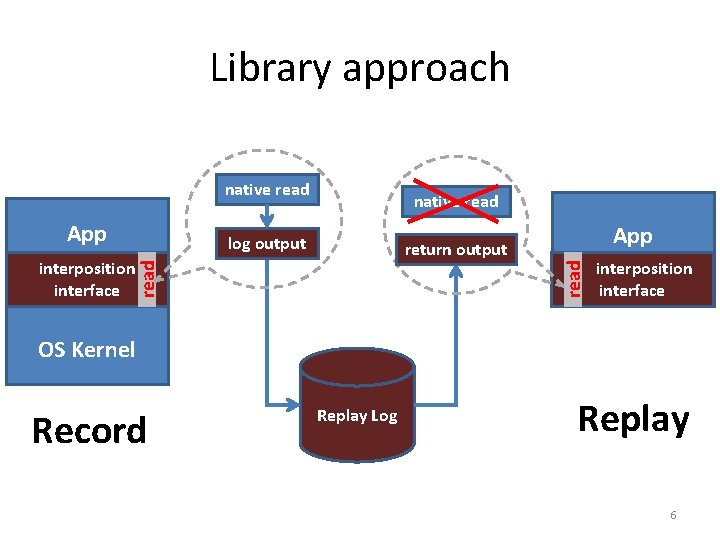
Library approach native read App native read log output App return output read interposition interface OS Kernel Record Replay Log Replay 6
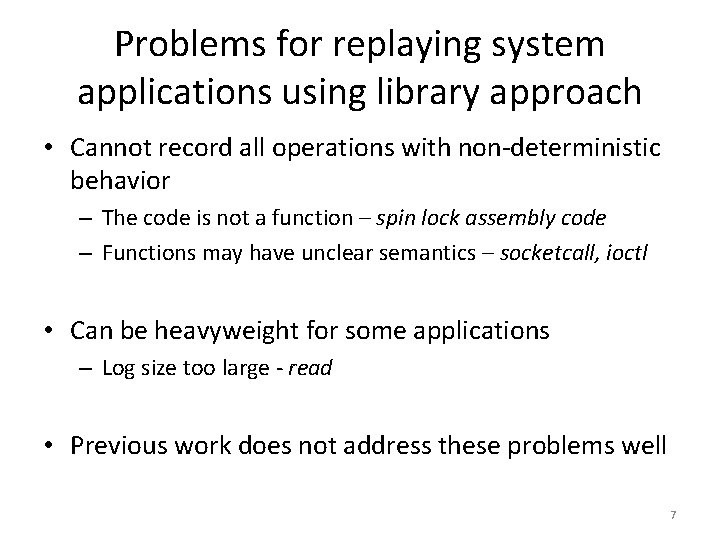
Problems for replaying system applications using library approach • Cannot record all operations with non-deterministic behavior – The code is not a function – spin lock assembly code – Functions may have unclear semantics – socketcall, ioctl • Can be heavyweight for some applications – Log size too large - read • Previous work does not address these problems well 7
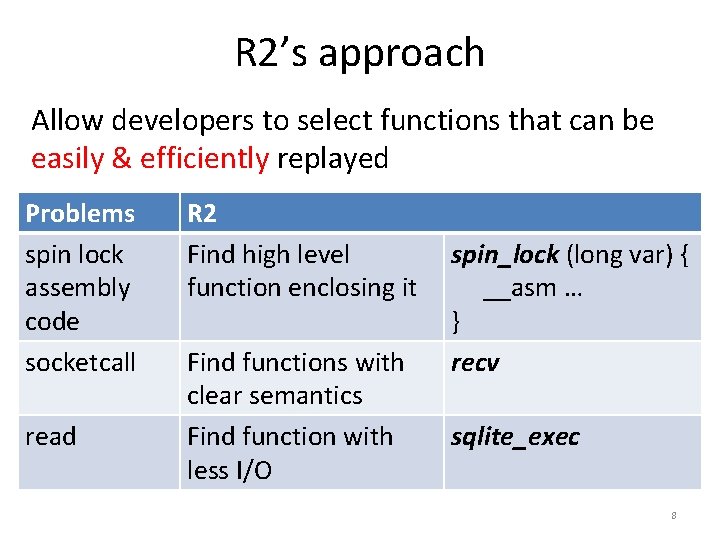
R 2’s approach Allow developers to select functions that can be easily & efficiently replayed Problems spin lock assembly code socketcall read R 2 Find high level function enclosing it Find functions with clear semantics Find function with less I/O spin_lock (long var) { __asm … } recv sqlite_exec 8
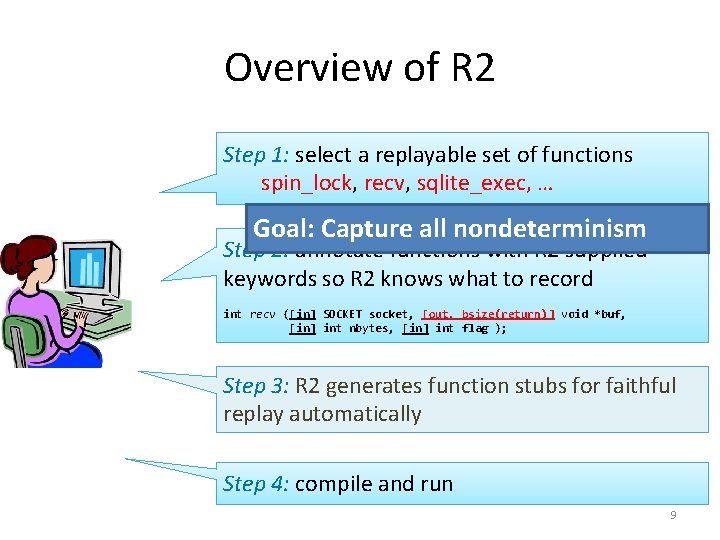
Overview of R 2 Step 1: select a replayable set of functions spin_lock, recv, sqlite_exec, … Goal: Capture all nondeterminism Step 2: annotate functions with R 2 supplied keywords so R 2 knows what to record int recv ([in] SOCKET socket, [out, bsize(return)] void *buf, [in] int nbytes, [in] int flag ); Step 3: R 2 generates function stubs for faithful replay automatically Step 4: compile and run 9
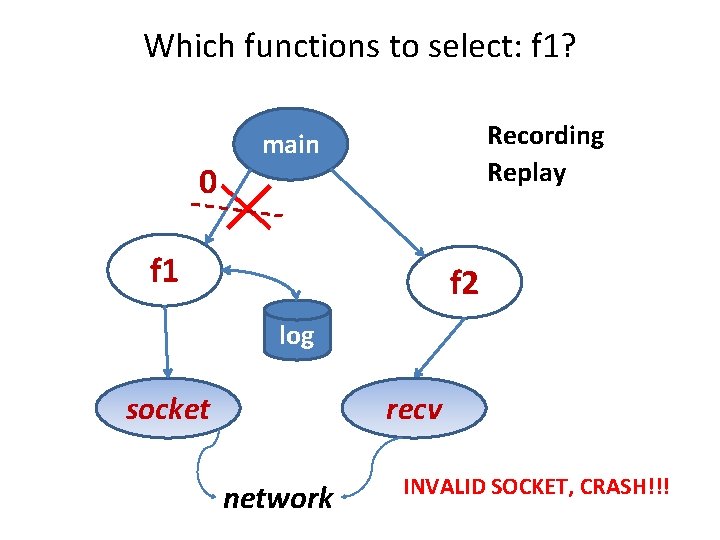
Which functions to select: f 1? 0 Recording Replay main f 1 f 2 log socket recv network INVALID SOCKET, CRASH!!!
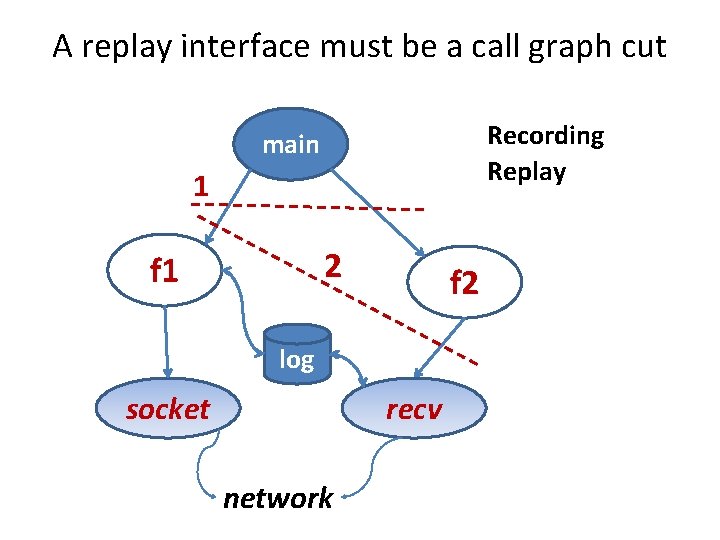
A replay interface must be a call graph cut Recording Replay main 1 2 f 1 f 2 log socket recv network
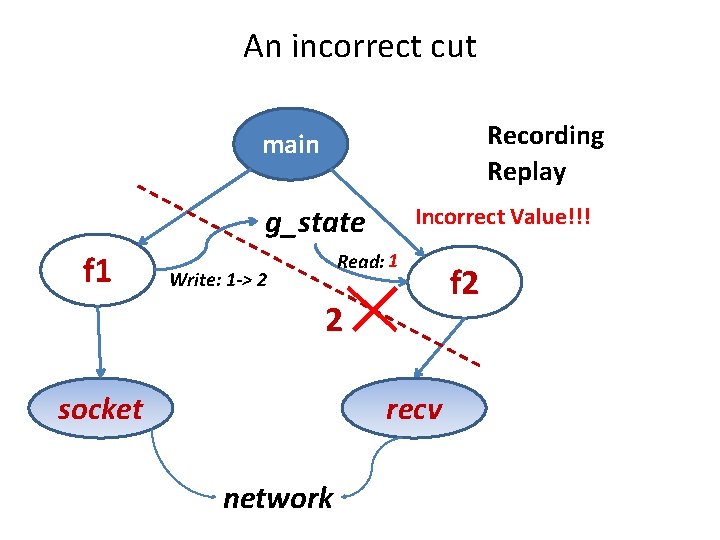
An incorrect cut Recording Replay main g_state f 1 Incorrect Value!!! Read: 12 Write: 1 -> 2 2 socket recv network f 2
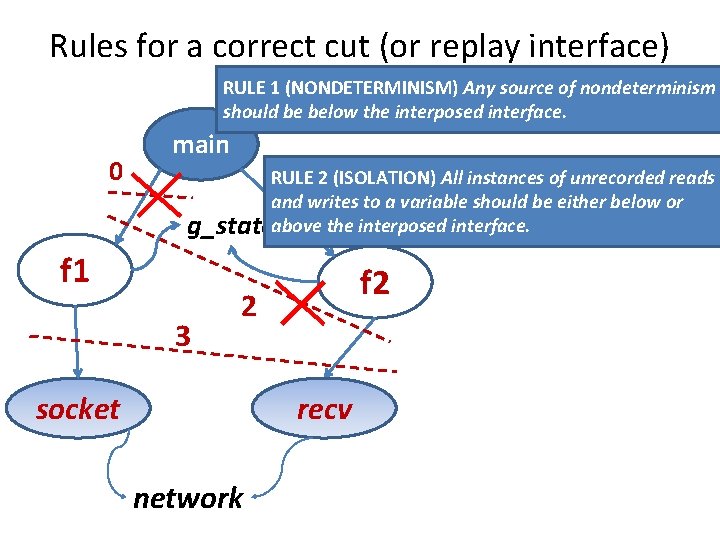
Rules for a correct cut (or replay interface) RULE 1 (NONDETERMINISM) Any source of nondeterminism should be below the interposed interface. 0 main RULE 2 (ISOLATION) All instances of unrecorded reads and writes to a variable should be either below or g_stateabove the interposed interface. f 1 3 f 2 2 socket recv network
Find a good cut in practice • Can be difficult to identify correct cut in complex call graph • Module APIs are good candidates – Encapsulate internal state well 14
Implementation Challenges • • • Deterministic memory footprint Execution order in multi-threaded apps Reuse intercepted functions Identify function side effects Threads created by implementation 15
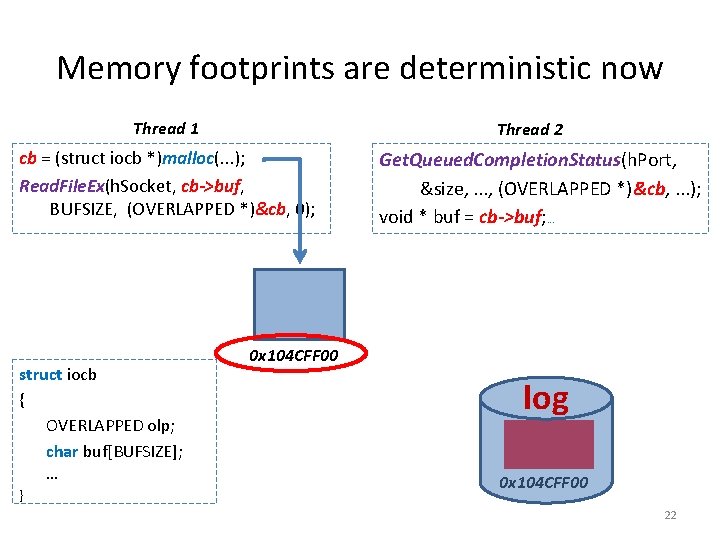
Deterministic memory footprint • What? – Memory state and its evolution must be the same during recording and replay • Why? – Different memory address may lead to different control flow 16
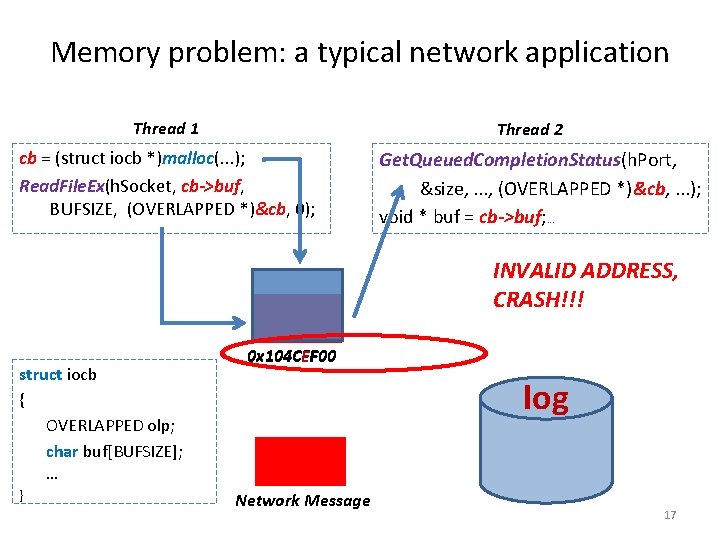
Memory problem: a typical network application Thread 1 Thread 2 cb = (struct iocb *)malloc(. . . ); Read. File. Ex(h. Socket, cb->buf, BUFSIZE, (OVERLAPPED *)&cb, 0); Get. Queued. Completion. Status(h. Port, &size, . . . , (OVERLAPPED *)&cb, . . . ); void * buf = cb->buf; . . . INVALID ADDRESS, CRASH!!! struct iocb { OVERLAPPED olp; char buf[BUFSIZE]; … } 0 x 104 CFF 00 0 x 104 CEF 00 log Network Message 17
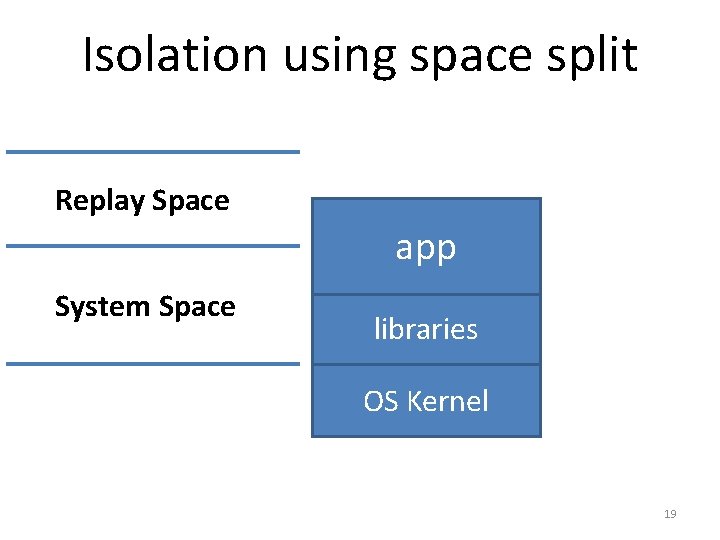
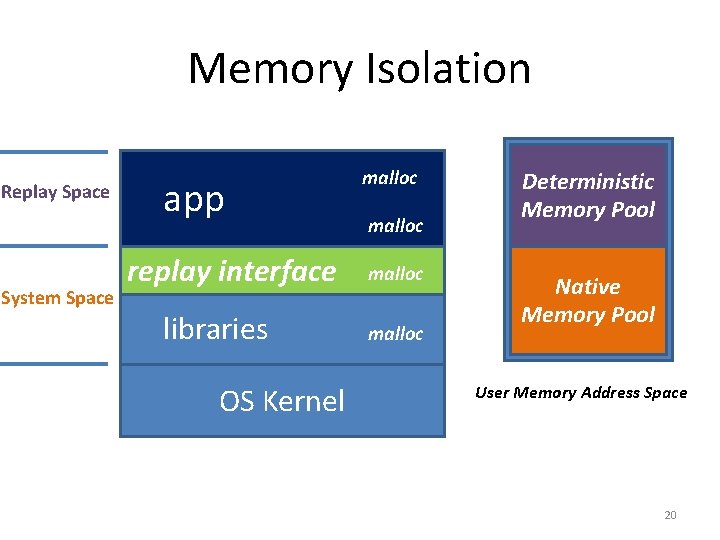
Why different memory addresses? • The tool and the application are in the same address space • The tool inherently runs differently during record and replay • Intercepted functions are not executed during replay – Missed memory requests inside the functions – Modules not loaded during replay 18
Isolation using space split Replay Space app System Space replay interface libraries OS Kernel 19
Memory Isolation Replay Space System Space app replay interface libraries OS Kernel malloc Deterministic Memory Pool Native Memory Pool User Memory Address Space 20
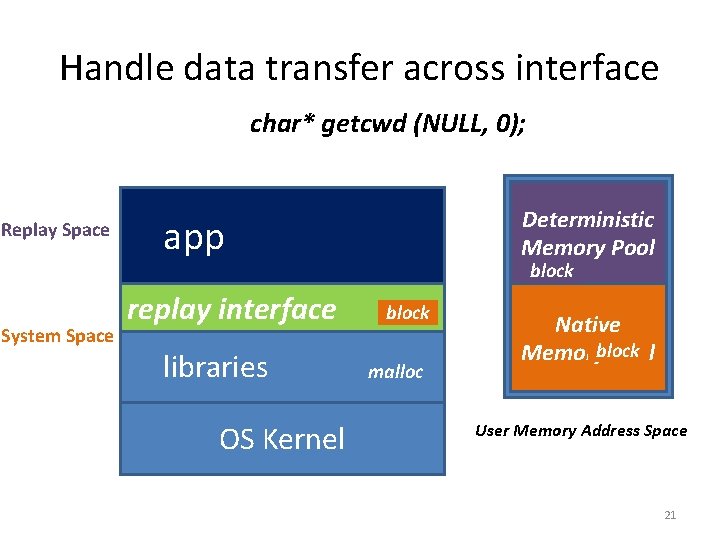
Handle data transfer across interface [xpointer] char* getcwd (NULL, 0); Replay Space System Space Deterministic Memory Pool app replay interface libraries OS Kernel block malloc Native Memoryblock Pool User Memory Address Space 21
Memory footprints are deterministic now Thread 1 Thread 2 cb = (struct iocb *)malloc(. . . ); Read. File. Ex(h. Socket, cb->buf, BUFSIZE, (OVERLAPPED *)&cb, 0); struct iocb { OVERLAPPED olp; char buf[BUFSIZE]; … } Get. Queued. Completion. Status(h. Port, &size, . . . , (OVERLAPPED *)&cb, . . . ); void * buf = cb->buf; . . . 0 x 104 CFF 00 log 0 x 104 CFF 00 22
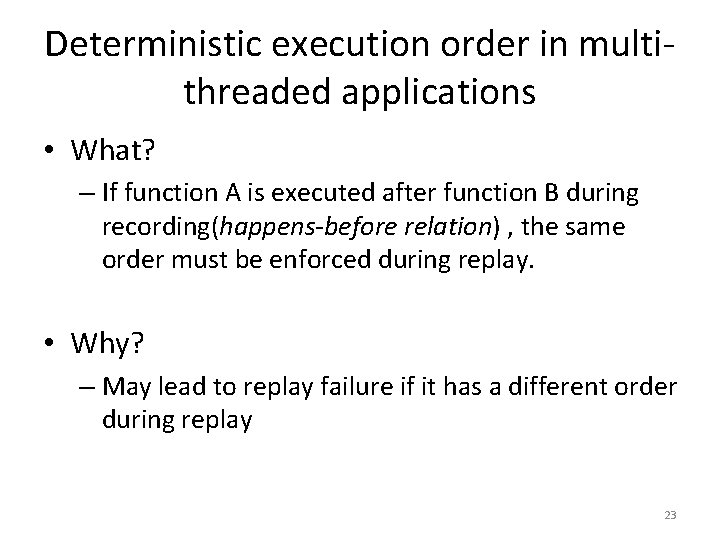
Deterministic execution order in multithreaded applications • What? – If function A is executed after function B during recording(happens-before relation) , the same order must be enforced during replay. • Why? – May lead to replay failure if it has a different order during replay 23
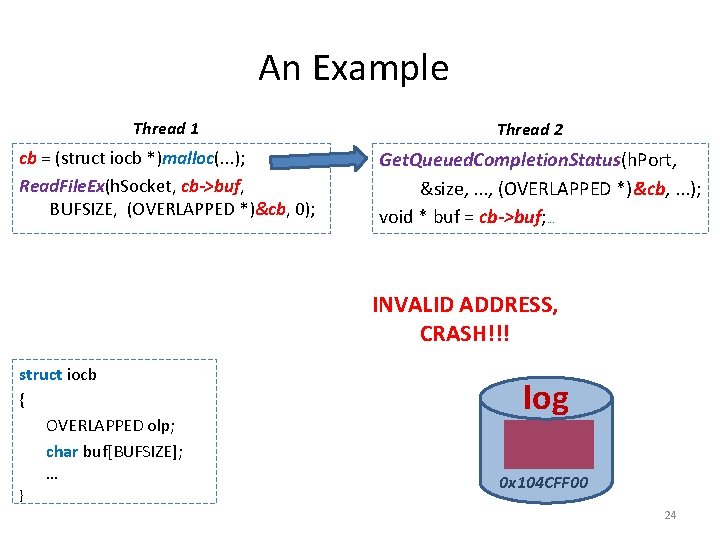
An Example Thread 1 cb = (struct iocb *)malloc(. . . ); Read. File. Ex(h. Socket, cb->buf, BUFSIZE, (OVERLAPPED *)&cb, 0); Thread 2 Get. Queued. Completion. Status(h. Port, &size, . . . , (OVERLAPPED *)&cb, . . . ); void * buf = cb->buf; . . . INVALID ADDRESS, CRASH!!! struct iocb { OVERLAPPED olp; char buf[BUFSIZE]; … } log 0 x 104 CFF 00 24
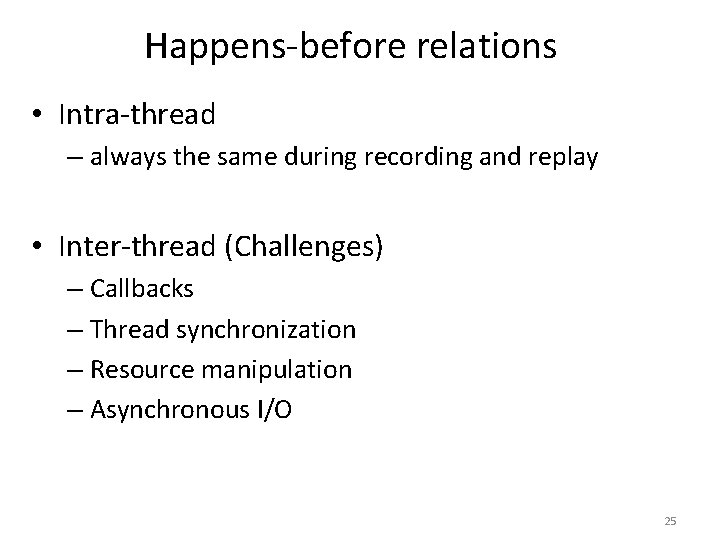
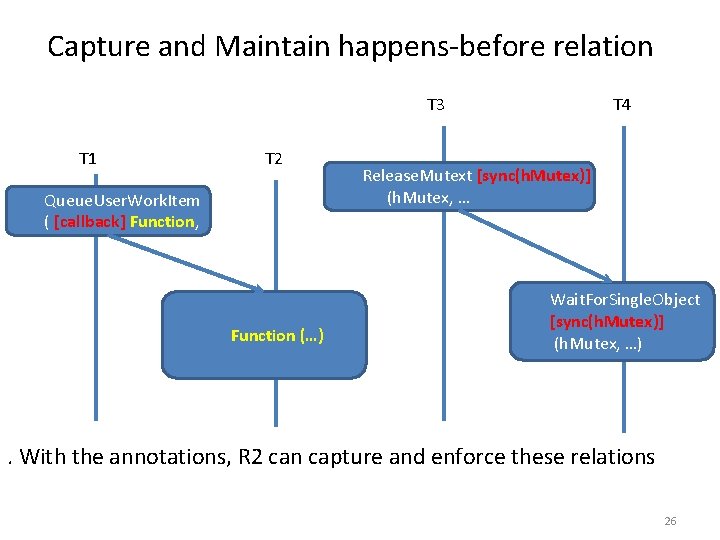
Happens-before relations • Intra-thread – always the same during recording and replay • Inter-thread (Challenges) – Callbacks – Thread synchronization – Resource manipulation – Asynchronous I/O 25
Capture and Maintain happens-before relation T 3 T 1 T 2 Queue. User. Work. Item ( [callback] Function, Function (…) T 4 Release. Mutext [sync(h. Mutex)] (h. Mutex, … Wait. For. Single. Object [sync(h. Mutex)] (h. Mutex, …) . With the annotations, R 2 can capture and enforce these relations 26
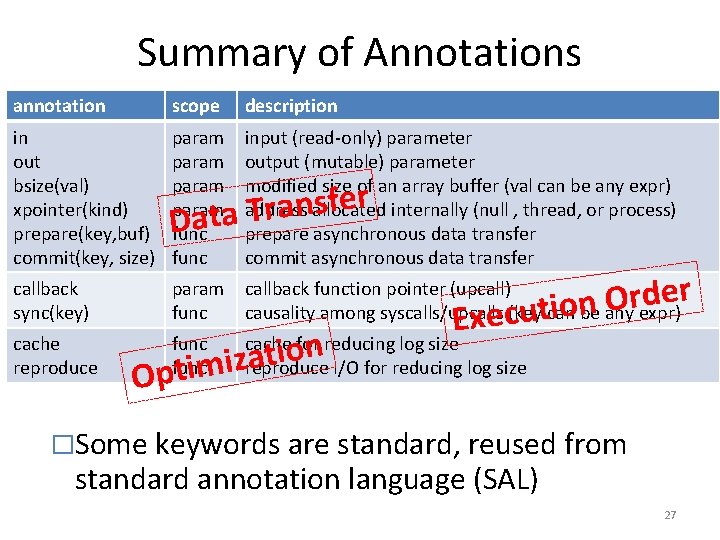
Summary of Annotations annotation scope description in out bsize(val) xpointer(kind) prepare(key, buf) commit(key, size) param func input (read-only) parameter output (mutable) parameter modified size of an array buffer (val can be any expr) address allocated internally (null , thread, or process) prepare asynchronous data transfer commit asynchronous data transfer param func callback function pointer (upcall) causality among syscalls/upcalls (key can be any expr) callback sync(key) cache reproduce r e f s n a r T Data n o i t a z i m i t p O func r e d r O n Executio cache for reducing log size reproduce I/O for reducing log size �Some keywords are standard, reused from standard annotation language (SAL) 27
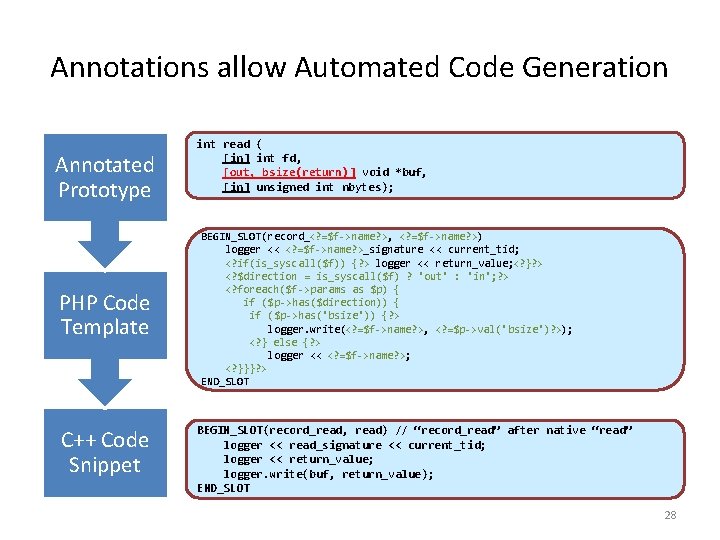
Annotations allow Automated Code Generation Annotated Prototype PHP Code Template C++ Code Snippet int read ( [in] int fd, [out, bsize(return)] void *buf, [in] unsigned int nbytes); BEGIN_SLOT(record_<? =$f->name? >, <? =$f->name? >) logger << <? =$f->name? >_signature << current_tid; <? if(is_syscall($f)) {? > logger << return_value; <? }? > <? $direction = is_syscall($f) ? 'out' : 'in'; ? > <? foreach($f->params as $p) { if ($p->has($direction)) { if ($p->has('bsize')) {? > logger. write(<? =$f->name? >, <? =$p->val('bsize')? >); <? } else {? > logger << <? =$f->name? >; <? }}}? > END_SLOT BEGIN_SLOT(record_read, read) // “record_read” after native “read” logger << read_signature << current_tid; logger << return_value; logger. write(buf, return_value); END_SLOT 28
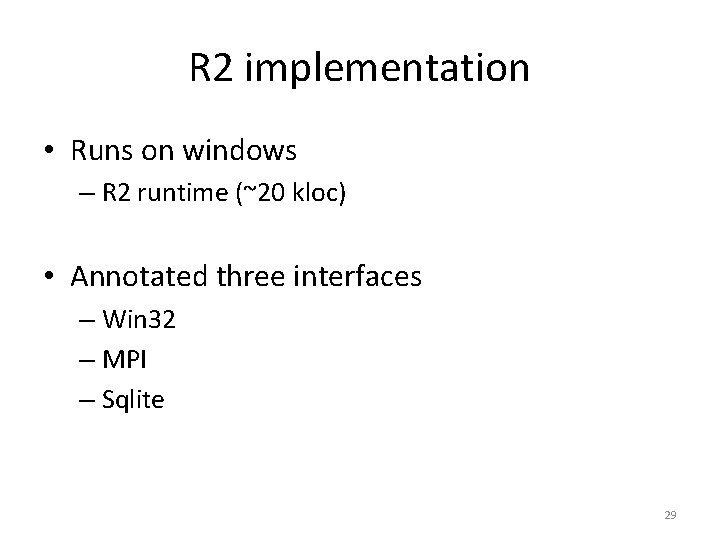
R 2 implementation • Runs on windows – R 2 runtime (~20 kloc) • Annotated three interfaces – Win 32 – MPI – Sqlite 29
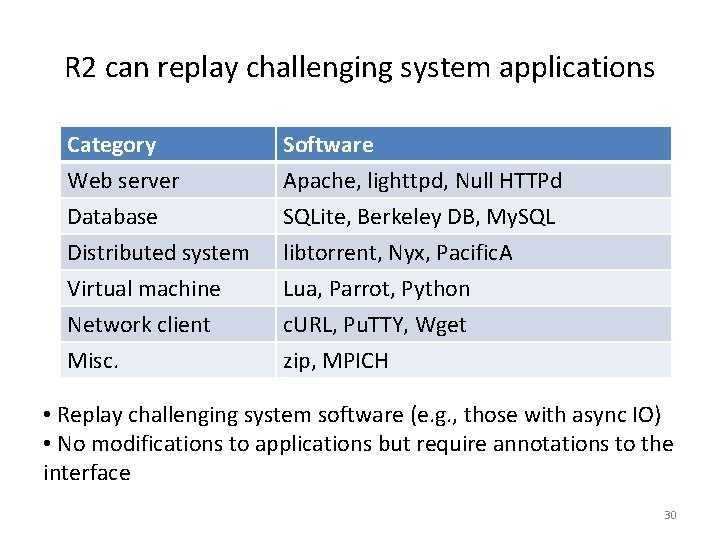
R 2 can replay challenging system applications Category Web server Database Distributed system Virtual machine Network client Misc. Software Apache, lighttpd, Null HTTPd SQLite, Berkeley DB, My. SQL libtorrent, Nyx, Pacific. A Lua, Parrot, Python c. URL, Pu. TTY, Wget zip, MPICH • Replay challenging system software (e. g. , those with async IO) • No modifications to applications but require annotations to the interface 30
Evaluation • Questions to answer – Annotation effort – Overall Performance – Effectiveness of customized interface 31
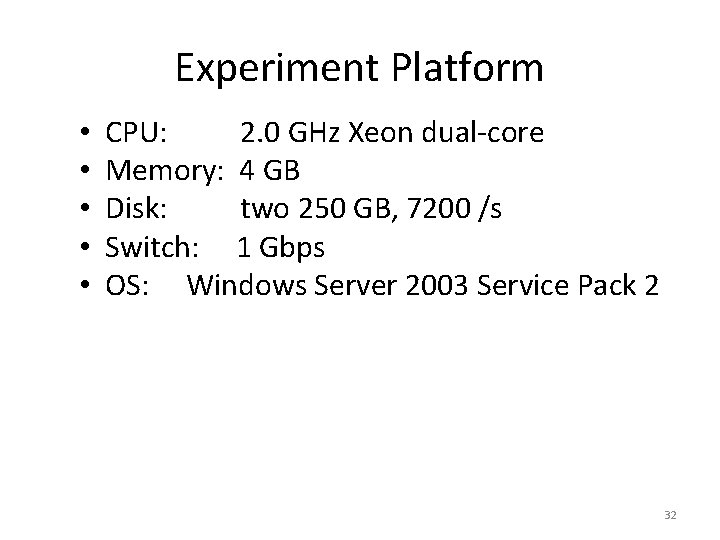
Experiment Platform • • • CPU: 2. 0 GHz Xeon dual-core Memory: 4 GB Disk: two 250 GB, 7200 /s Switch: 1 Gbps OS: Windows Server 2003 Service Pack 2 32
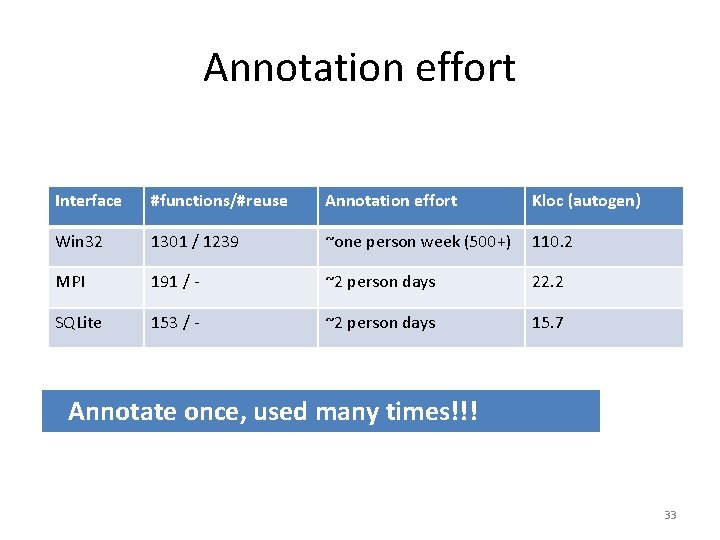
Annotation effort Interface #functions/#reuse Annotation effort Kloc (autogen) Win 32 1301 / 1239 ~one person week (500+) 110. 2 MPI 191 / - ~2 person days 22. 2 SQLite 153 / - ~2 person days 15. 7 Annotate once, used many times!!! 33
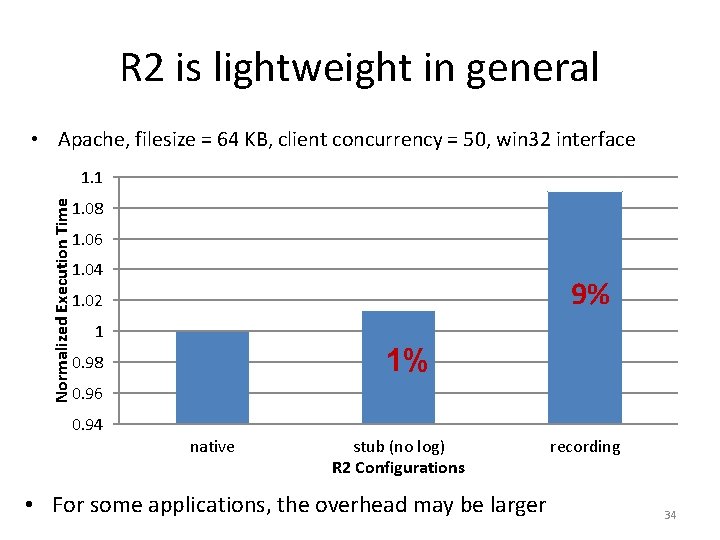
R 2 is lightweight in general • Apache, filesize = 64 KB, client concurrency = 50, win 32 interface Normalized Execution Time 1. 1 1. 08 1. 06 1. 04 9% 1. 02 1 1% 0. 98 0. 96 0. 94 native stub (no log) R 2 Configurations • For some applications, the overhead may be larger recording 34
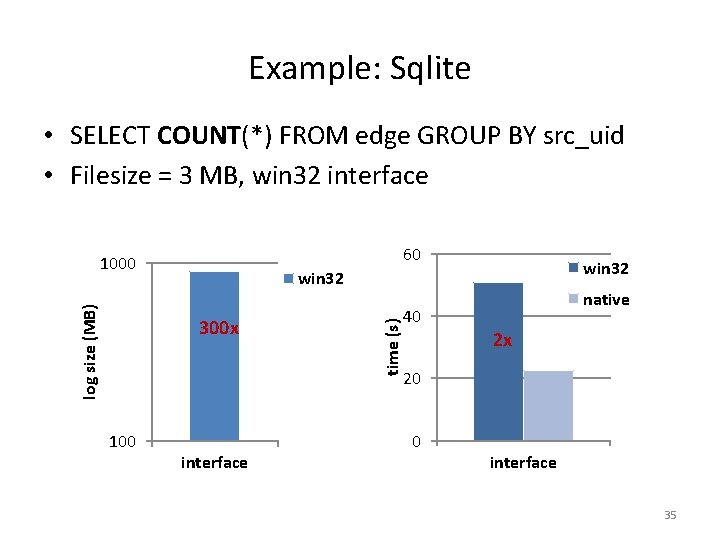
Example: Sqlite • SELECT COUNT(*) FROM edge GROUP BY src_uid • Filesize = 3 MB, win 32 interface 60 300 x 100 win 32 interface time (s) log size (MB) 1000 native 40 2 x 20 0 interface 35
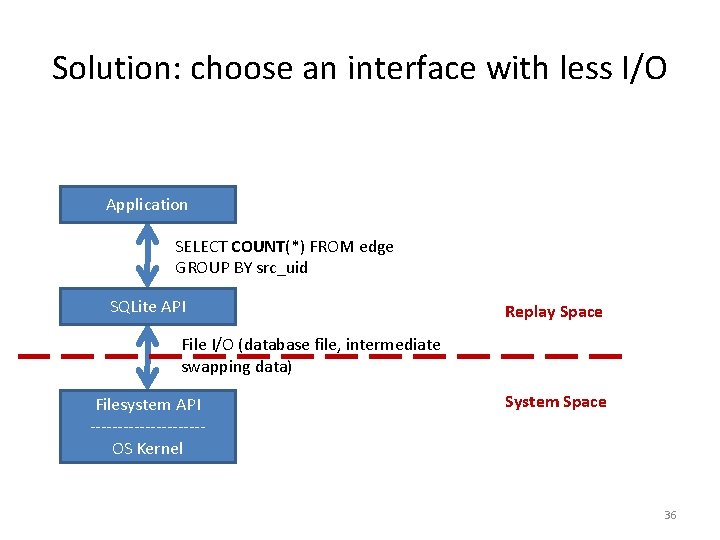
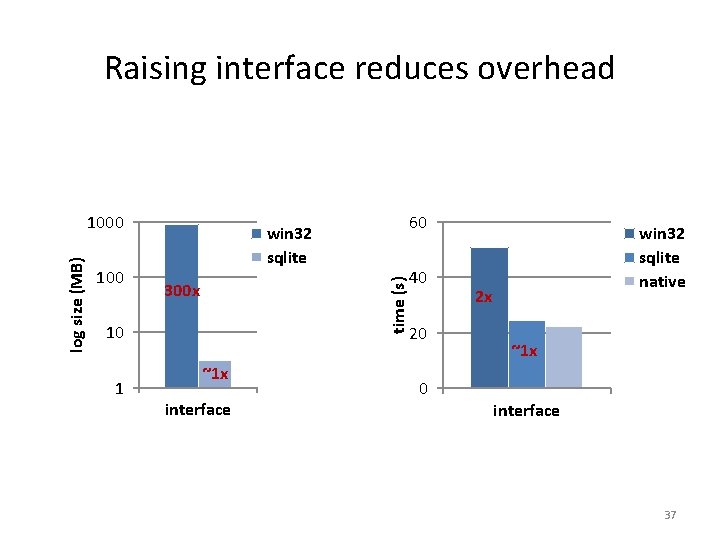
Solution: choose an interface with less I/O Application SELECT COUNT(*) FROM edge GROUP BY src_uid SQLite API Replay Space File I/O (database file, intermediate swapping data) Filesystem API ----------OS Kernel System Space 36
Raising interface reduces overhead 100 300 x 10 1 60 win 32 sqlite time (s) log size (MB) 1000 ~1 x interface 40 20 0 win 32 sqlite native 2 x ~1 x interface 37
R 2 is useful beyond replay • Space split can help in-process tools – E. g. , in model checker • Define what you do/don’t want to check • Space split + annotation + code generation, a powerful combination that we have applied to many other projects – Hang Cure for dynamically curing hang problems (Eurosys’ 08) – Towards Automatic Inference of Task Hierarchies in Complex Systems (Hot. Dep’ 08) – MPIWiz: Subgroup reproducible replay of MPI applications (PPo. PP’ 09) – Model checker for distributed systems (Submitted) 38
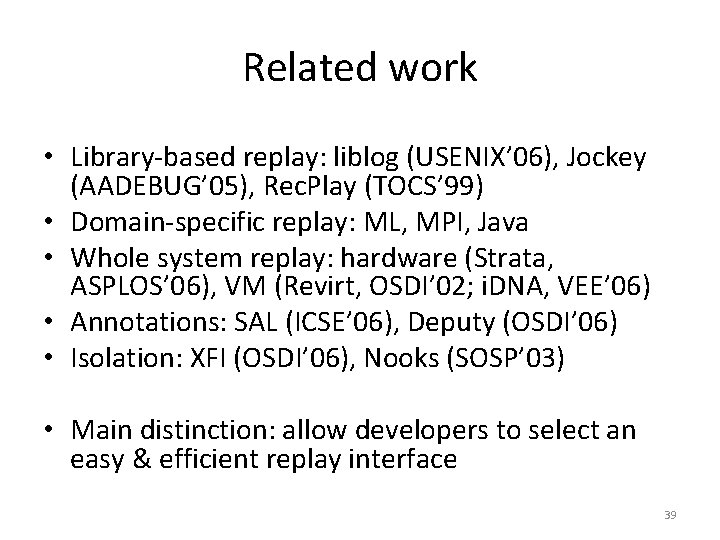
Related work • Library-based replay: liblog (USENIX’ 06), Jockey (AADEBUG’ 05), Rec. Play (TOCS’ 99) • Domain-specific replay: ML, MPI, Java • Whole system replay: hardware (Strata, ASPLOS’ 06), VM (Revirt, OSDI’ 02; i. DNA, VEE’ 06) • Annotations: SAL (ICSE’ 06), Deputy (OSDI’ 06) • Isolation: XFI (OSDI’ 06), Nooks (SOSP’ 03) • Main distinction: allow developers to select an easy & efficient replay interface 39
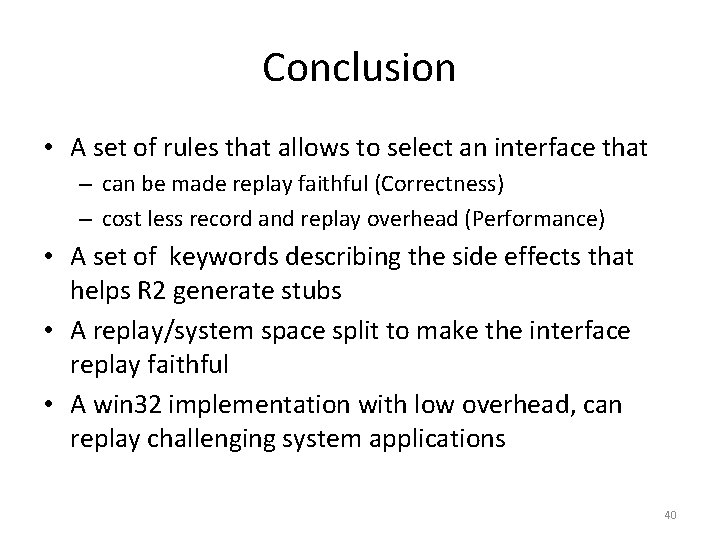
Conclusion • A set of rules that allows to select an interface that – can be made replay faithful (Correctness) – cost less record and replay overhead (Performance) • A set of keywords describing the side effects that helps R 2 generate stubs • A replay/system space split to make the interface replay faithful • A win 32 implementation with low overhead, can replay challenging system applications 40
Thanks! 41
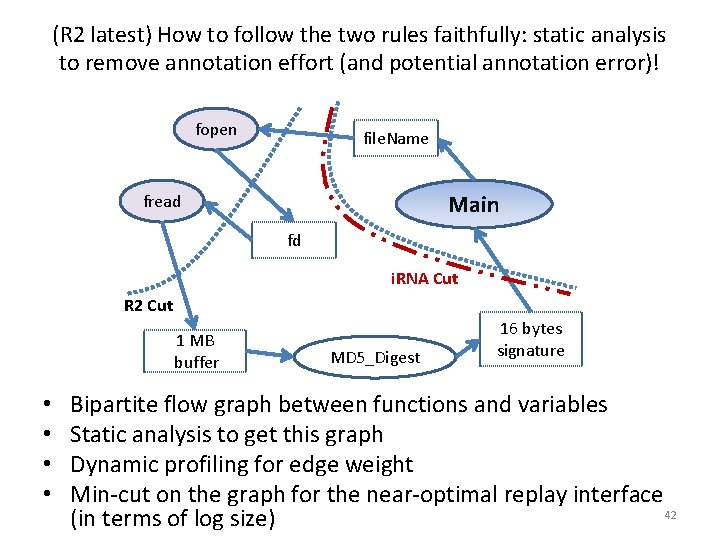
(R 2 latest) How to follow the two rules faithfully: static analysis to remove annotation effort (and potential annotation error)! fopen file. Name Main fread fd i. RNA Cut R 2 Cut 1 MB buffer • • MD 5_Digest 16 bytes signature Bipartite flow graph between functions and variables Static analysis to get this graph Dynamic profiling for edge weight Min-cut on the graph for the near-optimal replay interface 42 (in terms of log size)