Quantum Error Correction Daniel Gottesman Perimeter Institute The
- Slides: 52
Quantum Error Correction Daniel Gottesman Perimeter Institute
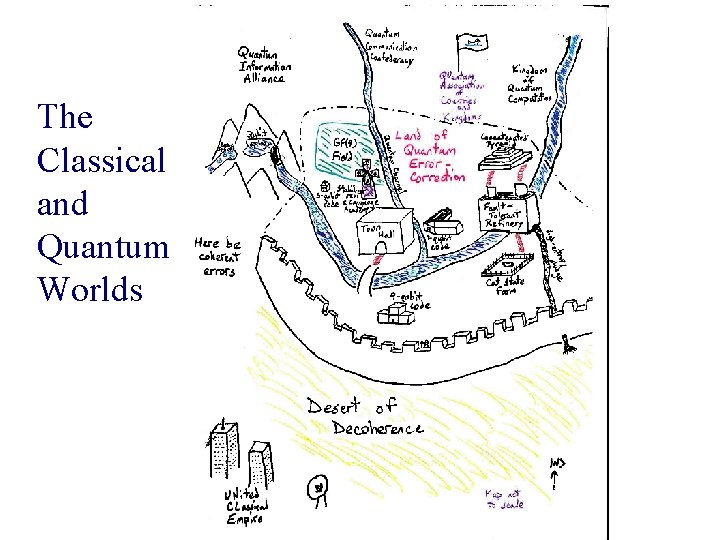
The Classical and Quantum Worlds
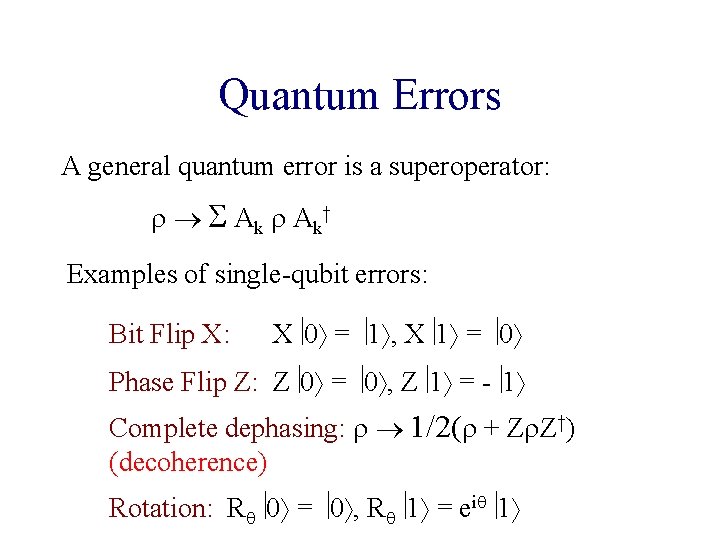
Quantum Errors A general quantum error is a superoperator: A k† Examples of single-qubit errors: Bit Flip X: X 0 = 1 , X 1 = 0 Phase Flip Z: Z 0 = 0 , Z 1 = - 1 Complete dephasing: 1/2( + Z Z†) (decoherence) Rotation: R 0 = 0 , R 1 = ei 1
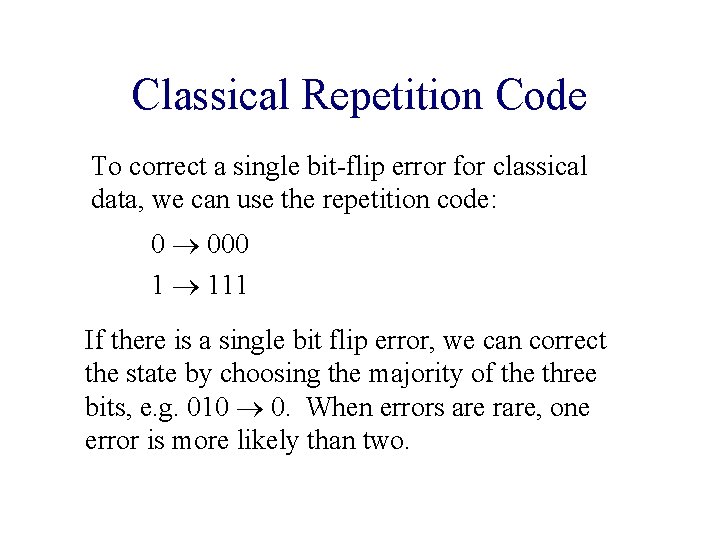
Classical Repetition Code To correct a single bit-flip error for classical data, we can use the repetition code: 0 000 1 111 If there is a single bit flip error, we can correct the state by choosing the majority of the three bits, e. g. 010 0. When errors are rare, one error is more likely than two.
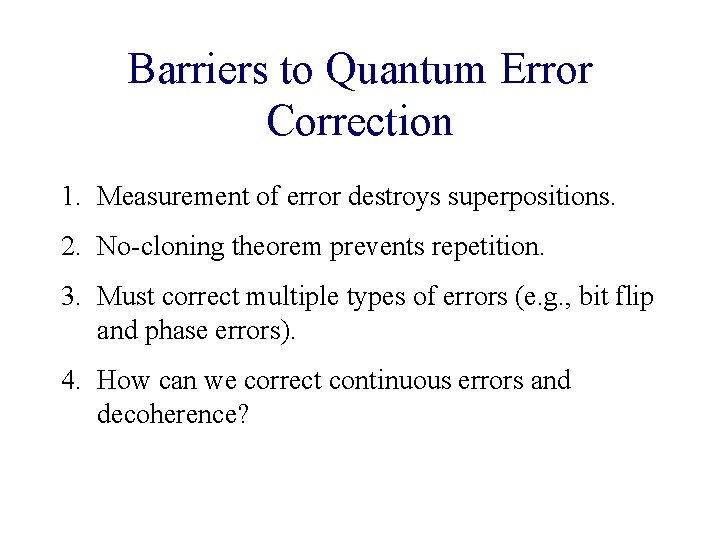
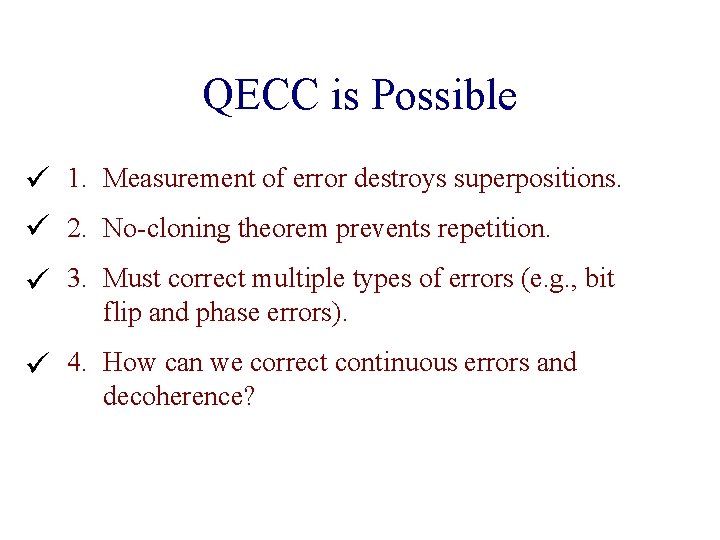
Barriers to Quantum Error Correction 1. Measurement of error destroys superpositions. 2. No-cloning theorem prevents repetition. 3. Must correct multiple types of errors (e. g. , bit flip and phase errors). 4. How can we correct continuous errors and decoherence?
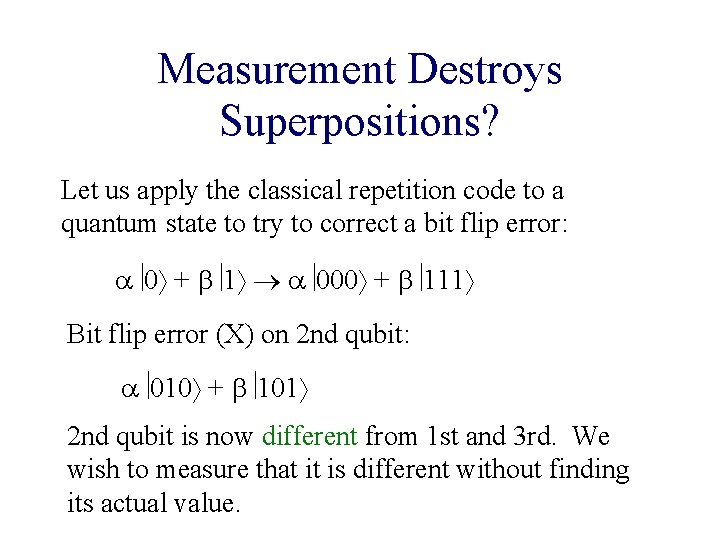
Measurement Destroys Superpositions? Let us apply the classical repetition code to a quantum state to try to correct a bit flip error: 0 + 1 000 + 111 Bit flip error (X) on 2 nd qubit: 010 + 101 2 nd qubit is now different from 1 st and 3 rd. We wish to measure that it is different without finding its actual value.
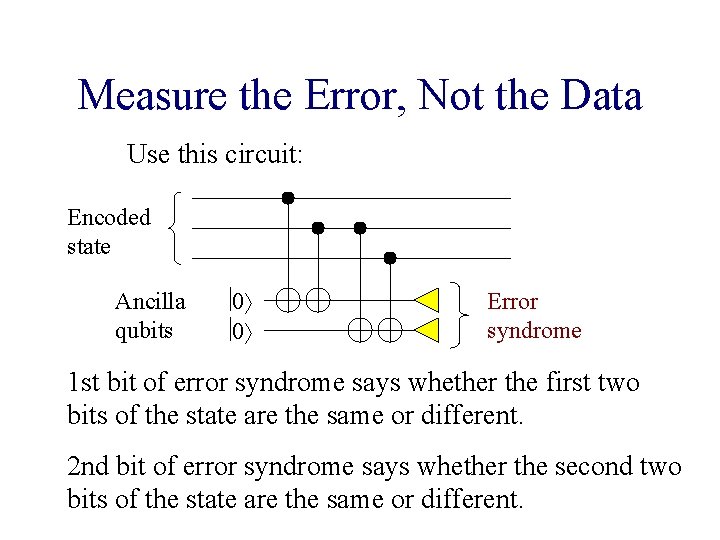
Measure the Error, Not the Data Use this circuit: Encoded state Ancilla qubits 0 0 Error syndrome 1 st bit of error syndrome says whether the first two bits of the state are the same or different. 2 nd bit of error syndrome says whether the second two bits of the state are the same or different.
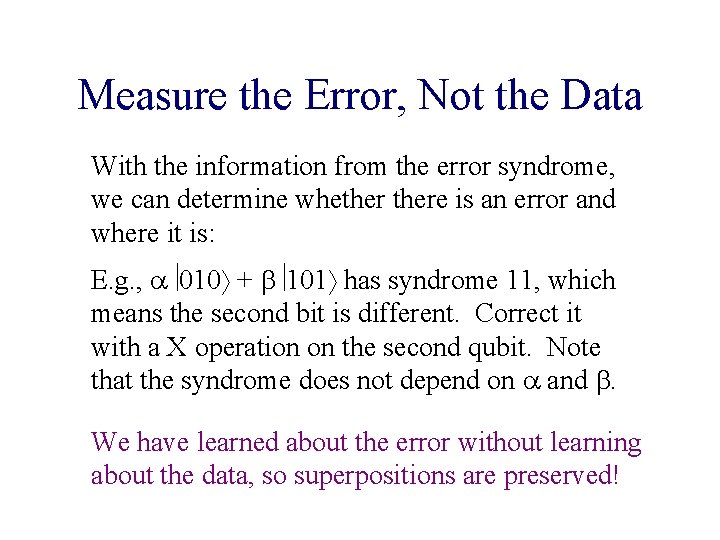
Measure the Error, Not the Data With the information from the error syndrome, we can determine whethere is an error and where it is: E. g. , 010 + 101 has syndrome 11, which means the second bit is different. Correct it with a X operation on the second qubit. Note that the syndrome does not depend on and . We have learned about the error without learning about the data, so superpositions are preserved!
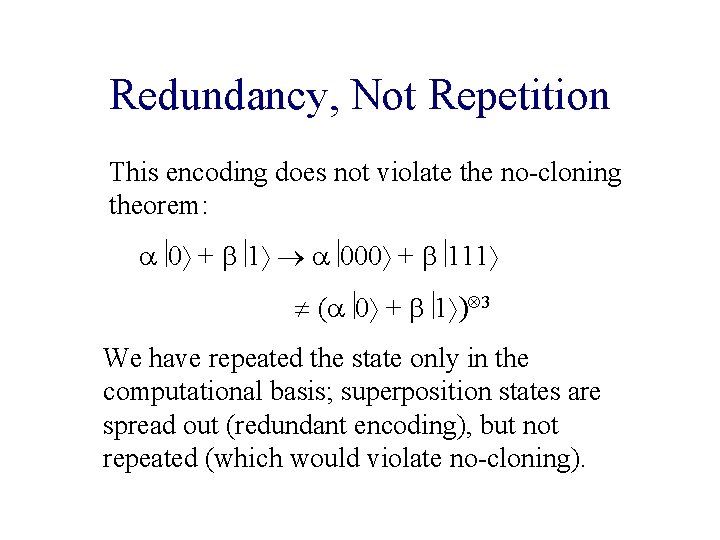
Redundancy, Not Repetition This encoding does not violate the no-cloning theorem: 0 + 1 000 + 111 ( 0 + 1 ) 3 We have repeated the state only in the computational basis; superposition states are spread out (redundant encoding), but not repeated (which would violate no-cloning).
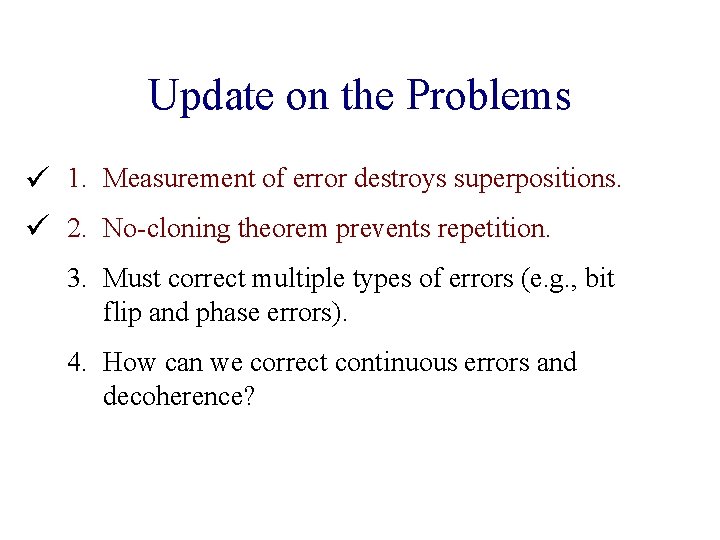
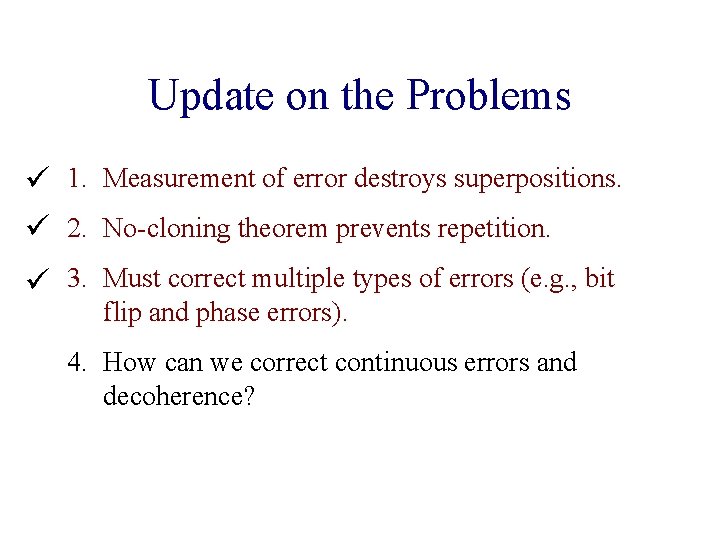
Update on the Problems 1. Measurement of error destroys superpositions. 2. No-cloning theorem prevents repetition. 3. Must correct multiple types of errors (e. g. , bit flip and phase errors). 4. How can we correct continuous errors and decoherence?
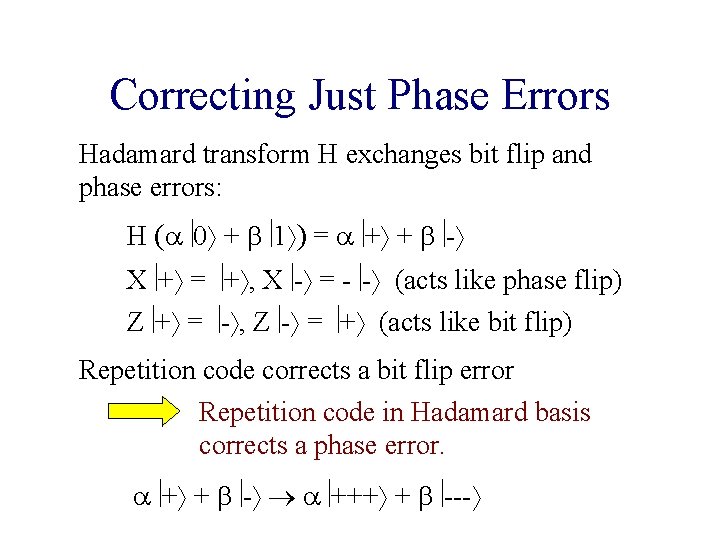
Correcting Just Phase Errors Hadamard transform H exchanges bit flip and phase errors: H ( 0 + 1 ) = + + - X + = + , X - = - - (acts like phase flip) Z + = - , Z - = + (acts like bit flip) Repetition code corrects a bit flip error Repetition code in Hadamard basis corrects a phase error. + + - +++ + ---
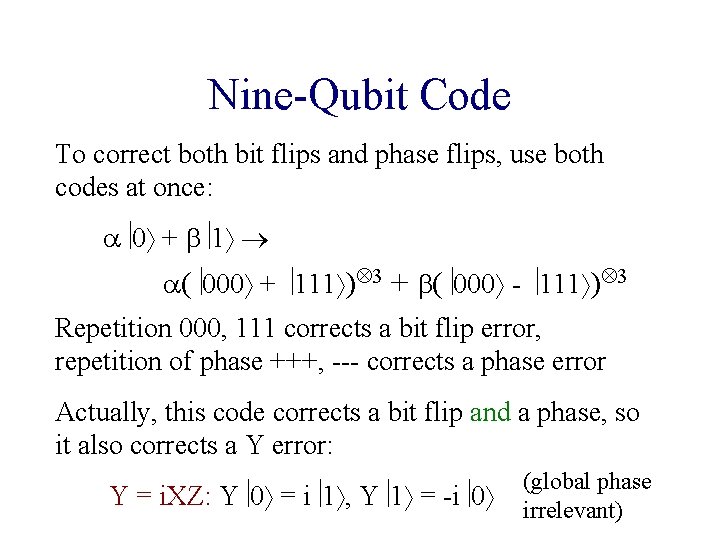
Nine-Qubit Code To correct both bit flips and phase flips, use both codes at once: 0 + 1 ( 000 + 111 ) 3 + ( 000 - 111 ) 3 Repetition 000, 111 corrects a bit flip error, repetition of phase +++, --- corrects a phase error Actually, this code corrects a bit flip and a phase, so it also corrects a Y error: Y = i. XZ: Y 0 = i 1 , Y 1 = -i 0 (global phase irrelevant)
Update on the Problems 1. Measurement of error destroys superpositions. 2. No-cloning theorem prevents repetition. 3. Must correct multiple types of errors (e. g. , bit flip and phase errors). 4. How can we correct continuous errors and decoherence?
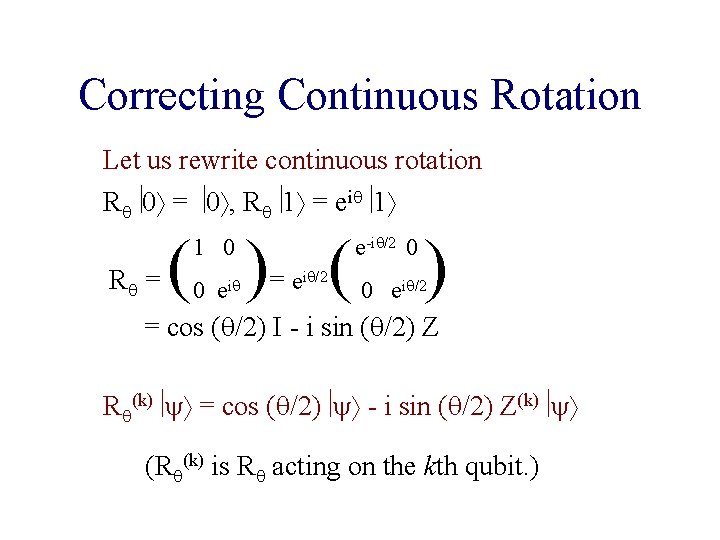
Correcting Continuous Rotation Let us rewrite continuous rotation R 0 = 0 , R 1 = ei 1 ( ) ( 1 0 R = 0 ei = ei /2 e-i /2 0 ) 0 ei /2 = cos ( /2) I - i sin ( /2) Z R (k) = cos ( /2) - i sin ( /2) Z(k) (R (k) is R acting on the kth qubit. )
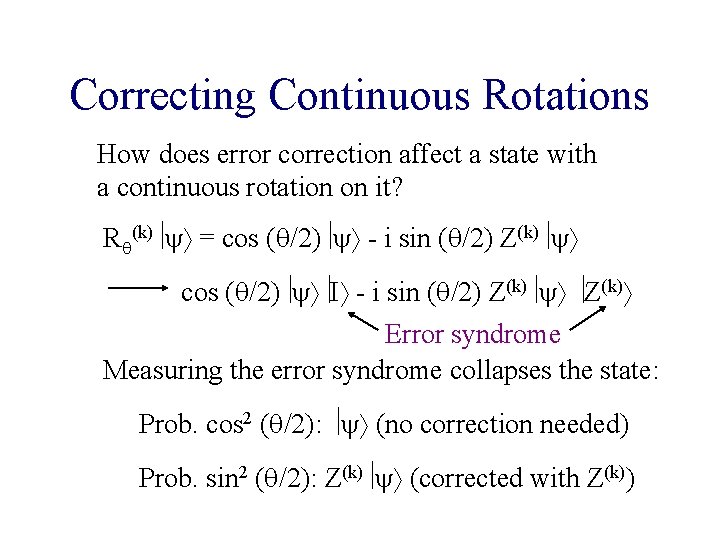
Correcting Continuous Rotations How does error correction affect a state with a continuous rotation on it? R (k) = cos ( /2) - i sin ( /2) Z(k) cos ( /2) I - i sin ( /2) Z(k) Error syndrome Measuring the error syndrome collapses the state: Prob. cos 2 ( /2): (no correction needed) Prob. sin 2 ( /2): Z(k) (corrected with Z(k))
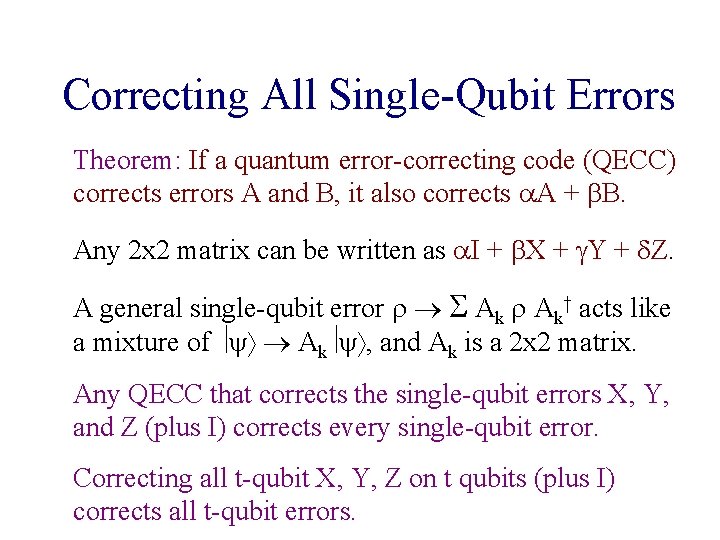
Correcting All Single-Qubit Errors Theorem: If a quantum error-correcting code (QECC) corrects errors A and B, it also corrects A + B. Any 2 x 2 matrix can be written as I + X + Y + Z. A general single-qubit error Ak† acts like a mixture of Ak , and Ak is a 2 x 2 matrix. Any QECC that corrects the single-qubit errors X, Y, and Z (plus I) corrects every single-qubit error. Correcting all t-qubit X, Y, Z on t qubits (plus I) corrects all t-qubit errors.
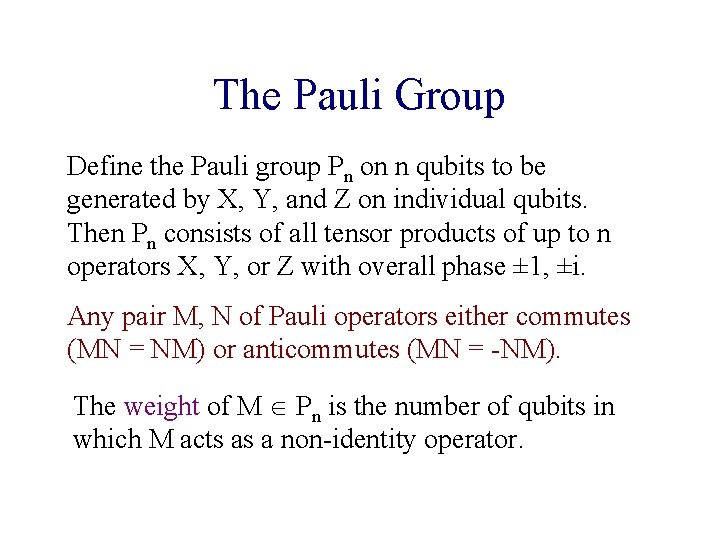
The Pauli Group Define the Pauli group Pn on n qubits to be generated by X, Y, and Z on individual qubits. Then Pn consists of all tensor products of up to n operators X, Y, or Z with overall phase ± 1, ±i. Any pair M, N of Pauli operators either commutes (MN = NM) or anticommutes (MN = -NM). The weight of M Pn is the number of qubits in which M acts as a non-identity operator.
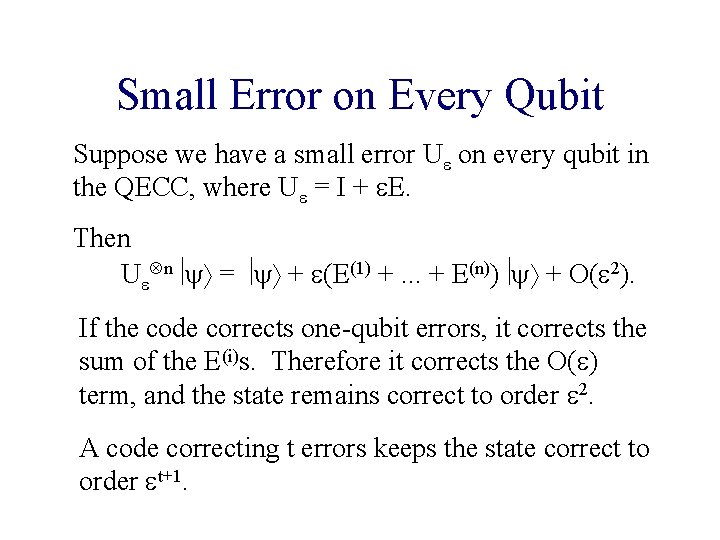
Small Error on Every Qubit Suppose we have a small error U on every qubit in the QECC, where U = I + E. Then U n = + (E(1) +. . . + E(n)) + O( 2). If the code corrects one-qubit errors, it corrects the sum of the E(i)s. Therefore it corrects the O( ) term, and the state remains correct to order 2. A code correcting t errors keeps the state correct to order t+1.
QECC is Possible 1. Measurement of error destroys superpositions. 2. No-cloning theorem prevents repetition. 3. Must correct multiple types of errors (e. g. , bit flip and phase errors). 4. How can we correct continuous errors and decoherence?
Stabilizer Codes
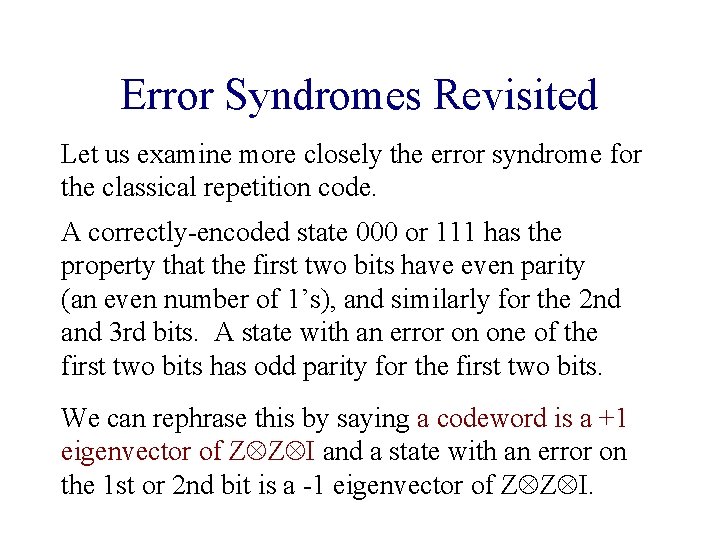
Error Syndromes Revisited Let us examine more closely the error syndrome for the classical repetition code. A correctly-encoded state 000 or 111 has the property that the first two bits have even parity (an even number of 1’s), and similarly for the 2 nd and 3 rd bits. A state with an error on one of the first two bits has odd parity for the first two bits. We can rephrase this by saying a codeword is a +1 eigenvector of Z Z I and a state with an error on the 1 st or 2 nd bit is a -1 eigenvector of Z Z I.
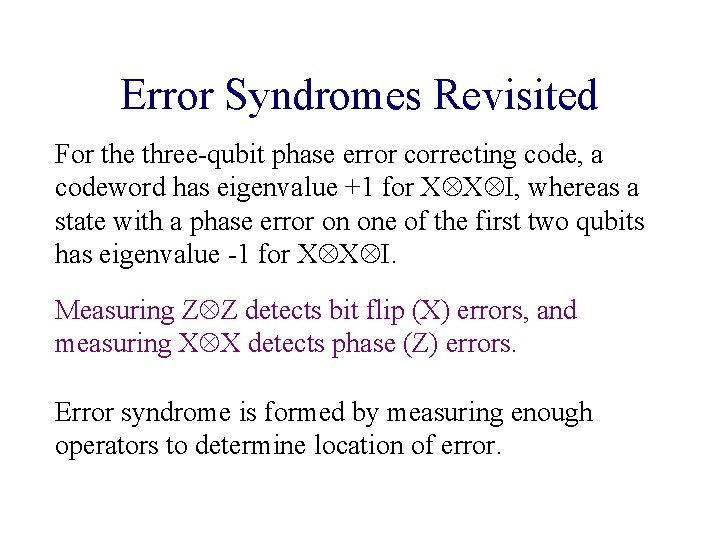
Error Syndromes Revisited For the three-qubit phase error correcting code, a codeword has eigenvalue +1 for X X I, whereas a state with a phase error on one of the first two qubits has eigenvalue -1 for X X I. Measuring Z Z detects bit flip (X) errors, and measuring X X detects phase (Z) errors. Error syndrome is formed by measuring enough operators to determine location of error.
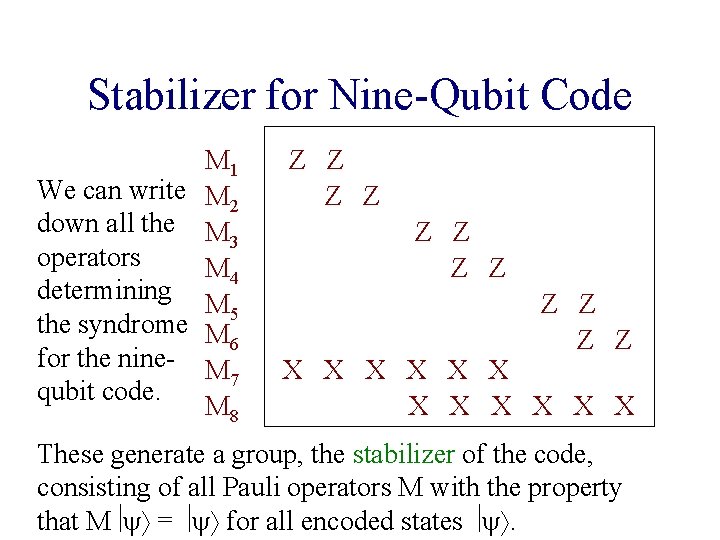
Stabilizer for Nine-Qubit Code M 1 We can write M 2 down all the M 3 operators M 4 determining M 5 the syndrome M 6 for the nine- M 7 qubit code. M 8 Z Z Z X X X These generate a group, the stabilizer of the code, consisting of all Pauli operators M with the property that M = for all encoded states .
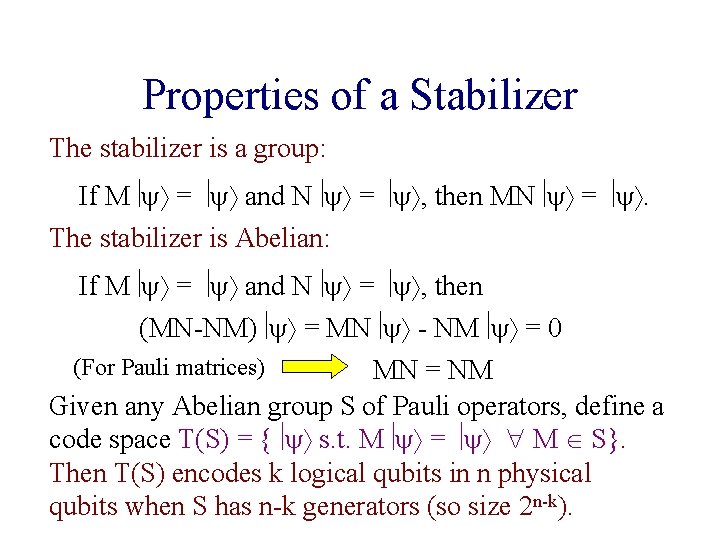
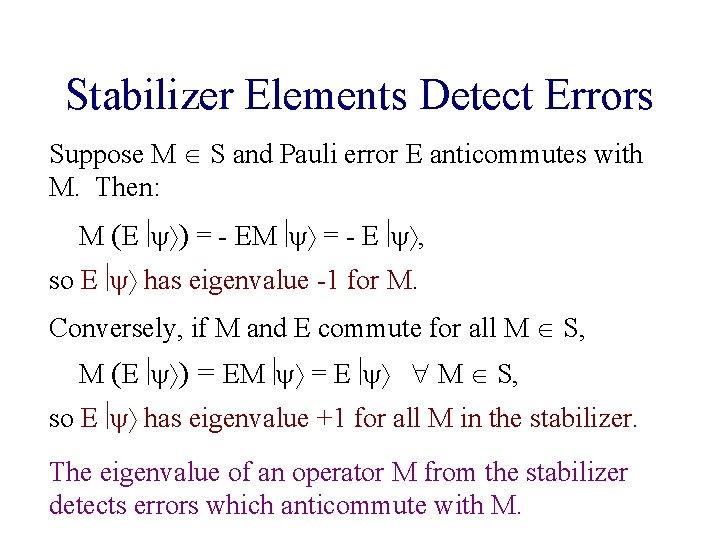
Properties of a Stabilizer The stabilizer is a group: If M = and N = , then MN = . The stabilizer is Abelian: If M = and N = , then (MN-NM) = MN - NM = 0 (For Pauli matrices) MN = NM Given any Abelian group S of Pauli operators, define a code space T(S) = { s. t. M = M S}. Then T(S) encodes k logical qubits in n physical qubits when S has n-k generators (so size 2 n-k).
Stabilizer Elements Detect Errors Suppose M S and Pauli error E anticommutes with M. Then: M (E ) = - EM = - E , so E has eigenvalue -1 for M. Conversely, if M and E commute for all M S, M (E ) = EM = E M S, so E has eigenvalue +1 for all M in the stabilizer. The eigenvalue of an operator M from the stabilizer detects errors which anticommute with M.
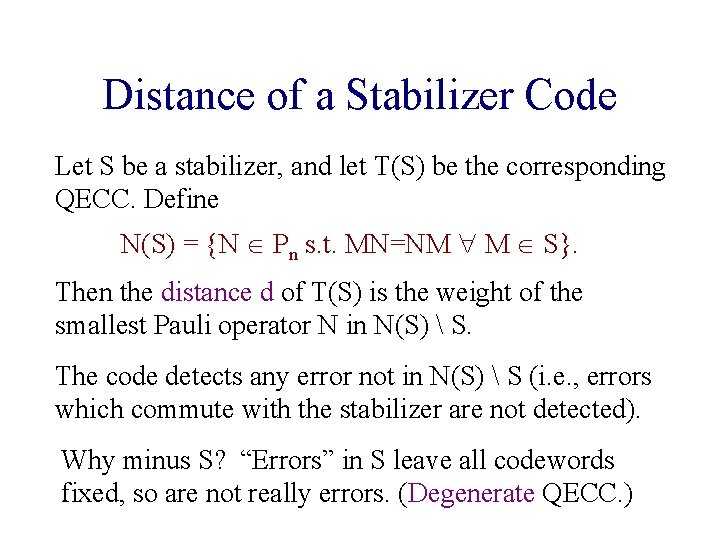
Distance of a Stabilizer Code Let S be a stabilizer, and let T(S) be the corresponding QECC. Define N(S) = {N Pn s. t. MN=NM M S}. Then the distance d of T(S) is the weight of the smallest Pauli operator N in N(S) S. The code detects any error not in N(S) S (i. e. , errors which commute with the stabilizer are not detected). Why minus S? “Errors” in S leave all codewords fixed, so are not really errors. (Degenerate QECC. )
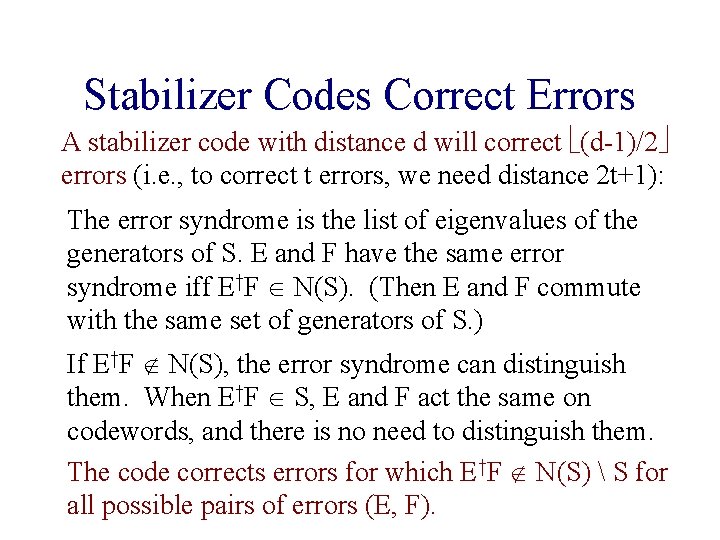
Stabilizer Codes Correct Errors A stabilizer code with distance d will correct (d-1)/2 errors (i. e. , to correct t errors, we need distance 2 t+1): The error syndrome is the list of eigenvalues of the generators of S. E and F have the same error syndrome iff E†F N(S). (Then E and F commute with the same set of generators of S. ) If E†F N(S), the error syndrome can distinguish them. When E†F S, E and F act the same on codewords, and there is no need to distinguish them. The code corrects errors for which E†F N(S) S for all possible pairs of errors (E, F).
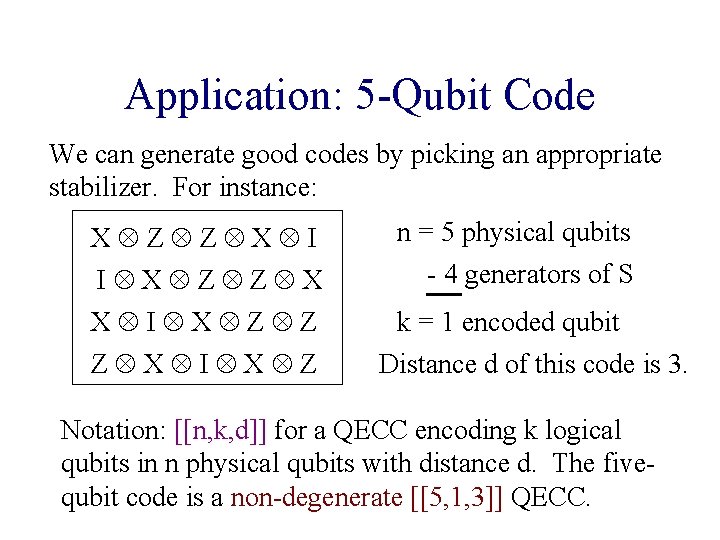
Application: 5 -Qubit Code We can generate good codes by picking an appropriate stabilizer. For instance: X Z Z X I I X Z Z X X I X Z Z Z X I X Z n = 5 physical qubits - 4 generators of S k = 1 encoded qubit Distance d of this code is 3. Notation: [[n, k, d]] for a QECC encoding k logical qubits in n physical qubits with distance d. The fivequbit code is a non-degenerate [[5, 1, 3]] QECC.
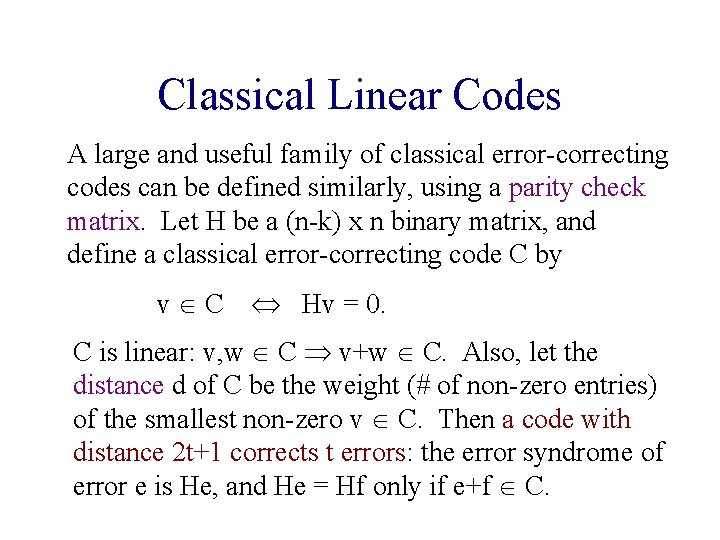
Classical Linear Codes A large and useful family of classical error-correcting codes can be defined similarly, using a parity check matrix. Let H be a (n-k) x n binary matrix, and define a classical error-correcting code C by v C Hv = 0. C is linear: v, w C v+w C. Also, let the distance d of C be the weight (# of non-zero entries) of the smallest non-zero v C. Then a code with distance 2 t+1 corrects t errors: the error syndrome of error e is He, and He = Hf only if e+f C.
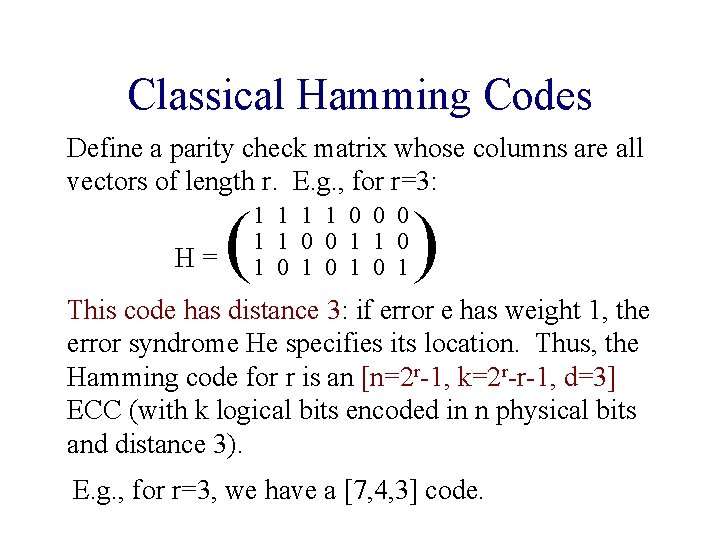
Classical Hamming Codes Define a parity check matrix whose columns are all vectors of length r. E. g. , for r=3: H= ( 1 1 0 0 0 1 1 0 1 0 1 ) This code has distance 3: if error e has weight 1, the error syndrome He specifies its location. Thus, the Hamming code for r is an [n=2 r-1, k=2 r-r-1, d=3] ECC (with k logical bits encoded in n physical bits and distance 3). E. g. , for r=3, we have a [7, 4, 3] code.
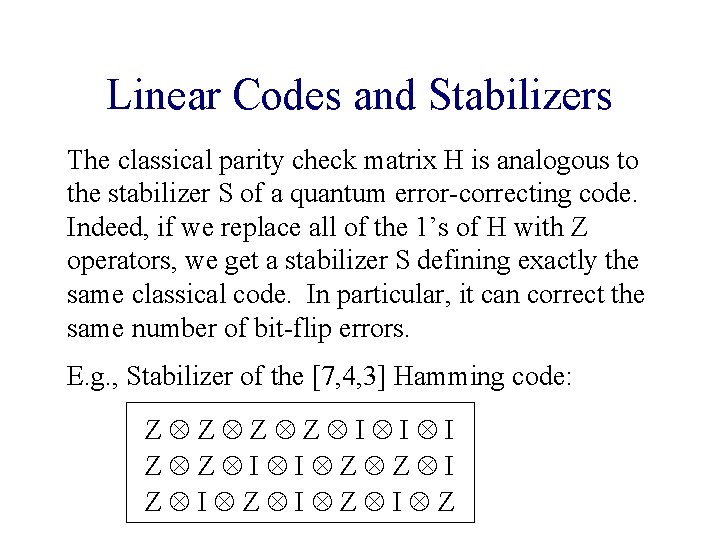
Linear Codes and Stabilizers The classical parity check matrix H is analogous to the stabilizer S of a quantum error-correcting code. Indeed, if we replace all of the 1’s of H with Z operators, we get a stabilizer S defining exactly the same classical code. In particular, it can correct the same number of bit-flip errors. E. g. , Stabilizer of the [7, 4, 3] Hamming code: Z Z I I I Z Z I Z I Z
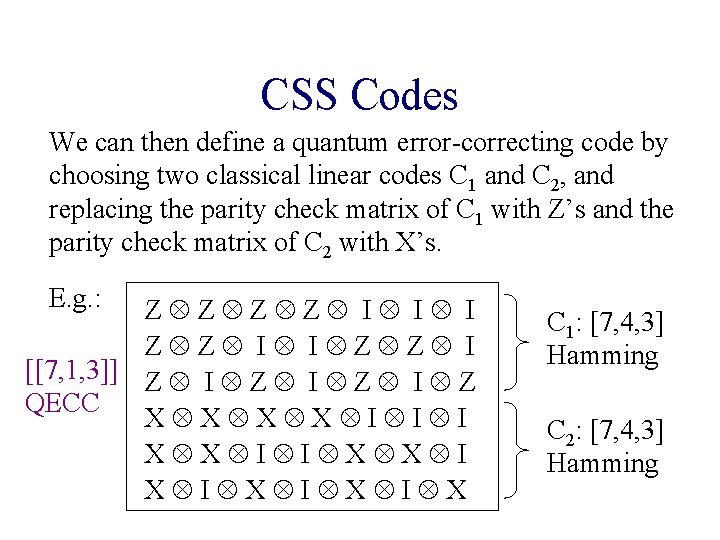
CSS Codes We can then define a quantum error-correcting code by choosing two classical linear codes C 1 and C 2, and replacing the parity check matrix of C 1 with Z’s and the parity check matrix of C 2 with X’s. E. g. : Z Z I I I Z Z I [[7, 1, 3]] Z I Z QECC X X I I I X X I X I X C 1: [7, 4, 3] Hamming C 2: [7, 4, 3] Hamming
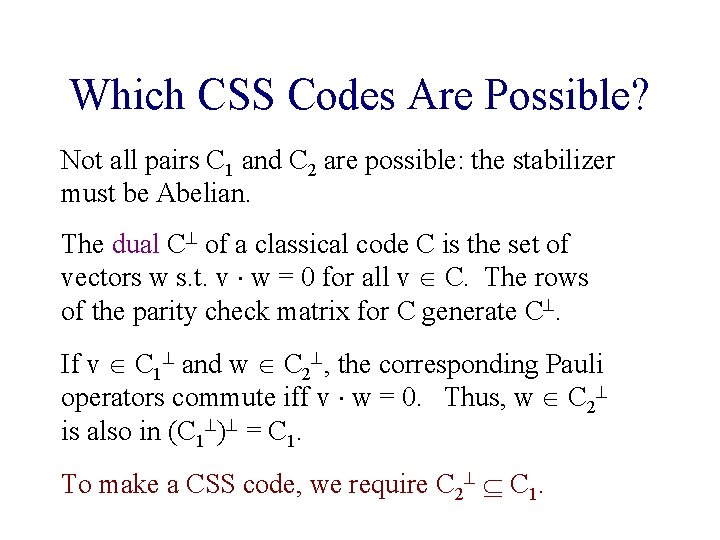
Which CSS Codes Are Possible? Not all pairs C 1 and C 2 are possible: the stabilizer must be Abelian. The dual C of a classical code C is the set of vectors w s. t. v w = 0 for all v C. The rows of the parity check matrix for C generate C. If v C 1 and w C 2 , the corresponding Pauli operators commute iff v w = 0. Thus, w C 2 is also in (C 1 ) = C 1. To make a CSS code, we require C 2 C 1.
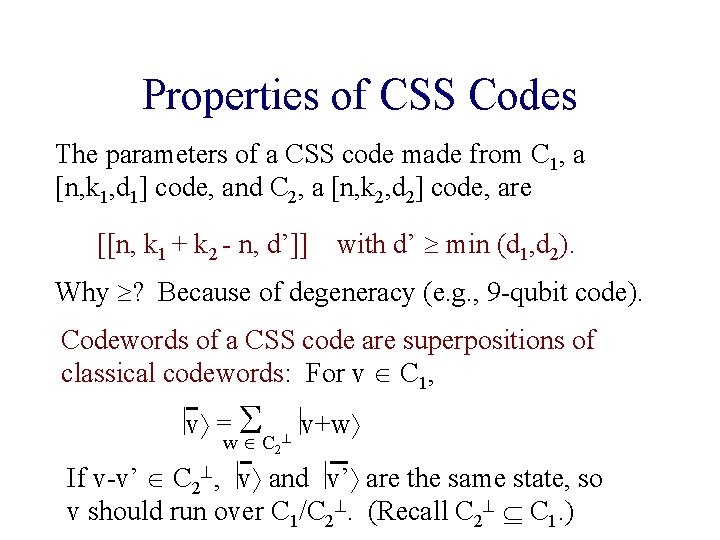
Properties of CSS Codes The parameters of a CSS code made from C 1, a [n, k 1, d 1] code, and C 2, a [n, k 2, d 2] code, are [[n, k 1 + k 2 - n, d’]] with d’ min (d 1, d 2). Why ? Because of degeneracy (e. g. , 9 -qubit code). Codewords of a CSS code are superpositions of classical codewords: For v C 1, v = w C 2 v+w If v-v’ C 2 , v and v’ are the same state, so v should run over C 1/C 2. (Recall C 2 C 1. )
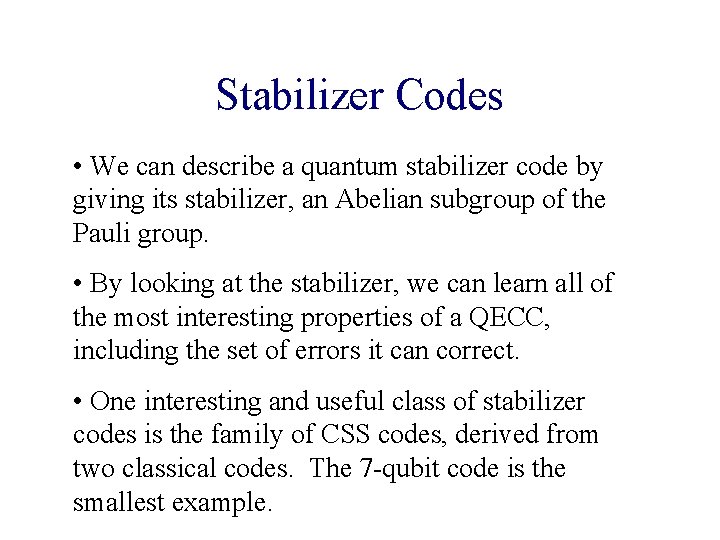
Stabilizer Codes • We can describe a quantum stabilizer code by giving its stabilizer, an Abelian subgroup of the Pauli group. • By looking at the stabilizer, we can learn all of the most interesting properties of a QECC, including the set of errors it can correct. • One interesting and useful class of stabilizer codes is the family of CSS codes, derived from two classical codes. The 7 -qubit code is the smallest example.
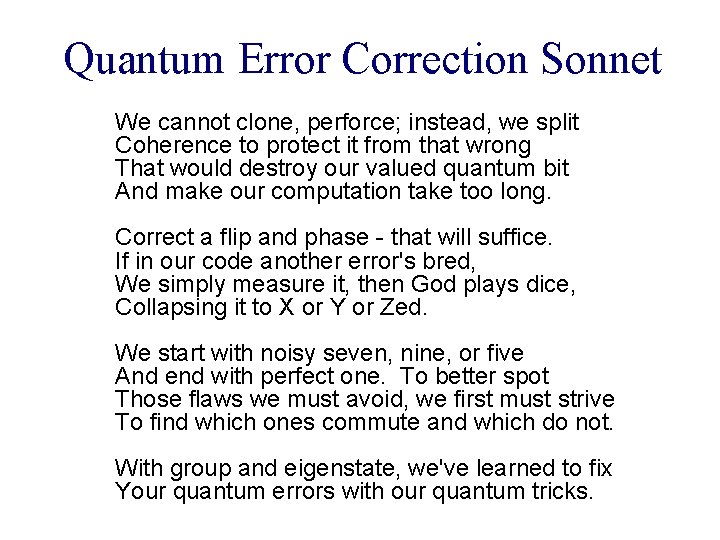
Quantum Error Correction Sonnet We cannot clone, perforce; instead, we split Coherence to protect it from that wrong That would destroy our valued quantum bit And make our computation take too long. Correct a flip and phase - that will suffice. If in our code another error's bred, We simply measure it, then God plays dice, Collapsing it to X or Y or Zed. We start with noisy seven, nine, or five And end with perfect one. To better spot Those flaws we must avoid, we first must strive To find which ones commute and which do not. With group and eigenstate, we've learned to fix Your quantum errors with our quantum tricks.
Fault-Tolerant Quantum Computation
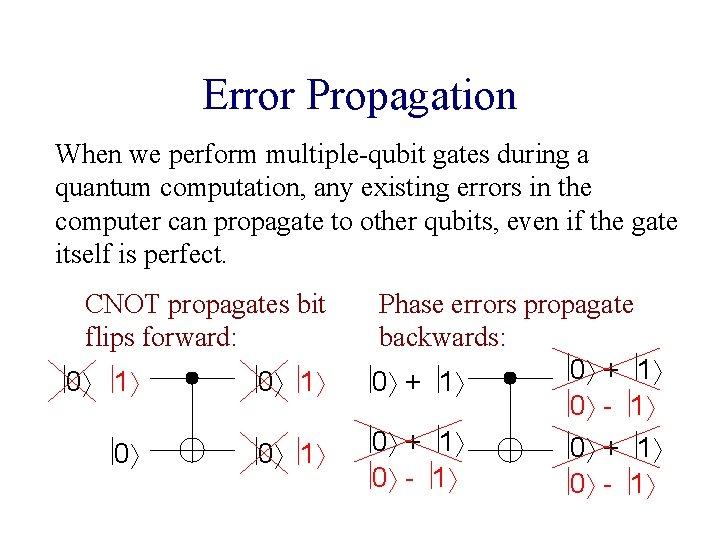
Error Propagation When we perform multiple-qubit gates during a quantum computation, any existing errors in the computer can propagate to other qubits, even if the gate itself is perfect. CNOT propagates bit flips forward: 0 1 0 0 1 Phase errors propagate backwards: 0 + 1 0 - 1
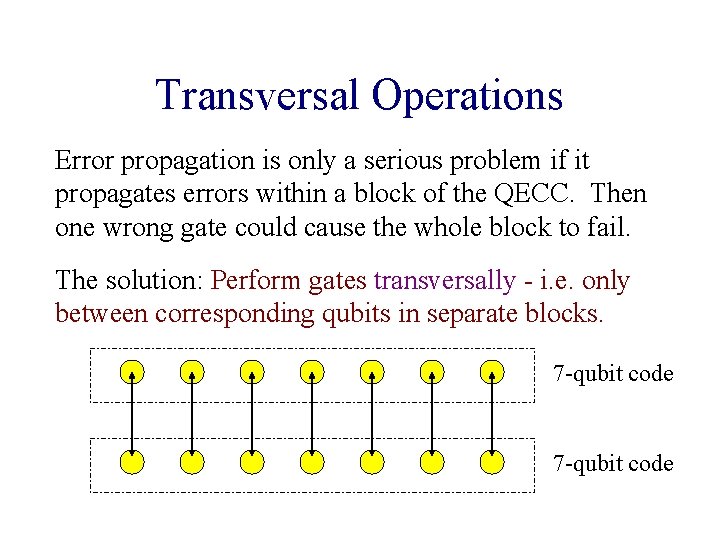
Transversal Operations Error propagation is only a serious problem if it propagates errors within a block of the QECC. Then one wrong gate could cause the whole block to fail. The solution: Perform gates transversally - i. e. only between corresponding qubits in separate blocks. 7 -qubit code
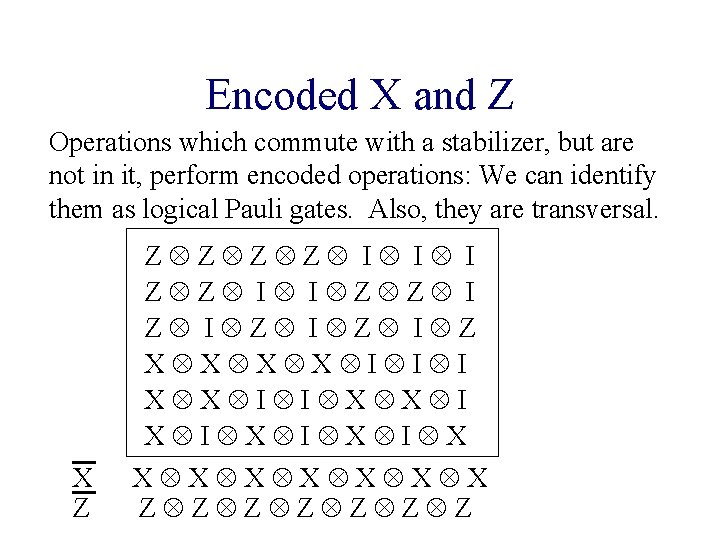
Encoded X and Z Operations which commute with a stabilizer, but are not in it, perform encoded operations: We can identify them as logical Pauli gates. Also, they are transversal. Z Z I I I Z Z I Z I Z X X I I I X X I X I X X Z X X X X Z Z Z Z
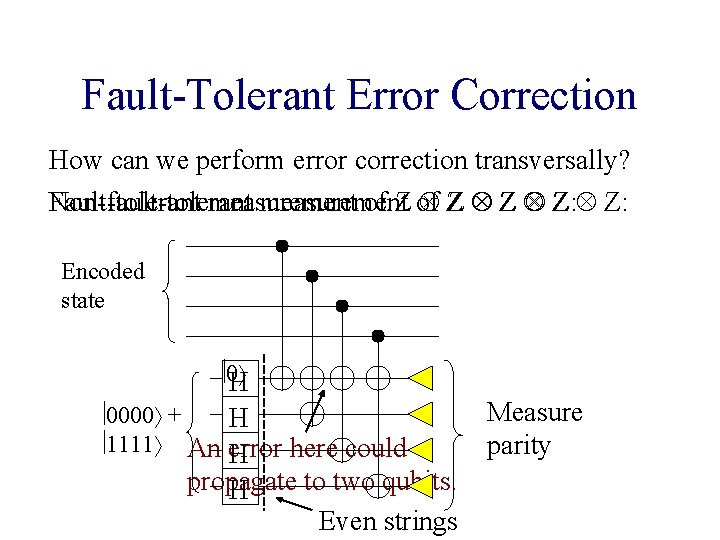
Fault-Tolerant Error Correction How can we perform error correction transversally? Fault-tolerant measurement of Z Z Z Z: Non-fault-tolerant measurement Encoded state 0 H 0000 + H 1111 An error H here could propagate to two qubits. H Even strings Measure parity
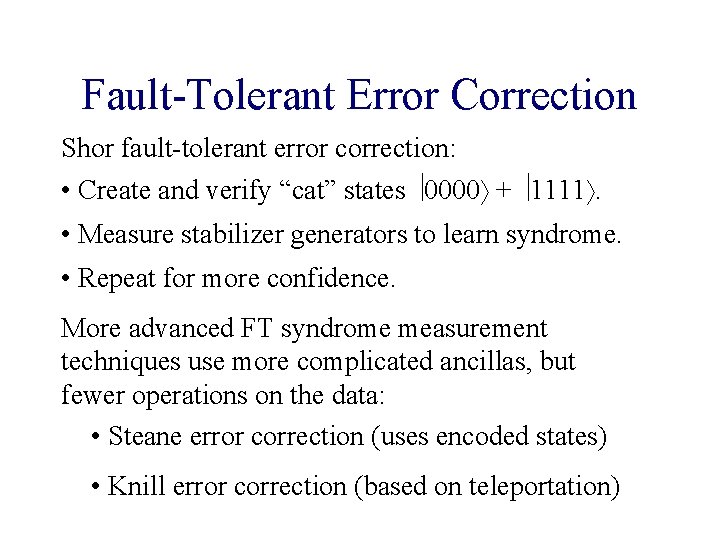
Fault-Tolerant Error Correction Shor fault-tolerant error correction: • Create and verify “cat” states 0000 + 1111. • Measure stabilizer generators to learn syndrome. • Repeat for more confidence. More advanced FT syndrome measurement techniques use more complicated ancillas, but fewer operations on the data: • Steane error correction (uses encoded states) • Knill error correction (based on teleportation)
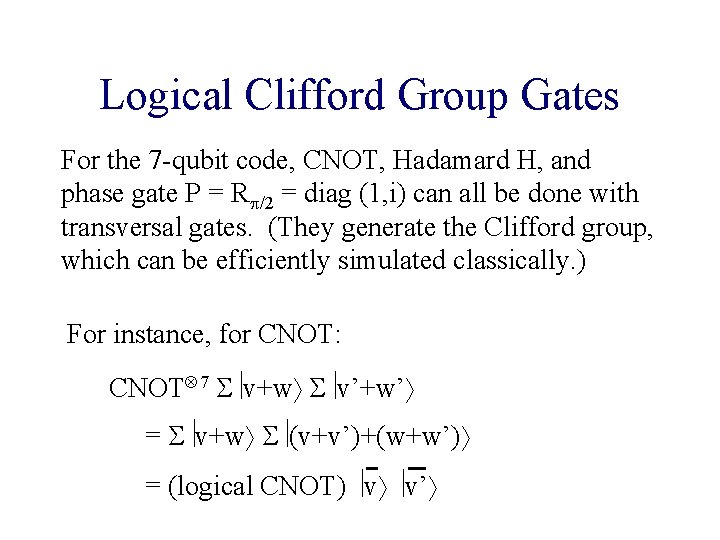
Logical Clifford Group Gates For the 7 -qubit code, CNOT, Hadamard H, and phase gate P = R /2 = diag (1, i) can all be done with transversal gates. (They generate the Clifford group, which can be efficiently simulated classically. ) For instance, for CNOT: CNOT 7 v+w v’+w’ = v+w (v+v’)+(w+w’) = (logical CNOT) v v’
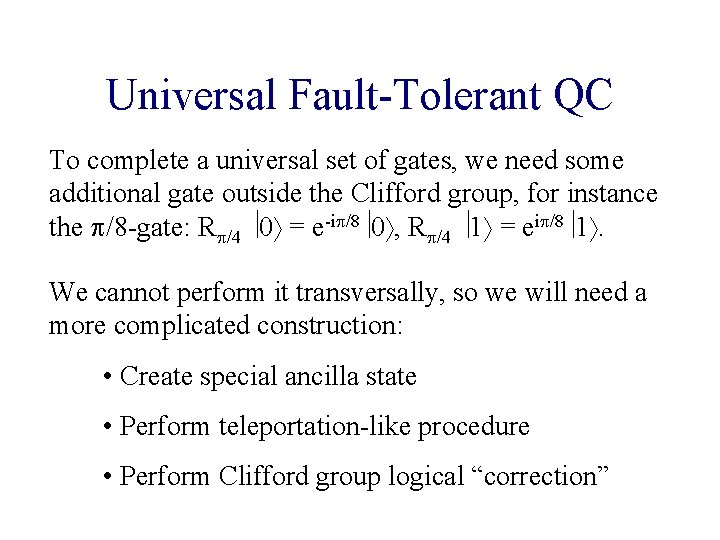
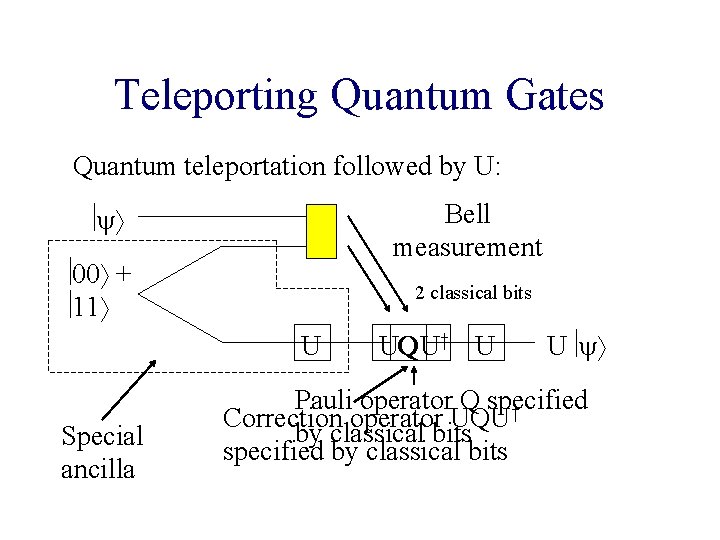
Universal Fault-Tolerant QC To complete a universal set of gates, we need some additional gate outside the Clifford group, for instance the /8 -gate: R /4 0 = e-i /8 0 , R /4 1 = ei /8 1. We cannot perform it transversally, so we will need a more complicated construction: • Create special ancilla state • Perform teleportation-like procedure • Perform Clifford group logical “correction”
Teleporting Quantum Gates Quantum teleportation followed by U: Bell measurement 00 + 11 2 classical bits U Special ancilla UQU Q † U U Pauli operator Q specified Correction operator UQU† by classical bits specified by classical bits
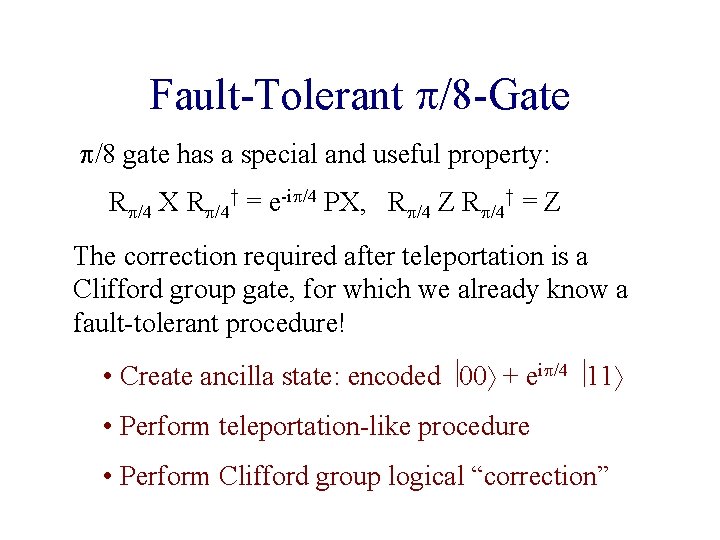
Fault-Tolerant /8 -Gate /8 gate has a special and useful property: R /4 X R /4† = e-i /4 PX, R /4 Z R /4† = Z The correction required after teleportation is a Clifford group gate, for which we already know a fault-tolerant procedure! • Create ancilla state: encoded 00 + ei /4 11 • Perform teleportation-like procedure • Perform Clifford group logical “correction”
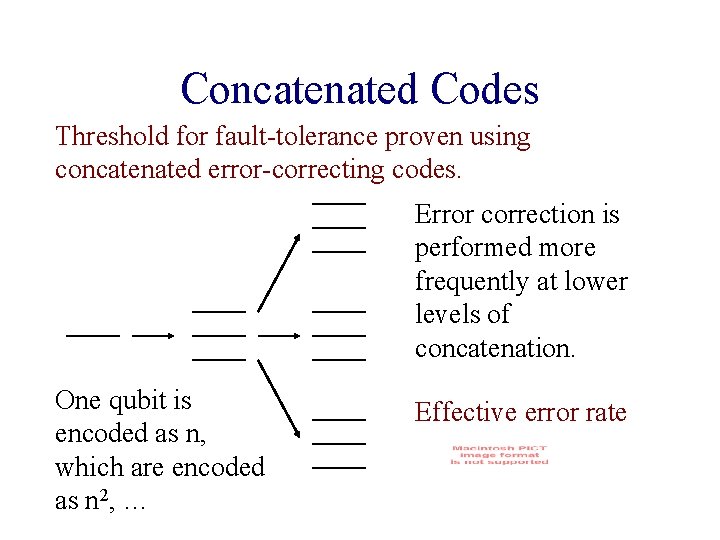
Concatenated Codes Threshold for fault-tolerance proven using concatenated error-correcting codes. Error correction is performed more frequently at lower levels of concatenation. One qubit is encoded as n, which are encoded as n 2, … Effective error rate
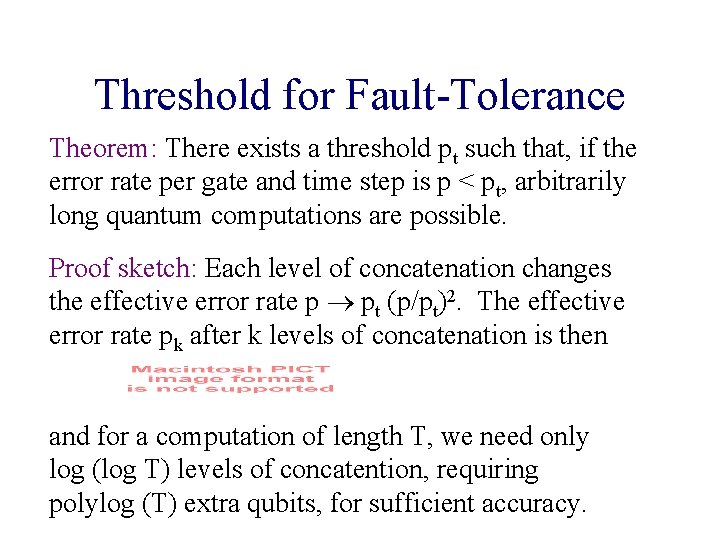
Threshold for Fault-Tolerance Theorem: There exists a threshold pt such that, if the error rate per gate and time step is p < pt, arbitrarily long quantum computations are possible. Proof sketch: Each level of concatenation changes the effective error rate p pt (p/pt)2. The effective error rate pk after k levels of concatenation is then and for a computation of length T, we need only log (log T) levels of concatention, requiring polylog (T) extra qubits, for sufficient accuracy.
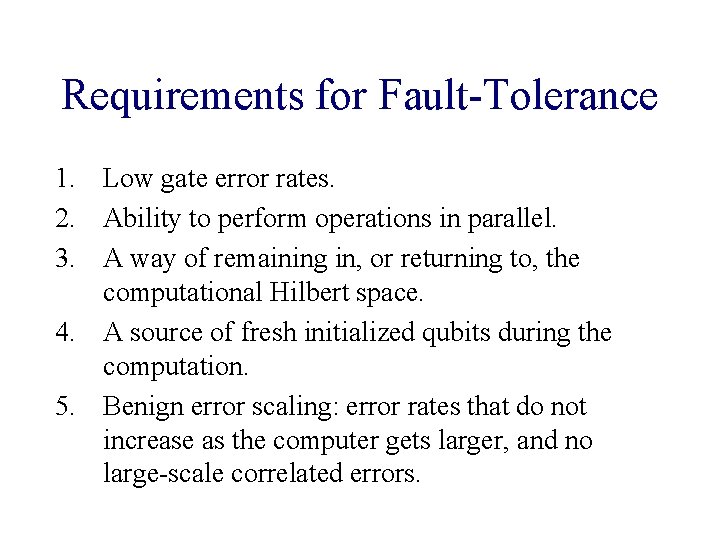
Requirements for Fault-Tolerance 1. Low gate error rates. 2. Ability to perform operations in parallel. 3. A way of remaining in, or returning to, the computational Hilbert space. 4. A source of fresh initialized qubits during the computation. 5. Benign error scaling: error rates that do not increase as the computer gets larger, and no large-scale correlated errors.
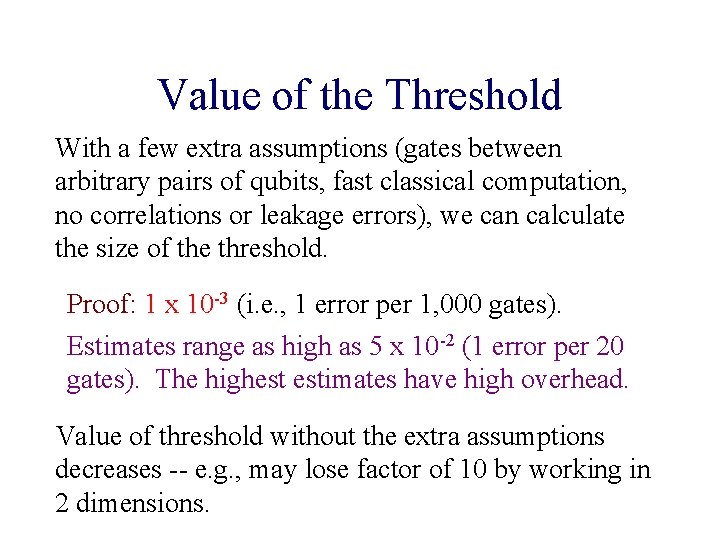
Value of the Threshold With a few extra assumptions (gates between arbitrary pairs of qubits, fast classical computation, no correlations or leakage errors), we can calculate the size of the threshold. Proof: 1 x 10 -3 (i. e. , 1 error per 1, 000 gates). Estimates range as high as 5 x 10 -2 (1 error per 20 gates). The highest estimates have high overhead. Value of threshold without the extra assumptions decreases -- e. g. , may lose factor of 10 by working in 2 dimensions.
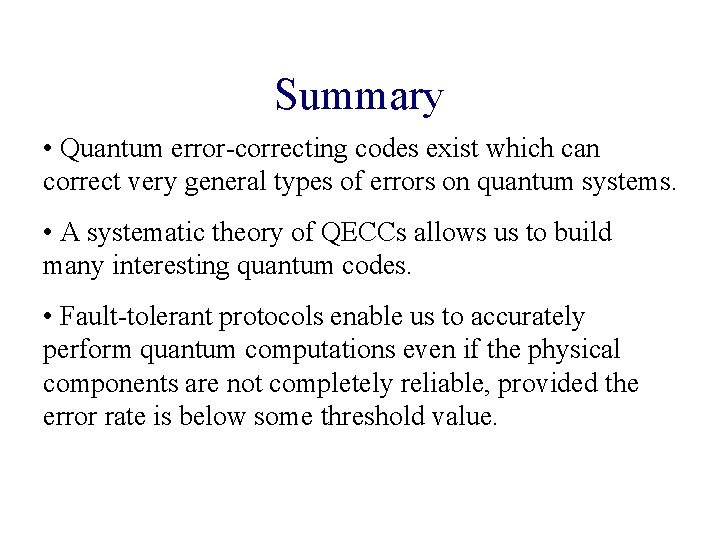
Summary • Quantum error-correcting codes exist which can correct very general types of errors on quantum systems. • A systematic theory of QECCs allows us to build many interesting quantum codes. • Fault-tolerant protocols enable us to accurately perform quantum computations even if the physical components are not completely reliable, provided the error rate is below some threshold value.
Further Information • Short intro. to QECCs: quant-ph/0004072 • Short intro. to fault-tolerance: quant-ph/0701112 • Long intro. to QECC and fault-tolerance: ar. Xiv: 0904. 2557 • Chapter 10 of Nielsen and Chuang • Chapter 7 of John Preskill’s lecture notes: http: //www. theory. caltech. edu/~preskill/ph 229 • Threshold proof & fault-tolerance: quant-ph/0504218 • Complete course on QECCs: http: //perimeterinstitute. ca/personal/dgottesman/QECC 2007