The Threshold for FaultTolerant Quantum Computation Daniel Gottesman



- Slides: 18
The Threshold for Fault-Tolerant Quantum Computation Daniel Gottesman Perimeter Institute
Basics of Fault-Tolerance • The purpose of fault-tolerance is to enable reliable quantum computations when the computer’s basic components are unreliable. • To achieve this, the qubits in the computer are encoded in blocks of a quantum error-correcting code, which allows us to correct the state even when some qubits are wrong. • A fault-tolerant protocol prevents catastrophic error propagation by ensuring that a single faulty gate or time step produces only a single error in each block of the quantum error-correcting code.
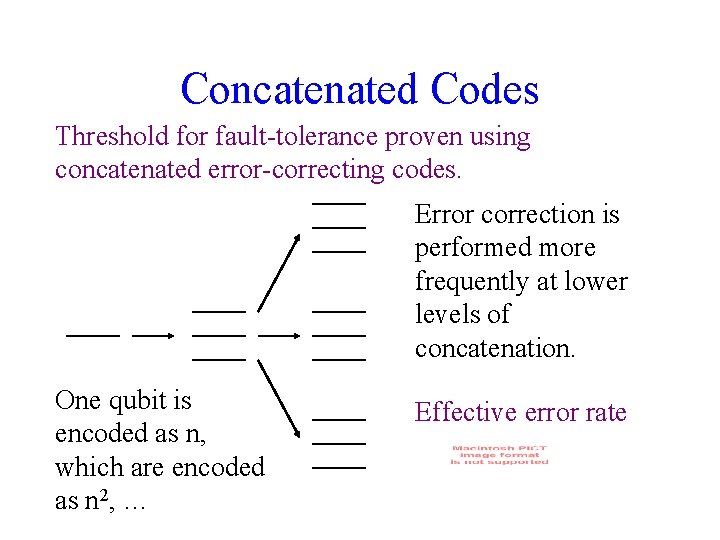
Concatenated Codes Threshold for fault-tolerance proven using concatenated error-correcting codes. Error correction is performed more frequently at lower levels of concatenation. One qubit is encoded as n, which are encoded as n 2, … Effective error rate
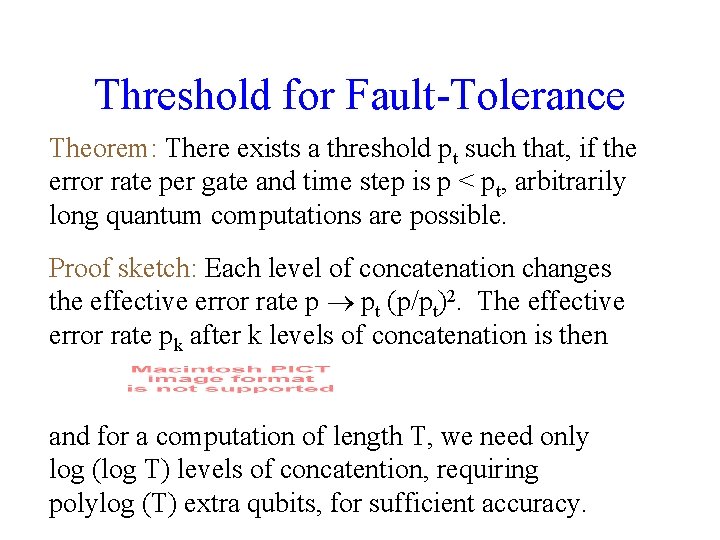
Threshold for Fault-Tolerance Theorem: There exists a threshold pt such that, if the error rate per gate and time step is p < pt, arbitrarily long quantum computations are possible. Proof sketch: Each level of concatenation changes the effective error rate p pt (p/pt)2. The effective error rate pk after k levels of concatenation is then and for a computation of length T, we need only log (log T) levels of concatention, requiring polylog (T) extra qubits, for sufficient accuracy.
Determining the Threshold Value There are three basic methodologies used to determine the value of the threshold: • Numerical simulation: Randomly choose errors on a computer, see how often they cause a problem. Tends to give high threshold value, but maybe this is an overestimate; only applies to simple error models. • Rigorous proof: Prove a certain circuit is fault-tolerant for some error rate. Gives the lowest threshold value, but everything is included (up to proof’s assumptions). • Analytic estimate: Guess certain effects are negligible and calculate threshold based on that. Gives intermediate threshold values.
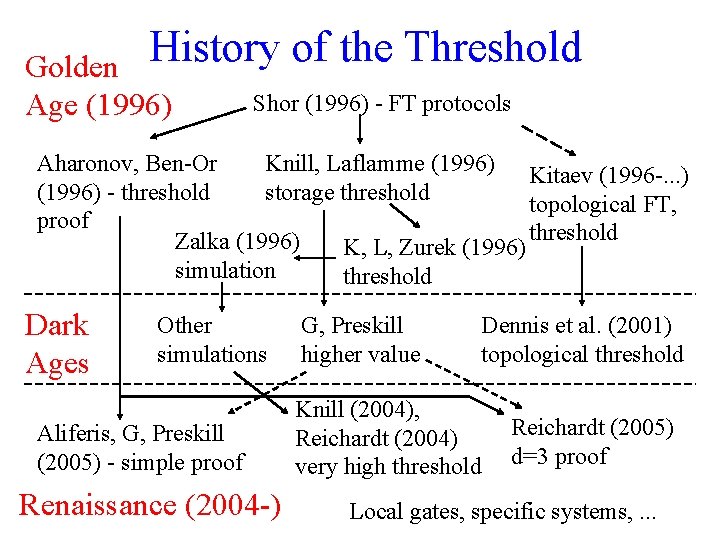
History of the Threshold Golden Age (1996) Shor (1996) - FT protocols Aharonov, Ben-Or Knill, Laflamme (1996) Kitaev (1996 -. . . ) (1996) - threshold storage threshold topological FT, proof threshold Zalka (1996) K, L, Zurek (1996) simulation threshold Dark Ages Other simulations Aliferis, G, Preskill (2005) - simple proof Renaissance (2004 -) G, Preskill higher value Dennis et al. (2001) topological threshold Knill (2004), Reichardt (2004) very high threshold Reichardt (2005) d=3 proof Local gates, specific systems, . . .
Requirements for Fault-Tolerance 1. Low gate error rates. 2. Ability to perform operations in parallel. 3. A way of remaining in, or returning to, the computational Hilbert space. 4. A source of fresh initialized qubits during the computation. 5. Benign error scaling: error rates that do not increase as the computer gets larger, and no large-scale correlated errors.
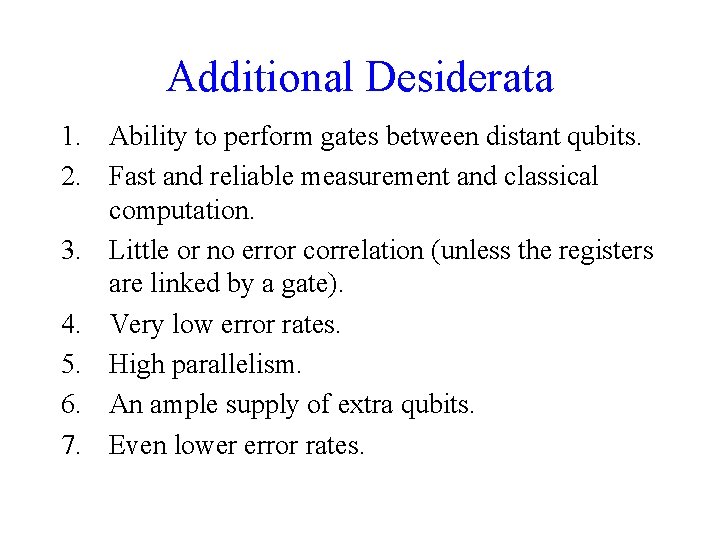
Additional Desiderata 1. Ability to perform gates between distant qubits. 2. Fast and reliable measurement and classical computation. 3. Little or no error correlation (unless the registers are linked by a gate). 4. Very low error rates. 5. High parallelism. 6. An ample supply of extra qubits. 7. Even lower error rates.
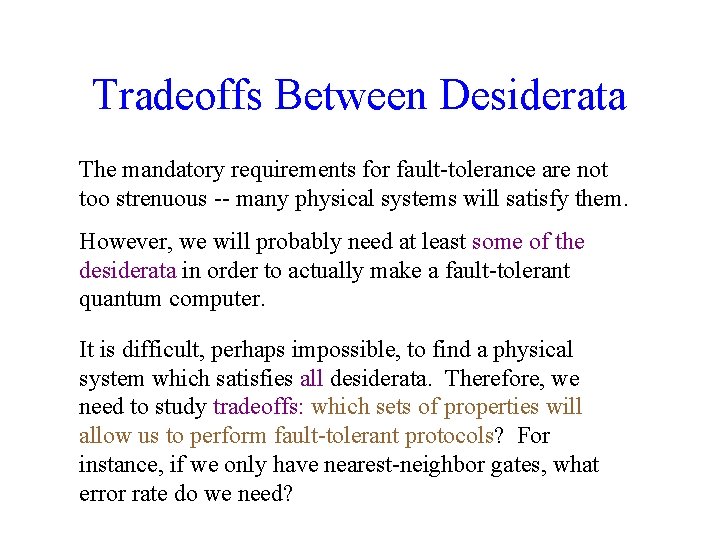
Tradeoffs Between Desiderata The mandatory requirements for fault-tolerance are not too strenuous -- many physical systems will satisfy them. However, we will probably need at least some of the desiderata in order to actually make a fault-tolerant quantum computer. It is difficult, perhaps impossible, to find a physical system which satisfies all desiderata. Therefore, we need to study tradeoffs: which sets of properties will allow us to perform fault-tolerant protocols? For instance, if we only have nearest-neighbor gates, what error rate do we need?
Threshold Values Computed threshold value depends on error-correcting code, fault-tolerant circuitry, analysis technique. Assume for now that all additional desiderata are satisfied. • Concatenated 7 -qubit code, standard circuitry: • Threshold ~ 10 -3 (various simulations) • Threshold ~ 3 x 10 -5 (proof: Aliferis, Gottesman, Preskill, quant-ph/0504218; also Reichardt, quantph/0509203) • Best known code: 25 -qubit Bacon-Shor code • Threshold ~ 2 x 10 -4 (proof: Aliferis, Cross, quant -ph/0610063)
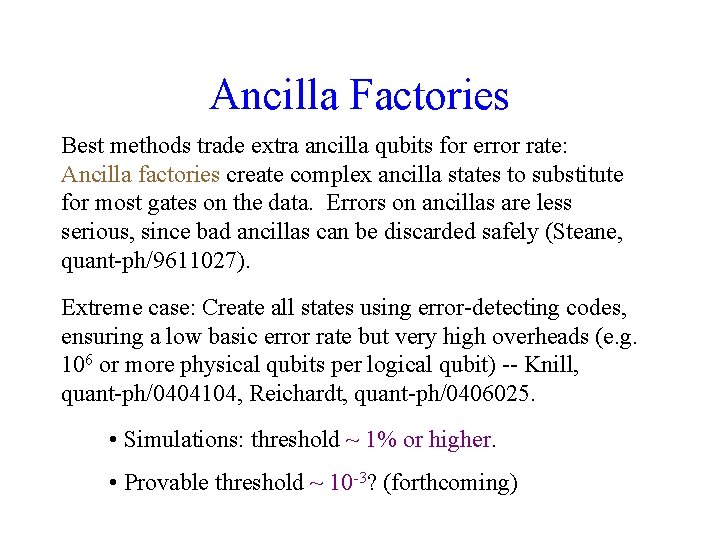
Ancilla Factories Best methods trade extra ancilla qubits for error rate: Ancilla factories create complex ancilla states to substitute for most gates on the data. Errors on ancillas are less serious, since bad ancillas can be discarded safely (Steane, quant-ph/9611027). Extreme case: Create all states using error-detecting codes, ensuring a low basic error rate but very high overheads (e. g. 106 or more physical qubits per logical qubit) -- Knill, quant-ph/0404104, Reichardt, quant-ph/0406025. • Simulations: threshold ~ 1% or higher. • Provable threshold ~ 10 -3? (forthcoming)
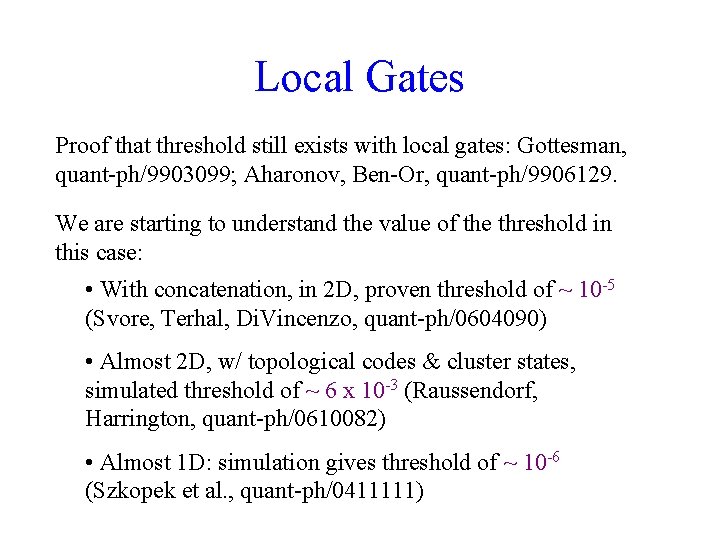
Local Gates Proof that threshold still exists with local gates: Gottesman, quant-ph/9903099; Aharonov, Ben-Or, quant-ph/9906129. We are starting to understand the value of the threshold in this case: • With concatenation, in 2 D, proven threshold of ~ 10 -5 (Svore, Terhal, Di. Vincenzo, quant-ph/0604090) • Almost 2 D, w/ topological codes & cluster states, simulated threshold of ~ 6 x 10 -3 (Raussendorf, Harrington, quant-ph/0610082) • Almost 1 D: simulation gives threshold of ~ 10 -6 (Szkopek et al. , quant-ph/0411111)
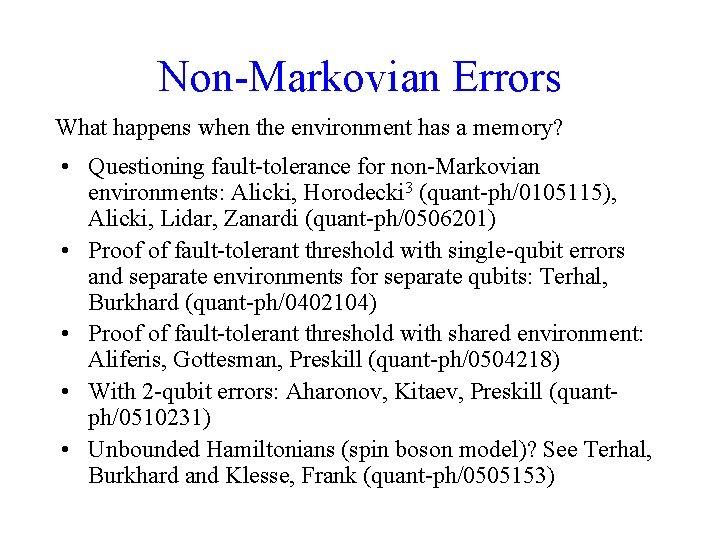
Non-Markovian Errors What happens when the environment has a memory? • Questioning fault-tolerance for non-Markovian environments: Alicki, Horodecki 3 (quant-ph/0105115), Alicki, Lidar, Zanardi (quant-ph/0506201) • Proof of fault-tolerant threshold with single-qubit errors and separate environments for separate qubits: Terhal, Burkhard (quant-ph/0402104) • Proof of fault-tolerant threshold with shared environment: Aliferis, Gottesman, Preskill (quant-ph/0504218) • With 2 -qubit errors: Aharonov, Kitaev, Preskill (quantph/0510231) • Unbounded Hamiltonians (spin boson model)? See Terhal, Burkhard and Klesse, Frank (quant-ph/0505153)
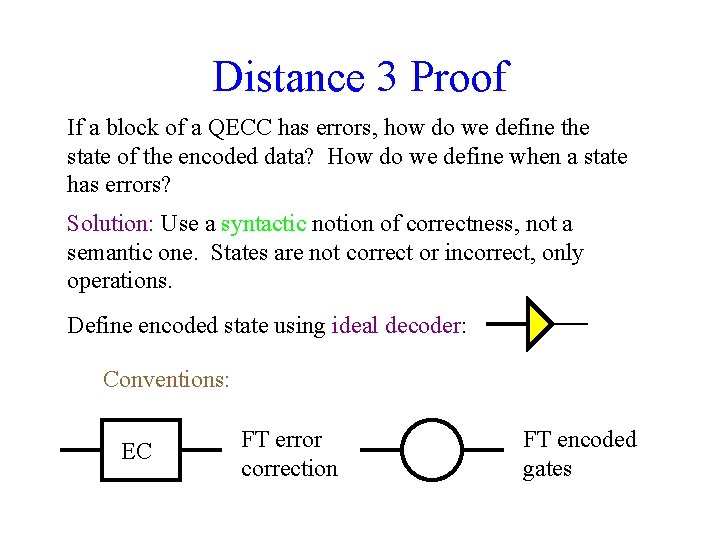
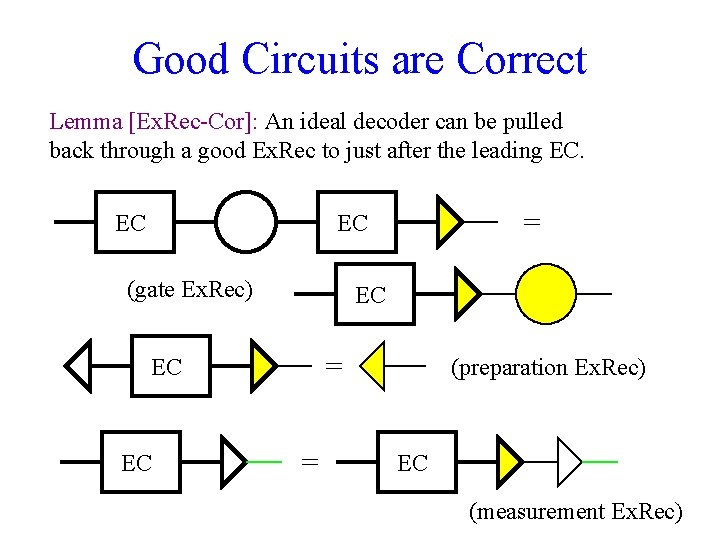
Distance 3 Proof If a block of a QECC has errors, how do we define the state of the encoded data? How do we define when a state has errors? Solution: Use a syntactic notion of correctness, not a semantic one. States are not correct or incorrect, only operations. Define encoded state using ideal decoder: Conventions: EC FT error correction FT encoded gates
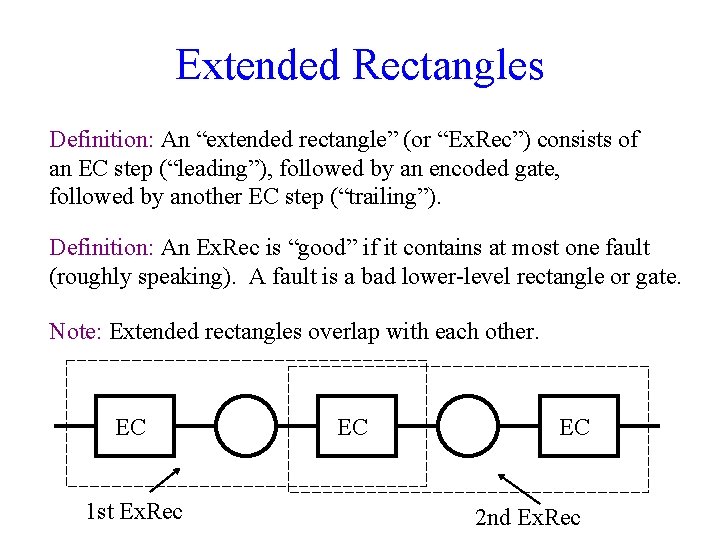
Extended Rectangles Definition: An “extended rectangle” (or “Ex. Rec”) consists of an EC step (“leading”), followed by an encoded gate, followed by another EC step (“trailing”). Definition: An Ex. Rec is “good” if it contains at most one fault (roughly speaking). A fault is a bad lower-level rectangle or gate. Note: Extended rectangles overlap with each other. EC 1 st Ex. Rec EC EC 2 nd Ex. Rec
Good Circuits are Correct Lemma [Ex. Rec-Cor]: An ideal decoder can be pulled back through a good Ex. Rec to just after the leading EC. EC = EC (gate Ex. Rec) EC = EC EC = (preparation Ex. Rec) EC (measurement Ex. Rec)
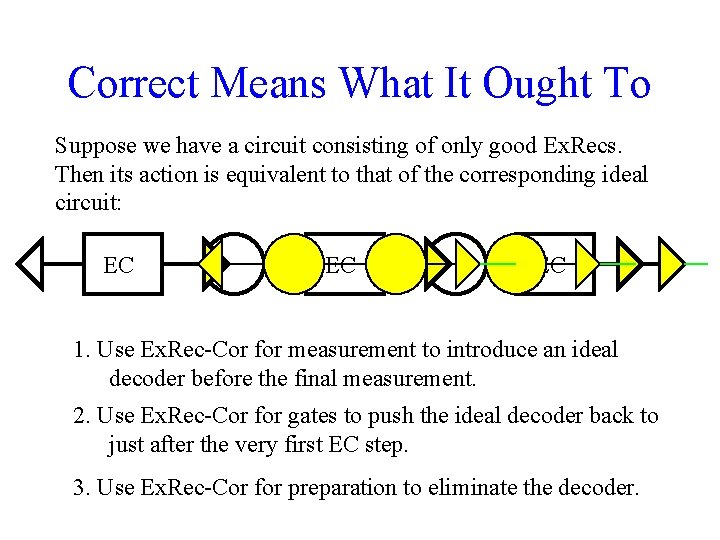
Correct Means What It Ought To Suppose we have a circuit consisting of only good Ex. Recs. Then its action is equivalent to that of the corresponding ideal circuit: EC EC EC 1. Use Ex. Rec-Cor for measurement to introduce an ideal decoder before the final measurement. 2. Use Ex. Rec-Cor for gates to push the ideal decoder back to just after the very first EC step. 3. Use Ex. Rec-Cor for preparation to eliminate the decoder.
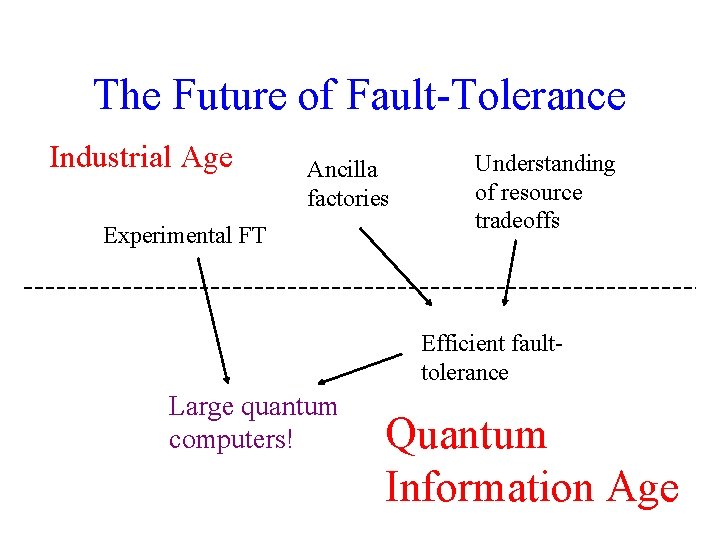
The Future of Fault-Tolerance Industrial Age Ancilla factories Experimental FT Understanding of resource tradeoffs Efficient faulttolerance Large quantum computers! Quantum Information Age