PeertoPeer P 2 P systems DHT Chord Pastry

![Finger Tables finger table start int. 1 2 4 [1, 2) [2, 4) [4,](https://slidetodoc.com/presentation_image_h/e746fe7c474e2bf671af02ae3b82c62e/image-36.jpg "Finger Tables finger table start int. 1 2 4 [1, 2) [2, 4) [4,")
- Slides: 122
Peer-to-Peer (P 2 P) systems DHT, Chord, Pastry, …
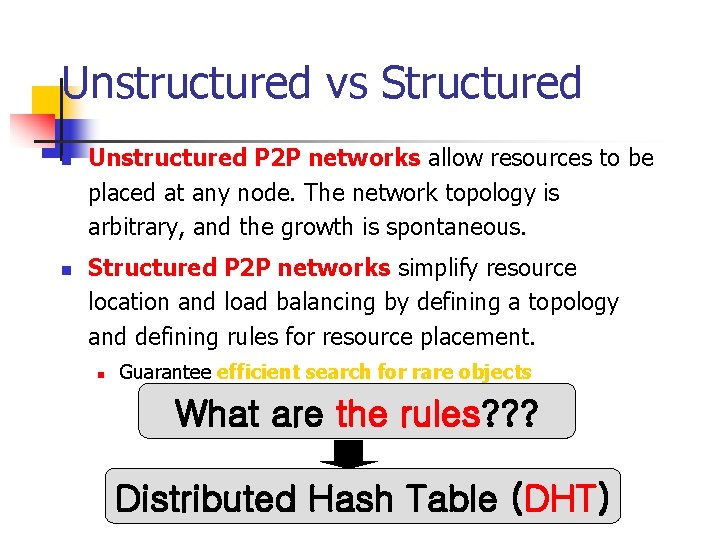
Unstructured vs Structured n n Unstructured P 2 P networks allow resources to be placed at any node. The network topology is arbitrary, and the growth is spontaneous. Structured P 2 P networks simplify resource location and load balancing by defining a topology and defining rules for resource placement. n Guarantee efficient search for rare objects What are the rules? ? ? Distributed Hash Table (DHT)
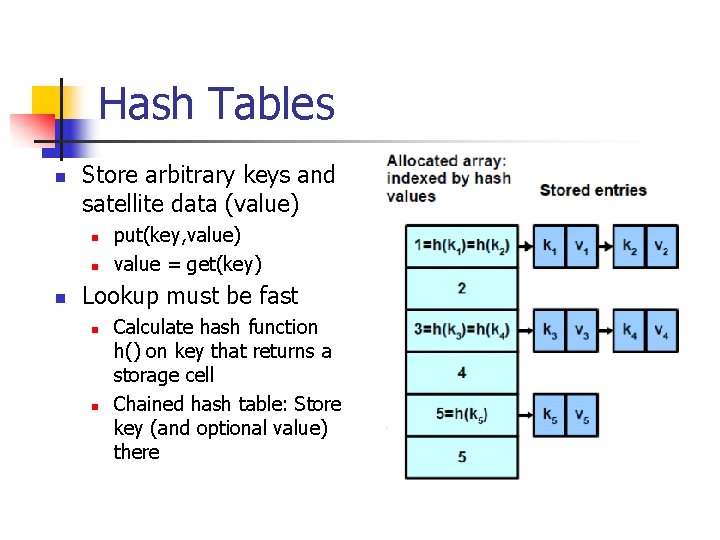
Hash Tables n Store arbitrary keys and satellite data (value) n n n put(key, value) value = get(key) Lookup must be fast n n Calculate hash function h() on key that returns a storage cell Chained hash table: Store key (and optional value) there
What Is a DHT? n Single-node hash table: key = Hash(name) put(key, value) get(key) -> value n How do I do this across millions of hosts on the Internet? n Distributed Hash Table
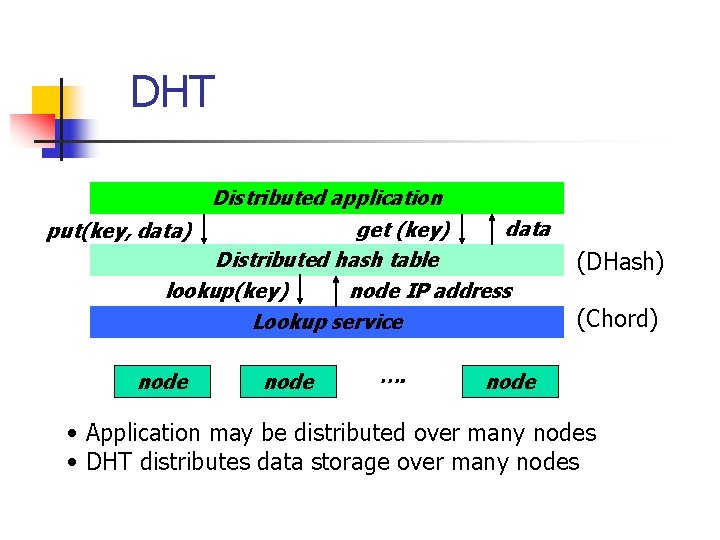
DHT Distributed application data get (key) Distributed hash table lookup(key) node IP address Lookup service put(key, data) node …. (DHash) (Chord) node • Application may be distributed over many nodes • DHT distributes data storage over many nodes
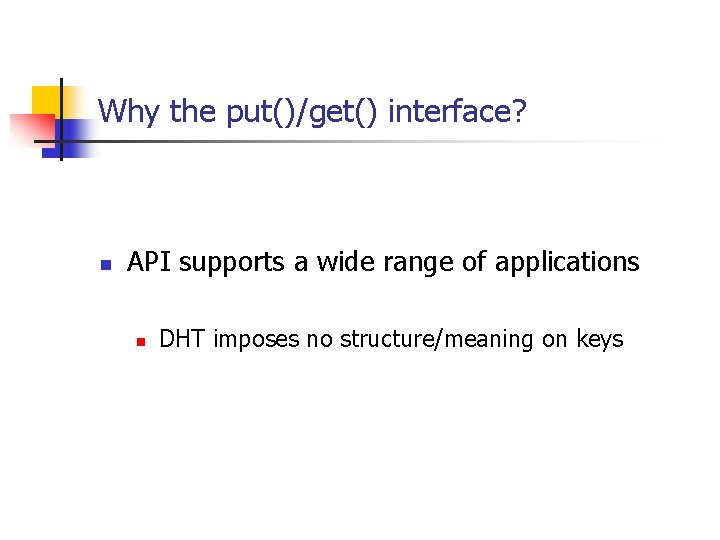
Why the put()/get() interface? n API supports a wide range of applications n DHT imposes no structure/meaning on keys
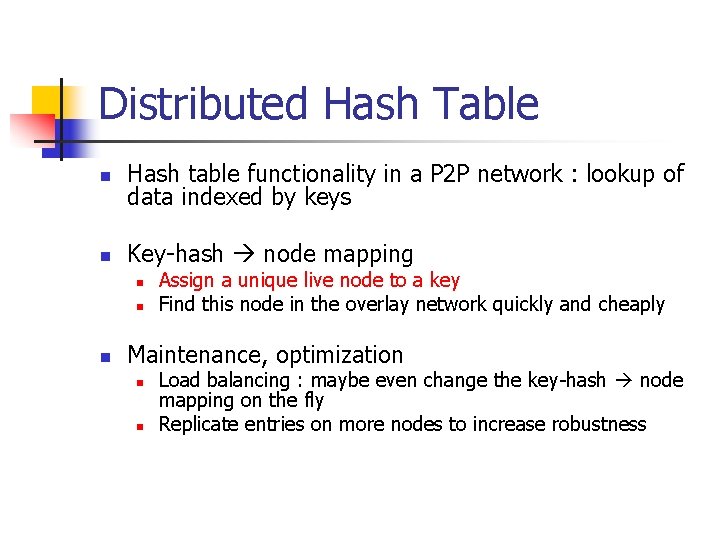
Distributed Hash Table n Hash table functionality in a P 2 P network : lookup of data indexed by keys n Key-hash node mapping n n n Assign a unique live node to a key Find this node in the overlay network quickly and cheaply Maintenance, optimization n n Load balancing : maybe even change the key-hash node mapping on the fly Replicate entries on more nodes to increase robustness
Distributed Hash Table
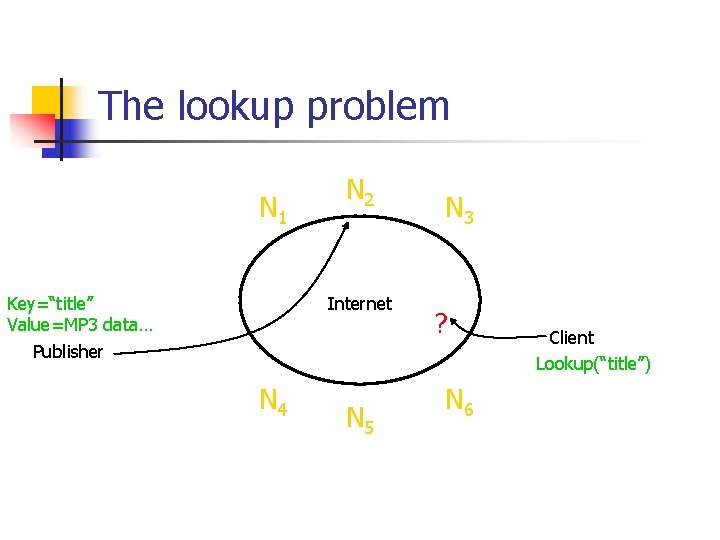
The lookup problem N 1 Key=“title” Value=MP 3 data… Publisher N 2 Internet N 4 N 5 N 3 ? N 6 Client Lookup(“title”)
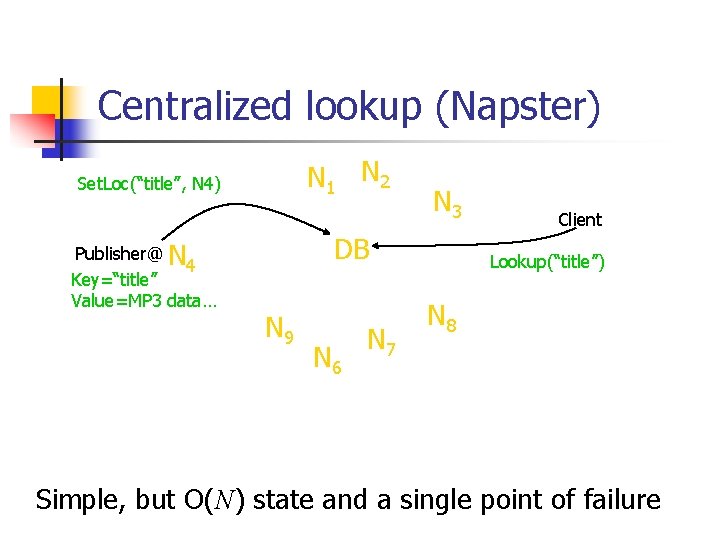
Centralized lookup (Napster) N 1 N 2 Set. Loc(“title”, N 4) Publisher@ N 4 Key=“title” Value=MP 3 data… N 3 DB N 9 N 6 N 7 Client Lookup(“title”) N 8 Simple, but O(N) state and a single point of failure
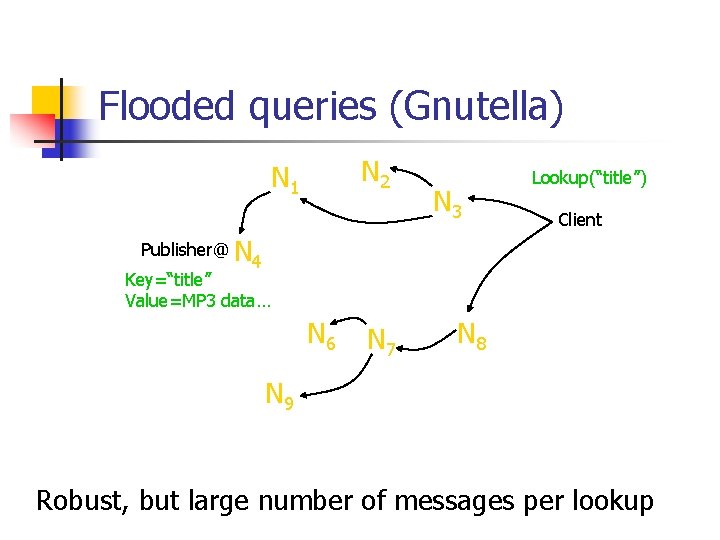
Flooded queries (Gnutella) N 2 N 1 Publisher@ N N 3 Lookup(“title”) Client 4 Key=“title” Value=MP 3 data… N 6 N 7 N 8 N 9 Robust, but large number of messages per lookup
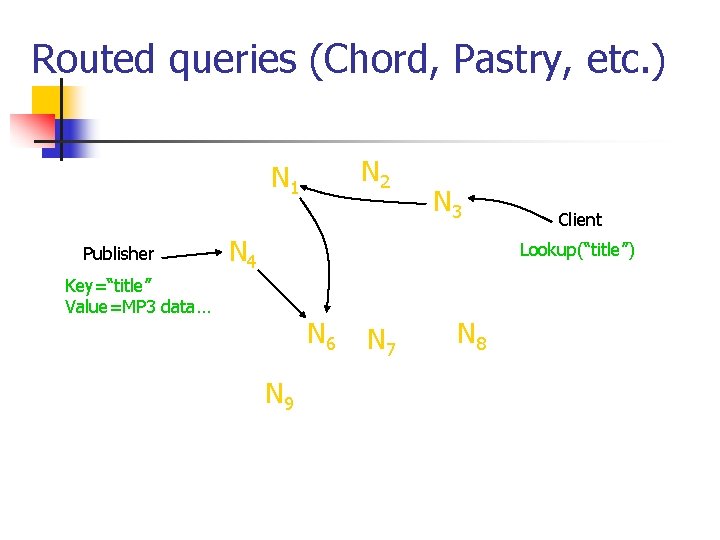
Routed queries (Chord, Pastry, etc. ) N 2 N 1 Publisher N 3 N 4 Client Lookup(“title”) Key=“title” Value=MP 3 data… N 6 N 9 N 7 N 8
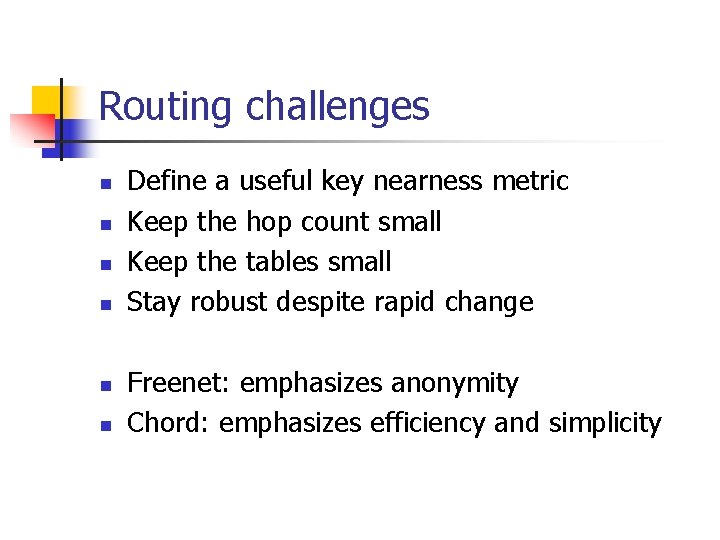
Routing challenges n n n Define a useful key nearness metric Keep the hop count small Keep the tables small Stay robust despite rapid change Freenet: emphasizes anonymity Chord: emphasizes efficiency and simplicity
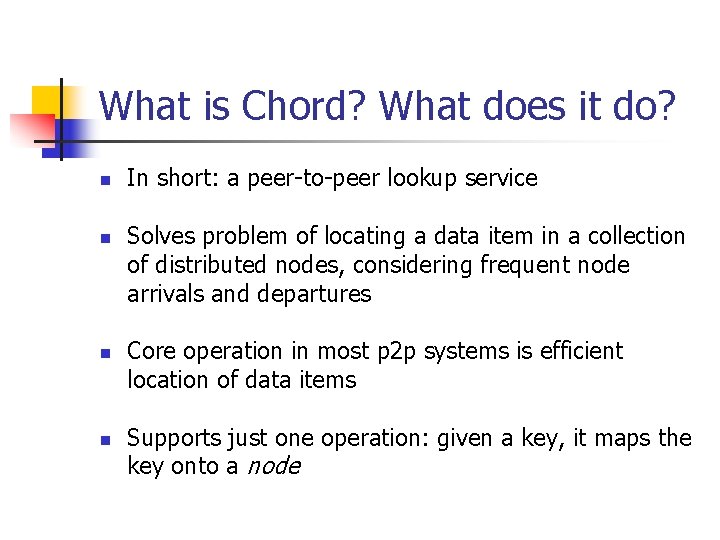
What is Chord? What does it do? n n In short: a peer-to-peer lookup service Solves problem of locating a data item in a collection of distributed nodes, considering frequent node arrivals and departures Core operation in most p 2 p systems is efficient location of data items Supports just one operation: given a key, it maps the key onto a node
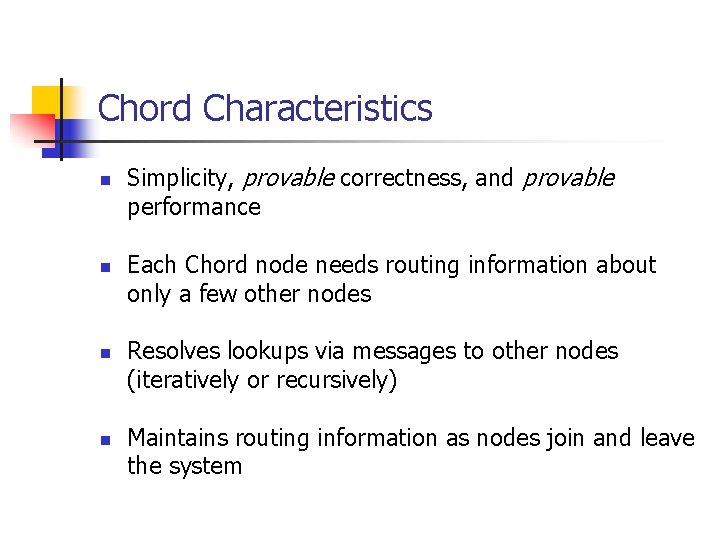
Chord Characteristics n n Simplicity, provable correctness, and provable performance Each Chord node needs routing information about only a few other nodes Resolves lookups via messages to other nodes (iteratively or recursively) Maintains routing information as nodes join and leave the system
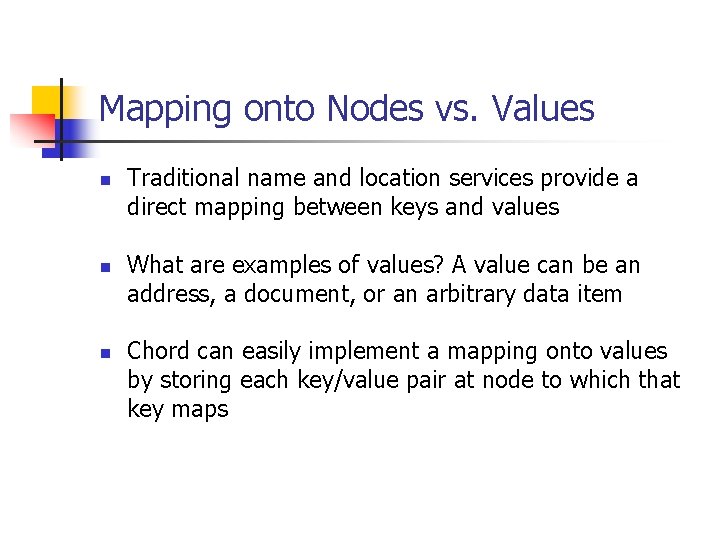
Mapping onto Nodes vs. Values n n n Traditional name and location services provide a direct mapping between keys and values What are examples of values? A value can be an address, a document, or an arbitrary data item Chord can easily implement a mapping onto values by storing each key/value pair at node to which that key maps
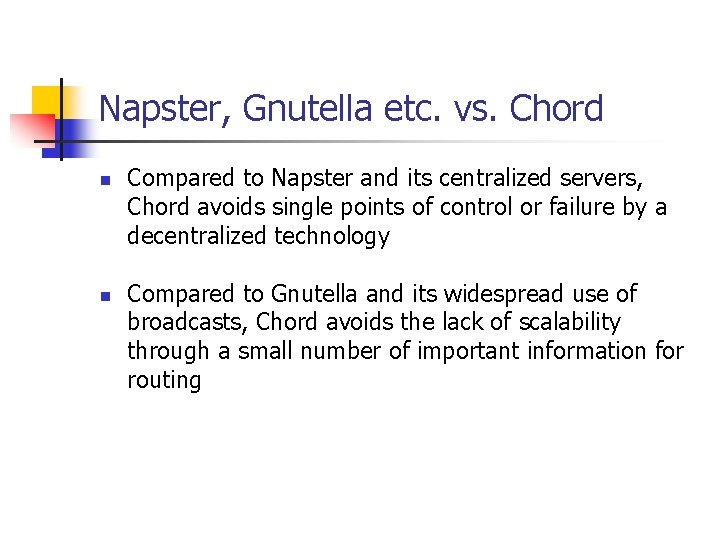
Napster, Gnutella etc. vs. Chord n n Compared to Napster and its centralized servers, Chord avoids single points of control or failure by a decentralized technology Compared to Gnutella and its widespread use of broadcasts, Chord avoids the lack of scalability through a small number of important information for routing
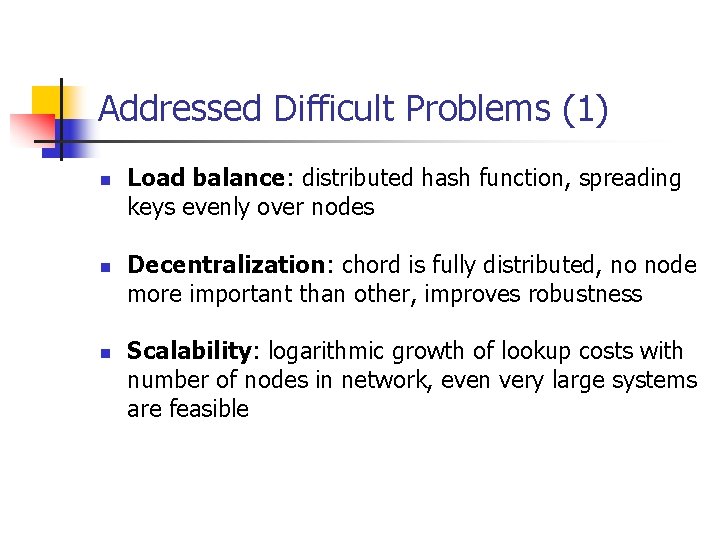
Addressed Difficult Problems (1) n n n Load balance: distributed hash function, spreading keys evenly over nodes Decentralization: chord is fully distributed, no node more important than other, improves robustness Scalability: logarithmic growth of lookup costs with number of nodes in network, even very large systems are feasible
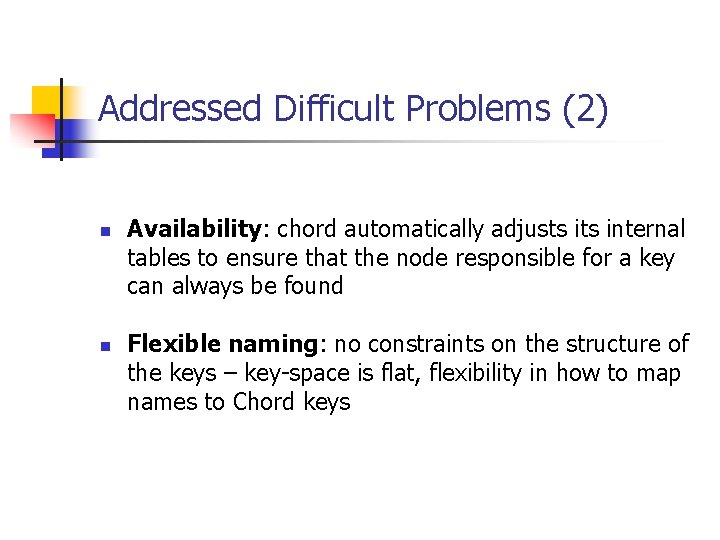
Addressed Difficult Problems (2) n n Availability: chord automatically adjusts internal tables to ensure that the node responsible for a key can always be found Flexible naming: no constraints on the structure of the keys – key-space is flat, flexibility in how to map names to Chord keys
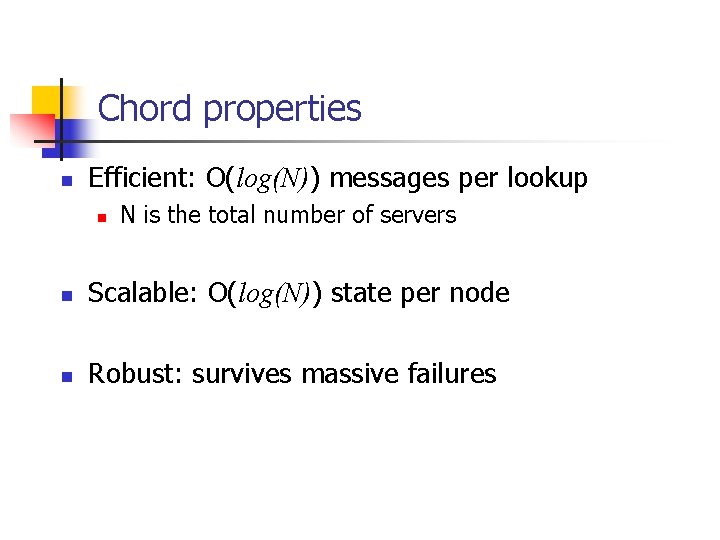
Chord properties n Efficient: O(log(N)) messages per lookup n N is the total number of servers n Scalable: O(log(N)) state per node n Robust: survives massive failures
The Base Chord Protocol (1) n Specifies how to find the locations of keys n How new nodes join the system n How to recover from the failure or planned departure of existing nodes
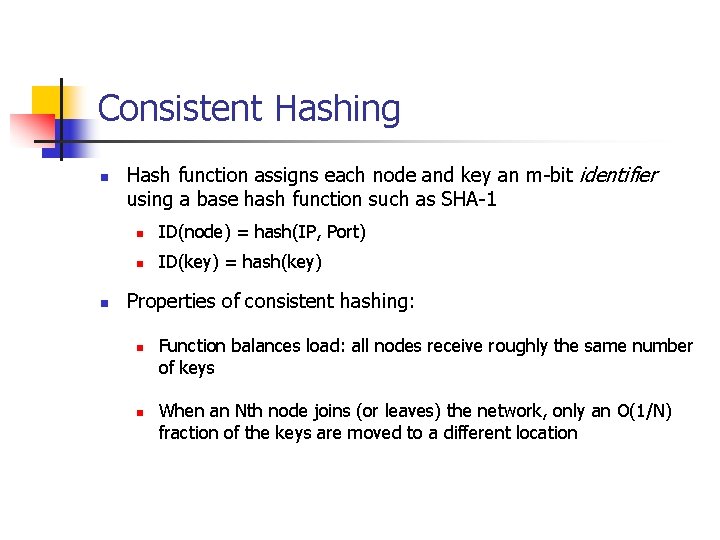
Consistent Hashing n n Hash function assigns each node and key an m-bit identifier using a base hash function such as SHA-1 n ID(node) = hash(IP, Port) n ID(key) = hash(key) Properties of consistent hashing: n n Function balances load: all nodes receive roughly the same number of keys When an Nth node joins (or leaves) the network, only an O(1/N) fraction of the keys are moved to a different location
Chord IDs n Key identifier = SHA-1(key) Node identifier = SHA-1(IP, Port) Both are uniformly distributed n Both exist in the same ID space n How to map key IDs to node IDs? n n
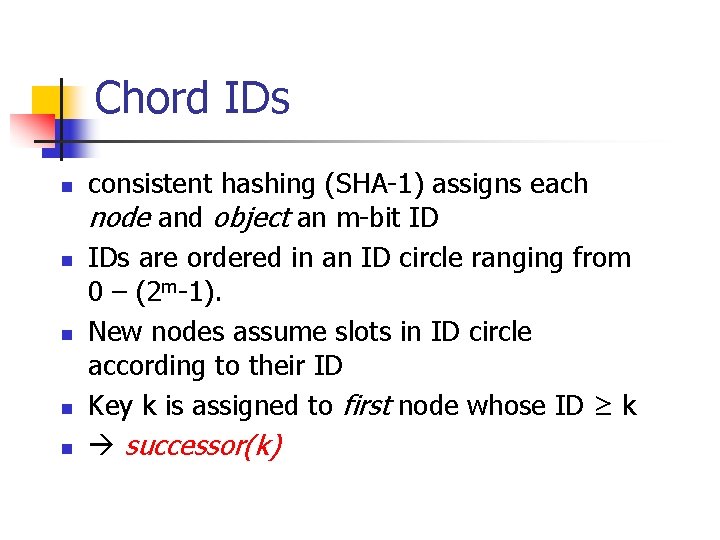
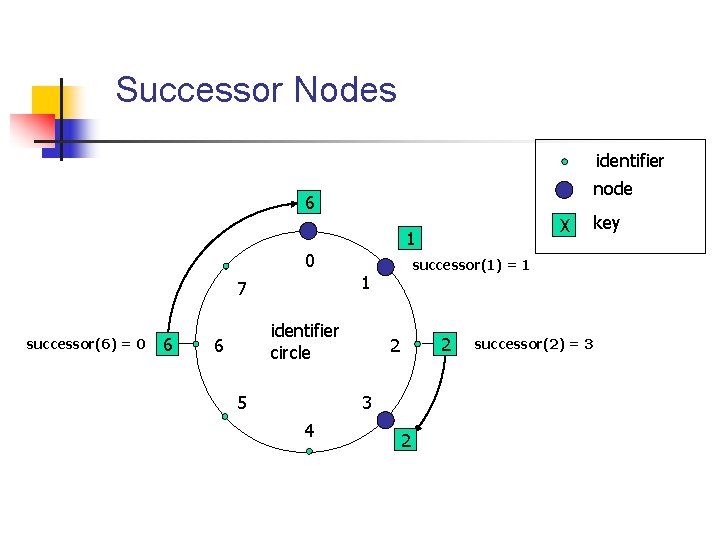
Chord IDs n n n consistent hashing (SHA-1) assigns each node and object an m-bit ID IDs are ordered in an ID circle ranging from 0 – (2 m-1). New nodes assume slots in ID circle according to their ID Key k is assigned to first node whose ID ≥ k successor(k)
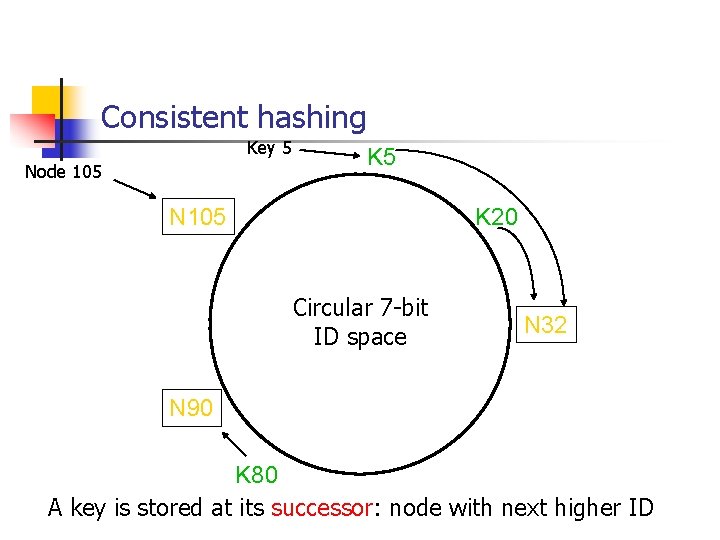
Consistent hashing Key 5 Node 105 K 5 N 105 K 20 Circular 7 -bit ID space N 32 N 90 K 80 A key is stored at its successor: node with next higher ID
Successor Nodes identifier node 6 1 0 successor(6) = 0 6 identifier circle 6 successor(1) = 1 1 7 5 2 2 3 4 X 2 successor(2) = 3 key
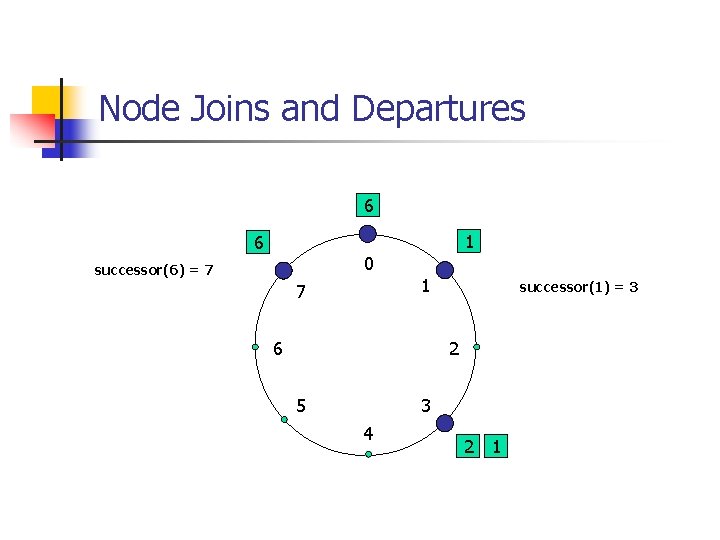
Node Joins and Departures 6 6 1 0 successor(6) = 7 1 7 6 successor(1) = 3 2 5 3 4 2 1
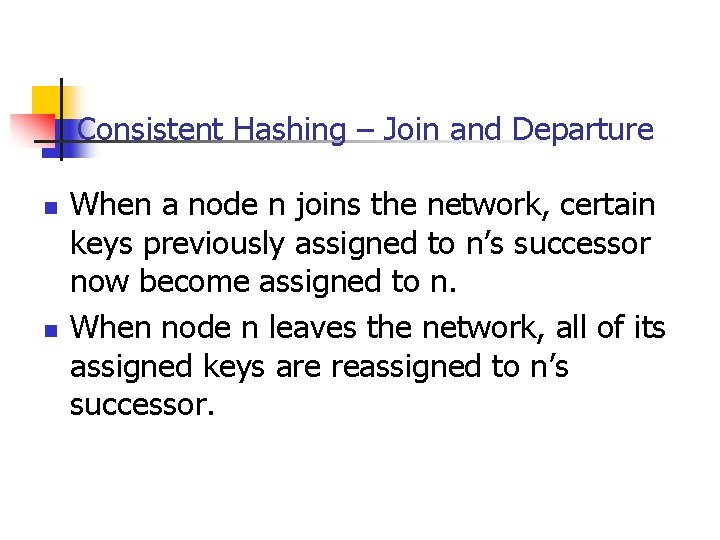
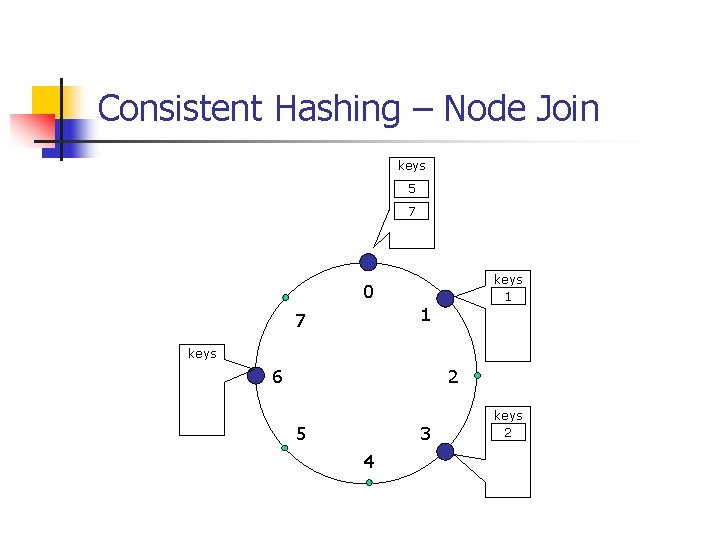
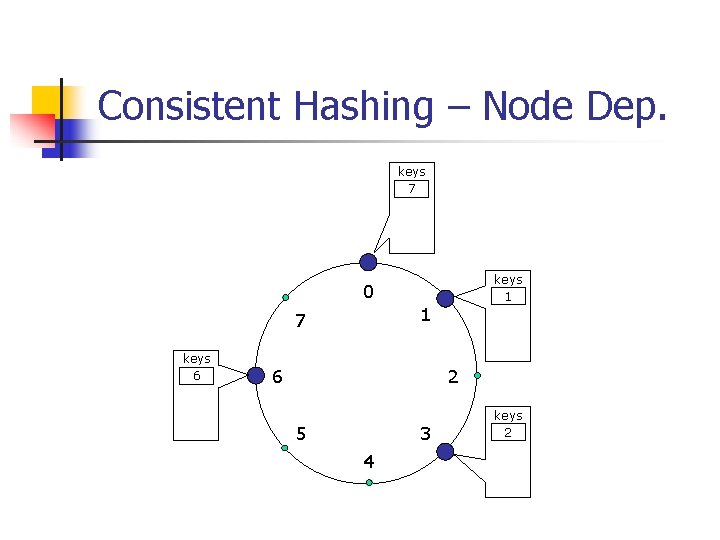
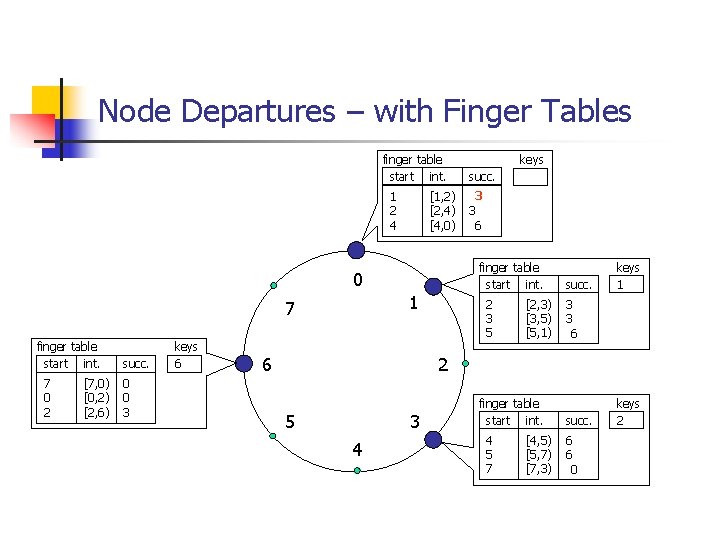
Consistent Hashing – Join and Departure n n When a node n joins the network, certain keys previously assigned to n’s successor now become assigned to n. When node n leaves the network, all of its assigned keys are reassigned to n’s successor.
Consistent Hashing – Node Join keys 5 7 keys 1 0 1 7 keys 6 2 5 3 4 keys 2
Consistent Hashing – Node Dep. keys 7 keys 1 0 1 7 keys 6 6 2 5 3 4 keys 2
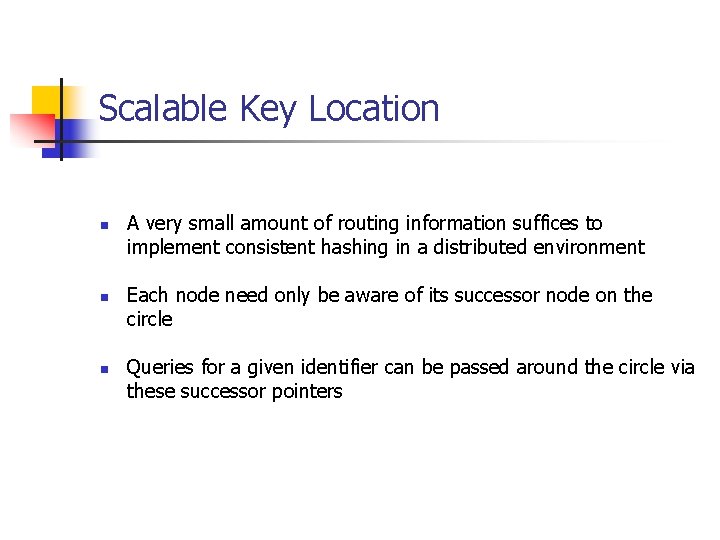
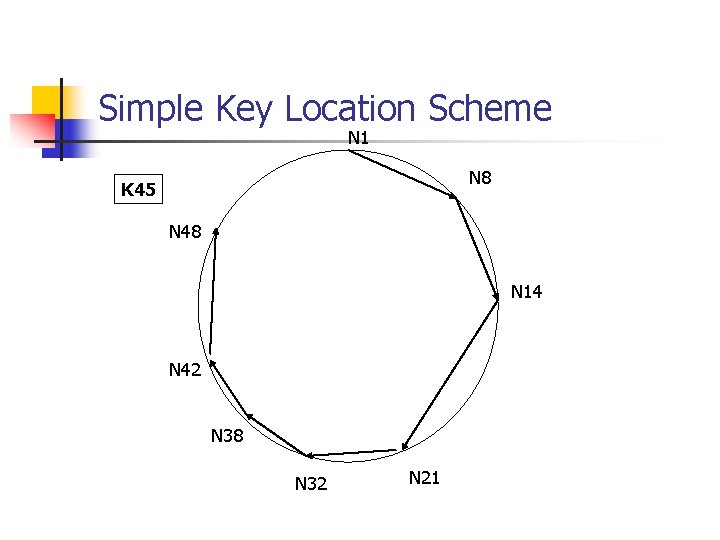
Scalable Key Location n A very small amount of routing information suffices to implement consistent hashing in a distributed environment Each node need only be aware of its successor node on the circle Queries for a given identifier can be passed around the circle via these successor pointers
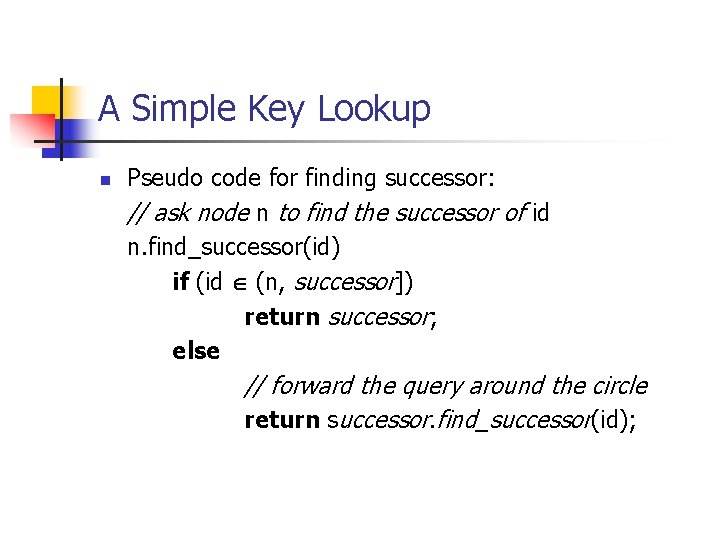
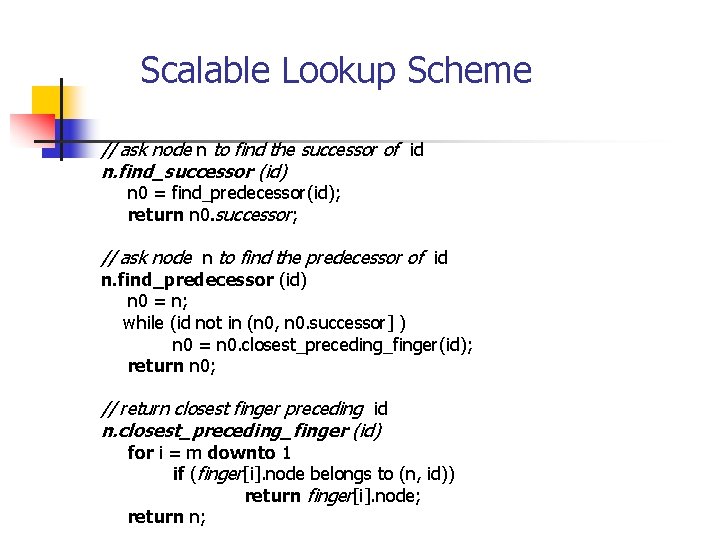
A Simple Key Lookup n Pseudo code for finding successor: // ask node n to find the successor of id n. find_successor(id) if (id (n, successor]) return successor; else // forward the query around the circle return successor. find_successor(id);
Scalable Key Location n Resolution scheme correct, BUT inefficient: n it may require traversing all N nodes!
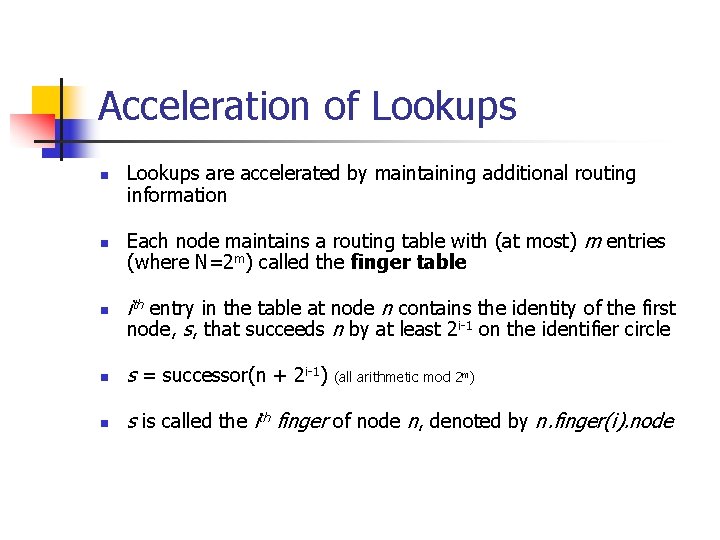
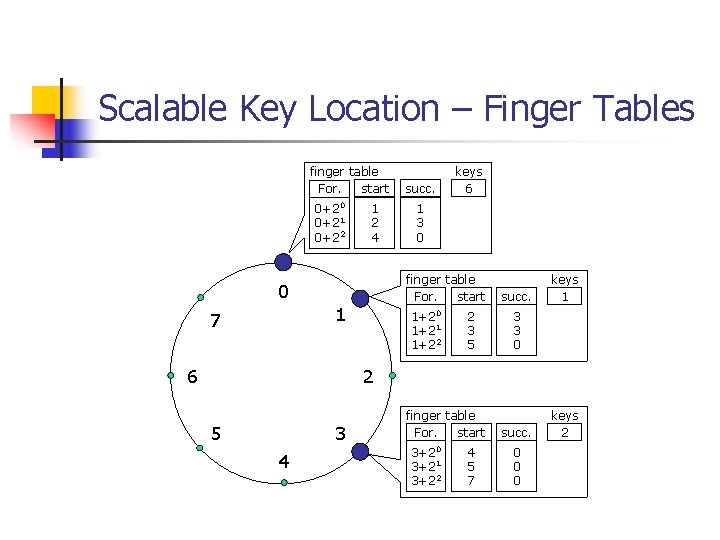
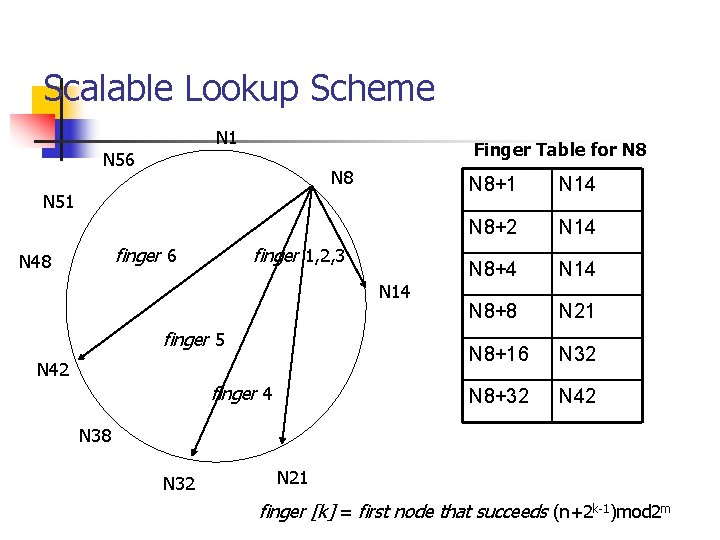
Acceleration of Lookups n n n Lookups are accelerated by maintaining additional routing information Each node maintains a routing table with (at most) m entries (where N=2 m) called the finger table ith entry in the table at node n contains the identity of the first node, s, that succeeds n by at least 2 i-1 on the identifier circle n s = successor(n + 2 i-1) (all arithmetic mod 2 m) n s is called the ith finger of node n, denoted by n. finger(i). node
Scalable Key Location – Finger Tables finger table start For. 0+20 0+21 0+22 1 2 4 1 6 succ. 1 3 0 finger table For. start 0 7 keys 6 0 1+21 1+22 2 3 5 succ. keys 1 3 3 0 2 5 3 4 finger table For. start 0 3+21 3+22 4 5 7 succ. 0 0 0 keys 2
Finger Tables finger table start int. 1 2 4 [1, 2) [2, 4) [4, 0) 1 6 1 3 0 finger table start int. 0 7 succ. keys 6 2 3 5 [2, 3) [3, 5) [5, 1) succ. keys 1 3 3 0 2 5 3 4 finger table start int. 4 5 7 [4, 5) [5, 7) [7, 3) succ. 0 0 0 keys 2
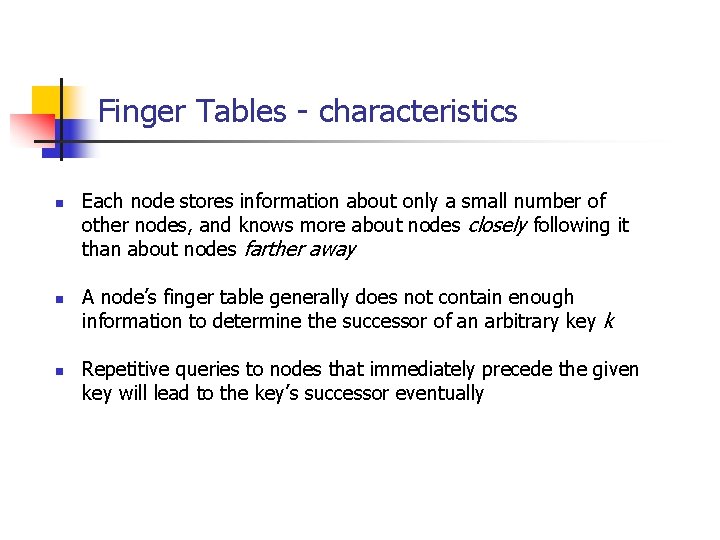
Finger Tables - characteristics n n n Each node stores information about only a small number of other nodes, and knows more about nodes closely following it than about nodes farther away A node’s finger table generally does not contain enough information to determine the successor of an arbitrary key k Repetitive queries to nodes that immediately precede the given key will lead to the key’s successor eventually
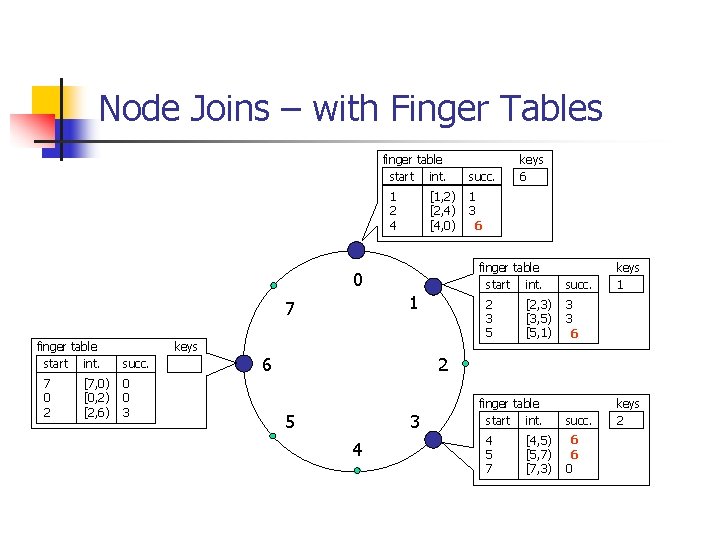
Node Joins – with Finger Tables finger table start int. 1 2 4 [1, 2) [2, 4) [4, 0) finger table start int. 7 0 2 [7, 0) [0, 2) [2, 6) keys succ. 1 0 0 3 6 1 3 06 finger table start int. 0 7 succ. keys 6 2 3 5 [2, 3) [3, 5) [5, 1) succ. keys 1 3 3 06 2 5 3 4 finger table start int. 4 5 7 [4, 5) [5, 7) [7, 3) succ. 06 06 0 keys 2
Node Departures – with Finger Tables finger table start int. 1 2 4 [1, 2) [2, 4) [4, 0) finger table start int. 7 0 2 [7, 0) [0, 2) [2, 6) succ. 0 0 3 keys 6 1 6 succ. 13 3 06 finger table start int. 0 7 keys 2 3 5 [2, 3) [3, 5) [5, 1) succ. keys 1 3 3 06 2 5 3 4 finger table start int. 4 5 7 [4, 5) [5, 7) [7, 3) succ. 6 6 00 keys 2
Simple Key Location Scheme N 1 N 8 K 45 N 48 N 14 N 42 N 38 N 32 N 21
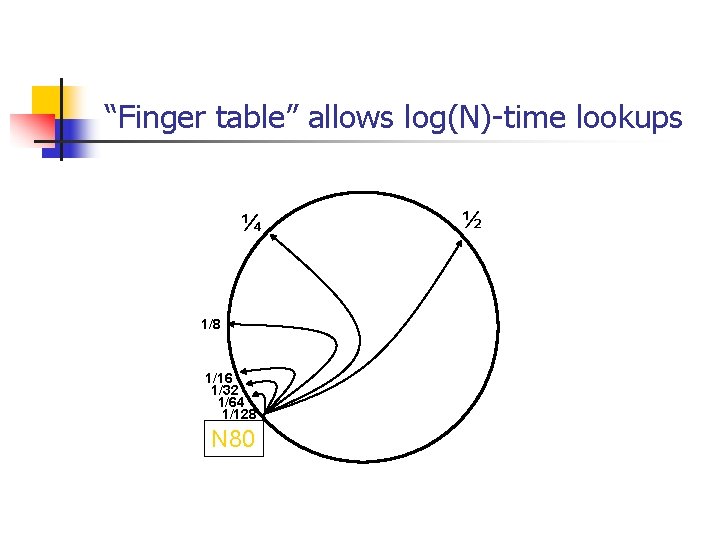
Scalable Lookup Scheme N 1 N 56 Finger Table for N 8 N 51 finger 6 N 48 finger 1, 2, 3 N 14 finger 5 N 42 finger 4 N 8+1 N 14 N 8+2 N 14 N 8+4 N 14 N 8+8 N 21 N 8+16 N 32 N 8+32 N 42 N 38 N 32 N 21 finger [k] = first node that succeeds (n+2 k-1)mod 2 m
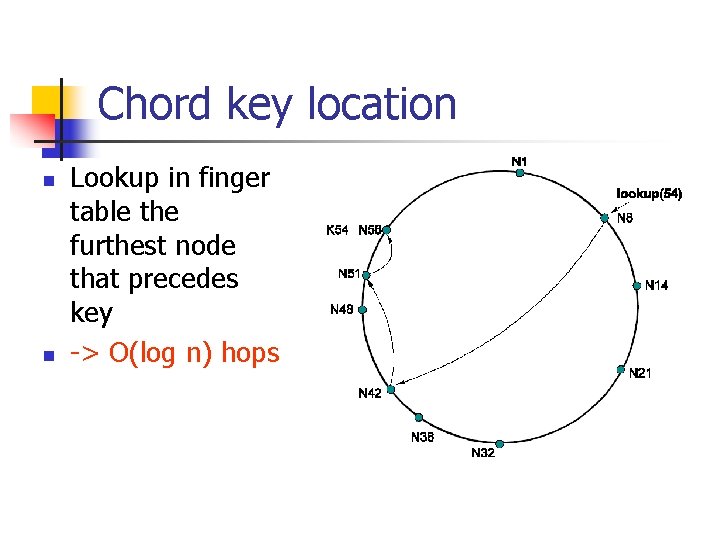
Chord key location n n Lookup in finger table the furthest node that precedes key -> O(log n) hops
Scalable Lookup Scheme // ask node n to find the successor of id n. find_successor (id) n 0 = find_predecessor(id); return n 0. successor; // ask node n to find the predecessor of id n. find_predecessor (id) n 0 = n; while (id not in (n 0, n 0. successor] ) n 0 = n 0. closest_preceding_finger(id); return n 0; // return closest finger preceding id n. closest_preceding_finger (id) for i = m downto 1 if (finger[i]. node belongs to (n, id)) return finger[i]. node; return n;
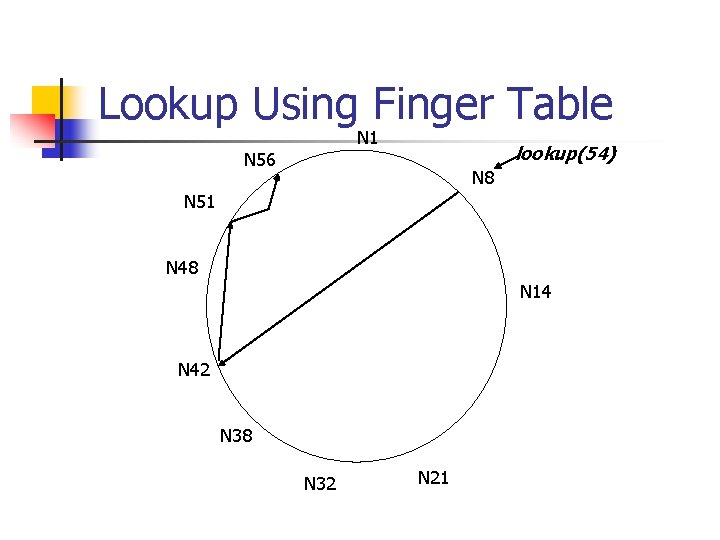
Lookup Using Finger Table N 1 N 56 lookup(54) N 8 N 51 N 48 N 14 N 42 N 38 N 32 N 21
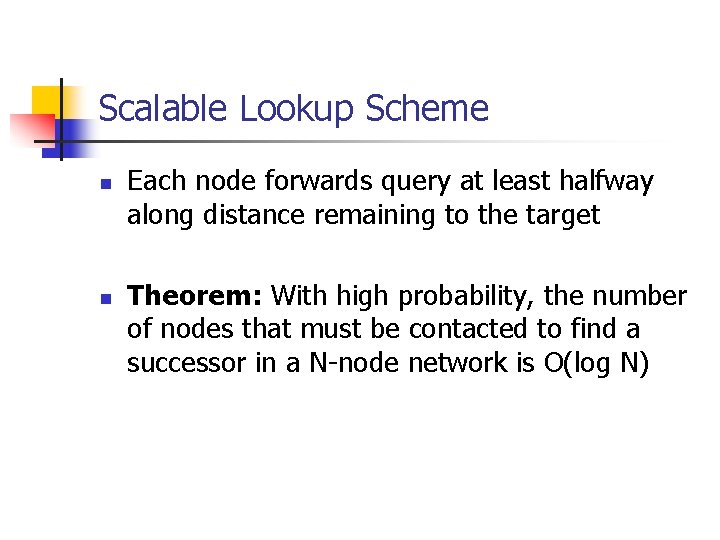
Scalable Lookup Scheme n n Each node forwards query at least halfway along distance remaining to the target Theorem: With high probability, the number of nodes that must be contacted to find a successor in a N-node network is O(log N)
“Finger table” allows log(N)-time lookups ¼ 1/8 1/16 1/32 1/64 1/128 N 80 ½
Dynamic Operations and Failures Need to deal with: n n Node Joins and Stabilization Impact of Node Joins on Lookups Failure and Replication Voluntary Node Departures
Node Joins and Stabilization n Node’s successor pointer should be up to date n n For correctly executing lookups Each node periodically runs a “Stabilization” Protocol n Updates finger tables and successor pointers
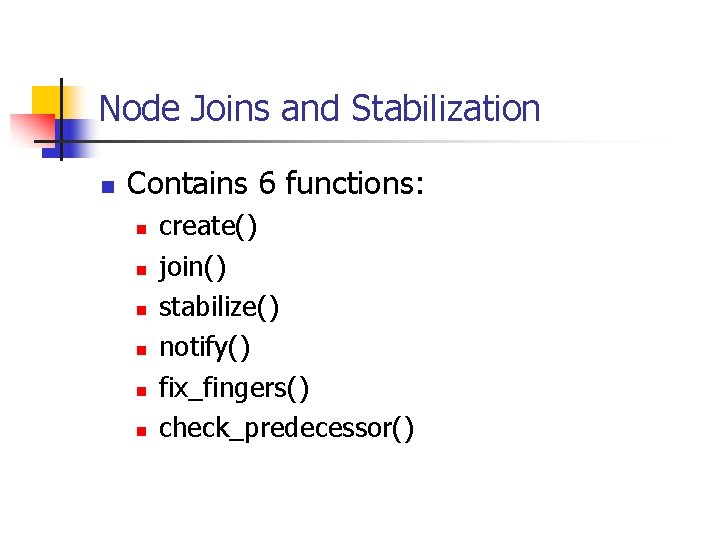
Node Joins and Stabilization n Contains 6 functions: n n n create() join() stabilize() notify() fix_fingers() check_predecessor()
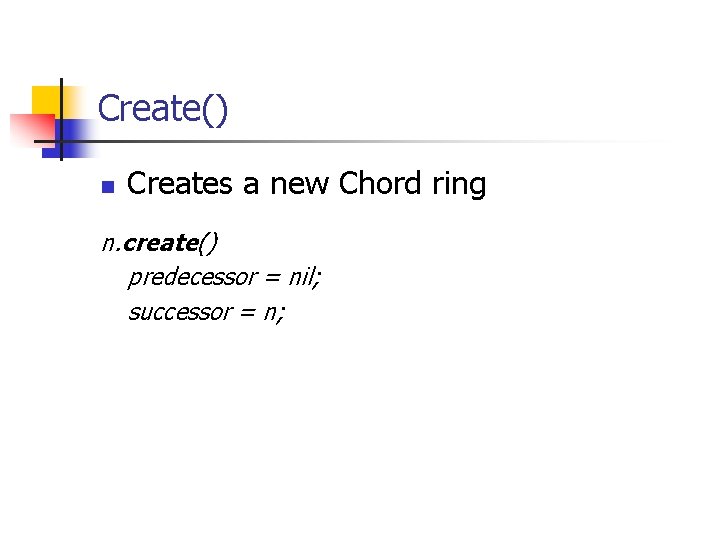
Create() n Creates a new Chord ring n. create() predecessor = nil; successor = n;
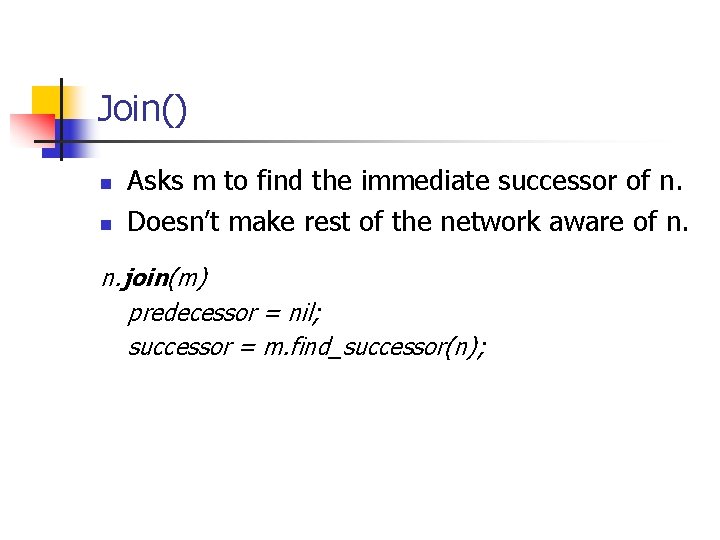
Join() n n Asks m to find the immediate successor of n. Doesn’t make rest of the network aware of n. join(m) predecessor = nil; successor = m. find_successor(n);
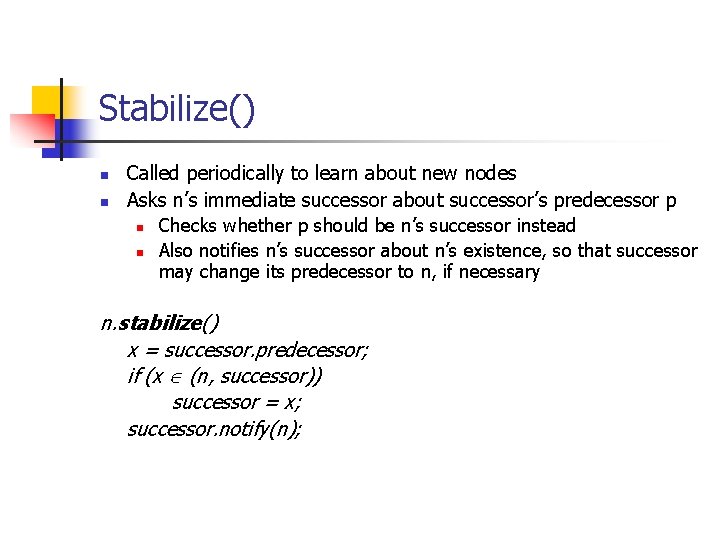
Stabilize() n n Called periodically to learn about new nodes Asks n’s immediate successor about successor’s predecessor p n n Checks whether p should be n’s successor instead Also notifies n’s successor about n’s existence, so that successor may change its predecessor to n, if necessary n. stabilize() x = successor. predecessor; if (x (n, successor)) successor = x; successor. notify(n);
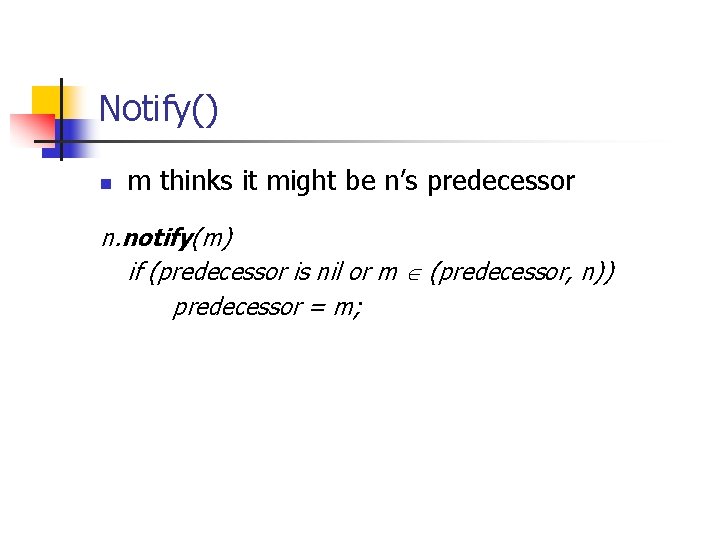
Notify() n m thinks it might be n’s predecessor n. notify(m) if (predecessor is nil or m (predecessor, n)) predecessor = m;
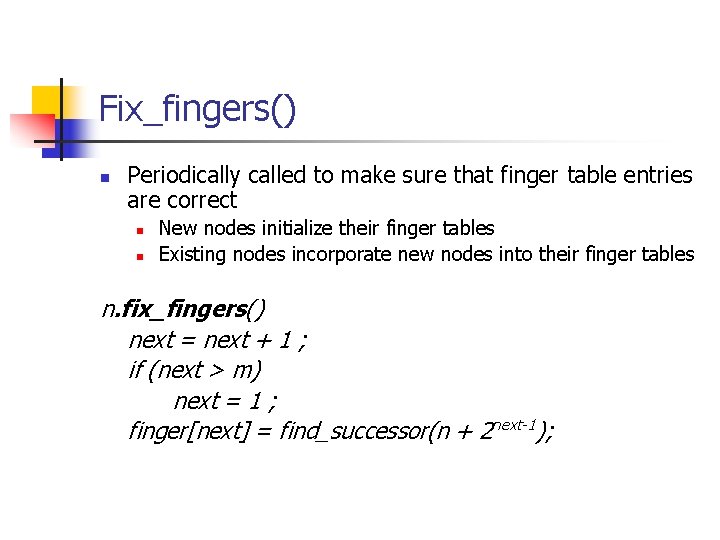
Fix_fingers() n Periodically called to make sure that finger table entries are correct n n New nodes initialize their finger tables Existing nodes incorporate new nodes into their finger tables n. fix_fingers() next = next + 1 ; if (next > m) next = 1 ; finger[next] = find_successor(n + 2 next-1);
Check_predecessor() n Periodically called to check whether predecessor has failed n If yes, it clears the predecessor pointer, which can then be modified by notify() n. check_predecessor() if (predecessor has failed) predecessor = nil;
Theorem n If any sequence of join operations is executed interleaved with stabilizations, then at some time after the last join the successor pointers will form a cycle on all nodes in the network
Stabilization Protocol n Guarantees to add nodes in a fashion to preserve reachability
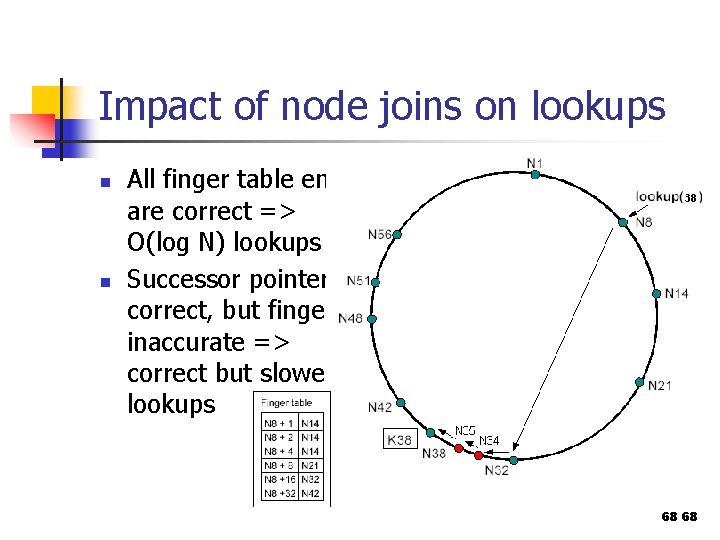
Impact of Node Joins on Lookups n If finger table entries are reasonably current n n If successor pointers are correct but finger tables are incorrect n n Lookup finds the correct successor in O(log N) steps Correct lookup but slower If incorrect successor pointers n Lookup may fail
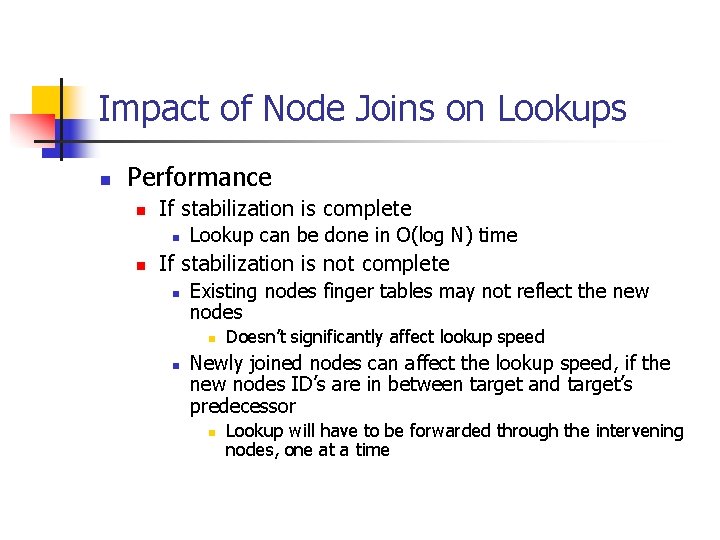
Impact of Node Joins on Lookups n Performance n If stabilization is complete n n Lookup can be done in O(log N) time If stabilization is not complete n Existing nodes finger tables may not reflect the new nodes n n Doesn’t significantly affect lookup speed Newly joined nodes can affect the lookup speed, if the new nodes ID’s are in between target and target’s predecessor n Lookup will have to be forwarded through the intervening nodes, one at a time
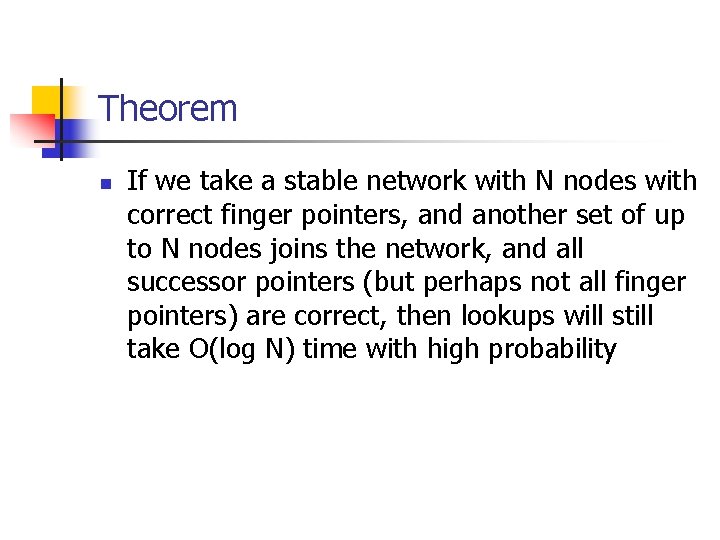
Theorem n If we take a stable network with N nodes with correct finger pointers, and another set of up to N nodes joins the network, and all successor pointers (but perhaps not all finger pointers) are correct, then lookups will still take O(log N) time with high probability
Source of Inconsistencies: Concurrent Operations and Failures n n n Basic “stabilization” protocol is used to keep nodes’ successor pointers up to date, which is sufficient to guarantee correctness of lookups Those successor pointers can then be used to verify the finger table entries Every node runs stabilize periodically to find newly joined nodes
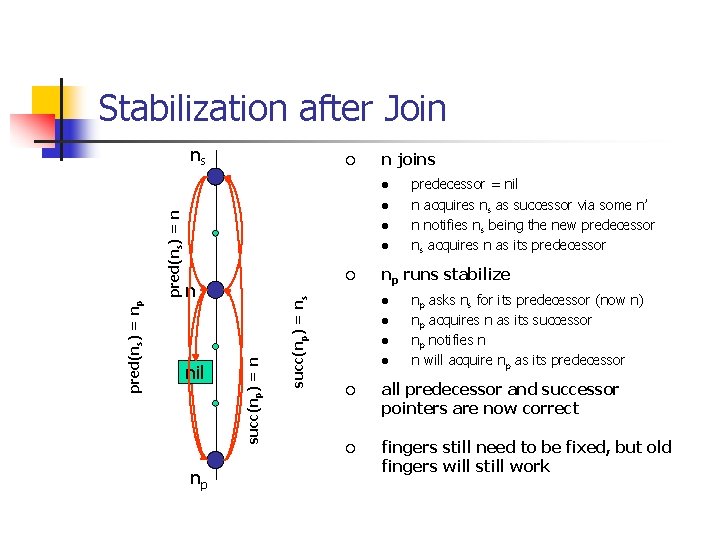
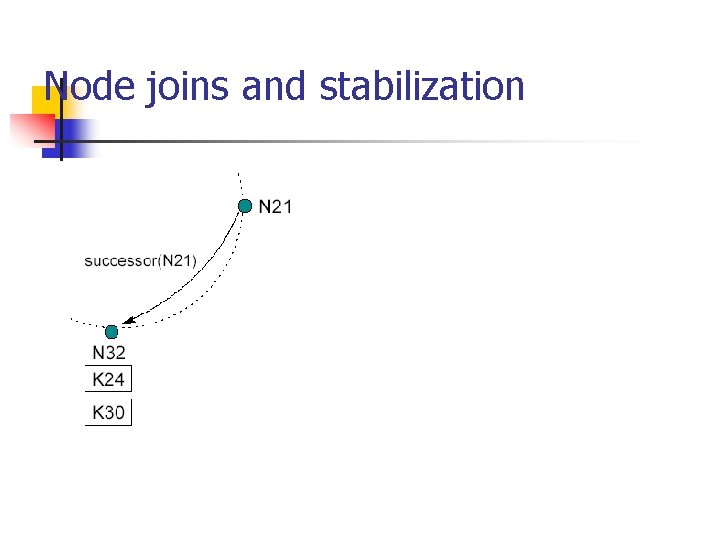
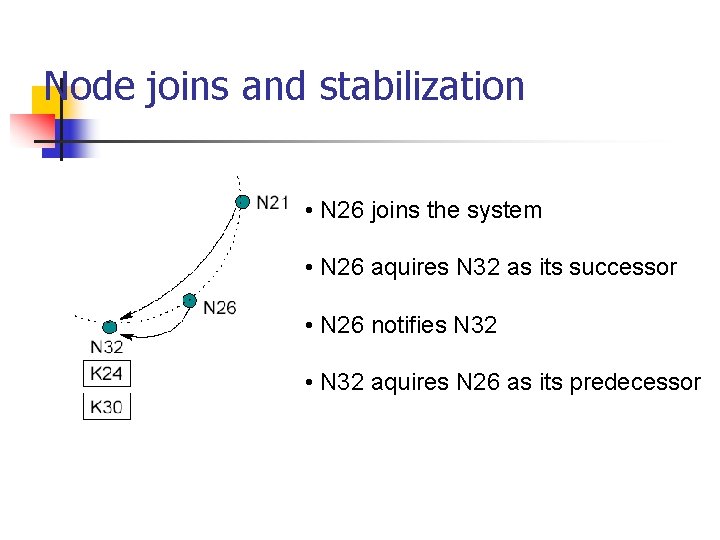
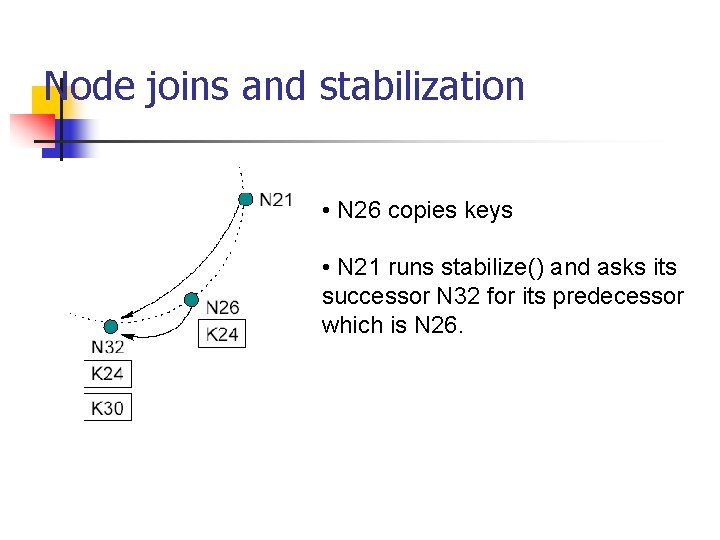
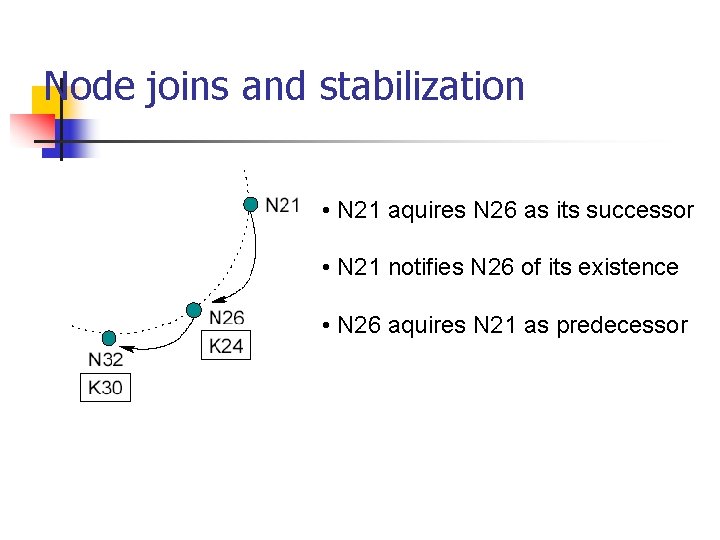
Stabilization after Join ns ¡ n joins l l l n nil np succ(np) = ns ¡ succ(np) = n pred(ns) = np pred(ns) = n l predecessor = nil n acquires ns as successor via some n’ n notifies ns being the new predecessor ns acquires n as its predecessor np runs stabilize l l np asks ns for its predecessor (now n) np acquires n as its successor np notifies n n will acquire np as its predecessor ¡ all predecessor and successor pointers are now correct ¡ fingers still need to be fixed, but old fingers will still work
Node joins and stabilization
Node joins and stabilization • N 26 joins the system • N 26 aquires N 32 as its successor • N 26 notifies N 32 • N 32 aquires N 26 as its predecessor
Node joins and stabilization • N 26 copies keys • N 21 runs stabilize() and asks its successor N 32 for its predecessor which is N 26.
Node joins and stabilization • N 21 aquires N 26 as its successor • N 21 notifies N 26 of its existence • N 26 aquires N 21 as predecessor
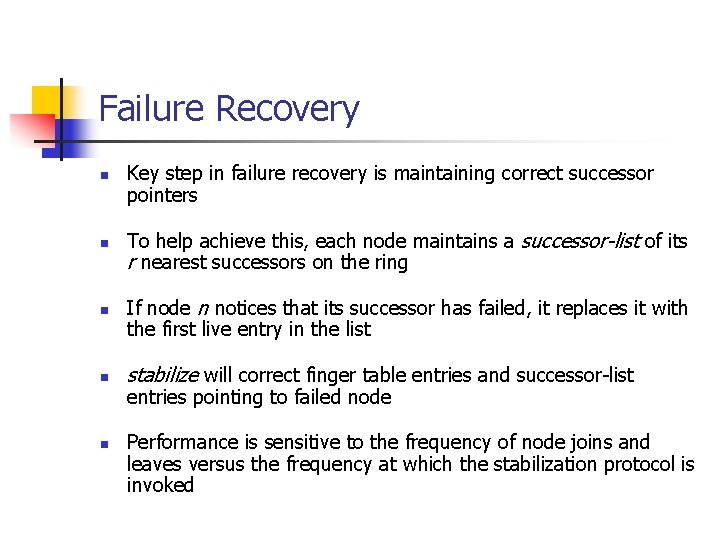
Failure Recovery n n n Key step in failure recovery is maintaining correct successor pointers To help achieve this, each node maintains a successor-list of its r nearest successors on the ring If node n notices that its successor has failed, it replaces it with the first live entry in the list stabilize will correct finger table entries and successor-list entries pointing to failed node Performance is sensitive to the frequency of node joins and leaves versus the frequency at which the stabilization protocol is invoked
Impact of node joins on lookups n n All finger table entries are correct => O(log N) lookups Successor pointers correct, but fingers inaccurate => correct but slower lookups 68 68
Impact of node joins on lookups n n n 69 Stabilization completed => no influence on performence Only for the negligible case that a large number of nodes joins between the target‘s predecessor and the target, the lookup is slightly slower No influence on performance as long as fingers are adjusted faster than the network doubles in size 69
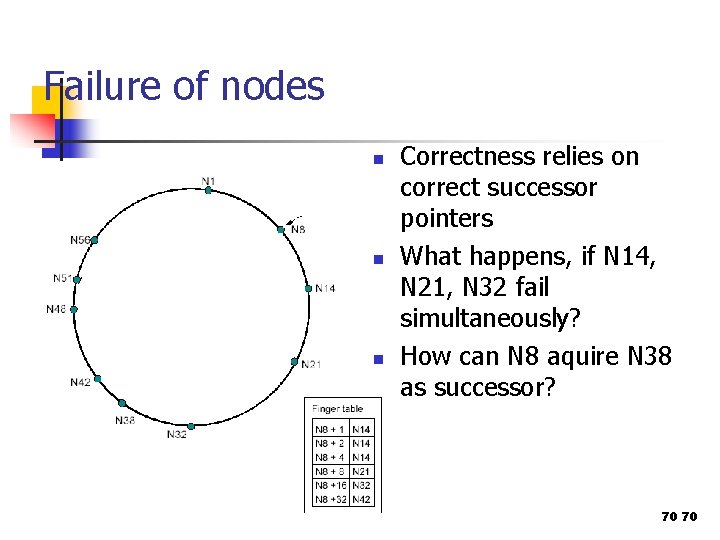
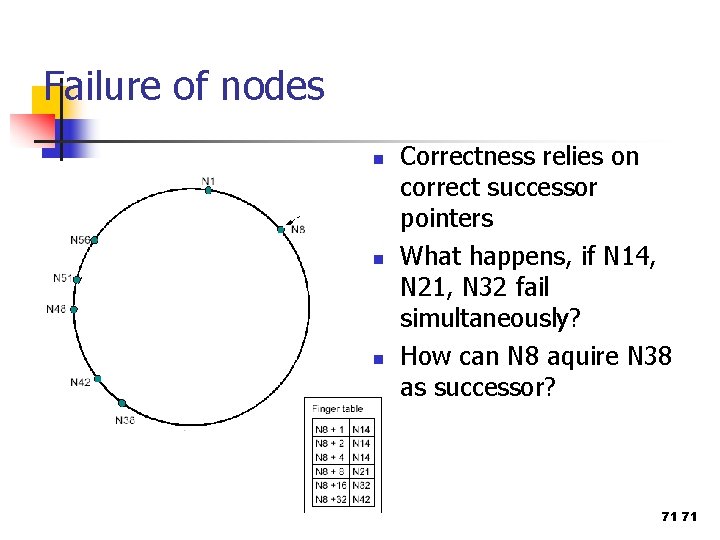
Failure of nodes n n n Correctness relies on correct successor pointers What happens, if N 14, N 21, N 32 fail simultaneously? How can N 8 aquire N 38 as successor? 70 70
Failure of nodes n n n Correctness relies on correct successor pointers What happens, if N 14, N 21, N 32 fail simultaneously? How can N 8 aquire N 38 as successor? 71 71
Voluntary Node Departures n n Can be treated as node failures Two possible enhancements n n Leaving node may transfers all its keys to its successor Leaving node may notify its predecessor and successor about each other so that they can update their links
Chord – facts n n Every node is responsible for about K/N keys (N nodes, K keys) When a node joins or leaves an N-node network, only O(K/N) keys change hands (and only to and from joining or leaving node) Lookups need O(log N) messages To reestablish routing invariants and finger tables after node joining or leaving, only O(log 2 N) messages are required
Pastry n n n Self-organizing overlay network of nodes With high probability, nodes with adjacent node. Id are diverse in geography, ownership, jurisdiction, network attachment, etc… Pastry takes into account network locality (e. g. IP routing hops).
Pastry n Instead of organizing the id-space as a Chord-like ring, the routing is based on numeric closeness of identifiers n The focus is not only on the no. of routing hops, but also on network locality – as factors in routing efficiency
Pastry n Identifier space: n n n Nodes and data items are uniquely associated with mbit ids – integers in the range (0 – 2 m -1) – m is typically 128 Pastry views ids as strings of digits to the base 2 b where b is typically chosen to be 4 A key is located on the node to whose node id it is numerically closest
Routing Goal n Pastry routes messages to the node whose node. Id is numerically closest to the given key in less than log 2 b (N) steps: n “A heuristic ensures that among a set of nodes with the k closest node. Ids to the key, the message is likely to first reach a node near the node from which the message originates, in term of the proximity metric”
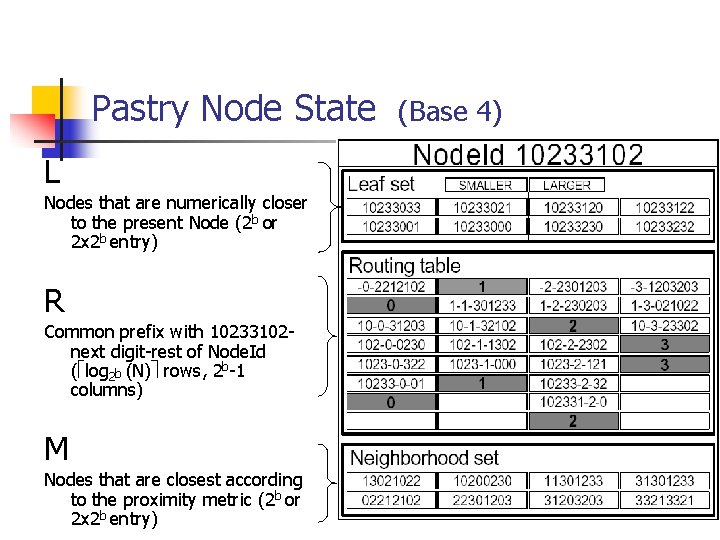
Routing Information n Pastry’s node state is divided into 3 main elements n n n The routing table – similar to Chord’s finger table – stores links to id-space The leaf set contains nodes which are close in the idspace Nodes that are closed together in terms of network locality are listed in the neighbourhood set
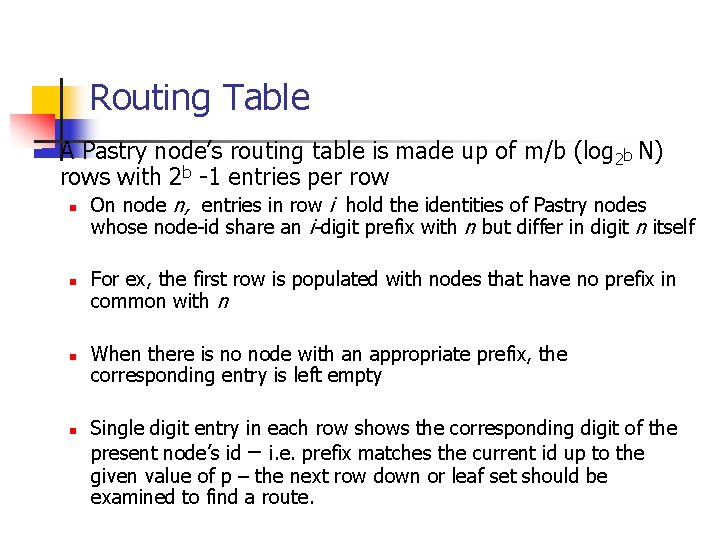
Routing Table n A Pastry node’s routing table is made up of m/b (log 2 b N) rows with 2 b -1 entries per row n n On node n, entries in row i hold the identities of Pastry nodes whose node-id share an i-digit prefix with n but differ in digit n itself For ex, the first row is populated with nodes that have no prefix in common with n When there is no node with an appropriate prefix, the corresponding entry is left empty Single digit entry in each row shows the corresponding digit of the present node’s id – i. e. prefix matches the current id up to the given value of p – the next row down or leaf set should be examined to find a route.
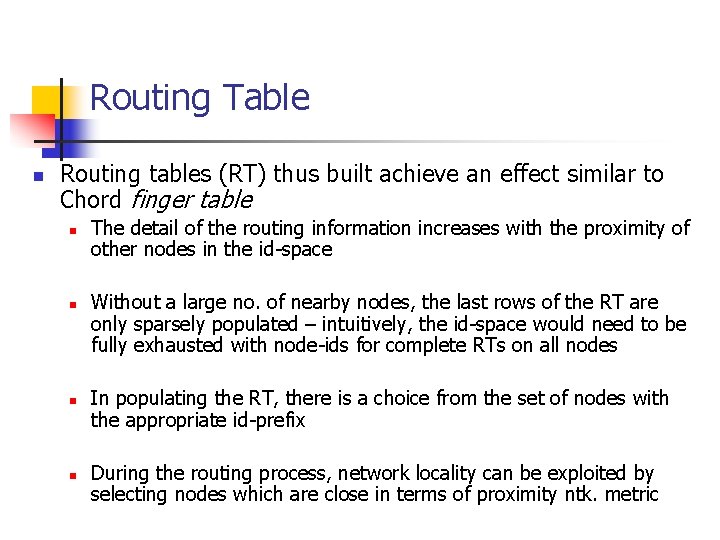
Routing Table n Routing tables (RT) thus built achieve an effect similar to Chord finger table n n The detail of the routing information increases with the proximity of other nodes in the id-space Without a large no. of nearby nodes, the last rows of the RT are only sparsely populated – intuitively, the id-space would need to be fully exhausted with node-ids for complete RTs on all nodes In populating the RT, there is a choice from the set of nodes with the appropriate id-prefix During the routing process, network locality can be exploited by selecting nodes which are close in terms of proximity ntk. metric
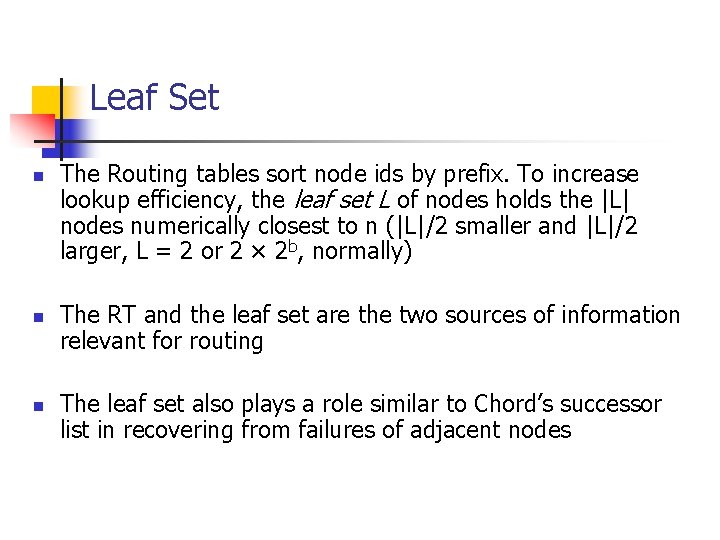
Leaf Set n n n The Routing tables sort node ids by prefix. To increase lookup efficiency, the leaf set L of nodes holds the |L| nodes numerically closest to n (|L|/2 smaller and |L|/2 larger, L = 2 or 2 × 2 b, normally) The RT and the leaf set are the two sources of information relevant for routing The leaf set also plays a role similar to Chord’s successor list in recovering from failures of adjacent nodes
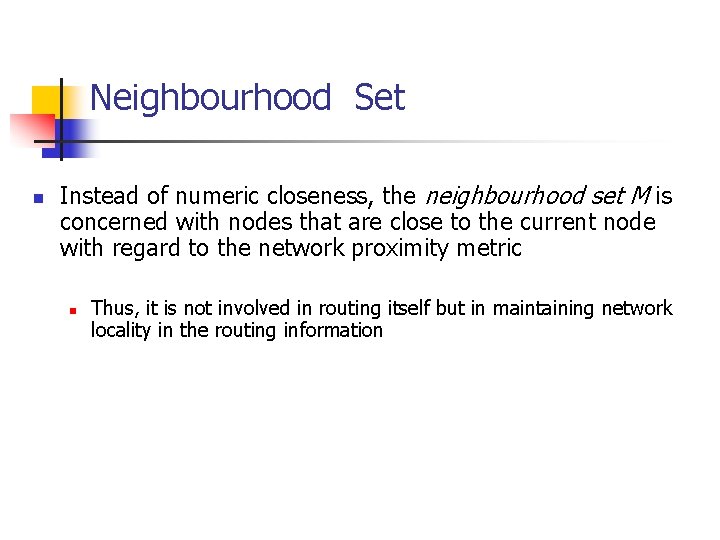
Neighbourhood Set n Instead of numeric closeness, the neighbourhood set M is concerned with nodes that are close to the current node with regard to the network proximity metric n Thus, it is not involved in routing itself but in maintaining network locality in the routing information
Pastry Node State L Nodes that are numerically closer to the present Node (2 b or 2 x 2 b entry) R Common prefix with 10233102 next digit-rest of Node. Id ( log 2 b (N) rows, 2 b-1 columns) M Nodes that are closest according to the proximity metric (2 b or 2 x 2 b entry) (Base 4)
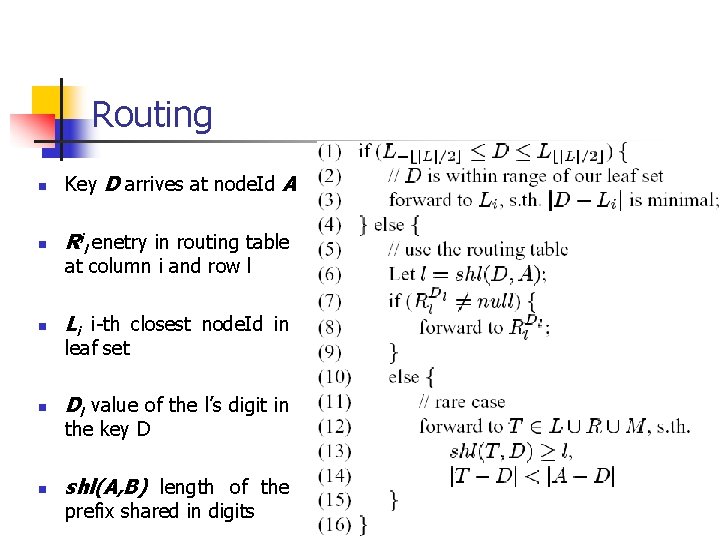
Routing n Key D arrives at node. Id A n Ril enetry in routing table at column i and row l n Li i-th closest node. Id in leaf set n Dl value of the l’s digit in the key D n shl(A, B) length of the prefix shared in digits
Routing n Routing is divided into two main steps: n First, a node checks whether the key K is within the range of its leaf set n If it is the case, it implies that K is located in one of the nearby nodes of the leaf set. Thus, the node forwards the query to the leaf set node numerically closest to K. In case this is the node itself, the routing process is finished.
Routing n n If K does not fall within the range of the leaf set, the query needs to be forwarded over a large distance using the routing table In this case, a node n tries to pass the query on to a node which shares a longer common prefix with K than n itself n If there is no such entry in the RT, the query is forwarded to a node which shares a prefix with K of the same length as n but which is numerically close to K than n
Routing n This scheme ensures that routing loop do not occur because the query is routed strictly to a node with a longer common identifier prefix than the current node, or to a numerically closer node with the same prefix
Routing performance n Routing procedure converges, each step takes the message to node that either: n n Shares a longer prefix with the key than the local node Shares as long a prefix with, but is numerically closer to the key than the local node.
Routing performance n Assumption: Routing tables are accurate and no recent n There are 3 cases in the Pastry routing scheme: node failures n n Case 1: Forward the query (according to the RT) to a node with a longer prefix match than the current node. Thus, the no. of nodes with longer prefix matches is reduced by at least a factor of 2 b in each step, so the destination is reached in log 2 b N steps.
Routing performance n There are 3 cases: n Case 2: The query is routed via leaf set (one step). This increases the no. of hop by one
Routing performance n There are 3 cases: n Case 3: The key is neither covered by the leaf set nor does the RT contains an entry with a longer matching prefix than the current node n n Consequently, the query is forwarded to a node with the same prefix length, adding an additional routing hop. For a moderate leaf set size ( |L| = 2 × 2 b), the probability of this case is less than 0. 6%. So, it is very unlikely that more than one additional hop is incurred.
Routing performance n As a result, the complexity of routing remains at O(log 2 b N) on average n n Higher values of b leads to fast routing but also increases the amount of state that needs to managed at each node Thus, b is typically 4 but Pastry implementation can choose an appropriate trade-off for specific application
Join and Failure n Join n Use routing to find numerically closest node already in network Ask state from all nodes on the route and initialize own state Error correction n n Failed leaf node: contact a leaf node on the side of the failed node and add appropriate new neighbor Failed table entry: contact a live entry with same prefix as failed entry until new live entry found, if none found, keep trying with longer prefix table entries
Self Organization: Node Arrival n n The new node n is assumed to know a nearby Pastry node k based on the network proximity metric Now n needs to initialize its RT, leaf set and neighbourhood set. n n Since K is assumed to be close to n, the nodes in K’s neghbourhood set are reasonably good choices for n, too. Thus, n copies the neighbourhood set from K.
Self Organization: Node Arrival n To build its RT and leaf set, n routes a special join message via k to a key equal to n n n According to the standard routing rules, the query is forwarded to the node c with the numerically closest id and hence the leaf set of c is suitable for n, so it retrieves c’s leaf set for itself. The join request triggers all nodes, which forwarded the query towards c, to provide n with their routing information.
Self Organization: Node Arrival n Node n’s RT is constructed from the routing information of these nodes starting at row 0. n As this row is independent of the local node id, n can use these entries at row zero of k’s routing table n n n In particular, it is assumed that n and k are close in terms of network proximity metric Since k stores nearby nodes in its RT, these entries are also close to n. In the general case of n and k not sharing a common prefix, n cannot reuse entries from any other row in K’s RT.
Self Organization: Node Arrival n n The route of the join message from n to c leads via nodes v 1, v 2, … vn with increasingly longer common prefixes of n and vi Thus, row 1 from the RT of v 1 is also a good choice for the same row of the RT of n The same is true for row 2 on node v 2 and so on Based on this information, the RT of n can be constructed.
Self Organization: Node Arrival n Finally, the new node sends its node state to all nodes in its routing data so that these nodes can update their own routing information accordingly n n In contrast to lazy updates in Chord, this mechanism actively updates the state in all affected nodes when a new node joins the system At this stage, the new node is fully present and reachable in the Pastry network
Node Failure n n Node failure is detected when a communication attempt with another node fails. Routing requires contacting nodes from RT and leaf set, resulting in lazy detection of failures During routing, the failure of a single node in the RT does not significantly delay the routing process. The local node can chose to forward the query to a different node from the same row in the RT. (Alternatively, a node could store backup nodes with each entry in the RT)
Node Failure n n To replace the failed node at entry i in row j of its RT (Rji), a node contacts another node referenced in row j Entries in the same row j of the remote node are valid for the local node and hence it can copy entry Rji from the remote node to its own RT In case it failed as well, it can probe another node in row j for entry Rji If no live node with appropriate node. ID prefix can be obtained in this way, the local node queries nodes from the preceding row Rj-1
Node Failure n n n Repairing a failed entry in the leaf set of a node is straightforward – utilizing the leaf set of other nodes referenced in the local leaf set. Contacts the leaf set of the largest index on the side of the failed node If this node is unavailable, the local node can revert to leaf set with smaller indices
Node Departure n Neighborhood node: asks other members for their M, checks the distance of each of the newly discovered nodes, and updates its own neighborhood set accordingly.
Locality n n “Route chosen for a message is likely to be good with respect to the proximity metric” Discussion: n n n Locality in the routing table Route locality Locating the nearest among k nodes
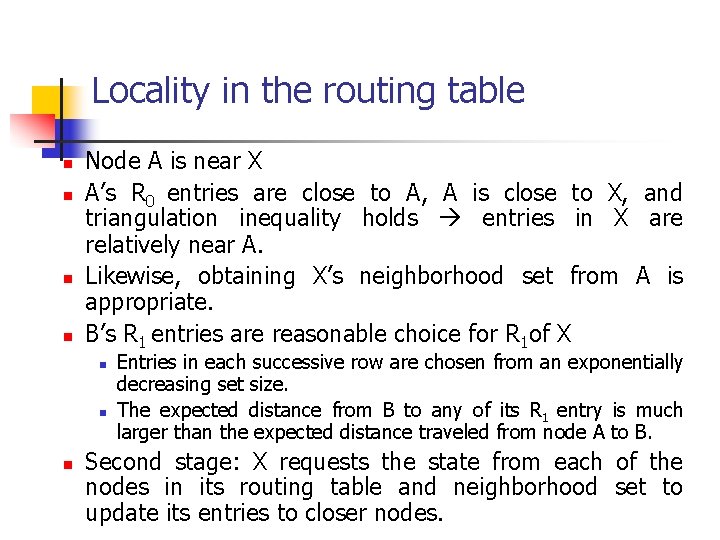
Locality in the routing table n n Node A is near X A’s R 0 entries are close to A, A is close to X, and triangulation inequality holds entries in X are relatively near A. Likewise, obtaining X’s neighborhood set from A is appropriate. B’s R 1 entries are reasonable choice for R 1 of X n n n Entries in each successive row are chosen from an exponentially decreasing set size. The expected distance from B to any of its R 1 entry is much larger than the expected distance traveled from node A to B. Second stage: X requests the state from each of the nodes in its routing table and neighborhood set to update its entries to closer nodes.
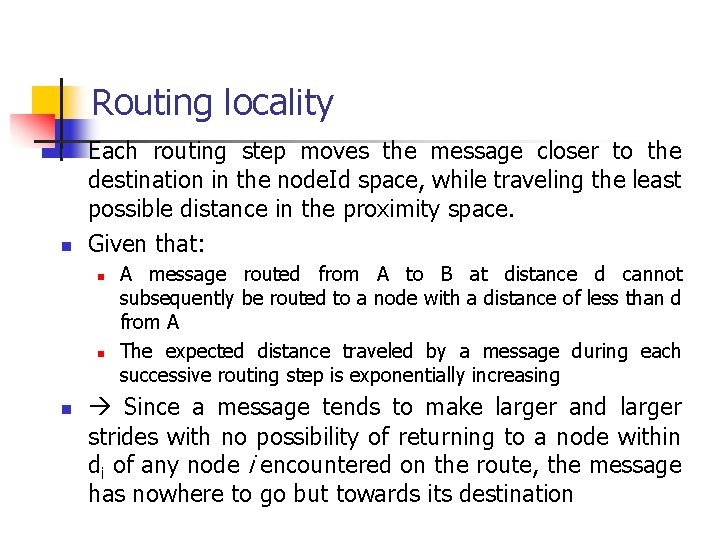
Routing locality n n Each routing step moves the message closer to the destination in the node. Id space, while traveling the least possible distance in the proximity space. Given that: n n n A message routed from A to B at distance d cannot subsequently be routed to a node with a distance of less than d from A The expected distance traveled by a message during each successive routing step is exponentially increasing Since a message tends to make larger and larger strides with no possibility of returning to a node within di of any node i encountered on the route, the message has nowhere to go but towards its destination
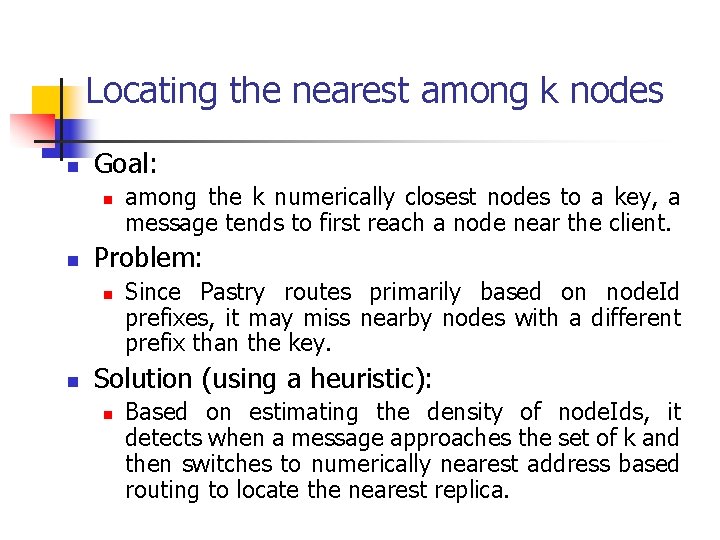
Locating the nearest among k nodes n Goal: n n Problem: n n among the k numerically closest nodes to a key, a message tends to first reach a node near the client. Since Pastry routes primarily based on node. Id prefixes, it may miss nearby nodes with a different prefix than the key. Solution (using a heuristic): n Based on estimating the density of node. Ids, it detects when a message approaches the set of k and then switches to numerically nearest address based routing to locate the nearest replica.
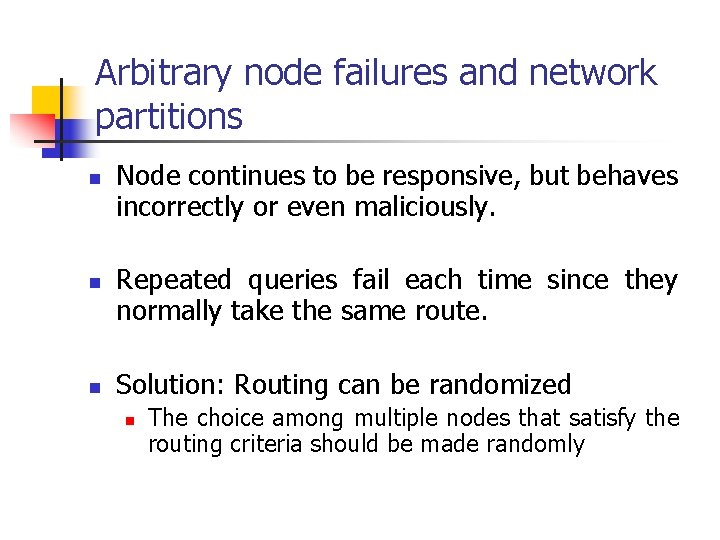
Arbitrary node failures and network partitions n n n Node continues to be responsive, but behaves incorrectly or even maliciously. Repeated queries fail each time since they normally take the same route. Solution: Routing can be randomized n The choice among multiple nodes that satisfy the routing criteria should be made randomly
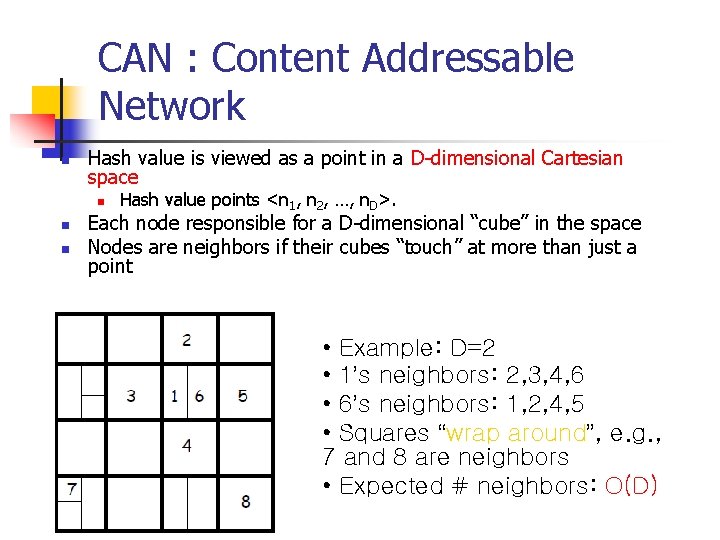
CAN : Content Addressable Network n Hash value is viewed as a point in a D-dimensional Cartesian space n n n Hash value points <n 1, n 2, …, n. D>. Each node responsible for a D-dimensional “cube” in the space Nodes are neighbors if their cubes “touch” at more than just a point • Example: D=2 • 1’s neighbors: 2, 3, 4, 6 • 6’s neighbors: 1, 2, 4, 5 • Squares “wrap around”, e. g. , 7 and 8 are neighbors • Expected # neighbors: O(D)
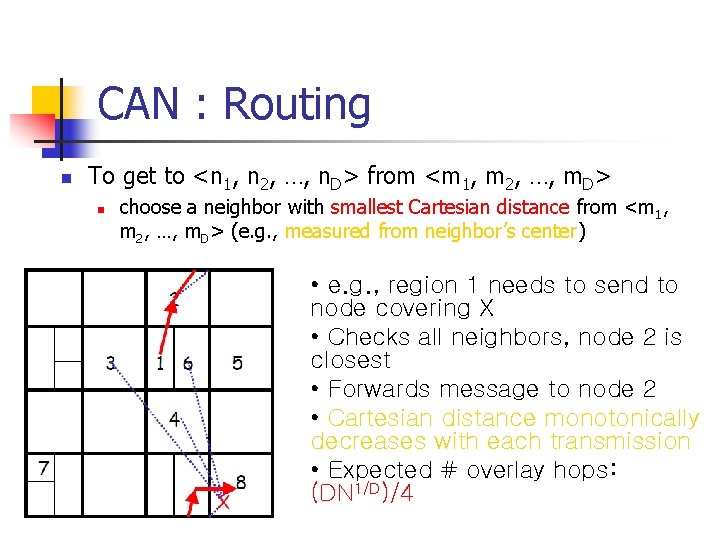
CAN : Routing n To get to <n 1, n 2, …, n. D> from <m 1, m 2, …, m. D> n choose a neighbor with smallest Cartesian distance from <m 1, m 2, …, m. D> (e. g. , measured from neighbor’s center) • e. g. , region 1 needs to send to node covering X • Checks all neighbors, node 2 is closest • Forwards message to node 2 • Cartesian distance monotonically decreases with each transmission • Expected # overlay hops: (DN 1/D)/4
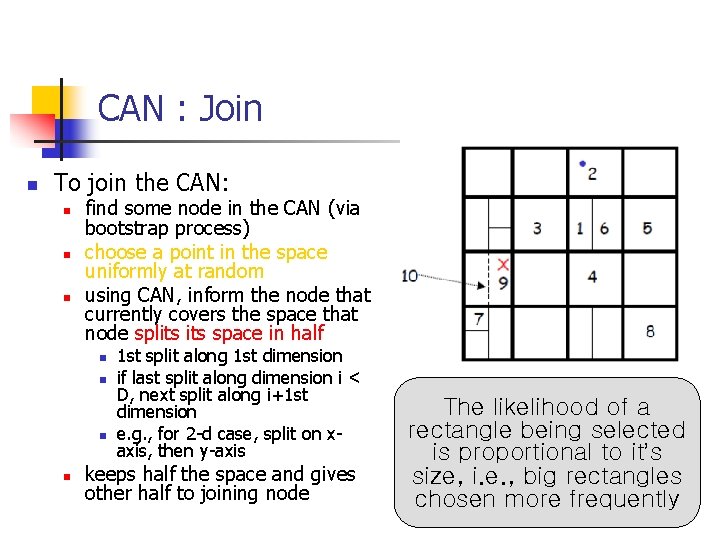
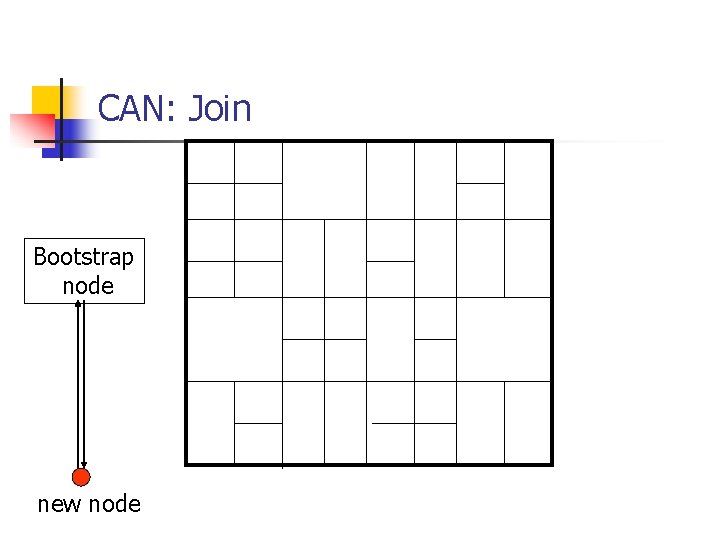
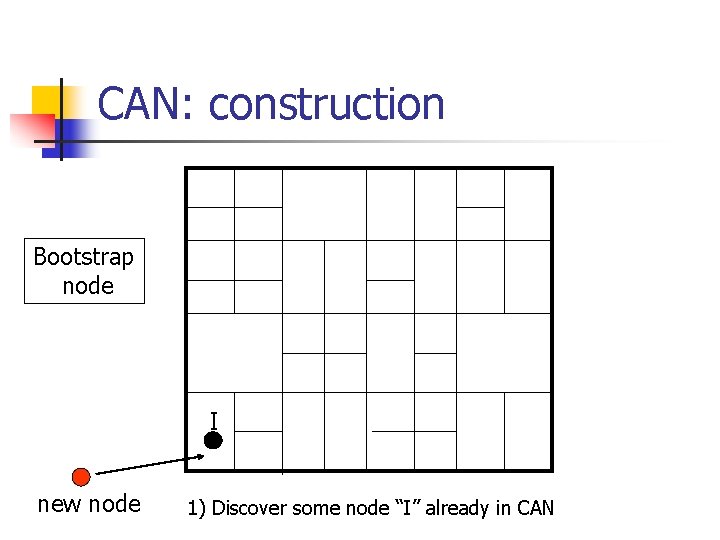
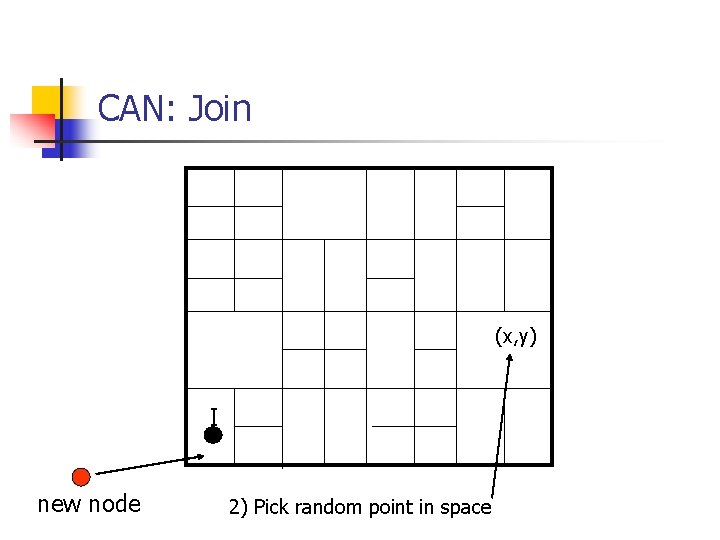
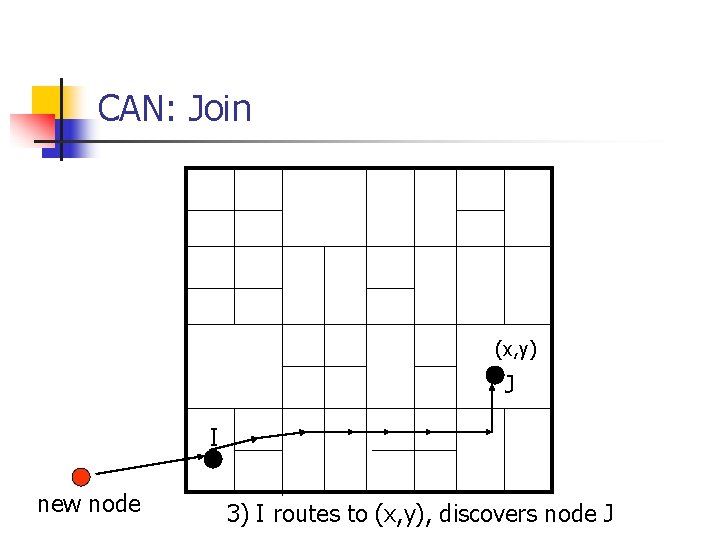
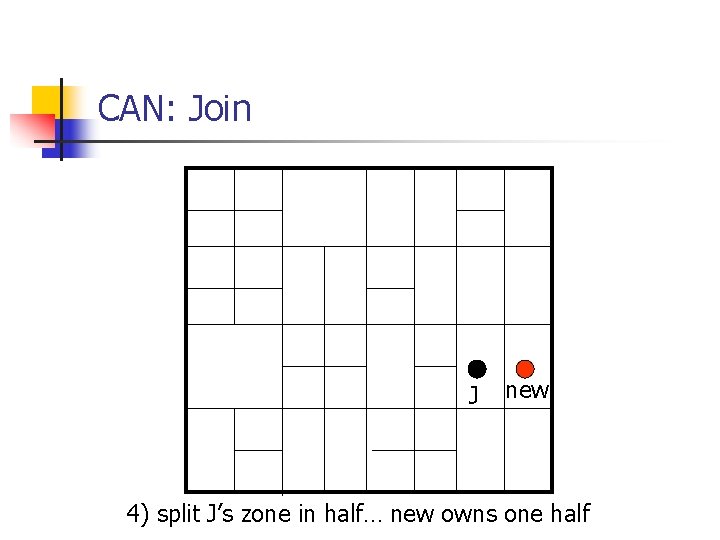
CAN : Join n To join the CAN: n n n find some node in the CAN (via bootstrap process) choose a point in the space uniformly at random using CAN, inform the node that currently covers the space that node splits space in half n n 1 st split along 1 st dimension if last split along dimension i < D, next split along i+1 st dimension e. g. , for 2 -d case, split on xaxis, then y-axis keeps half the space and gives other half to joining node The likelihood of a rectangle being selected is proportional to it’s size, i. e. , big rectangles chosen more frequently
CAN: Join Bootstrap node new node
CAN: construction Bootstrap node I new node 1) Discover some node “I” already in CAN
CAN: Join (x, y) I new node 2) Pick random point in space
CAN: Join (x, y) J I new node 3) I routes to (x, y), discovers node J
CAN: Join J new 4) split J’s zone in half… new owns one half
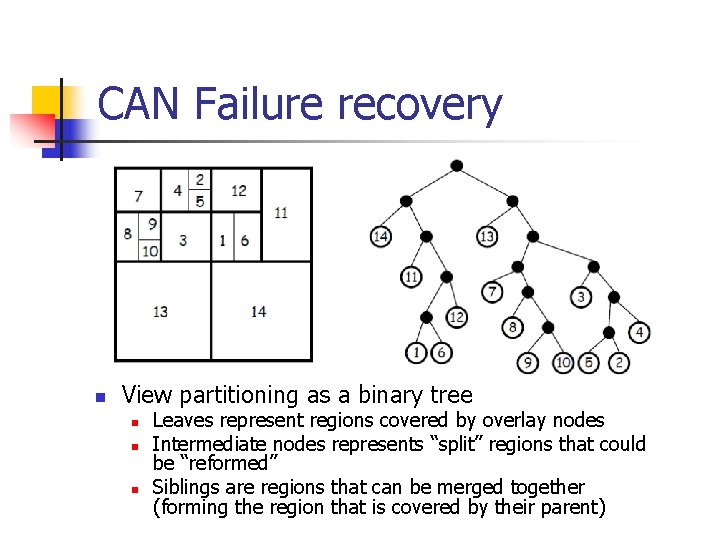
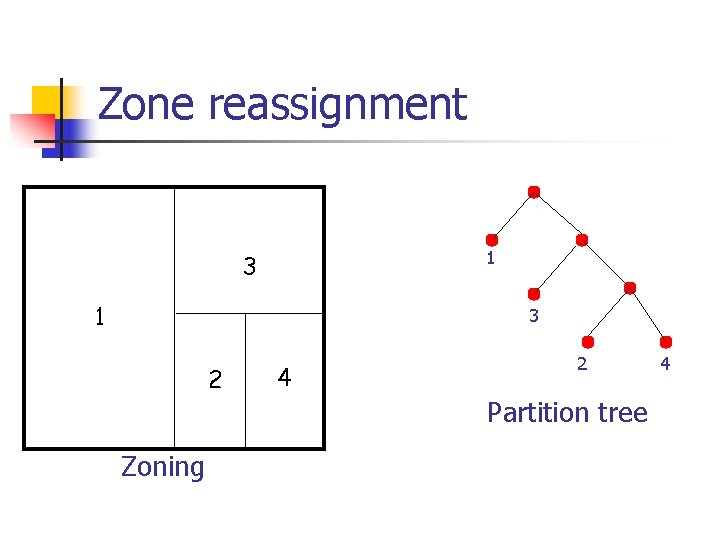
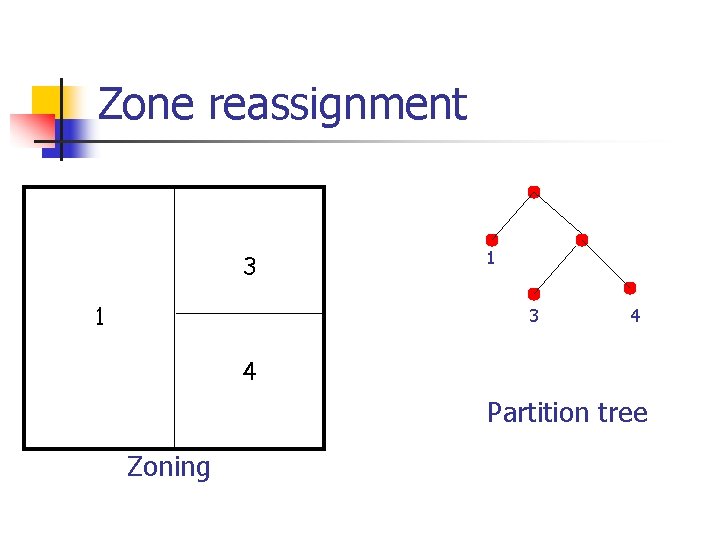
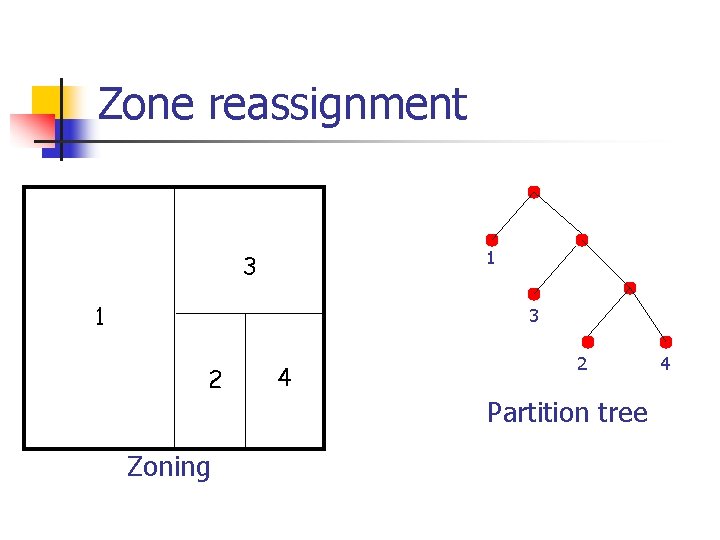
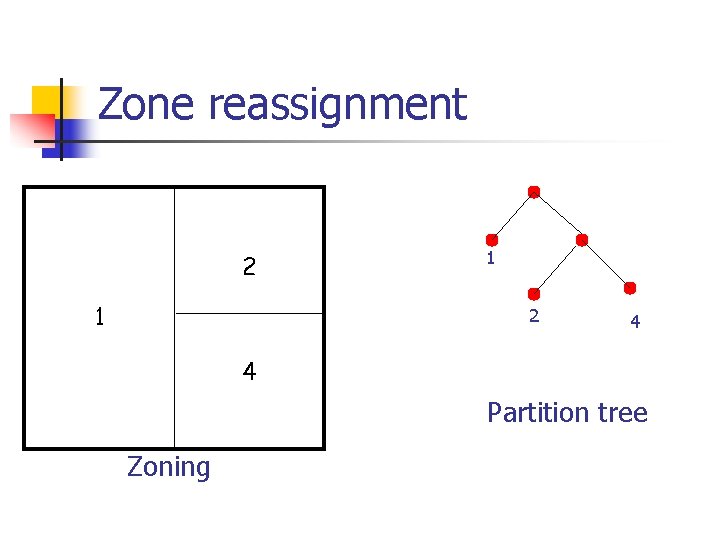
CAN Failure recovery n View partitioning as a binary tree n n n Leaves represent regions covered by overlay nodes Intermediate nodes represents “split” regions that could be “reformed” Siblings are regions that can be merged together (forming the region that is covered by their parent)
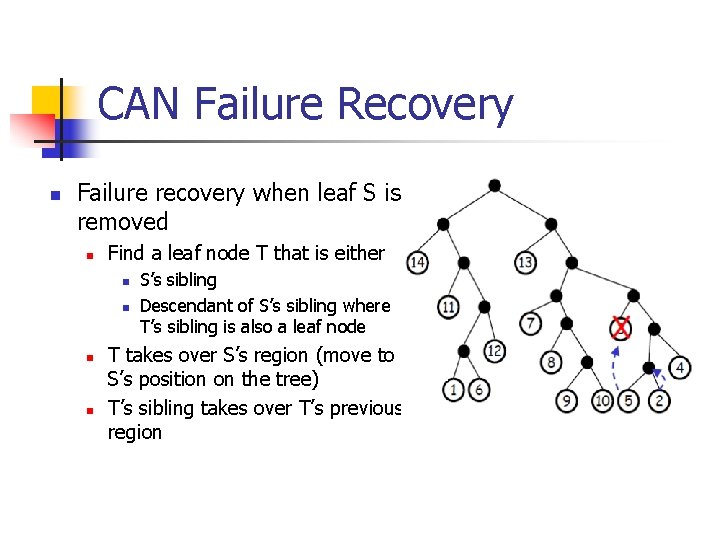
CAN Failure Recovery n Failure recovery when leaf S is removed n Find a leaf node T that is either n n S’s sibling Descendant of S’s sibling where T’s sibling is also a leaf node T takes over S’s region (move to S’s position on the tree) T’s sibling takes over T’s previous region
Maintenance n n Use zone takeover in case of failure or leaving of a node Send your neighbor table to neighbors to inform that you are alive at discrete time interval t If your neighbor does not send alive in time t, takeover its zone Zone reassignment is needed
Zone reassignment 1 3 2 Zoning 4 2 Partition tree 4
Zone reassignment 3 1 1 3 4 4 Partition tree Zoning
Zone reassignment 1 3 2 Zoning 4 2 Partition tree 4
Zone reassignment 2 1 1 2 4 4 Partition tree Zoning