
A Sybilproof DHT using a social network Socialnets
A Sybil-proof DHT using a social network Socialnets workshop April 1, 2008 Chris Lesniewski-Laas MIT CSAIL Presented by Ying Xuan

Overview • • • Distributed Hash Tables The Sybil attack Model (network, adversary) Tool: random sampling from a social network Sybil-proof DHT protocols
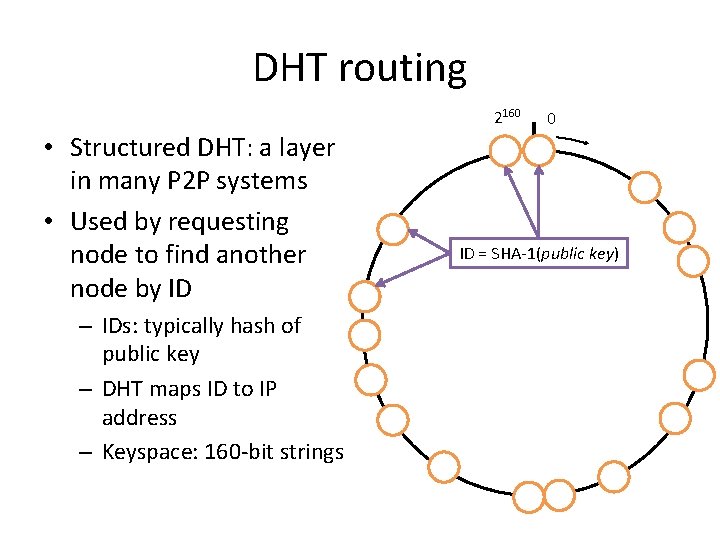
DHT routing 2160 • Structured DHT: a layer in many P 2 P systems • Used by requesting node to find another node by ID – IDs: typically hash of public key – DHT maps ID to IP address – Keyspace: 160 -bit strings 0 ID = SHA-1(public key)
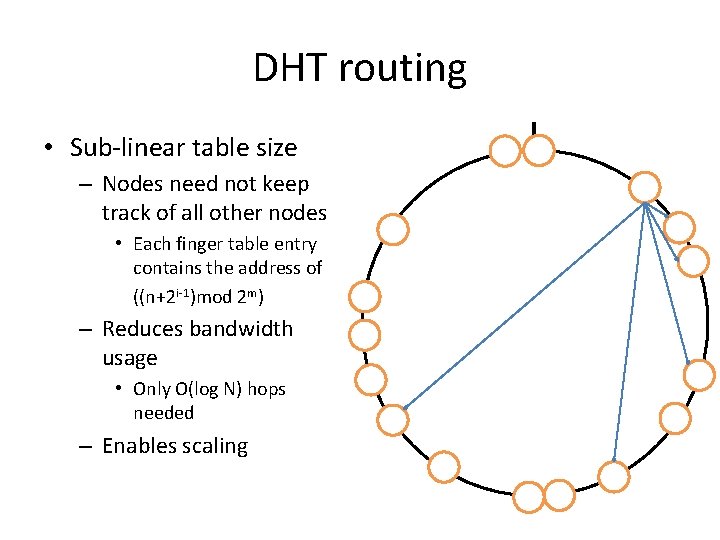
DHT routing • Sub-linear table size – Nodes need not keep track of all other nodes • Each finger table entry contains the address of ((n+2 i-1)mod 2 m) – Reduces bandwidth usage • Only O(log N) hops needed – Enables scaling

DHT routing • Routing via intermediate hops • Result is authenticated • Trade off table size versus routing hops s t {IP addr}PKt {IDt}
The Sybil Attack “One can have, some claim, as many electronic personas as one has time and energy to create. ” Judith S. Donath
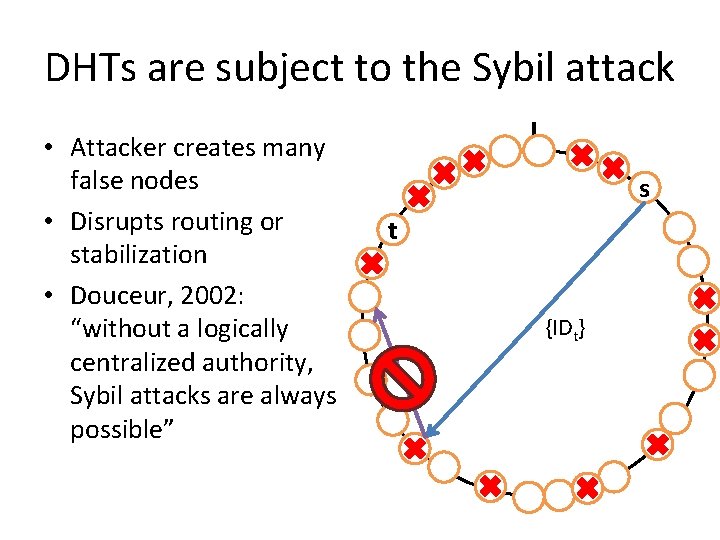
DHTs are subject to the Sybil attack • Attacker creates many false nodes • Disrupts routing or stabilization • Douceur, 2002: “without a logically centralized authority, Sybil attacks are always possible” s t {IDt}
Methods to limit the Sybil attack • Limit IDs per IP address • Central CA issues IDs – Strong PKI – CAPTCHA – Cryptographic puzzles • All methods have drawbacks – cost, compatibility, barriers to entry • Adversary may have more resources
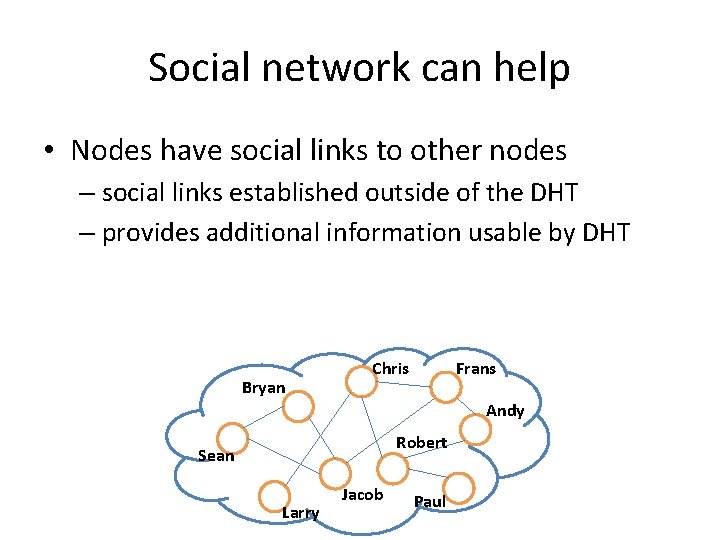
Social network can help • Nodes have social links to other nodes – social links established outside of the DHT – provides additional information usable by DHT Bryan Chris Frans Andy Robert Sean Larry Jacob Paul

Social network model
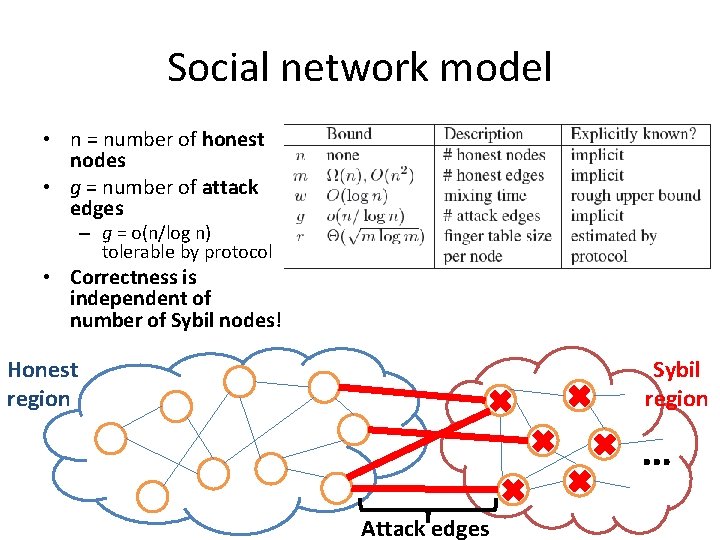
Social network model • n = number of honest nodes • g = number of attack edges – g = o(n/log n) tolerable by protocol • Correctness is independent of number of Sybil nodes! Honest region Sybil region … Attack edges
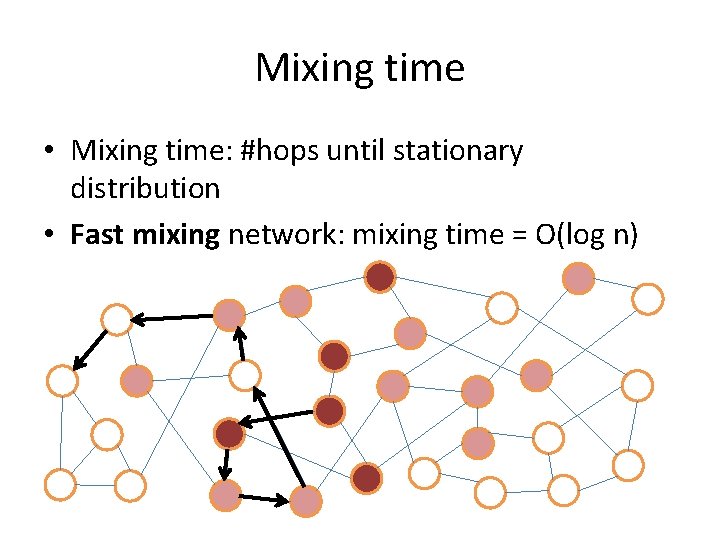
Mixing time • Mixing time: #hops until stationary distribution • Fast mixing network: mixing time = O(log n)
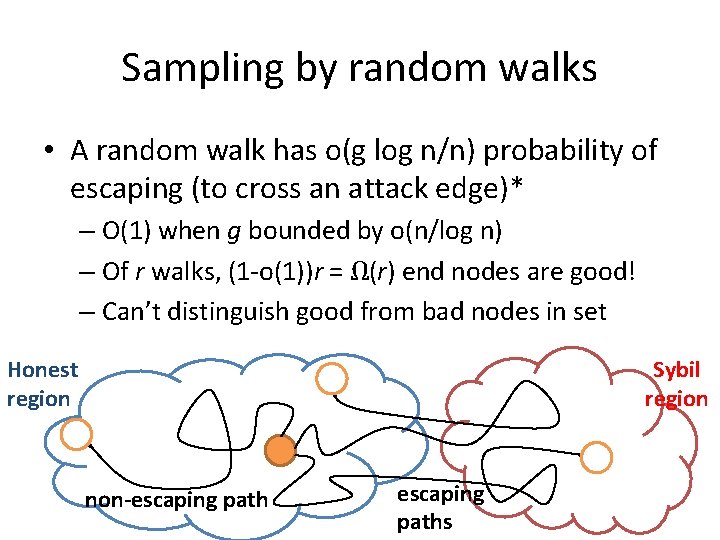
Sampling by random walks • A random walk has o(g log n/n) probability of escaping (to cross an attack edge)* – O(1) when g bounded by o(n/log n) – Of r walks, (1 -o(1))r = Ω(r) end nodes are good! – Can’t distinguish good from bad nodes in set Honest region Sybil region non-escaping paths
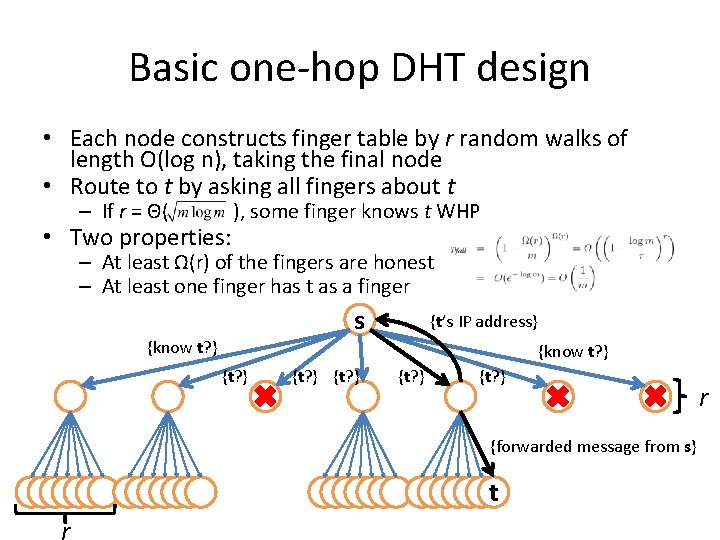
Basic one-hop DHT design • Each node constructs finger table by r random walks of length O(log n), taking the final node • Route to t by asking all fingers about t – If r = Θ( • Two properties: ), some finger knows t WHP – At least Ω(r) of the fingers are honest – At least one finger has t as a finger s {know t? } {t’s IP address} {know t? } {t? } {forwarded message from s} t r r
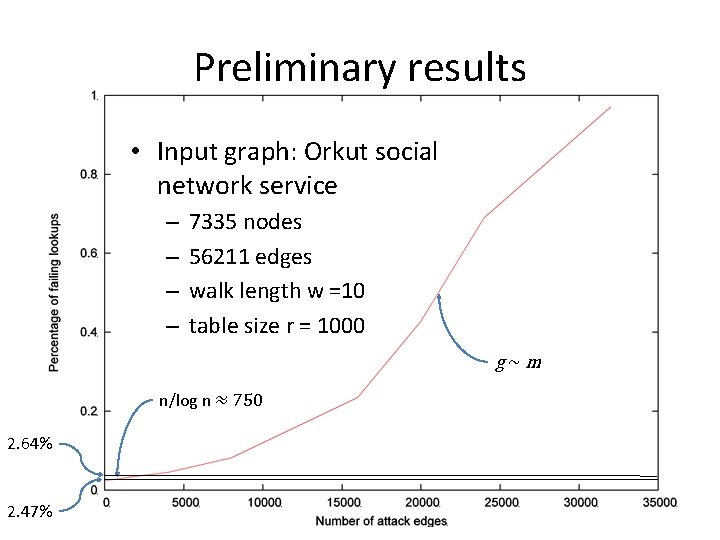
Preliminary results • Input graph: Orkut social network service – – 7335 nodes 56211 edges walk length w =10 table size r = 1000 g~m n/log n ≈ 750 2. 64% 2. 47%
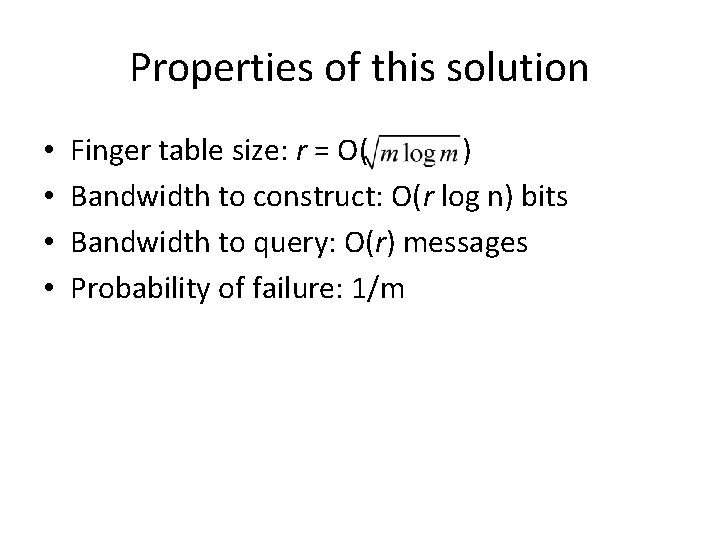
Properties of this solution • • Finger table size: r = O( ) Bandwidth to construct: O(r log n) bits Bandwidth to query: O(r) messages Probability of failure: 1/m
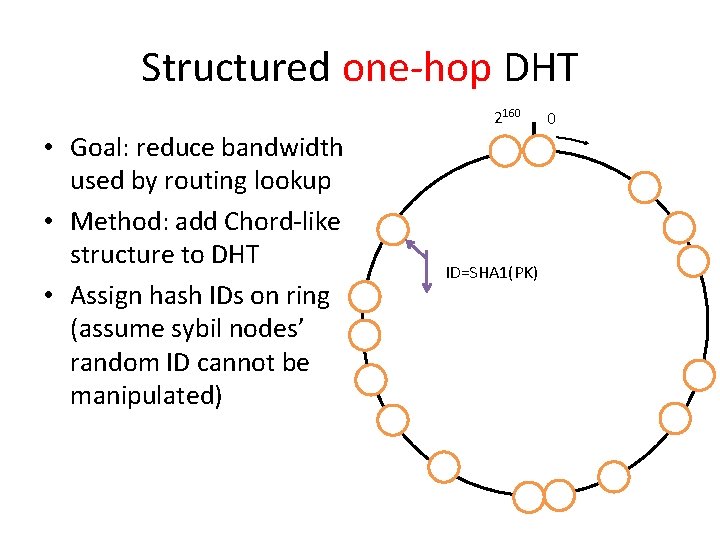
Structured one-hop DHT 2160 • Goal: reduce bandwidth used by routing lookup • Method: add Chord-like structure to DHT • Assign hash IDs on ring (assume sybil nodes’ random ID cannot be manipulated) ID=SHA 1(PK) 0
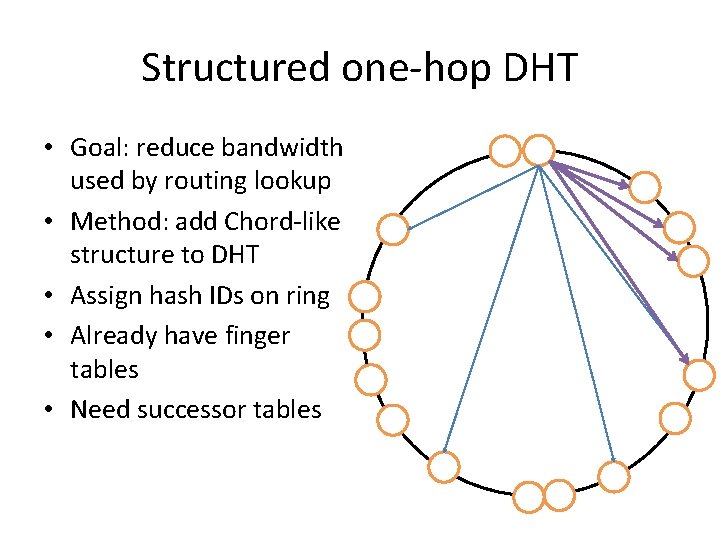
Structured one-hop DHT • Goal: reduce bandwidth used by routing lookup • Method: add Chord-like structure to DHT • Assign hash IDs on ring • Already have finger tables • Need successor tables
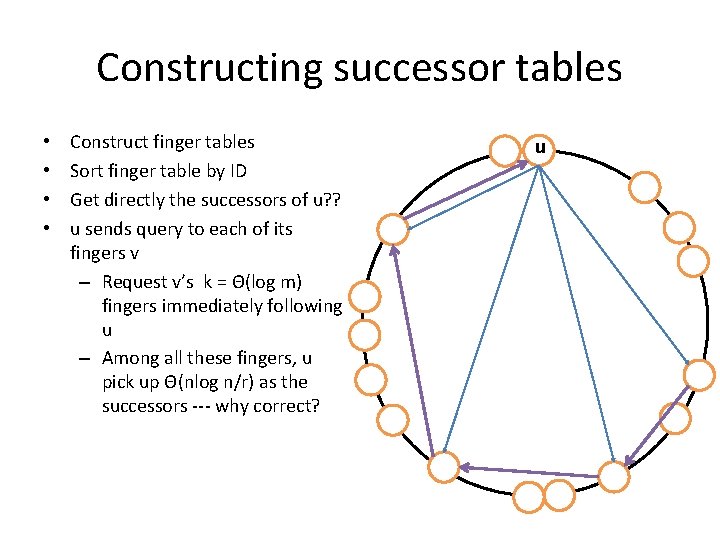
Constructing successor tables • • Construct finger tables Sort finger table by ID Get directly the successors of u? ? u sends query to each of its fingers v – Request v’s k = Θ(log m) fingers immediately following u – Among all these fingers, u pick up Θ(nlog n/r) as the successors --- why correct? u
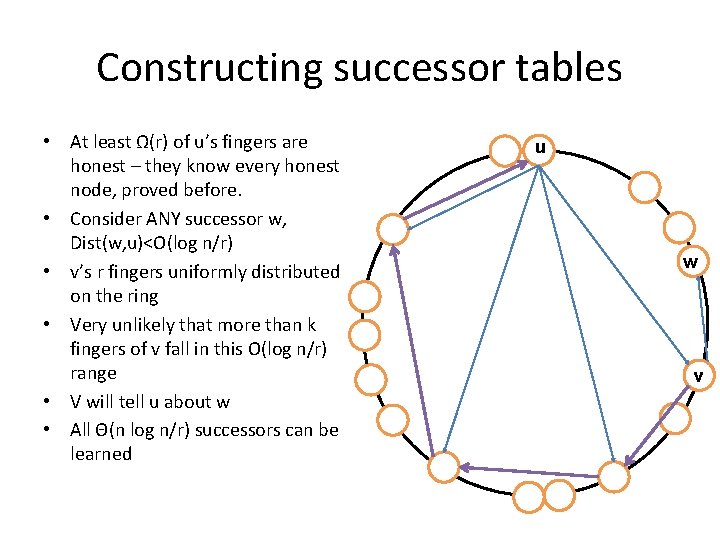
Constructing successor tables • At least Ω(r) of u’s fingers are honest – they know every honest node, proved before. • Consider ANY successor w, Dist(w, u)<O(log n/r) • v’s r fingers uniformly distributed on the ring • Very unlikely that more than k fingers of v fall in this O(log n/r) range • V will tell u about w • All Θ(n log n/r) successors can be learned u w v
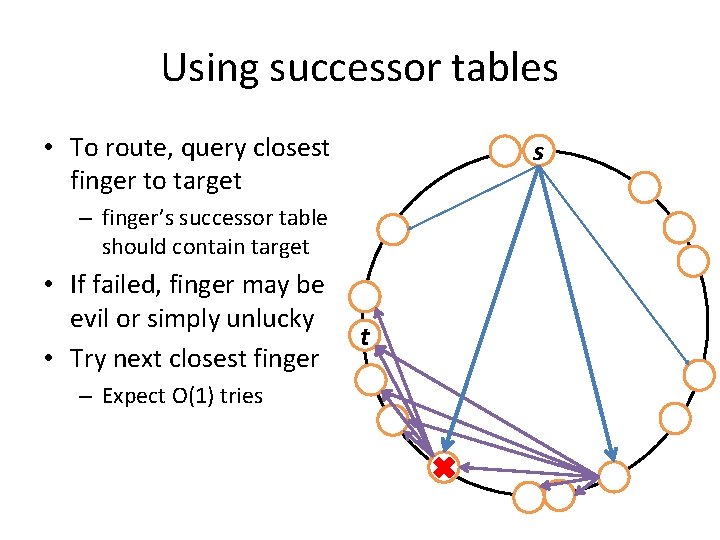
Using successor tables • To route, query closest finger to target s – finger’s successor table should contain target • If failed, finger may be evil or simply unlucky • Try next closest finger – Expect O(1) tries t
Summary • DHTs are subject to the Sybil attack • Social networks provide useful information • Created a Sybil-resistant one-hop DHT – Resistant to g = o(n/log n) attack edges – Table sizes and routing Bandwidth O( – Uses O(1) messages to route ) • This is important: enables fully decentralized and secure peer-to-peer systems

The End Q&A
- Slides: 23