Monads Gonads Douglas Crockford Today Monads Managing Asynchronicity
- Slides: 62
Monads & Gonads Douglas Crockford
Today • Monads • Managing Asynchronicity • Syntaxation • Principles of Security • Go To There and Back Again • Quality
Functional Programming with functions.
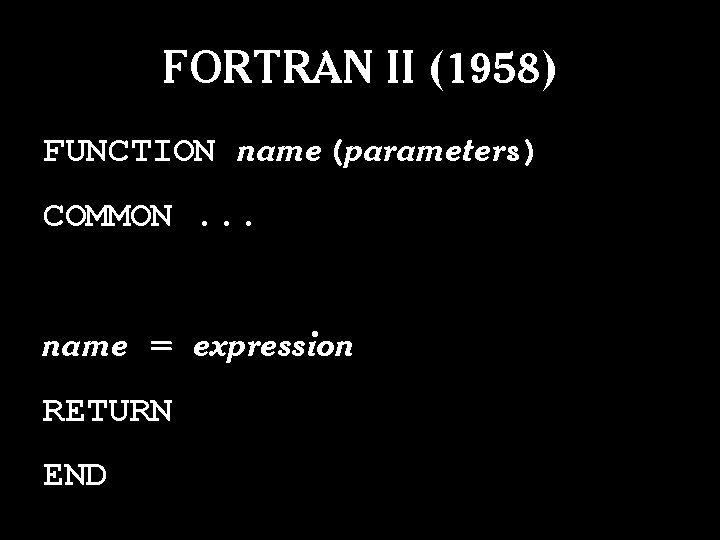
FORTRAN II (1958) FUNCTION name(parameters) COMMON. . . name = expression RETURN END
First Class Functions Higher Order Functions Lexical Closure
Pure Functional Programming More mathematical.
Functions as maps
Memoization Caching
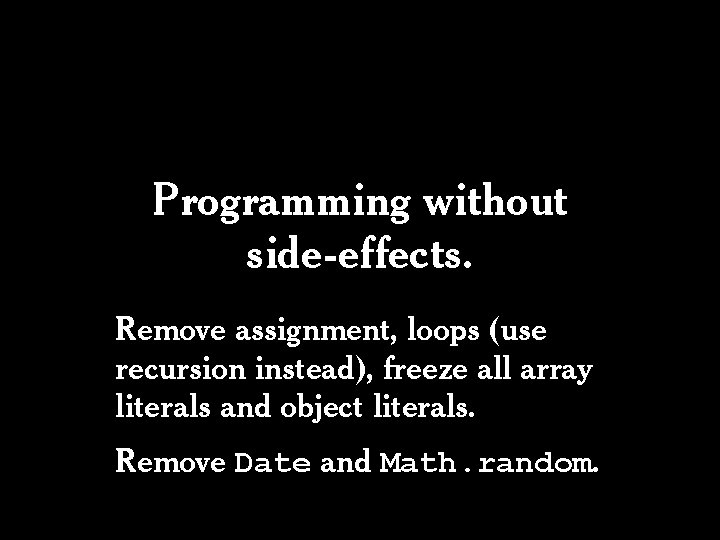
Programming without side-effects. Remove assignment, loops (use recursion instead), freeze all array literals and object literals. Remove Date and Math. random.
In the real world, everything changes. Immutability makes it hard to interact with the world.
Monads A loophole in the function contract.
In order to understand monads, you need to first learn Haskell and Category Theory.
In order to understand monads, you need to first learn Haskell and Category Theory. In order to understand burritos, you must first learn Spanish.
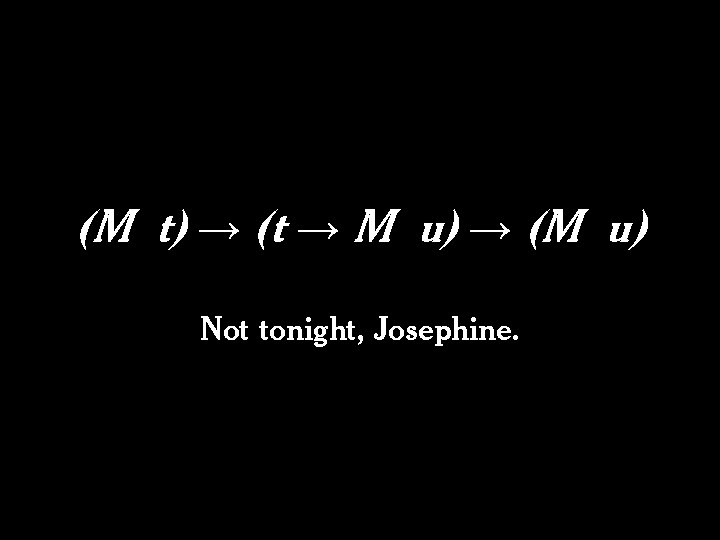
(M t) → (t → M u) → (M u) Not tonight, Josephine.
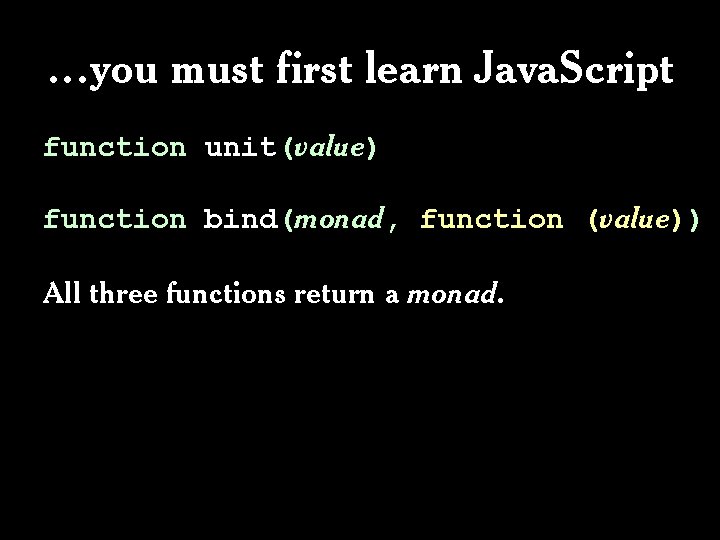
…you must first learn Java. Script function unit(value) function bind(monad, function (value)) All three functions return a monad.
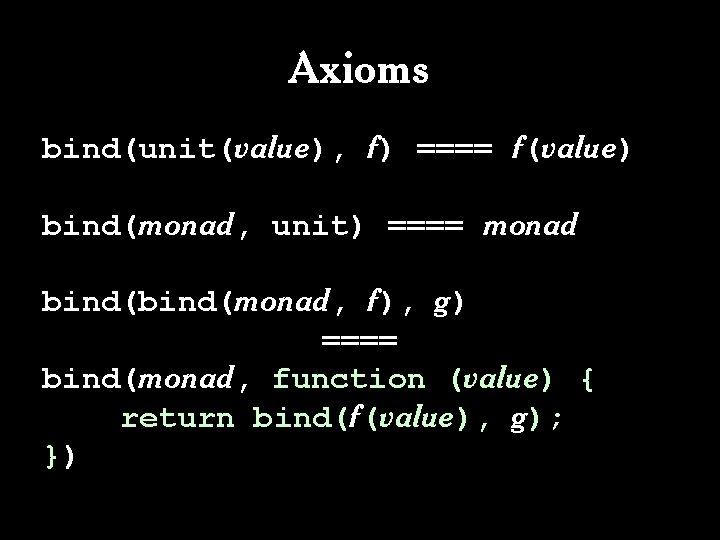
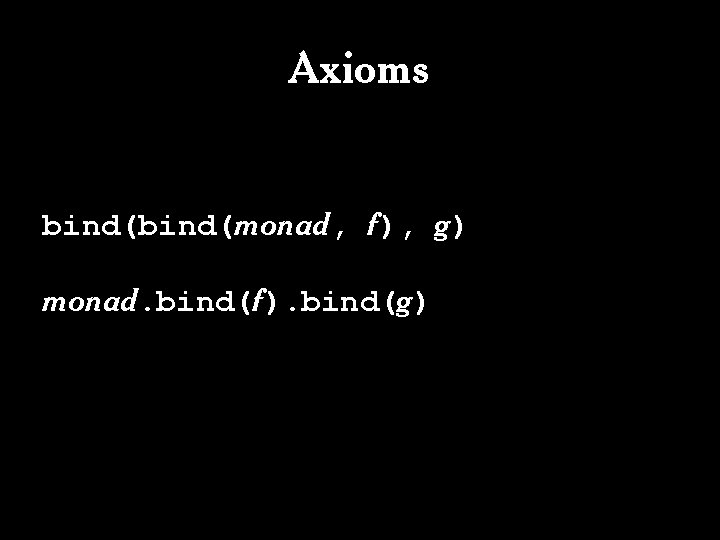
Axioms bind(unit(value), f) ==== f(value) bind(monad, unit) ==== monad bind(monad, f), g) ==== bind(monad, function (value) { return bind(f(value), g); })
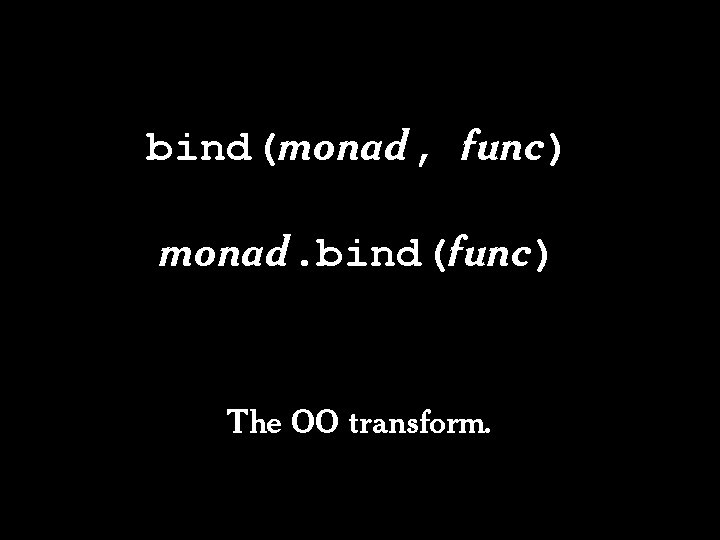
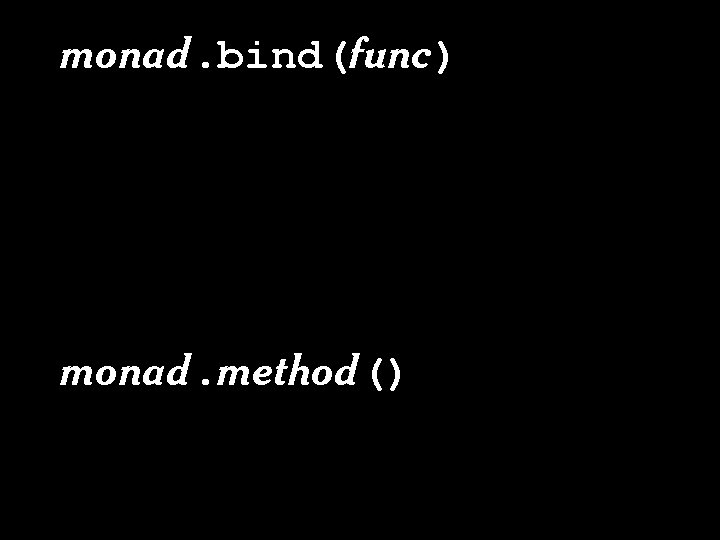
bind(monad, func) monad. bind(func) The OO transform.
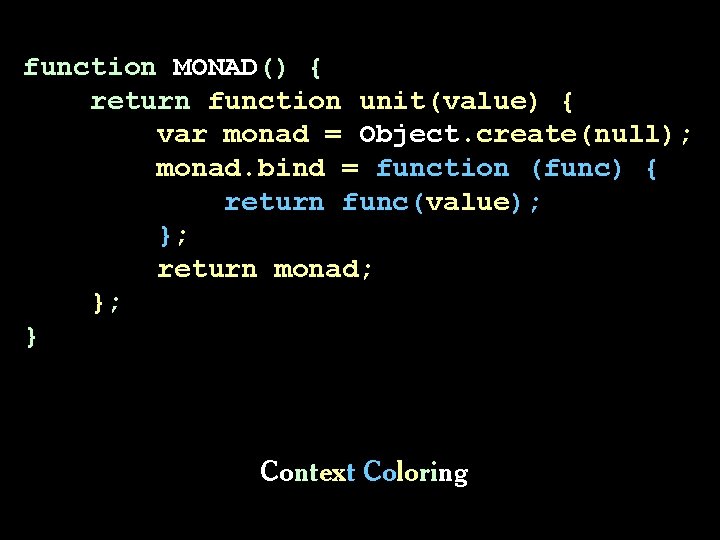
function MONAD() { return function unit(value) { var monad = Object. create(null); monad. bind = function (func) { return func(value); }; return monad; }; } Context Coloring
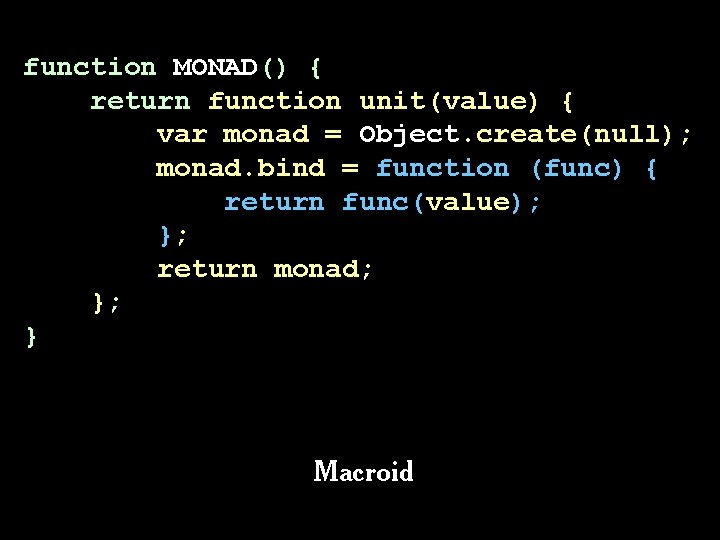
function MONAD() { return function unit(value) { var monad = Object. create(null); monad. bind = function (func) { return func(value); }; return monad; }; } Macroid
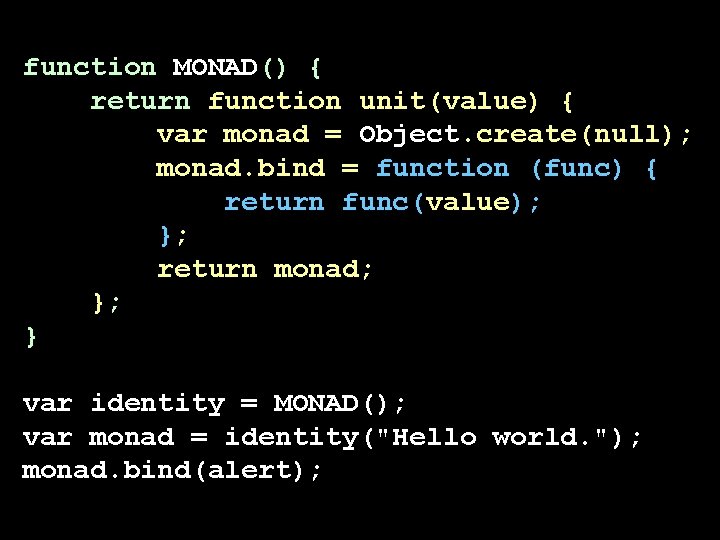
function MONAD() { return function unit(value) { var monad = Object. create(null); monad. bind = function (func) { return func(value); }; return monad; }; } var identity = MONAD(); var monad = identity("Hello world. "); monad. bind(alert);
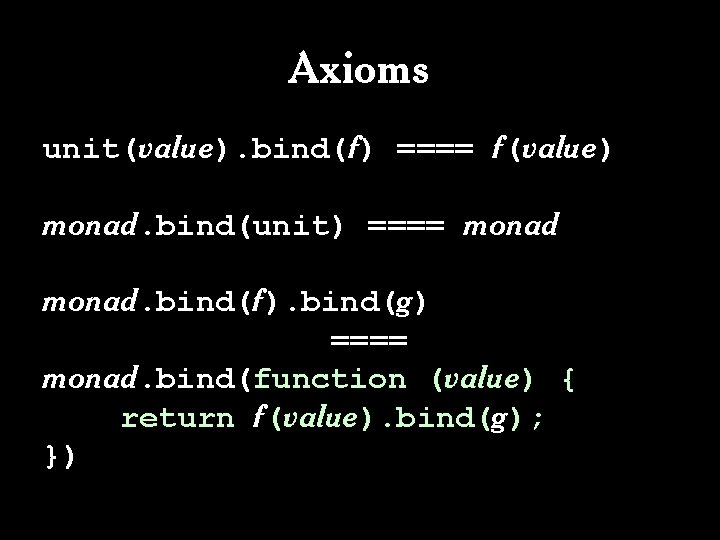
Axioms unit(value). bind(f) ==== f(value) monad. bind(unit) ==== monad. bind(f). bind(g) ==== monad. bind(function (value) { return f(value). bind(g); })
Axioms bind(monad, f), g) monad. bind(f). bind(g)
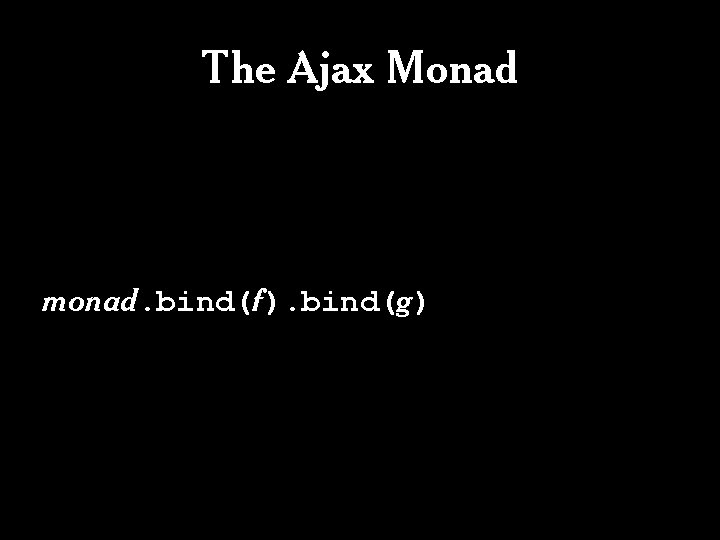
The Ajax Monad monad. bind(f). bind(g)
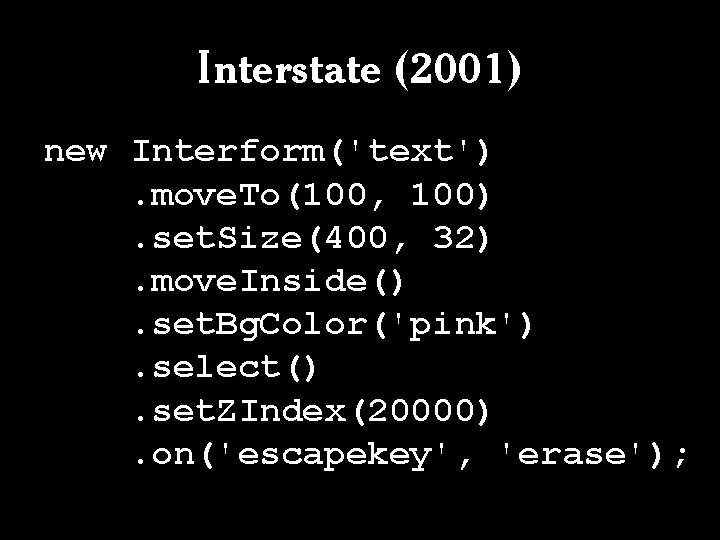
Interstate (2001) new Interform('text'). move. To(100, 100). set. Size(400, 32). move. Inside(). set. Bg. Color('pink'). select(). set. ZIndex(20000). on('escapekey', 'erase');
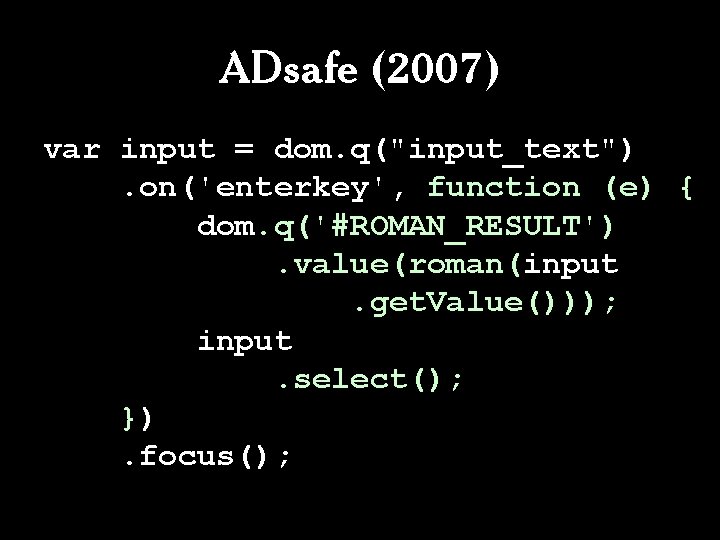
ADsafe (2007) var input = dom. q("input_text"). on('enterkey', function (e) { dom. q('#ROMAN_RESULT'). value(roman(input. get. Value())); input. select(); }). focus();
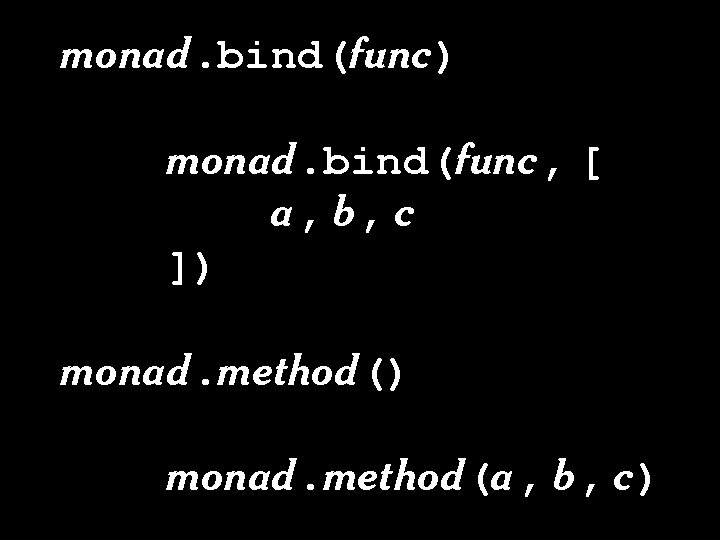
monad. bind(func) monad. bind(func, [ a, b, c ]) monad. method(a, b, c)
monad. bind(func) monad. bind(func, [ a, b, c ]) monad. method(a, b, c)
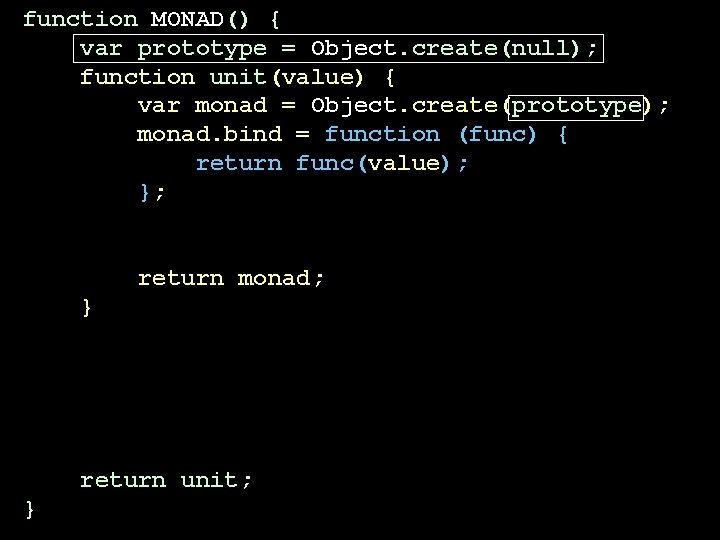
function MONAD() { var prototype = Object. create(null); function unit(value) { var monad = Object. create(prototype); monad. bind = function (func) { return func(value); }; return monad; } return unit; }
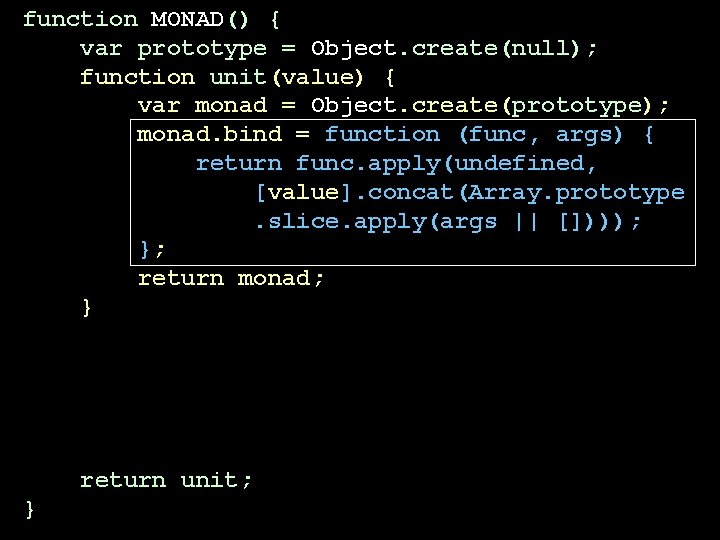
function MONAD() { var prototype = Object. create(null); function unit(value) { var monad = Object. create(prototype); monad. bind = function (func, args) { return func. apply(undefined, [value]. concat(Array. prototype. slice. apply(args || []))); }; return monad; } return unit; }
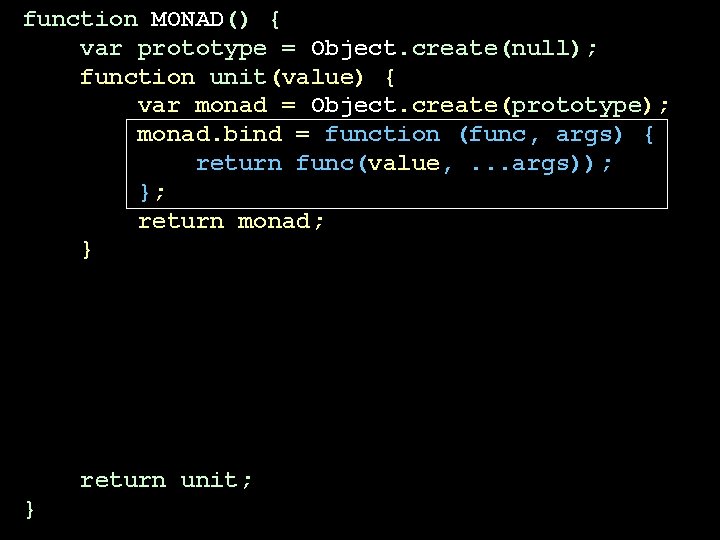
function MONAD() { var prototype = Object. create(null); function unit(value) { var monad = Object. create(prototype); monad. bind = function (func, args) { return func(value, . . . args)); }; return monad; } return unit; }
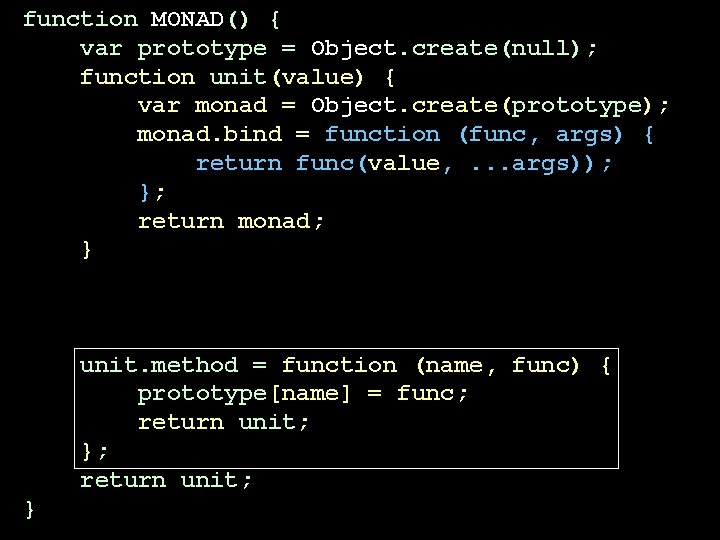
function MONAD() { var prototype = Object. create(null); function unit(value) { var monad = Object. create(prototype); monad. bind = function (func, args) { return func(value, . . . args)); }; return monad; } unit. method = function (name, func) { prototype[name] = func; return unit; }
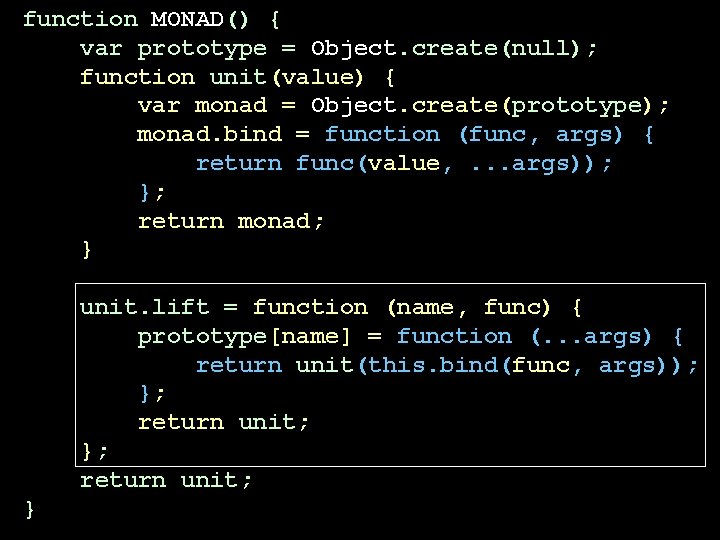
function MONAD() { var prototype = Object. create(null); function unit(value) { var monad = Object. create(prototype); monad. bind = function (func, args) { return func(value, . . . args)); }; return monad; } unit. lift = function (name, func) { prototype[name] = function (. . . args) { return unit(this. bind(func, args)); }; return unit; }
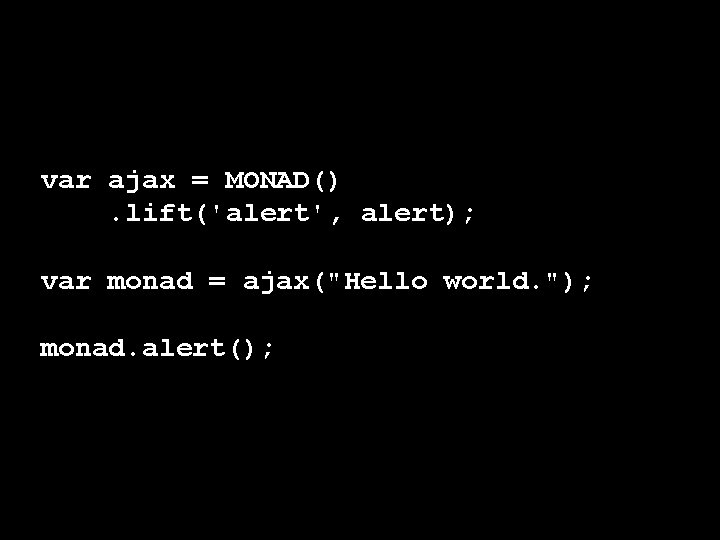
var ajax = MONAD(). lift('alert', alert); var monad = ajax("Hello world. "); monad. alert();
null Null Pointer Exception
Maybe Na. N
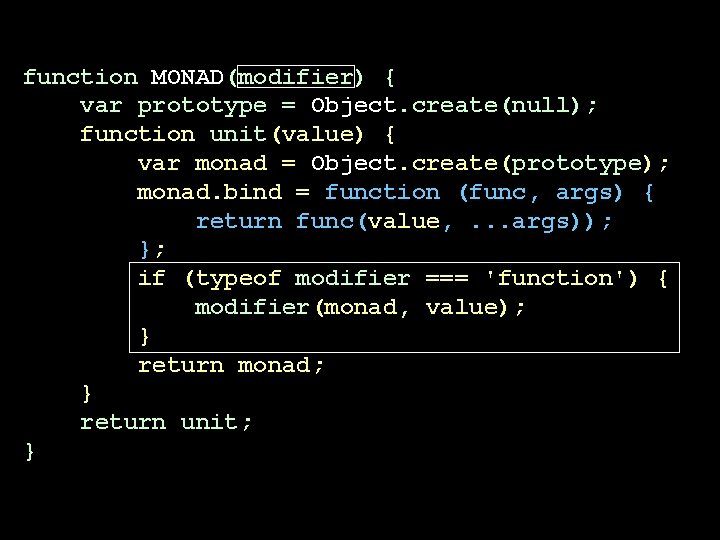
function MONAD(modifier) { var prototype = Object. create(null); function unit(value) { var monad = Object. create(prototype); monad. bind = function (func, args) { return func(value, . . . args)); }; if (typeof modifier === 'function') { modifier(monad, value); } return monad; } return unit; }
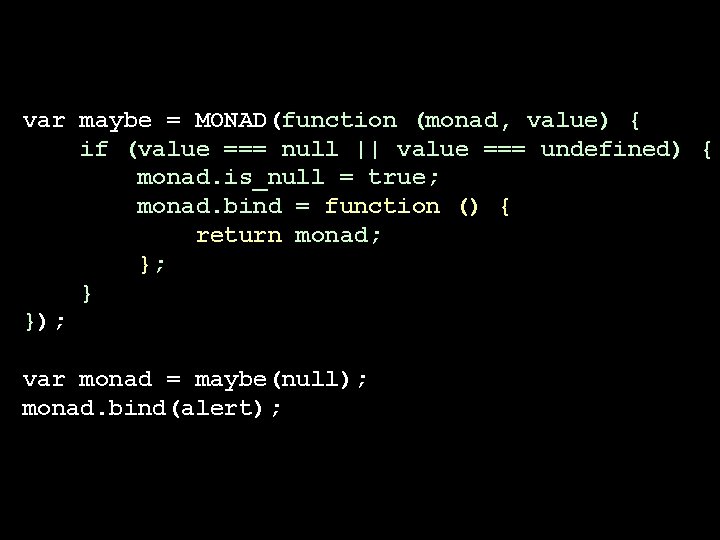
var maybe = MONAD(function (monad, value) { if (value === null || value === undefined) { monad. is_null = true; monad. bind = function () { return monad; }; } }); var monad = maybe(null); monad. bind(alert);
Our Friend the Monad The Identity Monad The Ajax Monad The Maybe Monad
Concurrency Threads are evil.
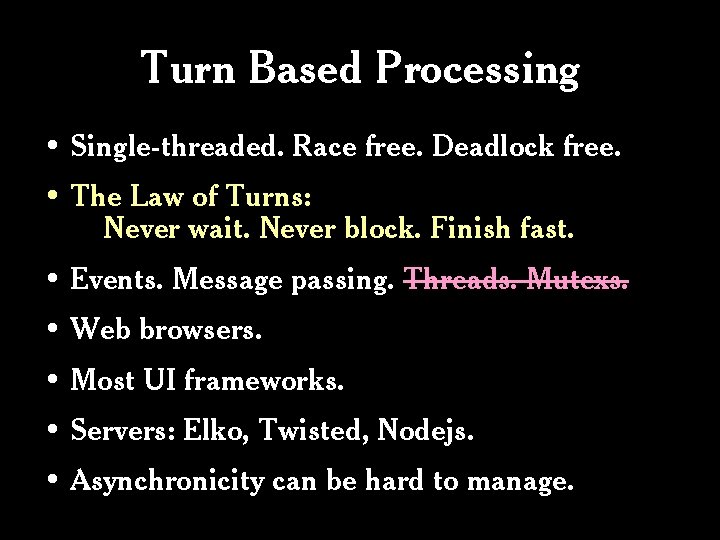
Turn Based Processing • Single-threaded. Race free. Deadlock free. • The Law of Turns: Never wait. Never block. Finish fast. • Events. Message passing. Threads. Mutexs. • Web browsers. • Most UI frameworks. • Servers: Elko, Twisted, Nodejs. • Asynchronicity can be hard to manage.
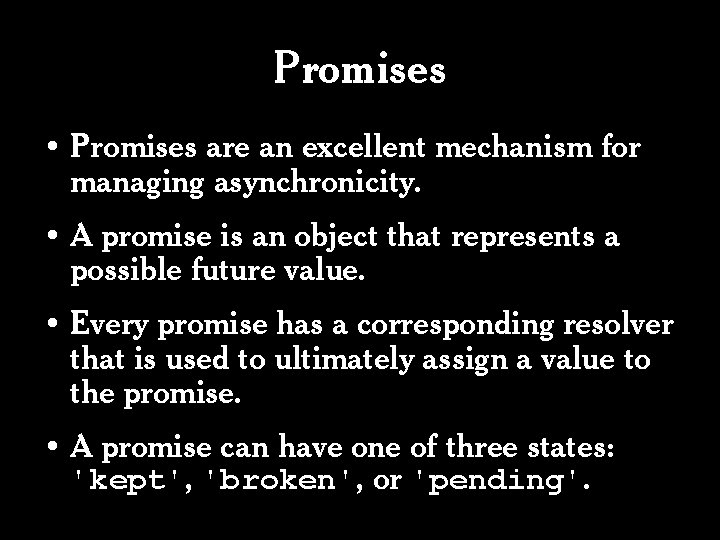
Promises • Promises are an excellent mechanism for managing asynchronicity. • A promise is an object that represents a possible future value. • Every promise has a corresponding resolver that is used to ultimately assign a value to the promise. • A promise can have one of three states: 'kept', 'broken', or 'pending'.
Promises • A promise is an event generator. It fires its event when the value of the promise is ultimately known. • At any time after the making the promise, event handling functions can be registered with the promise, which will be called in order with the promise’s value when it is known.
Promises • A promise can accept functions that will be called with the value once the promise has been kept or broken. • promise. when(success, failure) returns another promise for the result of your success function.
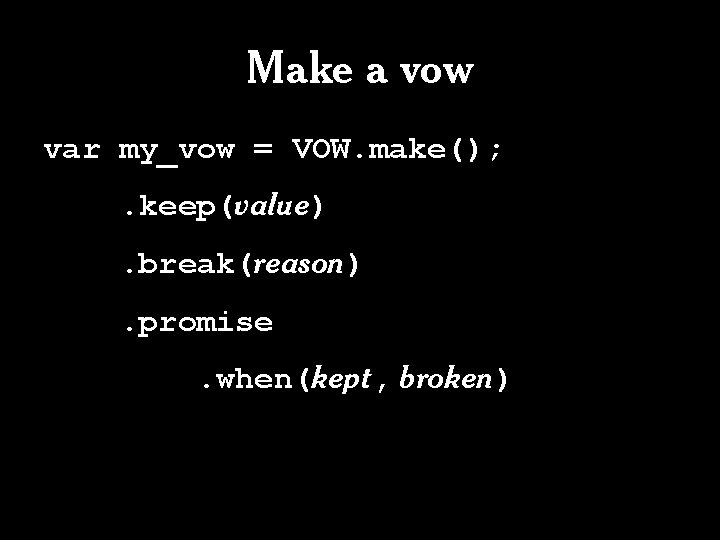
Make a vow var my_vow = VOW. make(); . keep(value). break(reason). promise. when(kept, broken)
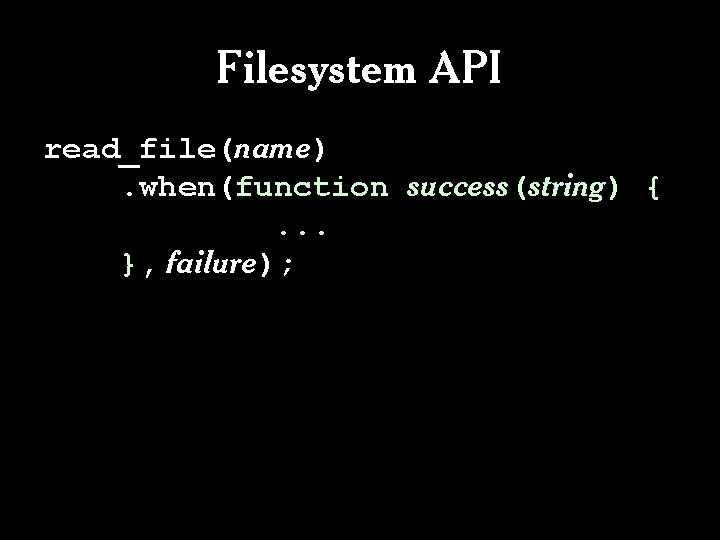
Filesystem API read_file(name). when(function success(string) {. . . }, failure);
Exceptions • Exceptions modify the flow of control by unwinding the state. • In a turn based system, the stack is empty at the end of every turn. • Exceptions cannot be delivered across turns. • Broken promises can.
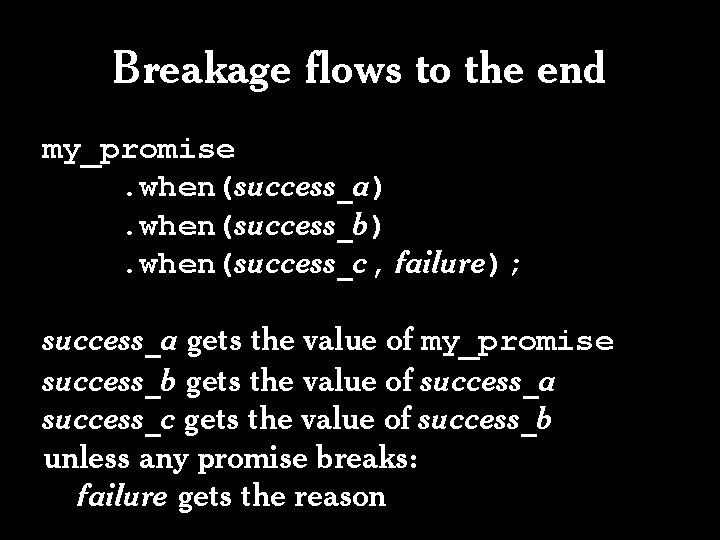
Breakage flows to the end my_promise. when(success_a). when(success_b). when(success_c, failure); success_a gets the value of my_promise success_b gets the value of success_a success_c gets the value of success_b unless any promise breaks: failure gets the reason
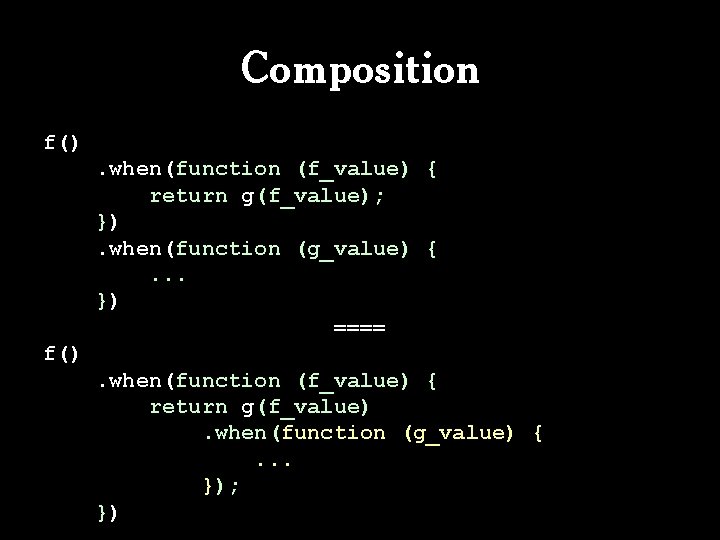
Composition f(). when(function (f_value) { return g(f_value); }). when(function (g_value) {. . . }) ==== f(). when(function (f_value) { return g(f_value). when(function (g_value) {. . . }); })
A promise is a monad • The value is not known when the monad is made. • Each promise is linked to two resolver functions, keep and break, that determine the promise’s success and value. • when can take two functions, bind only one.
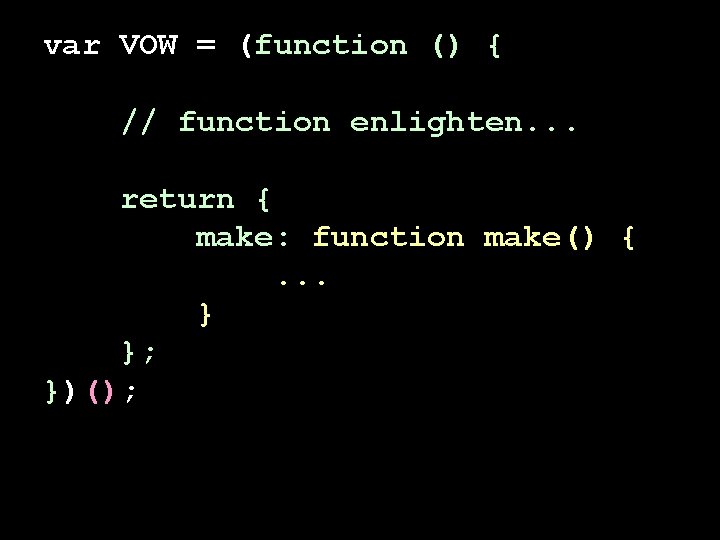
var VOW = (function () { // function enlighten. . . return { make: function make() {. . . } }; })();
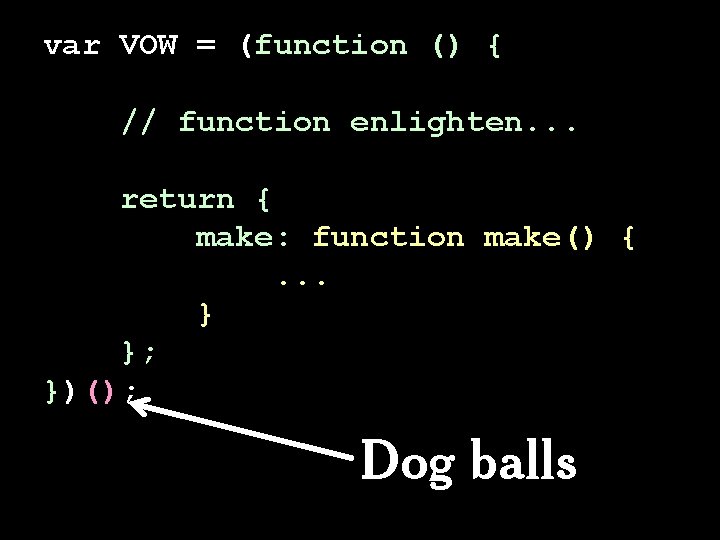
var VOW = (function () { // function enlighten. . . return { make: function make() {. . . } }; })(); Dog balls
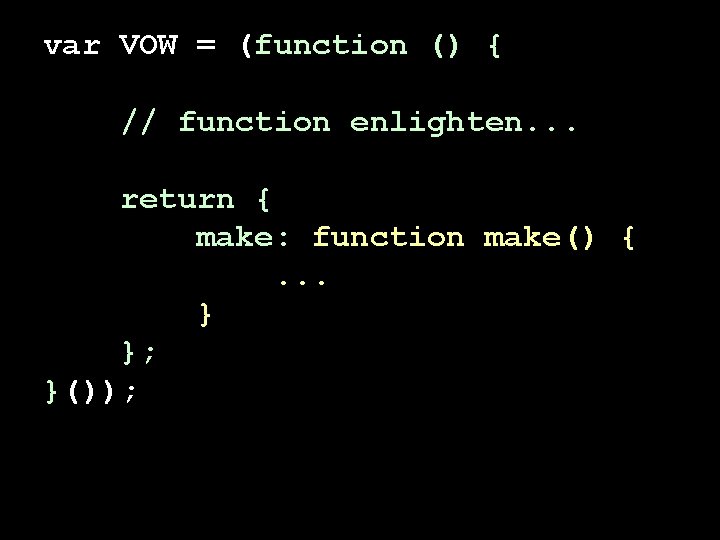
var VOW = (function () { // function enlighten. . . return { make: function make() {. . . } }; }());
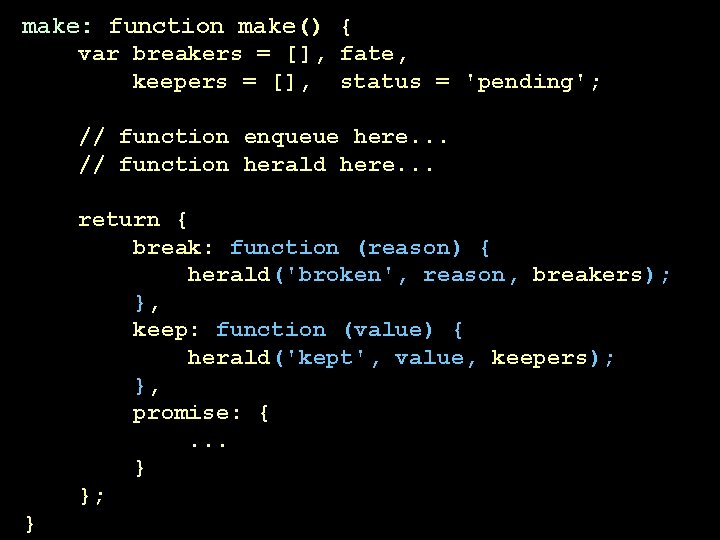
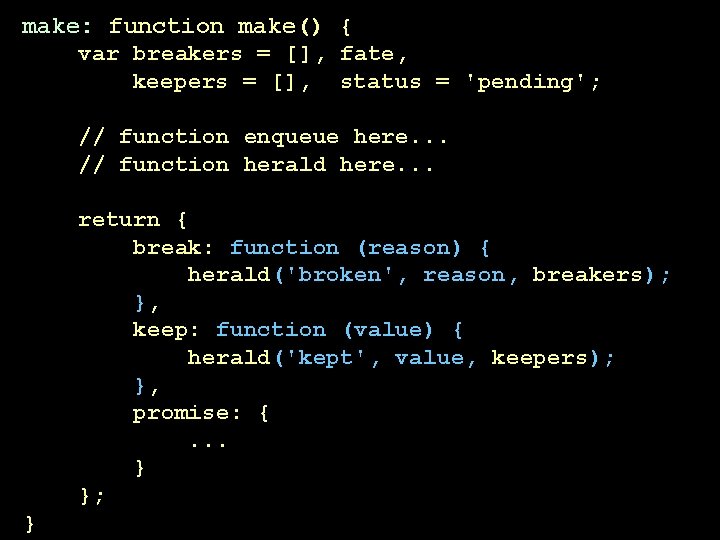
make: function make() { var breakers = [], fate, keepers = [], status = 'pending'; // function enqueue here. . . // function herald here. . . return { break: function (reason) { herald('broken', reason, breakers); }, keep: function (value) { herald('kept', value, keepers); }, promise: {. . . } }; }
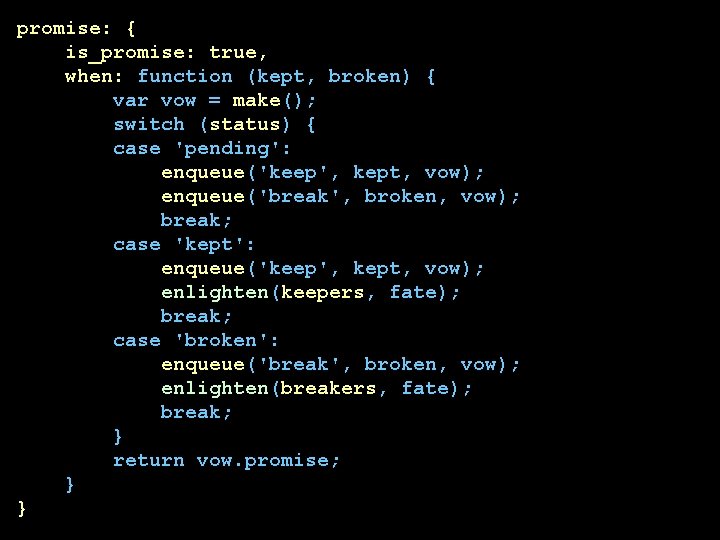
promise: { is_promise: true, when: function (kept, broken) { var vow = make(); switch (status) { case 'pending': enqueue('keep', kept, vow); enqueue('break', broken, vow); break; case 'kept': enqueue('keep', kept, vow); enlighten(keepers, fate); break; case 'broken': enqueue('break', broken, vow); enlighten(breakers, fate); break; } return vow. promise; } }
make: function make() { var breakers = [], fate, keepers = [], status = 'pending'; // function enqueue here. . . // function herald here. . . return { break: function (reason) { herald('broken', reason, breakers); }, keep: function (value) { herald('kept', value, keepers); }, promise: {. . . } }; }
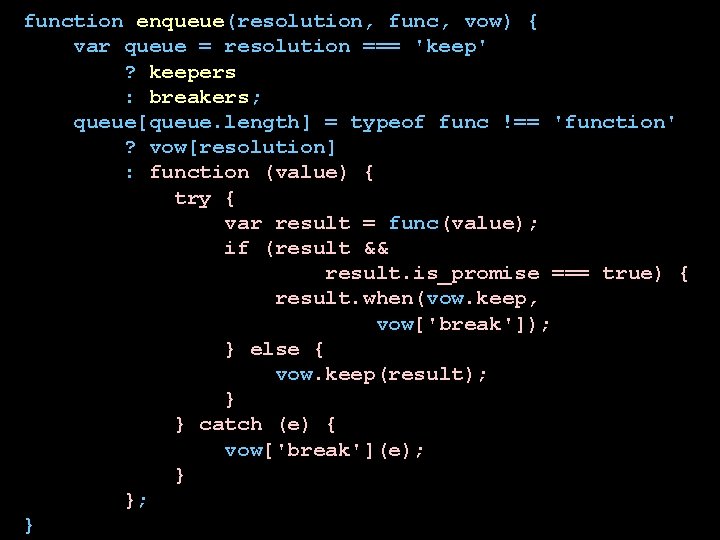
function enqueue(resolution, func, vow) { var queue = resolution === 'keep' ? keepers : breakers; queue[queue. length] = typeof func !== 'function' ? vow[resolution] : function (value) { try { var result = func(value); if (result && result. is_promise === true) { result. when(vow. keep, vow['break']); } else { vow. keep(result); } } catch (e) { vow['break'](e); } }; }
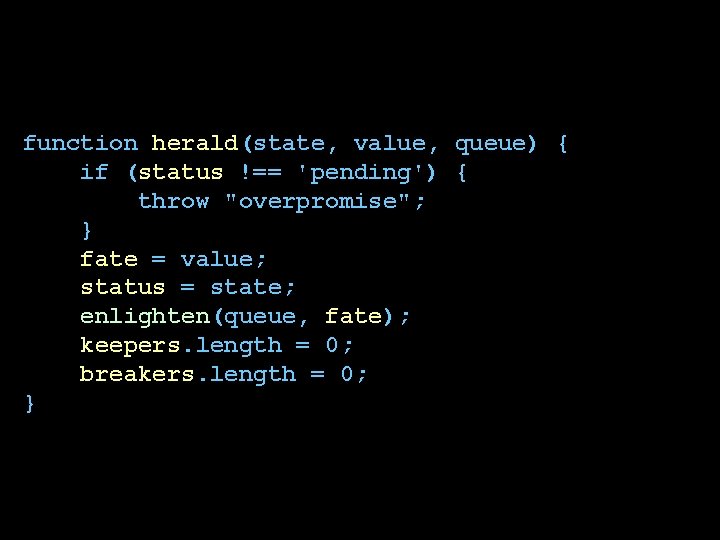
function herald(state, value, queue) { if (status !== 'pending') { throw "overpromise"; } fate = value; status = state; enlighten(queue, fate); keepers. length = 0; breakers. length = 0; }
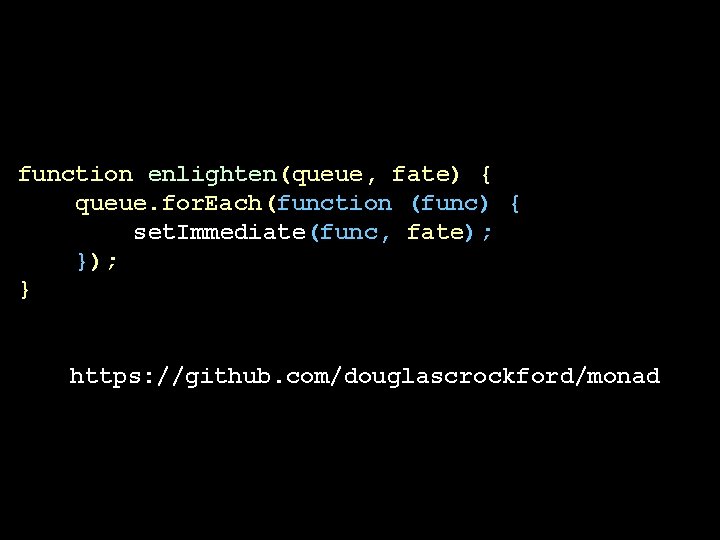
function enlighten(queue, fate) { queue. for. Each(function (func) { set. Immediate(func, fate); } https: //github. com/douglascrockford/monad
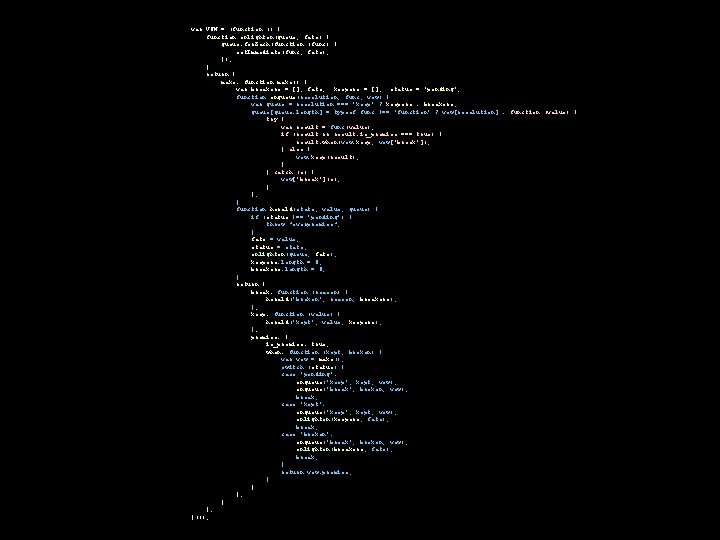
var VOW = (function () { function enlighten(queue, fate) { queue. for. Each(function (func) { set. Immediate(func, fate); } return { make: function make() { var breakers = [], fate, keepers = [], status = 'pending'; function enqueue(resolution, func, vow) { var queue = resolution === 'keep' ? keepers : breakers; queue[queue. length] = typeof func !== 'function' ? vow[resolution] : function (value) { try { var result = func(value); if (result && result. is_promise === true) { result. when(vow. keep, vow['break']); } else { vow. keep(result); } } catch (e) { vow['break'](e); } }; } function herald(state, value, queue) { if (status !== 'pending') { throw "overpromise"; } fate = value; status = state; enlighten(queue, fate); keepers. length = 0; breakers. length = 0; } return { break: function (reason) { herald('broken', reason, breakers); }, keep: function (value) { herald('kept', value, keepers); }, promise: { is_promise: true, when: function (kept, broken) { var vow = make(); switch (status) { case 'pending': enqueue('keep', kept, vow); enqueue('break', broken, vow); break; case 'kept': enqueue('keep', kept, vow); enlighten(keepers, fate); break; case 'broken': enqueue('break', broken, vow); enlighten(breakers, fate); break; } return vow. promise; } } }; }());
Our Friend the Monad The Identity Monad The Ajax Monad The Maybe Monad The Promise Monad
Further Viewing Carl Hewitt. The Actor Model (everything you wanted to know, but were afraid to ask) http: //channel 9. msdn. com/Shows/Going+Deep/ Hewitt-Meijer-and-Szyperski-The-Actor-Modeleverything-you-wanted-to-know-but-were-afraidto-ask Mark Miller. Secure Distributed Programming with Object-capabilities in Java. Script http: //www. youtube. com/watch? v=w 9 h. HHvh. Z_HY http: //www. youtube. com/watch? v=o. Bqe. DYETXME