Supervision Through a Constructivist Lens Douglas Guiffrida Ph

- Slides: 12
Supervision Through a Constructivist Lens Douglas Guiffrida, Ph. D. , Professor. , University of Rochester, NY USA
My Path to Constructivism • Reflective Practice and Observation • No formal training in constructivism • Practitioner scholarship – Mahoney & Neimeyer – George Kelly
“I recall professors saying that once they had understood Piaget they found their students no longer understood them” (Hugh Gash, Dublin City University).
Why a Constructivist Lens? • An “intellectual force” in the social sciences. • Apparent in ancient philosophies of the Tao (yin & yang), the Buddha, Heraclitus. • Contemporary philosophers: Giabattista Vico (1668 -1744), Immanuel Kant (17241804), Arthur Schopenhauer (1788 -1860), and Hans Vaihinger (1852 -1933).
• Integrated into many psychotherapy theories: psychoanalytic, humanistic, cognitive behavioral, systems, multicultural • Prominent in contemporary approaches: Narrative, Solution Focused, Constructive • Yet despite this strong influence in psychotherapy, ideas only recently been used a lens for conceptualizing clinical supervision.
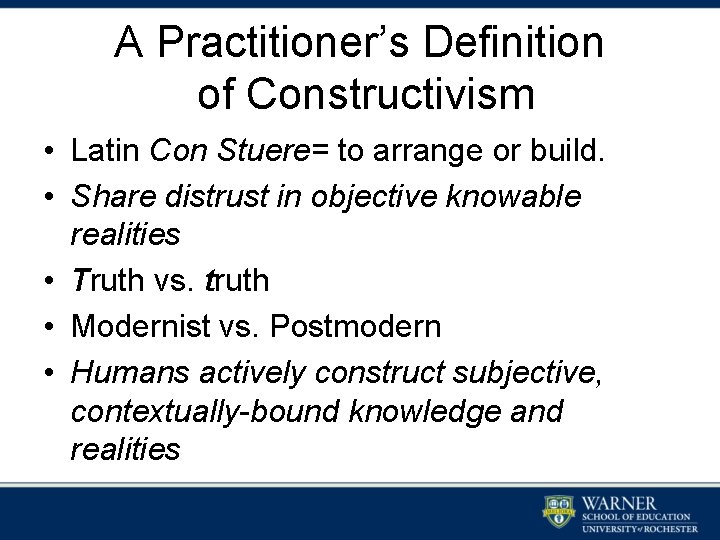
A Practitioner’s Definition of Constructivism • Latin Con Stuere= to arrange or build. • Share distrust in objective knowable realities • Truth vs. truth • Modernist vs. Postmodern • Humans actively construct subjective, contextually-bound knowledge and realities
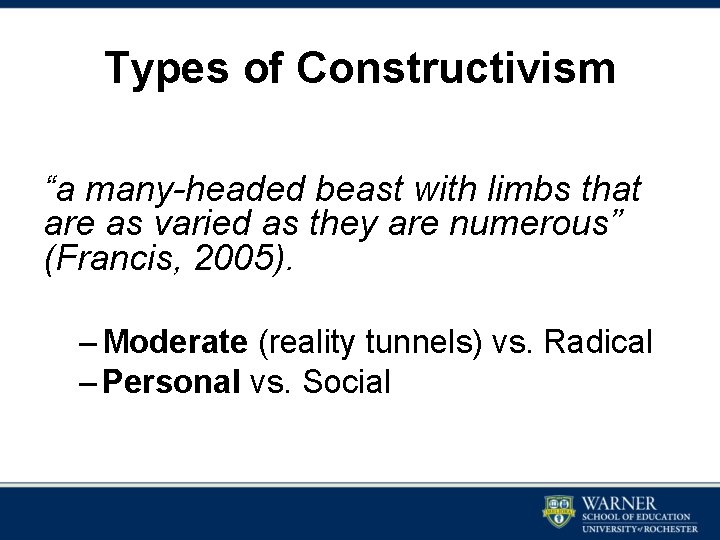
Types of Constructivism “a many-headed beast with limbs that are as varied as they are numerous” (Francis, 2005). – Moderate (reality tunnels) vs. Radical – Personal vs. Social
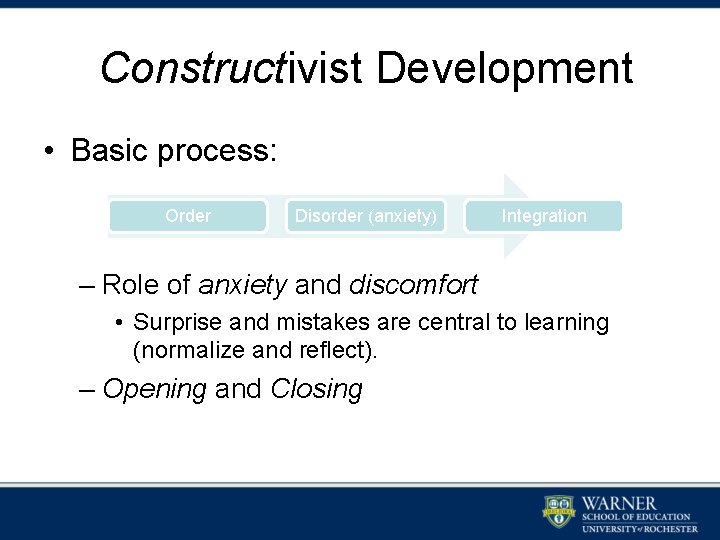
Constructivist Development • Basic process: Order Disorder (anxiety) Integration – Role of anxiety and discomfort • Surprise and mistakes are central to learning (normalize and reflect). – Opening and Closing
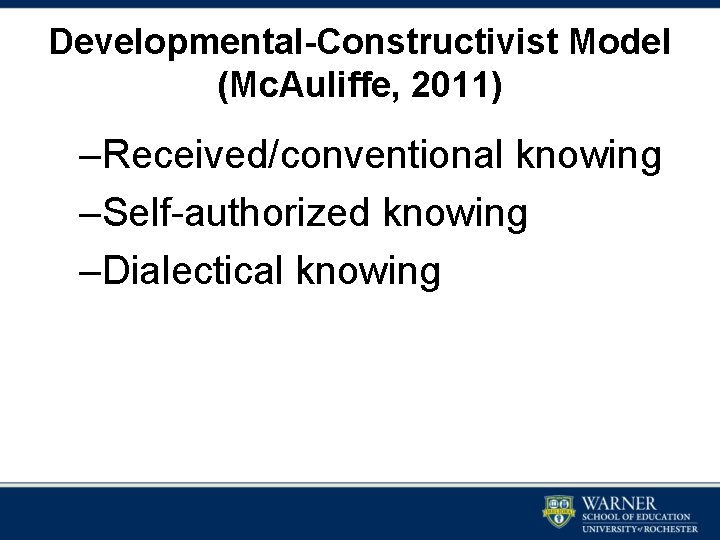
Developmental-Constructivist Model (Mc. Auliffe, 2011) –Received/conventional knowing –Self-authorized knowing –Dialectical knowing
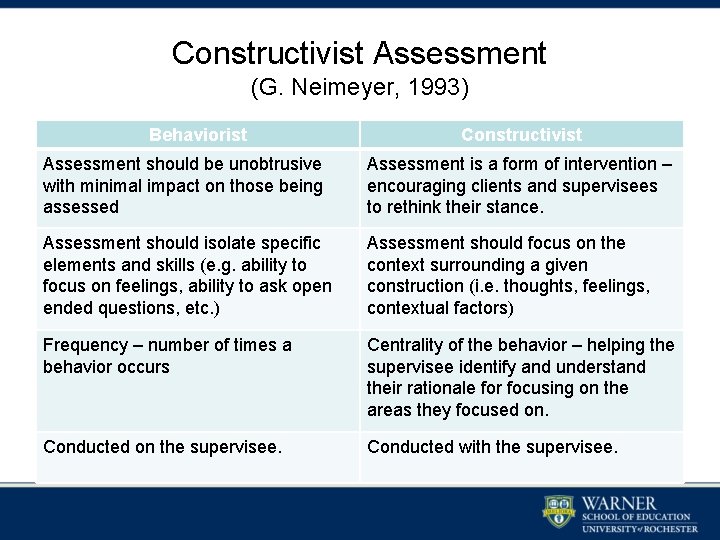
Constructivist Assessment (G. Neimeyer, 1993) Behaviorist Constructivist Assessment should be unobtrusive with minimal impact on those being assessed Assessment is a form of intervention – encouraging clients and supervisees to rethink their stance. Assessment should isolate specific elements and skills (e. g. ability to focus on feelings, ability to ask open ended questions, etc. ) Assessment should focus on the context surrounding a given construction (i. e. thoughts, feelings, contextual factors) Frequency – number of times a behavior occurs Centrality of the behavior – helping the supervisee identify and understand their rationale for focusing on the areas they focused on. Conducted on the supervisee. Conducted with the supervisee.
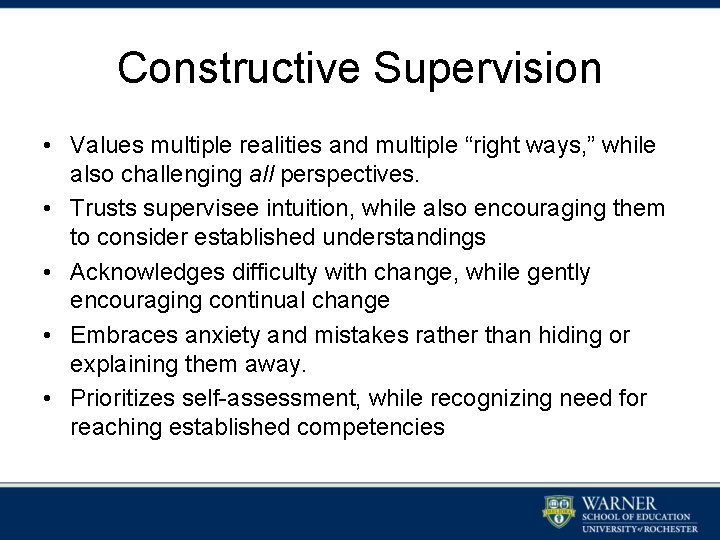
Constructive Supervision • Values multiple realities and multiple “right ways, ” while also challenging all perspectives. • Trusts supervisee intuition, while also encouraging them to consider established understandings • Acknowledges difficulty with change, while gently encouraging continual change • Embraces anxiety and mistakes rather than hiding or explaining them away. • Prioritizes self-assessment, while recognizing need for reaching established competencies
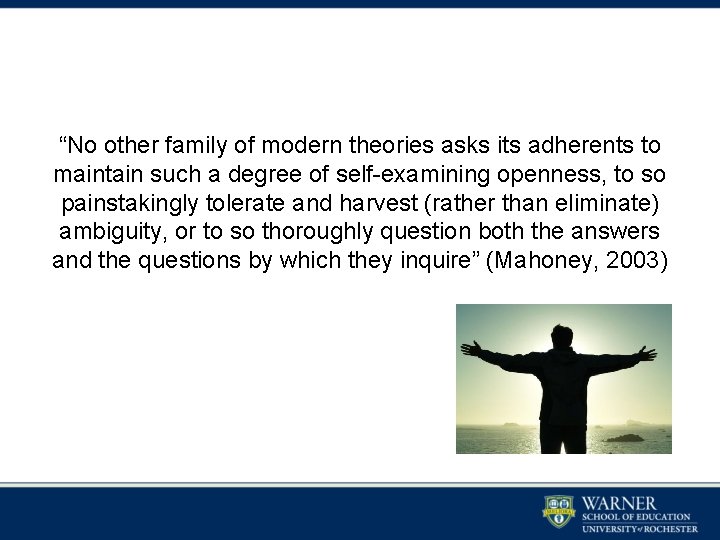
“No other family of modern theories asks its adherents to maintain such a degree of self-examining openness, to so painstakingly tolerate and harvest (rather than eliminate) ambiguity, or to so thoroughly question both the answers and the questions by which they inquire” (Mahoney, 2003)