
ObjectOriented Patterns Frameworks Dr Douglas C Schmidt d
Object-Oriented Patterns & Frameworks Dr. Douglas C. Schmidt d. schmidt@vanderbilt. edu www. dre. vanderbilt. edu/~schmidt Professor of EECS Vanderbilt University Nashville, Tennessee
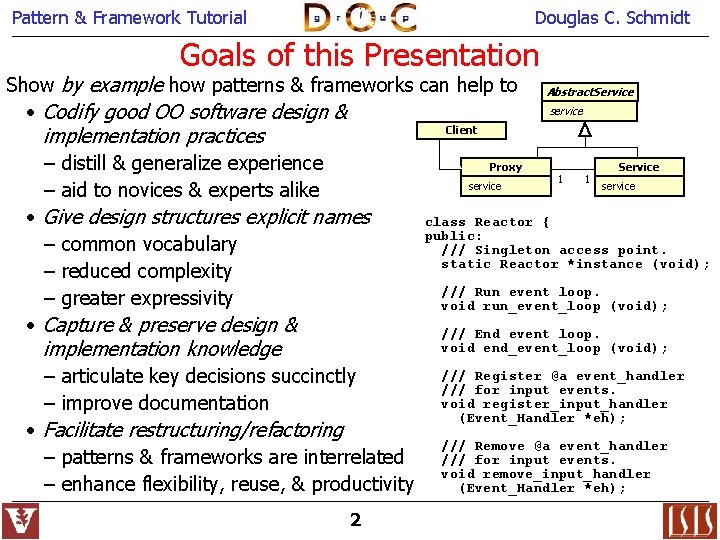
Pattern & Framework Tutorial Douglas C. Schmidt Goals of this Presentation Show by example how patterns & frameworks can help to • Codify good OO software design & implementation practices – distill & generalize experience – aid to novices & experts alike • Give design structures explicit names – common vocabulary – reduced complexity – greater expressivity • Capture & preserve design & implementation knowledge – articulate key decisions succinctly – improve documentation • Facilitate restructuring/refactoring – patterns & frameworks are interrelated – enhance flexibility, reuse, & productivity 2 Abstract. Service service Client Proxy service 1 1 Service service class Reactor { public: /// Singleton access point. static Reactor *instance (void); /// Run event loop. void run_event_loop (void); /// End event loop. void end_event_loop (void); /// Register @a event_handler /// for input events. void register_input_handler (Event_Handler *eh); /// Remove @a event_handler /// for input events. void remove_input_handler (Event_Handler *eh);
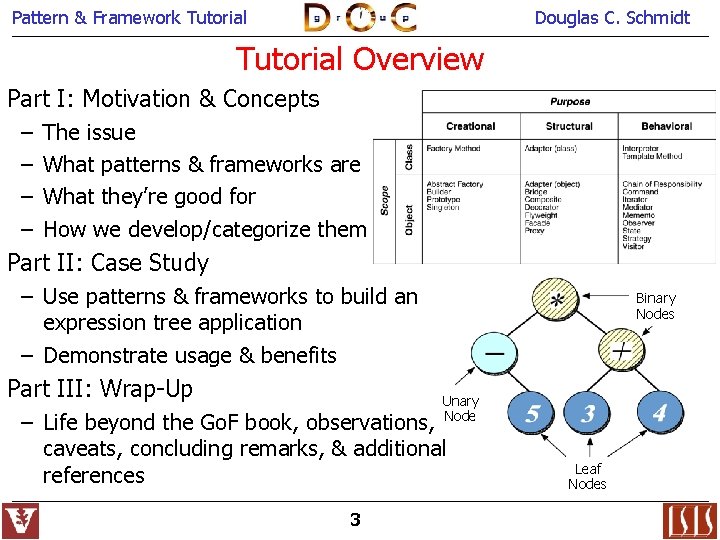
Pattern & Framework Tutorial Douglas C. Schmidt Tutorial Overview Part I: Motivation & Concepts – – The issue What patterns & frameworks are What they’re good for How we develop/categorize them Part II: Case Study – Use patterns & frameworks to build an expression tree application – Demonstrate usage & benefits Part III: Wrap-Up Binary Nodes Unary Node – Life beyond the Go. F book, observations, caveats, concluding remarks, & additional references 3 Leaf Nodes
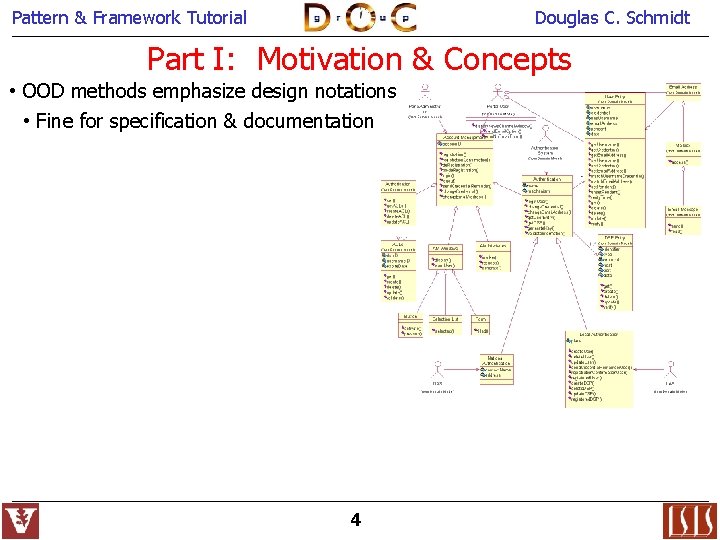
Pattern & Framework Tutorial Douglas C. Schmidt Part I: Motivation & Concepts • OOD methods emphasize design notations • Fine for specification & documentation 4
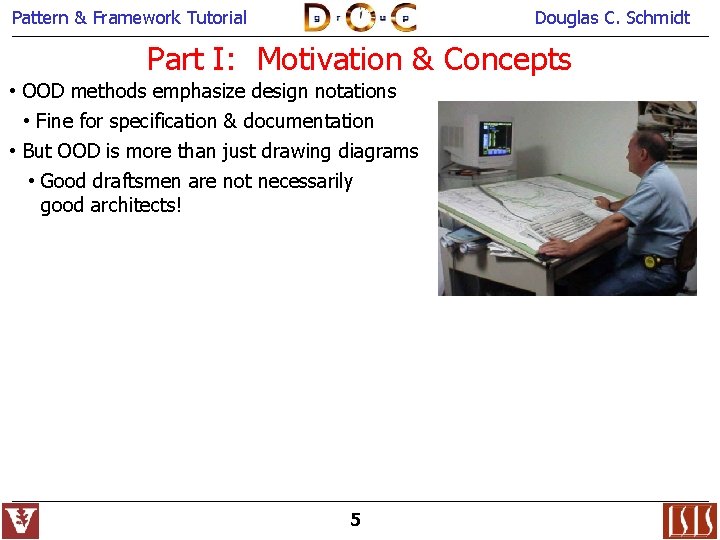
Pattern & Framework Tutorial Douglas C. Schmidt Part I: Motivation & Concepts • OOD methods emphasize design notations • Fine for specification & documentation • But OOD is more than just drawing diagrams • Good draftsmen are not necessarily good architects! 5
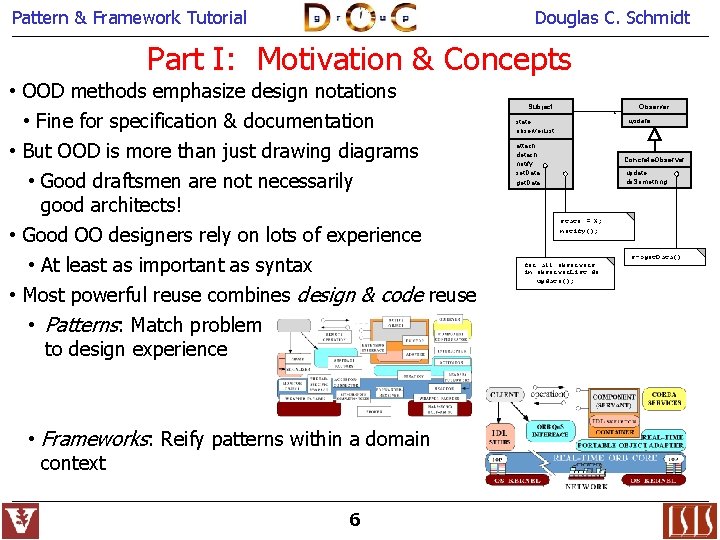
Pattern & Framework Tutorial Douglas C. Schmidt Part I: Motivation & Concepts • OOD methods emphasize design notations • Fine for specification & documentation • But OOD is more than just drawing diagrams • Good draftsmen are not necessarily good architects! • Good OO designers rely on lots of experience • At least as important as syntax • Most powerful reuse combines design & code reuse • Patterns: Match problem to design experience Observer Subject * state observer. List attach detach notify set. Data get. Data update Concrete. Observer update do. Something state = X; notify(); for all observers in observer. List do update(); s->get. Data() • Frameworks: Reify patterns within a domain context 6
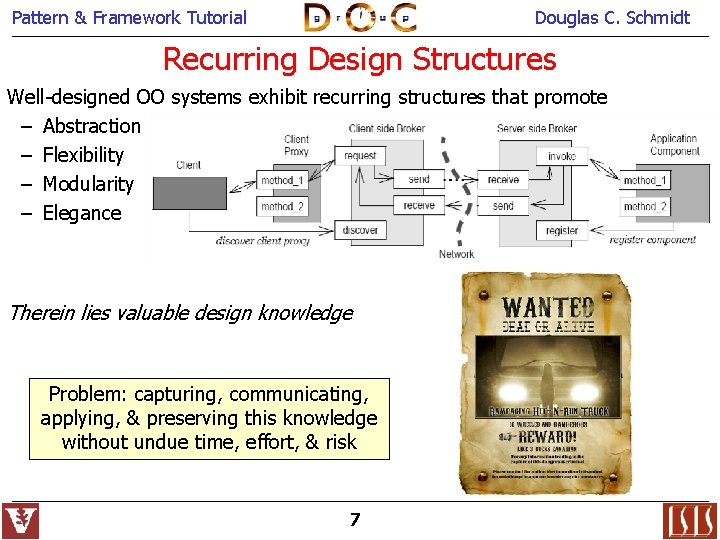
Pattern & Framework Tutorial Douglas C. Schmidt Recurring Design Structures Well-designed OO systems exhibit recurring structures that promote – Abstraction – Flexibility – Modularity – Elegance Therein lies valuable design knowledge Problem: capturing, communicating, applying, & preserving this knowledge without undue time, effort, & risk 7
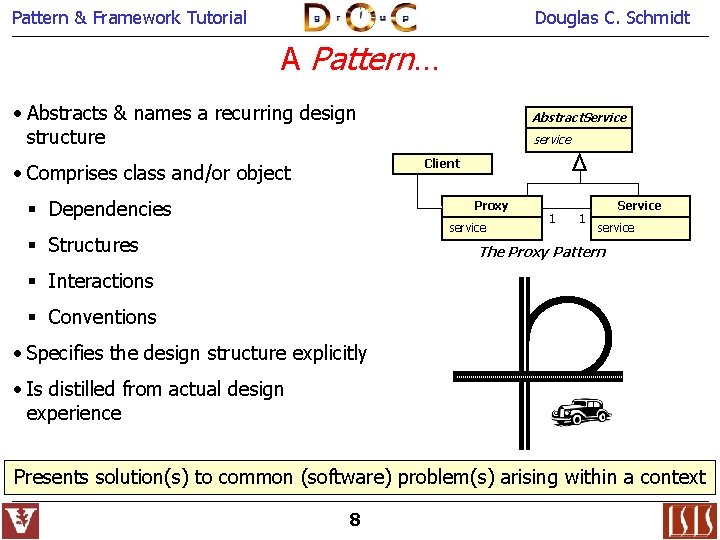
Pattern & Framework Tutorial Douglas C. Schmidt A Pattern… • Abstracts & names a recurring design structure Abstract. Service service Client • Comprises class and/or object § Dependencies Proxy service § Structures 1 1 Service service The Proxy Pattern § Interactions § Conventions • Specifies the design structure explicitly • Is distilled from actual design experience Presents solution(s) to common (software) problem(s) arising within a context 8
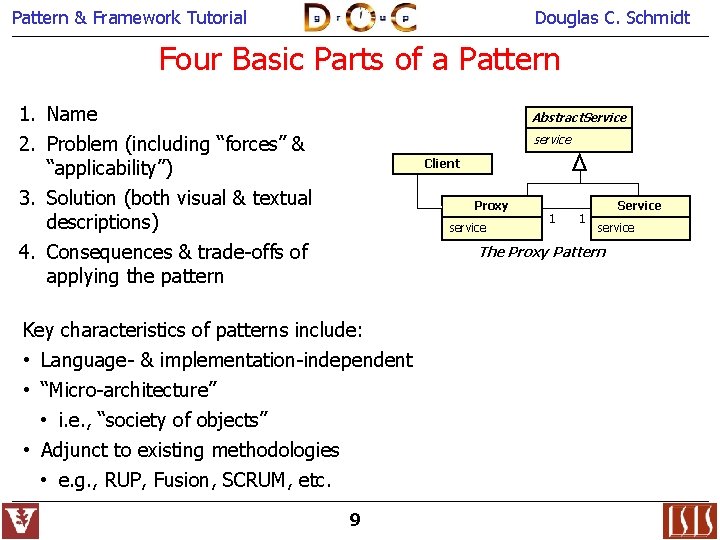
Pattern & Framework Tutorial Douglas C. Schmidt Four Basic Parts of a Pattern 1. Name 2. Problem (including “forces” & “applicability”) 3. Solution (both visual & textual descriptions) 4. Consequences & trade-offs of applying the pattern Abstract. Service service Client Proxy service 1 1 Service service The Proxy Pattern Key characteristics of patterns include: • Language- & implementation-independent • “Micro-architecture” • i. e. , “society of objects” • Adjunct to existing methodologies • e. g. , RUP, Fusion, SCRUM, etc. 9
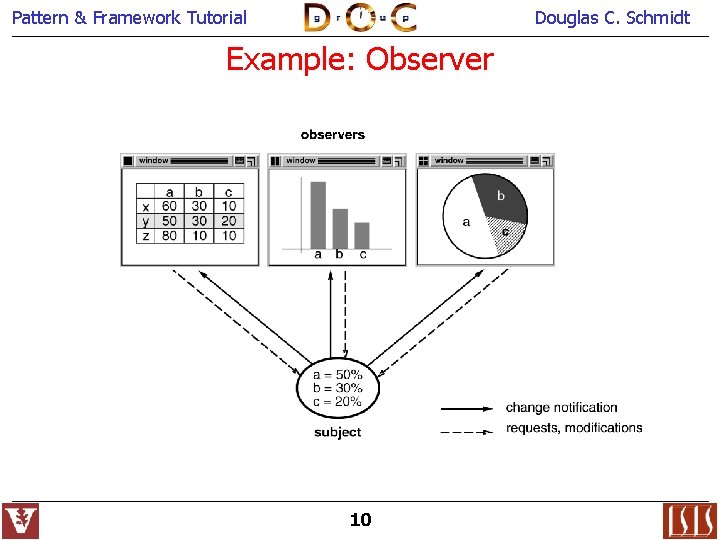
Pattern & Framework Tutorial Douglas C. Schmidt Example: Observer 10
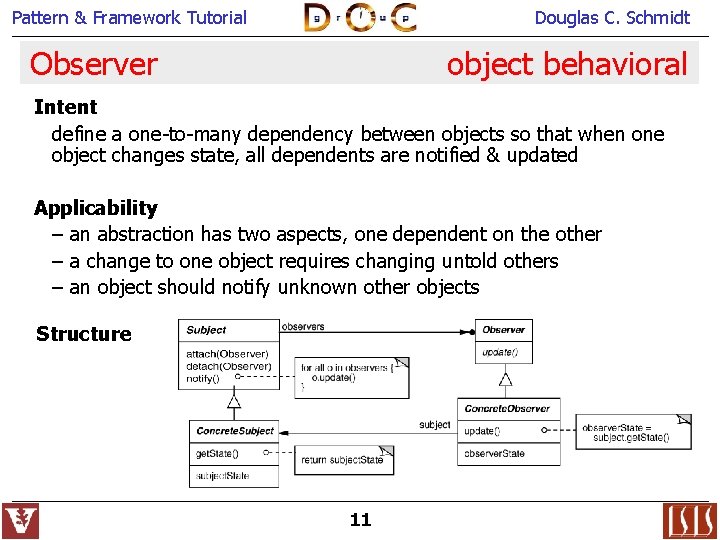
Pattern & Framework Tutorial Douglas C. Schmidt Observer object behavioral Intent define a one-to-many dependency between objects so that when one object changes state, all dependents are notified & updated Applicability – an abstraction has two aspects, one dependent on the other – a change to one object requires changing untold others – an object should notify unknown other objects Structure 11
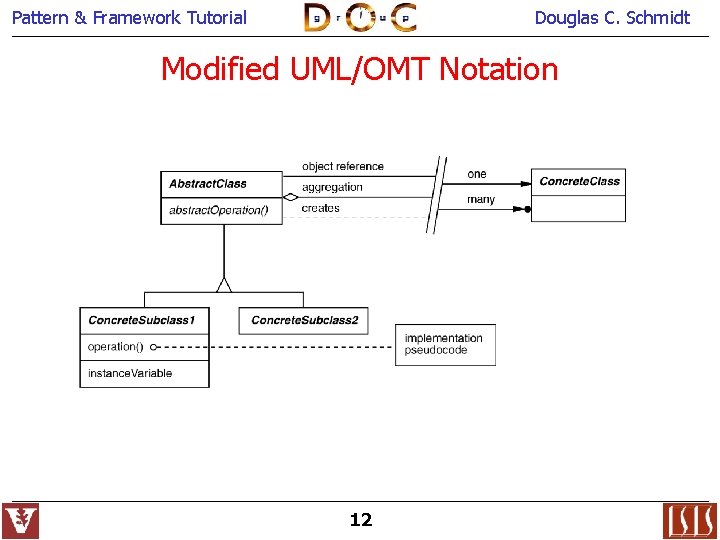
Pattern & Framework Tutorial Douglas C. Schmidt Modified UML/OMT Notation 12
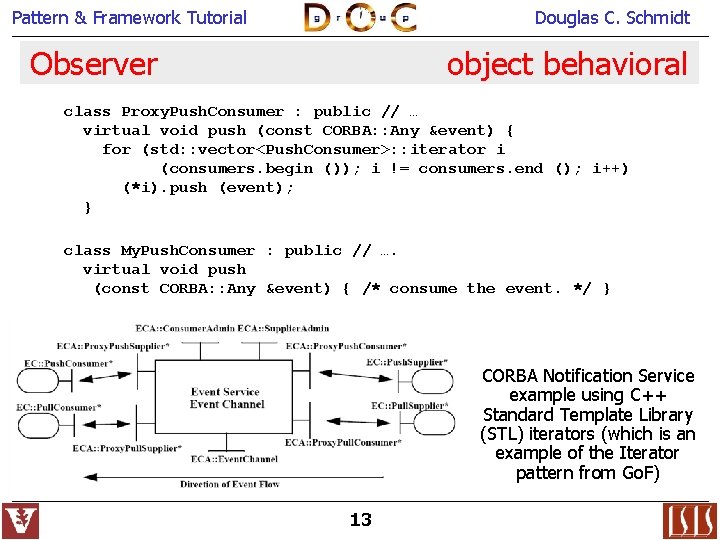
Pattern & Framework Tutorial Douglas C. Schmidt Observer object behavioral class Proxy. Push. Consumer : public // … virtual void push (const CORBA: : Any &event) { for (std: : vector<Push. Consumer>: : iterator i (consumers. begin ()); i != consumers. end (); i++) (*i). push (event); } class My. Push. Consumer : public // …. virtual void push (const CORBA: : Any &event) { /* consume the event. */ } CORBA Notification Service example using C++ Standard Template Library (STL) iterators (which is an example of the Iterator pattern from Go. F) 13
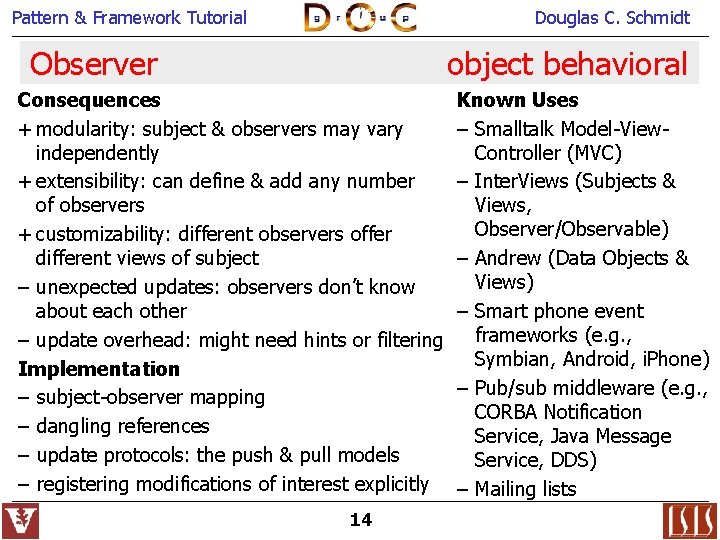
Pattern & Framework Tutorial Douglas C. Schmidt Observer object behavioral Consequences Known Uses + modularity: subject & observers may vary – Smalltalk Model-Viewindependently Controller (MVC) + extensibility: can define & add any number – Inter. Views (Subjects & of observers Views, Observer/Observable) + customizability: different observers offer different views of subject – Andrew (Data Objects & Views) – unexpected updates: observers don’t know about each other – Smart phone event frameworks (e. g. , – update overhead: might need hints or filtering Symbian, Android, i. Phone) Implementation – Pub/sub middleware (e. g. , – subject-observer mapping CORBA Notification – dangling references Service, Java Message – update protocols: the push & pull models Service, DDS) – registering modifications of interest explicitly – Mailing lists 14
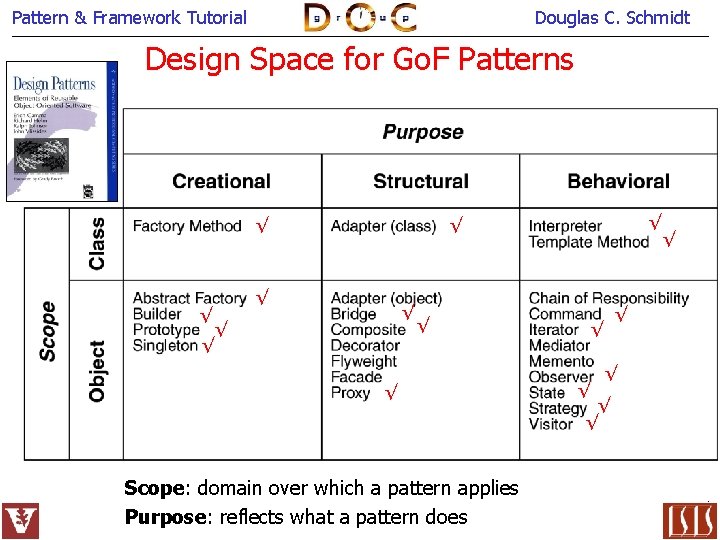
Pattern & Framework Tutorial Douglas C. Schmidt Design Space for Go. F Patterns √ √ √ √ √ Scope: domain over which a pattern applies Purpose: reflects what a pattern does 15 √ √ √ √
Pattern & Framework Tutorial Douglas C. Schmidt Go. F Pattern Template (1 st half) Intent short description of the pattern & its purpose Also Known As Any aliases this pattern is known by Motivation motivating scenario demonstrating pattern’s use Applicability circumstances in which pattern applies Structure graphical representation of pattern using modified UML notation Participants participating classes and/or objects & their responsibilities 16
Pattern & Framework Tutorial . . . Douglas C. Schmidt Go. F Pattern Template (2 nd half) Collaborations how participants cooperate to carry out their responsibilities Consequences the results of application, benefits, liabilities Implementation pitfalls, hints, techniques, plus language-dependent issues Sample Code sample implementations in C++, Java, C#, Python, Smalltalk, C, etc. Known Uses examples drawn from existing systems Related Patterns discussion of other patterns that relate to this one 17
Pattern & Framework Tutorial Douglas C. Schmidt Benefits & Limitations of Patterns Benefits Limitations • Design reuse • Require significant tedious & error-prone human effort to handcraft pattern implementations design reuse • Uniform design vocabulary • Enhance understanding, restructuring, & team communication • Basis for automation • Transcends language-centric biases/myopia • Can be deceptively simple uniform design vocabulary • May limit design options • Leaves important (implementation) details unresolved • Abstracts away from many unimportant details Addressing the limitations of patterns requires more than just design reuse 18
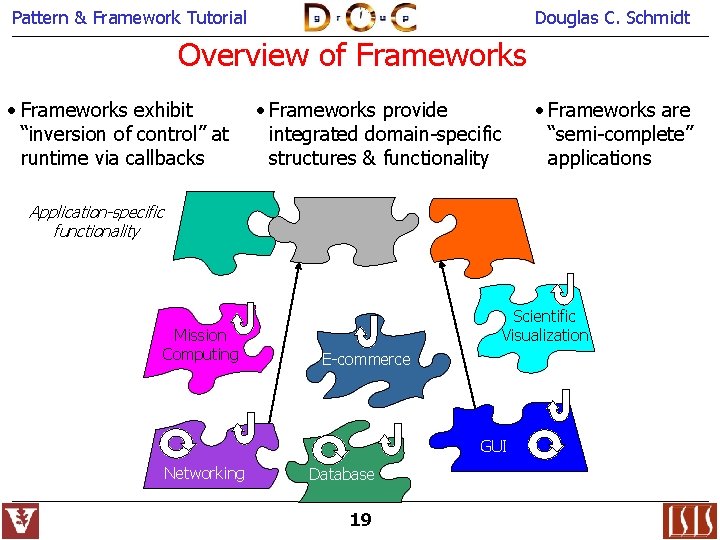
Pattern & Framework Tutorial Douglas C. Schmidt Overview of Frameworks • Frameworks provide • Frameworks exhibit integrated domain-specific “inversion of control” at structures & functionality runtime via callbacks • Frameworks are “semi-complete” applications Application-specific functionality Mission Computing Scientific Visualization E-commerce GUI Networking Database 19
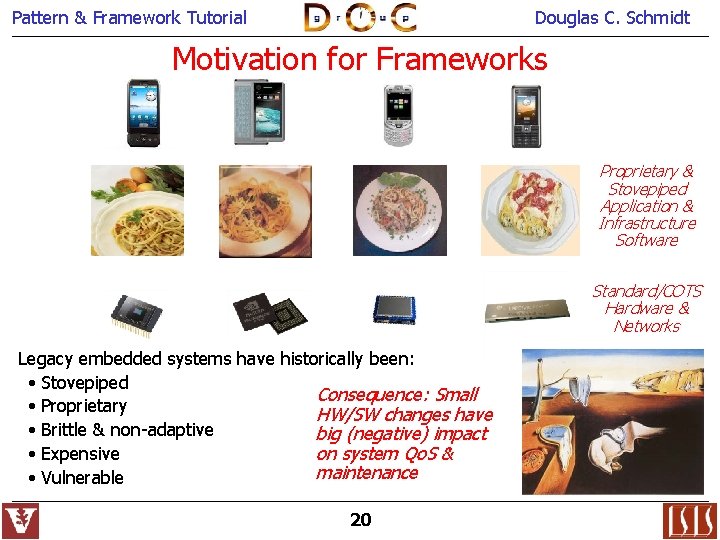
Pattern & Framework Tutorial Douglas C. Schmidt Motivation for Frameworks Application Software Proprietary & Stovepiped Application & Infrastructure Software Standard/COTS Hardware & Networks Legacy embedded systems have historically been: • Stovepiped Consequence: Small • Proprietary HW/SW changes have • Brittle & non-adaptive big (negative) impact on system Qo. S & • Expensive maintenance • Vulnerable 20
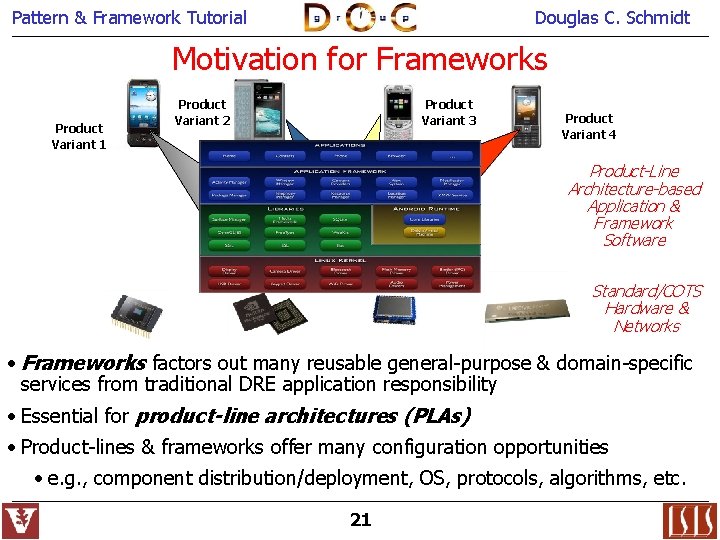
Pattern & Framework Tutorial Douglas C. Schmidt Motivation for Frameworks Product Variant 1 Product Variant 2 Product Variant 3 Product Variant 4 Product-Line Architecture-based Application & Framework Software Standard/COTS Hardware & Networks • Frameworks factors out many reusable general-purpose & domain-specific services from traditional DRE application responsibility • Essential for product-line architectures (PLAs) • Product-lines & frameworks offer many configuration opportunities • e. g. , component distribution/deployment, OS, protocols, algorithms, etc. 21
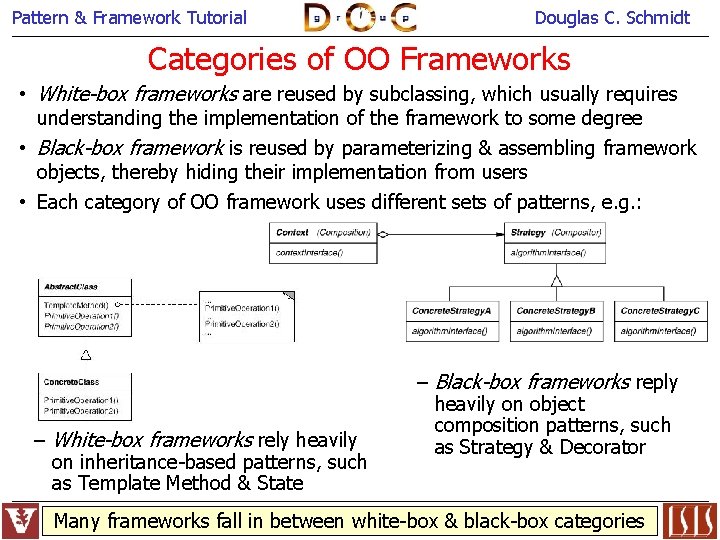
Pattern & Framework Tutorial Douglas C. Schmidt Categories of OO Frameworks • White-box frameworks are reused by subclassing, which usually requires understanding the implementation of the framework to some degree • Black-box framework is reused by parameterizing & assembling framework objects, thereby hiding their implementation from users • Each category of OO framework uses different sets of patterns, e. g. : – White-box frameworks rely heavily on inheritance-based patterns, such as Template Method & State – Black-box frameworks reply heavily on object composition patterns, such as Strategy & Decorator 22 Many frameworks fall in between white-box & black-box categories
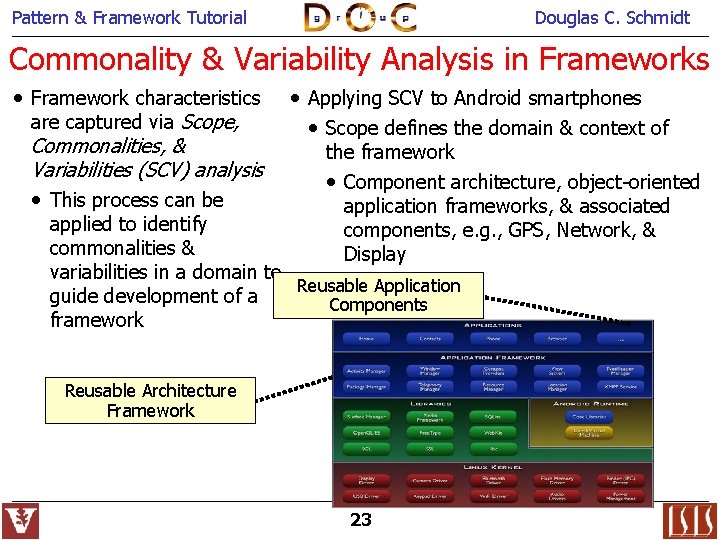
Pattern & Framework Tutorial Douglas C. Schmidt Commonality & Variability Analysis in Frameworks • Framework characteristics are captured via Scope, Commonalities, & Variabilities (SCV) analysis • This process can be • Applying SCV to Android smartphones • Scope defines the domain & context of the framework • Component architecture, object-oriented application frameworks, & associated components, e. g. , GPS, Network, & Display applied to identify commonalities & variabilities in a domain to Reusable Application guide development of a Components framework Reusable Architecture Framework 23
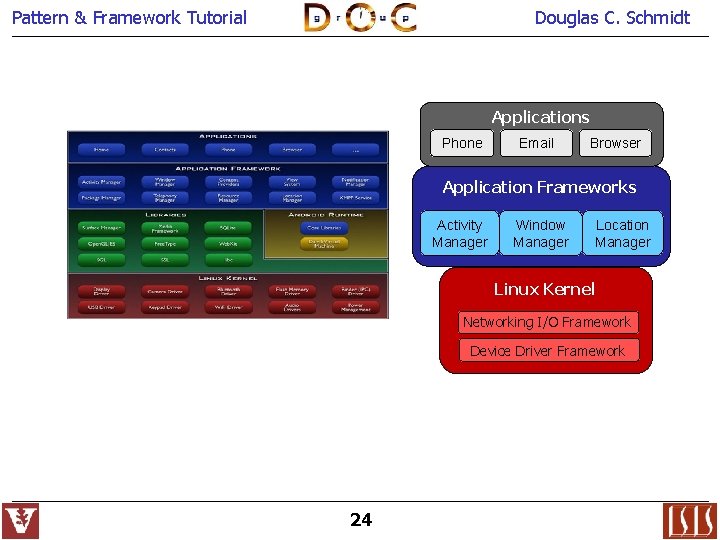
Pattern & Framework Tutorial Douglas C. Schmidt Applications Phone Email Browser Application Frameworks Activity Manager Window Manager Location Manager Linux Kernel Networking I/O Framework Device Driver Framework 24
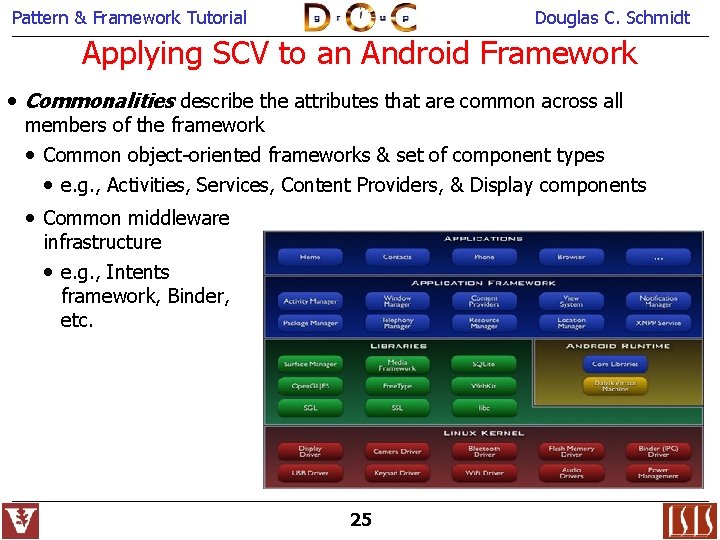
Pattern & Framework Tutorial Douglas C. Schmidt Applying SCV to an Android Framework • Commonalities describe the attributes that are common across all members of the framework • Common object-oriented frameworks & set of component types • e. g. , Activities, Services, Content Providers, & Display components • Common middleware infrastructure • e. g. , Intents framework, Binder, etc. 25
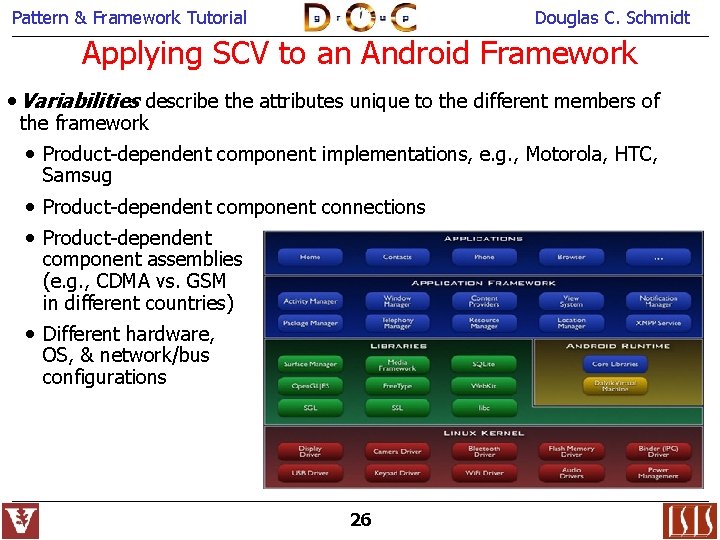
Pattern & Framework Tutorial Douglas C. Schmidt Applying SCV to an Android Framework • Variabilities describe the attributes unique to the different members of the framework • Product-dependent component implementations, e. g. , Motorola, HTC, Samsug • Product-dependent component connections • Product-dependent component assemblies (e. g. , CDMA vs. GSM in different countries) • Different hardware, OS, & network/bus configurations 26
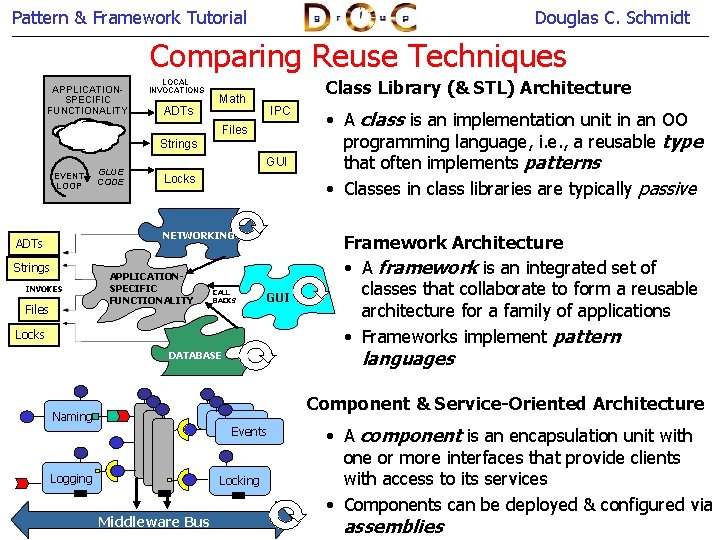
Pattern & Framework Tutorial Douglas C. Schmidt Comparing Reuse Techniques APPLICATIONSPECIFIC FUNCTIONALITY LOCAL INVOCATIONS ADTs Class Library (& STL) Architecture Math IPC Files Strings EVENT LOOP GLUE CODE Reactor ADTs Strings INVOKES Files GUI Locks NETWORKING APPLICATIONSPECIFIC FUNCTIONALITY CALL BACKS GUI Locks • A class is an implementation unit in an OO programming language, i. e. , a reusable type that often implements patterns • Classes in class libraries are typically passive Framework Architecture • A framework is an integrated set of classes that collaborate to form a reusable architecture for a family of applications • Frameworks implement pattern languages DATABASE Component & Service-Oriented Architecture Naming Events Logging Locking Middleware Bus • A component is an encapsulation unit with one or more interfaces that provide clients with access to its services • Components can be deployed & configured via 27 assemblies
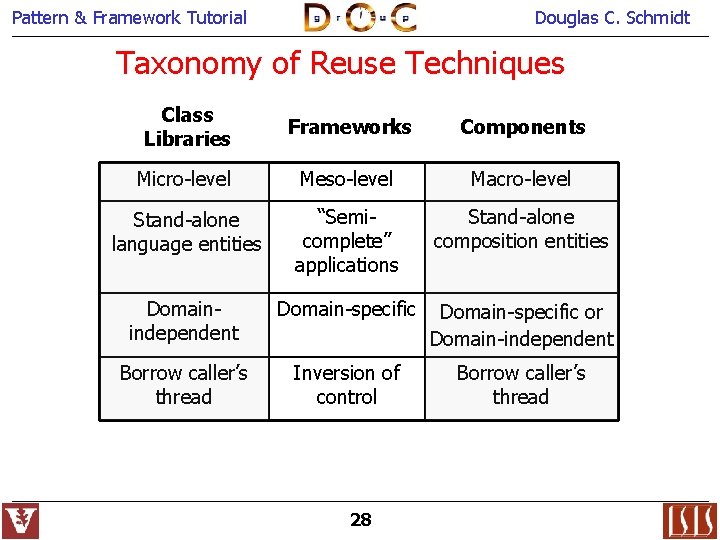
Pattern & Framework Tutorial Douglas C. Schmidt Taxonomy of Reuse Techniques Class Libraries Frameworks Components Micro-level Meso-level Macro-level Stand-alone language entities “Semicomplete” applications Stand-alone composition entities Domainindependent Domain-specific or Domain-independent Borrow caller’s thread Inversion of control Borrow caller’s thread 28
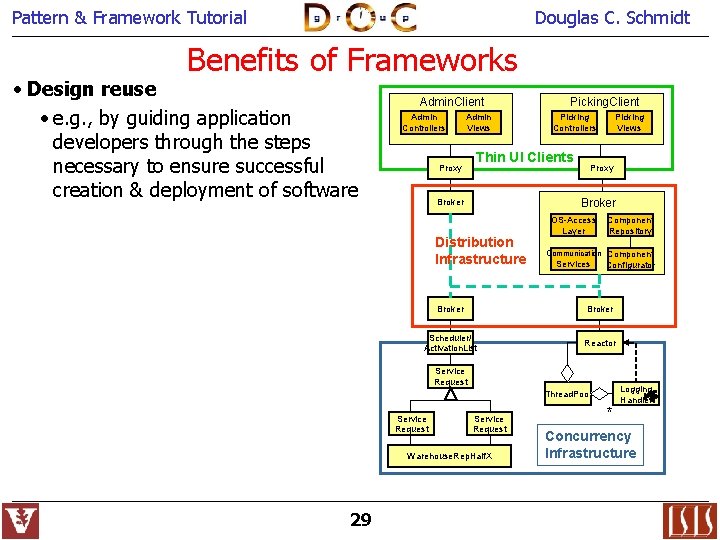
Pattern & Framework Tutorial Douglas C. Schmidt Benefits of Frameworks • Design reuse • e. g. , by guiding application developers through the steps necessary to ensure successful creation & deployment of software Admin. Client Admin Controllers Admin Views Proxy Picking. Client Picking Controllers Thin UI Clients Picking Views Proxy Broker Distribution Infrastructure OS-Access Layer Component Repository Communication Component Services Configurator Broker Scheduler/ Activation. List Reactor Service Request Thread. Pool Service Request Warehouse. Rep. Half. X 29 * Logging Handler Concurrency Infrastructure
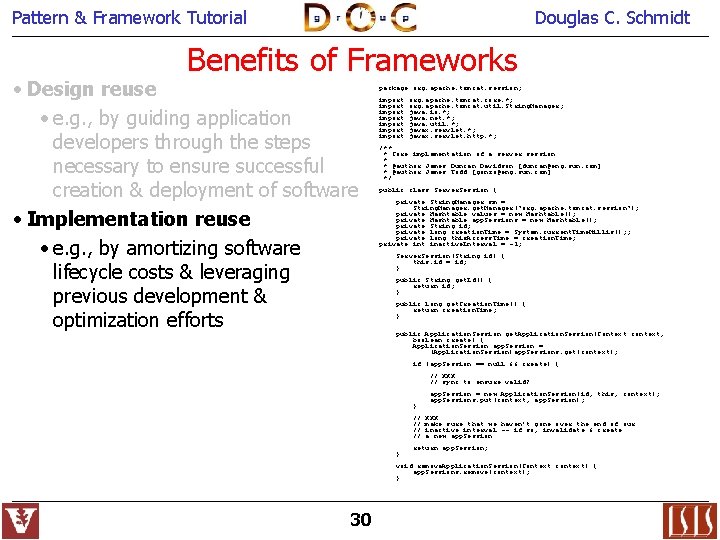
Pattern & Framework Tutorial Douglas C. Schmidt Benefits of Frameworks • Design reuse • e. g. , by guiding application developers through the steps necessary to ensure successful creation & deployment of software • Implementation reuse • e. g. , by amortizing software lifecycle costs & leveraging previous development & optimization efforts package org. apache. tomcat. session; import import org. apache. tomcat. core. *; org. apache. tomcat. util. String. Manager; java. io. *; java. net. *; java. util. *; javax. servlet. http. *; /** * Core implementation of a server session * * @author James Duncan Davidson [duncan@eng. sun. com] * @author James Todd [gonzo@eng. sun. com] */ public class Server. Session { private String. Manager sm = String. Manager. get. Manager("org. apache. tomcat. session"); private Hashtable values = new Hashtable(); private Hashtable app. Sessions = new Hashtable(); private String id; private long creation. Time = System. current. Time. Millis(); ; private long this. Access. Time = creation. Time; private int inactive. Interval = -1; Server. Session(String id) { this. id = id; } public String get. Id() { return id; } public long get. Creation. Time() { return creation. Time; } public Application. Session get. Application. Session(Context context, boolean create) { Application. Session app. Session = (Application. Session)app. Sessions. get(context); if (app. Session == null && create) { // XXX // sync to ensure valid? } // // } app. Session = new Application. Session(id, this, context); app. Sessions. put(context, app. Session); XXX make sure that we haven't gone over the end of our inactive interval -- if so, invalidate & create a new app. Session return app. Session; void remove. Application. Session(Context context) { app. Sessions. remove(context); } 30
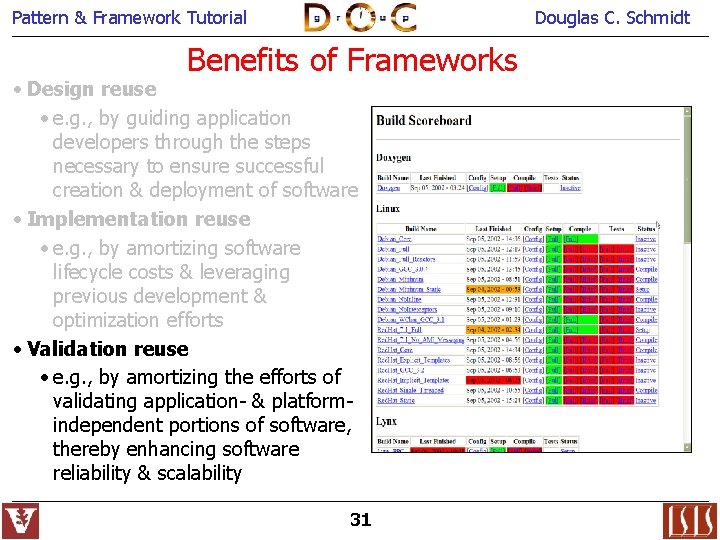
Pattern & Framework Tutorial Douglas C. Schmidt Benefits of Frameworks • Design reuse • e. g. , by guiding application developers through the steps necessary to ensure successful creation & deployment of software • Implementation reuse • e. g. , by amortizing software lifecycle costs & leveraging previous development & optimization efforts • Validation reuse • e. g. , by amortizing the efforts of validating application- & platformindependent portions of software, thereby enhancing software reliability & scalability 31
Pattern & Framework Tutorial Douglas C. Schmidt Limitations of Frameworks • Frameworks are powerful, but can be hard to use effectively (& even harder to create) for many application developers • Commonality & variability analysis requires significant domain knowledge & OO design/implementation expertise • Significant time required to evaluate applicability & quality of a framework for a particular domain • Debugging is tricky due to inversion of control • V&V is tricky due to “late binding” • May incur performance degradations due to extra (unnecessary) levels of indirection www. cs. wustl. edu/ ~schmidt/PDF/Queue-04. pdf Many frameworks limitations can be addressed with knowledge of patterns! 32
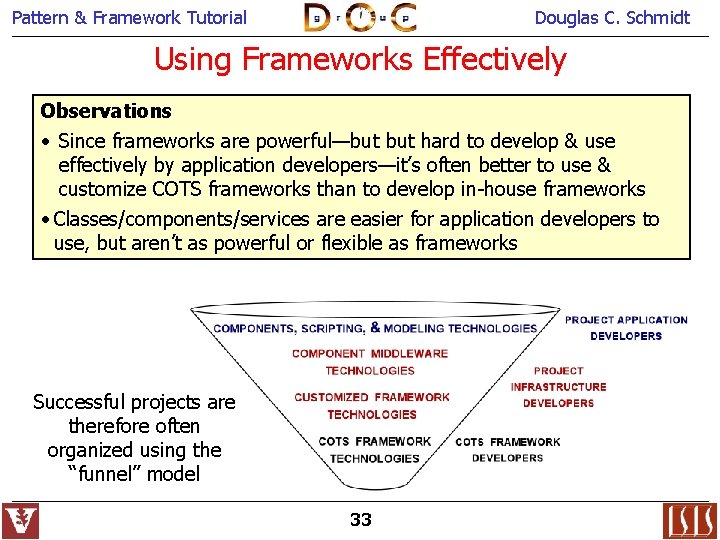
Pattern & Framework Tutorial Douglas C. Schmidt Using Frameworks Effectively Observations • Since frameworks are powerful—but hard to develop & use effectively by application developers—it’s often better to use & customize COTS frameworks than to develop in-house frameworks • Classes/components/services are easier for application developers to use, but aren’t as powerful or flexible as frameworks Successful projects are therefore often organized using the “funnel” model 33
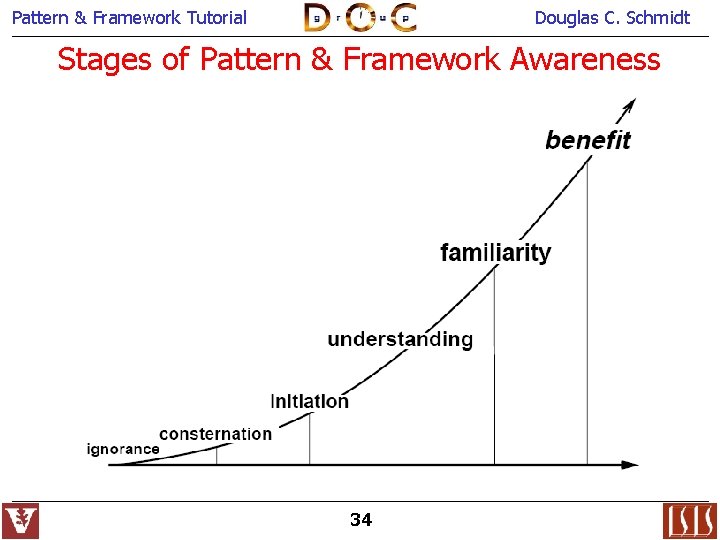
Pattern & Framework Tutorial Douglas C. Schmidt Stages of Pattern & Framework Awareness 34
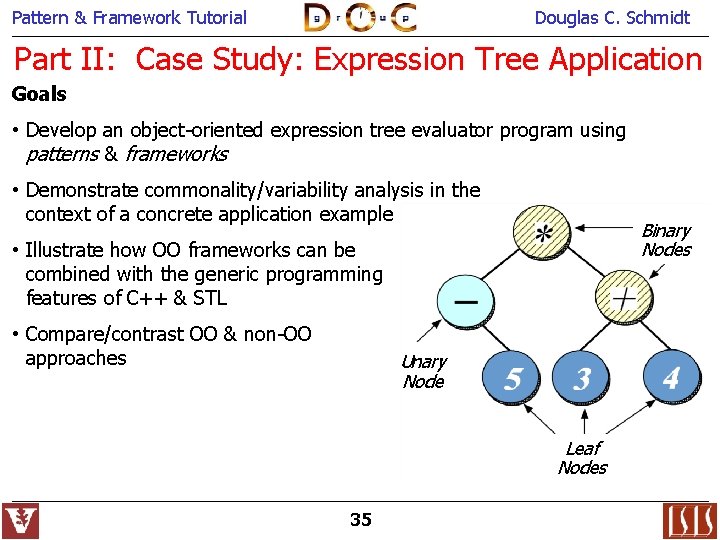
Pattern & Framework Tutorial Douglas C. Schmidt Part II: Case Study: Expression Tree Application Goals • Develop an object-oriented expression tree evaluator program using patterns & frameworks • Demonstrate commonality/variability analysis in the context of a concrete application example Binary Nodes • Illustrate how OO frameworks can be combined with the generic programming features of C++ & STL • Compare/contrast OO & non-OO approaches Unary Node Leaf Nodes 35
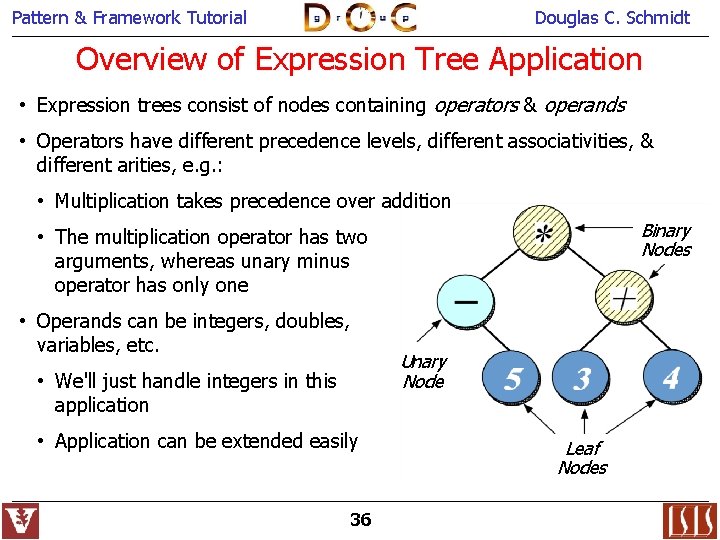
Pattern & Framework Tutorial Douglas C. Schmidt Overview of Expression Tree Application • Expression trees consist of nodes containing operators & operands • Operators have different precedence levels, different associativities, & different arities, e. g. : • Multiplication takes precedence over addition Binary • The multiplication operator has two Nodes arguments, whereas unary minus operator has only one • Operands can be integers, doubles, variables, etc. Unary Node • We'll just handle integers in this application • Application can be extended easily 36 Leaf Nodes
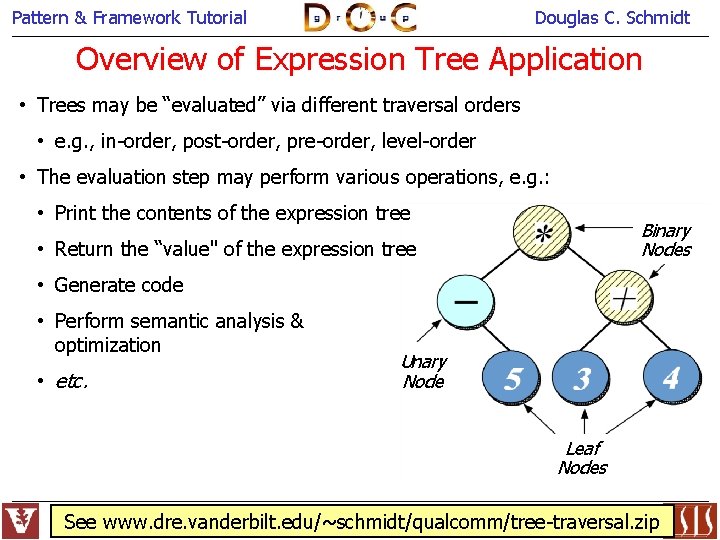
Pattern & Framework Tutorial Douglas C. Schmidt Overview of Expression Tree Application • Trees may be “evaluated” via different traversal orders • e. g. , in-order, post-order, pre-order, level-order • The evaluation step may perform various operations, e. g. : • Print the contents of the expression tree Binary Nodes • Return the “value" of the expression tree • Generate code • Perform semantic analysis & optimization • etc. Unary Node Leaf Nodes 37 See www. dre. vanderbilt. edu/~schmidt/qualcomm/tree-traversal. zip
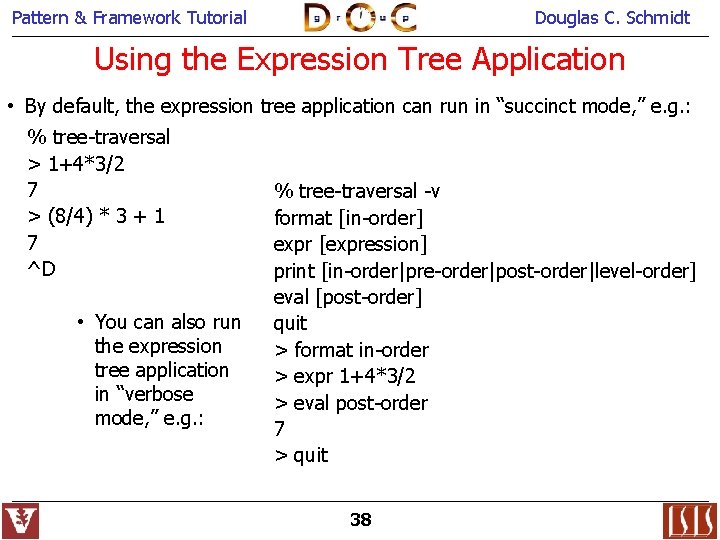
Pattern & Framework Tutorial Douglas C. Schmidt Using the Expression Tree Application • By default, the expression tree application can run in “succinct mode, ” e. g. : % tree-traversal > 1+4*3/2 7 > (8/4) * 3 + 1 7 ^D • You can also run the expression tree application in “verbose mode, ” e. g. : % tree-traversal -v format [in-order] expr [expression] print [in-order|pre-order|post-order|level-order] eval [post-order] quit > format in-order > expr 1+4*3/2 > eval post-order 7 > quit 38
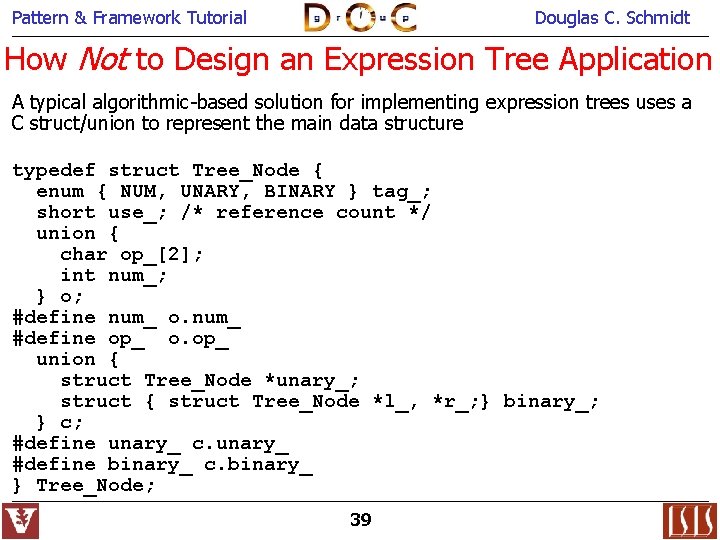
Pattern & Framework Tutorial Douglas C. Schmidt How Not to Design an Expression Tree Application A typical algorithmic-based solution for implementing expression trees uses a C struct/union to represent the main data structure typedef struct Tree_Node { enum { NUM, UNARY, BINARY } tag_; short use_; /* reference count */ union { char op_[2]; int num_; } o; #define num_ o. num_ #define op_ o. op_ union { struct Tree_Node *unary_; struct { struct Tree_Node *l_, *r_; } binary_; } c; #define unary_ c. unary_ #define binary_ c. binary_ } Tree_Node; 39
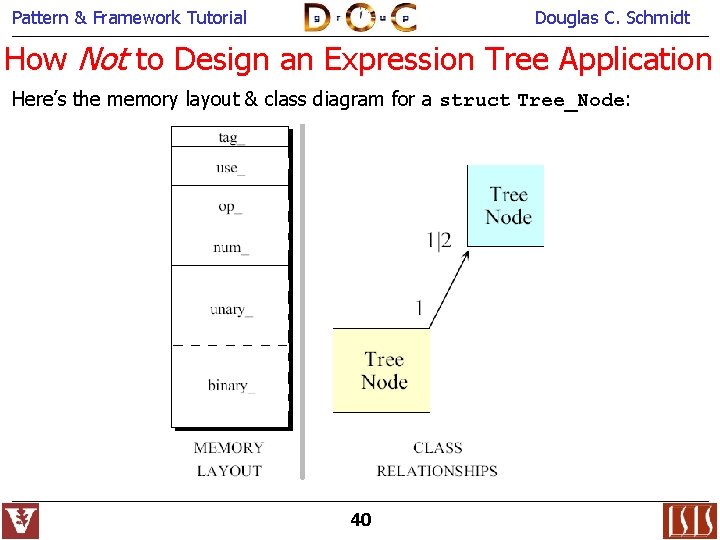
Pattern & Framework Tutorial Douglas C. Schmidt How Not to Design an Expression Tree Application Here’s the memory layout & class diagram for a struct Tree_Node: 40
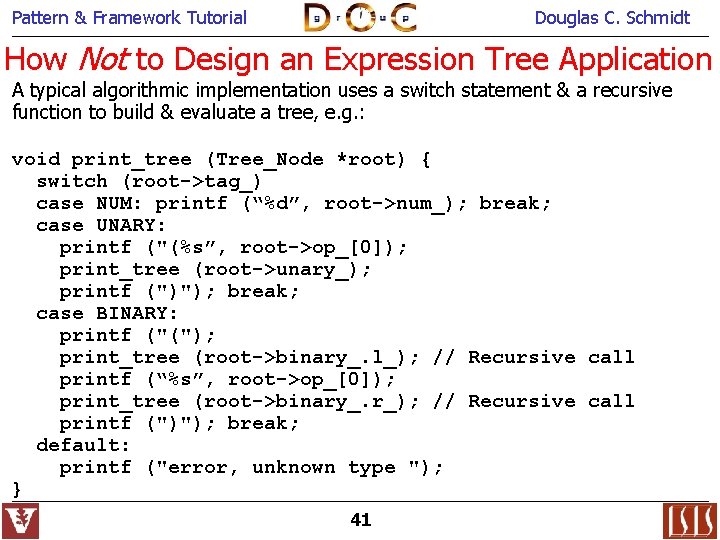
Pattern & Framework Tutorial Douglas C. Schmidt How Not to Design an Expression Tree Application A typical algorithmic implementation uses a switch statement & a recursive function to build & evaluate a tree, e. g. : void print_tree (Tree_Node *root) { switch (root->tag_) case NUM: printf (“%d”, root->num_); break; case UNARY: printf ("(%s”, root->op_[0]); print_tree (root->unary_); printf (")"); break; case BINARY: printf ("("); print_tree (root->binary_. l_); // Recursive call printf (“%s”, root->op_[0]); print_tree (root->binary_. r_); // Recursive call printf (")"); break; default: printf ("error, unknown type "); } 41
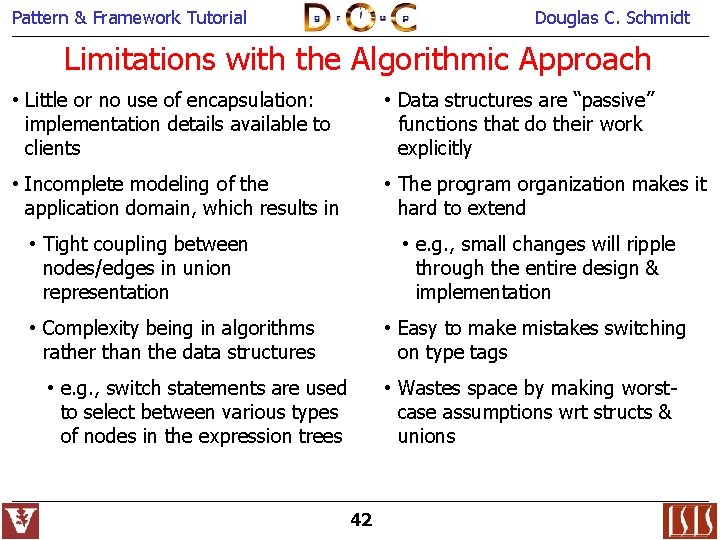
Pattern & Framework Tutorial Douglas C. Schmidt Limitations with the Algorithmic Approach • Little or no use of encapsulation: implementation details available to clients • Data structures are “passive” functions that do their work explicitly • Incomplete modeling of the application domain, which results in • The program organization makes it hard to extend • Tight coupling between nodes/edges in union representation • e. g. , small changes will ripple through the entire design & implementation • Complexity being in algorithms rather than the data structures • Easy to make mistakes switching on type tags • e. g. , switch statements are used to select between various types of nodes in the expression trees 42 • Wastes space by making worstcase assumptions wrt structs & unions
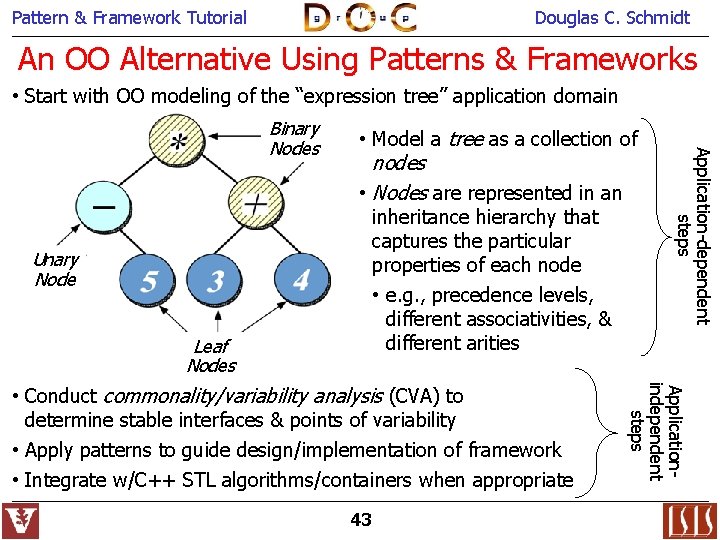
Pattern & Framework Tutorial Douglas C. Schmidt An OO Alternative Using Patterns & Frameworks • Start with OO modeling of the “expression tree” application domain Unary Node Leaf Nodes • Model a tree as a collection of nodes • Nodes are represented in an inheritance hierarchy that captures the particular properties of each node • e. g. , precedence levels, different associativities, & different arities 43 Applicationindependent steps • Conduct commonality/variability analysis (CVA) to determine stable interfaces & points of variability • Apply patterns to guide design/implementation of framework • Integrate w/C++ STL algorithms/containers when appropriate Application-dependent steps Binary Nodes
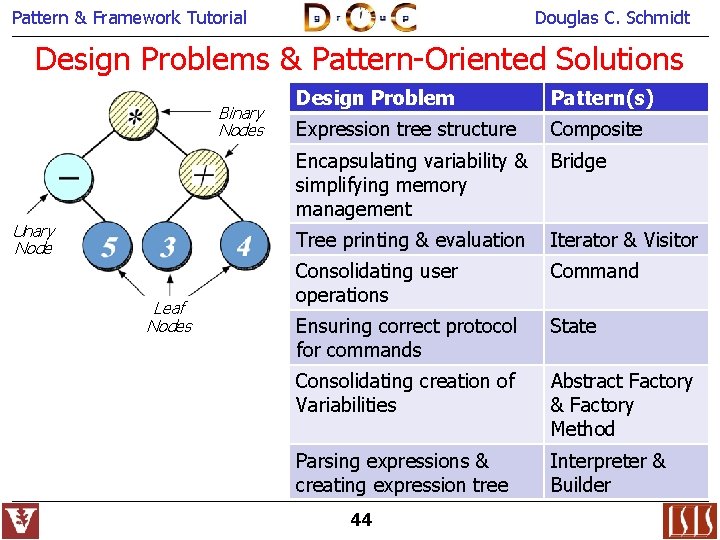
Pattern & Framework Tutorial Douglas C. Schmidt Design Problems & Pattern-Oriented Solutions Binary Nodes Design Problem Pattern(s) Expression tree structure Composite Encapsulating variability & Bridge simplifying memory management Unary Node Tree printing & evaluation Iterator & Visitor Leaf Nodes Consolidating user operations Command Ensuring correct protocol for commands State Consolidating creation of Variabilities Abstract Factory & Factory Method Parsing expressions & creating expression tree Interpreter & Builder 44
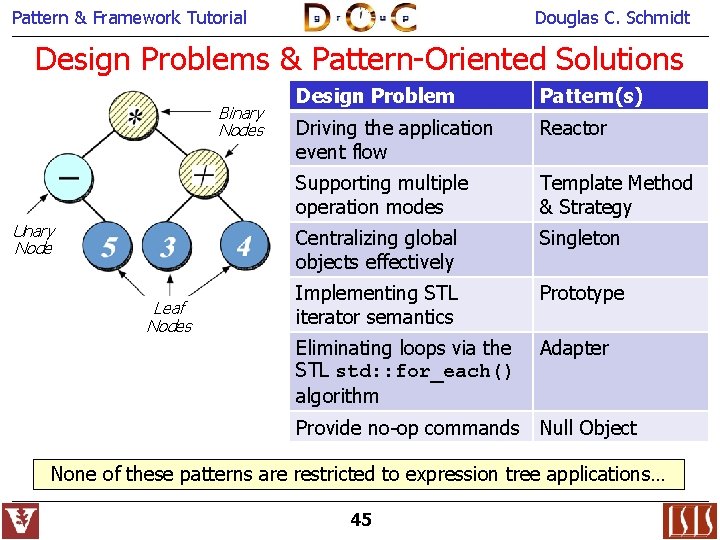
Pattern & Framework Tutorial Douglas C. Schmidt Design Problems & Pattern-Oriented Solutions Binary Nodes Unary Node Leaf Nodes Design Problem Pattern(s) Driving the application event flow Reactor Supporting multiple operation modes Template Method & Strategy Centralizing global objects effectively Singleton Implementing STL iterator semantics Prototype Eliminating loops via the STL std: : for_each() algorithm Adapter Provide no-op commands Null Object None of these patterns are restricted to expression tree applications… 45
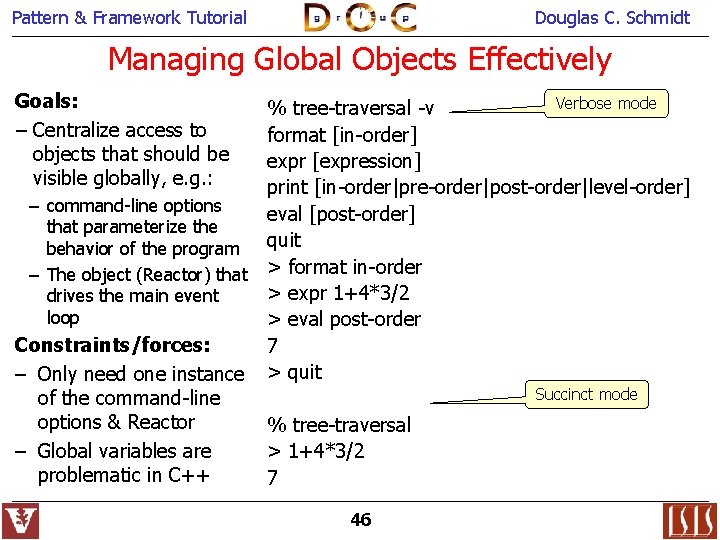
Pattern & Framework Tutorial Douglas C. Schmidt Managing Global Objects Effectively Goals: – Centralize access to objects that should be visible globally, e. g. : Verbose mode % tree-traversal -v format [in-order] expr [expression] print [in-order|pre-order|post-order|level-order] – command-line options eval [post-order] that parameterize the quit behavior of the program – The object (Reactor) that > format in-order > expr 1+4*3/2 drives the main event loop > eval post-order Constraints/forces: 7 – Only need one instance > quit Succinct mode of the command-line options & Reactor % tree-traversal – Global variables are > 1+4*3/2 problematic in C++ 7 46
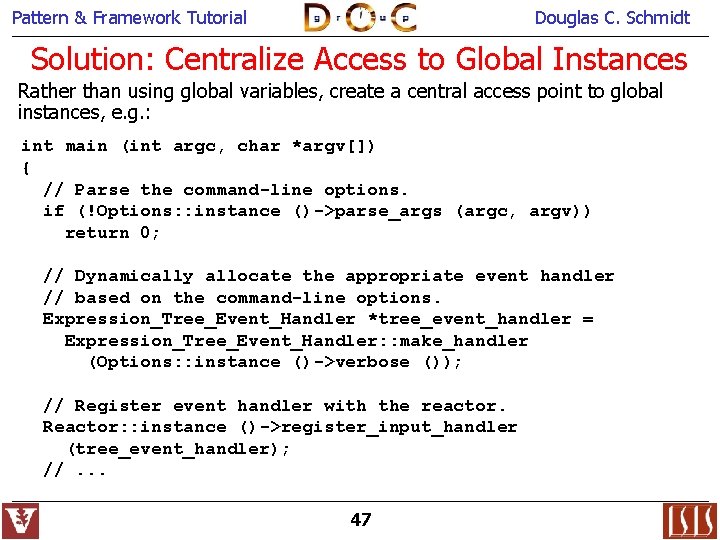
Pattern & Framework Tutorial Douglas C. Schmidt Solution: Centralize Access to Global Instances Rather than using global variables, create a central access point to global instances, e. g. : int main (int argc, char *argv[]) { // Parse the command-line options. if (!Options: : instance ()->parse_args (argc, argv)) return 0; // Dynamically allocate the appropriate event handler // based on the command-line options. Expression_Tree_Event_Handler *tree_event_handler = Expression_Tree_Event_Handler: : make_handler (Options: : instance ()->verbose ()); // Register event handler with the reactor. Reactor: : instance ()->register_input_handler (tree_event_handler); //. . . 47
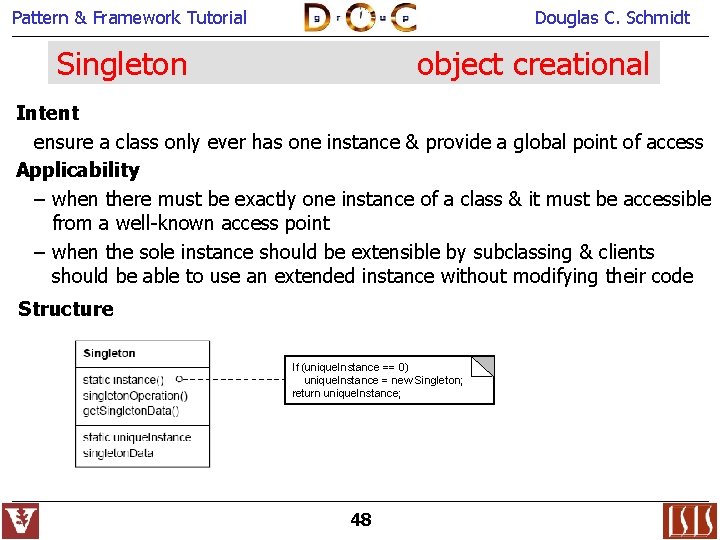
Pattern & Framework Tutorial Douglas C. Schmidt Singleton object creational Intent ensure a class only ever has one instance & provide a global point of access Applicability – when there must be exactly one instance of a class & it must be accessible from a well-known access point – when the sole instance should be extensible by subclassing & clients should be able to use an extended instance without modifying their code Structure If (unique. Instance == 0) unique. Instance = new Singleton; return unique. Instance; 48
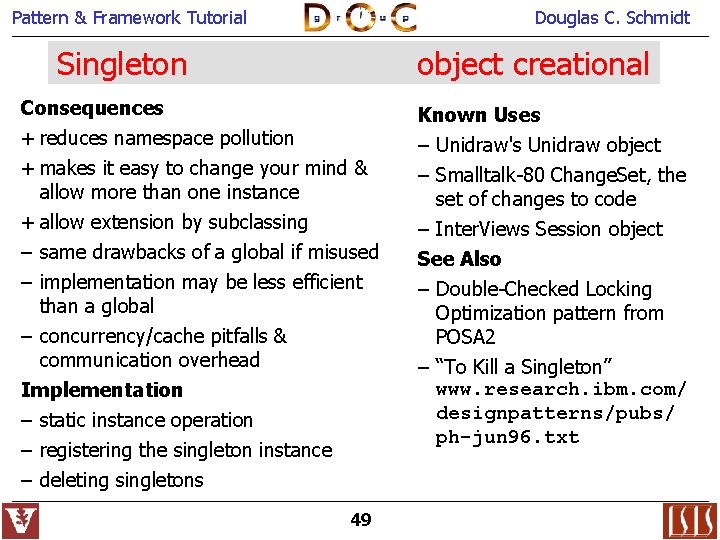
Pattern & Framework Tutorial Douglas C. Schmidt Singleton object creational Consequences + reduces namespace pollution + makes it easy to change your mind & allow more than one instance + allow extension by subclassing – same drawbacks of a global if misused – implementation may be less efficient than a global – concurrency/cache pitfalls & communication overhead Implementation – static instance operation – registering the singleton instance – deleting singletons 49 Known Uses – Unidraw's Unidraw object – Smalltalk-80 Change. Set, the set of changes to code – Inter. Views Session object See Also – Double-Checked Locking Optimization pattern from POSA 2 – “To Kill a Singleton” www. research. ibm. com/ designpatterns/pubs/ ph-jun 96. txt
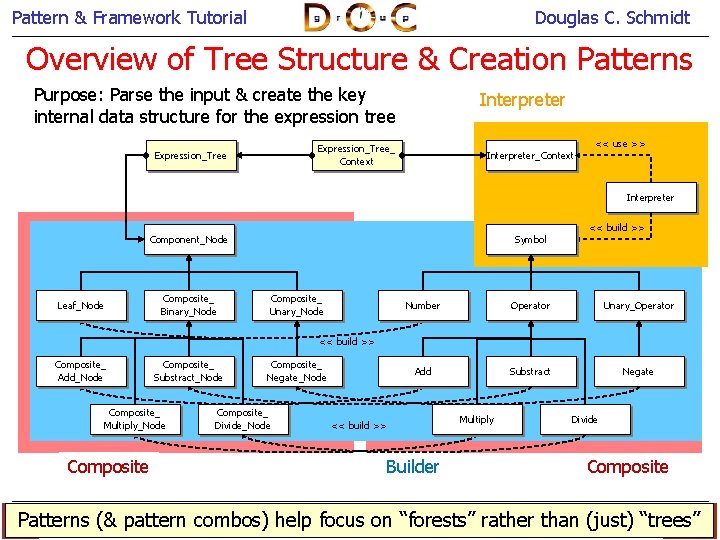
Pattern & Framework Tutorial Douglas C. Schmidt Overview of Tree Structure & Creation Patterns Purpose: Parse the input & create the key internal data structure for the expression tree Interpreter Expression_Tree_ Context Expression_Tree Interpreter_Context << use >> Interpreter Component_Node Leaf_Node Composite_ Binary_Node Symbol Composite_ Unary_Node << build >> Number Operator Unary_Operator Add Substract Negate << build >> Composite_ Add_Node Composite_ Substract_Node Composite_ Multiply_Node Composite_ Negate_Node Composite_ Divide_Node << build >> Builder Multiply Divide Composite 50 Patterns (& pattern combos) help focus on “forests” rather than (just) “trees”
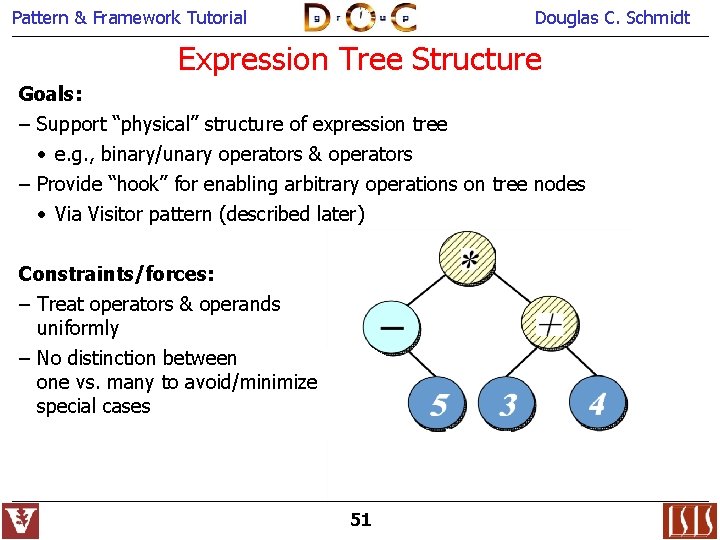
Pattern & Framework Tutorial Douglas C. Schmidt Expression Tree Structure Goals: – Support “physical” structure of expression tree • e. g. , binary/unary operators & operators – Provide “hook” for enabling arbitrary operations on tree nodes • Via Visitor pattern (described later) Constraints/forces: – Treat operators & operands uniformly – No distinction between one vs. many to avoid/minimize Unary Node special cases Leaf Nodes 51
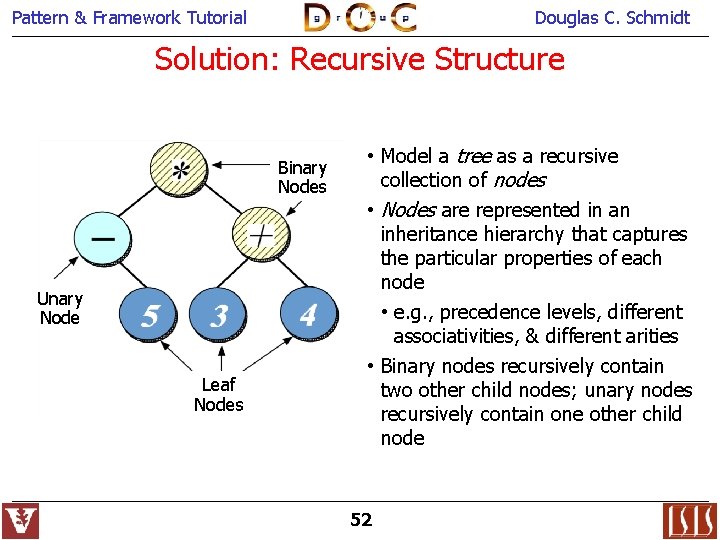
Pattern & Framework Tutorial Douglas C. Schmidt Solution: Recursive Structure Binary Nodes Unary Node Leaf Nodes • Model a tree as a recursive collection of nodes • Nodes are represented in an inheritance hierarchy that captures the particular properties of each node • e. g. , precedence levels, different associativities, & different arities • Binary nodes recursively contain two other child nodes; unary nodes recursively contain one other child node 52
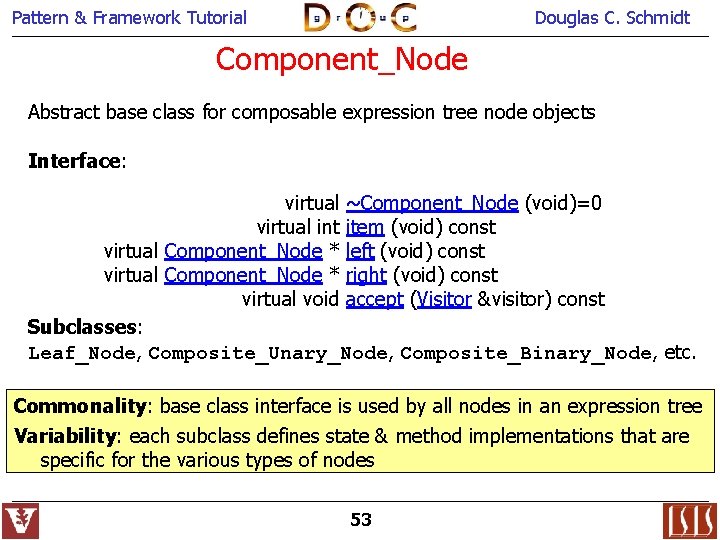
Pattern & Framework Tutorial Douglas C. Schmidt Component_Node Abstract base class for composable expression tree node objects Interface: virtual ~Component_Node (void)=0 virtual int item (void) const virtual Component_Node * left (void) const virtual Component_Node * right (void) const virtual void accept (Visitor &visitor) const Subclasses: Leaf_Node, Composite_Unary_Node, Composite_Binary_Node, etc. Commonality: base class interface is used by all nodes in an expression tree Variability: each subclass defines state & method implementations that are specific for the various types of nodes 53
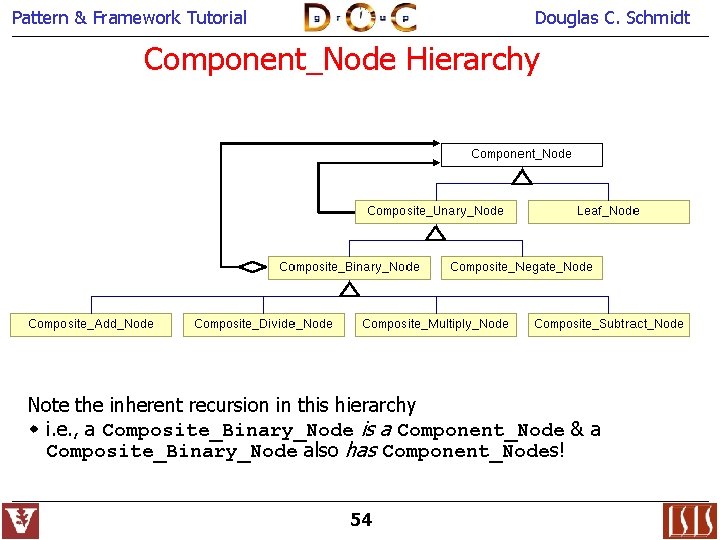
Pattern & Framework Tutorial Douglas C. Schmidt Component_Node Hierarchy Note the inherent recursion in this hierarchy w i. e. , a Composite_Binary_Node is a Component_Node & a Composite_Binary_Node also has Component_Nodes! 54
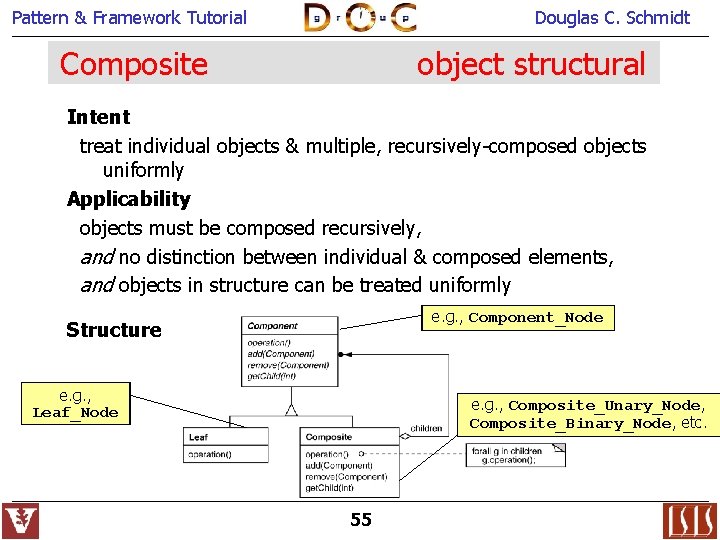
Pattern & Framework Tutorial Douglas C. Schmidt Composite object structural Intent treat individual objects & multiple, recursively-composed objects uniformly Applicability objects must be composed recursively, and no distinction between individual & composed elements, and objects in structure can be treated uniformly e. g. , Component_Node Structure e. g. , Leaf_Node e. g. , Composite_Unary_Node, Composite_Binary_Node, etc. 55
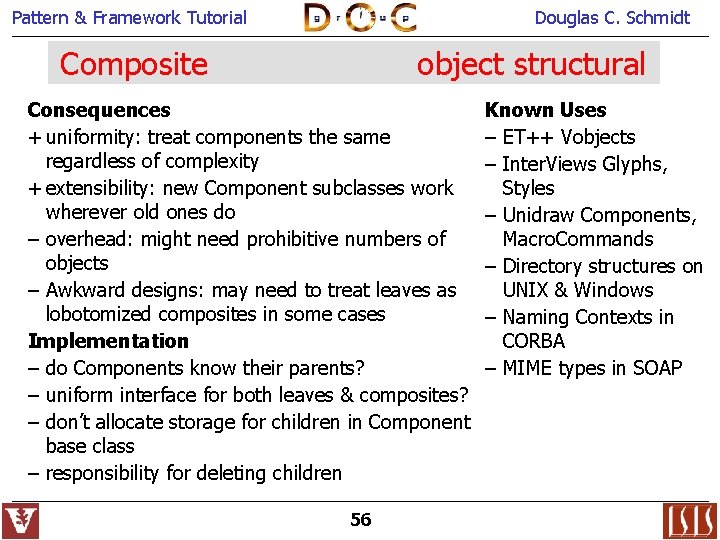
Pattern & Framework Tutorial Douglas C. Schmidt Composite object structural Consequences + uniformity: treat components the same regardless of complexity + extensibility: new Component subclasses work wherever old ones do – overhead: might need prohibitive numbers of objects – Awkward designs: may need to treat leaves as lobotomized composites in some cases Implementation – do Components know their parents? – uniform interface for both leaves & composites? – don’t allocate storage for children in Component base class – responsibility for deleting children 56 Known Uses – ET++ Vobjects – Inter. Views Glyphs, Styles – Unidraw Components, Macro. Commands – Directory structures on UNIX & Windows – Naming Contexts in CORBA – MIME types in SOAP
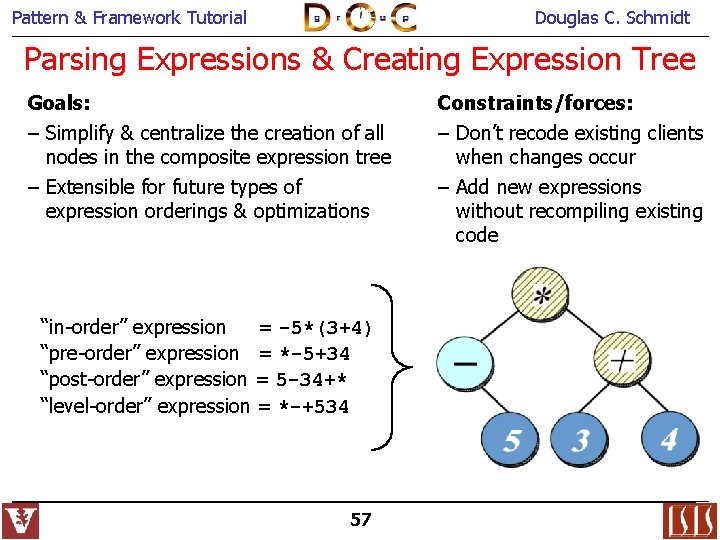
Pattern & Framework Tutorial Douglas C. Schmidt Parsing Expressions & Creating Expression Tree Goals: – Simplify & centralize the creation of all nodes in the composite expression tree – Extensible for future types of expression orderings & optimizations “in-order” expression = -5*(3+4) “pre-order” expression = *-5+34 “post-order” expression = 5 -34+* “level-order” expression = *-+534 57 Constraints/forces: – Don’t recode existing clients when changes occur – Add new expressions without recompiling existing code
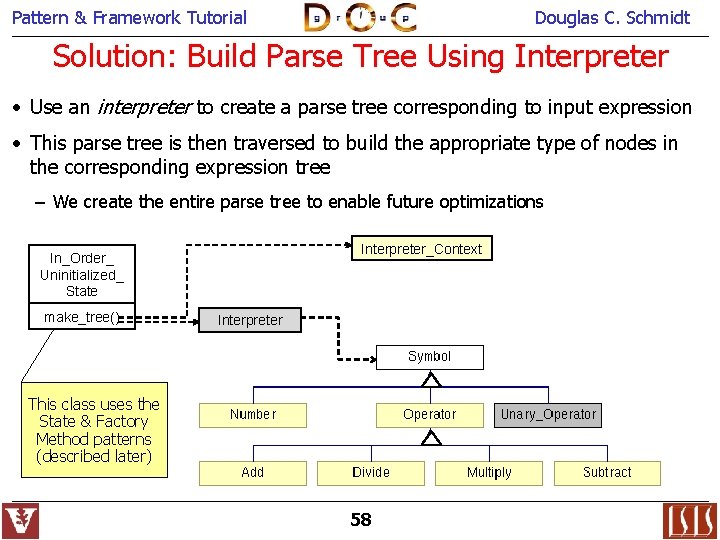
Pattern & Framework Tutorial Douglas C. Schmidt Solution: Build Parse Tree Using Interpreter • Use an interpreter to create a parse tree corresponding to input expression • This parse tree is then traversed to build the appropriate type of nodes in the corresponding expression tree – We create the entire parse tree to enable future optimizations Interpreter_Context In_Order_ Uninitialized_ State make_tree() Interpreter This class uses the State & Factory Method patterns (described later) 58
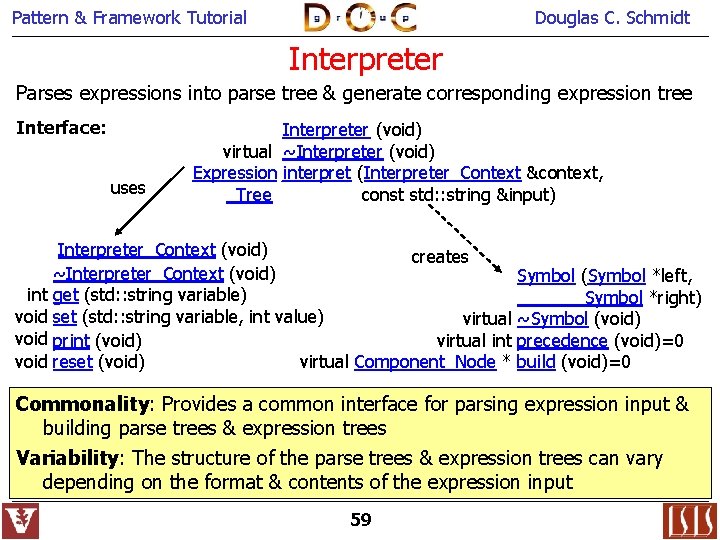
Pattern & Framework Tutorial Douglas C. Schmidt Interpreter Parses expressions into parse tree & generate corresponding expression tree Interface: uses Interpreter (void) virtual ~Interpreter (void) Expression interpret (Interpreter_Context &context, _Tree const std: : string &input) Interpreter_Context (void) creates ~Interpreter_Context (void) Symbol (Symbol *left, int get (std: : string variable) Symbol *right) void set (std: : string variable, int value) virtual ~Symbol (void) void print (void) virtual int precedence (void)=0 void reset (void) virtual Component_Node * build (void)=0 Commonality: Provides a common interface for parsing expression input & building parse trees & expression trees Variability: The structure of the parse trees & expression trees can vary depending on the format & contents of the expression input 59
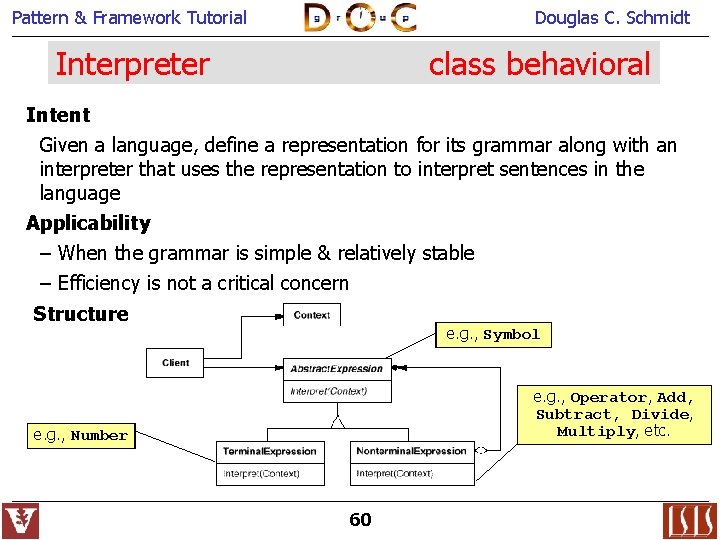
Pattern & Framework Tutorial Douglas C. Schmidt Interpreter class behavioral Intent Given a language, define a representation for its grammar along with an interpreter that uses the representation to interpret sentences in the language Applicability – When the grammar is simple & relatively stable – Efficiency is not a critical concern Structure e. g. , Symbol e. g. , Operator, Add, Subtract, Divide, Multiply, etc. e. g. , Number 60
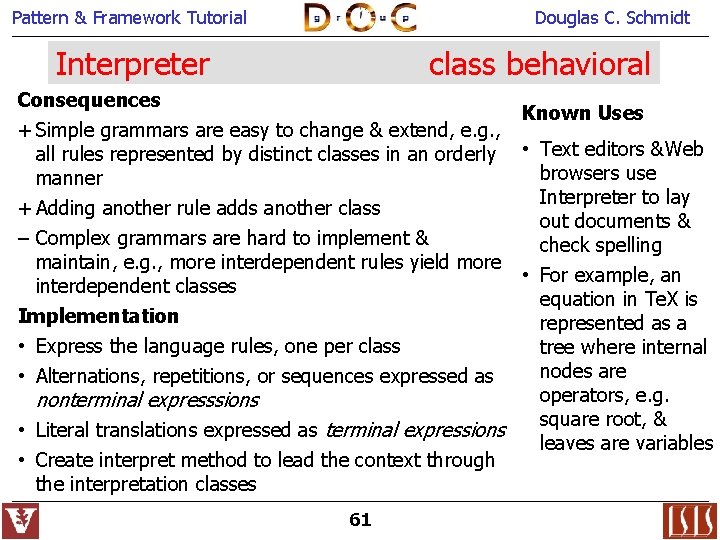
Pattern & Framework Tutorial Douglas C. Schmidt Interpreter class behavioral Consequences Known Uses + Simple grammars are easy to change & extend, e. g. , all rules represented by distinct classes in an orderly • Text editors &Web browsers use manner Interpreter to lay + Adding another rule adds another class out documents & – Complex grammars are hard to implement & check spelling maintain, e. g. , more interdependent rules yield more • For example, an interdependent classes equation in Te. X is Implementation represented as a • Express the language rules, one per class tree where internal nodes are • Alternations, repetitions, or sequences expressed as operators, e. g. nonterminal expresssions square root, & • Literal translations expressed as terminal expressions leaves are variables • Create interpret method to lead the context through the interpretation classes 61
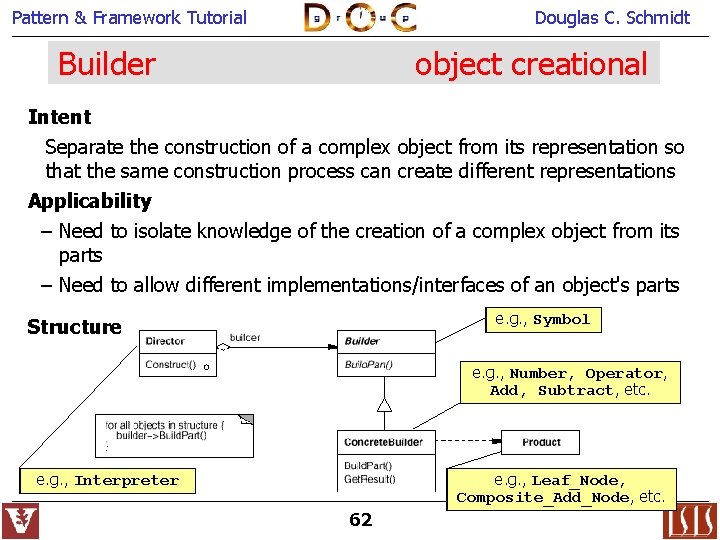
Pattern & Framework Tutorial Douglas C. Schmidt Builder object creational Intent Separate the construction of a complex object from its representation so that the same construction process can create different representations Applicability – Need to isolate knowledge of the creation of a complex object from its parts – Need to allow different implementations/interfaces of an object's parts e. g. , Symbol Structure e. g. , Number, Operator, Add, Subtract, etc. e. g. , Interpreter e. g. , Leaf_Node, Composite_Add_Node, etc. 62
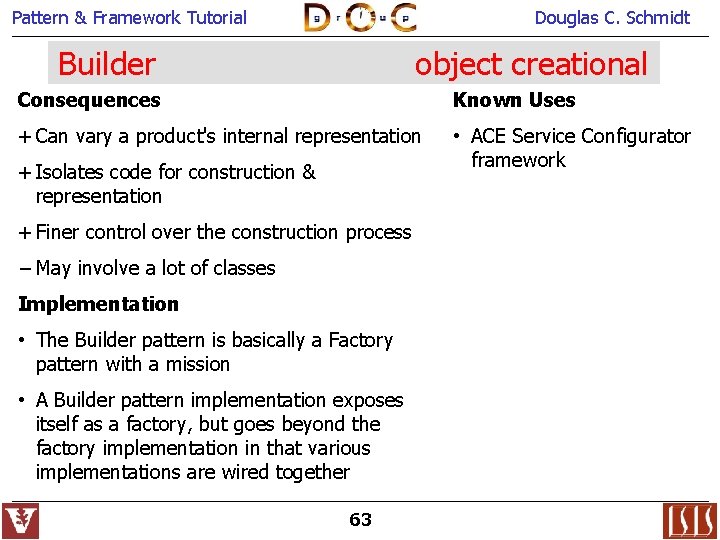
Pattern & Framework Tutorial Douglas C. Schmidt Builder object creational Consequences Known Uses + Can vary a product's internal representation • ACE Service Configurator framework + Isolates code for construction & representation + Finer control over the construction process − May involve a lot of classes Implementation • The Builder pattern is basically a Factory pattern with a mission • A Builder pattern implementation exposes itself as a factory, but goes beyond the factory implementation in that various implementations are wired together 63
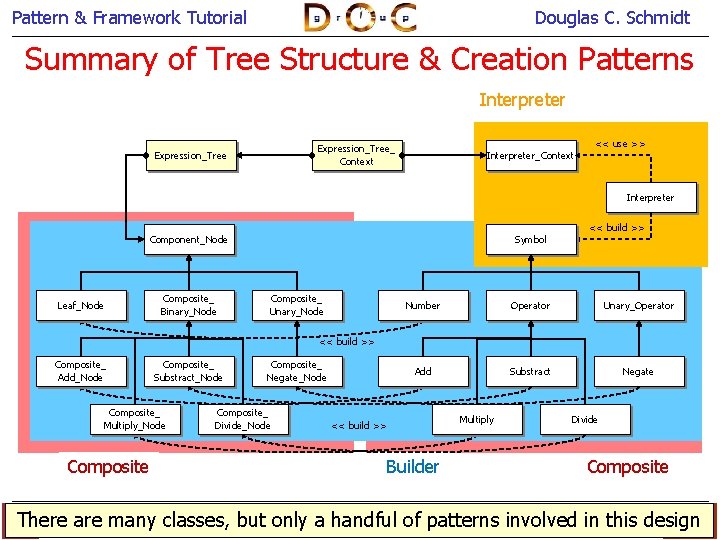
Pattern & Framework Tutorial Douglas C. Schmidt Summary of Tree Structure & Creation Patterns Interpreter Expression_Tree_ Context Expression_Tree Interpreter_Context << use >> Interpreter Component_Node Leaf_Node Composite_ Binary_Node Symbol Composite_ Unary_Node << build >> Number Operator Unary_Operator Add Substract Negate << build >> Composite_ Add_Node Composite_ Substract_Node Composite_ Multiply_Node Composite_ Negate_Node Composite_ Divide_Node << build >> Builder Multiply Divide Composite 64 There are many classes, but only a handful of patterns involved in this design
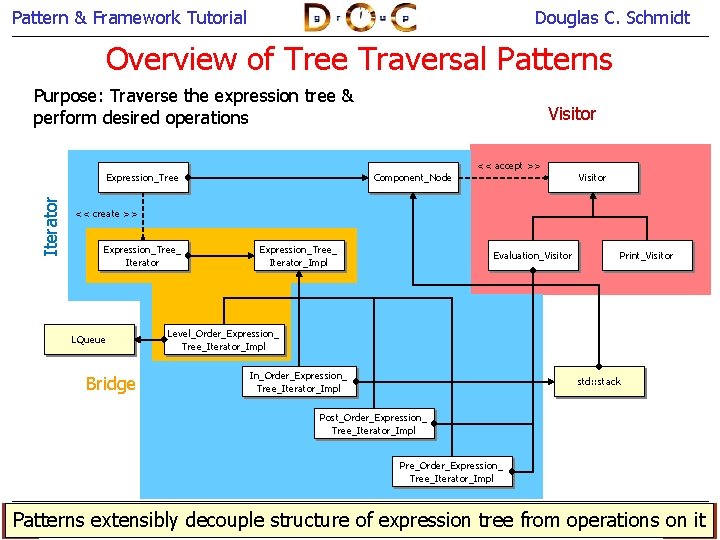
Pattern & Framework Tutorial Douglas C. Schmidt Overview of Tree Traversal Patterns Purpose: Traverse the expression tree & perform desired operations Iterator Expression_Tree Visitor Component_Node << accept >> Visitor << create >> Expression_Tree_ Iterator LQueue Bridge Expression_Tree_ Iterator_Impl Evaluation_Visitor Print_Visitor Level_Order_Expression_ Tree_Iterator_Impl In_Order_Expression_ Tree_Iterator_Impl std: : stack Post_Order_Expression_ Tree_Iterator_Impl Pre_Order_Expression_ Tree_Iterator_Impl 65 Patterns extensibly decouple structure of expression tree from operations on it
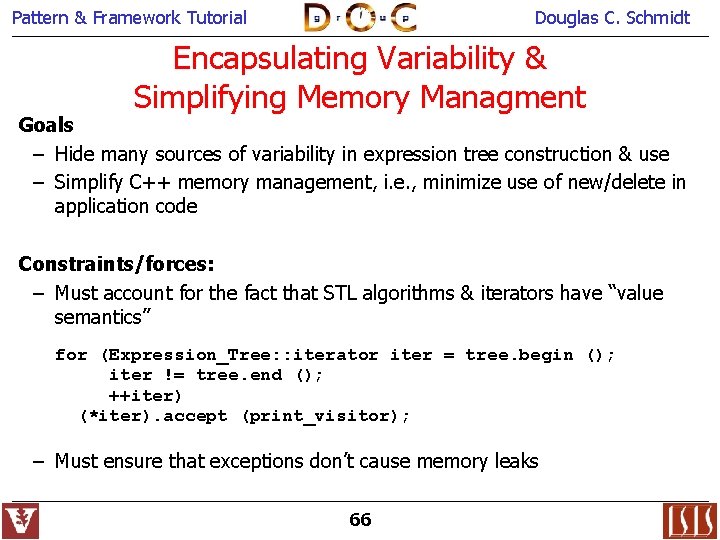
Pattern & Framework Tutorial Douglas C. Schmidt Encapsulating Variability & Simplifying Memory Managment Goals – Hide many sources of variability in expression tree construction & use – Simplify C++ memory management, i. e. , minimize use of new/delete in application code Constraints/forces: – Must account for the fact that STL algorithms & iterators have “value semantics” for (Expression_Tree: : iterator iter = tree. begin (); iter != tree. end (); ++iter) (*iter). accept (print_visitor); – Must ensure that exceptions don’t cause memory leaks 66
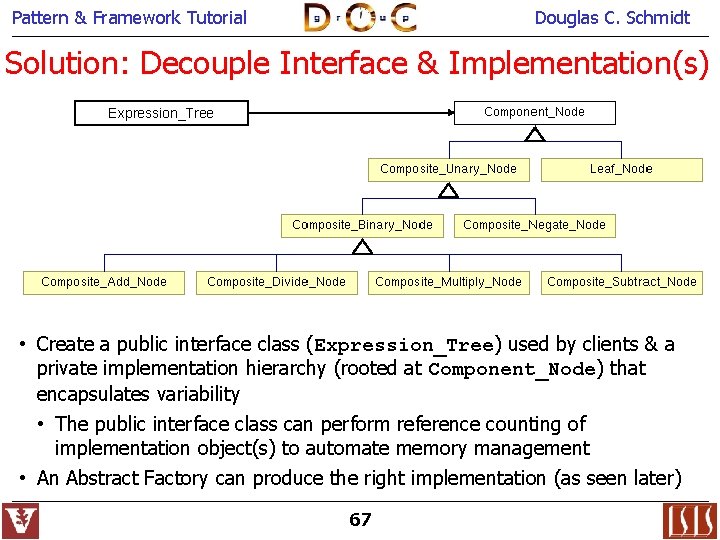
Pattern & Framework Tutorial Douglas C. Schmidt Solution: Decouple Interface & Implementation(s) Expression_Tree • Create a public interface class (Expression_Tree) used by clients & a private implementation hierarchy (rooted at Component_Node) that encapsulates variability • The public interface class can perform reference counting of implementation object(s) to automate memory management • An Abstract Factory can produce the right implementation (as seen later) 67
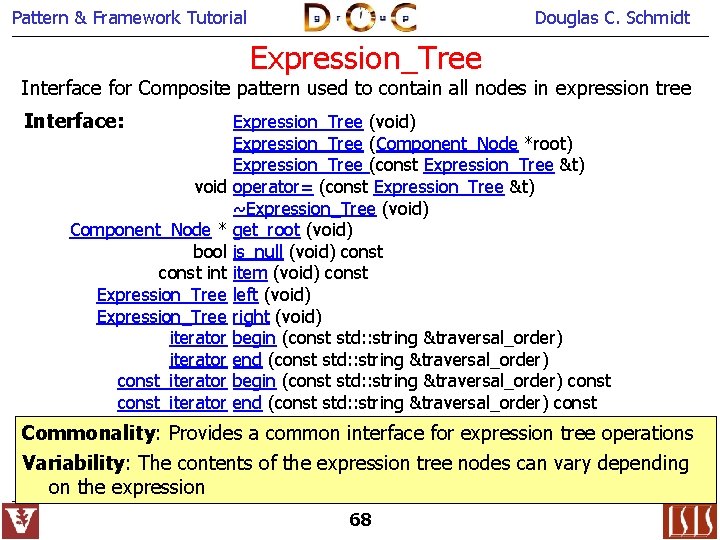
Pattern & Framework Tutorial Douglas C. Schmidt Expression_Tree Interface for Composite pattern used to contain all nodes in expression tree Interface: Expression_Tree (void) Expression_Tree (Component_Node *root) Expression_Tree (const Expression_Tree &t) void operator= (const Expression_Tree &t) ~Expression_Tree (void) Component_Node * get_root (void) bool is_null (void) const int item (void) const Expression_Tree left (void) Expression_Tree right (void) iterator begin (const std: : string &traversal_order) iterator end (const std: : string &traversal_order) const_iterator begin (const std: : string &traversal_order) const_iterator end (const std: : string &traversal_order) const Commonality: Provides a common interface for expression tree operations Variability: The contents of the expression tree nodes can vary depending on the expression 68
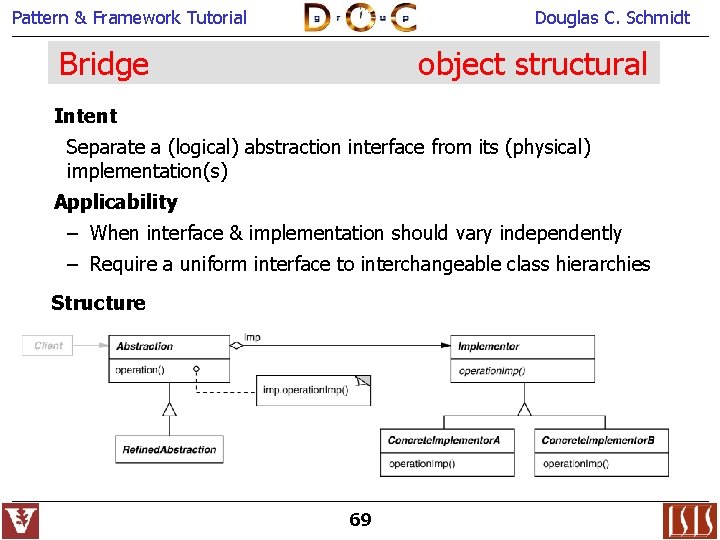
Pattern & Framework Tutorial Douglas C. Schmidt Bridge object structural Intent Separate a (logical) abstraction interface from its (physical) implementation(s) Applicability – When interface & implementation should vary independently – Require a uniform interface to interchangeable class hierarchies Structure 69
Pattern & Framework Tutorial Douglas C. Schmidt Bridge object structural Consequences + abstraction interface & implementation are independent + implementations can vary dynamically + Can be used transparently with STL algorithms & containers – one-size-fits-all Abstraction & Implementor interfaces Implementation • sharing Implementors & reference counting • See reusable Refcounter template class (based on STL/boost shared_pointer) • creating the right Implementor (often use factories) Known Uses • ET++ Window/Window. Port • libg++ Set/{Linked. List, Hash. Table} • AWT Component/Component. Peer 70
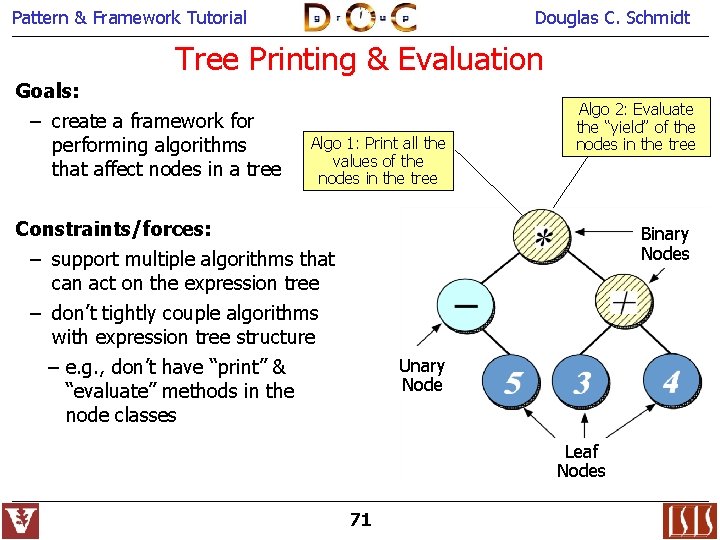
Pattern & Framework Tutorial Douglas C. Schmidt Tree Printing & Evaluation Goals: – create a framework for performing algorithms that affect nodes in a tree Algo 1: Print all the values of the nodes in the tree Constraints/forces: – support multiple algorithms that can act on the expression tree – don’t tightly couple algorithms with expression tree structure – e. g. , don’t have “print” & “evaluate” methods in the node classes Algo 2: Evaluate the “yield” of the nodes in the tree Binary Nodes Unary Node Leaf Nodes 71
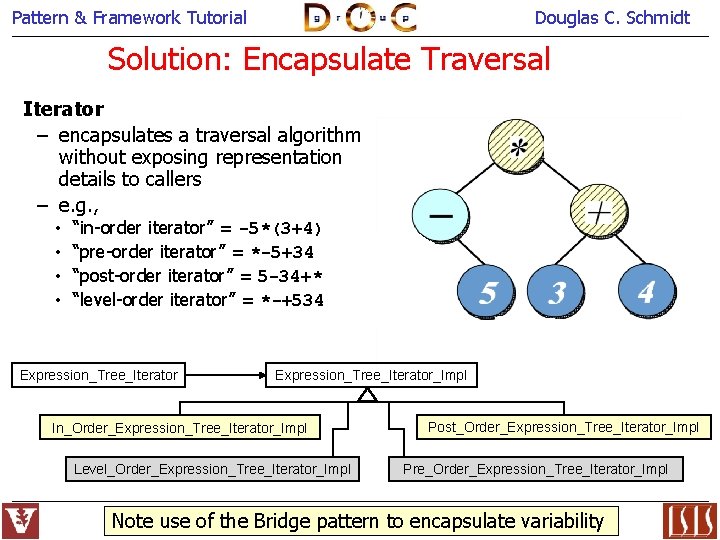
Pattern & Framework Tutorial Douglas C. Schmidt Solution: Encapsulate Traversal Iterator – encapsulates a traversal algorithm without exposing representation details to callers – e. g. , • • “in-order iterator” = -5*(3+4) “pre-order iterator” = *-5+34 “post-order iterator” = 5 -34+* “level-order iterator” = *-+534 Expression_Tree_Iterator Unary Node Expression_Tree_Iterator_Impl In_Order_Expression_Tree_Iterator_Impl Level_Order_Expression_Tree_Iterator_Impl Leaf Nodes Post_Order_Expression_Tree_Iterator_Impl Pre_Order_Expression_Tree_Iterator_Impl 72 Note use of the Bridge pattern to encapsulate variability
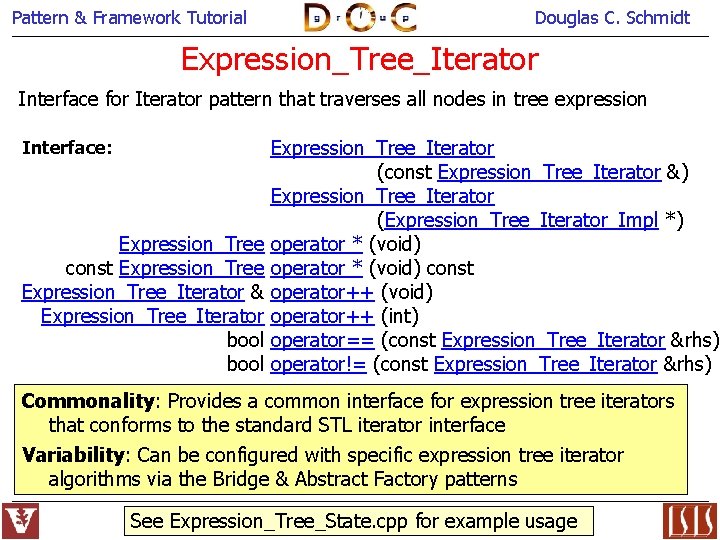
Pattern & Framework Tutorial Douglas C. Schmidt Expression_Tree_Iterator Interface for Iterator pattern that traverses all nodes in tree expression Expression_Tree_Iterator (const Expression_Tree_Iterator &) Expression_Tree_Iterator (Expression_Tree_Iterator_Impl *) Expression_Tree operator * (void) const Expression_Tree_Iterator & operator++ (void) Expression_Tree_Iterator operator++ (int) bool operator== (const Expression_Tree_Iterator &rhs) bool operator!= (const Expression_Tree_Iterator &rhs) Interface: Commonality: Provides a common interface for expression tree iterators that conforms to the standard STL iterator interface Variability: Can be configured with specific expression tree iterator algorithms via the Bridge & Abstract Factory patterns 73 See Expression_Tree_State. cpp for example usage
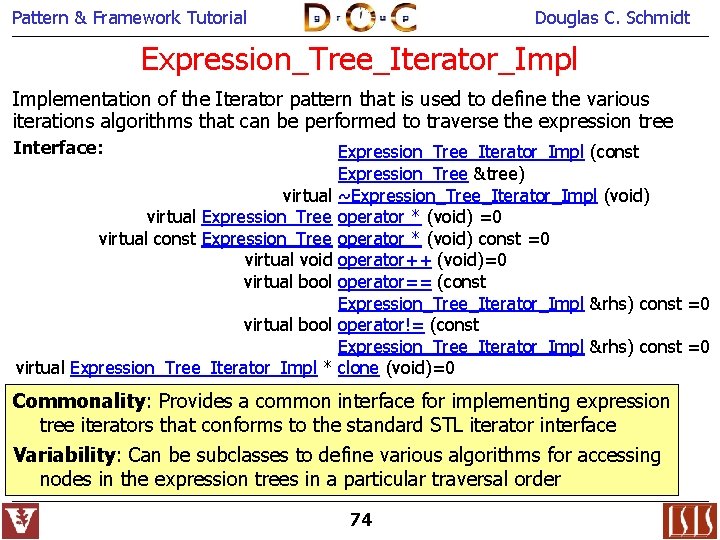
Pattern & Framework Tutorial Douglas C. Schmidt Expression_Tree_Iterator_Implementation of the Iterator pattern that is used to define the various iterations algorithms that can be performed to traverse the expression tree Interface: Expression_Tree_Iterator_Impl (const Expression_Tree &tree) virtual ~Expression_Tree_Iterator_Impl (void) virtual Expression_Tree operator * (void) =0 virtual const Expression_Tree operator * (void) const =0 virtual void operator++ (void)=0 virtual bool operator== (const Expression_Tree_Iterator_Impl &rhs) const =0 virtual bool operator!= (const Expression_Tree_Iterator_Impl &rhs) const =0 virtual Expression_Tree_Iterator_Impl * clone (void)=0 Commonality: Provides a common interface for implementing expression tree iterators that conforms to the standard STL iterator interface Variability: Can be subclasses to define various algorithms for accessing nodes in the expression trees in a particular traversal order 74
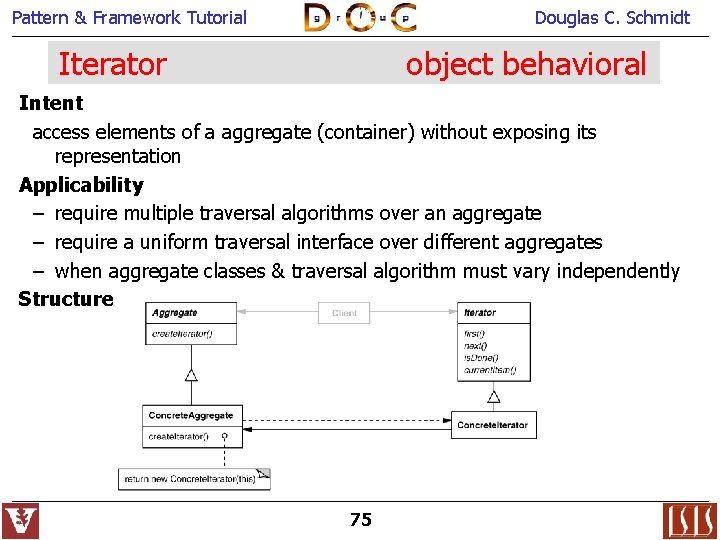
Pattern & Framework Tutorial Douglas C. Schmidt Iterator object behavioral Intent access elements of a aggregate (container) without exposing its representation Applicability – require multiple traversal algorithms over an aggregate – require a uniform traversal interface over different aggregates – when aggregate classes & traversal algorithm must vary independently Structure 75
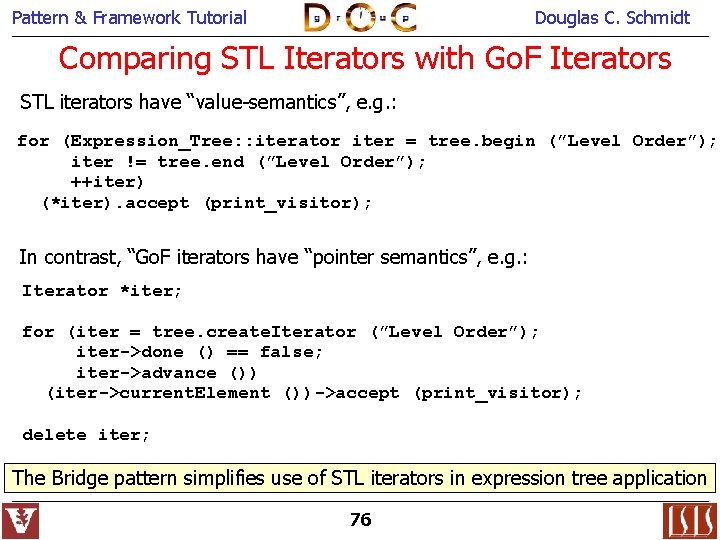
Pattern & Framework Tutorial Douglas C. Schmidt Comparing STL Iterators with Go. F Iterators STL iterators have “value-semantics”, e. g. : for (Expression_Tree: : iterator iter = tree. begin (”Level Order”); iter != tree. end (”Level Order”); ++iter) (*iter). accept (print_visitor); In contrast, “Go. F iterators have “pointer semantics”, e. g. : Iterator *iter; for (iter = tree. create. Iterator (”Level Order”); iter->done () == false; iter->advance ()) (iter->current. Element ())->accept (print_visitor); delete iter; The Bridge pattern simplifies use of STL iterators in expression tree application 76
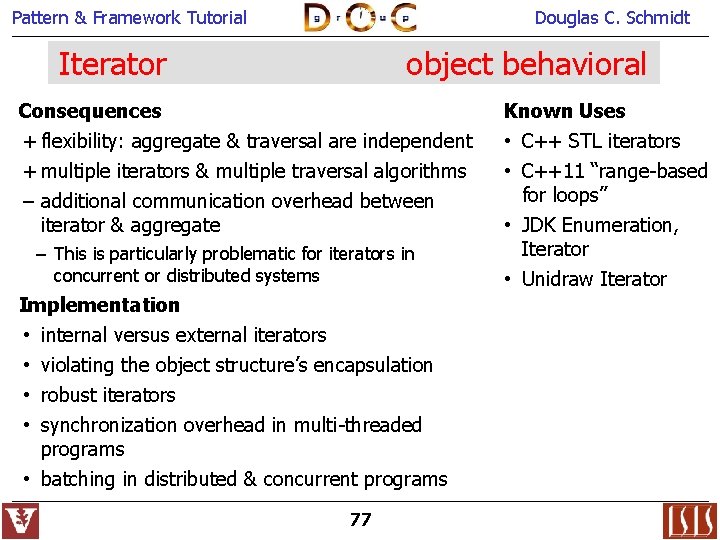
Pattern & Framework Tutorial Douglas C. Schmidt Iterator object behavioral Consequences + flexibility: aggregate & traversal are independent + multiple iterators & multiple traversal algorithms – additional communication overhead between iterator & aggregate – This is particularly problematic for iterators in concurrent or distributed systems Implementation • internal versus external iterators • violating the object structure’s encapsulation • robust iterators • synchronization overhead in multi-threaded programs • batching in distributed & concurrent programs 77 Known Uses • C++ STL iterators • C++11 “range-based for loops” • JDK Enumeration, Iterator • Unidraw Iterator
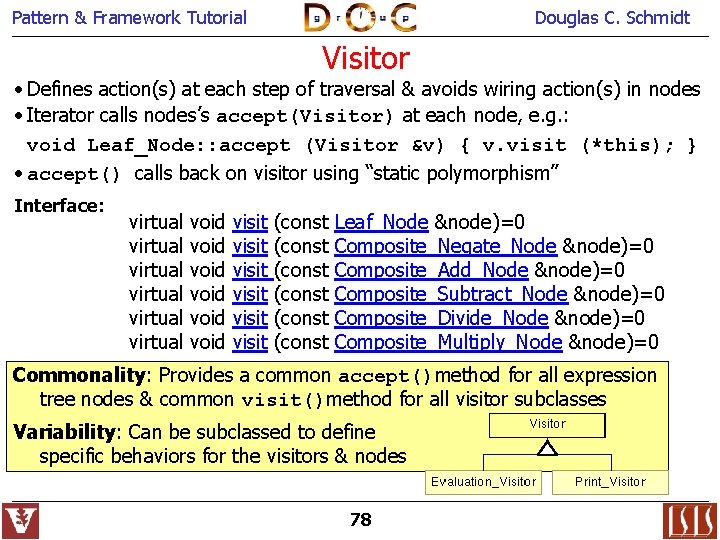
Pattern & Framework Tutorial Douglas C. Schmidt Visitor • Defines action(s) at each step of traversal & avoids wiring action(s) in nodes • Iterator calls nodes’s accept(Visitor) at each node, e. g. : void Leaf_Node: : accept (Visitor &v) { v. visit (*this); } • accept() calls back on visitor using “static polymorphism” Interface: virtual void visit (const Leaf_Node &node)=0 virtual void visit (const Composite_Negate_Node &node)=0 virtual void visit (const Composite_Add_Node &node)=0 virtual void visit (const Composite_Subtract_Node &node)=0 virtual void visit (const Composite_Divide_Node &node)=0 virtual void visit (const Composite_Multiply_Node &node)=0 Commonality: Provides a common accept()method for all expression tree nodes & common visit()method for all visitor subclasses Variability: Can be subclassed to define specific behaviors for the visitors & nodes 78
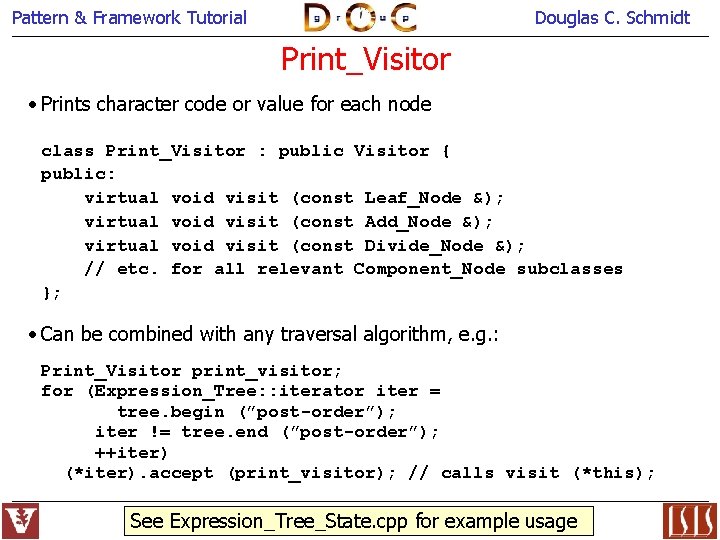
Pattern & Framework Tutorial Douglas C. Schmidt Print_Visitor • Prints character code or value for each node class Print_Visitor : public Visitor { public: virtual void visit (const Leaf_Node &); virtual void visit (const Add_Node &); virtual void visit (const Divide_Node &); // etc. for all relevant Component_Node subclasses }; • Can be combined with any traversal algorithm, e. g. : Print_Visitor print_visitor; for (Expression_Tree: : iterator iter = tree. begin (”post-order”); iter != tree. end (”post-order”); ++iter) (*iter). accept (print_visitor); // calls visit (*this); 79 See Expression_Tree_State. cpp for example usage
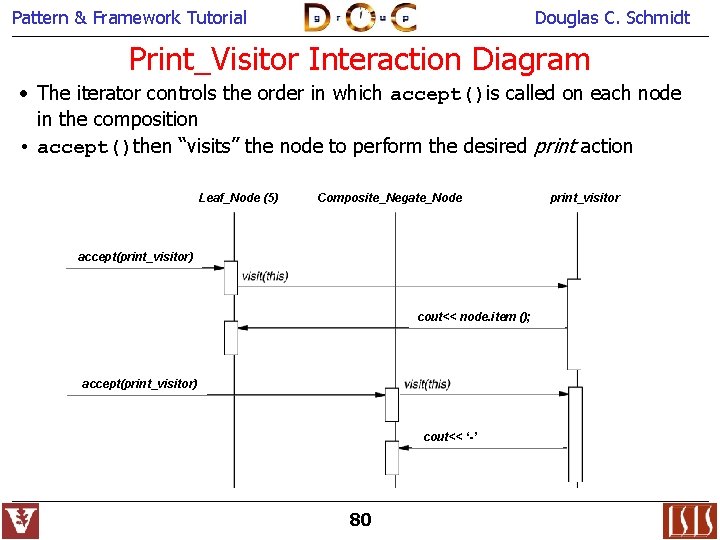
Pattern & Framework Tutorial Douglas C. Schmidt Print_Visitor Interaction Diagram • The iterator controls the order in which accept()is called on each node in the composition • accept()then “visits” the node to perform the desired print action Leaf_Node (5) Composite_Negate_Node accept(print_visitor) cout<< node. item (); accept(print_visitor) cout<< ‘-’ 80 print_visitor
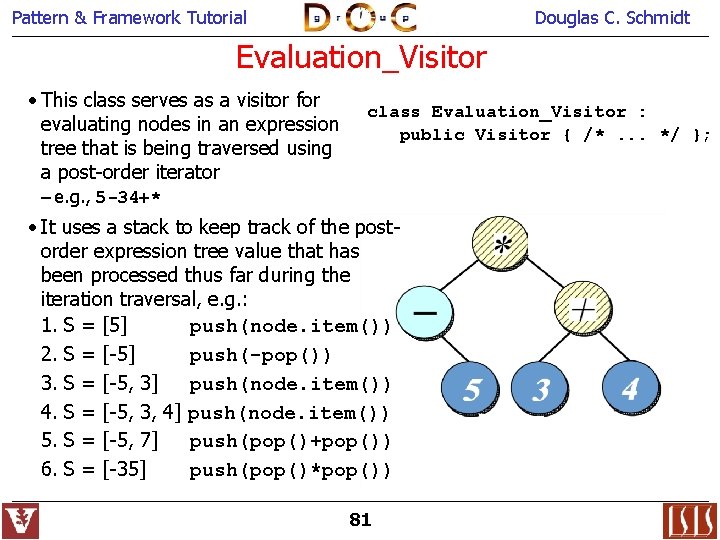
Pattern & Framework Tutorial Douglas C. Schmidt Evaluation_Visitor • This class serves as a visitor for class Evaluation_Visitor : evaluating nodes in an expression public Visitor { /*. . . */ }; tree that is being traversed using a post-order iterator – e. g. , 5 -34+* • It uses a stack to keep track of the postorder expression tree value that has been processed thus far during the iteration traversal, e. g. : 1. S = [5] push(node. item()) 2. S = [-5] push(-pop()) Unary 3. S = [-5, 3] push(node. item()) Node 4. S = [-5, 3, 4] push(node. item()) 5. S = [-5, 7] push(pop()+pop()) 6. S = [-35] push(pop()*pop()) 81 Leaf Nodes
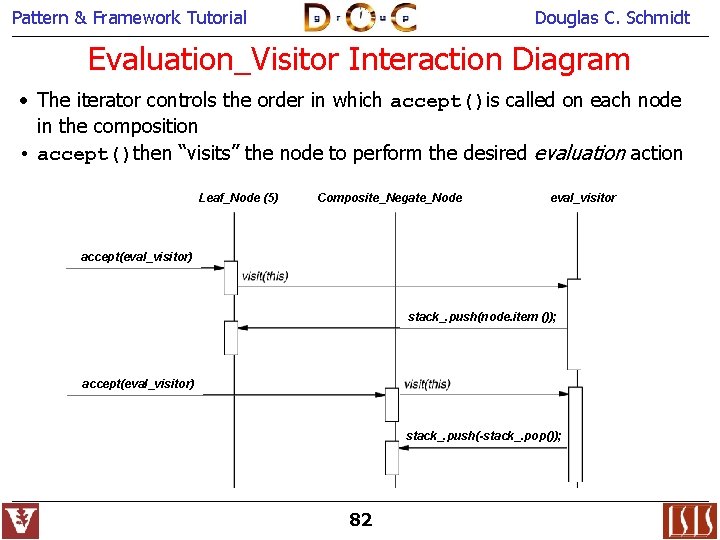
Pattern & Framework Tutorial Douglas C. Schmidt Evaluation_Visitor Interaction Diagram • The iterator controls the order in which accept()is called on each node in the composition • accept()then “visits” the node to perform the desired evaluation action Leaf_Node (5) Composite_Negate_Node eval_visitor accept(eval_visitor) stack_. push(node. item ()); accept(eval_visitor) stack_. push(-stack_. pop()); 82
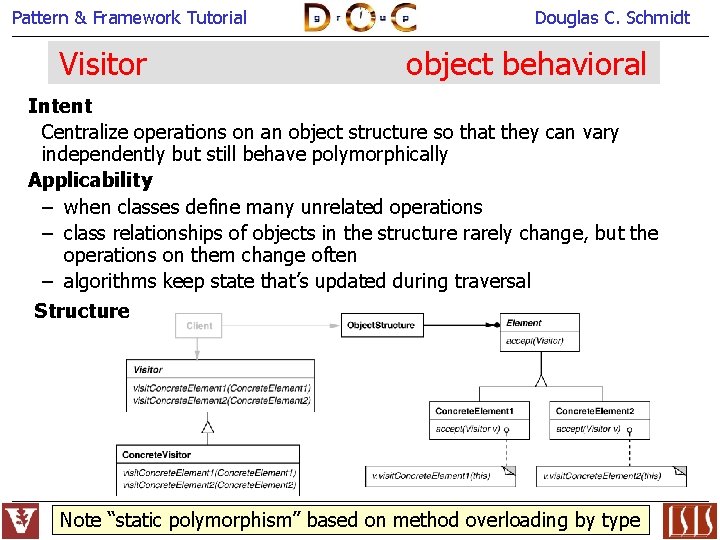
Pattern & Framework Tutorial Douglas C. Schmidt Visitor object behavioral Intent Centralize operations on an object structure so that they can vary independently but still behave polymorphically Applicability – when classes define many unrelated operations – class relationships of objects in the structure rarely change, but the operations on them change often – algorithms keep state that’s updated during traversal Structure 83 Note “static polymorphism” based on method overloading by type
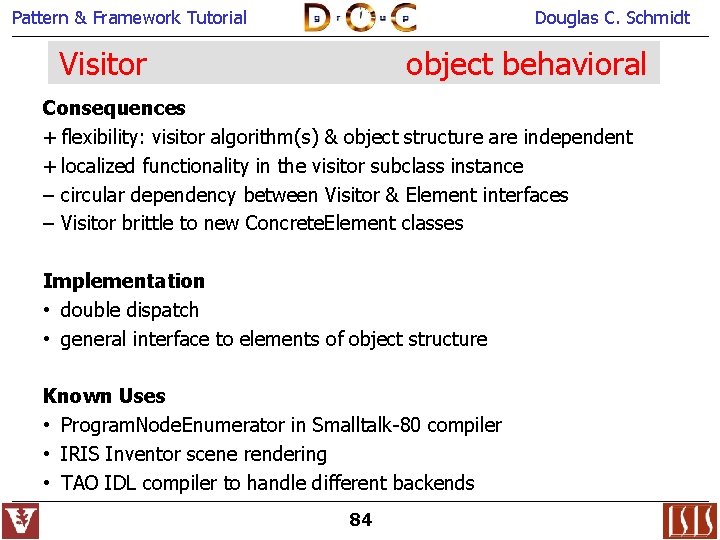
Pattern & Framework Tutorial Douglas C. Schmidt Visitor object behavioral Consequences + flexibility: visitor algorithm(s) & object structure are independent + localized functionality in the visitor subclass instance – circular dependency between Visitor & Element interfaces – Visitor brittle to new Concrete. Element classes Implementation • double dispatch • general interface to elements of object structure Known Uses • Program. Node. Enumerator in Smalltalk-80 compiler • IRIS Inventor scene rendering • TAO IDL compiler to handle different backends 84
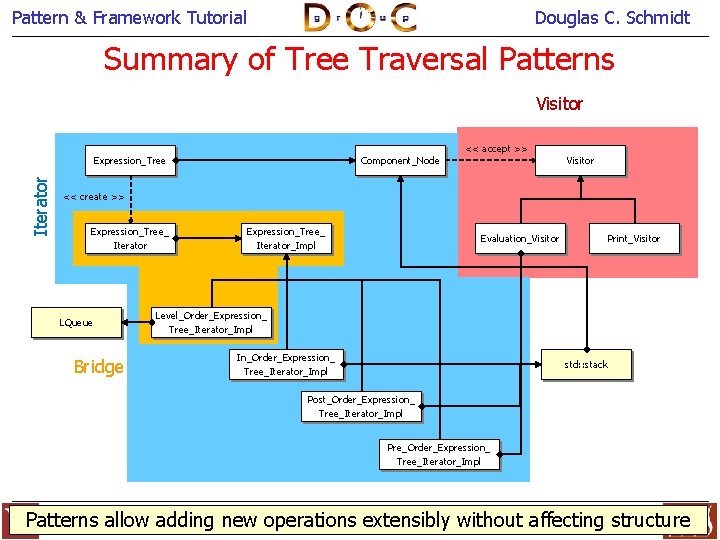
Pattern & Framework Tutorial Douglas C. Schmidt Summary of Tree Traversal Patterns Visitor Iterator Expression_Tree Component_Node << accept >> Visitor << create >> Expression_Tree_ Iterator LQueue Bridge Expression_Tree_ Iterator_Impl Evaluation_Visitor Print_Visitor Level_Order_Expression_ Tree_Iterator_Impl In_Order_Expression_ Tree_Iterator_Impl std: : stack Post_Order_Expression_ Tree_Iterator_Impl Pre_Order_Expression_ Tree_Iterator_Impl 85 Patterns allow adding new operations extensibly without affecting structure
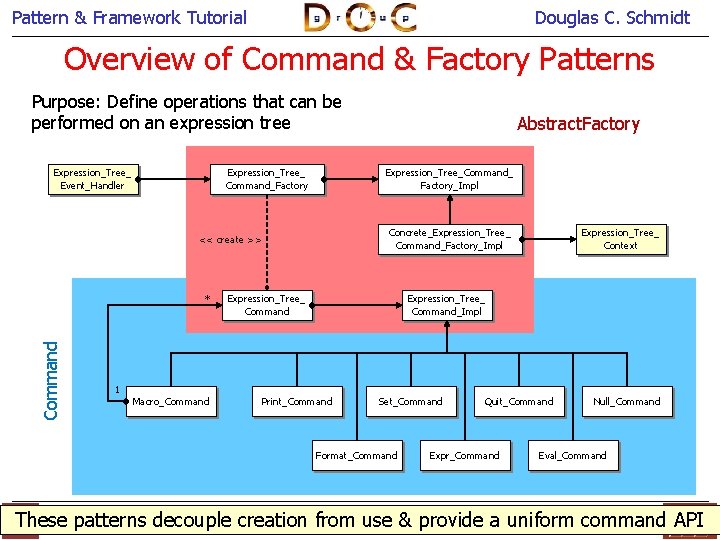
Pattern & Framework Tutorial Douglas C. Schmidt Overview of Command & Factory Patterns Purpose: Define operations that can be performed on an expression tree Expression_Tree_ Event_Handler Expression_Tree_ Command_Factory Expression_Tree_Command_ Factory_Impl Concrete_Expression_Tree_ Command_Factory_Impl << create >> Command * 1 Macro_Command Abstract. Factory Expression_Tree_ Command Expression_Tree_ Context Expression_Tree_ Command_Impl Print_Command Set_Command Format_Command Quit_Command Expr_Command Null_Command Eval_Command 86 These patterns decouple creation from use & provide a uniform command API
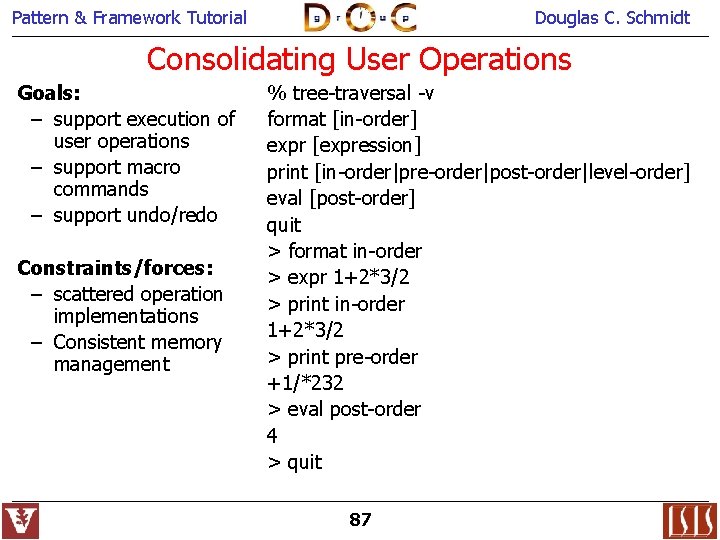
Pattern & Framework Tutorial Douglas C. Schmidt Consolidating User Operations Goals: – support execution of user operations – support macro commands – support undo/redo Constraints/forces: – scattered operation implementations – Consistent memory management % tree-traversal -v format [in-order] expr [expression] print [in-order|pre-order|post-order|level-order] eval [post-order] quit > format in-order > expr 1+2*3/2 > print in-order 1+2*3/2 > print pre-order +1/*232 > eval post-order 4 > quit 87
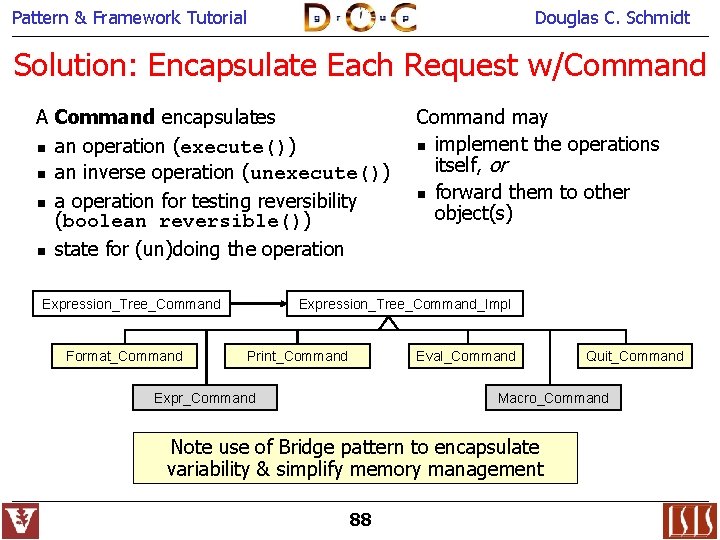
Pattern & Framework Tutorial Douglas C. Schmidt Solution: Encapsulate Each Request w/Command A Command encapsulates n an operation (execute()) n an inverse operation (unexecute()) n a operation for testing reversibility (boolean reversible()) n state for (un)doing the operation Expression_Tree_Command Format_Command may n implement the operations itself, or n forward them to other object(s) Expression_Tree_Command_Impl Eval_Command Print_Command Expr_Command Quit_Command Macro_Command Note use of Bridge pattern to encapsulate variability & simplify memory management 88
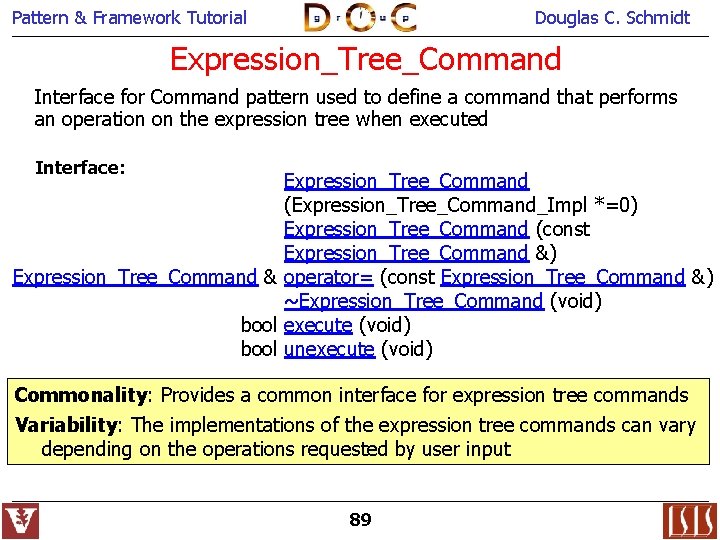
Pattern & Framework Tutorial Douglas C. Schmidt Expression_Tree_Command Interface for Command pattern used to define a command that performs an operation on the expression tree when executed Interface: Expression_Tree_Command (Expression_Tree_Command_Impl *=0) Expression_Tree_Command (const Expression_Tree_Command &) Expression_Tree_Command & operator= (const Expression_Tree_Command &) ~Expression_Tree_Command (void) bool execute (void) bool unexecute (void) Commonality: Provides a common interface for expression tree commands Variability: The implementations of the expression tree commands can vary depending on the operations requested by user input 89
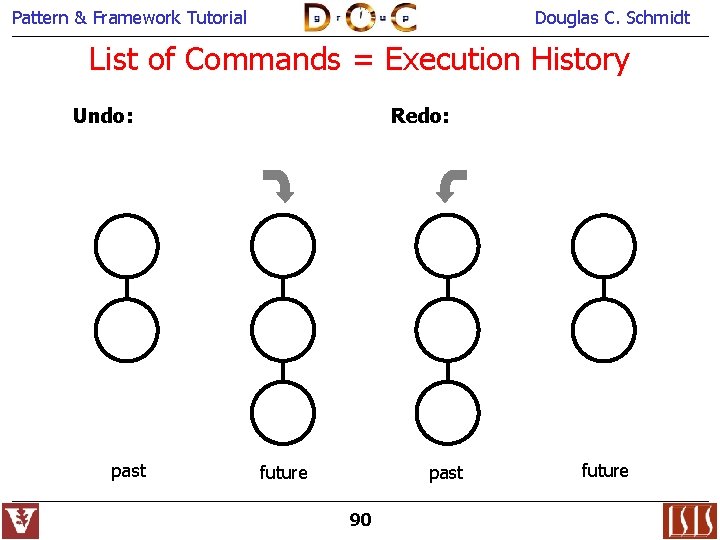
Pattern & Framework Tutorial Douglas C. Schmidt List of Commands = Execution History Undo: unexecute() Redo: cmd past execute() unexecute() cmd future past 90 future
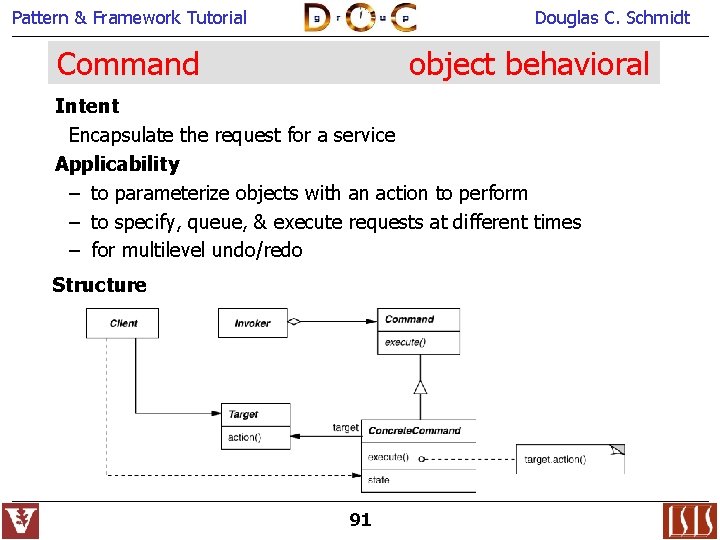
Pattern & Framework Tutorial Douglas C. Schmidt Command object behavioral Intent Encapsulate the request for a service Applicability – to parameterize objects with an action to perform – to specify, queue, & execute requests at different times – for multilevel undo/redo Structure 91
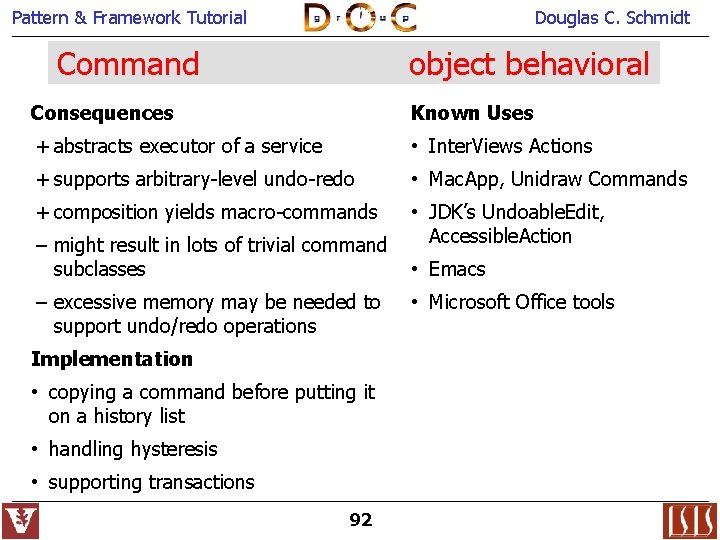
Pattern & Framework Tutorial Douglas C. Schmidt Command object behavioral Consequences Known Uses + abstracts executor of a service • Inter. Views Actions + supports arbitrary-level undo-redo • Mac. App, Unidraw Commands + composition yields macro-commands • JDK’s Undoable. Edit, Accessible. Action – might result in lots of trivial command subclasses • Emacs – excessive memory may be needed to support undo/redo operations Implementation • copying a command before putting it on a history list • handling hysteresis • supporting transactions 92 • Microsoft Office tools
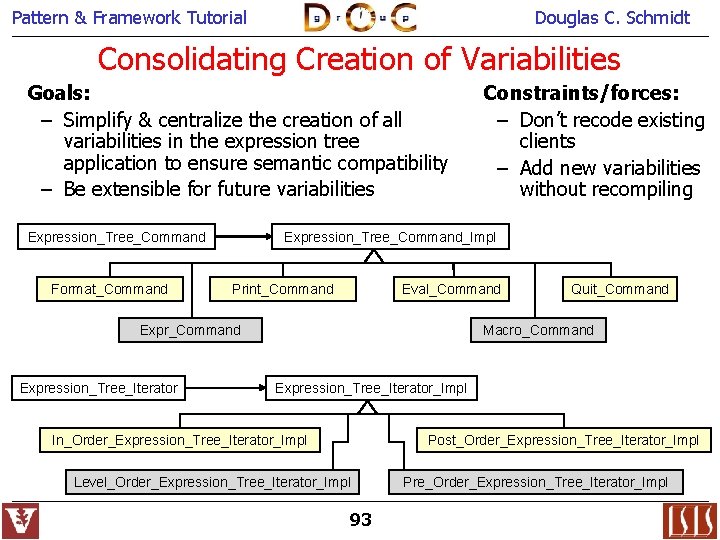
Pattern & Framework Tutorial Douglas C. Schmidt Consolidating Creation of Variabilities Goals: – Simplify & centralize the creation of all variabilities in the expression tree application to ensure semantic compatibility – Be extensible for future variabilities Expression_Tree_Command Format_Command Expression_Tree_Command_Impl Print_Command Eval_Command Expression_Tree_Iterator Constraints/forces: – Don’t recode existing clients – Add new variabilities without recompiling Quit_Command Macro_Command Expression_Tree_Iterator_Impl Post_Order_Expression_Tree_Iterator_Impl In_Order_Expression_Tree_Iterator_Impl Level_Order_Expression_Tree_Iterator_Impl 93 Pre_Order_Expression_Tree_Iterator_Impl
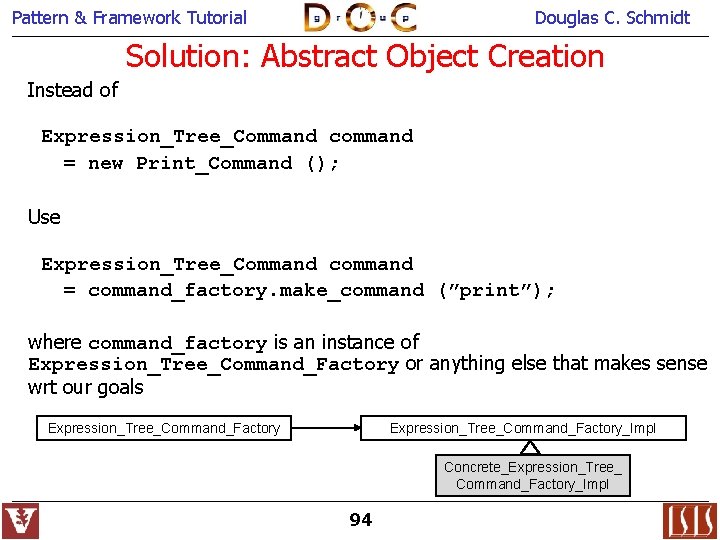
Pattern & Framework Tutorial Douglas C. Schmidt Solution: Abstract Object Creation Instead of Expression_Tree_Command command = new Print_Command (); Use Expression_Tree_Command command = command_factory. make_command (”print”); where command_factory is an instance of Expression_Tree_Command_Factory or anything else that makes sense wrt our goals Expression_Tree_Command_Factory_Impl Concrete_Expression_Tree_ Command_Factory_Impl 94
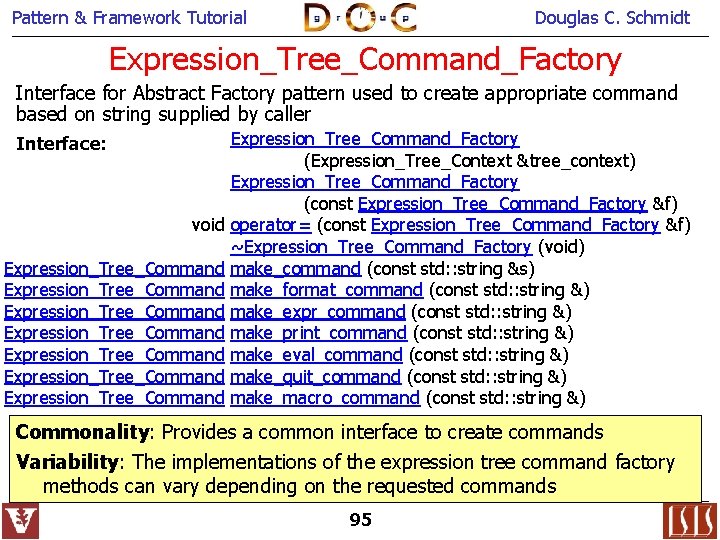
Pattern & Framework Tutorial Douglas C. Schmidt Expression_Tree_Command_Factory Interface for Abstract Factory pattern used to create appropriate command based on string supplied by caller Expression_Tree_Command_Factory (Expression_Tree_Context &tree_context) Expression_Tree_Command_Factory (const Expression_Tree_Command_Factory &f) void operator= (const Expression_Tree_Command_Factory &f) ~Expression_Tree_Command_Factory (void) Expression_Tree_Command make_command (const std: : string &s) Expression_Tree_Command make_format_command (const std: : string &) Expression_Tree_Command make_expr_command (const std: : string &) Expression_Tree_Command make_print_command (const std: : string &) Expression_Tree_Command make_eval_command (const std: : string &) Expression_Tree_Command make_quit_command (const std: : string &) Expression_Tree_Command make_macro_command (const std: : string &) Interface: Commonality: Provides a common interface to create commands Variability: The implementations of the expression tree command factory methods can vary depending on the requested commands 95
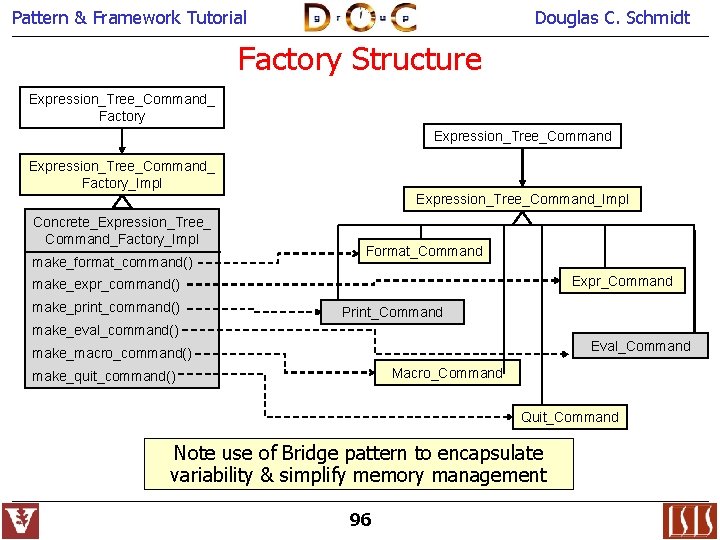
Pattern & Framework Tutorial Douglas C. Schmidt Factory Structure Expression_Tree_Command_ Factory_Impl Expression_Tree_Command_Impl Concrete_Expression_Tree_ Command_Factory_Impl make_format_command() Format_Command Expr_Command make_expr_command() make_print_command() Print_Command make_eval_command() Eval_Command make_macro_command() Macro_Command make_quit_command() Quit_Command Note use of Bridge pattern to encapsulate variability & simplify memory management 96
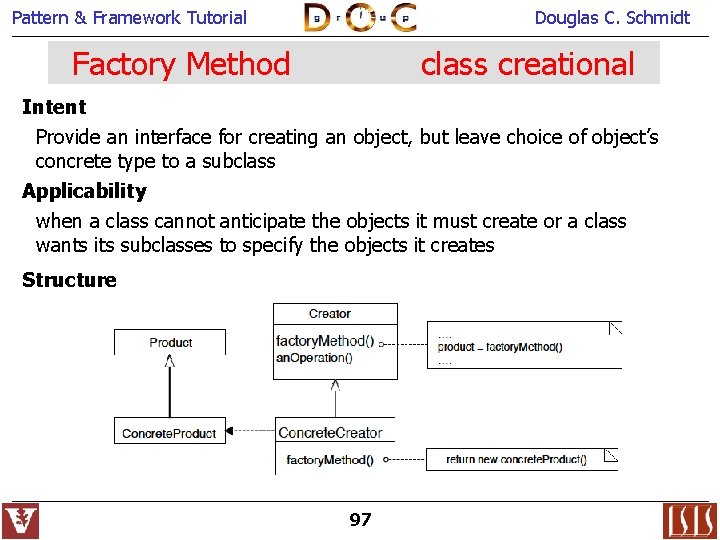
Pattern & Framework Tutorial Douglas C. Schmidt Factory Method class creational Intent Provide an interface for creating an object, but leave choice of object’s concrete type to a subclass Applicability when a class cannot anticipate the objects it must create or a class wants its subclasses to specify the objects it creates Structure 97
Pattern & Framework Tutorial Douglas C. Schmidt Factory Method class creational Consequences Known Uses +By avoiding to specify the class name of the • Inter. Views Kits concrete class &the details of its creation the • ET++ Window. System client code has become more flexible • AWT Toolkit +The client is only dependent on the interface • The ACE ORB (TAO) - Construction of objects requires one additional • BREW class in some cases • UNIX open() syscall Implementation • There are two choices here • The creator class is abstract & does not implement creation methods (then it must be subclassed) • The creator class is concrete & provides a default implementation (then it can be subclassed) • Should a factory method be able to create different variants? If so the method must be equipped with a parameter 98
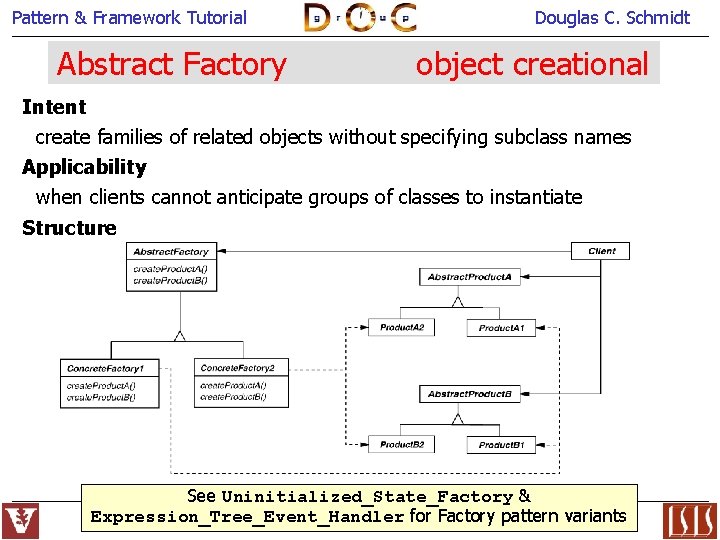
Pattern & Framework Tutorial Douglas C. Schmidt Abstract Factory object creational Intent create families of related objects without specifying subclass names Applicability when clients cannot anticipate groups of classes to instantiate Structure See Uninitialized_State_Factory & Expression_Tree_Event_Handler for Factory pattern variants 99
Pattern & Framework Tutorial Douglas C. Schmidt Abstract Factory object creational Consequences + flexibility: removes type (i. e. , subclass) dependencies from clients + abstraction & semantic checking: hides product’s composition – hard to extend factory interface to create new products Known Uses – Inter. Views Kits – ET++ Window. System – AWT Toolkit – The ACE ORB (TAO) Implementation • parameterization as a way of controlling interface size • configuration with Prototypes, i. e. , determines who creates the factories • abstract factories are essentially groups of factory methods 100
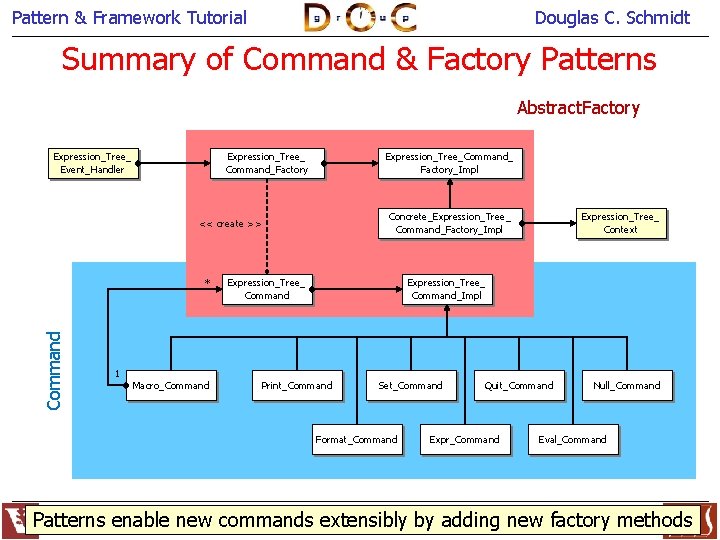
Pattern & Framework Tutorial Douglas C. Schmidt Summary of Command & Factory Patterns Abstract. Factory Expression_Tree_ Event_Handler Expression_Tree_ Command_Factory Expression_Tree_Command_ Factory_Impl Concrete_Expression_Tree_ Command_Factory_Impl << create >> Command * 1 Macro_Command Expression_Tree_ Context Expression_Tree_ Command_Impl Print_Command Set_Command Format_Command Quit_Command Expr_Command Null_Command Eval_Command 101 Patterns enable new commands extensibly by adding new factory methods
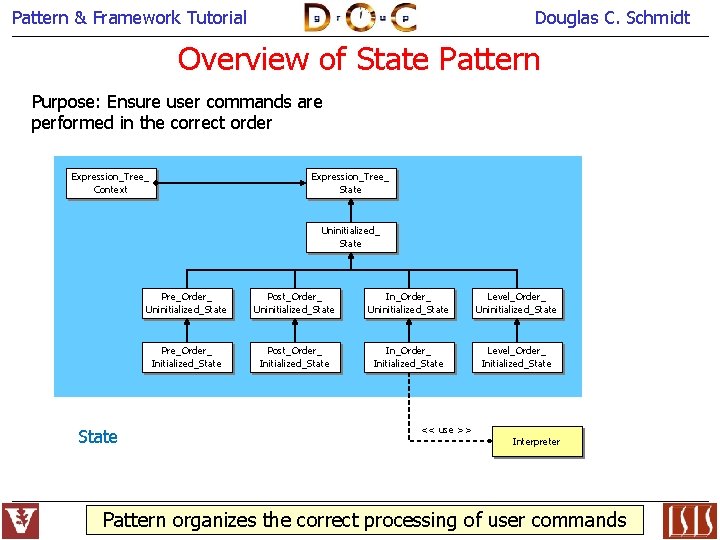
Pattern & Framework Tutorial Douglas C. Schmidt Overview of State Pattern Purpose: Ensure user commands are performed in the correct order Expression_Tree_ Context Expression_Tree_ State Uninitialized_ State Pre_Order_ Uninitialized_State Post_Order_ Uninitialized_State In_Order_ Uninitialized_State Level_Order_ Uninitialized_State Pre_Order_ Initialized_State Post_Order_ Initialized_State In_Order_ Initialized_State Level_Order_ Initialized_State << use >> Interpreter 102 Pattern organizes the correct processing of user commands
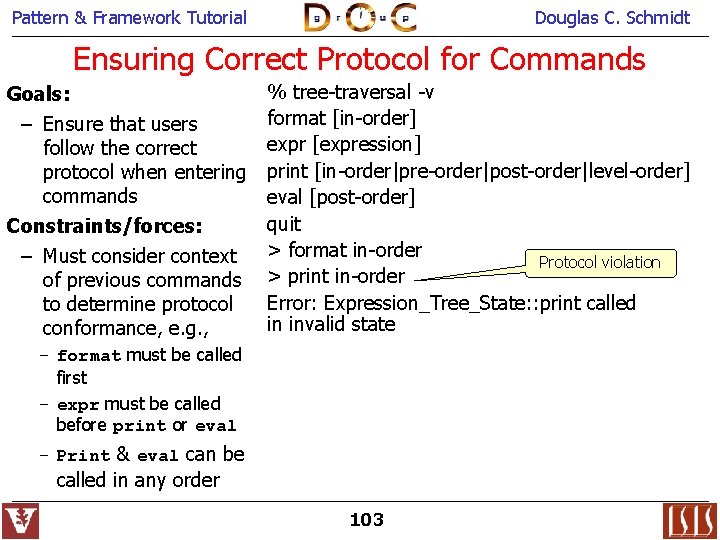
Pattern & Framework Tutorial Douglas C. Schmidt Ensuring Correct Protocol for Commands Goals: – Ensure that users follow the correct protocol when entering commands Constraints/forces: – Must consider context of previous commands to determine protocol conformance, e. g. , % tree-traversal -v format [in-order] expr [expression] print [in-order|pre-order|post-order|level-order] eval [post-order] quit > format in-order Protocol violation > print in-order Error: Expression_Tree_State: : print called in invalid state – format must be called first – expr must be called before print or eval – Print & eval can be called in any order 103
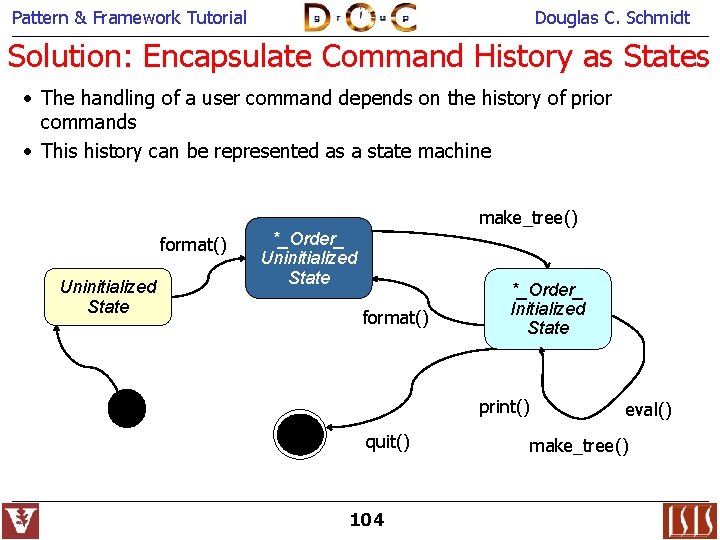
Pattern & Framework Tutorial Douglas C. Schmidt Solution: Encapsulate Command History as States • The handling of a user command depends on the history of prior commands • This history can be represented as a state machine make_tree() format() Uninitialized State *_Order_ Uninitialized State format() *_Order_ Initialized State print() quit() 104 eval() make_tree()
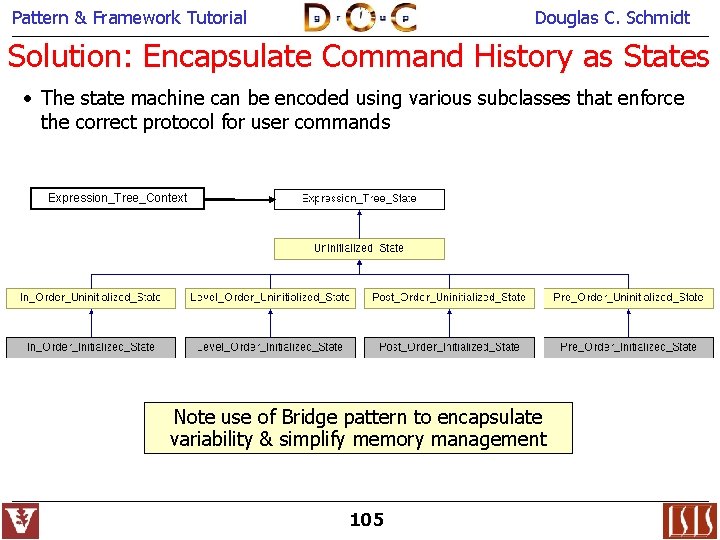
Pattern & Framework Tutorial Douglas C. Schmidt Solution: Encapsulate Command History as States • The state machine can be encoded using various subclasses that enforce the correct protocol for user commands Expression_Tree_Context Note use of Bridge pattern to encapsulate variability & simplify memory management 105
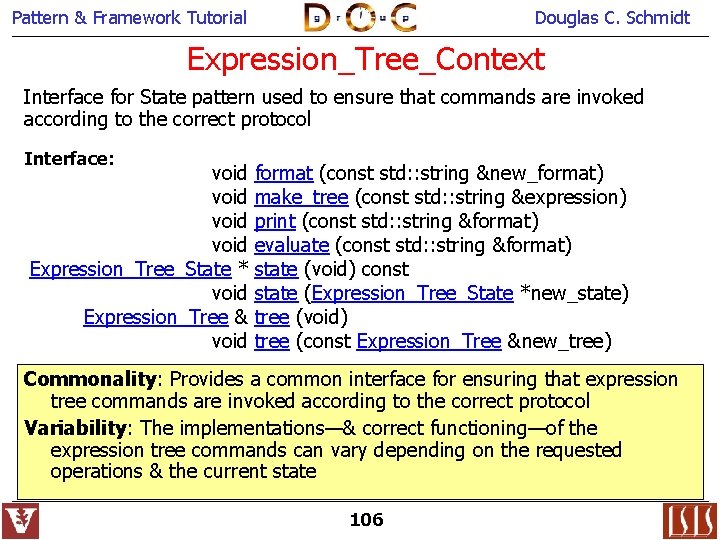
Pattern & Framework Tutorial Douglas C. Schmidt Expression_Tree_Context Interface for State pattern used to ensure that commands are invoked according to the correct protocol Interface: void format (const std: : string &new_format) void make_tree (const std: : string &expression) void print (const std: : string &format) void evaluate (const std: : string &format) Expression_Tree_State * state (void) const void state (Expression_Tree_State *new_state) Expression_Tree & tree (void) void tree (const Expression_Tree &new_tree) Commonality: Provides a common interface for ensuring that expression tree commands are invoked according to the correct protocol Variability: The implementations—& correct functioning—of the expression tree commands can vary depending on the requested operations & the current state 106
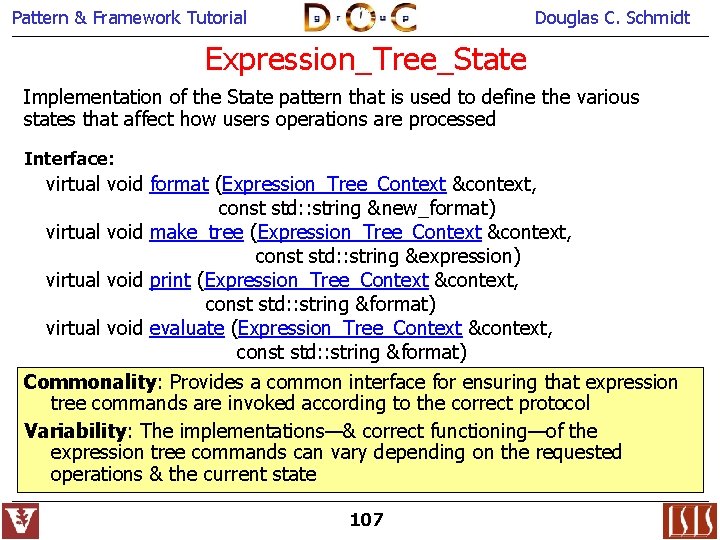
Pattern & Framework Tutorial Douglas C. Schmidt Expression_Tree_State Implementation of the State pattern that is used to define the various states that affect how users operations are processed Interface: virtual void format (Expression_Tree_Context &context, const std: : string &new_format) virtual void make_tree (Expression_Tree_Context &context, const std: : string &expression) virtual void print (Expression_Tree_Context &context, const std: : string &format) virtual void evaluate (Expression_Tree_Context &context, const std: : string &format) Commonality: Provides a common interface for ensuring that expression tree commands are invoked according to the correct protocol Variability: The implementations—& correct functioning—of the expression tree commands can vary depending on the requested operations & the current state 107
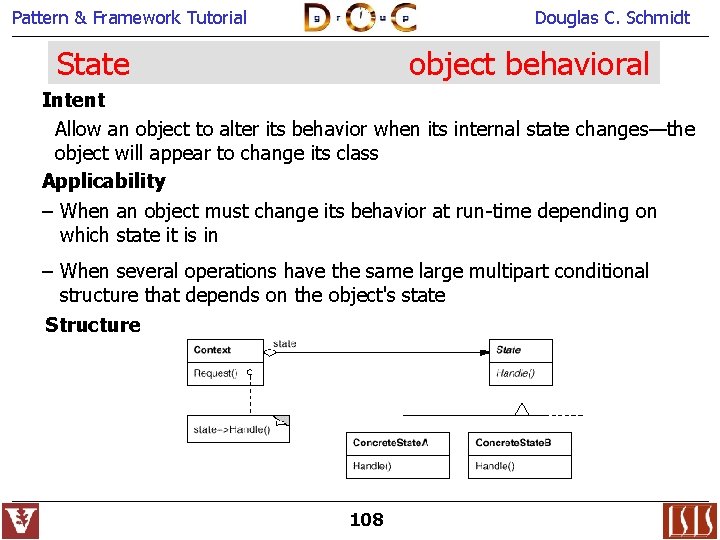
Pattern & Framework Tutorial Douglas C. Schmidt State object behavioral Intent Allow an object to alter its behavior when its internal state changes—the object will appear to change its class Applicability – When an object must change its behavior at run-time depending on which state it is in – When several operations have the same large multipart conditional structure that depends on the object's state Structure 108
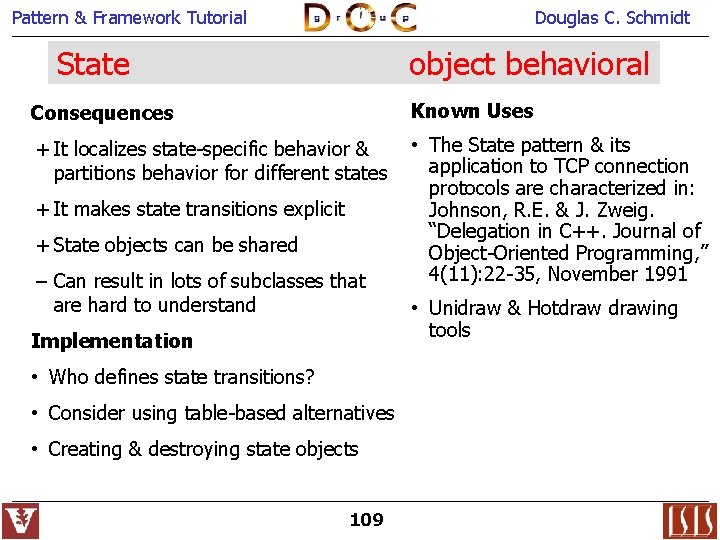
Pattern & Framework Tutorial Douglas C. Schmidt State object behavioral Known Uses Consequences • The State pattern & its + It localizes state-specific behavior & application to TCP connection partitions behavior for different states protocols are characterized in: + It makes state transitions explicit Johnson, R. E. & J. Zweig. “Delegation in C++. Journal of + State objects can be shared Object-Oriented Programming, ” 4(11): 22 -35, November 1991 – Can result in lots of subclasses that are hard to understand • Unidraw & Hotdrawing tools Implementation • Who defines state transitions? • Consider using table-based alternatives • Creating & destroying state objects 109
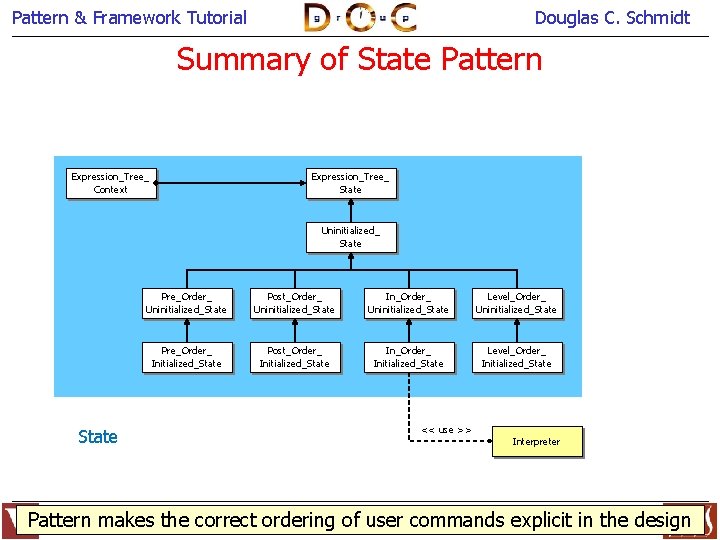
Pattern & Framework Tutorial Douglas C. Schmidt Summary of State Pattern Expression_Tree_ Context Expression_Tree_ State Uninitialized_ State Pre_Order_ Uninitialized_State Post_Order_ Uninitialized_State In_Order_ Uninitialized_State Level_Order_ Uninitialized_State Pre_Order_ Initialized_State Post_Order_ Initialized_State In_Order_ Initialized_State Level_Order_ Initialized_State << use >> Interpreter 110 Pattern makes the correct ordering of user commands explicit in the design
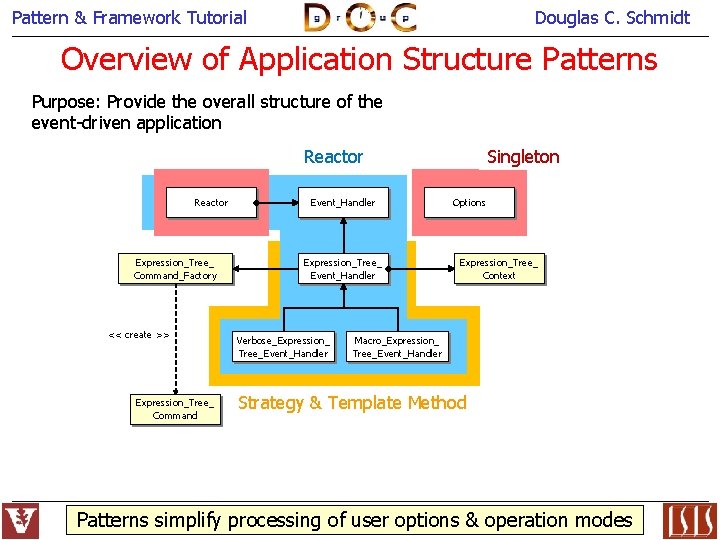
Pattern & Framework Tutorial Douglas C. Schmidt Overview of Application Structure Patterns Purpose: Provide the overall structure of the event-driven application Reactor Expression_Tree_ Command_Factory << create >> Expression_Tree_ Command Event_Handler Expression_Tree_ Event_Handler Verbose_Expression_ Tree_Event_Handler Singleton Options Expression_Tree_ Context Macro_Expression_ Tree_Event_Handler Strategy & Template Method 111 Patterns simplify processing of user options & operation modes
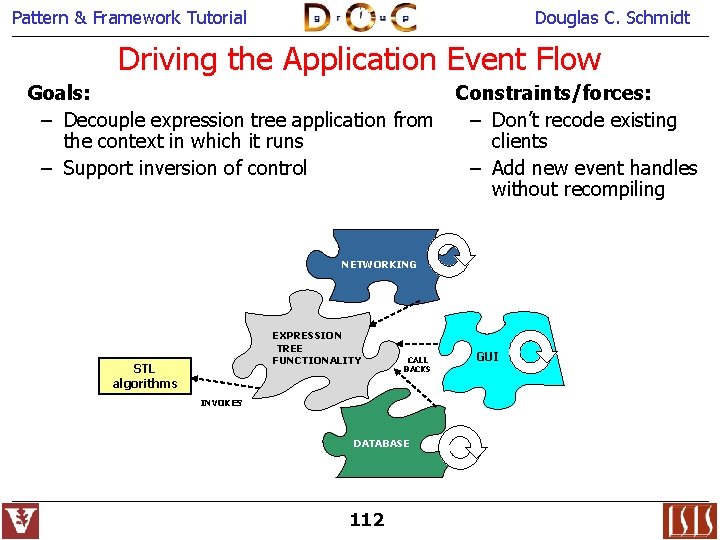
Pattern & Framework Tutorial Douglas C. Schmidt Driving the Application Event Flow Goals: Constraints/forces: – Decouple expression tree application from – Don’t recode existing the context in which it runs clients – Support inversion of control – Add new event handles without recompiling Reactor NETWORKING EXPRESSION TREE FUNCTIONALITY STL algorithms CALL BACKS INVOKES DATABASE 112 GUI
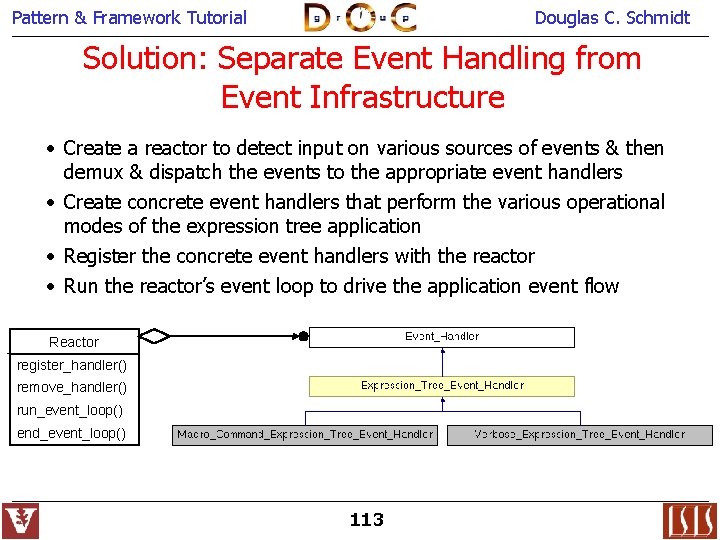
Pattern & Framework Tutorial Douglas C. Schmidt Solution: Separate Event Handling from Event Infrastructure • Create a reactor to detect input on various sources of events & then demux & dispatch the events to the appropriate event handlers • Create concrete event handlers that perform the various operational modes of the expression tree application • Register the concrete event handlers with the reactor • Run the reactor’s event loop to drive the application event flow Reactor register_handler() remove_handler() run_event_loop() end_event_loop() 113
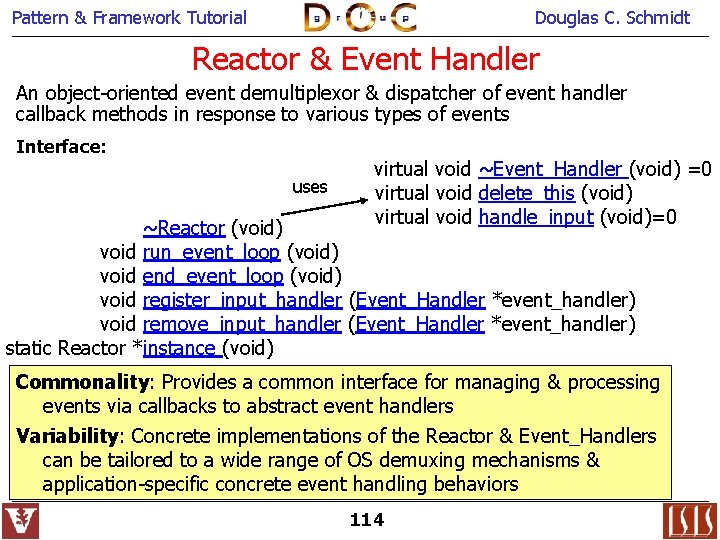
Pattern & Framework Tutorial Douglas C. Schmidt Reactor & Event Handler An object-oriented event demultiplexor & dispatcher of event handler callback methods in response to various types of events Interface: uses virtual void ~Event_Handler (void) =0 virtual void delete_this (void) virtual void handle_input (void)=0 ~Reactor (void) void run_event_loop (void) void end_event_loop (void) void register_input_handler (Event_Handler *event_handler) void remove_input_handler (Event_Handler *event_handler) static Reactor *instance (void) Commonality: Provides a common interface for managing & processing events via callbacks to abstract event handlers Variability: Concrete implementations of the Reactor & Event_Handlers can be tailored to a wide range of OS demuxing mechanisms & application-specific concrete event handling behaviors 114
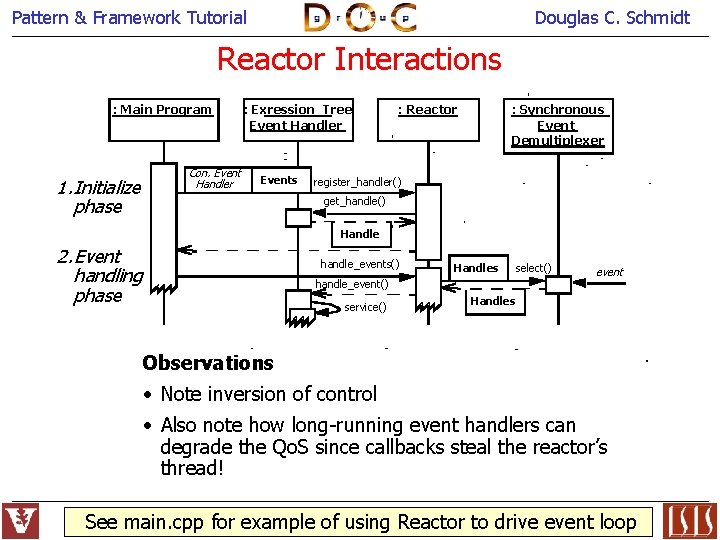
Pattern & Framework Tutorial Douglas C. Schmidt Reactor Interactions : Main Program 1. Initialize phase Con. Event Handler : Exression_Tree Event Handler Events : Reactor : Synchronous Event Demultiplexer register_handler() get_handle() Handle 2. Event handling phase handle_events() Handles handle_event() service() select() event Handles Observations • Note inversion of control • Also note how long-running event handlers can degrade the Qo. S since callbacks steal the reactor’s thread! 115 See main. cpp for example of using Reactor to drive event loop
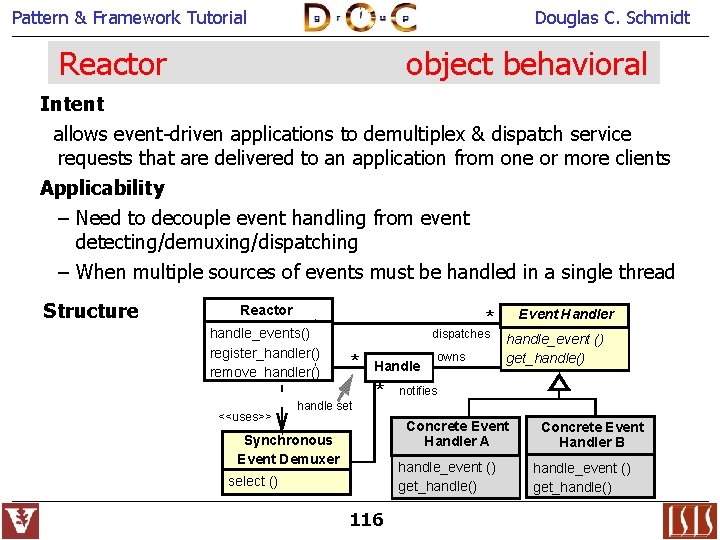
Pattern & Framework Tutorial Douglas C. Schmidt Reactor object behavioral Intent allows event-driven applications to demultiplex & dispatch service requests that are delivered to an application from one or more clients Applicability – Need to decouple event handling from event detecting/demuxing/dispatching – When multiple sources of events must be handled in a single thread Structure Reactor handle_events() register_handler() remove_handler() <<uses>> * dispatches * handle set Handle * owns Event Handler handle_event () get_handle() notifies Concrete Event Handler A Synchronous Event Demuxer handle_event () get_handle() select () 116 Concrete Event Handler B handle_event () get_handle()
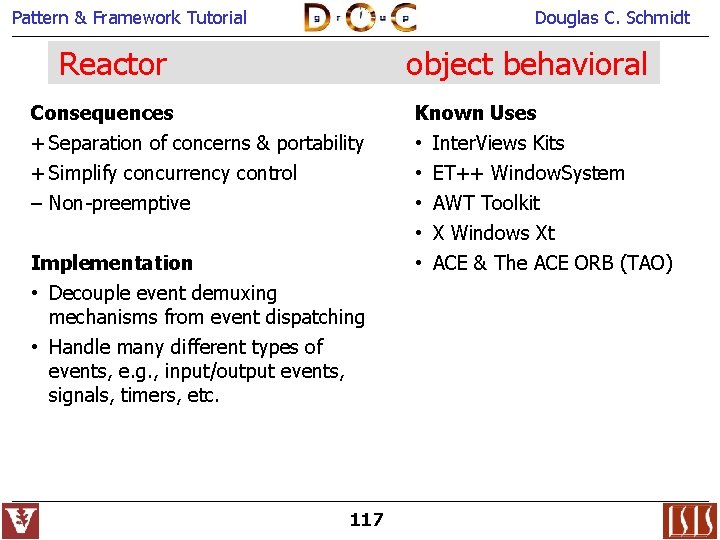
Pattern & Framework Tutorial Douglas C. Schmidt Reactor object behavioral Consequences + Separation of concerns & portability + Simplify concurrency control – Non-preemptive Implementation • Decouple event demuxing mechanisms from event dispatching • Handle many different types of events, e. g. , input/output events, signals, timers, etc. 117 Known Uses • Inter. Views Kits • ET++ Window. System • AWT Toolkit • X Windows Xt • ACE & The ACE ORB (TAO)
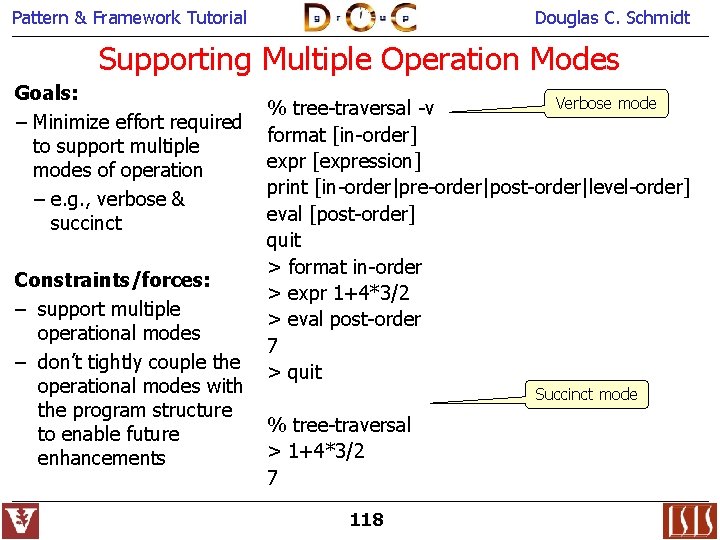
Pattern & Framework Tutorial Douglas C. Schmidt Supporting Multiple Operation Modes Goals: – Minimize effort required to support multiple modes of operation – e. g. , verbose & succinct Verbose mode % tree-traversal -v format [in-order] expr [expression] print [in-order|pre-order|post-order|level-order] eval [post-order] quit > format in-order > expr 1+4*3/2 > eval post-order 7 > quit Constraints/forces: – support multiple operational modes – don’t tightly couple the operational modes with the program structure % tree-traversal to enable future > 1+4*3/2 enhancements 7 118 Succinct mode
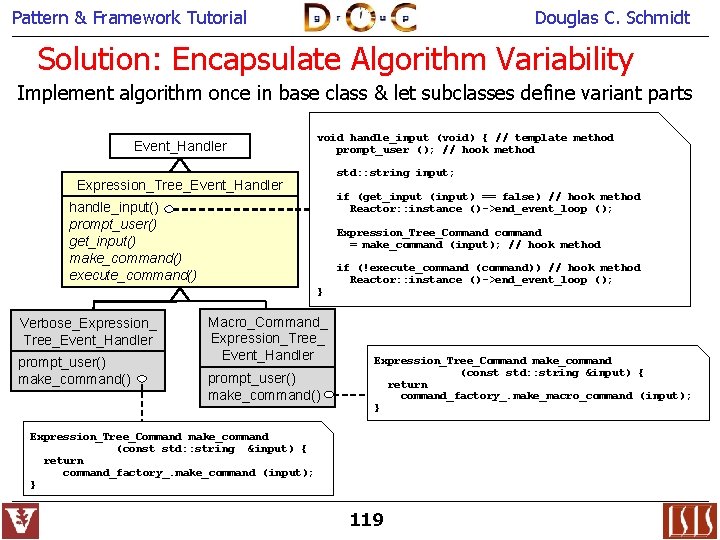
Pattern & Framework Tutorial Douglas C. Schmidt Solution: Encapsulate Algorithm Variability Implement algorithm once in base class & let subclasses define variant parts Event_Handler void handle_input (void) { // template method prompt_user (); // hook method std: : string input; Expression_Tree_Event_Handler if (get_input (input) == false) // hook method Reactor: : instance ()->end_event_loop (); handle_input() prompt_user() get_input() make_command() execute_command() Expression_Tree_Command command = make_command (input); // hook method } Verbose_Expression_ Tree_Event_Handler prompt_user() make_command() Macro_Command_ Expression_Tree_ Event_Handler prompt_user() make_command() if (!execute_command (command)) // hook method Reactor: : instance ()->end_event_loop (); Expression_Tree_Command make_command (const std: : string &input) { return command_factory_. make_macro_command (input); } Expression_Tree_Command make_command (const std: : string &input) { return command_factory_. make_command (input); } 119
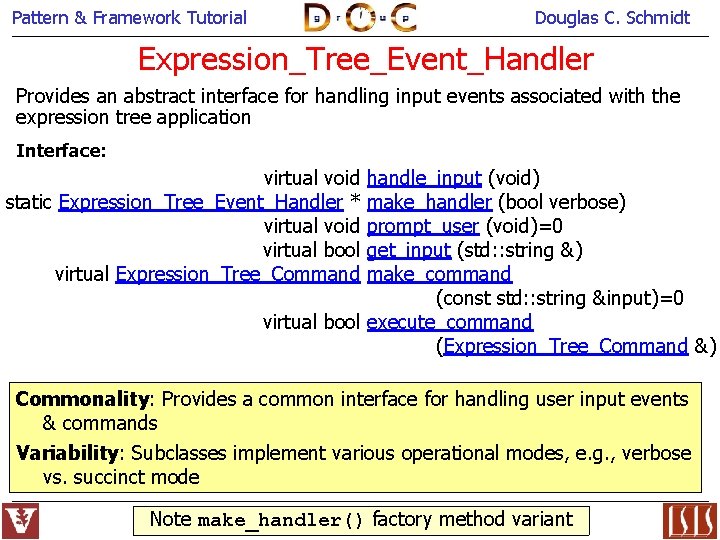
Pattern & Framework Tutorial Douglas C. Schmidt Expression_Tree_Event_Handler Provides an abstract interface for handling input events associated with the expression tree application Interface: virtual void handle_input (void) static Expression_Tree_Event_Handler * make_handler (bool verbose) virtual void prompt_user (void)=0 virtual bool get_input (std: : string &) virtual Expression_Tree_Command make_command (const std: : string &input)=0 virtual bool execute_command (Expression_Tree_Command &) Commonality: Provides a common interface for handling user input events & commands Variability: Subclasses implement various operational modes, e. g. , verbose vs. succinct mode Note make_handler() factory method variant 120
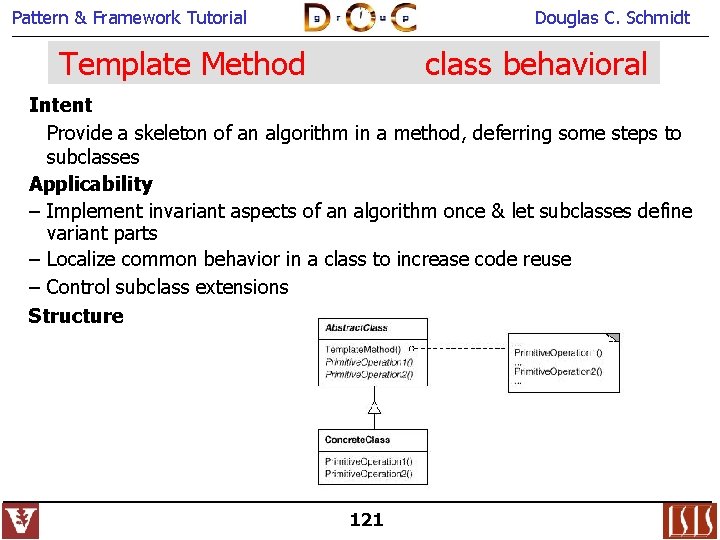
Pattern & Framework Tutorial Douglas C. Schmidt Template Method class behavioral Intent Provide a skeleton of an algorithm in a method, deferring some steps to subclasses Applicability – Implement invariant aspects of an algorithm once & let subclasses define variant parts – Localize common behavior in a class to increase code reuse – Control subclass extensions Structure 121
Pattern & Framework Tutorial Douglas C. Schmidt Template Method class behavioral Consequences + Leads to inversion of control (“Hollywood principle”: don't call us – we'll call you) + Promotes code reuse + Lets you enforce overriding rules – Must subclass to specialize behavior (cf. Strategy pattern) Implementation • Virtual vs. non-virtual template method • Few vs. lots of primitive operations (hook method) • Naming conventions (do_*() prefix) Known Uses • Inter. Views Kits • ET++ Window. System • AWT Toolkit • ACE & The ACE ORB (TAO) 122
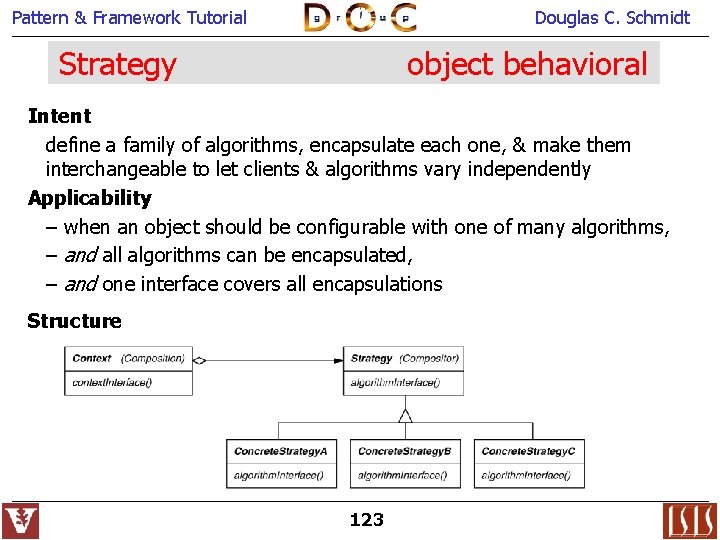
Pattern & Framework Tutorial Douglas C. Schmidt Strategy object behavioral Intent define a family of algorithms, encapsulate each one, & make them interchangeable to let clients & algorithms vary independently Applicability – when an object should be configurable with one of many algorithms, – and all algorithms can be encapsulated, – and one interface covers all encapsulations Structure 123
Pattern & Framework Tutorial Douglas C. Schmidt Strategy object behavioral Consequences + greater flexibility, reuse Known Uses • Inter. Views text formatting + can change algorithms dynamically – strategy creation & communication overhead – inflexible Strategy interface – semantic incompatibility of multiple strategies used together Implementation • exchanging information between a Strategy & its context • static strategy selection via parameterized types • RTL register allocation & scheduling strategies • ET++Swaps. Manager calculation engines • The ACE ORB (TAO) Realtime CORBA middleware See Also • Bridge pattern (object structural) 124
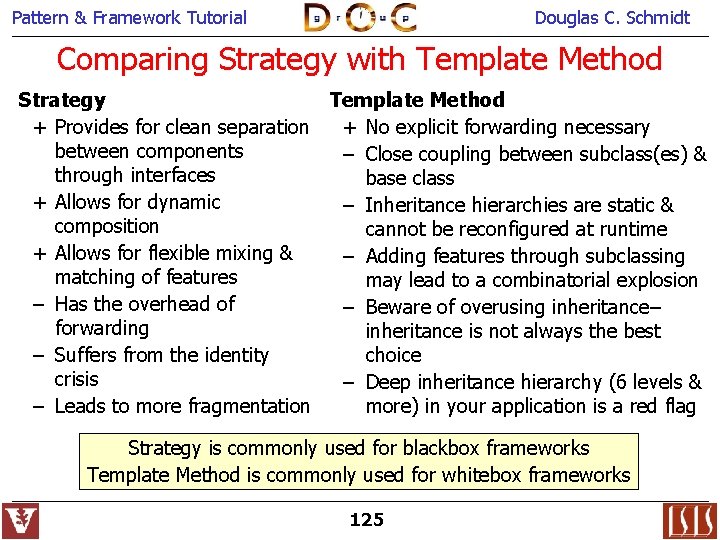
Pattern & Framework Tutorial Douglas C. Schmidt Comparing Strategy with Template Method Strategy Template Method + Provides for clean separation + No explicit forwarding necessary between components – Close coupling between subclass(es) & through interfaces base class + Allows for dynamic – Inheritance hierarchies are static & composition cannot be reconfigured at runtime + Allows for flexible mixing & – Adding features through subclassing matching of features may lead to a combinatorial explosion – Has the overhead of – Beware of overusing inheritance– forwarding inheritance is not always the best – Suffers from the identity choice crisis – Deep inheritance hierarchy (6 levels & – Leads to more fragmentation more) in your application is a red flag Strategy is commonly used for blackbox frameworks Template Method is commonly used for whitebox frameworks 125
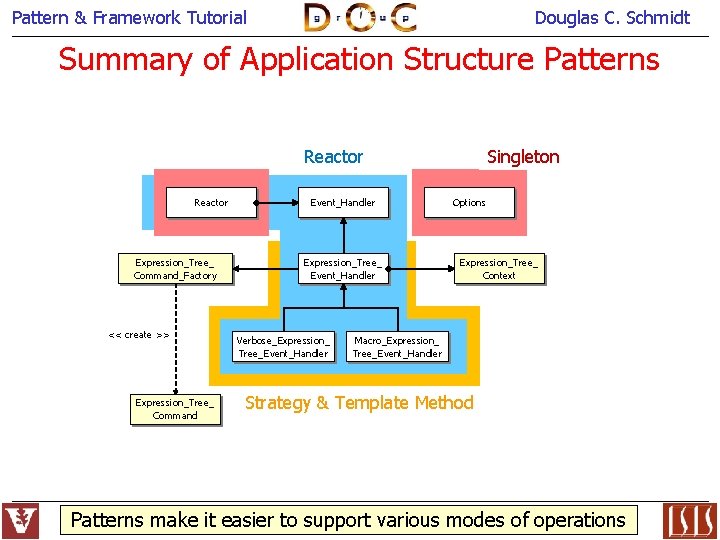
Pattern & Framework Tutorial Douglas C. Schmidt Summary of Application Structure Patterns Reactor Expression_Tree_ Command_Factory << create >> Expression_Tree_ Command Event_Handler Expression_Tree_ Event_Handler Verbose_Expression_ Tree_Event_Handler Singleton Options Expression_Tree_ Context Macro_Expression_ Tree_Event_Handler Strategy & Template Method 126 Patterns make it easier to support various modes of operations
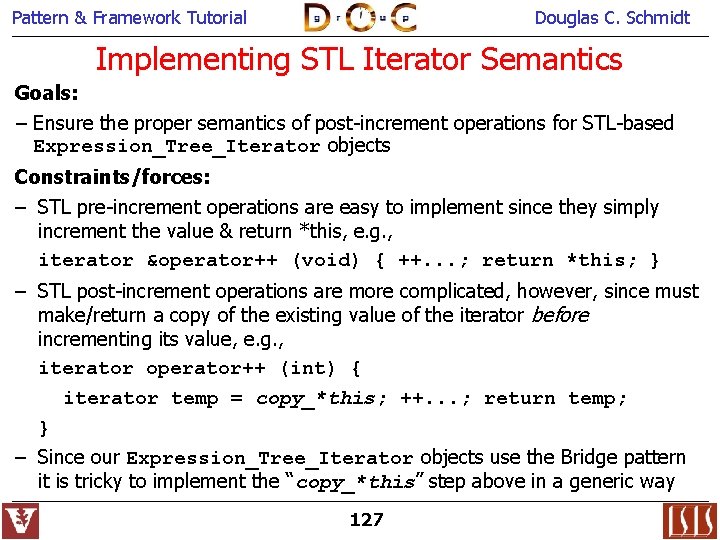
Pattern & Framework Tutorial Douglas C. Schmidt Implementing STL Iterator Semantics Goals: – Ensure the proper semantics of post-increment operations for STL-based Expression_Tree_Iterator objects Constraints/forces: – STL pre-increment operations are easy to implement since they simply increment the value & return *this, e. g. , iterator &operator++ (void) { ++. . . ; return *this; } – STL post-increment operations are more complicated, however, since must make/return a copy of the existing value of the iterator before incrementing its value, e. g. , iterator operator++ (int) { iterator temp = copy_*this; ++. . . ; return temp; } – Since our Expression_Tree_Iterator objects use the Bridge pattern it is tricky to implement the “copy_*this” step above in a generic way 127
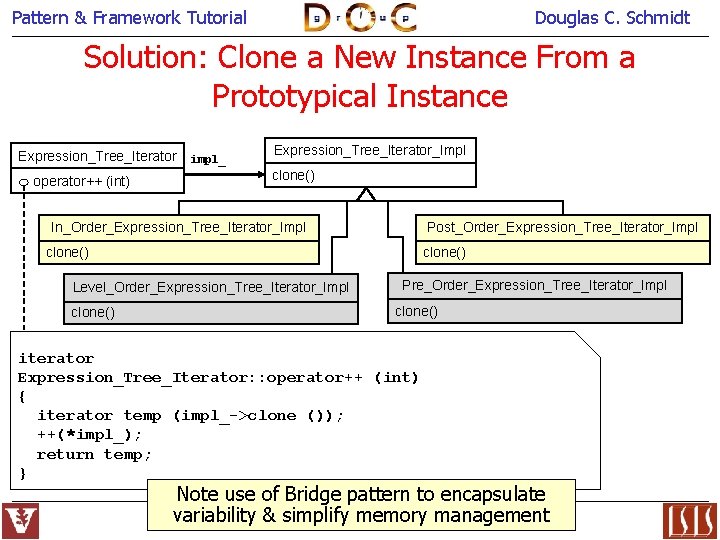
Pattern & Framework Tutorial Douglas C. Schmidt Solution: Clone a New Instance From a Prototypical Instance Expression_Tree_Iterator operator++ (int) impl_ Expression_Tree_Iterator_Impl clone() Post_Order_Expression_Tree_Iterator_Impl In_Order_Expression_Tree_Iterator_Impl clone() Level_Order_Expression_Tree_Iterator_Impl clone() Pre_Order_Expression_Tree_Iterator_Impl clone() iterator Expression_Tree_Iterator: : operator++ (int) { iterator temp (impl_->clone ()); ++(*impl_); return temp; } Note use of Bridge pattern to encapsulate variability & simplify memory management 128
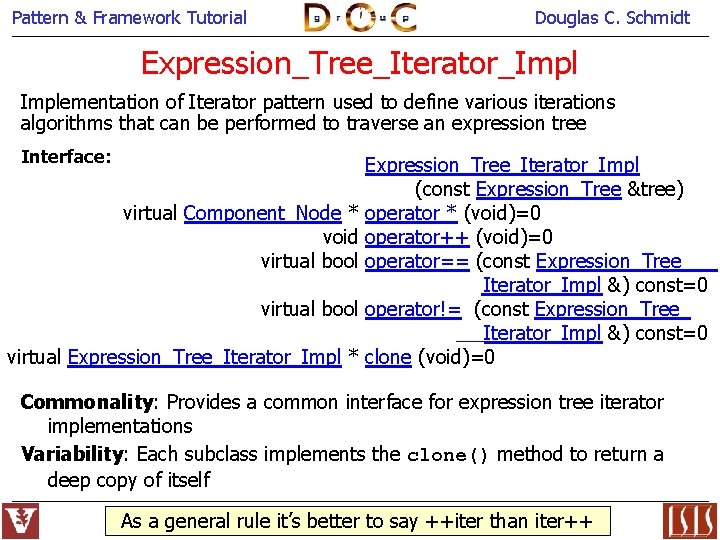
Pattern & Framework Tutorial Douglas C. Schmidt Expression_Tree_Iterator_Implementation of Iterator pattern used to define various iterations algorithms that can be performed to traverse an expression tree Interface: Expression_Tree_Iterator_Impl (const Expression_Tree &tree) virtual Component_Node * operator * (void)=0 void operator++ (void)=0 virtual bool operator== (const Expression_Tree_ Iterator_Impl &) const=0 virtual bool operator!= (const Expression_Tree_ Iterator_Impl &) const=0 virtual Expression_Tree_Iterator_Impl * clone (void)=0 Commonality: Provides a common interface for expression tree iterator implementations Variability: Each subclass implements the clone() method to return a deep copy of itself 129 As a general rule it’s better to say ++iter than iter++
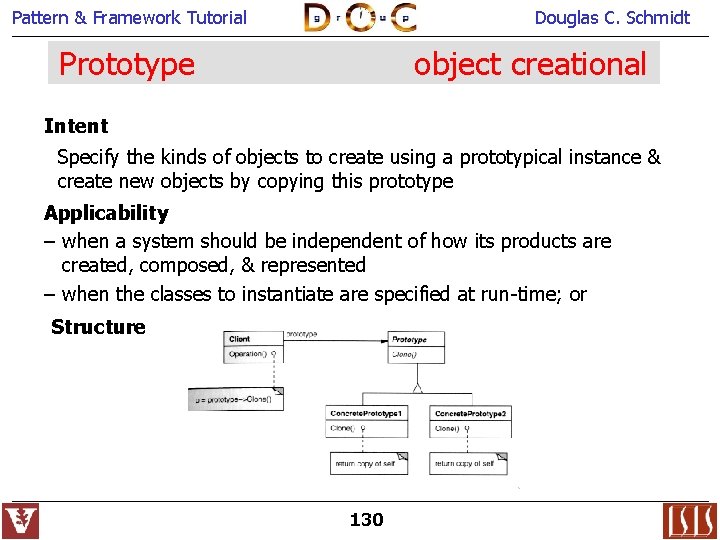
Pattern & Framework Tutorial Douglas C. Schmidt Prototype object creational Intent Specify the kinds of objects to create using a prototypical instance & create new objects by copying this prototype Applicability – when a system should be independent of how its products are created, composed, & represented – when the classes to instantiate are specified at run-time; or Structure 130
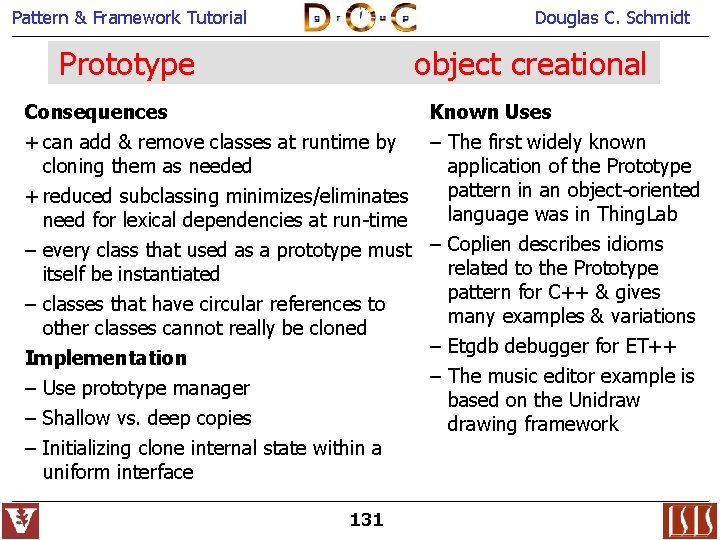
Pattern & Framework Tutorial Douglas C. Schmidt Prototype object creational Consequences + can add & remove classes at runtime by cloning them as needed + reduced subclassing minimizes/eliminates need for lexical dependencies at run-time – every class that used as a prototype must itself be instantiated – classes that have circular references to other classes cannot really be cloned Implementation – Use prototype manager – Shallow vs. deep copies – Initializing clone internal state within a uniform interface 131 Known Uses – The first widely known application of the Prototype pattern in an object-oriented language was in Thing. Lab – Coplien describes idioms related to the Prototype pattern for C++ & gives many examples & variations – Etgdb debugger for ET++ – The music editor example is based on the Unidrawing framework

Pattern & Framework Tutorial Douglas C. Schmidt Part III: Wrap-Up 132
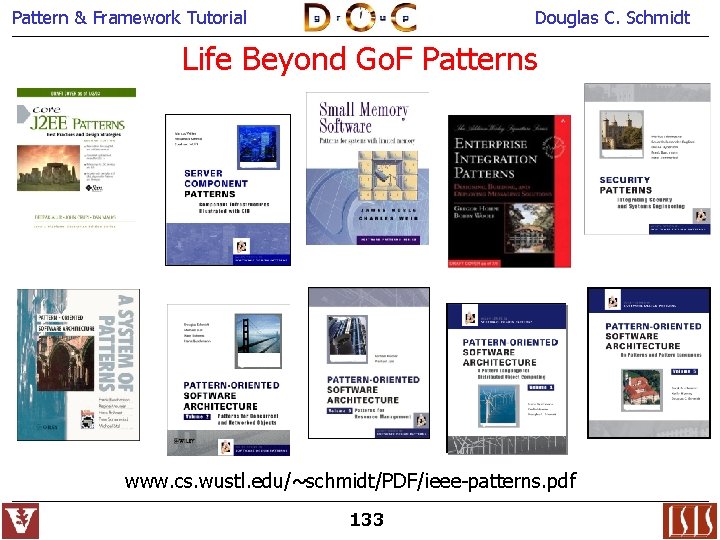
Pattern & Framework Tutorial Douglas C. Schmidt Life Beyond Go. F Patterns www. cs. wustl. edu/~schmidt/PDF/ieee-patterns. pdf 133
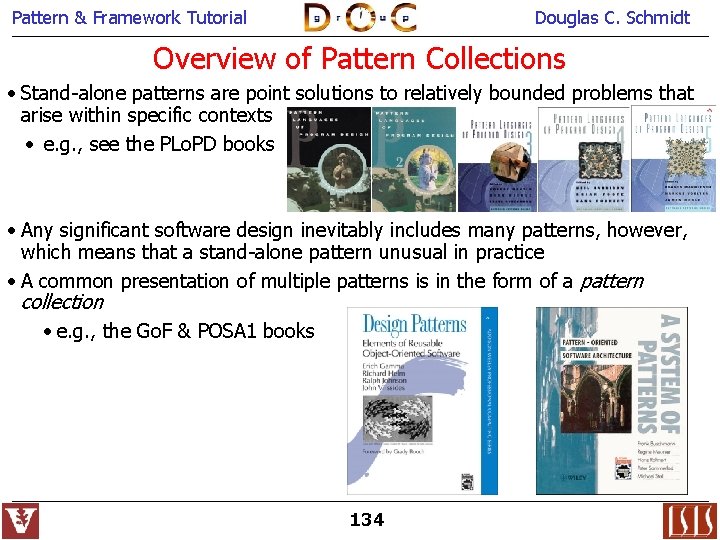
Pattern & Framework Tutorial Douglas C. Schmidt Overview of Pattern Collections • Stand-alone patterns are point solutions to relatively bounded problems that arise within specific contexts • e. g. , see the PLo. PD books • Any significant software design inevitably includes many patterns, however, which means that a stand-alone pattern unusual in practice • A common presentation of multiple patterns is in the form of a pattern collection • e. g. , the Go. F & POSA 1 books 134
Pattern & Framework Tutorial Douglas C. Schmidt Overview of Pattern Relationships • Patterns representing the foci for discussion, point solutions, or localized design ideas can be used in isolation with some success • Patterns are generally gregarious, however, in that they form relationships with other patterns • Four of the most common types of pattern relationships include: 1. Patterns complements, where 3. Pattern sequences generalize one pattern provides the missing the progression of patterns & the ingredient needed by another or way a design can be established where one pattern contrasts with by joining predecessor patterns another by providing an alternative to form part of the context of solution to a related problem each successive pattern 2. Pattern compounds capture 4. Pattern languages define a recurring subcommunities of patterns vocabulary for talking about that are common & identifiable software development problems enough that they can be treated & provide a process for the as a single decision in response to orderly resolution of these a recurring problems 135
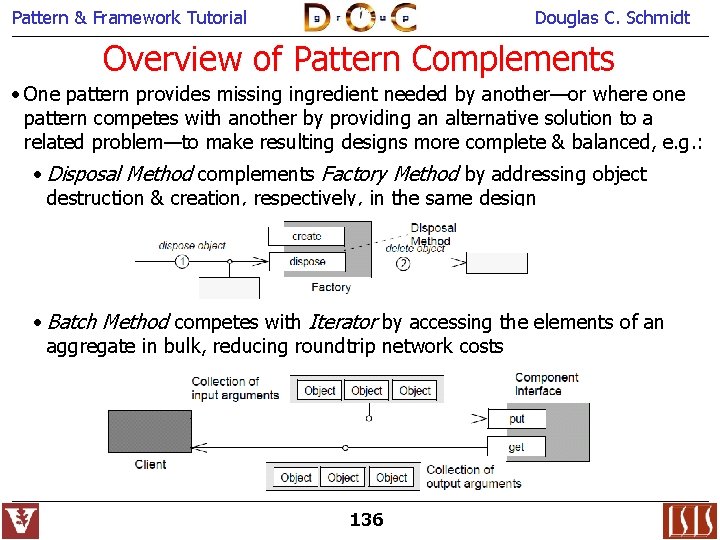
Pattern & Framework Tutorial Douglas C. Schmidt Overview of Pattern Complements • One pattern provides missing ingredient needed by another—or where one pattern competes with another by providing an alternative solution to a related problem—to make resulting designs more complete & balanced, e. g. : • Disposal Method complements Factory Method by addressing object destruction & creation, respectively, in the same design • Batch Method competes with Iterator by accessing the elements of an aggregate in bulk, reducing roundtrip network costs 136
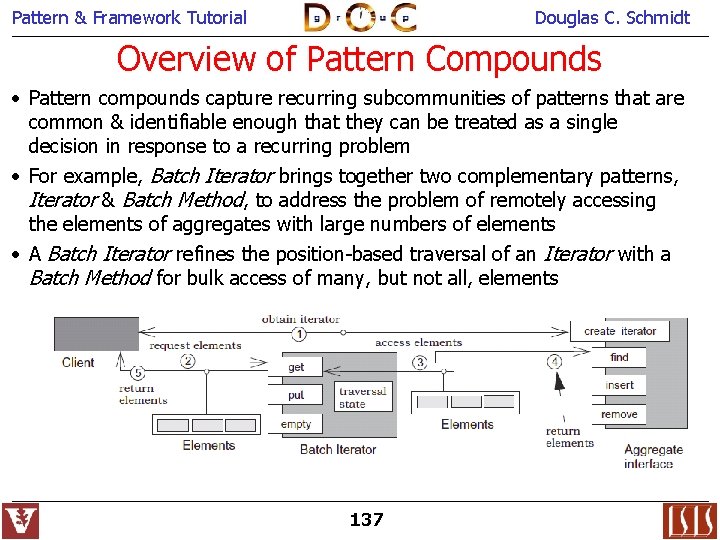
Pattern & Framework Tutorial Douglas C. Schmidt Overview of Pattern Compounds • Pattern compounds capture recurring subcommunities of patterns that are common & identifiable enough that they can be treated as a single decision in response to a recurring problem • For example, Batch Iterator brings together two complementary patterns, Iterator & Batch Method, to address the problem of remotely accessing the elements of aggregates with large numbers of elements • A Batch Iterator refines the position-based traversal of an Iterator with a Batch Method for bulk access of many, but not all, elements 137
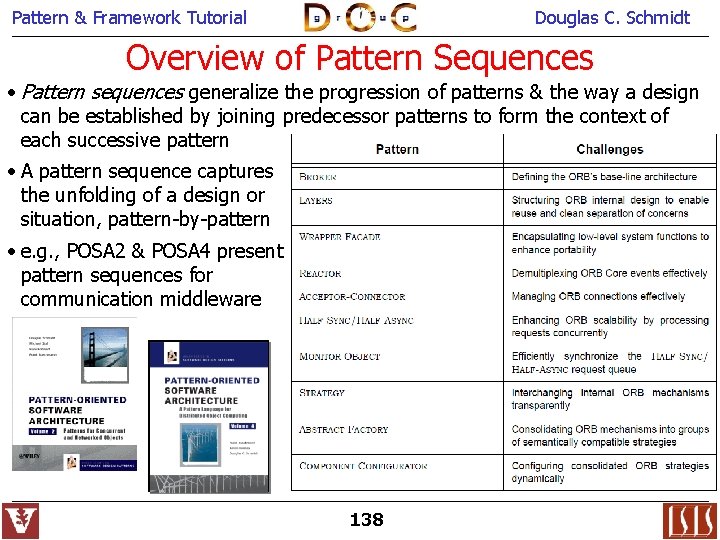
Pattern & Framework Tutorial Douglas C. Schmidt Overview of Pattern Sequences • Pattern sequences generalize the progression of patterns & the way a design can be established by joining predecessor patterns to form the context of each successive pattern • A pattern sequence captures the unfolding of a design or situation, pattern-by-pattern • e. g. , POSA 2 & POSA 4 present pattern sequences for communication middleware 138
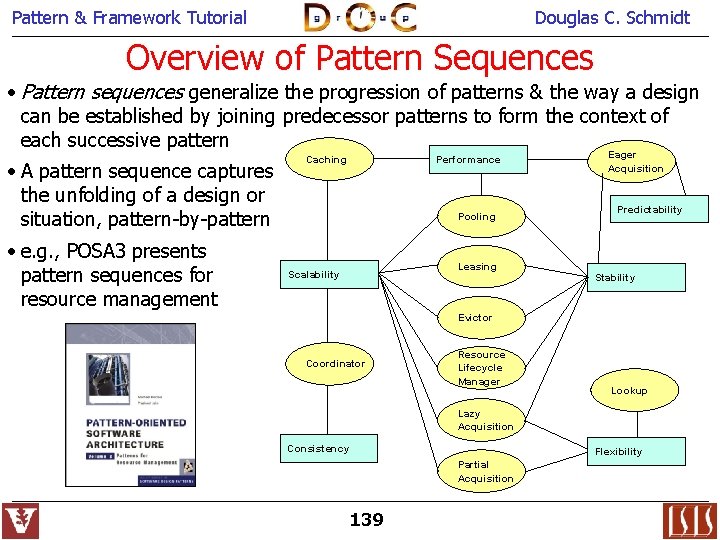
Pattern & Framework Tutorial Douglas C. Schmidt Overview of Pattern Sequences • Pattern sequences generalize the progression of patterns & the way a design can be established by joining predecessor patterns to form the context of each successive pattern Performance Caching Eager Acquisition • A pattern sequence captures the unfolding of a design or Predictability Pooling situation, pattern-by-pattern • e. g. , POSA 3 presents Leasing Scalability Stability pattern sequences for resource management Evictor Coordinator Resource Lifecycle Manager Lookup Lazy Acquisition Consistency Flexibility Partial Acquisition 139
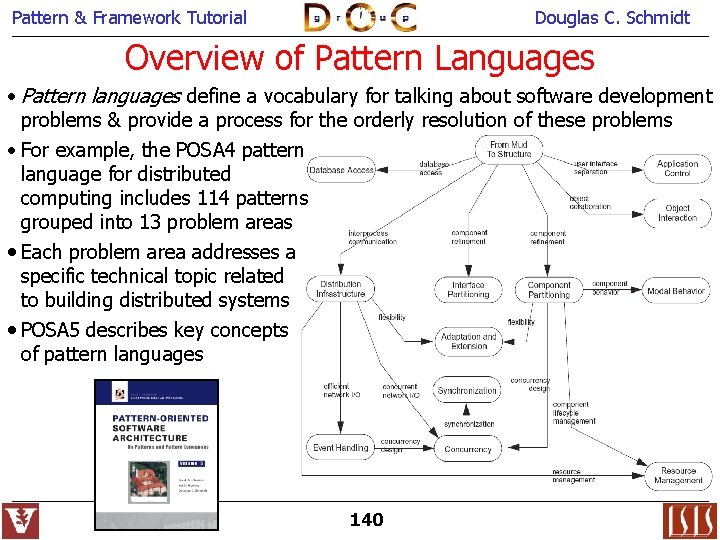
Pattern & Framework Tutorial Douglas C. Schmidt Overview of Pattern Languages • Pattern languages define a vocabulary for talking about software development problems & provide a process for the orderly resolution of these problems • For example, the POSA 4 pattern language for distributed computing includes 114 patterns grouped into 13 problem areas • Each problem area addresses a specific technical topic related to building distributed systems • POSA 5 describes key concepts of pattern languages 140
Pattern & Framework Tutorial Douglas C. Schmidt Observations on Applying Patterns & Frameworks Patterns & frameworks support • design/implementation at a more abstract level – treat many class/object interactions as a unit – often beneficial after initial design – targets for class refactorings • Variation-oriented design/implementation – consider what design aspects are variable – identify applicable pattern(s) – vary patterns to evaluate tradeoffs – repeat 141 Patterns are applicable in all stages of the OO lifecycle analysis, design, & reviews – realization & documentation – reuse & refactoring – Patterns often equated with OO languages, but many also apply to C
Pattern & Framework Tutorial Douglas C. Schmidt Caveats to Keep in Mind Don’t apply patterns & frameworks blindly • Added indirection can yield increased complexity, cost • Understand patterns to learn how to better develop/use frameworks Resist branding everything a pattern • Articulate specific benefits • Demonstrate wide applicability • Find at least three existing examples from code other than your own! Pattern & framework design even harder than OO design! 142
Pattern & Framework Tutorial Douglas C. Schmidt Concluding Remarks • Patterns & frameworks promote – Integrated design & implementation reuse – uniform design vocabulary – understanding, restructuring, & team communication – a basis for automation – a “new” way to think about software design & implementation There’s much more to patterns than just the Go. F, however!!!! 143
Pattern & Framework Tutorial Books Douglas C. Schmidt Pattern References Timeless Way of Building, Alexander, ISBN 0 -19 -502402 -8 A Pattern Language, Alexander, 0 -19 -501 -919 -9 Design Patterns, Gamma, et al. , 0 -201 -63361 -2 CD version 0 -201 -63498 -8 Pattern-Oriented Software Architecture, Vol. 1, Buschmann, et al. , 0 -471 -95869 -7 Pattern-Oriented Software Architecture, Vol. 2, Schmidt, et al. , 0 -471 -60695 -2 Pattern-Oriented Software Architecture, Vol. 3, Jain & Kircher, 0 -470 -84525 -2 Pattern-Oriented Software Architecture, Vol. 4, Buschmann, et al. , 0 -470 -05902 -8 Pattern-Oriented Software Architecture, Vol. 5, Buschmann, et al. , 0 -471 -48648 -5 144
Pattern & Framework Tutorial Douglas C. Schmidt Pattern References (cont’d) More Books Analysis Patterns, Fowler; 0 -201 -89542 -0 Concurrent Programming in Java, 2 nd ed. , Lea, 0 -201 -31009 -0 Pattern Languages of Program Design Vol. 1, Coplien, et al. , eds. , ISBN 0 -201 -60734 -4 Vol. 2, Vlissides, et al. , eds. , 0 -201 -89527 -7 Vol. 3, Martin, et al. , eds. , 0 -201 -31011 -2 Vol. 4, Harrison, et al. , eds. , 0 -201 -43304 -4 Vol. 5, Manolescu, et al. , eds. , 0 -32194 -4 Anti. Patterns, Brown, et al. , 0 -471 -19713 -0 Applying UML & Patterns, 2 nd ed. , Larman, 0 -13 -092569 -1 Pattern Hatching, Vlissides, 0 -201 -43293 -5 The Pattern Almanac 2000, Rising, 0 -201 -61567 -3 145
Pattern & Framework Tutorial Douglas C. Schmidt Pattern References (cont’d) Even More Books Small Memory Software, Noble & Weir, 0 -201 -59607 -5 Microsoft Visual Basic Design Patterns, Stamatakis, 1 -572 -31957 -7 Smalltalk Best Practice Patterns, Beck; 0 -13 -476904 -X The Design Patterns Smalltalk Companion, Alpert, et al. , 0 -201 -18462 -1 Modern C++ Design, Alexandrescu, ISBN 0 -201 -70431 -5 Building Parsers with Java, Metsker, 0 -201 -71962 -2 Core J 2 EE Patterns, Alur, et al. , 0 -130 -64884 -1 Design Patterns Explained, Shalloway & Trott, 0 -201 -71594 -5 The Joy of Patterns, Goldfedder, 0 -201 -65759 -7 The Manager Pool, Olson & Stimmel, 0 -201 -72583 -5 146
Pattern & Framework Tutorial Douglas C. Schmidt Pattern References (cont’d) Early Papers “Object-Oriented Patterns, ” P. Coad; Comm. of the ACM, 9/92 “Documenting Frameworks using Patterns, ” R. Johnson; OOPSLA ’ 92 “Design Patterns: Abstraction & Reuse of Object-Oriented Design, ” Gamma, Helm, Johnson, Vlissides, ECOOP ’ 93 Articles Java Report, Java Pro, JOOP, Dr. Dobb’s Journal, Java Developers Journal, C++ Report How to Study Patterns http: //www. industriallogic. com/papers/learning. html 147
Pattern & Framework Tutorial Douglas C. Schmidt Pattern-Oriented Conferences PLo. P 2011: Pattern Languages of Programs October 2011, Collocated with SPLASH (formerly OOPSLA) Euro. PLo. P 2012, July 2012, Kloster Irsee, Germany … See hillside. net/conferences/ for up-to-the-minute info 148
Pattern & Framework Tutorial Douglas C. Schmidt Mailing Lists patterns@cs. uiuc. edu: present & refine patterns-discussion@cs. uiuc. edu: general discussion gang-of-4 -patterns@cs. uiuc. edu: discussion on Design Patterns siemens-patterns@cs. uiuc. edu: discussion on Pattern-Oriented Software Architecture ui-patterns@cs. uiuc. edu: discussion on user interface patterns business-patterns@cs. uiuc. edu: discussion on patterns for business processes ipc-patterns@cs. uiuc. edu: discussion on patterns for distributed systems See http: //hillside. net/patterns/mailing. htm for an up-to-date list. 149
- Slides: 149