Navigating the transition to professional life as a

- Slides: 32
Navigating the transition to professional life as a counselling psychologist © Lewis Blair
• This presentation template has been prepared to enable teaching/dissemination of the material in Chapter 33 of The Handbook of Counselling Psychology, 4 th edn, edited by Barbara Douglas et al. , and published by SAGE. The chapter is entitled ‘The Transition from Trainee to Qualified Counselling Psychologist’ and the chapter author is Lewis Blair. • It can be used, adapted, and ‘fleshed out’ but please acknowledge the author and publication
Background • The Handbook of Counselling Psychology, 4 th edn, edited by Barbara Douglas et al. , published by SAGE • Significantly redesigned to better meet the needs of practitioners, trainees, and lecturers • Developmental approach reflected in a series of chapters about career transitions and career stages in counselling psychology • Little previous literature or formal programmes to recognise and support the transition to professional life in counselling psychology
Aims for this session • Provide a ‘road-map’ to assist qualifying counselling psychologists to begin to navigate this transition • Normalise common experiences of this transition • Contextualise this transition • Identify factors that help us manage this transition (and those that might hinder it)
Sources for the chapter • Literature review (including transition theory, developmental theories, career development theories, transition support in other professions, etc. ) • Online pilot survey • Interviews • Focus group with final year trainees • Author’s personal experience
What are we talking about here? • Covers the period from the end of training through the first two years post-qualification • External changes and inner psychological transition
Discussion: What do you expect this transition to be like? • In pairs, try to identify your expectations, hopes, and fears about the transition to professional life as a counselling psychologist
Transitions in life and career • • • Seven stage model of Adams, Hayes and Hopson (1976) A sequence of immobilisation, minimisation, depression, acceptance of reality, letting go, testing, search for meaning and internalisation Transitions are dynamic Likely to contain both positive and negative experiences Regression as well as progression Common to experience disorientation and anxiety about change, and perhaps cling all the more to solid ground, the 'old' things of which we feel more sure
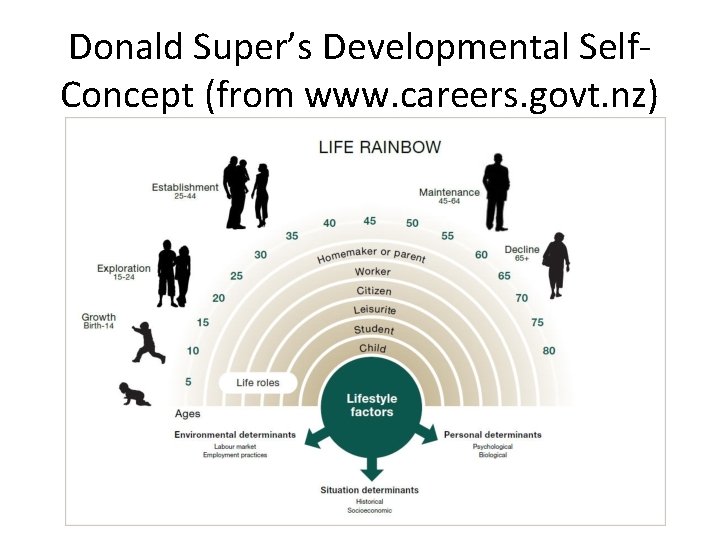
Donald Super’s Developmental Self. Concept (from www. careers. govt. nz)
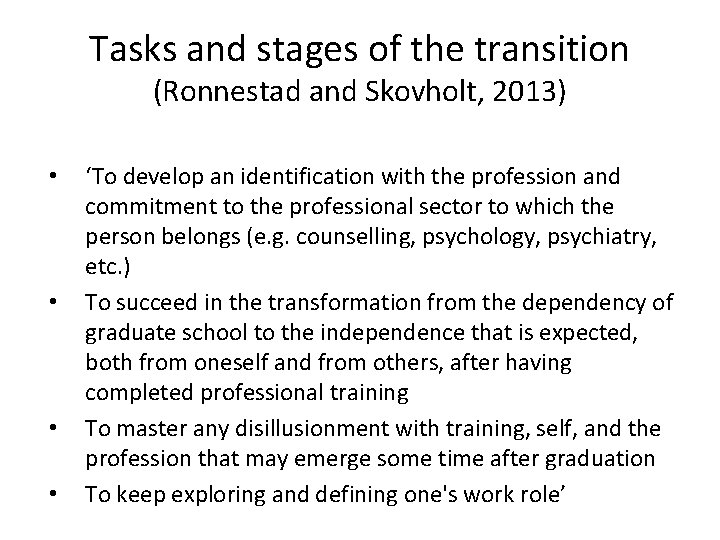
Tasks and stages of the transition (Ronnestad and Skovholt, 2013) • • ‘To develop an identification with the profession and commitment to the professional sector to which the person belongs (e. g. counselling, psychology, psychiatry, etc. ) To succeed in the transformation from the dependency of graduate school to the independence that is expected, both from oneself and from others, after having completed professional training To master any disillusionment with training, self, and the profession that may emerge some time after graduation To keep exploring and defining one's work role’
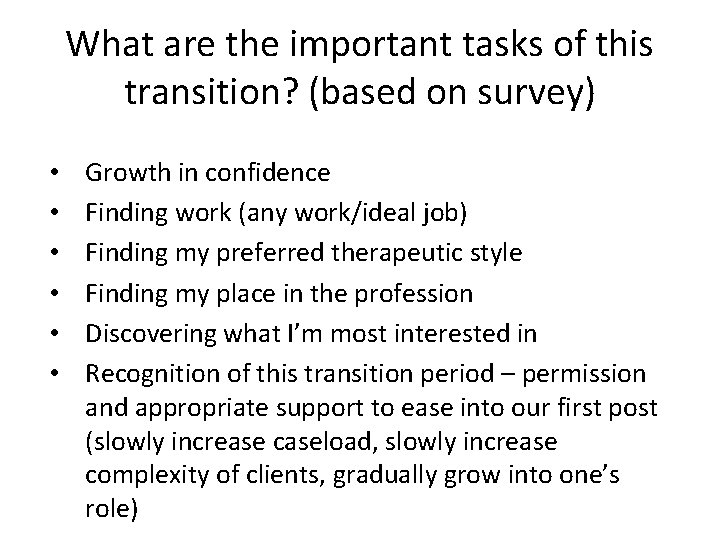
What are the important tasks of this transition? (based on survey) • • • Growth in confidence Finding work (any work/ideal job) Finding my preferred therapeutic style Finding my place in the profession Discovering what I’m most interested in Recognition of this transition period – permission and appropriate support to ease into our first post (slowly increase caseload, slowly increase complexity of clients, gradually grow into one’s role)
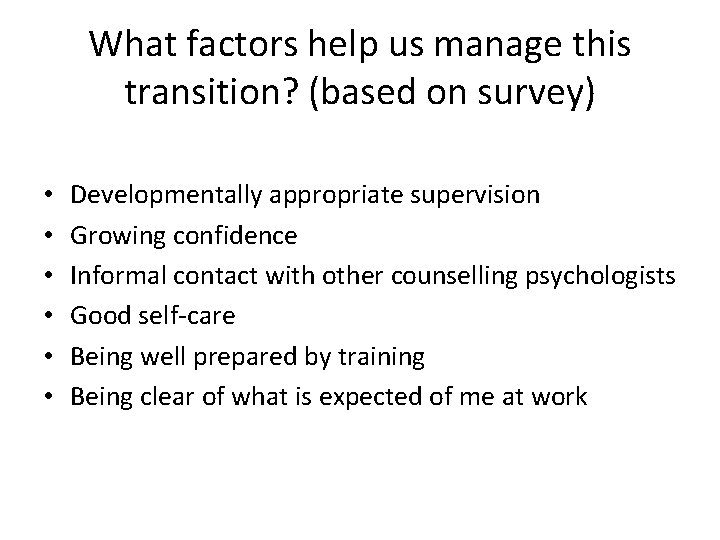
What factors help us manage this transition? (based on survey) • • • Developmentally appropriate supervision Growing confidence Informal contact with other counselling psychologists Good self-care Being well prepared by training Being clear of what is expected of me at work
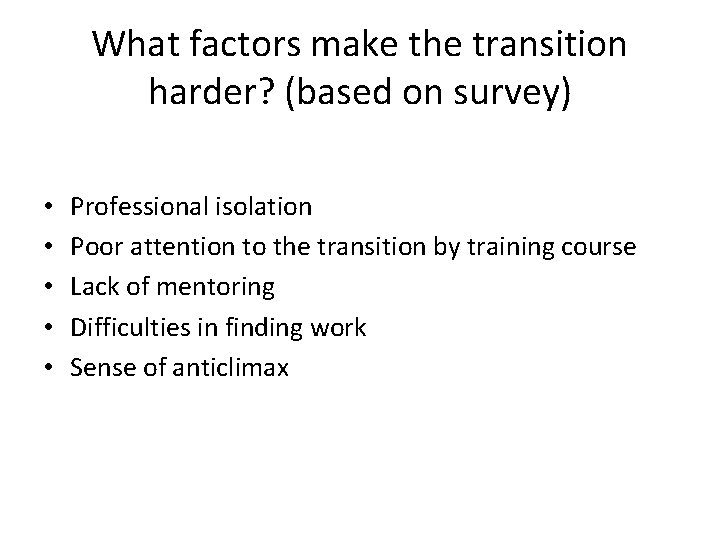
What factors make the transition harder? (based on survey) • • • Professional isolation Poor attention to the transition by training course Lack of mentoring Difficulties in finding work Sense of anticlimax
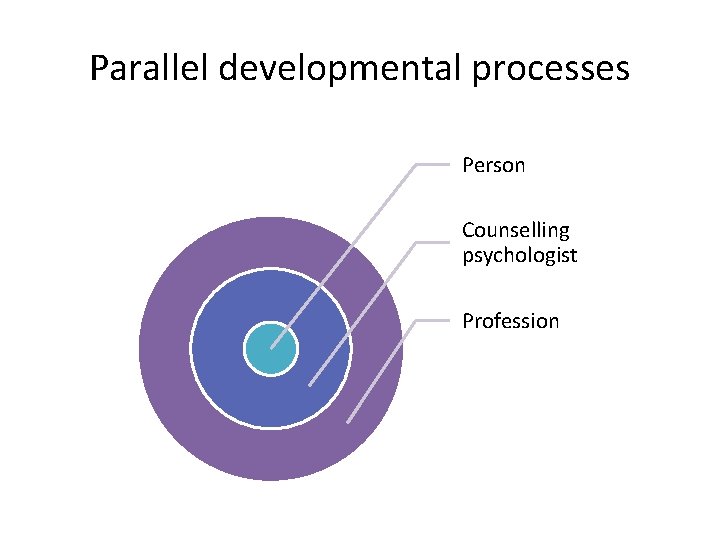
Parallel developmental processes Person Counselling psychologist Profession
Self-reflection prompts • At what stage of adult life are you in your personal life? (E. g. in terms of financial independence, relationships, first/second/third career direction, psycho-spiritual growth, physical health, etc. ) • How does this match (or mismatch) with being a newly qualified counselling psychologist?
Increased autonomy and responsibility • A natural progression to greater autonomy (though can be surprising) • Can feel validating and developmentally appropriate and somewhat daunting • Early career therapists can take too much responsibility for therapy, increasing risk of burnout (Ackerley et al. , 1988; Vredenburgh et al. , 1999) • Baron, Sekel and Stott (1984) suggest that avoiding over commitment is a key task of the early career period
Becoming a more competent scientist–practitioner • Reflective learning cycle no longer ‘enforced’ by assignments • Need for pro-active approach to ongoing learning and development • Learning and skills development may be strongly tied to demands of first post
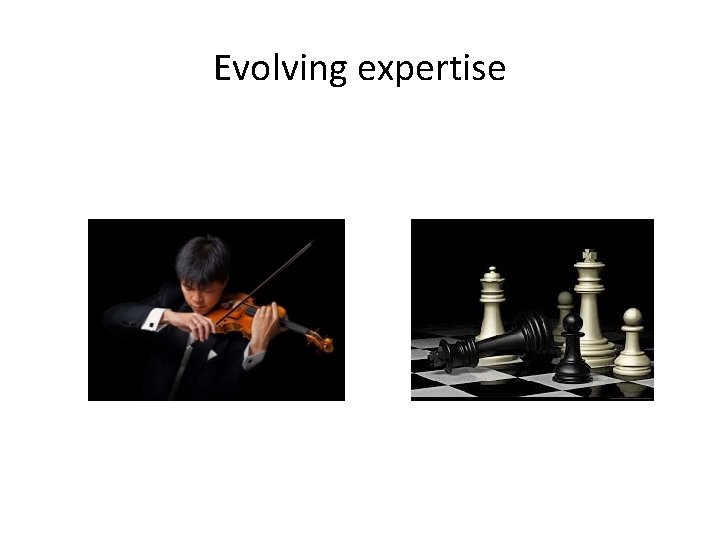
Evolving expertise
Evolving expertise (cont. ) • Ericsson et al. (2003; 2006) • Acquisition of expertise across varied domains (music, chess, sport, writing, etc. ) requires 10, 000 hours of deliberate practice (roughly 10 years) • Deliberate practice: o Knowing your current baseline effectiveness o Setting goals just beyond your current level of ability o Deliberately and repeatedly practicing particular skills to try to meet the new target o Getting accurate feedback on progress o Finding out where you went wrong o Re-adjusting
Supervision and developmental stage • Increased autonomy in supervision (see e. g. Integrated Developmental Model of supervision – Stoltenberg and Mc. Neill, 2009) • New use of supervision – less searching for didactic guidance, more peer-like and intended to aid your own reflective process • May be slightly harder if continuing with the same supervisor as during training
Discovering and developing a personal therapeutic style • More choice over personal integration of therapeutic models (with some exceptions, e. g. IAPT, research trials) • As much a ‘trial and error’ discovery of what one does and prefers, as much as constituting deliberate, mindful choice • Perhaps more outward-looking and generative (Erikson, 1959) • Less focussed on evidencing our own ‘performance’
Discovering and developing a personal therapeutic style (cont. ) • Broader range of clients • More long-term work • More risk and complexity (generally protected from such clients during training) • Link ongoing development of therapeutic expertise to scientist–practitioner model
Finding appropriate mentoring and professional support • • ‘Mentoring is to support and encourage people to manage their own learning in order that they maximise their potential, develop their skills, improve their performance and become the person they want to be. ’ (Eric Parsloe, The Oxford School of Coaching & Mentoring) A mentor may be a peer or someone more experienced; individual or group Usually informally arranged (may not even be explicit mentoring) May be especially important in independent practice or third sector organisations where there are fewer psychologist colleagues
Finding appropriate mentoring and professional support (cont. ) • May be general or for specific area (e. g. career development, writing/teaching, etc. ) • Source of encouragement, advice, sharing of frustrations and challenges, reduces isolation, assists new developments in career, provides perspective, etc. • Professional networks (e. g. DCo. P) and events (e. g. conferences) can be good ways to meet potential mentors
Exercise: Identifying mentors past, present and future • So far, who has provided a good example, inspiration, encouragement, guidance, solace? • What elements of mentoring might be valuable for you over the next year or two? • Who might you look to for these elements?
Professional registration • HCPC • BPS • Unions
Finding suitable employment – factors to consider • This is a period of consolidation • Does the organisation recognise the nature of this transition and the idea of ‘preceptorship’? • Will I be given time and space to grow into the role and build up a caseload gradually? • Will I be specialising too much before my general skills are adequately consolidated? • Does the work match my current level of competence and confidence and does it match my interests and lifestyle?
What we lose once qualified • Clear, formal evaluation/formal mentoring (as well as the anxiety/stress this produces!) • Externally imposed direction and boundaries (quasiparenting? ) • Continual reflective cycle (through coursework, tutorials, practice, etc. ) • Significant time spent with counselling psychologist peers • Safety/protection from the ‘real world’ (protege comes from Latin ‘protegere’ which means ‘one who is protected’)
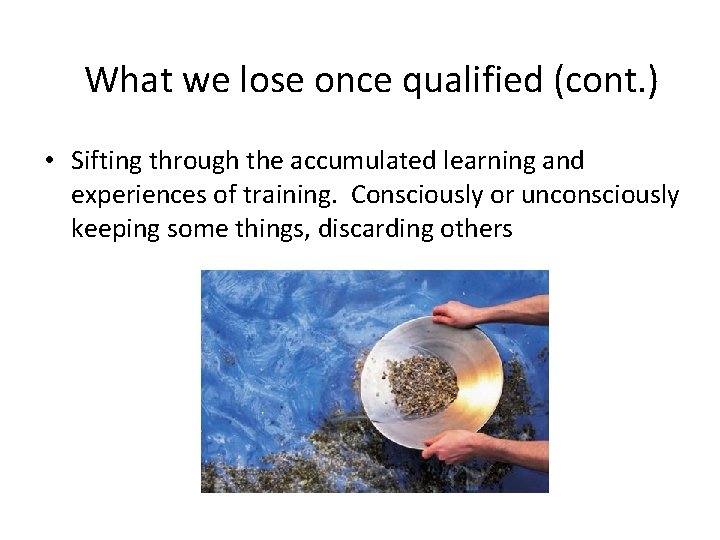
What we lose once qualified (cont. ) • Sifting through the accumulated learning and experiences of training. Consciously or unconsciously keeping some things, discarding others
Discussion: sifting the diamonds from the detritus • What might you miss/do you miss about the training period and trainee identity? • What elements of trainee identity do you wish to let go of as you move into qualified practice? • What elements of training will you treasure most?
References • Ackerley, G. D. , Burnell, J. , Holder, D. C. and Kurdek, L. A. (1988) ‘Burnout among licensed psychologists’, Professional Psychology: Research and Practice, 19(6): 624– 31. • Adams, J. , Hayes, J. and Hopson, B. (1976) Transition: Understanding and Managing Personal Change. London: Martin Robertson. • Baron, A. , Sekel, A. C. and Stott, F. W. (1984) ‘Early career issues for counseling center psychologists: The first six years’, The Counseling Psychologist, 12(1): 121– 5. • Ericsson, K. A. , Charness, N. , Feltovich, P. J. and Hoffman, R. R. (eds) (2006) The Cambridge Handbook of Expertise and Expert Performance. Cambridge: Cambridge University Press.
References (cont. ) • Ericsson, K. A. , Krampe, R. T. and Tesch-Romer, C. (1993) ‘The role of deliberate practice in the acquisition of expert performance’, Psychological Review, 100(3): 363– 406. • Vredenburgh, L. D. , Carlozzi, A. F. and Stein, L. B. (1999) ‘Burnout in counseling psychologists: Type of practice setting and pertinent demographics’, Counselling Psychology Quarterly, 12(3): 293– 302. • www. mentorset. org. uk/pages/mentoring. htm