
MVA Disability Determination Dr J Douglas Salmon Jr
MVA Disability Determination Dr. J. Douglas Salmon Jr. CEO, Rehabilitation Research, Education & Evaluation Services (RREES)
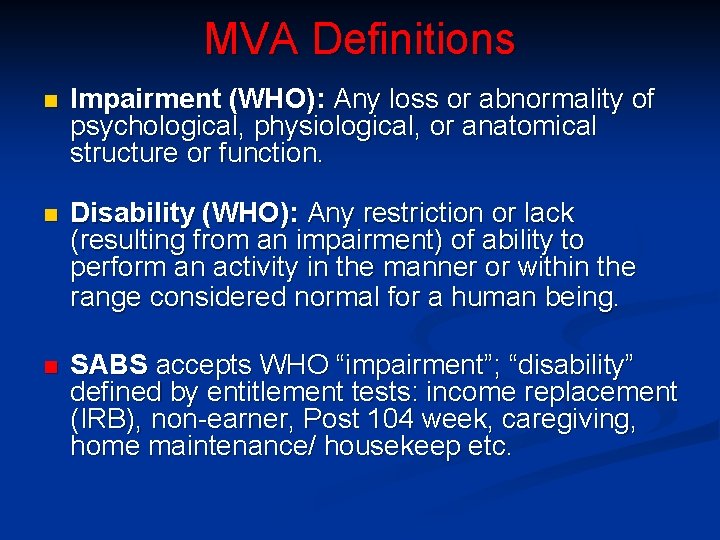
MVA Definitions n Impairment (WHO): Any loss or abnormality of psychological, physiological, or anatomical structure or function. n Disability (WHO): Any restriction or lack (resulting from an impairment) of ability to perform an activity in the manner or within the range considered normal for a human being. n SABS accepts WHO “impairment”; “disability” defined by entitlement tests: income replacement (IRB), non-earner, Post 104 week, caregiving, home maintenance/ housekeep etc.
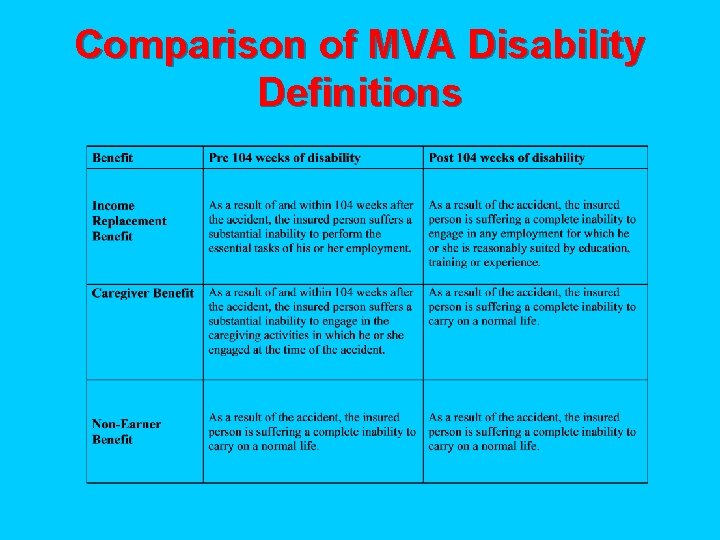
Comparison of MVA Disability Definitions
Complete Inability to Carry on a Normal Life n Morelli and Zurich n Test defined in section 2(4) of SABS: n “…. The person sustains an impairment that continuously prevents the person from engaging in the substantially all of the activities in which the person ordinarily engaged before the accident. ” n Ms. Morelli did not meet the test because there was no significant difference between her physical ability to carry out her daily activities before the accident and after the
Complete Inability to Carry on a Normal Life n Da Ponte and M. V. A. C. Fund - - Before accident, took care of all housekeeping duties. After accident unable to resume her household duties in any substantial way because of limited mobility.
Complete Inability to Carry on a Normal Life n Da Ponte and M. V. A. C. Fund “The case law establishes that the phrase “engaging in” means more than isolated postaccident attempts to perform activities that an applicant was able to perform prior to the accident. The manner in which an activity is performed, or the quality of the performance, must also be considered … The activity must be viewed as a whole and should not be broken down into its constituent parts. ”
Complete Inability to Carry on a Normal Life n Da Ponte and M. V. A. C. Fund “In cases where pain is primary factor that allegedly prevents the insured from engaging in his or her former activities, the question is not whether the insured can physically do these activities, whether the degree of pain experienced, either at the time or subsequently, is such that the individual is practically prevented from engaging in those
Walker v. Ritchie Implications n Walker v. Richie Primary life roles now considered n n i. e. substantial inability to perform primary premorbid life roles This definition may not yet have been sufficiently generalized in case law
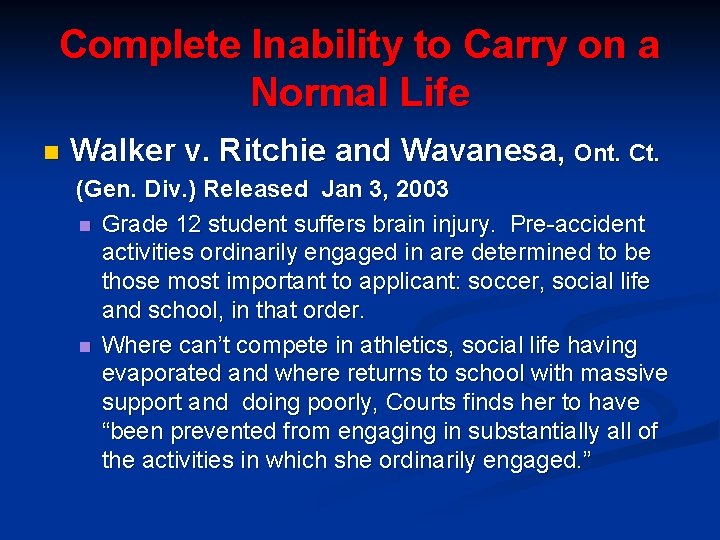
Complete Inability to Carry on a Normal Life n Walker v. Ritchie and Wavanesa, Ont. Ct. (Gen. Div. ) Released Jan 3, 2003 n Grade 12 student suffers brain injury. Pre-accident activities ordinarily engaged in are determined to be those most important to applicant: soccer, social life and school, in that order. n Where can’t compete in athletics, social life having evaporated and where returns to school with massive support and doing poorly, Courts finds her to have “been prevented from engaging in substantially all of the activities in which she ordinarily engaged. ”
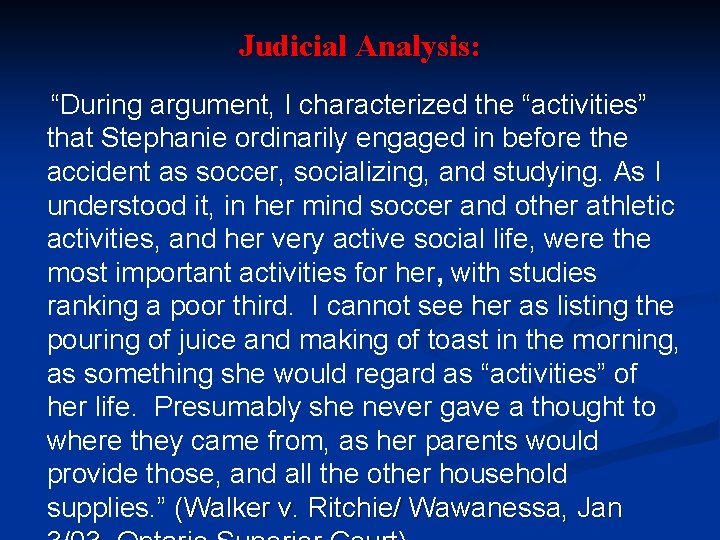
Judicial Analysis: “During argument, I characterized the “activities” that Stephanie ordinarily engaged in before the accident as soccer, socializing, and studying. As I understood it, in her mind soccer and other athletic activities, and her very active social life, were the most important activities for her, with studies ranking a poor third. I cannot see her as listing the pouring of juice and making of toast in the morning, as something she would regard as “activities” of her life. Presumably she never gave a thought to where they came from, as her parents would provide those, and all the other household supplies. ” (Walker v. Ritchie/ Wawanessa, Jan
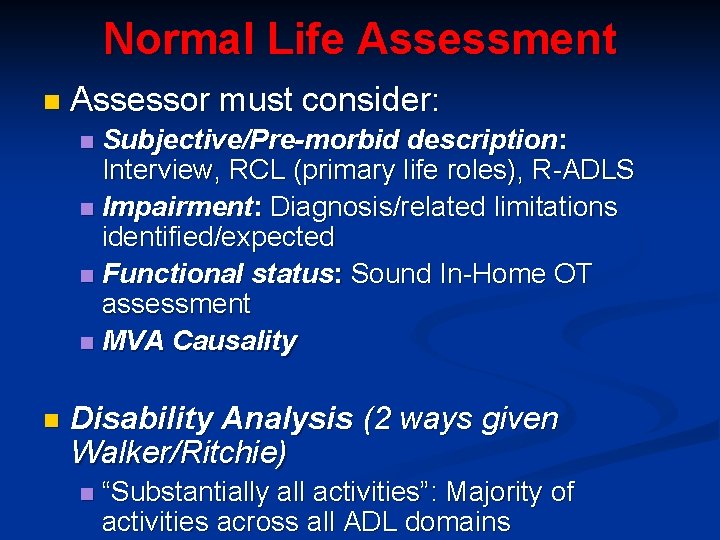
Normal Life Assessment n Assessor must consider: Subjective/Pre-morbid description: Interview, RCL (primary life roles), R-ADLS n Impairment: Diagnosis/related limitations identified/expected n Functional status: Sound In-Home OT assessment n MVA Causality n n Disability Analysis (2 ways given Walker/Ritchie) n “Substantially all activities”: Majority of activities across all ADL domains
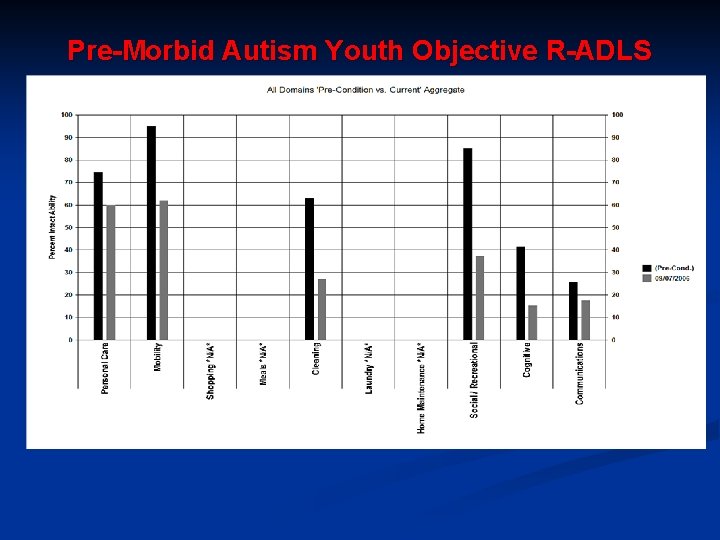
Pre-Morbid Autism Youth Objective R-ADLS
Pre 104 Week IRB Disability Test n As a result of and within 104 weeks after the accident, the insured person suffers a substantial inability to perform the essential tasks of his or her employment.

Impairment & “Own Occupation” Disability Determination Illness/Injury Impairment/Diagnosis Determination Physical Impairments/Dx • IME/s (neurol. , orthop. , etc. ) • Allied physical assessment (PT speech, etc. ) Emotional/Behavioural Impairments/Dx Cognitive Impairments/Dx • Neuropsychological assessments • Psychological assessments • Psychiatric assessment Occupational Disability Determination: Can client perform essential job tasks? Physical Functional Abilities (FAE) • IME’s –basic sensory- motor (e. g. visual, hearing) • FAE Specific Physical Demands (PDA) Dr. J. Douglas Salmon, Jr. © 2001, 2006 Emotional/Interpersonal Functional Abilities (CP-FAE) • Comprehensive Psychological Disability Assessment • Cognitive/Psych. FAE • Neuropsychological Emotional/Psychosocial Demands (CP-JDA) Job Demands Analysis Cognitive Functional Abilities (CP-FAE) • Neuropsychological (Neurocognitive impairment) • Cognitive/Psych. FAE (or NPA) (Non-neurological impairments) Cognitive Demands (CP-JDA)
CP-FAE: Pre-eminence of Cognitive Essential Job Tasks “Given recent estimates that about 75 percent of the new jobs in the economy have to do with cognitive ability, not physical ability, and that the heavy lifting in the economy is now being done with people’s minds, not with their backs, this aspect of mental disability is more significant than it might have been a number of years ago”. Rod Phillips, President/CEO, Warren Sheppell Consultants Corp
f. MRI/Chronic Pain Impacts n “A new study indicates that chronic pain has a widespread impact on overall brain function, a finding that may offer a possible explanation for many of the common cognitive and behavioral comorbidities seen in such patients. Using functional magnetic resonance imaging (f. MRI), investigators at Northwestern University, in Chicago, Illinois, found individuals with chronic back pain (CBP) had alterations in the functional connectivity of their cortical regions — areas of the brain that are unrelated to pain — compared with healthy controls. ” "This is the first clue we have that conditions such as depression, anxiety, sleep disturbances, and decisionmaking difficulties, which affect the quality of life of chronic pain patients as much as the pain itself, may be directly related to altered brain function as a result of chronic pain, " principal investigator Dante Chialvo, MD, told Medscape Neurology & Neurosurgery, Feb. 2008.
Major MVA Mental Health Diagnoses & Interpersonal/Cognitive Sequelae n Major depression, Dysthymic disorder, Generalized anxiety, PTSD n All include in their DSM diagnostic criteria: n n Cognitive symptoms All require in their DSM diagnostic criteria: n “The disturbance causes clinically significant distress or impairment in social, occupational, or other important areas of functioning. ”
Chronic Pain Entitlement As referenced in Safi v. Sovereign General FSCO, September, 2007: n “Courts and FSCO arbitrators have recognized chronic pain syndrome, fibromyalgia, and other related medical conditions as significant medical impairments. [14] It is also agreed that pain is a subjective experience, which may be incapable of objective measurement. In some cases there may be no organic cause for a person's pain. [15]” 14: Kotey and State Farm Mutual Automobile Insurance Company (FSCO A 97 -001506, October 4, 1999); Martin v. Workers' Compensation Board of Nova Scotia [2003] 2 S. C. R. 504 15: Hall and Zurich Insurance Company (FSCO A 96 -001624, July 24, 1998)
IRB (Pre- 104 wk) Case Law Sivananthan v. State Farm (FSCO A 02 -000307, February, 2004) n In considering the disability analysis of a female clerical worker with established chronic pain, whose cognitive difficulties were documented in a vocational assessment and through collateral evidence, Arbitrator A. Sone noted the following: n “[The claimant] must prove that she suffered a substantial inability to perform the essential tasks of her employment. To decide whether she meets this test, I must determine what were the essential tasks of her employment. Based on the credible evidence I received from her, I find that the essential tasks of her employment at the time of the accident were clerical in nature. I find that they included the ability to work away from her residence and therefore included travel. I also find that they included the ability to arrive at work punctually and reliably, and to work full-time, for example, approximately eight hours per day, five days per week. ” (underscore added)
n To address the Pre-104 week determination in chronic pain context, arbitrator considered: Claimant’s credibility n Competitive productivity level n Full time capacity n
Chronic Pain Credibility Pivotal n “Credibility. In significant measure, [her] . complaints are subjective. Therefore, I must assess her credibility. In order to assess her credibility as a witness, I may evaluate her demeanor, internal inconsistencies in her evidence, contradiction by others, contradiction by documents, and the inherent implausibility of her evidence, given general knowledge of the human condition. I f raised, I must also examine allegations of dishonesty or fraud. ” Sivananthan v. State Farm (FSCO A 02 -000307, February, 2004)
Productivity Criterion References Flemming v. Wawanesa, OIC A-000406, April 28, 1992) n “. . . the fact that the Application is able to perform some functions of her occupation on a part-time basis does not address the standard of disability set out in the regulations. . . In determining an applicant's ability to perform his or her essential occupational tasks, the demands of such tasks cannot be evaluated in isolation from the broader employment context. . . The regulations contemplate inability to perform the duties of remunerative work. The performance of essential tasks must incorporate the ability to perform such tasks in a manner, at a speed or for a time that renders such performance capable of being remunerative. (underscore added)
Full-time (pre) Criterion References Soos v. Canadian Surety (OIC A 97001015, June 12, 1998; ) n “The focus of the inquiry must be on the applicant's ability to perform the essential tasks of her job as opposed to whether or not certain tasks could be performed on a part-time basis. ”
Recognizing Non-CNS Cognitive Impairments Safi v. Sovereign General FSCO, September, 2007 (also supported in Zach v. State Farm, July 2007 and in Sivananthan v. State Farm, FSCO A 02 -000307, February, 2004) n “I accept … that on a psychological level, Mr. Safi currently experiences clinically significant difficulties in sustained attention, concentration, speed of information processing, and assimilating new information. He is psychologically substantially disabled from performing the essential tasks of any employment for which he might be reasonably
Recognizing Non-CNS Cognitive Impairments cont… n “I accepted Ms. Zach's evidence that her head and eye pain resulted in her inability to concentrate and sit at a computer for more than a few hours at a time. Ms. Zach testified in a clear and forthright manner and I am persuaded, on a balance of probabilities, that she was not able to perform the essential tasks of her employment as a graphic artist from the termination date of her IRBs up to the 104 week point. ” Zach v. State Farm, July 2007 (also supported in Sivananthan v. State Farm, FSCO A 02 -
Work as an Integrated Whole n “It is not appropriate to simply identify a discrete series of employment competencies that an individual may be able to demonstrate under artificial testing situations and then to cobble these together into a theorized ability to engage in employment. This sort of analysis misses the whole dimension of employment being a living relationship between the employer and the employee. The Regulation talks about an ability to “engage in employment” not simply to perform discrete job tasks. In my view, to “engage in employment” is to participate actively in the work relationship over some reasonable period of time. In addition, the employee must be able to meet normal employer expectations. ” Shubrook v. Lombard (FSCO A 03 -000361, November 26, 2004)
Pre-104 Case Law Summary Essential job tasks must be clearly articulated n Full time consideration only (pre MVA full time) n Productivity must be competitive n Work considered as an integrated whole n Non-CNS cognitive demands/impairments recognized n
Post 104 IRB Disability Test n As a result of the accident, the insured person is suffering a complete inability to engage in any employment for which he or she is reasonably suited by education, training or experience.
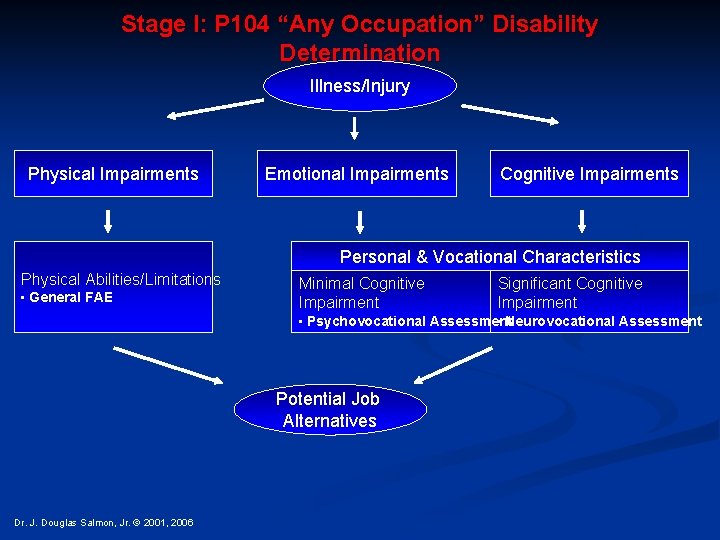
Stage I: P 104 “Any Occupation” Disability Determination Illness/Injury Physical Impairments Emotional Impairments Cognitive Impairments Personal & Vocational Characteristics Physical Abilities/Limitations • General FAE Minimal Cognitive Impairment Significant Cognitive Impairment • Psychovocational Assessment • Neurovocational Assessment Potential Job Alternatives Dr. J. Douglas Salmon, Jr. © 2001, 2006
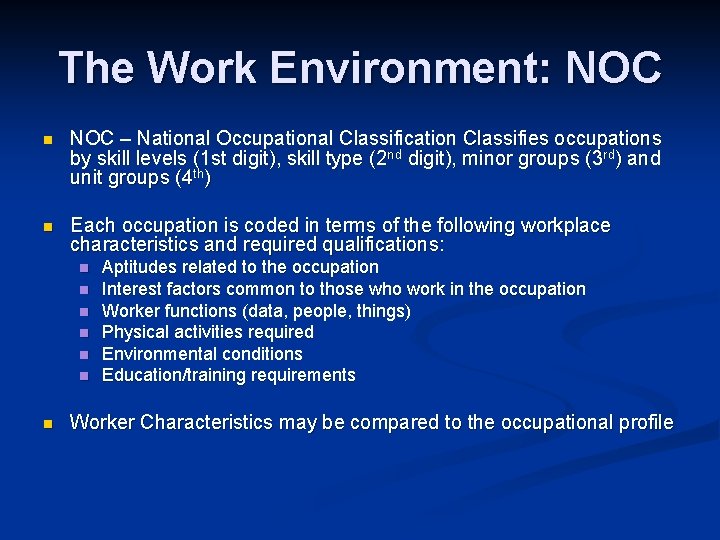
The Work Environment: NOC n NOC – National Occupational Classification Classifies occupations by skill levels (1 st digit), skill type (2 nd digit), minor groups (3 rd) and unit groups (4 th) n Each occupation is coded in terms of the following workplace characteristics and required qualifications: n n n n Aptitudes related to the occupation Interest factors common to those who work in the occupation Worker functions (data, people, things) Physical activities required Environmental conditions Education/training requirements Worker Characteristics may be compared to the occupational profile
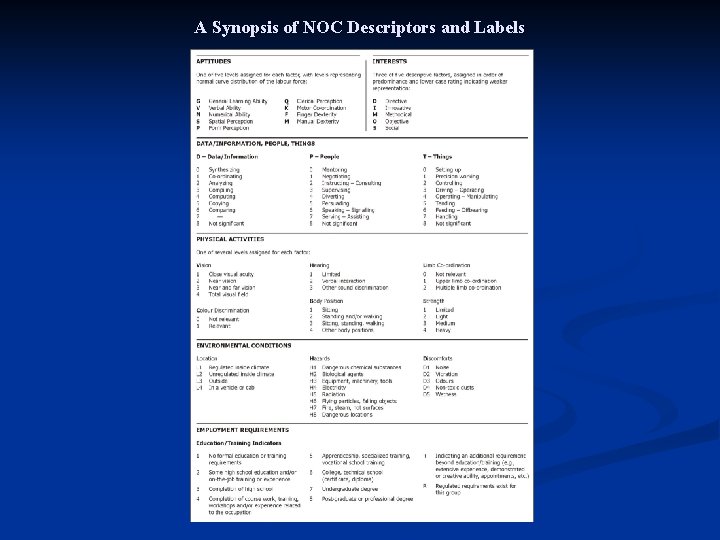
A Synopsis of NOC Descriptors and Labels
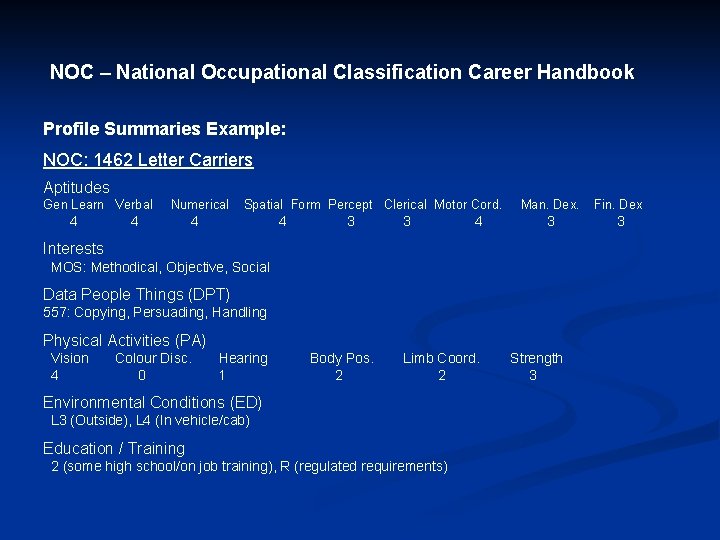
NOC – National Occupational Classification Career Handbook Profile Summaries Example: NOC: 1462 Letter Carriers Aptitudes Gen Learn Verbal Numerical Spatial Form Percept Clerical Motor Cord. Man. Dex. Fin. Dex 4 4 4 4 3 3 4 3 3 Interests MOS: Methodical, Objective, Social Data People Things (DPT) 557: Copying, Persuading, Handling Physical Activities (PA) Vision 4 Colour Disc. Hearing Body Pos. 0 1 2 Limb Coord. Strength 2 3 Environmental Conditions (ED) L 3 (Outside), L 4 (In vehicle/cab) Education / Training 2 (some high school/on job training), R (regulated requirements)
Transferable Skills Analyses (TSAs) Discrediting their use Transferable skills based on “aptitudes” which are person’s potential to learn a skill and NOT synonymous with actual skills acquisition…e. g. an individual may have the aptitude to be a carpenter’s assistant, but that doesn’t mean that the person actually has functional work skills in this area (and often don’t). By contrast, in our psychovocs, we do a “functional transferable skills analysis” to determine ACTUAL skills that the individual has acquired over their career, rather than their skills potential.
TSA Issues: Discrediting their use cont… § Pain, emotional and cognitive impairments will typically erode functioning such that the individual will not be able to perform many TSA jobs (psychovoc/neurovoc would show that they are performing well below these levels) § Reported levels of past achieved Education and academic skills are commonly undermined by: disuse of academic skills pre accident; further erosion post accident due to prolonged disuse & cognitive impairments; foreign education in non-English language results in individual testing well below English based equivalency
TSA Issues: Discrediting their use cont… § People often obtain jobs (pre-accident) through friends and family, thereby bypassing the called for requirements of the NOC, making it look like they have higher levels of education/literacy/numeracy/aptitudes than is really the case
TSA Issues: Discrediting their use cont… n Many jobs in fact may be less demanding than suggested by the aptitude and other requirements in the NOC which reflect “average” requirements for an occupation. . e. g. hotel clerks in big chains require university/college programs for entry, while small family owned hotels require none of this typically. A TSA will enter education and aptitude levels for the big chains making it look as though the individuals pre-morbid skill/educational base was more substantial than in reality. n TSA’s typically use a wage database that is either US based, averaged across experience levels, or otherwise incompatible with the mandatory FSCO wage table.
Case Example 41 year old, English speaking, foreign born male n Two-year postsecondary education n Pre-MVA press machine operator n Left hip fracture; chronic pain n Psychological diagnoses only at P 104: n n PTSD, with ongoing in-vehicular/pedestrian phobia n Major depression, partially resolved with mild Adjustment Disorder- Anxiety, irritability
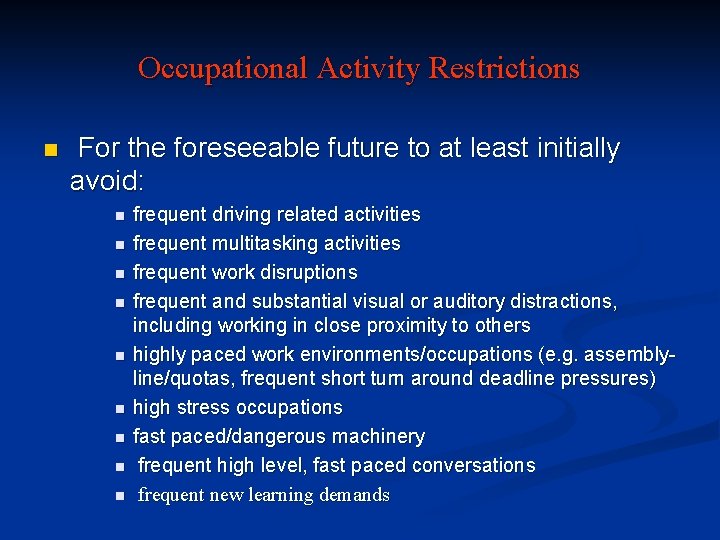
Occupational Activity Restrictions n For the foreseeable future to at least initially avoid: n n n n n frequent driving related activities frequent multitasking activities frequent work disruptions frequent and substantial visual or auditory distractions, including working in close proximity to others highly paced work environments/occupations (e. g. assemblyline/quotas, frequent short turn around deadline pressures) high stress occupations fast paced/dangerous machinery frequent high level, fast paced conversations frequent new learning demands
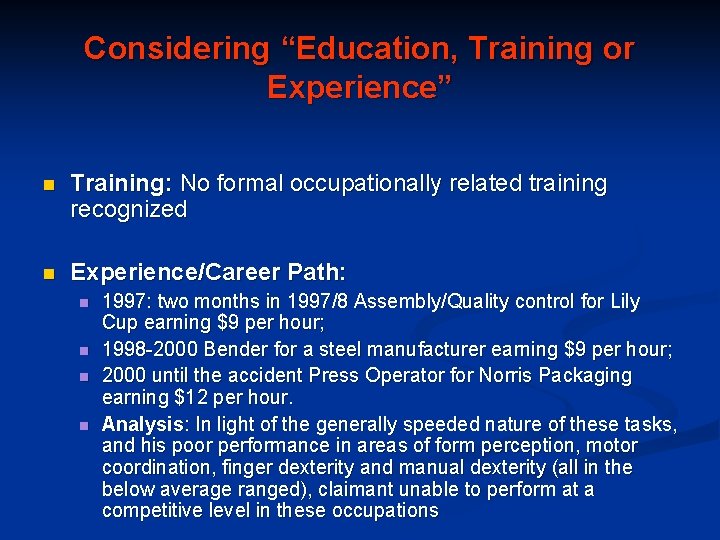
Considering “Education, Training or Experience” n Training: No formal occupationally related training recognized n Experience/Career Path: n n 1997: two months in 1997/8 Assembly/Quality control for Lily Cup earning $9 per hour; 1998 -2000 Bender for a steel manufacturer earning $9 per hour; 2000 until the accident Press Operator for Norris Packaging earning $12 per hour. Analysis: In light of the generally speeded nature of these tasks, and his poor performance in areas of form perception, motor coordination, finger dexterity and manual dexterity (all in the below average ranged), claimant unable to perform at a competitive level in these occupations
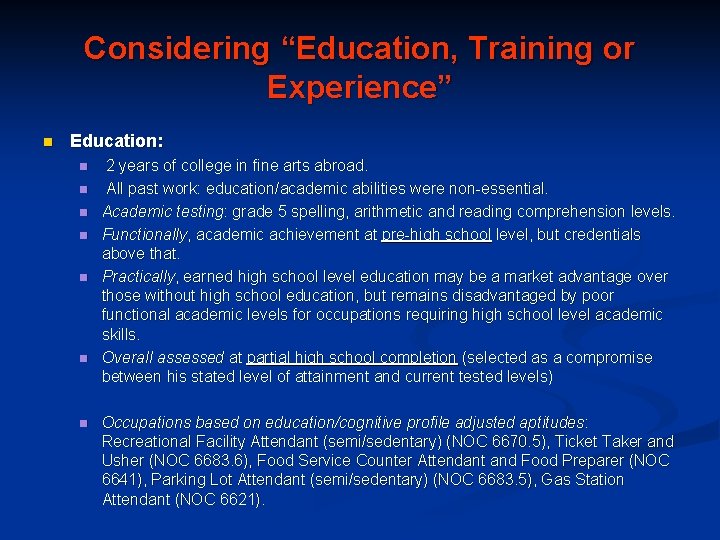
Considering “Education, Training or Experience” n Education: n n n n 2 years of college in fine arts abroad. All past work: education/academic abilities were non-essential. Academic testing: grade 5 spelling, arithmetic and reading comprehension levels. Functionally, academic achievement at pre-high school level, but credentials above that. Practically, earned high school level education may be a market advantage over those without high school education, but remains disadvantaged by poor functional academic levels for occupations requiring high school level academic skills. Overall assessed at partial high school completion (selected as a compromise between his stated level of attainment and current tested levels) Occupations based on education/cognitive profile adjusted aptitudes: Recreational Facility Attendant (semi/sedentary) (NOC 6670. 5), Ticket Taker and Usher (NOC 6683. 6), Food Service Counter Attendant and Food Preparer (NOC 6641), Parking Lot Attendant (semi/sedentary) (NOC 6683. 5), Gas Station Attendant (NOC 6621).
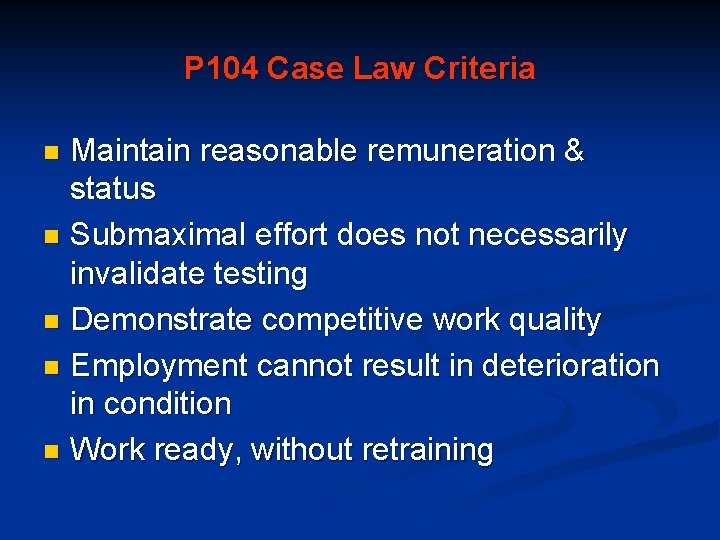
P 104 Case Law Criteria Maintain reasonable remuneration & status n Submaximal effort does not necessarily invalidate testing n Demonstrate competitive work quality n Employment cannot result in deterioration in condition n Work ready, without retraining n
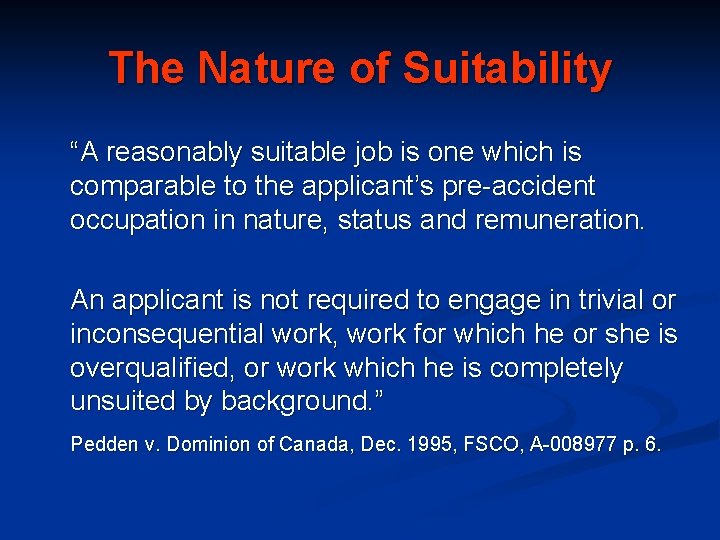
The Nature of Suitability “A reasonably suitable job is one which is comparable to the applicant’s pre-accident occupation in nature, status and remuneration. An applicant is not required to engage in trivial or inconsequential work, work for which he or she is overqualified, or work which he is completely unsuited by background. ” Pedden v. Dominion of Canada, Dec. 1995, FSCO, A-008977 p. 6.
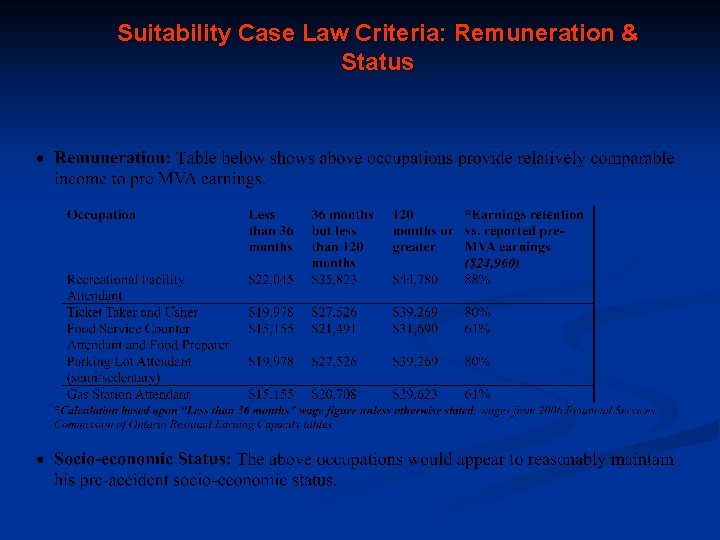
Suitability Case Law Criteria: Remuneration & Status
Complete Inability to Engage in Any Suited Employment Unconscious submaximal effort does not invalidate testing (L. F. v. State Farm) n
Occupations Need Not Be Exhaustive “…the applicant is not required to prove the impossible; i. e. that the applicant is unable to perform every employment or occupation for which he/she is reasonably suited. ” Wigle v. Royal Insurance, Arb. Seife, 1996
Complete Inability to Engage in Any Suited Employment n Terry v. Wawanese n n “Somehow, the ability to engage in a reasonably suitable job, considered as a whole, including reasonable hours and productivity must be addressed” Concurred within: n n n Lombardi v. State Farm Horne v. CIBC Insurance L. F. v. State Farm
Complete Inability to Engage in Any Suited Employment n “The ability to engage in a reasonably suitable job, considered as a whole, including reasonable hours, consistent attendance and productivity is the essence of the ‘complete inability’ test” (Terry v. Wawanesa, L. F. v. State Farm)
Complete Inability to Engage in Any Suited Employment “Considerations of the ‘complete inability’ test include whether the applicant demonstrates the speed, accuracy, consistency and productivity sufficient to be employable in the suitable occupation. ” (Terry v. Wawanesa, L. F. v. State Farm)
Complete Inability to Engage in Any Suited Employment “If the applicant’s performance on DAC testing fails to result in competitive levels of speed, accuracy, consistently, longevity and productivity sufficient to be employable in one of the identified suitable occupations, the applicant satisfies the ‘Complete Inability’ test. ” (Terry v. Wawanesa, L. F. v. State Farm)
Complete Inability to Engage in Any Suited Employment If the applicant requires more than minimal retraining to do the job, the job is not suitable and the claimant meets the test. (Horne v. CIBC) n
Rejection of Self-Employment n [The vocational evaluator] recommended that she consider self-employment involving answering telephones in a home office. This would allow [her] to change positions at will. [The evaluator] noted that [her] success will depend on her ability to market her services and obtain clients, and that until she became established, she might have difficulty obtaining a wage comparable to what she earned pre-accident. I find no evidence that [she] has any of the requisite skills for marketing, obtaining clients, billing, collecting accounts and running a business. I find that in most cases, selfemployment would be such a different enterprise from regular employment, that the two cannot be equated. Lee v. Certas, June, 2006
Need not be “Continuously” Prevented from Working n “In this regard, I also note that the test for post 104 -week benefits does not contain any requirement or refer to any definition that requires Ms. Lee to be "continuously" prevented from working. I agree with the arbitrator in the Lombardi case, that the drafters did not intend periodic work to necessarily bar benefits in relation to the overall analysis of a work disability. ” Lee v. Certas, June, 2006
On the Validity of Job Trials n n “There is no better evidence of incapacity to perform a task than the failure of an honest and sustained attempt to do it. ” Foden v. Cooperators, 1978, Ontario High Court of Justice; recently referenced in Rumak v. Personal, Nov 2003.
Job Performance, Not Employment Key n “It might at first glance seem anomalous to hold that a person who has returned full-time to work and who is receiving full pay is at the same time "totally disabled". The anomaly is more apparent than real. First, on the facts, plaintiff's employer did not keep her on because he was satisfied with her work. He was not satisfied. He kept her because he hoped she would improve, notwithstanding that she was not capable of doing what was expected of her and that the quality of her work had deteriorated. It is open to an employer to keep on an employee whose work is not satisfactory just as it is open to him to terminate the employment. As I have observed, those facts standing by themselves may mean little. To be terminated does not prove that an employee does not have the capacity to perform a task nor does to be kept on the payroll prove that he has. ” Foden v. Cooperators, 1978, Ontario High Court of Justice; recently referenced in Rumak v. Personal, Nov 2003.
Complete Inability to Engage in Any Suited Employment n “If the jobs identified by the assessors as suitable are discordant with the applicant’s ambitions or would promote depression or deterioration in the applicant’s conditions, it is unreasonable for the jobs to be considered suitable” (Attavar v. Allstate, Ontario Court of Appeal, released January 29, 2003)
P 104 Apparent De-emphasized Factors Job availability/existence n Capacity to travel to work (& assuming travel not an essential job task) n These factors would typically be considered in tort loss of earning capacity n
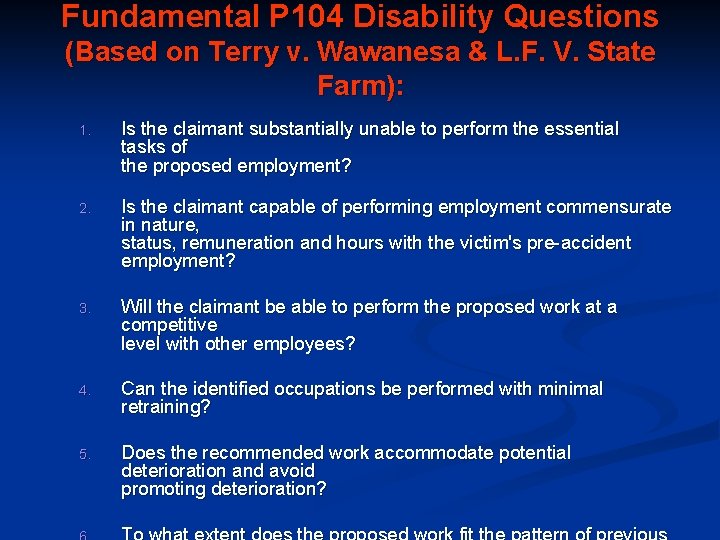
Fundamental P 104 Disability Questions (Based on Terry v. Wawanesa & L. F. V. State Farm): 1. Is the claimant substantially unable to perform the essential tasks of the proposed employment? 2. Is the claimant capable of performing employment commensurate in nature, status, remuneration and hours with the victim's pre-accident employment? 3. Will the claimant be able to perform the proposed work at a competitive level with other employees? 4. Can the identified occupations be performed with minimal retraining? 5. Does the recommended work accommodate potential deterioration and avoid promoting deterioration?
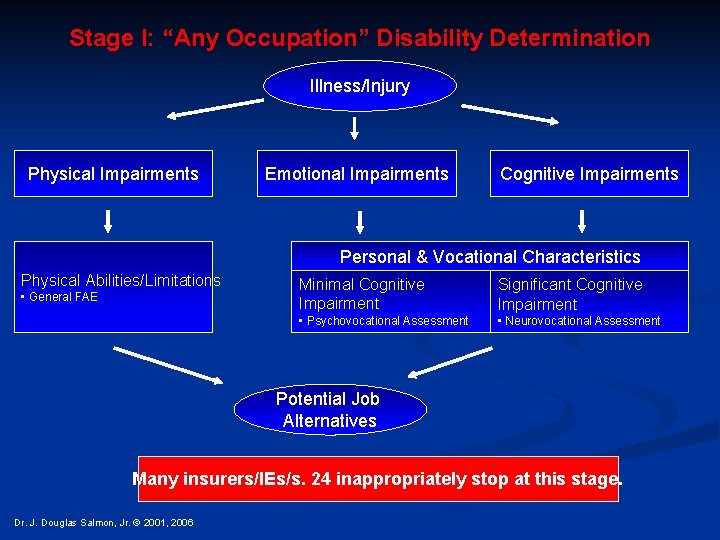
Stage I: “Any Occupation” Disability Determination Illness/Injury Physical Impairments Emotional Impairments Cognitive Impairments Personal & Vocational Characteristics Physical Abilities/Limitations • General FAE Minimal Cognitive Impairment Significant Cognitive Impairment • Psychovocational Assessment • Neurovocational Assessment Potential Job Alternatives Many insurers/IEs/s. 24 inappropriately stop at this stage. Dr. J. Douglas Salmon, Jr. © 2001, 2006
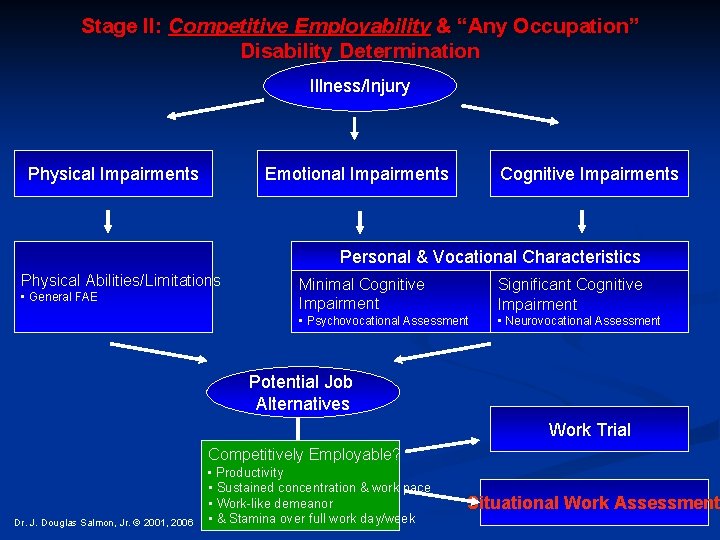
Stage II: Competitive Employability & “Any Occupation” Disability Determination Illness/Injury Physical Impairments Emotional Impairments Cognitive Impairments Personal & Vocational Characteristics Physical Abilities/Limitations • General FAE Minimal Cognitive Impairment Significant Cognitive Impairment • Psychovocational Assessment • Neurovocational Assessment Potential Job Alternatives Work Trial Competitively Employable? Dr. J. Douglas Salmon, Jr. © 2001, 2006 • Productivity • Sustained concentration & work pace • Work-like demeanor • & Stamina over full work day/week Situational Work Assessment
Post 104 Week Disability Determination: Post DAC Strategy n Psycho/Neurovocational Post 104 focused disability assessments should never present a general “laundry list” of occupations, but should be more focussed on identifying a few “testable jobs” n s. 24 Psycho/Neurovocational assessment should distinguish between voc rehab purposes and P 104 determination, and should include earnings and SES analysis n Utilize Situational Assessments and/or work trials to determine “competitive employability” n Avoid TSA/FAEs as predominant features in IEs/s. 24 s
- Slides: 60