MMF 42007 Komposit PIL Dr Ir Anne Zulfia


- Slides: 74
MMF 42007 Komposit (PIL) Dr. Ir. Anne Zulfia MSc
Pengenalan Material Komposit
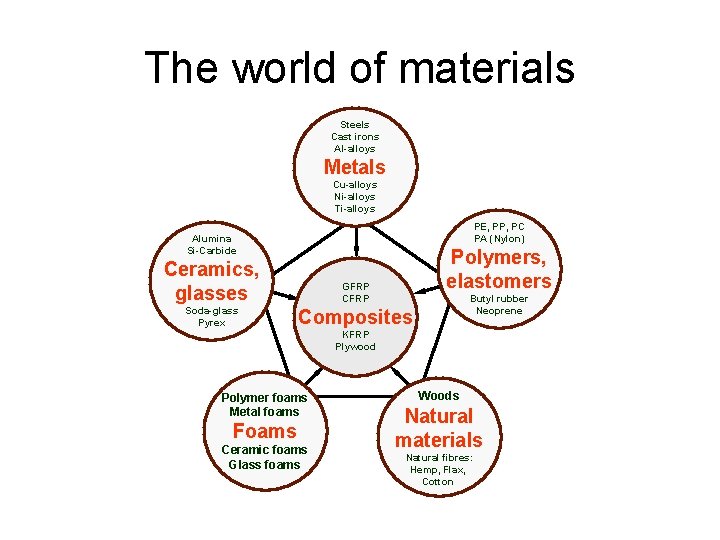
The world of materials Steels Cast irons Al-alloys Metals Cu-alloys Ni-alloys Ti-alloys PE, PP, PC PA (Nylon) Alumina Si-Carbide Polymers, elastomers Ceramics, glasses GFRP CFRP Soda-glass Pyrex Composites Butyl rubber Neoprene KFRP Plywood Polymer foams Metal foams Foams Ceramic foams Glass foams Woods Natural materials Natural fibres: Hemp, Flax, Cotton
Pengertian Komposit Ø Komposit merupakan kombinasi dari dua material atau lebih yang memiliki fasa yang berbeda menjadi suatu material baru yang memiliki properti lebih baik dari keduanya. Ø Jika kombinasi ini terjadi dalam skala makroskopis maka disebut sebagai komposit. Ø Jika kombinasi ini terjadi secara mikoroskopis (molekular level) maka disebut sebagai alloy atau paduan.
Composites are formed from two or more types of materials. Examples include polymer/ceramic and metal/ceramic composites. Composites are used because overall properties of the composites are superior to those of the individual components. For example: polymer/ceramic composites have a greater modulus than the polymer component, but aren't as brittle as ceramics.
Composite materials – Introduction • Definition: a material composed of 2 or more constituents – Reinforcement phase (e. g. , Fibers) – Binder phase (e. g. , compliant matrix) • Advantages – High strength and stiffness – Low weight ratio – Material can be designed in addition to the structure
Two types of composites are: Fiber Reinforced Composites Particle Reinforced Composites
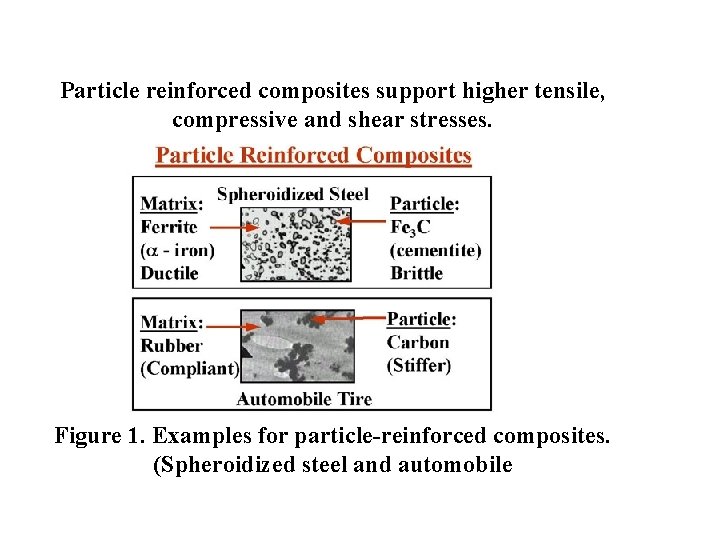
Particle reinforced composites support higher tensile, compressive and shear stresses. Figure 1. Examples for particle-reinforced composites. (Spheroidized steel and automobile
The following are some of the reasons why composites are selected for certain applications: v High strength to weight ratio (low density high tensile strength) v High creep resistance v High tensile strength at elevated temperatures v High toughness
Examples of Composites • Natural – Wood • flexible cellulose fibers held together with stiff lignin – Bone • strong protein collagen and hard, brittle apatite • Artificial (man-made) – constituent phases are chemically distinct
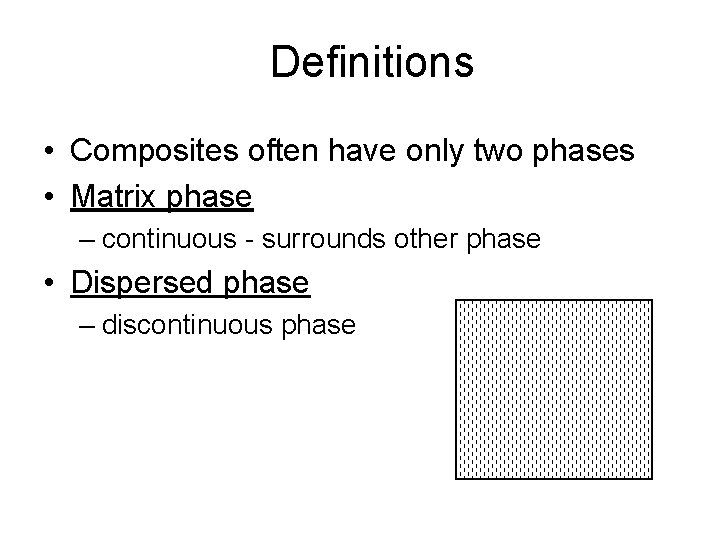
Definitions • Composites often have only two phases • Matrix phase – continuous - surrounds other phase • Dispersed phase – discontinuous phase Matrix (light) Dispersed phase (dark)
Objectives • Definitions in composite materials – dispersed phase, matrix • Structure of composites – particle-reinforced – fiber reinforced – structural composites
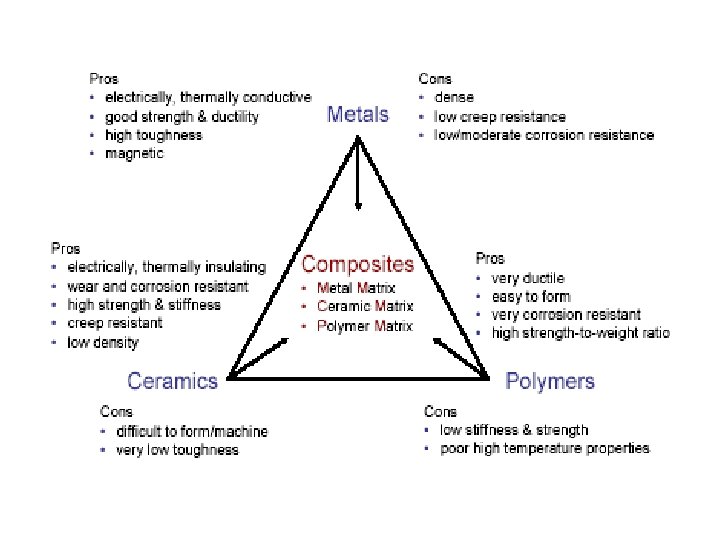
Introduction • Engineering applications often require unusual combinations of properties – esp. aerospace, underwater, and transportation – can’t be achieved with a single material – e. g. - aerospace requires strong, stiff, light, and abrasion resistant material • most strong, stiff materials are dense and heavy • most light materials are not abrasion resistant • Solution is in composite materials
Examples of Composites • Natural – Wood • flexible cellulose fibers held together with stiff lignin – Bone • strong protein collagen and hard, brittle apatite • Artificial (man-made) – constituent phases are chemically distinct
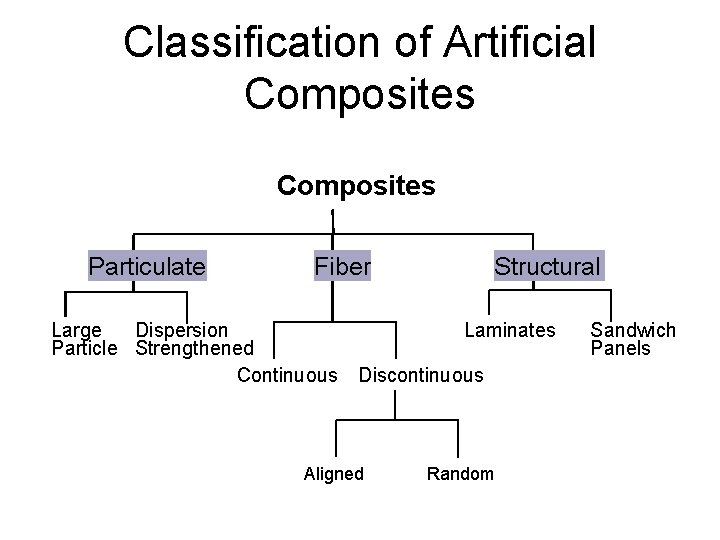
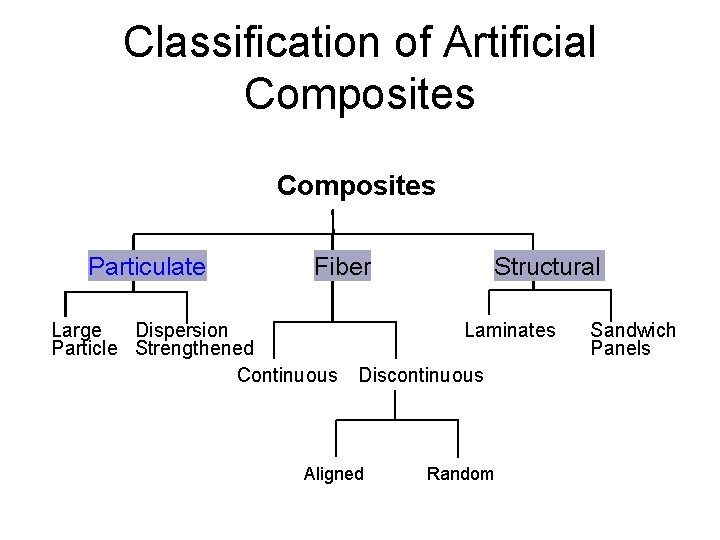
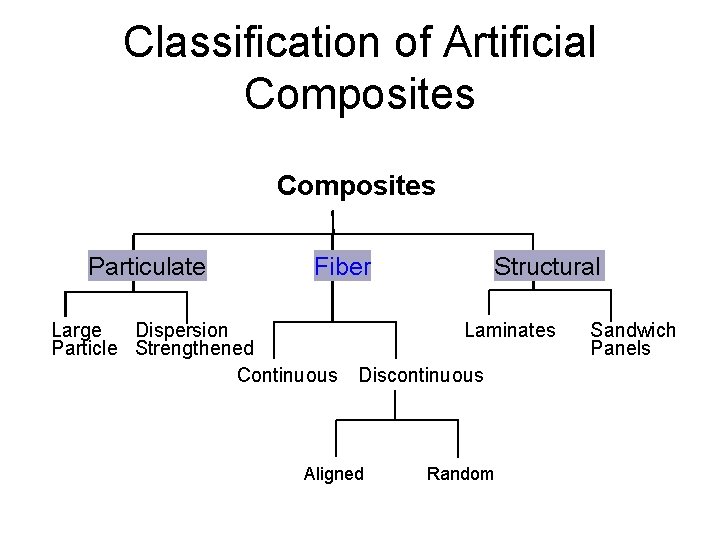
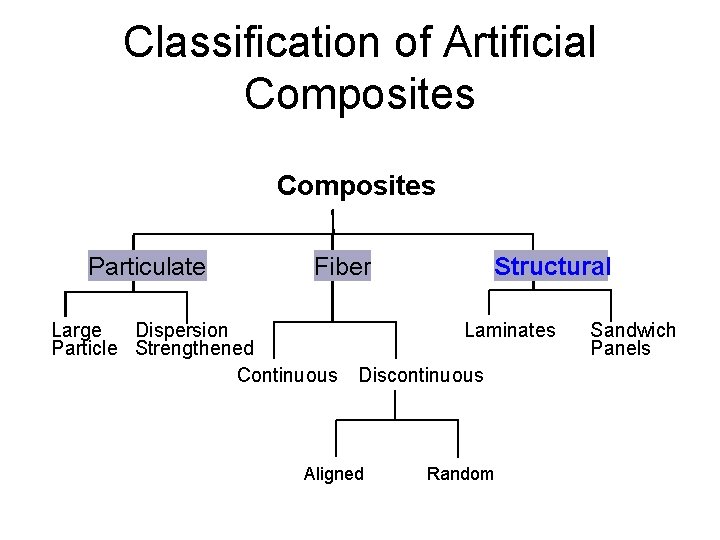
Classification of Artificial Composites Particulate Fiber Large Dispersion Particle Strengthened Continuous Structural Laminates Discontinuous Aligned Random Sandwich Panels
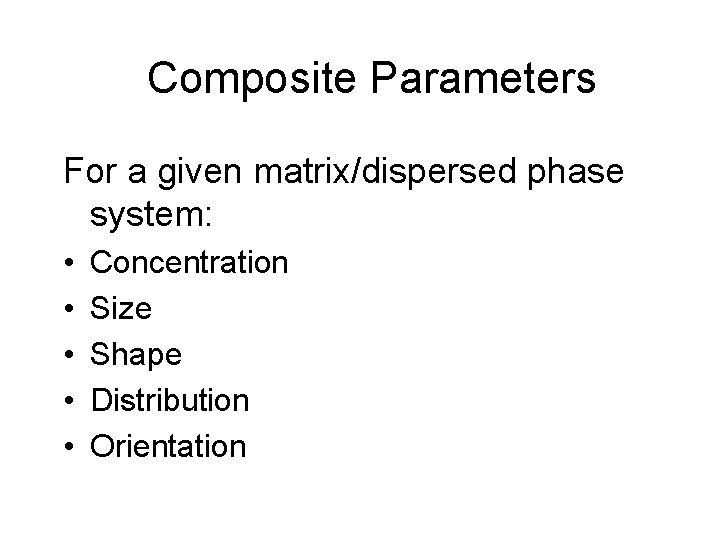
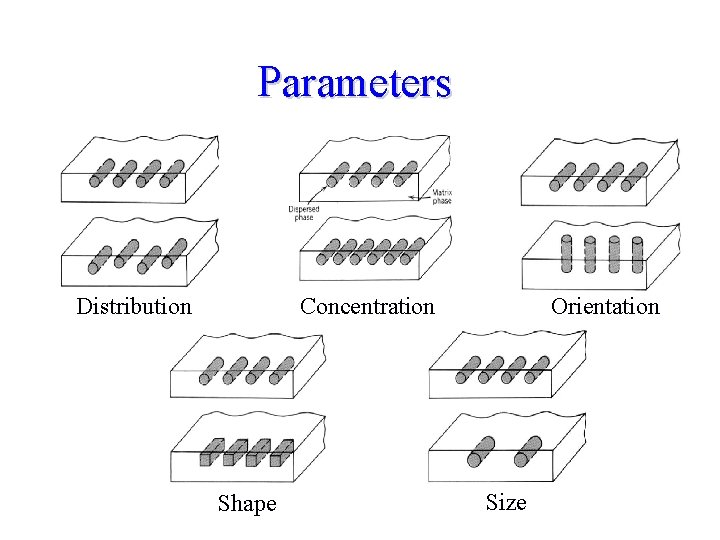
Properties of Composites Dependent on: • constituent phases • relative amounts • geometry of dispersed phase – shape of particles – particle size – particle distribution – particle orientation
Composite Parameters For a given matrix/dispersed phase system: • • • Concentration Size Shape Distribution Orientation
Parameters Distribution Concentration Shape Orientation Size
Classification of Artificial Composites Particulate Fiber Large Dispersion Particle Strengthened Continuous Structural Laminates Discontinuous Aligned Random Sandwich Panels
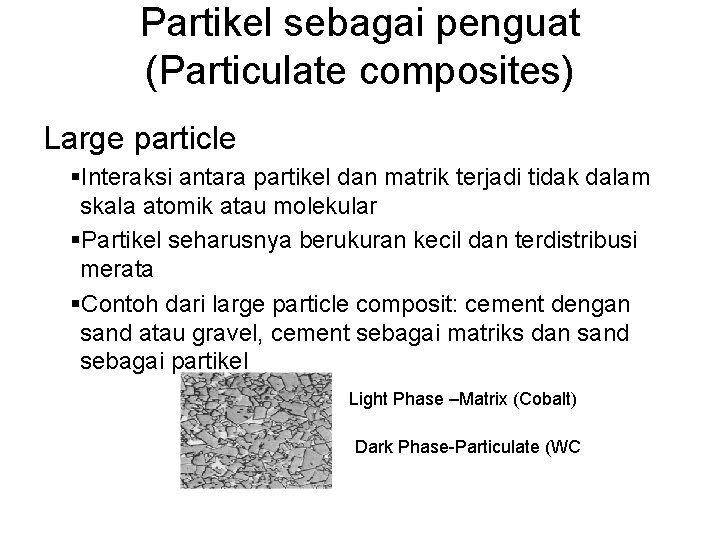
Partikel sebagai penguat (Particulate composites) Large particle §Interaksi antara partikel dan matrik terjadi tidak dalam skala atomik atau molekular §Partikel seharusnya berukuran kecil dan terdistribusi merata §Contoh dari large particle composit: cement dengan sand atau gravel, cement sebagai matriks dan sand sebagai partikel Light Phase –Matrix (Cobalt) Dark Phase-Particulate (WC
Particle-Reinforced Composites • Divided into two classes – (based on strengthening mechanism) • Large particle – interaction between particles and matrix are not on the atomic or molecular level – particle/matrix interface strength is critical • Dispersion strengthened – 0. 01 -0. 1 mm particles – inhibit dislocation motion
Large Particle Composites Examples: • Some polymers with added fillers are really large particle composites • Concrete (cement with sand or gravel) – cement is matrix, sand is particulate
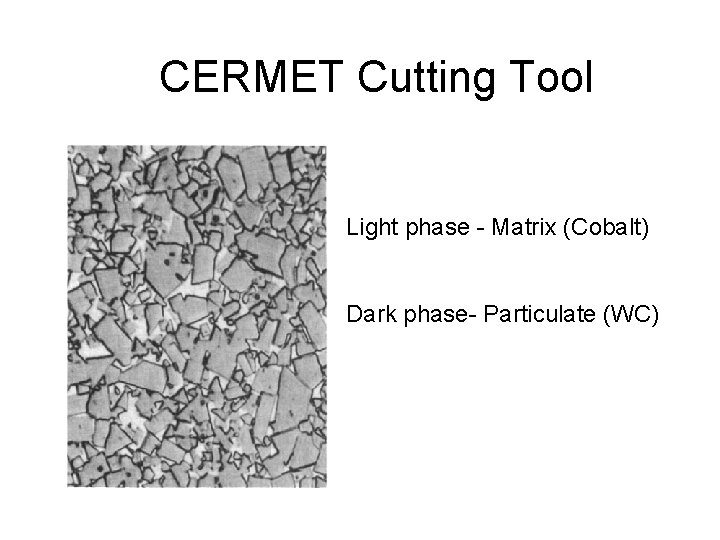
CERMET Cutting Tool Light phase - Matrix (Cobalt) Dark phase- Particulate (WC)
Large Particle Composites Desired Characteristics • Particles should be approximately equiaxed • Particles should be small and evenly distributed • Volume fraction dependent on desired properties
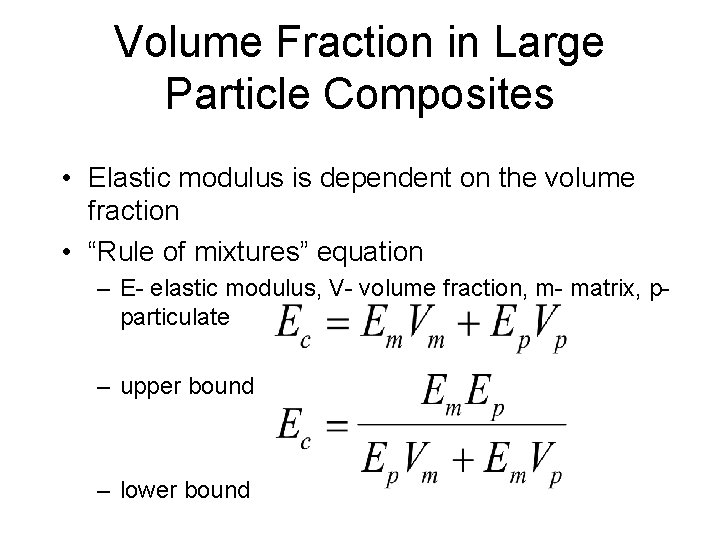
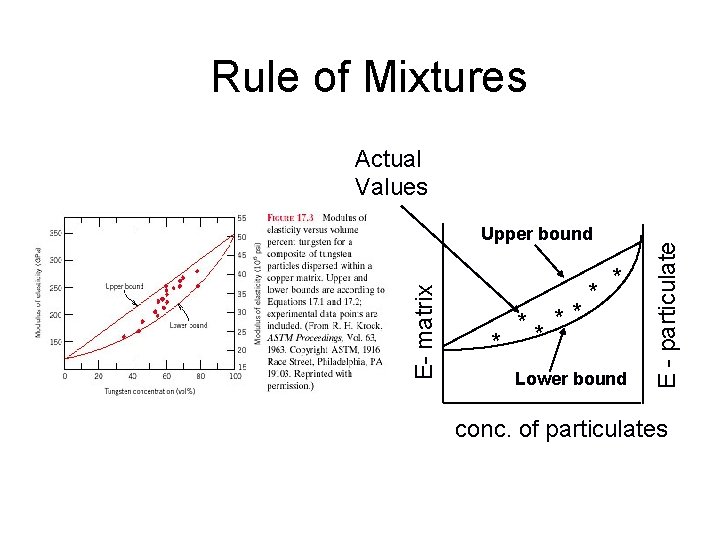
Volume Fraction in Large Particle Composites • Elastic modulus is dependent on the volume fraction • “Rule of mixtures” equation – E- elastic modulus, V- volume fraction, m- matrix, p- particulate – upper bound – lower bound
Rule of Mixtures E- matrix Upper bound ** ** * Lower bound E - particulate Actual Values conc. of particulates
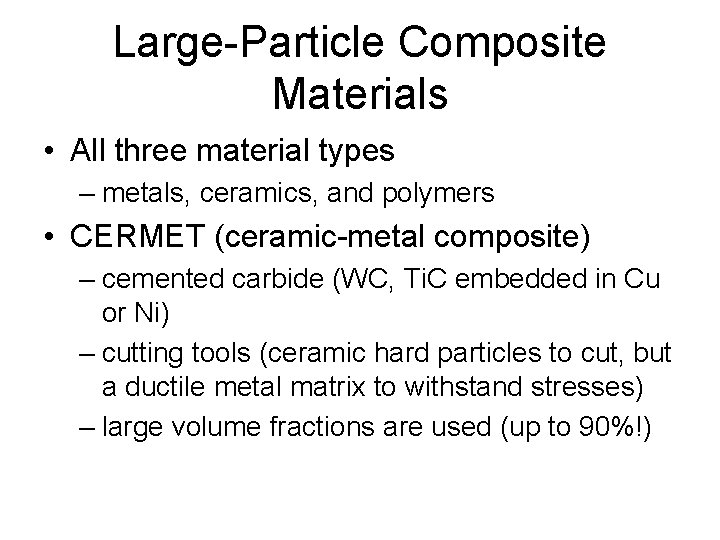
Large-Particle Composite Materials • All three material types – metals, ceramics, and polymers • CERMET (ceramic-metal composite) – cemented carbide (WC, Ti. C embedded in Cu or Ni) – cutting tools (ceramic hard particles to cut, but a ductile metal matrix to withstand stresses) – large volume fractions are used (up to 90%!)
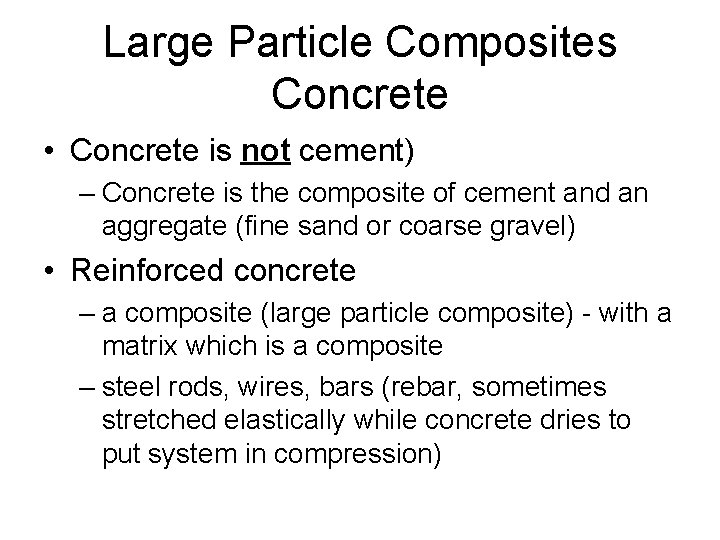
Large Particle Composites Concrete • Concrete is not cement) – Concrete is the composite of cement and an aggregate (fine sand or coarse gravel) • Reinforced concrete – a composite (large particle composite) - with a matrix which is a composite – steel rods, wires, bars (rebar, sometimes stretched elastically while concrete dries to put system in compression)
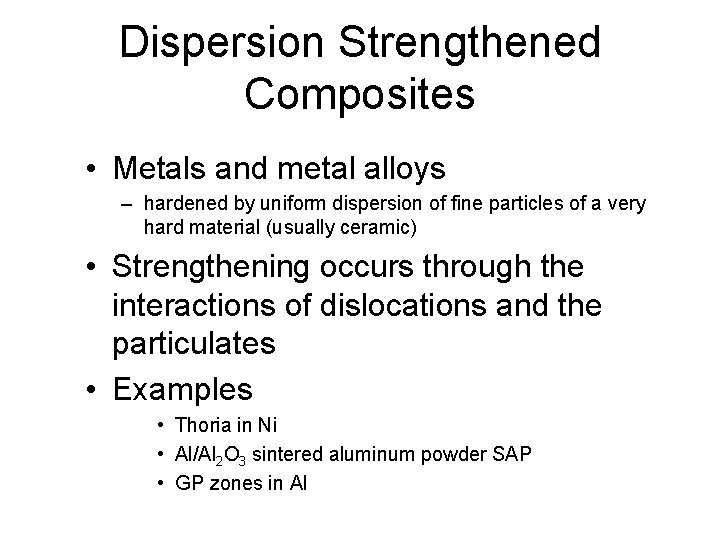
Dispersion Strengthened Composites • Metals and metal alloys – hardened by uniform dispersion of fine particles of a very hard material (usually ceramic) • Strengthening occurs through the interactions of dislocations and the particulates • Examples • Thoria in Ni • Al/Al 2 O 3 sintered aluminum powder SAP • GP zones in Al
Classification of Artificial Composites Particulate Fiber Large Dispersion Particle Strengthened Continuous Structural Laminates Discontinuous Aligned Random Sandwich Panels
Fiber sebagai reinforced Fiber yang digunakan harus: • Mempunyai diameter yang lebih kecil dari diameter bulknya (matriksnya) namun harus lebih kuat dari bulknya • Harus mempunyai tensile strength yang tinggi
• • Matriks yang dipadukan dengan fiber berfungsi sebagai : Penjepit fiber Melindungi fiber dari kerusakan permukaan Pemisah antara fiber dan juga mencegah timbulnya perambatan crack dari suatu fiber ke fiber lain Berfungsi sebagai medium dimana eksternal stress yang diaplikasikan ke komposit, ditransmisikan didistribusikan ke fiber.
Matriks yang digunakan harus : • Ductility tinggi • Memiliki modulus elastisitans lebih rendah daripada fiber • Mempunyai ikatan yang bagus antara matriks dan fiber • Biasanya secara umum yang digunakan adalah polimer dan logam
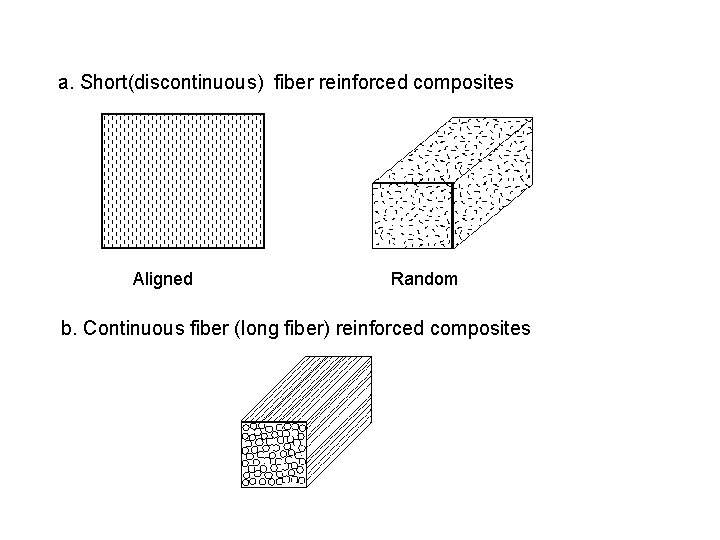
a. Short(discontinuous) fiber reinforced composites Aligned Random b. Continuous fiber (long fiber) reinforced composites
Fiber yang biasa digunakan antara lain : Fibers – Glass – Sangat umun digunakan, fiber yang murah adalah glass fiber yang sering digunakan untuk reinforcement dalam matrik polimer – Komposisi umum adalah 50 – 60 % Si. O 2 dan paduan lain yaitu Al, Ca, Mg, Na, dll. – Moisture dapat mengurangi kekuatan dari glass fiber – Glass fiber sangat rentan mengalami static fatik – Biasanya digunakan untuk: piping, tanks, boats, alat-alat olah raga
Sifat-Sifatnya • Densitynya cukup rendah ( sekitar 2. 55 g/cc) • Tensile strengthnya cukup tinggi (sekitar 1. 8 GPa) • Biasanya stiffnessnya rendah (70 GPa) • Stabilitas dimensinya baik • Resisten terhadap panas • Resisten terhadap dingin • Tahan korosi
Keuntungan : • Biaya murah • Tahan korosi • Biayanya relative lebih rendah dari komposit lainnya Kerugian • Kekuatannya relative rendah • Elongasi tinggi • Keuatan dan beratnya sedang (moderate) Jenis-jenisnya antara lain : – E-Glass - electrical, cheaper – S-Glass - high strength
Fibers - Aramid (kevlar, Twaron) Ø Biasanya digunakan untuk : Armor, protective clothing, industrial, sporting goods Ø Keuntungan : kekutannya cukup tinggi, dan lebih ductile dari carbon
Carbon Fibers • Densitaskarbon cukup ringan yaitu sekitar 2. 3 g/cc • Struktur grafit yang digunakan untuk membuat fiber berbentuk seperti kristal intan. • Karakteristik komposit dengan serat karbon : – ringan; – kekuatan yang sangat tinggi; – kekakuan (modulus elastisitas) tinggi. • Diproduksi dari poliakrilonitril (PAN), melalui tiga tahap proses : • Stabilisasi = peregangan dan oksidasi; • Karbonisasi= pemanasan untuk mengurangi O, H, N; • Grafitisasi = meningkatkan modulus elastisitas.
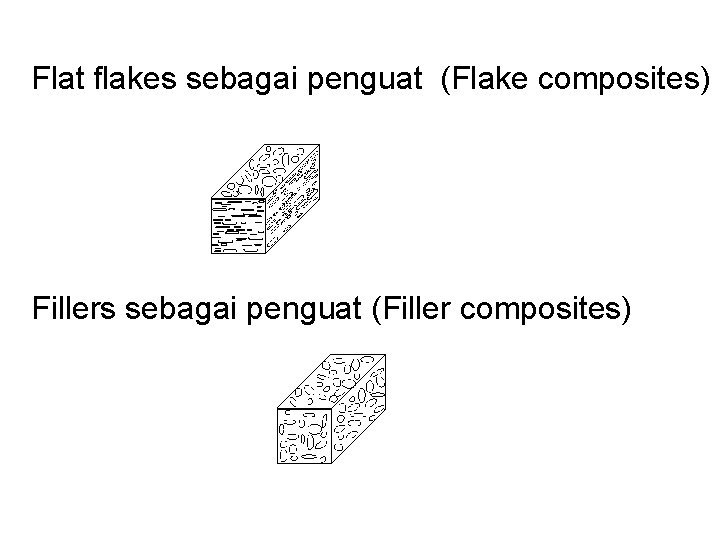
Flat flakes sebagai penguat (Flake composites) Fillers sebagai penguat (Filler composites)
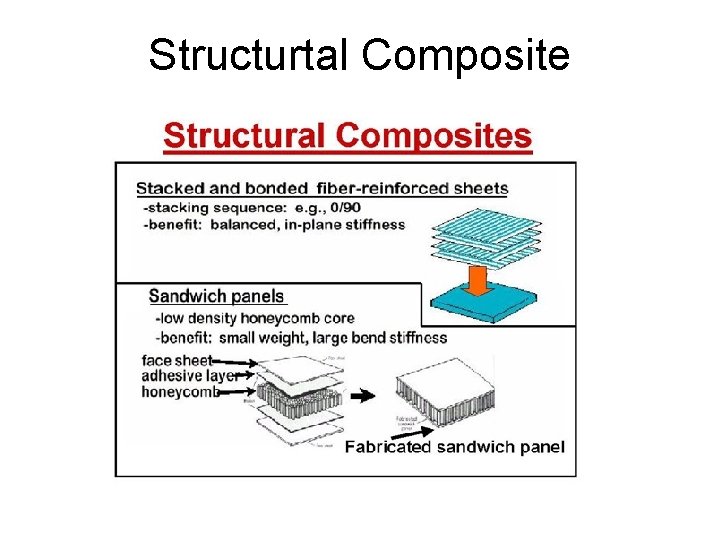
Structurtal Composite
Fiber-Reinforced Composites • Technologically, the most important type of composite • Characterized in terms of specific strength or specific modulus = strength (or E) per weight – usually want to maximize specific strength and modulus • Subclasses: – Short fiber and continuous fiber lengths
Fiber Phase Requirements for the fiber • The small diameter fiber must be much stronger than the bulk material • High tensile strength Different classifications • whiskers (single crystal - large aspect ratio) • fibers (polycrystalline or amorphous) • wires (large diameters - usually metal)
Matrix Phase Function • Binds fibers together • Acts as a medium through which externally applied stress is transmitted and distributed to the fibers • Protects fiber from surface damage • Separates fibers and prevents a crack from one fiber from propagating through another
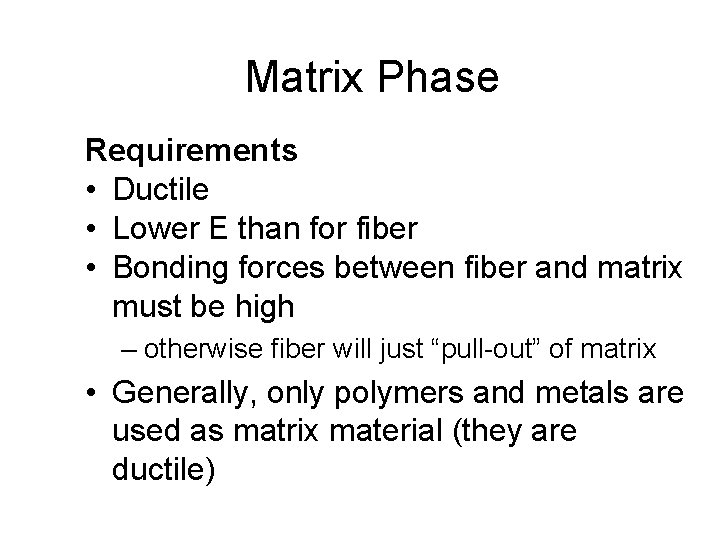
Matrix Phase Requirements • Ductile • Lower E than for fiber • Bonding forces between fiber and matrix must be high – otherwise fiber will just “pull-out” of matrix • Generally, only polymers and metals are used as matrix material (they are ductile)
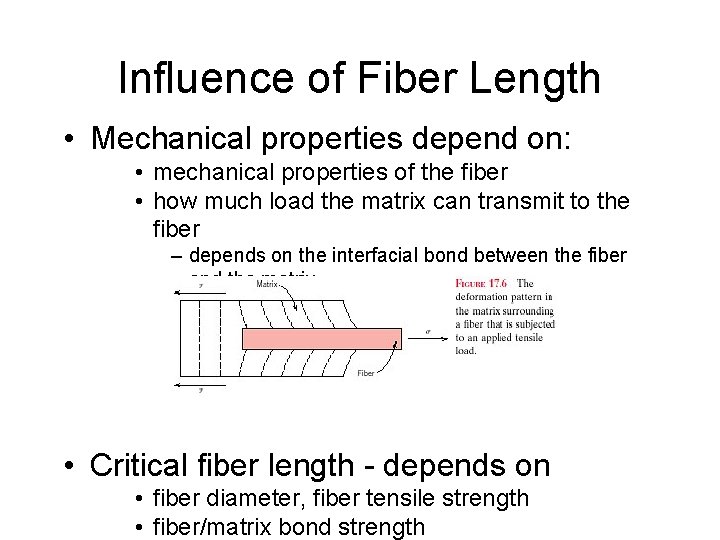
Influence of Fiber Length • Mechanical properties depend on: • mechanical properties of the fiber • how much load the matrix can transmit to the fiber – depends on the interfacial bond between the fiber and the matrix • Critical fiber length - depends on • fiber diameter, fiber tensile strength • fiber/matrix bond strength
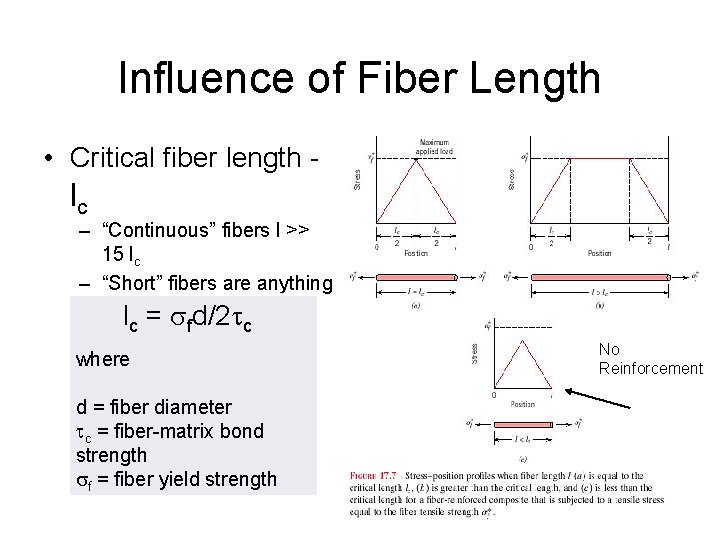
Influence of Fiber Length • Critical fiber length - lc – “Continuous” fibers l >> 15 lc – “Short” fibers are anything shorter 15 lc = sfd/2 tc where d = fiber diameter tc = fiber-matrix bond strength sf = fiber yield strength No Reinforcement
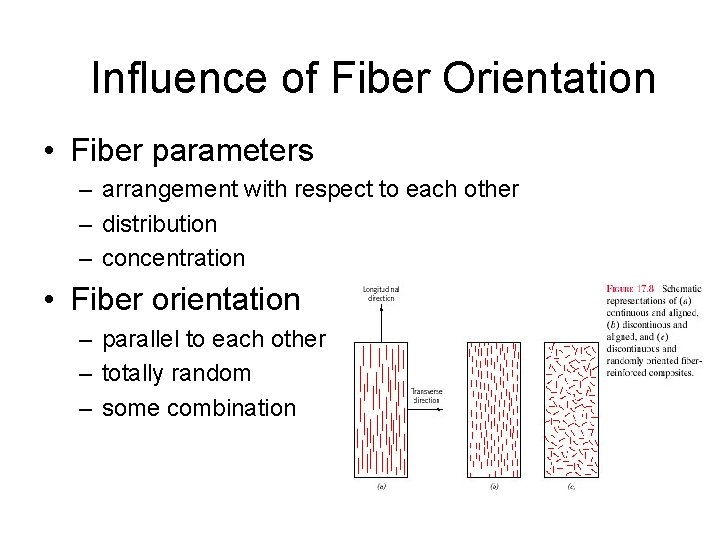
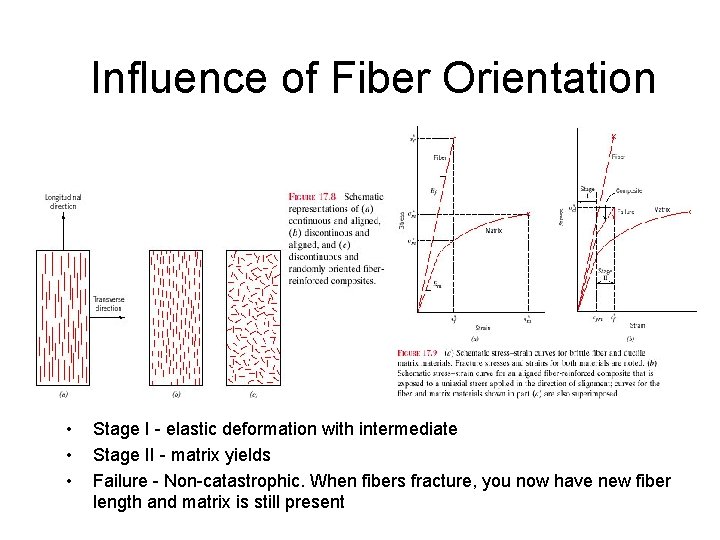
Influence of Fiber Orientation • Fiber parameters – arrangement with respect to each other – distribution – concentration • Fiber orientation – parallel to each other – totally random – some combination
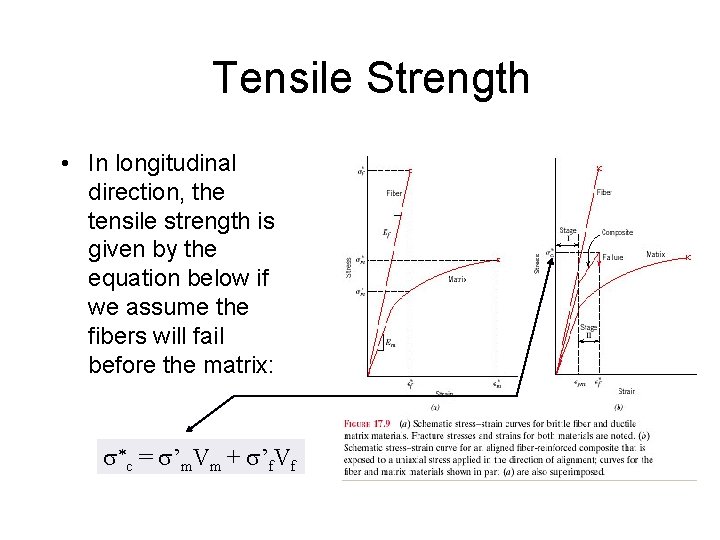
Influence of Fiber Orientation • • • Stage I - elastic deformation with intermediate Stage II - matrix yields Failure - Non-catastrophic. When fibers fracture, you now have new fiber length and matrix is still present
Aligned Fibers • When fibers are aligned – properties of material are highly anisotropic – modulus in direction of alignment is a function of the volume fraction of the E of the fiber and matrix – modulus perpendicular to direction of alignment is considerably less (the fibers do not contribute)
Randomly Oriented Fibers • Properties are isotropic – not dependent on direction • Ultimate tensile strength is less than for aligned fibers • May be desirable to sacrifice strength for the isotropic nature of the composite
Fiberglass Reinforced Composites Glass is a common reinforcement • it is easily drawn into fibers • it is cheap and readily available • it is easy to process into composites • it can produce very strong, very light composites (high specific strength) • it is usually chemically inert (does not degrade in harsh environments)
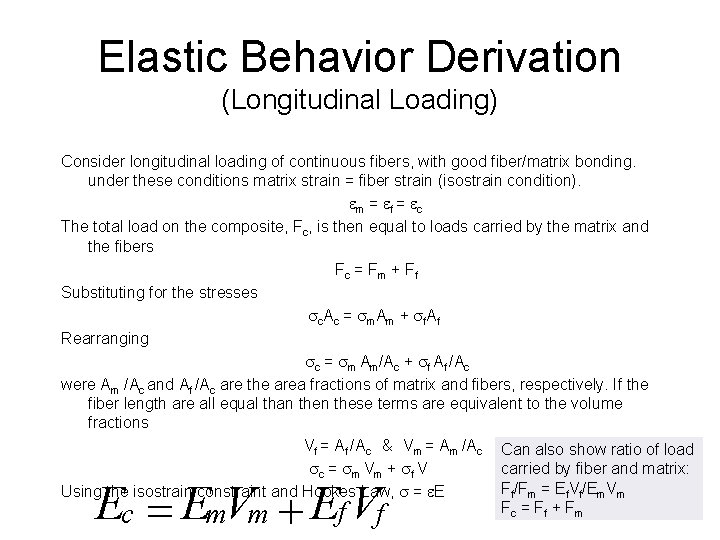
Elastic Behavior Derivation (Longitudinal Loading) Consider longitudinal loading of continuous fibers, with good fiber/matrix bonding. under these conditions matrix strain = fiber strain (isostrain condition). em = ef = ec The total load on the composite, Fc, is then equal to loads carried by the matrix and the fibers Fc = Fm + Ff Substituting for the stresses sc. Ac = sm. Am + sf. Af Rearranging sc = sm Am/Ac + sf Af /Ac were Am /Ac and Af /Ac are the area fractions of matrix and fibers, respectively. If the fiber length are all equal than these terms are equivalent to the volume fractions Vf = Af /Ac & Vm = Am /Ac Can also show ratio of load sc = sm Vm + sf V carried by fiber and matrix: Ff/Fm = Ef. Vf/Em. Vm Using the isostrain constraint and Hookes Law, s = e. E Fc = Ff + Fm Ec = Em. Vm + Ef Vf
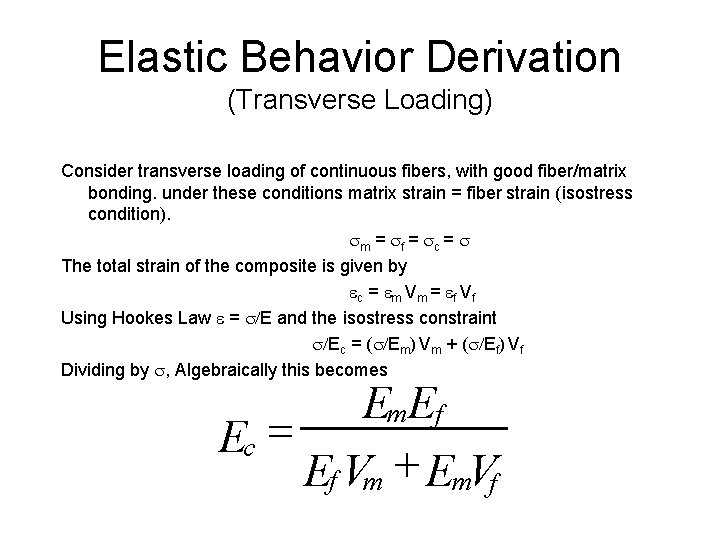
Elastic Behavior Derivation (Transverse Loading) Consider transverse loading of continuous fibers, with good fiber/matrix bonding. under these conditions matrix strain = fiber strain (isostress condition). sm = sf = sc = s The total strain of the composite is given by ec = em Vm = ef Vf Using Hookes Law e = s/E and the isostress constraint s/Ec = (s/Em) Vm + (s/Ef) Vf Dividing by s, Algebraically this becomes Em. Ef Ec = Ef Vm + Em. Vf
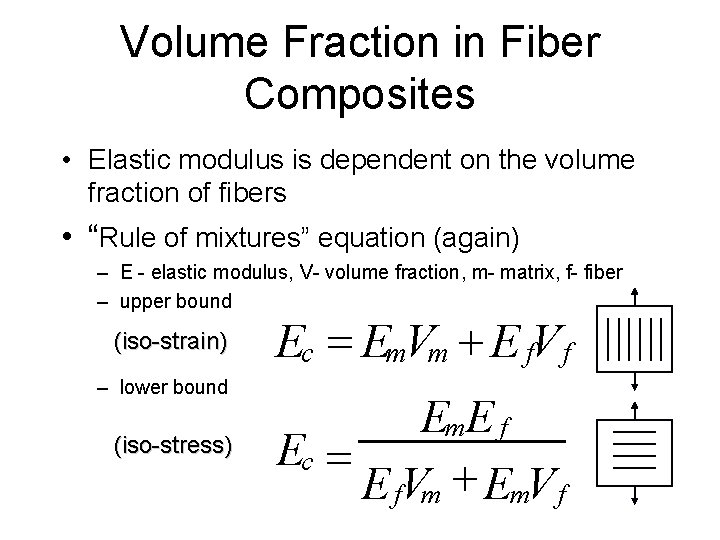
Volume Fraction in Fiber Composites • Elastic modulus is dependent on the volume fraction of fibers • “Rule of mixtures” equation (again) – E - elastic modulus, V- volume fraction, m- matrix, f- fiber – upper bound (iso-strain) – lower bound (iso-stress) Ec = Em. Vm + E f. V f Em. E f Ec = E f. Vm + Em. V f
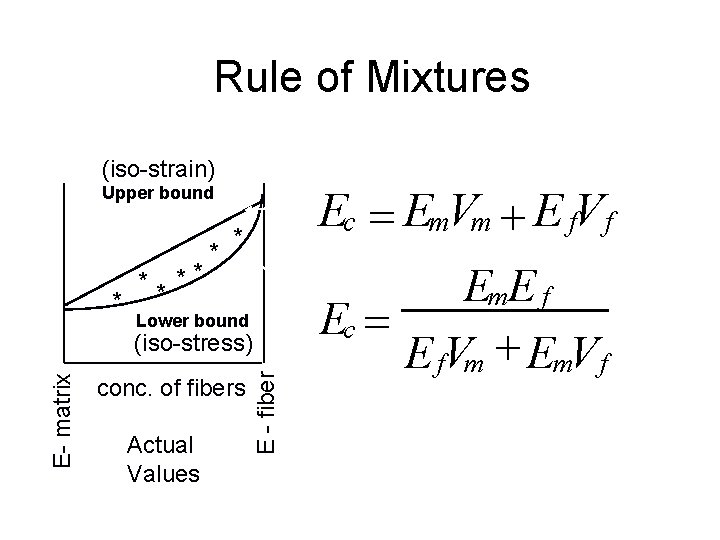
Rule of Mixtures (iso-strain) Ec = Em. Vm + E f. V f Upper bound ** ** * Lower bound conc. of fibers Actual Values E - fiber E- matrix (iso-stress) Em. E f Ec = E f. Vm + Em. V f
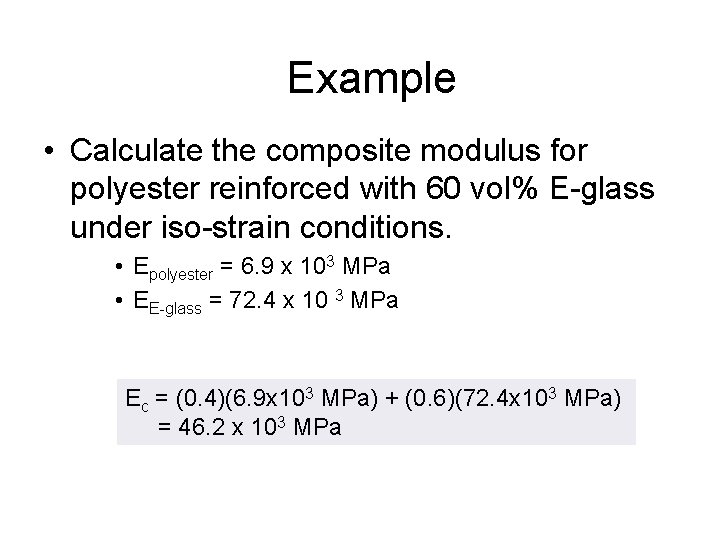
Example • Calculate the composite modulus for polyester reinforced with 60 vol% E-glass under iso-strain conditions. • Epolyester = 6. 9 x 10³ MPa • EE-glass = 72. 4 x 10 3 MPa Ec = (0. 4)(6. 9 x 10³ MPa) + (0. 6)(72. 4 x 10³ MPa) = 46. 2 x 10³ MPa
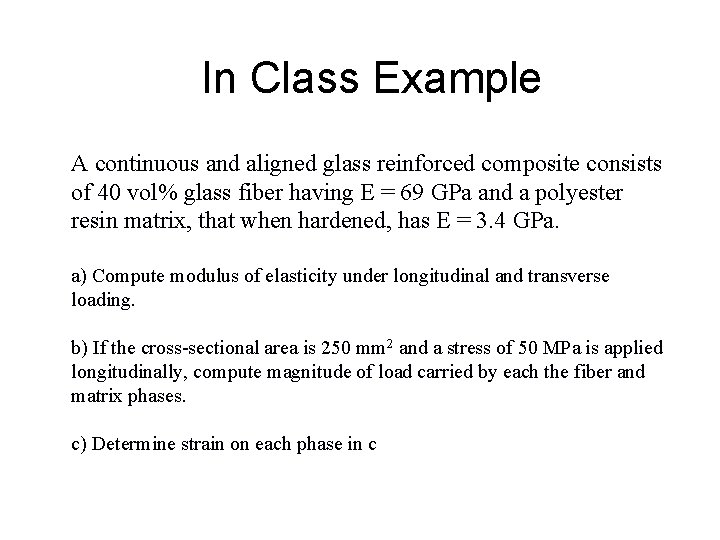
In Class Example A continuous and aligned glass reinforced composite consists of 40 vol% glass fiber having E = 69 GPa and a polyester resin matrix, that when hardened, has E = 3. 4 GPa. a) Compute modulus of elasticity under longitudinal and transverse loading. b) If the cross-sectional area is 250 mm 2 and a stress of 50 MPa is applied longitudinally, compute magnitude of load carried by each the fiber and matrix phases. c) Determine strain on each phase in c
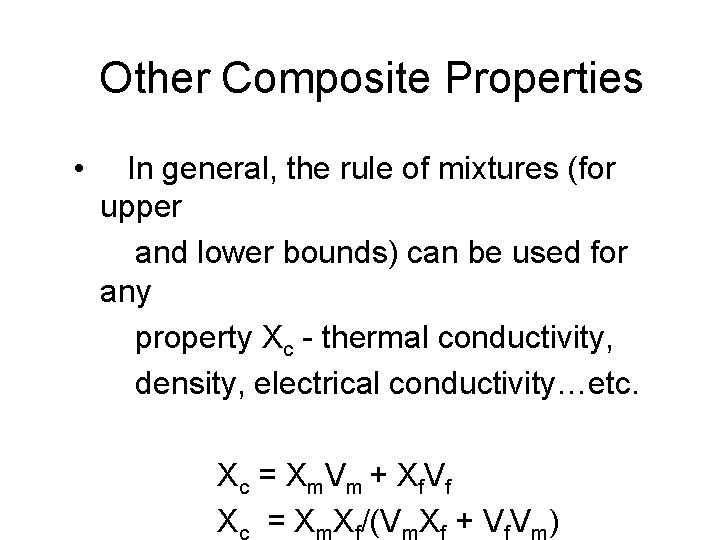
Other Composite Properties • In general, the rule of mixtures (for upper and lower bounds) can be used for any property Xc - thermal conductivity, density, electrical conductivity…etc. Xc = Xm. Vm + Xf. Vf Xc = Xm. Xf/(Vm. Xf + Vf. Vm)
Tensile Strength • In longitudinal direction, the tensile strength is given by the equation below if we assume the fibers will fail before the matrix: s*c = s’m. Vm + s’f. Vf
Discontinuous Fibers • Aligned s*c = s*f. Vf(1 -lc/2 l) + s’m. Vm s*c = (ltc/d)Vf + s’m. Vm for l > lc for l < lc • Random 0. 6 Ec = KEf. Vf + Em. Vm where K ~ 0. 1 to 3/8 1/5
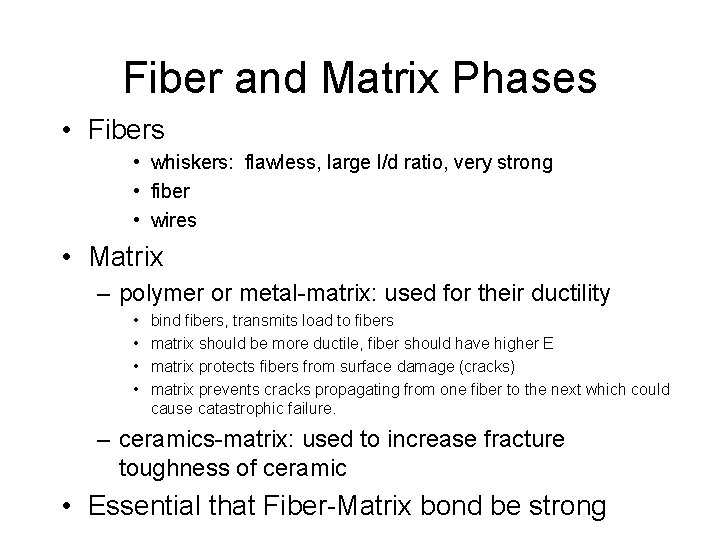
Fiber and Matrix Phases • Fibers • whiskers: flawless, large l/d ratio, very strong • fiber • wires • Matrix – polymer or metal-matrix: used for their ductility • • bind fibers, transmits load to fibers matrix should be more ductile, fiber should have higher E matrix protects fibers from surface damage (cracks) matrix prevents cracks propagating from one fiber to the next which could cause catastrophic failure. – ceramics-matrix: used to increase fracture toughness of ceramic • Essential that Fiber-Matrix bond be strong
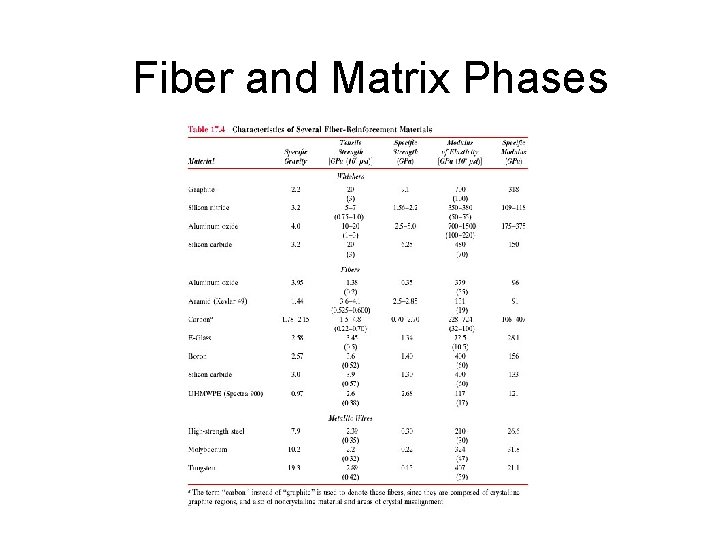
Fiber and Matrix Phases
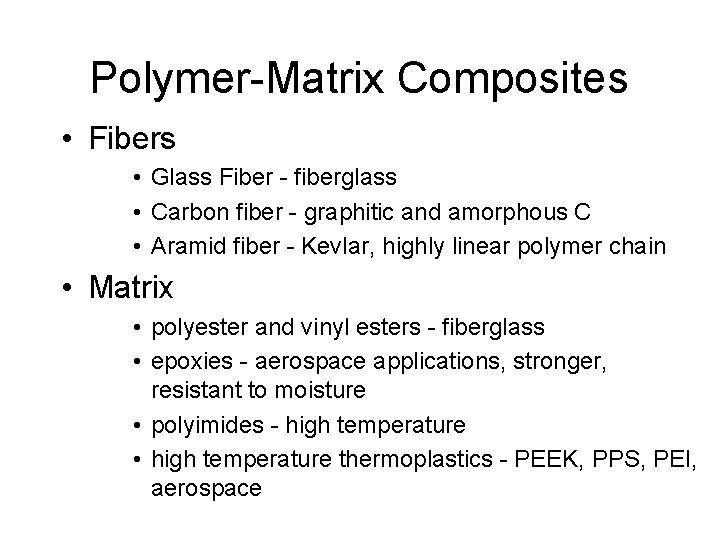
Polymer-Matrix Composites • Fibers • Glass Fiber - fiberglass • Carbon fiber - graphitic and amorphous C • Aramid fiber - Kevlar, highly linear polymer chain • Matrix • polyester and vinyl esters - fiberglass • epoxies - aerospace applications, stronger, resistant to moisture • polyimides - high temperature • high temperature thermoplastics - PEEK, PPS, PEI, aerospace
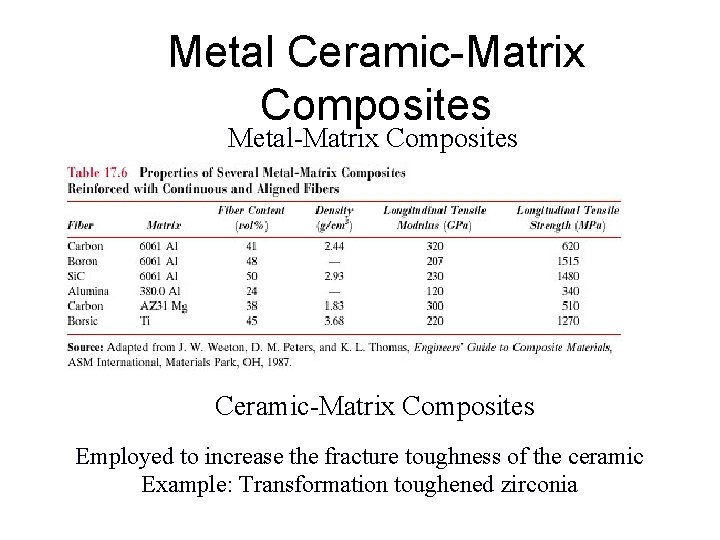
Metal Ceramic-Matrix Composites Metal-Matrix Composites Ceramic-Matrix Composites Employed to increase the fracture toughness of the ceramic Example: Transformation toughened zirconia
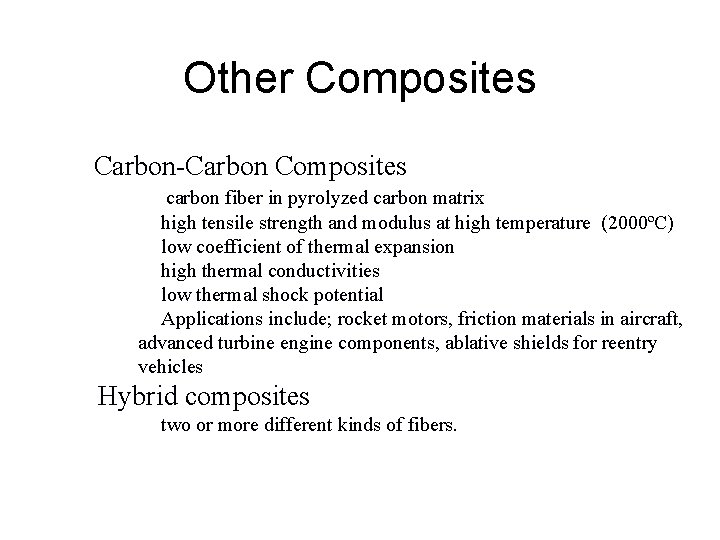
Other Composites 4 Carbon-Carbon Composites 4 carbon fiber in pyrolyzed carbon matrix 4 high tensile strength and modulus at high temperature (2000ºC) 4 low coefficient of thermal expansion 4 high thermal conductivities 4 low thermal shock potential 4 Applications include; rocket motors, friction materials in aircraft, advanced turbine engine components, ablative shields for reentry vehicles 4 Hybrid composites 4 two or more different kinds of fibers.
Classification of Artificial Composites Particulate Fiber Large Dispersion Particle Strengthened Continuous Structural Laminates Discontinuous Aligned Random Sandwich Panels
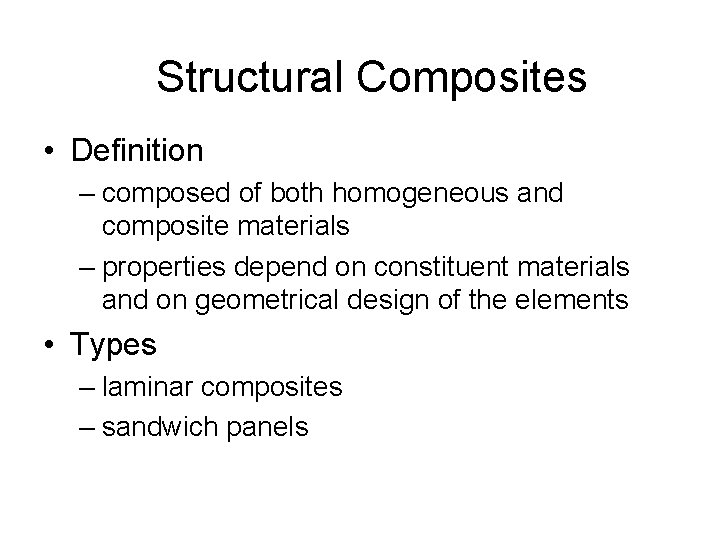
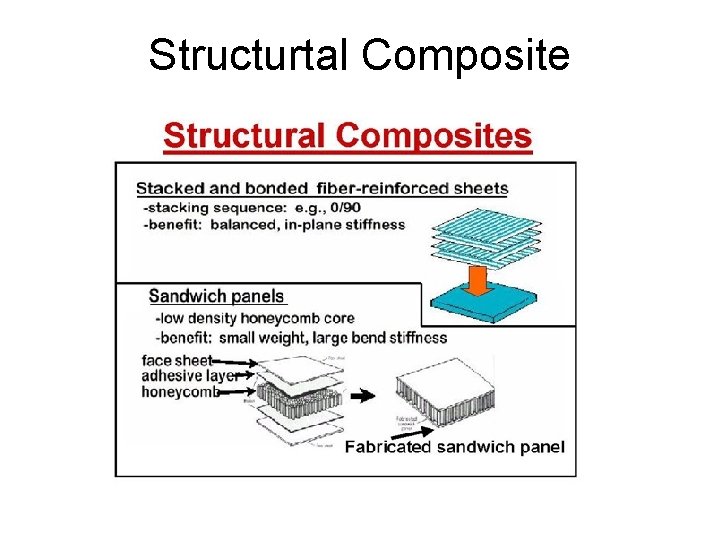
Structural Composites • Definition – composed of both homogeneous and composite materials – properties depend on constituent materials and on geometrical design of the elements • Types – laminar composites – sandwich panels
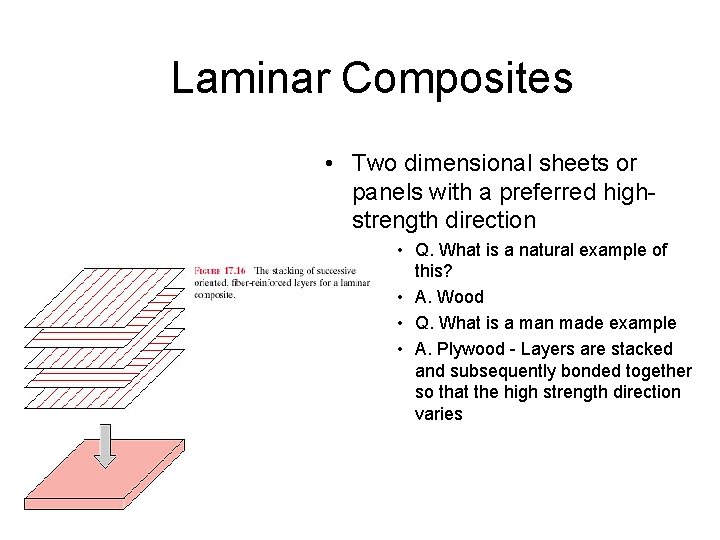
Laminar Composites • Two dimensional sheets or panels with a preferred highstrength direction • Q. What is a natural example of this? • A. Wood • Q. What is a man made example • A. Plywood - Layers are stacked and subsequently bonded together so that the high strength direction varies
Plywood
Sandwich Panels • Two strong outer sheets (called faces) separated by a layer of less dense material or core (which has lower E and lower strength) • Core – separates faces – resists deformation perpendicular to the faces – often honeycomb structures • Used in roofs, walls, wings
Sandwich Panel
Structurtal Composite