
NANTAI NVERSTES BUILDING MATERIALS CHAPTER 2 STRUCTURAL CLAY
NİŞANTAŞI ÜNİVERSİTESİ BUILDING MATERIALS CHAPTER 2 -STRUCTURAL CLAY PRODUCTS Mühendislik Mimarlık Fakültesi mmf. nisantasi. edu. tr NİŞANTAŞI ÜNİVERS İTESİ ©
CLAY PRODUCTS Clay products are one of the most important classes of structural materials. The raw materials used in their manufacture are clay blended with quartz, sand, chamatte (refractory clay burned at 1000– 1400°C and crushed), slag, sawdust and pulverized coal. Structural clay products or building ceramics are basically fabricated by moulding, drying and burning a clay mass. Higher the bulk specific gravity, the stronger is the clay product. This rule does not hold good for vitrified products since the specific gravity of clay decreases as vitrification advances. NİŞANTAŞI ÜNİVERSİTESİ ©
TYPES OF CLAYS • Purest clays consist mainly of kaolinite (2 Si. O 2. Al 2 O 3. 2 H 2 O) with small quantities of minerals such as quartz, mica, felspar, calcite, magnesite, etc. By their origin, clays are subdivided as residual and transported clays. • Residual clays, known as Kaolin or China clay, are formed from the decay of underlying rocks and are used for making pottery. The transported or sedimentary clays result from the action of weathering agencies. These are more disperse, contain impurities, and free from large particles of mother rocks. NİŞANTAŞI ÜNİVERSİTESİ ©
CLASSIFICATION ON THE BASIS OF RESISTANCE On the basis of resistance to high temperatures (more than 1580°C), clays are classified as refractory, high melting and low melting clays. The refractory clays are highly disperse and very plastic. These have high content of alumina and low content of impurities, such as Fe 2 O 3, tending to lower the refractoriness. High melting clays have high refractoriness (1350– 1580°C) and contain small amount of impurities such as quartz, felspar, mica, calcium carbonate and magnesium carbonate. These are used for manufacturing facing bricks, floor tiles, sewer pipes, etc. Low melting clays have refractoriness less than 1350°C and have varying compositions. These are used to manufacture bricks, blocks, tiles, etc. NİŞANTAŞI ÜNİVERSİTESİ ©
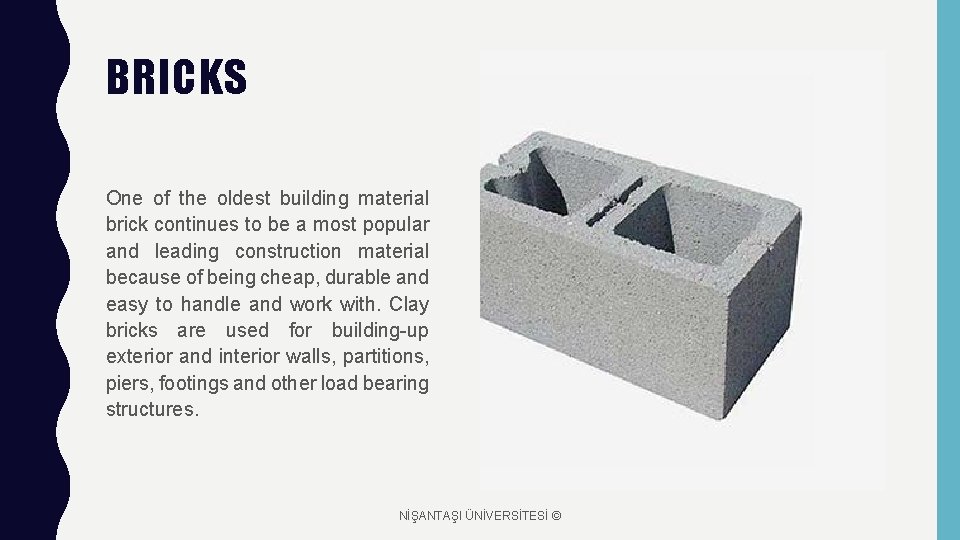
BRICKS One of the oldest building material brick continues to be a most popular and leading construction material because of being cheap, durable and easy to handle and work with. Clay bricks are used for building-up exterior and interior walls, partitions, piers, footings and other load bearing structures. NİŞANTAŞI ÜNİVERSİTESİ ©
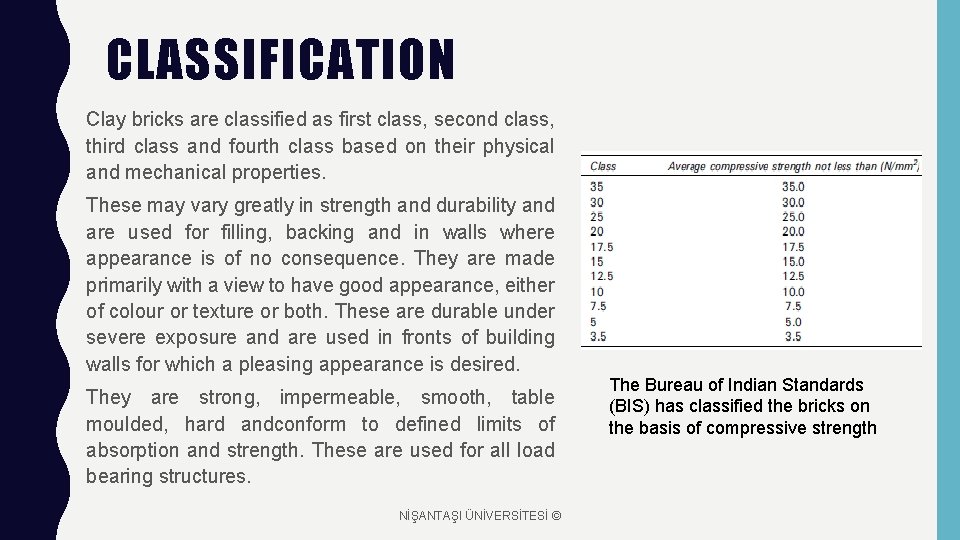
CLASSIFICATION Clay bricks are classified as first class, second class, third class and fourth class based on their physical and mechanical properties. These may vary greatly in strength and durability and are used for filling, backing and in walls where appearance is of no consequence. They are made primarily with a view to have good appearance, either of colour or texture or both. These are durable under severe exposure and are used in fronts of building walls for which a pleasing appearance is desired. They are strong, impermeable, smooth, table moulded, hard andconform to defined limits of absorption and strength. These are used for all load bearing structures. NİŞANTAŞI ÜNİVERSİTESİ © The Bureau of Indian Standards (BIS) has classified the bricks on the basis of compressive strength
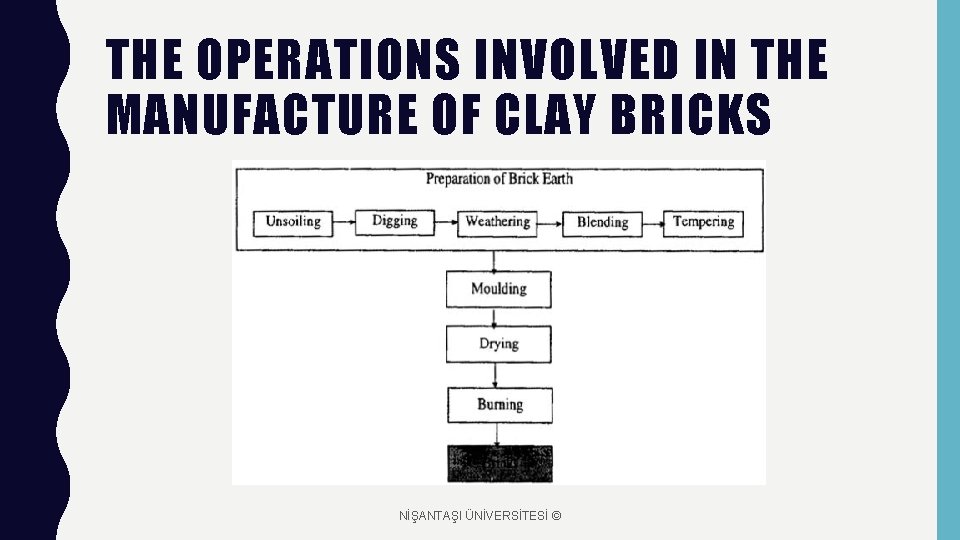
THE OPERATIONS INVOLVED IN THE MANUFACTURE OF CLAY BRICKS NİŞANTAŞI ÜNİVERSİTESİ ©
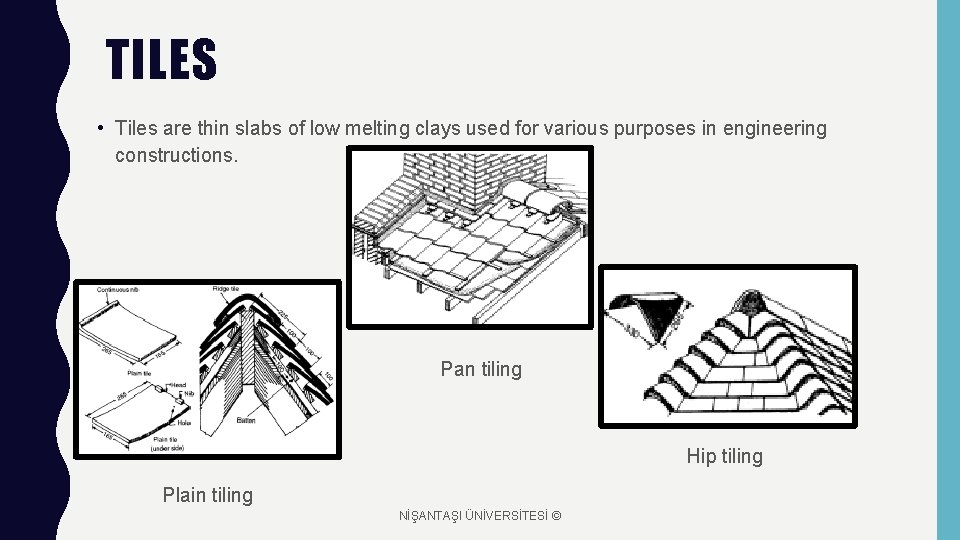
TILES • Tiles are thin slabs of low melting clays used for various purposes in engineering constructions. Pan tiling Hip tiling Plain tiling NİŞANTAŞI ÜNİVERSİTESİ ©
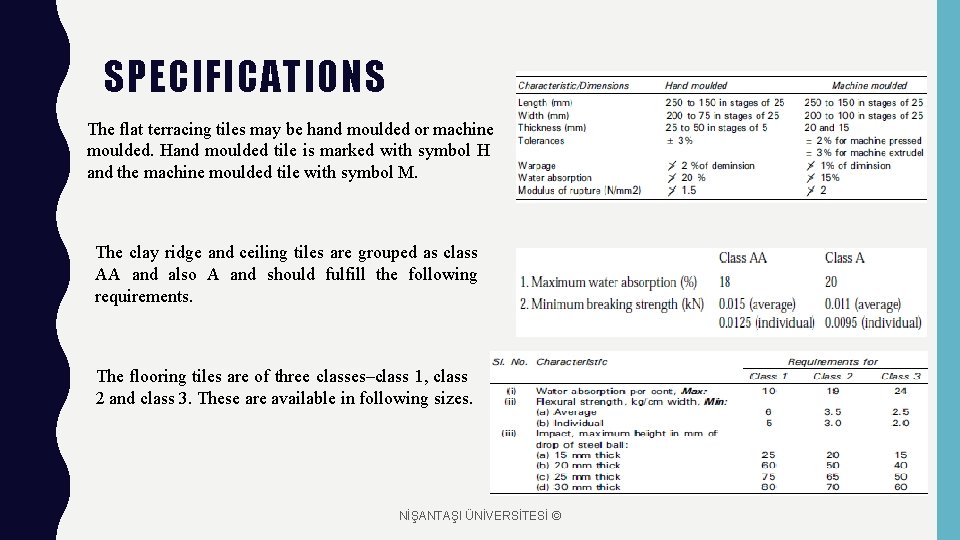
SPECIFICATIONS The flat terracing tiles may be hand moulded or machine moulded. Hand moulded tile is marked with symbol H and the machine moulded tile with symbol M. The clay ridge and ceiling tiles are grouped as class AA and also A and should fulfill the following requirements. The flooring tiles are of three classes–class 1, class 2 and class 3. These are available in following sizes. NİŞANTAŞI ÜNİVERSİTESİ ©
REFERENCES 1. S. K. DUGGAL, BUILDING MATERIALS, NEW AGE INTERNATIONAL (P) LIMITED, PUBLISHERS NİŞANTAŞI ÜNİVERSİTESİ ©
- Slides: 10