Mindset Grit and Determination The Key to Leading







- Slides: 49
Mindset, Grit, and Determination: The Key to Leading by Influence Jim Grant Georgia Compensatory Education Leadership Conference Session #1 February 24, 2014 Savannah, GA 1 -800 -924 -9621 Ext. 1140 jgrant@sde. com
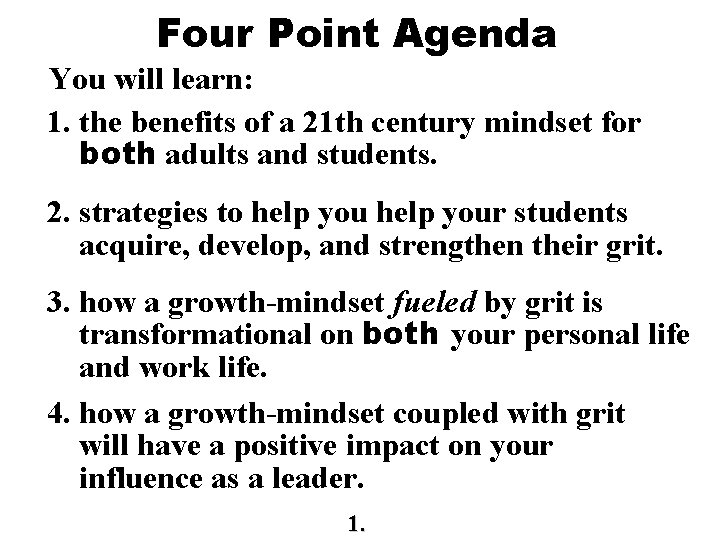
Four Point Agenda You will learn: 1. the benefits of a 21 th century mindset for both adults and students. 2. strategies to help your students acquire, develop, and strengthen their grit. 3. how a growth-mindset fueled by grit is transformational on both your personal life and work life. 4. how a growth-mindset coupled with grit will have a positive impact on your influence as a leader. 1.
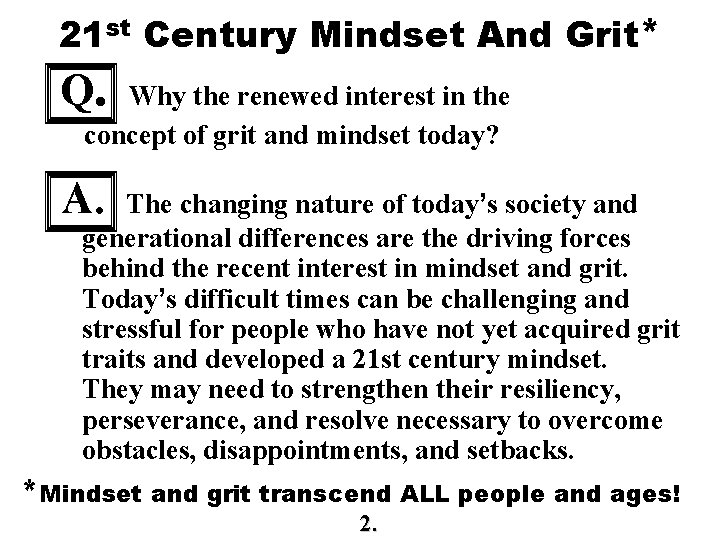
21 st Century Mindset And Grit* Q. Why the renewed interest in the concept of grit and mindset today? A. The changing nature of today’s society and generational differences are the driving forces behind the recent interest in mindset and grit. Today’s difficult times can be challenging and stressful for people who have not yet acquired grit traits and developed a 21 st century mindset. They may need to strengthen their resiliency, perseverance, and resolve necessary to overcome obstacles, disappointments, and setbacks. *Mindset and grit transcend ALL people and ages! 2.
Understanding Mindset A 21 st century mindset is based on the notion one is always growing and learning, and the view one adopts for themselves profoundly affects the way they lead their life. Their basic beliefs, values, and reference frames are used to organize their world. People with a 21 st century mindset believe they create their own future. People with a fixed mindset may believe heredity, luck, and destiny has more to do with creating their future than effort. They tend to believe the future is something that happens to them. 3.
21 st Century Mindset Persons who have a 21 st century mindset: __ have an optimistic perspective. __ are always up to a challenge. __ identify their own strengths and eaknesses. _ believe they are evolving and always have omething to learn (lifelong learner). __ stretch themselves when learning new things. __ have the persistence and the effort to learn something over a longer time period. __ try doing things they couldn’t do before. __ view “good failures” as learning opportunities. __ are known for their reliability and commitment. Based on the work of: Carol S. Dweck, Angela Duckworth, Paul Tough, et al. 4.
Benefits of a 21 st Century Mindset A 21 st century mindset will: __ reinforce your optimism. __ strengthen your perseverance and effort. __ help you thrive during challenging times. __ reinforce your belief that you can change and grow. __ boost your tenacity and effort. __ foster the adoption of grit traits. __ stiffen your resolve when faced with setbacks, challenges, and disappointments. __ strengthen your resilience. __ solidify your determination and effort to be reliable and fully committed. Based on the work of: Carol S. Dweck, Angela Duckworth, Paul Tough, et al. 5.
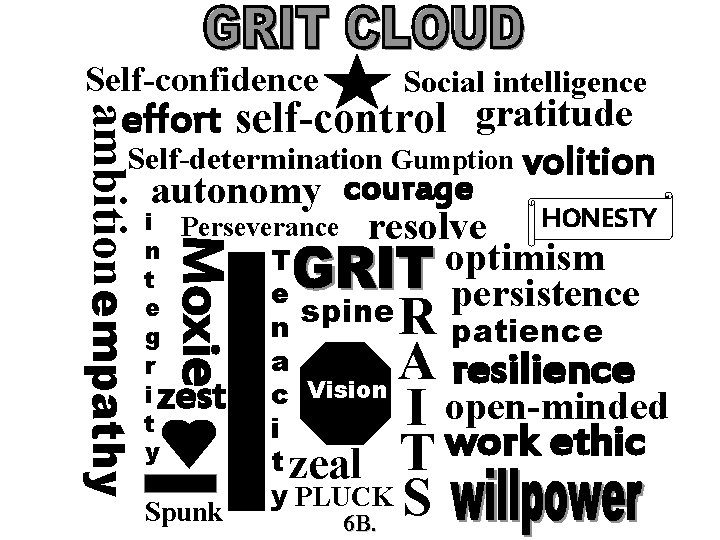
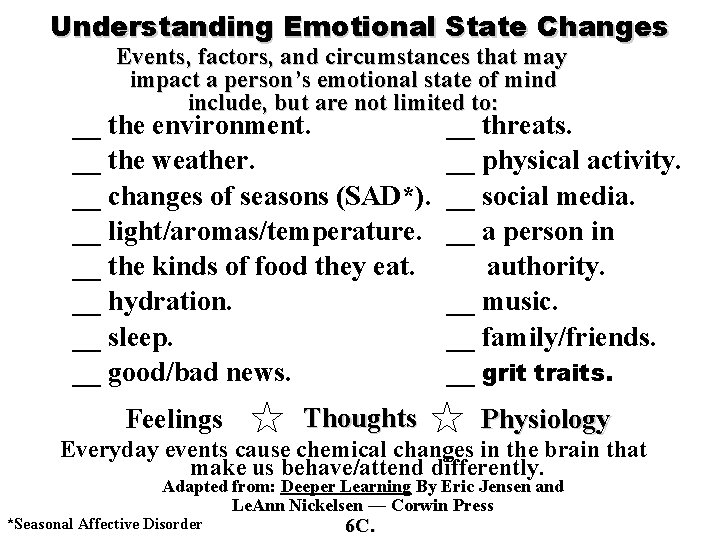
How to Develop, Strengthen, and Maintain A 21 st Century Mindset 1. Start by taking an inventory of your mindset traits (see slides 4 & 5). 2. Become familiar with the terminology of grit and mindset traits (see slide 6 A). Each week, select a word from the grit cloud poster to work on to enhance your grit (see slide 6 B). 3. Surround yourself with role models who have a 21 st century mindset. 4. Use your understanding of emotional state changes to enhance your mindset (see slide 6 C). 6.
“Gritty” Words effortitude gumption spunk spine/backbone courage self-determination self-confidence initiative hard worker ambitious resolve social intelligence zest/zeal tenacity perseverance stay-the-course persistence optimism self-control resilience open-minded goal-focused gratitude volition conscientious optimism moxie “Gritty” words are used interchangeably to address both mindset and grit. 6 A.
Self-confidence Social intelligence autonomy courage HONESTY i Perseverance resolve n T optimism t e persistence e spine g r i t y Moxie ambition empathy effort self-control gratitude Self-determination Gumption volition zest Spunk n a c Vision i t zeal y PLUCK 6 B. R patience A resilience I open-minded work ethic T S
Understanding Emotional State Changes Events, factors, and circumstances that may impact a person’s emotional state of mind include, but are not limited to: __ the environment. __ the weather. __ changes of seasons (SAD*). __ light/aromas/temperature. __ the kinds of food they eat. __ hydration. __ sleep. __ good/bad news. Feelings Thoughts __ threats. __ physical activity. __ social media. __ a person in authority. __ music. __ family/friends. __ grit traits. Physiology Everyday events cause chemical changes in the brain that make us behave/attend differently. Adapted from: Deeper Learning By Eric Jensen and Le. Ann Nickelsen — Corwin Press *Seasonal Affective Disorder 6 C.
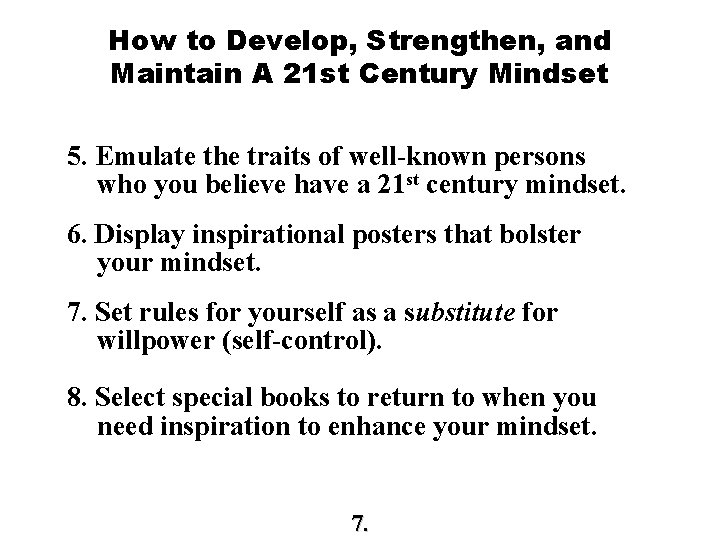
How to Develop, Strengthen, and Maintain A 21 st Century Mindset 5. Emulate the traits of well-known persons who you believe have a 21 st century mindset. 6. Display inspirational posters that bolster your mindset. 7. Set rules for yourself as a substitute for willpower (self-control). 8. Select special books to return to when you need inspiration to enhance your mindset. 7.
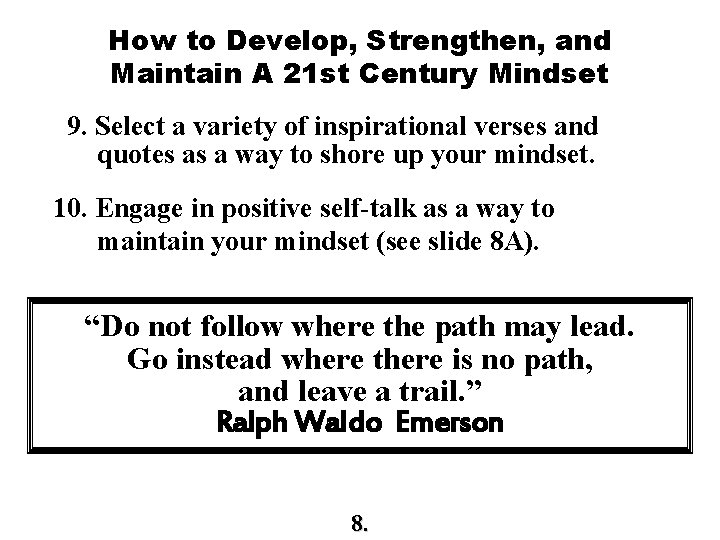
How to Develop, Strengthen, and Maintain A 21 st Century Mindset 9. Select a variety of inspirational verses and quotes as a way to shore up your mindset. 10. Engage in positive self-talk as a way to maintain your mindset (see slide 8 A). “Do not follow where the path may lead. Go instead where there is no path, and leave a trail. ” Ralph Waldo Emerson 8.
Self-Talk. . Maintaining My Mindset Be here now! There are no shortcuts. I will work harder. Tomorrow is a new day. If I fall down, I will get back up. Nothing ventured, nothing gained. Rome wasn’t built in a day. I will follow my to-do-list today. 8 A.
What Is Grit? Grit could be defined as a collection of hardy, timeless character traits that emanate from a 21 st century mindset. They enable one to persevere in the face of setbacks, adversity, and disappointments in the pursuit of long-term goals. Firmness of mind or spirit… unyielding courage in the face of hardship or danger. ~ Merriam-Webster 23. 9.
Traditional Character Traits Traditional character traits usually center around moral and community values include, but are not limited to: __ courage. * __ fairness. __ respect. __ patriotism. __ self-discipline. * __ empathy. __ honesty. __ integrity. __ citizenship. __ responsibility. __ perseverance. * __ caring/kindness. These traits transcend ALL people and ages! *Traits in common with performance character traits. Adapted from: Dr. Thomas Lickona — Character Education Network and the Character Education Partnership charactered. net/main/traits. asp 10.
Grit Traits Grit qualities may include, but are not limited to: ___ self-control (willpower). ___ persistence. ___ tenacity. ___ resilience. ___ hard work. ___ delayed gratification. ___ perseverance. ___ open-mindedness. ___ optimism. ___ conscientiousness. ___ social intelligence. ___ courage. Based on the work of: Angela Lee Duckworth, Laura Pappano, and Paul Tough, et al. 11.
Not Yet “Gritty” Students who have not yet become “gritty” may: ___ be less optimistic. ___ have a fixed mindset ___ NOT be putting in enough effort. ___ be inclined to give up quickly. ___ have feelings of entitlement. ___ look for the easy way out. ___ NOT be resilient. ___ NOT be able to delay gratification. ___ NOT have perseverance. ___ have a poor work ethic. ___ NOT persist when a task becomes difficult. ___ NOT have yet developed the quality trait of self-regulation. ___ NOT be reliable nor make commitments. 12.
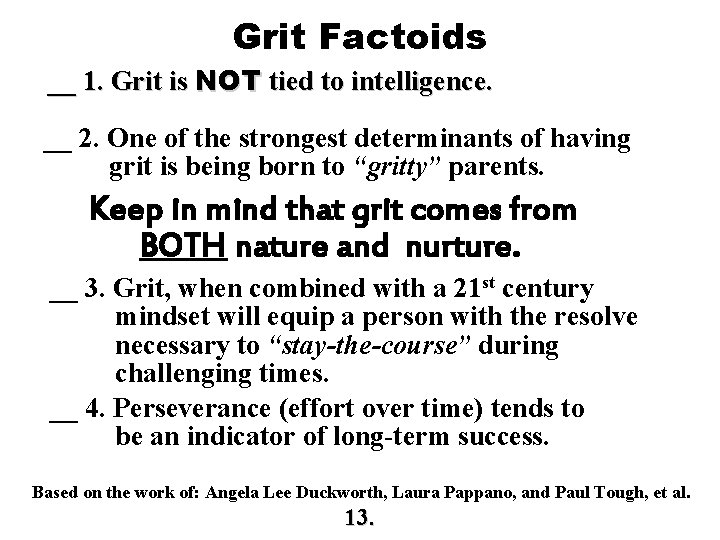
Grit Factoids __ 1. Grit is NOT tied to intelligence. __ 2. One of the strongest determinants of having grit is being born to “gritty” parents. Keep in mind that grit comes from BOTH nature and nurture. __ 3. Grit, when combined with a 21 st century mindset will equip a person with the resolve necessary to “stay-the-course” during challenging times. __ 4. Perseverance (effort over time) tends to be an indicator of long-term success. Based on the work of: Angela Lee Duckworth, Laura Pappano, and Paul Tough, et al. 13.
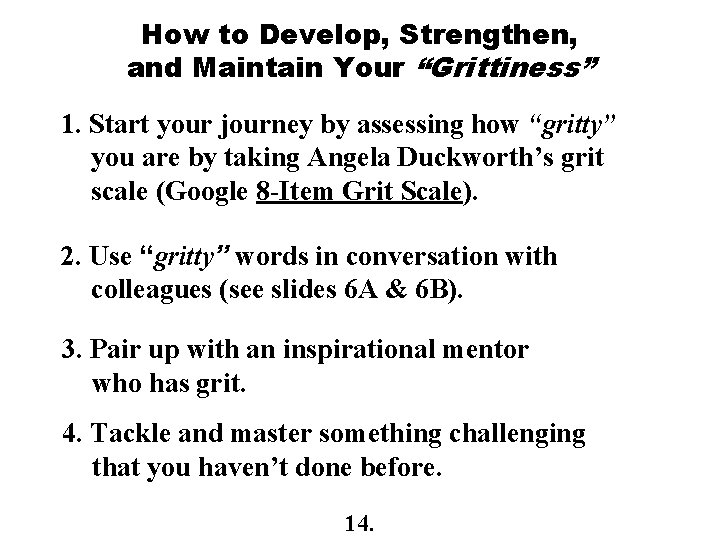
How to Develop, Strengthen, and Maintain Your “Grittiness” 1. Start your journey by assessing how “gritty” you are by taking Angela Duckworth’s grit scale (Google 8 -Item Grit Scale). 2. Use “gritty” words in conversation with colleagues (see slides 6 A & 6 B). 3. Pair up with an inspirational mentor who has grit. 4. Tackle and master something challenging that you haven’t done before. 14.
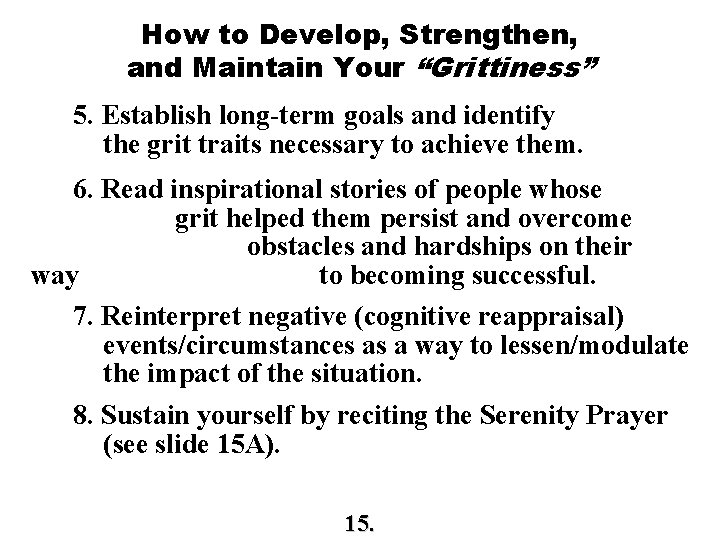
How to Develop, Strengthen, and Maintain Your “Grittiness” 5. Establish long-term goals and identify the grit traits necessary to achieve them. 6. Read inspirational stories of people whose grit helped them persist and overcome obstacles and hardships on their way to becoming successful. 7. Reinterpret negative (cognitive reappraisal) events/circumstances as a way to lessen/modulate the impact of the situation. 8. Sustain yourself by reciting the Serenity Prayer (see slide 15 A). 15.
God grant me the serenity to accept the things ITurn cannot to your neighbor. Tell him the change, change thefact you learned in most important this presentation. things I can, and the wisdom to know the difference. Reinhold Niebuhr, Theologian 15 A.
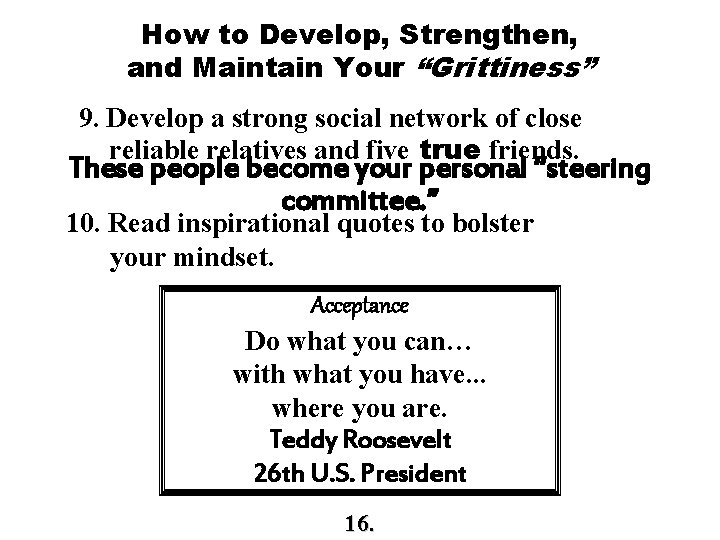
How to Develop, Strengthen, and Maintain Your “Grittiness” 9. Develop a strong social network of close reliable relatives and five true friends. These people become your personal “steering committee. ” 10. Read inspirational quotes to bolster your mindset. Acceptance Do what you can… with what you have. . . where you are. Teddy Roosevelt 26 th U. S. President 16.
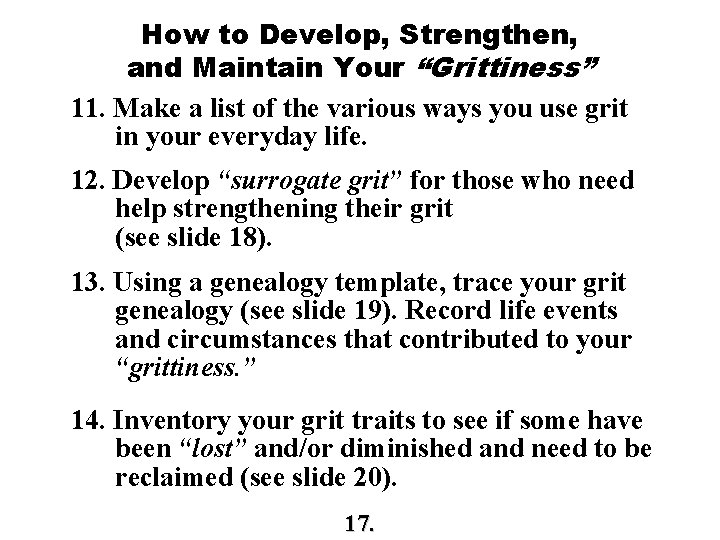
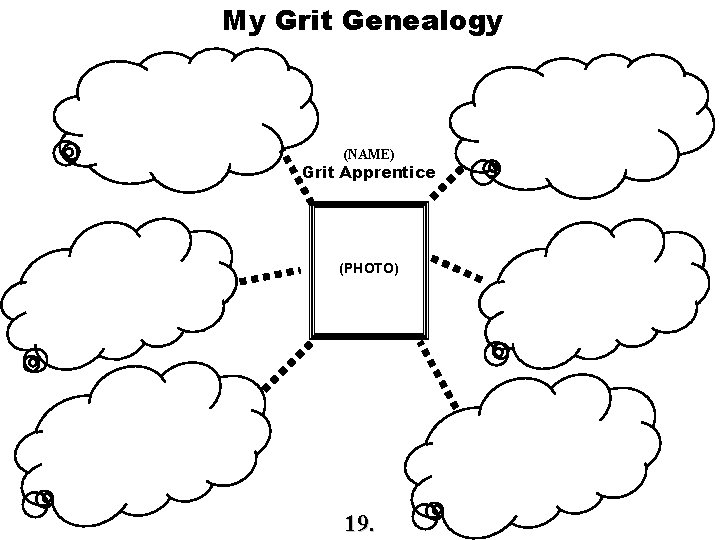
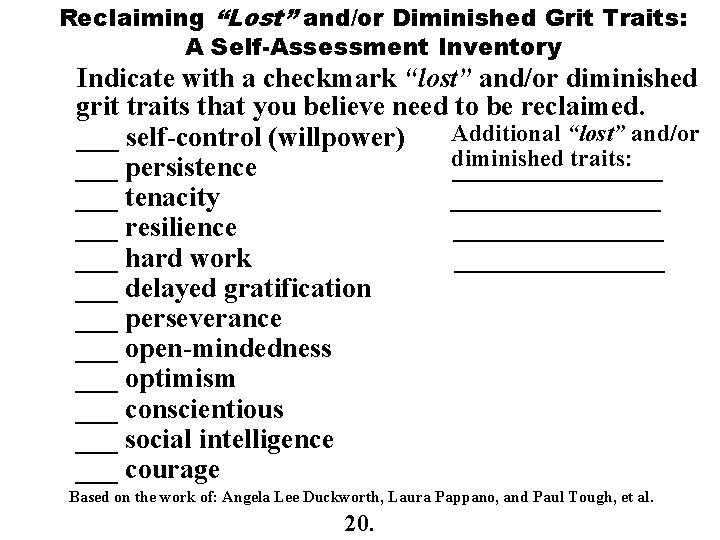
How to Develop, Strengthen, and Maintain Your “Grittiness” 11. Make a list of the various ways you use grit in your everyday life. 12. Develop “surrogate grit” for those who need help strengthening their grit (see slide 18). 13. Using a genealogy template, trace your grit genealogy (see slide 19). Record life events and circumstances that contributed to your “grittiness. ” 14. Inventory your grit traits to see if some have been “lost” and/or diminished and need to be reclaimed (see slide 20). 17.
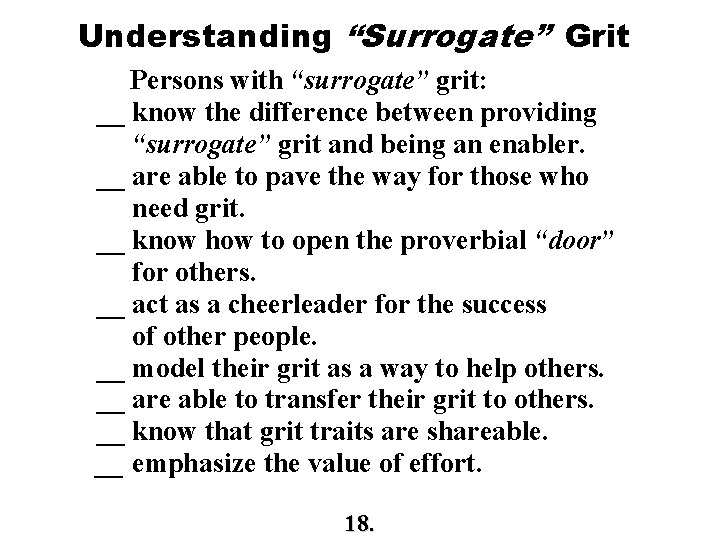
Understanding “Surrogate” Grit Persons with “surrogate” grit: __ know the difference between providing “surrogate” grit and being an enabler. __ are able to pave the way for those who need grit. __ know how to open the proverbial “door” for others. __ act as a cheerleader for the success of other people. __ model their grit as a way to help others. __ are able to transfer their grit to others. __ know that grit traits are shareable. __ emphasize the value of effort. 18.
My Grit Genealogy (NAME) Grit Apprentice (PHOTO) 19.
Reclaiming “Lost” and/or Diminished Grit Traits: A Self-Assessment Inventory Indicate with a checkmark “lost” and/or diminished grit traits that you believe need to be reclaimed. Additional “lost” and/or ___ self-control (willpower) diminished traits: ___ persistence ________ ___ tenacity ________ ___ resilience ________ ___ hard work ________ ___ delayed gratification ___ perseverance ___ open-mindedness ___ optimism ___ conscientious ___ social intelligence ___ courage Based on the work of: Angela Lee Duckworth, Laura Pappano, and Paul Tough, et al. 20.
How to Develop, Strengthen, and Maintain Your “Grittiness” 15. Set time aside to give back to a local community charity or worthy cause as a way to stay humble. 16. Read the inspirational poems by Edgar Albert Guest: Don’t Quit and On Quitting 17. Name something you saved for over a long period of time (delayed-gratification). 18. Post a newspaper clipping of a person who exhibits grit. 19. Practice gratitude every day. Pay it forward! 21.
How to Develop, Strengthen, and Maintain Your “Grittiness” 20. Learn about SISU… “the word that explains Finland” (see slide 22 A). Make a point of adopting a SISU symbol. 21. Use the inspirational wisdom of idioms for self-motivation (see slide 22 B). 22. When you were a student, what jobs, associations, and activities were you involved in that required grit? 22.
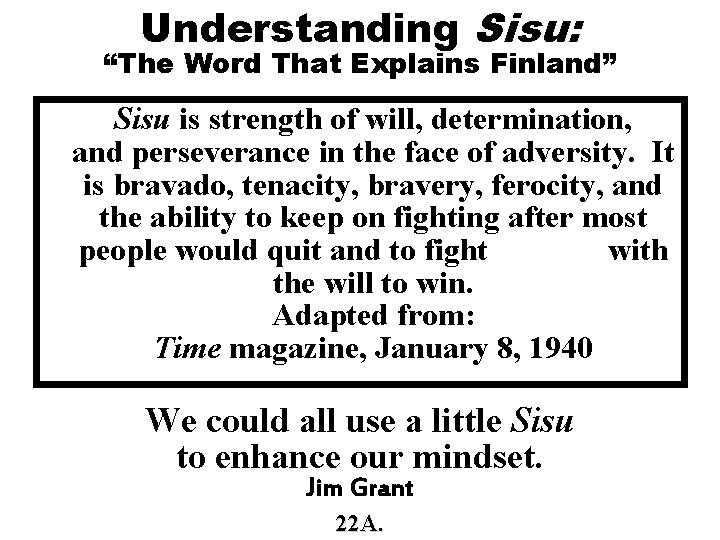
Understanding Sisu: “The Word That Explains Finland” Sisu is strength of will, determination, and perseverance in the face of adversity. It is bravado, tenacity, bravery, ferocity, and the ability to keep on fighting after most people would quit and to fight with the will to win. Adapted from: Time magazine, January 8, 1940 We could all use a little Sisu to enhance our mindset. Jim Grant 22 A.
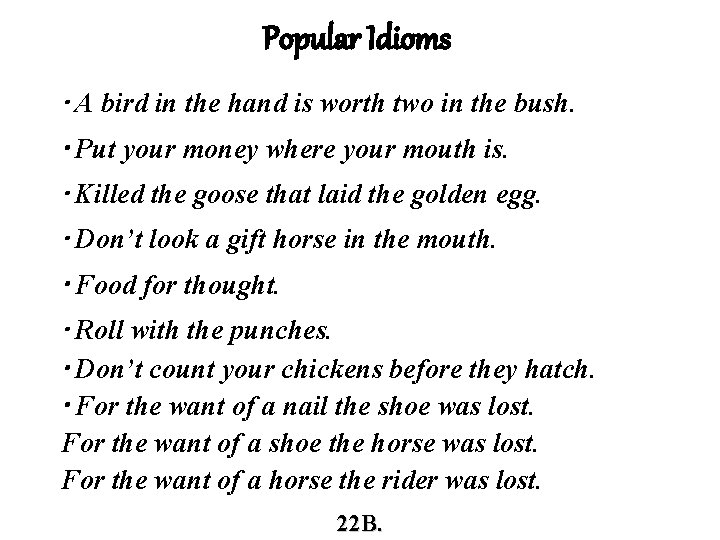
Popular Idioms • A bird in the hand is worth two in the bush. • Put your money where your mouth is. • Killed the goose that laid the golden egg. • Don’t look a gift horse in the mouth. • Food for thought. • Roll with the punches. • Don’t count your chickens before they hatch. • For the want of a nail the shoe was lost. For the want of a shoe the horse was lost. For the want of a horse the rider was lost. 22 B.
The Younger Generation Q. A. Have we inadvertently shielded many young people from developing a solid work ethic and acquiring the grit necessary to overcome life’s disappointments and setbacks and deal with failure. Unfortunately, I am afraid so! How did we let this happen? 23.
“Helicopter” Parents engaged in excessive parenting may: __ do their child’s homework. __ take their child’s word against the teacher. __ demand the teacher give their child better grades. __ constantly “rescue” their child. __ fight their child’s “battles. ” __ protect their child from a “dangerous world. ’’ __ spare their children from having to do chores. __ arrange the “rules of the games” their children play. __ direct and orchestrate their child’s life. 24.
“Snowplow” Parenting Over-protective parenting may: __ remove any hurdles in a child’s way. __ protect children from setbacks. __ shield children from disappointments. __ protect their children from making mistakes. __ overlook the power of effort. __ weaken children’s perseverance. * __ undermine children’s resilience. * __ inadvertently foster an entitlement mindset in children. *performance grit trait. 25.
Creating Strong “Gritty” Children “It’s not our job to toughen our children up to face a cruel and heartless world. It’s our job to raise children who will make the world a little less cruel and heartless. ” ~L. R. Knost We don’t want to create “tough” kids… we want to foster strong “gritty” ones! 26.
Developing “Gritty” Children: Conditions to Consider Strategies selected to help develop and/or strengthen a child’s grit: 1. will depend on the child’s emotional readiness. 2. will depend on the child’s chronological age and grade level. 3. must take into consideration the child’s developmental level. 4. must start with the child’s capacity to handle setbacks, disappointments, and obstacles. Note: It is important to monitor the child’s reaction to struggles and “good failures. ” 27.
How Teachers Can Help Students Become “Gritty” Teachers can: 1. teach children what it means to be “gritty” and to have a 21 st century mindset. 2. use “gritty” words/phrases to encourage and motivate students to persevere when they’re engaged in challenging tasks. (see slides 6 A-6 B). 3. have students practice using the common vocabulary that describes grit and a 21 st century mindset (see slides 6 A-6 B). 4. encourage students to read and discuss books about young people who are “gritty. ” 28.
How Teachers Can Help Students Become “Gritty” Teachers can: 5. use universal intervention strategies targeted to help at-risk students persevere through academically challenging tasks. 6. encourage students to seek out adult mentors who are “gritty. ” 7. read aloud books that contain stories that have a moral and foster grit traits that encourage good character. 8. encourage students to engage in self-talk as a way for them to develop perseverance and increase their stamina (see slide 29 A). 29.
Self-Talk Fosters “Grittiness” I am NOT a quitter! I will repeat, “Little strokes fell great oaks. ” I AM the “Little Engine That Could. ” I will ask a friend for help. I will look at the problem in another way. I will try three times before asking for help. I will say my special inspirational number or word (s). 29 A.
How Teachers Can Help Students Become “Grittier” Teachers can: 9. pair less “gritty” students with those students who are both inspirational and “grittier. ” 10. assist students in establishing long-term goals and help them identify and match the grit traits necessary to achieve them. 11. have students time themselves as to how long they can stay with a challenging task. The goal is to increase their time-on-task each day. Have them create a chart to record their gains. 30.
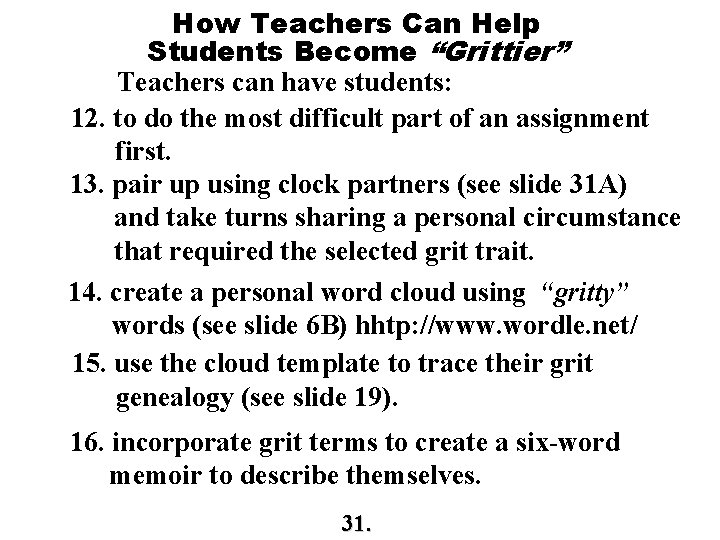
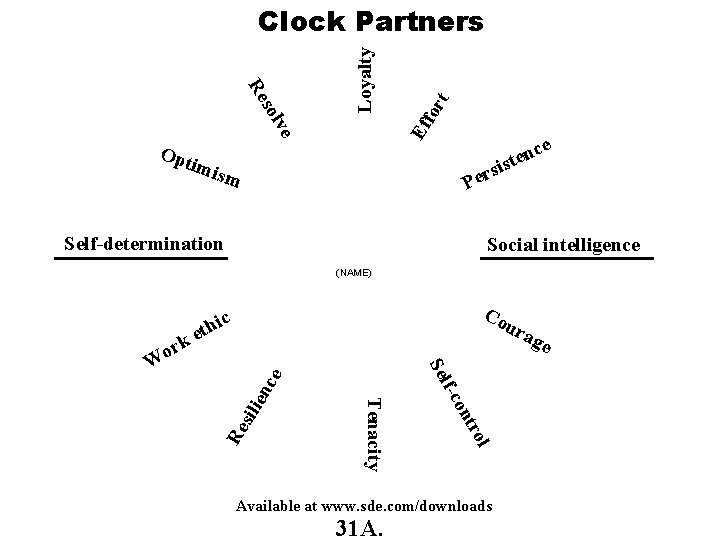
How Teachers Can Help Students Become “Grittier” Teachers can have students: 12. to do the most difficult part of an assignment first. 13. pair up using clock partners (see slide 31 A) and take turns sharing a personal circumstance that required the selected grit trait. 14. create a personal word cloud using “gritty” words (see slide 6 B) hhtp: //www. wordle. net/ 15. use the cloud template to trace their grit genealogy (see slide 19). 16. incorporate grit terms to create a six-word memoir to describe themselves. 31.
Opt t Ef for ve sol Re Loyalty Clock Partners e c n te imis is s r Pe m Self-determination Social intelligence (NAME) Co ur ic h t e k r o ce en sili Re l tro on Tenacity lf-c Se W Available at www. sde. com/downloads 31 A. age
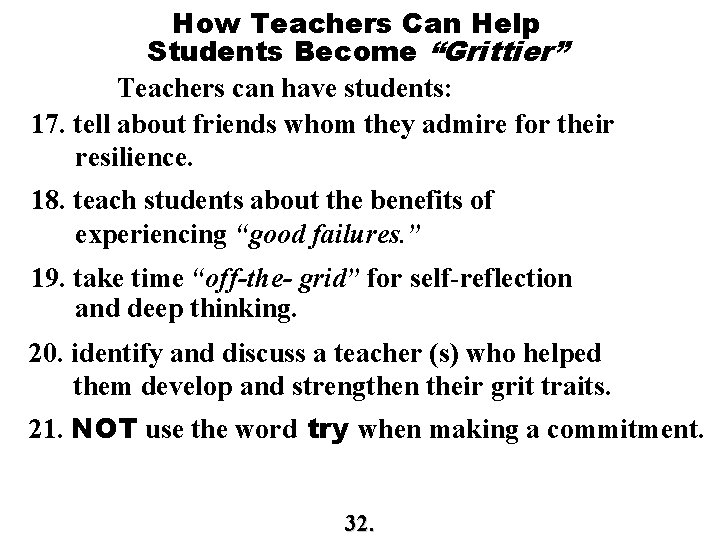
How Teachers Can Help Students Become “Grittier” Teachers can have students: 17. tell about friends whom they admire for their resilience. 18. teach students about the benefits of experiencing “good failures. ” 19. take time “off-the- grid” for self-reflection and deep thinking. 20. identify and discuss a teacher (s) who helped them develop and strengthen their grit traits. 21. NOT use the word try when making a commitment. 32.
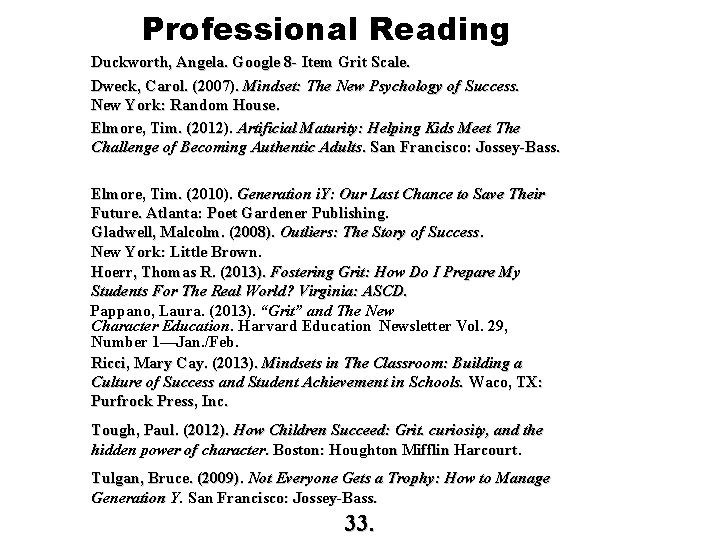
Professional Reading Duckworth, Angela. Google 8 - Item Grit Scale. Dweck, Carol. (2007). Mindset: The New Psychology of Success. New York: Random House. Elmore, Tim. (2012). Artificial Maturity: Helping Kids Meet The Challenge of Becoming Authentic Adults. San Francisco: Jossey-Bass. Elmore, Tim. (2010). Generation i. Y: Our Last Chance to Save Their Future. Atlanta: Poet Gardener Publishing. Gladwell, Malcolm. (2008). Outliers: The Story of Success. New York: Little Brown. Hoerr, Thomas R. (2013). Fostering Grit: How Do I Prepare My Students For The Real World? Virginia: ASCD. Pappano, Laura. (2013). “Grit” and The New Character Education. Harvard Education Newsletter Vol. 29, Number 1—Jan. /Feb. Ricci, Mary Cay. (2013). Mindsets in The Classroom: Building a Culture of Success and Student Achievement in Schools. Waco, TX: Purfrock Press, Inc. Tough, Paul. (2012). How Children Succeed: Grit. curiosity, and the hidden power of character. Boston: Houghton Mifflin Harcourt. Tulgan, Bruce. (2009). Not Everyone Gets a Trophy: How to Manage Generation Y. San Francisco: Jossey-Bass. 33.
Grit-Building Children’s Books & Publications Andreae, Giles, Guy Parker-Rees, GIRAFFES CAN’T DANCE, Cartwheel Books, Scholastic, Inc. , New York, NY. 1999. Brimmer, Larry Dane; BIRMINGHAM SUNDAY, Calkins Creek, Boyds Mills Press, Inc. , Honesdale, PA, 2010. Cheney, Lynne, A IS FOR ABIGAIL, Simon & Shuster Books, New York, NY 2003. Curtis, Christopher Paul; THE WATSONS GO TO BIRMINGHAM— 1963; Bantam Doubleday Dell Books, New York, NY. 1995. Cobblestone Magazine, JAPANESE AMERICANS, Volume 17, number 4; April 1996. Cobblestone Magazine, ORPHAN TRAINS, Volume 19, Number 4, April 1998. Droyd, Ann, GOODNIGHT i. PAD, Blue Rider Press, Penquin Group, New York, NY, 2011. 34.
Grit-Building Children’s Books & Publications Finch, Mary; Slater, Kate; THE LITTLE RED HEN, Barefoot Books, Cambridge, MA; l 999. Glaser, Jason, THE BUFFALO SOLDIERS AND THE AMERICAN WEST, Capstone Press, Mankata, MN; 2006. Gray, Libba Moore; DEAR WILLIE RUDD, ; Simon & Shuster; New York, 1993. Jeffrey, Gary, MARTIN LUTHER KING, JR. A LIFE OF A CIVIL RIGHTS LEADER, Rosen Publishing Group, Inc. New York, NY. 2007. Gray, Luli, ANT AND GRASSHOPPER, Simon & Schuster Children’s Publishing Division, New York, NY. 2011. Gunderson, Jessica; THE SHIRTWAIST FACTORY FIRE, Capstone Press, Mankata, MN; 2006. 35.
Grit-Building Children’s Books & Publications Jeffrey, Gary; SITTING BULL, THE LIFE OF A LAKOTA SIOUX CHIEF; Rosen Publishing Group, Inc. New York, NY 2005. Kamkwamba, William & Mealer, Byran; THE BOY WHO HARNESSED THE WIND; Dial Books for Young Readers, New York, NY; 2012 Krauss, Ruth, THE CARROT SEED, Harper Festival, Harper. Collins Publishers, New York, NY. 1993. Mc. Cully, Emily Arnold, MIRETTE ON THE HIGH WIRE, Penguin Putnam Books for Young Readers, New York, NY, 1992. ………, MEMORIES COME TO US IN THE RAIN AND THE WIND, Red Sun Press, Jamaica Plain, MA; l 998. Moss, Marissa, MIGHTY JACKIE, THE STRIKE-OUT QUEEN; Simon & Shuster Books; New York; 2004. Piper, Watty; THE LITTLE ENGINE THAT COULD, Platt & Munk Publishers, Div of Grosset & Dunlap, New York, NY. 1976. 36.
Grit-Building Children’s Books & Publications Polacco, Patricia; PINK AND SAY; Philomel Books; Penquin Young Readers Group, New York, NY; 1994. Raven, Margot Theis, MERCEDES AND THE CHOCOLATE PILOT, Sleeping Bear Press, Ann Arbor, MI 2002. Reynolds, Aaron; BACK OF THE BUS; Penquin Books; New York, NY; 2010. Shone, Rob, ROSA PARKS, THE LIFE OF A CIVIL RIGHTS HEROINE, Rosen Publishing Group, New York, NY. 2007. Tucker, Phillip Thomas; CATHY WILLIAMS, FROM SLAVE TO FEMALE BUFFALO SOLDIER, Stockpole Books, Mechanicsburg PA. 2002. Welvaert, Scott, R. ; THE DONNER PARTY: Capstone Press; Mankata, MN; 2006. Winter, Jeanette; THE LIBRARIAN OF BASRA; Harcourt Children’s Books; Mexico; 2005. 37.
Administrator workshops Bring Jim Grant to your school If You’re Riding a Horse and It Dies, Get Off!: Understanding The Future of School Change The Changing Nature of Society: Understanding the Impact On Schools and Communities 50 Leadership Tips and Tactics for Courageous Principals Grade-Level Retention In The Era of Common Core State Standards What Extraordinary principals Do Differently Universal Interventions For At-Risk students Meet Common Core State Standards Mindset, Grit and Determination: The Key to Leading by Influence Jim Grant — Staff Development for Educators 1 -800 -924 -9621 Ext. 1140 jgrant@sde. com 38.
Teacher Workshops Bring Jim Grant to your school What Extraordinary Teachers Do Differently Low-Prep, High-Impact Intervention Strategies To Raise The Achievement of Struggling Students Strategies To Help ALL Students Academically Persevere In The face of Challenging Standards Universal Intervention Strategies: Help Your At-Risk Students Meet Common Core State Standards Reading Intervention Strategies for Students Who Read It, But Don’t Get It. Discipline Tips And Classroom Management Strategies That Work Mindset, Feedback, and Grit: Strategies to Help Students Academically Persevere In The Face of Challenging Standards Jim Grant — Staff Development for Educators 1 -800 -924 -9621 Ext. 1140 jgrant@sde. com 39.