
Promoting Grit Growth Mindset and Metacognition in Our









- Slides: 22
Promoting Grit, Growth Mindset, and Metacognition in Our Students Kentucky Exceptional Children’s Conference Dr. Cindy Clemson Murray State University November 20, 2017
Questions to Think About: 1. What do you already know about: – Grit – Growth Mindset – Metacognition 2. Please share with your neighbor
Why Discuss These Three Together? What do Metacognition, Growth Mindset and Grit all have in common? • All can be taught • All correlate with academic success • Metacognition and Growth Mindset support Grit
Grit “Perseverance to accomplish long-term or higher -order goals in the face of challenges and setbacks, engaging the student’s psychological resources, such as their academic mindsets, effortful control, and strategies and tactics. ” Angela Duckworth
Grit Looking at all factors of success…social intelligence, physical health, IQ…. it is grit that is a significant predictor of success (Duckworth, 2013).
Grit Angela Lee Duckworth’s work: Grit is the power of passion and perseverance https: //youtu. be/H 14 b. Buluw. B 8
Angela Duckworth’s Grit Scale • How Gritty Are You? • Angela Duckworth’s Grit Scale https: //www. dropbox. com/s/2 pzjz 1 v 0 dadmr 8 r/12 -item%20 Grit%20 Scale. pdf? dl=0
To Develop Grit – Teach a Growth Mindset • Fixed mindset - Students believe their basic abilities, their intelligence, their talents, are just fixed traits. They have a certain amount and that’s that. • Growth mindset - Students understand that their talents and abilities can be developed through effort, good teaching and persistence. They don’t necessarily think everyone’s the same or anyone can be Einstein, but they believe everyone can get smarter if they work at it. Carol Dweck, Stanford University
Growth Mindset Carol Dweck: The Power of Yet! https: //youtu. be/hii. Ee. MN 7 vb. Q “Test scores and measures of achievement tell you where a student is, but they don’t tell you where a student could end up. ”
Growth Mindset • Fixed – Students believe intelligence is fixed, you are born with a certain amount of intelligence. • Growth – Students believe intelligence is like a muscle and the more you challenge it and work it the more intelligence you will have • How a person attributes failure: those who attribute failure to their own inability-“I’m not Intelligent” become helpless because it is something they CAN’T control • Those who interpret failure as a result of insufficient effort or an ineffective strategy dig deeper and try different approaches. This is something the student CAN control
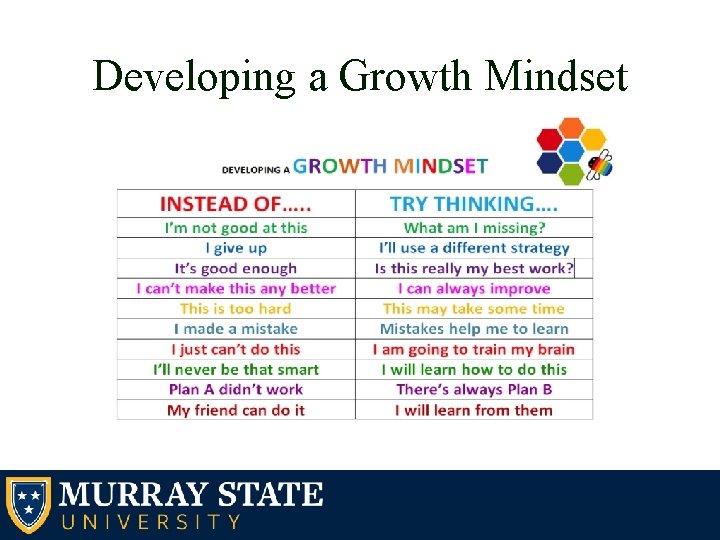
Developing a Growth Mindset • Teach about Failure – What did you learn? How can you improve? • 5 Great Questions to Ask Yourself After a Failure • Examples of famous people who failed before they succeeded • https: //www. youtube. com/watch? v=U 0 l. Gc. ESi. LWM (Links to an external site. )Links to an external site.
Developing a Growth Mindset
To Develop Grit and Growth Mindset Teach Metacognition Strategies • Metacognition is a tool to support grit – perseverance to reach a goal. – i. e. assess the demands of the task, evaluate their own knowledge and skills, plan their approach, monitor their progress and adjust their strategies as needed • Having a growth mindset supports perseverance
Metacognition • Knowledge about one’s own knowledge, thinking about one’s own thinking, and learning about one’s own learning • Set of processes involved in monitoring and directing one’s own thinking • One’s ability to monitor, evaluate, and make plans for one’s learning…. effective learning involves planning and goal-setting, monitoring one's progress, and adapting as needed
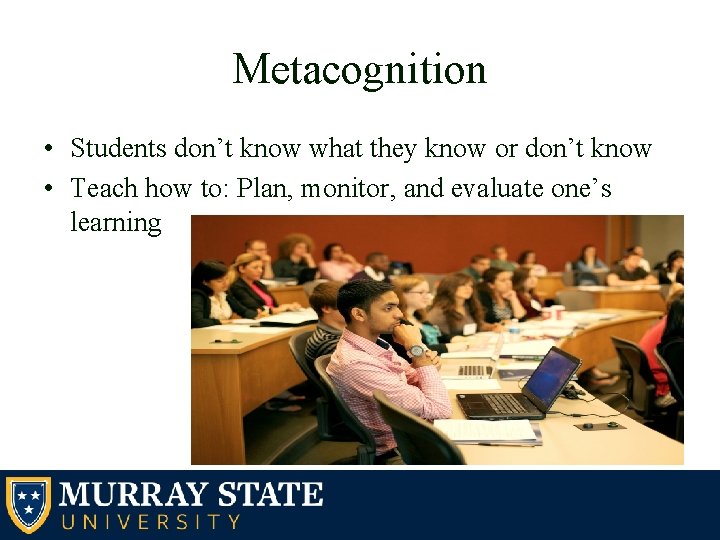
Metacognition • Students don’t know what they know or don’t know • Teach how to: Plan, monitor, and evaluate one’s learning
Metacognitive Strategies for Elementary Students
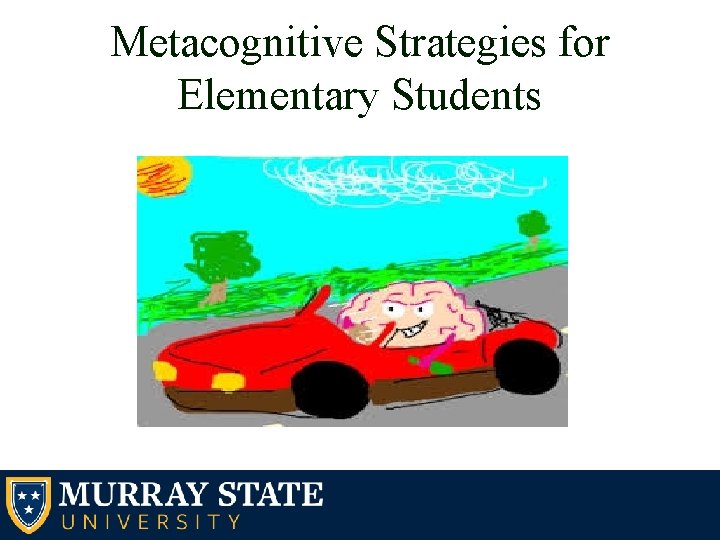
Metacognitive Strategies for Elementary Students • Begin with explicit lesson on metacognition: driving a brain car • Super Powers for Learning – Super 3 teaches plan, do, and review. Turkey Trouble (Silvano, 2009) • To teach selective attention – Calm Cool, the Listening Rabbit. • To teach working memory – use Memory Pegs
Metacognitive Strategies for Middle and High School Students • • • Metacognitive Assignment Wrapper Evidence based study strategies Exam planning Exam wrappers (reflection) Metacognitive Reading Modeling – Think like a _____ e. g. biologist • Reflection – Muddiest Point – 2 minute paper
How Are You Teaching Metacognition • Currently doing? Any planning or reflective activities? • What might we create to support metacognition?
Takeaways • How might you leverage anything that we have discussed today? • Share with one other person.
References • Ambrose, S. A. , Bridges, M. W. , Di. Pietro, M. , Lovett, M. C. , & Norman M. K. (2010). How learning works: Seven research -based principles for smart teaching. San Francisco, CA: Jossey-Bass. • Arthur, P. (2017). Enhancing metacognition, grit, and growth mindset for students. Atlanta: National First Year Experience conference • Bjork, R. , Dunlosky, J. , and Kornell, N. (2012). Self-regulated learning: Beliefs, techniques, and illusions. Annual Review of Psychology.
References (cont. ) • Duckworth, A. L. (2016). Grit: The power of passion and persistence. New York: Scribner. • Dweck, C. S. (2007). Mindset: The new psychology of success. New York: Random House. • Nilson, L. (2013). Creating self-regulated learners: Strategies to strengthen students’ self-awareness and learning skills. Sterling, VA: Stylus Publishing. • Tanner, D. (2012). Promoting student metacognition. CBE Life Science Education, 113– 120 • Wilson, D. & Conyers, C. (2016). Teaching students to drive their brains. ASCD. Alexandria, VA.