Midterm Review EECS 2011 Prof J Elder 1

- Slides: 68
Midterm Review EECS 2011 Prof. J. Elder -1 - Last Updated: February 11, 2015
Topics on the Midterm Ø Data Structures & Object-Oriented Design Ø Run-Time Analysis Ø Linear Data Structures Ø The Java Collections Framework Ø Recursion Ø Trees Ø Priority Queues & Heaps EECS 2011 Prof. J. Elder -2 - Last Updated: February 11, 2015
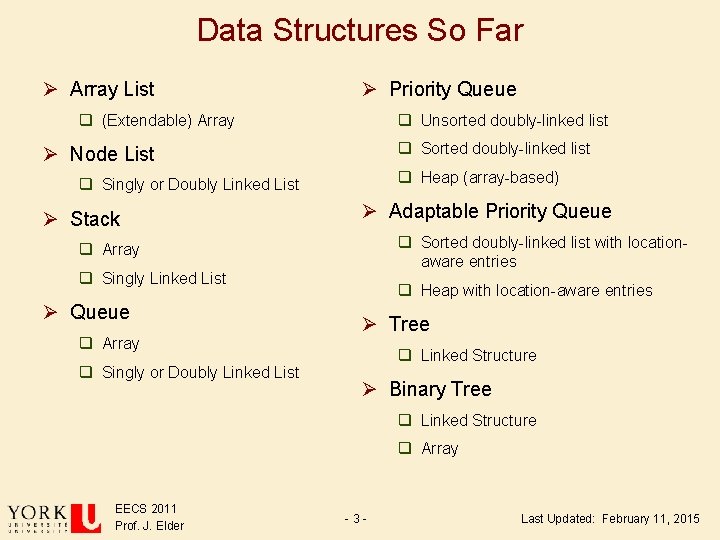
Data Structures So Far Ø Array List Ø Priority Queue q (Extendable) Array q Unsorted doubly-linked list q Sorted doubly-linked list Ø Node List q Heap (array-based) q Singly or Doubly Linked List Ø Stack Ø Adaptable Priority Queue q Sorted doubly-linked list with locationaware entries q Array q Singly Linked List Ø Queue q Array q Singly or Doubly Linked List q Heap with location-aware entries Ø Tree q Linked Structure Ø Binary Tree q Linked Structure q Array EECS 2011 Prof. J. Elder -3 - Last Updated: February 11, 2015
Topics on the Midterm Ø Data Structures & Object-Oriented Design Ø Run-Time Analysis Ø Linear Data Structures Ø The Java Collections Framework Ø Recursion Ø Trees Ø Priority Queues & Heaps EECS 2011 Prof. J. Elder -4 - Last Updated: February 11, 2015
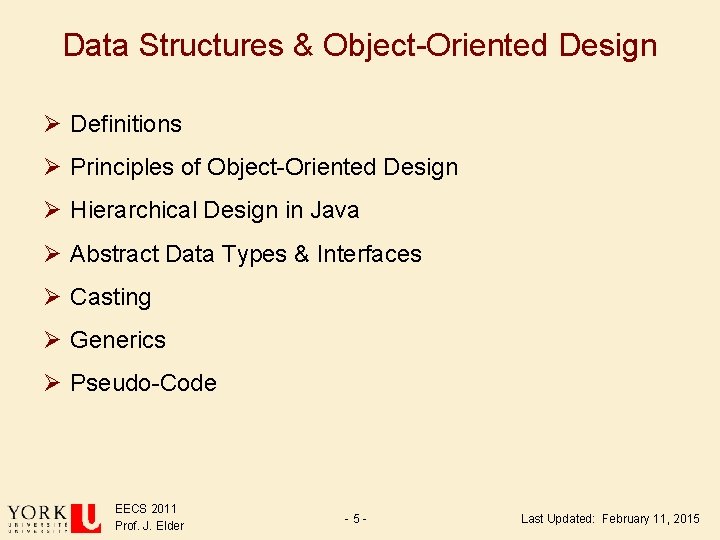
Data Structures & Object-Oriented Design Ø Definitions Ø Principles of Object-Oriented Design Ø Hierarchical Design in Java Ø Abstract Data Types & Interfaces Ø Casting Ø Generics Ø Pseudo-Code EECS 2011 Prof. J. Elder -5 - Last Updated: February 11, 2015
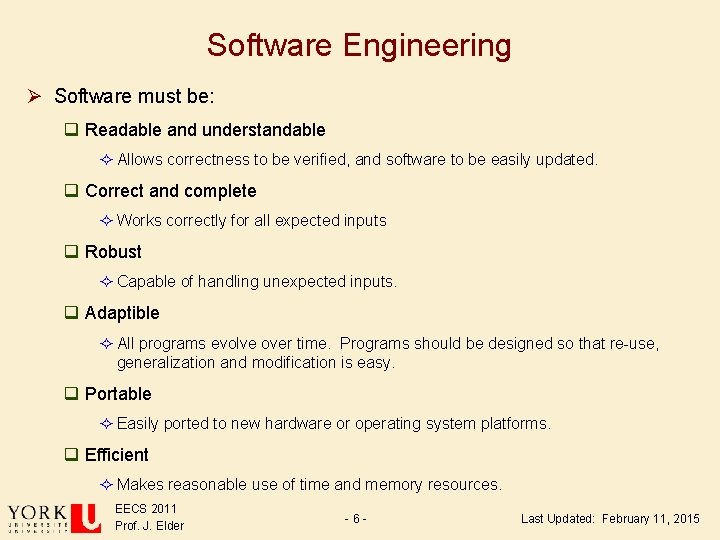
Software Engineering Ø Software must be: q Readable and understandable ² Allows correctness to be verified, and software to be easily updated. q Correct and complete ² Works correctly for all expected inputs q Robust ² Capable of handling unexpected inputs. q Adaptible ² All programs evolve over time. Programs should be designed so that re-use, generalization and modification is easy. q Portable ² Easily ported to new hardware or operating system platforms. q Efficient ² Makes reasonable use of time and memory resources. EECS 2011 Prof. J. Elder -6 - Last Updated: February 11, 2015
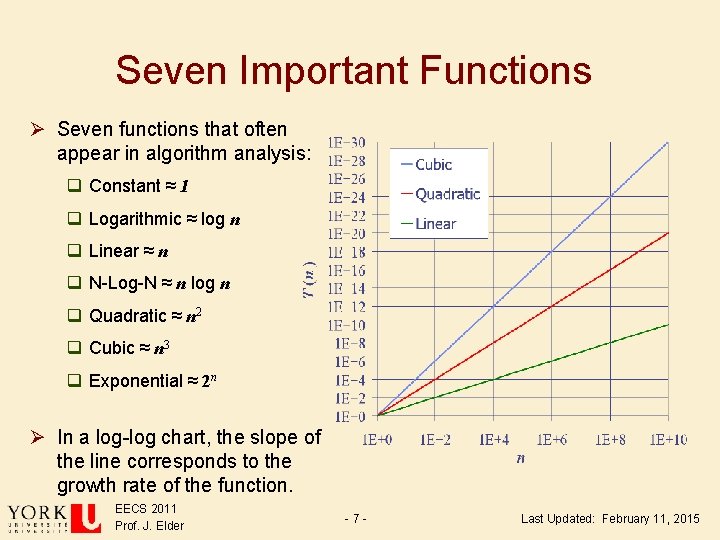
Seven Important Functions Ø Seven functions that often appear in algorithm analysis: q Constant ≈ 1 q Logarithmic ≈ log n q Linear ≈ n q N-Log-N ≈ n log n q Quadratic ≈ n 2 q Cubic ≈ n 3 q Exponential ≈ 2 n Ø In a log-log chart, the slope of the line corresponds to the growth rate of the function. EECS 2011 Prof. J. Elder -7 - Last Updated: February 11, 2015
Topics on the Midterm Ø Data Structures & Object-Oriented Design Ø Run-Time Analysis Ø Linear Data Structures Ø The Java Collections Framework Ø Recursion Ø Trees Ø Priority Queues & Heaps EECS 2011 Prof. J. Elder -8 - Last Updated: February 11, 2015
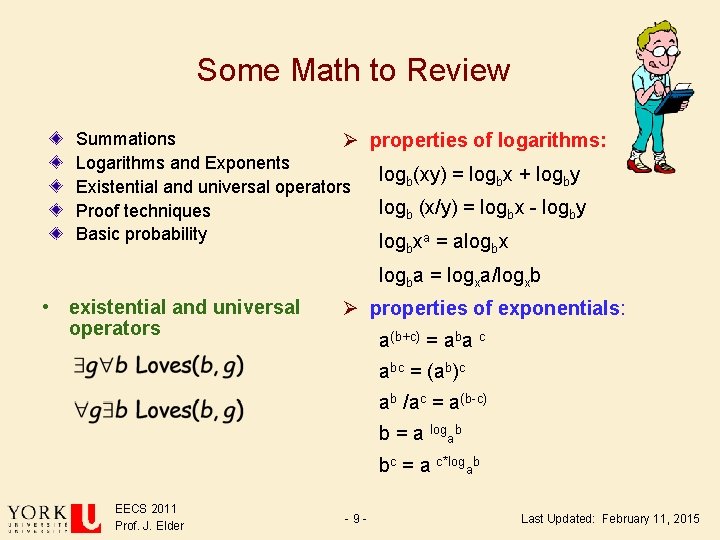
Some Math to Review Summations Ø properties of logarithms: Logarithms and Exponents logb(xy) = logbx + logby Existential and universal operators logb (x/y) = logbx - logby Proof techniques Basic probability logbxa = alogbx logba = logxa/logxb • existential and universal operators Ø properties of exponentials: a(b+c) = aba c abc = (ab)c ab /ac = a(b-c) b = a logab bc = a c*logab EECS 2011 Prof. J. Elder -9 - Last Updated: February 11, 2015
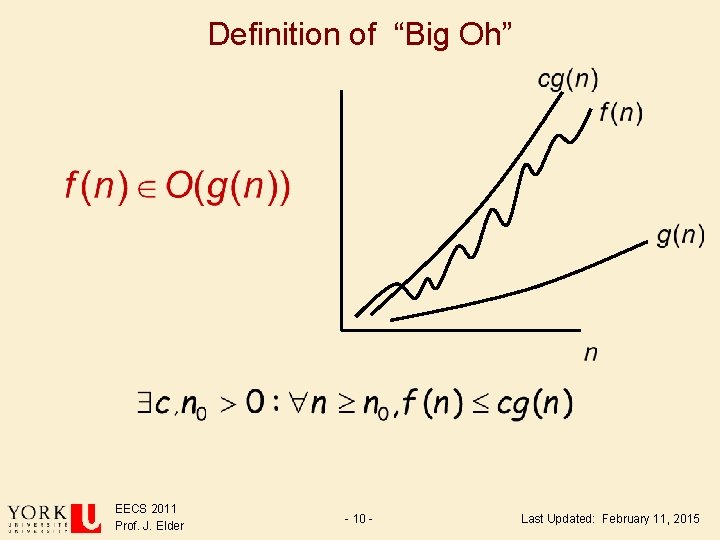
Definition of “Big Oh” EECS 2011 Prof. J. Elder - 10 - Last Updated: February 11, 2015
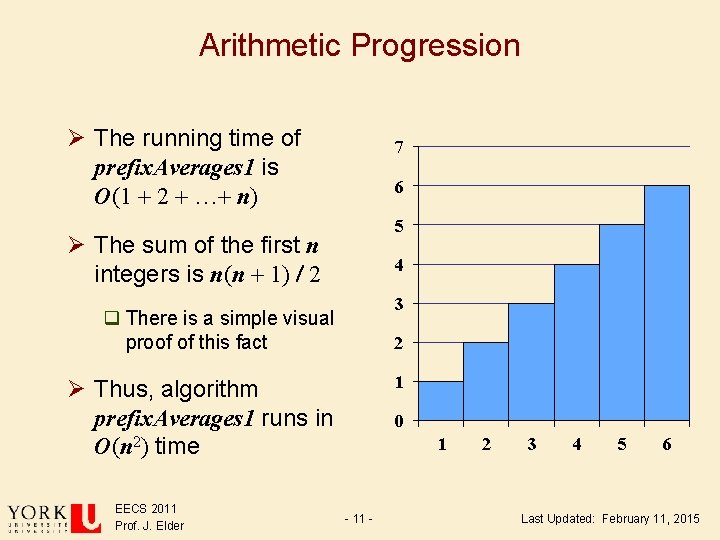
Arithmetic Progression Ø The running time of prefix. Averages 1 is O(1 + 2 + …+ n) 7 6 5 Ø The sum of the first n integers is n(n + 1) / 2 4 3 q There is a simple visual proof of this fact 2 1 Ø Thus, algorithm prefix. Averages 1 runs in O(n 2) time EECS 2011 Prof. J. Elder 0 1 - 11 - 2 3 4 5 6 Last Updated: February 11, 2015
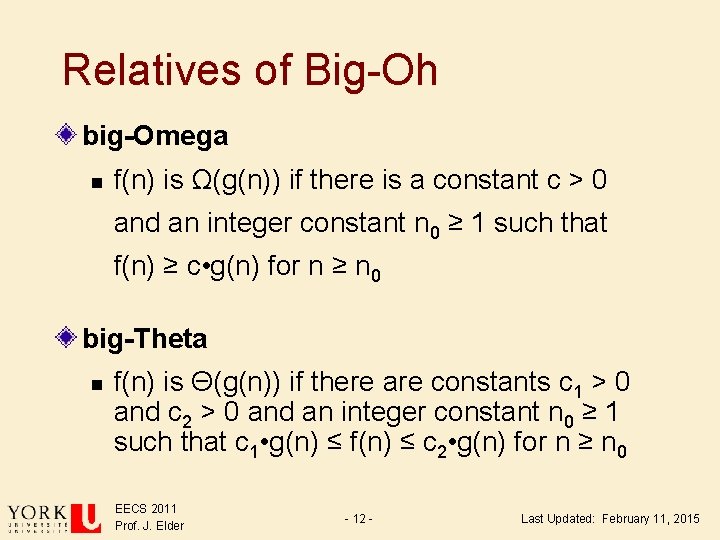
Relatives of Big-Oh big-Omega n f(n) is Ω(g(n)) if there is a constant c > 0 and an integer constant n 0 ≥ 1 such that f(n) ≥ c • g(n) for n ≥ n 0 big-Theta n f(n) is Θ(g(n)) if there are constants c 1 > 0 and c 2 > 0 and an integer constant n 0 ≥ 1 such that c 1 • g(n) ≤ f(n) ≤ c 2 • g(n) for n ≥ n 0 EECS 2011 Prof. J. Elder - 12 - Last Updated: February 11, 2015
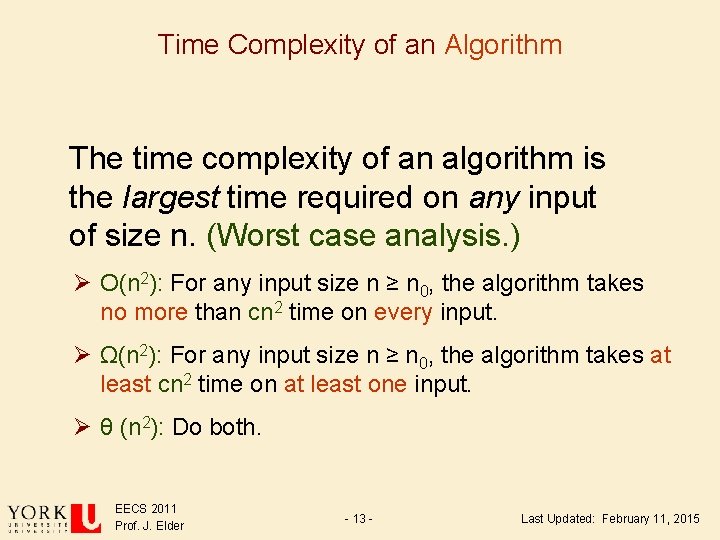
Time Complexity of an Algorithm The time complexity of an algorithm is the largest time required on any input of size n. (Worst case analysis. ) Ø O(n 2): For any input size n ≥ n 0, the algorithm takes no more than cn 2 time on every input. Ø Ω(n 2): For any input size n ≥ n 0, the algorithm takes at least cn 2 time on at least one input. Ø θ (n 2): Do both. EECS 2011 Prof. J. Elder - 13 - Last Updated: February 11, 2015
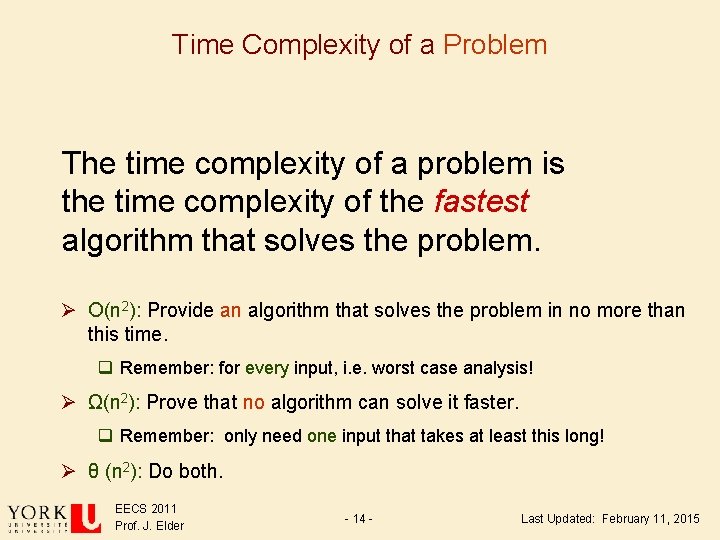
Time Complexity of a Problem The time complexity of a problem is the time complexity of the fastest algorithm that solves the problem. Ø O(n 2): Provide an algorithm that solves the problem in no more than this time. q Remember: for every input, i. e. worst case analysis! Ø Ω(n 2): Prove that no algorithm can solve it faster. q Remember: only need one input that takes at least this long! Ø θ (n 2): Do both. EECS 2011 Prof. J. Elder - 14 - Last Updated: February 11, 2015
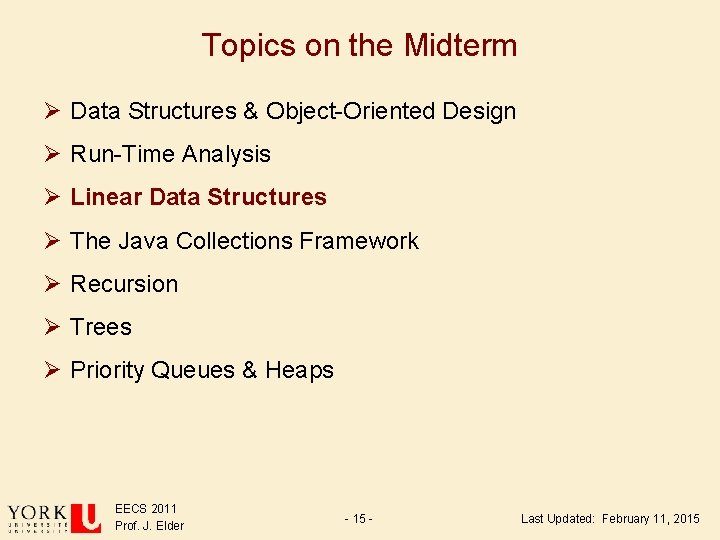
Topics on the Midterm Ø Data Structures & Object-Oriented Design Ø Run-Time Analysis Ø Linear Data Structures Ø The Java Collections Framework Ø Recursion Ø Trees Ø Priority Queues & Heaps EECS 2011 Prof. J. Elder - 15 - Last Updated: February 11, 2015
Arrays EECS 2011 Prof. J. Elder - 16 - Last Updated: February 11, 2015
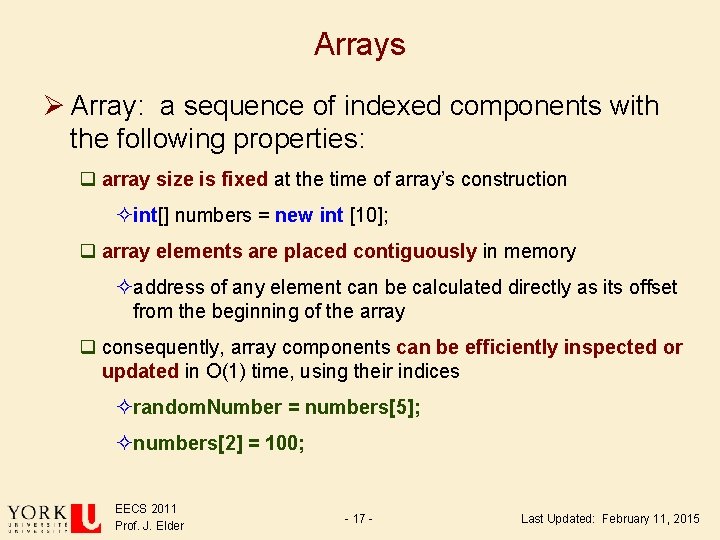
Arrays Ø Array: a sequence of indexed components with the following properties: q array size is fixed at the time of array’s construction ²int[] numbers = new int [10]; q array elements are placed contiguously in memory ²address of any element can be calculated directly as its offset from the beginning of the array q consequently, array components can be efficiently inspected or updated in O(1) time, using their indices ²random. Number = numbers[5]; ²numbers[2] = 100; EECS 2011 Prof. J. Elder - 17 - Last Updated: February 11, 2015
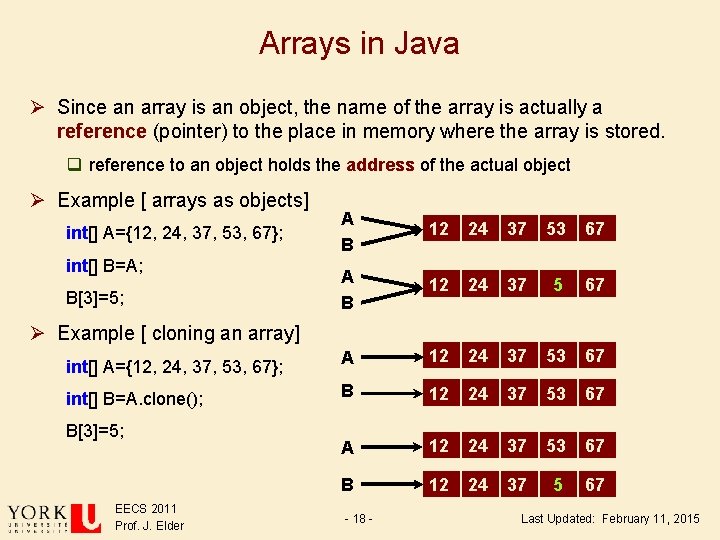
Arrays in Java Ø Since an array is an object, the name of the array is actually a reference (pointer) to the place in memory where the array is stored. q reference to an object holds the address of the actual object Ø Example [ arrays as objects] A B 12 24 37 53 67 A B 12 24 37 5 67 int[] A={12, 24, 37, 53, 67}; A 12 24 37 53 67 int[] B=A. clone(); B 12 24 37 53 67 A 12 24 37 53 67 B 12 24 37 5 67 int[] A={12, 24, 37, 53, 67}; int[] B=A; B[3]=5; Ø Example [ cloning an array] B[3]=5; EECS 2011 Prof. J. Elder - 18 - Last Updated: February 11, 2015
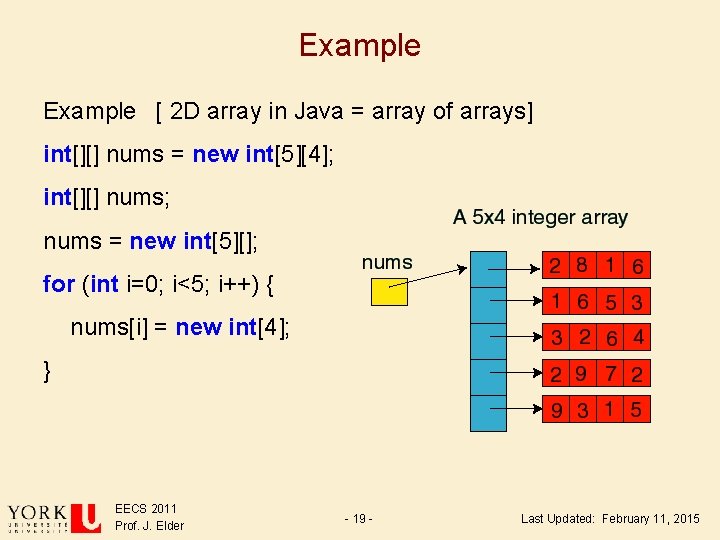
Example [ 2 D array in Java = array of arrays] int[][] nums = new int[5][4]; int[][] nums; nums = new int[5][]; for (int i=0; i<5; i++) { nums[i] = new int[4]; } EECS 2011 Prof. J. Elder - 19 - Last Updated: February 11, 2015
Array Lists EECS 2011 Prof. J. Elder - 20 - Last Updated: February 11, 2015
The Array List ADT (§ 6. 1) Ø The Array List ADT extends the notion of array by storing a sequence of arbitrary objects Ø An element can be accessed, inserted or removed by specifying its rank (number of elements preceding it) Ø An exception is thrown if an incorrect rank is specified (e. g. , a negative rank) EECS 2011 Prof. J. Elder - 21 - Last Updated: February 11, 2015
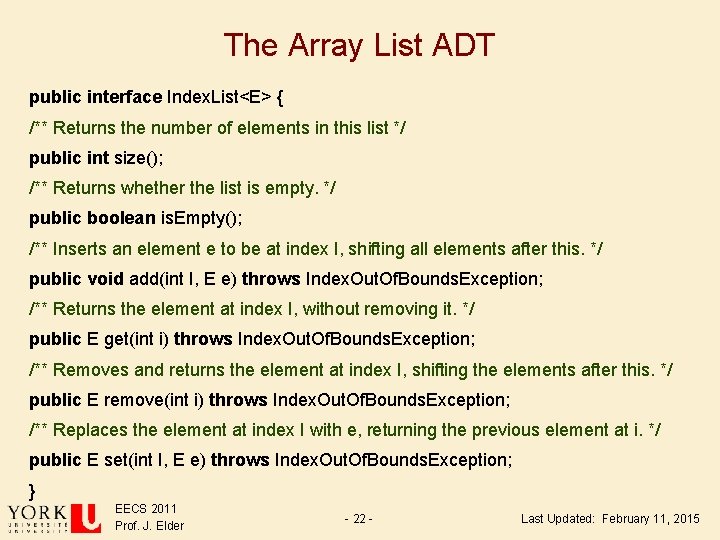
The Array List ADT public interface Index. List<E> { /** Returns the number of elements in this list */ public int size(); /** Returns whether the list is empty. */ public boolean is. Empty(); /** Inserts an element e to be at index I, shifting all elements after this. */ public void add(int I, E e) throws Index. Out. Of. Bounds. Exception; /** Returns the element at index I, without removing it. */ public E get(int i) throws Index. Out. Of. Bounds. Exception; /** Removes and returns the element at index I, shifting the elements after this. */ public E remove(int i) throws Index. Out. Of. Bounds. Exception; /** Replaces the element at index I with e, returning the previous element at i. */ public E set(int I, E e) throws Index. Out. Of. Bounds. Exception; } EECS 2011 Prof. J. Elder - 22 - Last Updated: February 11, 2015
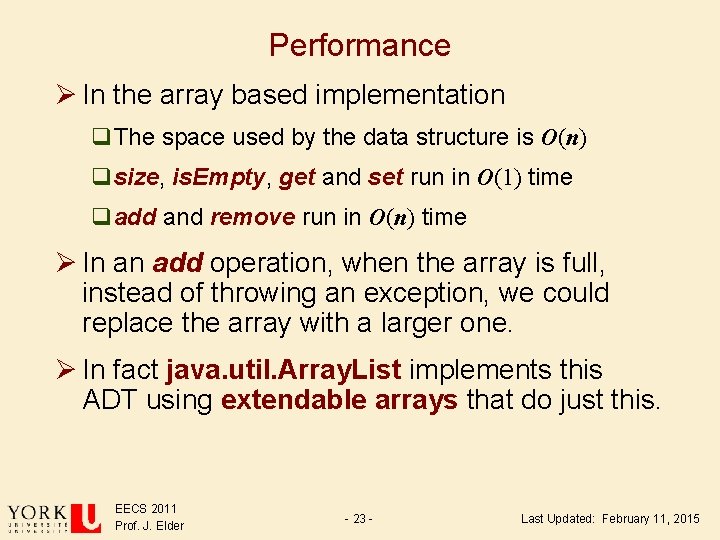
Performance Ø In the array based implementation q. The space used by the data structure is O(n) qsize, is. Empty, get and set run in O(1) time qadd and remove run in O(n) time Ø In an add operation, when the array is full, instead of throwing an exception, we could replace the array with a larger one. Ø In fact java. util. Array. List implements this ADT using extendable arrays that do just this. EECS 2011 Prof. J. Elder - 23 - Last Updated: February 11, 2015
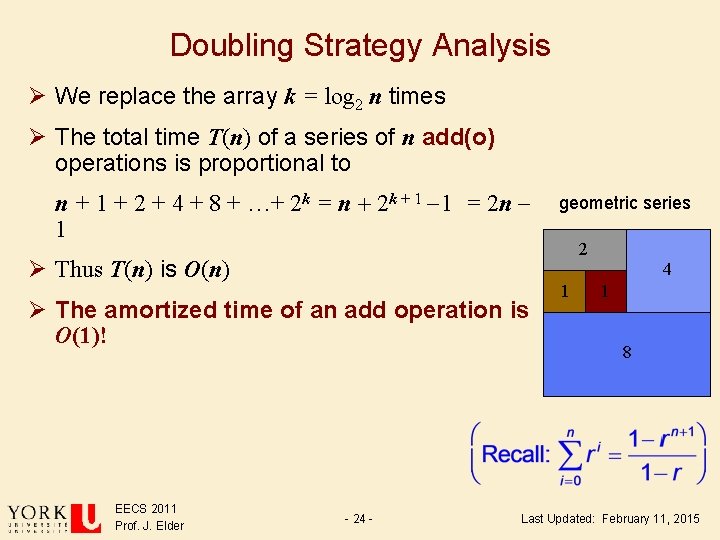
Doubling Strategy Analysis Ø We replace the array k = log 2 n times Ø The total time T(n) of a series of n add(o) operations is proportional to n + 1 + 2 + 4 + 8 + …+ 2 k = n + 2 k + 1 -1 = 2 n 1 Ø Thus T(n) is O(n) Ø The amortized time of an add operation is O(1)! EECS 2011 Prof. J. Elder - 24 - geometric series 2 1 4 1 8 Last Updated: February 11, 2015
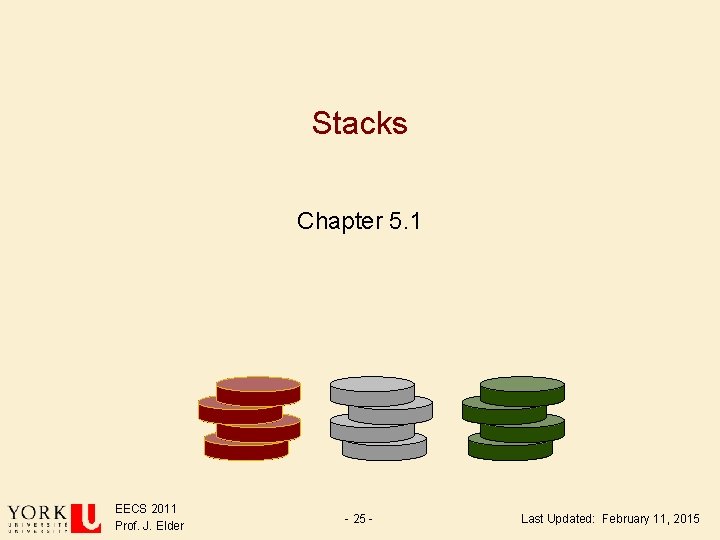
Stacks Chapter 5. 1 EECS 2011 Prof. J. Elder - 25 - Last Updated: February 11, 2015
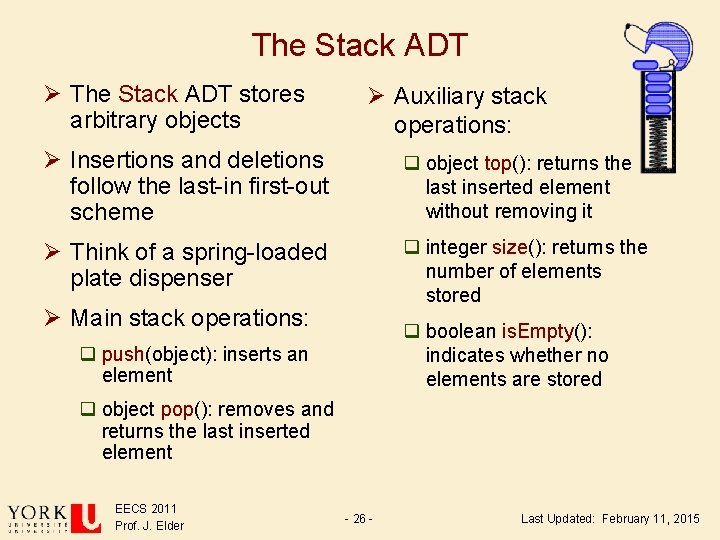
The Stack ADT Ø The Stack ADT stores arbitrary objects Ø Auxiliary stack operations: Ø Insertions and deletions follow the last-in first-out scheme q object top(): returns the last inserted element without removing it Ø Think of a spring-loaded plate dispenser q integer size(): returns the number of elements stored Ø Main stack operations: q boolean is. Empty(): indicates whether no elements are stored q push(object): inserts an element q object pop(): removes and returns the last inserted element EECS 2011 Prof. J. Elder - 26 - Last Updated: February 11, 2015
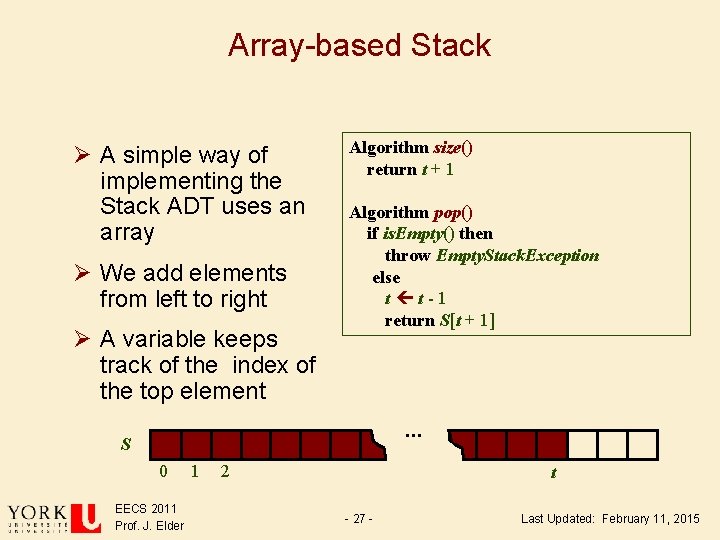
Array-based Stack Ø A simple way of implementing the Stack ADT uses an array Ø We add elements from left to right Ø A variable keeps track of the index of the top element Algorithm size() return t + 1 Algorithm pop() if is. Empty() then throw Empty. Stack. Exception else t t-1 return S[t + 1] … S 0 EECS 2011 Prof. J. Elder 1 2 t - 27 - Last Updated: February 11, 2015
Queues Chapters 5. 2 -5. 3 EECS 2011 Prof. J. Elder - 28 - Last Updated: February 11, 2015
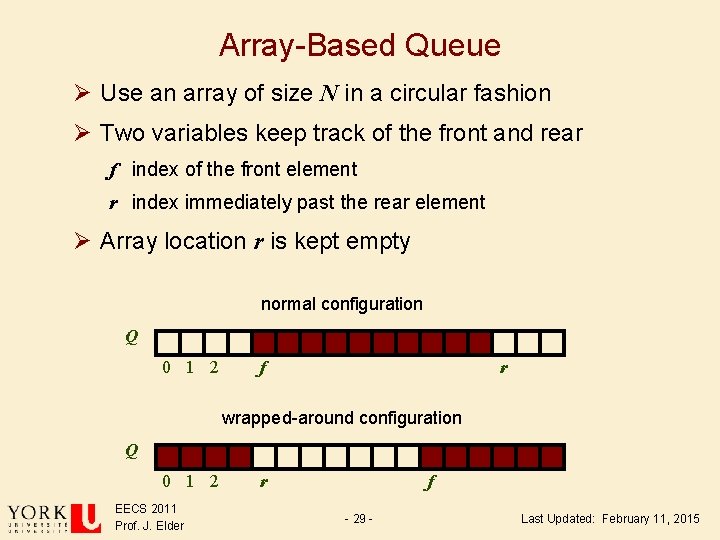
Array-Based Queue Ø Use an array of size N in a circular fashion Ø Two variables keep track of the front and rear f index of the front element r index immediately past the rear element Ø Array location r is kept empty normal configuration Q 0 1 2 f r wrapped-around configuration Q 0 1 2 EECS 2011 Prof. J. Elder r f - 29 - Last Updated: February 11, 2015
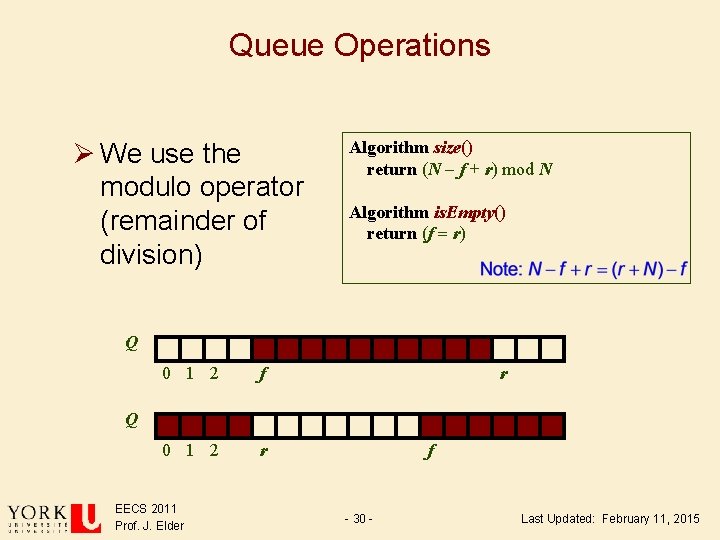
Queue Operations Ø We use the modulo operator (remainder of division) Algorithm size() return (N - f + r) mod N Algorithm is. Empty() return (f = r) Q 0 1 2 f 0 1 2 r r Q EECS 2011 Prof. J. Elder f - 30 - Last Updated: February 11, 2015
Linked Lists Chapters 3. 2 – 3. 3 EECS 2011 Prof. J. Elder - 31 - Last Updated: February 11, 2015
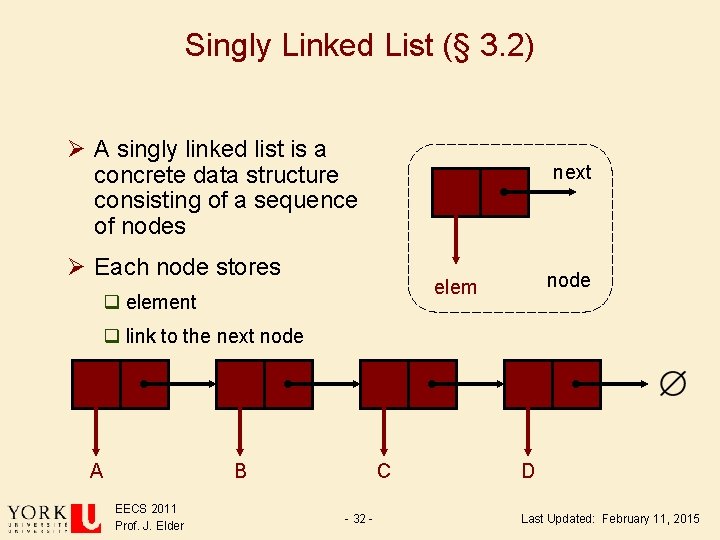
Singly Linked List (§ 3. 2) Ø A singly linked list is a concrete data structure consisting of a sequence of nodes next Ø Each node stores node elem q element q link to the next node A B EECS 2011 Prof. J. Elder C - 32 - D Last Updated: February 11, 2015
Running Time Ø Adding at the head is O(1) Ø Removing at the head is O(1) Ø How about tail operations? EECS 2011 Prof. J. Elder - 33 - Last Updated: February 11, 2015
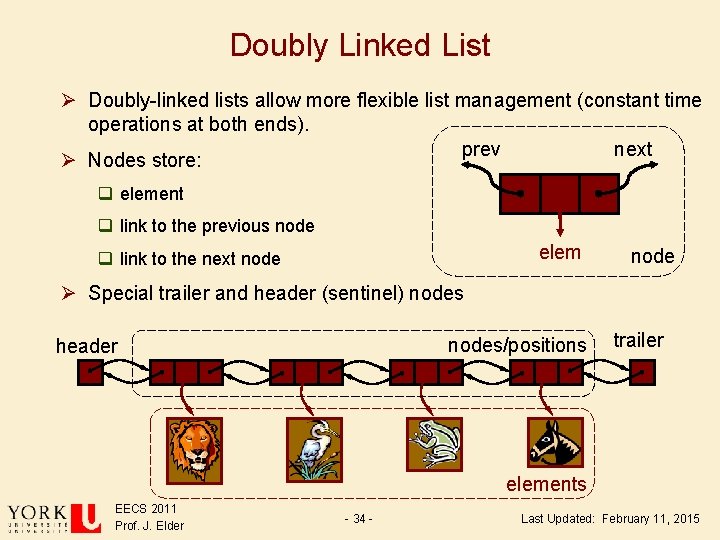
Doubly Linked List Ø Doubly-linked lists allow more flexible list management (constant time operations at both ends). prev next Ø Nodes store: q element q link to the previous node elem q link to the next node Ø Special trailer and header (sentinel) nodes/positions header trailer elements EECS 2011 Prof. J. Elder - 34 - Last Updated: February 11, 2015
Topics on the Midterm Ø Data Structures & Object-Oriented Design Ø Run-Time Analysis Ø Linear Data Structures Ø The Java Collections Framework Ø Recursion Ø Trees Ø Priority Queues & Heaps EECS 2011 Prof. J. Elder - 35 - Last Updated: February 11, 2015
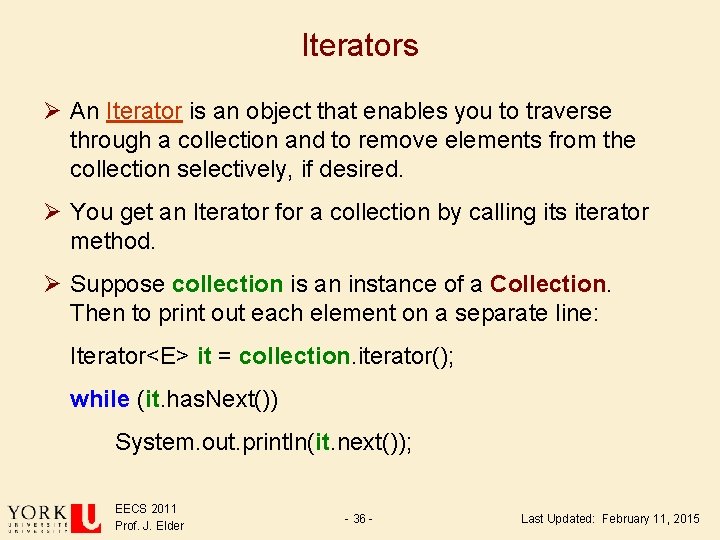
Iterators Ø An Iterator is an object that enables you to traverse through a collection and to remove elements from the collection selectively, if desired. Ø You get an Iterator for a collection by calling its iterator method. Ø Suppose collection is an instance of a Collection. Then to print out each element on a separate line: Iterator<E> it = collection. iterator(); while (it. has. Next()) System. out. println(it. next()); EECS 2011 Prof. J. Elder - 36 - Last Updated: February 11, 2015
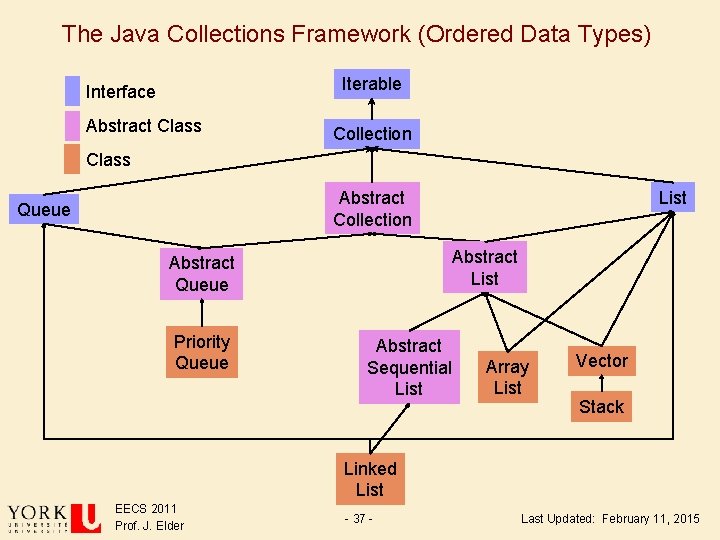
The Java Collections Framework (Ordered Data Types) Iterable Interface Abstract Class Collection Class List Abstract Collection Queue Abstract List Abstract Queue Priority Queue Abstract Sequential List Array List Vector Stack Linked List EECS 2011 Prof. J. Elder - 37 - Last Updated: February 11, 2015
Topics on the Midterm Ø Data Structures & Object-Oriented Design Ø Run-Time Analysis Ø Linear Data Structures Ø The Java Collections Framework Ø Recursion Ø Trees Ø Priority Queues & Heaps EECS 2011 Prof. J. Elder - 38 - Last Updated: February 11, 2015
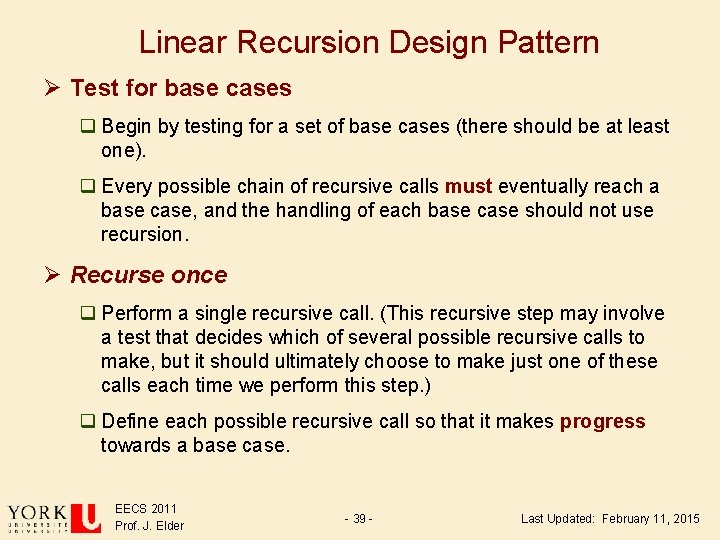
Linear Recursion Design Pattern Ø Test for base cases q Begin by testing for a set of base cases (there should be at least one). q Every possible chain of recursive calls must eventually reach a base case, and the handling of each base case should not use recursion. Ø Recurse once q Perform a single recursive call. (This recursive step may involve a test that decides which of several possible recursive calls to make, but it should ultimately choose to make just one of these calls each time we perform this step. ) q Define each possible recursive call so that it makes progress towards a base case. EECS 2011 Prof. J. Elder - 39 - Last Updated: February 11, 2015
Binary Recursion Ø Binary recursion occurs whenever there are two recursive calls for each non-base case. Ø Example 1: The Fibonacci Sequence EECS 2011 Prof. J. Elder - 40 - Last Updated: February 11, 2015
Topics on the Midterm Ø Data Structures & Object-Oriented Design Ø Run-Time Analysis Ø Linear Data Structures Ø The Java Collections Framework Ø Recursion Ø Trees Ø Priority Queues & Heaps EECS 2011 Prof. J. Elder - 41 - Last Updated: February 11, 2015
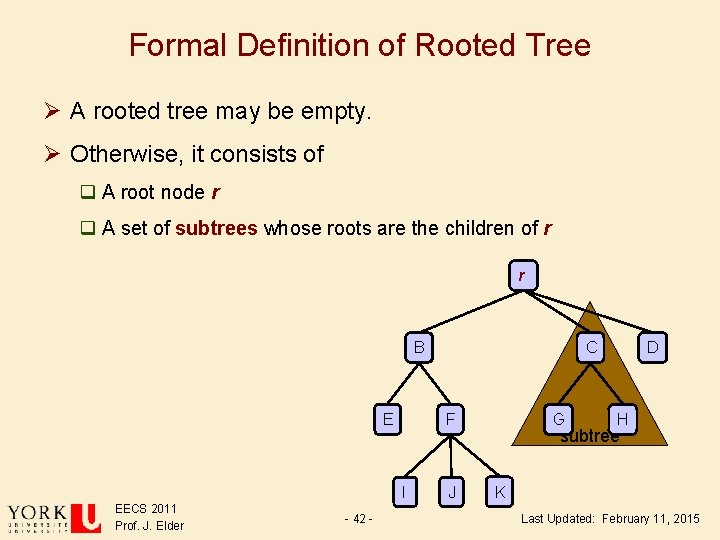
Formal Definition of Rooted Tree Ø A rooted tree may be empty. Ø Otherwise, it consists of q A root node r q A set of subtrees whose roots are the children of r r C B E F I EECS 2011 Prof. J. Elder - 42 - J G D H subtree K Last Updated: February 11, 2015
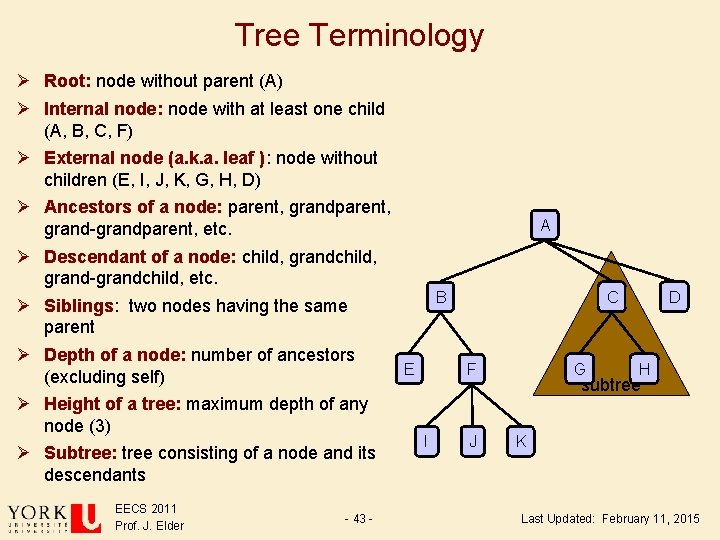
Tree Terminology Ø Root: node without parent (A) Ø Internal node: node with at least one child (A, B, C, F) Ø External node (a. k. a. leaf ): node without children (E, I, J, K, G, H, D) Ø Ancestors of a node: parent, grand-grandparent, etc. Ø Descendant of a node: child, grand-grandchild, etc. B Ø Siblings: two nodes having the same parent Ø Depth of a node: number of ancestors E (excluding self) Ø Height of a tree: maximum depth of any node (3) I Ø Subtree: tree consisting of a node and its descendants EECS 2011 Prof. J. Elder - 43 - A C G F J D H subtree K Last Updated: February 11, 2015
Position ADT Ø The Position ADT models the notion of place within a data structure where a single object is stored Ø It gives a unified view of diverse ways of storing data, such as qa cell of an array qa node of a linked list qa node of a tree Ø Just one method: qobject element(): returns the element stored at the position EECS 2011 Prof. J. Elder - 44 - Last Updated: February 11, 2015
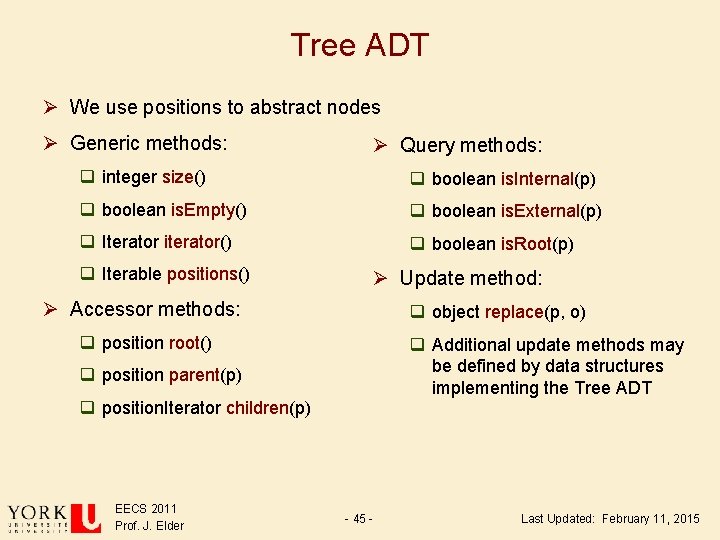
Tree ADT Ø We use positions to abstract nodes Ø Generic methods: Ø Query methods: q integer size() q boolean is. Internal(p) q boolean is. Empty() q boolean is. External(p) q Iterator iterator() q boolean is. Root(p) q Iterable positions() Ø Update method: Ø Accessor methods: q object replace(p, o) q position root() q Additional update methods may be defined by data structures implementing the Tree ADT q position parent(p) q position. Iterator children(p) EECS 2011 Prof. J. Elder - 45 - Last Updated: February 11, 2015
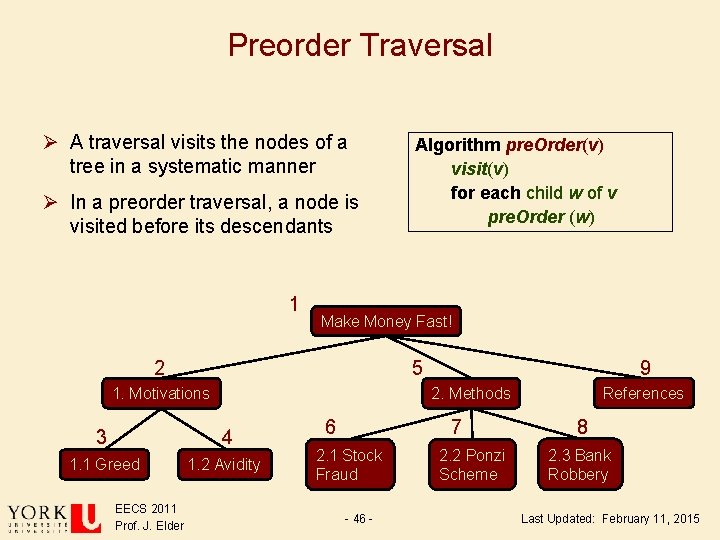
Preorder Traversal Ø A traversal visits the nodes of a tree in a systematic manner Ø In a preorder traversal, a node is visited before its descendants 1 Make Money Fast! 2 5 1. Motivations 9 2. Methods 3 4 1. 1 Greed 1. 2 Avidity EECS 2011 Prof. J. Elder Algorithm pre. Order(v) visit(v) for each child w of v pre. Order (w) 6 7 2. 1 Stock Fraud - 46 - 2. 2 Ponzi Scheme References 8 2. 3 Bank Robbery Last Updated: February 11, 2015
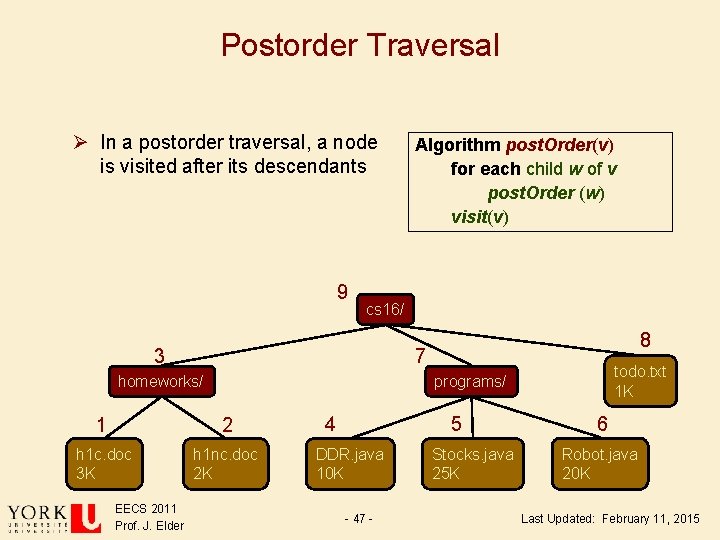
Postorder Traversal Ø In a postorder traversal, a node is visited after its descendants 9 cs 16/ 3 8 7 homeworks/ todo. txt 1 K programs/ 1 2 h 1 c. doc 3 K h 1 nc. doc 2 K EECS 2011 Prof. J. Elder Algorithm post. Order(v) for each child w of v post. Order (w) visit(v) 4 5 DDR. java 10 K - 47 - Stocks. java 25 K 6 Robot. java 20 K Last Updated: February 11, 2015
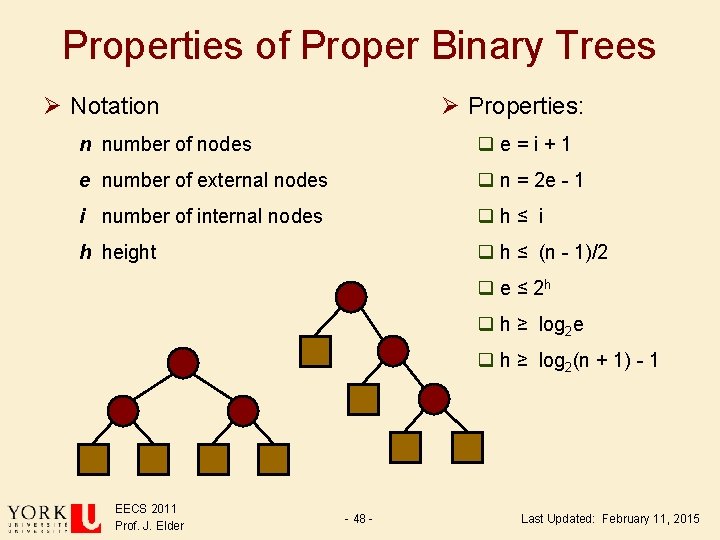
Properties of Proper Binary Trees Ø Notation Ø Properties: n number of nodes qe = i + 1 e number of external nodes q n = 2 e - 1 i number of internal nodes qh ≤ i h height q h ≤ (n - 1)/2 q e ≤ 2 h q h ≥ log 2 e q h ≥ log 2(n + 1) - 1 EECS 2011 Prof. J. Elder - 48 - Last Updated: February 11, 2015
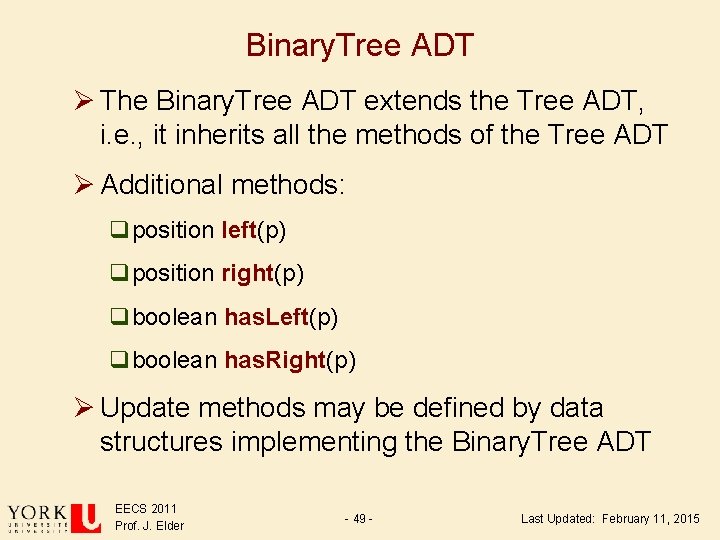
Binary. Tree ADT Ø The Binary. Tree ADT extends the Tree ADT, i. e. , it inherits all the methods of the Tree ADT Ø Additional methods: qposition left(p) qposition right(p) qboolean has. Left(p) qboolean has. Right(p) Ø Update methods may be defined by data structures implementing the Binary. Tree ADT EECS 2011 Prof. J. Elder - 49 - Last Updated: February 11, 2015
Topics on the Midterm Ø Data Structures & Object-Oriented Design Ø Run-Time Analysis Ø Linear Data Structures Ø The Java Collections Framework Ø Recursion Ø Trees Ø Priority Queues & Heaps EECS 2011 Prof. J. Elder - 50 - Last Updated: February 11, 2015
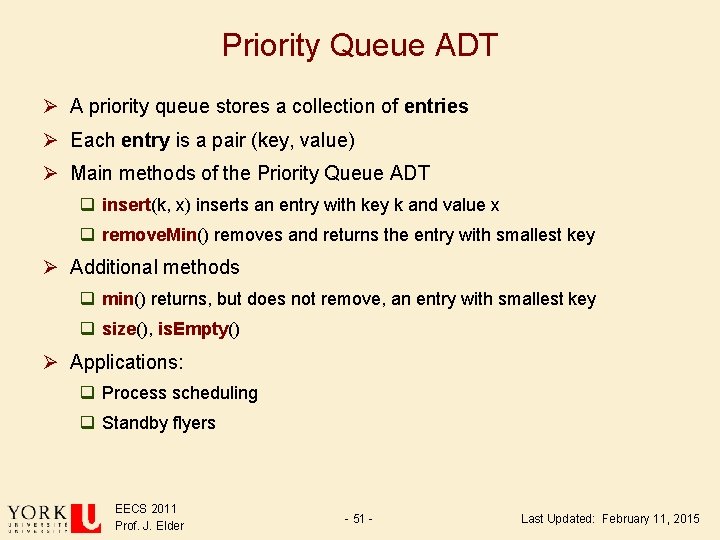
Priority Queue ADT Ø A priority queue stores a collection of entries Ø Each entry is a pair (key, value) Ø Main methods of the Priority Queue ADT q insert(k, x) inserts an entry with key k and value x q remove. Min() removes and returns the entry with smallest key Ø Additional methods q min() returns, but does not remove, an entry with smallest key q size(), is. Empty() Ø Applications: q Process scheduling q Standby flyers EECS 2011 Prof. J. Elder - 51 - Last Updated: February 11, 2015
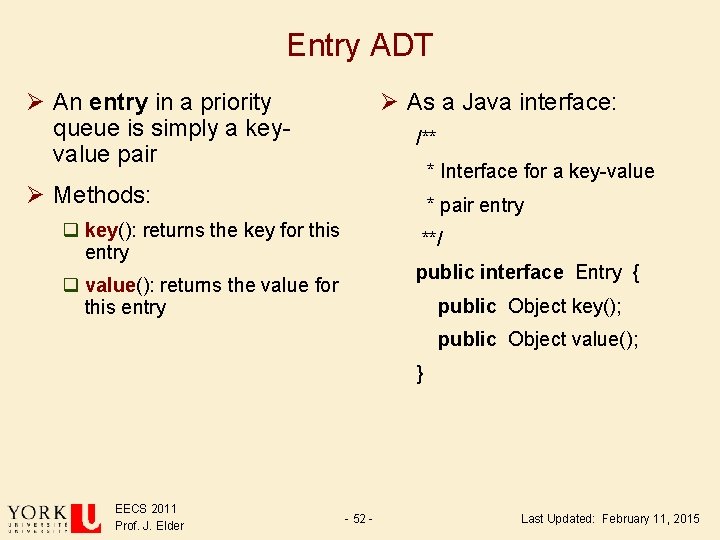
Entry ADT Ø As a Java interface: Ø An entry in a priority queue is simply a keyvalue pair /** * Interface for a key-value Ø Methods: * pair entry q key(): returns the key for this entry **/ public interface Entry { q value(): returns the value for this entry public Object key(); public Object value(); } EECS 2011 Prof. J. Elder - 52 - Last Updated: February 11, 2015
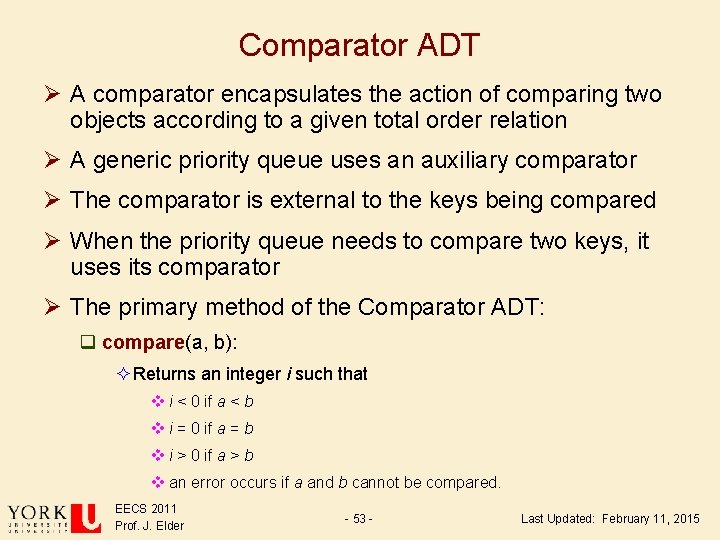
Comparator ADT Ø A comparator encapsulates the action of comparing two objects according to a given total order relation Ø A generic priority queue uses an auxiliary comparator Ø The comparator is external to the keys being compared Ø When the priority queue needs to compare two keys, it uses its comparator Ø The primary method of the Comparator ADT: q compare(a, b): ² Returns an integer i such that v i < 0 if a < b v i = 0 if a = b v i > 0 if a > b v an error occurs if a and b cannot be compared. EECS 2011 Prof. J. Elder - 53 - Last Updated: February 11, 2015
Sequence-based Priority Queue Ø Implementation with an unsorted list 4 5 2 3 Ø Implementation with a sorted list 1 1 Ø Performance: 3 4 5 Ø Performance: q insert takes O(1) time since we can insert the item at the beginning or end of the sequence q insert takes O(n) time since we have to find the right place to insert the item q remove. Min and min take O(1) time, since the smallest key is at the beginning q remove. Min and min take O(n) time since we have to traverse the entire sequence to find the smallest key EECS 2011 Prof. J. Elder 2 Is this tradeoff inevitable? - 54 - Last Updated: February 11, 2015
Heaps Ø Goal: q O(log n) insertion q O(log n) removal Ø Remember that O(log n) is almost as good as O(1)! q e. g. , n = 1, 000, 000 log n ≅ 30 Ø There are min heaps and max heaps. We will assume min heaps. EECS 2011 Prof. J. Elder - 55 - Last Updated: February 11, 2015
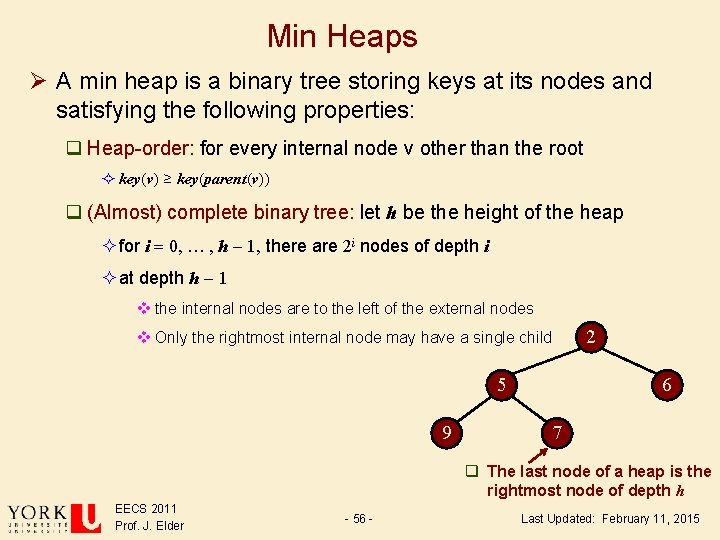
Min Heaps Ø A min heap is a binary tree storing keys at its nodes and satisfying the following properties: q Heap-order: for every internal node v other than the root ² key(v) ≥ key(parent(v)) q (Almost) complete binary tree: let h be the height of the heap ² for i = 0, … , h - 1, there are 2 i nodes of depth i ² at depth h – 1 v the internal nodes are to the left of the external nodes v Only the rightmost internal node may have a single child 5 9 2 6 7 q The last node of a heap is the rightmost node of depth h EECS 2011 Prof. J. Elder - 56 - Last Updated: February 11, 2015
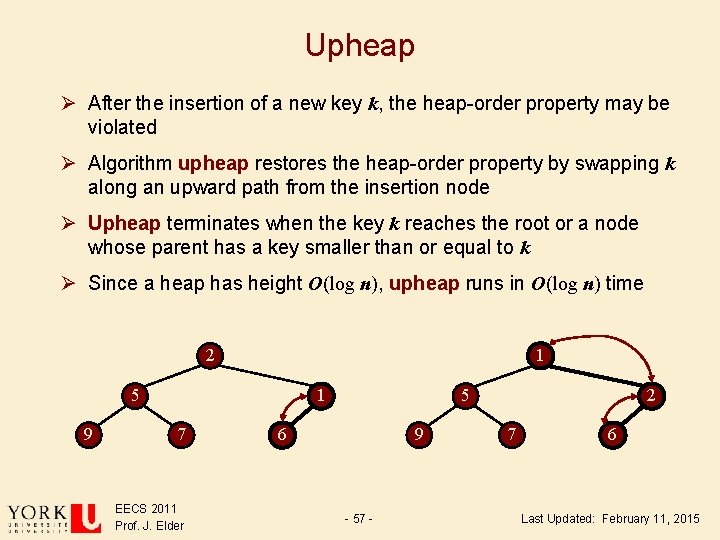
Upheap Ø After the insertion of a new key k, the heap-order property may be violated Ø Algorithm upheap restores the heap-order property by swapping k along an upward path from the insertion node Ø Upheap terminates when the key k reaches the root or a node whose parent has a key smaller than or equal to k Ø Since a heap has height O(log n), upheap runs in O(log n) time 2 1 5 9 1 7 EECS 2011 Prof. J. Elder 5 6 9 - 57 - 2 7 6 Last Updated: February 11, 2015
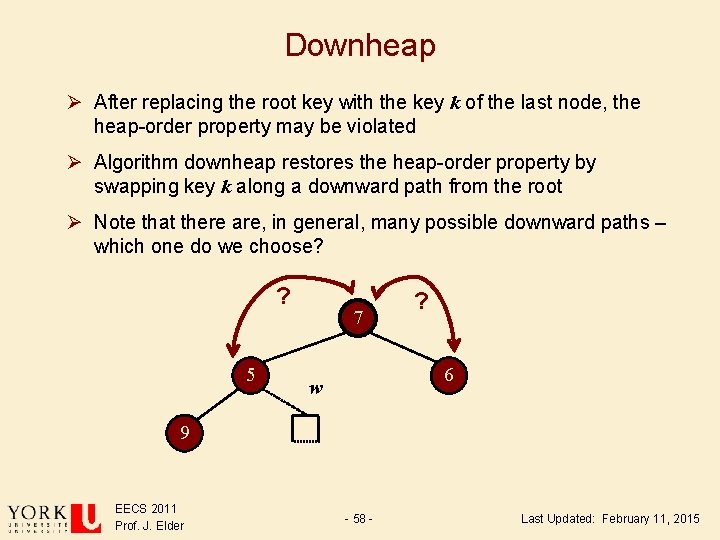
Downheap Ø After replacing the root key with the key k of the last node, the heap-order property may be violated Ø Algorithm downheap restores the heap-order property by swapping key k along a downward path from the root Ø Note that there are, in general, many possible downward paths – which one do we choose? ? 5 7 ? 6 w 9 EECS 2011 Prof. J. Elder - 58 - Last Updated: February 11, 2015
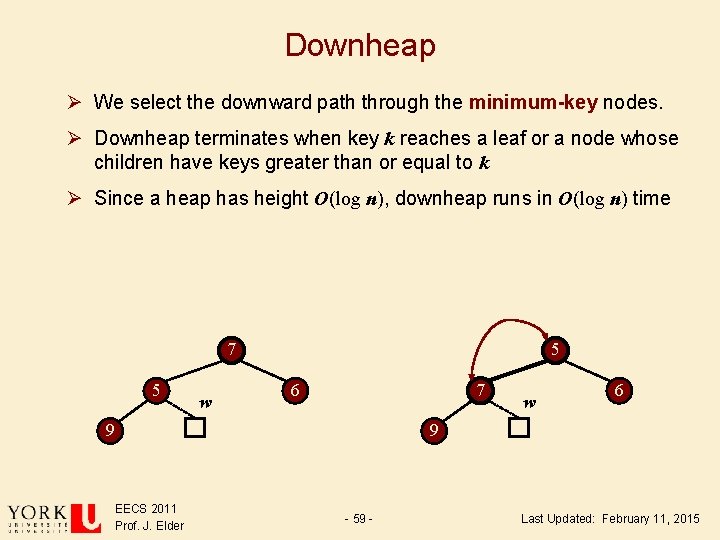
Downheap Ø We select the downward path through the minimum-key nodes. Ø Downheap terminates when key k reaches a leaf or a node whose children have keys greater than or equal to k Ø Since a heap has height O(log n), downheap runs in O(log n) time 7 5 w 5 6 7 9 w 6 9 EECS 2011 Prof. J. Elder - 59 - Last Updated: February 11, 2015
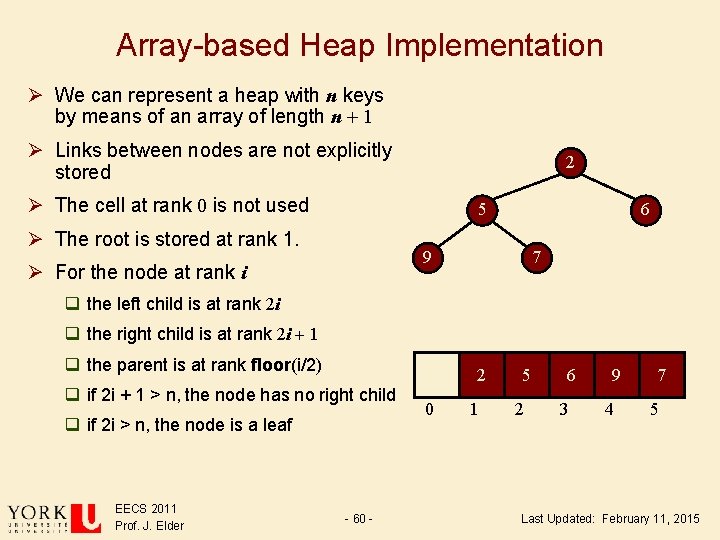
Array-based Heap Implementation Ø We can represent a heap with n keys by means of an array of length n + 1 Ø Links between nodes are not explicitly stored 2 Ø The cell at rank 0 is not used 5 Ø The root is stored at rank 1. 6 9 Ø For the node at rank i 7 q the left child is at rank 2 i q the right child is at rank 2 i + 1 q the parent is at rank floor(i/2) q if 2 i + 1 > n, the node has no right child q if 2 i > n, the node is a leaf EECS 2011 Prof. J. Elder - 60 - 2 0 1 5 2 6 3 9 4 7 5 Last Updated: February 11, 2015
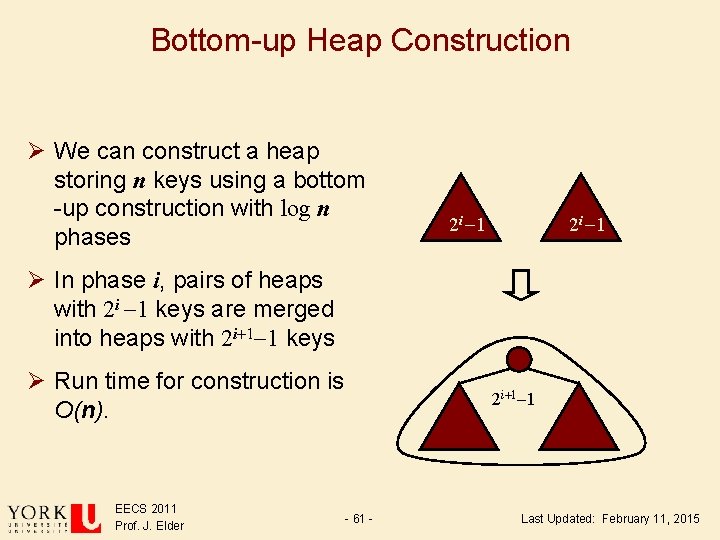
Bottom-up Heap Construction Ø We can construct a heap storing n keys using a bottom -up construction with log n phases 2 i -1 Ø In phase i, pairs of heaps with 2 i -1 keys are merged into heaps with 2 i+1 -1 keys Ø Run time for construction is O(n). EECS 2011 Prof. J. Elder 2 i+1 -1 - 61 - Last Updated: February 11, 2015
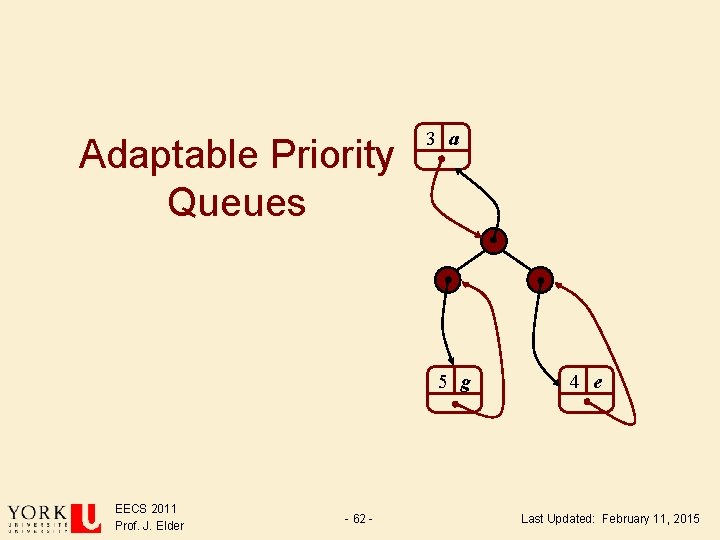
Adaptable Priority Queues 3 a 5 g EECS 2011 Prof. J. Elder - 62 - 4 e Last Updated: February 11, 2015
Additional Methods of the Adaptable Priority Queue ADT Ø remove(e): Remove from P and return entry e. Ø replace. Key(e, k): Replace with k and return the old key; an error condition occurs if k is invalid (that is, k cannot be compared with other keys). Ø replace. Value(e, x): Replace with x and return the old value. EECS 2011 Prof. J. Elder - 63 - Last Updated: February 11, 2015
Location-Aware Entries Ø A locator-aware entry identifies and tracks the location of its (key, value) object within a data structure EECS 2011 Prof. J. Elder - 64 - Last Updated: February 11, 2015
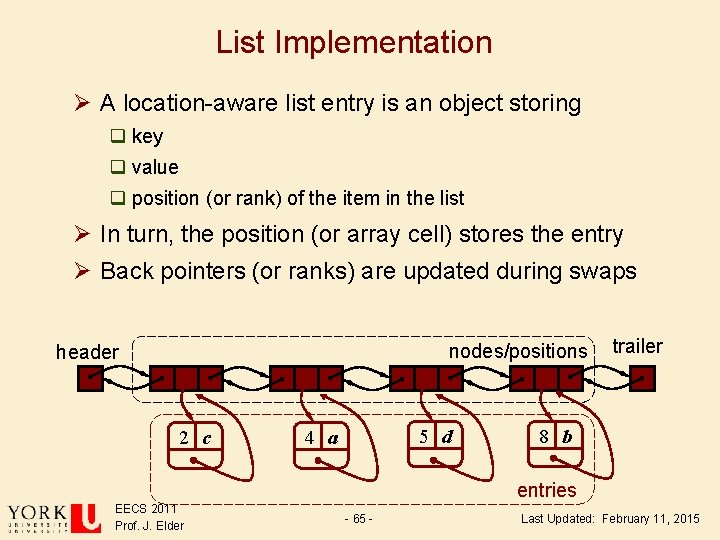
List Implementation Ø A location-aware list entry is an object storing q key q value q position (or rank) of the item in the list Ø In turn, the position (or array cell) stores the entry Ø Back pointers (or ranks) are updated during swaps nodes/positions header 2 c 5 d 4 a trailer 8 b entries EECS 2011 Prof. J. Elder - 65 - Last Updated: February 11, 2015
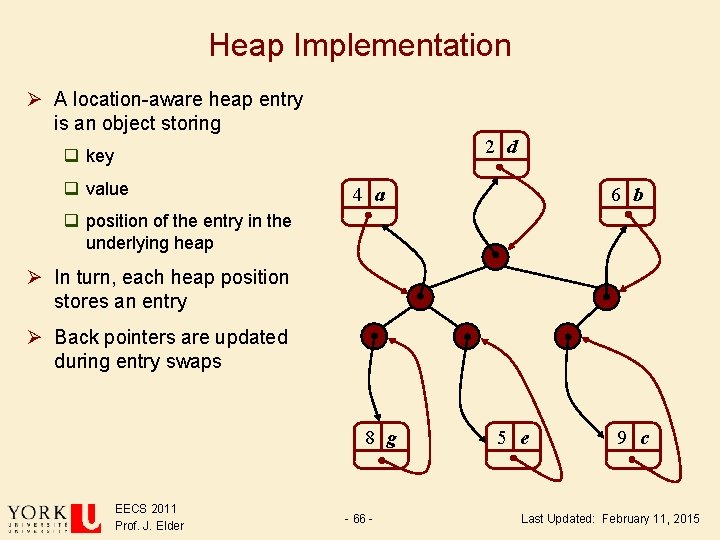
Heap Implementation Ø A location-aware heap entry is an object storing 2 d q key q value 4 a 6 b q position of the entry in the underlying heap Ø In turn, each heap position stores an entry Ø Back pointers are updated during entry swaps 8 g EECS 2011 Prof. J. Elder - 66 - 5 e 9 c Last Updated: February 11, 2015
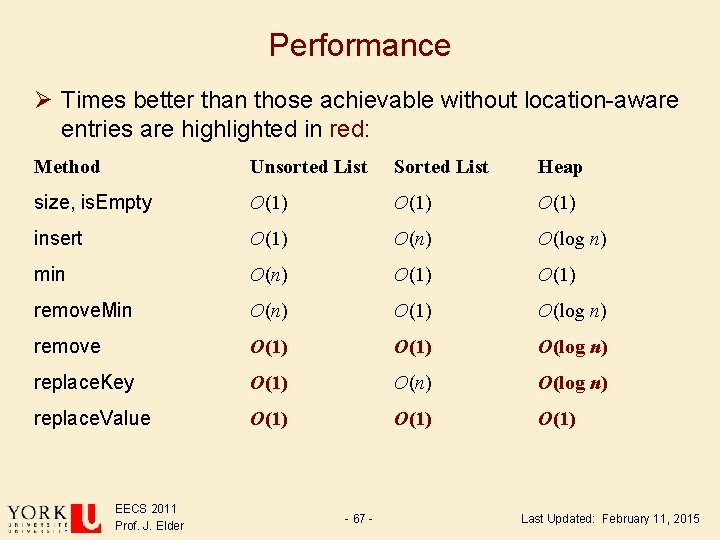
Performance Ø Times better than those achievable without location-aware entries are highlighted in red: Method Unsorted List Sorted List Heap size, is. Empty O(1) insert O(1) O(n) O(log n) min O(n) O(1) remove. Min O(n) O(1) O(log n) remove O(1) O(log n) replace. Key O(1) O(n) O(log n) replace. Value O(1) EECS 2011 Prof. J. Elder - 67 - Last Updated: February 11, 2015
Topics on the Midterm Ø Data Structures & Object-Oriented Design Ø Run-Time Analysis Ø Linear Data Structures Ø The Java Collections Framework Ø Recursion Ø Trees Ø Priority Queues & Heaps EECS 2011 Prof. J. Elder - 68 - Last Updated: February 11, 2015