
THE SOLAR SYSTEM By Justin Elder INTRODUCTION Our
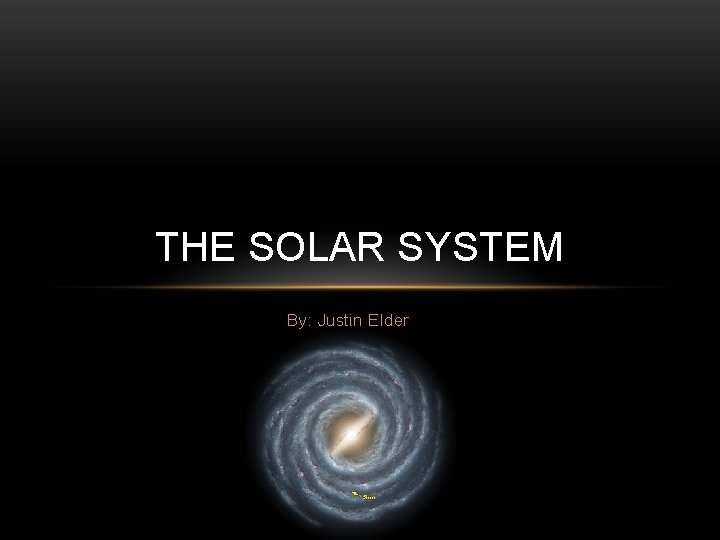
THE SOLAR SYSTEM By: Justin Elder
INTRODUCTION • Our solar system is part of the Milky Way galaxy • The solar system consists of the Sun and planets that gravitationally orbit around it • The solar system is approximately 4. 6 billion years old • The solar system consists of four inner planets (Terrestrial Planets) Mercury, Venus, Earth, and Mars and four outer planets (Gas Giants) Jupiter, Saturn, Uranus, and Neptune
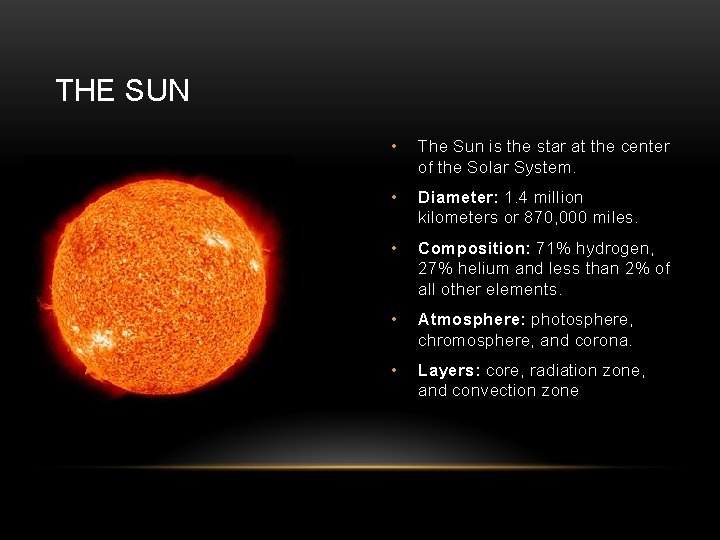
THE SUN • The Sun is the star at the center of the Solar System. • Diameter: 1. 4 million kilometers or 870, 000 miles. • Composition: 71% hydrogen, 27% helium and less than 2% of all other elements. • Atmosphere: photosphere, chromosphere, and corona. • Layers: core, radiation zone, and convection zone
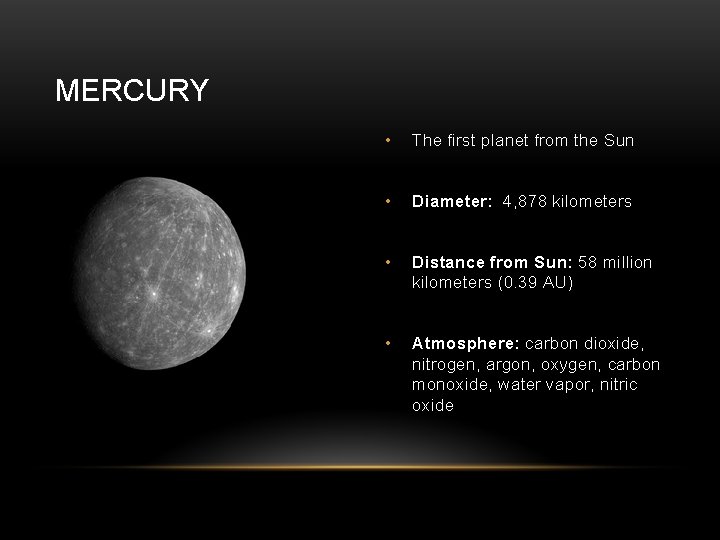
MERCURY • The first planet from the Sun • Diameter: 4, 878 kilometers • Distance from Sun: 58 million kilometers (0. 39 AU) • Atmosphere: carbon dioxide, nitrogen, argon, oxygen, carbon monoxide, water vapor, nitric oxide
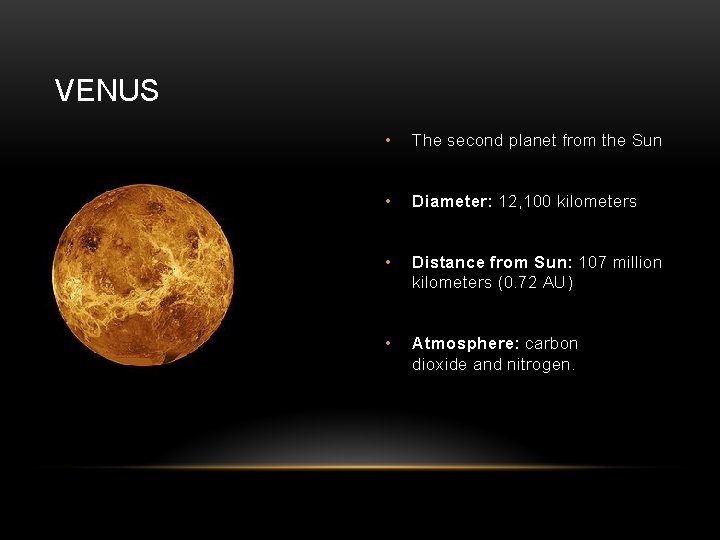
VENUS • The second planet from the Sun • Diameter: 12, 100 kilometers • Distance from Sun: 107 million kilometers (0. 72 AU) • Atmosphere: carbon dioxide and nitrogen.
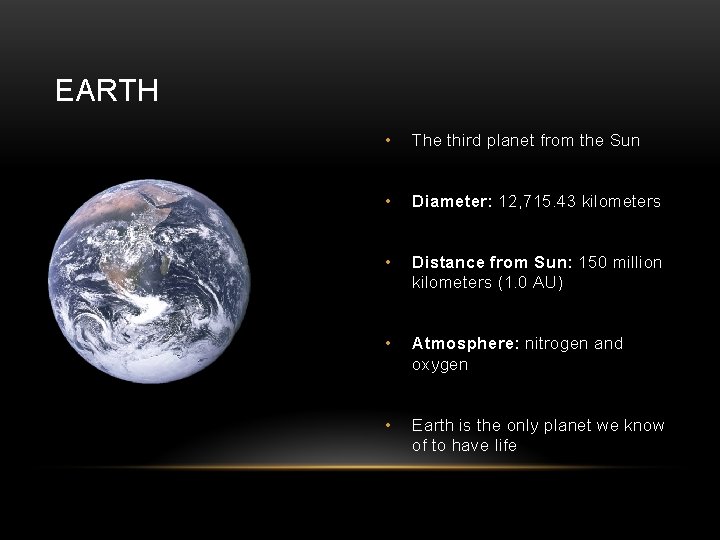
EARTH • The third planet from the Sun • Diameter: 12, 715. 43 kilometers • Distance from Sun: 150 million kilometers (1. 0 AU) • Atmosphere: nitrogen and oxygen • Earth is the only planet we know of to have life
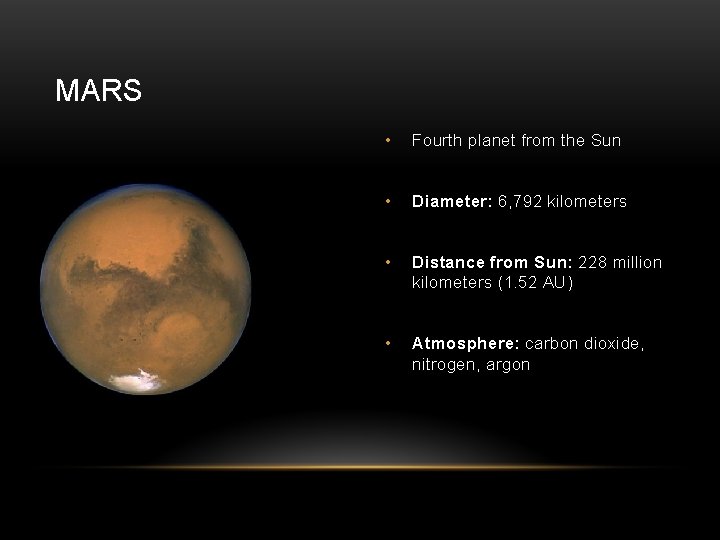
MARS • Fourth planet from the Sun • Diameter: 6, 792 kilometers • Distance from Sun: 228 million kilometers (1. 52 AU) • Atmosphere: carbon dioxide, nitrogen, argon
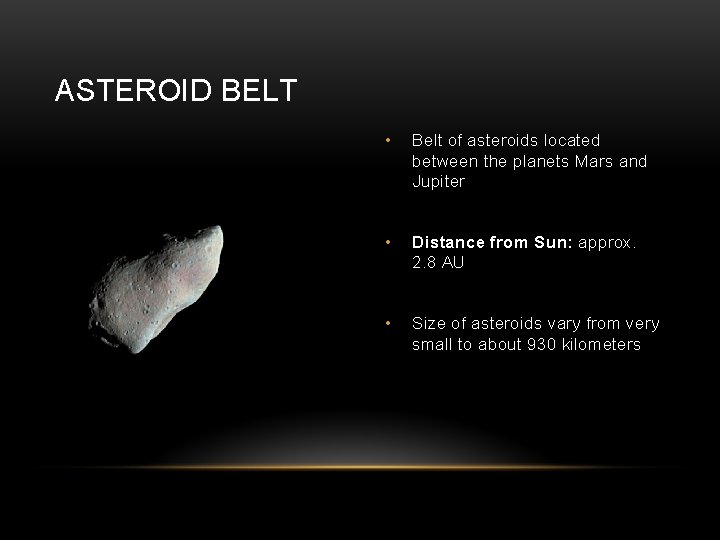
ASTEROID BELT • Belt of asteroids located between the planets Mars and Jupiter • Distance from Sun: approx. 2. 8 AU • Size of asteroids vary from very small to about 930 kilometers
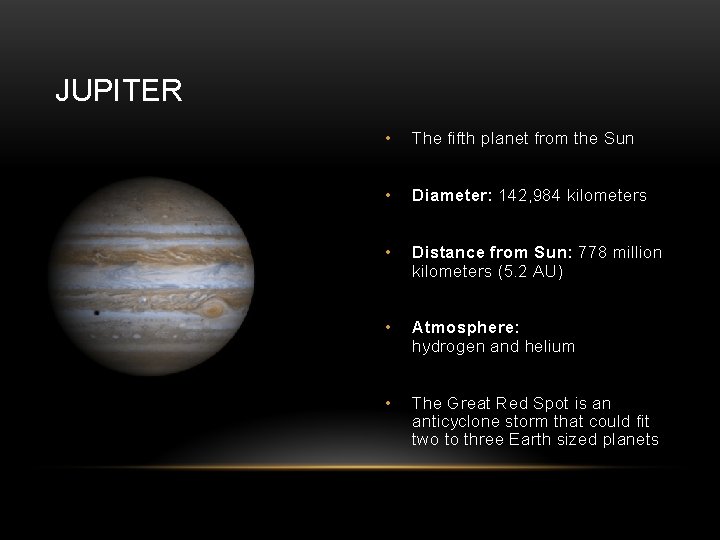
JUPITER • The fifth planet from the Sun • Diameter: 142, 984 kilometers • Distance from Sun: 778 million kilometers (5. 2 AU) • Atmosphere: hydrogen and helium • The Great Red Spot is an anticyclone storm that could fit two to three Earth sized planets
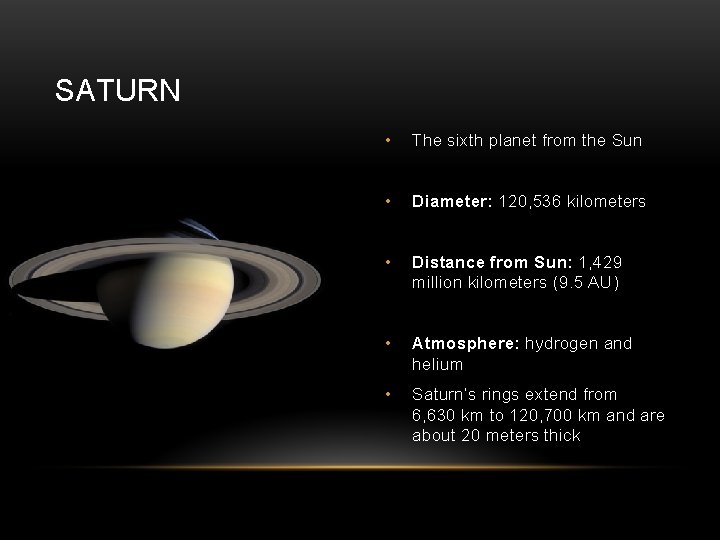
SATURN • The sixth planet from the Sun • Diameter: 120, 536 kilometers • Distance from Sun: 1, 429 million kilometers (9. 5 AU) • Atmosphere: hydrogen and helium • Saturn’s rings extend from 6, 630 km to 120, 700 km and are about 20 meters thick
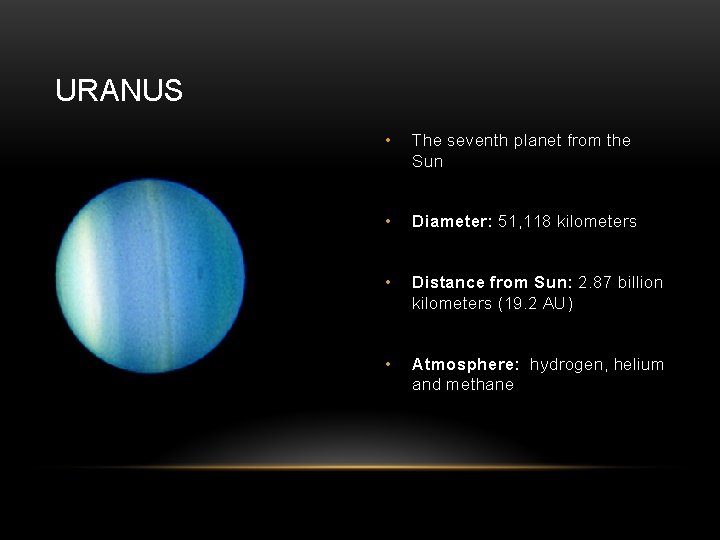
URANUS • The seventh planet from the Sun • Diameter: 51, 118 kilometers • Distance from Sun: 2. 87 billion kilometers (19. 2 AU) • Atmosphere: hydrogen, helium and methane
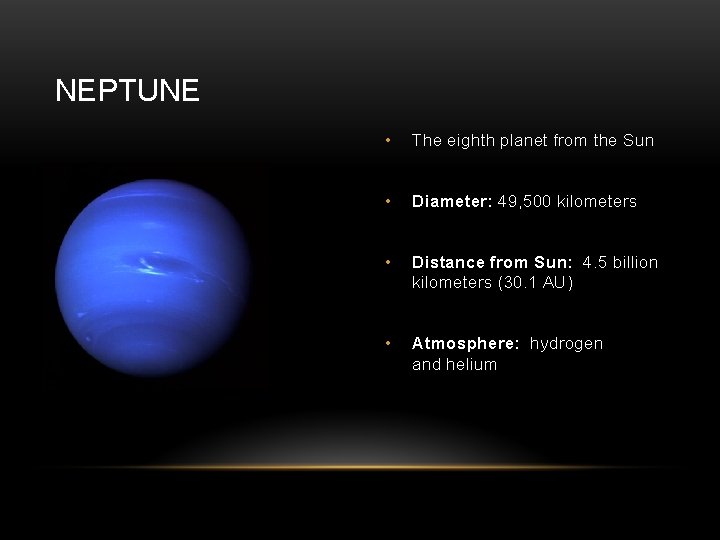
NEPTUNE • The eighth planet from the Sun • Diameter: 49, 500 kilometers • Distance from Sun: 4. 5 billion kilometers (30. 1 AU) • Atmosphere: hydrogen and helium
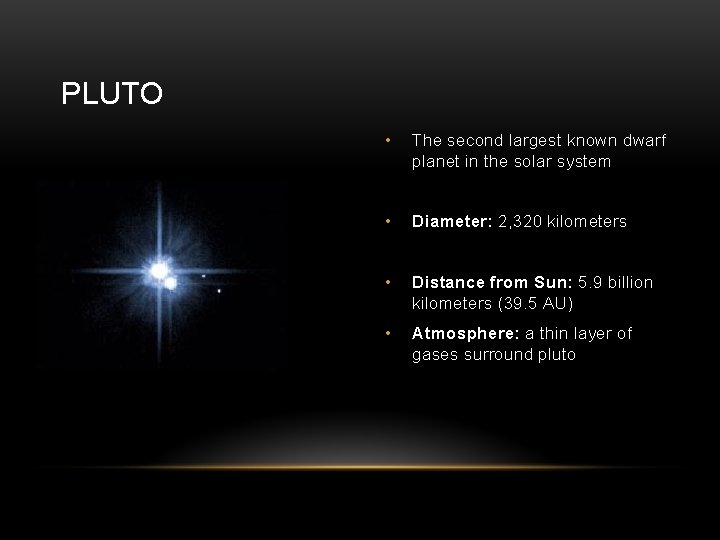
PLUTO • The second largest known dwarf planet in the solar system • Diameter: 2, 320 kilometers • Distance from Sun: 5. 9 billion kilometers (39. 5 AU) • Atmosphere: a thin layer of gases surround pluto
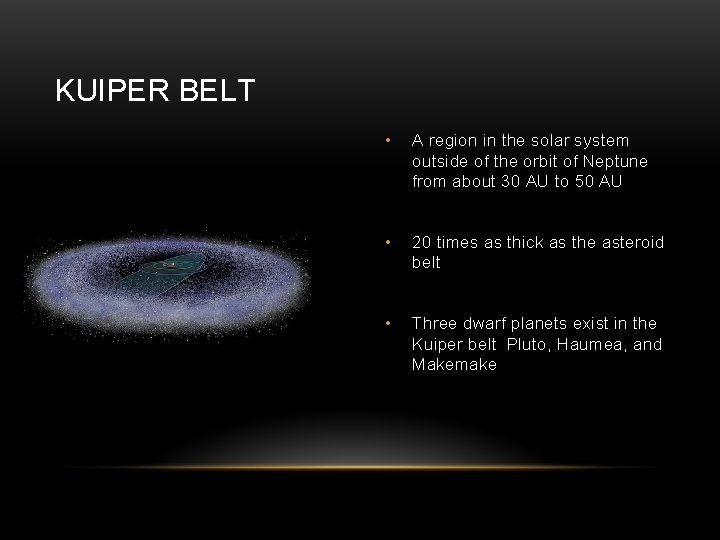
KUIPER BELT • A region in the solar system outside of the orbit of Neptune from about 30 AU to 50 AU • 20 times as thick as the asteroid belt • Three dwarf planets exist in the Kuiper belt Pluto, Haumea, and Makemake
CONCLUSION • Andromeda is the close galaxy to the solar systems galaxy • There are more that 140 moons in the Solar System • The Sun will eventually turn into a red giant and finally a white dwarf
- Slides: 15