MANSON SCHOOL DISTRICT Options Program Choice is a

- Slides: 62
MANSON SCHOOL DISTRICT Options Program “Choice is a catalyst for change. By providing the benefits of a tailored learning experience for students, school choice provides parents access to opportunities for their children to thrive and succeed. ” Chairman of the State Board of Education in Florida, T. Willard Fair 1
“What does the Options program look like at the classroom level? ” – Dynamics of a multi-age classroom – Key concepts of a constructivist learning environment or learner-centered classroom – Progression based on proficiency with students as active participants in the assessment process – Integrated arts curriculum 2
The desired outcome of tonight’s presentation is to answer questions like… • • Would this be a good option for my child? Would it meet my child’s needs? Would this be a good option for my family? Can I see my child in this learning environment? • Can I see myself actively involved in this program? 3
4
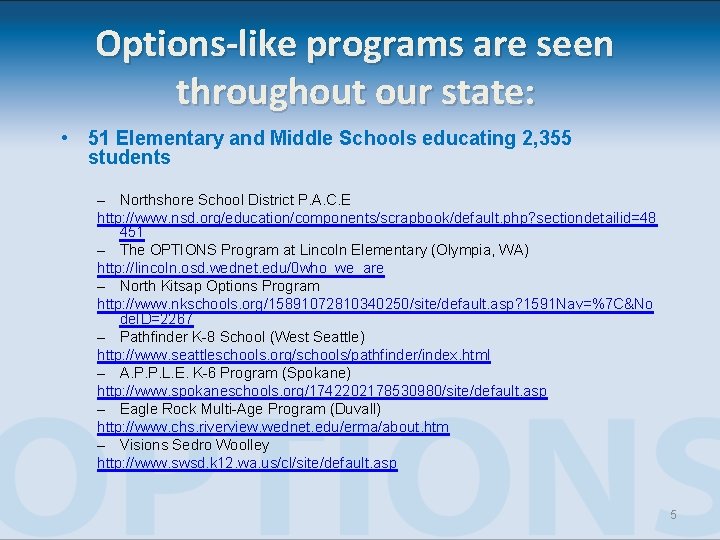
Options-like programs are seen throughout our state: • 51 Elementary and Middle Schools educating 2, 355 students – Northshore School District P. A. C. E http: //www. nsd. org/education/components/scrapbook/default. php? sectiondetailid=48 451 – The OPTIONS Program at Lincoln Elementary (Olympia, WA) http: //lincoln. osd. wednet. edu/0 who_we_are – North Kitsap Options Program http: //www. nkschools. org/15891072810340250/site/default. asp? 1591 Nav=%7 C&No de. ID=2267 – Pathfinder K-8 School (West Seattle) http: //www. seattleschools. org/schools/pathfinder/index. html – A. P. P. L. E. K-6 Program (Spokane) http: //www. spokaneschools. org/1742202178530980/site/default. asp – Eagle Rock Multi-Age Program (Duvall) http: //www. chs. riverview. wednet. edu/erma/about. htm – Visions Sedro Woolley http: //www. swsd. k 12. wa. us/cl/site/default. asp 5
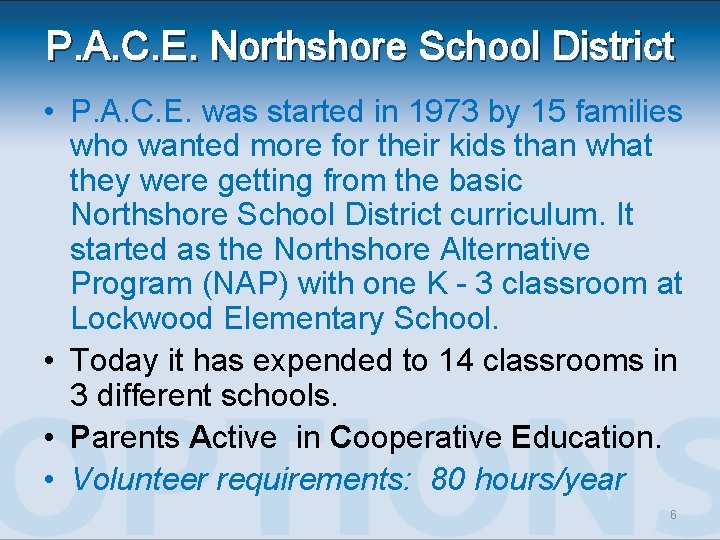
P. A. C. E. Northshore School District • P. A. C. E. was started in 1973 by 15 families who wanted more for their kids than what they were getting from the basic Northshore School District curriculum. It started as the Northshore Alternative Program (NAP) with one K - 3 classroom at Lockwood Elementary School. • Today it has expended to 14 classrooms in 3 different schools. • Parents Active in Cooperative Education. • Volunteer requirements: 80 hours/year 6
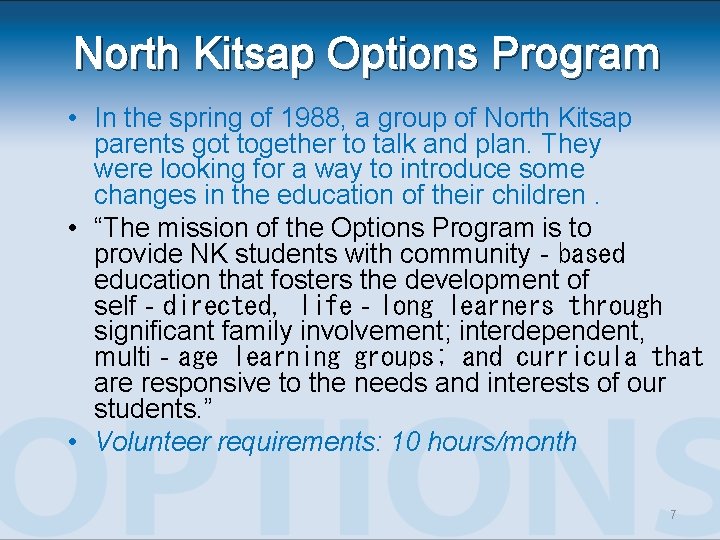
North Kitsap Options Program • In the spring of 1988, a group of North Kitsap parents got together to talk and plan. They were looking for a way to introduce some changes in the education of their children. • “The mission of the Options Program is to provide NK students with community‐based education that fosters the development of self‐directed, life‐long learners through significant family involvement; interdependent, multi‐age learning groups; and curricula that are responsive to the needs and interests of our students. ” • Volunteer requirements: 10 hours/month 7
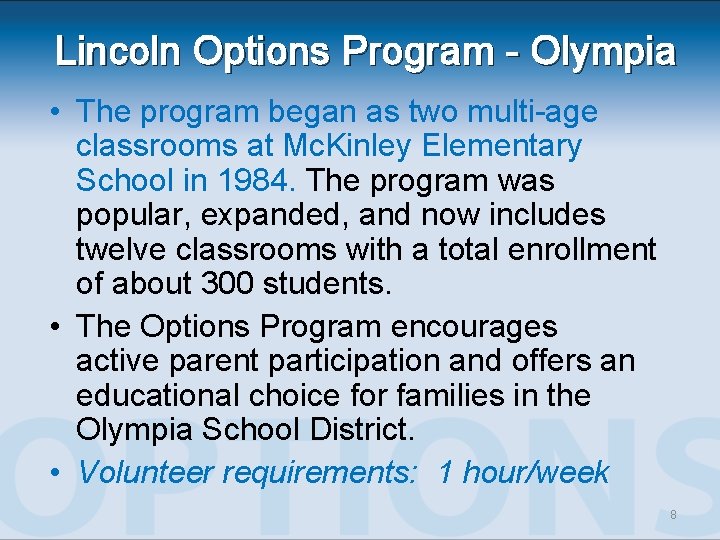
Lincoln Options Program - Olympia • The program began as two multi-age classrooms at Mc. Kinley Elementary School in 1984. The program was popular, expanded, and now includes twelve classrooms with a total enrollment of about 300 students. • The Options Program encourages active parent participation and offers an educational choice for families in the Olympia School District. • Volunteer requirements: 1 hour/week 8
Room Nine in Meridian Park • The Room Nine Community School, established in 1974, is located in Meridian Park Elementary School in the Shoreline School District. • It enrolls 100 students grades K-8. Room Nine addresses student learning requirements through use of standard curriculums, community resources, field trips, projects, and teacher/parent/student-generated activities. In addition, learning is integrated through thematic units, applying skills to real-life problems and having students work in multi-age groups. Students take ownership of their learning 9 through self-assessment.
Chelan Valley Independent School • Community educators and families founded Chelan Valley Independent School in 1992. They recognized the need to establish an alternative educational choice in the Chelan Valley. They wanted an environment that encouraged family involvement and fostered an excitement and love of learning in a multiage setting. • Volunteer requirements: 5 hours/month 10
Overview of the Dynamics of a Multi -age Classroom: History of the Multi-age Classroom What Is a Multi-age Classroom Benefits of Multi-age Classrooms Disadvantages of Multi-age Classrooms FAQs 11
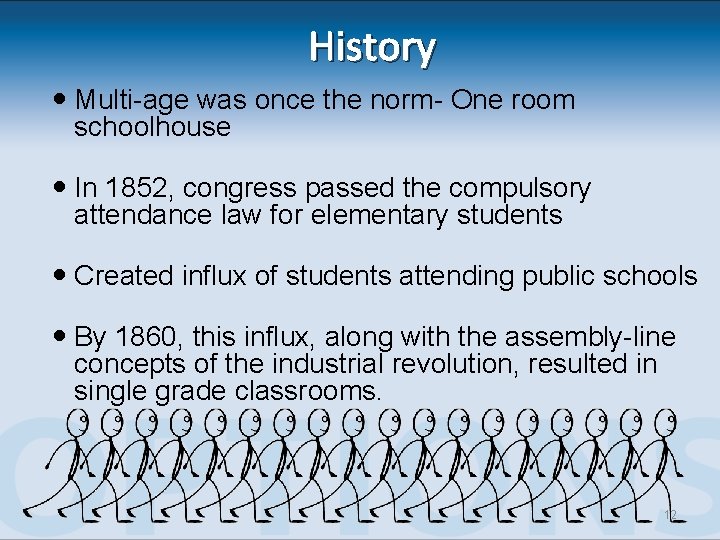
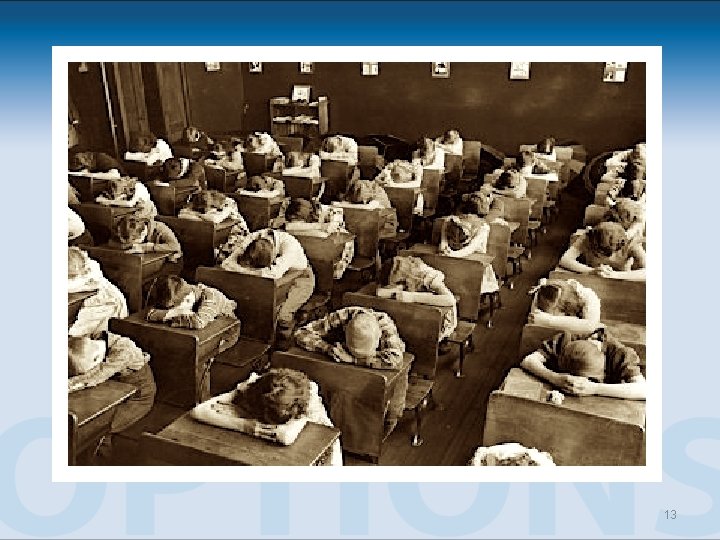
History Multi-age was once the norm- One room schoolhouse In 1852, congress passed the compulsory attendance law for elementary students Created influx of students attending public schools By 1860, this influx, along with the assembly-line concepts of the industrial revolution, resulted in single grade classrooms. 12
13
History In the 1960’s, educational psychologists challenged the benefits of single grade classrooms Public schools around the country started creating multi-age options 14
Trend No one is tracking the number of multi-age classes operating nationwide, but the number peaked in the late 1990 s. Multi-age classes continue to operate in every state and in public, private and charter schools. Multi-age education is more prevalent in Canada, Europe and parts of Asia. Marzano et al suggest multi-age classroom may be the best avenue for implementing the most current researched-based practices for effective highly engaged classrooms 15
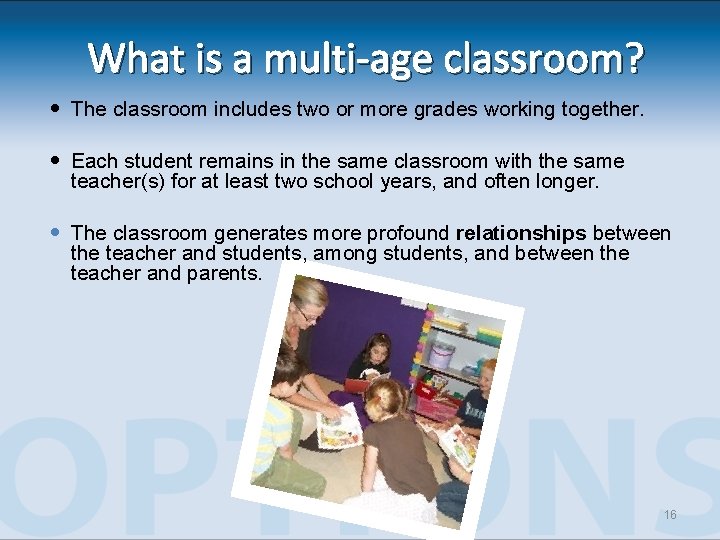
What is a multi-age classroom? The classroom includes two or more grades working together. Each student remains in the same classroom with the same teacher(s) for at least two school years, and often longer. The classroom generates more profound relationships between the teacher and students, among students, and between the teacher and parents. 16
What is a multi-age classroom? The teacher focuses less on grade grouping and more on individual qualities and capabilities, not all of which are at the same level of development. Teachers move from “teaching to an imaginary middle of the class” to conceiving and structuring learning activities that meet the needs of diverse individuals. 17
What is a multi-age classroom? Units or activities are planned for participation by the whole group much of the time. But the individual student’s work may be more individualized; the expectations will vary, depending on the individual’s needs and abilities. Differentiated instruction is at the heart of instruction. 18
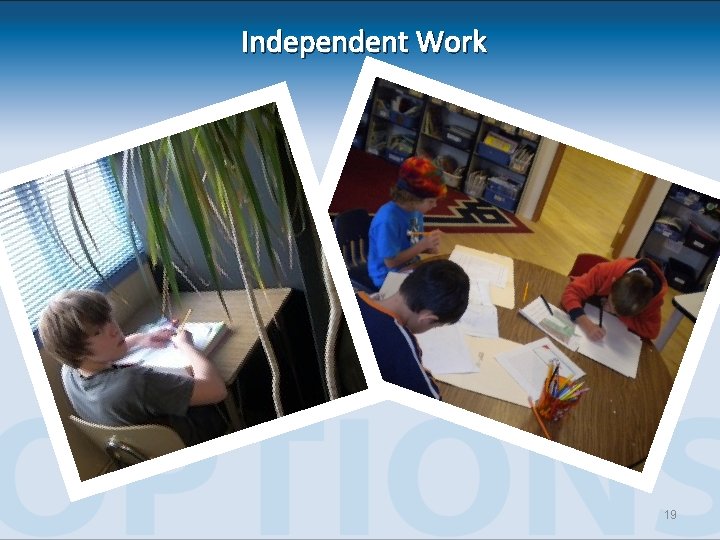
Independent Work 19
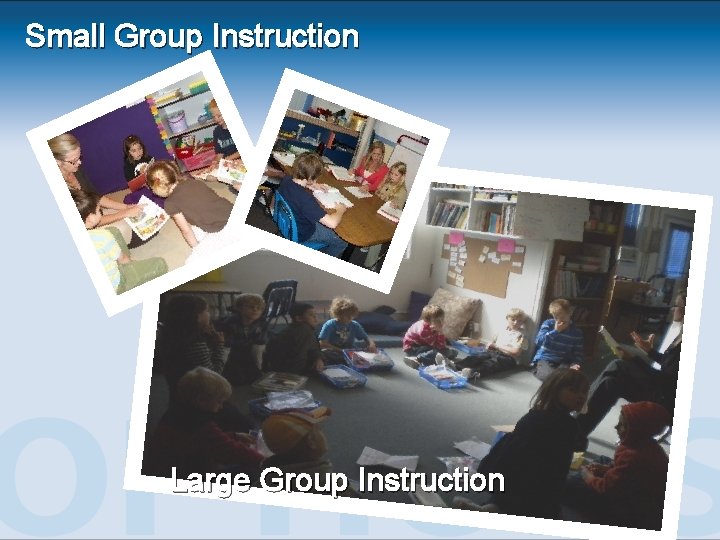
Small Group Instruction Large Group Instruction 20
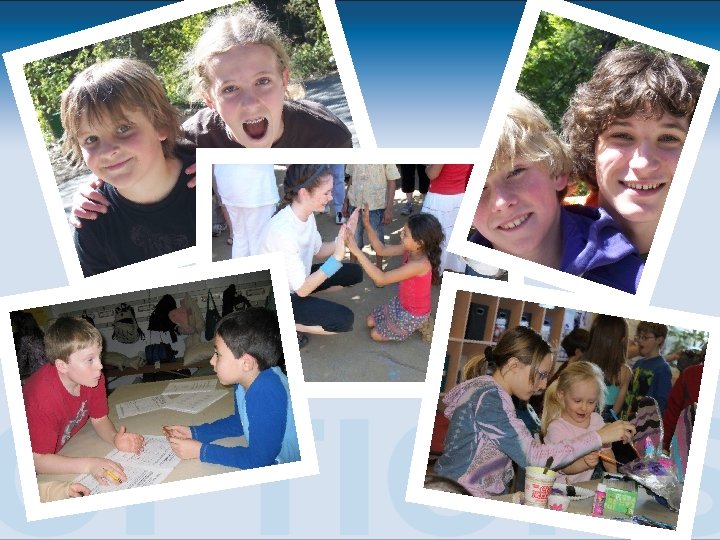
What is a multi-age classroom? The children perceive each other in terms of specific personal qualities and capabilities and are less concerned with grade differences. Chronological age becomes less important as a determinant of children’s relationships, while developmental age becomes more important. The metaphor of family characterizes the social qualities of the classrooms. 21
22
What are the benefits for students in multi-age classrooms? An increase in the quality of the relationship between the teacher and student: Greater knowledge of the student’s capacities and needs Greater consistency of teacher behavior and expectations Greater felt comfort and security in the classroom Greater mutual caring and concern 23
What are the benefits for students of multi -age classrooms? Social climate is more positive Recognition of diversity of capabilities by the students increases their acceptance and even valuing of difference among their peers Reduction of negative norms Students of different ages become increasingly interdependent because they often teach or mentor each other 24
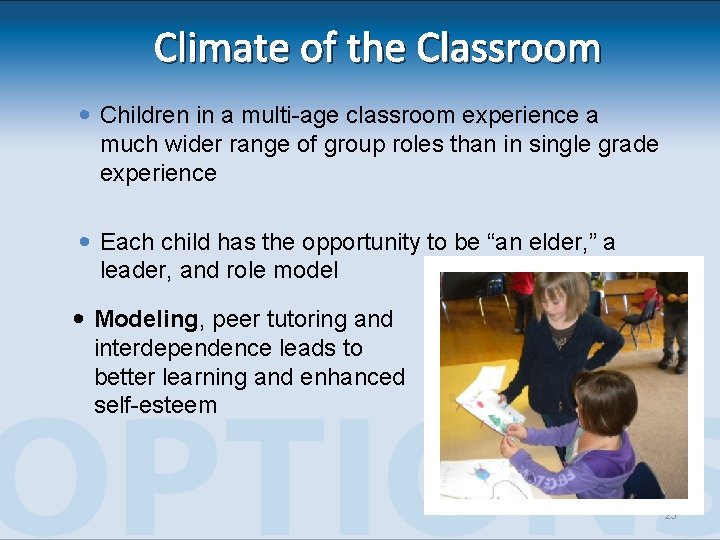
Climate of the Classroom Children in a multi-age classroom experience a much wider range of group roles than in single grade experience Each child has the opportunity to be “an elder, ” a leader, and role model Modeling, peer tutoring and interdependence leads to better learning and enhanced self-esteem 25
What are the benefits for students in multi -age classrooms? With less new students entering the classroom each year the teacher is able to pay more attention to the new students Helps teachers to address the dilemma of failing a student in a way that gets them “out of the box” of two poor choices, failing or social promotion. 26
Benefits For Teachers Deeper, more profound relationships with kids Greater personal rewards in seeing students’ growth and learning Minimizes the stress of starting a new school year as it supports productive use of school time right from the first week of school 27
Benefits For Teachers Stronger and more productive relationships with the parents of their students Continuity from year to year Get to apply/must apply best educational practices, including learner-centered learning and differentiated instruction 28
Benefits For Parents Increase in comfort when they can get to know a teacher over more than a year They know the routine and benefit from it just like the child Greater likelihood that the parent and teacher can work together to support a child’s growth and learning 29
Disadvantages For Students None - Unless a poor teacher with poor instruction 30
Disadvantages For Teachers It’s a tremendous amount of work Curriculum changes year to year Students needs change from year to year Parents don’t always understand the classroom so it’s more work to educate them It’s a greater commitment so more responsibility to the whole program 31
Disadvantages For Parents Same as for students None - Unless a poor teacher with poor instruction 32
FAQ: Are multi-age classrooms less structured? Structure is an interesting concept based on one’s perspective and comfort. Multi-age is highly structured To orchestrate large group instruction, small group instruction, student-centered learning and independent projects, there has to be a set of negotiated rules and routines worked out between the teacher and students. 33
“Charodic” Chaordic – term coined by top educational experts to describe most effective student centered classrooms where every student is on task. Goal - Students are on task and engaged in a learning activity a large percentage of the day 34
FAQ: Are multi-age classrooms less structured? ‘Structure’ is teacher specific, not classroom type specific. Some teachers can manage more freedom and flexibility than others. It doesn’t have to do with multi-age or single-age classes necessarily. There are teachers of single-age classes that offer more movement than the traditional model of classroom; and there are multi-age teachers that limit the amount of movement and noise within their class. 35
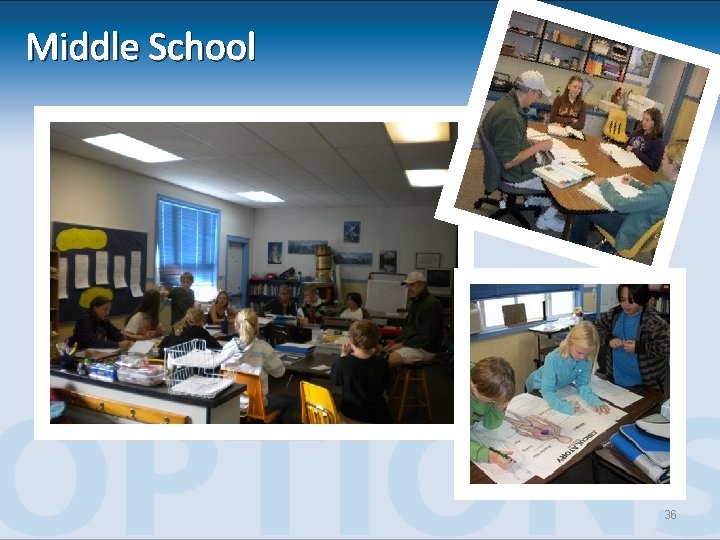
Middle School 36
FAQ: Will multi-age students end up with gaps in the curriculum? When student learning is being monitored by one teacher over a number of years, it is less likely that they will end up with gaps in their conceptual and skill development. Over this span of years, students in multi-age classes will cover the same topics as their peers in single grades. If teachers and students alike are conscious of power standards, the multi-age years give more time for some standards to be reached by struggling students but all goals remain the same. 37
FAQ: Will the oldest age group in the multi-age class get behind their peers in a single grade class? Multi-age teachers focus instruction on students’ learning needs rather than on grade-level curriculum. The question to be addressed is “what is the student’s next step? ” even if it is several grade levels above their current placement. The teacher’s attention is not divided between the age groups (as in some multi-grade classes). Therefore, students have the advantage of continuous learning, and in many cases will be ahead of their peers in a single grade class. 38
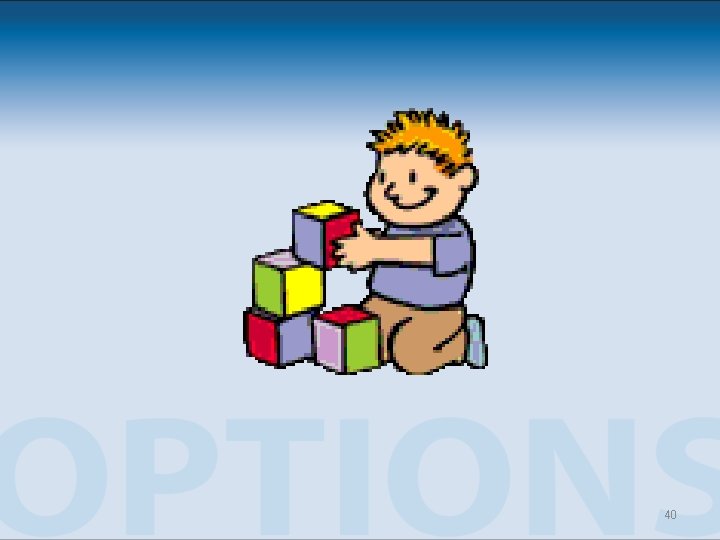
Key Concepts of Constructivism Confucius Say… “I hear and I forget. I see and I remember. I do and I understand. ” 39
40
Key Concepts of Constructivism • Constructing understanding – Students must construct knowledge in their own minds. – Students must be active learners, finding connections between new information and existing knowledge and building up new understandings. – The teacher’s role is to facilitate this process. 41
Key Concepts of Constructivism • Learner-centered classrooms – Each student comes with different levels of understanding, different developmental capabilities, different modes/learning styles for constructing understanding. – Students must work in their appropriate “zone of proximal development. ” – Students must be involved in the assessment process. – Students must participate in individualized learning plans 42
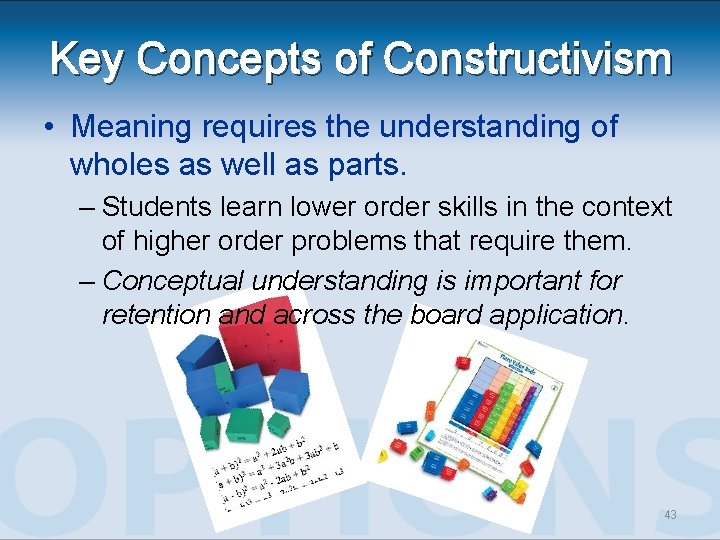
Key Concepts of Constructivism • Meaning requires the understanding of wholes as well as parts. – Students learn lower order skills in the context of higher order problems that require them. – Conceptual understanding is important for retention and across the board application. 43
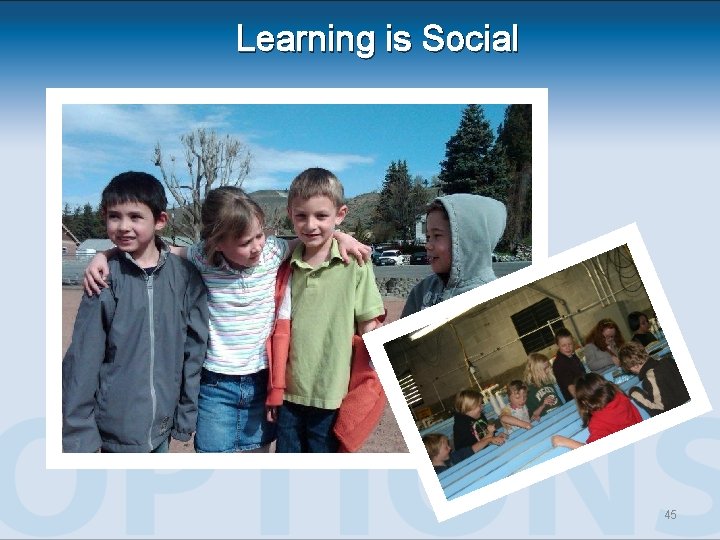
Key Concepts of Constructivism • Social interactions support learning – Cooperative grouping • Mixed-ability • Homogeneous grouping – Peer mentoring – Sharing responsibility – Challenge each other, stimulate thinking, talk self and others through problems 44
Learning is Social 45
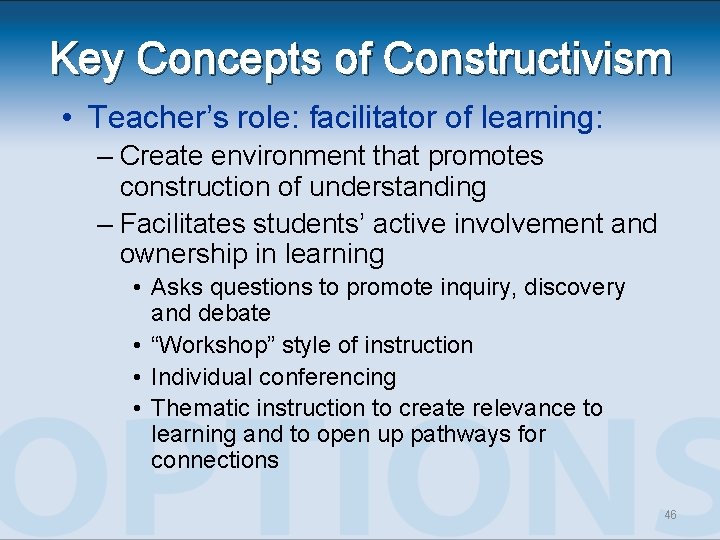
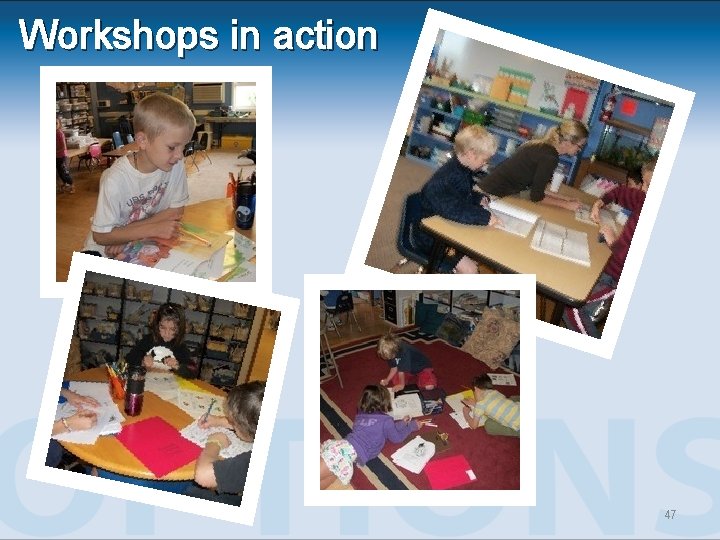
Key Concepts of Constructivism • Teacher’s role: facilitator of learning: – Create environment that promotes construction of understanding – Facilitates students’ active involvement and ownership in learning • Asks questions to promote inquiry, discovery and debate • “Workshop” style of instruction • Individual conferencing • Thematic instruction to create relevance to learning and to open up pathways for connections 46
Workshops in action 47
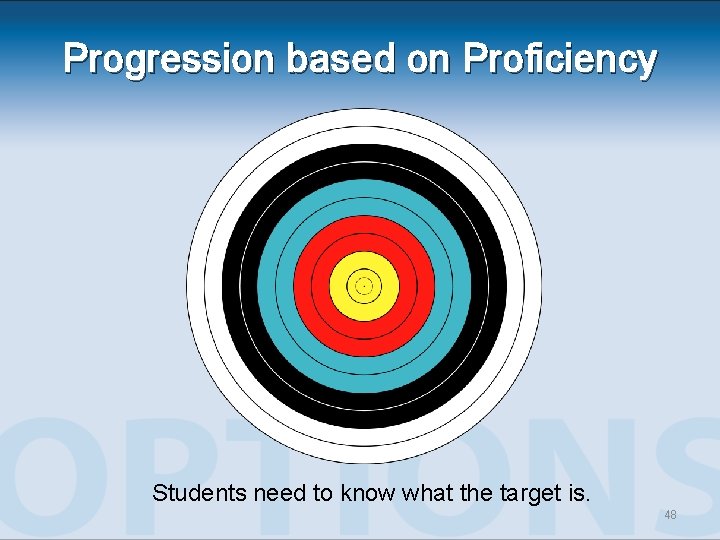
Progression based on Proficiency Students need to know what the target is. 48
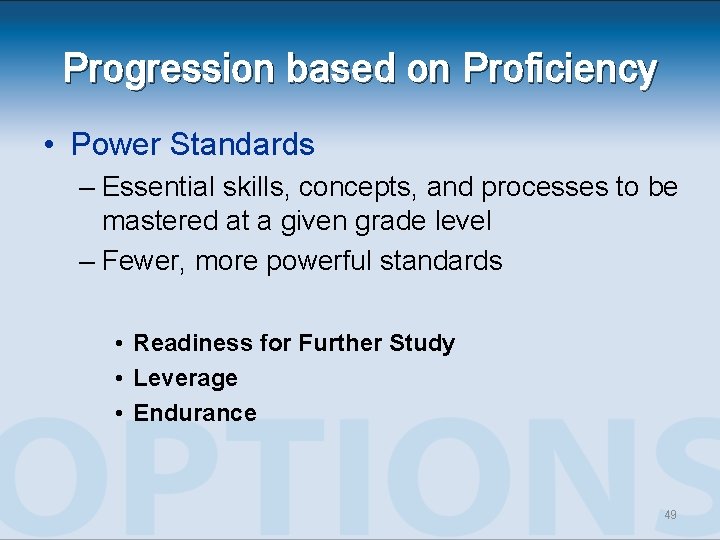
Progression based on Proficiency • Power Standards – Essential skills, concepts, and processes to be mastered at a given grade level – Fewer, more powerful standards • Readiness for Further Study • Leverage • Endurance 49
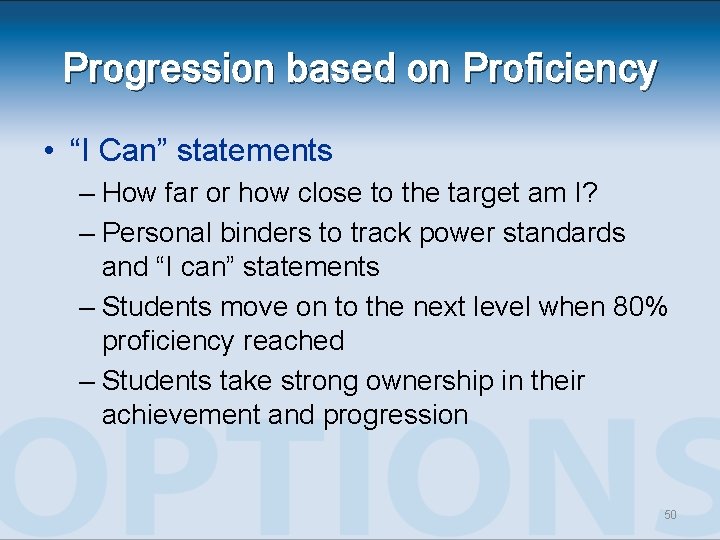
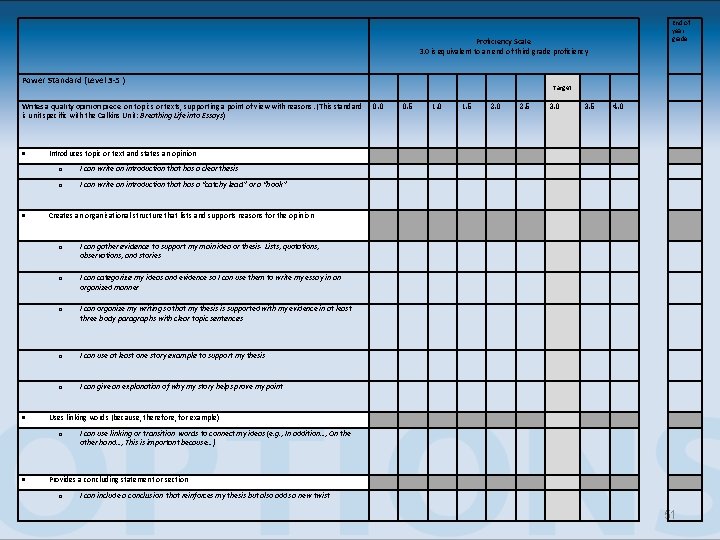
Progression based on Proficiency • “I Can” statements – How far or how close to the target am I? – Personal binders to track power standards and “I can” statements – Students move on to the next level when 80% proficiency reached – Students take strong ownership in their achievement and progression 50
End of year grade Proficiency Scale 3. 0 is equivalent to an end of third grade proficiency Power Standard (Level 3 -5 ) Writes a quality opinion piece on topics or texts, supporting a point of view with reasons. (This standard is unit specific with the Calkins Unit: Breathing Life into Essays) 0. 0 0. 5 1. 0 1. 5 2. 0 2. 5 3. 0 3. 5 4. 0 Introduces topic or text and states an opinion o I can write an introduction that has a clear thesis o I can write an introduction that has a “catchy lead” or a “hook” Creates an organizational structure that lists and supports reasons for the opinion o I can gather evidence to support my main idea or thesis- Lists, quotations, observations, and stories o I can categorize my ideas and evidence so I can use them to write my essay in an organized manner o I can organize my writing so that my thesis is supported with my evidence in at least three body paragraphs with clear topic sentences o I can use at least one story example to support my thesis o I can give an explanation of why my story helps prove my point Uses linking words (because, therefore, for example) o Target I can use linking or transition words to connect my ideas (e. g. , In addition…, On the other hand…, This is important because…) Provides a concluding statement or section o I can include a conclusion that reinforces my thesis but also adds a new twist 51
Hitting targets promotes intrinsic excitement and motivation. Totally Awesome! 52
How do we decrease “Brain Drain”? 53
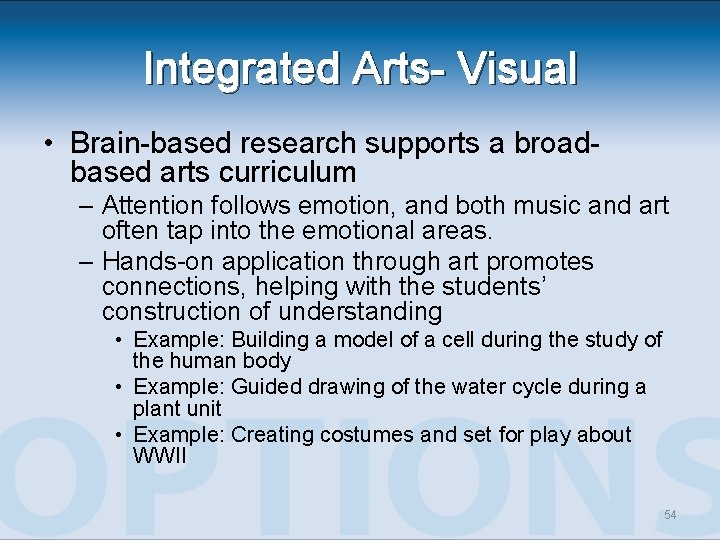
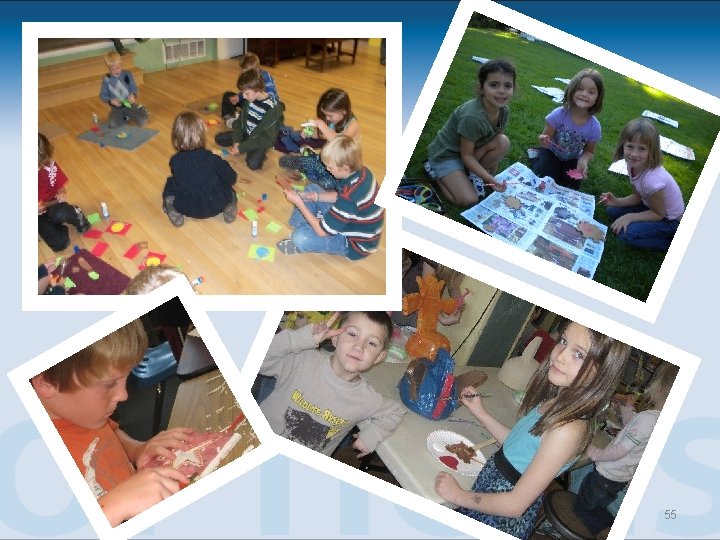
Integrated Arts- Visual • Brain-based research supports a broadbased arts curriculum – Attention follows emotion, and both music and art often tap into the emotional areas. – Hands-on application through art promotes connections, helping with the students’ construction of understanding • Example: Building a model of a cell during the study of the human body • Example: Guided drawing of the water cycle during a plant unit • Example: Creating costumes and set for play about WWII 54
55
56
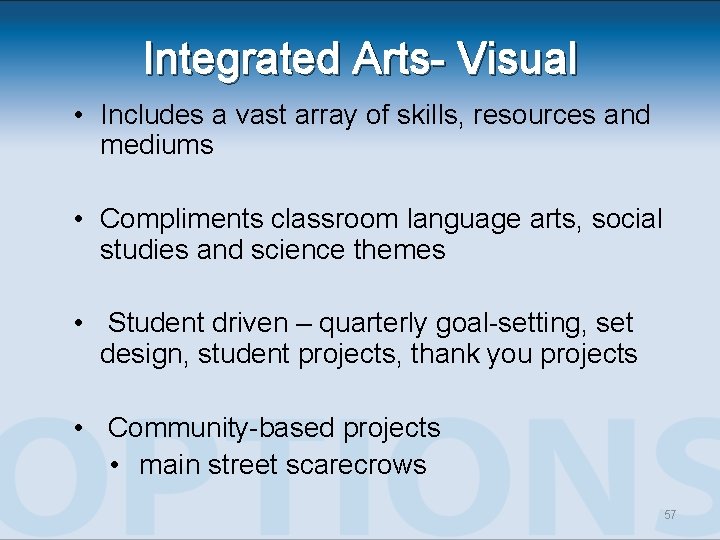
Integrated Arts- Visual • Includes a vast array of skills, resources and mediums • Compliments classroom language arts, social studies and science themes • Student driven – quarterly goal-setting, set design, student projects, thank you projects • Community-based projects • main street scarecrows 57
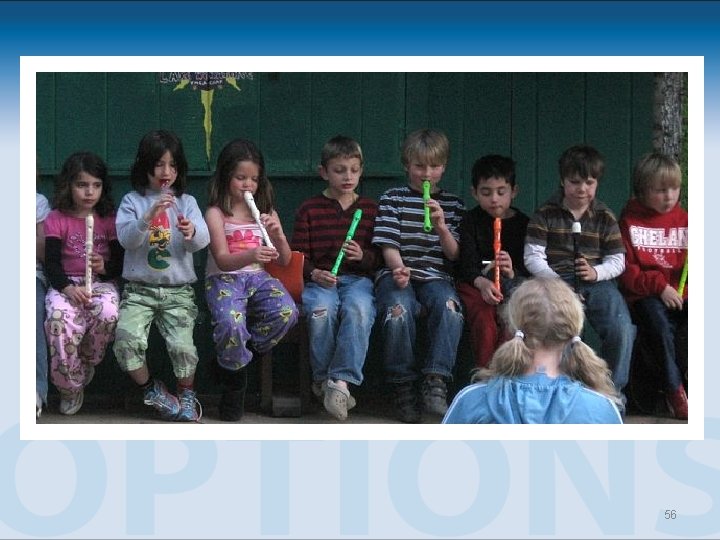
Integrated Arts- Performing Arts • Illustrates multi-age, hands on learning and teaches 21 st century skills: • Collaboration/creative problem solving • Taking personal responsibility • Taking direction/receiving constructive criticism • Stretching beyond one’s comfort zone/ developing self confidence/public speaking • Goal setting/meeting deadlines • Presenting a quality product/intrinsic motivation 58
Integrated Arts- Performing Arts • Thematic integration: • Jack and the Giant: • Made scientific observations and graphed bean plants • Studied photosynthesis and the water cycle • Studied the literary structure of fairy tales • Charlie and the Chocolate Factory • Studied the cacao growing process from bean to chocolate bar • Learned about the Aztecs and Mayans • Studied Roald Dahl as they tried their hand at creating Roald Dahl-like characters in writing pieces. 59
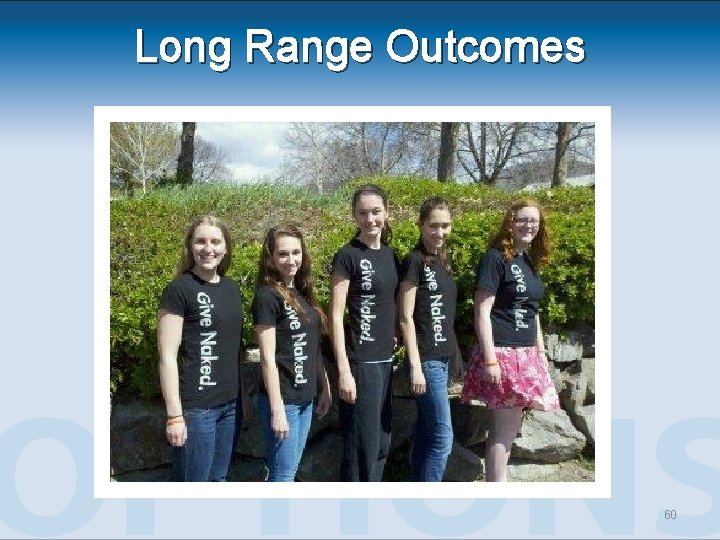
Long Range Outcomes 60
The desired outcome of tonight’s presentation is to answer questions like… • • Would this be a good option for my child? Would it meet my child’s needs? Would this be a good option for my family? Can I see my child in this learning environment? • Can I see myself actively involved in this program? 61
Additional Information Available: • See the CVIS website to review this presentation at www. cvis. org. • Handouts with information on curriculum are available in Spanish and English. • Sign-up sheets, describing your level of interest, are on the tables in back. • Important Dates: – Thursday, June 16: Options Meeting at CVIS at 5: 30 – Monday, June 20: Manson School Board Meeting • Call 687 -9502 to tour Manson Elementary with Mrs. Ireland 62