Management of migraine headaches in adults for primary









- Slides: 42
Management of migraine headaches in adults for primary care physician MEGHANA DORESWAMY MD NEUROLOGY AND SLEEP MEDICINE SEPTEMBER 6, 2015
Objectives � Diagnostic criteria and pathophysiology of migraine . headache. � Epidemiology and impact of migraine headache � Treatment of acute migraine headache. � Preventive therapy for migraine headaches.
What type of headache is this? § § § A 32 -year-old male presents with worsening headache He has had headaches since 23, they have always been under and around eyes He has a history of sinus trouble Headaches are associated with photophobia/osmophobia/occasional loss of appetite Pain is a dull pulsing pain, better with sleeping. Diagnosis? ? ?
Migraine vs. Sinus headache � Studies show that about 85% of people with self described sinus headaches actually have migraine headaches. � Sinus problems, like many other things trigger migraine headaches � Bottom line– the majority of headaches severe enough to cause a person to seek medical attention are Migraines � 45% of migraine patients report sinus symptoms including rhinorrhea, nasal congestion and lacrimation.
Case 2 § § § A 36 yr female presents with worsening headaches. Started 2 years ago, occurred 2 x per month, associated with N/V/photophobia/phonophobia She has constant, background, holocephalic headache associated with continuous photophobia for three months, rated 6/10 Exacerbations- 4 x /week, severe throbbing with worsened photophobia, phonophobia and nausea, last up to 24 hrs Sumatriptan 100 mg has not been effective
Diagnosis? � Cluster headache � Rebound headache � Chronic migraine headache � Chronic tension headache
Tension-type Headache or Migraine Mild Moderate Severe Unilateral Bilateral Photophobia Nausea Aura Vomiting Aggravated by Activity Throbbing Pressure Tension-Type Migraine © 2002 Primary Care Network
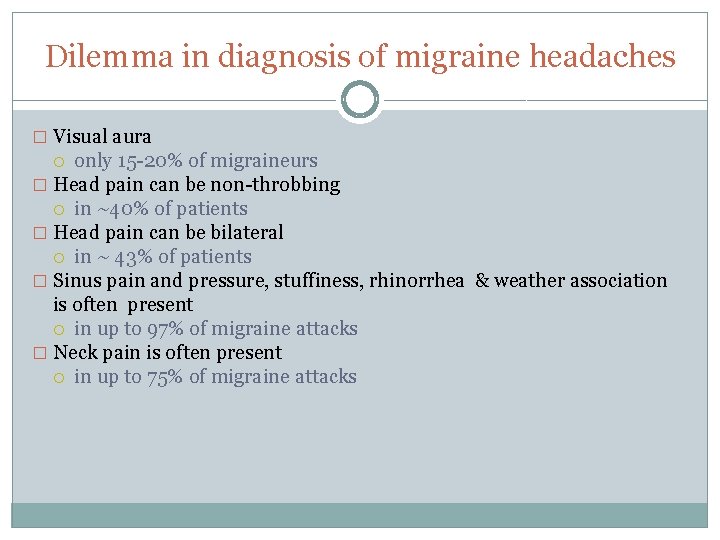
Dilemma in diagnosis of migraine headaches � Visual aura only 15 -20% of migraineurs � Head pain can be non-throbbing in ~40% of patients � Head pain can be bilateral in ~ 43% of patients � Sinus pain and pressure, stuffiness, rhinorrhea & weather association is often present in up to 97% of migraine attacks � Neck pain is often present in up to 75% of migraine attacks
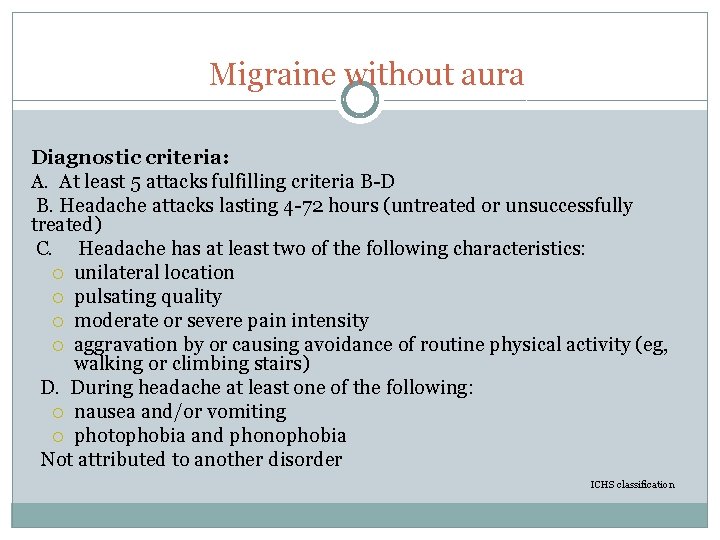
Migraine without aura Diagnostic criteria: A. At least 5 attacks fulfilling criteria B-D B. Headache attacks lasting 4 -72 hours (untreated or unsuccessfully treated) C. Headache has at least two of the following characteristics: unilateral location pulsating quality moderate or severe pain intensity aggravation by or causing avoidance of routine physical activity (eg, walking or climbing stairs) D. During headache at least one of the following: nausea and/or vomiting photophobia and phonophobia Not attributed to another disorder ICHS classification
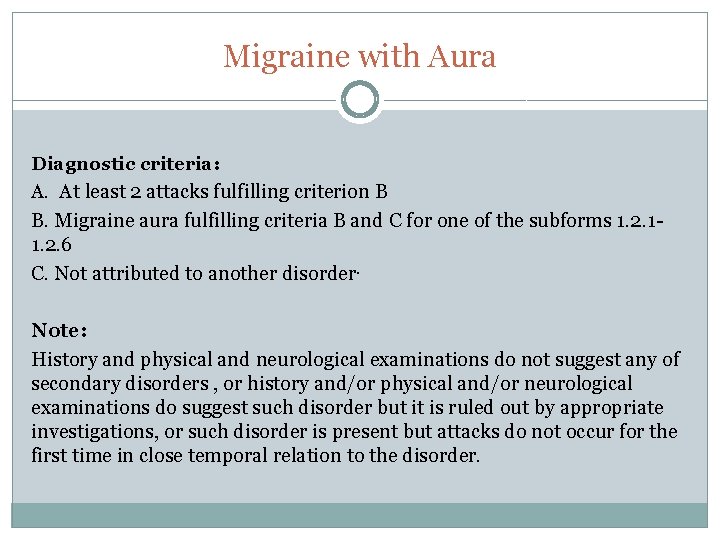
Migraine with Aura Diagnostic criteria: A. At least 2 attacks fulfilling criterion B B. Migraine aura fulfilling criteria B and C for one of the subforms 1. 2. 11. 2. 6 C. Not attributed to another disorder. Note: History and physical and neurological examinations do not suggest any of secondary disorders , or history and/or physical and/or neurological examinations do suggest such disorder but it is ruled out by appropriate investigations, or such disorder is present but attacks do not occur for the first time in close temporal relation to the disorder.
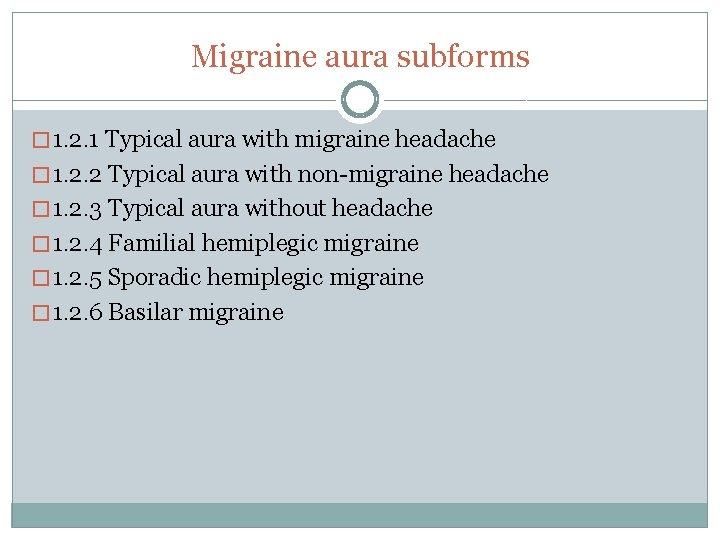
Migraine aura subforms � 1. 2. 1 Typical aura with migraine headache � 1. 2. 2 Typical aura with non-migraine headache � 1. 2. 3 Typical aura without headache � 1. 2. 4 Familial hemiplegic migraine � 1. 2. 5 Sporadic hemiplegic migraine � 1. 2. 6 Basilar migraine
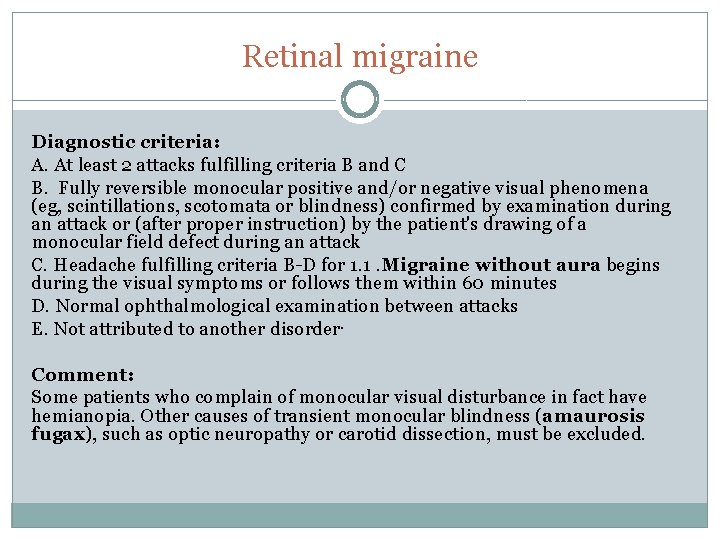
Retinal migraine Diagnostic criteria: A. At least 2 attacks fulfilling criteria B and C B. Fully reversible monocular positive and/or negative visual phenomena (eg, scintillations, scotomata or blindness) confirmed by examination during an attack or (after proper instruction) by the patient's drawing of a monocular field defect during an attack C. Headache fulfilling criteria B-D for 1. 1. Migraine without aura begins during the visual symptoms or follows them within 60 minutes D. Normal ophthalmological examination between attacks E. Not attributed to another disorder. Comment: Some patients who complain of monocular visual disturbance in fact have hemianopia. Other causes of transient monocular blindness (amaurosis fugax), such as optic neuropathy or carotid dissection, must be excluded.
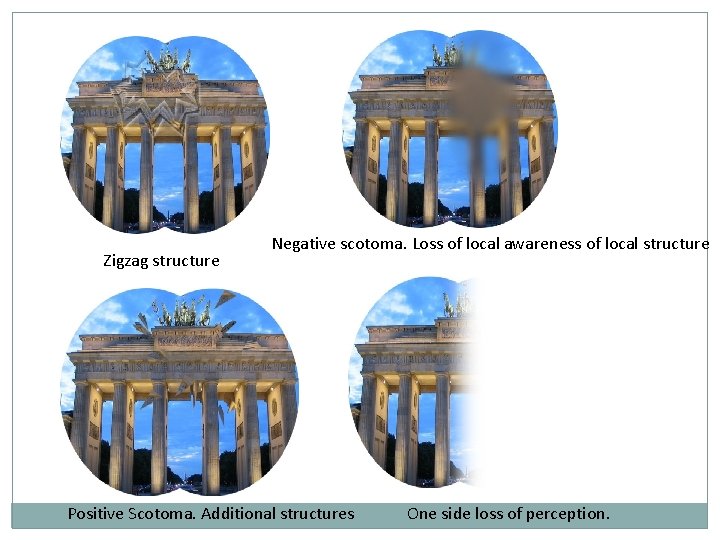
Zigzag structure Negative scotoma. Loss of local awareness of local structure Positive Scotoma. Additional structures One side loss of perception.
Phases of migraine
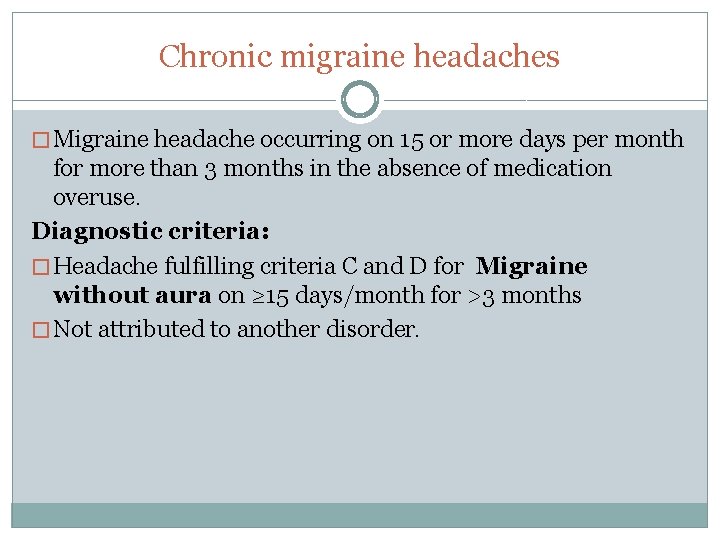
Chronic migraine headaches � Migraine headache occurring on 15 or more days per month for more than 3 months in the absence of medication overuse. Diagnostic criteria: � Headache fulfilling criteria C and D for Migraine without aura on ≥ 15 days/month for >3 months � Not attributed to another disorder.
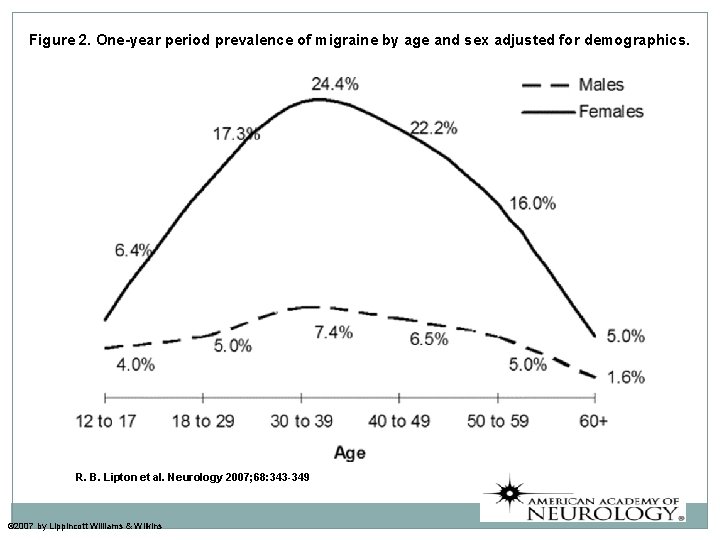
Figure 2. One-year period prevalence of migraine by age and sex adjusted for demographics. R. B. Lipton et al. Neurology 2007; 68: 343 -349 © 2007 by Lippincott Williams & Wilkins
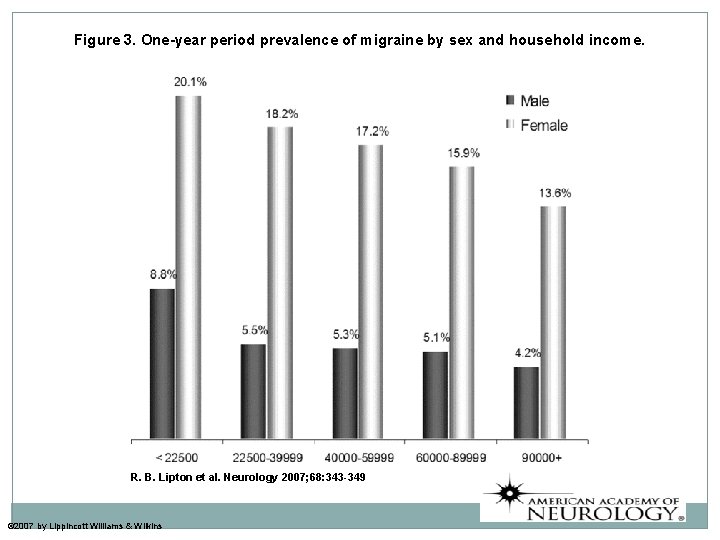
Figure 3. One-year period prevalence of migraine by sex and household income. R. B. Lipton et al. Neurology 2007; 68: 343 -349 © 2007 by Lippincott Williams & Wilkins
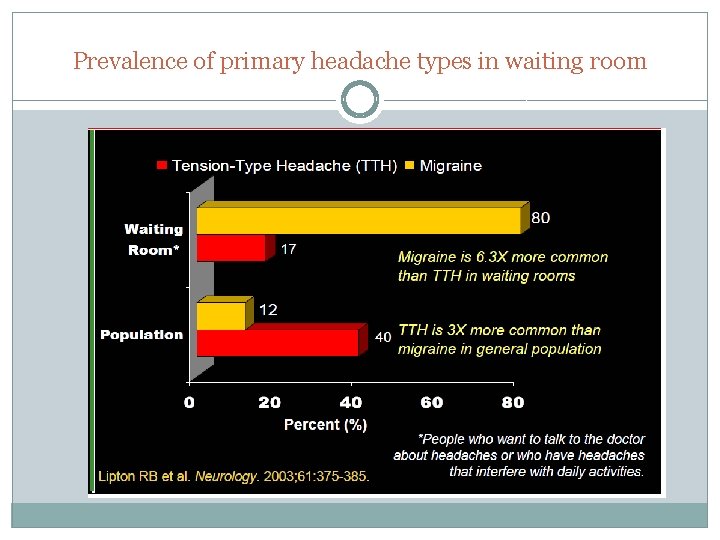
Prevalence of primary headache types in waiting room
Migraine Burden in U. S. � Migraineur in one in four households � 28 million migraineurs in the US � Estimated annual cost of labor lost to migraine greater than $ 13 billion per year � Peak prevalence ages 25 -55 � Often ineffectively treated.
Migraine Pain Intensity and Disability 9% Function Normally >75% Report Severe to Extremely Severe Pain 53% 39% Severe Impairment Some or Bed Rest Impairment Required Patients (%) Lipton RB et al. Headache. 2001; 41: 638 -645.
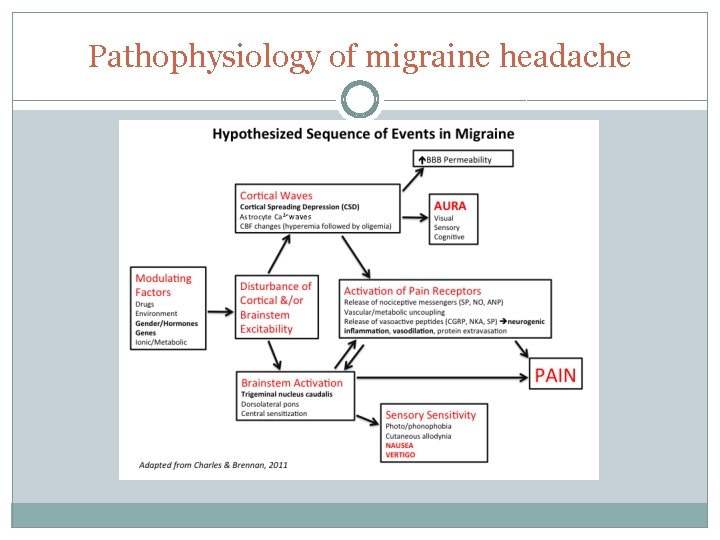
Pathophysiology of migraine headache � Harold G Wolff, a pioneer of the vascular theory of migraine, proposed that the neurological symptoms of the migraine aura were caused by cerebral vasoconstriction, and the headache by vasodilatation. � This had been replaced by cortical spreading depression theory of Leao(neural theory) � Most recent theory- migraine neurovascular phenomenon
Pathophysiology of migraine headache
Pathophysiology of migraine headache
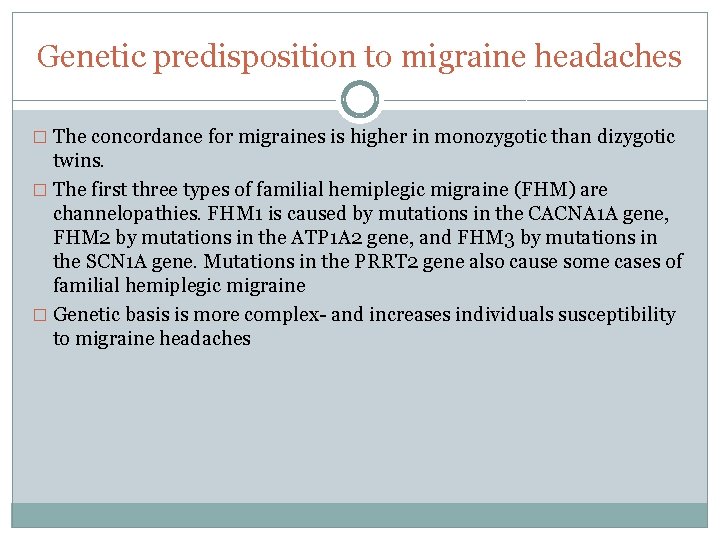
Genetic predisposition to migraine headaches � The concordance for migraines is higher in monozygotic than dizygotic twins. � The first three types of familial hemiplegic migraine (FHM) are channelopathies. FHM 1 is caused by mutations in the CACNA 1 A gene, FHM 2 by mutations in the ATP 1 A 2 gene, and FHM 3 by mutations in the SCN 1 A gene. Mutations in the PRRT 2 gene also cause some cases of familial hemiplegic migraine � Genetic basis is more complex- and increases individuals susceptibility to migraine headaches
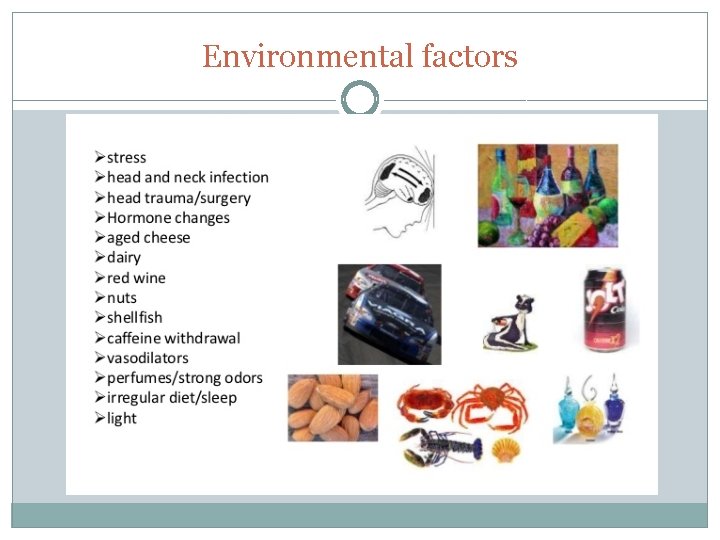
Environmental factors
Principles of migraine management v Life style management- with patient education v Avoid medication rebound headache v Abortive therapy v Preventive therapy.
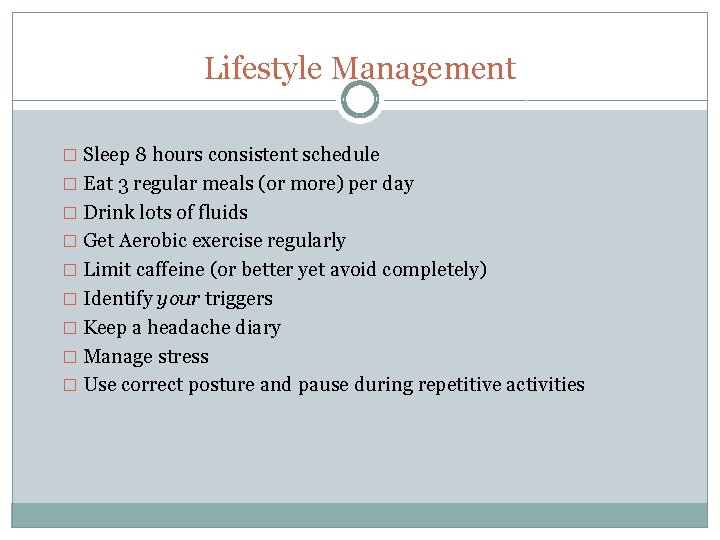
Lifestyle Management � Sleep 8 hours consistent schedule � Eat 3 regular meals (or more) per day � Drink lots of fluids � Get Aerobic exercise regularly � Limit caffeine (or better yet avoid completely) � Identify your triggers � Keep a headache diary � Manage stress � Use correct posture and pause during repetitive activities
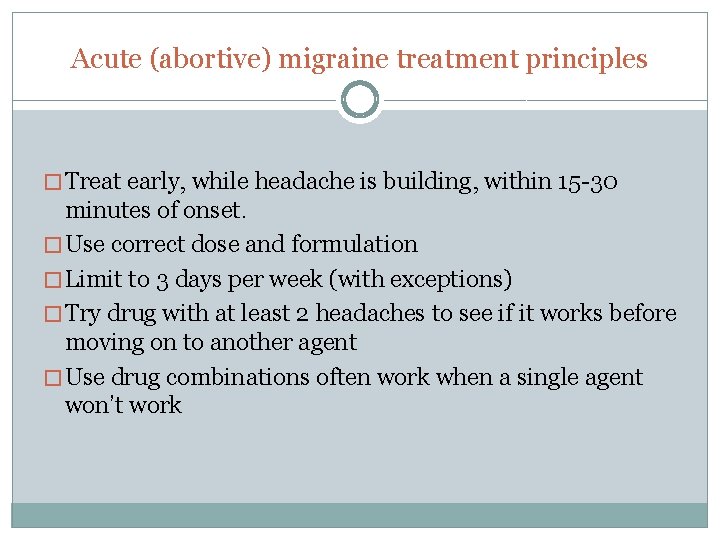
Acute (abortive) migraine treatment principles � Treat early, while headache is building, within 15 -30 minutes of onset. � Use correct dose and formulation � Limit to 3 days per week (with exceptions) � Try drug with at least 2 headaches to see if it works before moving on to another agent � Use drug combinations often work when a single agent won’t work
Acute treatment options n Specific Triptans - Faster onset Sumatriptan, Zolmitriptan, eletriptan, rizatriptan and almotriptan Triptans Slower Onset Naratriptan and Frovatriptan -Ergotamine/DHE; Migranol n Nonspecific NSAIDs simple analgesics combination analgesics Anti-Nausea meds Promethazine, metoclopramide, prochloroperazine. Ondansetron
Triptan therapy As a class triptan in relation to non specific medications � Rapid onset of relief � Have higher efficacy. � Favorable side effect Adverse effects- flushing, chest pain. Contraindicated in patients with coronary artery disease, angina, patients with hemiplegic or basilar migraines, severe uncontrolled hypertension.
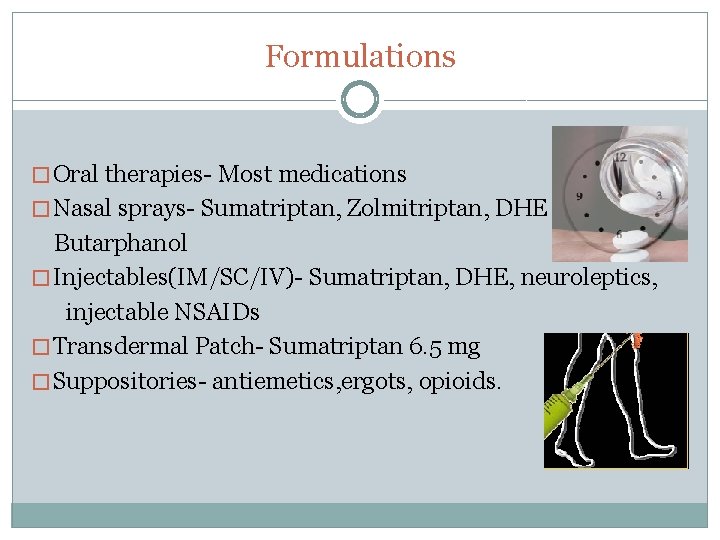
Formulations � Oral therapies- Most medications � Nasal sprays- Sumatriptan, Zolmitriptan, DHE Butarphanol � Injectables(IM/SC/IV)- Sumatriptan, DHE, neuroleptics, injectable NSAIDs � Transdermal Patch- Sumatriptan 6. 5 mg � Suppositories- antiemetics, ergots, opioids.
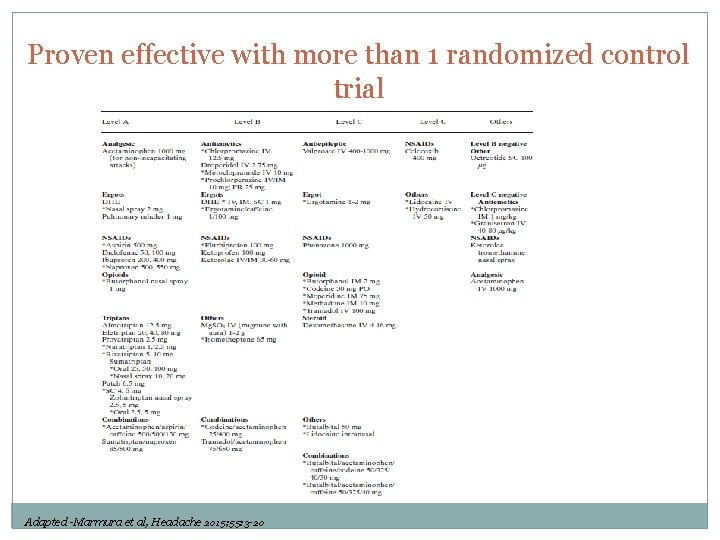
Proven effective with more than 1 randomized control trial Adapted -Marmura et al, Headache 2015; 55: 3 -20
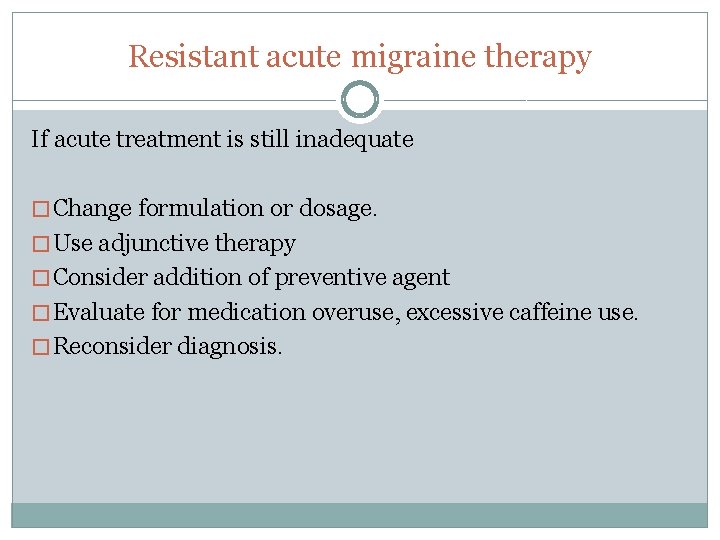
Resistant acute migraine therapy If acute treatment is still inadequate � Change formulation or dosage. � Use adjunctive therapy � Consider addition of preventive agent � Evaluate for medication overuse, excessive caffeine use. � Reconsider diagnosis.
Mechanism of action of migraine medications
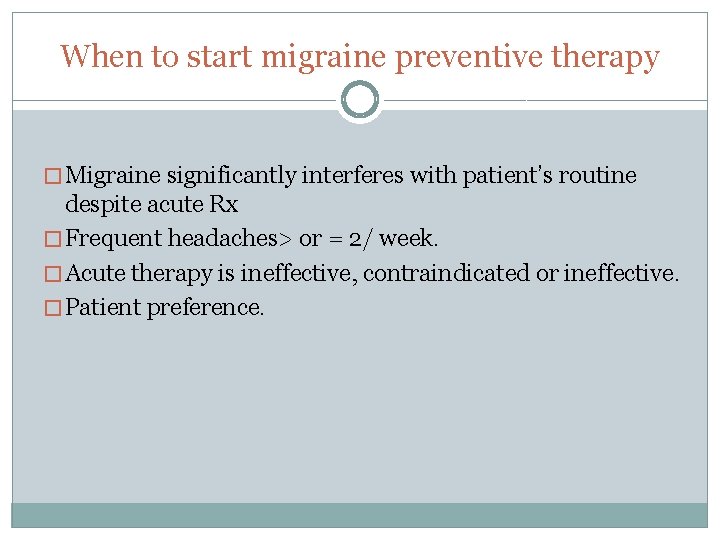
When to start migraine preventive therapy � Migraine significantly interferes with patient’s routine despite acute Rx � Frequent headaches> or = 2/ week. � Acute therapy is ineffective, contraindicated or ineffective. � Patient preference.
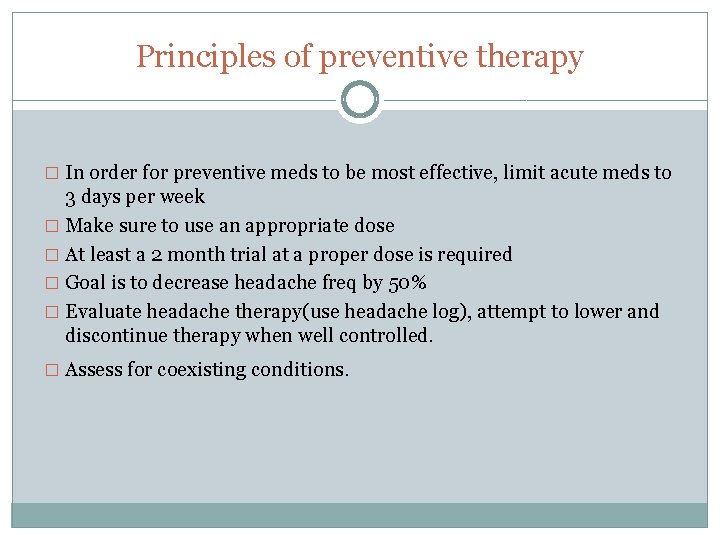
Principles of preventive therapy � In order for preventive meds to be most effective, limit acute meds to 3 days per week � Make sure to use an appropriate dose � At least a 2 month trial at a proper dose is required � Goal is to decrease headache freq by 50% � Evaluate headache therapy(use headache log), attempt to lower and discontinue therapy when well controlled. � Assess for coexisting conditions.
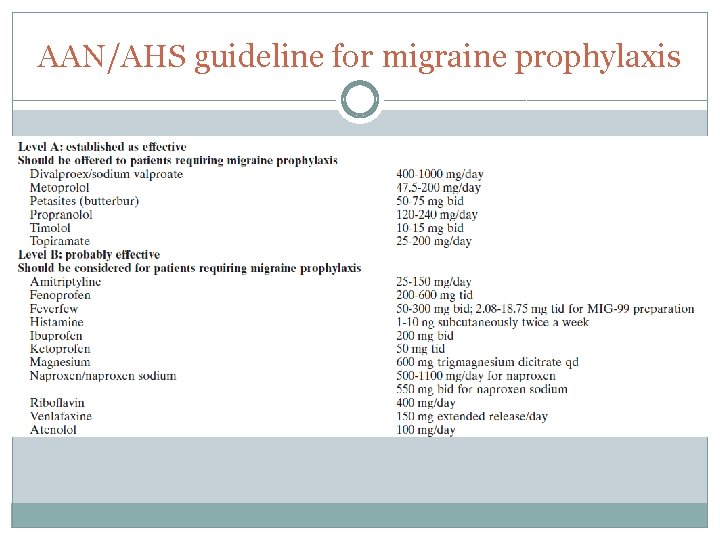
AAN/AHS guideline for migraine prophylaxis
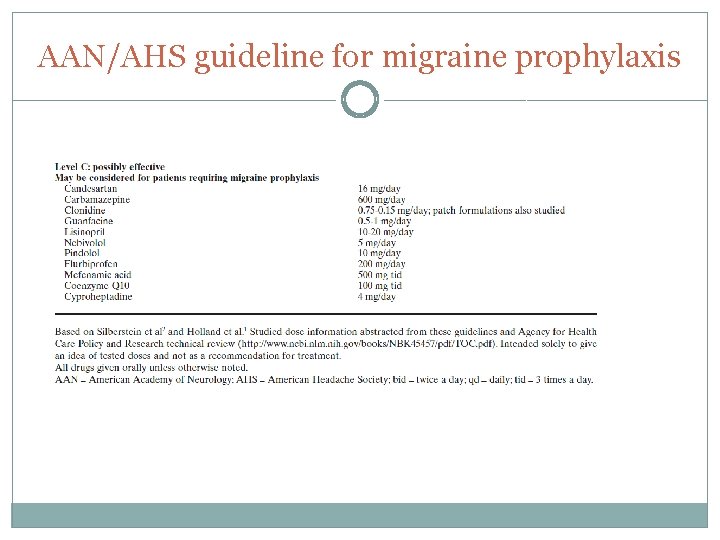
AAN/AHS guideline for migraine prophylaxis
Nonpharmacologic Treatments � Biofeedback � Relaxation therapy � Cognitive Behavioral Therapy � Acupressure � Acupuncture � Physical Therapy � Chiropractic treatment
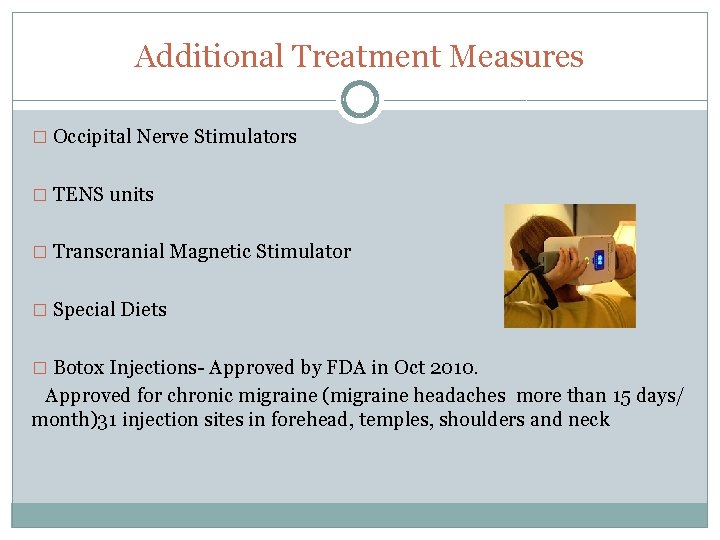
Additional Treatment Measures � Occipital Nerve Stimulators � TENS units � Transcranial Magnetic Stimulator � Special Diets � Botox Injections- Approved by FDA in Oct 2010. Approved for chronic migraine (migraine headaches more than 15 days/ month)31 injection sites in forehead, temples, shoulders and neck
Emerging therapy in migraine management � Monoclonal antibodies (m. Abs) targeting calcitonin gene-related peptide (CGRP) and its receptor. � 5 -HT 1 F receptor agonist lasmiditan and glial cell modulator ibudilast. � Neuro-modulation for migraine headache- sphenopalatine ganglion stimulation, trigeminal nerve stimulation and transcutaneous vagus nerve stimulation.
Questions?