
Hey Doc I Cant See Ophthalmology 101 for



- Slides: 60
Hey Doc, I Can’t See! Ophthalmology 101 for Primary Care Physicians Jennifer Somers Weizer, MD June 13, 2016
n No financial interests
Agenda How the eye works n Common eye problems n – Red eye – Cataract – Age-related macular degeneration – Glaucoma – Retinal blood vessel blockages – Migraines n When to refer
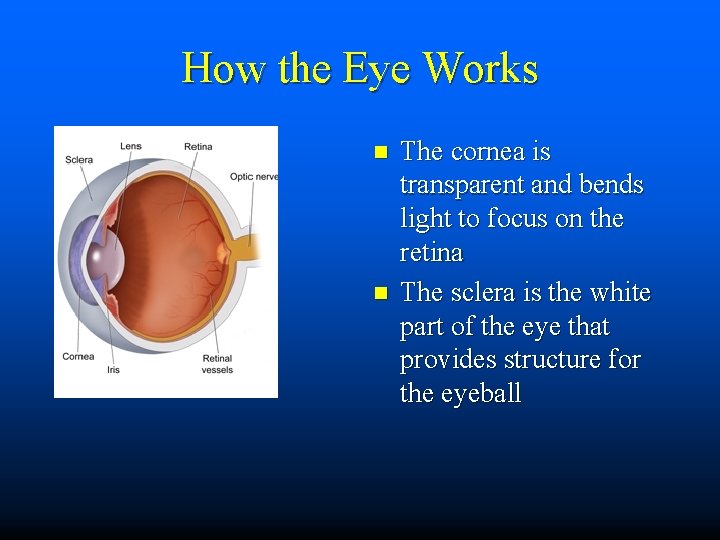
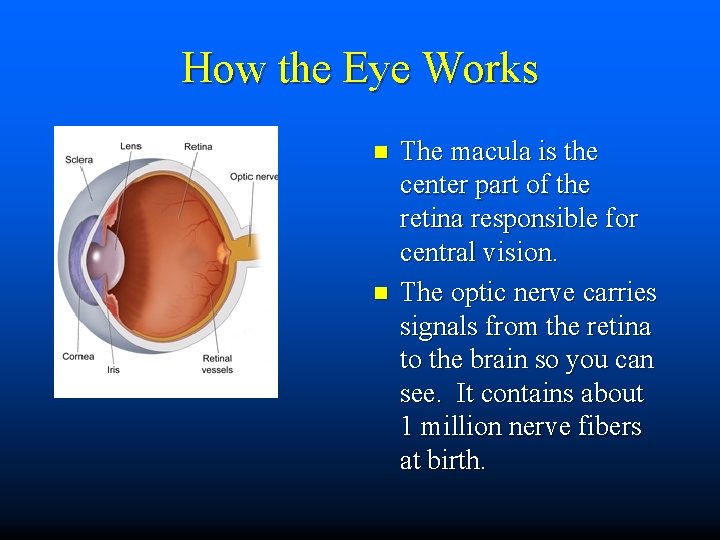
How the Eye Works n n The cornea is transparent and bends light to focus on the retina The sclera is the white part of the eye that provides structure for the eyeball
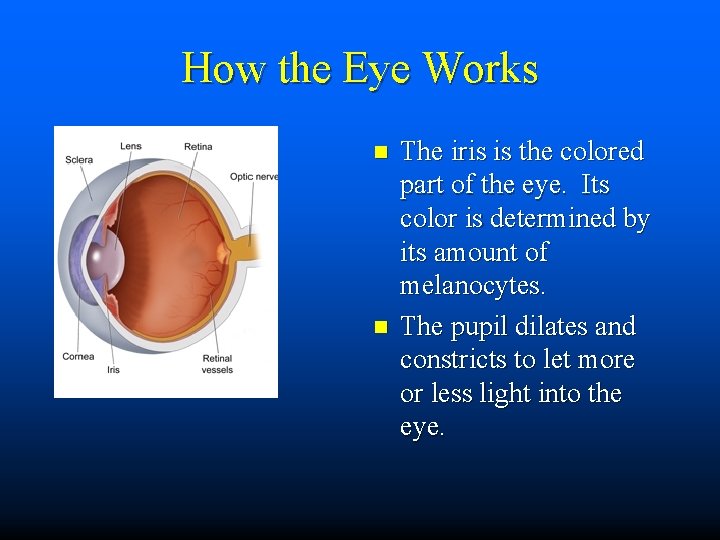
How the Eye Works n n The iris is the colored part of the eye. Its color is determined by its amount of melanocytes. The pupil dilates and constricts to let more or less light into the eye.
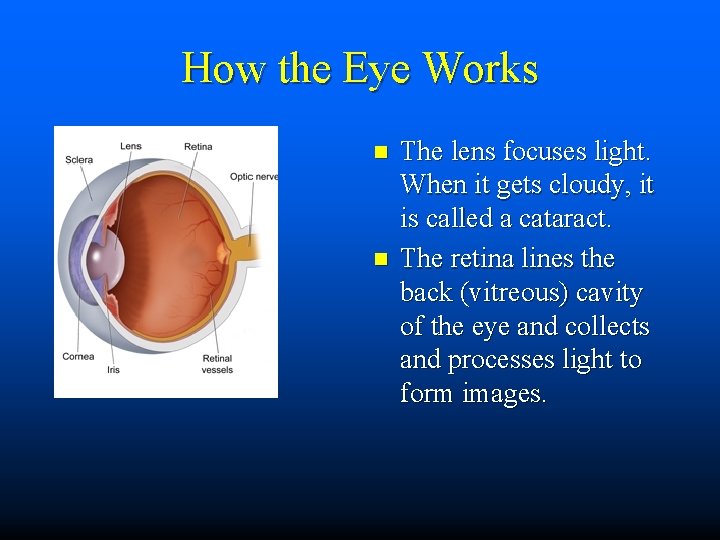
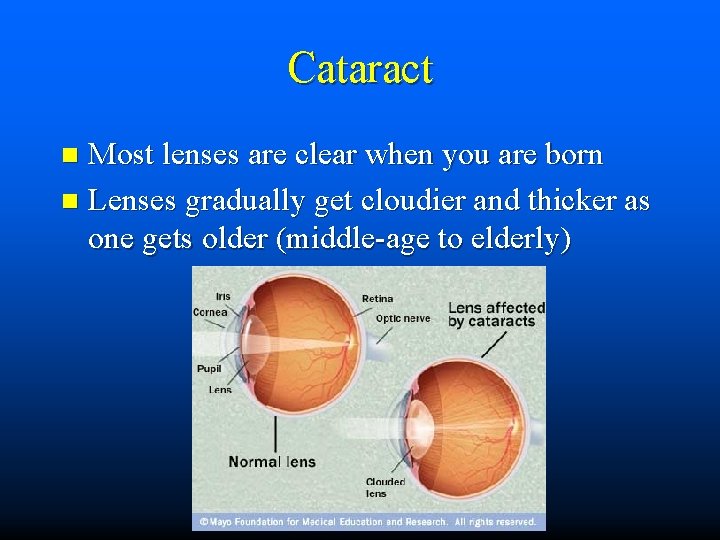
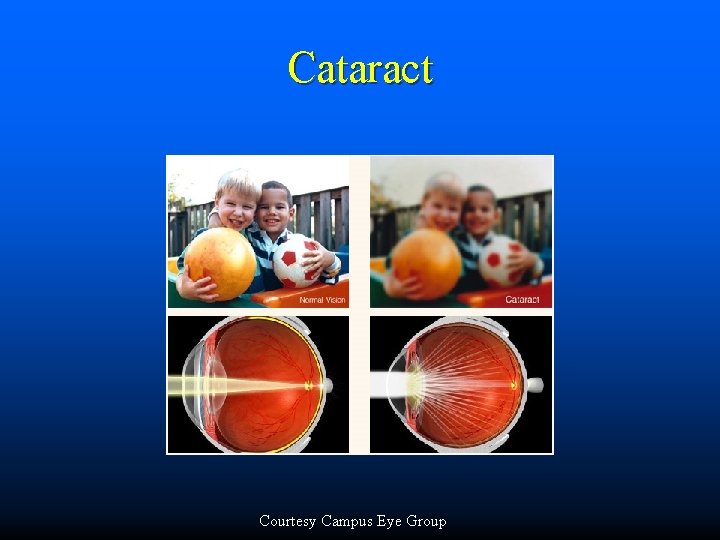
How the Eye Works n n The lens focuses light. When it gets cloudy, it is called a cataract. The retina lines the back (vitreous) cavity of the eye and collects and processes light to form images.
How the Eye Works n n The macula is the center part of the retina responsible for central vision. The optic nerve carries signals from the retina to the brain so you can see. It contains about 1 million nerve fibers at birth.
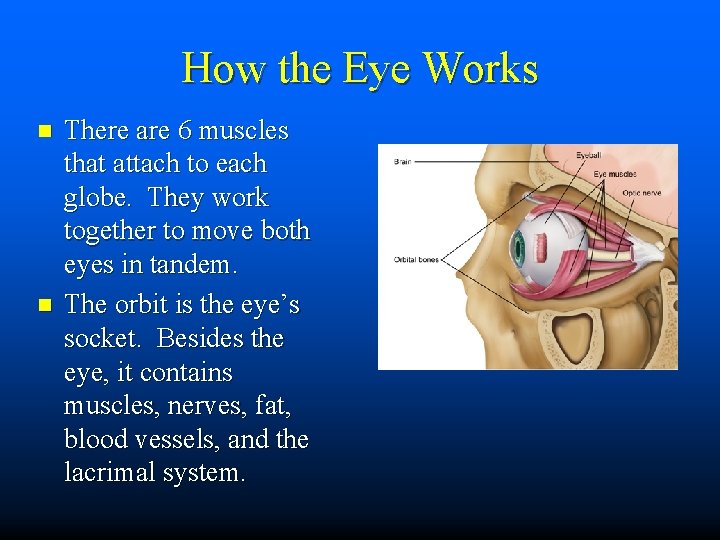
How the Eye Works n n There are 6 muscles that attach to each globe. They work together to move both eyes in tandem. The orbit is the eye’s socket. Besides the eye, it contains muscles, nerves, fat, blood vessels, and the lacrimal system.
The Visual Pathway
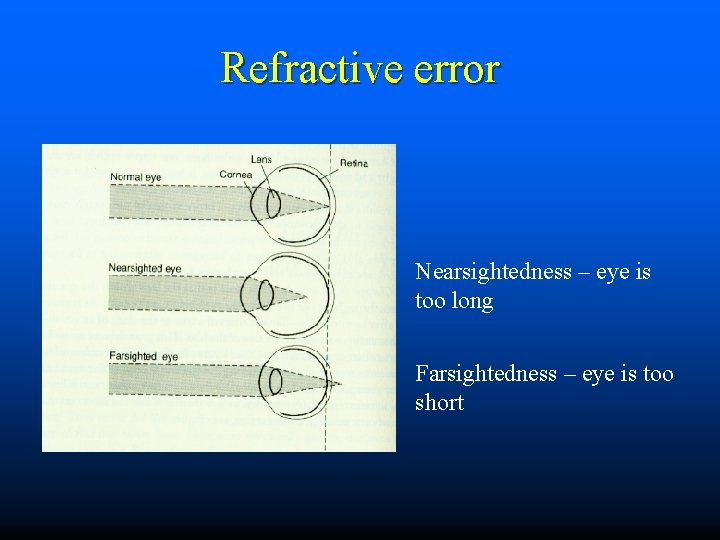
Refractive error Nearsightedness – eye is too long Farsightedness – eye is too short
Factoid: Optical Illusion n Many people wonder if eye exercises can reduce their need for glasses or contact lenses. – In the vast majority of cases, the answer is no. – It is better to wear glasses or contact lenses if they help you achieve your optimum vision.
Red Eye n Conjunctivitis – Viral – Bacterial – Allergic – Toxic Subconjunctival hemorrhage n Episcleritis/scleritis n
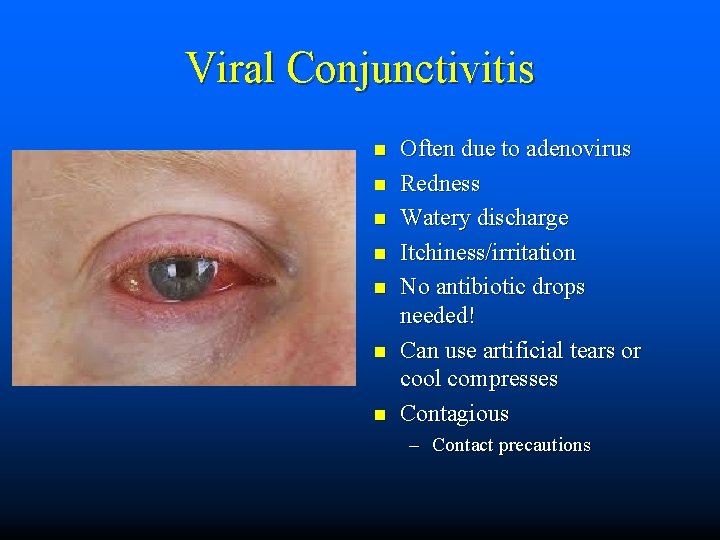
Viral Conjunctivitis n n n n Often due to adenovirus Redness Watery discharge Itchiness/irritation No antibiotic drops needed! Can use artificial tears or cool compresses Contagious – Contact precautions
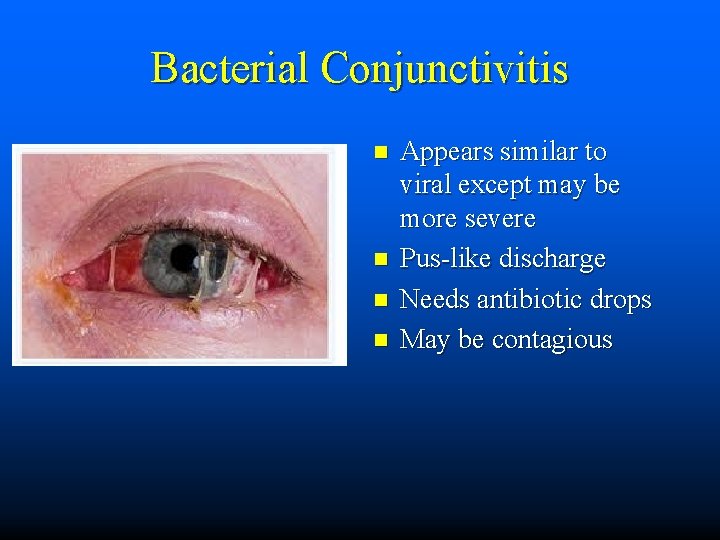
Bacterial Conjunctivitis n n Appears similar to viral except may be more severe Pus-like discharge Needs antibiotic drops May be contagious
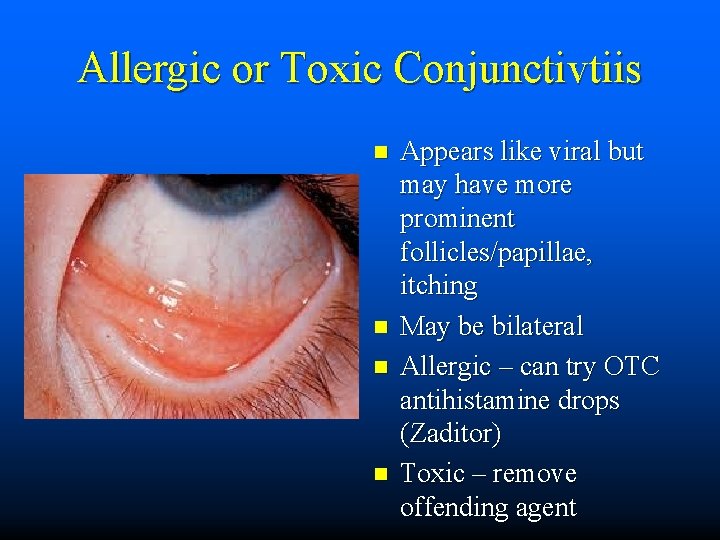
Allergic or Toxic Conjunctivtiis n n Appears like viral but may have more prominent follicles/papillae, itching May be bilateral Allergic – can try OTC antihistamine drops (Zaditor) Toxic – remove offending agent
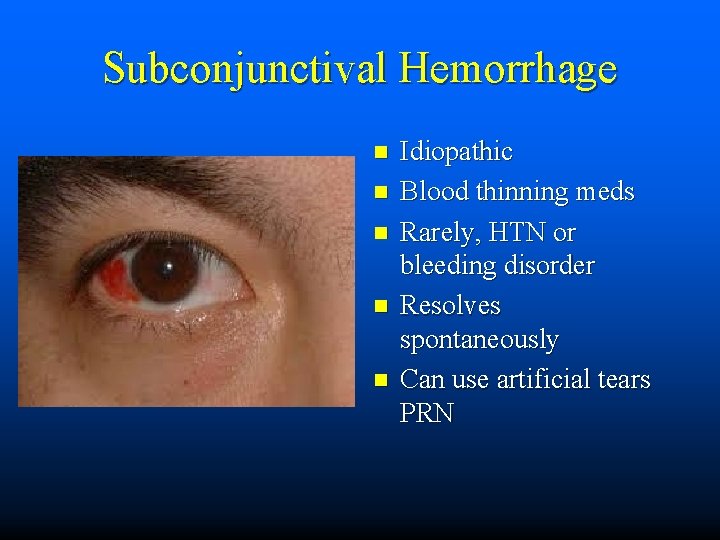
Subconjunctival Hemorrhage n n n Idiopathic Blood thinning meds Rarely, HTN or bleeding disorder Resolves spontaneously Can use artificial tears PRN
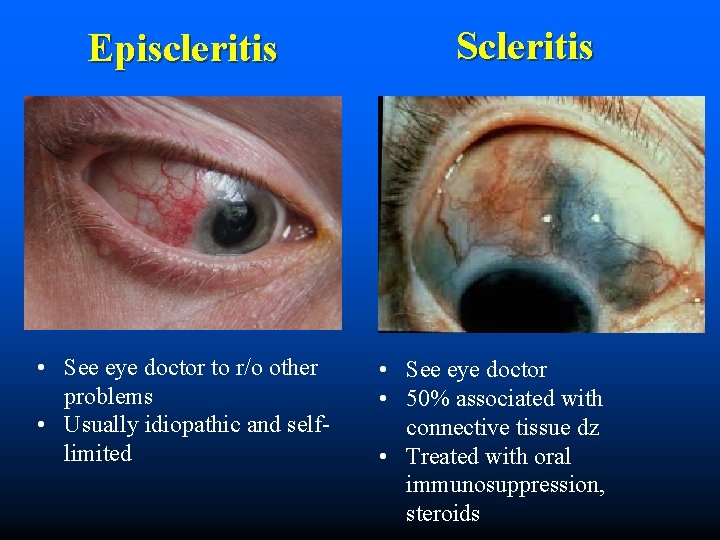
Episcleritis • See eye doctor to r/o other problems • Usually idiopathic and selflimited Scleritis • See eye doctor • 50% associated with connective tissue dz • Treated with oral immunosuppression, steroids
Factoid: True or False? n You can harm your eyes by reading or watching TV too much. – False – spending time reading or watching TV will not help or hurt your eyes.
Cataract Most lenses are clear when you are born n Lenses gradually get cloudier and thicker as one gets older (middle-age to elderly) n
Cataract Courtesy Campus Eye Group
Factoid: True or False? n Cataracts cause a small percentage of the world’s blindness. – False – cataracts cause 48% of the world’s blindness, according to the World Health Organization.
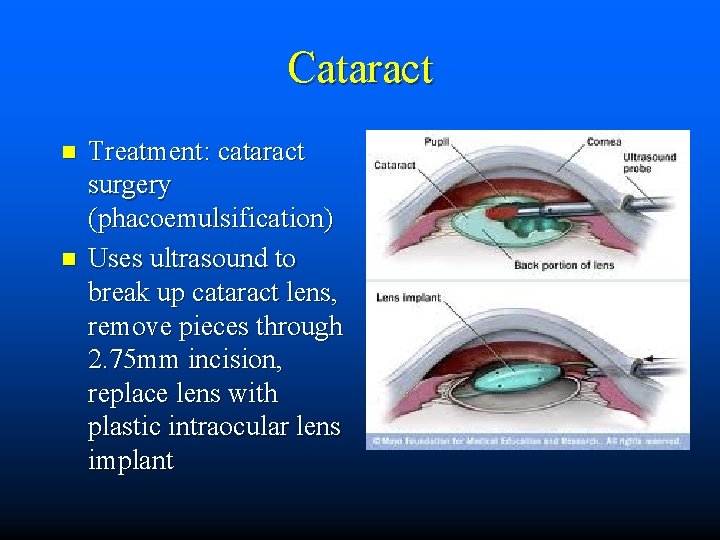
Cataract n n Treatment: cataract surgery (phacoemulsification) Uses ultrasound to break up cataract lens, remove pieces through 2. 75 mm incision, replace lens with plastic intraocular lens implant
Cataract surgery Most people see better afterwards n Risks of major problems 1% or less n Outpatient surgery n Monitored anesthesia care, not general anesthesia n Takes about 1 month to heal fully n
Factoid: What is an Eye Doctor? n Ophthalmologist (MD) – physician (college, medical school, residency) – Treats patients medically and surgically n Optometrist (OD) – college, optometry school – Does not perform surgery n Optician – fits patients for glasses
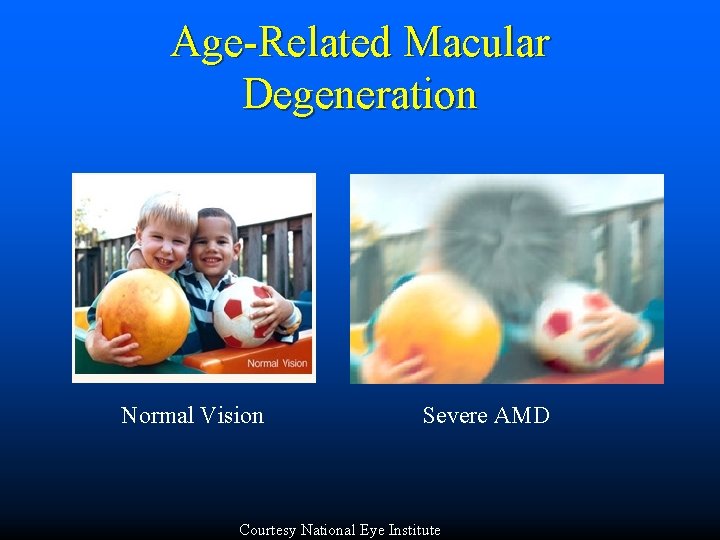
Age-Related Macular Degeneration n Definition – A spectrum of disease in which aging material deposits under the central retina, or macula – Can cause problems with central vision – Affects 30% of people aged 75 -85 in the US
Age-Related Macular Degeneration Normal Vision Severe AMD Courtesy National Eye Institute
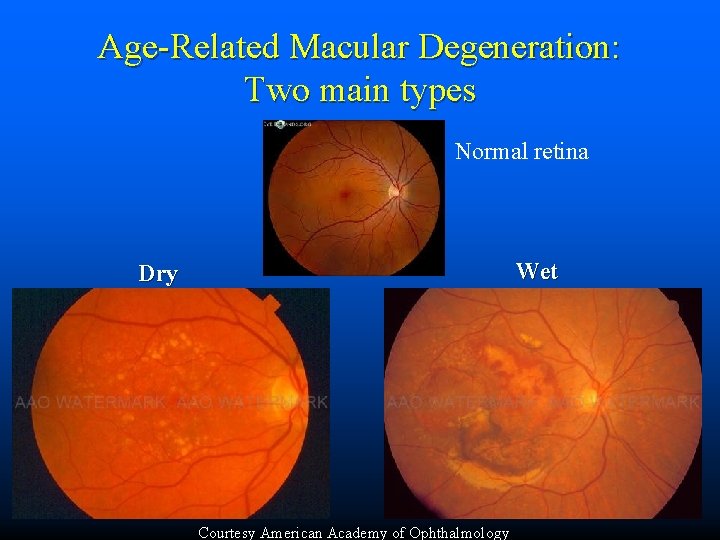
Age-Related Macular Degeneration: Two main types Normal retina Wet Dry Courtesy American Academy of Ophthalmology
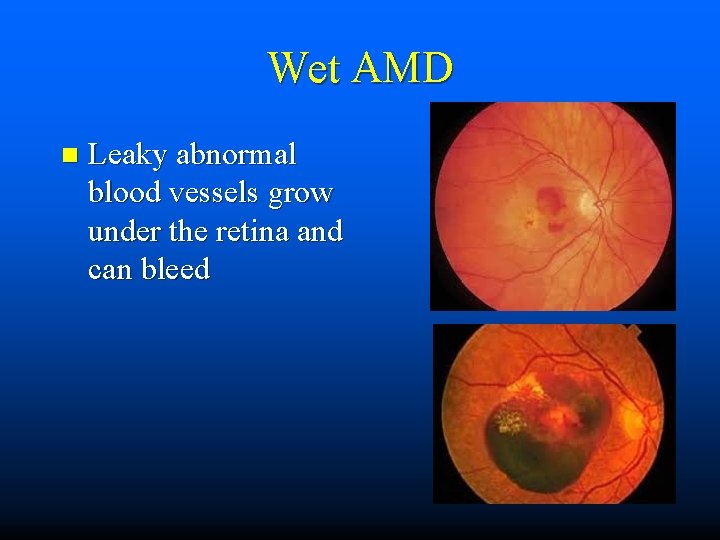
Wet AMD n Leaky abnormal blood vessels grow under the retina and can bleed
True or False? n Age-related macular degeneration cause total blindness. – False – While this disease can be scary, it only affects the center retina and not the total retina. – Most people with macular degeneration maintain vision that allows them to get around on their own.
Age-related Macular Degeneration n Risk factors – Caucasian race – Family history – High blood pressure and/or heart disease – Smoking – Ultraviolet light exposure – Fatty diet
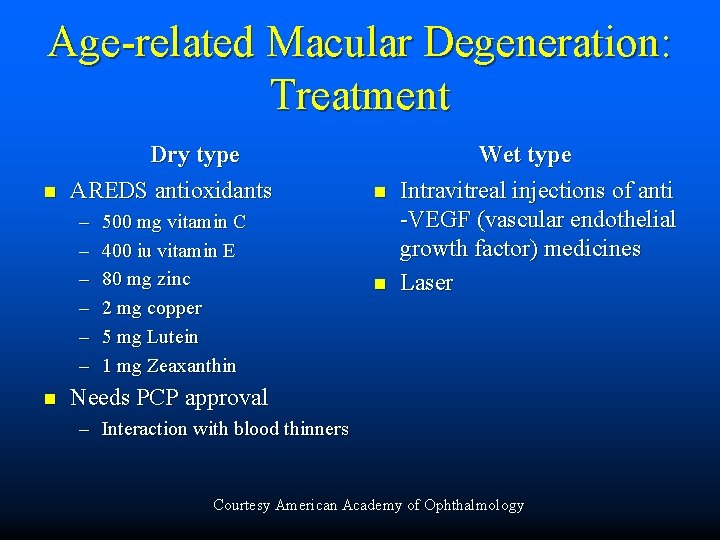
Age-related Macular Degeneration: Treatment n Dry type AREDS antioxidants – – – n 500 mg vitamin C 400 iu vitamin E 80 mg zinc 2 mg copper 5 mg Lutein 1 mg Zeaxanthin n n Wet type Intravitreal injections of anti -VEGF (vascular endothelial growth factor) medicines Laser Needs PCP approval – Interaction with blood thinners Courtesy American Academy of Ophthalmology
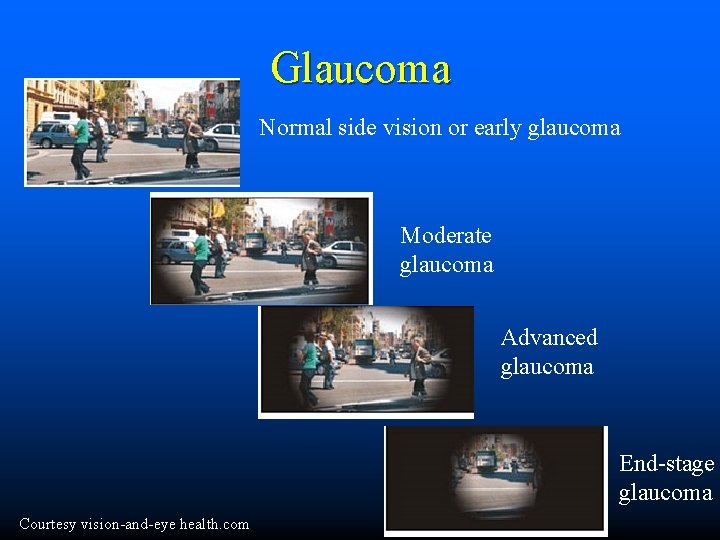
Glaucoma n Definition – A disease of the optic nerve that is often linked to high eye pressure that causes primarily side vision loss n Can cause blindness if left untreated
Glaucoma Affects about 2% of adults >40 years old in US n Higher rates in African Americans and Hispanics n Risk of developing glaucoma increases with age and having a family history n
True or False? n Having a close relative with glaucoma increases your risk of the disease by 4 -9 times – True
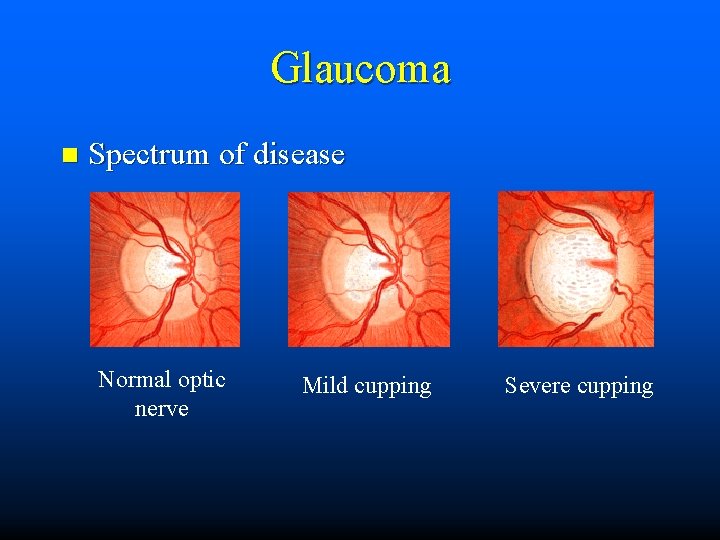
Glaucoma n Spectrum of disease Normal optic nerve Mild cupping Severe cupping
Glaucoma Normal side vision or early glaucoma Moderate glaucoma Advanced glaucoma End-stage glaucoma Courtesy vision-and-eye health. com
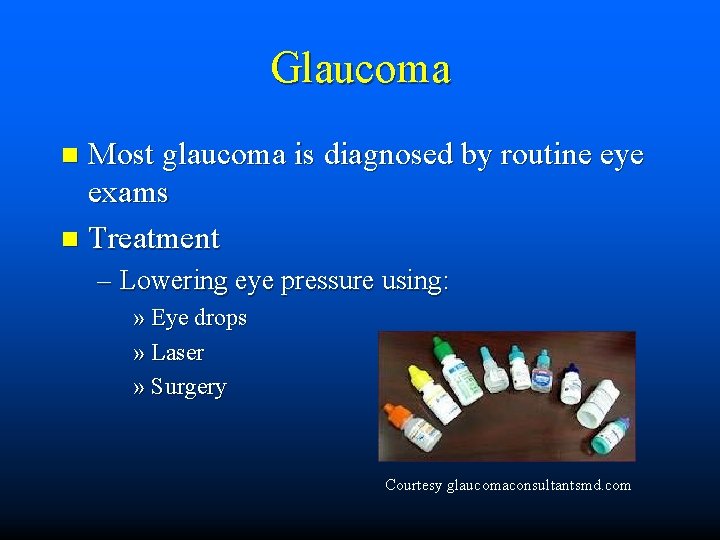
Glaucoma Most glaucoma is diagnosed by routine eye exams n Treatment n – Lowering eye pressure using: » Eye drops » Laser » Surgery Courtesy glaucomaconsultantsmd. com
Retinal artery and vein blockages Central or branch retinal artery occlusion n Central or branch retinal vein occlusion n – Retinal blood vessels become blocked from atherosclerosis and/or thrombosis » Like a “stroke” to the retina
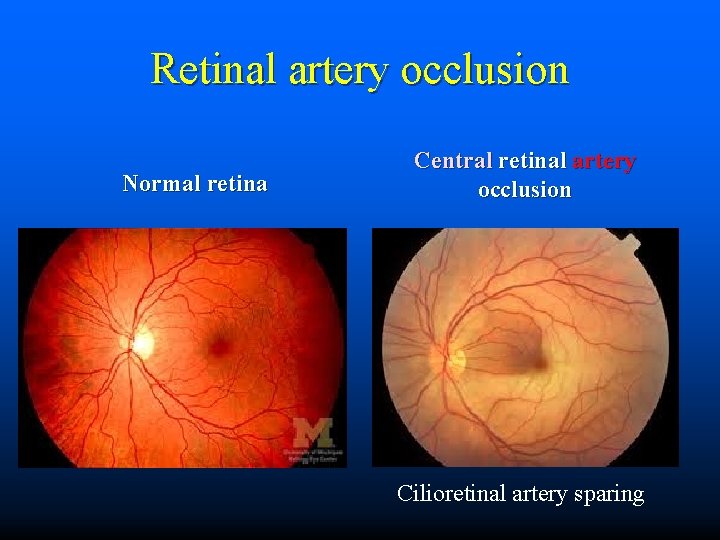
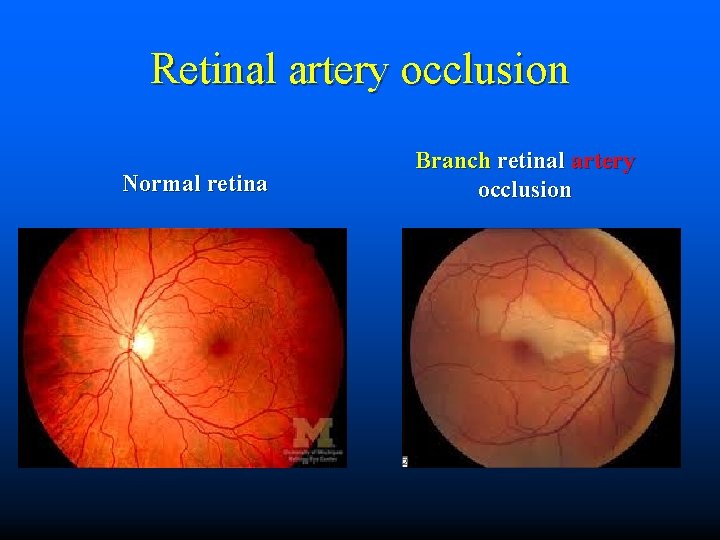
Retinal artery occlusions Fatty debris lodges in a retinal artery n Central retinal artery occlusion: the main arterial branch to the retina is blocked n – Poor visual outcome n Branch retina artery occlusion: a smaller branch of the main artery that feeds part of the retina is blocked – Outcome depends which part of the retina is affected
Retinal artery occlusion Normal retina Central retinal artery occlusion Cilioretinal artery sparing
Retinal artery occlusion Normal retina Branch retinal artery occlusion
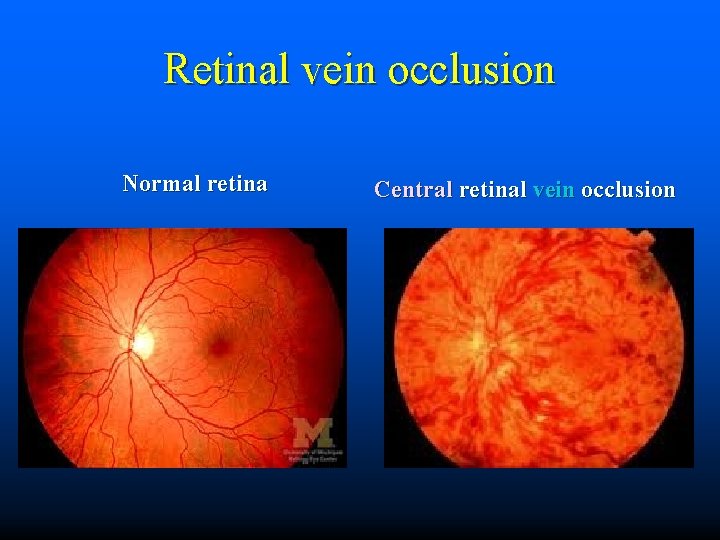
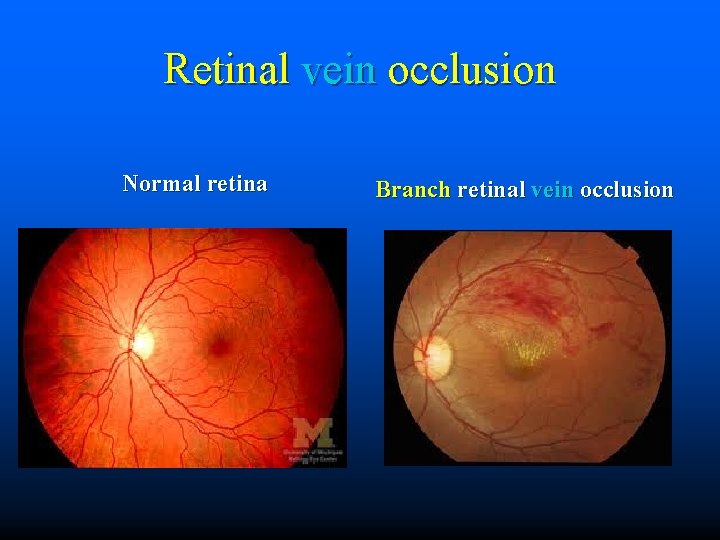
Retinal vein occlusions A clot lodges in a retinal vein n Central retinal vein occlusion: the main venous branch from the retina is blocked n – Visual outcome is variable n Branch retina vein occlusion: a smaller branch of the main vein that drains part of the retina is blocked – Outcome depends which part of the retina is affected, and to what degree
Retinal vein occlusion Normal retina Central retinal vein occlusion
Retinal vein occlusion Normal retina Branch retinal vein occlusion
Risk factors for retinal blood vessel blockages Age >50 n Risk factors for and history of heart disease, stroke n – Diabetes, high blood pressure, hyperlipidemia
Symptoms of retinal blood vessel blockages Sudden, painless vision loss in one eye n If that happens, see an ophthalmologist right away n
Diagnosing retinal blood vessel blockages Your ophthalmologist will examine your eyes and will probably dilate them n Some photographic testing may be performed n You may be referred to your PCP to look for and manage vascular risk factors n
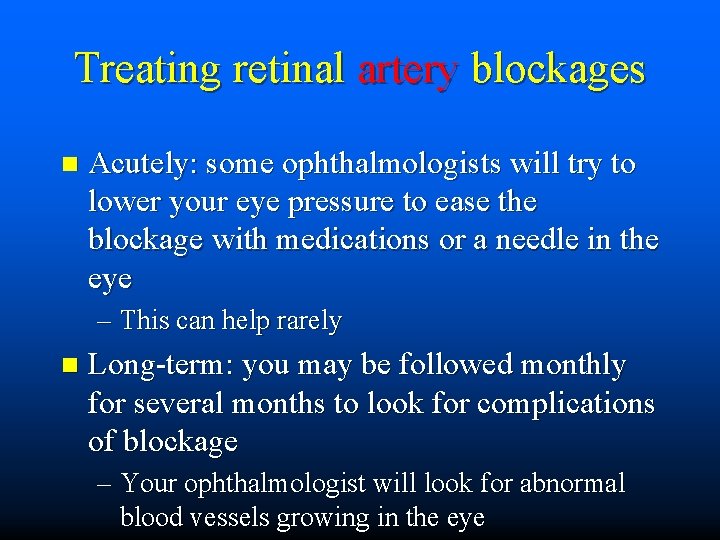
Treating retinal artery blockages n Acutely: some ophthalmologists will try to lower your eye pressure to ease the blockage with medications or a needle in the eye – This can help rarely n Long-term: you may be followed monthly for several months to look for complications of blockage – Your ophthalmologist will look for abnormal blood vessels growing in the eye
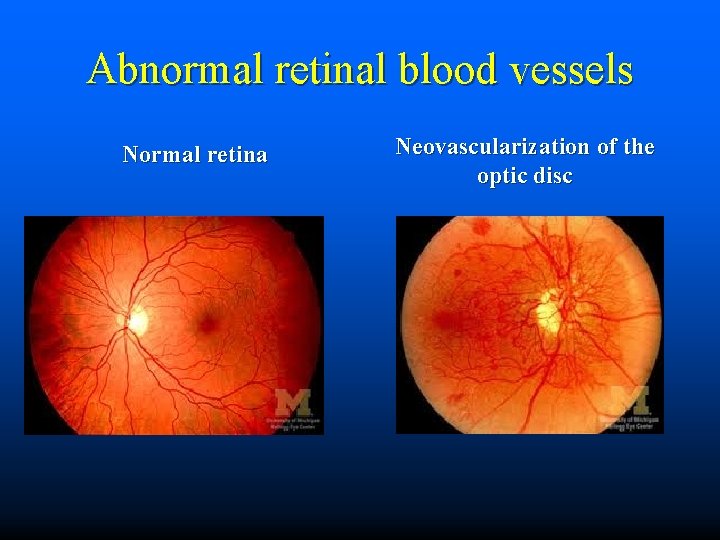
Treating retinal blood vessel blockages Abnormal blood vessels can grow as a result of retinal artery or vein blockages (neovascularization) n These abnormal vessels can leak, bleed, or cause glaucoma by growing and clogging the eyeball’s natural drainage angle n
Abnormal retinal blood vessels Normal retina Neovascularization of the optic disc
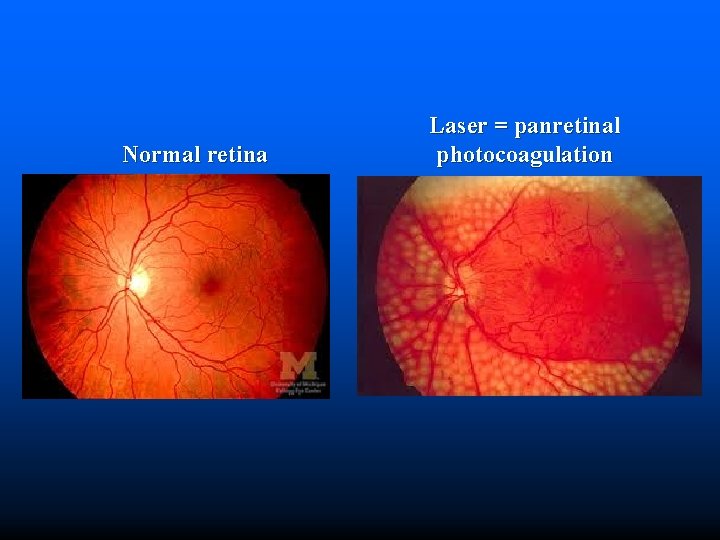
Treating retinal blood vessel blockages n To make neovascularization regress: – Laser – Injecting steroid medication into the eye – Injecting anti-Vascular Endothelial Growth Factor drugs (often used to treat wet macular degeneration) into the eye
Normal retina Laser = panretinal photocoagulation
Factoid: True or False? n Each of us has a dominant eye and a nondominant eye, like being right- or lefthanded. – True
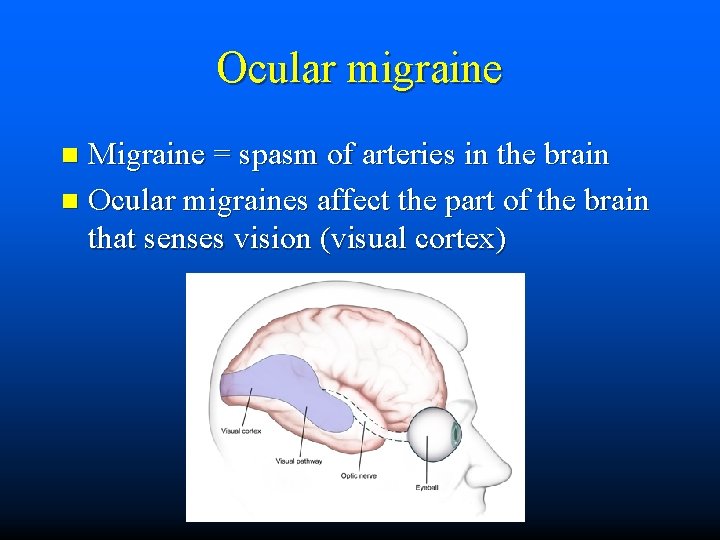
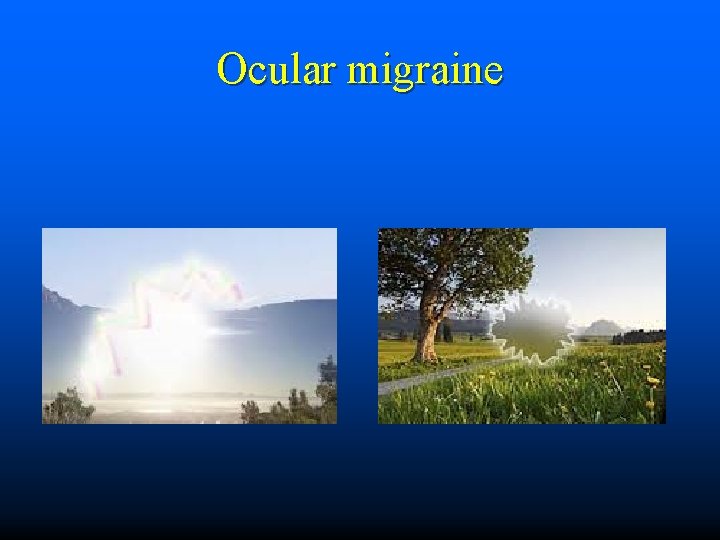
Ocular migraine Migraine = spasm of arteries in the brain n Ocular migraines affect the part of the brain that senses vision (visual cortex) n
Migraine 34% women aged 15 -20 have had at least 1 migraine n Classic headache symptoms n – Throbbing pain – One-sided – Light and sound sensitivity – Nausea +/- vomiting – Lasts minutes to hours – Aura in some cases » Visual, smell, sound
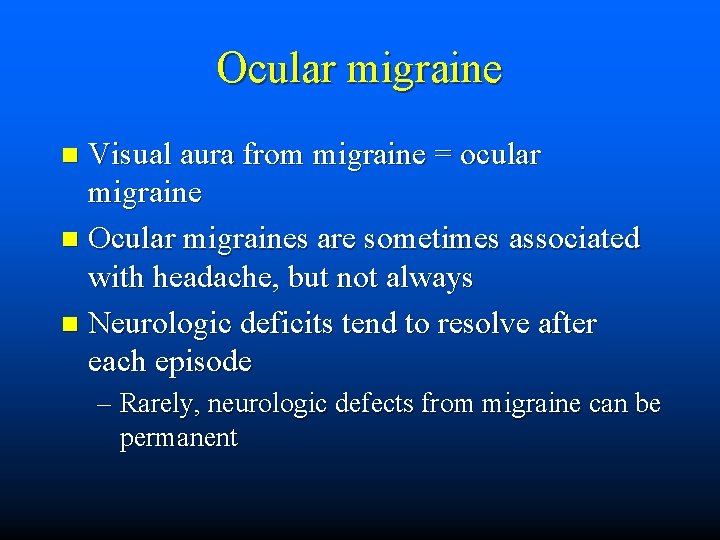
Ocular migraine Visual aura from migraine = ocular migraine n Ocular migraines are sometimes associated with headache, but not always n Neurologic deficits tend to resolve after each episode n – Rarely, neurologic defects from migraine can be permanent
Ocular migraine
Migraine treatment n Over-the-counter and prescription medications are available to treat migraine – Abort current attack – Prevent future attacks See neurologist or PCP n Get enough sleep n Avoid stress and tension n Avoid triggers n – Keep diary to identify triggers
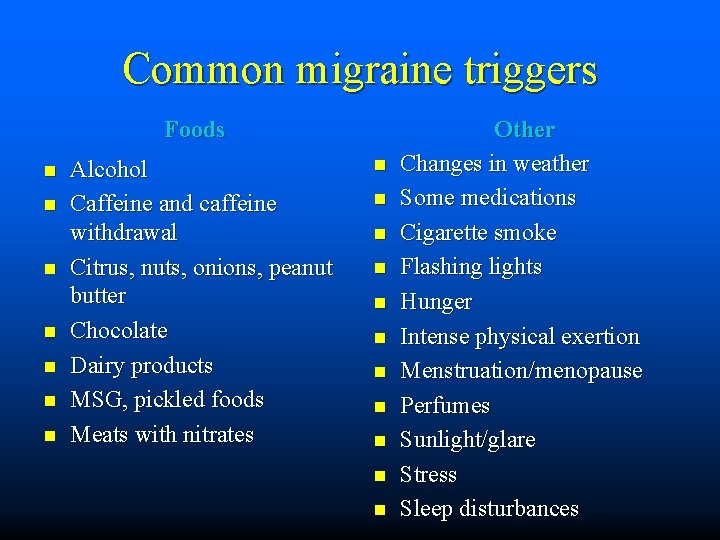
Common migraine triggers Foods n n n n Alcohol Caffeine and caffeine withdrawal Citrus, nuts, onions, peanut butter Chocolate Dairy products MSG, pickled foods Meats with nitrates n n n Other Changes in weather Some medications Cigarette smoke Flashing lights Hunger Intense physical exertion Menstruation/menopause Perfumes Sunlight/glare Stress Sleep disturbances
When to Refer to an Ophthalmologist Loss of vision n Significant eye pain n Eye symptoms with neurologic findings n Eye symptoms after trauma n New-onset double vision n