
Prof Omnia Amin Nayel Dr Abdul latif Mahesar
Prof. Omnia Amin Nayel & Dr. Abdul latif Mahesar
ILOs Differentiate between types of headache regarding their symptoms, signs and pathophysiology. Recognize drugs used to prevent migraine Identify drugs used to rescue and abort migraine Elaborate on the pharmacokinetics, dynamic and toxic profile of some of these drugs.
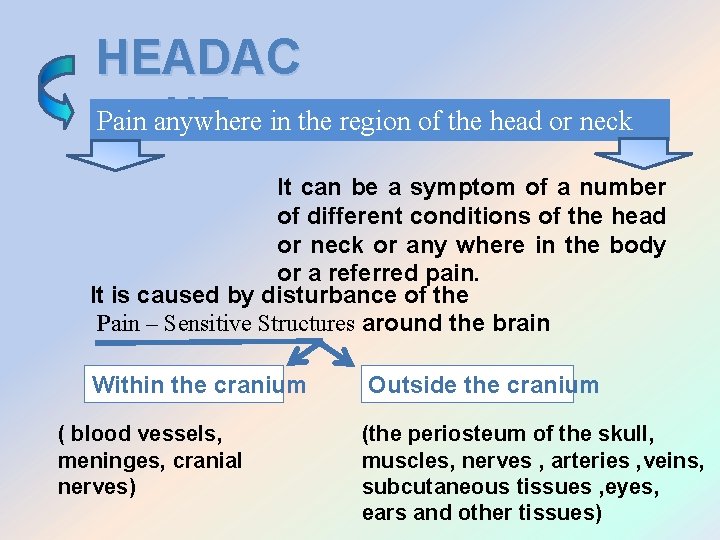
HEADAC Pain anywhere HE in the region of the head or neck It can be a symptom of a number of different conditions of the head or neck or any where in the body or a referred pain. It is caused by disturbance of the Pain – Sensitive Structures around the brain Within the cranium ( blood vessels, meninges, cranial nerves) Outside the cranium (the periosteum of the skull, muscles, nerves , arteries , veins, subcutaneous tissues , eyes, ears and other tissues)
Classification Primary: Migraine, tension type headache, cluster headache, trigeminal cephalgias and others where� cause in NSAIDs unknown Secondary: Based on the etiology Ø Trauma: of head or neck Ø Vascular disorders: ischeamic stroke, intracrainial hemorrhage. Ø Disease: intracranial tumors, infection, Ø Homeostasis disorders: high BP, fastening, hypothroidsm. �Treat the etiology Ø Others……
MIGRAI NE Recurrent attacks of throbbing headache Unilateral / or on both sides Lasting from > 2 up to 72 hrs. + Preceded (or accompanied) by AURA Perceptual disturbance of motor < sensory nature visual [ Photophobia (↑sensitivity to light) ] auditory [ Phonophobia (↑ sensitivity to sound) ] olfactory unpleasant smell …. . Develops over 5 -20 min. & last fewer than 60 min
Phases of Migraine 1. Prodrom Phase; a change in mood or behavior that starts hours or days before headache. It is experienced by 60% of migraineurs. 2. Aura Phase; Sensory > motor symptoms starts 5 -20 min before the migraine attack. It is experienced by 20% of migraineurs. 3. Headache Phase; moderate to severe pain, �with activity + anorexia, vomiting, Intolerance to light, sounds, odors Blurry vision /Blocked nose /Pale face Sensations of heat or coldness /Sweating /Tenderness of the scalp 4. Postdrom Phase: still not normal, either; * More likely fatigued → irritability /impaired concentration /scalp tenderness /mood changes / GIT symptoms, ……
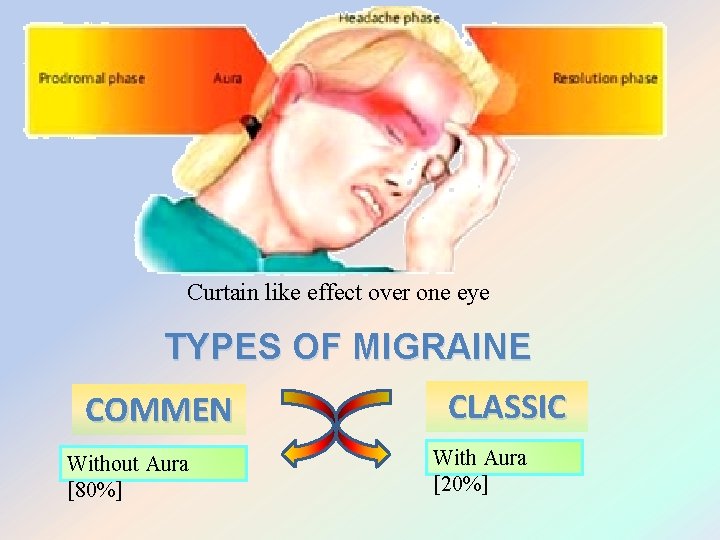
Curtain like effect over one eye TYPES OF MIGRAINE COMMEN Without Aura [80%] CLASSIC With Aura [20%]
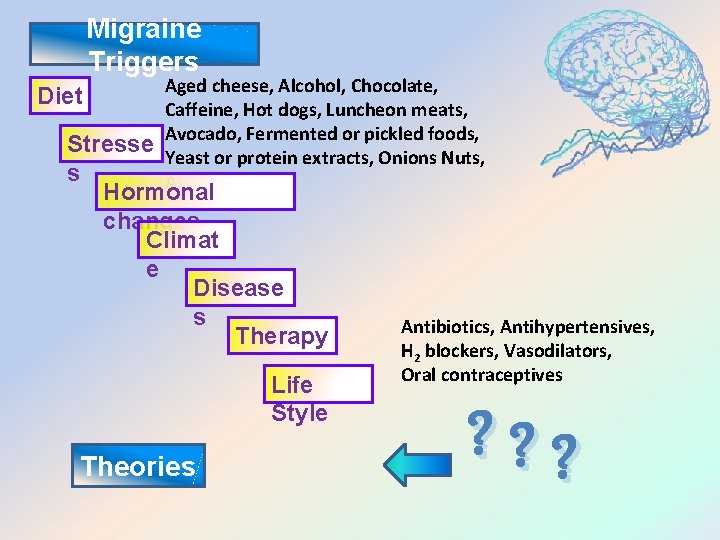
Migraine Triggers Diet Aged cheese, Alcohol, Chocolate, Caffeine, Hot dogs, Luncheon meats, Avocado, Fermented or pickled foods, Yeast or protein extracts, Onions Nuts, Aspartame. Stresse s Hormonal changes Climat e Disease s Therapy Life Style Theories Antibiotics, Antihypertensives, H 2 blockers, Vasodilators, Oral contraceptives ? ? ?
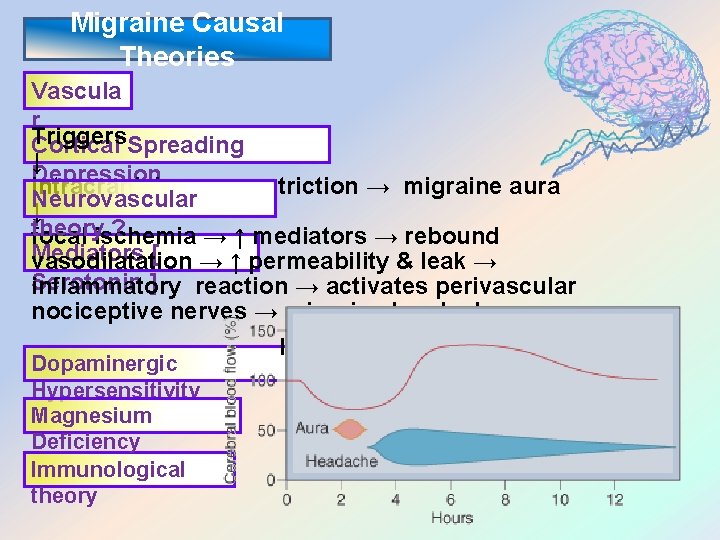
Migraine Causal Theories Vascula r Triggers. Spreading Cortical ↓ Depression Intracranial vasoconstriction → migraine aura Neurovascular ↓ theory ? focal ischemia → ↑ mediators → rebound Mediators [ vasodilatation → ↑ permeability & leak → Serotonin ] inflammatory reaction → activates perivascular nociceptive nerves → migraine headache ↓ It throbs as blood flow at these Dopaminergic sensitive area with each heart Hypersensitivity beat Magnesium Deficiency Immunological theory
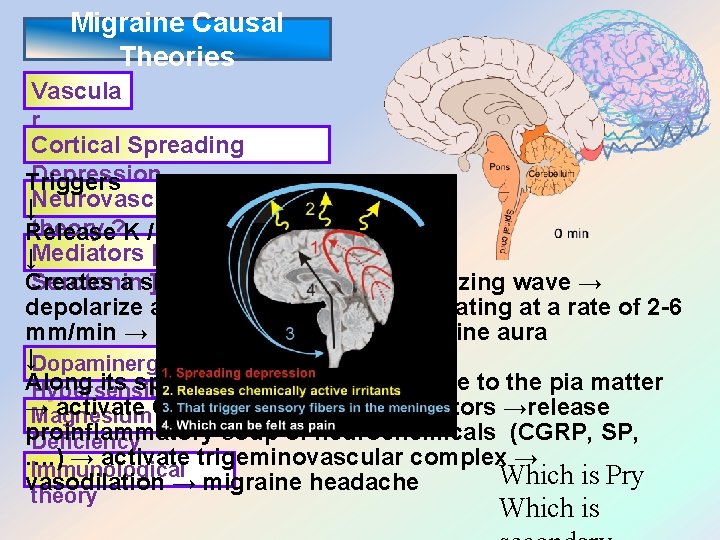
Migraine Causal Theories Vascula r Cortical Spreading Depression Triggers ↓Neurovascular theory ? K / glutamates Release ↓Mediators [ Creates a slowly well-defined depolarizing wave → Serotonin ] depolarize adjacent tissues → propagating at a rate of 2 -6 mm/min → vasoconstriction → migraine aura ↓Dopaminergic + and K+ ions diffuse to the pia matter Along its spread H Hypersensitivity → activate C-fiber meningeal nociceptors →release Magnesium proinflammatory soup of neurochemicals (CGRP, SP, Deficiency …. ) → activate trigeminovascular complex → Immunological Which is Pry vasodilation → migraine headache theory Which is
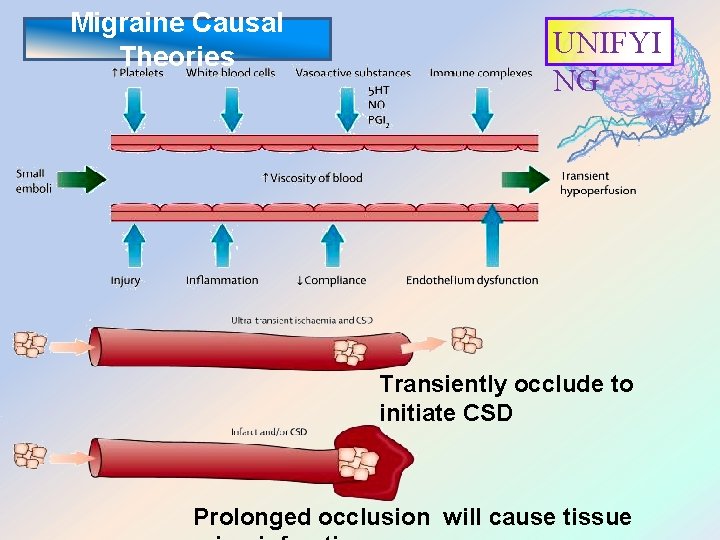
Migraine Causal Theories UNIFYI NG Transiently occlude to initiate CSD Prolonged occlusion will cause tissue
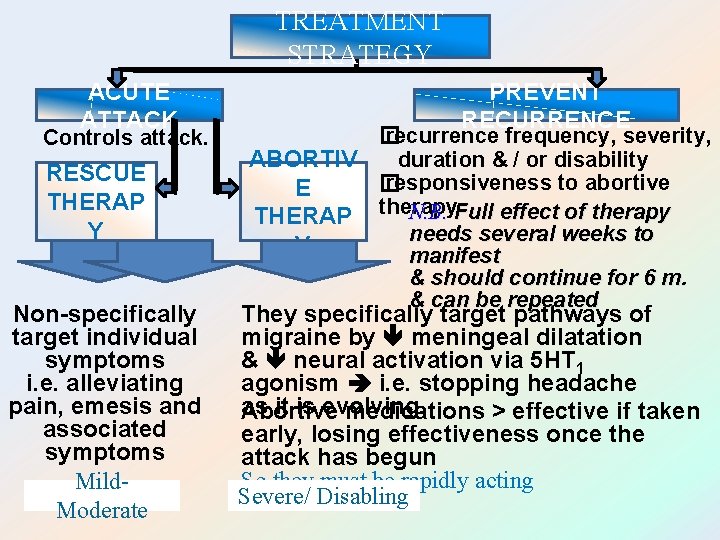
TREATMENT STRATEGY ACUTE ATTACK Controls attack. RESCUE THERAP Y Non-specifically target individual symptoms i. e. alleviating pain, emesis and associated symptoms Mild. Moderate PREVENT RECURRENCE ABORTIV E THERAP Y � recurrence frequency, severity, duration & / or disability � responsiveness to abortive therapy N. B. Full effect of therapy needs several weeks to manifest & should continue for 6 m. & can be repeated They specifically target pathways of migraine by meningeal dilatation & neural activation via 5 HT 1 agonism i. e. stopping headache as it is evolving. Abortive medications > effective if taken early, losing effectiveness once the attack has begun So they must be rapidly acting Severe/ Disabling
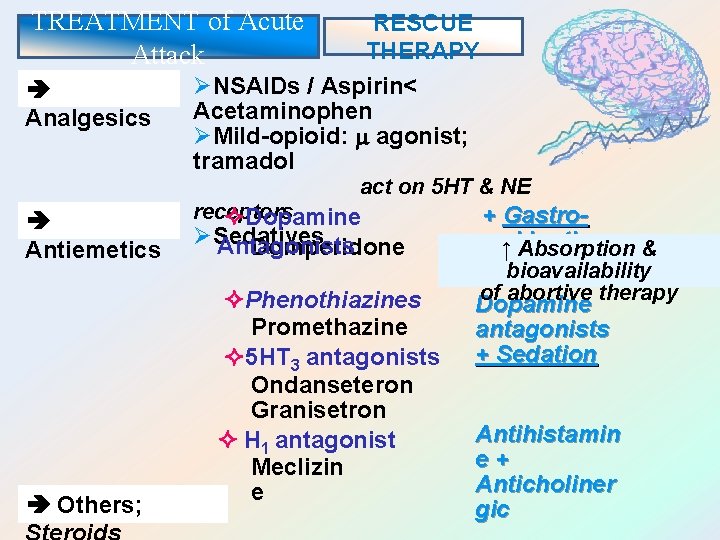
TREATMENT of Acute Attack Analgesics RESCUE THERAPY ØNSAIDs / Aspirin< Acetaminophen ØMild-opioid: m agonist; tramadol act on 5 HT & NE Antiemetics Others; receptors Dopamine ØSedatives Antagonists Domperidone Phenothiazines Promethazine 5 HT 3 antagonists Ondanseteron Granisetron H 1 antagonist Meclizin e + Gastroprokinetic ↑ Absorption & bioavailability of abortive therapy Dopamine antagonists + Sedation Antihistamin e+ Anticholiner gic
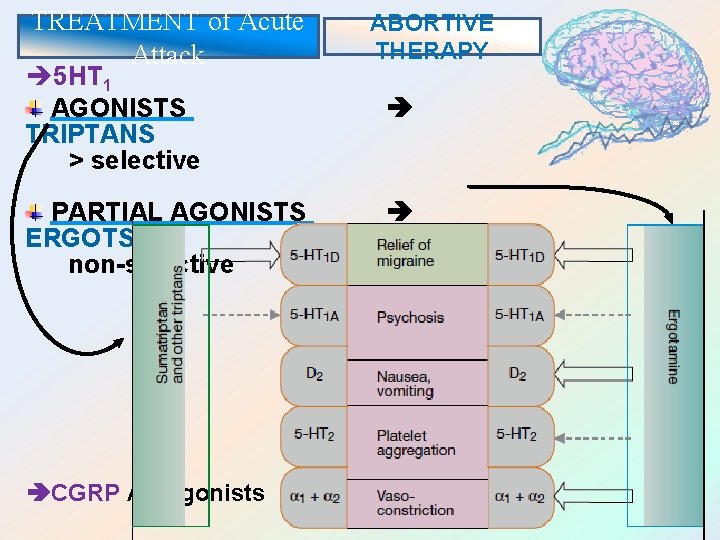
TREATMENT of Acute Attack è 5 HT 1 AGONISTS TRIPTANS > selective PARTIAL AGONISTS ERGOTS non-selective CGRP Antagonists ABORTIVE THERAPY
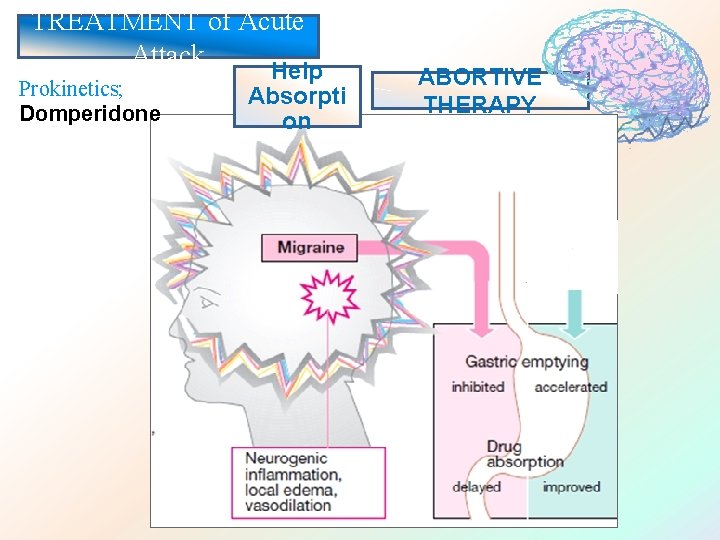
TREATMENT of Acute Attack Prokinetics; Domperidone Help Absorpti on ABORTIVE THERAPY
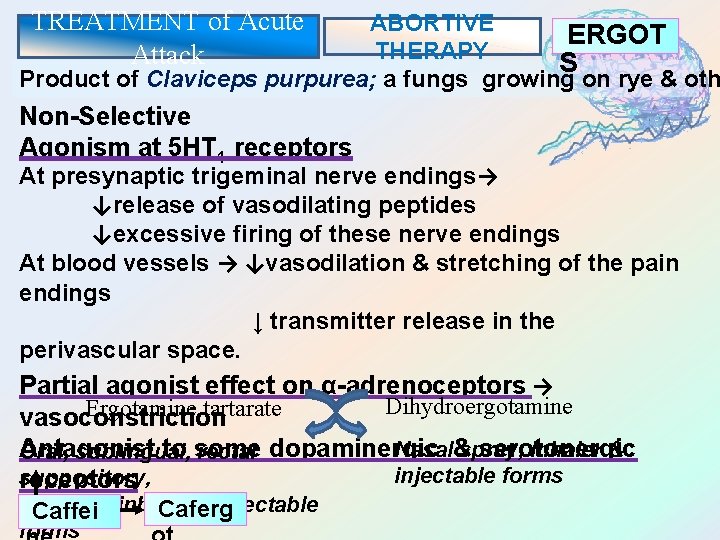
TREATMENT of Acute Attack ABORTIVE ERGOT THERAPY S Product of Claviceps purpurea; a fungs growing on rye & oth Non-Selective Agonism at 5 HT 1 receptors At presynaptic trigeminal nerve endings→ ↓release of vasodilating peptides ↓excessive firing of these nerve endings At blood vessels → ↓vasodilation & stretching of the pain endings ↓ transmitter release in the perivascular space. Partial agonist effect on α-adrenoceptors → Dihydroergotamine Ergotamine tartarate vasoconstriction Nasal & spray, inhaler & Antagonist to some serotonergic Oral, sublingual, rectal dopaminergic injectable forms suppository, receptors & injectable Caferg Caffei inhaler forms
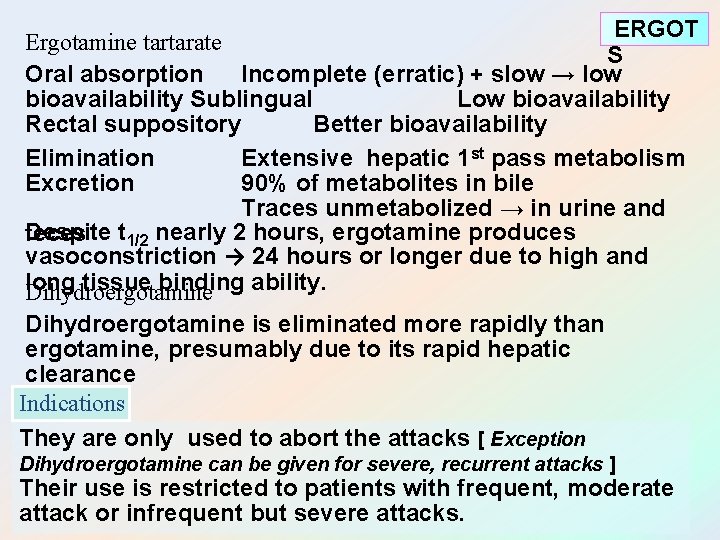
ERGOT Ergotamine tartarate S Oral absorption Incomplete (erratic) + slow → low bioavailability Sublingual Low bioavailability Rectal suppository Better bioavailability Elimination Extensive hepatic 1 st pass metabolism Excretion 90% of metabolites in bile Traces unmetabolized → in urine and Despite feces t 1/2 nearly 2 hours, ergotamine produces vasoconstriction → 24 hours or longer due to high and long tissue binding ability. Dihydroergotamine is eliminated more rapidly than ergotamine, presumably due to its rapid hepatic clearance Indications They are only used to abort the attacks [ Exception Dihydroergotamine can be given for severe, recurrent attacks ] Their use is restricted to patients with frequent, moderate attack or infrequent but severe attacks.
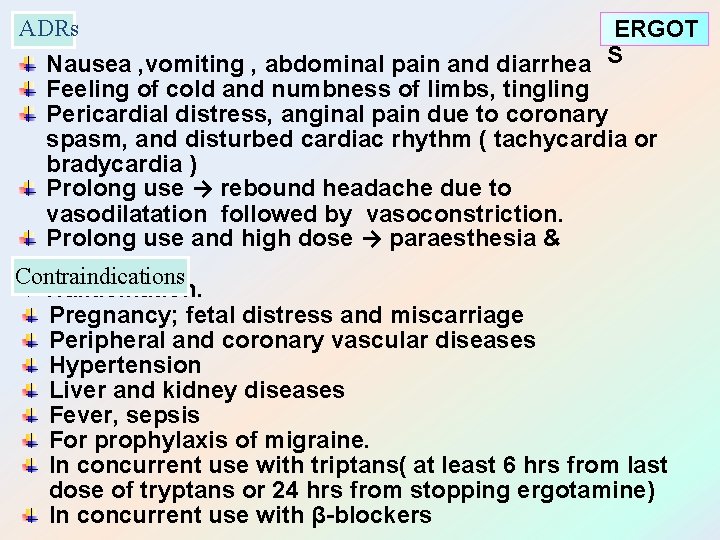
ADRs ERGOT Nausea , vomiting , abdominal pain and diarrhea S Feeling of cold and numbness of limbs, tingling Pericardial distress, anginal pain due to coronary spasm, and disturbed cardiac rhythm ( tachycardia or bradycardia ) Prolong use → rebound headache due to vasodilatation followed by vasoconstriction. Prolong use and high dose → paraesthesia & gangrene Contraindications Hallucination. Pregnancy; fetal distress and miscarriage Peripheral and coronary vascular diseases Hypertension Liver and kidney diseases Fever, sepsis For prophylaxis of migraine. In concurrent use with triptans( at least 6 hrs from last dose of tryptans or 24 hrs from stopping ergotamine) In concurrent use with β-blockers
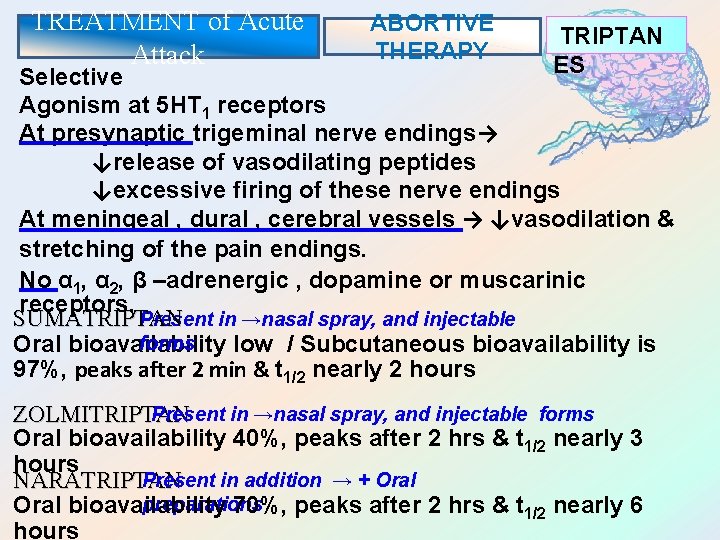
TREATMENT of Acute Attack ABORTIVE THERAPY TRIPTAN ES Selective Agonism at 5 HT 1 receptors At presynaptic trigeminal nerve endings→ ↓release of vasodilating peptides ↓excessive firing of these nerve endings At meningeal , dural , cerebral vessels → ↓vasodilation & stretching of the pain endings. No α 1, α 2, β –adrenergic , dopamine or muscarinic receptors. Present in →nasal spray, and injectable SUMATRIPTAN forms Oral bioavailability low / Subcutaneous bioavailability is 97%, peaks after 2 min & t 1/2 nearly 2 hours Present in →nasal spray, and injectable forms ZOLMITRIPTAN Oral bioavailability 40%, peaks after 2 hrs & t 1/2 nearly 3 hours Present in addition → + Oral NARATRIPTAN preparations Oral bioavailability 70%, peaks after 2 hrs & t 1/2 nearly 6 hours
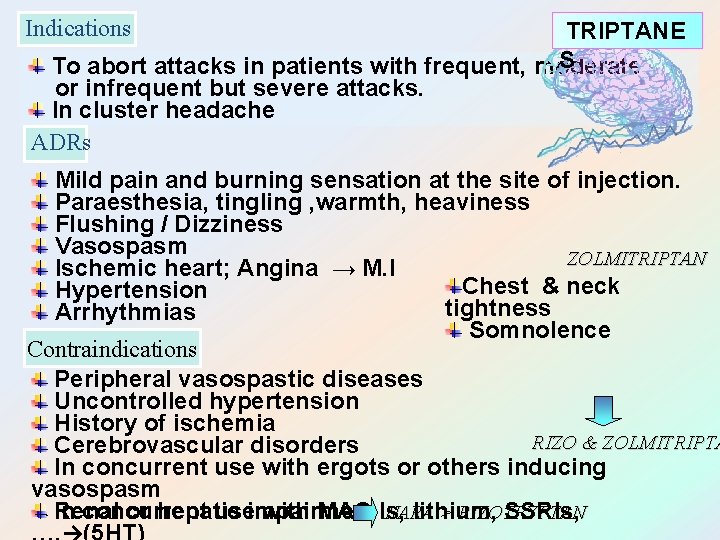
Indications TRIPTANE S To abort attacks in patients with frequent, moderate or infrequent but severe attacks. In cluster headache ADRs Mild pain and burning sensation at the site of injection. Paraesthesia, tingling , warmth, heaviness Flushing / Dizziness Vasospasm ZOLMITRIPTAN Ischemic heart; Angina → M. I Chest & neck Hypertension tightness Arrhythmias Somnolence Contraindications Peripheral vasospastic diseases Uncontrolled hypertension History of ischemia RIZO & ZOLMITRIPTA Cerebrovascular disorders In concurrent use with ergots or others inducing vasospasm NARA > RIZOTRYPTAN Renal or hepatic In concurrent useimpairment with MAO Is, lithium, SSRIs,
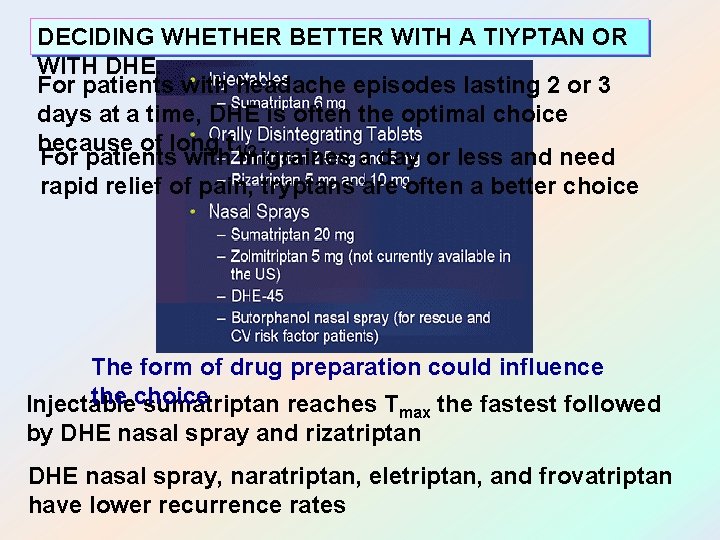
DECIDING WHETHER BETTER WITH A TIYPTAN OR WITH DHE. For patients with headache episodes lasting 2 or 3 days at a time, DHE is often the optimal choice because of long t 1/2 For patients with migraines a day or less and need rapid relief of pain, tryptans are often a better choice The form of drug preparation could influence the choice Injectable sumatriptan reaches T the fastest followed max by DHE nasal spray and rizatriptan DHE nasal spray, naratriptan, eletriptan, and frovatriptan have lower recurrence rates
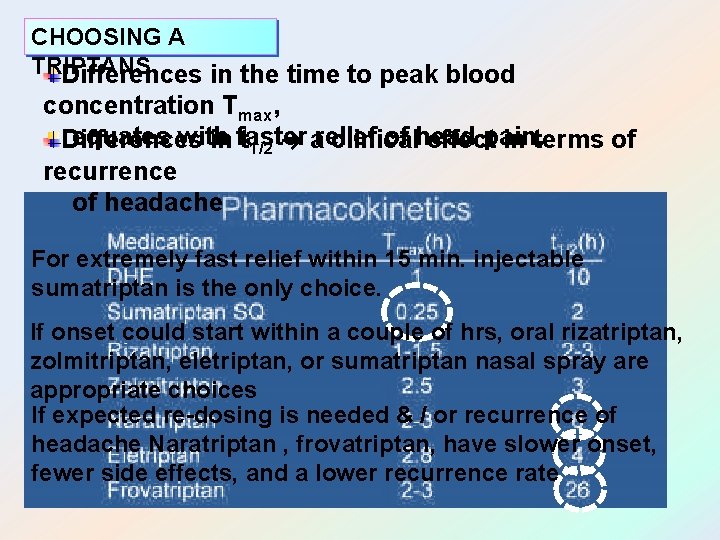
CHOOSING A TRIPTANS Differences in the time to peak blood concentration Tmax, equates with of head Differences in faster t 1/2 → arelief clinical effectpain. in terms of recurrence of headache For extremely fast relief within 15 min. injectable sumatriptan is the only choice. If onset could start within a couple of hrs, oral rizatriptan, zolmitriptan, eletriptan, or sumatriptan nasal spray are appropriate choices If expected re-dosing is needed & / or recurrence of headache Naratriptan , frovatriptan, have slower onset, fewer side effects, and a lower recurrence rate
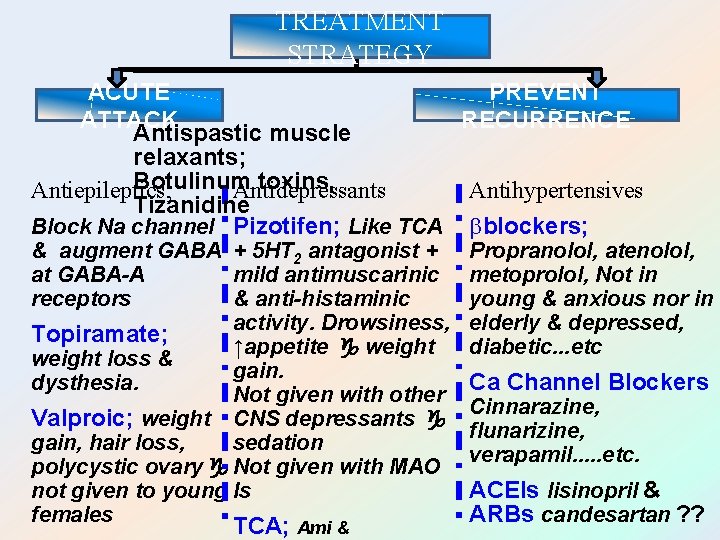
TREATMENT STRATEGY ACUTE PREVENT ATTACK RECURRENCE Antispastic muscle relaxants; Botulinum toxins, Antiepileptics; Antidepressants Antihypertensives Tizanidine Block Na channel Pizotifen; Like TCA bblockers; & augment GABA + 5 HT 2 antagonist + at GABA-A mild antimuscarinic receptors & anti-histaminic activity. Drowsiness, Topiramate; ↑appetite weight loss & gain. dysthesia. Not given with other Valproic; weight CNS depressants gain, hair loss, sedation polycystic ovary Not given with MAO not given to young Is females TCA; Ami & Propranolol, atenolol, metoprolol, Not in young & anxious nor in elderly & depressed, diabetic. . . etc Ca Channel Blockers Cinnarazine, flunarizine, verapamil. . . etc. ACEIs lisinopril & ARBs candesartan ? ?
- Slides: 24