JustinTime and Lean Operations What is JIT Producing
- Slides: 100
Just-in-Time and Lean Operations
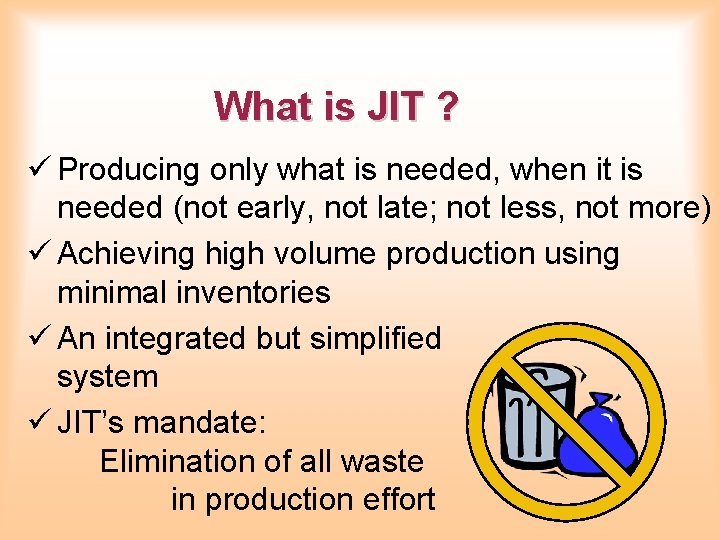
What is JIT ? ü Producing only what is needed, when it is needed (not early, not late; not less, not more) ü Achieving high volume production using minimal inventories ü An integrated but simplified system ü JIT’s mandate: Elimination of all waste in production effort
Just-in-Time Just-in-time (JIT): A highly coordinated processing system in which goods move through the system, and services are performed, just as they are needed · Supplies and components are ‘pulled’ through the system to arrive where they are needed when they are needed (just-in-time) · A management philosophy of continuous and forced problem solving by attacking the root causes
Lean Production · JIT lean production · Lean Production system is a flexible one that supplies customers high quality goods and services (exactly what the customer wants, when the customer wants), with minimal resources (without waste), through continuous improvement · Lean systems are: Demand driven · Focused on waste reduction · Have a culture that is dedicated to excellence and continuous improvement ·
What Does Just-in-Time Do? · · · Attacks waste (anything not adding value to the product) Achieves streamlined production by reducing inventory Exposes problems and bottlenecks caused by variability
Goal of JIT The ultimate goal of JIT is a balanced system. Achieves a smooth, rapid flow of materials through the system
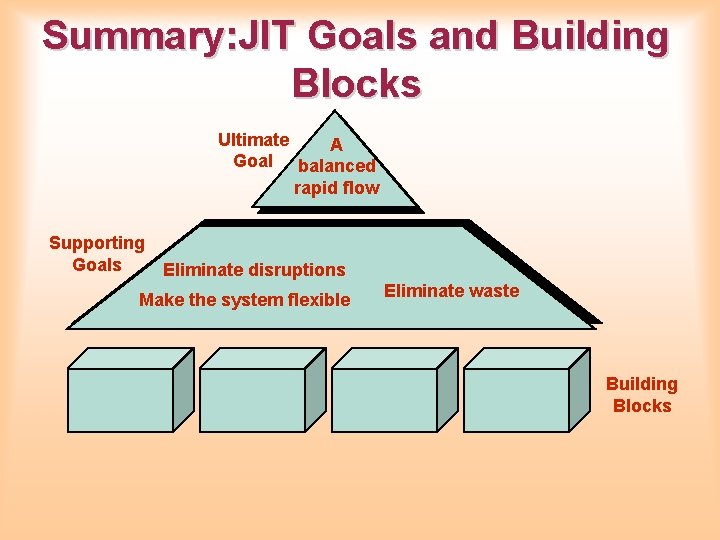
Summary: JIT Goals and Building Blocks Ultimate A Goal balanced rapid flow Supporting Goals Eliminate disruptions Make the system flexible Eliminate waste Building Blocks
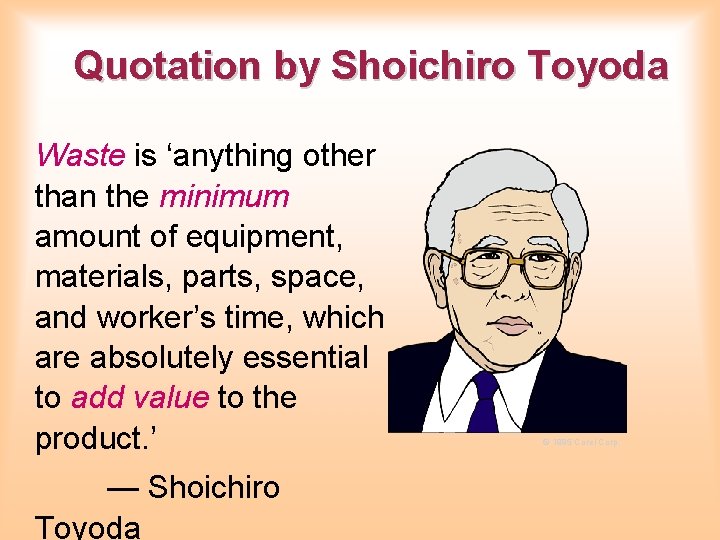
Quotation by Shoichiro Toyoda Waste is ‘anything other than the minimum amount of equipment, materials, parts, space, and worker’s time, which are absolutely essential to add value to the product. ’ — Shoichiro Toyoda © 1995 Corel Corp.
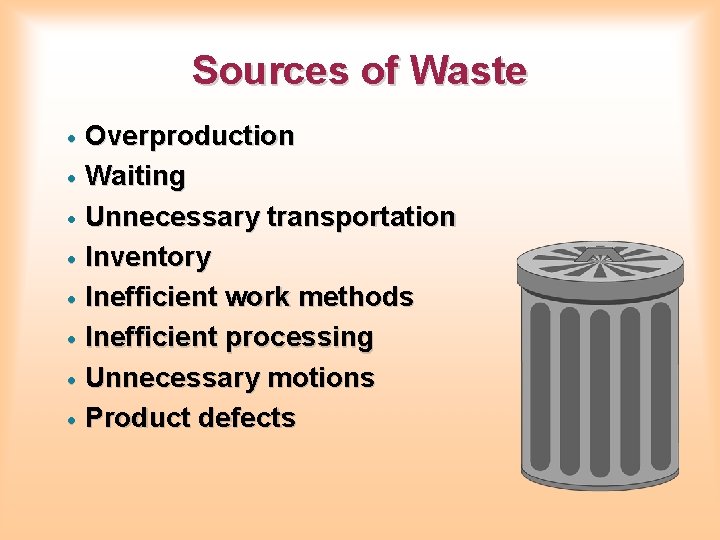
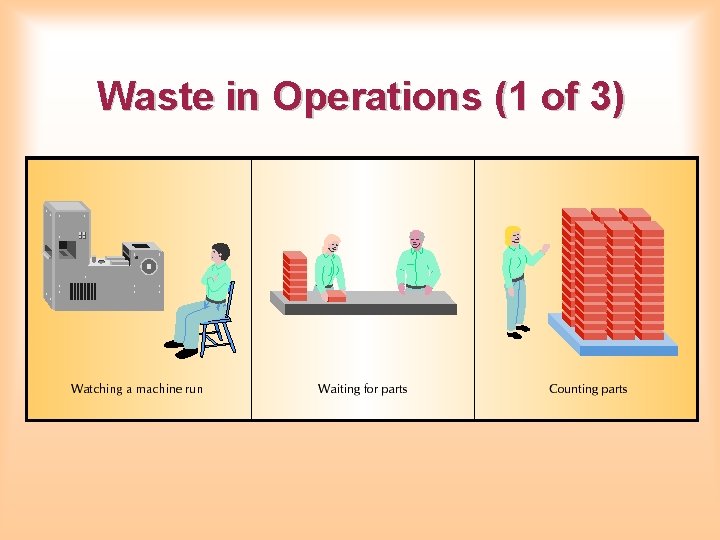
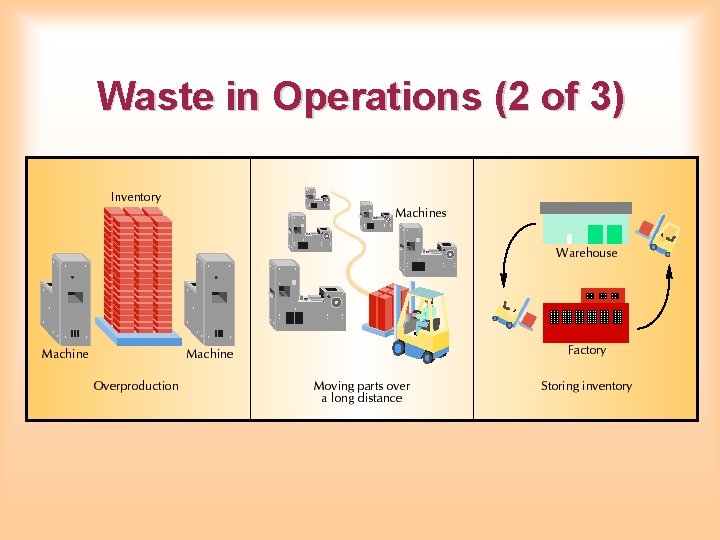
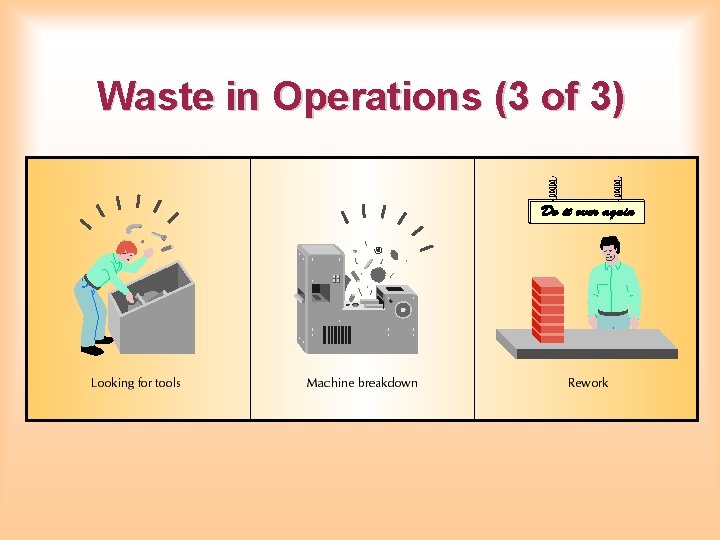
Sources of Waste Overproduction · Waiting · Unnecessary transportation · Inventory · Inefficient work methods · Inefficient processing · Unnecessary motions · Product defects ·
Waste in Operations (1 of 3)
Waste in Operations (2 of 3)
Waste in Operations (3 of 3)
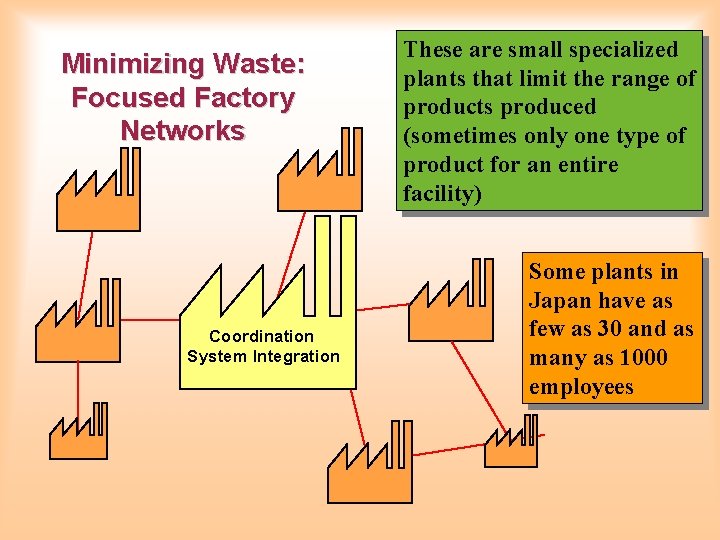
Minimizing Waste: Focused Factory Networks Coordination System Integration These are small specialized plants that limit the range of products produced (sometimes only one type of product for an entire facility) Some plants in Japan have as few as 30 and as many as 1000 employees
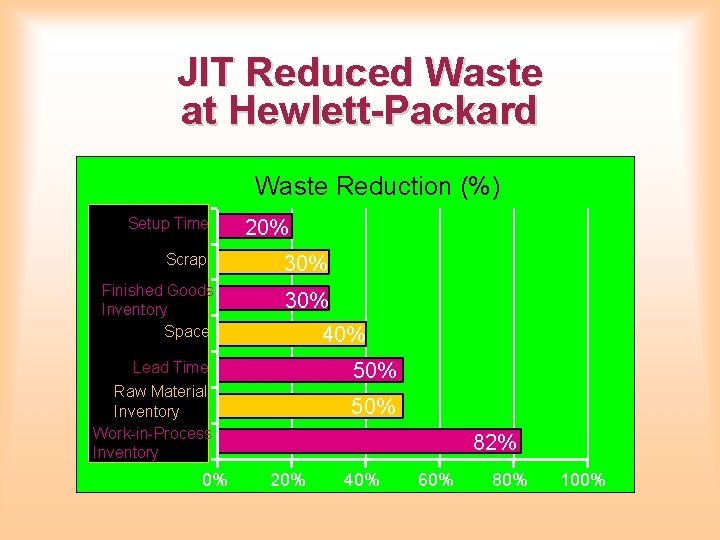
JIT Reduced Waste at Hewlett-Packard Waste Reduction (%) Setup Time Scrap Finished Goods Inventory Space 20% 30% 40% Lead Time 50% Raw Material Inventory Work-in-Process Inventory 0% 50% 82% 20% 40% 60% 80% 100%
JIT Building Blocks In order to achieve competitive advantage through JIT, the necessary building blocks should be installed The building blocks can also be regarded as JIT success factors or the basic elements of JIT
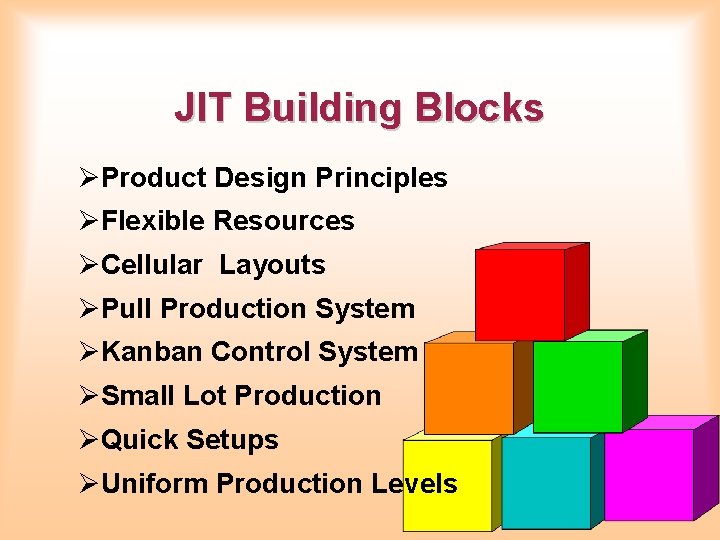
JIT Building Blocks ØProduct Design Principles ØFlexible Resources ØCellular Layouts ØPull Production System ØKanban Control System ØSmall Lot Production ØQuick Setups ØUniform Production Levels
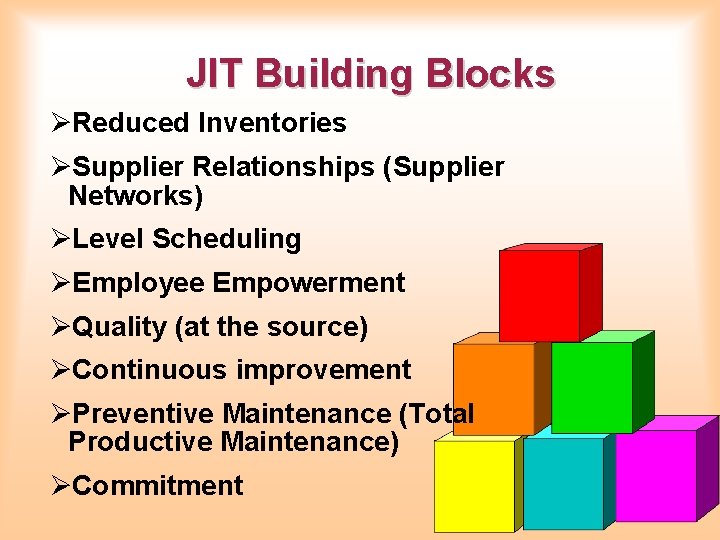
JIT Building Blocks ØReduced Inventories ØSupplier Relationships (Supplier Networks) ØLevel Scheduling ØEmployee Empowerment ØQuality (at the source) ØContinuous improvement ØPreventive Maintenance (Total Productive Maintenance) ØCommitment
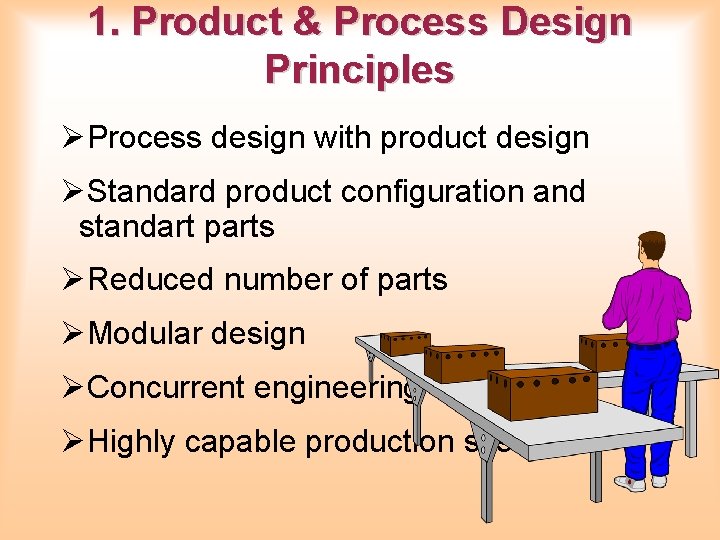
1. Product & Process Design Principles ØProcess design with product design ØStandard product configuration and standart parts ØReduced number of parts ØModular design ØConcurrent engineering ØHighly capable production systems
2. Flexible Resources ü Multifunctional workers ü General purpose machines ü Study operators & improve operations
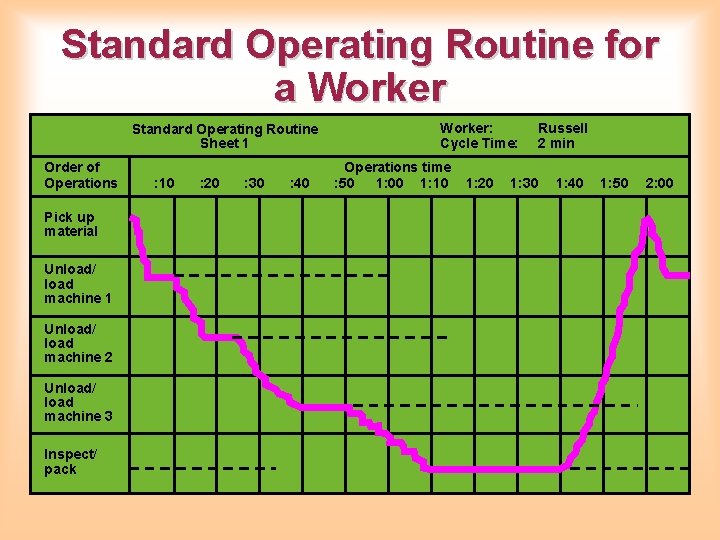
Standard Operating Routine for a Worker Standard Operating Routine Sheet 1 Order of Operations Pick up material Unload/ load machine 1 Unload/ load machine 2 Unload/ load machine 3 Inspect/ pack : 10 : 20 : 30 : 40 Worker: Cycle Time: Operations time : 50 1: 00 1: 10 1: 20 Russell 2 min 1: 30 1: 40 1: 50 2: 00
3. Layout ØJIT objective: Reduce movement of people and material ØMovement is waste! ØJIT requires Øwork-cells for product families (group technology) Ømovable, changeable, flexible machinery Øshort distances Øhigh level of workplace organization and neatness
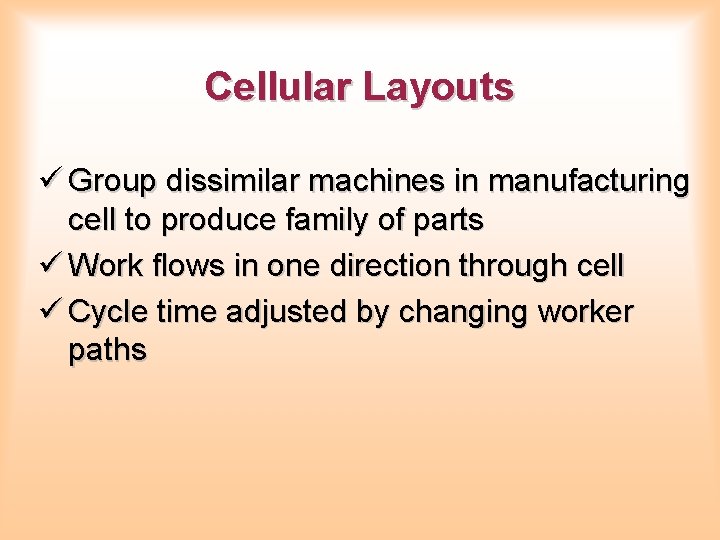
Cellular Layouts ü Group dissimilar machines in manufacturing cell to produce family of parts ü Work flows in one direction through cell ü Cycle time adjusted by changing worker paths
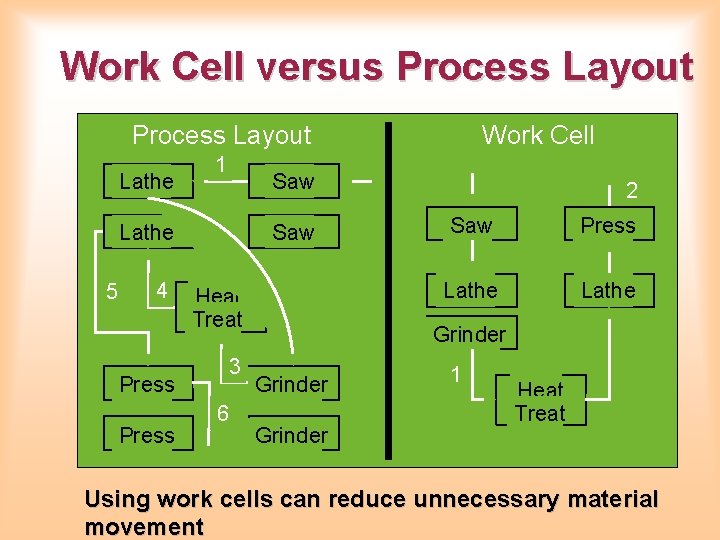
Work Cell versus Process Layout Lathe 5 4 1 Press Saw 2 Heat Treat 3 Press 6 Work Cell 2 Saw Press Lathe Grinder 1 Heat Treat Using work cells can reduce unnecessary material movement
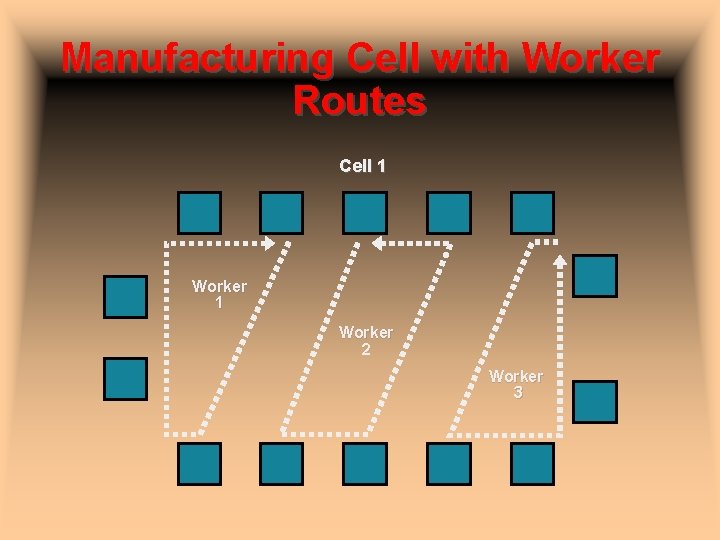
Manufacturing Cell with Worker Routes Cell 1 Worker 2 Worker 3
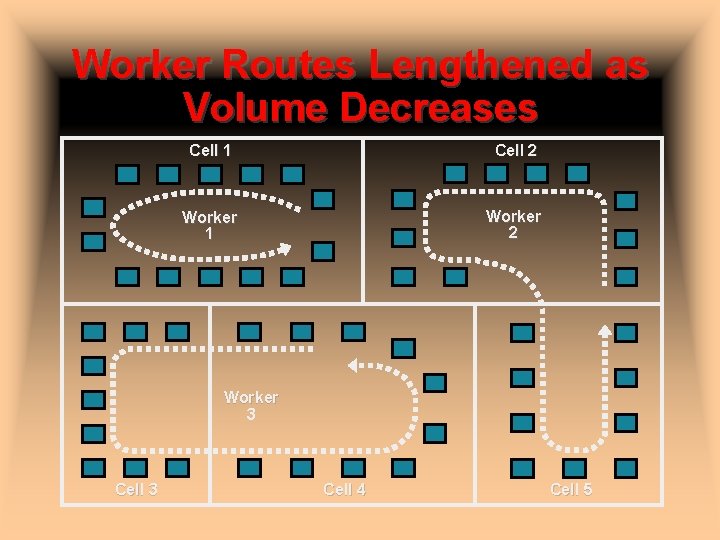
Worker Routes Lengthened as Volume Decreases Cell 1 Cell 2 Worker 1 Worker 2 Worker 3 Cell 4 Cell 5
Layout Tactics Build work cells for families of products · Minimize distance · Design little space for inventory · Improve employee communication · Use poka-yoke devices · Build flexible or movable equipment · Cross train workers to add flexibility to layout ·
4. The Pull System ü Material is pulled through the system when needed ü Reversal of traditional push system where material is pushed according to a schedule ü Forces cooperation ü Prevent over and underproduction
Pull System & Kanban Control ØPull system: System for moving work where a workstation pulls output from the preceding station just as it is needed. (e. g. Kanban) vs. ØPush system: System for moving work where output is pushed to the next station as it is completed
5. Kanban Production Control System (1 of 2) ü Kanban: Japanese word for card, or may be a flag, ball etc. ü Paperless production control system ü Card or other device that communicates demand for work or materials from the preceding station ü Kanban card indicates standard quantity of production ü Used often with fixed sized container
5. Kanban Production Control System (2 of 2) ü The kanban cards provide direct control (limit) on the amount of work-in-process between cells. ü Derived from two-bin inventory system ü Maintains discipline of pull production ü Production kanban authorizes production ü Withdrawal kanban authorizes movement of goods
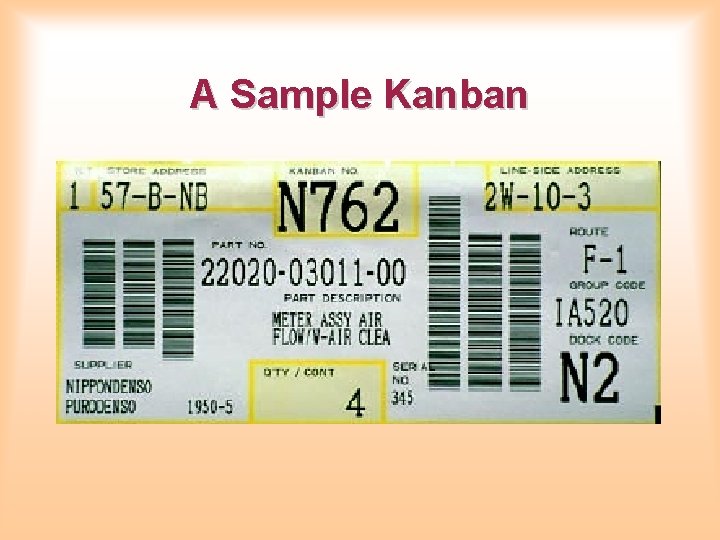
A Sample Kanban
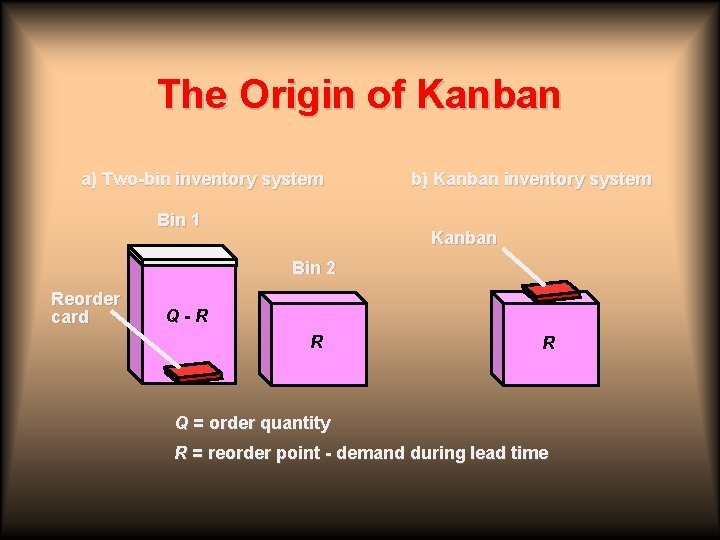
The Origin of Kanban a) Two-bin inventory system Bin 1 b) Kanban inventory system Kanban Bin 2 Reorder card Q-R R R Q = order quantity R = reorder point - demand during lead time
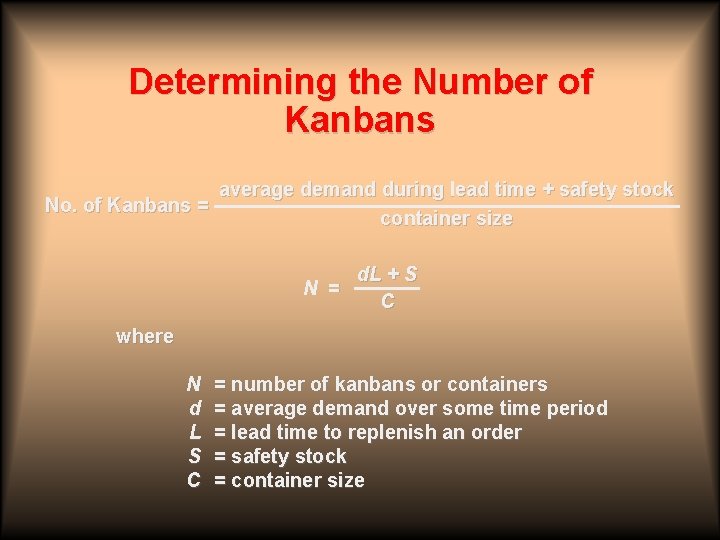
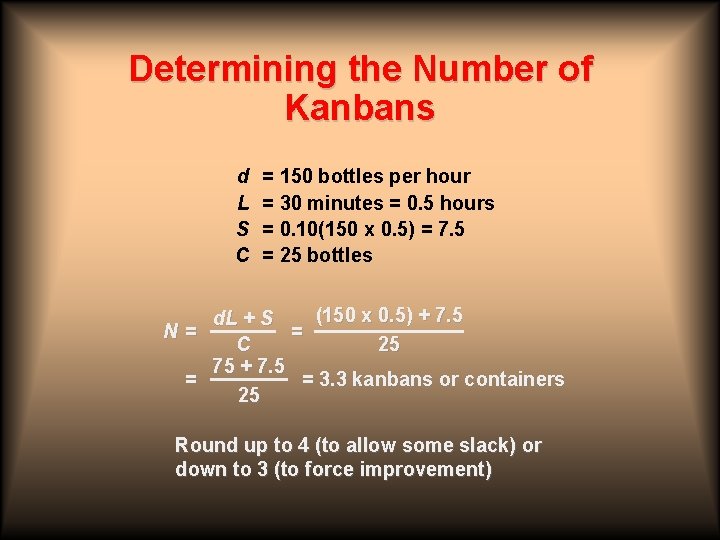
Determining the Number of Kanbans No. of Kanbans = average demand during lead time + safety stock container size N = d. L + S C where N d L S C = number of kanbans or containers = average demand over some time period = lead time to replenish an order = safety stock = container size
Determining the Number of Kanbans d L S C = 150 bottles per hour = 30 minutes = 0. 5 hours = 0. 10(150 x 0. 5) = 7. 5 = 25 bottles (150 x 0. 5) + 7. 5 d. L + S N= = 25 C 75 + 7. 5 = = 3. 3 kanbans or containers 25 Round up to 4 (to allow some slack) or down to 3 (to force improvement)
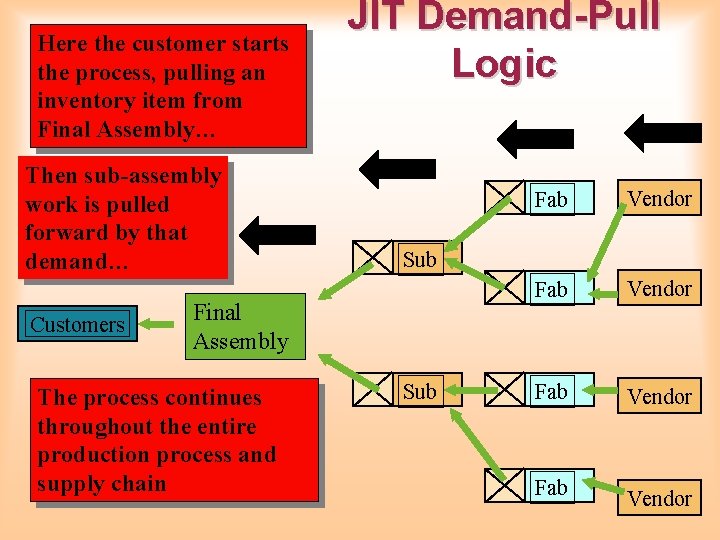
Here the customer starts the process, pulling an inventory item from Final Assembly… Then sub-assembly work is pulled forward by that demand… Customers JIT Demand-Pull Logic Vendor Fab Vendor Sub Final Assembly The process continues throughout the entire production process and supply chain Fab Sub
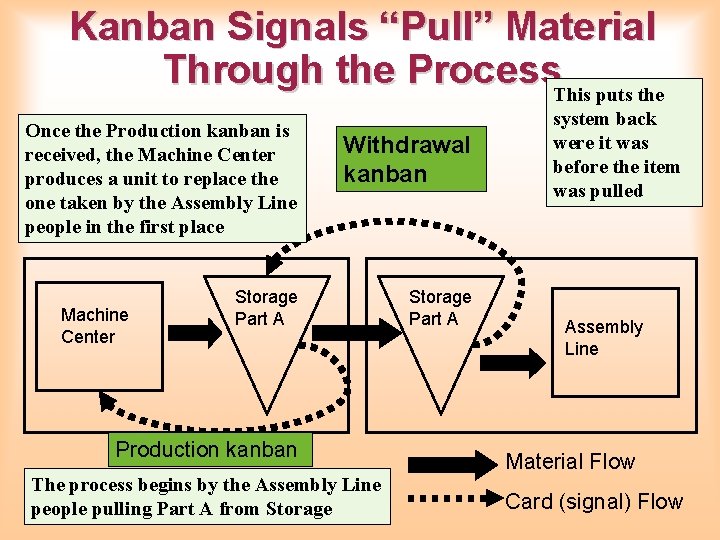
Kanban Signals “Pull” Material Through the Process. This puts the Once the Production kanban is received, the Machine Center produces a unit to replace the one taken by the Assembly Line people in the first place Machine Center Withdrawal kanban Storage Part A Production kanban The process begins by the Assembly Line people pulling Part A from Storage Part A system back were it was before the item was pulled Assembly Line Material Flow Card (signal) Flow
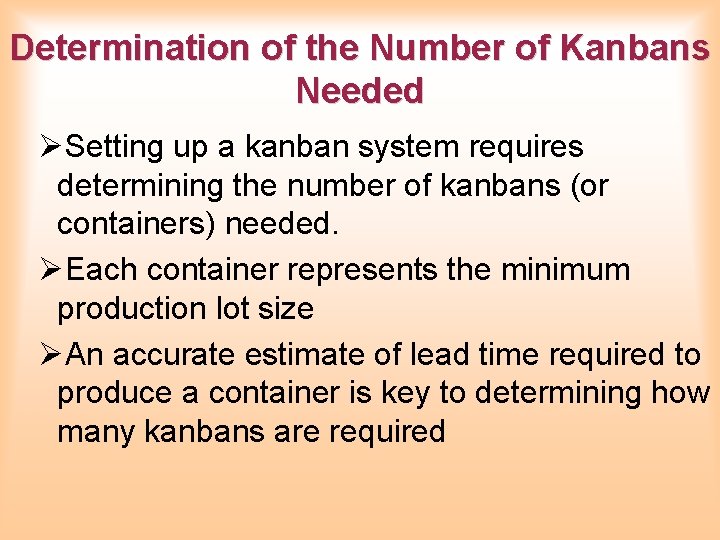
Determination of the Number of Kanbans Needed ØSetting up a kanban system requires determining the number of kanbans (or containers) needed. ØEach container represents the minimum production lot size ØAn accurate estimate of lead time required to produce a container is key to determining how many kanbans are required
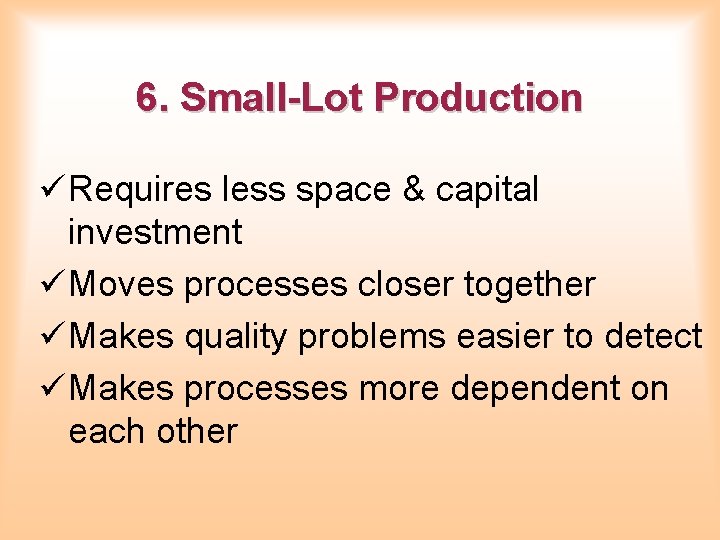
6. Small-Lot Production ü Requires less space & capital investment ü Moves processes closer together ü Makes quality problems easier to detect ü Makes processes more dependent on each other
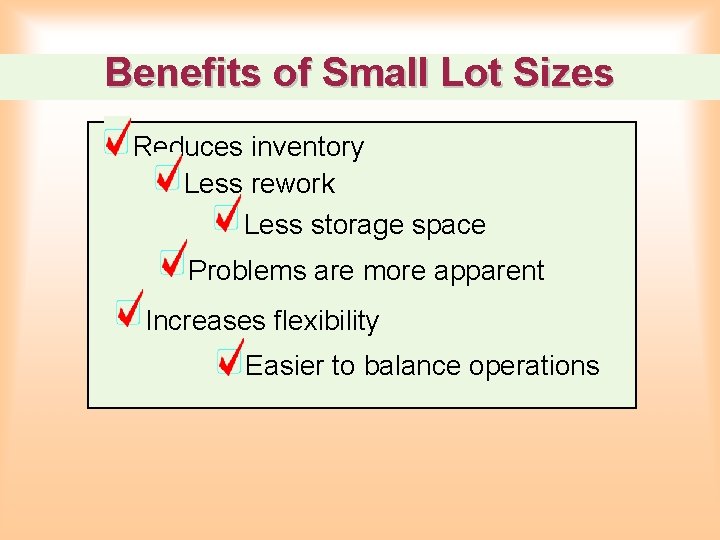
Benefits of Small Lot Sizes Reduces inventory Less rework Less storage space Problems are more apparent Increases flexibility Easier to balance operations
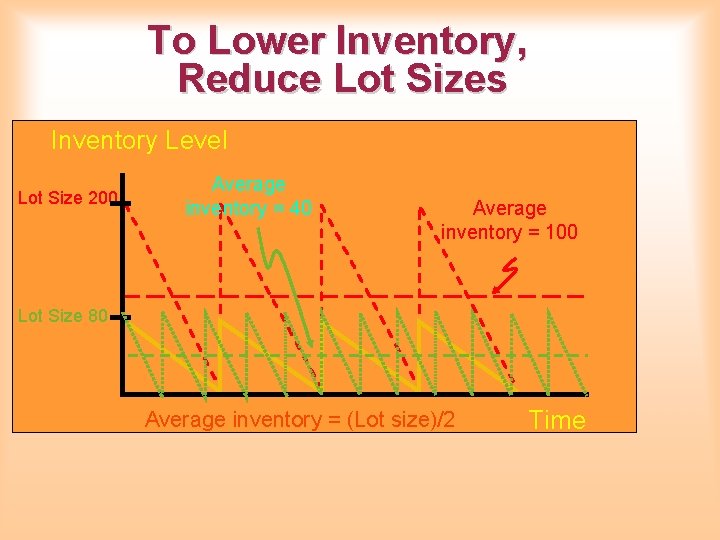
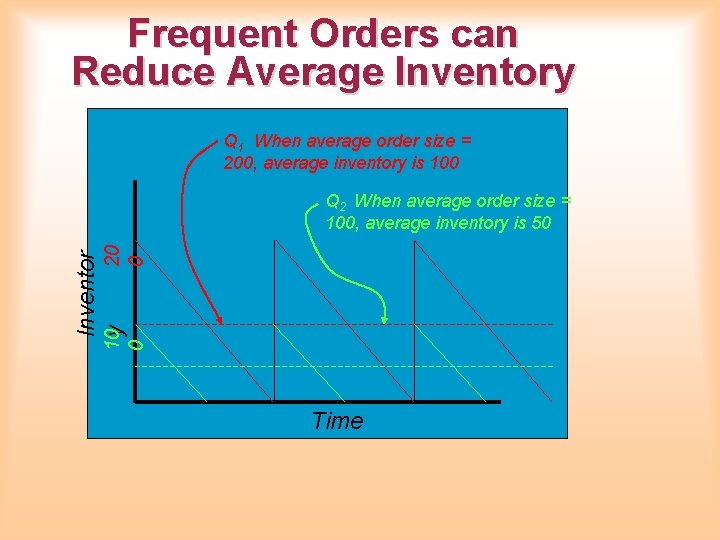
To Lower Inventory, Reduce Lot Sizes Inventory Level Lot Size 200 Average inventory = 40 Average inventory = 100 Lot Size 80 Average inventory = (Lot size)/2 Time
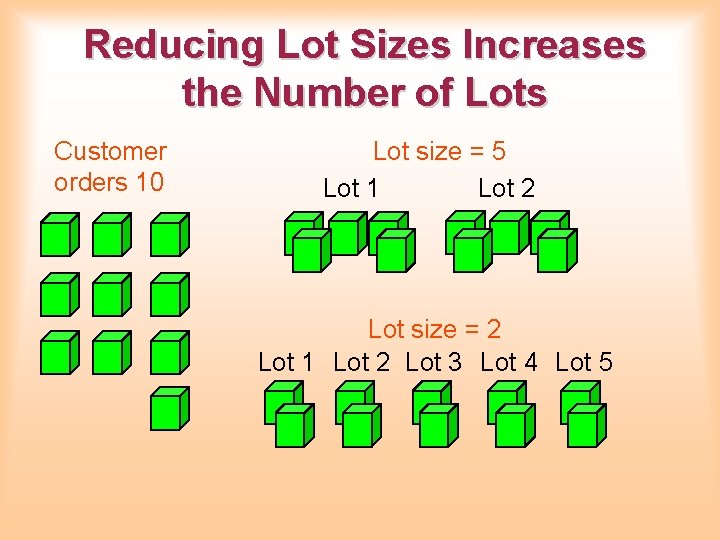
Reducing Lot Sizes Increases the Number of Lots Customer orders 10 Lot size = 5 Lot 2 Lot 1 Lot size = 2 Lot 1 Lot 2 Lot 3 Lot 4 Lot 5
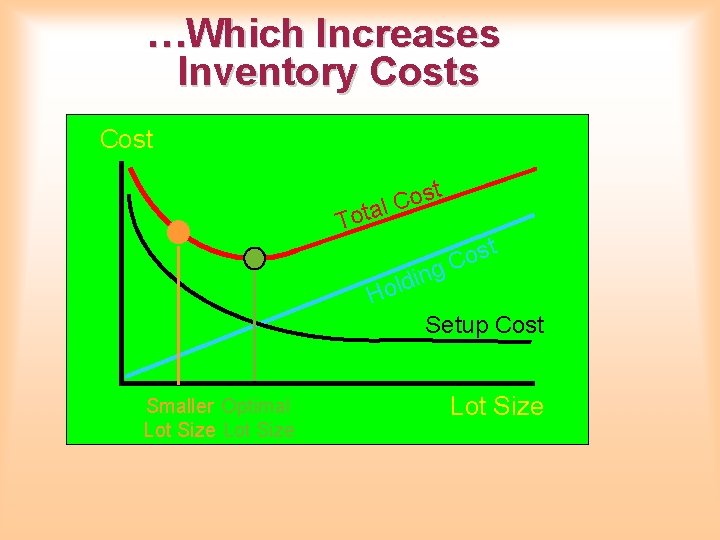
…Which Increases Inventory Costs Cost t To os C l ta g n i d ol t s o C H Setup Cost Smaller Optimal Lot Size
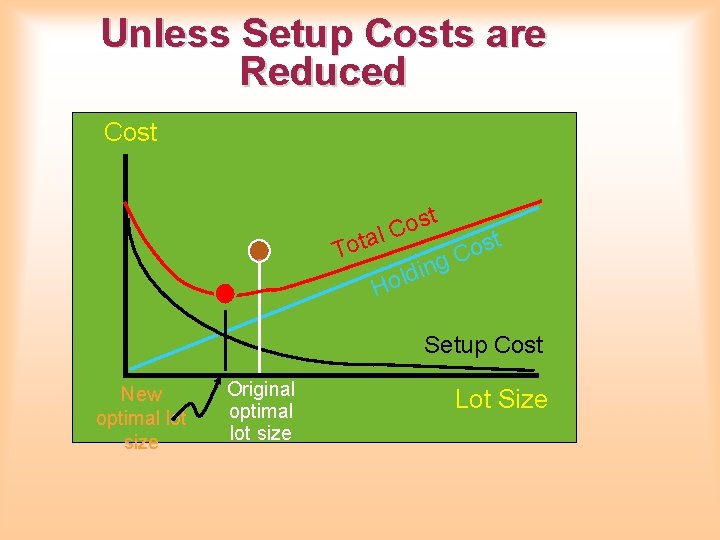
Unless Setup Costs are Reduced Cost t os C l ta To g n i d ol t s o C H Setup Cost New optimal lot size Original optimal lot size Lot Size
Frequent Orders can Reduce Average Inventory Q 1 When average order size = 200, average inventory is 100 0 0 Inventor 10 y 20 Q 2 When average order size = 100, average inventory is 50 Time
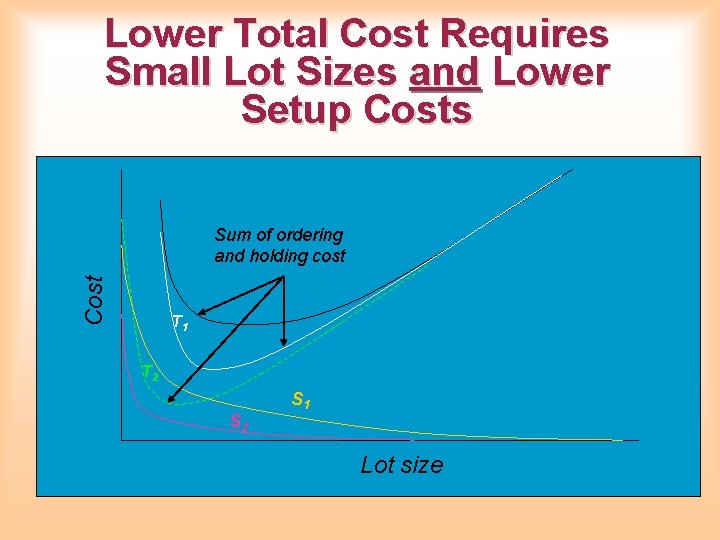
Lower Total Cost Requires Small Lot Sizes and Lower Setup Costs Cost Sum of ordering and holding cost T 1 T 2 S 1 Lot size
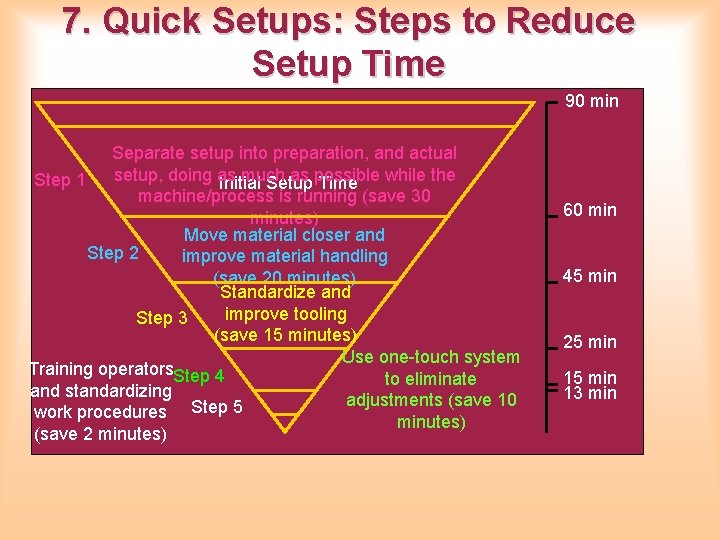
7. Quick Setups: Steps to Reduce Setup Time 90 min Separate setup into preparation, and actual setup, doing as much as possible while the Step 1 Initial Setup Time machine/process is running (save 30 minutes) Move material closer and Step 2 improve material handling (save 20 minutes) Standardize and improve tooling Step 3 (save 15 minutes) Use one-touch system Training operators. Step 4 to eliminate and standardizing adjustments (save 10 work procedures Step 5 minutes) (save 2 minutes) 60 min 45 min 25 min 13 min
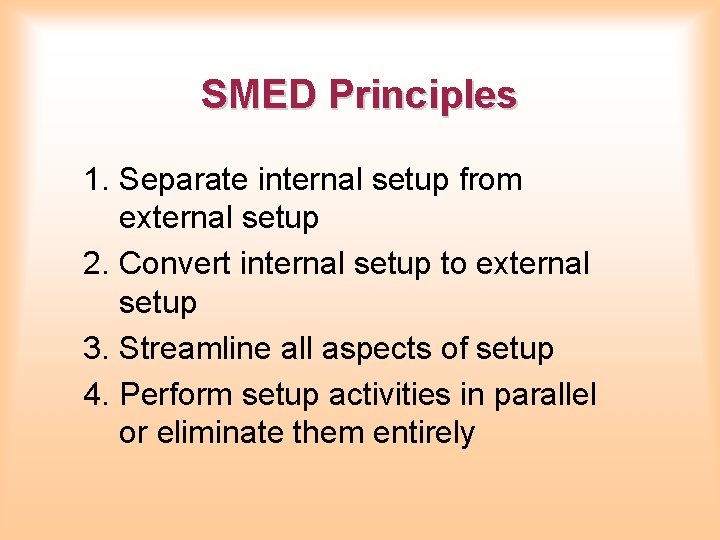
SMED Principles 1. Separate internal setup from external setup 2. Convert internal setup to external setup 3. Streamline all aspects of setup 4. Perform setup activities in parallel or eliminate them entirely
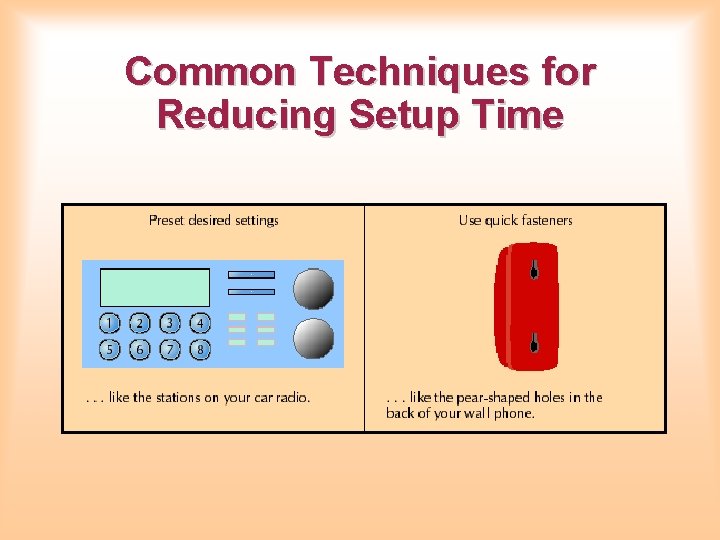
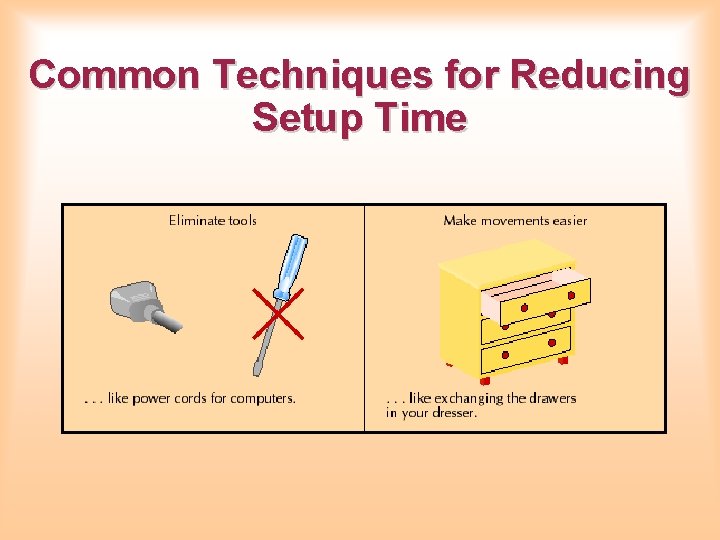
Common Techniques for Reducing Setup Time
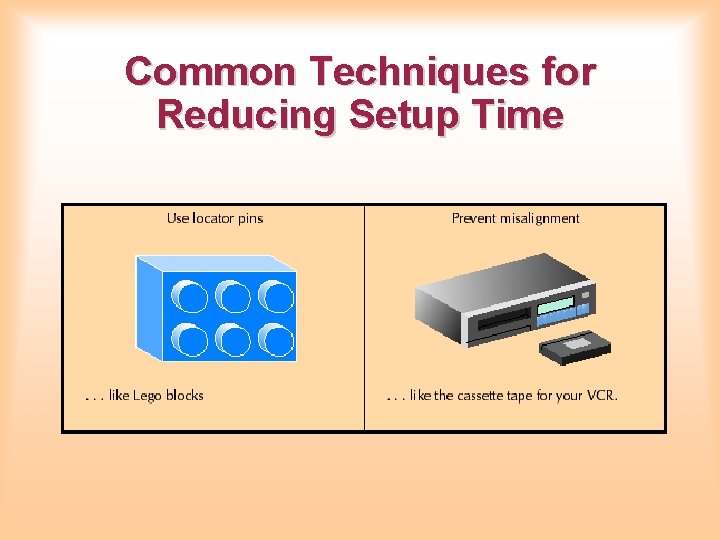
Common Techniques for Reducing Setup Time
Common Techniques for Reducing Setup Time
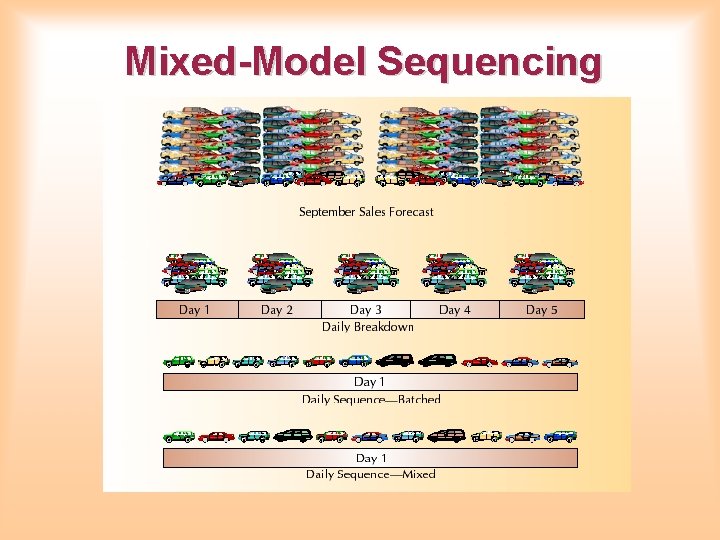
8. Uniform Production ü Results from smoothing production requirements ü Kanban systems can handle +/- 10% demand changes ü Smooths demand across planning horizon ü Mixed-model assembly steadies component production
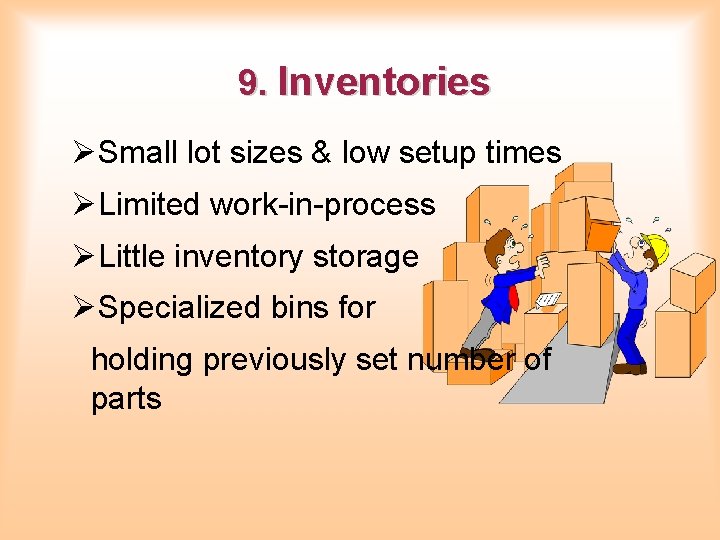
9. Inventories ØSmall lot sizes & low setup times ØLimited work-in-process ØLittle inventory storage ØSpecialized bins for holding previously set number of parts
Inventory Ø Traditional: inventory exists in case problems arise Ø JIT objective: eliminate inventory Ø JIT requires ØSmall lot sizes ØLow setup time ØContainers for fixed number of parts Ø JIT inventory: Minimum inventory to keep the system running
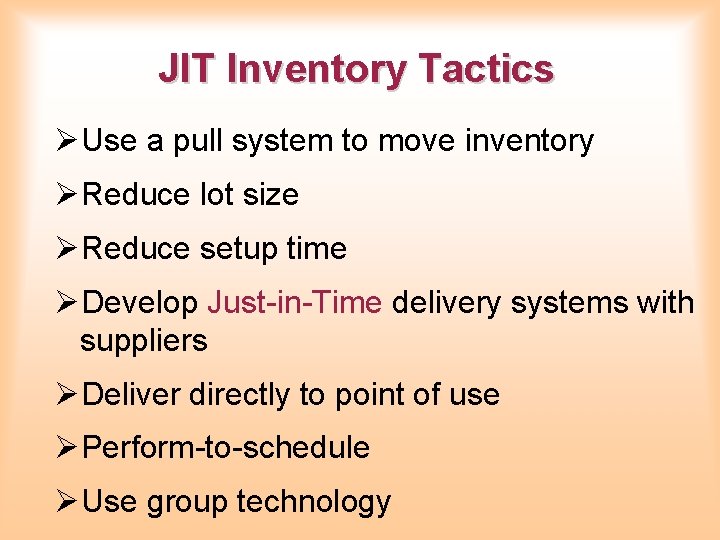
JIT Inventory Tactics ØUse a pull system to move inventory ØReduce lot size ØReduce setup time ØDevelop Just-in-Time delivery systems with suppliers ØDeliver directly to point of use ØPerform-to-schedule ØUse group technology
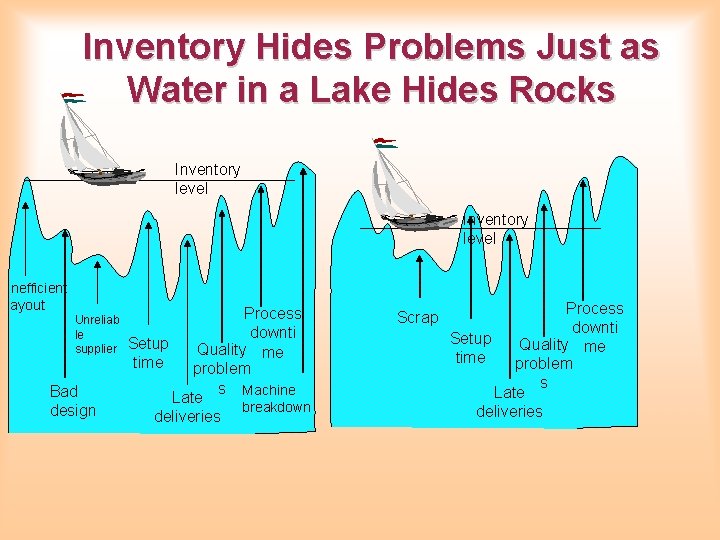
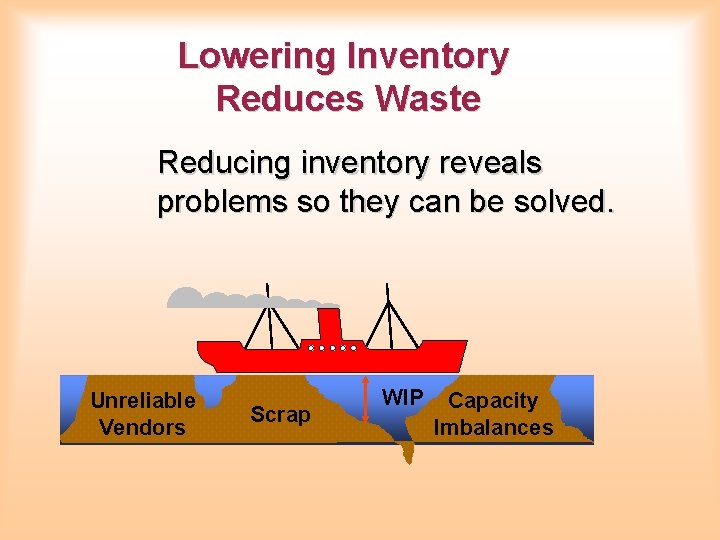
Inventory Hides Problems Just as Water in a Lake Hides Rocks Inventory level İnefficient layout Unreliab le supplier Bad design Process downti Setup Quality me time problem s Machine Late breakdown deliveries Scrap Process downti Setup Quality me time problem s Late deliveries
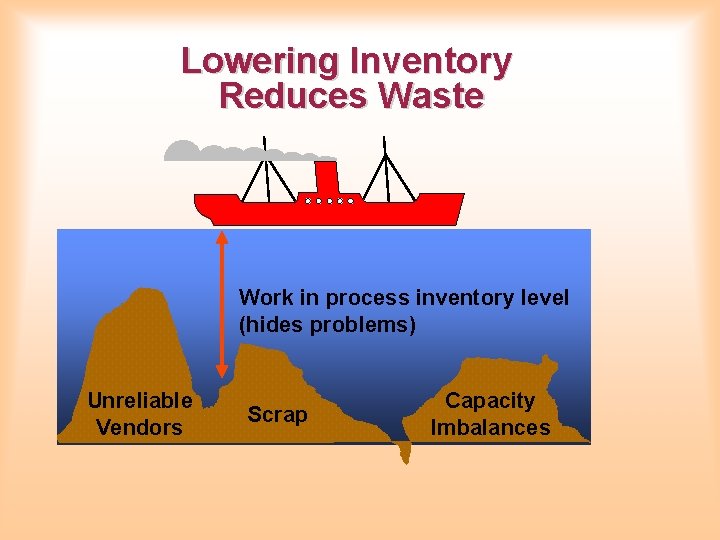
Lowering Inventory Reduces Waste Work in process inventory level (hides problems) Unreliable Vendors Scrap Capacity Imbalances
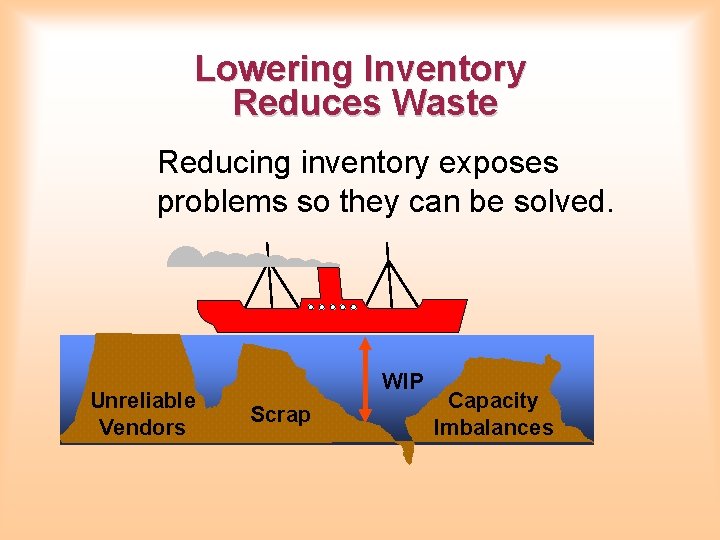
Lowering Inventory Reduces Waste Reducing inventory exposes problems so they can be solved. Unreliable Vendors WIP Scrap Capacity Imbalances
Lowering Inventory Reduces Waste Reducing inventory reveals problems so they can be solved. Unreliable Vendors Scrap WIP Capacity Imbalances
10. Supplier Relationships Ø Reduced number of vendors Ø Supportive supplier relationships Ø Quality deliveries on time Ø Frequent deliveries in small lot quantities Ø Reduced lead times
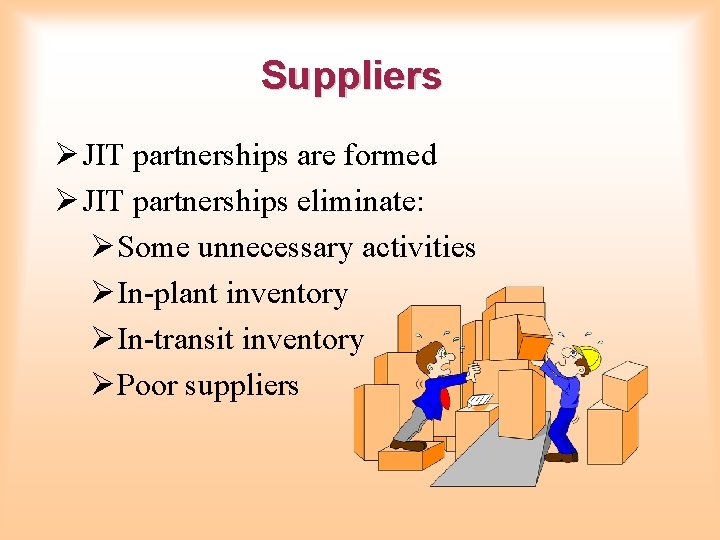
Suppliers Ø JIT partnerships are formed Ø JIT partnerships eliminate: ØSome unnecessary activities ØIn-plant inventory ØIn-transit inventory ØPoor suppliers
Characteristics of JIT Partnerships Suppliers · Few · Nearby · Long-term relationships · Analysis and support to enable desirable suppliers to become or stay price competitive · Buyer resists vertical integration and subsequent wipeout of supplier business · Suppliers encouraged to extend JIT to their suppliers (2 nd and 3 rd tier suppliers)
Characteristics of JIT Partnerships Quantities ØSteady output rate ØFrequent deliveries in small-lot quantities ØLong-term contract agreements ØMinimal or no paperwork (use EDI or internet) ØDelivery quantities fixed for whole contract term ØLittle or no permissible overage or underage
Characteristics of JIT Partnerships Quality ØMinimal product specifications imposed on suppliers ØHelp suppliers meet quality requirements ØClose relationship between buyers’ and suppliers quality assurance people ØSuppliers use poka-yoke and process control charts instead of lot-sampling techniques
Goals of JIT Partnerships v. Elimination of unnecessary activities v. Elimination of in-plant inventory v. Elimination of in-transit inventory v. Elimination of poor suppliers
Supplier Policies 1. Locate near to the customer 2. Use small, side loaded trucks and ship mixed loads 3. Consider establishing small warehouses near to the customer or consolidating warehouses with other suppliers 4. Use standardized containers and make deliveries according to a precise delivery schedule 5. Become a certified supplier and accept
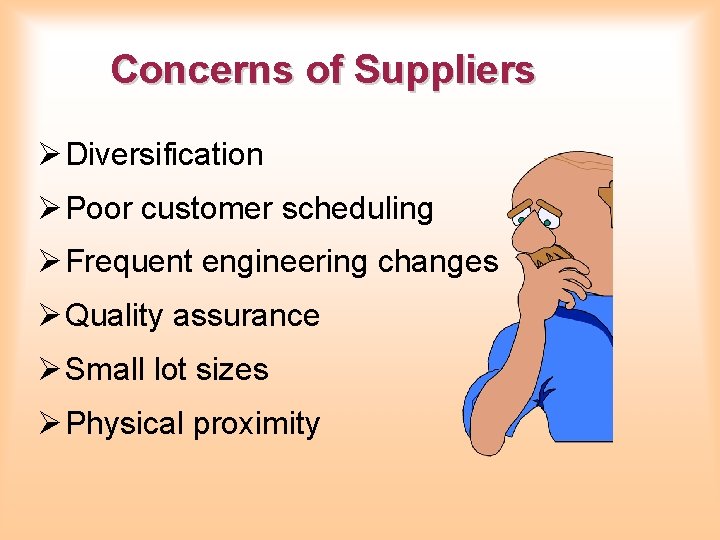
Concerns of Suppliers Ø Diversification Ø Poor customer scheduling Ø Frequent engineering changes Ø Quality assurance Ø Small lot sizes Ø Physical proximity
11. Scheduling Involves timing of operations Scheduling in JIT requires · Level loading (level schedules) · Zero deviation from schedules · Suppliers informed about schedules · Small lots · Kanban techniques
JIT Scheduling Tactics Scheduling in JIT requires (1 of 2): ØCommunicating the schedule to suppliers ØMaking level schedules ØFreezing part of the schedule ØPerforming to schedule ØSeeking one-piece-make and one-piecemove
JIT Scheduling Tactics Scheduling in JIT requires (2 of 2): ØElimination ofwaste ØProducing in small lots ØUsing kanbans ØMaking each operation produce a perfect part ØZero deviation from schedules
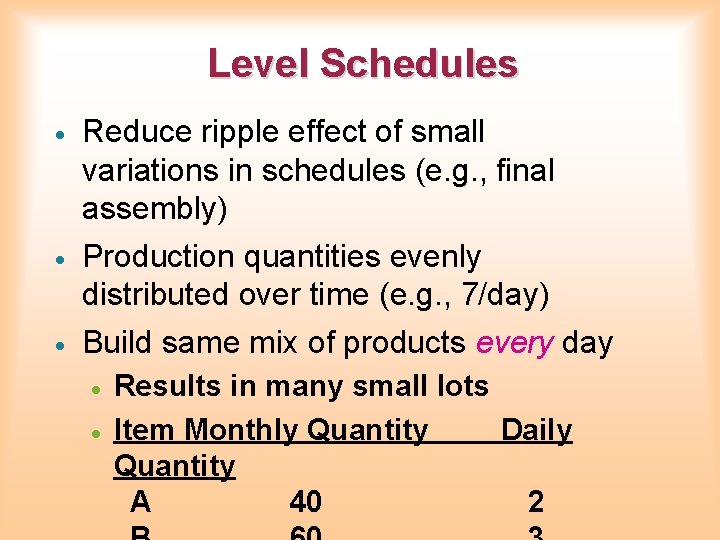
Level Schedules · · · Reduce ripple effect of small variations in schedules (e. g. , final assembly) Production quantities evenly distributed over time (e. g. , 7/day) Build same mix of products every day · · Results in many small lots Item Monthly Quantity Daily Quantity A 40 2
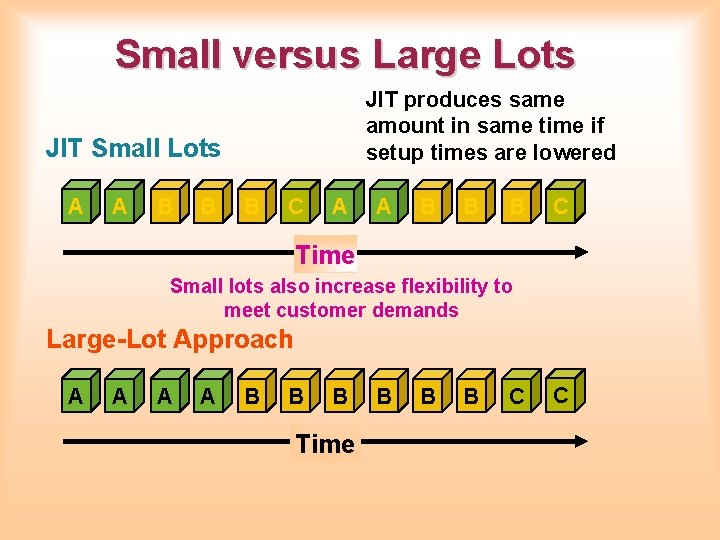
Small versus Large Lots JIT produces same amount in same time if setup times are lowered JIT Small Lots A A B B B C Time Small lots also increase flexibility to meet customer demands Large-Lot Approach A A B B B Time B B B C C
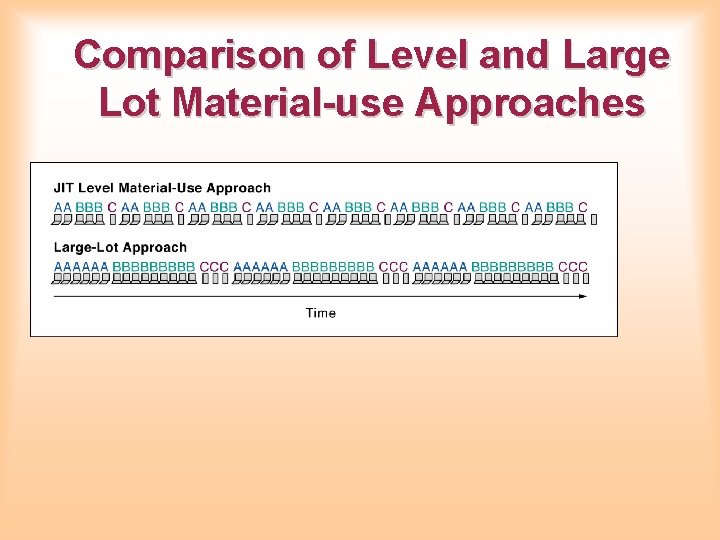
Comparison of Level and Large Lot Material-use Approaches
Mixed-Model Sequencing
12. Employee Empowerment Workers are assets Employee empowerment · Empowered and cross-trained employees (to help clear bottlenecks) · Get employees involved in product & process (employees know the job best!) · Few job classifications to ensure flexibility of employees · Training support
13. Quality Production ØJIT exposes quality problems by reducing inventory ØJIT eliminates number defects with small lots ØJIT requires quality by suppliers ØTeam approach and continuous improvement are important for ensuring quality ØQuality is maintained by the following procedure: Find the root cause of the problem, solve
Quality Production ØJIT requires TQM ØStatistical process control ØContinuous improvement ØWorker involvement & empowered employees ØInspect own work ØQuality circles ØImmediate feedback ØFailsafe methods such as poka-yoke ØQuality at the source
Quality Production JIT requires 1) Quality within the firm · Autonomation (jidoka): automatic detection of defects during production 2) Quality by suppliers
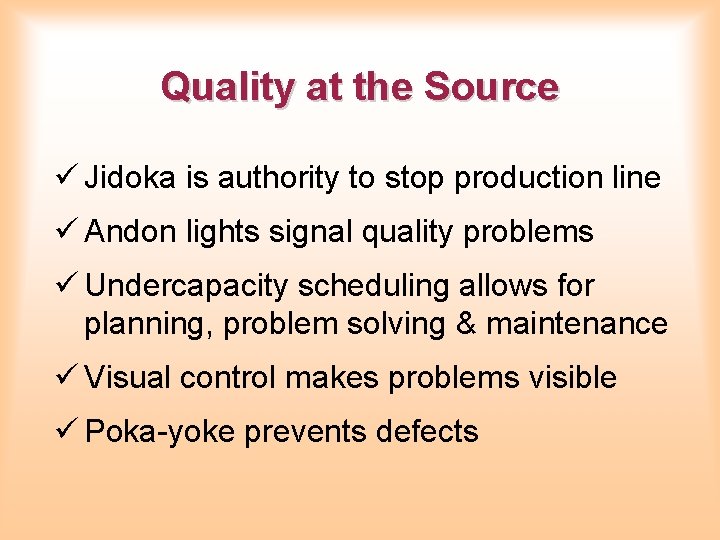
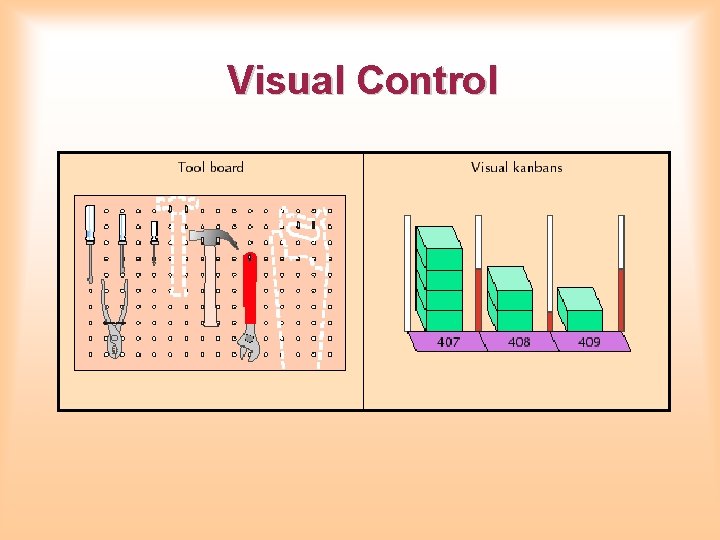
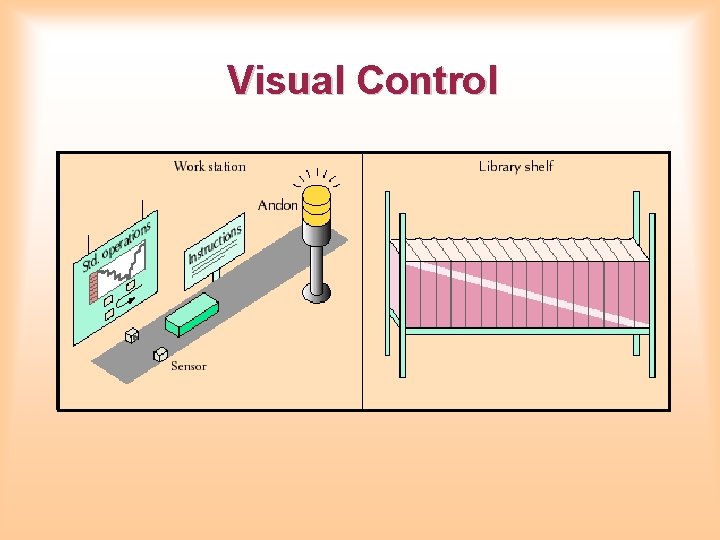
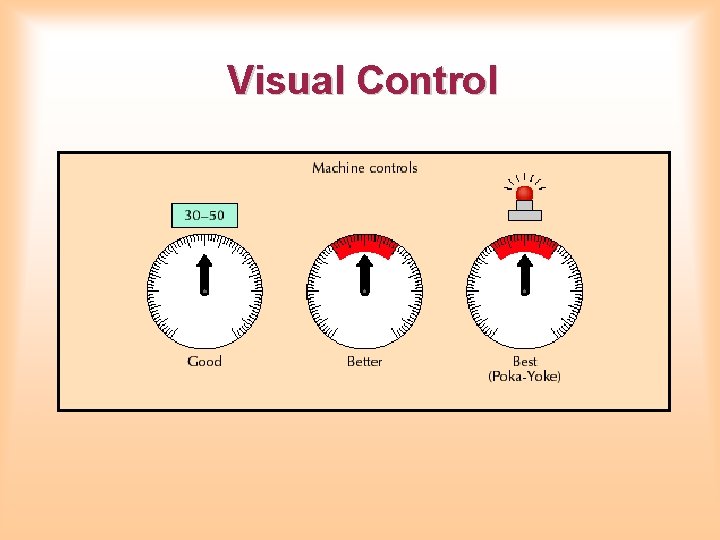
Quality at the Source ü Jidoka is authority to stop production line ü Andon lights signal quality problems ü Undercapacity scheduling allows for planning, problem solving & maintenance ü Visual control makes problems visible ü Poka-yoke prevents defects
Visual Control
Visual Control
Visual Control
Kaizen ü Continuous improvement ü Requires total employment involvement ü Essence of JIT is willingness of workers to üSpot quality problems üHalt production when necessary üGenerate ideas for improvement üAnalyze problems
14. Preventive Maintenance ØAll activities involved in keeping equipment in working order ØDone to prevent failure ØJIT requires ØScheduled & daily PM ØOperator involvement in PM ØKnows machines ØResponsible for product quality
Total Productive Maintenance (TPM) ü Breakdown maintenance üRepairs to make failed machine operational ü Preventive maintenance üSystem of periodic inspection & maintenance to keep machines operating ü TPM combines preventive maintenance & total quality concepts
TPM Requires Management to: ü Design products that can be easily produced on existing machines ü Design machines for easier operation, changeover, maintenance ü Train & retrain workers to operate machines ü Purchase machines that maximize productive potential ü Design preventive maintenance plan
15. Bottom-round Management Style & Commitment · Support of management, employees and suppliers Any improvement must be made in accordance with the scientific method, under the quidance of a teacher, at the lowest possible level in the organization (Toyota Production System’s
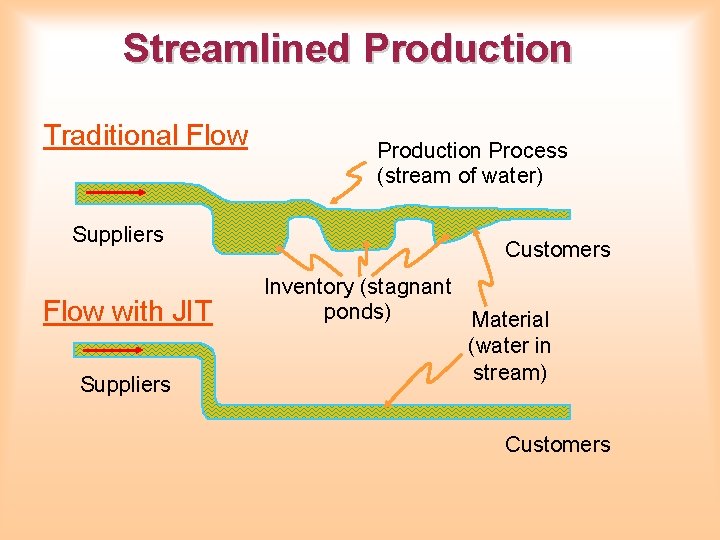
Streamlined Production Traditional Flow Suppliers Flow with JIT Suppliers Production Process (stream of water) Customers Inventory (stagnant ponds) Material (water in stream) Customers
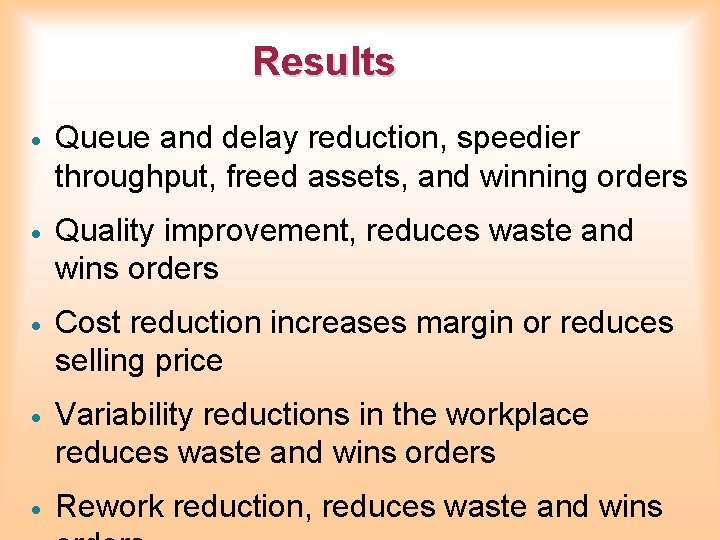
Results · Queue and delay reduction, speedier throughput, freed assets, and winning orders · Quality improvement, reduces waste and wins orders · Cost reduction increases margin or reduces selling price · Variability reductions in the workplace reduces waste and wins orders · Rework reduction, reduces waste and wins
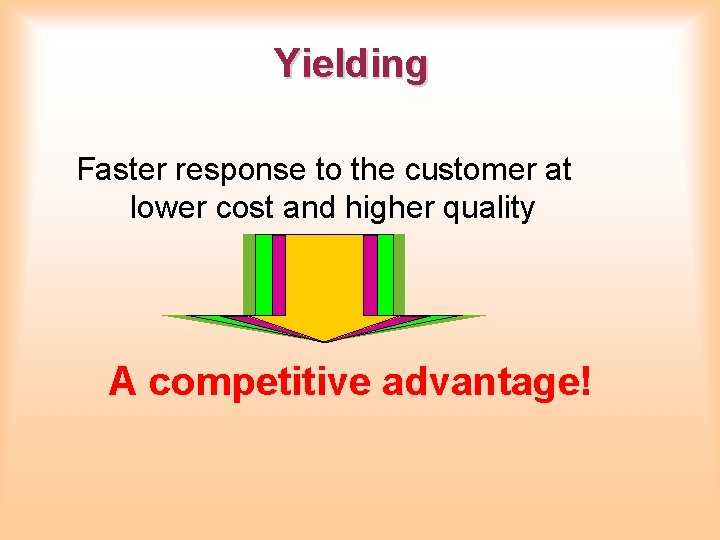
Yielding Faster response to the customer at lower cost and higher quality A competitive advantage!
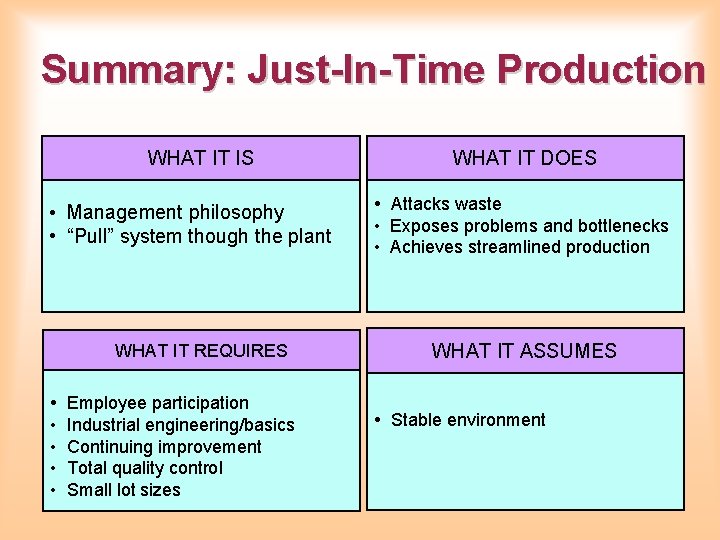
Summary: Just-In-Time Production WHAT IT IS • Management philosophy • “Pull” system though the plant WHAT IT REQUIRES • Employee participation • • Industrial engineering/basics Continuing improvement Total quality control Small lot sizes WHAT IT DOES • Attacks waste • Exposes problems and bottlenecks • Achieves streamlined production WHAT IT ASSUMES • Stable environment
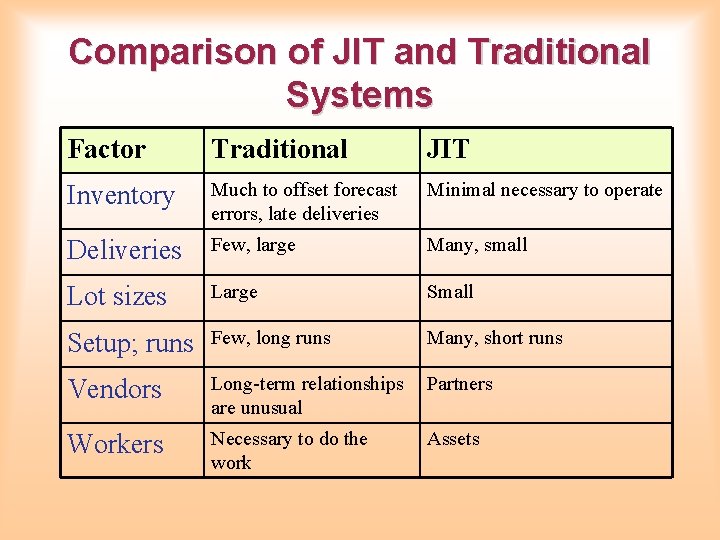
Comparison of JIT and Traditional Systems Factor Traditional JIT Inventory Much to offset forecast errors, late deliveries Minimal necessary to operate Deliveries Few, large Many, small Lot sizes Large Small Setup; runs Few, long runs Many, short runs Vendors Long-term relationships are unusual Partners Workers Necessary to do the work Assets
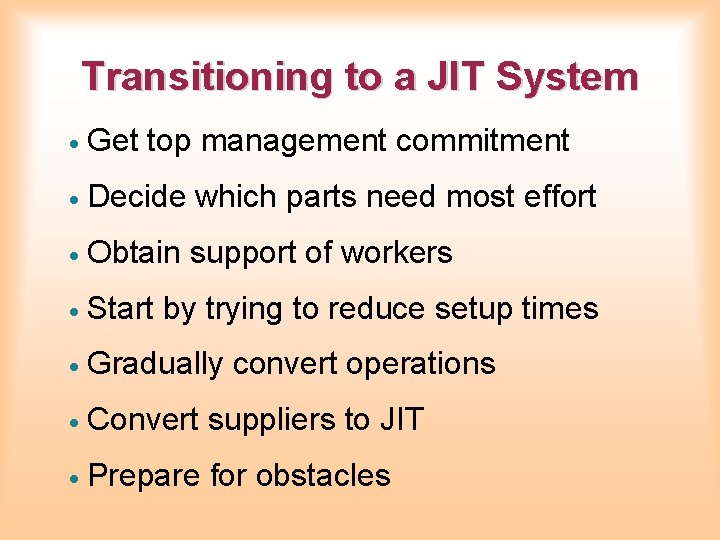
Transitioning to a JIT System · Get top management commitment · Decide which parts need most effort · Obtain support of workers · Start by trying to reduce setup times · Gradually convert operations · Convert suppliers to JIT · Prepare for obstacles
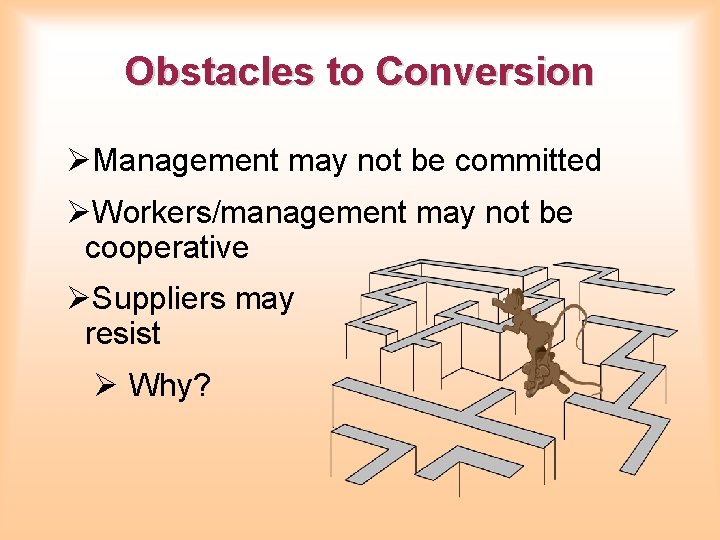
Obstacles to Conversion ØManagement may not be committed ØWorkers/management may not be cooperative ØSuppliers may resist Ø Why?
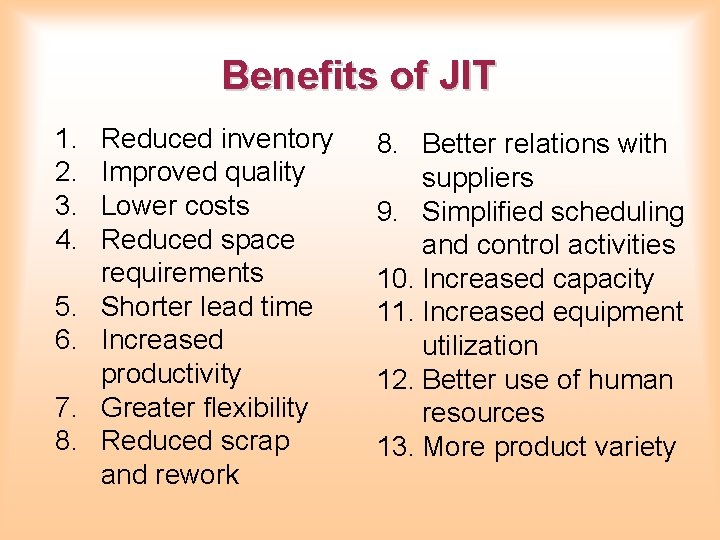
Benefits of JIT 1. 2. 3. 4. 5. 6. 7. 8. Reduced inventory Improved quality Lower costs Reduced space requirements Shorter lead time Increased productivity Greater flexibility Reduced scrap and rework 8. Better relations with suppliers 9. Simplified scheduling and control activities 10. Increased capacity 11. Increased equipment utilization 12. Better use of human resources 13. More product variety
JIT in Services (1 of 3) The basic goal of the demand flow technology in the service organization is to provide optimum response to the customer with the highest quality service and lowest possible cost.
JIT in Services (2 of 3) All the techniques used in manufacturing are used in services ØLevel the facility load & eliminate disruptions and unnecessary activities ØReorganize physical configuration ØIntroduce demand-pull scheduling ØDevelop supplier networks
. JIT in Services (3 of 3) All the techniques used in manufacturing are used in services · Make the system flexible · Eliminate · Simplify waste the process · Organize · Upgrade problem solving groups quality
JIT Implementation ü Use JIT to finely tune an operating system ü Somewhat different in USA than Japan ü JIT is still evolving ü JIT isn’t for everyone
Attributes of Lean Producers - They · use JIT to eliminate virtually all inventory · build systems to help employees produce a perfect part every time · reduce space requirements · develop close relationships with suppliers · educate suppliers
Attributes of Lean Producers - They Ø eliminate all but value-added activities Ø develop the workforce Ø make jobs more challenging Ø reduce the number of job classes and build worker flexibility