
Introduction to Lean Six Sigma A Human Resources
- Slides: 33
Introduction to Lean Six Sigma A Human Resources Perspective
Agenda �Short Biography �History of Lean Six Sigma (LSS) �LSS Methodology �Success Factors �Application to HR �Examples of project ideas �New York ISO case study
About the Presenter David Duda �Over twelve years of LSS experience �Delta Airlines, Inc. 1998 -2008 �Production based application of LSS �New York Independent System Operator 2008 -- Present �Service/transactional based application of LSS �Certified Six Sigma Black Belt �Contact Info: pdduda@gmail. com
The History of Lean Six Sigma A New Approach to Quality
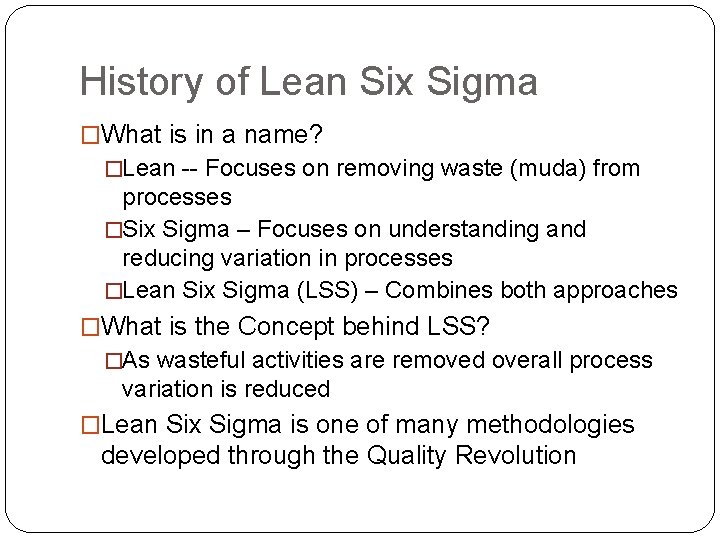
History of Lean Six Sigma �What is in a name? �Lean -- Focuses on removing waste (muda) from processes �Six Sigma – Focuses on understanding and reducing variation in processes �Lean Six Sigma (LSS) – Combines both approaches �What is the Concept behind LSS? �As wasteful activities are removed overall process variation is reduced �Lean Six Sigma is one of many methodologies developed through the Quality Revolution
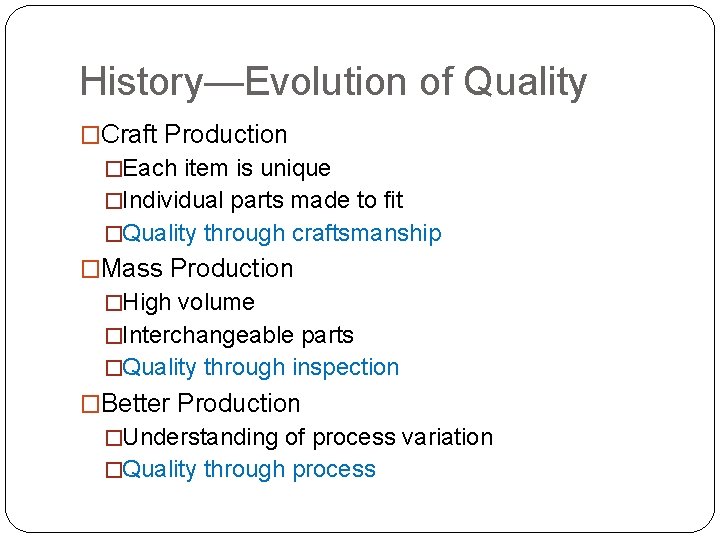
History—Evolution of Quality �Craft Production �Each item is unique �Individual parts made to fit �Quality through craftsmanship �Mass Production �High volume �Interchangeable parts �Quality through inspection �Better Production �Understanding of process variation �Quality through process
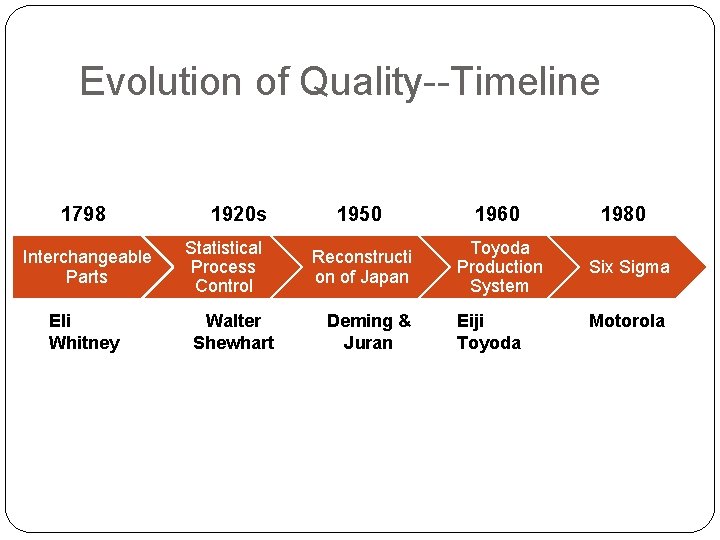
Evolution of Quality--Timeline 1798 Interchangeable Parts Eli Whitney 1920 s Statistical Process Control Walter Shewhart 1950 1960 Reconstructi on of Japan Toyoda Production System Deming & Juran Eiji Toyoda 1980 Six Sigma Motorola
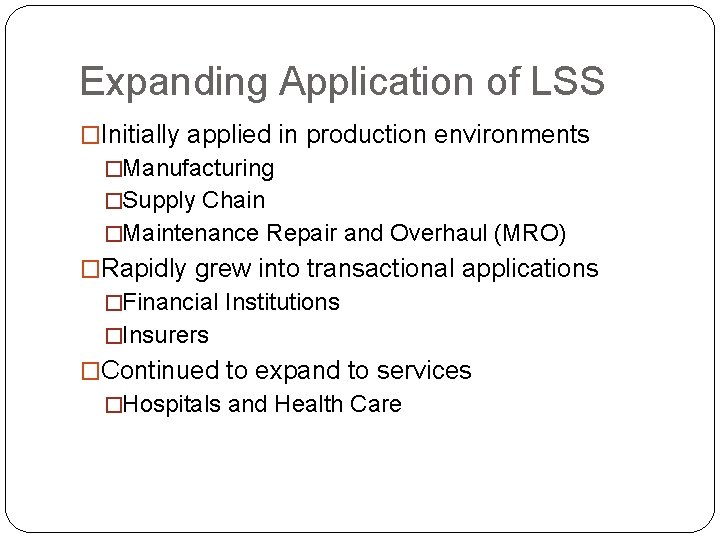
Expanding Application of LSS �Initially applied in production environments �Manufacturing �Supply Chain �Maintenance Repair and Overhaul (MRO) �Rapidly grew into transactional applications �Financial Institutions �Insurers �Continued to expand to services �Hospitals and Health Care
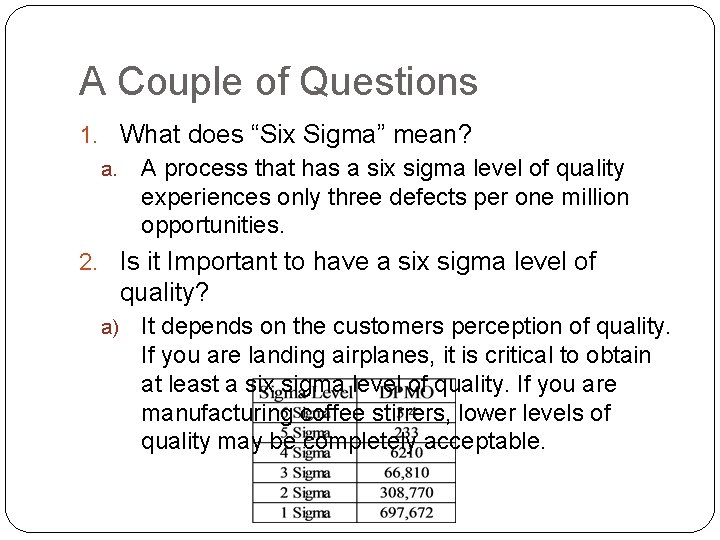
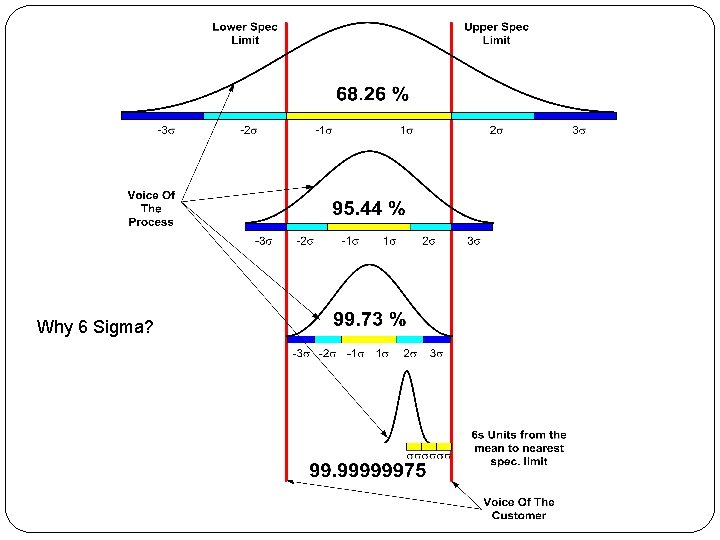
A Couple of Questions 1. What does “Six Sigma” mean? a. A process that has a six sigma level of quality experiences only three defects per one million opportunities. 2. Is it Important to have a six sigma level of quality? a) It depends on the customers perception of quality. If you are landing airplanes, it is critical to obtain at least a six sigma level of quality. If you are manufacturing coffee stirrers, lower levels of quality may be completely acceptable.
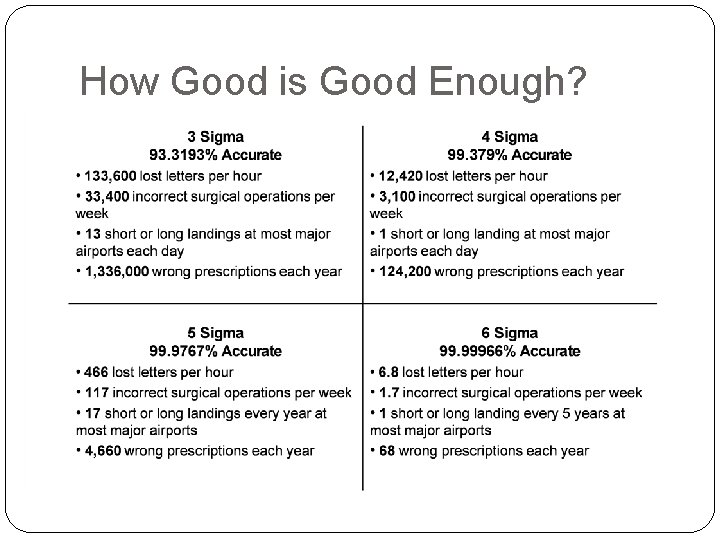
How Good is Good Enough?
Lean Six Sigma Methodology What is Lean Six Sigma?
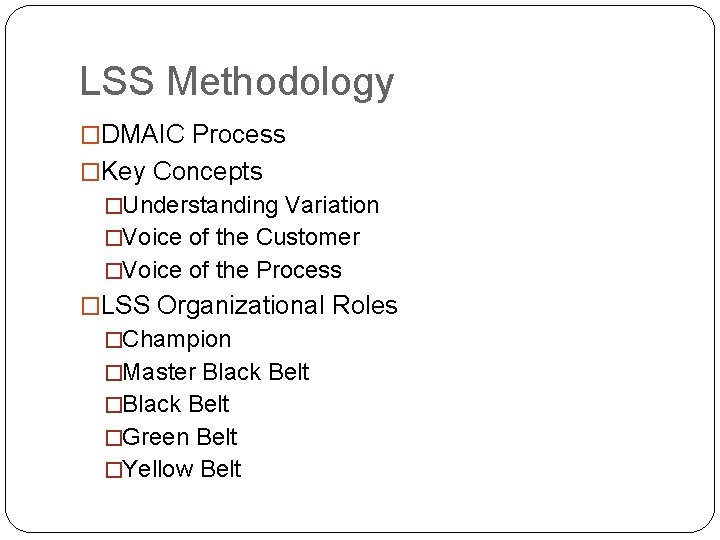
LSS Methodology �DMAIC Process �Key Concepts �Understanding Variation �Voice of the Customer �Voice of the Process �LSS Organizational Roles �Champion �Master Black Belt �Green Belt �Yellow Belt
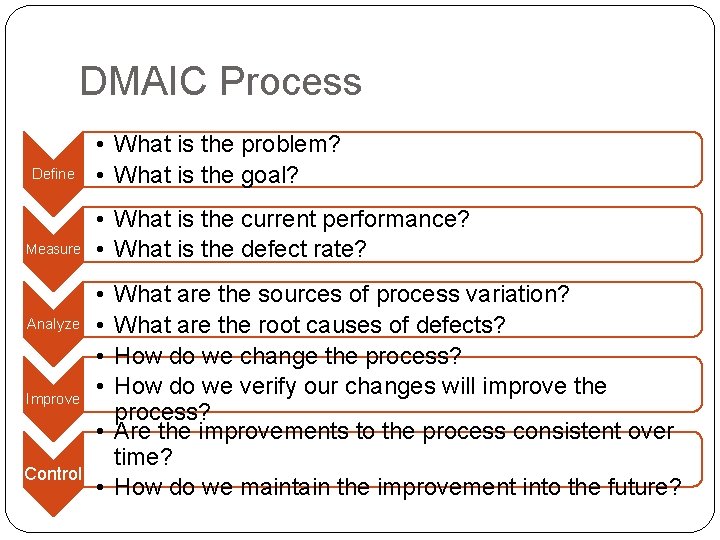
DMAIC Process Define Measure Analyze Improve Control • What is the problem? • What is the goal? • What is the current performance? • What is the defect rate? • • What are the sources of process variation? What are the root causes of defects? How do we change the process? How do we verify our changes will improve the process? • Are the improvements to the process consistent over time? • How do we maintain the improvement into the future?
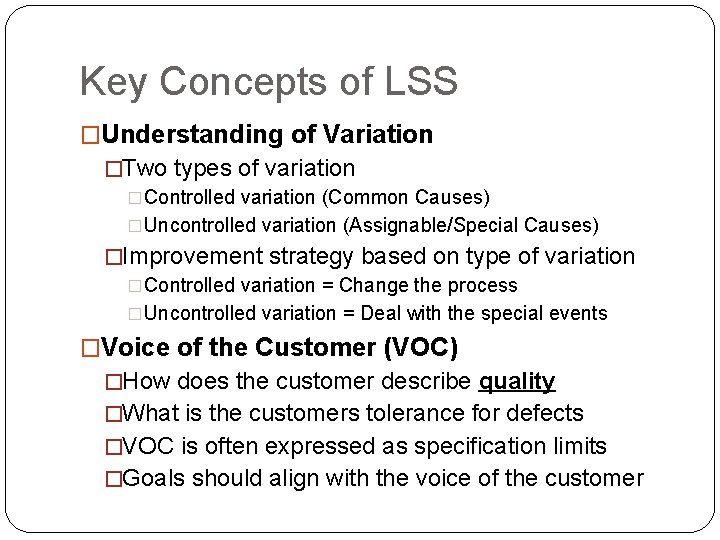
Key Concepts of LSS �Understanding of Variation �Two types of variation �Controlled variation (Common Causes) �Uncontrolled variation (Assignable/Special Causes) �Improvement strategy based on type of variation �Controlled variation = Change the process �Uncontrolled variation = Deal with the special events �Voice of the Customer (VOC) �How does the customer describe quality �What is the customers tolerance for defects �VOC is often expressed as specification limits �Goals should align with the voice of the customer
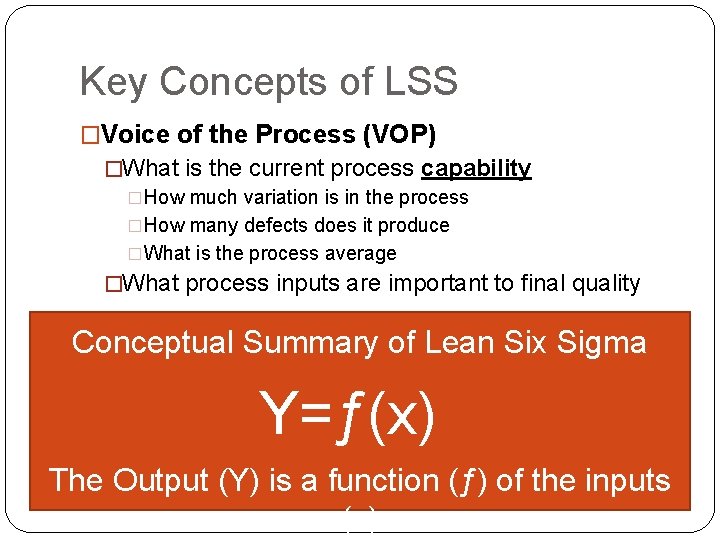
Key Concepts of LSS �Voice of the Process (VOP) �What is the current process capability �How much variation is in the process �How many defects does it produce �What is the process average �What process inputs are important to final quality Conceptual Summary of Lean Six Sigma Y=ƒ(x) The Output (Y) is a function (ƒ) of the inputs (x)
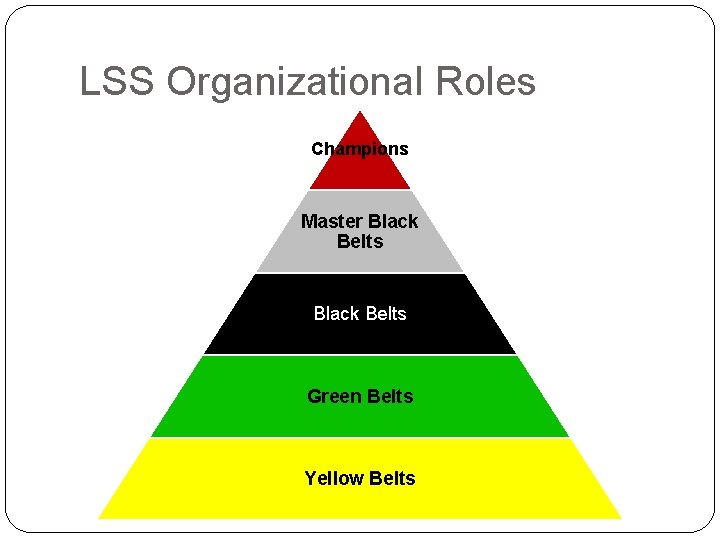
LSS Organizational Roles Champions Master Black Belts Green Belts Yellow Belts
Lean Six Sigma Success Factors What are the building blocks for successful LSS programs?
Considerations for LSS Success �Organizational Factors �Commitment of Senior Management �Clear organizational vision and goals �Effective LSS training strategy �LSS Team Factors �Flexibility �Practicality �Focus on Customers (Internal and external) �Strengths of LSS Methodology �Data Based �Scalable �Structured
Considerations for LSS Success �LSS Challenges �It is not a quick win approach to continuous improvement �It requires an investment �It requires a degree of organizational humility
Applying LSS in Human Resources Can I apply LSS to my processes?
Questions for Consideration 1. You have mentioned that LSS is an organizational approach. Can I learn LSS concepts and apply them to my area of expertise? 2. What are the challenges faced when trying to apply LSS to HR processes when the larger organization hasn’t embraced the methodology? 3. What are the unique challenges for HR in the application of LSS? 4. What types of process are idea for LSS application?
Effective LSS Application In HR A Case Study: The New York Independent Operator (NYISO)
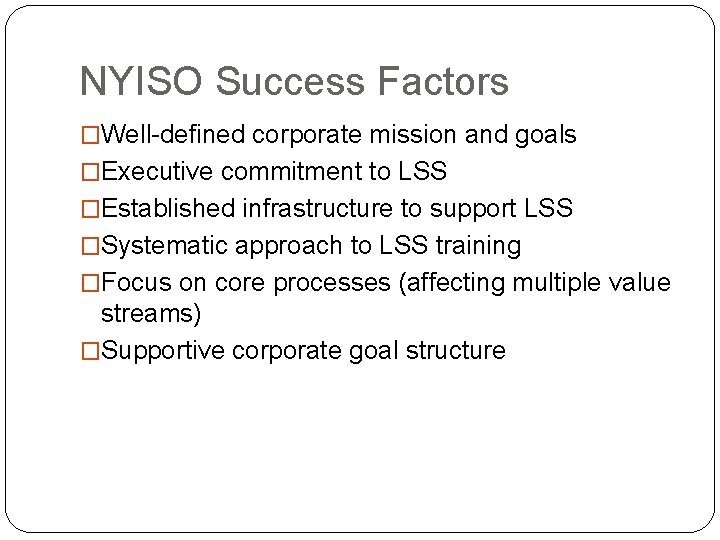
NYISO Success Factors �Well-defined corporate mission and goals �Executive commitment to LSS �Established infrastructure to support LSS �Systematic approach to LSS training �Focus on core processes (affecting multiple value streams) �Supportive corporate goal structure
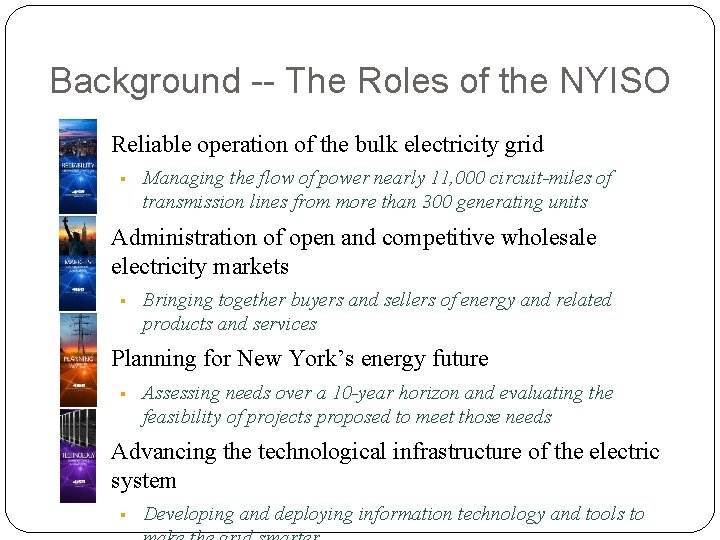
Background -- The Roles of the NYISO w Reliable operation of the bulk electricity grid § Managing the flow of power nearly 11, 000 circuit-miles of transmission lines from more than 300 generating units w Administration of open and competitive wholesale electricity markets § Bringing together buyers and sellers of energy and related products and services w Planning for New York’s energy future § Assessing needs over a 10 -year horizon and evaluating the feasibility of projects proposed to meet those needs w Advancing the technological infrastructure of the electric system § Developing and deploying information technology and tools to
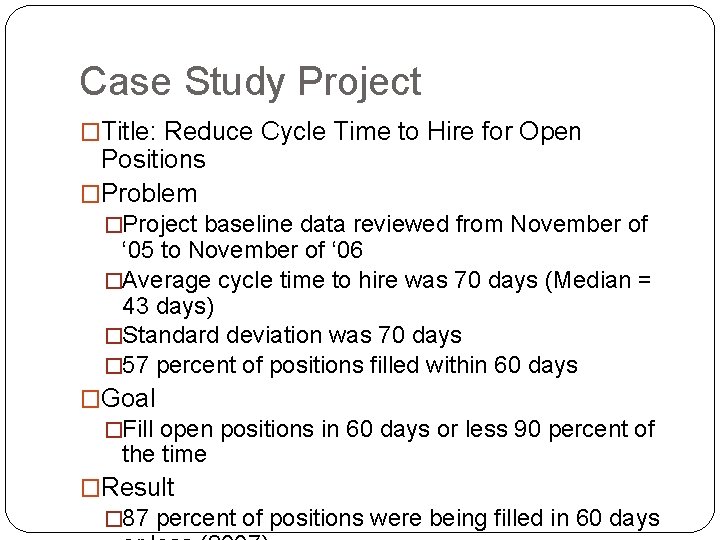
Case Study Project �Title: Reduce Cycle Time to Hire for Open Positions �Problem �Project baseline data reviewed from November of ‘ 05 to November of ‘ 06 �Average cycle time to hire was 70 days (Median = 43 days) �Standard deviation was 70 days � 57 percent of positions filled within 60 days �Goal �Fill open positions in 60 days or less 90 percent of the time �Result � 87 percent of positions were being filled in 60 days
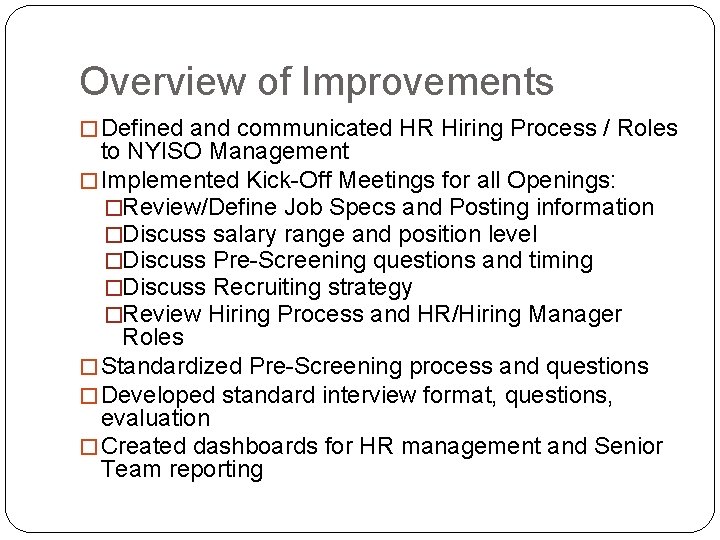
Overview of Improvements � Defined and communicated HR Hiring Process / Roles to NYISO Management � Implemented Kick-Off Meetings for all Openings: �Review/Define Job Specs and Posting information �Discuss salary range and position level �Discuss Pre-Screening questions and timing �Discuss Recruiting strategy �Review Hiring Process and HR/Hiring Manager Roles � Standardized Pre-Screening process and questions � Developed standard interview format, questions, evaluation � Created dashboards for HR management and Senior Team reporting
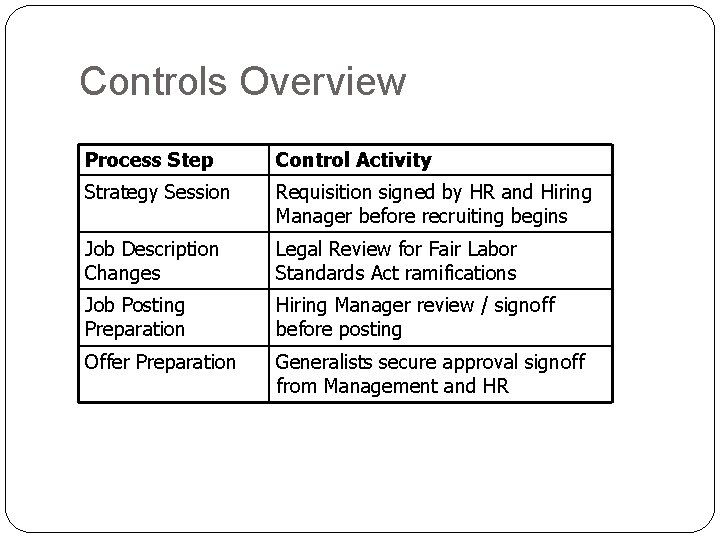
Controls Overview Process Step Control Activity Strategy Session Requisition signed by HR and Hiring Manager before recruiting begins Job Description Changes Legal Review for Fair Labor Standards Act ramifications Job Posting Preparation Hiring Manager review / signoff before posting Offer Preparation Generalists secure approval signoff from Management and HR
Appendix Supplemental Material
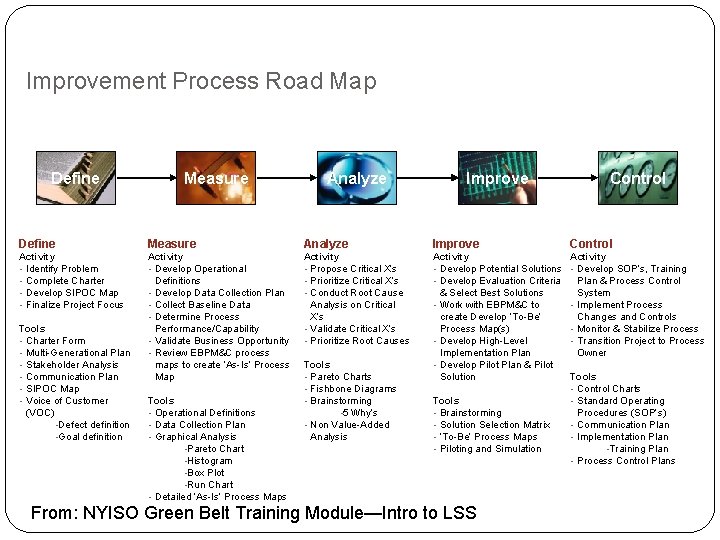
Improvement Process Road Map Define Measure Analyze Improve Control Activity • Identify Problem • Complete Charter • Develop SIPOC Map • Finalize Project Focus Activity • Develop Operational Definitions • Develop Data Collection Plan • Collect Baseline Data • Determine Process Performance/Capability • Validate Business Opportunity • Review EBPM&C process maps to create ‘As-Is’ Process Map Activity • Propose Critical X’s • Prioritize Critical X’s • Conduct Root Cause Analysis on Critical X’s • Validate Critical X’s • Prioritize Root Causes Activity • Develop Potential Solutions • Develop Evaluation Criteria & Select Best Solutions • Work with EBPM&C to create Develop ‘To-Be’ Process Map(s) • Develop High-Level Implementation Plan • Develop Pilot Plan & Pilot Solution Activity • Develop SOP’s, Training Plan & Process Control System • Implement Process Changes and Controls • Monitor & Stabilize Process • Transition Project to Process Owner Tools • Charter Form • Multi-Generational Plan • Stakeholder Analysis • Communication Plan • SIPOC Map • Voice of Customer (VOC) • Defect definition • Goal definition Tools • Operational Definitions • Data Collection Plan • Graphical Analysis • Pareto Chart • Histogram • Box Plot • Run Chart • Detailed ‘As-Is’ Process Maps Tools • Pareto Charts • Fishbone Diagrams • Brainstorming • 5 Why’s • Non Value-Added Analysis Tools • Brainstorming • Solution Selection Matrix • ‘To-Be’ Process Maps • Piloting and Simulation From: NYISO Green Belt Training Module—Intro to LSS Tools • Control Charts • Standard Operating Procedures (SOP’s) • Communication Plan • Implementation Plan • Training Plan • Process Control Plans
Why 6 Sigma?
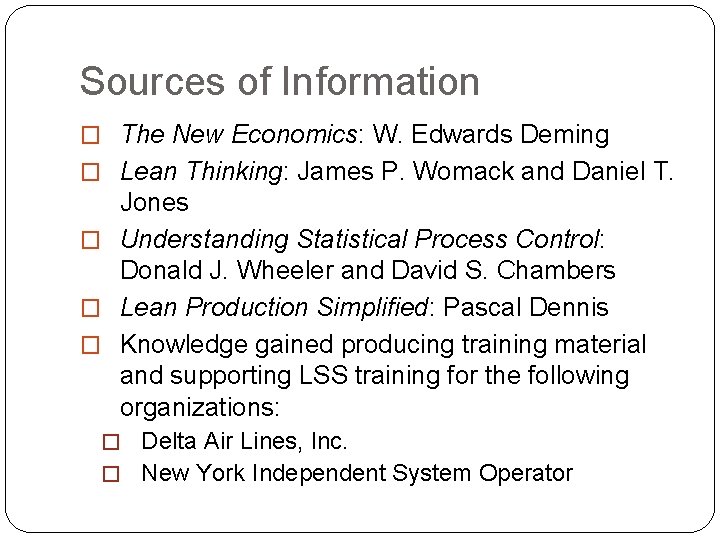
Sources of Information � The New Economics: W. Edwards Deming � Lean Thinking: James P. Womack and Daniel T. Jones � Understanding Statistical Process Control: Donald J. Wheeler and David S. Chambers � Lean Production Simplified: Pascal Dennis � Knowledge gained producing training material and supporting LSS training for the following organizations: � Delta Air Lines, Inc. � New York Independent System Operator
Helpful Links General Info: Six Sigma Website: http: //www. isixsigma. com Organizations that provide Six Sigma Training: ASQ: http: //asq. org/certification/index. html BMGI: http: //www. bmgi. com/
Disclaimer This presentation was not prepared by, with, or for the New York Independent System Operator, Inc. , and any opinions expressed or conclusions reached herein are not the opinions or conclusions of the New York Independent System Operator, Inc.