Home Hygiene Prevention of infection at home and

- Slides: 58
Home Hygiene Prevention of infection at home and in everyday life: a learning and training resource International Scientific Forum on Home Hygiene and Infection Prevention Society 2018 1
Using this resource on hygiene in home and everyday life Changes in recent years mean that prevention of infection through hygiene in home and everyday life is becoming increasingly important. One of the current drivers is the fundamental part that hygiene plays in tackling antibiotic resistance. It is also prompted by concerns about growing numbers of people at greater risk of infection being cared for or caring for themselves in the community. The International Scientific Forum on Home Hygiene (IFH) and the Infection Prevention Society (IPS) have produced a teaching/self learning resource on hygiene in home and everyday life. This is available from https: //www. ifh-homehygiene. org/training-best-practice/home-hygiene-%E 2%80%93 -prevention-infectionhome-training-resource-carers-and-their To support the use of this resource for learning and training, we have produced this supplementary resource which contains only the “hygiene advice” sheets This resource can be used either for Power. Point group presentations, or for printing (either in whole or in parts) and distribution to those who you are training – or to leave behind with family members Turn the page to learn more 2
Who is this resource for? This resource is intended primarily for: Training of professional carers who provide care in the home Use by professional carers for support/guidance of family members or informal carers who look after others at home Training of (or self-learning use by) any group requiring understanding of hygiene in home and everyday life, such as doctors, pharmacists, school teachers, public health/social care workers, health promotion organisations, food standards authorities, consumer groups and commercial organisations Use by the media for preparing health features Use by public-facing groups for developing hygiene advice for the public It can also be used by the public to teach themselves about home and everyday life hygiene The resource is designed for teaching or self-learning. It aims to show that home and everyday life hygiene is simple and logical. 3
Contents Introduction What’s this resource about? Who is it for? How to use this resource Using this resource for training of professional carers Using this resource for supporting family carers and family members Vocational training in health and social care Participatory exercises to develop understanding 1. Understanding hygiene in home & everyday life Module 1: Breaking the chain of infection through targeted hygiene 21 2. Putting hygiene into practice Module 2: Hand hygiene Module 3: Respiratory hygiene Module 4: Food hygiene Module 5: General environmental hygiene Cloths and cleaning equipment Surfaces commonly touched by hands Toilets, nappies, pads, potties and changing mats Baths, sinks, showers, whirlpool baths and tiled surfaces Floors, walls and soft furnishings Pets and other animals Toys and play equipment Clothing, household linens and laundering Module 6: Waste disposal 3. Where there is more risk – hygiene in home healthcare Module 7: Where there is more risk of infection Introduction Healthy people at greater risk of infection Poor living conditions, unhealthy lifestyles Home healthcare Medical equipment and dressings Wound care Preventing urinary tract infections Caring for a catheter bag Module 8: People who are infected and pose a risk to others Gastrointestinal infections continued over
3 contd: Where there is more risk – hygiene in home healthcare Respiratory infections Clostridium difficile Skin and wound infections Module 9: Protective clothing and gloves 4. Other Issues Module 10: Tackling antibiotic resistance: role of hygiene Module 11: Choosing a disinfectant
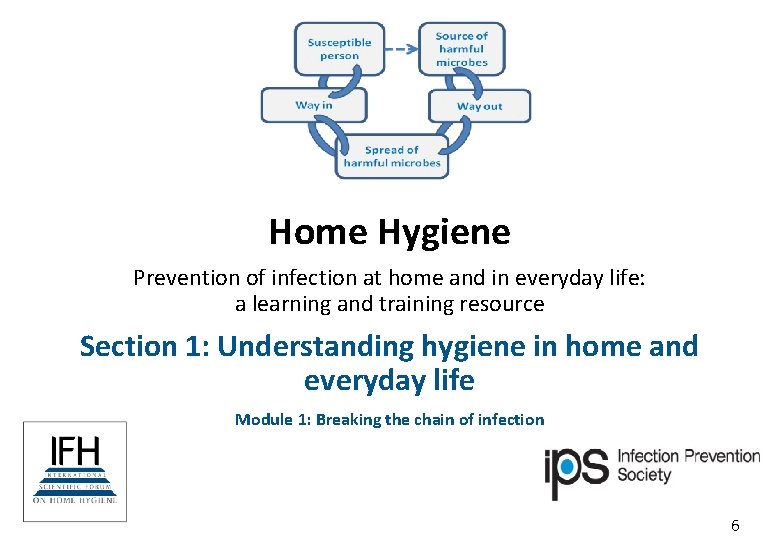
Home Hygiene Prevention of infection at home and in everyday life: a learning and training resource Section 1: Understanding hygiene in home and everyday life Module 1: Breaking the chain of infection 6
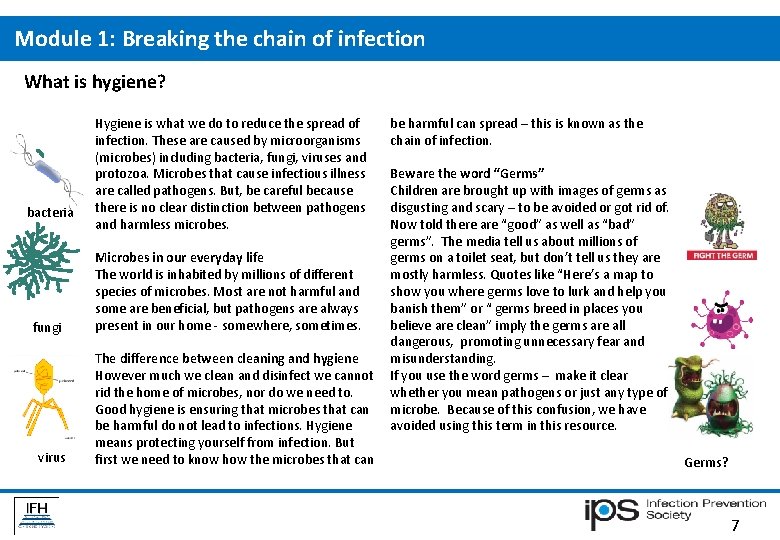
Module 1: Breaking the chain of infection What is hygiene? bacteria fungi virus Hygiene is what we do to reduce the spread of infection. These are caused by microorganisms (microbes) including bacteria, fungi, viruses and protozoa. Microbes that cause infectious illness are called pathogens. But, be careful because there is no clear distinction between pathogens and harmless microbes. be harmful can spread – this is known as the chain of infection. Beware the word “Germs” Children are brought up with images of germs as disgusting and scary – to be avoided or got rid of. Now told there are “good” as well as “bad” germs”. The media tell us about millions of Microbes in our everyday life germs on a toilet seat, but don’t tell us they are The world is inhabited by millions of different mostly harmless. Quotes like “Here’s a map to species of microbes. Most are not harmful and show you where germs love to lurk and help you some are beneficial, but pathogens are always banish them” or “ germs breed in places you present in our home - somewhere, sometimes. believe are clean” imply the germs are all dangerous, promoting unnecessary fear and The difference between cleaning and hygiene misunderstanding. However much we clean and disinfect we cannot If you use the word germs – make it clear rid the home of microbes, nor do we need to. whether you mean pathogens or just any type of Good hygiene is ensuring that microbes that can microbe. Because of this confusion, we have avoided using this term in this resource. be harmful do not lead to infections. Hygiene means protecting yourself from infection. But first we need to know how the microbes that can Germs? Turn the page to learn more 7
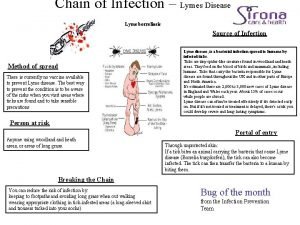
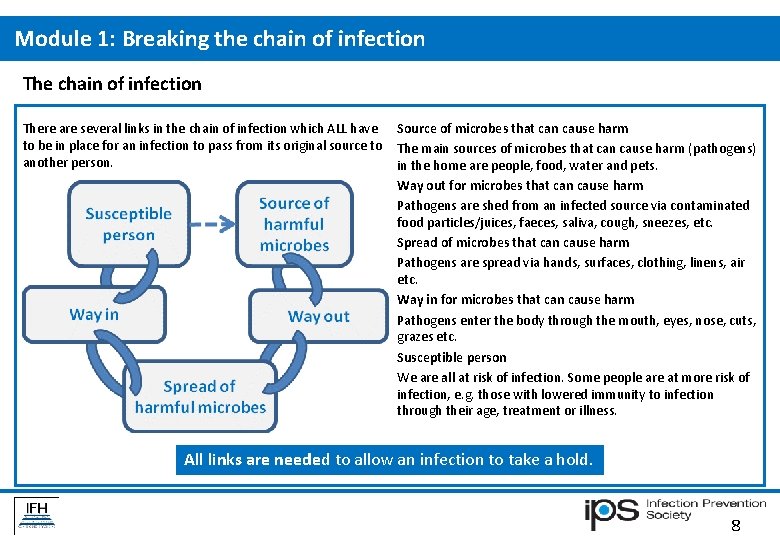
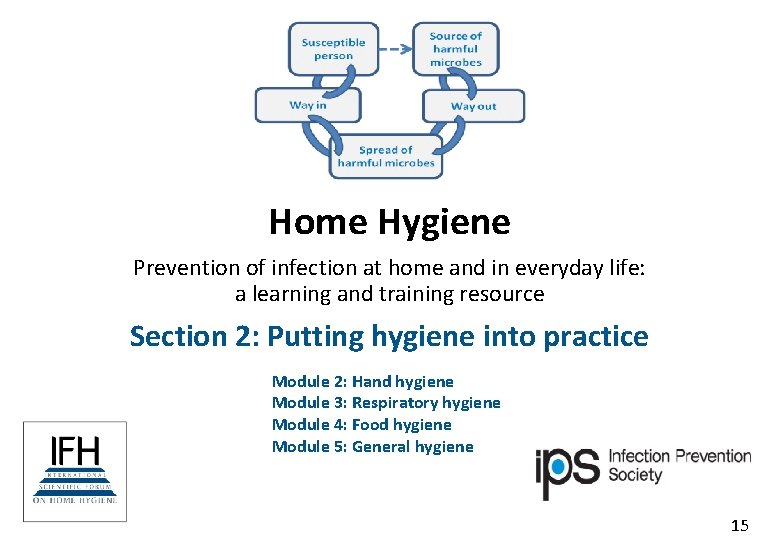
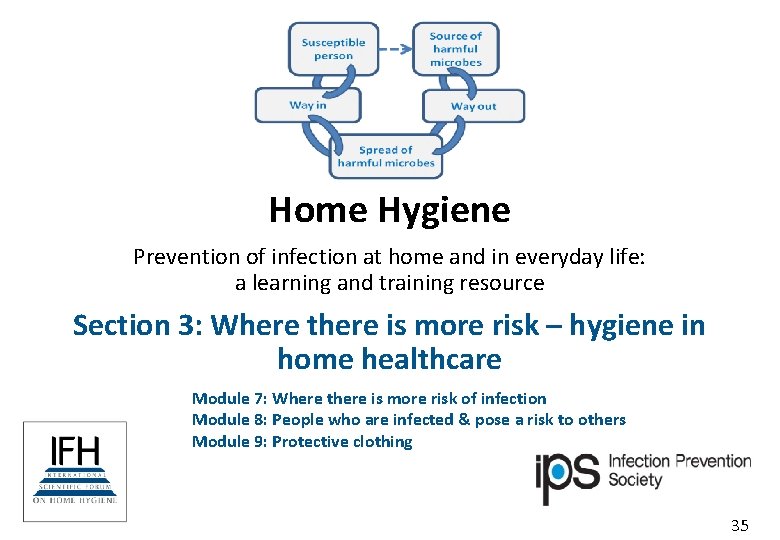
Module 1: Breaking the chain of infection There are several links in the chain of infection which ALL have Source of microbes that can cause harm to be in place for an infection to pass from its original source to The main sources of microbes that can cause harm (pathogens) another person. in the home are people, food, water and pets. Way out for microbes that can cause harm Pathogens are shed from an infected source via contaminated food particles/juices, faeces, saliva, cough, sneezes, etc. Spread of microbes that can cause harm Pathogens are spread via hands, surfaces, clothing, linens, air etc. Way in for microbes that can cause harm Pathogens enter the body through the mouth, eyes, nose, cuts, grazes etc. Susceptible person We are all at risk of infection. Some people are at more risk of infection, e. g. those with lowered immunity to infection through their age, treatment or illness. All links are needed to allow an infection to take a hold. Turn the page to learn more 8
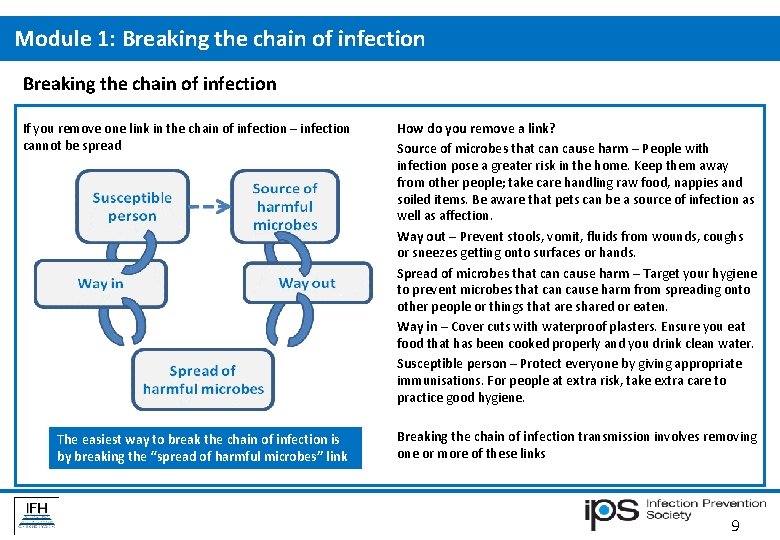
Module 1: Breaking the chain of infection If you remove one link in the chain of infection – infection cannot be spread The easiest way to break the chain of infection is by breaking the “spread of harmful microbes” link How do you remove a link? Source of microbes that can cause harm – People with infection pose a greater risk in the home. Keep them away from other people; take care handling raw food, nappies and soiled items. Be aware that pets can be a source of infection as well as affection. Way out – Prevent stools, vomit, fluids from wounds, coughs or sneezes getting onto surfaces or hands. Spread of microbes that can cause harm – Target your hygiene to prevent microbes that can cause harm from spreading onto other people or things that are shared or eaten. Way in – Cover cuts with waterproof plasters. Ensure you eat food that has been cooked properly and you drink clean water. Susceptible person – Protect everyone by giving appropriate immunisations. For people at extra risk, take extra care to practice good hygiene. Breaking the chain of infection transmission involves removing one or more of these links Turn the page to learn more 9
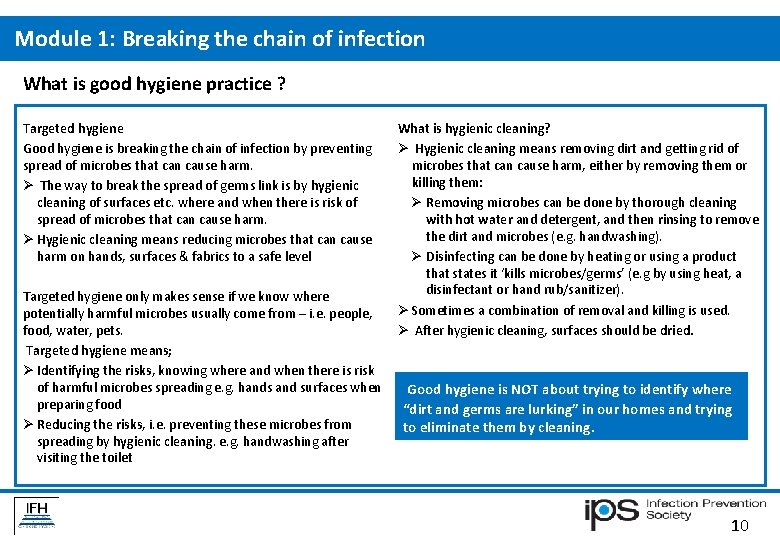
Module 1: Breaking the chain of infection What is good hygiene practice ? Targeted hygiene Good hygiene is breaking the chain of infection by preventing spread of microbes that can cause harm. The way to break the spread of germs link is by hygienic cleaning of surfaces etc. where and when there is risk of spread of microbes that can cause harm. Hygienic cleaning means reducing microbes that can cause harm on hands, surfaces & fabrics to a safe level Targeted hygiene only makes sense if we know where potentially harmful microbes usually come from – i. e. people, food, water, pets. Targeted hygiene means; Identifying the risks, knowing where and when there is risk of harmful microbes spreading e. g. hands and surfaces when preparing food Reducing the risks, i. e. preventing these microbes from spreading by hygienic cleaning. e. g. handwashing after visiting the toilet What is hygienic cleaning? Hygienic cleaning means removing dirt and getting rid of microbes that can cause harm, either by removing them or killing them: Removing microbes can be done by thorough cleaning with hot water and detergent, and then rinsing to remove the dirt and microbes (e. g. handwashing). Disinfecting can be done by heating or using a product that states it ‘kills microbes/germs’ (e. g by using heat, a disinfectant or hand rub/sanitizer). Sometimes a combination of removal and killing is used. After hygienic cleaning, surfaces should be dried. Good hygiene is NOT about trying to identify where “dirt and germs are lurking” in our homes and trying to eliminate them by cleaning. Turn the page to learn more 10
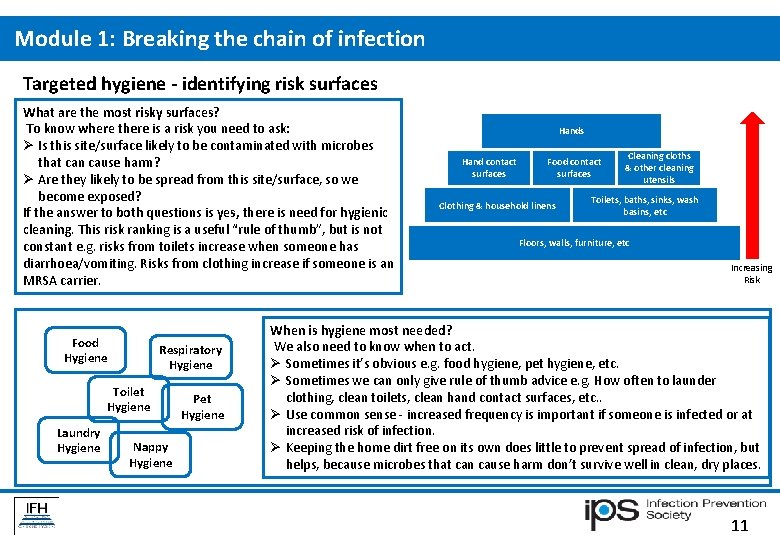
Module 1: Breaking the chain of infection Targeted hygiene - identifying risk surfaces What are the most risky surfaces? To know where there is a risk you need to ask: Is this site/surface likely to be contaminated with microbes that can cause harm? Are they likely to be spread from this site/surface, so we become exposed? If the answer to both questions is yes, there is need for hygienic cleaning. This risk ranking is a useful “rule of thumb”, but is not constant e. g. risks from toilets increase when someone has diarrhoea/vomiting. Risks from clothing increase if someone is an MRSA carrier. Food Hygiene Respiratory Hygiene Toilet Hygiene Laundry Hygiene Nappy Hygiene Pet Hygiene Hands Hand contact surfaces Food contact surfaces Clothing & household linens Cleaning cloths & other cleaning utensils Toilets, baths, sinks, wash basins, etc Floors, walls, furniture, etc Increasing Risk When is hygiene most needed? We also need to know when to act. Sometimes it’s obvious e. g. food hygiene, pet hygiene, etc. Sometimes we can only give rule of thumb advice e. g. How often to launder clothing, clean toilets, clean hand contact surfaces, etc. . Use common sense - increased frequency is important if someone is infected or at increased risk of infection. Keeping the home dirt free on its own does little to prevent spread of infection, but helps, because microbes that can cause harm don’t survive well in clean, dry places. Turn the page to learn more 11
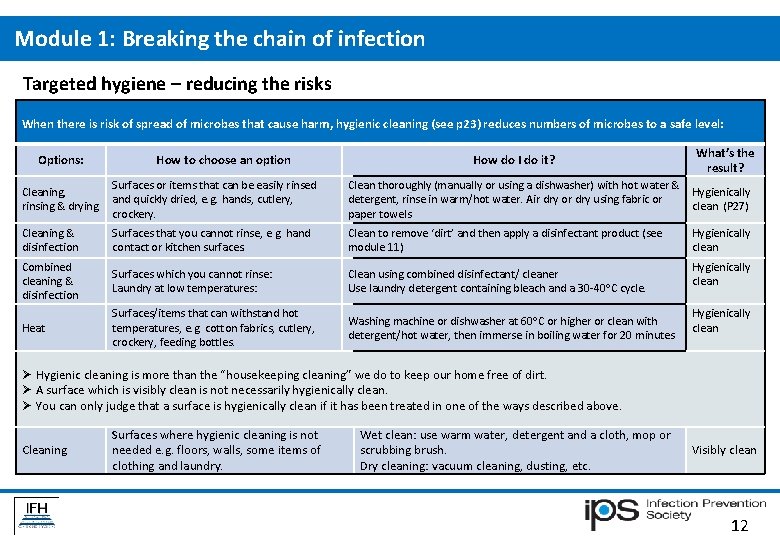
Module 1: Breaking the chain of infection Targeted hygiene – reducing the risks When there is risk of spread of microbes that cause harm, hygienic cleaning (see p 23) reduces numbers of microbes to a safe level: Options: How to choose an option How do I do it? What’s the result? Cleaning, rinsing & drying Surfaces or items that can be easily rinsed and quickly dried, e. g. hands, cutlery, crockery. Clean thoroughly (manually or using a dishwasher) with hot water & Hygienically detergent, rinse in warm/hot water. Air dry or dry using fabric or clean (P 27) paper towels Cleaning & disinfection Surfaces that you cannot rinse, e. g. hand contact or kitchen surfaces. Clean to remove ‘dirt’ and then apply a disinfectant product (see module 11) Combined cleaning & disinfection Surfaces which you cannot rinse: Laundry at low temperatures: Clean using combined disinfectant/ cleaner Use laundry detergent containing bleach and a 30 -40 C cycle. Heat Surfaces/items that can withstand hot temperatures, e. g. cotton fabrics, cutlery, crockery, feeding bottles. Washing machine or dishwasher at 60 C or higher or clean with detergent/hot water, then immerse in boiling water for 20 minutes Hygienically clean Hygienic cleaning is more than the “housekeeping cleaning” we do to keep our home free of dirt. A surface which is visibly clean is not necessarily hygienically clean. You can only judge that a surface is hygienically clean if it has been treated in one of the ways described above. Cleaning Surfaces where hygienic cleaning is not needed e. g. floors, walls, some items of clothing and laundry. Wet clean: use warm water, detergent and a cloth, mop or scrubbing brush. Dry cleaning: vacuum cleaning, dusting, etc. Turn the page to learn more Visibly clean 12
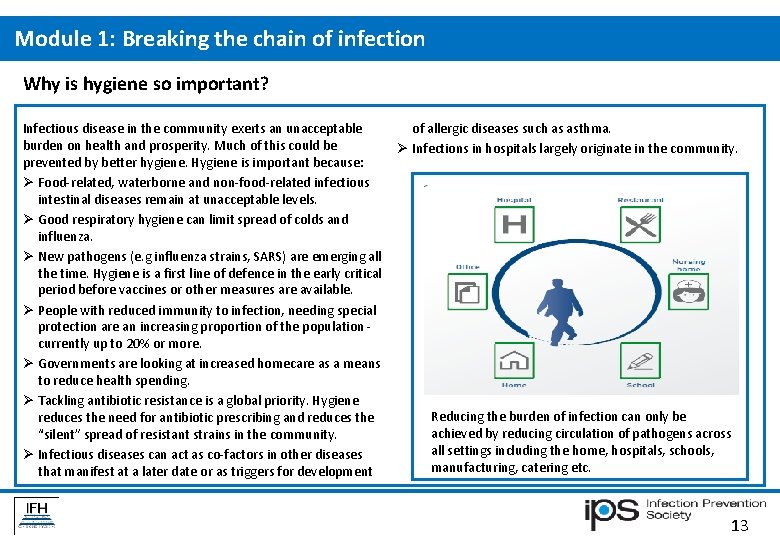
Module 1: Breaking the chain of infection Why is hygiene so important? Infectious disease in the community exerts an unacceptable of allergic diseases such as asthma. burden on health and prosperity. Much of this could be Infections in hospitals largely originate in the community. prevented by better hygiene. Hygiene is important because: Food-related, waterborne and non-food-related infectious intestinal diseases remain at unacceptable levels. Good respiratory hygiene can limit spread of colds and influenza. New pathogens (e. g influenza strains, SARS) are emerging all the time. Hygiene is a first line of defence in the early critical period before vaccines or other measures are available. People with reduced immunity to infection, needing special protection are an increasing proportion of the population - currently up to 20% or more. Governments are looking at increased homecare as a means to reduce health spending. Tackling antibiotic resistance is a global priority. Hygiene Reducing the burden of infection can only be reduces the need for antibiotic prescribing and reduces the achieved by reducing circulation of pathogens across “silent” spread of resistant strains in the community. all settings including the home, hospitals, schools, Infectious diseases can act as co-factors in other diseases manufacturing, catering etc. that manifest at a later date or as triggers for development Turn the page to learn more 13
Module 1: Breaking the chain of infection YOU can make a difference In this section we showed how to break the chain of infection using targeted hygiene. The following sections show to put targeted hygiene into practice in your daily life and in home healthcare situations. Here a few points worth thinking about: Microbes adapt and change so making hygiene “rules” is difficult. Understanding “breaking the chain of infection” enables you to adapt your hygiene to meet your own needs and challenges. Infection spreads by multiple interlinking routes – there’s a limit to how often we can wash our hands, but keeping hand contact surfaces and cleaning cloths hygienically clean will further reduce infection spread via hands. To be effective, hygiene needs to be applied to all critical points - the bottom line is, if we are not exposed to potentially harmful microbes we cannot become infected. People still believe hygiene means getting rid of “dirt”, believing that this is where germs “lurk”. People often think cleaning “germ hotspots” regularly will protect their family. To change hygiene behaviour we must first understand that hygiene means stopping infections from spreading Targeted hygiene means less not more cleaning! Why is good hygiene important to YOU? Statistics about hygiene-related diseases are hard to grasp, but here are some reasons why hygiene has direct benefits for YOU and YOUR family: Infections don’t “happen by accident or misfortune” – it’s preventable. By preventing infections, which always happen at the most inconvenient times, you can avoid: The hassle of an unexpected days off work, paying for childcare or visits to the doctor. Disruption of family leisure activities – celebrations, holidays, etc. Granny getting sick whilst caring for grandchildren 14
Home Hygiene Prevention of infection at home and in everyday life: a learning and training resource Section 2: Putting hygiene into practice Module 2: Hand hygiene Module 3: Respiratory hygiene Module 4: Food hygiene Module 5: General hygiene 15
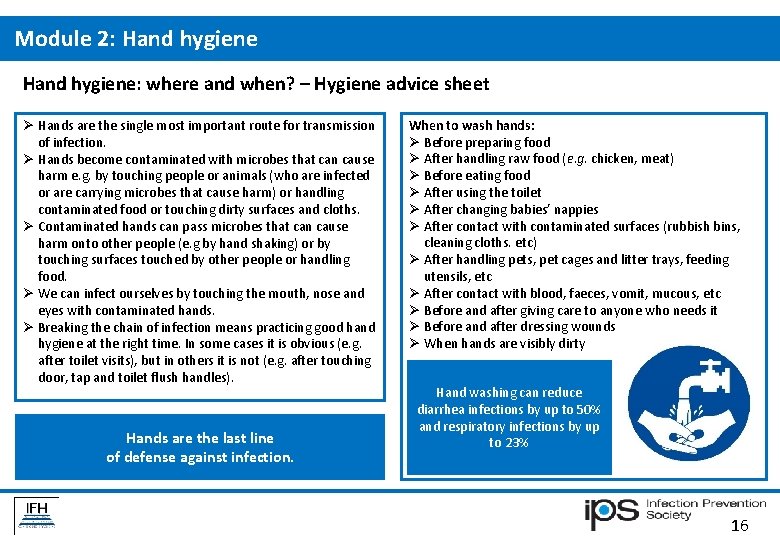
Module 2: Hand hygiene: where and when? – Hygiene advice sheet Hands are the single most important route for transmission of infection. Hands become contaminated with microbes that can cause harm e. g. by touching people or animals (who are infected or are carrying microbes that cause harm) or handling contaminated food or touching dirty surfaces and cloths. Contaminated hands can pass microbes that can cause harm onto other people (e. g by hand shaking) or by touching surfaces touched by other people or handling food. We can infect ourselves by touching the mouth, nose and eyes with contaminated hands. Breaking the chain of infection means practicing good hand hygiene at the right time. In some cases it is obvious (e. g. after toilet visits), but in others it is not (e. g. after touching door, tap and toilet flush handles). When to wash hands: Before preparing food After handling raw food (e. g. chicken, meat) Before eating food After using the toilet After changing babies’ nappies After contact with contaminated surfaces (rubbish bins, cleaning cloths. etc) After handling pets, pet cages and litter trays, feeding utensils, etc After contact with blood, faeces, vomit, mucous, etc Before and after giving care to anyone who needs it Before and after dressing wounds When hands are visibly dirty Hands are the last line of defense against infection. Turn the page to learn more Hand washing can reduce diarrhea infections by up to 50% and respiratory infections by up to 23% 16
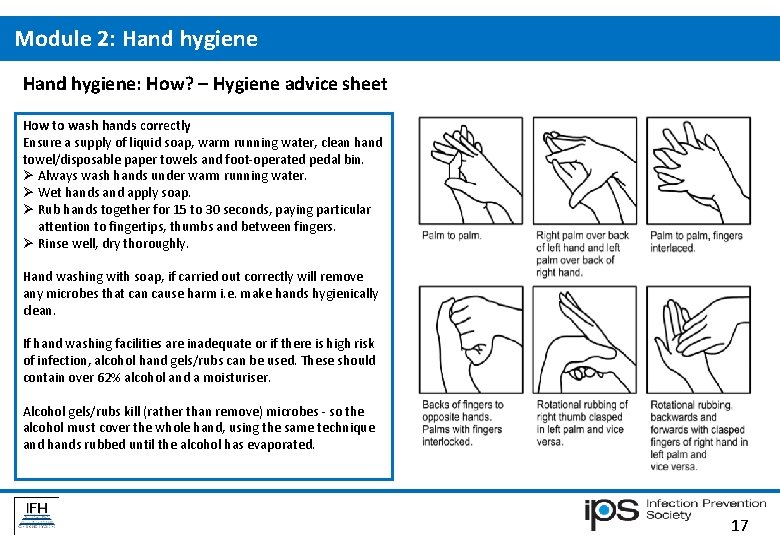
Module 2: Hand hygiene: How? – Hygiene advice sheet How to wash hands correctly Ensure a supply of liquid soap, warm running water, clean hand towel/disposable paper towels and foot-operated pedal bin. Always wash hands under warm running water. Wet hands and apply soap. Rub hands together for 15 to 30 seconds, paying particular attention to fingertips, thumbs and between fingers. Rinse well, dry thoroughly. Hand washing with soap, if carried out correctly will remove any microbes that can cause harm i. e. make hands hygienically clean. If hand washing facilities are inadequate or if there is high risk of infection, alcohol hand gels/rubs can be used. These should contain over 62% alcohol and a moisturiser. Alcohol gels/rubs kill (rather than remove) microbes - so the alcohol must cover the whole hand, using the same technique and hands rubbed until the alcohol has evaporated. Turn the page to learn more 17
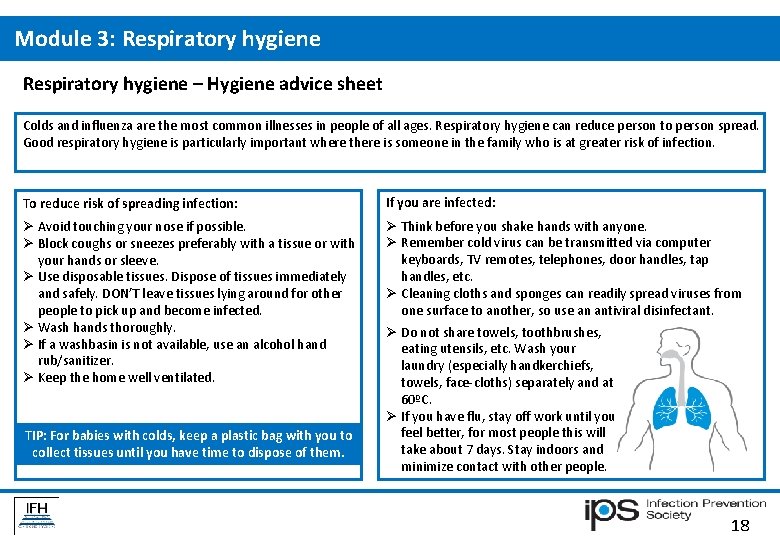
Module 3: Respiratory hygiene – Hygiene advice sheet Colds and influenza are the most common illnesses in people of all ages. Respiratory hygiene can reduce person to person spread. Good respiratory hygiene is particularly important where there is someone in the family who is at greater risk of infection. To reduce risk of spreading infection: If you are infected: Avoid touching your nose if possible. Block coughs or sneezes preferably with a tissue or with your hands or sleeve. Use disposable tissues. Dispose of tissues immediately and safely. DON’T leave tissues lying around for other people to pick up and become infected. Wash hands thoroughly. If a washbasin is not available, use an alcohol hand rub/sanitizer. Keep the home well ventilated. Think before you shake hands with anyone. Remember cold virus can be transmitted via computer keyboards, TV remotes, telephones, door handles, tap handles, etc. Cleaning cloths and sponges can readily spread viruses from one surface to another, so use an antiviral disinfectant. Stay off work or school until you're feeling better. For most people, this will take about a week. TIP: For babies with colds, keep a plastic bag with you to collect tissues until you have time to dispose of them. Do not share towels, toothbrushes, eating utensils, etc. Wash your laundry (especially handkerchiefs, towels, face-cloths) separately and at 60ºC. If you have flu, stay off work until you feel better, for most people this will take about 7 days. Stay indoors and minimize contact with other people. Turn the page to learn more 18
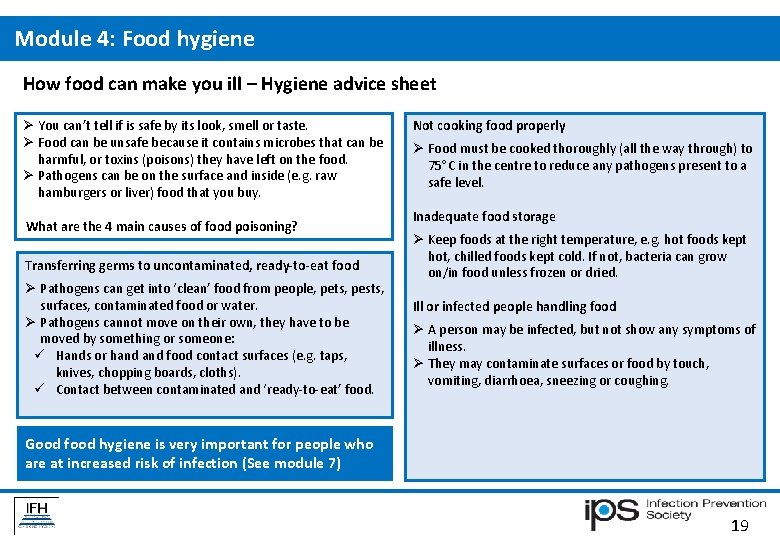
Module 4: Food hygiene How food can make you ill – Hygiene advice sheet You can’t tell if is safe by its look, smell or taste. Food can be unsafe because it contains microbes that can be harmful, or toxins (poisons) they have left on the food. Pathogens can be on the surface and inside (e. g. raw hamburgers or liver) food that you buy. What are the 4 main causes of food poisoning? Transferring germs to uncontaminated, ready-to-eat food Pathogens can get into ‘clean’ food from people, pets, pests, surfaces, contaminated food or water. Pathogens cannot move on their own, they have to be moved by something or someone: ü Hands or hand food contact surfaces (e. g. taps, knives, chopping boards, cloths). ü Contact between contaminated and ‘ready-to-eat’ food. Not cooking food properly Food must be cooked thoroughly (all the way through) to 75 C in the centre to reduce any pathogens present to a safe level. Inadequate food storage Keep foods at the right temperature, e. g. hot foods kept hot, chilled foods kept cold. If not, bacteria can grow on/in food unless frozen or dried. Ill or infected people handling food A person may be infected, but not show any symptoms of illness. They may contaminate surfaces or food by touch, vomiting, diarrhoea, sneezing or coughing. Good food hygiene is very important for people who are at increased risk of infection (See module 7) Turn the page to learn more 19
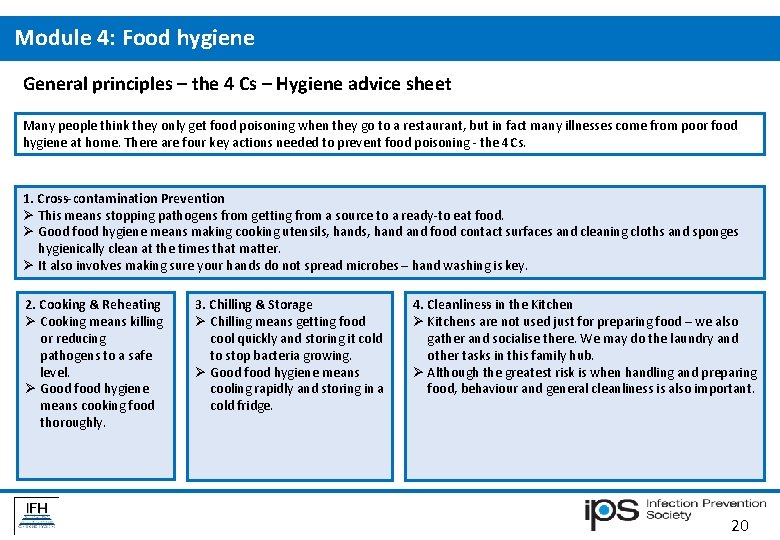
Module 4: Food hygiene Module 4: Food Hygiene General principles – the 4 Cs – Hygiene advice sheet Many people think they only get food poisoning when they go to a restaurant, but in fact many illnesses come from poor food hygiene at home. There are four key actions needed to prevent food poisoning - the 4 Cs. 1. Cross-contamination Prevention This means stopping pathogens from getting from a source to a ready-to eat food. Good food hygiene means making cooking utensils, hand and food contact surfaces and cleaning cloths and sponges hygienically clean at the times that matter. It also involves making sure your hands do not spread microbes – hand washing is key. 2. Cooking & Reheating Cooking means killing or reducing pathogens to a safe level. Good food hygiene means cooking food thoroughly. 3. Chilling & Storage Chilling means getting food cool quickly and storing it cold to stop bacteria growing. Good food hygiene means cooling rapidly and storing in a cold fridge. 4. Cleanliness in the Kitchens are not used just for preparing food – we also gather and socialise there. We may do the laundry and other tasks in this family hub. Although the greatest risk is when handling and preparing food, behaviour and general cleanliness is also important. 20
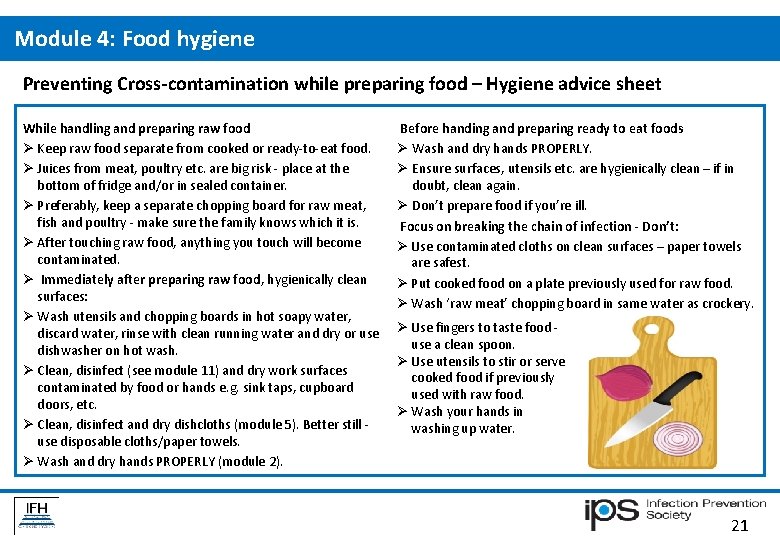
Module 4: Food hygiene Preventing Cross-contamination while preparing food – Hygiene advice sheet While handling and preparing raw food Keep raw food separate from cooked or ready-to-eat food. Juices from meat, poultry etc. are big risk - place at the bottom of fridge and/or in sealed container. Preferably, keep a separate chopping board for raw meat, fish and poultry - make sure the family knows which it is. After touching raw food, anything you touch will become contaminated. Immediately after preparing raw food, hygienically clean surfaces: Wash utensils and chopping boards in hot soapy water, discard water, rinse with clean running water and dry or use dishwasher on hot wash. Clean, disinfect (see module 11) and dry work surfaces contaminated by food or hands e. g. sink taps, cupboard doors, etc. Clean, disinfect and dry dishcloths (module 5). Better still - use disposable cloths/paper towels. Wash and dry hands PROPERLY (module 2). Before handing and preparing ready to eat foods Wash and dry hands PROPERLY. Ensure surfaces, utensils etc. are hygienically clean – if in doubt, clean again. Don’t prepare food if you’re ill. Focus on breaking the chain of infection - Don’t: Use contaminated cloths on clean surfaces – paper towels are safest. Put cooked food on a plate previously used for raw food. Wash ‘raw meat’ chopping board in same water as crockery. Use fingers to taste food - use a clean spoon. Use utensils to stir or serve cooked food if previously used with raw food. Wash your hands in washing up water. Turn the page to learn more 21
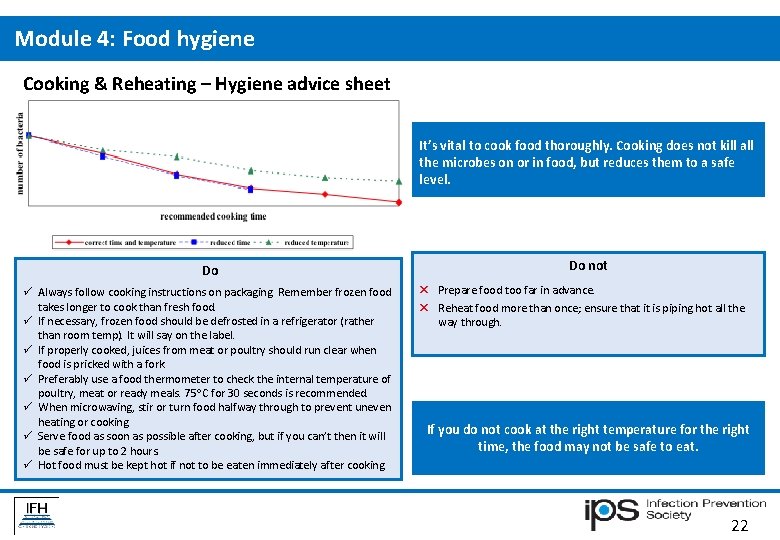
Module 4: Food hygiene Cooking & Reheating – Hygiene advice sheet It’s vital to cook food thoroughly. Cooking does not kill all the microbes on or in food, but reduces them to a safe level. Do ü Always follow cooking instructions on packaging. Remember frozen food takes longer to cook than fresh food. ü If necessary, frozen food should be defrosted in a refrigerator (rather than room temp). It will say on the label. ü If properly cooked, juices from meat or poultry should run clear when food is pricked with a fork. ü Preferably use a food thermometer to check the internal temperature of poultry, meat or ready meals. 75 C for 30 seconds is recommended. ü When microwaving, stir or turn food halfway through to prevent uneven heating or cooking. ü Serve food as soon as possible after cooking, but if you can’t then it will be safe for up to 2 hours. ü Hot food must be kept hot if not to be eaten immediately after cooking. Turn the page to learn more Do not Prepare food too far in advance. Reheat food more than once; ensure that it is piping hot all the way through. If you do not cook at the right temperature for the right time, the food may not be safe to eat. 22
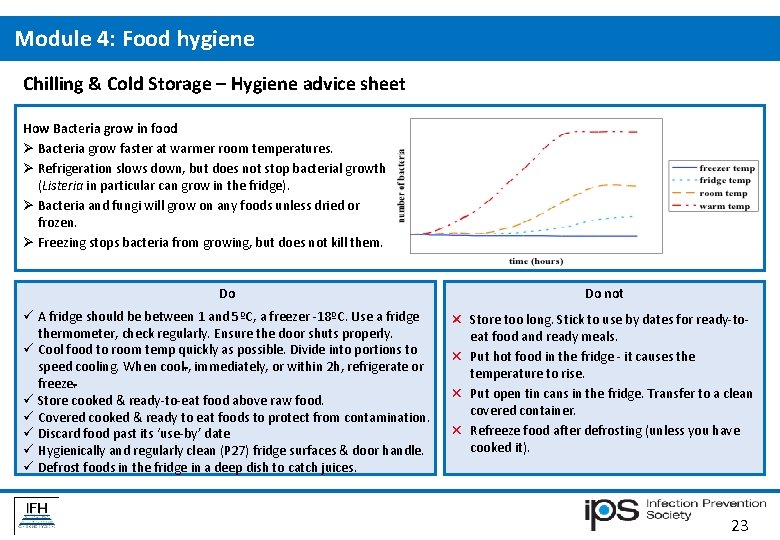
Module 4: Food hygiene Chilling & Cold Storage – Hygiene advice sheet How Bacteria grow in food Bacteria grow faster at warmer room temperatures. Refrigeration slows down, but does not stop bacterial growth (Listeria in particular can grow in the fridge). Bacteria and fungi will grow on any foods unless dried or frozen. Freezing stops bacteria from growing, but does not kill them. Do ü A fridge should be between 1 and 5ºC, a freezer -18ºC. Use a fridge thermometer, check regularly. Ensure the door shuts properly. ü Cool food to room temp quickly as possible. Divide into portions to speed cooling. When cool. , immediately, or within 2 h, refrigerate or freeze. ü Store cooked & ready-to-eat food above raw food. ü Covered cooked & ready to eat foods to protect from contamination. ü Discard food past its ‘use-by’ date ü Hygienically and regularly clean (P 27) fridge surfaces & door handle. ü Defrost foods in the fridge in a deep dish to catch juices. Turn the page to learn more Do not Store too long. Stick to use by dates for ready-toeat food and ready meals. Put hot food in the fridge - it causes the temperature to rise. Put open tin cans in the fridge. Transfer to a clean covered container. Refreeze food after defrosting (unless you have cooked it). 23
Module 4: Food hygiene Cleanliness in the kitchen – Hygiene advice sheet The domestic kitchen is not just where we prepare food – it’s also where we socialize. The greatest risk is handling food that’s why targeted hygiene is important, but how we behave in the kitchen and kitchen cleanliness are also important. So: Keep the kitchen clean and tidy to help reduce risks and discourage pests such as flies, ants and rodents. Don’t let food prep surfaces get cluttered with e. g. ornaments, cards, keys and purses – it makes it easier to keep them clean and practice good hygiene. Pets can be a source of infection. Keep bedding & litter trays out of the kitchen. Clean up faeces & disinfect (module 11). Cats jump on surfaces, so keep food covered and clean and disinfect surfaces before preparing ready to eat food. Keep the kitchen sink free from pathogens e. g. don’t pour contents of the nappy bucket down the sink, flush it down the toilet. If someone needs to vomit, use the toilet not the sink! Avoid using the kitchen sink for “dirty jobs” i. e. cleaning shoes, nappy rinsing etc. Use a bucket and put dirty water down the outside drain or toilet. If you do make the sink dirty, clean and disinfect immediately - someone may use it next for salad washing! It is not necessary to use a disinfectant everywhere for routine kitchen cleaning, save it for dealing with specific risks as mentioned above. Remember: Not all infections are foodborne. Most norovirus infections are transmitted from person to person, and people may not have symptoms, so don’t know they’re infected. Food handling by an infected person can contaminate food and spread infection, particularly if they have not washed their hands after using the toilet. Turn the page to learn more 24
Module 5: General hygiene Cloths and cleaning equipment – Hygiene advice sheet These are used to remove dirt and microbes from surfaces, but, in so doing, they can become a vector to spread contamination to hands and other surfaces. This means that they should be hygienically cleaned between different activities or discarded. If left damp, microbes, including some potentially harmful species, can multiply to high numbers making them difficult to clean. Cloths, sponges and scouring pads Cloths can be hygienically cleaned (P 27) in any of the following ways: Wash in a washing machine at 60 C (hot wash). Clean with detergent and warm water, rinse and then immerse in disinfectant (see module 11) solution for 20 minutes. Clean with detergent and water then immerse in boiling water for 20 minutes. Use disposable cloths if possible, particularly where there is high risk of infection e. g cleaning up faeces or vomit. Washing-up brushes Clean using detergent and hot water after use, rinse and leave head-up to dry. or - wash in the dishwasher. Mops and buckets Clean using detergent and hot water and rinse with a disinfecting solution. Wring out mops until dry as possible, leave to dry head-up. Rinse buckets with clean water, leave upside-down to dry. After hygienically cleaning, dry all cleaning utensils as rapidly as possible. Allocate different cloths for cleaning the kitchen, toilets, pet areas, etc. Turn the page to learn more 25
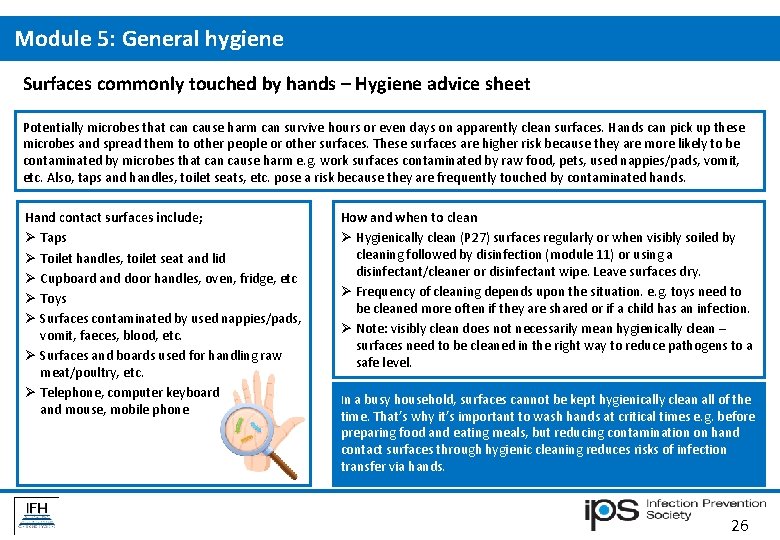
Module 5: General hygiene Surfaces commonly touched by hands – Hygiene advice sheet Potentially microbes that can cause harm can survive hours or even days on apparently clean surfaces. Hands can pick up these microbes and spread them to other people or other surfaces. These surfaces are higher risk because they are more likely to be contaminated by microbes that can cause harm e. g. work surfaces contaminated by raw food, pets, used nappies/pads, vomit, etc. Also, taps and handles, toilet seats, etc. pose a risk because they are frequently touched by contaminated hands. Hand contact surfaces include; Taps Toilet handles, toilet seat and lid Cupboard and door handles, oven, fridge, etc Toys Surfaces contaminated by used nappies/pads, vomit, faeces, blood, etc. Surfaces and boards used for handling raw meat/poultry, etc. Telephone, computer keyboard and mouse, mobile phone How and when to clean Hygienically clean (P 27) surfaces regularly or when visibly soiled by cleaning followed by disinfection (module 11) or using a disinfectant/cleaner or disinfectant wipe. Leave surfaces dry. Frequency of cleaning depends upon the situation. e. g. toys need to be cleaned more often if they are shared or if a child has an infection. Note: visibly clean does not necessarily mean hygienically clean – surfaces need to be cleaned in the right way to reduce pathogens to a safe level. In a busy household, surfaces cannot be kept hygienically clean all of the time. That’s why it’s important to wash hands at critical times e. g. before preparing food and eating meals, but reducing contamination on hand contact surfaces through hygienic cleaning reduces risks of infection transfer via hands. Turn the page to learn more 26
Module 5: General hygiene Toilets, continence pads and commode pots – Hygiene advice sheet These can become heavily contaminated with microbes that cause gut infections and are spread mainly via hands, surfaces and cleaning equipment (cloths, mops). If you are the patient, family or friend of the patient you may not wish to wear gloves. This is of course a personal choice but adherence to hand hygiene is vitally important. Toilets and commodes Keep the toilet bowl and u-bend clean by flushing after use and using a toilet cleaner and brush every few days. Remove scale regularly using a descalent. Keep the toilet seat, handle and under the toilet rim hygienically clean by cleaning followed by disinfection (module 11) or use a disinfectant/cleaner. If someone has diarrhoea or vomiting, add disinfectant to the toilet, close the lid and flush. To protect the family, hygienically clean all the surfaces of the toilet (toilet bowl, seat, lid) every time they use the toilet. Empty commode pots into the toilet. Hygienically clean by rinsing with detergent solution and empty into the toilet. Leave commode pot to dry upside down. Formal carers should wear disposable vinyl /nitrile gloves when cleaning toilets and commode pots. Wash hands after removing gloves. Turn to page 64 to learn more Continence pads and Stoma Bags Wear disposable vinyl/nitrile gloves to avoid soiling hands when handling continence pads, stoma bags etc. Put disposable pads and bags in a plastic bag, then into second bag, tie securely. Dispose with household rubbish. If using washable continence products, use toilet paper to remove solid faeces and dispose into the toilet. Launder washable continence products in a washing machine. Use a pre-wash cycle followed by a 60 C wash. Dry continence products quickly, ideally use a tumble drier or clothes line. Wash your hands after cleaning the toilet or handling used nappies or pads. 27
Module 5: General hygiene Toilets, nappies, pads, potties and changing mats – Hygiene advice sheet These can become heavily contaminated with microbes that cause gut infections, which spread mainly via hands, surfaces and cleaning equipment (cloths, mops, etc. ). Toilets and potties Keep the toilet bowl and u-bend clean by flushing after use and using a toilet cleaner and brush every few days. Remove scale regularly using descalent. Keep the toilet seat, handle, under the toilet rim, hygienically clean by cleaning followed by disinfection (module 11) - or use a combined disinfectant/cleaner If someone has diarrhoea or vomiting, add disinfectant to the toilet, close the lid and flush. To protect the family, hygienically clean all the surfaces of the toilet - toilet bowl, seat, lid, every time they use the toilet Empty potties into toilet. Hygienically clean by rinsing with detergent and emptying into toilet. Leave to dry upside down Toilet brushes should be regularly cleaned and disinfected If someone has had a stomach infection wear disposable vinyl/nitrile gloves when cleaning toilets and potties. Child carers should wear gloves. Wash hands after removing gloves Nappies, pads and changing mats If you are caring for a child who is wearing nappies wear gloves to avoid soiling hands when handling nappies. Parents may not wish to do this, but if the child is ill and there is risk of poo getting onto the hands. then disposable vinyl/nitrile gloves are advised. Put disposable nappies and pads in a plastic bag, then into second bag, tie securely. Dispose with household rubbish If using washable nappies, use toilet paper to remove solid faeces and dispose into the toilet Launder washable nappies in a washing machine. Use a pre-wash cycle followed by a 60 C wash Dry nappies quickly, ideally using a tumble drier, or clothes line Clean changing mats with detergent, disinfect and dry. Empty nappy buckets into the toilet, not the sink Wash your hands after cleaning the toilet or handling used nappies or pads. Turn the page to learn more 28
Module 5: General hygiene Baths, sinks, showers, whirlpool baths and tiled surfaces – Hygiene advice sheet Microbes, including pathogenic microbes can survive in the scum or scale left behind after bathing, showering etc. Stagnant water in the water pipes of showers, showerheads and whirlpool baths can become contaminated with microbes that become airborne when the shower, etc. is turned on. Moulds can live and grow on or behind wall and floor tiles and on shower curtains. Baths and sinks Hygienically clean (P 27) baths and sinks regularly by cleaning followed by thorough rinsing and leave to dry. Alternatively, you may wish to recommend cleaning followed by disinfection (module 11) or the use of a disinfectant cleaner which is suitable for the surface. This is particularly important after use by a person with a known or suspected infection or if it has been contaminated with faeces. Showers and whirlpool baths Clean shower trays and whirlpool baths as for baths and sinks. If a shower is not used for a long period, leave it to run at a hot temperature for a few minutes before use. Water pipes of whirlpool baths need to be disinfected after use following the manufacturer’s instructions. Disinfect the water pipes before use, if the pool has been out of use for some time Turn the page to learn more Tiles and shower curtains Make sure tiles and grout are in good condition and cleaned regularly. An anti-fungal product may be needed Hygienically clean or launder shower curtains regularly 29
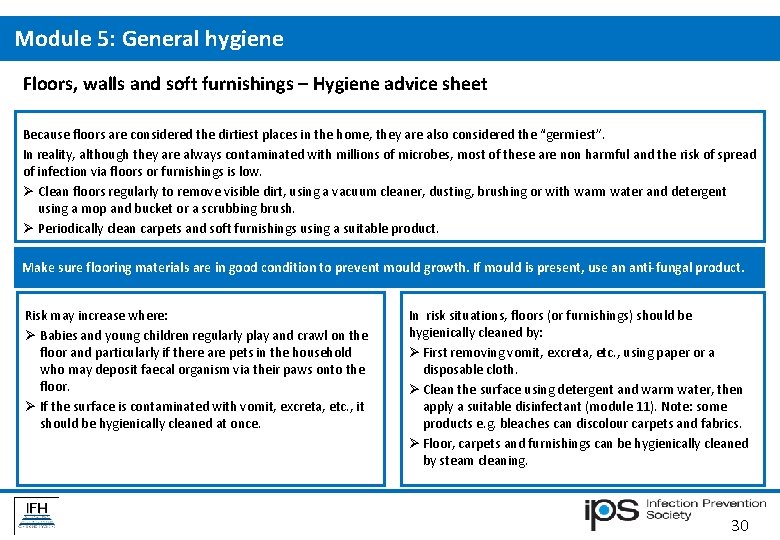
Module 5: General hygiene Floors, walls and soft furnishings – Hygiene advice sheet Because floors are considered the dirtiest places in the home, they are also considered the “germiest”. In reality, although they are always contaminated with millions of microbes, most of these are non harmful and the risk of spread of infection via floors or furnishings is low. Clean floors regularly to remove visible dirt, using a vacuum cleaner, dusting, brushing or with warm water and detergent using a mop and bucket or a scrubbing brush. Periodically clean carpets and soft furnishings using a suitable product. Make sure flooring materials are in good condition to prevent mould growth. If mould is present, use an anti-fungal product. Risk may increase where: Babies and young children regularly play and crawl on the floor and particularly if there are pets in the household who may deposit faecal organism via their paws onto the floor. If the surface is contaminated with vomit, excreta, etc. , it should be hygienically cleaned at once. In risk situations, floors (or furnishings) should be hygienically cleaned by: First removing vomit, excreta, etc. , using paper or a disposable cloth. Clean the surface using detergent and warm water, then apply a suitable disinfectant (module 11). Note: some products e. g. bleaches can discolour carpets and fabrics. Floor, carpets and furnishings can be hygienically cleaned by steam cleaning. Turn the page to learn more 30
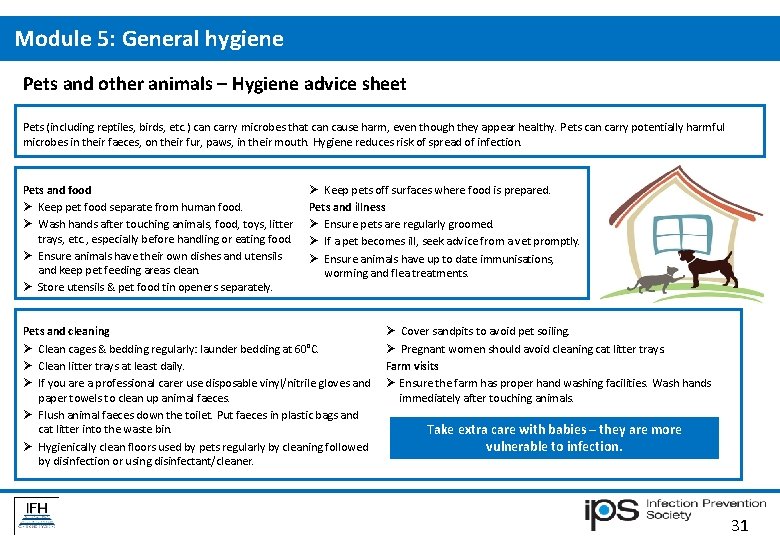
Module 5: General hygiene Pets and other animals – Hygiene advice sheet Pets (including reptiles, birds, etc. ) can carry microbes that can cause harm, even though they appear healthy. Pets can carry potentially harmful microbes in their faeces, on their fur, paws, in their mouth. Hygiene reduces risk of spread of infection. Pets and food Keep pet food separate from human food. Wash hands after touching animals, food, toys, litter trays, etc. , especially before handling or eating food. Ensure animals have their own dishes and utensils and keep pet feeding areas clean. Store utensils & pet food tin openers separately. Keep pets off surfaces where food is prepared. Pets and illness Ensure pets are regularly groomed. If a pet becomes ill, seek advice from a vet promptly. Ensure animals have up to date immunisations, worming and flea treatments. Pets and cleaning Clean cages & bedding regularly: launder bedding at 60°C. Clean litter trays at least daily. If you are a professional carer use disposable vinyl/nitrile gloves and paper towels to clean up animal faeces. Flush animal faeces down the toilet. Put faeces in plastic bags and cat litter into the waste bin. Hygienically clean floors used by pets regularly by cleaning followed by disinfection or using disinfectant/cleaner. Cover sandpits to avoid pet soiling. Pregnant women should avoid cleaning cat litter trays. Farm visits Ensure the farm has proper hand washing facilities. Wash hands immediately after touching animals. Turn the page to learn more Take extra care with babies – they are more vulnerable to infection. 31
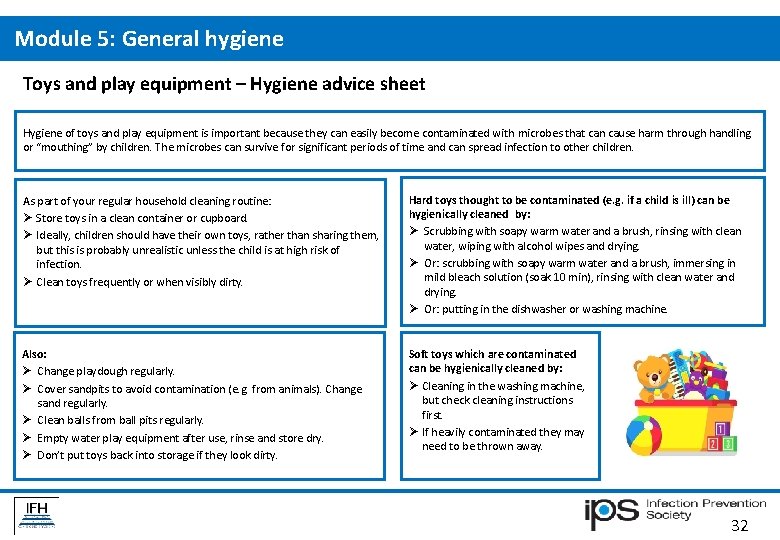
Module 5: General hygiene Toys and play equipment – Hygiene advice sheet Hygiene of toys and play equipment is important because they can easily become contaminated with microbes that can cause harm through handling or “mouthing” by children. The microbes can survive for significant periods of time and can spread infection to other children. As part of your regular household cleaning routine: Store toys in a clean container or cupboard. Ideally, children should have their own toys, rather than sharing them, but this is probably unrealistic unless the child is at high risk of infection. Clean toys frequently or when visibly dirty. Hard toys thought to be contaminated (e. g. if a child is ill) can be hygienically cleaned by: Scrubbing with soapy warm water and a brush, rinsing with clean water, wiping with alcohol wipes and drying. Or: scrubbing with soapy warm water and a brush, immersing in mild bleach solution (soak 10 min), rinsing with clean water and drying. Or: putting in the dishwasher or washing machine. Also: Change playdough regularly. Cover sandpits to avoid contamination (e. g. from animals). Change sand regularly. Clean balls from ball pits regularly. Empty water play equipment after use, rinse and store dry. Don’t put toys back into storage if they look dirty. Soft toys which are contaminated can be hygienically cleaned by: Cleaning in the washing machine, but check cleaning instructions first. If heavily contaminated they may need to be thrown away. Turn the page to learn more 32
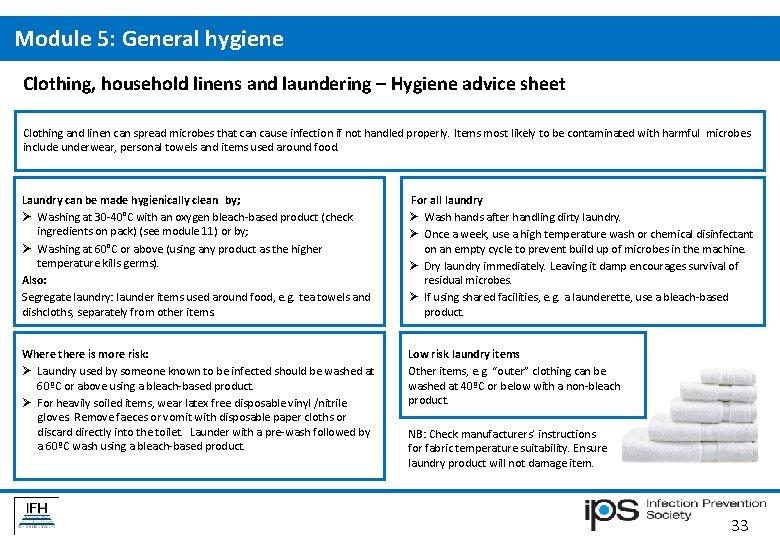
Module 5: General hygiene Clothing, household linens and laundering – Hygiene advice sheet Clothing and linen can spread microbes that can cause infection if not handled properly. Items most likely to be contaminated with harmful microbes include underwear, personal towels and items used around food. Laundry can be made hygienically clean by; Washing at 30 -40°C with an oxygen bleach-based product (check ingredients on pack) (see module 11) or by; Washing at 60°C or above (using any product as the higher temperature kills germs). Also: Segregate laundry: launder items used around food, e. g. tea towels and dishcloths, separately from other items. For all laundry Wash hands after handling dirty laundry. Once a week, use a high temperature wash or chemical disinfectant on an empty cycle to prevent build up of microbes in the machine. Dry laundry immediately. Leaving it damp encourages survival of residual microbes. If using shared facilities, e. g. a launderette, use a bleach-based product. Where there is more risk: Laundry used by someone known to be infected should be washed at 60ºC or above using a bleach-based product. For heavily soiled items, wear latex free disposable vinyl /nitrile gloves. Remove faeces or vomit with disposable paper cloths or discard directly into the toilet. Launder with a pre-wash followed by a 60ºC wash using a bleach-based product. Low risk laundry items Other items, e. g. “outer” clothing can be washed at 40ºC or below with a non-bleach product. NB: Check manufacturers’ instructions for fabric temperature suitability. Ensure laundry product will not damage item. Turn the page to learn more 33
Module 6: Domestic waste disposal – Hygiene advice sheet General waste Waste should be placed in a suitable waste bin with a close fitting lid. Indoor waste bins should be kept clean and dry. Regularly clean and disinfect the hand touch surfaces, e. g. lid. Foot-operated pedal bins are preferred. This prevents hands picking up microbes that can cause harm by touching bin lid. Waste should be transferred to outside bins in black plastic bags which are tied at the top. Bins should have tightly fitting lids. Waste should not be discarded carelessly as it attracts vermin and insects. Indoor waste bins should be hygienically cleaned and disinfected (p 27) after emptying. Wash hands after handling waste. Offensive waste This includes waste which is unpleasant, e. g. continence waste, but unless the person is infected, it is not considered risky and can be disposed of with general waste (see learn more). Catheter bags or stoma bags can be emptied in the toilet and the empty bag wrapped in a black plastic bag for disposal with general household waste. For special items used in healthcare When needles and other sharps are used, a sharps box should be made available for disposal. Paper tissues should be discarded into a plastic bag immediately after use. Tie the top of the bag before placing in a black plastic bag for general waste disposal. If you are a professional carer then latex free disposable vinyl/nitrile gloves and aprons should be worn when handling healthcare waste (see module 9). Always wash hands after handling tissues, waste bins or bags. When there is known infection, it may be necessary to dispose of healthcare waste in a separate orange bag, which is collected by a special collection service (See learn more). Turn the page to learn more 34
Home Hygiene Prevention of infection at home and in everyday life: a learning and training resource Section 3: Where there is more risk – hygiene in home healthcare Module 7: Where there is more risk of infection Module 8: People who are infected & pose a risk to others Module 9: Protective clothing 35
Module 7: Where there is more risk of infection Introduction The aim of this module is to understand the factors that increase risk of infection and how this can be managed. Being at more risk of infection is more common and serious than people think. It includes those who: are generally healthy, but have underlying health conditions (e. g diabetes, COPD, heart/kidney disease, MS). who live in deprived living conditions or have an unhealthy lifestyle e. g. do little exercise/ poor diet. are receiving treatment for an underlying disease. have an indwelling catheter, other medical devices, e. g. feeding tube, or have wounds that need dressings. require use of medical equipment. are receiving care from professional carers or family and friends. When those at increased risk get an infection, it is likely to be more serious, difficult to treat and may require hospitalisation or attention from their GP. A person can have more than one risk factor at the same time, making their risk of infection even greater. What to do Follow targeted hygiene (see sections 2 and 3). In situations where there is more risk, the differences are; if basic hygiene practices are not carried out correctly, risk of infection is much greater. in addition to basic practices, you may also have to handle medical equipment, dispose of contaminated waste, deal with medical equipment or cope with living conditions where basic hygiene facilities (e. g. liquid soap, clean towels, clean sinks) are not available. Turn the page to learn more 36
Module 7: Where there is more risk of infection People who are generally healthy, but at extra risk of infection – Hygiene advice sheet Healthy people who are at extra risk of infection at certain times include: The very young: children under the age of five and particularly those under the age of one year. The elderly: over 65 years. Pregnant women are particularly vulnerable to certain infections, e. g. urinary infections. Some infections can harm the unborn baby (e. g. listeriosis, rubella, toxoplasmosis). People taking proton pump inhibitors (PPIs) or other drugs which neutralise acid in the stomach. Targeted hygiene consistently applied is the way to reduce infection risks for these groups (sections 1 & 2). For babies under one year Clean bottles, teats and other feeding equipment in hot, soapy water, rinse and dry as soon as possible after feeds. Feeding utensils should be decontaminated by boiling or using a disinfectant. Pregnant women should specifically avoid contact with cats and cat litter, which can transmit toxoplasmosis. For all of these groups Ensure they have good diet, but avoid high risk foods (undercooked eggs, raw egg dishes, undercooked meat and poultry, raw shellfish, unpasteurised cheeses). Make sure they have appropriate immunisations which are kept up to date. Avoid contact with carers or family members with known or suspected infection. If you are unsure about anything, ask your local Community Nurse, Health Visitor or Community IPC or PHE Health Protection Team for advice and support. Turn the page to learn more 37
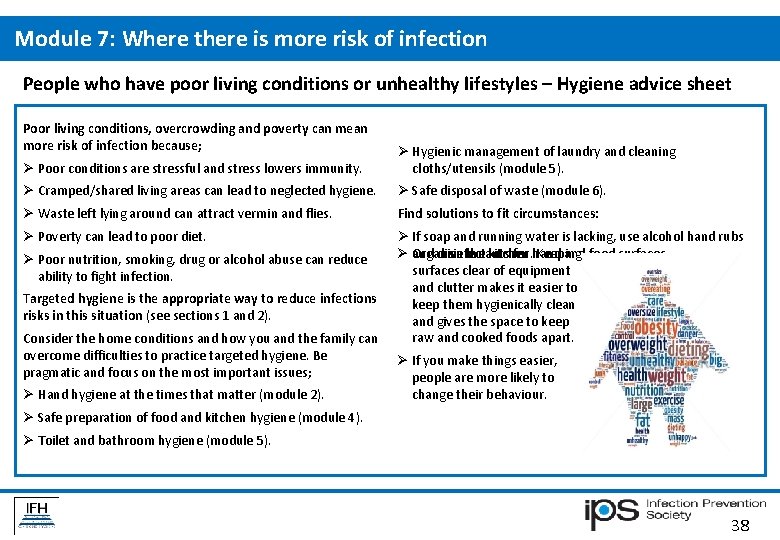
Module 7: Where there is more risk of infection People who have poor living conditions or unhealthy lifestyles – Hygiene advice sheet Poor living conditions, overcrowding and poverty can mean more risk of infection because; Poor conditions are stressful and stress lowers immunity. Hygienic management of laundry and cleaning cloths/utensils (module 5). Cramped/shared living areas can lead to neglected hygiene. Safe disposal of waste (module 6). Waste left lying around can attract vermin and flies. Find solutions to fit circumstances: Poverty can lead to poor diet. If soap and running water is lacking, use alcohol hand rubs and disinfectants for hand food surfaces. Organise the kitchen. Keeping surfaces clear of equipment and clutter makes it easier to keep them hygienically clean and gives the space to keep raw and cooked foods apart. Poor nutrition, smoking, drug or alcohol abuse can reduce ability to fight infection. Targeted hygiene is the appropriate way to reduce infections risks in this situation (see sections 1 and 2). Consider the home conditions and how you and the family can overcome difficulties to practice targeted hygiene. Be pragmatic and focus on the most important issues; Hand hygiene at the times that matter (module 2). If you make things easier, people are more likely to change their behaviour. Safe preparation of food and kitchen hygiene (module 4). Toilet and bathroom hygiene (module 5). Turn the page to learn more 38
Module 7: Where there is more risk of infection People at increased risk of infection – home healthcare – Hygiene advice sheet Individuals receiving care at home are more vulnerable to infection because they are relying on others to do things for them. They have less control over their surroundings and how to reduce risks. Targeted hygiene consistently applied, is the way to reduce infection risks (see sections 1 and 2). They can gain extra some protection from infection by; adopting a nourishing diet and healthy lifestyle. having the appropriate immunisations and following medical advice where appropriate. avoiding contact with carers or family members with known or suspected infections. The following are particularly vulnerable because they have reduced infection immunity: have an underlying illness e. g. diabetes mellitus, dementia, respiratory and circulatory disorders. are undergoing medical treatment or recently discharged from hospital. are taking medication which affects the immune system, e. g. There will be additional anticancer drugs, steroids. high risk care activities you may have to are taking antibiotics for repeated infections. undertake e. g. catheter or are immuno-compromised through other infections, e. g. HIV wound care. Managing infection. these activities is have open wounds and/or pressure ulcers/breaks to the described in the following skin. pages. have indwelling catheters, enteral feeding tubes or other medical devices. Turn the page to learn more 39
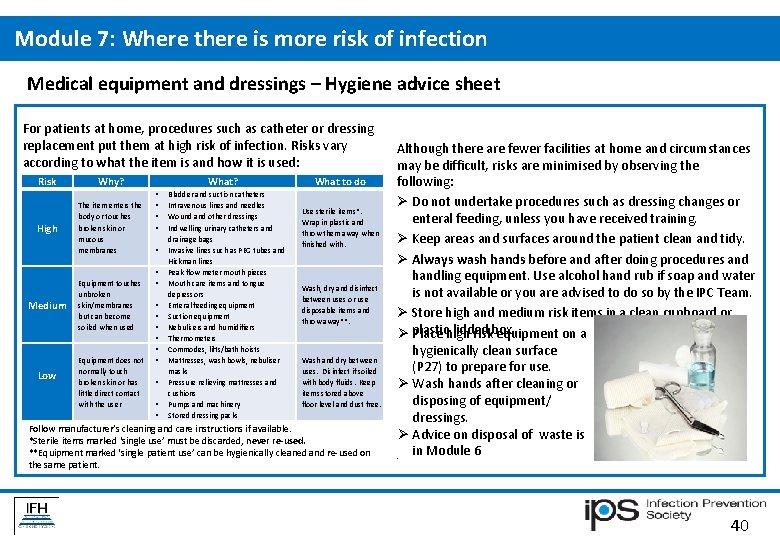
Module 7: Where there is more risk of infection Medical equipment and dressings – Hygiene advice sheet For patients at home, procedures such as catheter or dressing replacement put them at high risk of infection. Risks vary according to what the item is and how it is used: Risk High Why? The item enters the body or touches broken skin or mucous membranes Medium Equipment touches unbroken skin/membranes but can become soiled when used Low Equipment does not normally touch broken skin or has little direct contact with the user What? § § § § Bladder and suction catheters Intravenous lines and needles Wound and other dressings Indwelling urinary catheters and drainage bags Invasive lines such as PEG tubes and Hickman lines Peak flow meter mouth pieces Mouth care items and tongue depressors Enteral feeding equipment Suction equipment Nebulisers and humidifiers Thermometers Commodes, lifts/bath hoists Mattresses, wash bowls, nebuliser masks Pressure relieving mattresses and cushions Pumps and machinery Stored dressing packs What to do Use sterile items*. Wrap in plastic and throw them away when finished with. Wash, dry and disinfect between uses or use disposable items and throw away**. Wash and dry between uses. Disinfect if soiled with body fluids. Keep items stored above floor level and dust free. Follow manufacturer’s cleaning and care instructions if available. *Sterile items marked ‘single use’ must be discarded, never re-used. **Equipment marked ‘single patient use’ can be hygienically cleaned and re-used on the same patient. Although there are fewer facilities at home and circumstances may be difficult, risks are minimised by observing the following: Do not undertake procedures such as dressing changes or enteral feeding, unless you have received training. Keep areas and surfaces around the patient clean and tidy. Always wash hands before and after doing procedures and handling equipment. Use alcohol hand rub if soap and water is not available or you are advised to do so by the IPC Team. Store high and medium risk items in a clean cupboard or plastic-lidded box. Place high risk equipment on a hygienically clean surface (P 27) to prepare for use. Wash hands after cleaning or disposing of equipment/ dressings. Advice on disposal of waste is . in Module 6 Turn the page to learn more 40
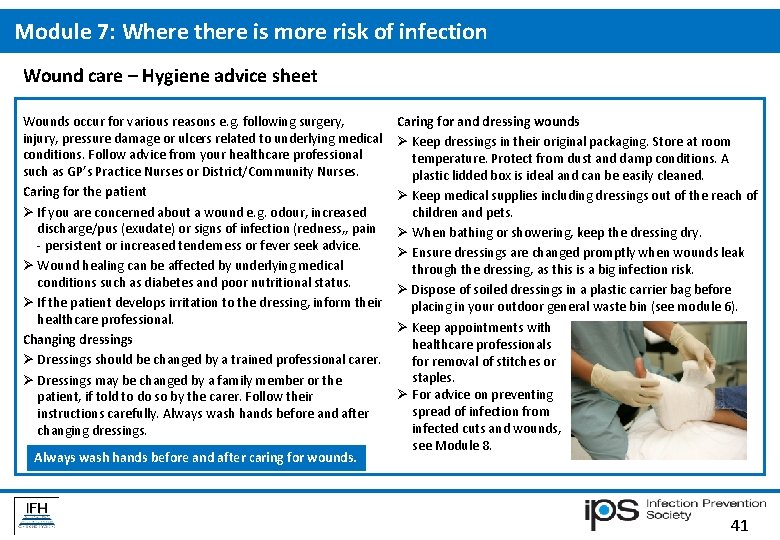
Module 7: Where there is more risk of infection Wound care – Hygiene advice sheet Wounds occur for various reasons e. g. following surgery, injury, pressure damage or ulcers related to underlying medical conditions. Follow advice from your healthcare professional such as GP’s Practice Nurses or District/Community Nurses. Caring for the patient If you are concerned about a wound e. g. odour, increased discharge/pus (exudate) or signs of infection (redness, , pain - persistent or increased tenderness or fever seek advice. Wound healing can be affected by underlying medical conditions such as diabetes and poor nutritional status. If the patient develops irritation to the dressing, inform their healthcare professional. Changing dressings Dressings should be changed by a trained professional carer. Dressings may be changed by a family member or the patient, if told to do so by the carer. Follow their instructions carefully. Always wash hands before and after changing dressings. Always wash hands before and after caring for wounds. Caring for and dressing wounds Keep dressings in their original packaging. Store at room temperature. Protect from dust and damp conditions. A plastic lidded box is ideal and can be easily cleaned. Keep medical supplies including dressings out of the reach of children and pets. When bathing or showering, keep the dressing dry. Ensure dressings are changed promptly when wounds leak through the dressing, as this is a big infection risk. Dispose of soiled dressings in a plastic carrier bag before placing in your outdoor general waste bin (see module 6). Keep appointments with healthcare professionals for removal of stitches or staples. For advice on preventing spread of infection from infected cuts and wounds, see Module 8. Turn the page to learn more 41
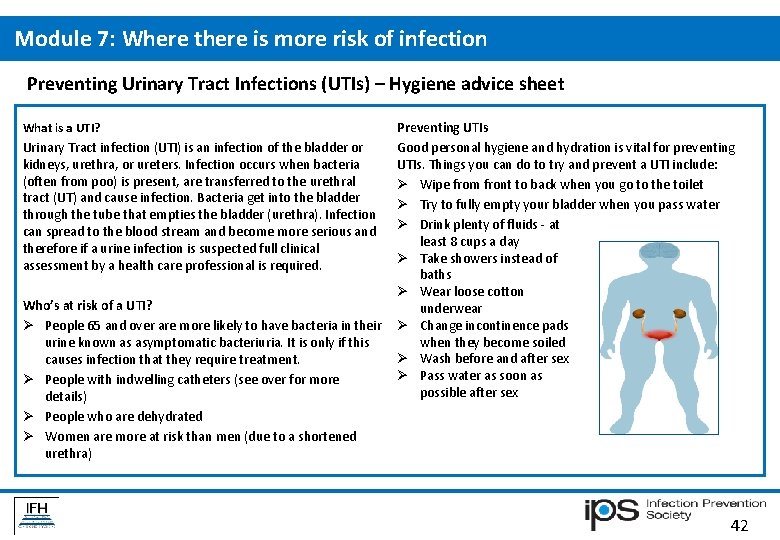
Module 7: Where there is more risk of infection Preventing Urinary Tract Infections (UTIs) – Hygiene advice sheet Preventing UTIs Urinary Tract infection (UTI) is an infection of the bladder or Good personal hygiene and hydration is vital for preventing kidneys, urethra, or ureters. Infection occurs when bacteria UTIs. Things you can do to try and prevent a UTI include: (often from poo) is present, are transferred to the urethral Wipe from front to back when you go to the toilet tract (UT) and cause infection. Bacteria get into the bladder Try to fully empty your bladder when you pass water through the tube that empties the bladder (urethra). Infection Drink plenty of fluids - at can spread to the blood stream and become more serious and least 8 cups a day therefore if a urine infection is suspected full clinical Take showers instead of assessment by a health care professional is required. baths Wear loose cotton Who’s at risk of a UTI? underwear People 65 and over are more likely to have bacteria in their Change incontinence pads when they become soiled urine known as asymptomatic bacteriuria. It is only if this Wash before and after sex causes infection that they require treatment. Pass water as soon as People with indwelling catheters (see over for more possible after sex details) People who are dehydrated Women are more at risk than men (due to a shortened urethra) What is a UTI? Turn to page 94 to learn more Turn the page to learn more 42
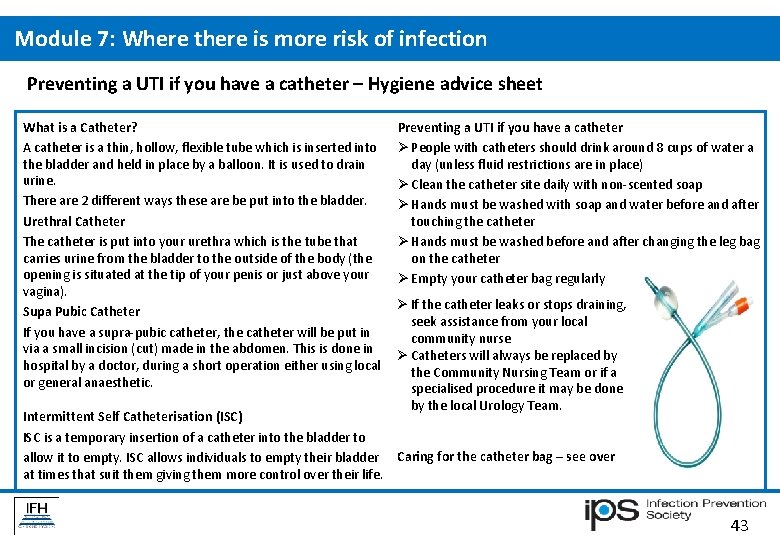
Module 7: Where there is more risk of infection Preventing a UTI if you have a catheter – Hygiene advice sheet What is a Catheter? A catheter is a thin, hollow, flexible tube which is inserted into the bladder and held in place by a balloon. It is used to drain urine. There are 2 different ways these are be put into the bladder. Urethral Catheter The catheter is put into your urethra which is the tube that carries urine from the bladder to the outside of the body (the opening is situated at the tip of your penis or just above your vagina). Supa Pubic Catheter If you have a supra-pubic catheter, the catheter will be put in via a small incision (cut) made in the abdomen. This is done in hospital by a doctor, during a short operation either using local or general anaesthetic. Preventing a UTI if you have a catheter People with catheters should drink around 8 cups of water a day (unless fluid restrictions are in place) Clean the catheter site daily with non-scented soap Hands must be washed with soap and water before and after touching the catheter Hands must be washed before and after changing the leg bag on the catheter Empty your catheter bag regularly If the catheter leaks or stops draining, seek assistance from your local community nurse Catheters will always be replaced by the Community Nursing Team or if a specialised procedure it may be done by the local Urology Team. Intermittent Self Catheterisation (ISC) ISC is a temporary insertion of a catheter into the bladder to allow it to empty. ISC allows individuals to empty their bladder Caring for the catheter bag – see over at times that suit them giving them more control over their life. Turn to page 94 to learn more 43
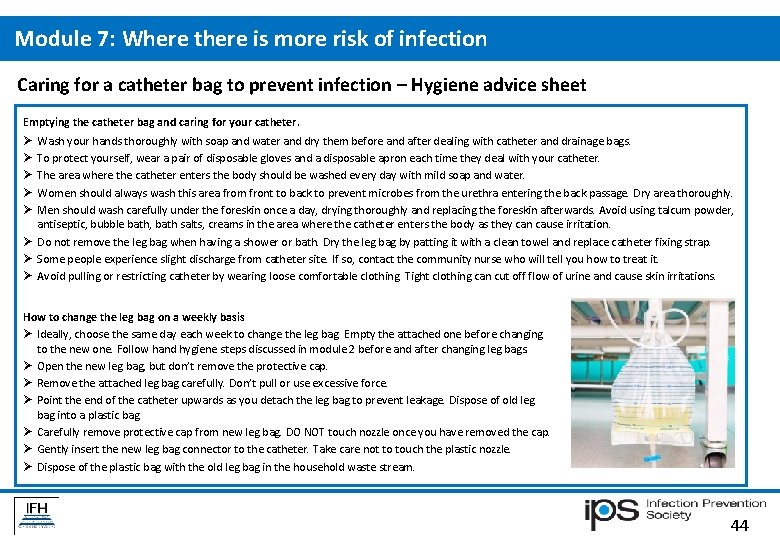
Module 7: Where there is more risk of infection Caring for a catheter bag to prevent infection – Hygiene advice sheet Emptying the catheter bag and caring for your catheter. Wash your hands thoroughly with soap and water and dry them before and after dealing with catheter and drainage bags. To protect yourself, wear a pair of disposable gloves and a disposable apron each time they deal with your catheter. The area where the catheter enters the body should be washed every day with mild soap and water. Women should always wash this area from front to back to prevent microbes from the urethra entering the back passage. Dry area thoroughly. Men should wash carefully under the foreskin once a day, drying thoroughly and replacing the foreskin afterwards. Avoid using talcum powder, antiseptic, bubble bath, bath salts, creams in the area where the catheter enters the body as they can cause irritation. Do not remove the leg bag when having a shower or bath. Dry the leg bag by patting it with a clean towel and replace catheter fixing strap. Some people experience slight discharge from catheter site. If so, contact the community nurse who will tell you how to treat it. Avoid pulling or restricting catheter by wearing loose comfortable clothing. Tight clothing can cut off flow of urine and cause skin irritations. How to change the leg bag on a weekly basis Ideally, choose the same day each week to change the leg bag. Empty the attached one before changing to the new one. Follow hand hygiene steps discussed in module 2 before and after changing leg bags. Open the new leg bag, but don’t remove the protective cap. Remove the attached leg bag carefully. Don’t pull or use excessive force. Point the end of the catheter upwards as you detach the leg bag to prevent leakage. Dispose of old leg bag into a plastic bag. Carefully remove protective cap from new leg bag. DO NOT touch nozzle once you have removed the cap. Gently insert the new leg bag connector to the catheter. Take care not to touch the plastic nozzle. Dispose of the plastic bag with the old leg bag in the household waste stream. Turn the page to learn more 44
Module 8: People who are infected & pose risk to others Introduction People living at home who have an infection may; Be infected with gastrointestinal infections (food poisoning or norovirus) or respiratory infections (colds, influenza). Have infected wounds. Have chronic wounds that have colonising bacteria (i. e. present but not causing infection). Be a carrier of a pathogenic microbes but show no symptoms, e. g. colonised by methicillin resistant S. aureus (MRSA) on their skin or in a wound or Salmonella in their gut. Hygiene should focus on preventing infection spreading to others by adopting targeted hygiene (see Sections 1 and 2). Vehicles for spreading infections are food (gut infections), contact (direct and indirect via hands, surfaces and fabrics) and air (respiratory infection). Key surfaces for infection spread are hands, cloths and food contact surfaces. Infected people should avoid contact with other people as far as possible, particularly those at increased risk of infection. Turn the page to learn more People often think that they can do nothing to prevent spread of colds, norovirus etc. Tell them that they can! This is particularly important where there is someone in the family who is at increased risk of infection 45
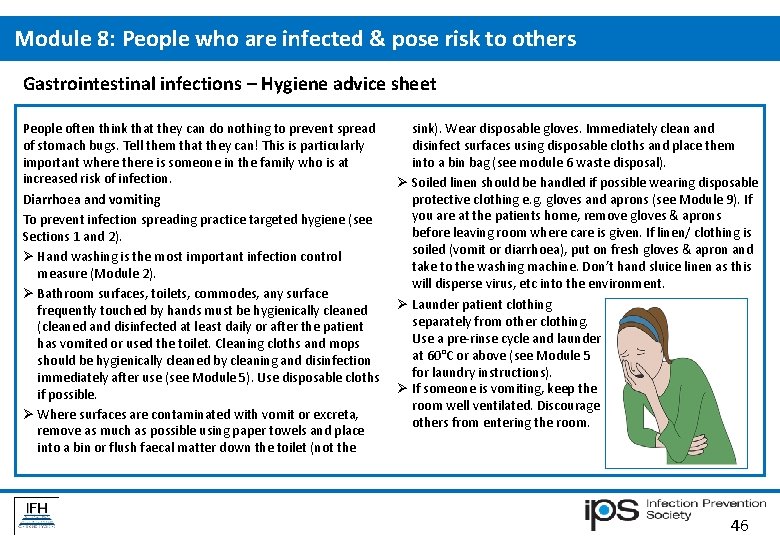
Module 8: People who are infected & pose risk to others Gastrointestinal infections – Hygiene advice sheet People often think that they can do nothing to prevent spread of stomach bugs. Tell them that they can! This is particularly important where there is someone in the family who is at increased risk of infection. Diarrhoea and vomiting To prevent infection spreading practice targeted hygiene (see Sections 1 and 2). Hand washing is the most important infection control measure (Module 2). Bathroom surfaces, toilets, commodes, any surface frequently touched by hands must be hygienically cleaned (cleaned and disinfected at least daily or after the patient has vomited or used the toilet. Cleaning cloths and mops should be hygienically cleaned by cleaning and disinfection immediately after use (see Module 5). Use disposable cloths if possible. Where surfaces are contaminated with vomit or excreta, remove as much as possible using paper towels and place into a bin or flush faecal matter down the toilet (not the sink). Wear disposable gloves. Immediately clean and disinfect surfaces using disposable cloths and place them into a bin bag (see module 6 waste disposal). Soiled linen should be handled if possible wearing disposable protective clothing e. g. gloves and aprons (see Module 9). If you are at the patients home, remove gloves & aprons before leaving room where care is given. If linen/ clothing is soiled (vomit or diarrhoea), put on fresh gloves & apron and take to the washing machine. Don’t hand sluice linen as this will disperse virus, etc into the environment. Launder patient clothing separately from other clothing. Use a pre-rinse cycle and launder at 60°C or above (see Module 5 for laundry instructions). If someone is vomiting, keep the room well ventilated. Discourage others from entering the room. Turn the page to learn more 46
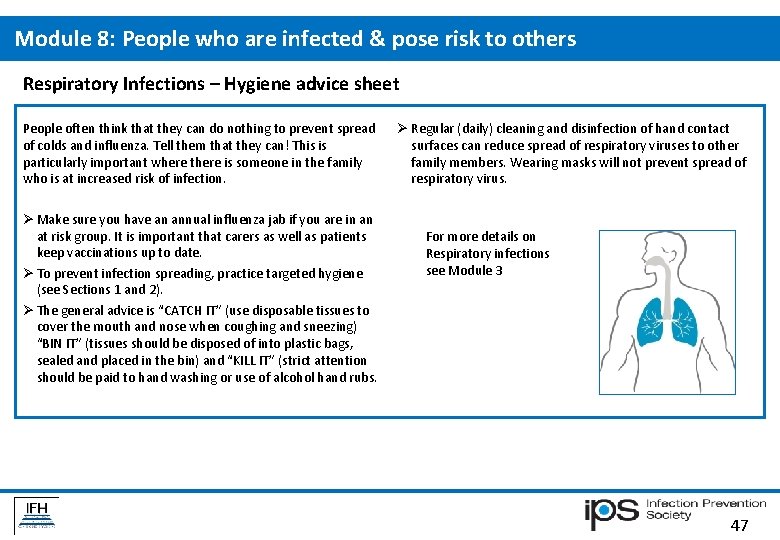
Module 8: People who are infected & pose risk to others Respiratory Infections – Hygiene advice sheet People often think that they can do nothing to prevent spread of colds and influenza. Tell them that they can! This is particularly important where there is someone in the family who is at increased risk of infection. Regular (daily) cleaning and disinfection of hand contact surfaces can reduce spread of respiratory viruses to other family members. Wearing masks will not prevent spread of respiratory virus. Make sure you have an annual influenza jab if you are in an at risk group. It is important that carers as well as patients keep vaccinations up to date. To prevent infection spreading, practice targeted hygiene (see Sections 1 and 2). The general advice is “CATCH IT” (use disposable tissues to cover the mouth and nose when coughing and sneezing) “BIN IT” (tissues should be disposed of into plastic bags, sealed and placed in the bin) and “KILL IT” (strict attention should be paid to hand washing or use of alcohol hand rubs. Turn the page to learn more For more details on Respiratory infections see Module 3 47
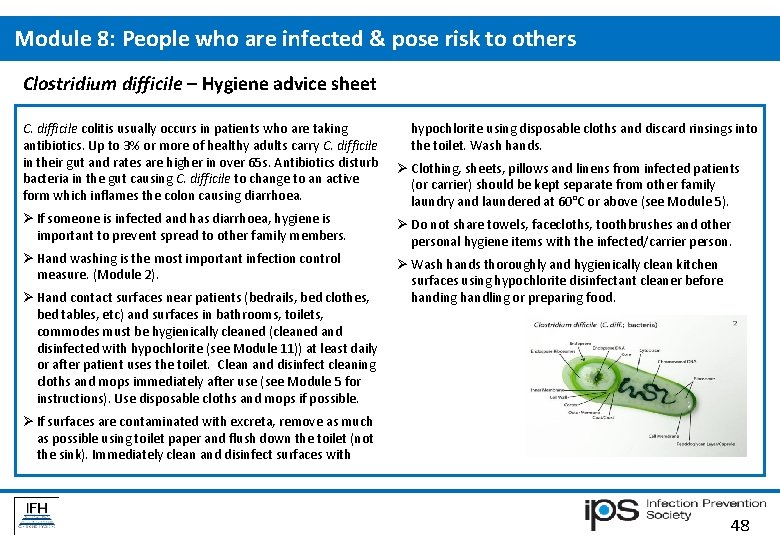
Module 8: People who are infected & pose risk to others Clostridium difficile – Hygiene advice sheet C. difficile colitis usually occurs in patients who are taking antibiotics. Up to 3% or more of healthy adults carry C. difficile in their gut and rates are higher in over 65 s. Antibiotics disturb bacteria in the gut causing C. difficile to change to an active form which inflames the colon causing diarrhoea. If someone is infected and has diarrhoea, hygiene is important to prevent spread to other family members. Hand washing is the most important infection control measure. (Module 2). Hand contact surfaces near patients (bedrails, bed clothes, bed tables, etc) and surfaces in bathrooms, toilets, commodes must be hygienically cleaned (cleaned and disinfected with hypochlorite (see Module 11)) at least daily or after patient uses the toilet. Clean and disinfect cleaning cloths and mops immediately after use (see Module 5 for instructions). Use disposable cloths and mops if possible. hypochlorite using disposable cloths and discard rinsings into the toilet. Wash hands. Clothing, sheets, pillows and linens from infected patients (or carrier) should be kept separate from other family laundry and laundered at 60°C or above (see Module 5). Do not share towels, facecloths, toothbrushes and other personal hygiene items with the infected/carrier person. Wash hands thoroughly and hygienically clean kitchen surfaces using hypochlorite disinfectant cleaner before handing handling or preparing food. If surfaces are contaminated with excreta, remove as much as possible using toilet paper and flush down the toilet (not the sink). Immediately clean and disinfect surfaces with Turn the page to learn more 48
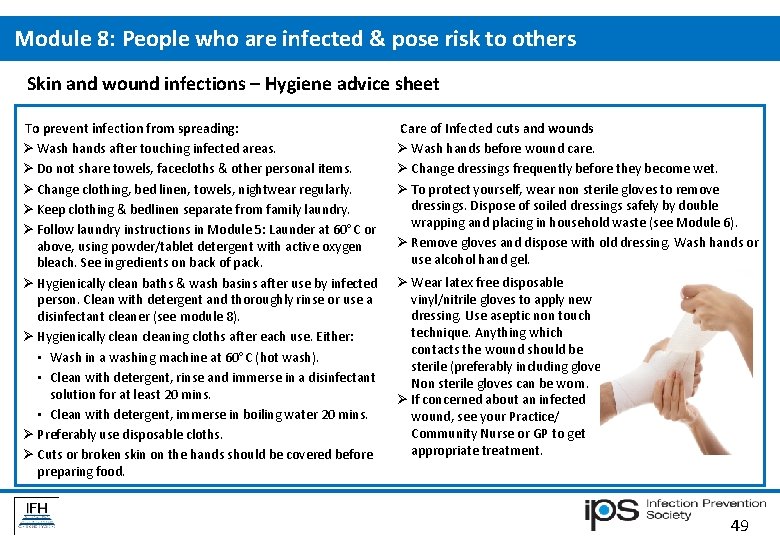
Module 8: People who are infected & pose risk to others Skin and wound infections – Hygiene advice sheet To prevent infection from spreading: Wash hands after touching infected areas. Do not share towels, facecloths & other personal items. Change clothing, bed linen, towels, nightwear regularly. Keep clothing & bedlinen separate from family laundry. Follow laundry instructions in Module 5: Launder at 60 C or above, using powder/tablet detergent with active oxygen bleach. See ingredients on back of pack. Hygienically clean baths & wash basins after use by infected person. Clean with detergent and thoroughly rinse or use a disinfectant cleaner (see module 8). Hygienically cleaning cloths after each use. Either: • Wash in a washing machine at 60 C (hot wash). • Clean with detergent, rinse and immerse in a disinfectant solution for at least 20 mins. • Clean with detergent, immerse in boiling water 20 mins. Preferably use disposable cloths. Cuts or broken skin on the hands should be covered before preparing food. Care of Infected cuts and wounds Wash hands before wound care. Change dressings frequently before they become wet. To protect yourself, wear non sterile gloves to remove dressings. Dispose of soiled dressings safely by double wrapping and placing in household waste (see Module 6). Remove gloves and dispose with old dressing. Wash hands or use alcohol hand gel. Wear latex free disposable vinyl/nitrile gloves to apply new dressing. Use aseptic non touch technique. Anything which contacts the wound should be sterile (preferably including gloves). Non sterile gloves can be worn. If concerned about an infected wound, see your Practice/ Community Nurse or GP to get appropriate treatment. Turn the page to learn more 49
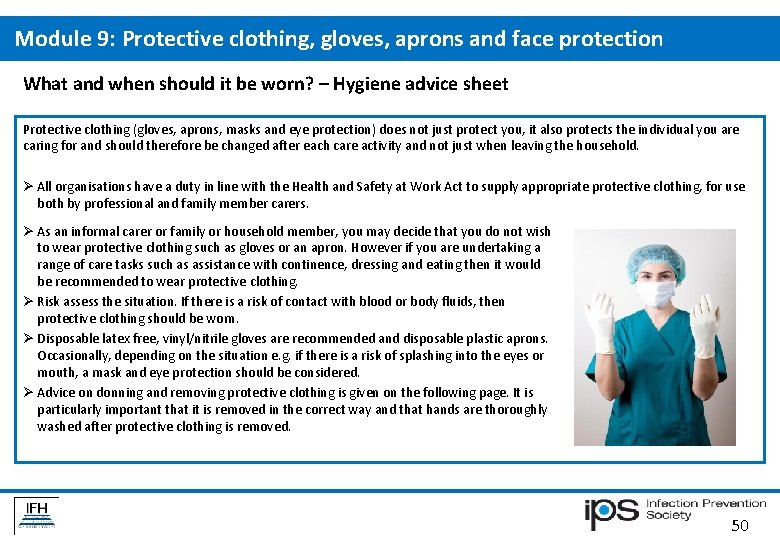
Module 9: Protective clothing, gloves, aprons and face protection What and when should it be worn? – Hygiene advice sheet Protective clothing (gloves, aprons, masks and eye protection) does not just protect you, it also protects the individual you are caring for and should therefore be changed after each care activity and not just when leaving the household. All organisations have a duty in line with the Health and Safety at Work Act to supply appropriate protective clothing, for use both by professional and family member carers. As an informal carer or family or household member, you may decide that you do not wish to wear protective clothing such as gloves or an apron. However if you are undertaking a range of care tasks such as assistance with continence, dressing and eating then it would be recommended to wear protective clothing. Risk assess the situation. If there is a risk of contact with blood or body fluids, then protective clothing should be worn. Disposable latex free, vinyl/nitrile gloves are recommended and disposable plastic aprons. Occasionally, depending on the situation e. g. if there is a risk of splashing into the eyes or mouth, a mask and eye protection should be considered. Advice on donning and removing protective clothing is given on the following page. It is particularly important that it is removed in the correct way and that hands are thoroughly washed after protective clothing is removed. Turn the page to learn more 50
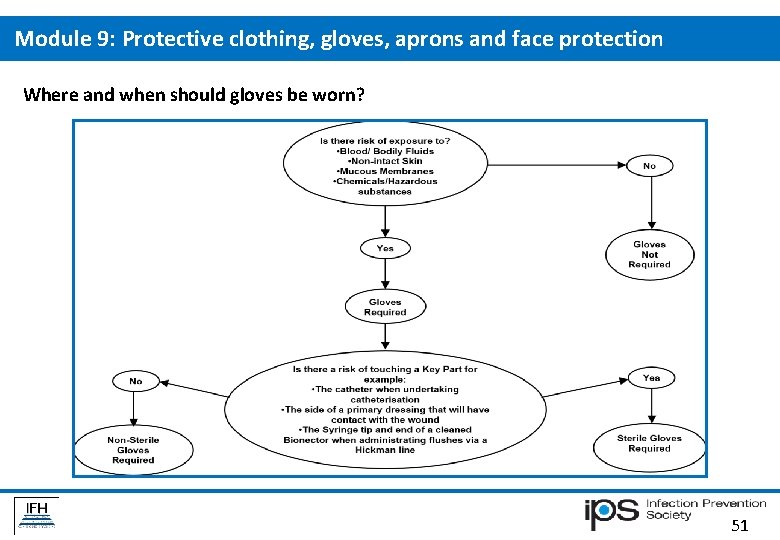
Module 9: Protective clothing, gloves, aprons and face protection Where and when should gloves be worn? 51
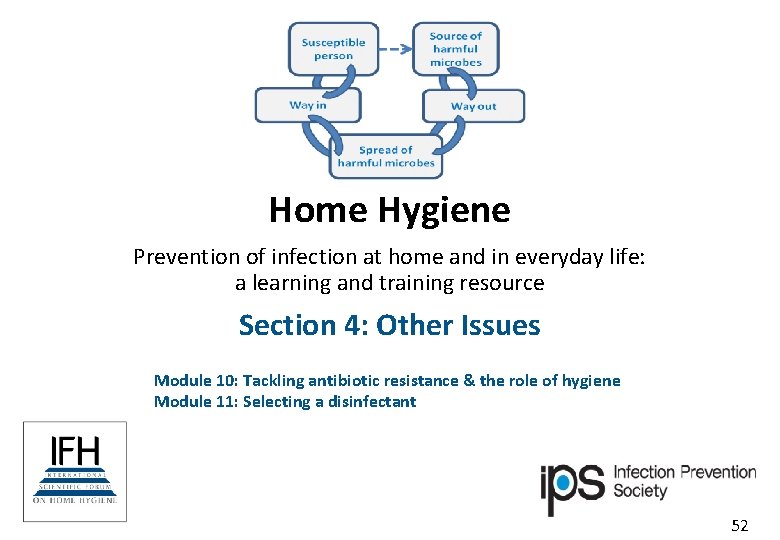
Home Hygiene Prevention of infection at home and in everyday life: a learning and training resource Section 4: Other Issues Module 10: Tackling antibiotic resistance & the role of hygiene Module 11: Selecting a disinfectant 52
Module 10: Tackling antibiotic resistance & the role of hygiene Tackling antibiotic resistance is a global priority : International and national action plans focus on 3 key areas: 1. Reducing antibiotic prescribing in humans and animals. 2. Developing new antibiotics. 3. Preventing infection and limiting spread of antibiotic resistant strains. Whereas early infection prevention initiatives focused on healthcare settings, policy makers now recognise that strategies must also involve home and community settings. Hygiene in home and everyday life addresses antibiotic resistance in two ways by: 1. Reducing the risk of developing infections, thereby reducing the need for antibiotic prescribing. 2. Reducing spread of resistant strains such as MRSA and multidrug resistant Gram-negative strains across the community. As prevalence of nasal or bowel carriage of resistant strains in the healthy population increases, this increases the risk of becoming infected with resistant strains. Spread of resistant strains can occur by; Person to person spread, either by direct contact or via hands and surfaces (particularly hand contact surfaces, and clothing and household linens. – Consumption of food or water contaminated by drug resistant strains. Studies show carriage of antibiotic resistance strains in healthy community populations, the presence of resistant strains in the environment and in food is increasing (4). – Targeted hygiene to prevent spread of infection and spread of resistant strains, focuses in the places (hands, contact surfaces, cleaning utensils, clothing and household linens etc. ) and at the times that matters (handling and cooking food, using the toilet, respiratory hygiene, laundering of clothing etc). Targeted hygiene is set out in Modules 1 and 2. Turn the page to learn more 53
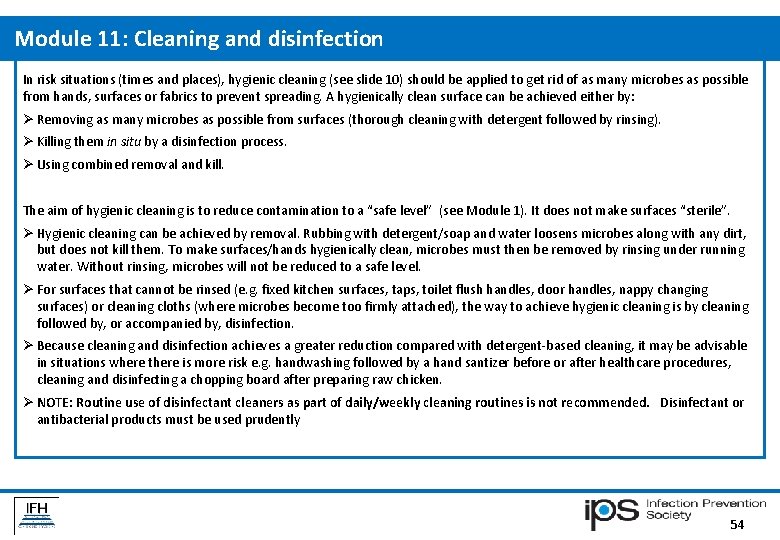
Module 11: Cleaning and disinfection In risk situations (times and places), hygienic cleaning (see slide 10) should be applied to get rid of as many microbes as possible from hands, surfaces or fabrics to prevent spreading. A hygienically clean surface can be achieved either by: Removing as many microbes as possible from surfaces (thorough cleaning with detergent followed by rinsing). Killing them in situ by a disinfection process. Using combined removal and kill. The aim of hygienic cleaning is to reduce contamination to a “safe level” (see Module 1). It does not make surfaces “sterile”. Hygienic cleaning can be achieved by removal. Rubbing with detergent/soap and water loosens microbes along with any dirt, but does not kill them. To make surfaces/hands hygienically clean, microbes must then be removed by rinsing under running water. Without rinsing, microbes will not be reduced to a safe level. For surfaces that cannot be rinsed (e. g. fixed kitchen surfaces, taps, toilet flush handles, door handles, nappy changing surfaces) or cleaning cloths (where microbes become too firmly attached), the way to achieve hygienic cleaning is by cleaning followed by, or accompanied by, disinfection. Because cleaning and disinfection achieves a greater reduction compared with detergent-based cleaning, it may be advisable in situations where there is more risk e. g. handwashing followed by a hand santizer before or after healthcare procedures, cleaning and disinfecting a chopping board after preparing raw chicken. NOTE: Routine use of disinfectant cleaners as part of daily/weekly cleaning routines is not recommended. Disinfectant or antibacterial products must be used prudently Turn the page to learn more 54
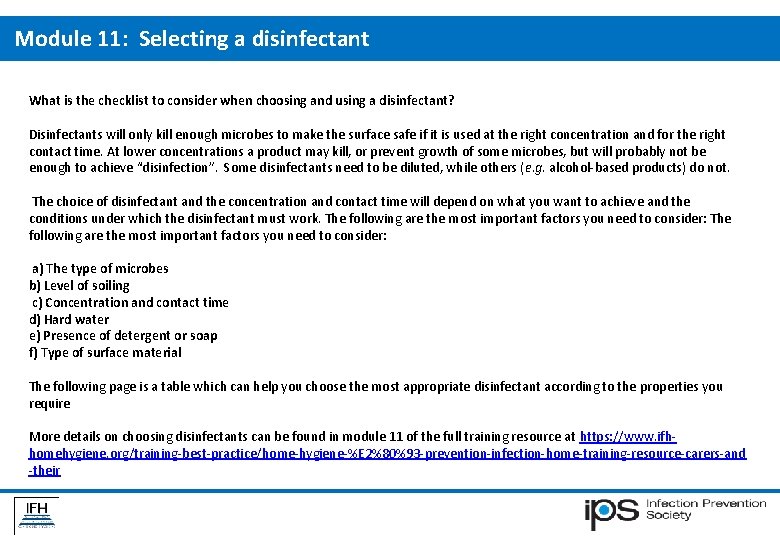
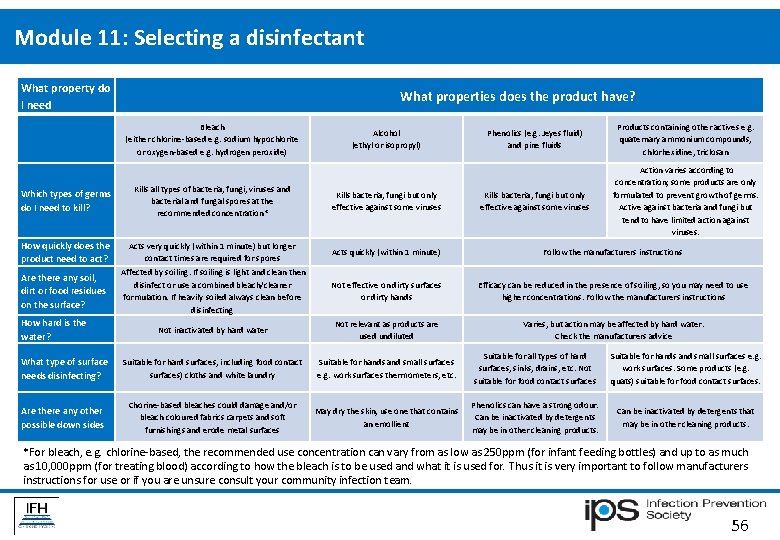
Module 11: Selecting a disinfectant What is the checklist to consider when choosing and using a disinfectant? Disinfectants will only kill enough microbes to make the surface safe if it is used at the right concentration and for the right contact time. At lower concentrations a product may kill, or prevent growth of some microbes, but will probably not be enough to achieve “disinfection”. Some disinfectants need to be diluted, while others (e. g. alcohol-based products) do not. The choice of disinfectant and the concentration and contact time will depend on what you want to achieve and the conditions under which the disinfectant must work. The following are the most important factors you need to consider: a) The type of microbes b) Level of soiling c) Concentration and contact time d) Hard water e) Presence of detergent or soap f) Type of surface material The following page is a table which can help you choose the most appropriate disinfectant according to the properties you require More details on choosing disinfectants can be found in module 11 of the full training resource at https: //www. ifhhomehygiene. org/training-best-practice/home-hygiene-%E 2%80%93 -prevention-infection-home-training-resource-carers-and -their Turn the page to learn more
Module 11: Selecting a disinfectant What property do I need What properties does the product have? Bleach (either chlorine-based e. g. sodium hypochlorite or oxygen-based e. g. hydrogen peroxide) Alcohol (ethyl or isopropyl) Phenolics (e. g. Jeyes fluid) and pine fluids Products containing other actives e. g. quaternary ammonium compounds, chlorhexidine, triclosan Kills bacteria, fungi but only effective against some viruses Action varies according to concentration; some products are only formulated to prevent growth of germs. Active against bacteria and fungi but tend to have limited action against viruses. Which types of germs do I need to kill? Kills all types of bacteria, fungi, viruses and bacterial and fungal spores at the recommended concentration* Kills bacteria, fungi but only effective against some viruses How quickly does the product need to act? Acts very quickly (within 1 minute) but longer contact times are required for spores Acts quickly (within 1 minute) Follow the manufacturers instructions Are there any soil, dirt or food residues on the surface? Affected by soiling. If soiling is light and clean then disinfect or use a combined bleach/cleaner formulation. If heavily soiled always clean before disinfecting Not effective on dirty surfaces or dirty hands Efficacy can be reduced in the presence of soiling, so you may need to use higher concentrations. Follow the manufacturers instructions Not inactivated by hard water Not relevant as products are used undiluted Varies, but action may be affected by hard water. Check the manufacturers advice What type of surface needs disinfecting? Suitable for hard surfaces, including food contact surfaces) cloths and white laundry Suitable for hands and small surfaces e. g. work surfaces thermometers, etc. Suitable for all types of hard surfaces, sinks, drains, etc. Not suitable for food contact surfaces Suitable for hands and small surfaces e. g. work surfaces. Some products (e. g. quats) suitable for food contact surfaces. Are there any other possible down sides Chorine-based bleaches could damage and/or bleach coloured fabrics carpets and soft furnishings and erode metal surfaces May dry the skin, use one that contains an emollient Phenolics can have a strong odour. Can be inactivated by detergents may be in other cleaning products. Can be inactivated by detergents that may be in other cleaning products. How hard is the water? *For bleach, e. g. chlorine-based, the recommended use concentration can vary from as low as 250 ppm (for infant feeding bottles) and up to as much as 10, 000 ppm (for treating blood) according to how the bleach is to be used and what it is used for. Thus it is very important to follow manufacturers instructions for use or if you are unsure consult your community infection team. 56
Acknowledgements This resource has been produced by a group of infection control/hygiene experts representing the International Scientific Forum on Home Hygiene and the UK Infection Prevention Society: Professor Lisa Ackerley, University of Salford, International Scientific Forum on Home Hygiene, Chartered Environmental Health Practitioner and Professorial Fellow, Royal Society for Public Health Professor Sally Bloomfield, London School of Hygiene and Tropical Medicine, International Scientific Forum on Home Hygiene , Infection Prevention Society, Hospital Infection Society Fiona Branton, Head of Infection Prevention and Control, Nottingham City Care Partnership; Infection Prevention Society Jude Robinson, Senior Lecturer and Researcher at Demontfort University, Leicester, Infection Prevention Society Educational Officer Karen Shaw, Infection Prevention and Control Lead, PHE AMR & HCAI Programme, Public Health England Helen Call, Scottish Branch Coordinator IPS, Infection Prevention and Control Nurse Katie Grayson IPS, Senior Nurse – Infection Prevention & Control Sheffield Health & Social Care NHS Foundation Trust, Infection Prevention Society Ceri Harris, Health Protection Nurse, Health Protection Division, Public Health Wales, Infection Prevention Society The resource is an update of the training resource “Home Hygiene Prevention of infection in the home – a training resource for carers and their trainers” originally published in 2003 © International Scientific Forum on Home Hygiene, UK Infection Prevention Society 2018 57
The International Scientific Forum on Home Hygiene is a not-for profit, non government organisation which was established in 1998, and is working to develop and promote hygiene in home and every day life based on sound scientific evidence (www. ifh-homehygiene. org) The UK Infection Prevention Society. Our vision is that no person is harmed by a preventable infection. Our mission is to inform promote and sustain expert infection prevention policy and practice in the pursuit of patient or service user and staff safety wherever care is delivered (https: //www. ips. uk. net/) 58