
Poultry meat hygiene and inspection Prof Dr Refaat




- Slides: 27
Poultry meat hygiene and inspection Prof. Dr: Refaat Farghaly
Introduction *Poultry refers to live / dressed domestic birds which have been bred for edible purposes& includes; chicken, ducks, geese & turkeys. *Poultry meat is the muscle tissue, skin, C. T& edible organs of avian spp, that usually used for food
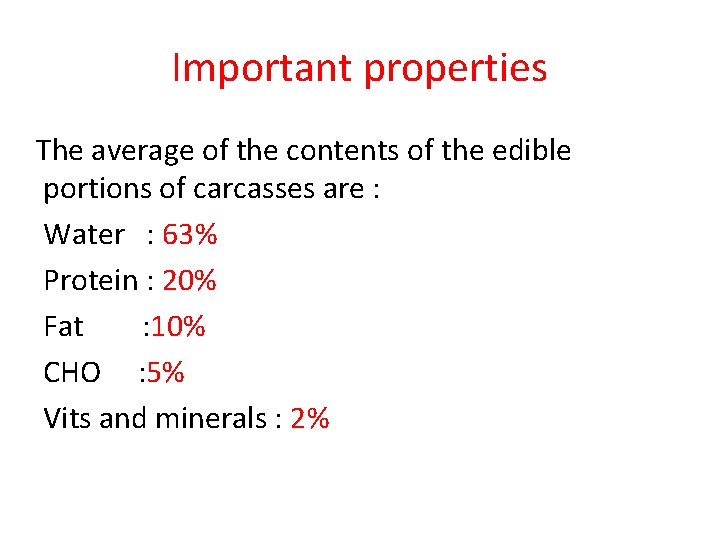
Important properties The average of the contents of the edible portions of carcasses are : Water : 63% Protein : 20% Fat : 10% CHO : 5% Vits and minerals : 2%
Poultry meat production This industry is concerned with broilers , cockerels and capons , turkey , ducks , geese , hens and some game species
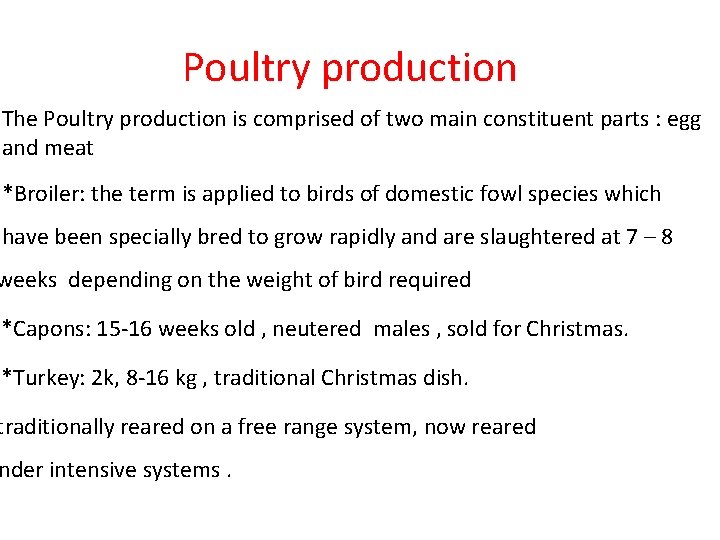
Poultry production The Poultry production is comprised of two main constituent parts : egg and meat *Broiler: the term is applied to birds of domestic fowl species which have been specially bred to grow rapidly and are slaughtered at 7 – 8 weeks depending on the weight of bird required *Capons: 15 -16 weeks old , neutered males , sold for Christmas. *Turkey: 2 k, 8 -16 kg , traditional Christmas dish. traditionally reared on a free range system, now reared nder intensive systems.
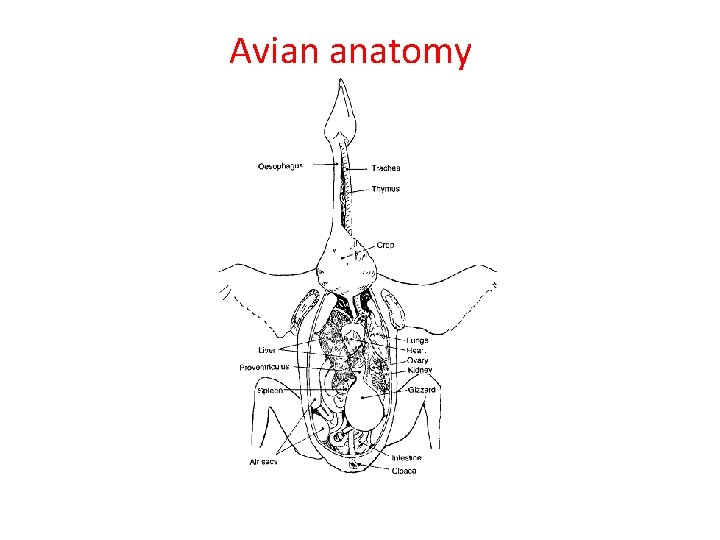
Avian anatomy
Avian anatomy *The skin : - Avian species has a thin dry skin is white to yellowish pink in color - Which in most place is covered with feather ( imressive contour feather , downy feather , hair like feather is more common in older bird ) -Shanks and feet are covered in scales , only exotic strains have feathers in shank area -the comb is an appendage on the dorsal aspect of the head -Wattles from the ventral aspect of the head -snood in tukeys arises from the base of upper beak -oil gland or preen gland at the base of the tail
*the skeleton -The backbone is formed of vertebrae of which there about 42 in domestic fowl made up of a long and xible neck of about 16 – 17 cervical vertebrae , thoracic region where only the 4 th thoracic vertebra is mobile , the reminder being fused -The fused synsacrum in the sacral region -The caudal vertebrae which are free he tail which is made up of fused terminal caudal vertebrae
*muscular system -there are two types of muscle in poultry 1 - the white muscle fiber which predominant in the breast muscle 2 -dark or red muscle fiber which predominant in the legs
*the digestive system 1 -Horny beak 2 - oesophagus is a thin walled tube passes down the neck 3 - stomach Is divided into two parts The first is the proventricular or glandular part The second is the gizzard or muscular part 4 -the small intestine Is the narrow tube and is split into duodenum , jejunum and ilium 5 -large intestine Consist of a short rectum and two caeca 6 -cloaca Is the terminal part of the intestine Divided by two folds into 3 compartments ( rectum and the urogenital ducts ) NB … in young birds is a diverticulum of dorsal aspect of cloaca which is known as the cloaca bursa ( Bursa of fabricius )
The respiratory system hen the birds inhales air is drawn through the nostrils into larynx and trachea The trachea is made up of cartilaginous rings ( 100 -130 in domestic birds ) Then pass to thoracic inlet where it divides into wo bronchi The air passes to air sacs
Construction & layout of an approved poultry Slaughter plant
The basic principles which applied to all approved slaughter plant are 1 -site A-it must be big enough to allow for all the activities associated with a poultry slaughter and processing plant to be carried out in uncrowded condition B-it must be designated away from residential areas to avoid the associated noise , traffic , congestion and bad smell C- it should also be sited where many facilities are found as water supply , which is required for washing and chilling and for cleansing at the end of the day D-good roods for access to the site are also necessary in addition to electricity , draining and telephone F- the size of the site must be taken into account at the initial planning stages for the possibility of increased throughput G-fire precautions and the safety and health of the work force must be considered during the construction and planning
2 -general construction A-the building must be sound simple in design and must not offer sites for rats and mice and should be designed to give the impression of clean , efficient food production premises B- the sewage ttt system should be screened to prevent unauthorized entry and far enough away from the plant to minimize risk of odour and contamination C-the area used for loading the meat should be well away from the live birds and waste ttt D- the light must be adequate to allow the operatives to carry out their duties and particularly at the inspection stations E-adequate ventilation particularly in the pluking and scaling area where is high steam production F- the design of the constriction should be accommodate the large and heavy equipment to be changed quickly with minimum alteration of the building G-doors should be big enough to allow new equipment to be brought into the plant H-the plant should be surrounded by a perimeter fence in order to prevent unauthorized entry.
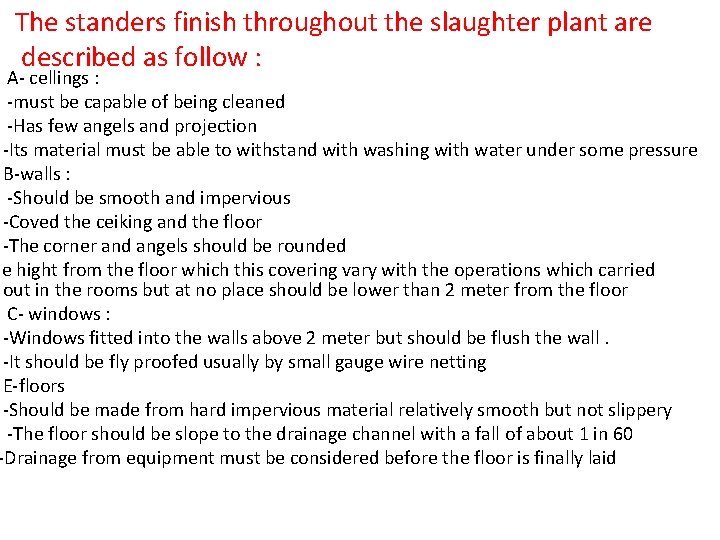
The standers finish throughout the slaughter plant are described as follow : A- cellings : -must be capable of being cleaned -Has few angels and projection -Its material must be able to withstand with washing with water under some pressure B-walls : -Should be smooth and impervious -Coved the ceiking and the floor -The corner and angels should be rounded he hight from the floor which this covering vary with the operations which carried out in the rooms but at no place should be lower than 2 meter from the floor C- windows : -Windows fitted into the walls above 2 meter but should be flush the wall. -It should be fly proofed usually by small gauge wire netting E-floors -Should be made from hard impervious material relatively smooth but not slippery -The floor should be slope to the drainage channel with a fall of about 1 in 60 -Drainage from equipment must be considered before the floor is finally laid
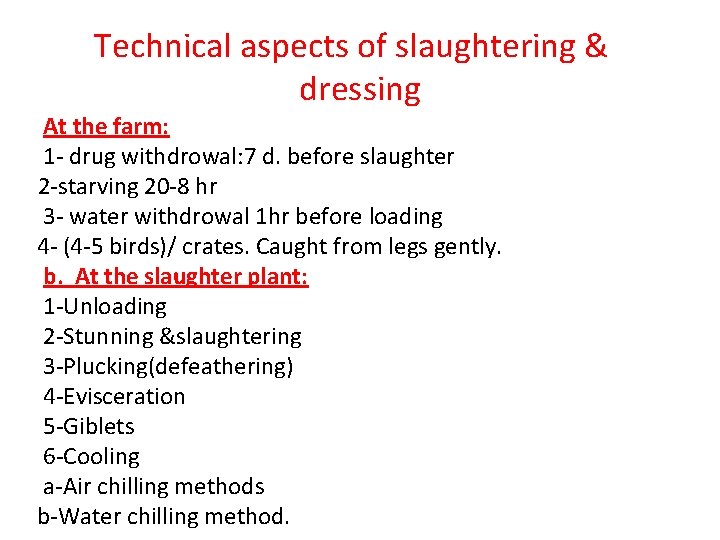
Technical aspects of slaughtering & dressing At the farm: 1 - drug withdrowal: 7 d. before slaughter 2 -starving 20 -8 hr 3 - water withdrowal 1 hr before loading 4 - (4 -5 birds)/ crates. Caught from legs gently. b. At the slaughter plant: 1 -Unloading 2 -Stunning &slaughtering 3 -Plucking(defeathering) 4 -Evisceration 5 -Giblets 6 -Cooling a-Air chilling methods b-Water chilling method.
poultry processing
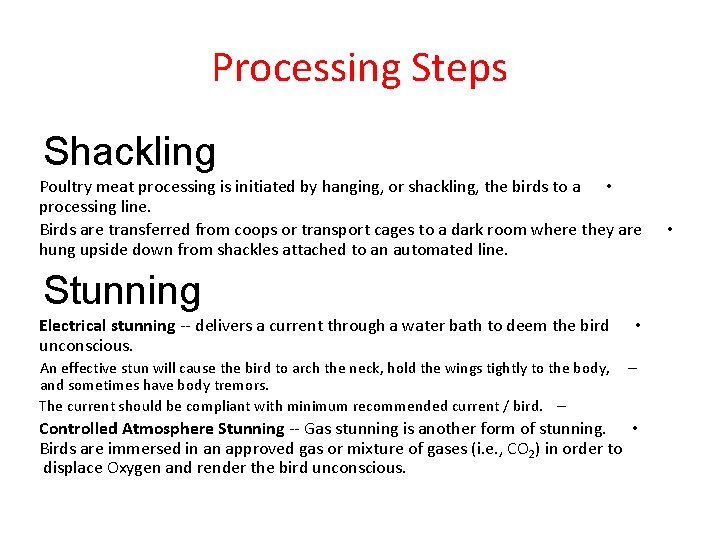
Processing Steps Shackling Poultry meat processing is initiated by hanging, or shackling, the birds to a • processing line. Birds are transferred from coops or transport cages to a dark room where they are hung upside down from shackles attached to an automated line. Stunning Electrical stunning -- delivers a current through a water bath to deem the bird unconscious. • An effective stun will cause the bird to arch the neck, hold the wings tightly to the body, and sometimes have body tremors. The current should be compliant with minimum recommended current / bird. – – Controlled Atmosphere Stunning -- Gas stunning is another form of stunning. • Birds are immersed in an approved gas or mixture of gases (i. e. , CO 2) in order to displace Oxygen and render the bird unconscious. •
Bleeding After stunning, the birds are passed through an automated knife that makes an incision on the neck to cut the jugular vein. With the carcass hanging upside down and the jugular vein cut, the majority of the blood is drained from the carcass. Scalding loosens the feathers to facilitate their removal. Carcasses are submerged into the scalder that contains water heated to 150 F. This high water temperature serves to loosen the connection of feathers to the skin.
Picking is a term that refers to feather removal. The picker removes the feathers on the carcass. The picker is an automated machine that contains rubber finger-like projections that rotate in a circular motion to remove feathers without damaging the carcass. Removal of feet, head, neck and oil glands Feet are removed at the knee joints. The head is cut and removed. The neck is cut by machine and esophagus is exposed.
Evisceration refers to the removal of internal organs. The inedible viscera consists of the spleen, esophagus, lungs, intestines and reproductive organs. The intestines (viscera) are federally inspected for signs of disease or other problems. Identified disease or other problems results in the removal, or condemnation, of the carcass from the processing line. The edible viscera, or giblets, consists of the heart, liver, and gizzard. The giblets are packaged in the carcass or sold separately.
Washing the carcass The carcasses are cleaned for microbial and visible concerns. When processing chicken, microbial bacteria such as E. Coli and Salmonella are analyzed. Chilling The carcass temperature must be reduced to prevent microbial growth. The USDA specifies the amount of chilling for specific bird sizes. 4 lb broiler: 40 F within 4 hours 4 -8 lb broiler: 40 F within 6 hours >8 lb broiler: 40 F within 8 hours Submerging the carcass in an ice (chilled water) bath is the most common method of carcass chilling. Carcass can also be chilled by air chilling. Air chilling occurs by passing cold air over the carcass. This is a more expensive process but some consumers are willing to pay more for air chilling.
Cut-up and deboning On average, 75 -80% of the live animal weight is retained in the carcass. This amount of live weight retained in the carcass is known as the dressing percentage or yield. The carcass can be sold whole, or individual components of carcass can be cut-up for individual sale. Cut-up often times includes removal of the breast, thigh, drumsticks, and wings. Deboning refers to the removal of bone from the cut-up meat. Breasts and thighs are commonly deboned.
Further processing The whole carcass or cut-up and deboned pieces may be further processed for added value. Further processing may include forming, curing, smoking, and cooking of products. Forming product requires a change in particle size and often includes the addition of nutrients to add flavor. Forming product also requires the use of a mold to obtain desired shape. Formed products include hot dogs, chicken nuggets, or sausage. Curing involves the addition of preservatives, often nitrates, to the meat to improve flavor and product shelf-life. Smoking also acts as a preservative while providing additional flavor to the product. Some product may prepared in a form that is edible without additional preparation and is known as “ready-to-eat”.
Storage Poultry meat should be refrigerated around 30 F. Keeping the poultry below 40 F reduces the risk of microbial growth. Refrigeration and freezing does not kill all microbes.
Thank you