HO 343 Session 15 Integrated HRIS Development EK

- Slides: 56
HO 343 -- Session 15: Integrated HRIS Development EK BUNCHUA ek@alpha. tu. ac. th Room # 528 Thammasat Business School
Today’s Lecture. 1 Recap HRIS Concepts. 2 HRIS Database. 3 Internal Records. 4 HR Intelligence. 5 HR Research. 6 HR DSS. 7 Functional ISs Integration
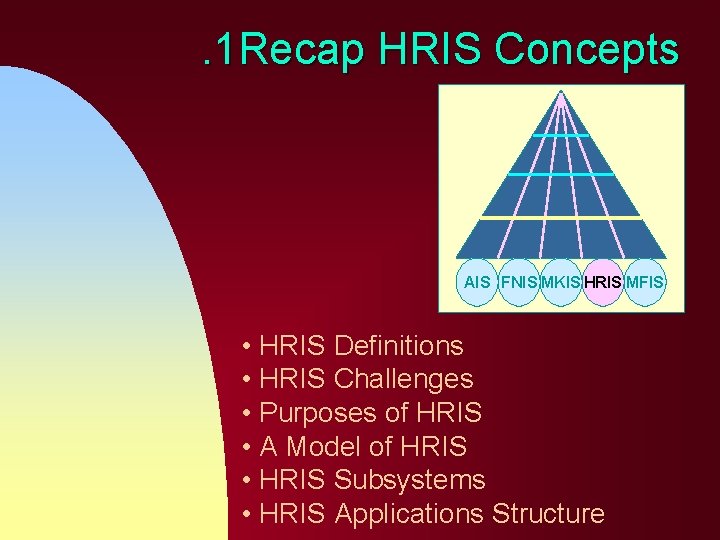
. 1 Recap HRIS Concepts AIS FNIS MKIS HRIS MFIS • HRIS Definitions • HRIS Challenges • Purposes of HRIS • A Model of HRIS • HRIS Subsystems • HRIS Applications Structure
Human Resource Information System. . . an integrated system designed to provide information used in HR decision making. )Mathis & Jackson(
Human Resource Information System. . . a system for • gathering and maintaining the data that describes the HR , • transforming the data into information, and • reporting the information to users. )Mc. Leod(
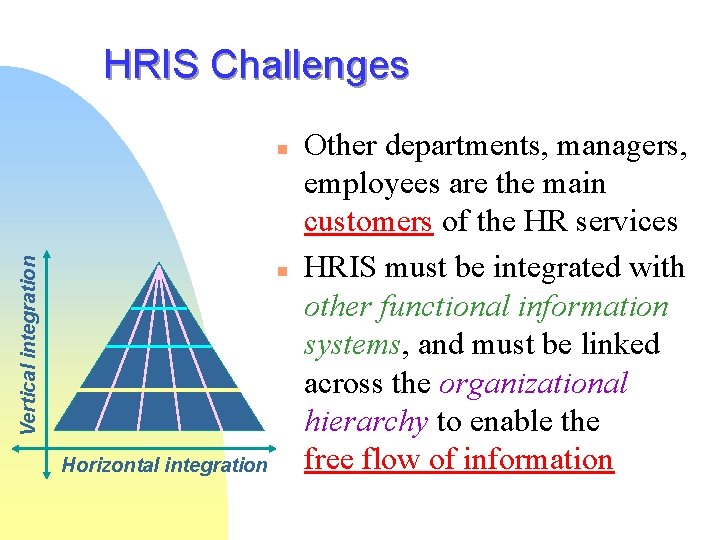
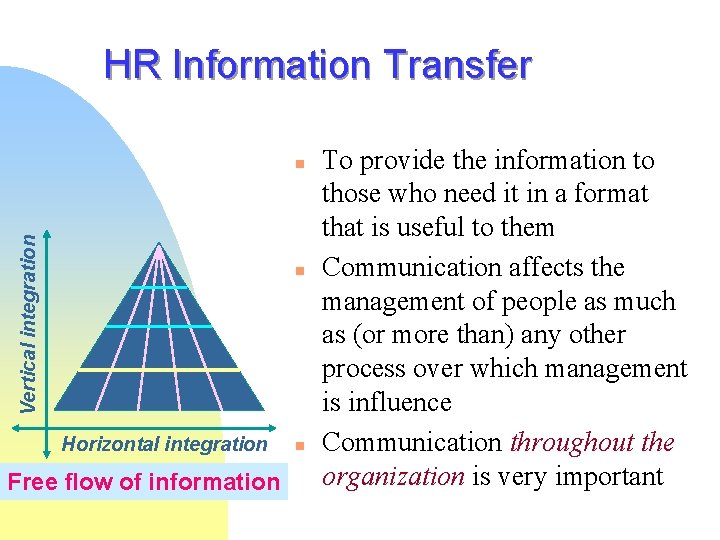
HRIS Challenges Vertical integration n n Horizontal integration Other departments, managers, employees are the main customers of the HR services HRIS must be integrated with other functional information systems, and must be linked across the organizational hierarchy to enable the free flow of information
Purposes of HRIS n n To improve the efficiency with which data on employees and HR activities is compiled To provide HR information more rapidly and more easily for use by management in making decisions )Mathis & Jackson(
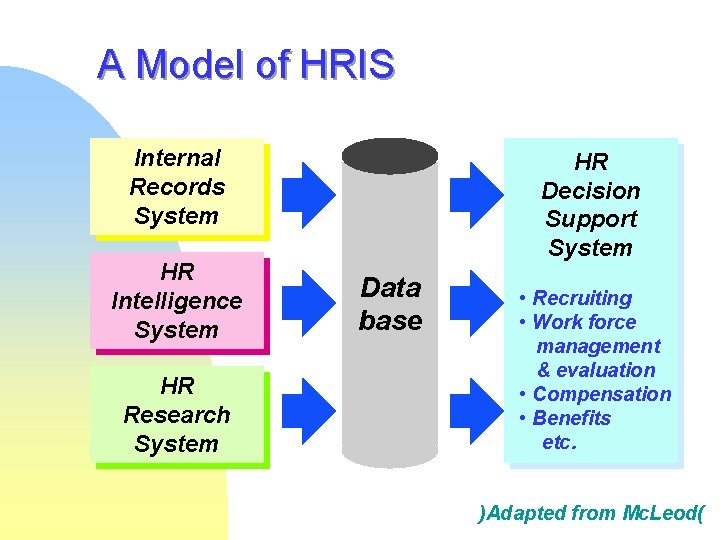
A Model of HRIS Internal Records System HR Intelligence System HR Research System HR Decision Support System Data base • Recruiting • Work force management & evaluation • Compensation • Benefits etc. )Adapted from Mc. Leod(
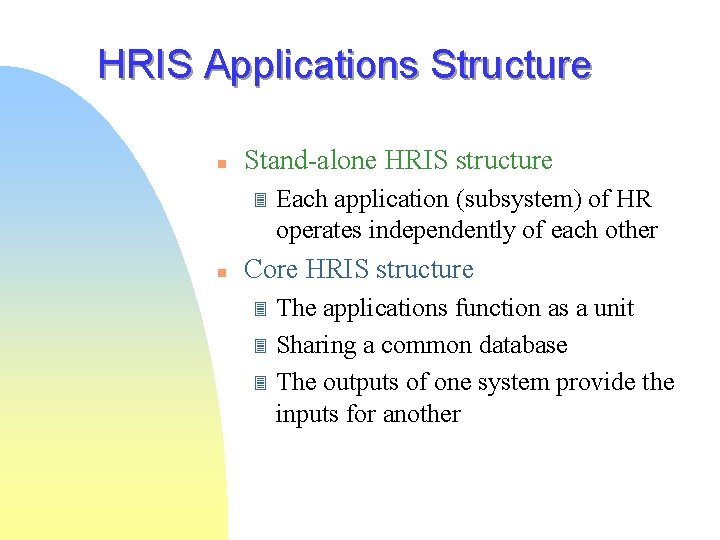
HRIS Applications Structure n Stand-alone HRIS structure 3 n Each application (subsystem) of HR operates independently of each other Core HRIS structure 3 3 3 The applications function as a unit Sharing a common database The outputs of one system provide the inputs for another
. 2 HRIS Database • Uses of HRIS Database • Steps in Developing HRIS Database
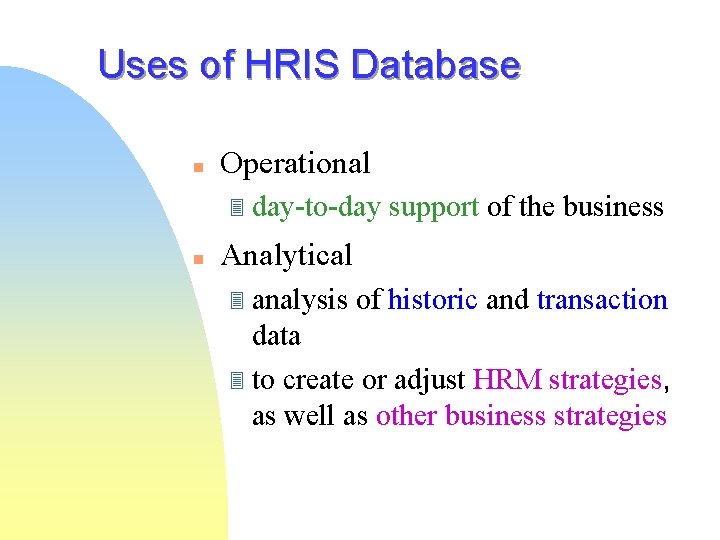
Uses of HRIS Database n Operational 3 day-to-day n support of the business Analytical 3 analysis of historic and transaction data 3 to create or adjust HRM strategies, as well as other business strategies
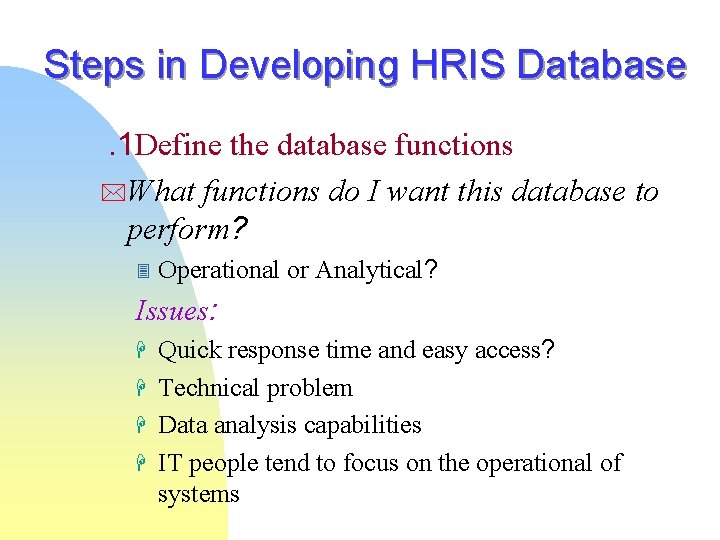
Steps in Developing HRIS Database. 1 Define the database functions *What functions do I want this database to perform? 3 Operational or Analytical? Issues: H H Quick response time and easy access? Technical problem Data analysis capabilities IT people tend to focus on the operational of systems
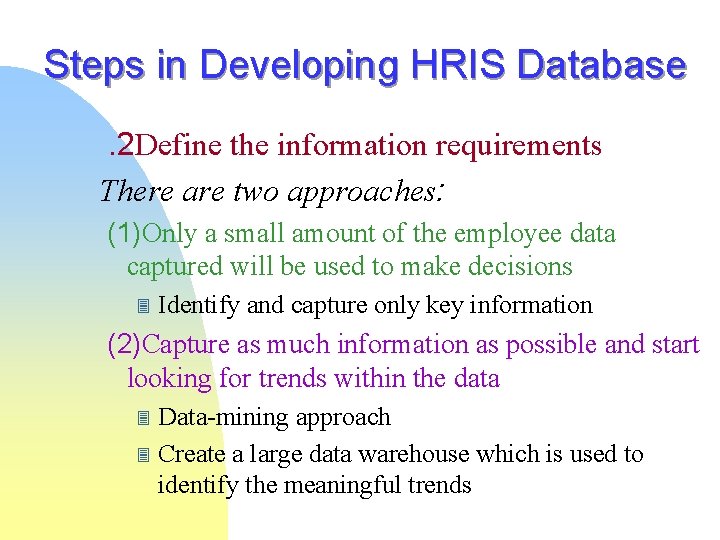
Steps in Developing HRIS Database. 2 Define the information requirements There are two approaches: (1)Only a small amount of the employee data captured will be used to make decisions 3 Identify and capture only key information (2)Capture as much information as possible and start looking for trends within the data 3 3 Data-mining approach Create a large data warehouse which is used to identify the meaningful trends
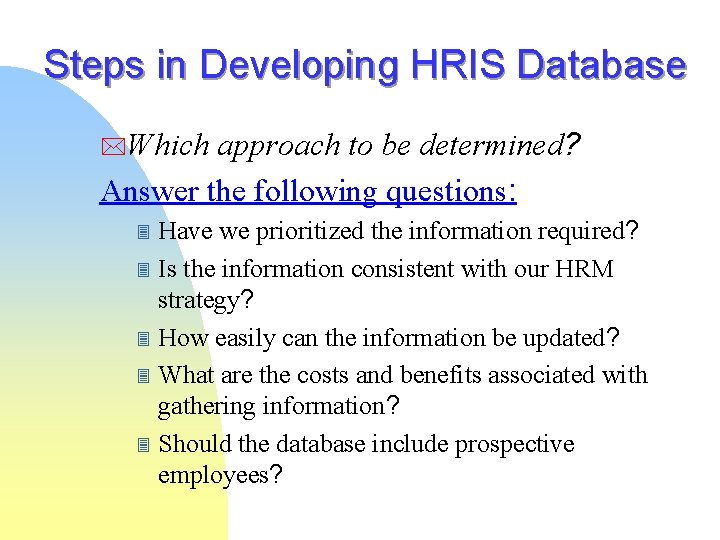
Steps in Developing HRIS Database *Which approach to be determined? Answer the following questions: 3 3 3 Have we prioritized the information required? Is the information consistent with our HRM strategy? How easily can the information be updated? What are the costs and benefits associated with gathering information? Should the database include prospective employees?
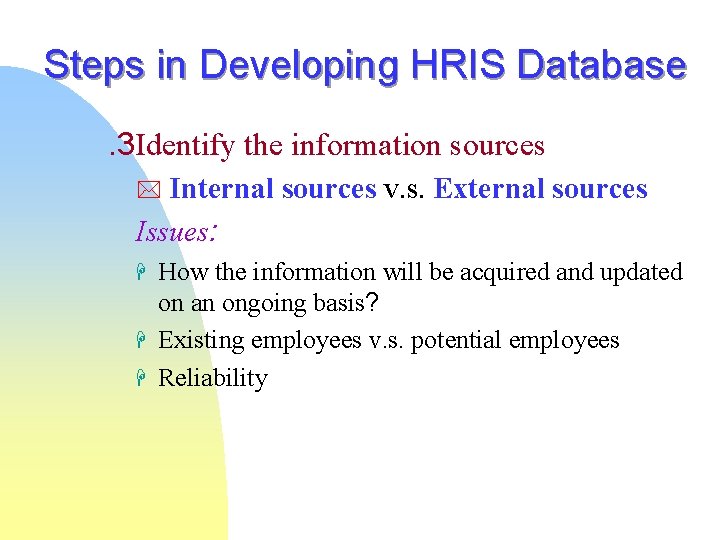
Steps in Developing HRIS Database. 3 Identify the information sources Internal sources v. s. External sources Issues: * H How the information will be acquired and updated on an ongoing basis? Existing employees v. s. potential employees Reliability
Steps in Developing HRIS Database. 4 Select the database technology and hardware platform 3 3 3 Depends on the intended uses of the database Relational database is the preferred solution for the vast majority of applications The selection of hardware platform will depend on the size of the database, and the number and location of potential users.
Steps in Developing HRIS Database. 5 Build applications to access and process information 3 3 Specify application requirements Element of the design F Data flow F Data store F Processes F Procedures F Controls F Roles
Steps in Developing HRIS Database. 6 Populate the database 3 3 Major task when developing HRIS database Poor-quality data is the primary reason for most of HRIS failures Issues H H H Much of the required information is already held in paper or electronic format Numbers of different locations where the data can be found Time consuming, require considerable resources
Steps in Developing HRIS Database. 7 Maintain the database 3 Ongoing maintenance activity is required to keep the information in the database up to date The database is a living breathing that requires constant attention -- you can’t just build it and say “that’s it. ” )Curtis(
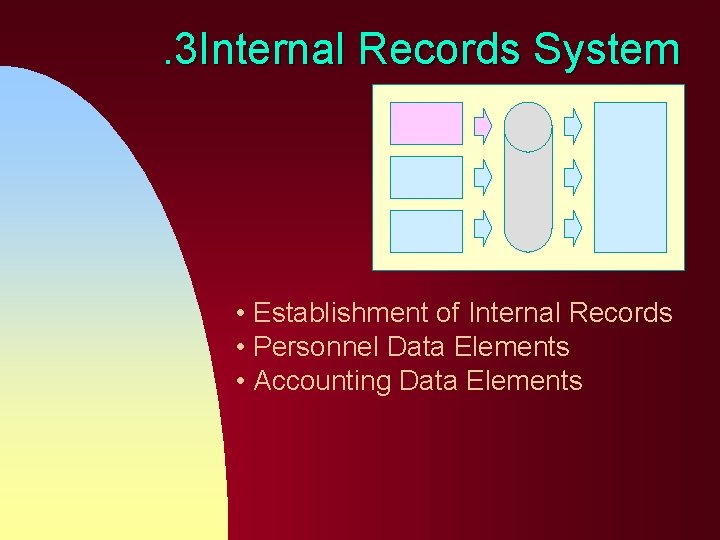
. 3 Internal Records System • Establishment of Internal Records • Personnel Data Elements • Accounting Data Elements
Establishment of Internal Records n n n Current employee-related data Confidential data 3 reference letters 3 promotability assessments 3 financial items 3 medical benefits Historical data
Personnel Data Elements Non-financial in nature n Relatively permanent n Be created by HR at the time of employment n Be kept current as long as the employees work for the firm Examples: n 3 employee name, sex, date of birth, education, number of dependents, etc.
Accounting Data Elements Primarily financial n Tend to be more dynamic Examples: n 3 hourly rate, monthly salary, current gross earnings, sales amount, commission paid, year-to-date income tax, etc.
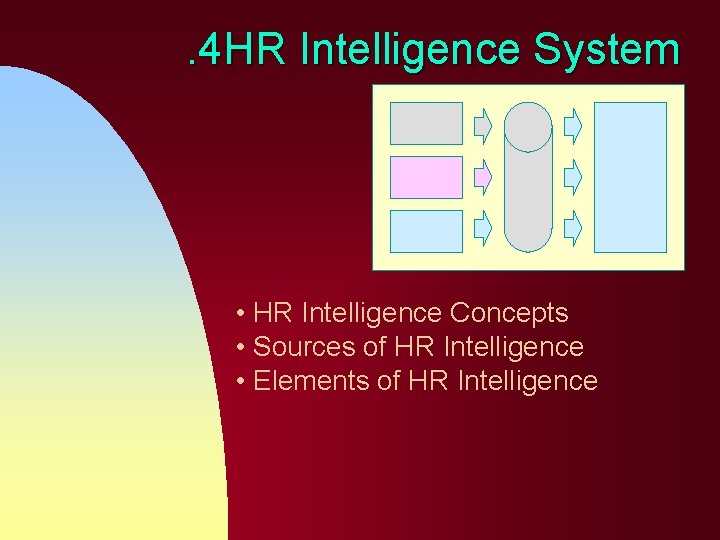
. 4 HR Intelligence System • HR Intelligence Concepts • Sources of HR Intelligence • Elements of HR Intelligence
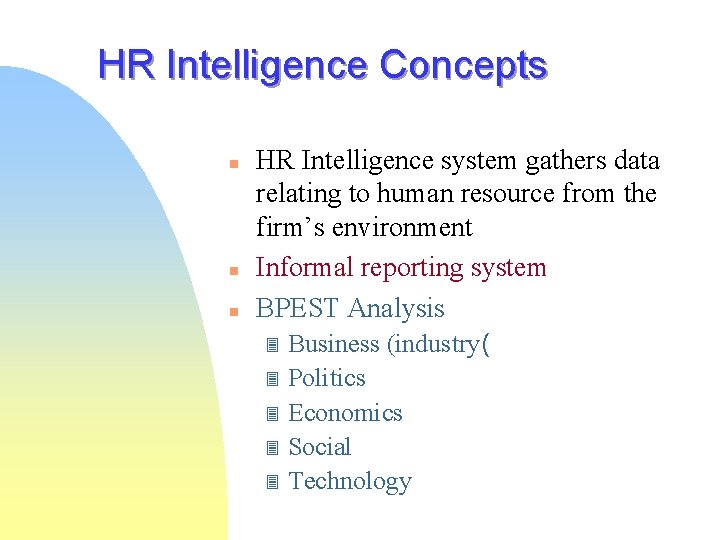
HR Intelligence Concepts n n n HR Intelligence system gathers data relating to human resource from the firm’s environment Informal reporting system BPEST Analysis 3 3 3 Business (industry( Politics Economics Social Technology
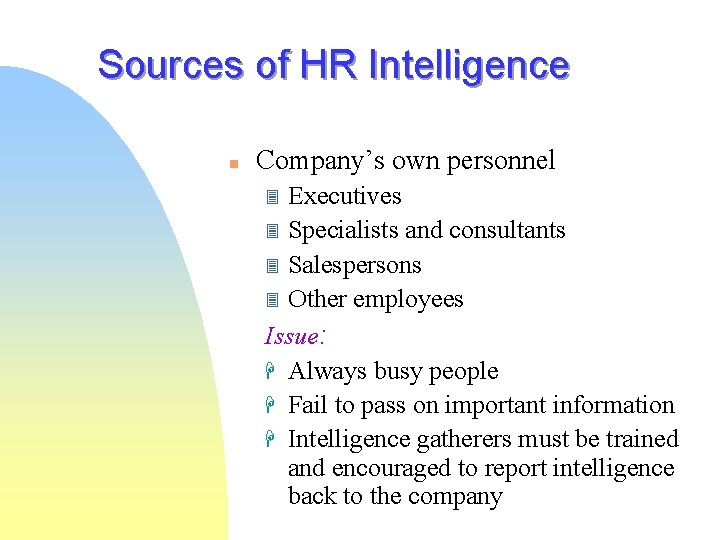
Sources of HR Intelligence n Company’s own personnel Executives 3 Specialists and consultants 3 Salespersons 3 Other employees Issue: H Always busy people H Fail to pass on important information H Intelligence gatherers must be trained and encouraged to report intelligence back to the company 3
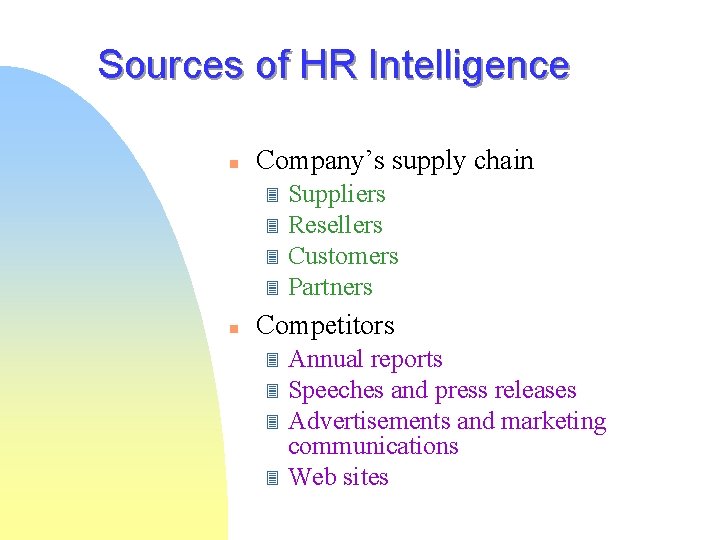
Sources of HR Intelligence n Company’s supply chain 3 3 n Suppliers Resellers Customers Partners Competitors 3 3 Annual reports Speeches and press releases Advertisements and marketing communications Web sites
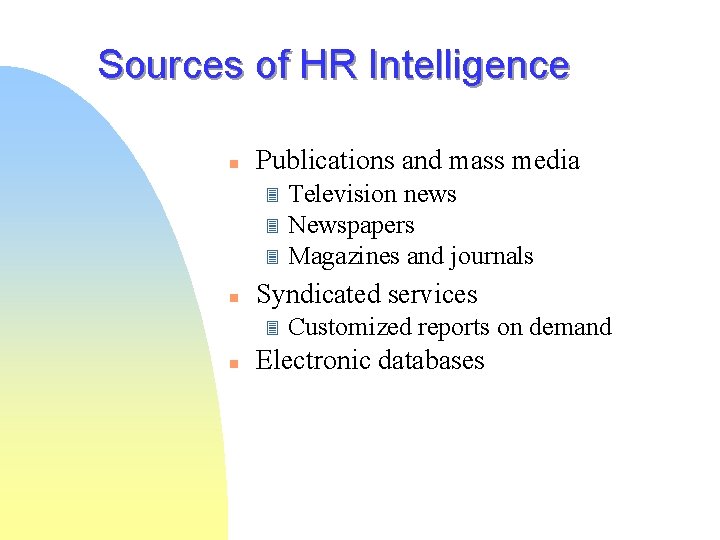
Sources of HR Intelligence n Publications and mass media 3 3 3 n Syndicated services 3 n Television news Newspapers Magazines and journals Customized reports on demand Electronic databases
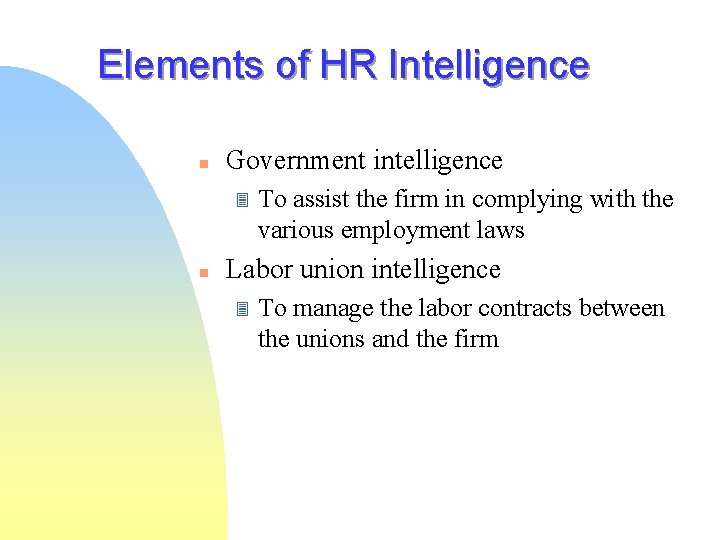
Elements of HR Intelligence n Government intelligence 3 n To assist the firm in complying with the various employment laws Labor union intelligence 3 To manage the labor contracts between the unions and the firm
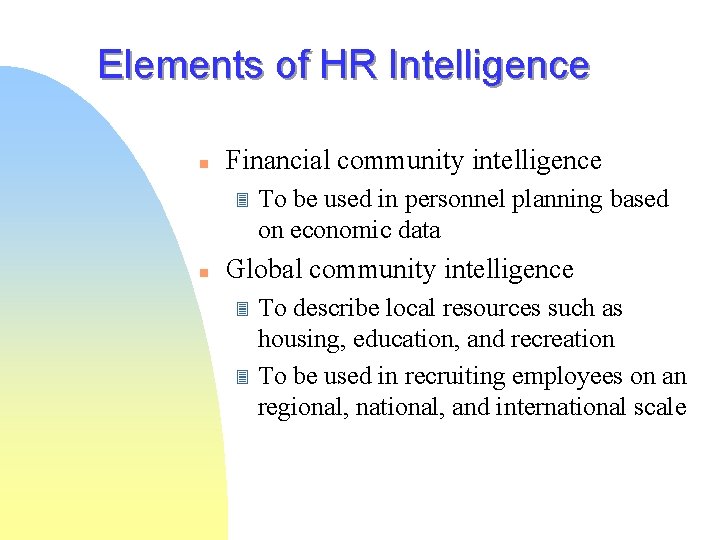
Elements of HR Intelligence n Financial community intelligence 3 n To be used in personnel planning based on economic data Global community intelligence 3 3 To describe local resources such as housing, education, and recreation To be used in recruiting employees on an regional, national, and international scale
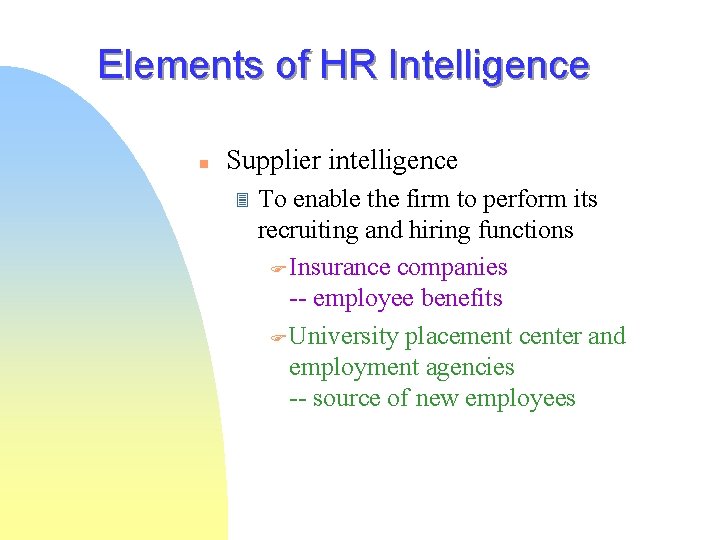
Elements of HR Intelligence n Supplier intelligence 3 To enable the firm to perform its recruiting and hiring functions F Insurance companies -- employee benefits F University placement center and employment agencies -- source of new employees
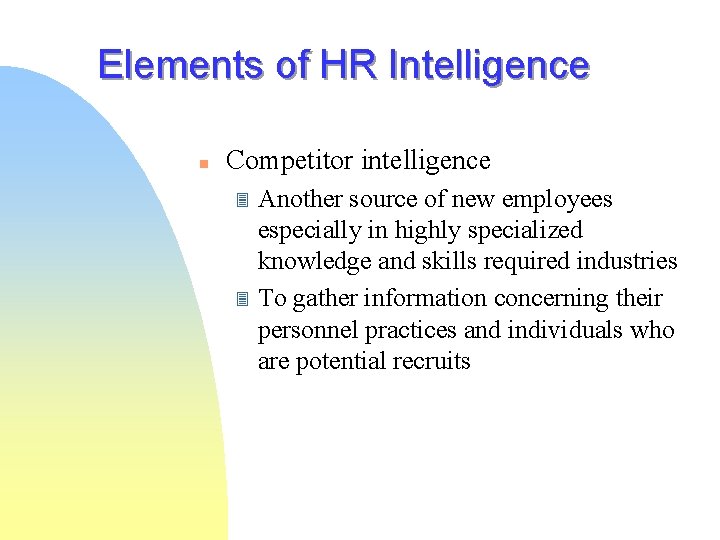
Elements of HR Intelligence n Competitor intelligence 3 3 Another source of new employees especially in highly specialized knowledge and skills required industries To gather information concerning their personnel practices and individuals who are potential recruits
. 5 HR Research System • Uses of HR Research • Types of Research • Experiments and Pilot Projects • Employee and Attitude Surveys • Exit Interviews • HR Audit
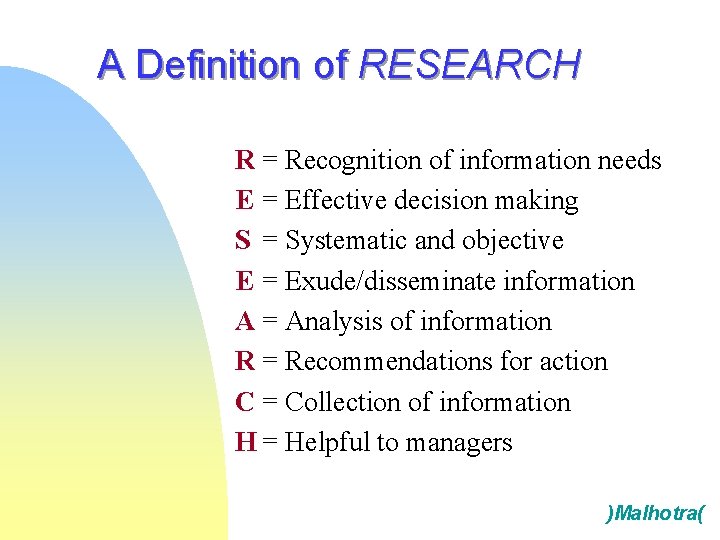
A Definition of RESEARCH R = Recognition of information needs E = Effective decision making S = Systematic and objective E = Exude/disseminate information A = Analysis of information R = Recommendations for action C = Collection of information H = Helpful to managers )Malhotra(
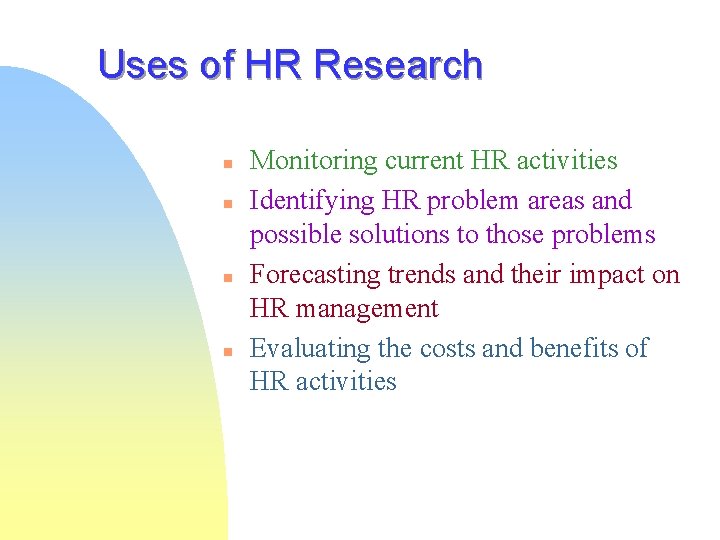
Uses of HR Research n n Monitoring current HR activities Identifying HR problem areas and possible solutions to those problems Forecasting trends and their impact on HR management Evaluating the costs and benefits of HR activities
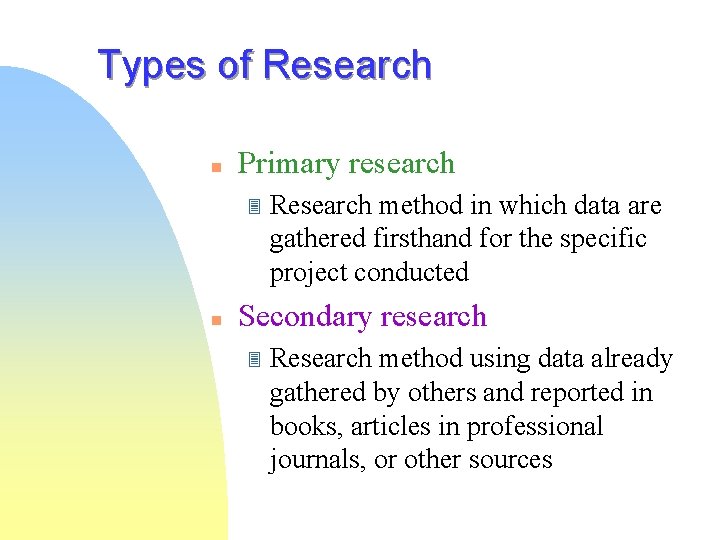
Types of Research n Primary research 3 n Research method in which data are gathered firsthand for the specific project conducted Secondary research 3 Research method using data already gathered by others and reported in books, articles in professional journals, or other sources
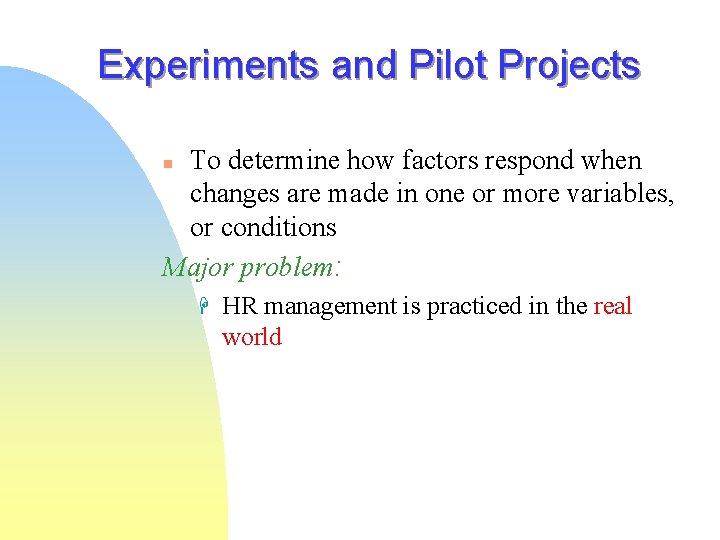
Experiments and Pilot Projects To determine how factors respond when changes are made in one or more variables, or conditions Major problem: n H HR management is practiced in the real world
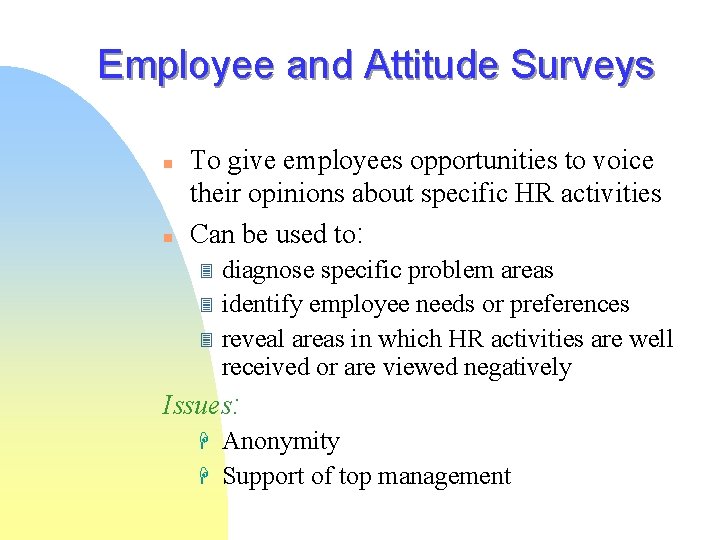
Employee and Attitude Surveys n n To give employees opportunities to voice their opinions about specific HR activities Can be used to: 3 3 3 diagnose specific problem areas identify employee needs or preferences reveal areas in which HR activities are well received or are viewed negatively Issues: H H Anonymity Support of top management
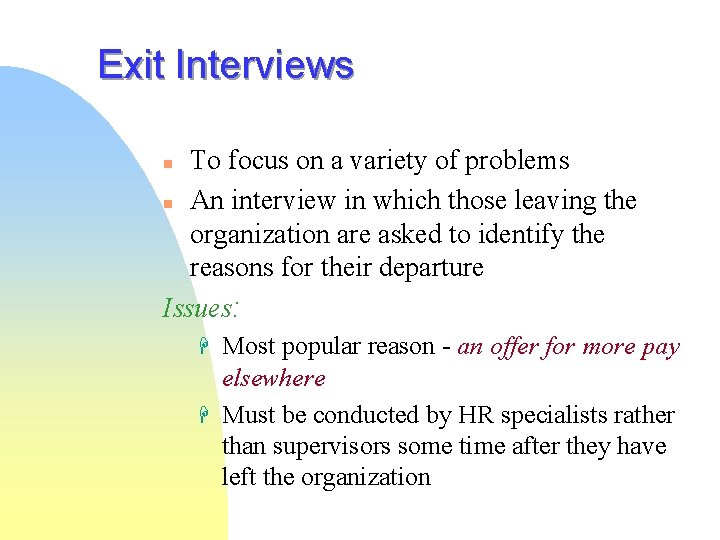
Exit Interviews To focus on a variety of problems n An interview in which those leaving the organization are asked to identify the reasons for their departure Issues: n H H Most popular reason - an offer for more pay elsewhere Must be conducted by HR specialists rather than supervisors some time after they have left the organization
HR Audit To assess HR effectiveness n A formal research effort that evaluates the current status of HR management in an organization Steps: n H H H Determine the objectives to be achieved in the HR area Compare the actual status of HR activities with the objectives Review of all relevant HR documents
. 6 HR Decision Support System • DSS Concepts • Characteristics of DSS • Identifying DSS Problem • Components of DSS • Stages of Decision Making • Levels of DSS • Approaches to Decision Analysis
DSS Concepts n A decision support system should: 4 Assist managers in making decisions to solve semi-structured problems. 4 Support the manager’s judgment rather than try to replace it. 4 Improve the manager’s decision-making effectiveness rather than its efficiency.
Characteristics of DSS n n n DSS offer users flexibility, adaptability, and a quick response DSS allow users to initiate and control the input and output DSS operate with little or no assistance from professional programmers DSS provide support for decisions and problems whose solutions cannot be specified in advance DSS use sophisticated analysis and modeling tools
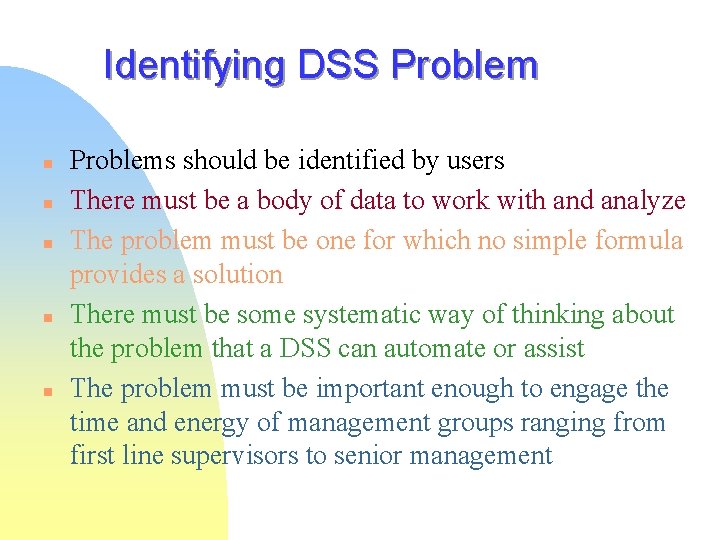
Identifying DSS Problem n n n Problems should be identified by users There must be a body of data to work with and analyze The problem must be one for which no simple formula provides a solution There must be some systematic way of thinking about the problem that a DSS can automate or assist The problem must be important enough to engage the time and energy of management groups ranging from first line supervisors to senior management
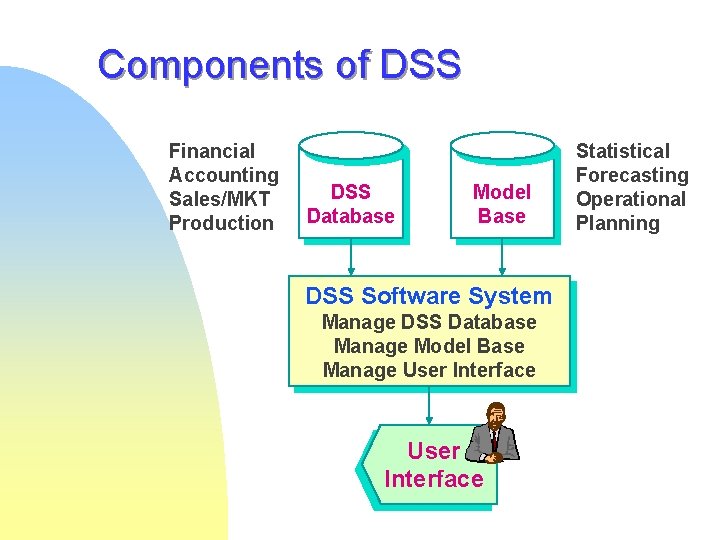
Components of DSS Financial Accounting Sales/MKT Production DSS Database Model Base DSS Software System Manage DSS Database Manage Model Base Manage User Interface Statistical Forecasting Operational Planning
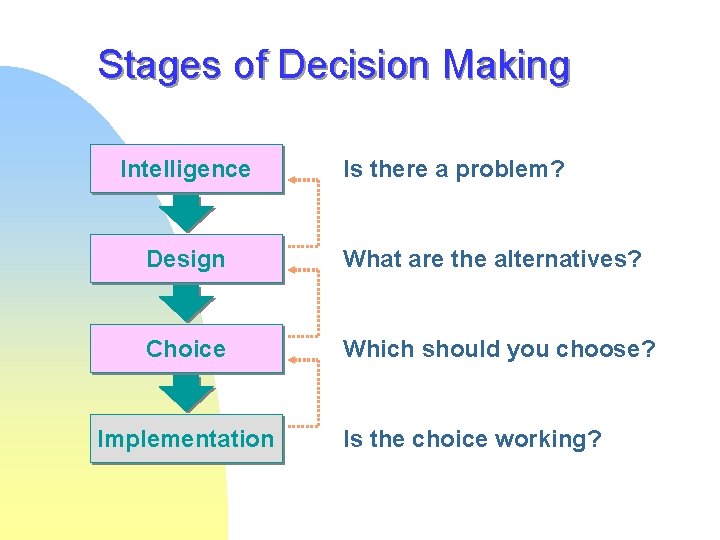
Stages of Decision Making Intelligence Is there a problem? Design What are the alternatives? Choice Which should you choose? Implementation Is the choice working?
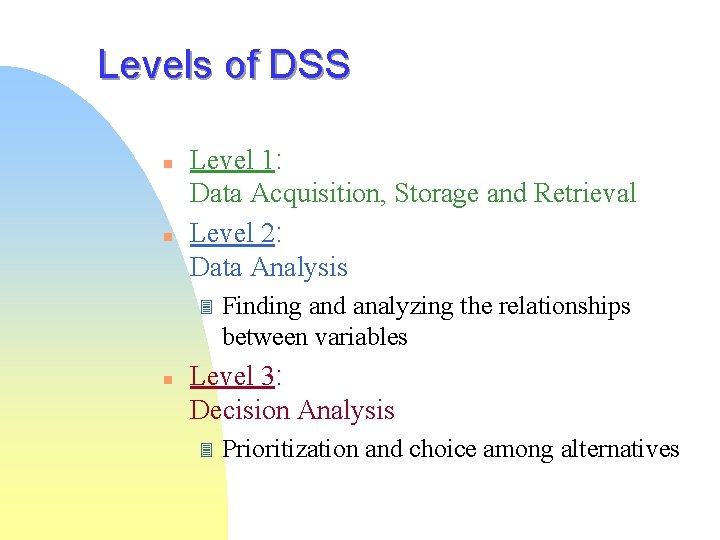
Levels of DSS n n Level 1: Data Acquisition, Storage and Retrieval Level 2: Data Analysis 3 n Finding and analyzing the relationships between variables Level 3: Decision Analysis 3 Prioritization and choice among alternatives
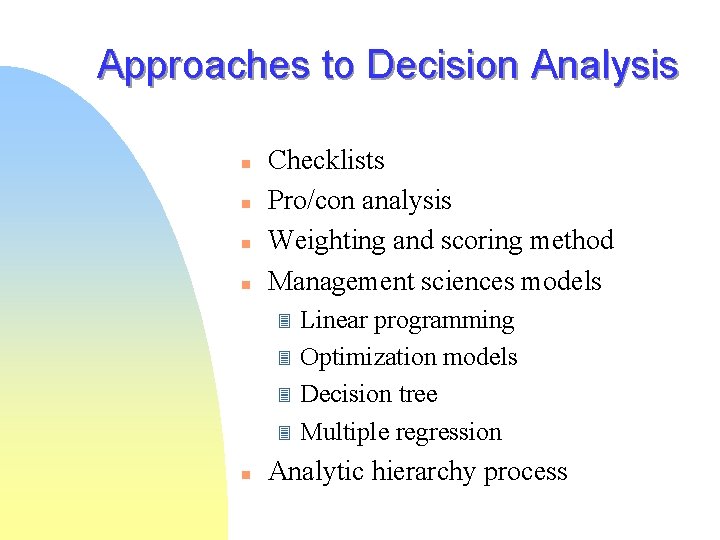
Approaches to Decision Analysis n n Checklists Pro/con analysis Weighting and scoring method Management sciences models 3 3 n Linear programming Optimization models Decision tree Multiple regression Analytic hierarchy process
. 7 Functional ISs Integration • Development of Business Information System • Managerial Views of HRIS • Value Chain Model • System Concept • HR Information Transfer
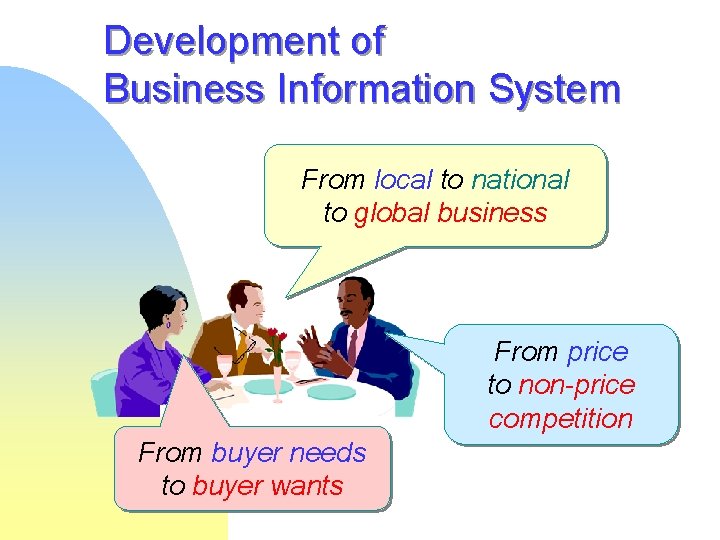
Development of Business Information System From local to national to global business From price to non-price competition From buyer needs to buyer wants
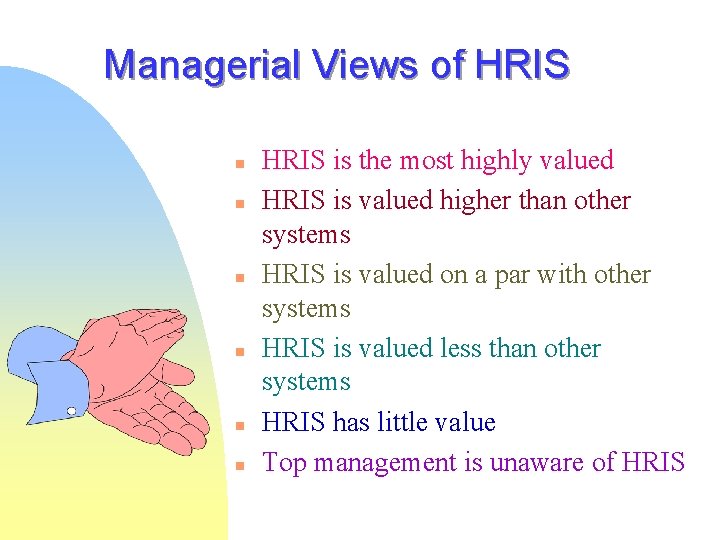
Managerial Views of HRIS n n n HRIS is the most highly valued HRIS is valued higher than other systems HRIS is valued on a par with other systems HRIS is valued less than other systems HRIS has little value Top management is unaware of HRIS
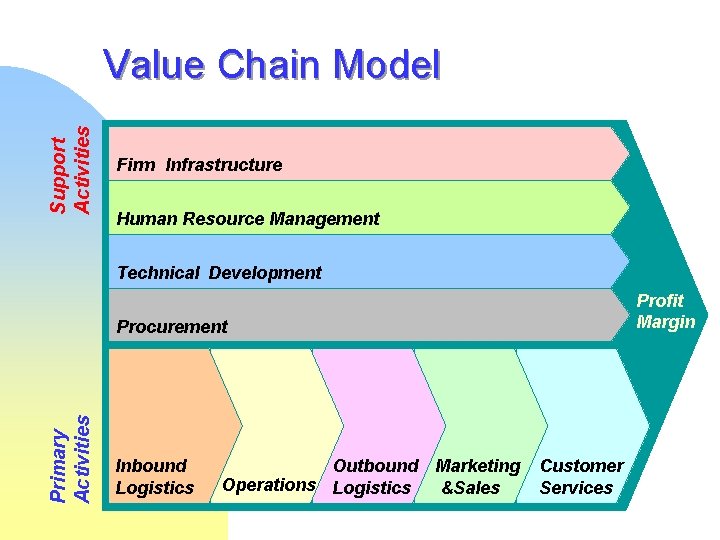
Support Activities Value Chain Model Firm Infrastructure Human Resource Management Technical Development Profit Margin Primary Activities Procurement Inbound Logistics Outbound Marketing Operations Logistics &Sales Customer Services
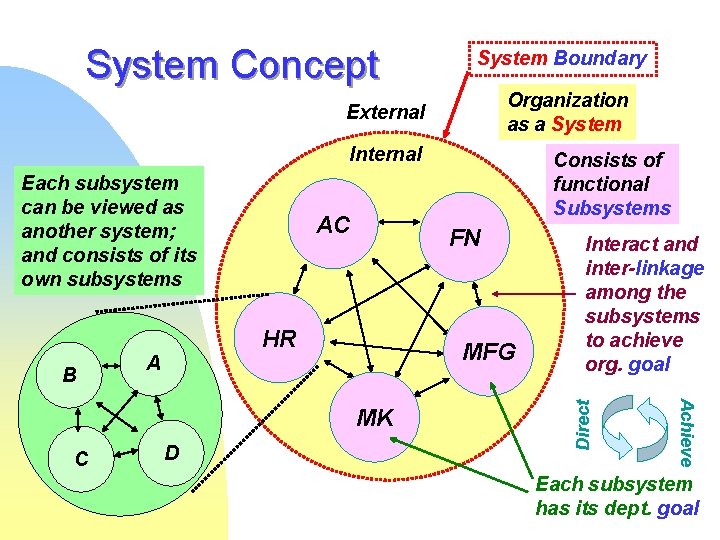
System Boundary Organization as a System External Internal Each subsystem can be viewed as another system; and consists of its own subsystems AC FN HR B MFG A D Interact and inter-linkage among the subsystems to achieve org. goal Achieve MK C Consists of functional Subsystems Direct System Concept Each subsystem has its dept. goal
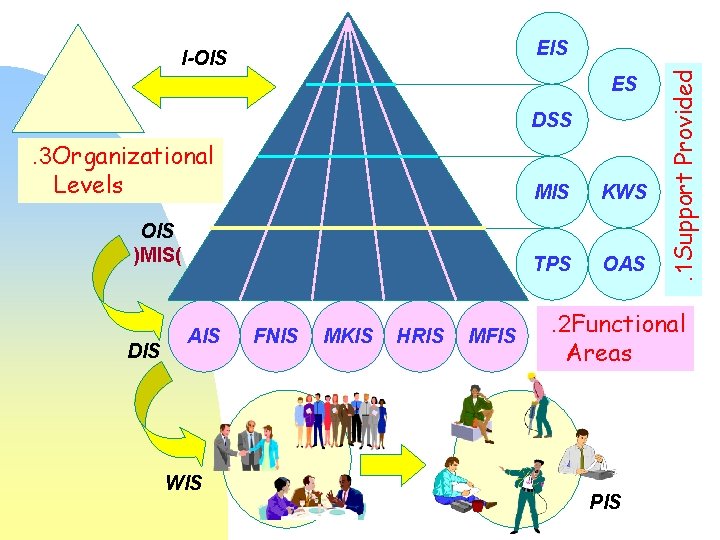
ES DSS . 3 Organizational Levels OIS )MIS( DIS AIS WIS FNIS MKIS HRIS MFIS MIS KWS TPS OAS . 1 Support Provided EIS I-OIS . 2 Functional Areas PIS
HR Information Transfer Vertical integration n n Horizontal integration Free flow of information n To provide the information to those who need it in a format that is useful to them Communication affects the management of people as much as (or more than) any other process over which management is influence Communication throughout the organization is very important
Ready for EXAM?