
HR Data Management An Historical Technological and Global
HR Data Management: An Historical, Technological and Global Approach Introduction
Objectives • Define HRIS and provide examples of how it can be used in a variety of human resource functions. • Understand why project management is critical in the integration of an HRIS. • Apply the basics of project management to an HRIS integration. 2
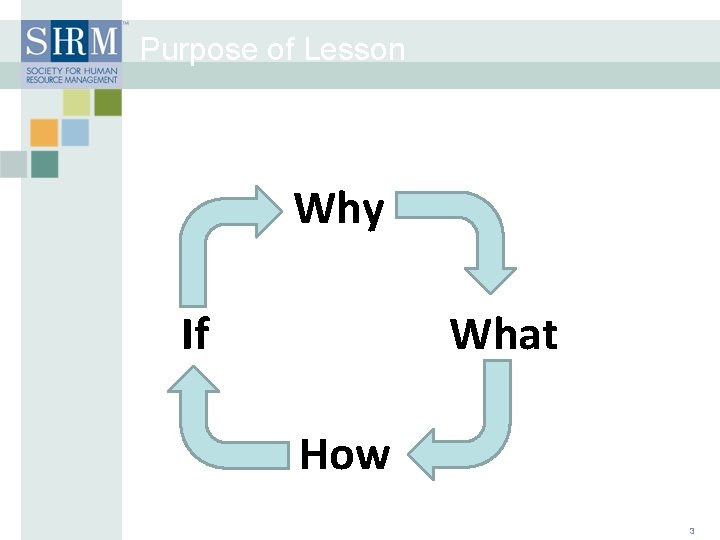
Purpose of Lesson Why What If How 3
Why are these topics together? • HRIS • Project Management ? 4
HRIS – HUMAN RESOURCE INFORMATION SYSTEMS SECTION #1 5
What will be covered in this class? § HRIS § What is an HRIS? § How is it used in organizations? § The history of HRIS § Project Management § Methods of project management § Project life cycle § Project management tools and skills § Integrating an HRIS across cultures § Integration process § Integration issues 6
HRIS • HRIS Defined > “HRIS can be briefly defined as integrated systems used to gather, store and analyze information regarding an organization’s human resources. ” (Hedrickson, 2003, p. 381). > HRIS “One which is used to acquire, store, manipulate, analyze, retrieve and distribute information about an organization’s human resources. ” (Tannenbaum 1990) 7
HRIS • Not just technology: “HRIS is not limited to the computer hardware and software applications that comprise the technical part of the system: it also includes the people, policies, procedures and data required to manage the HR function. ” (Hedrickson, 2003, p. 381). 8
History of HRIS • Early (pre-WW II) > Personnel • Old term for human resources • Historically isolated from core organizational functions > Record keeping • Name, address, phone, employment history 9
History of HRIS • Between 1945 and 1960 > Human capital issues > Employee morale > Formal selection and development > No real changes from earlier days 10
History of HRIS • Early (1960 s to 1980 s) > Personnel became HR > HR was seen as key in organizations > Government and regulatory agencies increased reporting requirements: – Affirmative action – EEO – OSHA > Still, HRIS was used mostly for keeping administrative records 11
History of HRIS • Contemporary HRIS > Large and small businesses are utilizing HRIS > Personal computers have made HRIS available and affordable for any sized firm > HRIS has evolved from simple record -keeping to complex analytical tools to assist management decision making 12
Who uses HRIS and how is it used? • HR Professionals > Reporting and compliance > Payroll and compensation analysis > Benefits administration > Applicant tracking, skills inventory • Functional Managers > Performance management and appraisal > Recruitment and resume processing > Team and project management > Training and skills testing > Management development 13
Who uses HRIS and how is it used? • Individual Employees > Self-service benefit options > Career planning > Training and development 14
Benefits of HRIS • Increased Efficiency – > more transactions with fewer resources • Increased Effectiveness – > more accurate information and simplification of processes 15
HRIS Terminology • HRIS – > Generic term referring to any information system used for obtaining relevant and timely information on which to base human resource decisions. (Mondy) • ERP – > Enterprise Resource Planning Software system that integrates several data sources and processes into a unified system. An ERP system provides the functions of at least two separate systems. i. e. Accounting and Inventory Management. (www. bestpricecomputers. co. uk) 16
HRIS Terminology • SAP – > System Applications and Products World’s largest business software company providing integrated software systems. In business since 1972 • Discussion – > What are some examples of HRIS systems, including both ERP and stand alone? 17
Discussion Topics • Provide specific examples of HRIS systems and provide the details (costs, system requirements and web site resources etc. ). • What are the strengths of the systems? • What are the weaknesses of the systems? • Respond to other student’s examples. • As a group, decide which HRIS is best for a large organization and which one is best for a small organization. 18
Discussion Activity • What are your perceptions of an HRIS? Possible discussion topics: • List HRIS software you have heard of and what functions they can complete. • What can an HRIS do for an organization? • List why your organization would want or does use an HRIS. 19
PROJECT MANAGEMENT SECTION #2 20
Project Management • Project Management – > a carefully planned and organized effort to accomplish a specific (and usually) onetime effort. www. managementhelp. org (retrieved 7/2/08) > A project is a series of tasks and activities that has a stated goal and objectives, a schedule with defined start and end dates, and a budget that sets limits on the project’s dedicated use of resources. SHRM Learning System, © 2008 , Module One Strategic Management, p. 1 -21 21
Project Management • Projects are characterized by – > A group of people > A goal > Limited time and money > A level of uncertainty regarding achievement 22
The Process of Project Management • Project Management Life Cycle > Defining (Scoping) • Answers the question – What will be covered by this project? > Planning • Identifies: Who, What, When and With what resources > Executing • Organizing people, allocating resources and scheduling tasks > Monitoring and Controlling • Tracking progress and taking corrective actions > Closing • Project completion and evaluation 23
The Process of Project Management • The MPMM Project Management Life Cycle > Project Initiation • Project Definition > Project Planning • Detailed Planning > Project Execution • Monitoring and Control > Project Closure • Post Implementation Review www. mpmm. com/project-management-methodology 24
The Process of Project Management • The Rational Unified Process (RUP) > The Inception Phase • Primary goal is to achieve consensus on project objectives and to obtain funding for the project > The Elaboration Phase • Identifies details of the project and architecture for the system > The Construction Phase • Development of the new system to the point where it is ready for deployment > The Transition Phase • The focus is on delivering the system into production, testing and fine tuning 25
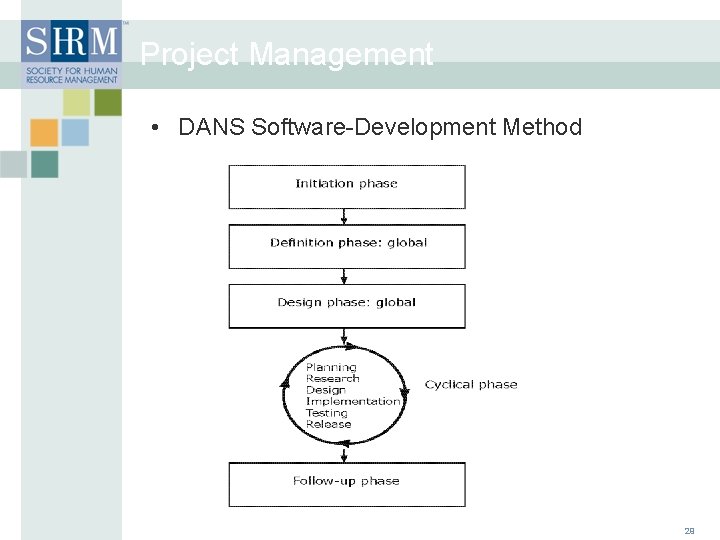
The Process of Project Management • DANS – • Initiation phase – Idea > Are we going to do this project? • Definition phase – What? > Is it possible? What is required? • Design phase – How? > Is it desirable? What will be the result? • Development phase – How to implement? > Is it feasible? How will we implement the project? • Implementation phase – Carrying out the project > Is the result adequate? How will we evaluate the project? • Follow-up phase – Maintenance > Final report 26
Project Management Systems for Software Development • Linear process – Waterfall model • Cyclical Project Management > Preferred for software development • Software development is a creative process • Impossible to identify all requirements beforehand • Difficult to estimate amount of time necessary for implementation • Intermediate results must be tested by users throughout the entire project 27
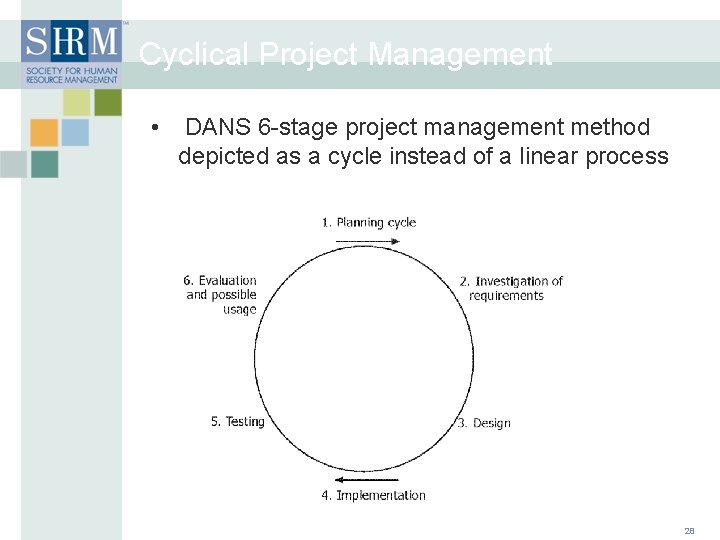
Cyclical Project Management • DANS 6 -stage project management method depicted as a cycle instead of a linear process 28
Project Management • DANS Software-Development Method 29
Discussion Activity • What is the hardest for the HR professional to control in a project (time, cost, scope)? • What can the HR professional do to help ensure success in time, cost, and scope? 30
PM Tools – Gantt Chart 31
PM Tools – PERT Chart 32
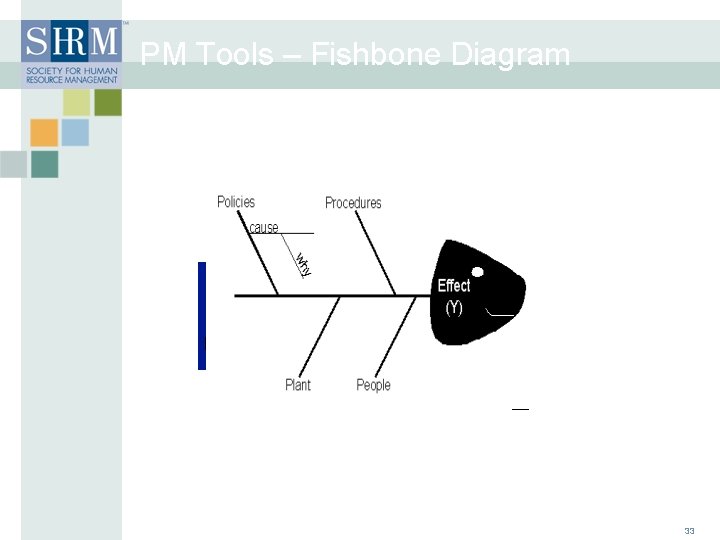
PM Tools – Fishbone Diagram Figure 1: Fishbone Diagram Example 33
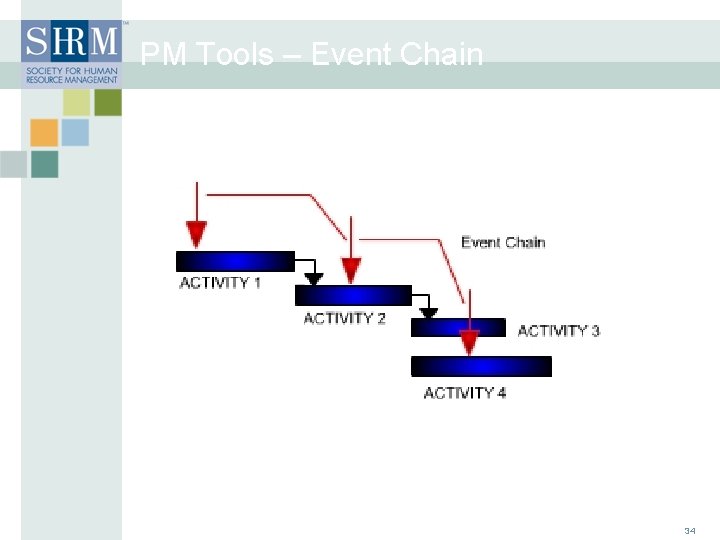
PM Tools – Event Chain 34
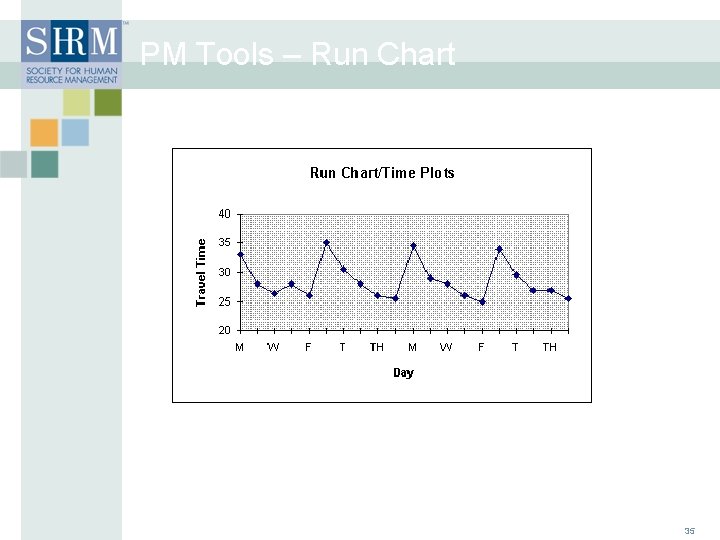
PM Tools – Run Chart 35
Project Management Software • Desktop > Microsoft Project > Cerebral Project • Web based > @task > Project Insight • Opensource > Kplato > Openwork Bench > dot. Project 36
Discussion Topics • Provide an example of a project management tool and discuss how it could be used. • Provide one software resource and identify its strengths and weaknesses. 37
MANAGING PROJECTS AND HRIS SECTION #3 38
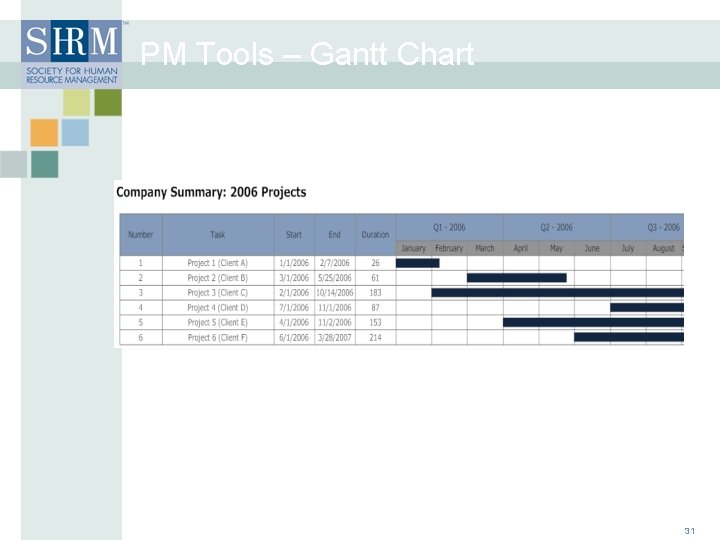
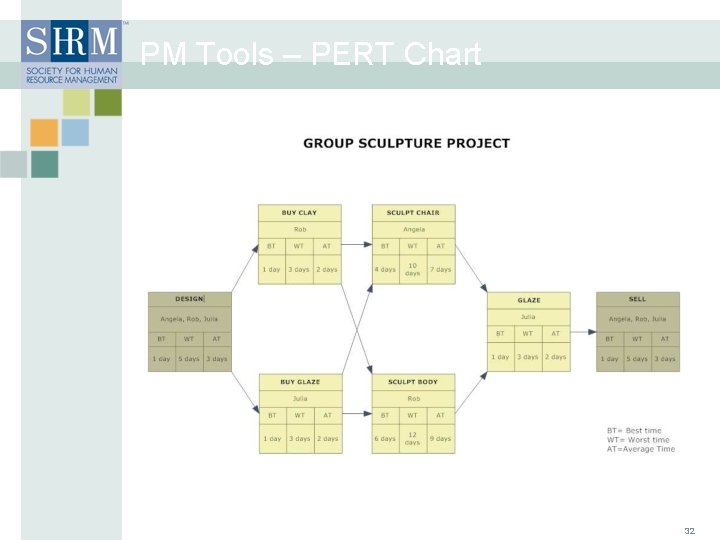
Managing Projects • Control Factors > Time • Scheduling / Gnatt and PERT Charts > Money • Budget projections > Quality • Good enough is good > Organization • Managing the project team > Information • Communication and decision making 39
People and the Project • Project Stakeholders and Tasks > The Project Sponsor • Member of management • Leadership role in getting project approved, funded and off the ground > Organizational Management • Identifies need for the project • Approves budget and assesses risk 40
People and the Project • Project Stakeholders and Tasks > The Project Manager • Manages the team and the process, has ultimate responsibility for project success > Roles of the Project Manager • Interpersonal • Informational • Decisional 41
People and the Project • Project Stakeholders and Tasks > The Project Team • Carries out the activities for project completion 42
Communications • Within the Project Team > Kick-off meeting • Communications Plan: who, when, what, how • Review/scope • Technical review > Establish how the team will be informed of issues and decisions • Face-to-face • Email • Virtual teams > International communications • One voice • Language of customer > Informing stakeholders 43
Leadership • Effective Project Managers > > > > Problem-Solving expertise Leadership expertise Context knowledge Analytical skill People skills Communication skills Administrative expertise 44
Project Management and HRIS • Integrating HRIS systems > Project Management expertise > HR knowledge > Foundation Business knowledge > Understanding of the Organization 45
PM Phases in an HRIS Implementation • • • Initiation Planning Executing Controlling Closure/Evaluation 46
Initiation • • Feasibility study Establish charter Set up project office Review phase 47
Project Planning • Resource plan: > People > Financial > Time • Quality • Risk • Communication • Procurement of materials • Contact suppliers • Contingency plan • Perform review of planning phase 48
Project Execution • Doing the project – Build the deliverables • Monitor and Control > Time > Cost > Quality > Risk > Resources > Acceptance > Communications 49
Project Execution • Issues Management • Change Process • Review of Project Execution 50
Project Control • Set baselines • Measure: > Progress > Performance • Compare: > Plan > Actual • Take action 51
Closure/Evaluation • • Project closure Project review Project evaluation Lessons learned 52
Specifics of PM to an HRIS Integration • • • Initiation Planning Executing Controlling Closure/Evaluation 53
Engagement Exercise • Create a list of critical risks and contingencies for an HRIS implementation. As a team or individually, create an outline of how each of phase of project management is affected. 54
HRIS IMPLEMENTATION SECTION #4 55
Traditional HRIS • Administrative Uses: • • Monitor absences Salary structures Training information Recruitment Media response Current information Medical information Global administration 56
HRIS in Business Decision Making > Analytical Processes: • • • Budget control Applicant tracking and screening Skills matching Appraisals Feedback Manpower planning Succession planning Skills monitoring Training needs analysis Global analysis 57
Why Not More? HRIS in Business Decision Making > Organization size > Organization culture • HR as a strategic partner • Internal culture and politics > HRIS time in use. > HR has limited IT and analytical skills. > IT has limited HR skills. 58
Application of HRIS • Strategic Management > Environmental scanning > Tracks quality and productivity improvements • Workforce Planning and Employment > Tracks promotions, transfers, hiring and termination rates > Maintains and prints EEOC data in the required form > Prints applicant flow and utilization reports for affirmative action programs • Human Resource Development > > Outlines career path development Tracks, education, skills and training programs Registers employees in courses Evaluates employee performance 59
Application of HRIS • Total Rewards > Tracks salary survey information > Tracks retirement planning, tuition reimbursement, COBRA and HIPAA info. > Facilitates benefit administration and salary analysis across job classifications • Employee and Labor Relations > Stores employee discipline records > Records union data and labor distribution data > Maintains attitude survey results • Risk Management > Identifies accident and illness trends > Tracks safety records, insurance and workers’ comp. claims > Monitors high-risk conditions and accidents 60
Legal Aspects of Data • Employee information > > What information should be gathered? How should it be used? Who should have access to data? How should data be safeguarded? • Privacy: > Directly related to job > Need-to-know basis • Social security number. 61
Data Security Issues • What’s causing the problem? > Inconsistent legal standards > More telecommuters and distance workers > More use of vendors and outsourcing > Increasing of organization wide IT systems > Demand for ease of use for e-mail, downloads, etc. 62
U. S. Laws and Employee Privacy • Fair Credit Reporting Act • Electronic Communications Privacy Act • Health Insurance Portability and Accountability Act (HIPPA) • Sarbanes – Oxley Act 63
Globalization and Employee Privacy • EU Data Protection Directive – 1998 > Companies must give consumers (or employees) access to correct their data > Personal data can be used only for the purpose for which it was obtained > Companies may NOT transfer personal data to countries that lack adequate data protection laws • Canadian Privacy Laws > Federal Rules > Provincial Regulation 64
Conflicts of Globalization • Conflicting Privacy Regulations > Collection of data > Transfer of data > Employee hot-lines • What’s a company to do? > “Safe Harbor” program 65
Other Issues in Globalization • Language barriers: > Royal English vs. American English. > Belgium (part of country): In Brussels employee selects (Dutch or French) • Processes differ slightly: > In U. S. address may trigger benefit changes > In Europe this is not a concern • Government regulations and reporting > Requirements will vary among countries • Terminology > may be different from one country to another • Culture > Individual vs. Collective 66
Change Management and HR Integrating HRIS • What is the role of HR during change? > Recognize individuals may react negatively to > > > > change Anticipate resistance and find ways to deal with it Show commitment and present a positive attitude toward the change Involve people in the process Ensure top management is visible and supportive Remind management and others that change is a process and successful change takes time Reinforce change with incentives Communicate with employees & management 67
Conclusions • • HRIS History of HRIS Project management. Integrating HRIS and project management • HRIS in business decision making • Globalization, legal, cultural and organizational change issues 68
- Slides: 68