Essex Primary SCITT Primary Science Course Lecture 1





- Slides: 94
Essex Primary SCITT Primary Science Course Lecture 1
Science – what do you think? n n Illustrate your name card with your view of science. You have 1 minute to look at your partners card and find out as much about their view of science as you can by questioning them.
Aims for the course I To ensure trainees … n have the knowledge, understanding, confidence and enthusiasm to teach science successfully in primary schools and excite the children! n develop knowledge of scientific concepts within KS 1, KS 2 and beyond; n have the ability to think like a scientist – question, hypothesise, collect evidence, analyse data, draw supportable conclusions.
Aims for the course II To ensure trainees … n plan meaningful learning opportunities for the primary classroom that are appropriately matched to children’s levels of understanding; n develop a range of teaching strategies to enable them to teach creative, interactive lessons that motivate children to learn; n reflect on and improve the quality of their teaching and analyse how well children are learning; n develop the attributes, knowledge and understanding, and skills to achieve QTS.
Aims for today n n n n Understand why we do science in primary schools Develop a clear understanding of what primary science and know the key elements of primary science Understand how the National Curriculum for Science is structured To explore the different ways we can help primary age children find out about the world and how these can be used in school To develop trainees’ knowledge and understanding about materials, including: solids, liquids, gases; effect of heating and cooling; change of state; particle theory To develop trainees’ knowledge and understanding of the process skills of observing and questioning To learn how to plan a practical science activity, including how to organise the classroom so that this can be done safely
Draw a Scientist….
Famous Scientists…. .
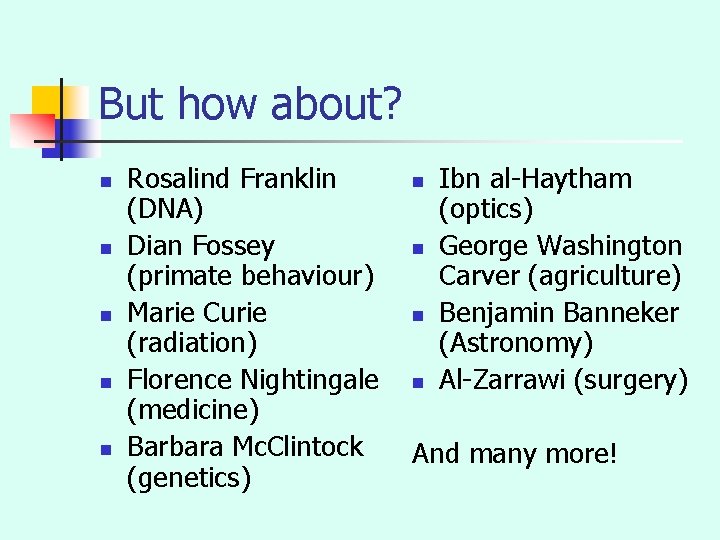
But how about? n n n Rosalind Franklin (DNA) Dian Fossey (primate behaviour) Marie Curie (radiation) Florence Nightingale (medicine) Barbara Mc. Clintock (genetics) n n Ibn al-Haytham (optics) George Washington Carver (agriculture) Benjamin Banneker (Astronomy) Al-Zarrawi (surgery) And many more!
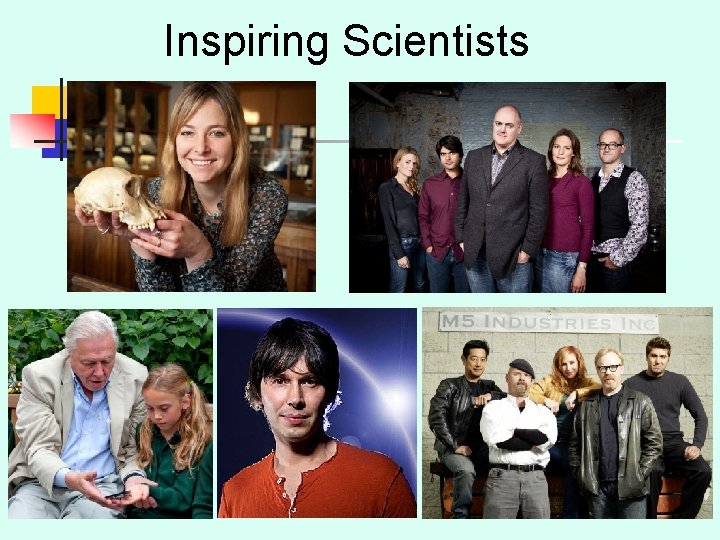
Inspiring Scientists
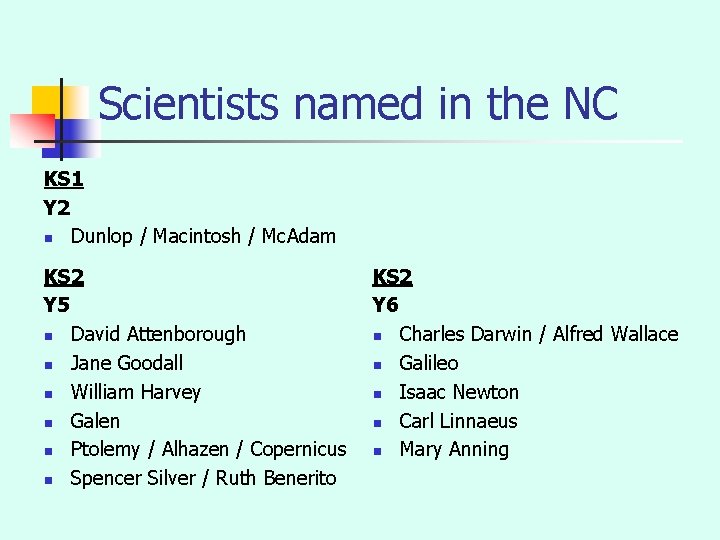
Scientists named in the NC KS 1 Y 2 n Dunlop / Macintosh / Mc. Adam KS 2 Y 5 n David Attenborough n Jane Goodall n William Harvey n Galen n Ptolemy / Alhazen / Copernicus n Spencer Silver / Ruth Benerito KS 2 Y 6 n Charles Darwin / Alfred Wallace n Galileo n Isaac Newton n Carl Linnaeus n Mary Anning
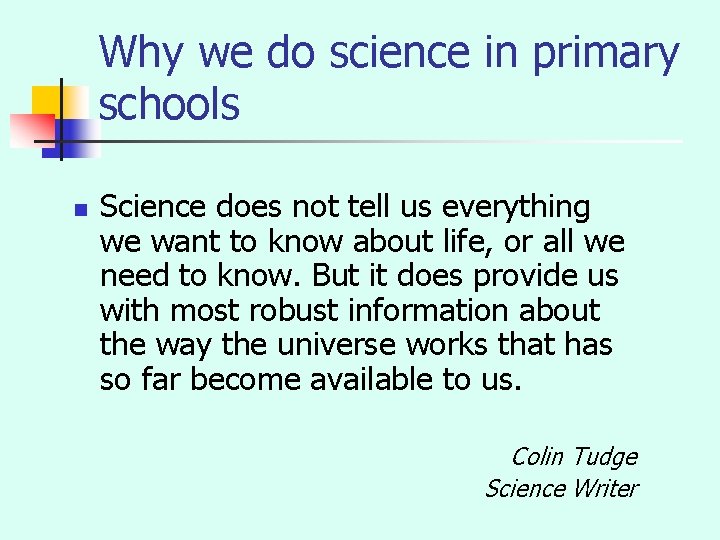
Why we do science in primary schools n Science does not tell us everything we want to know about life, or all we need to know. But it does provide us with most robust information about the way the universe works that has so far become available to us. Colin Tudge Science Writer
Why we do science in primary schools n Science is valuable because it meshes with all our lives and allows us to channel and use our spontaneous curiosity. Professor Susan Greenfield Director, Royal Institution
Why we do science in primary schools n Science is an integral part of modern culture. It stretches the imagination and creativity of young people. Its challenges are quite enormous. Professor Malcolm Longair Head of Cavendish Laboratory University of Cambridge
Dr. Tim Crook n n The power of science should not be underestimated. It has the potential to be the greatest force for good on earth in the 21 st century. Without great scientists it could be argued that the outlook for the earth is fairly bleak. http: //news. bbc. co. uk/1/hi/health/6969 136. stm
The Importance of science n Science stimulates and excites pupils’ curiosity about phenomena and events in the world around them. It also satisfies this curiosity with knowledge. Because science links direct practical experience with ideas, it can engage learners at many different levels. Scientific method is about developing and evaluating explanations through experimental evidence and modelling. This is a spur to critical and creative thought.
The Primary Science Expert n Science can be characterised by developing theories which fit the evidence available, but which may be disproved when further evidence comes to light. Wynne Harlen
Is science … The truth The whole truth And nothing but the truth?
A historical perspective n We can only believe something is true until the time we find out that it is not. Oliver Cromwell
1930 s encyclopaedia n In science, as in life, we can rarely say that something will definitely happen. However, we can say for certain that man will never land on the moon.
Steven Hawking’s view n Any physical theory is always provisional, in the sense that it is only a hypothesis; you can never prove it. No matter how many times the results of experiments agree with some theory, you can never be sure the next time the result will not contradict theory. On the other hand you can disprove theory by finding even a single observation that disagreed with the predictions of theory.
Gerald Haigh sums it up! n n The reason we need good science teaching – and we do need it, most urgently – has nothing to do with content, facts and practicalities. The most pressing imperative is that we somehow reduce the gullibility among the population at large. That a large number of people accept, without question, any old codswallop that someone cares to tell them is one of the great social problems of our time.
What are the 5 most important aspects to consider when teaching primary science?
Are these the 5 most important aspects? Engagement – what makes a rocket fly? n Discussion – with partner/peers n Explanation and Application of prior knowledge – draw an annotated diagram to show your thinking n Practical Activity – Blast off! n Analysis and Assessment – Talk Partners – review your diagram. What was accurate, what wasn’t? Trainee Reflection – What have we learnt about setting up science activities from this ? n
Rocket science explained n http: //www. bbc. co. uk/guides/zqcmvcw? intc_type=promo&intc_location=orb_pr omo_footer&intc_campaign=iwonder_ro cket&intc_linkname=homepage_b
What makes science exciting? n n n OFSTED’s view: http: //news. bbc. co. uk/1/hi/education/74 56891. stm Talk partner – Read the Ofsted report ‘Success in Science’. What do Ofsted think makes great science? Reflection – what must be in your science lessons?
National Curriculum Science Purpose of study A high-quality science education provides the foundations for understanding the world through the specific disciplines of biology, chemistry and physics. Science has changed our lives and is vital to the world’s future prosperity, and all pupils should be taught essential aspects of the knowledge, methods, processes and uses of science. Through building up a body of key foundational knowledge and concepts, pupils should be encouraged to recognise the power of rational explanation and develop a sense of excitement and curiosity about natural phenomena. They should be encouraged to understand how science can be used to explain what is occurring, predict how things will behave, and analyse causes.
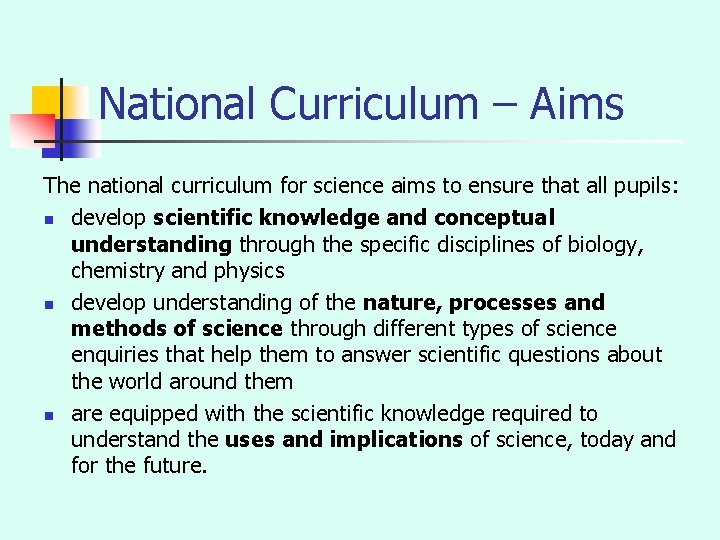
National Curriculum – Aims The national curriculum for science aims to ensure that all pupils: n develop scientific knowledge and conceptual understanding through the specific disciplines of biology, chemistry and physics n develop understanding of the nature, processes and methods of science through different types of science enquiries that help them to answer scientific questions about the world around them n are equipped with the scientific knowledge required to understand the uses and implications of science, today and for the future.
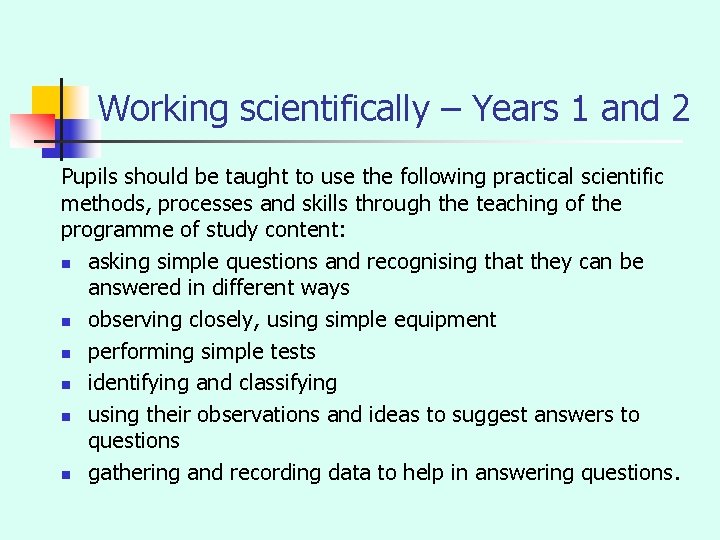
Working scientifically – Years 1 and 2 Pupils should be taught to use the following practical scientific methods, processes and skills through the teaching of the programme of study content: n asking simple questions and recognising that they can be answered in different ways n observing closely, using simple equipment n performing simple tests n identifying and classifying n using their observations and ideas to suggest answers to questions n gathering and recording data to help in answering questions.
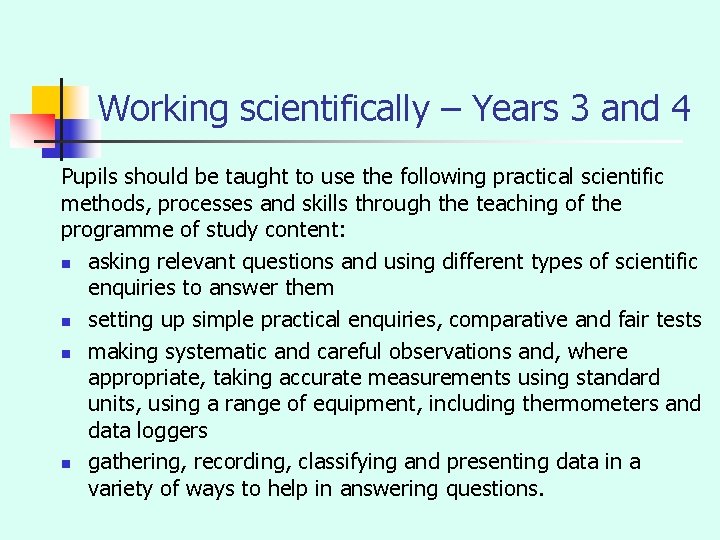
Working scientifically – Years 3 and 4 Pupils should be taught to use the following practical scientific methods, processes and skills through the teaching of the programme of study content: n asking relevant questions and using different types of scientific enquiries to answer them n setting up simple practical enquiries, comparative and fair tests n making systematic and careful observations and, where appropriate, taking accurate measurements using standard units, using a range of equipment, including thermometers and data loggers n gathering, recording, classifying and presenting data in a variety of ways to help in answering questions.
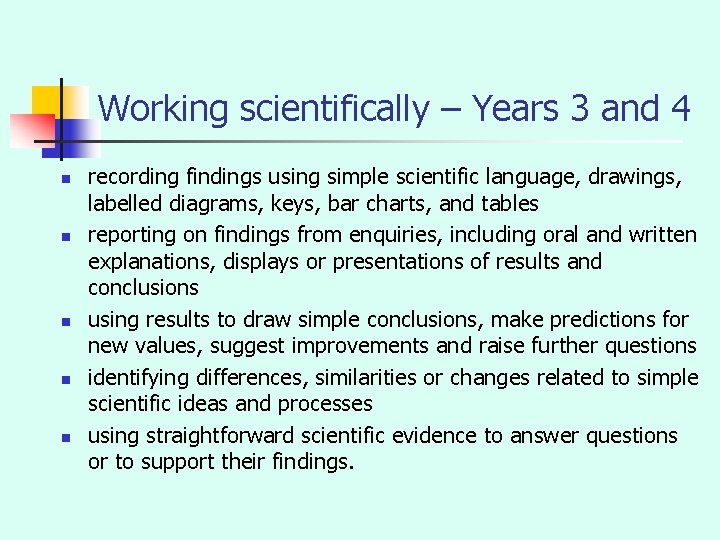
Working scientifically – Years 3 and 4 n n n recording findings using simple scientific language, drawings, labelled diagrams, keys, bar charts, and tables reporting on findings from enquiries, including oral and written explanations, displays or presentations of results and conclusions using results to draw simple conclusions, make predictions for new values, suggest improvements and raise further questions identifying differences, similarities or changes related to simple scientific ideas and processes using straightforward scientific evidence to answer questions or to support their findings.
Working scientifically – Years 5 and 6 Pupils should be taught to use the following practical scientific methods, processes and skills through the teaching of the programme of study content: n planning different types of scientific enquiries to answer questions, including recognising and controlling variables where necessary n taking measurements, using a range of scientific equipment, with increasing accuracy and precision, taking repeat readings when appropriate n recording data and results of increasing complexity using scientific diagrams and labels, classification keys, tables, scatter graphs, bar and line graphs
Working scientifically – Years 5 and 6 n n n using test results to make predictions to set up further comparative and fair tests reporting and presenting findings from enquiries, including conclusions, causal relationships and explanations of and degree of trust in results, in oral and written forms such as displays and other presentations identifying scientific evidence that has been used to support or refute ideas or arguments.
Activity Create 3 mind maps of the knowledge in the National Curriculum for Science KS 1 – LKS 2 – UKS 2 Extract the key themes / ideas http: //goo. gl/ay 32 an
Attitudes Not explicitly stated in the National Curriculum n n n n n Curiosity Respect for evidence Willingness to tolerate uncertainty Critical reflection Perseverance Creativity and inventiveness Open mindedness Sensitivity to the living and non-living environment Co-operation with others
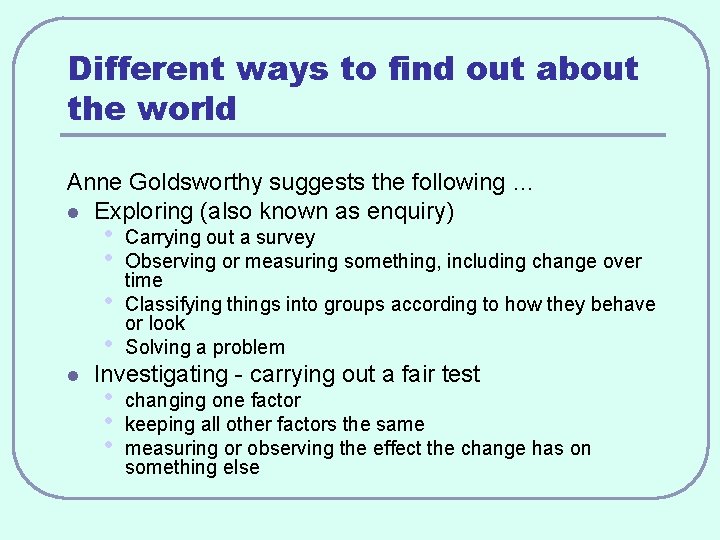
Different ways to find out about the world Anne Goldsworthy suggests the following … l Exploring (also known as enquiry) l • • Carrying out a survey Observing or measuring something, including change over time Classifying things into groups according to how they behave or look Solving a problem • • • changing one factor keeping all other factors the same measuring or observing the effect the change has on something else Investigating - carrying out a fair test
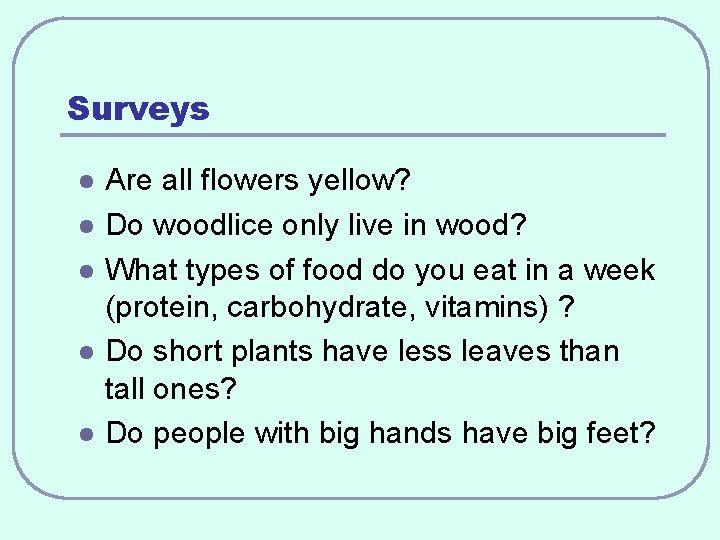
Surveys l l l Are all flowers yellow? Do woodlice only live in wood? What types of food do you eat in a week (protein, carbohydrate, vitamins) ? Do short plants have less leaves than tall ones? Do people with big hands have big feet?
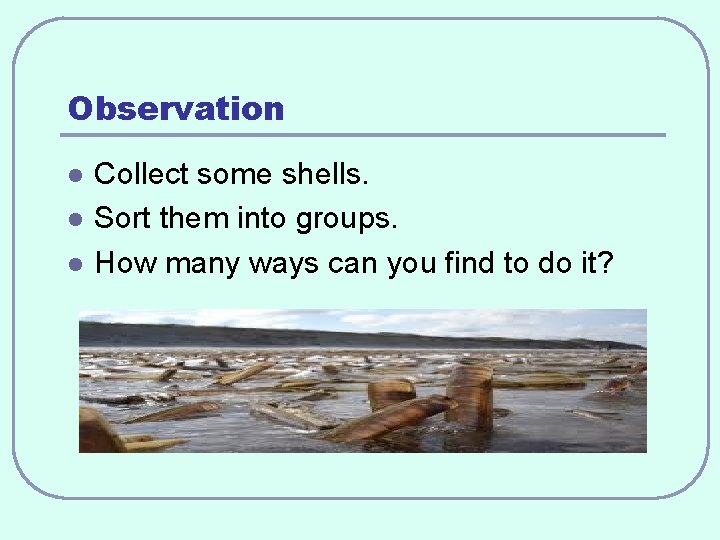
Observation l l l Collect some shells. Sort them into groups. How many ways can you find to do it?
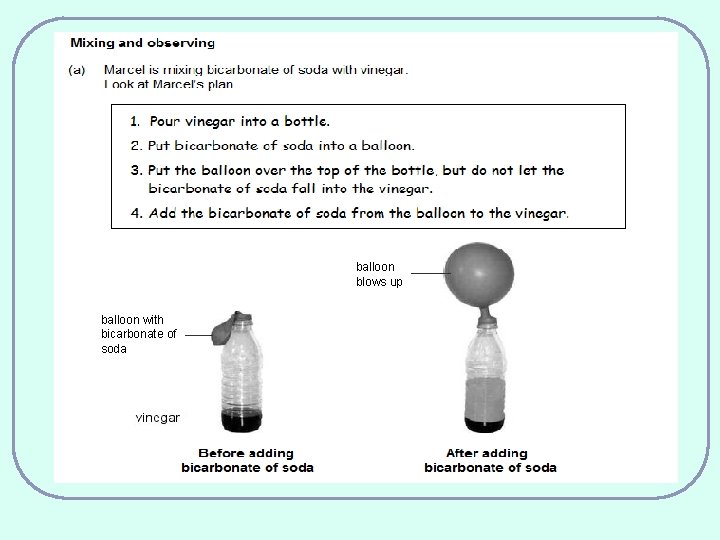
balloon blows up balloon with bicarbonate of soda
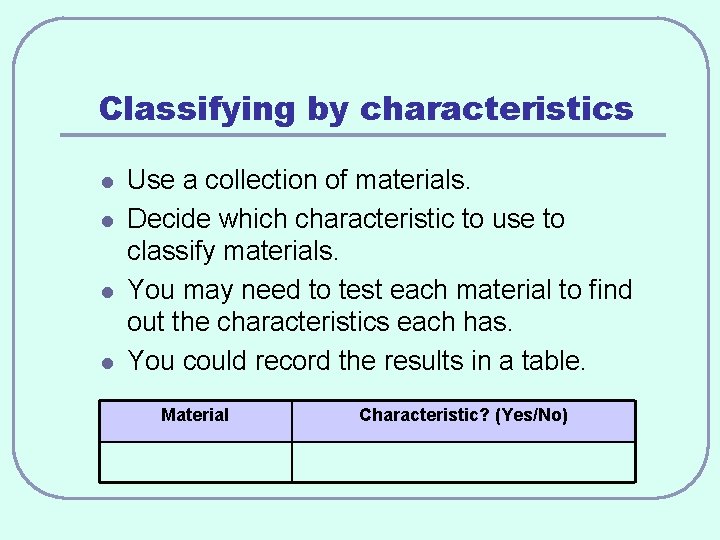
Classifying by characteristics l l Use a collection of materials. Decide which characteristic to use to classify materials. You may need to test each material to find out the characteristics each has. You could record the results in a table. Material Characteristic? (Yes/No)
Classifying things l l Classify according to characteristics (materials/mini-beasts). Pupils can classify according to teacher’s criteria though this is not scientific enquiry. For scientific enquiry children must select the categories. Can classify according to behaviour (materials which do/do not allow current to pass through). Identify what they have in common. When things are classified according to behaviour the results will be Yes/No.
Problem solving l l l All enquiries start with a problem or question, but these type often start with “Can I find a way to …”. They can require high level knowledge which the children have to use to solve the problem. Example, “Can you make a bridge out of paper to span the tables? ”
Which kind of exploration? l l l Which materials are attracted to a magnet? Can you make a suitable hedgehog ‘house’? How quickly does an ice cube melt in different places? How high will the bean seed grow in two weeks? Are there more spiders webs on the buildings or on the plants? Reflection – write down 1 thing you have learnt about exploring in science.
What does the word material mean? Matter from which a thing is made.
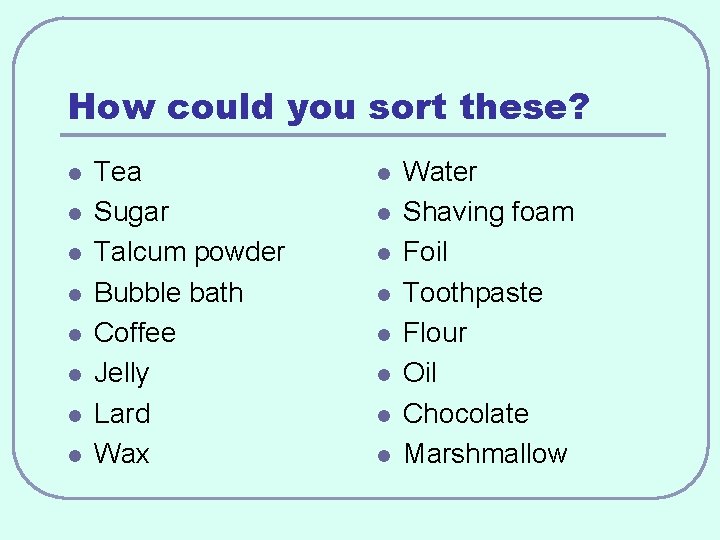
How could you sort these? l l l l Tea Sugar Talcum powder Bubble bath Coffee Jelly Lard Wax l l l l Water Shaving foam Foil Toothpaste Flour Oil Chocolate Marshmallow
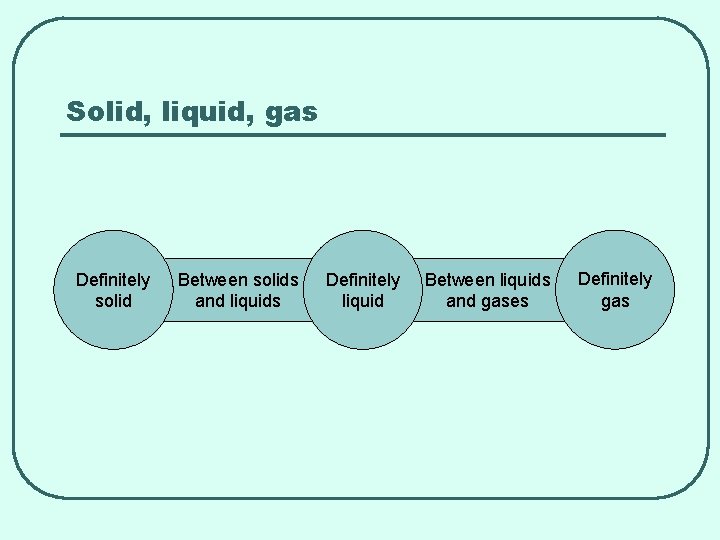
Solid, liquid, gas Definitely solid Between solids and liquids Definitely liquid Between liquids and gases Definitely gas
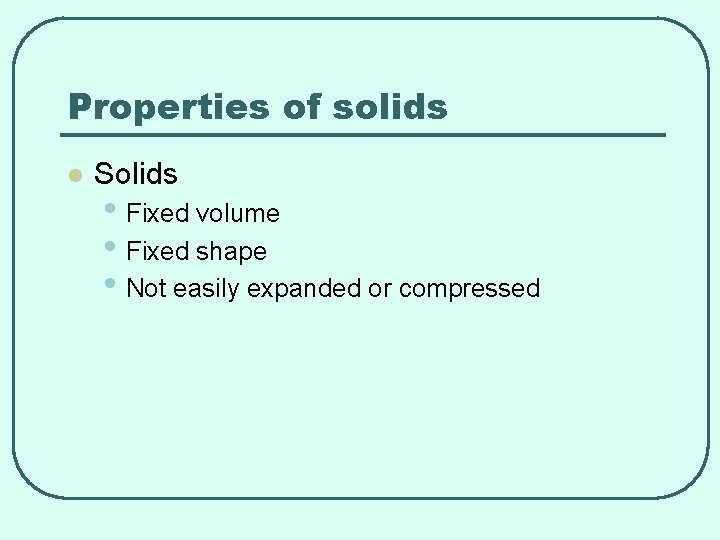
Properties of solids l Solids • Fixed volume • Fixed shape • Not easily expanded or compressed
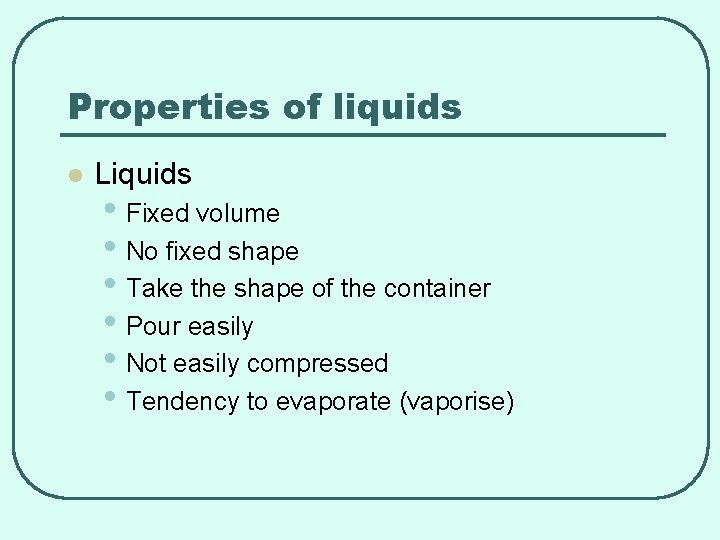
Properties of liquids l Liquids • Fixed volume • No fixed shape • Take the shape of the container • Pour easily • Not easily compressed • Tendency to evaporate (vaporise)
Properties of gases l Gases • No fixed volume • No fixed shape • Easily compressed • Flow easily • Expand to fill any volume
What are materials made of? l l l All materials are made of particles. The arrangement and movement of the particles give materials their different properties. Within each particle there are positive and negative charges. Between particles there may be forces of attraction or repulsion. Particle theory is used to explain the properties of solids, liquids and gases.
Characteristics of a solid l l Closely packed particles, arranged in a regular pattern with small spaces in between. Strongly bonded to neighbouring particles, which are able to vibrate but not move position. Difficult to pull apart due to attracting forces holding the particles together. Difficult to compress due to repelling forces stopping the particles from getting too close.
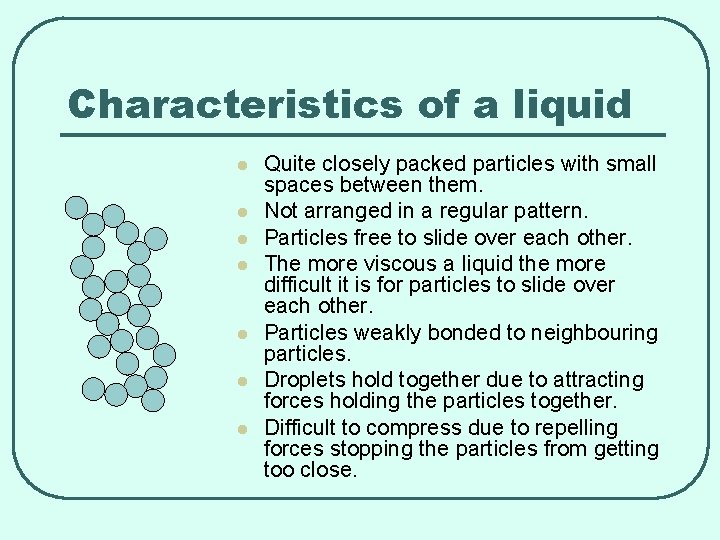
Characteristics of a liquid l l l l Quite closely packed particles with small spaces between them. Not arranged in a regular pattern. Particles free to slide over each other. The more viscous a liquid the more difficult it is for particles to slide over each other. Particles weakly bonded to neighbouring particles. Droplets hold together due to attracting forces holding the particles together. Difficult to compress due to repelling forces stopping the particles from getting too close.
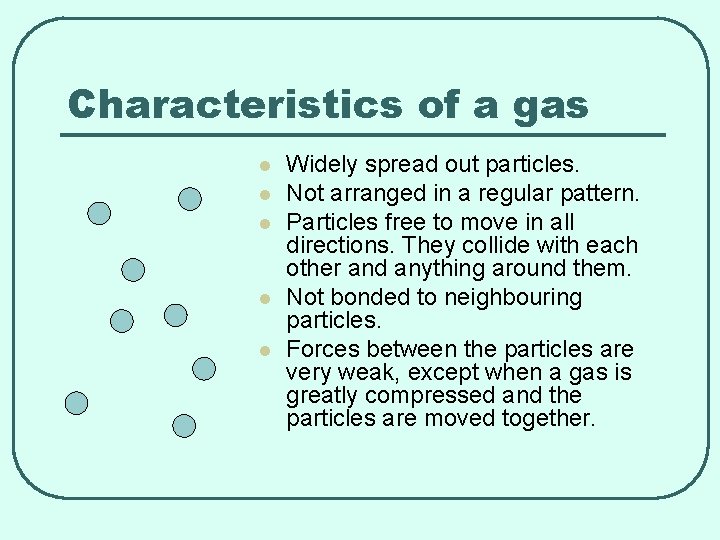
Characteristics of a gas l l l Widely spread out particles. Not arranged in a regular pattern. Particles free to move in all directions. They collide with each other and anything around them. Not bonded to neighbouring particles. Forces between the particles are very weak, except when a gas is greatly compressed and the particles are moved together.
What is a particle? l l All particles are made of atoms, they are often described as the building blocks of matter. Some particles contain only one type of atom. These substances are known as elements. An example is oxygen. Some particles contain two types of atom, which are joined together in fixed proportions as a result of a chemical reaction. An example is water (H 20) which is made up of 2 hydrogen atoms and 1 oxygen atom. Substances of this type are called compounds. When there are several elements and compounds mixed together they are called a mixture. Air is one example.
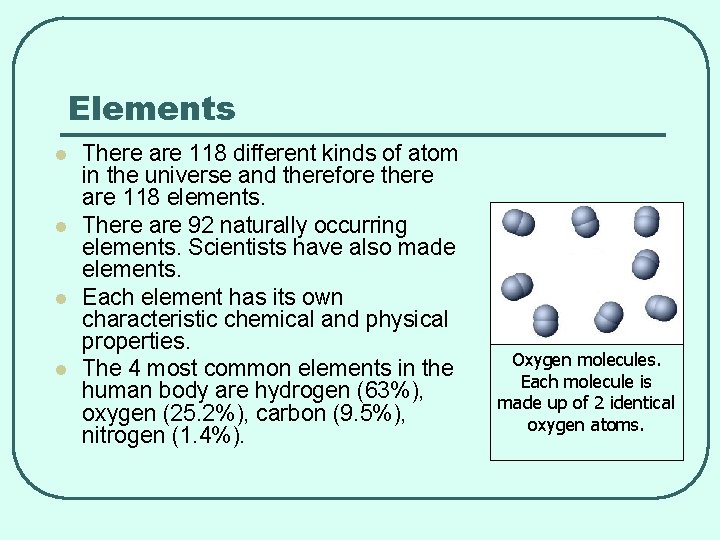
Elements l l There are 118 different kinds of atom in the universe and therefore there are 118 elements. There are 92 naturally occurring elements. Scientists have also made elements. Each element has its own characteristic chemical and physical properties. The 4 most common elements in the human body are hydrogen (63%), oxygen (25. 2%), carbon (9. 5%), nitrogen (1. 4%). Oxygen molecules. Each molecule is made up of 2 identical oxygen atoms.
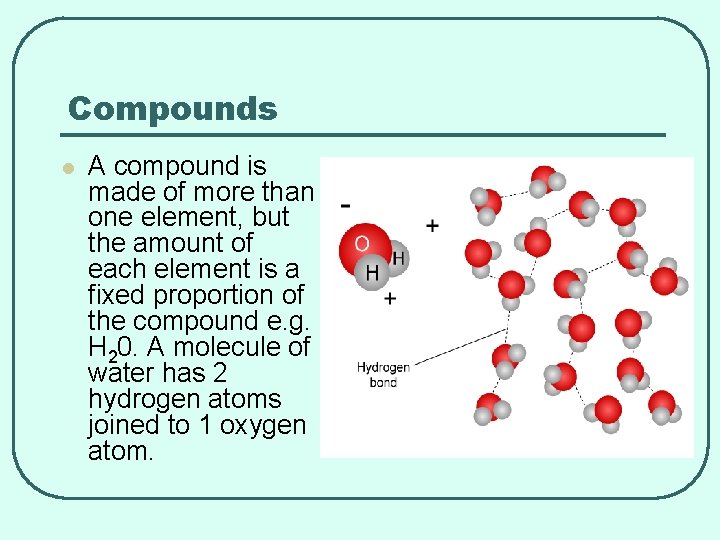
Compounds l A compound is made of more than one element, but the amount of each element is a fixed proportion of the compound e. g. H 20. A molecule of water has 2 hydrogen atoms joined to 1 oxygen atom.
Element or Compound? l l l l Carbon Dioxide Carbon Oxygen Water Table Salt Polythene Copper Rust
Changing state l l Energy is needed to make things happen. Energy can be transferred from one place to another and this can cause a change in temperature. Energy moves from hot to cold objects spontaneously and the temperature of each changes accordingly. If enough energy is transferred materials can change from a solid to a liquid or a liquid to a gas.
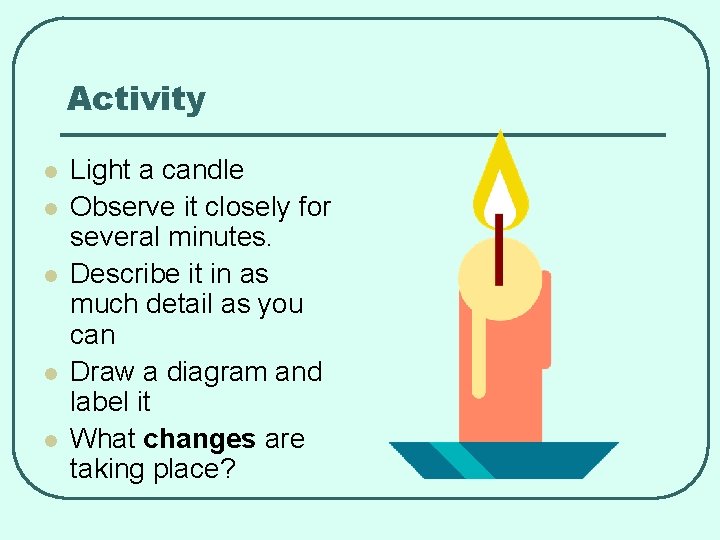
Activity l l l Light a candle Observe it closely for several minutes. Describe it in as much detail as you can Draw a diagram and label it What changes are taking place?
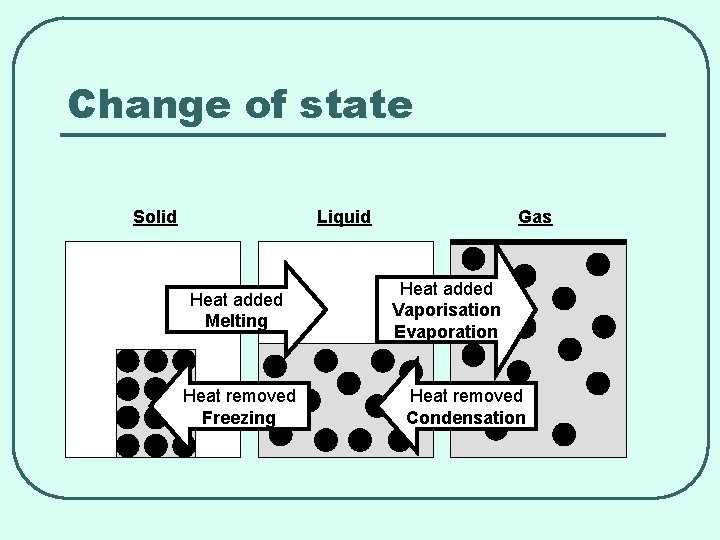
Change of state Solid Liquid Heat added Melting Heat removed Freezing Gas Heat added Vaporisation Evaporation Heat removed Condensation
Change of state vocabulary l l Melting – when a solid turns to a liquid due to heating. Evaporating – when a liquid turns to a gas due to heating Condensing – when a gas turns to a liquid by cooling Freezing/Solidifying – when a liquid turns to a solid by cooling
Changes due to heating l l Heat energy is transferred to the solid material. The heat energy causes particles in the solid material to move more vigorously. Eventually the energy transfer increases sufficiently and the particles move so vigorously that they are no longer fixed in their original positions and a liquid is formed. As more energy is transferred the particles move even more vigorously and a gas is formed.
Change of state – what stays the same? l l l the particles the shape and volume of particles the number of particles the mass of the substance the temperature of the substance at the point that the change occurs
What is different about water? l l Water has a larger volume when a solid (ice) than when it is in liquid form. When the liquid water solidifies it expands (increases in volume). Most substances have a smaller volume when they are in solid form than when they are in liquid form.
Changes due to cooling l l When a substance is cooled it may change from a gas to a liquid (condensing) or a liquid to a solid (freezing). On cooling, particles lose kinetic energy and so can become more strongly attracted to each other. When a liquid reaches freezing point the forces of attraction are sufficient to remove any remaining freedom and the particles come together to form the ordered solid arrangement. The heat has been removed to the surroundings.
Lesson Planning and Teaching n n n Subject/theme of study Context for learning Reference to NC programme of study Initial assessment of children’s knowledge Key objectives for this lesson Managing the lesson n n Resources, organisation and risk assessment Differentiation and grouping Lesson flow and teaching points Teaching strategies Assessing the learning
Planning an observation lesson n n Subject – Science Theme – Materials Context – part of a unit of work on the environment, including the melting of the polar ice caps. Reference to National Curriculum n Y 4 – States of Matter
Y 4 States of Matter Pupils should be taught to: n n n compare and group materials together, according to whether they are solids, liquids or gases observe that some materials change state when they are heated or cooled, and measure or research the temperature at which this happens in degrees Celsius (°C) identify the part played by evaporation and condensation in the water cycle and associate the rate of evaporation with temperature.
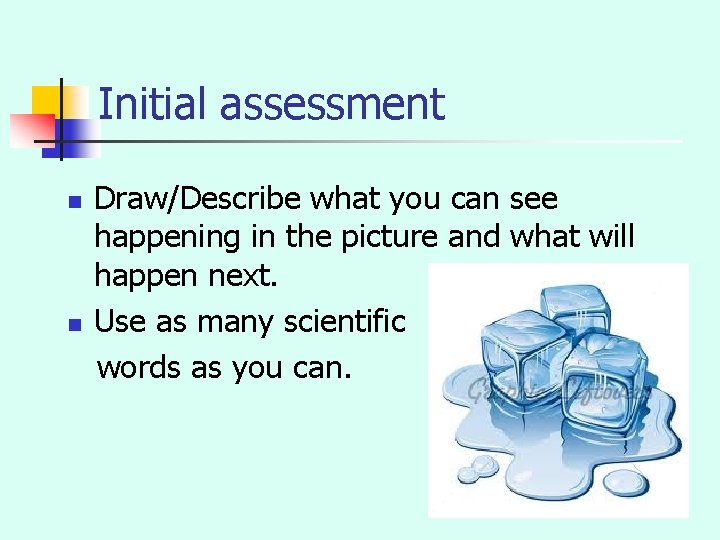
Initial assessment n n Draw/Describe what you can see happening in the picture and what will happen next. Use as many scientific words as you can.
Key objectives n By the end of the lesson children will … n n n use their observation skills to notice important changes know that ice (solid water) can be changed to water (liquid) by heating and the process is called melting. know that water (liquid) can be changed to water vapour (gas) by further heating and the process is called evaporation. some will be able to describe the changes that occur as solid water becomes a liquid and liquid water becomes a gas. some will know the temperature that these processes occur at in water.
Risk assessment I n n Children will be melting their own ice cube using a candle and a tea spoon, so planning for safety is essential. First ask yourself ‘What are the risks that need to be controlled? ’ Then decide how these risks could be safely managed. When you are clear about these things you can plan the organisation of the activity.
Risk assessment II n The main risks are: n n n n Children burnt when candle is lit Children burnt by flame of candle Children burnt by hot, melted wax Children burnt by hot tea spoon Children burnt by boiling water Flame setting flammable material alight and causing a fire Children playing with fire outside school
Risk assessment III and class organisation n n What would you do to ensure that the identified risks were sufficiently controlled that the risks could be reasonably managed and the children could take part in the activity? Following this risk assessment what decisions would you make on how the class would be organised for the task?
Resources n If you are using ice there needs to be some preparation. n n n Ice cubes Candles Matches Informing parents Question prompt cards for differentiation Something to make the children say ‘Wow!’
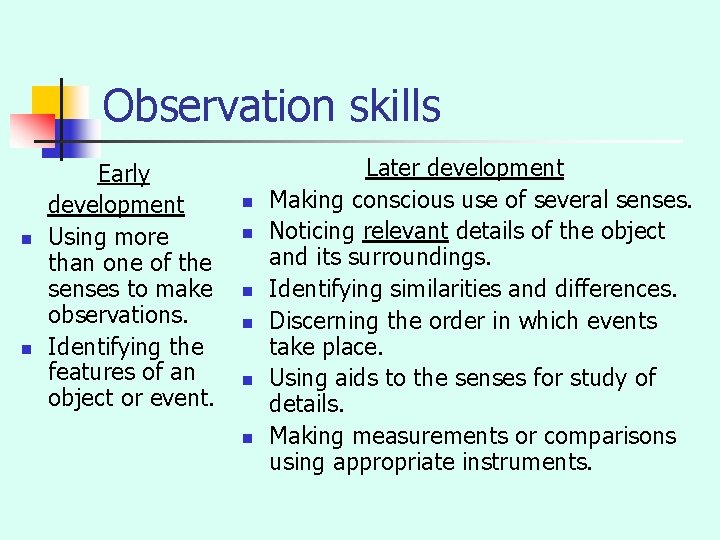
Observation skills n n Early development Using more than one of the senses to make observations. Identifying the features of an object or event. n n n Later development Making conscious use of several senses. Noticing relevant details of the object and its surroundings. Identifying similarities and differences. Discerning the order in which events take place. Using aids to the senses for study of details. Making measurements or comparisons using appropriate instruments.
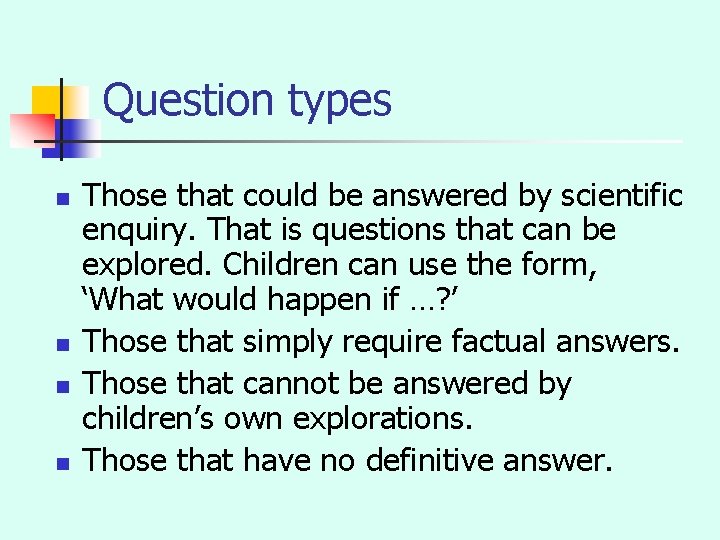
Question types n n Those that could be answered by scientific enquiry. That is questions that can be explored. Children can use the form, ‘What would happen if …? ’ Those that simply require factual answers. Those that cannot be answered by children’s own explorations. Those that have no definitive answer.
Questioning words n How many can you think of?
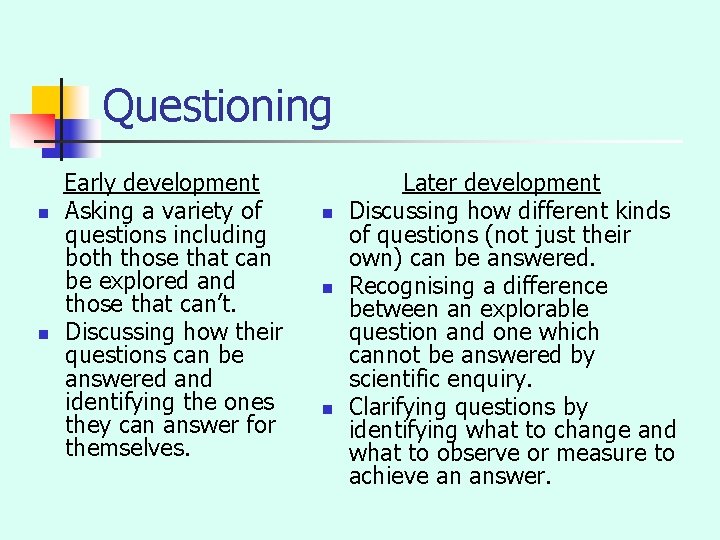
Questioning n n Early development Asking a variety of questions including both those that can be explored and those that can’t. Discussing how their questions can be answered and identifying the ones they can answer for themselves. n n n Later development Discussing how different kinds of questions (not just their own) can be answered. Recognising a difference between an explorable question and one which cannot be answered by scientific enquiry. Clarifying questions by identifying what to change and what to observe or measure to achieve an answer.
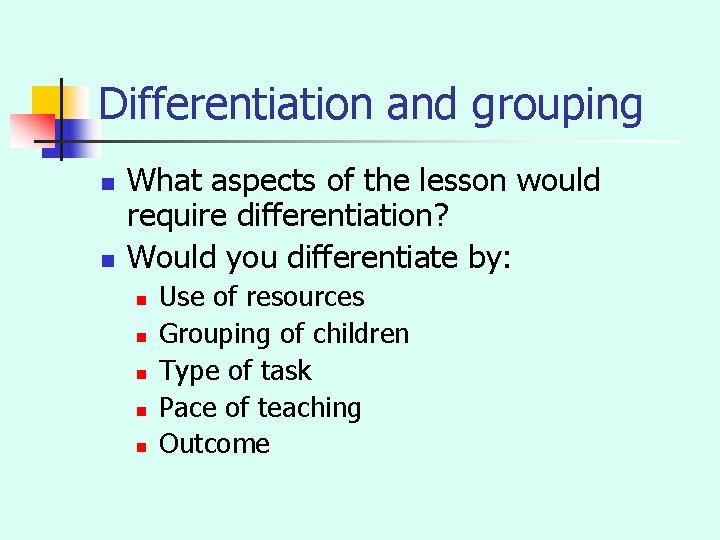
Differentiation and grouping n n What aspects of the lesson would require differentiation? Would you differentiate by: n n n Use of resources Grouping of children Type of task Pace of teaching Outcome
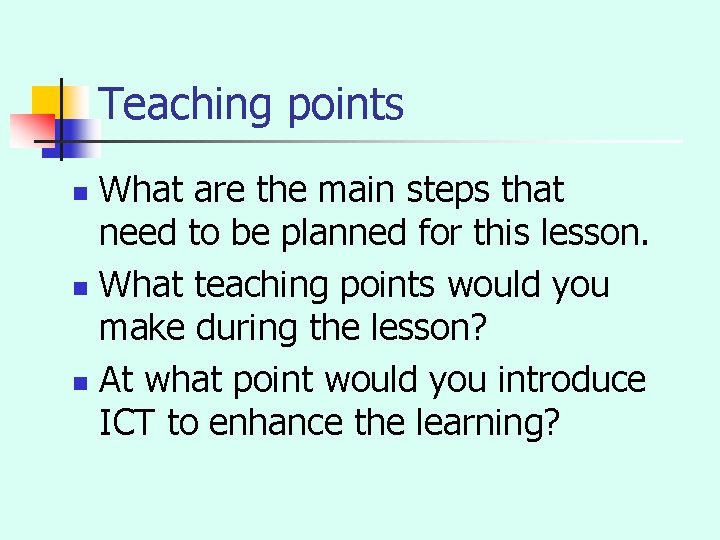
Teaching points What are the main steps that need to be planned for this lesson. n What teaching points would you make during the lesson? n At what point would you introduce ICT to enhance the learning? n
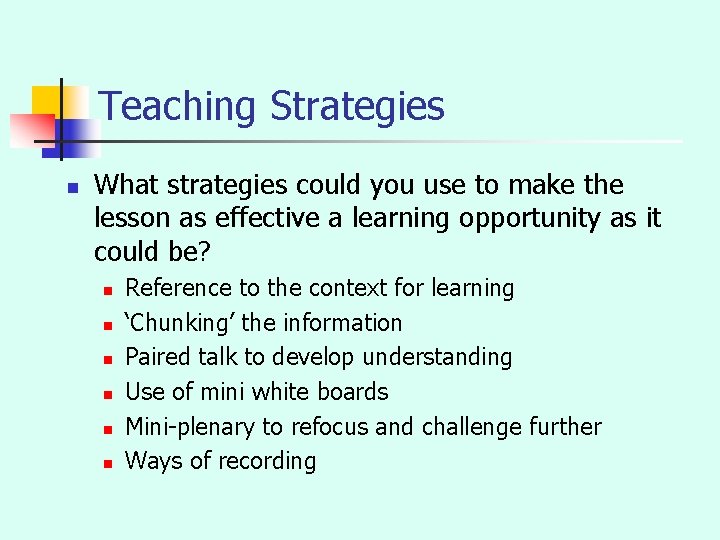
Teaching Strategies n What strategies could you use to make the lesson as effective a learning opportunity as it could be? n n n Reference to the context for learning ‘Chunking’ the information Paired talk to develop understanding Use of mini white boards Mini-plenary to refocus and challenge further Ways of recording
Assessment n n n How could you assess children during the lesson? What evidence would you use or collect? What could be assessed after the lesson? What evidence would you use or collect? Could you assess all children or just some?
Homework n n How do you decide whether to set homework or not following a classroom activity? What type of activity might be appropriate as a homework task? What if the task set is too hard? Should parents be encouraged to help children with their homework?
Children’s Development in Science Make a poster to display in your classroom to capture the key ideas in the following areas: • Development of process skills • Dimensions of Progress • From description to explanation • From ‘small’ to ‘big’ ideas • From personal to shared ideas
Development of process skills l l l From simple to more elaborated skills From effective use in familiar situations to effective use in unfamiliar situations From unconscious to conscious action
Dimensions of Progress l l l From description to explanation From ‘small’ to ‘big’ ideas From personal to shared ideas
From description to explanation l Young children use their senses to gather information to describe their observations • • • l Hear Touch Smell See Taste Older children try to explain rather than describe
Hubert Dyasi said … l An explanation is the result of combining intellectual activity with discrete facts gathered through enquiry. The development of explanations is an essential component of science enquiry.
From ‘small’ to ‘big’ ideas l Small ideas • Relate directly and exclusively to the object being observed l Big ideas • Link the object being observed with other • objects that occur in similar contexts Links these objects with other concepts
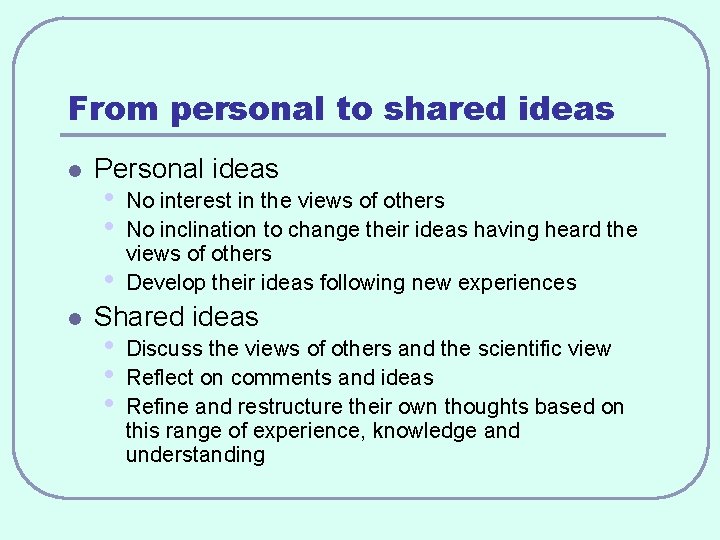
From personal to shared ideas l Personal ideas • • • l No interest in the views of others No inclination to change their ideas having heard the views of others Develop their ideas following new experiences Shared ideas • • • Discuss the views of others and the scientific view Reflect on comments and ideas Refine and restructure their own thoughts based on this range of experience, knowledge and understanding
Essential reading Chapter 6 A view of Learning in Science in Wynne Harlen’s book ‘The Teaching of Science in Primary Schools’ (third edition) Also worth reading – Chapter 6 Facing mismatches in the classroom in Osborne and Freyberg’s book ‘Learning in Science’
Very, very useful sites Big ideas in science that underpin all children’s learning l http: //www. nationalstemcentre. org. uk/elibrary/resource/ 11427/principles-and-big-ideas-of-science-education The National STEM Centre houses the UK’s largest collection of a wide range of high-quality support materials. l http: //www. nationalstemcentre. org. uk/primaryscience Free online science CPD for teachers, developed with Imperial College London. l http: //www. reachoutcpd. com/? dm_t=0, 0, 0
Also useful Sites created by Danny Nicholson l www. scittscience. co. uk l www. whiteboardblog. co. uk