Why sport The power of sport Lecture 1
- Slides: 15
Why ‘sport’? The ‘power’ of sport. Lecture 1 (10 July 2019): Tsukuba Summer Institute Dr Daniel Bloyce @Bloyce. D E: d. bloyce@chester. ac. uk
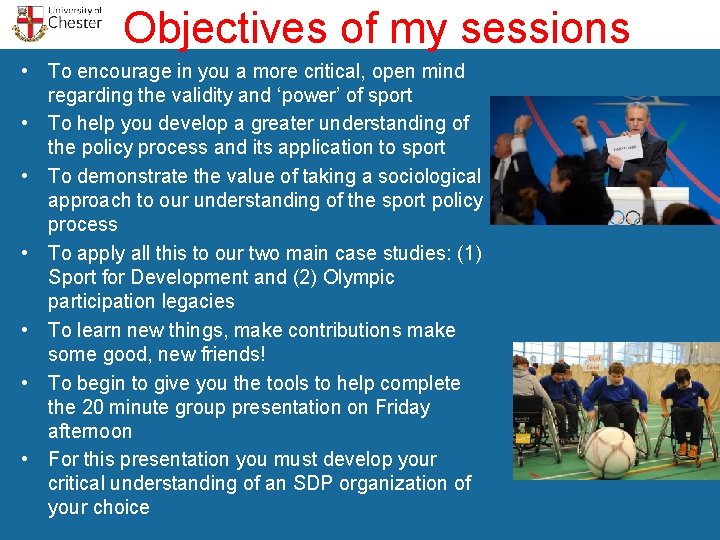
Objectives of my sessions • To encourage in you a more critical, open mind regarding the validity and ‘power’ of sport • To help you develop a greater understanding of the policy process and its application to sport • To demonstrate the value of taking a sociological approach to our understanding of the sport policy process • To apply all this to our two main case studies: (1) Sport for Development and (2) Olympic participation legacies • To learn new things, make contributions make some good, new friends! • To begin to give you the tools to help complete the 20 minute group presentation on Friday afternoon • For this presentation you must develop your critical understanding of an SDP organization of your choice
Group presentation • Get into groups, you need to do a 20 minute group presentation that has FIVE Power. Point ONLY slides with the following titles: • Slide 1: How is ‘sport’ used in the organisation? What are the ‘goals’? • Slide 2: What involvement is there with partners? • Slide 3: What ‘evidence’ is used to justify why sport is used as a tool? • Slide 4: What ‘evaluation’ is done about the organisation and by who? • Slide 5: What are your main critiques of the organisation?
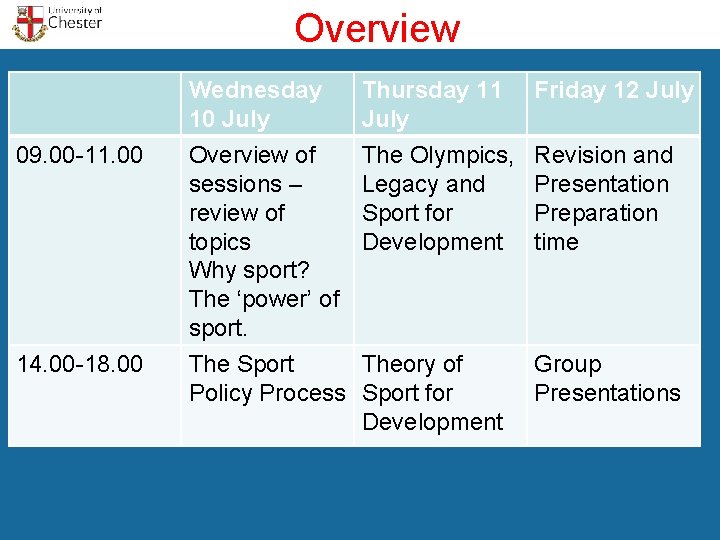
Overview 09. 00 -11. 00 14. 00 -18. 00 Wednesday 10 July Overview of sessions – review of topics Why sport? The ‘power’ of sport. The Sport Policy Process Thursday 11 July The Olympics, Legacy and Sport for Development Friday 12 July Theory of Sport for Development Group Presentations Revision and Presentation Preparation time
The ‘power’ of sport? • “Sport has the power to change the world…it has the power to inspire. It has the power to unite people in a way that little else does. It speaks to youth in a language they understand. Sport can create hope where once there was only despair. It is more powerful than government in breaking down racial barriers”
The ‘power’ of sport? • “Sport has a unique power to attract, mobilize and inspire. By its very nature, sport is about participation. It is about inclusion and citizenship. It stands for human values such as respect for the opponent, acceptance of binding rules, teamwork and fairness”
The ‘power’ of sport? • “Sport is also good for us. It teaches our children how to rise to a challenge, nurturing the character and discipline that will help them get on in life. It encourages us all to lead healthier and more active lives … By harnessing the power of sport for the good of our whole society, by investing in developing the talent of future stars in every sport and by standing up for the integrity of the sports we love, we can secure our sporting future and in doing so make our country stronger for generations to come ”
The ‘power’ of sport? • “Sport possesses the intrinsic value to respond to the basic human desire for physical movement and to generate feelings of satisfaction, pleasure and joy. Sport plays a key role in diverse facets of people’s lives, for example by supporting the sound fostering of youth, revitalizing local communities, the retaining and promoting of mental and physical health, the generating social and economic vitality, and raising national status in the international community. In view of this, it is important that the plan strives to create a society where all people can enjoy a happy and fulfilled life through sport”
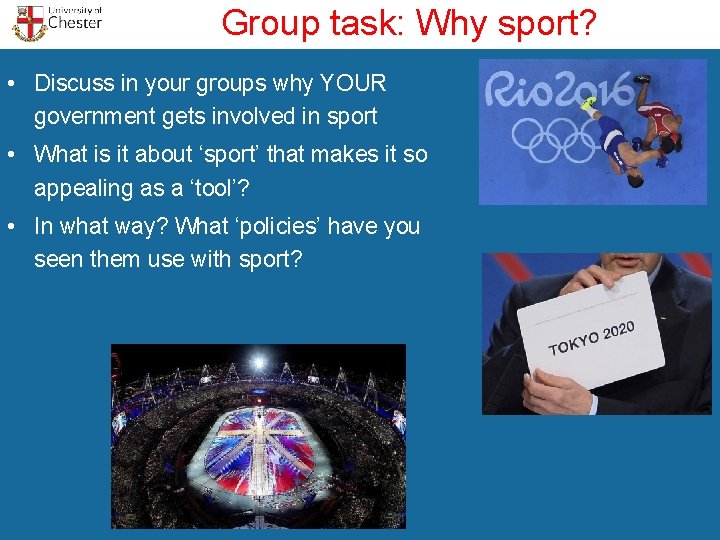
Group task: Why sport? • Discuss in your groups why YOUR government gets involved in sport • What is it about ‘sport’ that makes it so appealing as a ‘tool’? • In what way? What ‘policies’ have you seen them use with sport?
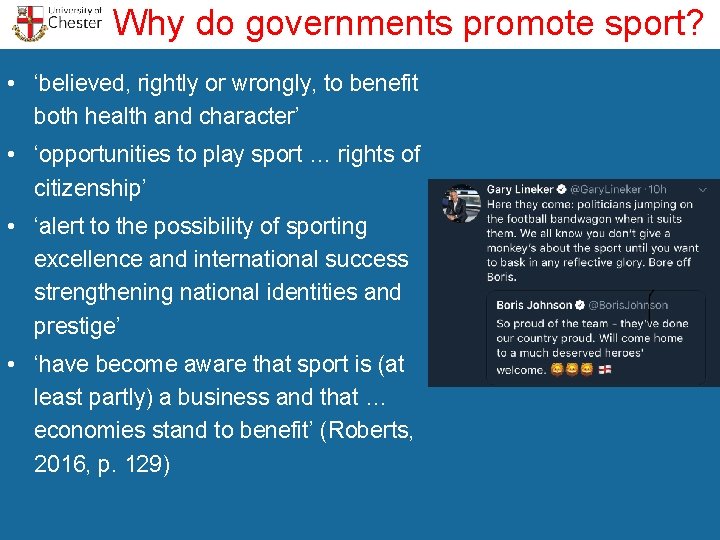
Why do governments promote sport? • ‘believed, rightly or wrongly, to benefit both health and character’ • ‘opportunities to play sport … rights of citizenship’ • ‘alert to the possibility of sporting excellence and international success strengthening national identities and prestige’ • ‘have become aware that sport is (at least partly) a business and that … economies stand to benefit’ (Roberts, 2016, p. 129)
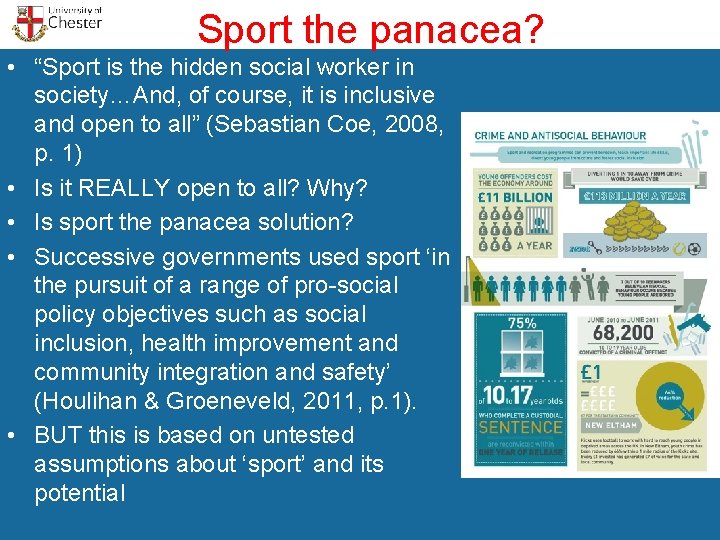
Sport the panacea? • “Sport is the hidden social worker in society…And, of course, it is inclusive and open to all” (Sebastian Coe, 2008, p. 1) • Is it REALLY open to all? Why? • Is sport the panacea solution? • Successive governments used sport ‘in the pursuit of a range of pro-social policy objectives such as social inclusion, health improvement and community integration and safety’ (Houlihan & Groeneveld, 2011, p. 1). • BUT this is based on untested assumptions about ‘sport’ and its potential
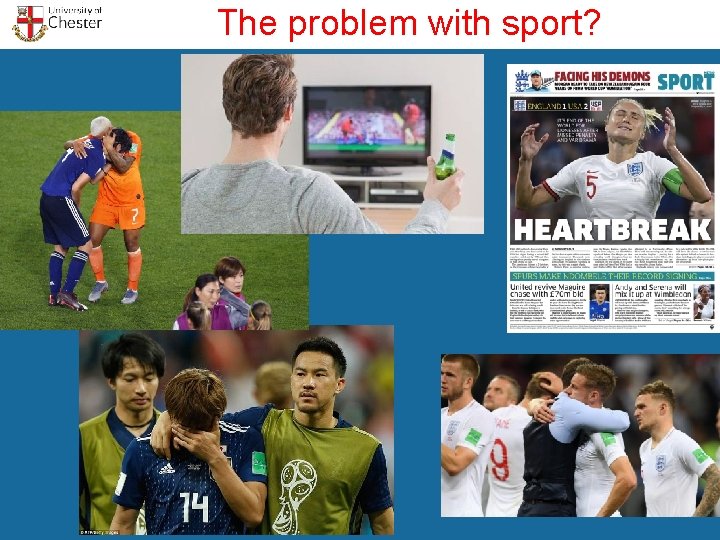
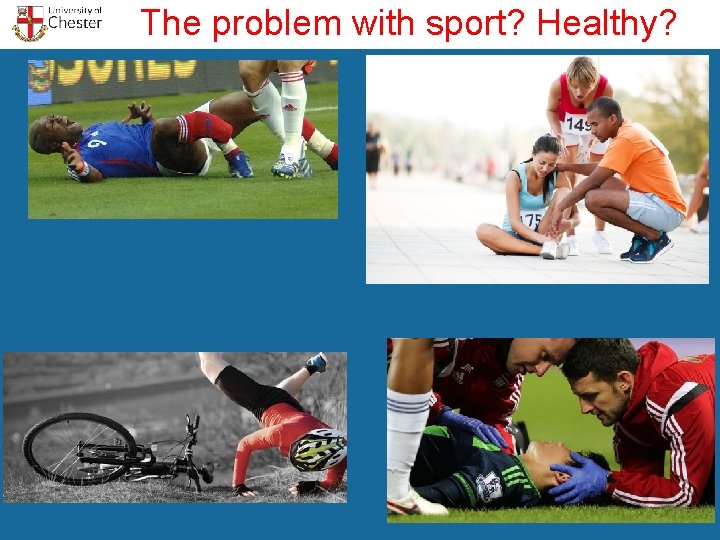
The problem with sport?
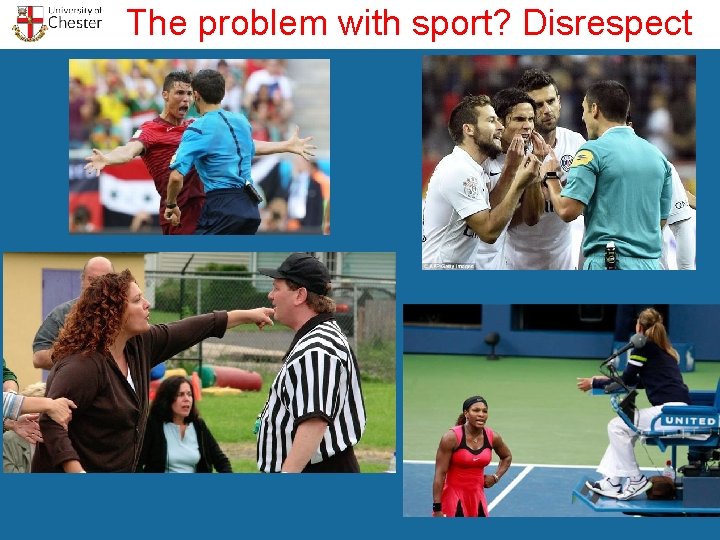
The problem with sport? Disrespect
The problem with sport? Healthy?
(1) The Limits of ‘Sport’ Political problems: • (i) Project managers with over-optimistic expectations of sport • (ii) Vague objectives – policy and programmes • (iii) Pressure on funding and preference for outputs (e. g. number of courses ran) than outcomes (decreased criminality) (2) Technical problems: • (i) When will impacts occur and can these be simply related to sport? • (ii) Evaluation usually an after-thought (Centre for Social Justice, 2011) • “You can take the kid out of the favela, but you cannot take the favela out of the kid”