DR L GIRIJA M D Hom Associate professor




- Slides: 79
DR. L. GIRIJA. M. D. (Hom. ), Associate professor, DEPARTMENT OF GYNAECOLOGY AND OBSTETRICS, SARADA KRISHNA HOMOEOPATHIC MEDICAL COLLEGE, KULASEKHARAM
INTRODUCTION � Worldwide, over 100 million women have used the intrauterine contraceptive device (IUD). � However, in North America less than 1% of women use this highly effective method of contraception.
INTRODUCTION � 2 copper IUDs (Nova-T and Flexi-T 300) and a levonorgestrel-releasing device (Mirena) are currently available. �Mirena is also referred to as a levonorgestrel-releasing intrauterine system (LNG-IUS).
EFFICACY � Intrauterine devices are highly effective methods of reversible contraception.
EFFICACY � In a large trial: 1. The failure rate of a copper IUD (Nova-T) was 1. 26 per 100 women-years (WY) and 2. The rate of ectopic pregnancy was 0. 25 per 100 WY.
EFFICACY � The failure rate of the levonorgestrel-releasing intrauterine system was 0. 09 per 100 WY and � The ectopic pregnancy rate was 0. 02 per 100 WY.
EFFICACY • Although the product monograph for the Nova-T copper IUD suggests that it be replaced every 30 months, clinical trials have shown that it is effective for 5 years. • The Flexi-T 300 copper IUD and the LNGIUS should be replaced every 5 years.
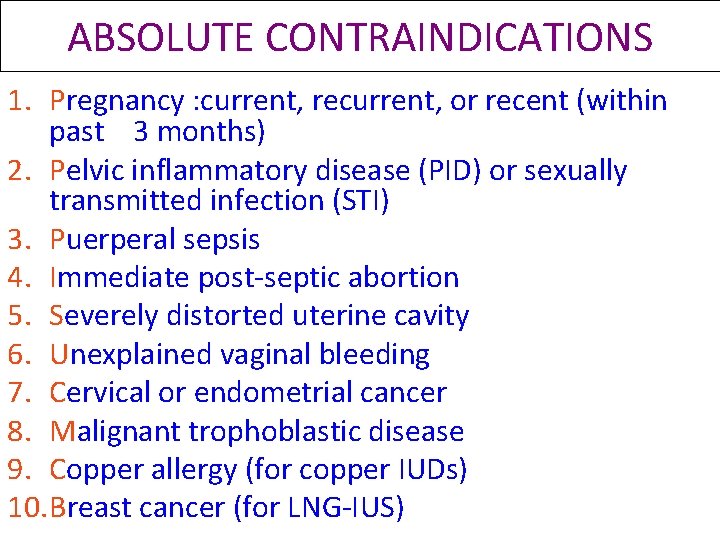
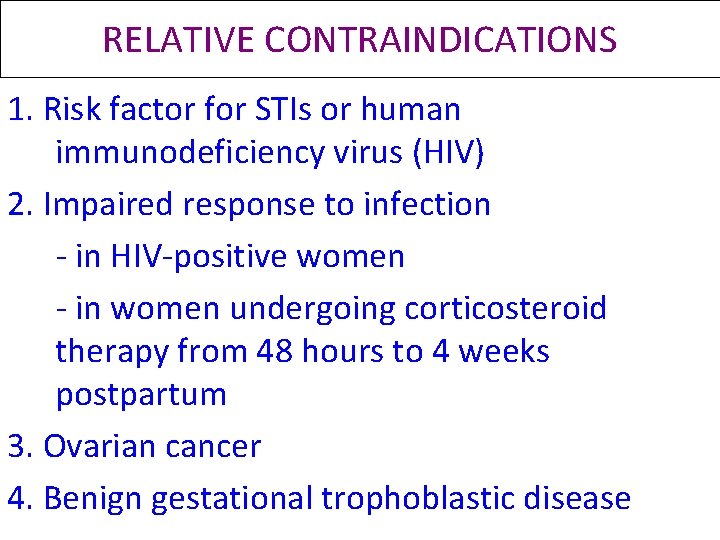
CONTRAINDICATIONS The World Health Organization (WHO) has developed a list of absolute and relative contraindications to use of an IUD.
ABSOLUTE CONTRAINDICATIONS 1. Pregnancy : current, recurrent, or recent (within past 3 months) 2. Pelvic inflammatory disease (PID) or sexually transmitted infection (STI) 3. Puerperal sepsis 4. Immediate post-septic abortion 5. Severely distorted uterine cavity 6. Unexplained vaginal bleeding 7. Cervical or endometrial cancer 8. Malignant trophoblastic disease 9. Copper allergy (for copper IUDs) 10. Breast cancer (for LNG-IUS)
RELATIVE CONTRAINDICATIONS 1. Risk factor for STIs or human immunodeficiency virus (HIV) 2. Impaired response to infection - in HIV-positive women - in women undergoing corticosteroid therapy from 48 hours to 4 weeks postpartum 3. Ovarian cancer 4. Benign gestational trophoblastic disease
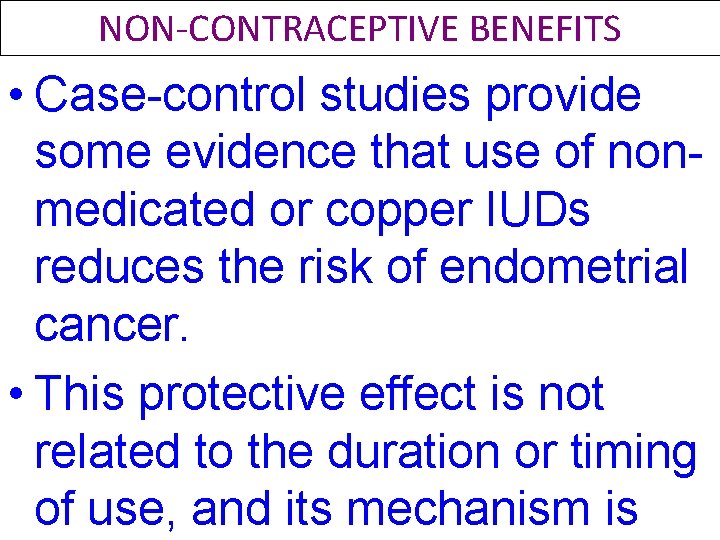
NON-CONTRACEPTIVE BENEFITS • Case-control studies provide some evidence that use of nonmedicated or copper IUDs reduces the risk of endometrial cancer. • This protective effect is not related to the duration or timing of use, and its mechanism is
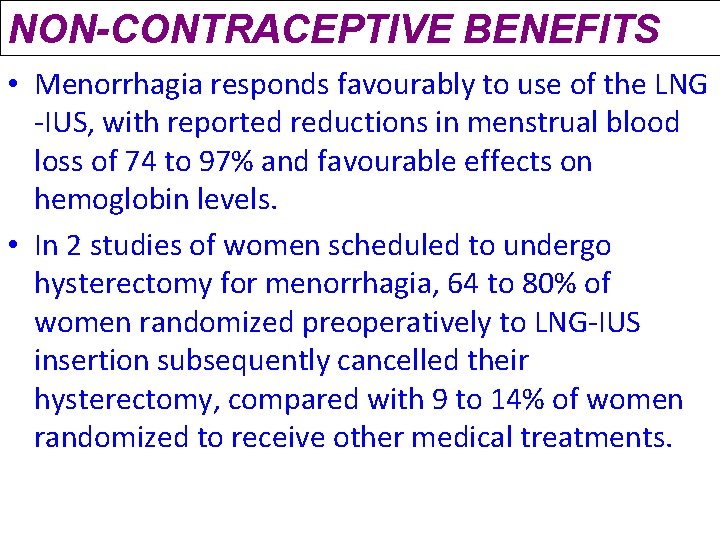
NON-CONTRACEPTIVE BENEFITS • Menorrhagia responds favourably to use of the LNG -IUS, with reported reductions in menstrual blood loss of 74 to 97% and favourable effects on hemoglobin levels. • In 2 studies of women scheduled to undergo hysterectomy for menorrhagia, 64 to 80% of women randomized preoperatively to LNG-IUS insertion subsequently cancelled their hysterectomy, compared with 9 to 14% of women randomized to receive other medical treatments.
NON-CONTRACEPTIVE BENEFITS • Dysmenorrhea may also improve in LNGIUS users. • A randomized controlled study found that use of the LNGIUS protects against endometrial hyperplasia in women on tamoxifen. • Small reports support a beneficial effect in the treatment of fibroid-related menorrhagia.
SIDE EFFECTS 1. BLEEDING 2. PAIN OR DYSMENORRHEA 3. HORMONAL 4. FUNCTIONAL OVARIAN CYSTS
1. BLEEDING • Irregular menstrual bleeding or an increase in the amount of bleeding are the most common side effects of IUDs in the first months after insertion. • Menstrual blood loss in users of copper IUDs increases by up to 65% over non-users.
1. BLEEDING • Use of non-steroidal antiinflammatory agents (NSAIDs) or tranexamic acid may help to decrease the amount of menstrual blood loss.
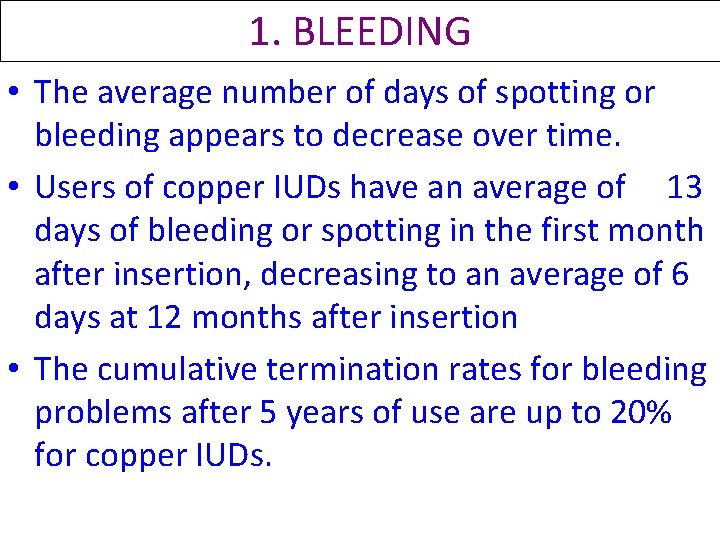
1. BLEEDING • The average number of days of spotting or bleeding appears to decrease over time. • Users of copper IUDs have an average of 13 days of bleeding or spotting in the first month after insertion, decreasing to an average of 6 days at 12 months after insertion • The cumulative termination rates for bleeding problems after 5 years of use are up to 20% for copper IUDs.
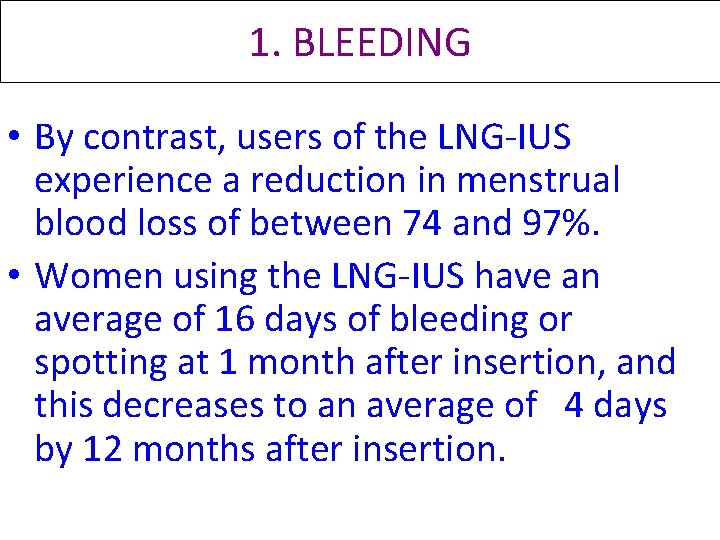
1. BLEEDING • By contrast, users of the LNG-IUS experience a reduction in menstrual blood loss of between 74 and 97%. • Women using the LNG-IUS have an average of 16 days of bleeding or spotting at 1 month after insertion, and this decreases to an average of 4 days by 12 months after insertion.
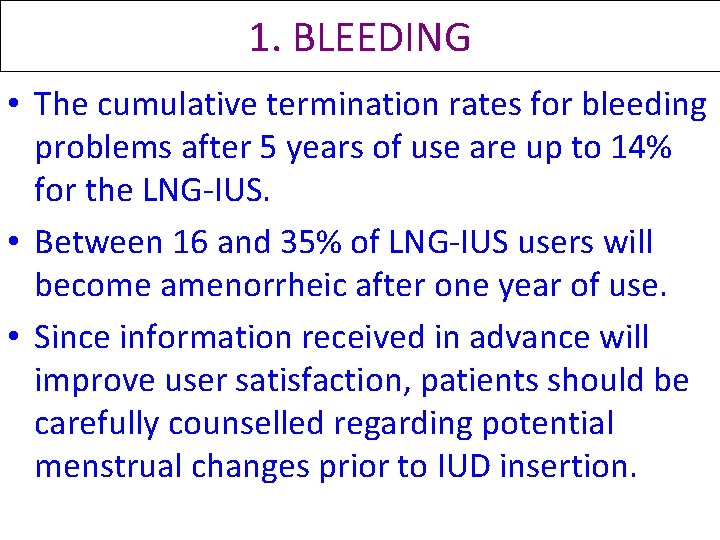
1. BLEEDING • The cumulative termination rates for bleeding problems after 5 years of use are up to 14% for the LNG-IUS. • Between 16 and 35% of LNG-IUS users will become amenorrheic after one year of use. • Since information received in advance will improve user satisfaction, patients should be carefully counselled regarding potential menstrual changes prior to IUD insertion.
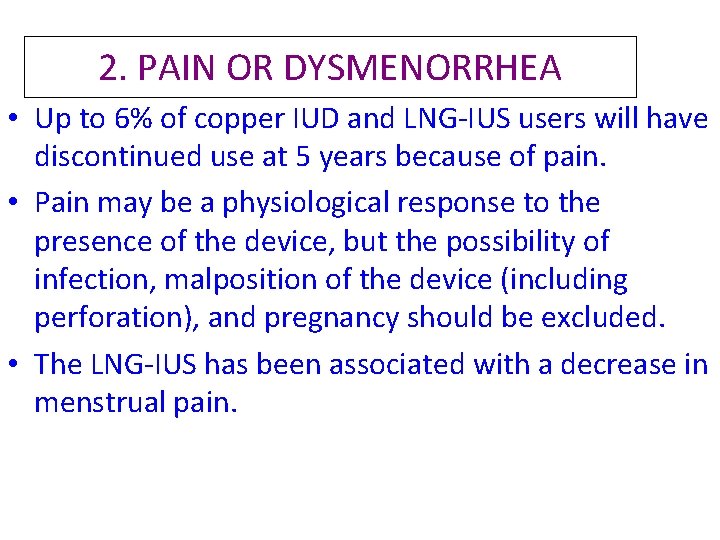
2. PAIN OR DYSMENORRHEA • Up to 6% of copper IUD and LNG-IUS users will have discontinued use at 5 years because of pain. • Pain may be a physiological response to the presence of the device, but the possibility of infection, malposition of the device (including perforation), and pregnancy should be excluded. • The LNG-IUS has been associated with a decrease in menstrual pain.
3. HORMONAL • The LNG-IUS appears to exert some systemic hormonal effects, even though the daily dose of levonorgestrel is extremely low. • Hormonal side effects include depression, acne, headache, and breast tenderness.
3. HORMONAL • Most studies report a low incidence of such adverse effects, which appear to be maximal at 3 months after insertion and then decrease. • Although weight gain has been reported as a side effect of LNG-IUS use, a large trial reported no significant difference in weight gain over 5 years in LNGIUS users and copper IUD users.
4. FUNCTIONAL OVARIAN CYSTS • Functional ovarian cysts have been reported in up to 30% of LNG-IUS users. • Since these cysts usually resolve spontaneously, they should be managed expectantly.
RISKS 1. UTERINE PERFORATION 2. INFECTION 3. EXPULSION 4. FAILURE
1. UTERINE PERFORATION • Uterine perforation is a rare complication of IUD insertion, occurring at a rate of 0. 6 to 1. 6 per 1000 insertions. • All uterine perforations, either partial or complete, occur or are initiated at the time of IUD insertion.
1. UTERINE PERFORATION • 1. 2. 3. 4. 5. Risk factors for perforation include: Postpartum insertion, An inexperienced operator, and A uterus that is immobile, Extremely anteverted or Extremely retroverted.
2. INFECTION • Evidence from large cohort studies , case-control studies, and randomized controlled trials indicates that any risk of genital tract infection after the first month of IUD use is small.
2. INFECTION • There appears to be an inverse relation between the risk of infection and the time since IUD insertion. • The Women’s Health Study data showed a relative risk of PID of 3. 8 in the first month after insertion, reaching baseline risk after 4 months.
2. INFECTION • Although insertion of an IUD contaminates the endometrial cavity with bacteria, the cavity becomes sterile soon afterwards. • Investigations by the World Health Organization found the risk to be highest in the first 20 days following insertion. • Exposure to STIs, and not the use of the IUD itself, is responsible for PID occurring after the first month of use.
2. INFECTION • It remains unclear whether the risk of PID is reduced in users of the LNGIUS compared to users of the copper IUDs. • IUD users should continue to use condoms for protection against STIs.
3. EXPULSION • Expulsion of the IUD is most common in the first year of use (2– 10% of users). • The 5 -year cumulative expulsion rate for the copper IUD is 6. 7% and for the LNG-IUS is 5. 8%. • Risk factors for expulsion include insertion immediately postpartum, nulliparity, and previous IUD expulsion. • A woman who has expelled one IUD has a 30% chance of expelling a subsequent device.
4. FAILURE • If a woman becomes pregnant with an IUD in situ, the possibility of ectopic pregnancy must be excluded. • The risk of spontaneous abortion is increased in women who continue a pregnancy with an IUD in place. • The UK Family Planning Research Network study found that 75% of pregnancies aborted if a copper IUD was left in situ, but that early removal virtually eliminated the risk of septic abortion.
4. FAILURE • If the IUD was removed, 89% of women had a live birth, compared to 25% of women who left the IUD in place. • Although the risk of spontaneous abortion appears to be normalized after IUD removal, the risk of preterm delivery remains higher.
MYTHS AND MISCONCEPTIONS 1. Nulliparous women cannot use IUDs. 2. IUDs increase the risk of ectopic pregnancy. 3. IUDs increase the risk of infertility. 4. IUDs increase the long-term risk of PID. 5. IUDs are not effective contraceptives.
MYTHS AND MISCONCEPTIONS Nulliparous women cannot use IUDs. Fact: • Nulliparity is not a contraindication to IUD use. • In carefully selected nulliparous women, IUDs may be successfully used.
MYTHS AND MISCONCEPTIONS IUDs increase the risk of ectopic pregnancy. Fact: • IUDs do not increase the risk of ectopic pregnancy. • Because IUDs work primarily by preventing fertilization, IUD users have a lower risk of ectopic pregnancy than women who are not using any form of birth control (0. 02– 0. 25/100 WY versus 0. 12– 0. 5/100 WY). • However, in women who conceive with an IUD in place, the diagnosis of ectopic pregnancy should be excluded.
MYTHS AND MISCONCEPTIONS IUDs increase the risk of infertility. Fact: • IUDs do not increase the risk of infertility. Women who discontinue use of an IUD in order to conceive are able to conceive at the same rate as women who have never used an IUD. • Copper IUD use is not associated with an increase in tubal factor infertility in nulliparous women.
MYTHS AND MISCONCEPTIONS IUDs increase the long-term risk of PID. Fact: • The incidence of PID among IUD users is less than 2 episodes per 1000 years of use, similar to that of the general population. • The increase in risk of PID associated with IUD use appears to be related only to the insertion process. • After the first month of use, the risk of infection is not significantly higher than in women without IUDs.
MYTHS AND MISCONCEPTIONS IUDs are not effective contraceptives. Fact: • IUDs are a highly effective method of birth control. • In fact, in long-term users of IUDs, the failure rate approaches that of tubal ligation. • The LNG-IUS appears to be as effective as tubal ligation.
INITIATION • Prior to insertion, informed consent should be obtained and the patient should be aware of the risks, benefits, and alternative methods of contraception.
INITIATION • Patients should be counselled regarding the potential side effects associated with the IUD of choice, particularly alterations in the menstrual cycle. • Patients should also be reminded that the IUD does not protect against STIs or HIV.
INITIATION • The IUD can be inserted at any time during the menstrual cycle once pregnancy or the possibility of pregnancy can be excluded.
INITIATION • Although the advantages of inserting the IUD during or shortly after menses include ruling out pregnancy and the masking of insertion-related bleeding, there is no evidence to support the common practice of inserting the IUD only during menses.
INITIATION • In fact, infection and expulsion rates may be higher when inserted during menses. • The IUD can be removed and replaced at the same time on any day of the menstrual cycle.
INITIATION • Postpartum women may be candidates for immediate IUD insertion (within 10– 15 minutes after delivery of the placenta). • These women are at higher risk of expulsion and uterine perforation.
INITIATION • In most circumstances, it is best to wait to insert the IUD until the uterus is completely involuted, usually at 4 to 6 weeks postpartum. • Women should wait until 6 weeks postpartum to have the LNG-IUS inserted.
INITIATION • An IUD can be safely inserted immediately after a first trimester pregnancy termination. • The cost-effectiveness of screening for gonorrhea and chlamydia infection prior to IUD insertion is unclear.
INITIATION • The cervix should be carefully inspected prior to IUD insertion, and, • if there is any evidence of mucopurulent discharge or pelvic tenderness, cervical swabs should be performed and IUD insertion delayed until the results are known.
ANTIBIOTIC PROPHYLAXIS • A Cochrane Collaboration review concluded that neither doxycycline nor azithromycin before IUD insertion conferred benefit. • According to the American Health Association’s 1997 guidelines for prevention of bacterial endocarditis (SBE), antibiotic prophylaxis is not necessary prior to IUD insertion if there is no obvious infection.
FOLLOW UP • A follow-up visit should be scheduled postinsertion. • This allows for: 1. the exclusion of infection, 2. an assessment of bleeding patterns, 3. an assessment of patient and partner satisfaction, and 4. an opportunity to reinforce the issue of condom use for protection against STIs and HIV. • After this visit, an IUD user should continue annual well-woman care as for any sexually active woman.
An IUD user should be instructed to contact her healthcare provider if any of the following occur: 1. She cannot feel the IUD’s threads 2. She or her partner can feel the lower end of the IUD 3. She thinks she is pregnant 4. She experiences persistent abdominal pain, fever, or unusual vaginal discharge 5. She or her partner feel pain or discomfort during intercourse 6. She experiences a sudden change in her menstrual periods 7. She wishes to have the device removed or wishes to conceive
TROUBLESHOOTING 1. LOST STRINGS 2. PREGNANCY WITH AN IUD IN PLACE 3. AMENORRHEA OR DELAYED MENSES 4. PAIN AND ABNORMAL BLEEDING 5. DIFFICULTY REMOVING THE IUD 6. STI IDENTIFIED WITH IUD IN PLACE 7. ACTINOMYCOSIS ON PAP SMEAR
1. LOST STRINGS • If an IUD user is unable to palpate the IUD strings, a speculum exam should be performed. • If the strings are not seen in the cervical os, the device 1. May have been expelled, 2. May have perforated the uterine wall, or 3. The strings may have been drawn up into the cervical canal.
1. LOST STRINGS • Pregnancy should be excluded. • Once pregnancy is excluded, the cervical canal should be explored (with a cotton swab, forceps, or similar instrument) to see if the strings can be found.
1. LOST STRINGS • If the strings cannot be found, ultrasound is the preferred method to identify the location of the IUD. • If the device is seen within the uterus, it can be left in situ.
1. LOST STRINGS • If the device is not identified within the uterus or the pelvis, a plain x-ray of the abdomen should be performed to determine whether the device has perforated the uterine wall. • Both the LNG-IUS and the copper IUD are radio-opaque.
2. PREGNANCY WITH AN IUD IN PLACE • Once she get pregnant, the diagnosis of an ectopic pregnancy has been excluded, • The IUD should be removed if possible. • If the strings are visible, gentle traction is applied to remove the device. • If the strings are not visible, gentle exploration of the cervical canal is performed.
2. PREGNANCY WITH AN IUD IN PLACE • If no strings are found, the possibility of perforation must be considered. • This is best excluded by pelvic ultrasound. • Despite reports of successful hysteroscopic IUD removal during the first trimester, if the device remains in the uterus then usually no attempt is made to remove it. • Note should be made of recovery of the IUD at the time of delivery.
3. AMENORRHEA OR DELAYED MENSES • Pregnancy must be excluded. • Once pregnancy has been excluded, investigation should be as for a woman without an IUD. • Up to 35% of LNG-IUS users may experience amenorrhea. • If proper positioning of the LNG-IUS is confirmed, it is unnecessary to perform repeated pregnancy tests. • If the IUD user is post-menopausal, the device should be removed.
4. PAIN AND ABNORMAL BLEEDING • Increased menstrual bleeding with or without an increase in menstrual cramping may occur in IUD users. • In the event of partial expulsion or perforation, the device should be removed and consideration given to inserting another IUD. • In the first few months after insertion, pain and spotting can also occur between menses.
4. PAIN AND ABNORMAL BLEEDING • The number of days of bleeding or spotting usually decreases over time. • Once partial expulsion, perforation, pregnancy, and infection are ruled out, treatment with NSAIDs may be helpful in treating these symptoms. • If pain or bleeding persists or worsens, removing the IUD must be considered.
5. DIFFICULTY REMOVING THE IUD • Grasping the string with a ring forceps and exerting gentle traction can usually accomplish removal of an IUD. • If the strings cannot be seen, manoeuvres such as those described above can be used to assist in localizing the strings. • If further manoeuvres are needed, a paracervical block may be considered.
5. DIFFICULTY REMOVING THE IUD • A uterine sound can be passed into the endometrial cavity to localize the IUD. • Cervical dilation may be required. • Once localized, the IUD can be subsequently grasped with a small grasping instrument directed towards it.
5. DIFFICULTY REMOVING THE IUD • If removal is not easily performed, direct visualization of the IUD with ultrasound or hysteroscopy may be required. • Occasionally general anesthetic may be needed to carry out IUD removal.
6. STI IDENTIFIED WITH IUD IN PLACE • Appropriate antibiotic therapy should be initiated for an IUD user (and her sexual contacts) found to have chlamydial or gonoccocal cervicitis. • If there is a suggestion of PID, the device should be removed after pre-treating the woman with antibiotics. • She should be counselled regarding the use of barrier contraceptive methods for STI prevention.
7. ACTINOMYCOSIS ON PAP SMEAR • Actinomycosis is considered a commensal vaginal organism but may be associated with frank infection. • Up to 20% of cervical smears in long-term copper IUD users show evidence of Actinomycosis, although this finding is only noted in up to 3% of LNG-IUS users. • Removal of the device in women with Actinomycosis on their Pap smear may not be necessary.
7. ACTINOMYCOSIS ON PAP SMEAR • In the asymptomatic woman, it is reasonable to leave the IUD in place, follow her with annual Pap smears and pelvic examinations, and warn her of potential symptoms of PID. • If the decision is made to treat, antibiotic therapy with penicillin G, tetracycline, or doxycycline may be given.
7. ACTINOMYCOSIS ON PAP SMEAR • If the woman is symptomatic, the IUD should be removed after antibiotic preloading. • If the infection is severe, she should be hospitalized, treated for PID, and investigated for possible abscess.
SUMMARY STATEMENTS
• In women who are at low risk of acquiring STIs, the use of an intrauterine device may be an excellent contraceptive option. (Level II)
• Efficacy rates for the levonorgestrelreleasing intrauterine system approach those of surgical sterilization; • it is therefore an excellent alternative to surgical sterilization for women who seek long-term contraception. (Level II)
The copper IUDs (Nova-T and Flexi-T 300) and the LNGIUS (Mirena) provide effective contraception for 5 years. (Level I)
• The risk of genital tract infection after the first month of IUD use is small. • There appears to be an inverse relation between risk of infection and time since IUD insertion. (Level II)
• Although the relative risk of pelvic inflammatory disease (PID) in the first month after insertion is increased slightly, the absolute risk is still low. • Exposure to sexually transmitted infections, and not the use of the IUD itself, is responsible for PID occurring after the first month of use. (Level II)
• Both types of IUDs provide excellent contraceptive efficacy (Level 1) • In addition, the copper IUD may decrease the risk of endometrial cancer (Level II)
• The levonorgestrel releasing IUS may provide an acceptable alternative to hysterectomy, by decreasing menorrhagia and increasing hemoglobin concentrations. (Level I)
RECOMMENDATIONS Health-care professionals providing family planning services should be familiar with the use of the intrauterine device (IUD). (Grade A)
RECOMMENDATIONS Appropriately trained personnel in adequately equipped facilities should be available in order to ensure that women have access to the IUD if they desire this method of contraception. (Grade A)