Community Development Workshop Professor Mike Kelly Institute of





- Slides: 61
Community Development Workshop. Professor Mike Kelly Institute of Public Health University of Cambridge UNIVERSITY OF CAMBRIDGE The Primary Care Unit
The difference between population health and individual health UNIVERSITY OF CAMBRIDGE The Primary Care Unit
The difference between population health and individual health • Why is Mr Smith sick? UNIVERSITY OF CAMBRIDGE The Primary Care Unit
The difference between population health and individual health • Why is Mr Smith sick? • Why is the health of the population of the West of Scotland worse than everywhere else in the UK? UNIVERSITY OF CAMBRIDGE The Primary Care Unit
The difference between population health and individual health • Why is Mr Smith sick? • Why is the health of the population of the West of Scotland worse than everywhere else in the UK? • We need two different explanations!! UNIVERSITY OF CAMBRIDGE The Primary Care Unit
X Y UNIVERSITY OF CAMBRIDGE The Primary Care Unit
A B UNIVERSITY OF CAMBRIDGE The Primary Care Unit
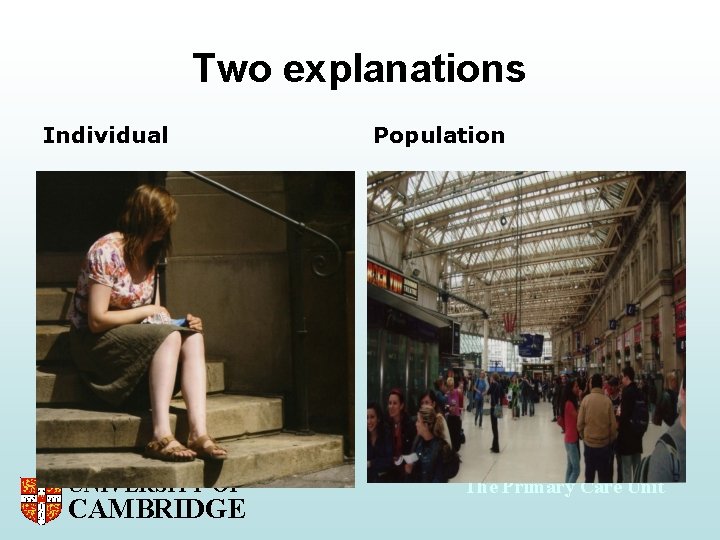
Two explanations Individual UNIVERSITY OF CAMBRIDGE Population The Primary Care Unit
• Population explanations are not achieved by adding up all the individual events. • The case of asbestos related disease in East London UNIVERSITY OF CAMBRIDGE The Primary Care Unit
UNIVERSITY OF CAMBRIDGE The Primary Care Unit
UNIVERSITY OF CAMBRIDGE The Primary Care Unit
UNIVERSITY OF CAMBRIDGE The Primary Care Unit
UNIVERSITY OF CAMBRIDGE The Primary Care Unit
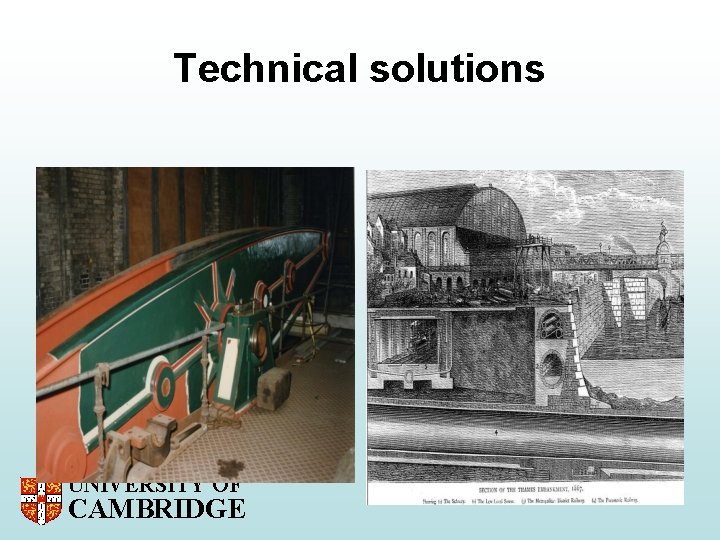
Technical solutions UNIVERSITY OF CAMBRIDGE The Primary Care Unit
UNIVERSITY OF CAMBRIDGE The Primary Care Unit
• Water and sewerage as the most widely diffused technological complex in human history – Christopher Hamlin, Public Health and Social Justice in the Age of Chadwick, Cambridge University Press, 1998 UNIVERSITY OF CAMBRIDGE The Primary Care Unit
UNIVERSITY OF CAMBRIDGE The Primary Care Unit
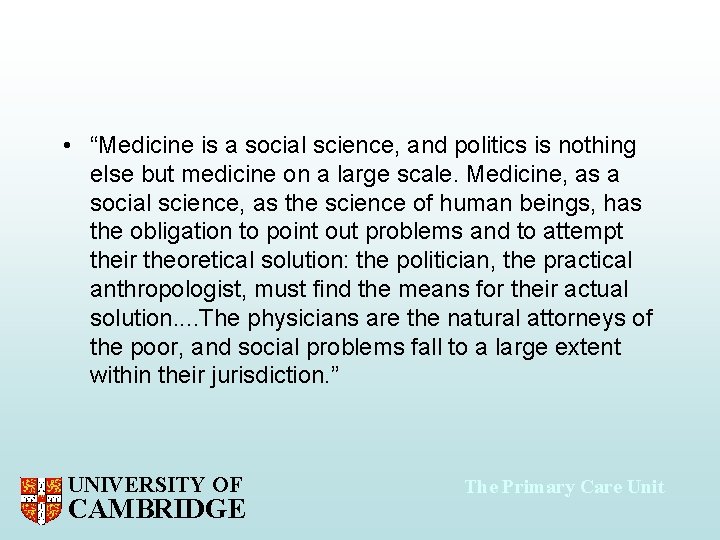
• “Medicine is a social science, and politics is nothing else but medicine on a large scale. Medicine, as a social science, as the science of human beings, has the obligation to point out problems and to attempt their theoretical solution: the politician, the practical anthropologist, must find the means for their actual solution. . The physicians are the natural attorneys of the poor, and social problems fall to a large extent within their jurisdiction. ” UNIVERSITY OF CAMBRIDGE The Primary Care Unit
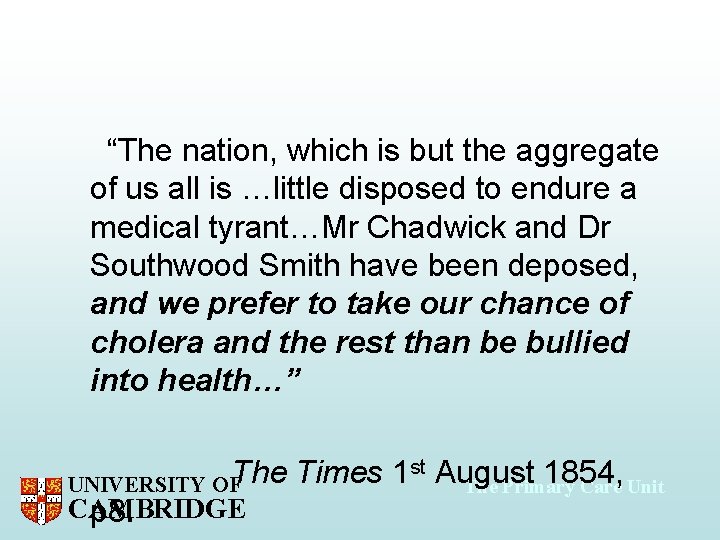
“The nation, which is but the aggregate of us all is …little disposed to endure a medical tyrant…Mr Chadwick and Dr Southwood Smith have been deposed, and we prefer to take our chance of cholera and the rest than be bullied into health…” st August 1854, The Times 1 UNIVERSITY OF The Primary Care Unit CAMBRIDGE p 8.
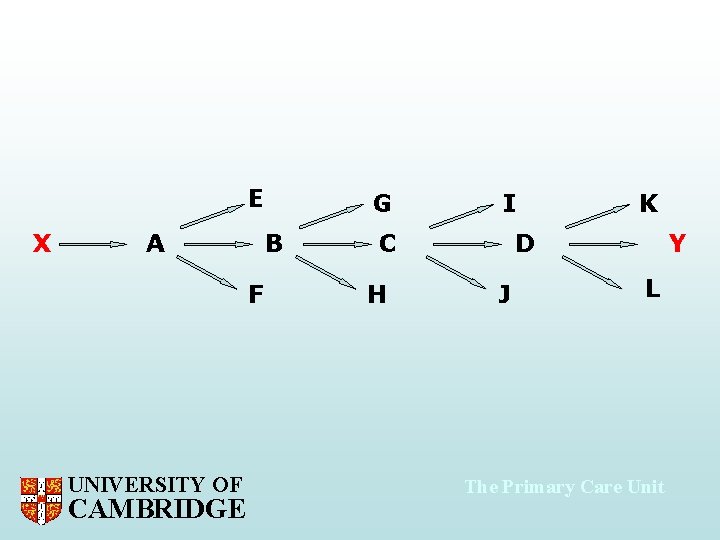
E X A B F UNIVERSITY OF CAMBRIDGE G I C H K D J Y L The Primary Care Unit
Antonovsky’s ideas • The pathogenic approach UNIVERSITY OF CAMBRIDGE The Primary Care Unit
Antonovsky’s ideas • The pathogenic approach. • Antonovsky’s studies of blue collar workers in the USA. UNIVERSITY OF CAMBRIDGE The Primary Care Unit
Antonovsky’s ideas • The pathogenic approach. • Antonovsky’s studies of blue collar workers in the USA. • Antonovsky goes to Israel via Aberdeen UNIVERSITY OF CAMBRIDGE The Primary Care Unit
Antonovsky’s ideas • The pathogenic approach. • Antonovsky’s studies of blue collar workers in the USA. • Antonovsky goes to Israel via Aberdeen. • The pathogenic approach asks the wrong question. UNIVERSITY OF CAMBRIDGE The Primary Care Unit
Antonovsky’s ideas • • • The pathogenic approach. Antonovsky’s studies of blue collar workers in the USA. Antonovsky goes to Israel via Aberdeen. The pathogenic approach asks the wrong question. Salutogenesis UNIVERSITY OF CAMBRIDGE The Primary Care Unit
Antonovsky’s ideas • • • The pathogenic approach. Antonovsky’s studies of blue collar workers in the USA. Antonovsky goes to Israel via Aberdeen. The pathogenic approach asks the wrong question. Salutogenesis Resilience, coping, and sense of coherence UNIVERSITY OF CAMBRIDGE The Primary Care Unit
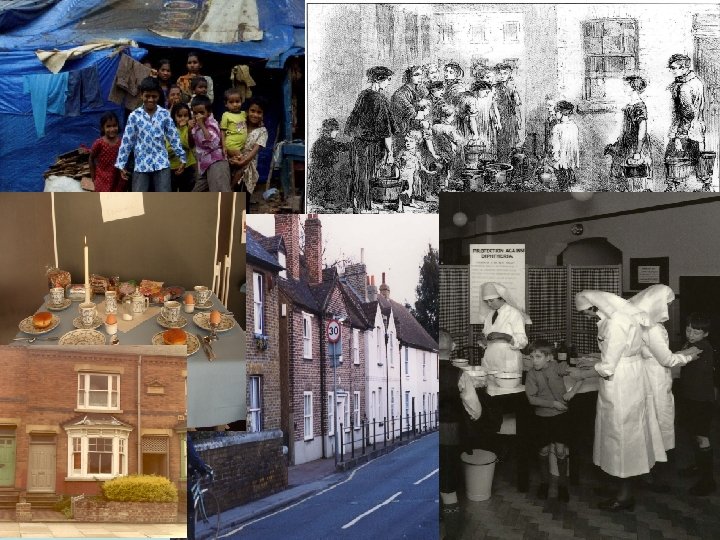
UNIVERSITY OF CAMBRIDGE The Primary Care Unit
Where does coping take place? UNIVERSITY OF CAMBRIDGE The Primary Care Unit
Lifeworlds UNIVERSITY OF CAMBRIDGE The Primary Care Unit
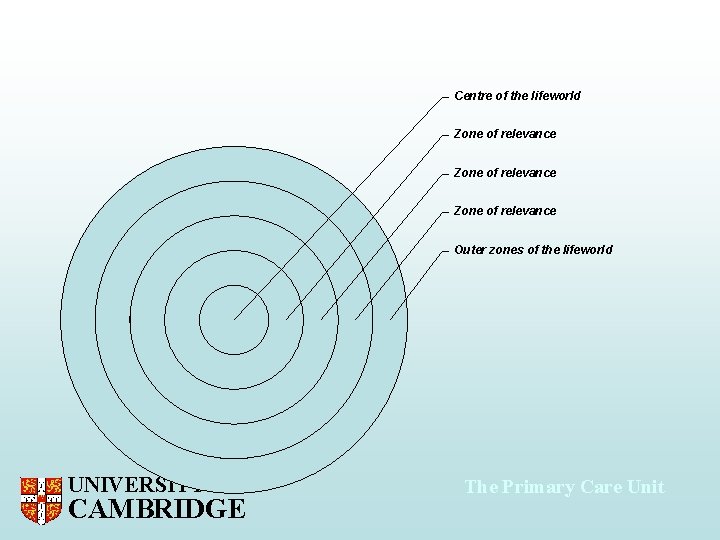
Centre of the lifeworld Zone of relevance Outer zones of the lifeworld UNIVERSITY OF CAMBRIDGE The Primary Care Unit
UNIVERSITY OF CAMBRIDGE The Primary Care Unit
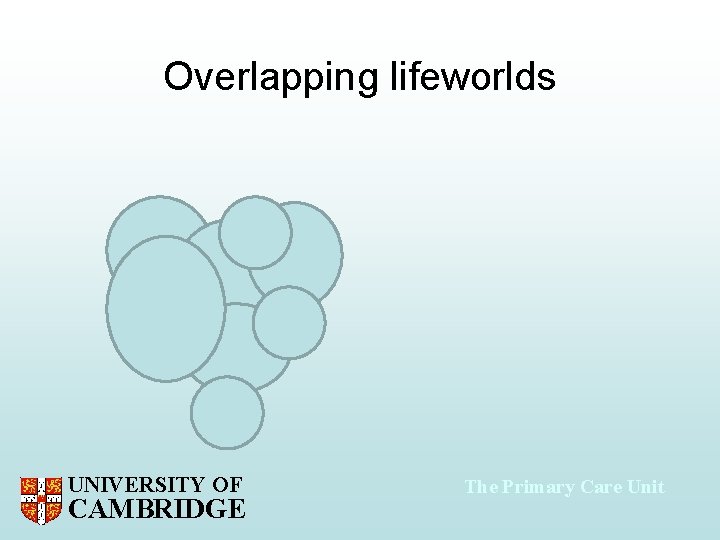
Overlapping lifeworlds UNIVERSITY OF CAMBRIDGE The Primary Care Unit
Coping in the life world • Technical skills. • Interpersonal relationships. • Feelings, emotions. • Making it make sense. UNIVERSITY OF CAMBRIDGE The Primary Care Unit
Capabilities • Sen, A. (2009) The Idea of Justice, London: Allen Lane UNIVERSITY OF CAMBRIDGE The Primary Care Unit
• Justice is not about finding or describing the perfectly just society. • Justice is about behaviour and relationships between people it is about behaviour. • The capability approach emphasises a person’s capability to do things he or she has reason to value. • The focus here is on the freedom that a person actually has to do this or be that – things that he or she may value doing or being. • It is about the opportunities for living, not just existing. . UNIVERSITY OF CAMBRIDGE The Primary Care Unit
• We don’t want you to be a different person, or a perfect person, but there are things you can do which will help you realise your capabilities. UNIVERSITY OF CAMBRIDGE The Primary Care Unit
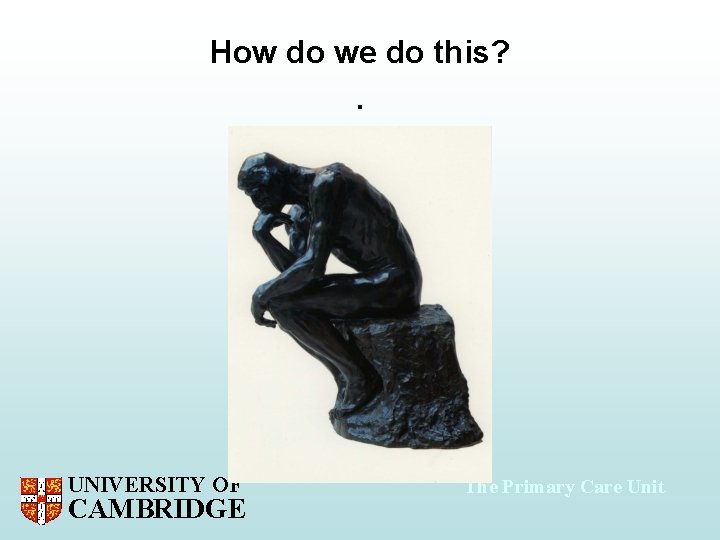
How do we do this? . UNIVERSITY OF CAMBRIDGE The Primary Care Unit
UNIVERSITY OF CAMBRIDGE The Primary Care Unit
UNIVERSITY OF CAMBRIDGE The Primary Care Unit
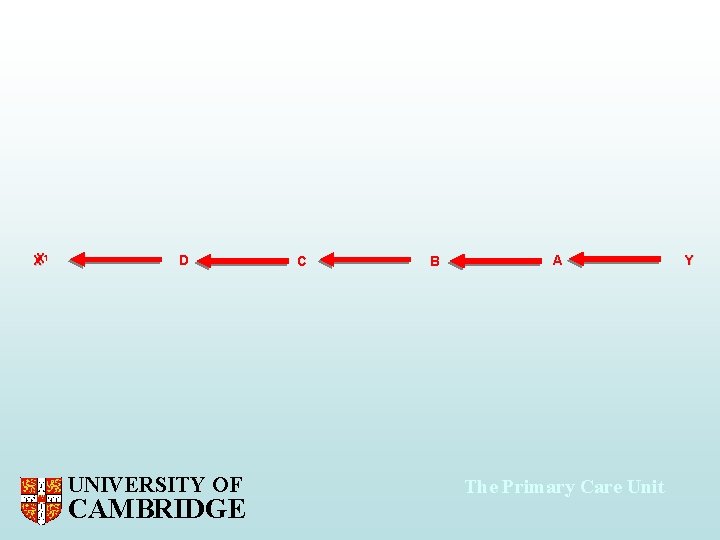
XX 1 D UNIVERSITY OF CAMBRIDGE C B A The Primary Care Unit Y
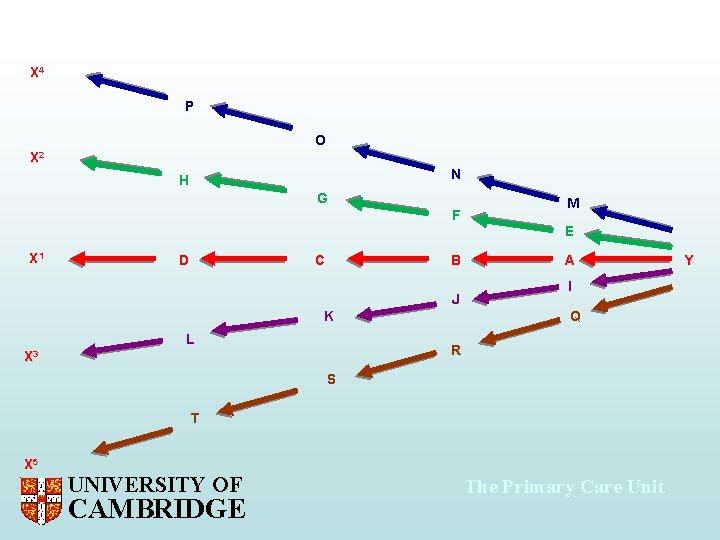
X 4 P O X 2 X N H G F M E X 1 D C B J K L A I Q R X 3 S T X 5 UNIVERSITY OF CAMBRIDGE The Primary Care Unit Y
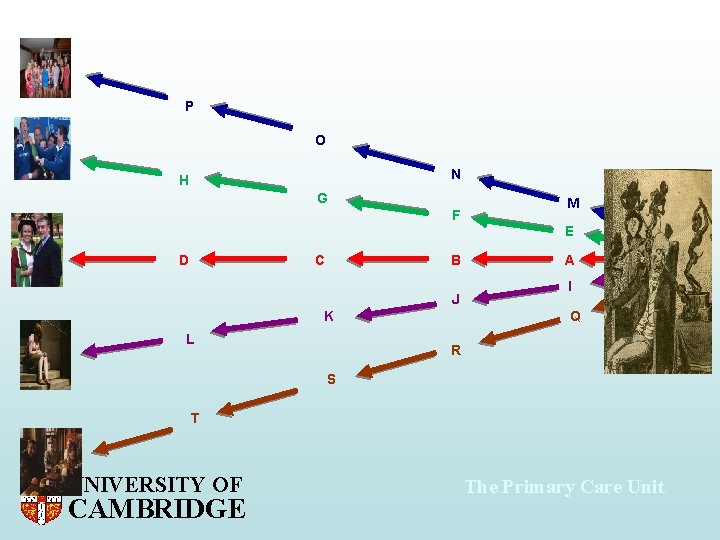
4 P O N H G F M E X 1 D C B J K L A I Q R X 3 S T X 5 UNIVERSITY OF CAMBRIDGE The Primary Care Unit Y
Delivering public health improvement using the evidence UNIVERSITY OF CAMBRIDGE The Primary Care Unit
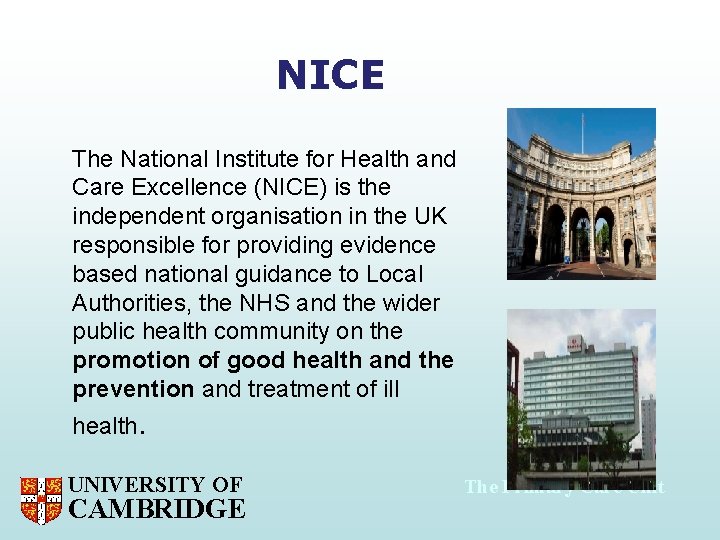
NICE The National Institute for Health and Care Excellence (NICE) is the independent organisation in the UK responsible for providing evidence based national guidance to Local Authorities, the NHS and the wider public health community on the promotion of good health and the prevention and treatment of ill health. UNIVERSITY OF CAMBRIDGE The Primary Care Unit
The legacy of Archie Cochrane Effectiveness and Efficiency (1972) UNIVERSITY OF CAMBRIDGE The Primary Care Unit
• Do we know whether intervention x for public health problem y is effective? • How do we know it is effective? • How do we know whether it is more or less effective than intervention z? • On what basis do we make that judgement of effectiveness? • Do we know what it costs? And is it cost effective? • If it is not cost effective, why is it still being used? • What are the dangers posed to the public of interventions and actions about which we are scientifically uncertain? • Are the interventions dangerous? Why are we using potentially dangerous or worthless interventions? UNIVERSITY OF CAMBRIDGE The Primary Care Unit
The implementation gap UNIVERSITY OF CAMBRIDGE The Primary Care Unit
• There is an extensive evidence base about what works and about what is cost effective. • The failure of the last two decades has been not to implement that which is known in favour of doing gimmicks, bright ideas, common sense, rolling out pilots, vision statements, etc. UNIVERSITY OF CAMBRIDGE The Primary Care Unit
Some evidence to policy successes • • The breathalyser and drink driving legislation Seat belt legislation The smoking ban The response to HIV AIDs UNIVERSITY OF CAMBRIDGE The Primary Care Unit
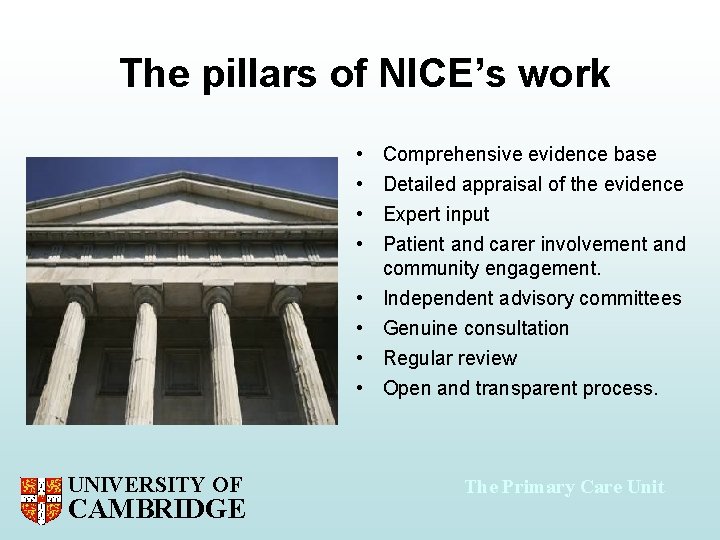
The pillars of NICE’s work • • UNIVERSITY OF CAMBRIDGE Comprehensive evidence base Detailed appraisal of the evidence Expert input Patient and carer involvement and community engagement. Independent advisory committees Genuine consultation Regular review Open and transparent process. The Primary Care Unit
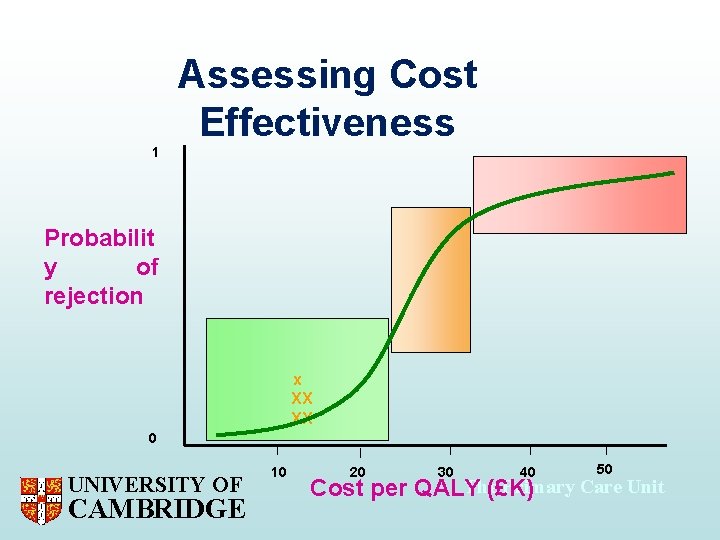
Assessing Cost Effectiveness 1 Probabilit y of rejection x XX XX 0 UNIVERSITY OF CAMBRIDGE 10 20 30 40 50 The(£K) Primary Care Unit Cost per QALY
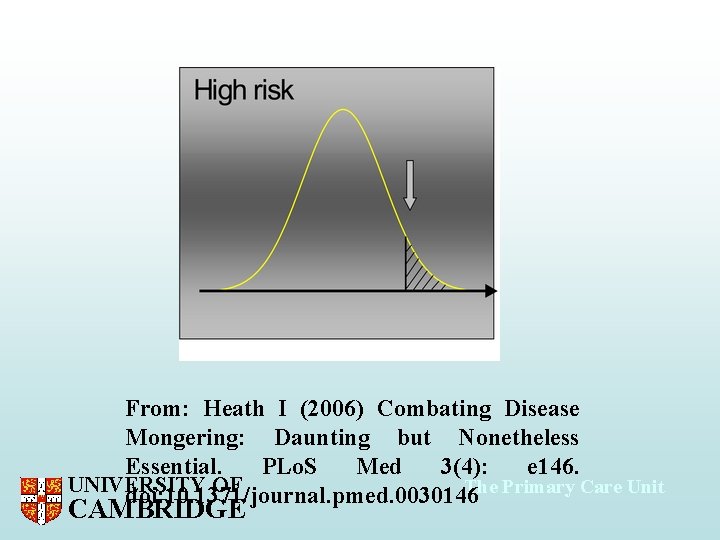
From: Heath I (2006) Combating Disease Mongering: Daunting but Nonetheless Essential. PLo. S Med 3(4): e 146. UNIVERSITY OF The Primary Care Unit doi: 10. 1371/journal. pmed. 0030146 CAMBRIDGE
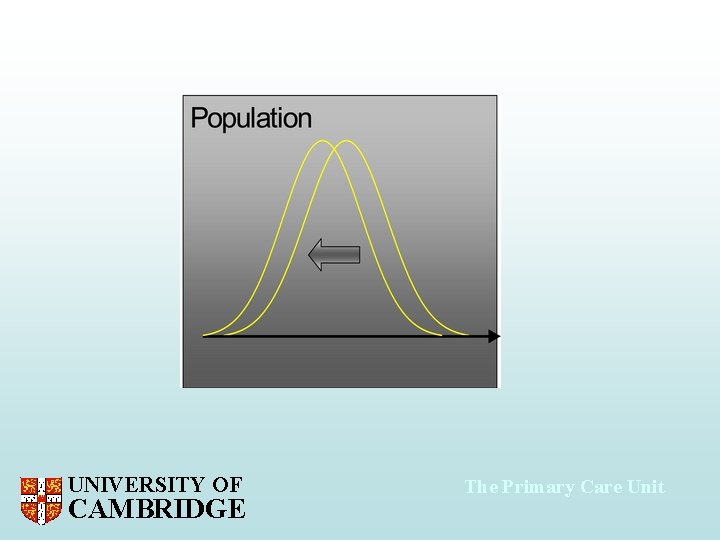
UNIVERSITY OF CAMBRIDGE The Primary Care Unit
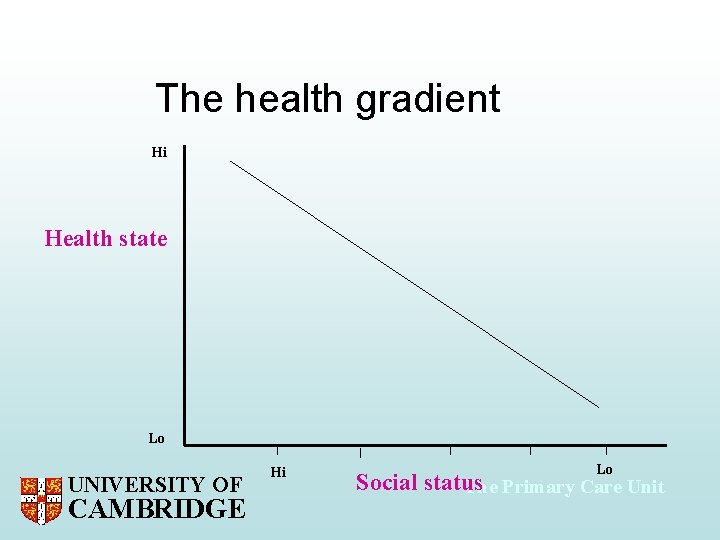
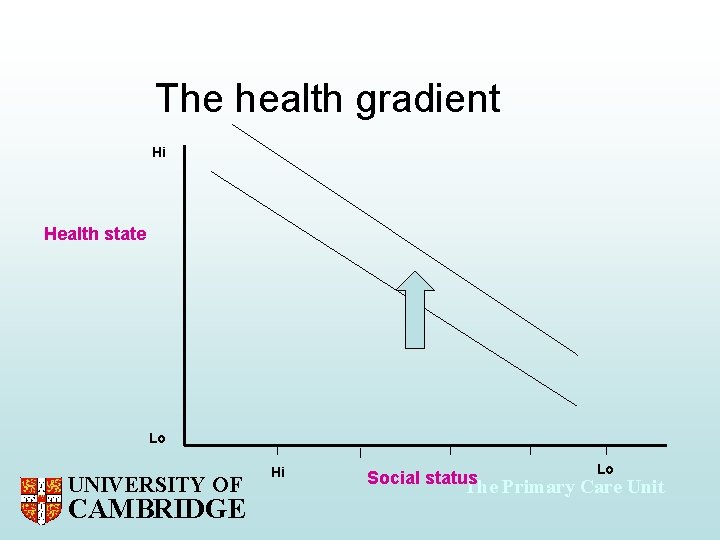
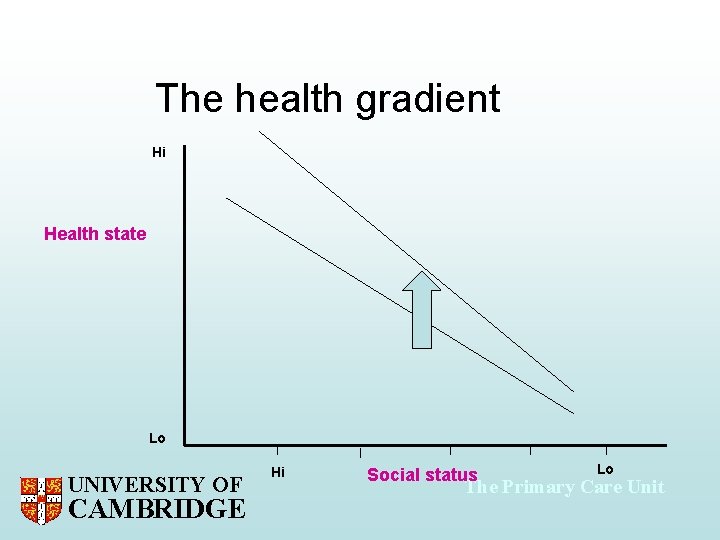
The health gradient Hi Health state Lo UNIVERSITY OF CAMBRIDGE Hi Lo Social status The Primary Care Unit
The health gradient Hi Health state Lo UNIVERSITY OF CAMBRIDGE Hi Lo Social status The Primary Care Unit
The health gradient Hi Health state Lo UNIVERSITY OF CAMBRIDGE Hi Social status Lo The Primary Care Unit
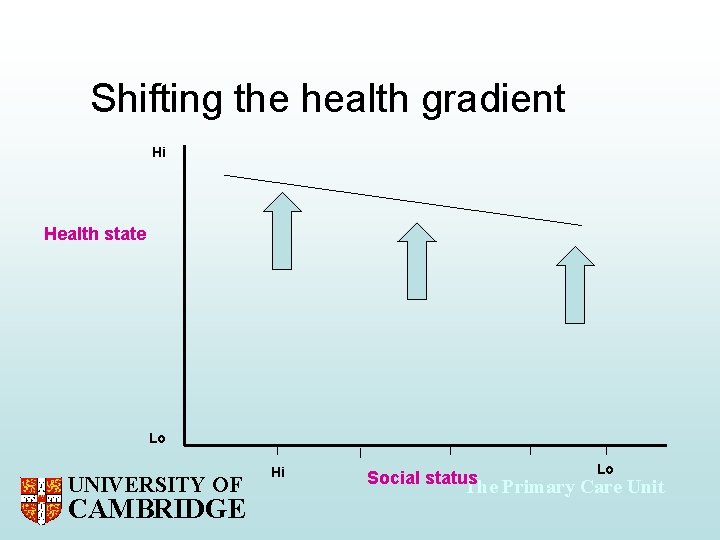
Shifting the health gradient Hi Health state Lo UNIVERSITY OF CAMBRIDGE Hi Lo Social status The Primary Care Unit
Social Practice. UNIVERSITY OF CAMBRIDGE The Primary Care Unit
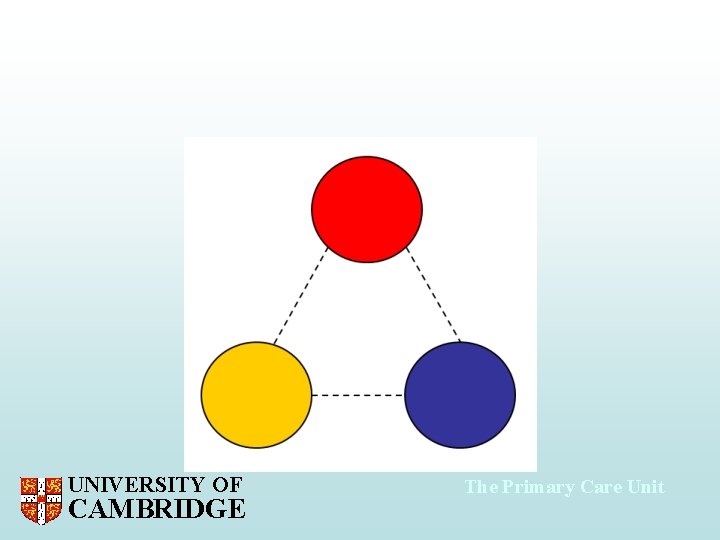
• materials (objects, consumer goods, infrastructures); • competence (including understandings of the situation; practical know-how) • meanings (including embodied understandings of the social significance of the practice; past experiences of participation etc. ). UNIVERSITY OF CAMBRIDGE The Primary Care Unit
UNIVERSITY OF CAMBRIDGE The Primary Care Unit
• Agency and structure. • Knowledgeable social actors. • The recursive nature of social life. • Typifications. Giddens A (1984) The Constitution of Society: Outline of the Theory of Structuration. Cambridge: Polity. UNIVERSITY OF CAMBRIDGE The Primary Care Unit