
Agribusiness in relation to the six national industry
Agribusiness in relation to the six national industry clusters Roehlano M Briones, Ph. D. Senior Research Fellow, Philippine Institute for Development Studies Presented at: 13 th National Convention on Statistics, EDSA Shangri-La Hotel, Mandaluyong City October 3, 2016 Philippine Institute for Development Studies Surian sa mga Pag-aaral Pangkaunlaran ng Pilipinas www. pids. gov. ph 1
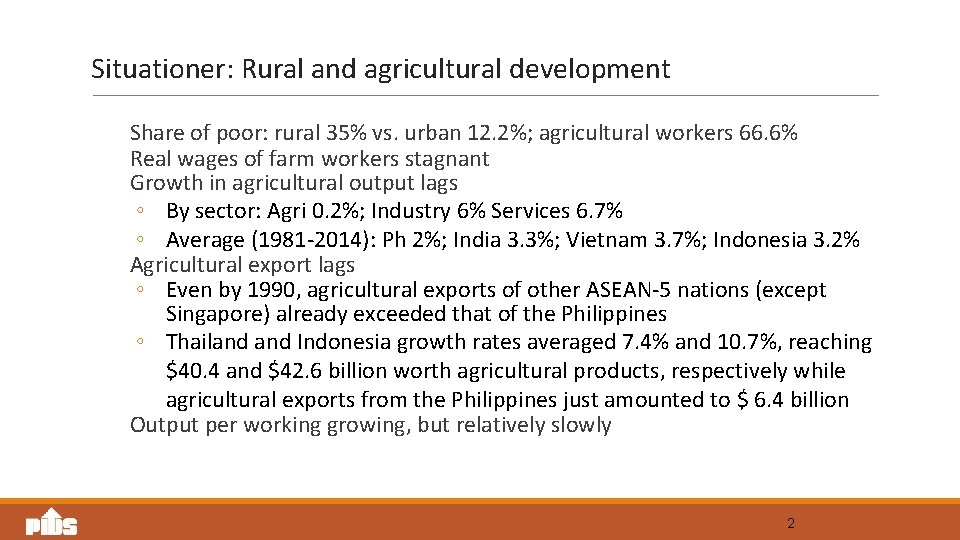
Situationer: Rural and agricultural development Share of poor: rural 35% vs. urban 12. 2%; agricultural workers 66. 6% Real wages of farm workers stagnant Growth in agricultural output lags ◦ By sector: Agri 0. 2%; Industry 6% Services 6. 7% ◦ Average (1981 -2014): Ph 2%; India 3. 3%; Vietnam 3. 7%; Indonesia 3. 2% Agricultural export lags ◦ Even by 1990, agricultural exports of other ASEAN-5 nations (except Singapore) already exceeded that of the Philippines ◦ Thailand Indonesia growth rates averaged 7. 4% and 10. 7%, reaching $40. 4 and $42. 6 billion worth agricultural products, respectively while agricultural exports from the Philippines just amounted to $ 6. 4 billion Output per working growing, but relatively slowly 2
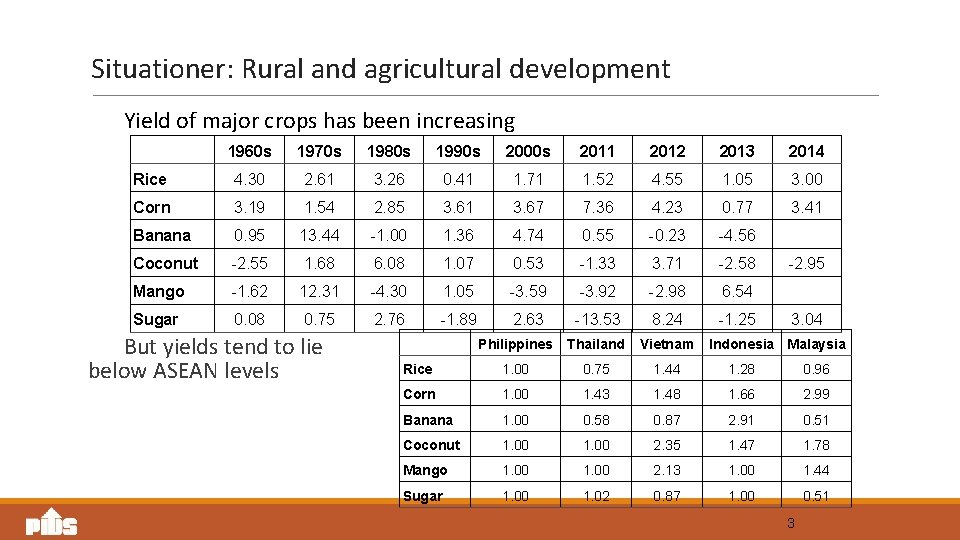
Situationer: Rural and agricultural development Yield of major crops has been increasing 1960 s 1970 s 1980 s 1990 s 2000 s 2011 2012 2013 2014 Rice 4. 30 2. 61 3. 26 0. 41 1. 71 1. 52 4. 55 1. 05 3. 00 Corn 3. 19 1. 54 2. 85 3. 61 3. 67 7. 36 4. 23 0. 77 3. 41 Banana 0. 95 13. 44 -1. 00 1. 36 4. 74 0. 55 -0. 23 -4. 56 Coconut -2. 55 1. 68 6. 08 1. 07 0. 53 -1. 33 3. 71 -2. 58 Mango -1. 62 12. 31 -4. 30 1. 05 -3. 59 -3. 92 -2. 98 6. 54 Sugar 0. 08 0. 75 2. 76 -1. 89 2. 63 -13. 53 8. 24 -1. 25 Philippines Thailand Vietnam Rice 1. 00 0. 75 1. 44 1. 28 0. 96 Corn 1. 00 1. 43 1. 48 1. 66 2. 99 Banana 1. 00 0. 58 0. 87 2. 91 0. 51 Coconut 1. 00 2. 35 1. 47 1. 78 Mango 1. 00 2. 13 1. 00 1. 44 Sugar 1. 00 1. 02 0. 87 1. 00 0. 51 But yields tend to lie below ASEAN levels -2. 95 3. 04 Indonesia Malaysia 3

Agricultural productivity → Agribusiness • Agricultural development is more than increased farm yield: agribusiness value chain and based on comparative advantage. • In developing Asia, change in agricultural output occurred within broader diversification – agribusiness transition • “agribusiness” – agriculture plus closely-linked sectors (forward and backward linkages) • World Bank (2009) reports shares of agribusiness in GDP for Indonesia and Thailand of 33% and 43%, respectively. For the Philippines, it is only 15% (Balisacan et al, 2011) + 10% • Rationale for industrial policy can be extended to agribusiness support. 4
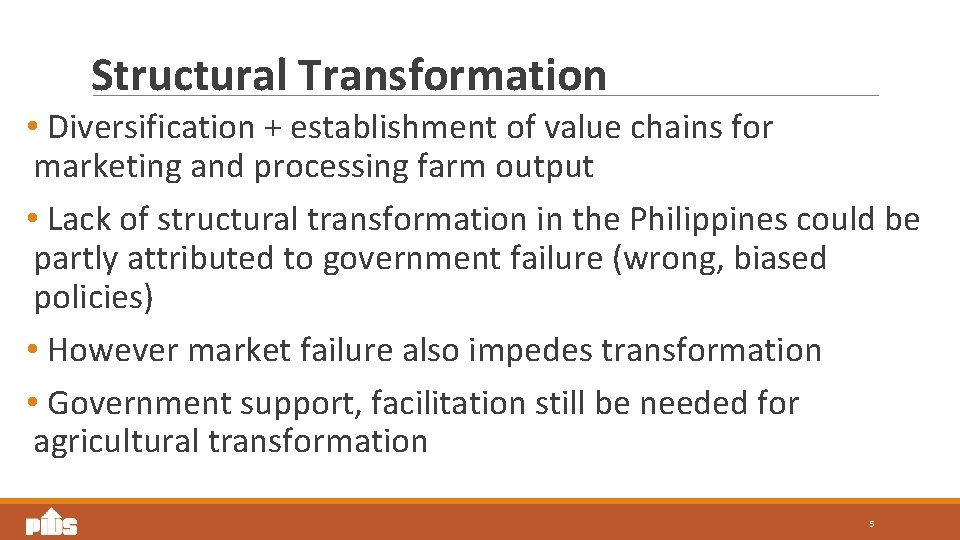
Structural Transformation • Diversification + establishment of value chains for marketing and processing farm output • Lack of structural transformation in the Philippines could be partly attributed to government failure (wrong, biased policies) • However market failure also impedes transformation • Government support, facilitation still be needed for agricultural transformation 5
Opportunities High global market demand for export-oriented crops: • For mango, outlook is favorable: high world demand, rising export prices • For carrageenan, market opportunities appear to be favorable: increasing demand for food and health, pharmaceuticals and beauty products • For cacao, local supply of cocoa products relative to demand is quite low. Cocoa Phil. estimates 30, 000 tons of cacao in dry bean equivalent is needed for local demand. 6
Constraints Vertical: • Supply chain and coordination issues ◦Small farmers lack of access to technologies, technical knowledge, quality inputs, financing: unable to supply requirements of processors ◦Highly perishable products such as fruits require well developed logistics, transport, and marketing services Horizontal: • Inadequate investment in public goods ◦ ◦ R&D provision has been insufficient allocation to major commodities and high value added products undersupply of proper management of common pool resources rural infrastructure backlog 7
Constraints: Horizontal Weak regulatory and certification system • Poor quality of regulatory services. Examples: ◦ Rubber: lack of standards on rubber grades broke the link from rubber growers to local manufacturers ◦ Shrimp: failure to comply with BFAR biosecurity procedures led to uncredited hatcheries and grow out farms Issues on compliance: ◦ Cacao processors need certification of Good Manufacturing Practice (GMP) in order to export; this could be especially difficult for small processors who lack funds to invest in the needed machines, technology, and certification process. ◦ Enabling MSMEs to achieve food standards may require complementary support such as technical and financial assistance from government. 8
Constraints Defective property rights regime • the security of property rights is dubious, especially uplands • securing a clean title is cumbersome and costly • CARP remains a discouragement to long term investments (e. g. Mango industry) 9
Way forward: Short term agenda Adopt vertical measures: Create a coordination mechanism among stakeholders • Development of a participatory competitiveness working group for agro-industry on a sector-specific basis and at a local level • Objective: lay groundwork for competitiveness strategy embodied in a road map → detailed analysis and prioritization of constraints by importance/urgency 10
Medium term agenda: Vertical and horizontal measures • Increase investments in: R&D, extension systems, irrigation facilities, regulatory systems and transport infrastructure • Other measures: • agribusiness parks • Incentives? - Performance-based allocation for subsidies • Price stabilization schemes? – grades and standards, price information 11
Long term agenda: Horizontal measures • Set up efficient land administration system • Incorporate agribusiness in industrial incentives and zoning scheme • Creation of a regulatory system facilitating business registration and licensing, standards and enforcement, contract compliance • Comprehensive competition policy prohibiting anticompetitive practices 12
Conclusion • The development of the rural economy is still a key factor for achieving inclusive growth • Agricultural development in the Philippine context involves transition from farming to agribusiness • Rural transformation can only be attained through upgrading and restructuring of supply chain to gain competitive advantage in high-value agro-industrial products • Reforms will require multi-stakeholder consultation through the operationalization of agribusiness road maps 13

Philippine Institute for Development Studies Surian sa mga Pag-aaral Pangkaunlaran ng Pilipinas Thank you WEBSITE: www. pids. gov. ph Service through policy research FACEBOOK: facebook. com/PIDS. PH TWITTER: twitter. com/PIDS_PH EMAIL: rbiones@mail. pids. gov. ph 14
- Slides: 14