
NYS Community Development Block Grant Program Program Year
NYS Community Development Block Grant Program _______________ Program Year 2011 Environmental Finance Center Smart Management for Small Communities: Practical Resources for Local Governance Holiday Valley Inn & Conference Center October 6 -7, 2010
New York State Community Development Block Grant Program Develop viable communities by providing decent housing and a suitable living environment, as well as expanding economic opportunities, principally for persons of low- and moderate-income. NYS must ensure that at least 70% of its CDBG grant funds are used for activities that benefit low- and moderate-income persons (at or below 80% of median) and meet one of the National Objectives: § Benefit low- and moderate-income persons or families; or § Aid in the prevention or elimination of slums or blight; or § Meet an urgent community development need 1, 266 eligible communities in New York State
NYS CDBG 2010 Competitive Awards n Amount Requested: $70, 733, 884 n Amount Awarded: $29, 501, 329 n Applications Received: 159 n Applications Awarded: 65
NYS CDBG 2010 Public Infrastructure n Public Sewer Projects n 7 Projects funded at $4, 129, 824 n Total project costs $5, 023, 654 n Leveraged funds $893, 830 n Public Water Projects n 11 Projects funded at $6, 351, 300 n Total project costs $9, 878, 469 n Leveraged funds $3, 527, 169
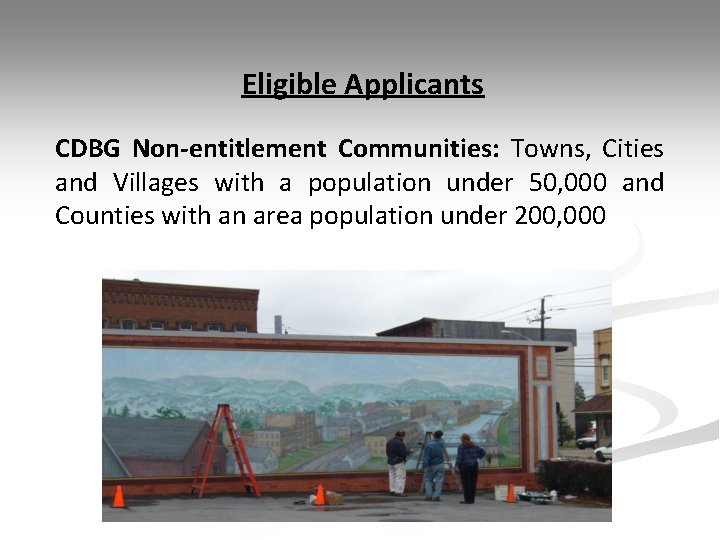
Eligible Applicants CDBG Non-entitlement Communities: Towns, Cities and Villages with a population under 50, 000 and Counties with an area population under 200, 000
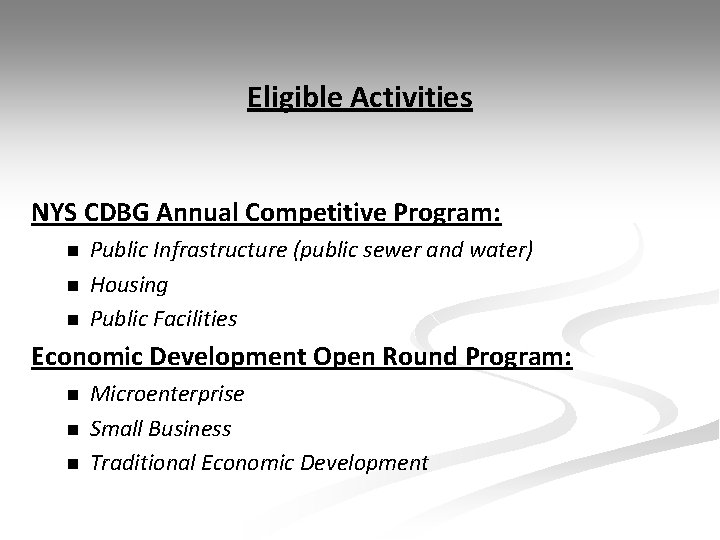
Eligible Activities NYS CDBG Annual Competitive Program: n n n Public Infrastructure (public sewer and water) Housing Public Facilities Economic Development Open Round Program: n n n Microenterprise Small Business Traditional Economic Development
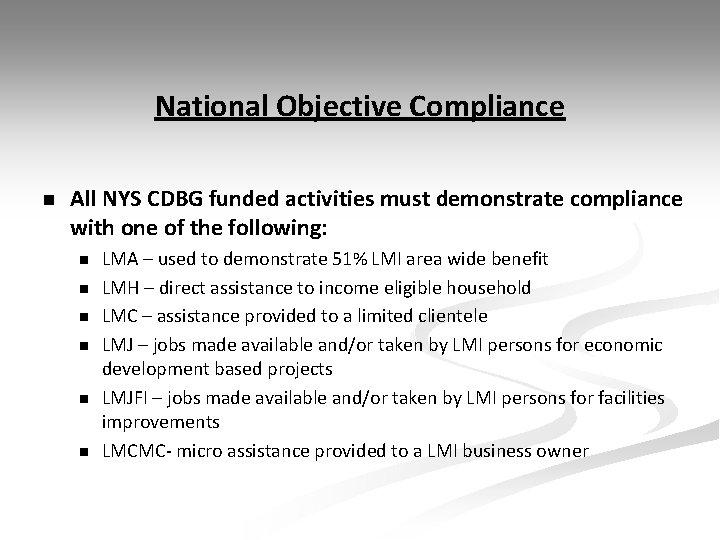
National Objective Compliance n All NYS CDBG funded activities must demonstrate compliance with one of the following: n n n LMA – used to demonstrate 51% LMI area wide benefit LMH – direct assistance to income eligible household LMC – assistance provided to a limited clientele LMJ – jobs made available and/or taken by LMI persons for economic development based projects LMJFI – jobs made available and/or taken by LMI persons for facilities improvements LMCMC- micro assistance provided to a LMI business owner
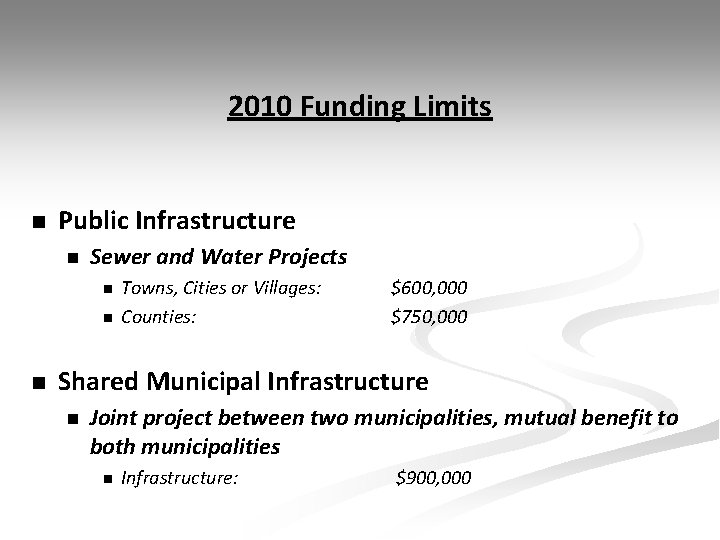
2010 Funding Limits n Public Infrastructure n Sewer and Water Projects n n n Towns, Cities or Villages: Counties: $600, 000 $750, 000 Shared Municipal Infrastructure n Joint project between two municipalities, mutual benefit to both municipalities n Infrastructure: $900, 000
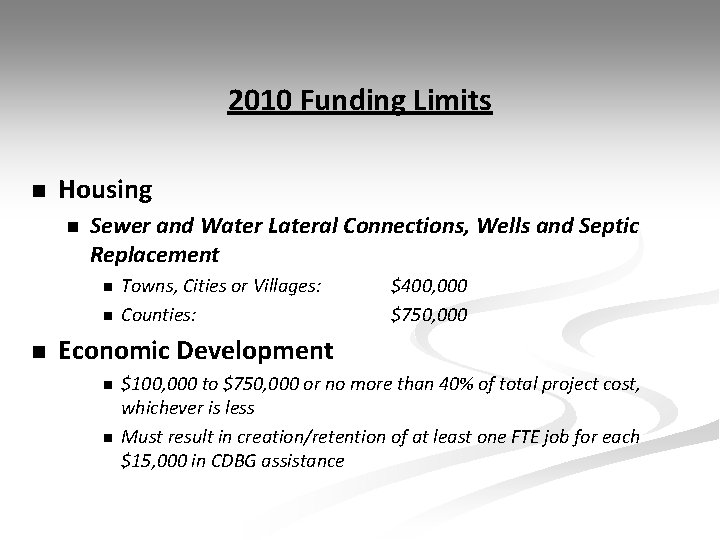
2010 Funding Limits n Housing n Sewer and Water Lateral Connections, Wells and Septic Replacement n n n Towns, Cities or Villages: Counties: $400, 000 $750, 000 Economic Development n n $100, 000 to $750, 000 or no more than 40% of total project cost, whichever is less Must result in creation/retention of at least one FTE job for each $15, 000 in CDBG assistance
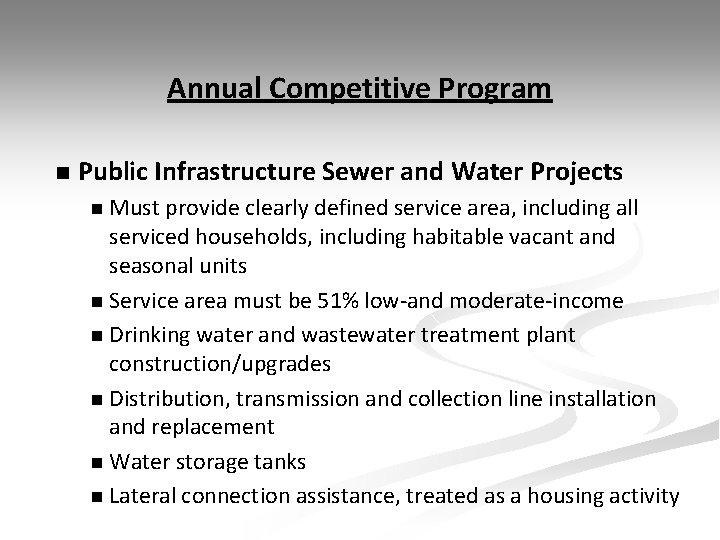
Annual Competitive Program n Public Infrastructure Sewer and Water Projects n Must provide clearly defined service area, including all serviced households, including habitable vacant and seasonal units n Service area must be 51% low-and moderate-income n Drinking water and wastewater treatment plant construction/upgrades n Distribution, transmission and collection line installation and replacement n Water storage tanks n Lateral connection assistance, treated as a housing activity
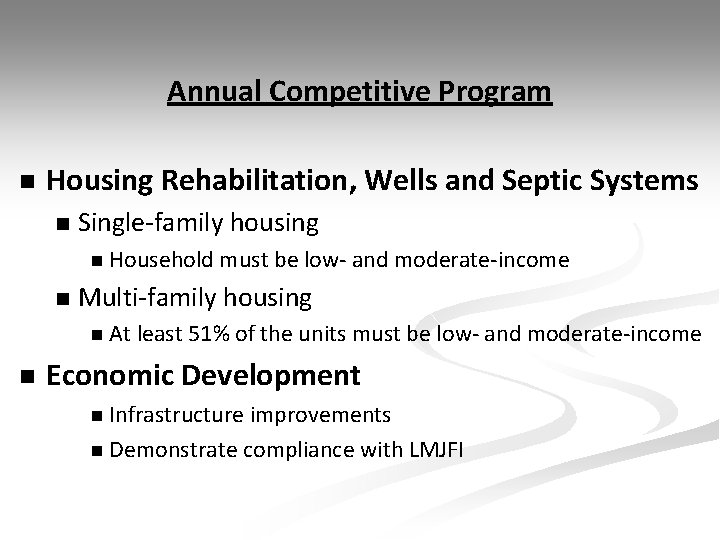
Annual Competitive Program n Housing Rehabilitation, Wells and Septic Systems n Single-family housing n Household n Multi-family housing n At n must be low- and moderate-income least 51% of the units must be low- and moderate-income Economic Development n Infrastructure improvements n Demonstrate compliance with LMJFI
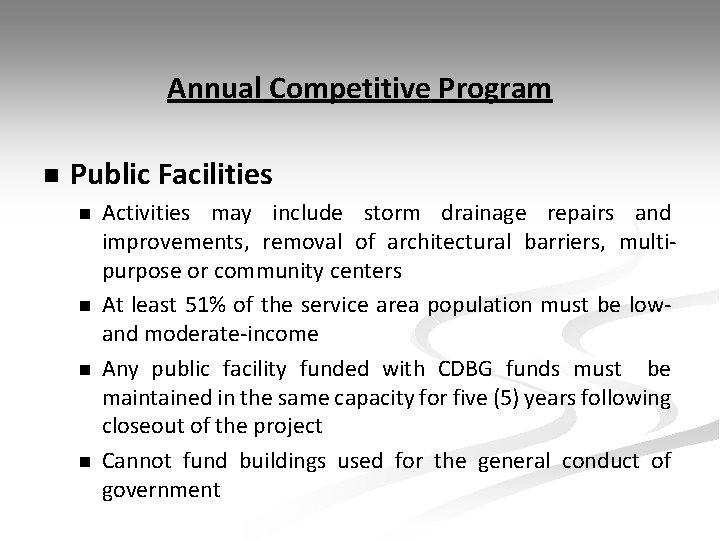
Annual Competitive Program n Public Facilities n n Activities may include storm drainage repairs and improvements, removal of architectural barriers, multipurpose or community centers At least 51% of the service area population must be lowand moderate-income Any public facility funded with CDBG funds must be maintained in the same capacity for five (5) years following closeout of the project Cannot fund buildings used for the general conduct of government
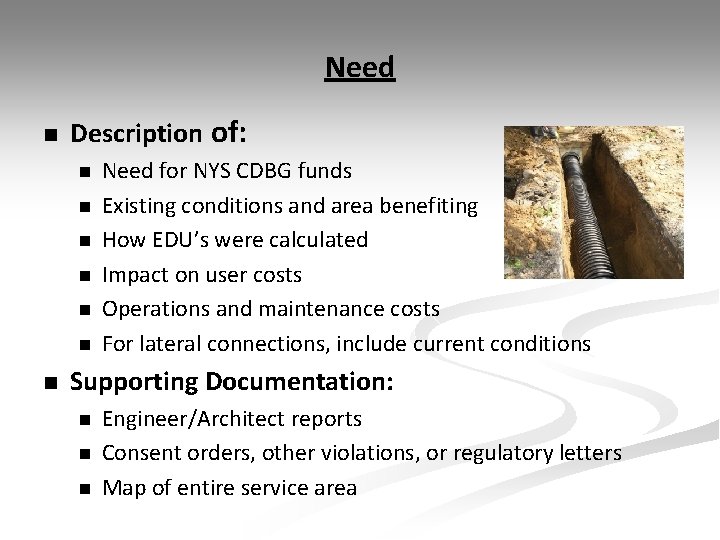
Need n Description of: n n n n Need for NYS CDBG funds Existing conditions and area benefiting How EDU’s were calculated Impact on user costs Operations and maintenance costs For lateral connections, include current conditions Supporting Documentation: n n n Engineer/Architect reports Consent orders, other violations, or regulatory letters Map of entire service area
Project Description n n n Be specific to the project and activities being proposed Should clearly demonstrate that the project will address the identified needs Detailed to provide a complete picture of the project Provide supporting documentation Sustainability Compliance with Smart Growth Legislation enacted on 8/31/2010 For lateral connections, include a brief description
Document National Objective Compliance n Public Water and Sewer and Public Facilities Projects n n LMI Area Benefit Test, at least 51% of the persons benefiting must have incomes at 80% or below the area median income Water and Sewer Lateral Projects n n Direct Benefit Activity Single-family household must be at 80% or less of area median income LMI Multi-family units must have at least 51% of units qualify as LMI or be made available to LMI households Application must demonstrate a sufficient pool of eligible applicants
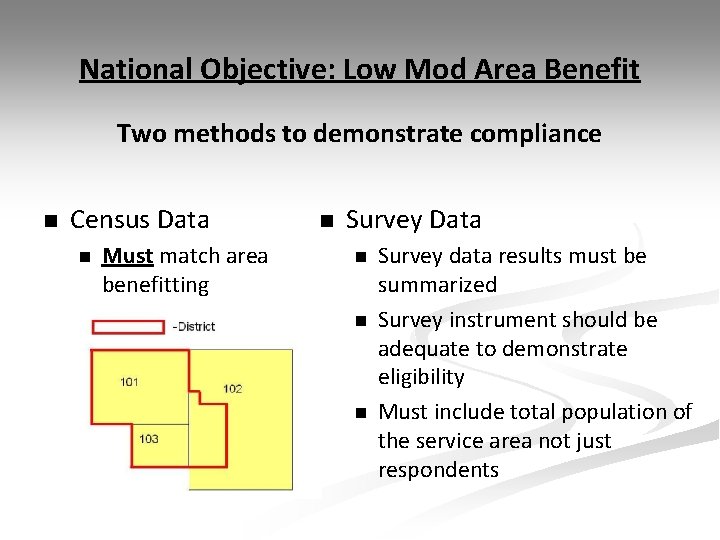
National Objective: Low Mod Area Benefit Two methods to demonstrate compliance n Census Data n Must match area benefitting n Survey Data n n n Survey data results must be summarized Survey instrument should be adequate to demonstrate eligibility Must include total population of the service area not just respondents
Budget n n n Provide budget for entire project Identify all funding sources, committed & projected, such as Rural Development, EFC and local funds Leveraged funds should be available and committed at time of NYS CDBG award Explain any budget gaps that may exist Supporting Documentation n n Up to date Engineer/Architect estimates Ensure prevailing wages were used when preparing estimates If force account labor, evidence of commitment of all resources Cost benefit analysis
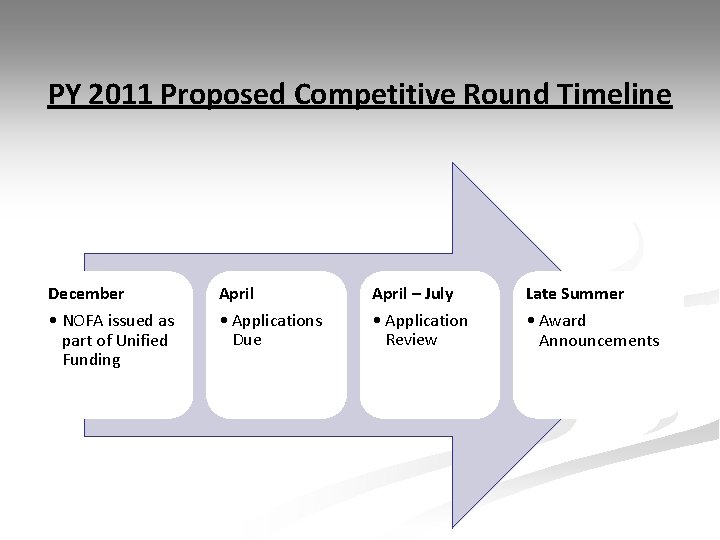
PY 2011 Proposed Competitive Round Timeline December April – July Late Summer • NOFA issued as part of Unified Funding • Applications Due • Application Review • Award Announcements
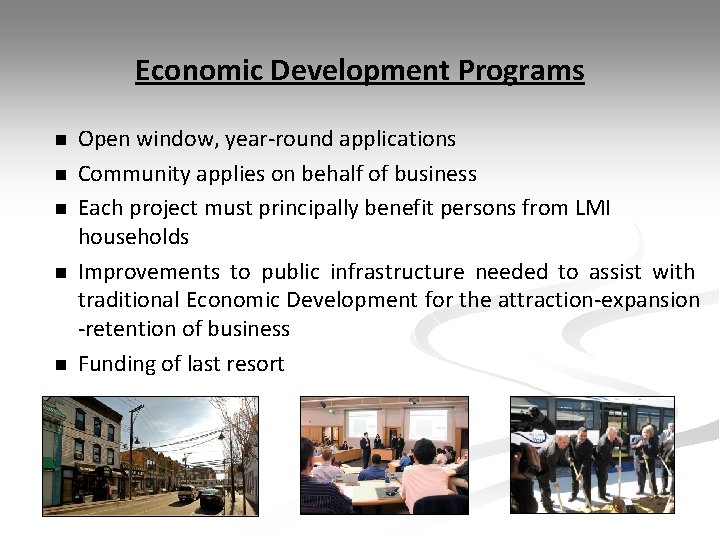
Economic Development Programs n n n Open window, year-round applications Community applies on behalf of business Each project must principally benefit persons from LMI households Improvements to public infrastructure needed to assist with traditional Economic Development for the attraction-expansion -retention of business Funding of last resort
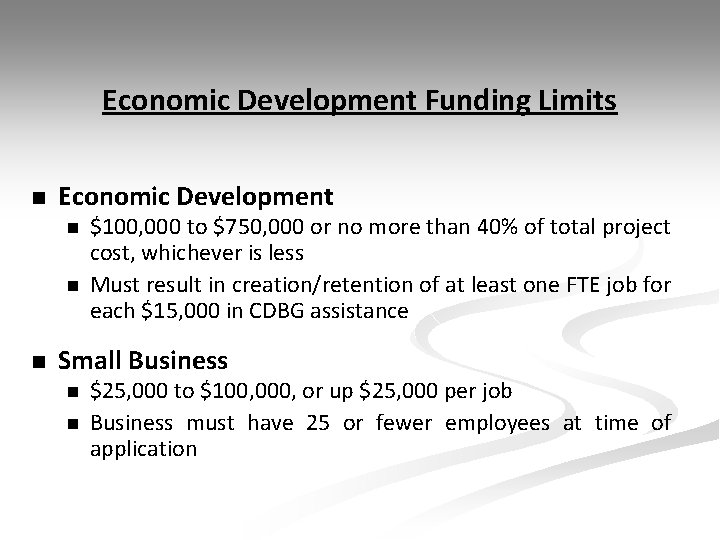
Economic Development Funding Limits n Economic Development n n n $100, 000 to $750, 000 or no more than 40% of total project cost, whichever is less Must result in creation/retention of at least one FTE job for each $15, 000 in CDBG assistance Small Business n n $25, 000 to $100, 000, or up $25, 000 per job Business must have 25 or fewer employees at time of application
Technical Assistance n n n One on One technical assistance (TA) is available at any time TA can be held in the field or our offices CEO or a municipal employee must participate in the technical assistance
Public Infrastructure Contact Information Rob Brooks, Senior Community Developer rbrooks@nyshcr. org Charlie Philion, Community Developer cphilion@nyshcr. org For Economic Development Infrastructure Only: Jessica Henderson, Economic Developer jhenderson@nyshcr. org Office of Community Renewal Hampton Plaza 38 -40 State Street, 9 th Floor Albany, NY 12207 (518) 474 -2057 http: //www. nyshcr. org
Contact Information for all other Programs http: //www. nyshcr. org n New York Main Street Program Karl Gustafson kgustafson@nyshcr. org n NYS Affordable Homeownership Development Program (AHC) Dominic Martello dmartello@nyshcr. org n Neighborhood Stabilization Program (NSP) Brian Segal bsegal@nyshcr. org n Urban Initiatives Pat Doyle pdoyle@nyshcr. org
Contact Information www. nyshcr. org n Rural Area Revitalization Program (RARP) Pat Doyle pdoyle@nyshcr. org n Neighborhood and Rural Preservation Program (N/RPC) William Allen wallen@nyshcr. org n HOME Local Program Administrators Pat Doyle pdoyle@nyshcr. org n Access to Home Pat Doyle pdoyle@nyshcr. org
Contact Information www. nyshcr. org n RESTORE Pat Doyle pdoyle@nyshcr. org n Subprime Foreclosure Prevention Services Program Greg Watson gwatson@nyshcr. org n Sustainable Neighborhoods Demonstration Program (SNDP) Pat Doyle pdoyle@nyshcr. org
- Slides: 28