
ETHIOPIAN MEAT AND DAIRY INDUSTRY DEVELOPMENT INSTITUTE EMDIDI




- Slides: 22
ETHIOPIAN MEAT AND DAIRY INDUSTRY DEVELOPMENT INSTITUTE (EMDIDI) YOGHURT TRAINING FOR TRAINEE/LEARNER NOVEMER, 2018 BISHOFTU, ETHIOPIA Assefa Bezie
Training contents 1. Training objectives 2. definition of yoghurt 3. Health benefits of yoghurt 4. Types of yoghurt 5. Flow diagram of set yoghurt 6. Flow diagrams of stir yoghurt Assefa Bezie
Training objectives v To Understand the concept of yoghurt v. To Identify the benefits of yoghurt v To differentiate the varieties of yoghurt v To Understand the manufacturing of set and stir yoghurt practically Assefa Bezie
1. Yoghurt Definitions yoghourt is a food produced by bacterial fermentation of milk. The bacteria used to make yogurt are known as "yogurt cultures". • Yogurt is a fermented milk product that contains the characteristic bacterial cultures Lactobacillus bulgaricus and Streptococcus thermophilus. • A semi-solid nourish food prepared from milk fermented by added bacteria, often sweetened and flavored. Assefa Bezie
2. Health Benefits of Yogurt 2. 1. It's Rich in Important Nutrients • Yogurt contains some of nearly every nutrient that your body needs. • It's known for containing a lot of calcium, a mineral necessary for healthy teeth and bones. Just one cup provides 49% of your daily calcium needs. • It is also high in B vitamins, particularly vitamin B 12 and riboflavin, both of which may protect against heart disease and certain neural tube birth defects. Assefa Bezie
CONT……… • One cup also provides 38% of your daily need for phosphorus, 12% for magnesium and 18% for potassium. These minerals are essential for several biological processes, such as regulating blood pressure, metabolism and bone health. • One nutrient that yoghurt does not contain naturally is vitamin D, but it is commonly fortified with it. Vitamin D promotes bone and immune system health and may reduce the risk of some diseases, including heart disease and depression. Assefa Bezie
CONT……… 2. 2 It's High in Protein • Yogurt provides an impressive amount of protein, with about 12 grams per 7 ounces (200 grams). • Protein has been shown to support metabolism by increasing your energy expenditure, or the number of calories that you burn throughout the day. • Getting enough protein is also important for appetite regulation, as it increases the production of hormones that signal fullness. It may automatically reduce the number of calories you consume overall, which is beneficial for weight control. Assefa Bezie
CONT…………. 2. 3. Some Varieties May Benefit Digestive Health • Some types of yogurt contain live bacteria, or probiotics, that were either a part of the starter culture or added after pasteurization. • These may benefit digestive health when consumed. • Unfortunately, many yogurts have been pasteurized, which is a heat treatment that kills the beneficial bacteria they contain. • Some types of yogurt contain probiotics, which may boost digestive health by reducing the symptoms of common gastrointestinal disorders, such as bloating, diarrhea and constipation. Assefa Bezie
CONT…… 2. 4. It May Strengthen Your Immune System • Consuming yogurt — especially if it contains probiotics — on a regular basis may strengthen your immune system and reduce your likelihood of contracting an illness. • Probiotics have been shown to reduce inflammation, which is linked to several health conditions ranging from viral infections to gut disorders. • Research shows that in some instances, probiotics may also help reduce the incidence, duration and severity of the common cold. • Yogurt provides probiotics, vitamins and minerals, all of which may boost immune health and prevent certain illnesses Assefa Bezie
CONT… 2. 5. It May Protect Against Osteoporosis • Yogurt contains some key nutrients for maintaining bone health, including calcium, protein, potassium, phosphorus and, sometimes, vitamin D. • All of these vitamins and minerals are especially helpful for preventing osteoporosis, a condition characterized by weakening of the bones. It is common in the elderly. • Individuals with osteoporosis have low bone density and are at a higher risk of bone fractures. • However, research shows that consuming at least three servings of dairy foods, such as yogurt, on a daily basis may help preserve bone mass and strength Assefa Bezie
CONT…. 2. 6. It May Benefit Heart Health • dairy products like yogurt have been shown to help reduce high blood pressure, which is a major risk factor for heart disease. The effects seem to be most prominent in those already diagnosed with high blood pressure 2. 7. It May Promote Weight Management • Yogurt has several properties that may help with weight management. • Yogurt is high in protein, which is very filling, and may improve your diet overall. Both of these aspects help with weight management Assefa Bezie .
3. Types of yoghurt 3. 1) Based on the chemical composition of the product Based on the fat content of yogurt, it can be categorized into three major varieties namely, regular yogurt, low-fat yogurt and non-fat yogurt. Regular yogurt is produced from the full fat milk which should contain at least 3. 25% of milk fat. On the other hand, low-fat yogurt and non-fat yogurt are produced from low fat milk or partially-skim milk, and skim milk respectively Assefa Bezie
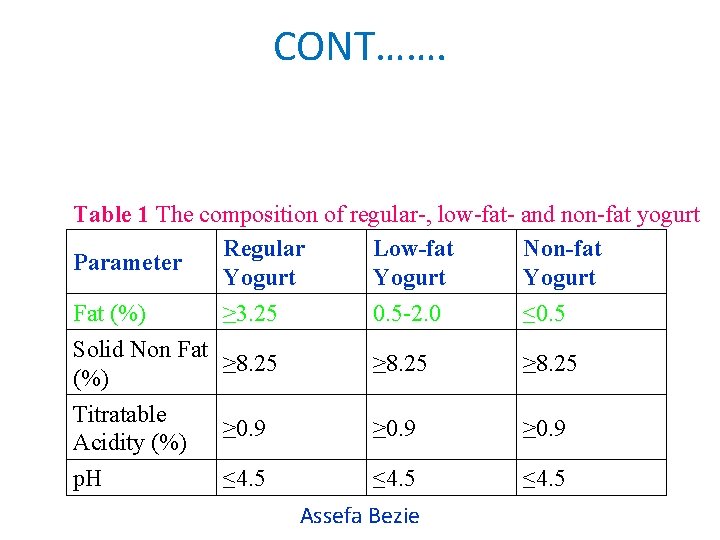
CONT……. Table 1 The composition of regular-, low-fat- and non-fat yogurt Regular Low-fat Non-fat Parameter Yogurt Fat (%) ≥ 3. 25 Solid Non Fat ≥ 8. 25 (%) Titratable Acidity (%) p. H 0. 5 -2. 0 ≤ 0. 5 ≥ 8. 25 ≥ 0. 9 ≤ 4. 5 Assefa Bezie
CONT……. 3. 2) Based on the physical nature of the product The physical nature of yogurt can be solid, semi-solid or fluid. Yogurts that are solid in nature (jelly-like texture) are called as set yogurt that is incubated and cooled in the final packaging. Whereas yogurts which are in semi-solid state and fluid nature called as stirred yogurt and fluid/drinking yogurt, respectively. Stirred yogurts are produced by incubating the mix in a tank followed by breaking by stirring prior to cooling and packaging Assefa Bezie
CONT……. 3. 3 Based on the flavor of the product Addition of flavors would enhance the consumer appeal while produce a variety of products. Flavors can either be added immediately before homogenization or after the homogenization. Yogurts can be categorized into plain-, fruit- and flavored yogurt based on the particular flavor of the yogurt. Assefa Bezie
CONT……. 3. 4 Plain/Natural Yogurt • it can be defined as the plain and unsweetened fermented milk product containing no added color or any other additives • Therefore, it is closer to the nutritional value of milk which it is made of, and provides all of the benefits associated with fermentation while supplying fewer amounts of calories. • Moreover, plain yogurt gives the pure yogurt taste and contains the richest calcium content among Assefa Bezie the yogurt products
CONT……. 3. 5 Flavored Yogurt • Yogurts are available in a vast array of flavors including fruit (apple, apricot, black cherry, black currant, blue berry, lemon, mandarin, raspberry, strawberry, peach), cereal, vegetables, chocolate, vanilla, caramel, ginger, etc. • In general, flavors are added to yogurt during production stage and the addition of flavors not only results a wide array of tastes, but also increase sweetness Assefa Bezie of the product
Homogenization Why Milk is going to Homogenize? The main Purpose of Homogenization are : v To reduce the average diameter of the fat globules v To improve the texture/viscosity of the final product Assefa Bezie
Assefa Bezie
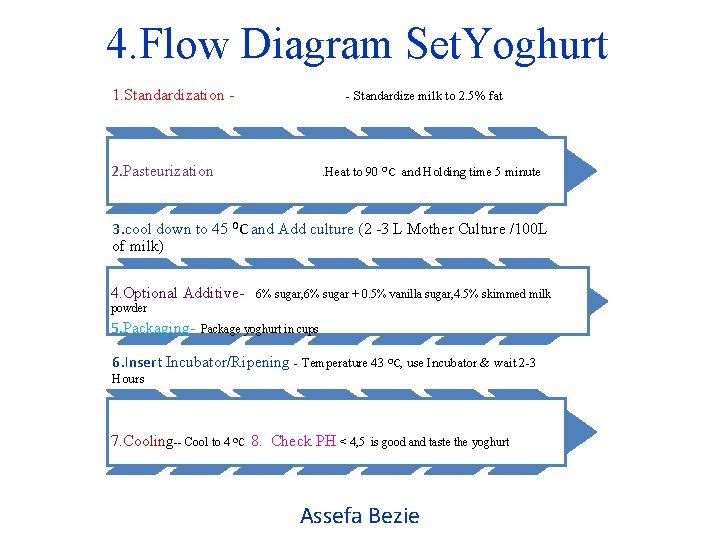
4. Flow Diagram Set. Yoghurt 1. Standardization - - Standardize milk to 2. 5% fat 2. Pasteurization . Heat to 90 OC and Holding time 5 minute 3. cool down to 45 OC and Add culture (2 -3 L Mother Culture /100 L of milk) 4. Optional Additive- 6% sugar, 6% sugar + 0. 5% vanilla sugar, 4. 5% skimmed milk powder 5. Packaging- Package yoghurt in cups 6. Insert Incubator/Ripening - Temperature 43 OC, use Incubator & wait 2 -3 Hours 7. Cooling-- Cool to 4 OC 8. Check PH < 4, 5 is good and taste the yoghurt Assefa Bezie
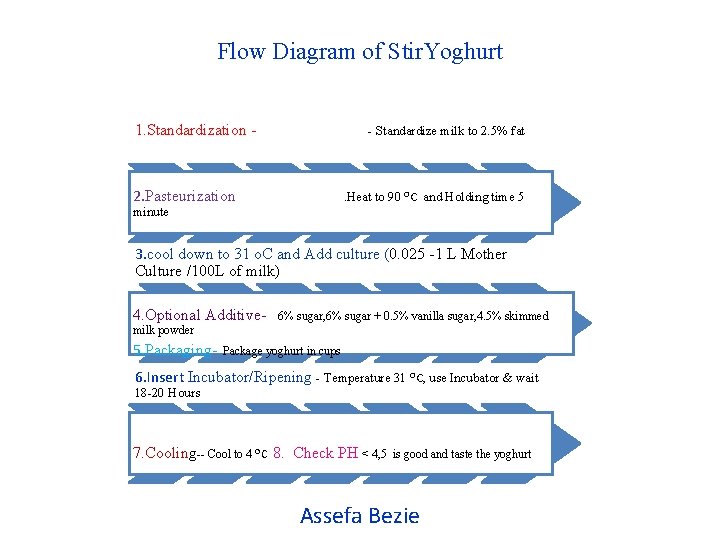
Flow Diagram of Stir. Yoghurt 1. Standardization - - Standardize milk to 2. 5% fat 2. Pasteurization . Heat to 90 OC and Holding time 5 minute 3. cool down to 31 o. C and Add culture (0. 025 -1 L Mother Culture /100 L of milk) 4. Optional Additive- 6% sugar, 6% sugar + 0. 5% vanilla sugar, 4. 5% skimmed milk powder 5. Packaging- Package yoghurt in cups 6. Insert Incubator/Ripening - Temperature 31 OC, use Incubator & wait 18 -20 Hours 7. Cooling-- Cool to 4 OC 8. Check PH < 4, 5 is good and taste the yoghurt Assefa Bezie
Thank You For Your Attention Assefa Bezie