
Approaches to Community Development Bo Beaulieu Southern Rural
Approaches to Community Development Bo Beaulieu Southern Rural Development Center
Defining Community Development A group of people in a community reaching a decision to initiate a social action process (that is, planned intervention) to change their economic, social, cultural, or environmental situation. Christenson and Robinson, 1978
Key Qualities of Community Development It is always purposive -- it has a specific reason for being undertaken Its purpose is always positive -- it represents an effort that citizens believe will improve their lives It exists in the efforts of people and not necessarily in goal achievement. Trying is enough to qualify as community development It is structure-oriented
Development “In” vs. “Of” the Community Development “in” the community is principally concerned with building the economic or physical infrastructure of a community Development “of” the community is focused on building the human capacity to address local issues and concerns. As such, it affects the structure of the community.
Reasons for Community Development Expand participation Reaction against some proposed change in the local area that is deemed as having negative consequences on residents’ quality of life Modify severe social, economic or environmental problems in the community Satisfy missing needs or resources
Three Approaches to Community Development Technical Conflict Assistance Approach Self-Help Approach
Technical Assistance Characteristics Usually involves the delivery of programs of services to a local area by some agency or organization It is often a “top-down” approach that involves the use of experts The focus is mainly on the task to be performed Assumes that answers to community problems can be arrived at scientifically
Technical Assistance Characteristics If residents wish to participate, they must study and understand a great deal of complex information Local citizens are defined as consumers of such development - not participants in it The most frequent employers of the technical assistance model is government
Conflict Approach Primary focus is upon the deliberate use of confrontation by professional organizers The or goal is to redistribute power A major organizing tool is to confront those forces seen as blocking efforts to solve problems In this approach, there is a deep suspicion of those who have formal community power This perspective assumes that power is never given away, that it has to be taken
Self-Help Approach Emphasis is on process -- people within the community working together to arrive at group decisions and taking actions to improve their community Based on the principle that people can collaborate in a community to provide important needs and services The process is more important than any particular task or goal
In the Self-Help Approach. . . We want to institutionalize a process of change based on building community institutions and strengthening community relationships rather than achieve any particular objective
Community vs. Economic Development: Same Things? Community development is much broader than economic development Unlike CD, economic development does not necessarily involve local citizen action, and it may not result in an improvement in the quality of life If economic development is undertaken without much community involvement, than there is no community development Economic development for community development has distinctive features that economic development alone might not have
How Community Development Differs from Economic Development It seeks to increase the resources for people to meet their needs It encourages the development of jobs, services, facilities, and groups that are needed by the whole community It seeks to reduce inequality It provides for and depends upon local community action and involvement
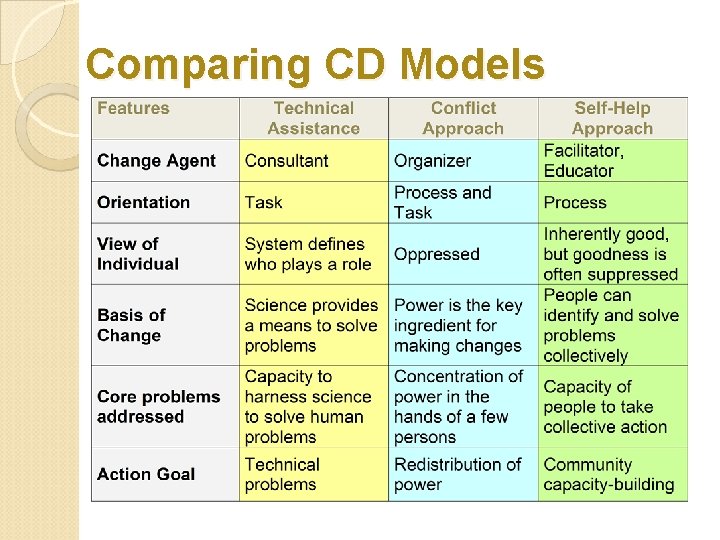
Comparing CD Models
Examples of CD Efforts That Embody the Self-Help Approach Strengthening and expanding the pool of leaders at the local level Enhancing the capacity of local government officials through training Providing needed information to help facilitate sound decision making (such as needs assessment, surveys, socioeconomic data)
Examples of CD Efforts Using Self-Help Approach Community asset mapping or Appreciative Inquiry Conflict Public mediation deliberation or study circles
- Slides: 16