Welding tests and issues Paula Freijedo Thierry Tardy
- Slides: 9
Welding tests and issues Paula Freijedo Thierry Tardy Carlo Zanoni
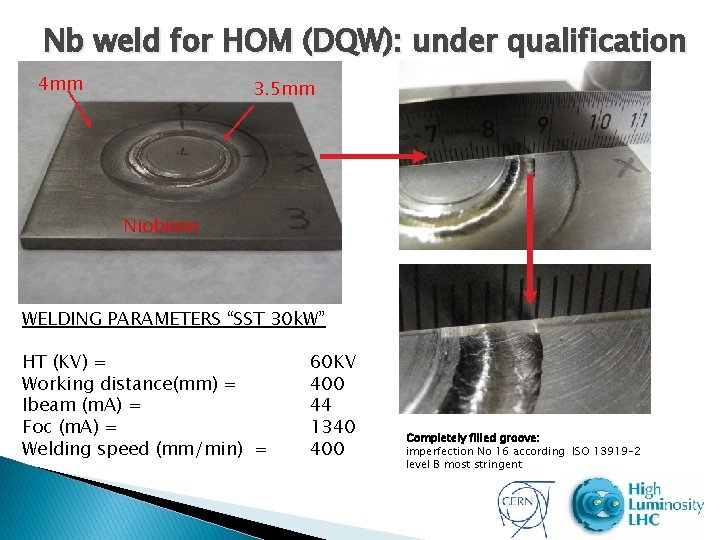
Nb weld for HOM (DQW): under qualification 4 mm 3. 5 mm Niobium WELDING PARAMETERS “SST 30 k. W” HT (KV) = Working distance(mm) = Ibeam (m. A) = Foc (m. A) = Welding speed (mm/min) = 60 KV 400 44 1340 400 Completely filled groove: imperfection No 16 according ISO 13919 -2 level B most stringent
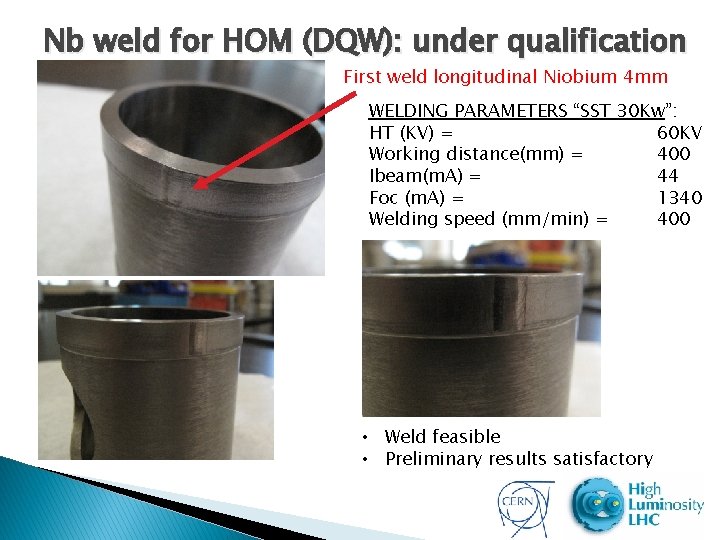
Nb weld for HOM (DQW): under qualification First weld longitudinal Niobium 4 mm WELDING PARAMETERS “SST 30 Kw”: HT (KV) = 60 KV Working distance(mm) = 400 Ibeam(m. A) = 44 Foc (m. A) = 1340 Welding speed (mm/min) = 400 • Weld feasible • Preliminary results satisfactory
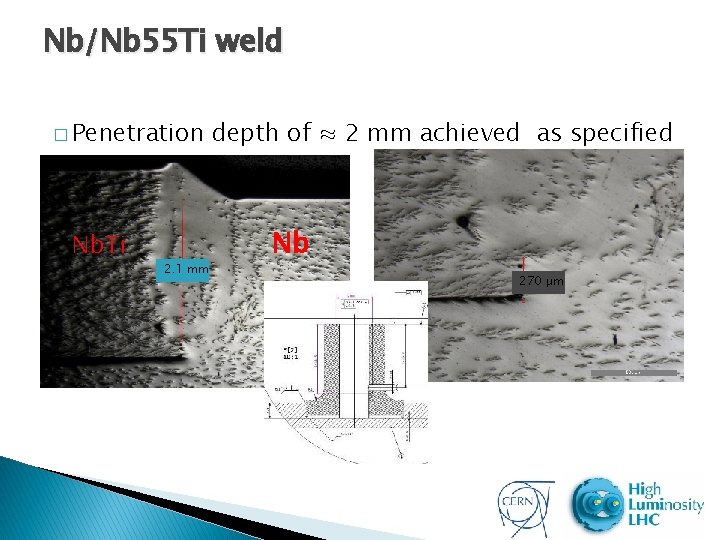
Nb/Nb 55 Ti weld � Penetration Nb. Ti 2. 1 mm depth of ≈ 2 mm achieved as specified Nb 270 µm
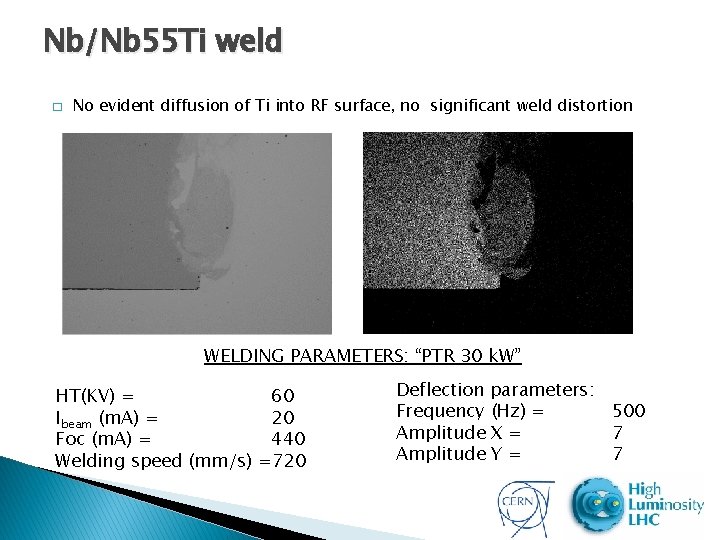
Nb/Nb 55 Ti weld � No evident diffusion of Ti into RF surface, no significant weld distortion WELDING PARAMETERS: “PTR 30 k. W” HT(KV) = 60 Ibeam (m. A) = 20 Foc (m. A) = 440 Welding speed (mm/s) =720 Deflection parameters: Frequency (Hz) = 500 Amplitude X = 7 Amplitude Y = 7
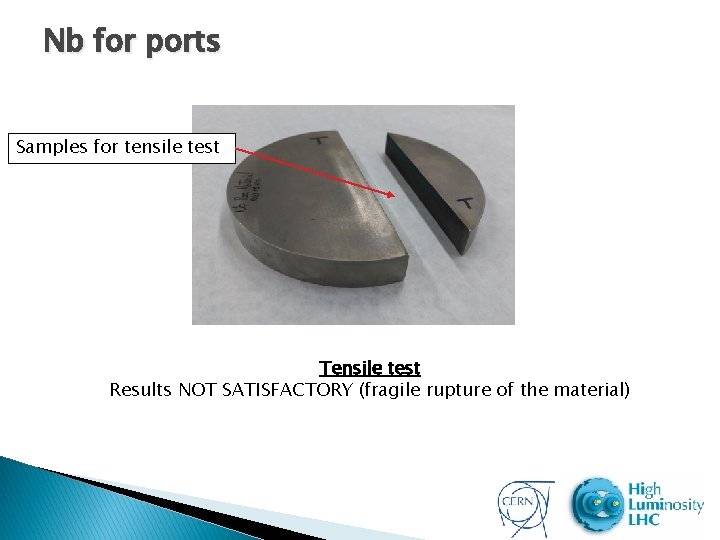
Nb for ports Samples for tensile test Tensile test Results NOT SATISFACTORY (fragile rupture of the material)
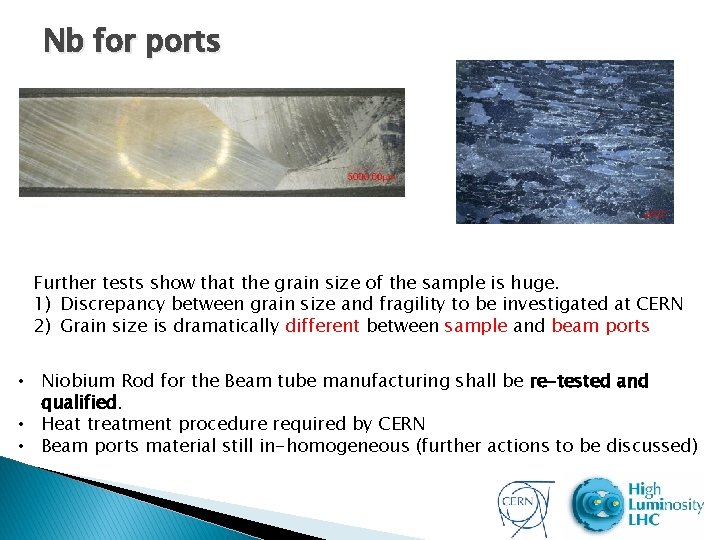
Nb for ports Further tests show that the grain size of the sample is huge. 1) Discrepancy between grain size and fragility to be investigated at CERN 2) Grain size is dramatically different between sample and beam ports • Niobium Rod for the Beam tube manufacturing shall be re-tested and qualified. • Heat treatment procedure required by CERN • Beam ports material still in-homogeneous (further actions to be discussed)
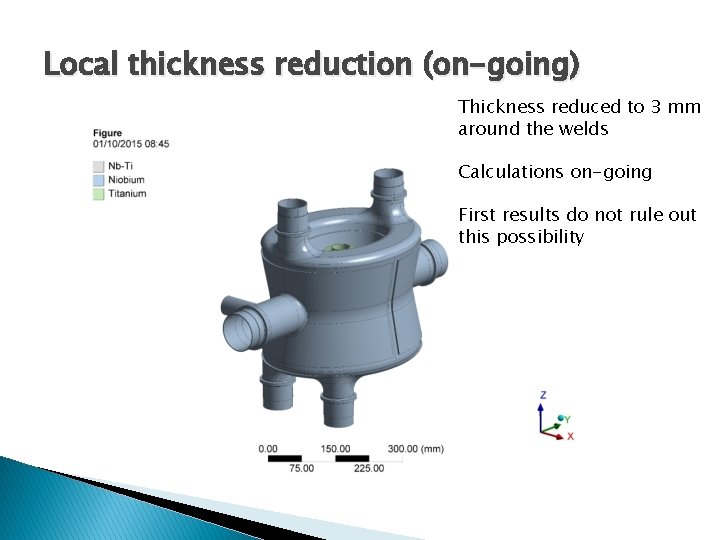
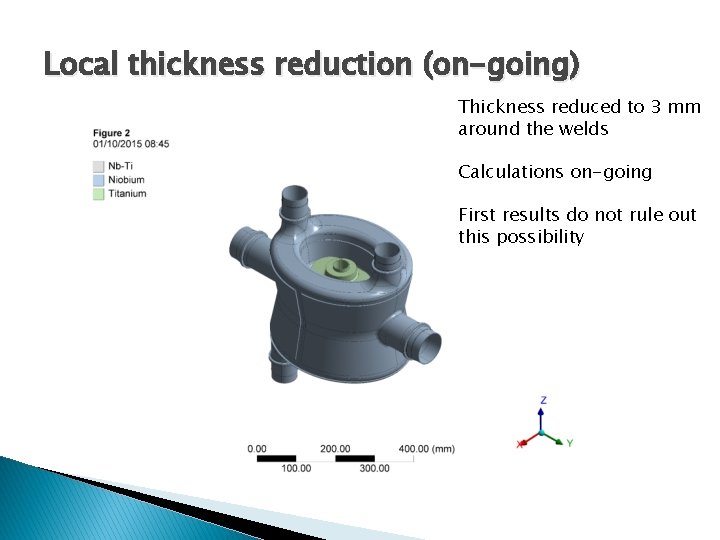
Local thickness reduction (on-going) Thickness reduced to 3 mm around the welds Calculations on-going First results do not rule out this possibility
Local thickness reduction (on-going) Thickness reduced to 3 mm around the welds Calculations on-going First results do not rule out this possibility