DIGNITY THROUGH ACTION WORKSHOP PART 2 The Dignity











- Slides: 32
DIGNITY THROUGH ACTION WORKSHOP PART 2 The Dignity Challenges HASCAS: Dignity through Action
Introduction to the Dignity Government Initiatives q Dignity in Care Campaign aims to stimulate a national debate around dignity in care and create a care system where there is zero tolerance of abuse and disrespect of people. (Launched in November 2006) q It is led by Government in partnership with many organizations. q Lays out the national expectations of what a care service that respects dignity should value Focuses on ten different challenges of dignity. HASCAS: Dignity through Action
Dignity Champions Dignity in Care Campaign - launched in November 2006 A Dignity Champion is someone who believes passionately that being treated with dignity is a basic human right, not an optional extra. They believe that care services must be compassionate, person-centered, as well as efficient, and are willing to try to do something to achieve this (Department of Health website). Dignity Champions are willing to: • Challenge disrespectful behaviour and be good role models. • Speak up about Dignity to improve service delivery. • Influence/inform colleagues. What can you do as a Dignity Champion? • Collaborate with other Dignity Champions. • Obtain promotional materials. • Gain support from the Regional Dignity Lead. • Submit/introduce Dignity Good Practice. HASCAS: Dignity through Action
10 Dignity Challenges (Summary) Respect Support people with same respect you would want for yourself or a member of your family. Abuse Have a zero tolerance of all forms of abuse. Privacy Respect people’s right to privacy. Autonomy Maintain the maximum possible level of independence, choice and control. Person-centered Care Treat each person as an individual by offering a personalised service. Self-esteem Assist people to maintain confidence and a positive selfesteem. Loneliness & Isolation Act to alleviate people’s loneliness and isolation. Communication Listen and support people to express their needs and wants. Complaints Ensure people feel able to complain without fear of retribution. Engaging Care Partners Engage with family members and carers as care partners. HASCAS: Dignity through Action
Dignity Challenges: Overall View HASCAS: Dignity through Action
Dignity Challenges: Overall View HASCAS: Dignity through Action
Dignity Challenges - Respect Support people with the same respect for rights and needs you would want for yourself or family member. Maintaining respect - are you really doing it? q Courtesy and consideration (time is taken to get to know people) Recognition of individuality Personal hygiene needs Cultural needs – spiritual concerns Access to private space Dietary and mobility needs Time to compete tasks q Partnership in decision-making q Encouraging self management of care (where possible) HASCAS: Dignity through Action
Dignity Challenges: Overall View HASCAS: Dignity through Action
Dignity Challenges: Overall View HASCAS: Dignity through Action
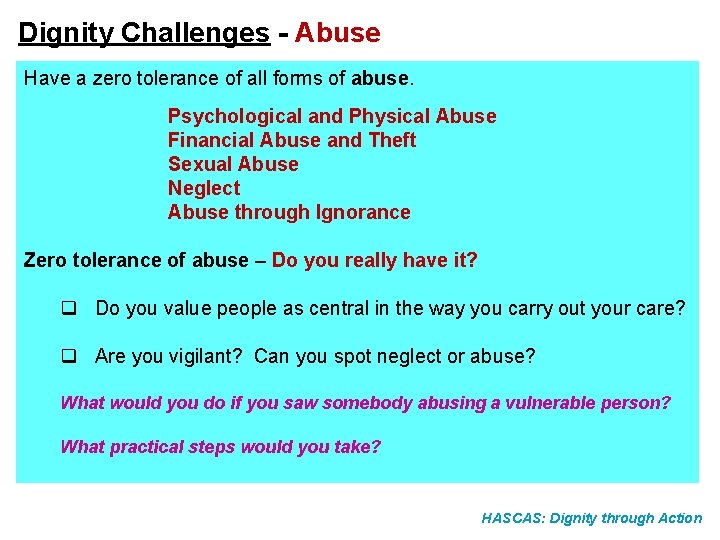
Dignity Challenges - Abuse Have a zero tolerance of all forms of abuse. Psychological and Physical Abuse Financial Abuse and Theft Sexual Abuse Neglect Abuse through Ignorance Zero tolerance of abuse – Do you really have it? q Do you value people as central in the way you carry out your care? q Are you vigilant? Can you spot neglect or abuse? What would you do if you saw somebody abusing a vulnerable person? What practical steps would you take? HASCAS: Dignity through Action
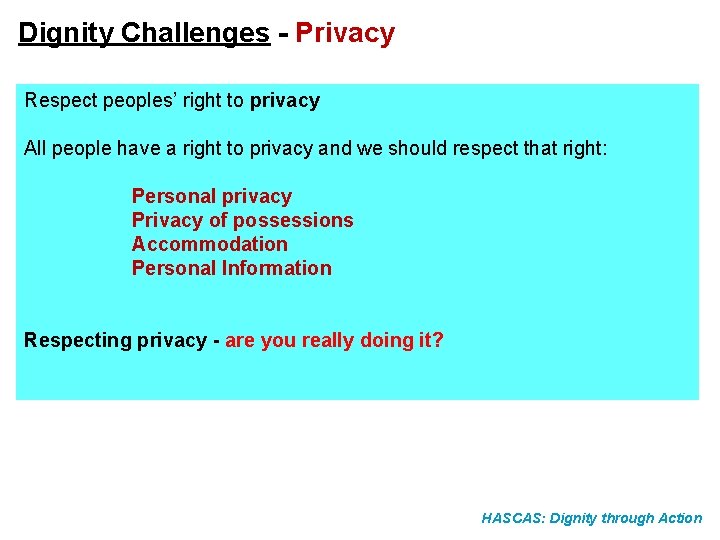
Dignity Challenges - Privacy Respect peoples’ right to privacy All people have a right to privacy and we should respect that right: Personal privacy Privacy of possessions Accommodation Personal Information Respecting privacy - are you really doing it? HASCAS: Dignity through Action
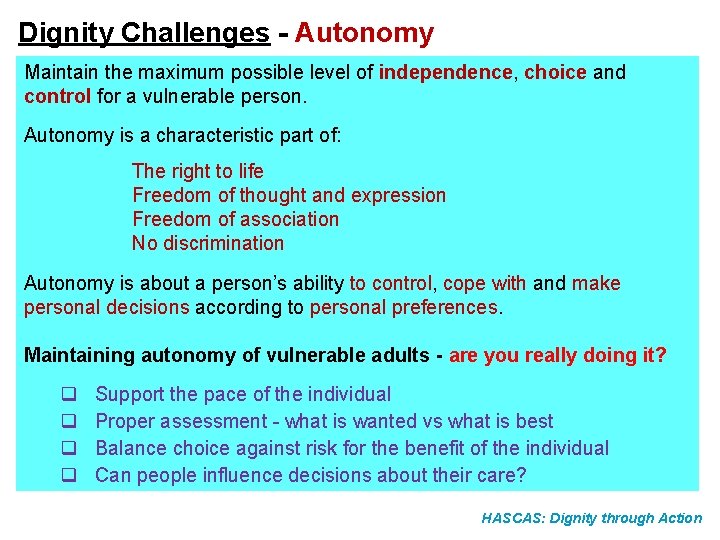
Dignity Challenges - Autonomy Maintain the maximum possible level of independence, choice and control for a vulnerable person. Autonomy is a characteristic part of: The right to life Freedom of thought and expression Freedom of association No discrimination Autonomy is about a person’s ability to control, cope with and make personal decisions according to personal preferences. Maintaining autonomy of vulnerable adults - are you really doing it? q Support the pace of the individual q Proper assessment - what is wanted vs what is best q Balance choice against risk for the benefit of the individual q Can people influence decisions about their care? HASCAS: Dignity through Action
Dignity Challenges – Person Centered Care Treat each person as an individual by offering a personalised service Do your own care practices promote care and support for vulnerable adults as individuals? Individuals have: Physical Needs Cultural Needs Spiritual Needs Psychological Needs Social Needs Personal Preferences Treating people as individuals - are you really doing it? What practical steps could you take tomorrow to help treat each person as an individual by offering personalised services? HASCAS: Dignity through Action
Dignity Challenges: Overall View HASCAS: Dignity through Action
Dignity Challenges: Overall View HASCAS: Dignity through Action
Dignity Challenges – Self-esteem Assist people to maintain confidence and a positive self-esteem q Encourage people to relate to other people. q Conserve social standing even when deterioration takes place. q Develop the self-confidence of people. q Encourage people to believe in themselves. q Encourage people to maintain a dignified appearance. Maintaining peoples’ self-esteem - are you really doing it? HASCAS: Dignity through Action
Dignity Challenges – Loneliness & Isolation Act to ease people’s loneliness and isolation Its a difficult challenge – how do you identify a person is lonely? Be aware of peoples’ loneliness and isolation and attempt to ease the effects be aware of the difference between Loneliness vs. Privacy & Solitude Know and understand the difference! HASCAS: Dignity through Action
Dignity Challenges: Overall View HASCAS: Dignity through Action
Dignity Challenges: Overall View HASCAS: Dignity through Action
Dignity Challenges - Communication Listen and support people to express their needs and wants Communication is a two way process Sound two way communication - are you really doing it? HASCAS: Dignity through Action
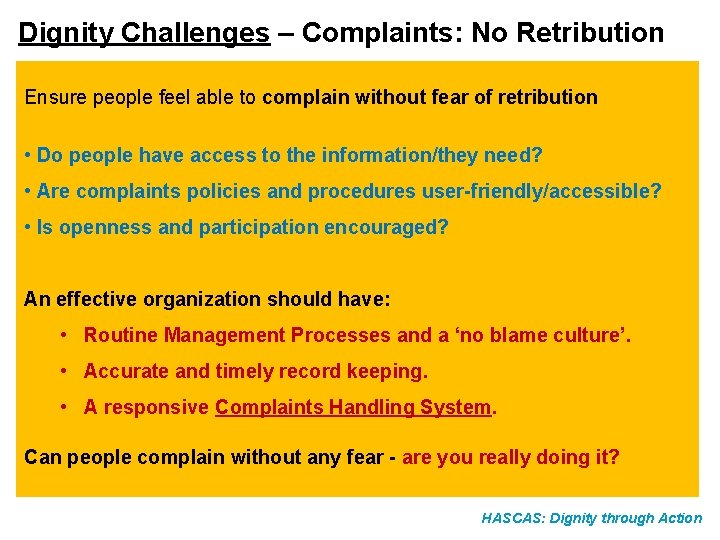
Dignity Challenges – Complaints: No Retribution Ensure people feel able to complain without fear of retribution • Do people have access to the information/they need? • Are complaints policies and procedures user-friendly/accessible? • Is openness and participation encouraged? An effective organization should have: • Routine Management Processes and a ‘no blame culture’. • Accurate and timely record keeping. • A responsive Complaints Handling System. Can people complain without any fear - are you really doing it? HASCAS: Dignity through Action
Dignity Challenges – Engaging Care Partners Engage with family members and carers as care partners Relationship with Care Partners: Relatives and carers should: (After DOE Project, 2008; RCN, 2008; SCIE, 2008) • Experience a welcoming ambience. • Be kept fully informed and receive timely information. • Be listened to and encouraged to contribute. • Be used as a valuable sources of information. Relatives and carers should know who is ‘in charge’ and how to raise issues. Are we alert to the possibility that relatives’ and carers’ views may not always the same as those of the person receiving care services? Do you really involve family members - are you really doing it? HASCAS: Dignity through Action
Dignity Challenges: Overall View HASCAS: Dignity through Action
Dignity Challenges: Overall View HASCAS: Dignity through Action
Activity 2. 1 Case Study B HASCAS: Dignity through Action
Activity 2. 1: Recognising Challenges to Dignity CASE STUDY B TEXT Located in Workshop Pack. You might find more than once instance of the same dignity challenge in the Case Study, and some challenges may be absent. Instructions: 1. Read the Case Study carefully. 2. In your group, discuss how the challenges to dignity appear in the Case Study. 3. Record your ideas on the worksheets provided. CASE STUDY B WORKSHEETS Located in Workshop Pack This lists the 10 dignity challenges with space for your notes against each one. Write your ideas in note form. HASCAS: Dignity through Action
Activity 2. 1: Recognising Challenges to Dignity ACTIVITY 2. 1 WORKSHEETS – See Workshop Pack HASCAS: Dignity through Action
Activity 2. 1 Case Study B HASCAS: Dignity through Action
HASCAS: Dignity through Action
Activity 2. 2 Using Dignity Audit Tools HASCAS: Dignity through Action
Activity 2. 2: Personal Dignity Audit Tools Fragment of the Personal Audit Tool HASCAS: Dignity through Action
HASCAS: Dignity through Action