Diagnostic Assessment for Aspergers Syndrome The Continuum of

- Slides: 51
Diagnostic Assessment for Asperger’s Syndrome The Continuum of Autism: From the work of Tony Atwood
What is Asperger’s Syndrome? • A disorder within the Autistic Spectrum Disorders • Considered a Neurobiological disorder • Major symptoms are Impairments in socialization, communication and imagination • First discussed by Hans Asperger in 1944 • Brought to international attention in the 1990’s • Suggested that the ratio of boys
Symptoms of Asperger’s Syndrome • Impairments in social interaction, narrow interests, an insistence on repetitive routines, speech and language peculiarities, nonverbal communication problems and motor clumsiness
Aloof • Avoid interactions • Mute • Behavior the main means of communication • Fascination with sensory experience
Passive • Approach adults for assistance with objects and for physical stimulation • Prolonged solitary play • Speech requires an external prompt, (echolalia, seeing an object/picture, dialogue “borrowed” from a favorite video) • Fascination with symmetry and collecting specific objects
Active but Odd • Often initiates interactions of short duration • Repetitive questions (social echolalia, script, alternative meaning, reassurance) • Lack of social play with others • Fascination with a specific topic or person.
Six Pathways to a Diagnosis of Asperger’s Syndrome • Diagnosis of autism in early childhood • Significant natural progress between 4 and 6 years of age • Effective early intervention programs • Progression along the continuum of autism
Recognition of Characteristics When First Enrolled at School • No clear signs of autism in early childhood • Teacher notices conspicuous features • Avoids social play with peers • Unaware of the codes of social conduct • Unusual qualities in conversation and imaginative play • Intense interest in a specific interest • Clumsiness when running, writing and catching • Teacher completes a developmental checklist for Asperger’s syndrome (ASAS)
Diagnosis of a Relative with Autism or Asperger’s Syndrome • Another family member has a diagnosis and knowledge of the continuum of autism leads to other family members being diagnosed • Some families have Asperger’s syndrome within and between generations
Dual Diagnosis • Attention deficit disorder • Language disorder • Cerebral palsy • Tourette’s disorder
Secondary Psychiatric Disorder • Depression • Anxiety disorder such as Obsessive Compulsive Disorder • Anger management • Schizophrenia
Residual Asperger’s Syndrome in an Adult • Self referral due to a relative having the diagnosis or information from the media • Agency referral from psychiatric services, forensic psychology and employment agencies
Diagnostic Assessment • Social Impairment
Social Impairment • Reciprocity (the balance between participants) • Inclusion (welcome, cooperation and control)
Pretending to be Normal • “…the fun came from setting up and arranging things. Maybe this desire to organize things rather than play with things, is the reason I never had a great interest in my peers. They always wanted to use things I had so carefully arranged. They would want to rearrange and redo. They did not let me control the environment. ”
Social Impairment • Level of maturity in deceit • Limited ability with team skills • Limited range of facial expressions and body language • Difficulty reading the facial expressions and body language of others • Limited ability to conceptualize thoughts and feelings of others
Speech and Language Characteristics • Pragmatics, Prosody and Pedantic
Pragmatic Aspects • • • The art of conversation Reciprocity Repairing a conversation Knowing when and how to interrupt Inappropriate comments Keeping on track Primarily interested in an exchange of information Appropriate topics Monologues or scripts Recognizing and accepting different points of view Literal interpretation
Prosody or the Melody of Speech • Lack of change of vocal tone and volume to indicate emotion and key words • Lack of variation in pitch, stress and rhythm • Accent not consistent with that of the local children • Difficulty understanding the relevance of the change in tone, inflection or emphasis on certain words when listening to the speech of others
Pedantic Speech • Overly Formal • Excessive technical details • “Adult” quality, sophisticated grammar or phrases • Must correct errors • Precise intonation
Unusual Qualities of Speech • Idiosyncratic use of words • Neologisms • Volume • Vocalizing thoughts • Verbal fluency affected by anxiety • Late onset
Special Interests • Dominate the person’s time and conversation • Statistics, cataloguing and symmetry • Idiosyncratic
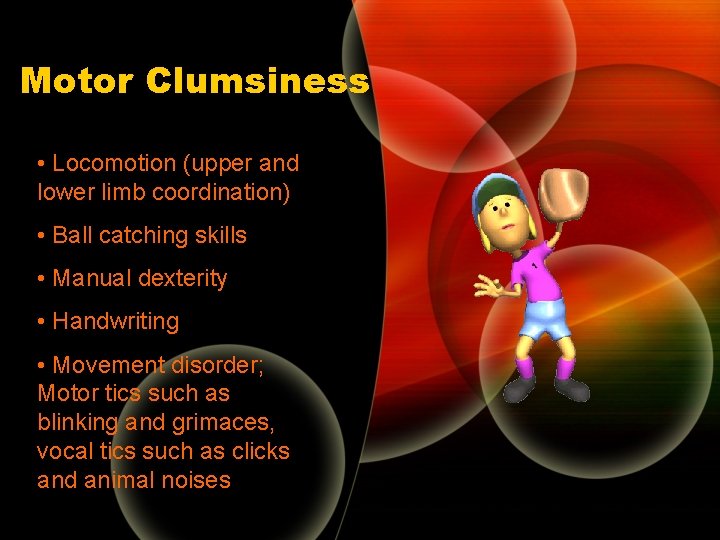
Motor Clumsiness • Locomotion (upper and lower limb coordination) • Ball catching skills • Manual dexterity • Handwriting • Movement disorder; Motor tics such as blinking and grimaces, vocal tics such as clicks and animal noises
Cognition • Problems with advanced Theory of Mind Skills • Weak Central Coherence • Impaired Executive Function • Profile on an Intelligence Test • Visualisers or verbalisers • Enclopedic memory • Solitary and idiosyncratic play • Preference for routines • Limited flexibility in thinking • Originality in problem solving
Sensory Sensitivity • Sound sensitivity • Tactile sensitivity • Sensitivity to the taste or texture of food • Stoic in response to pain or temperature • Synaesthesia
Relevant Information • Family history of similar individuals • Reports from teachers and therapists • Medical investigations and medicine • Developmental history • Prior diagnosis • Presence of a psychiatric disorder • Observation at school and home
Issues Relevant to the Diagnostic Assessment • Profile of abilities in girls (same pattern, less severe expression, coping mechanisms, fewer referrals) • Assessment procedures and criteria for adults (time to respond and the quality of the response, validity of the developmental history) • Alternative explanations: shy, social phobia, gifted emotional neglect in infancy • Choice of diagnostic criteria
Alternative Terms High Functioning Autism • HFA and AS at the behavioral and treatment level, are more the same than different • Lack of expertise, experience and confidence in the diagnosis of AS • HFA more likely if the child has a developmental history of autism • AS not a mild form of autism but a more subtle expression • Diagnosis of HFA can provide automatic access to services • Use the term that provides more resources
Developing Social Skills and Understanding Emotions
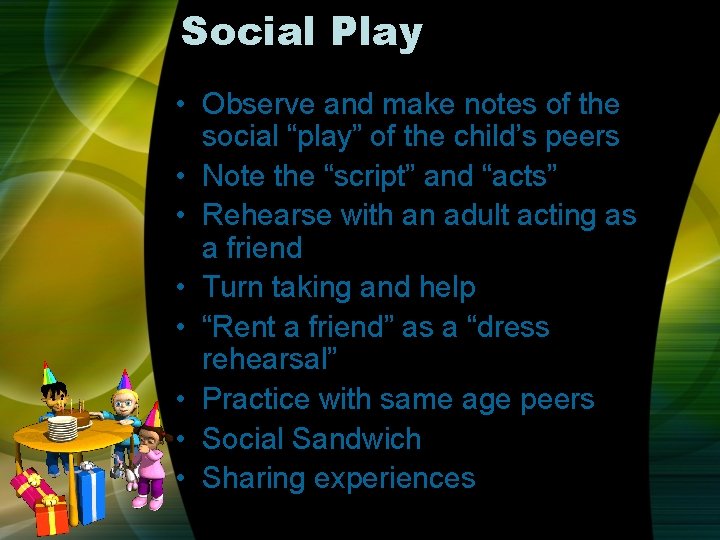
Social Play • Observe and make notes of the social “play” of the child’s peers • Note the “script” and “acts” • Rehearse with an adult acting as a friend • Turn taking and help • “Rent a friend” as a “dress rehearsal” • Practice with same age peers • Social Sandwich • Sharing experiences
Strategies for Social Integration
Inclusion with Ordinary Children • Observation of appropriate social/emotional behavior • Peer group who know how to modify their behavior to accommodate and support the child
Knowledge of the Nature of Asperger’s Syndrome • To recognize the challenges faced by the child • To explain their behavior to other children and adults • The Sixth Sense
Teach Theory of Mind Skills • • • Photographs, text, drawings, games Metaphor Social Stories Comic Strip Conversations Social Skills Groups
Encourage Friendship Skills • Behavioral strategies of task analysis, shaping, prompting and rewards • Cognitive strategies to learn theory and script using Social Stories
Four Levels in the Development of Friendship
Level 1: Approximately 3 to 6 Years • • Recognition of turn taking Egocentric conceptualization One way assistance Proximity and physical attributes Why is…. your friend? “Because I like him” “He lives next door”
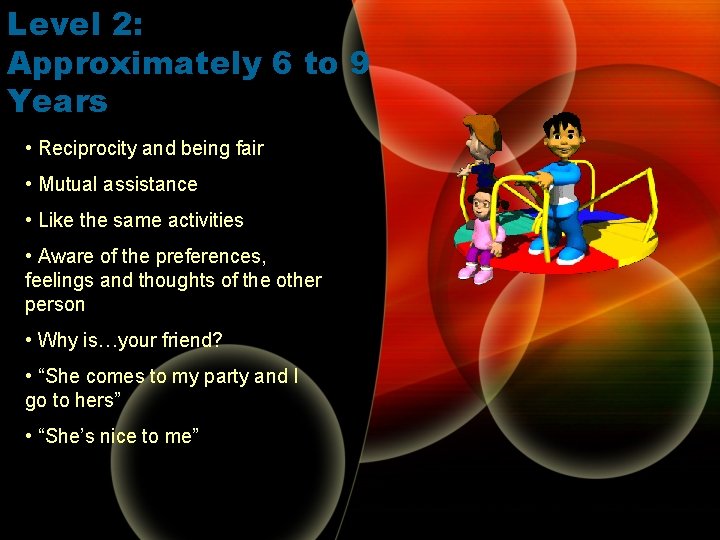
Level 2: Approximately 6 to 9 Years • Reciprocity and being fair • Mutual assistance • Like the same activities • Aware of the preferences, feelings and thoughts of the other person • Why is…your friend? • “She comes to my party and I go to hers” • “She’s nice to me”
Level 3: Approximately 9 to 13 Years • Aware of other’s opinion of them and how their words and actions affect the feelings of others • Shared experiences and interests • Greater selectivity and durability • Gender split • Trust, loyalty and keeping promises
Level 4: Adolescence to Adult • Peer group acceptance more important than the opinion of parents • Greater depth and breadth of self disclosure • Desire to be understood by friends • Different types of friendships • “He/She accepts me for who I am” • “We think the same way about things”
Characteristics Associated with Asperger’s Syndrome • Motivation for friendship • Immaturity • Control the activity • Describe what a friend should not do • Negative experiences
Checklist of Social Behaviors Used as an Index of Friendship Skills • Entry Skills – Recognizing when and how to join in – The “welcome” provided for children who approach them • Assistance – When and how to provide assistance – Seeking assistance from others • Criticism – Knowing when criticism is appropriate and inappropriate – How to criticize – Tolerance of criticism • Compliments – Compliments at appropriate times – Responding to a friend’s compliment • Accepting Suggestions – Incorporating the ideas of others in the activity – Indicating agreement • Reciprocity and Sharing – An equitable distribution of conversation, direction and resources
Checklist of Social Behaviors Used as an Index of Friendship Skills - Con’t • Conflict Resolution – Managing disagreement with compromise – Accepting the opinions of others – Not responding with aggression or immature resolution mechanisms • Monitoring and Listening – Regularly observing the other person to monitor their contribution and body language – Their own body language indicating an interest in the other person • Empathy – Recognizing when appropriate comments and actions are required in response to the other person’s circumstances and positive and negative feelings • Avoiding and Ending – Appropriate behavior and comments to maintain solitude – Appropriate behavior and comments to end the interaction
Encouraging Friendship Skills • Assess which skills are observed or absent • Assess the quality and range of expression • Use behavior and cognitive strategies to acquire and develop specific skills • Task analysis, prompting, shaping and reward • Reward all participants • Teach theory as well as the practices • Social stories
Additional Strategies • Friendship diary • Matching individuals with similar interests • Support groups for adults • Local and pen pal registries • Internet chat lines • Books of friendship • Recognizing when someone is not a friend • Maintaining and ending friendships • Tuition in characterization
Characterization Skills • Unusual in their perception and description of the personality characteristics of others and themselves • Limited lexicon to describe the different types of character • Immaturity and predominance of physical attributes • One dimensional approach • Difficulty reading a person’s character and adapting their behavior accordingly
Teaching Characterization Skills • The Mr. Men and Little Miss books • Examples are Mr. Grumpy, Little Miss Chatterbox and Mr. Nosey • Choosing an animal to represent someone’s personality • Reading dictionary definitions of character and identifying someone who has those characteristics • Identifying the description of their own character
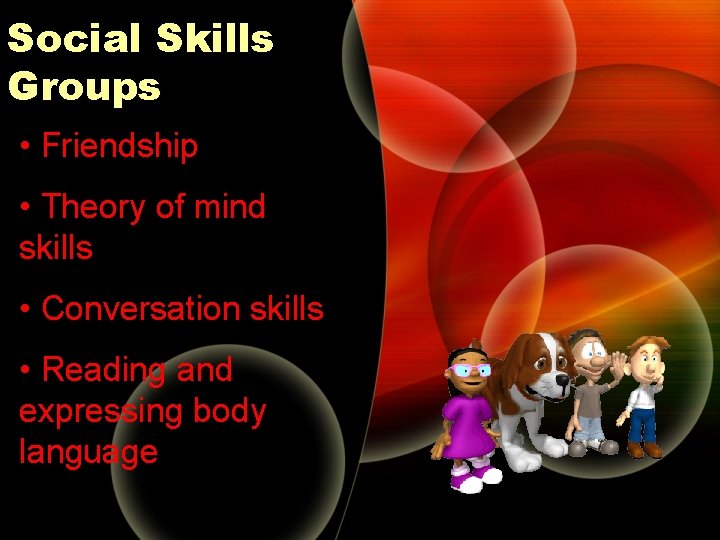
Social Skills Groups • Friendship • Theory of mind skills • Conversation skills • Reading and expressing body language
The Understanding and Expression of Emotions • A project on a specific emotion • Create a scrap book that illustrates the emotion • Compare and contrast other children’s scrap books • Identify the facial elements that express the emotion • A “thermometer” to measure the degree of intensity • Place photographs and words at the appropriate point on the “thermometer” • Point to the “degree” of expression in a particular situation
The Understanding and Expression of Emotions – Con’t • Appropriate tone of voice • Drama games for appropriate body language • Mirror and video recordings • Story books • Sentence completion exercises • Alternate positive and negative emotions
Imitation • Identify individuals skilled in a specific ability • Observe their actions and script • Copy or mimic their style • Speech and drama training