
Diagnostic Assessments of Reading DAR Fairlawn Elementary Community
- Slides: 30
Diagnostic Assessments of Reading (DAR) Fairlawn Elementary Community School
Benefits • Diagnose reading achievements at all levels with one kit (Kg – Adult) • Identify areas of difficulty for struggling readers in 40 minutes or less • Assess all five components of Reading: • • • Phonemic Awareness Phonics Vocabulary Fluency Comprehension
Details • Nine Tests: • • • Print Awareness Phonological Awareness Letters and Sounds Word Recognition Word Analysis Oral Reading Accuracy and Fluency Silent Reading Comprehension Spelling Word Meaning
Working with Elementary Students • If unable to handle a particular test • Move on quickly to the next test • Except during the Print Awareness test • Put student at ease by talking informally for a brief time • Suggestions on page 6 – “Establishing Rapport with Students” • Kg and 1 st – don’t push • They must feel success at some level
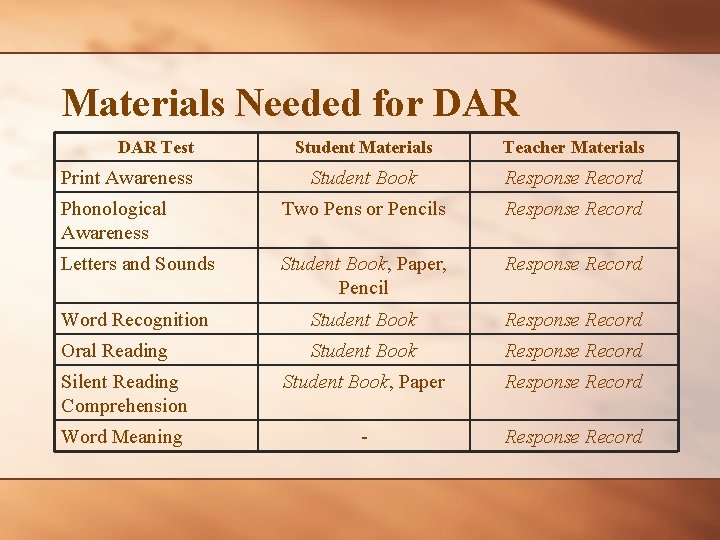
Materials Needed for DAR Test Student Materials Teacher Materials Student Book Response Record Phonological Awareness Two Pens or Pencils Response Record Letters and Sounds Student Book, Paper, Pencil Response Record Word Recognition Student Book Response Record Oral Reading Student Book Response Record Silent Reading Comprehension Student Book, Paper Response Record Word Meaning - Response Record Print Awareness
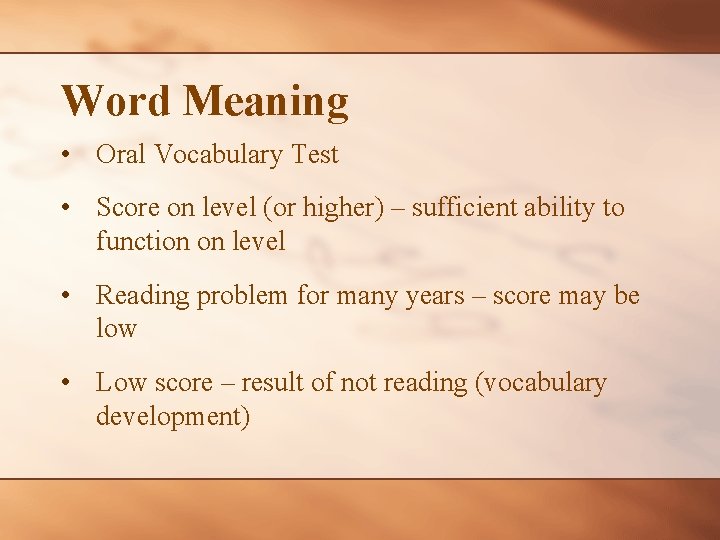
Word Meaning • Oral Vocabulary Test • Score on level (or higher) – sufficient ability to function on level • Reading problem for many years – score may be low • Low score – result of not reading (vocabulary development)
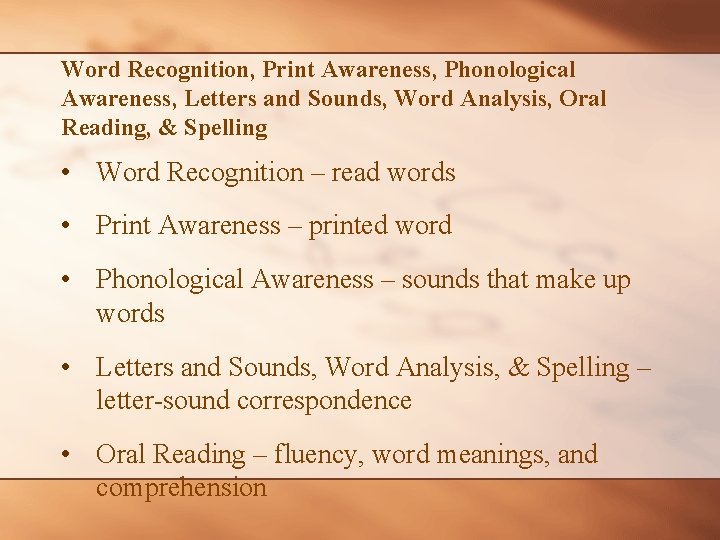
Word Recognition, Print Awareness, Phonological Awareness, Letters and Sounds, Word Analysis, Oral Reading, & Spelling • Word Recognition – read words • Print Awareness – printed word • Phonological Awareness – sounds that make up words • Letters and Sounds, Word Analysis, & Spelling – letter-sound correspondence • Oral Reading – fluency, word meanings, and comprehension
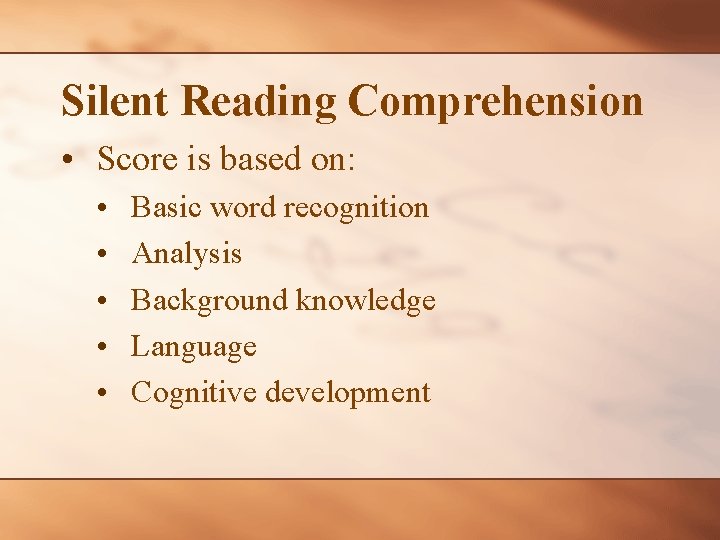
Silent Reading Comprehension • Score is based on: • • • Basic word recognition Analysis Background knowledge Language Cognitive development
Time Requirements and Pace • No set time limits • Approximately 40 minutes per student • Designed for quick administration • Maintain a brisk pace • Administered and scored simultaneously
Personnel Requirements • Classroom Teachers • Reading Coach • Special Education Teachers • Paraprofessionals
Procedures • Script in Response Record is in colored boldface type.
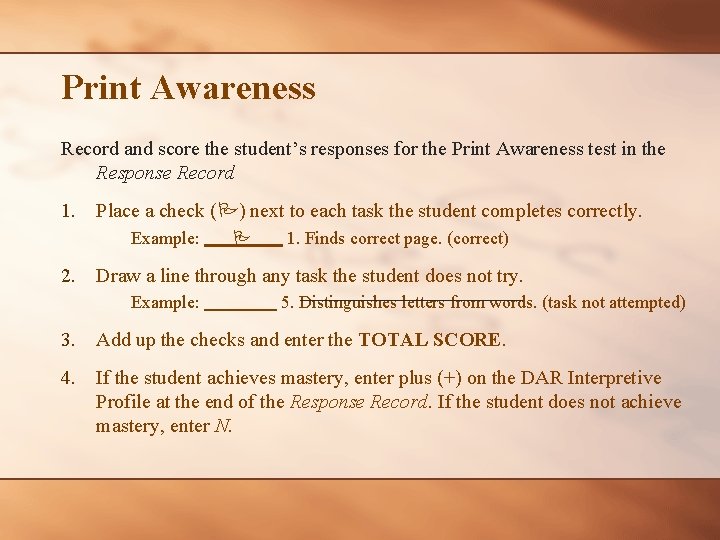
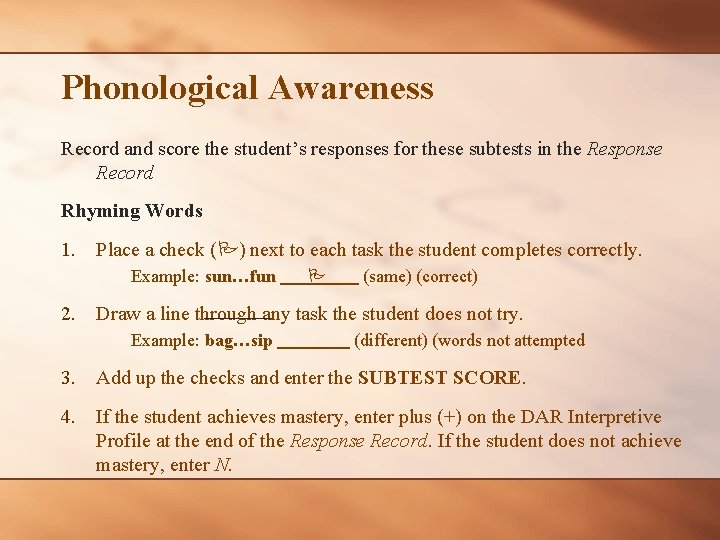
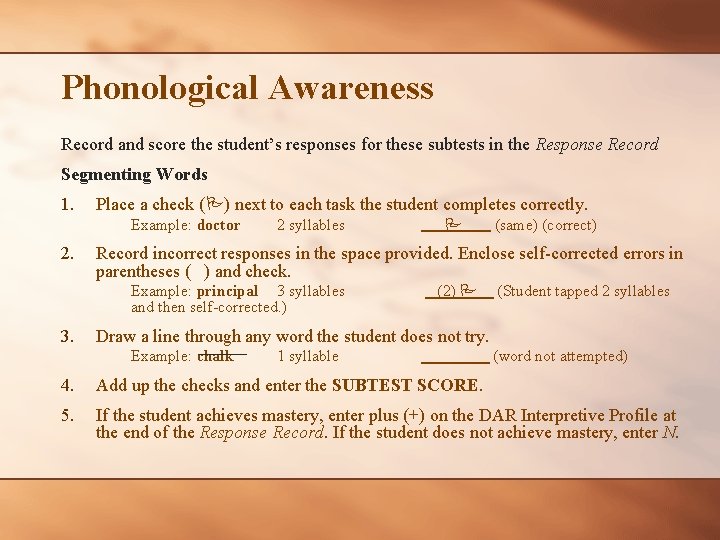
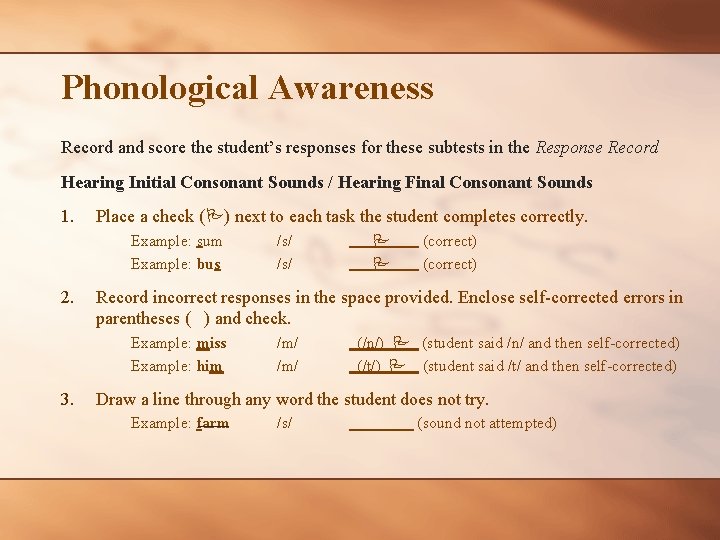
Recording and Scoring 1. A correct response to a question is indicated with a check mark ( ). 2. An incorrect response is recorded verbatim. Self-corrected errors are enclosed in parenthesis ( ) and checked. 3. A line through a question indicates the student did not try that question.
Print Awareness Record and score the student’s responses for the Print Awareness test in the Response Record 1. Place a check ( ) next to each task the student completes correctly. Example: 1. Finds correct page. (correct) 2. Draw a line through any task the student does not try. Example: 5. Distinguishes letters from words. (task not attempted) 3. Add up the checks and enter the TOTAL SCORE. 4. If the student achieves mastery, enter plus (+) on the DAR Interpretive Profile at the end of the Response Record. If the student does not achieve mastery, enter N.
Phonological Awareness Record and score the student’s responses for these subtests in the Response Record Rhyming Words 1. Place a check ( ) next to each task the student completes correctly. Example: sun…fun (same) (correct) 2. Draw a line through any task the student does not try. Example: bag…sip (different) (words not attempted 3. Add up the checks and enter the SUBTEST SCORE. 4. If the student achieves mastery, enter plus (+) on the DAR Interpretive Profile at the end of the Response Record. If the student does not achieve mastery, enter N.
Phonological Awareness Record and score the student’s responses for these subtests in the Response Record Segmenting Words 1. Place a check ( ) next to each task the student completes correctly. Example: doctor 2. 2 syllables (same) (correct) Record incorrect responses in the space provided. Enclose self-corrected errors in parentheses ( ) and check. Example: principal 3 syllables and then self-corrected. ) 3. (2) (Student tapped 2 syllables Draw a line through any word the student does not try. Example: chalk 1 syllable (word not attempted) 4. Add up the checks and enter the SUBTEST SCORE. 5. If the student achieves mastery, enter plus (+) on the DAR Interpretive Profile at the end of the Response Record. If the student does not achieve mastery, enter N.
Phonological Awareness Record and score the student’s responses for these subtests in the Response Record Hearing Initial Consonant Sounds / Hearing Final Consonant Sounds 1. Place a check ( ) next to each task the student completes correctly. Example: sum Example: bus 2. (correct) Record incorrect responses in the space provided. Enclose self-corrected errors in parentheses ( ) and check. Example: miss Example: him 3. /s/ /m/ (/n/) (student said /n/ and then self-corrected) (/t/) (student said /t/ and then self-corrected) Draw a line through any word the student does not try. Example: farm /s/ (sound not attempted)
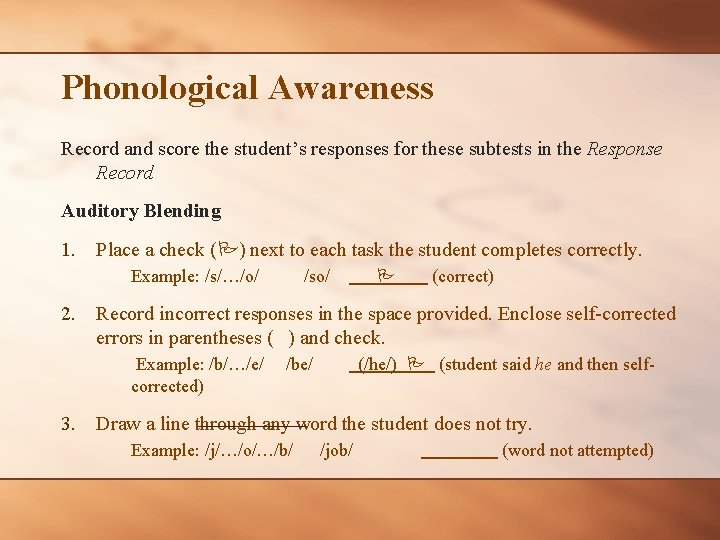
Phonological Awareness Record and score the student’s responses for these subtests in the Response Record Auditory Blending 1. Place a check ( ) next to each task the student completes correctly. Example: /s/…/o/ /so/ (correct) 2. Record incorrect responses in the space provided. Enclose self-corrected errors in parentheses ( ) and check. Example: /b/…/e/ corrected) (/he/) (student said he and then self- /be/ 3. Draw a line through any word the student does not try. Example: /j/…/o/…/b/ /job/ (word not attempted)
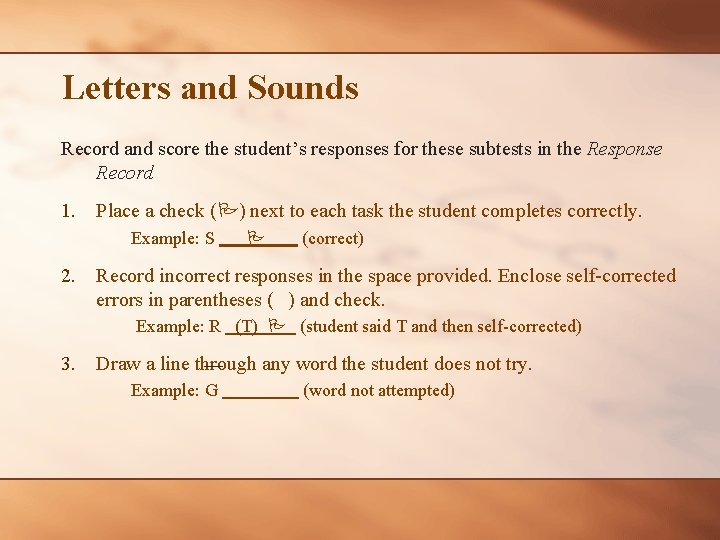
Letters and Sounds Record and score the student’s responses for these subtests in the Response Record 1. Place a check ( ) next to each task the student completes correctly. Example: S (correct) 2. Record incorrect responses in the space provided. Enclose self-corrected errors in parentheses ( ) and check. Example: R (T) (student said T and then self-corrected) 3. Draw a line through any word the student does not try. Example: G (word not attempted)
Letters and Sounds Record and score the student’s responses for these subtests in the Response Record 1. Place a check ( ) next to each task the student completes correctly. Example: S (correct) 2. Record incorrect responses in the space provided. Enclose self-corrected errors in parentheses ( ) and check. Example: R (T) (student said T and then self-corrected) 3. Draw a line through any word the student does not try. Example: G (word not attempted)
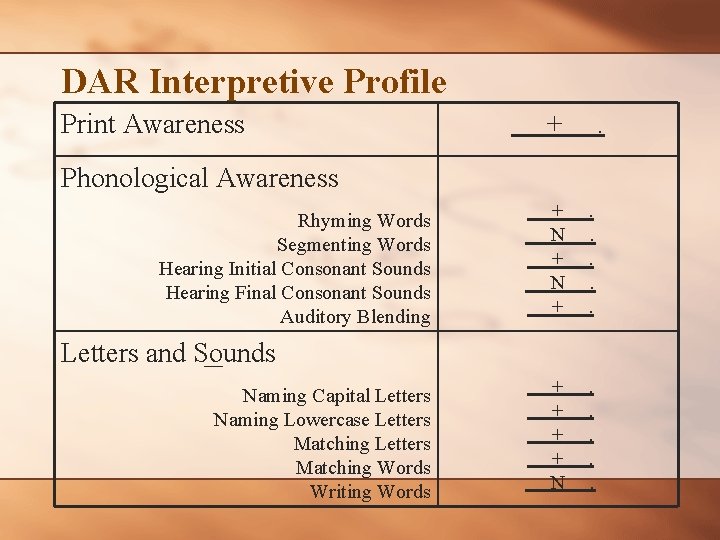
DAR Interpretive Profile Print Awareness + . Phonological Awareness Rhyming Words Segmenting Words Hearing Initial Consonant Sounds Hearing Final Consonant Sounds Auditory Blending + N + . . . + + N . . . Letters and Sounds Naming Capital Letters Naming Lowercase Letters Matching Words Writing Words
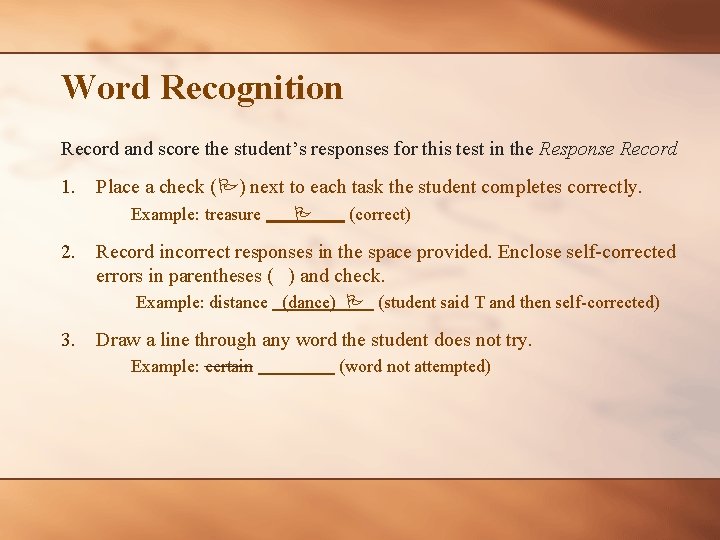
Word Recognition Record and score the student’s responses for this test in the Response Record 1. Place a check ( ) next to each task the student completes correctly. Example: treasure (correct) 2. Record incorrect responses in the space provided. Enclose self-corrected errors in parentheses ( ) and check. Example: distance (dance) (student said T and then self-corrected) 3. Draw a line through any word the student does not try. Example: certain (word not attempted)
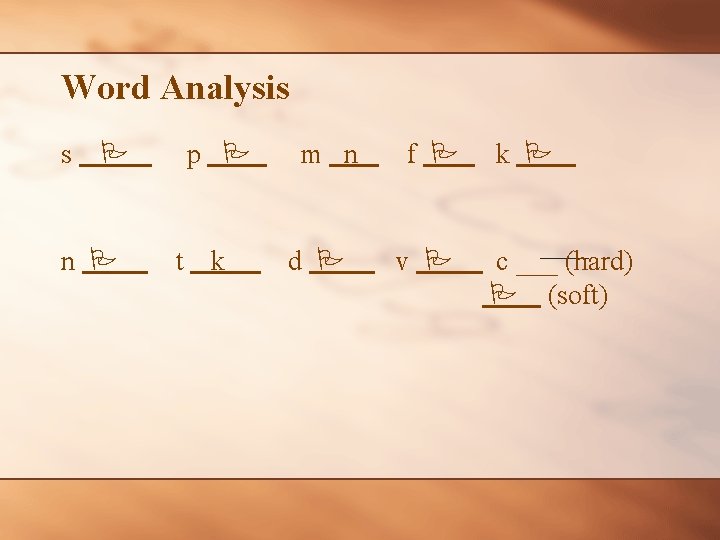
Word Analysis s n p t k m n d f v k c ___ (hard) (soft)
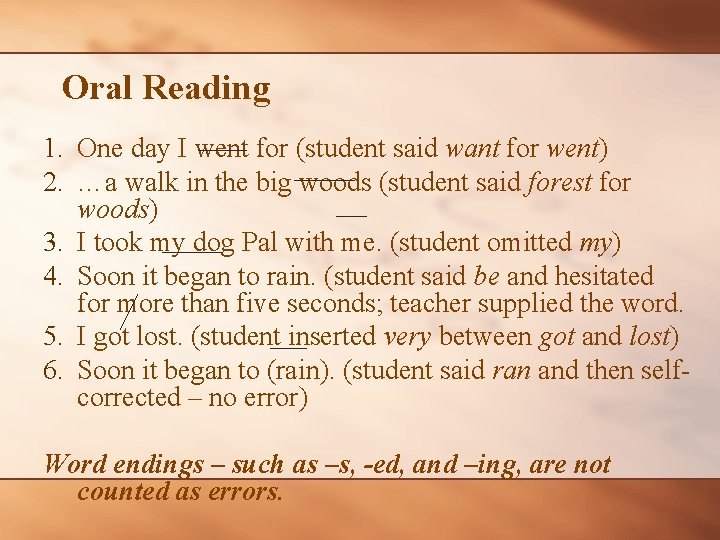
Oral Reading 1. One day I went for (student said want for went) 2. …a walk in the big woods (student said forest for woods) 3. I took my dog Pal with me. (student omitted my) 4. Soon it began to rain. (student said be and hesitated for more than five seconds; teacher supplied the word. 5. I got lost. (student inserted very between got and lost) 6. Soon it began to (rain). (student said ran and then selfcorrected – no error) Word endings – such as –s, -ed, and –ing, are not counted as errors.
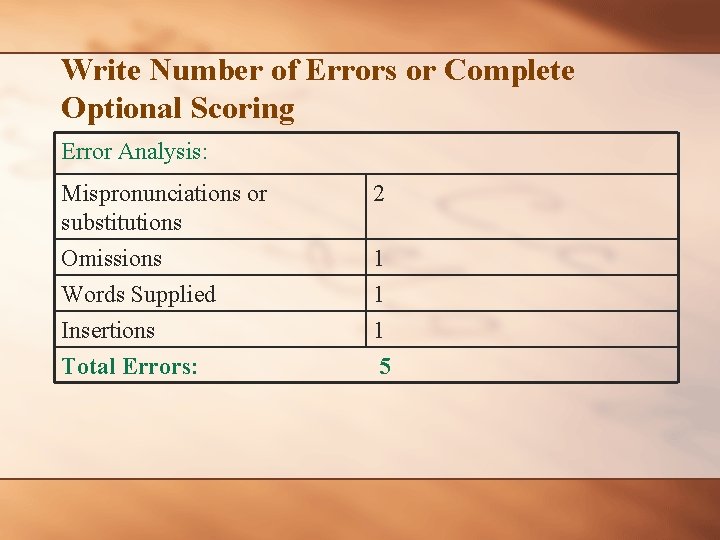
Write Number of Errors or Complete Optional Scoring Error Analysis: Mispronunciations or substitutions 2 Omissions Words Supplied Insertions Total Errors: 1 1 1 5
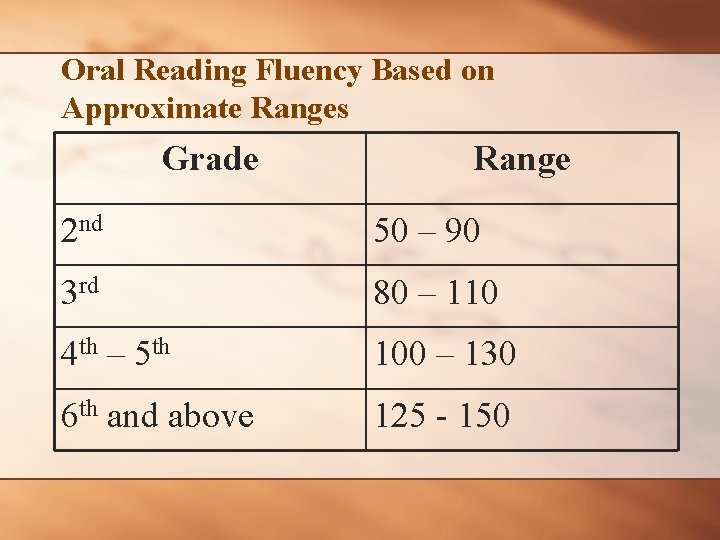
Oral Reading Fluency Based on Approximate Ranges Grade Range 2 nd 50 – 90 3 rd 80 – 110 4 th – 5 th 100 – 130 6 th and above 125 - 150
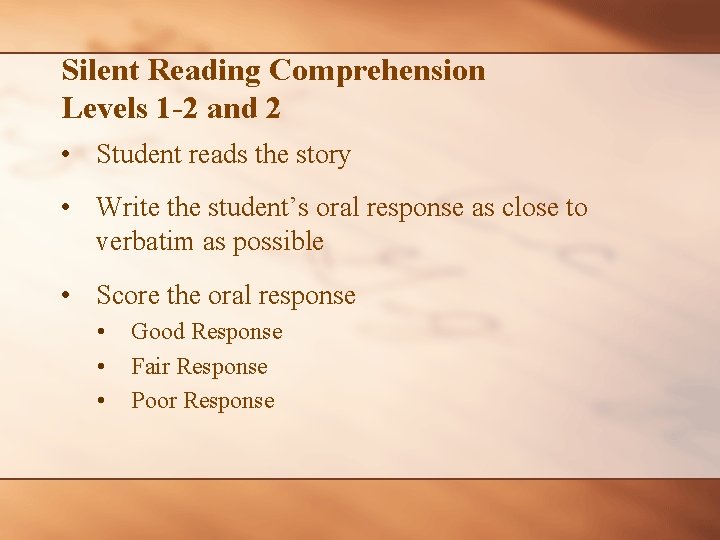
Silent Reading Comprehension Levels 1 -2 and 2 • Student reads the story • Write the student’s oral response as close to verbatim as possible • Score the oral response • • • Good Response Fair Response Poor Response
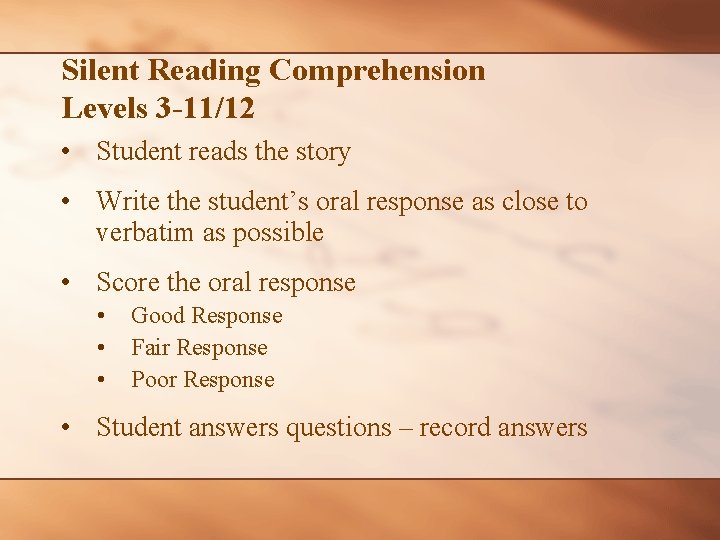
Silent Reading Comprehension Levels 3 -11/12 • Student reads the story • Write the student’s oral response as close to verbatim as possible • Score the oral response • • • Good Response Fair Response Poor Response • Student answers questions – record answers
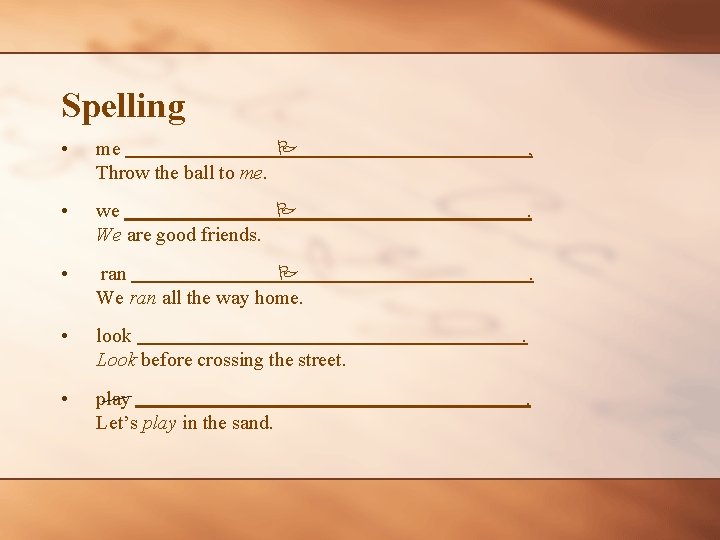
Spelling • me Throw the ball to me. , • we We are good friends. . • ran We ran all the way home. . • look Look before crossing the street. . • play Let’s play in the sand. .
Word Meaning • Read words to student • Student tells meaning • Follow directions if wrong or correct (page 49 of Response Record • See page 25 of Teacher’s Guide for acceptable responses.
Question and Answer Period