CS 785 Fall 2004 Gheorghe Tecuci tecucigmu edu
- Slides: 81
CS 785 Fall 2004 Gheorghe Tecuci tecuci@gmu. edu http: //lac. gmu. edu/ Learning Agents Center and Computer Science Department George Mason University 2004, G. Tecuci, Learning Agents Center
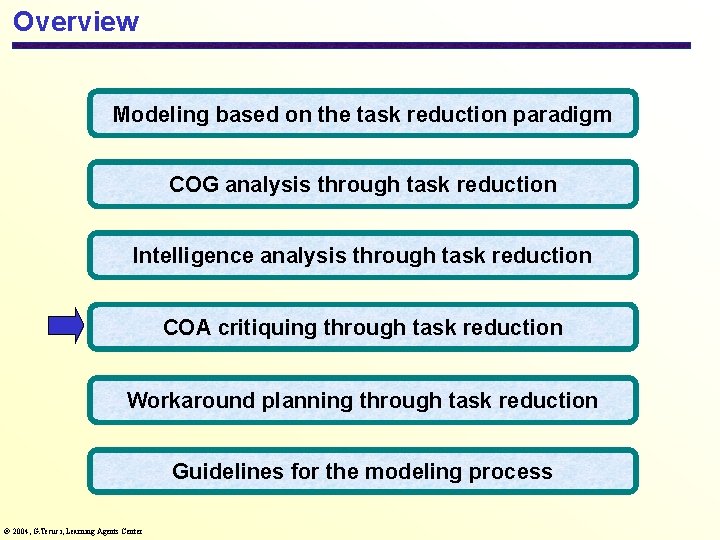
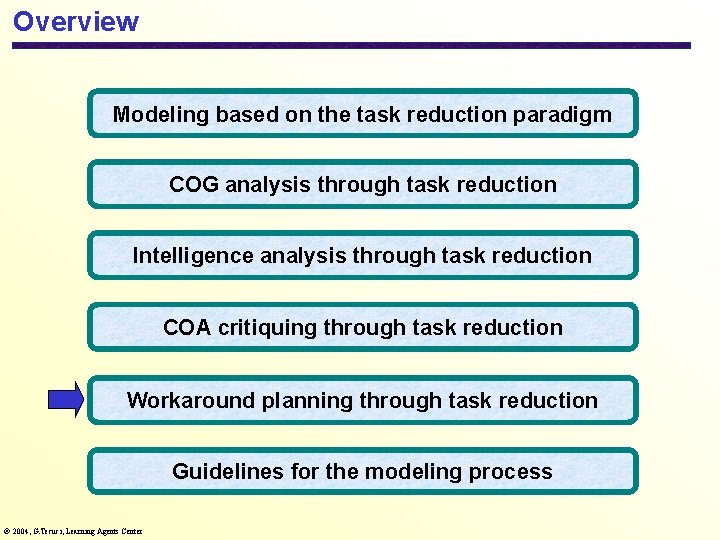
Overview Modeling based on the task reduction paradigm COG analysis through task reduction Intelligence analysis through task reduction COA critiquing through task reduction Workaround planning through task reduction Guidelines for the modeling process 2004, G. Tecuci, Learning Agents Center
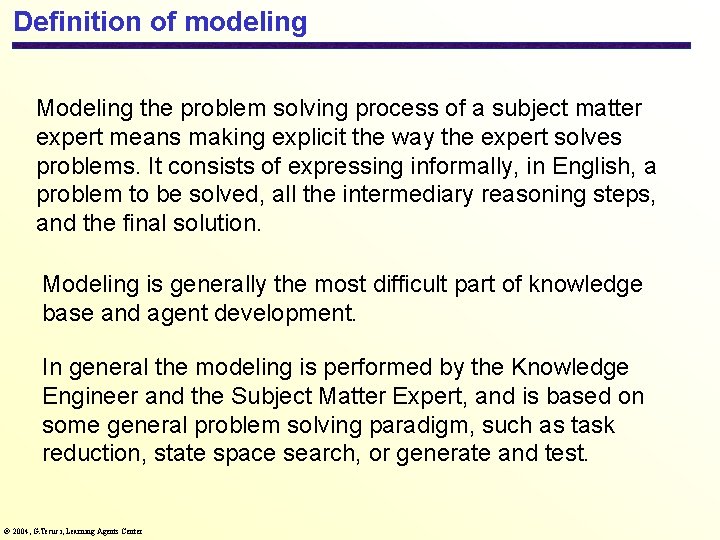
Definition of modeling Modeling the problem solving process of a subject matter expert means making explicit the way the expert solves problems. It consists of expressing informally, in English, a problem to be solved, all the intermediary reasoning steps, and the final solution. Modeling is generally the most difficult part of knowledge base and agent development. In general the modeling is performed by the Knowledge Engineer and the Subject Matter Expert, and is based on some general problem solving paradigm, such as task reduction, state space search, or generate and test. 2004, G. Tecuci, Learning Agents Center
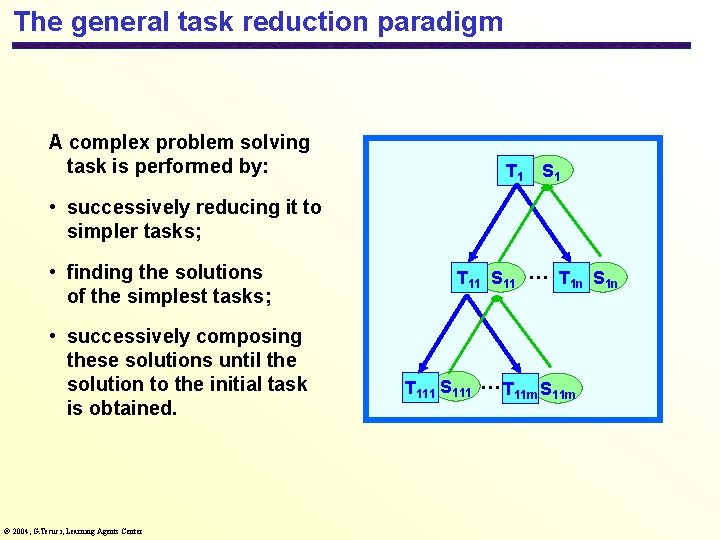
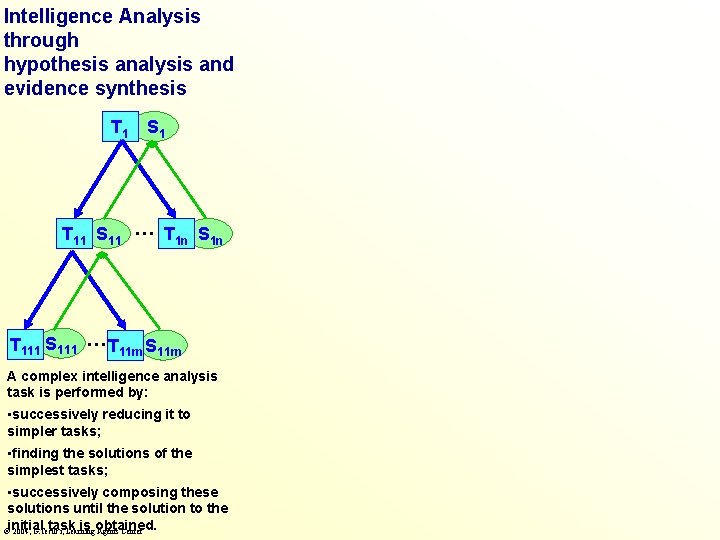
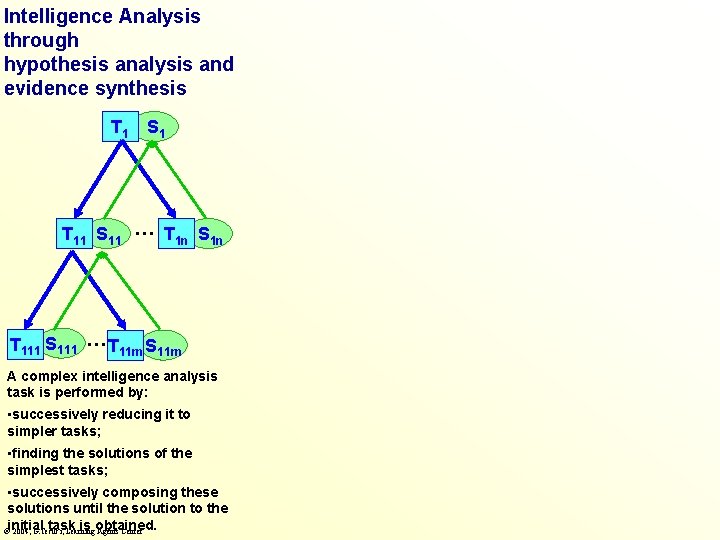
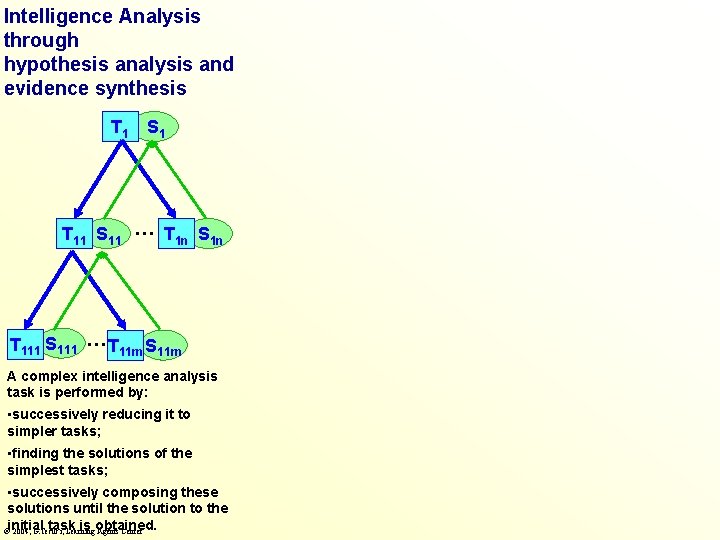
The general task reduction paradigm A complex problem solving task is performed by: T 1 S 1 • successively reducing it to simpler tasks; • finding the solutions of the simplest tasks; • successively composing these solutions until the solution to the initial task is obtained. 2004, G. Tecuci, Learning Agents Center T 11 S 11 … T 1 n S 1 n T 111 S 111 … T 11 m S 11 m
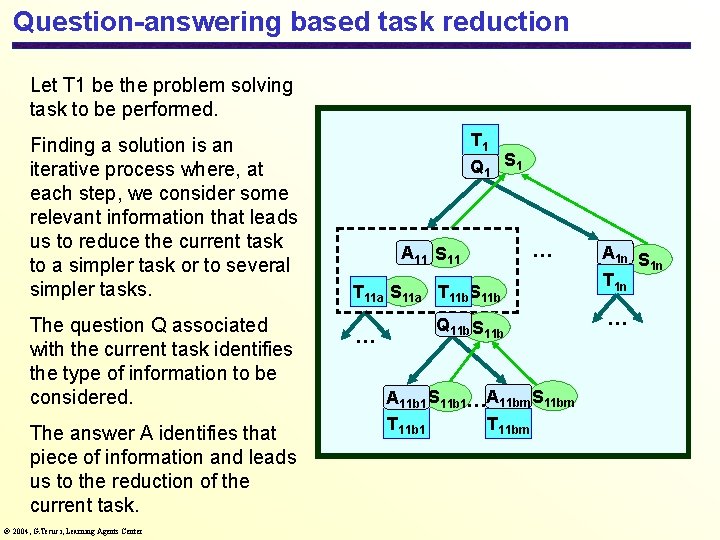
Question-answering based task reduction Let T 1 be the problem solving task to be performed. Finding a solution is an iterative process where, at each step, we consider some relevant information that leads us to reduce the current task to a simpler task or to several simpler tasks. The question Q associated with the current task identifies the type of information to be considered. The answer A identifies that piece of information and leads us to the reduction of the current task. 2004, G. Tecuci, Learning Agents Center T 1 Q 1 S 1 A 11 S 11 … T 11 a S 11 a T 11 b. S 11 b … Q 11 b S 11 b A 11 b 1 S 11 b 1… A 11 bm S 11 bm T 11 b 1 T 11 bm A 1 n S 1 n T 1 n …
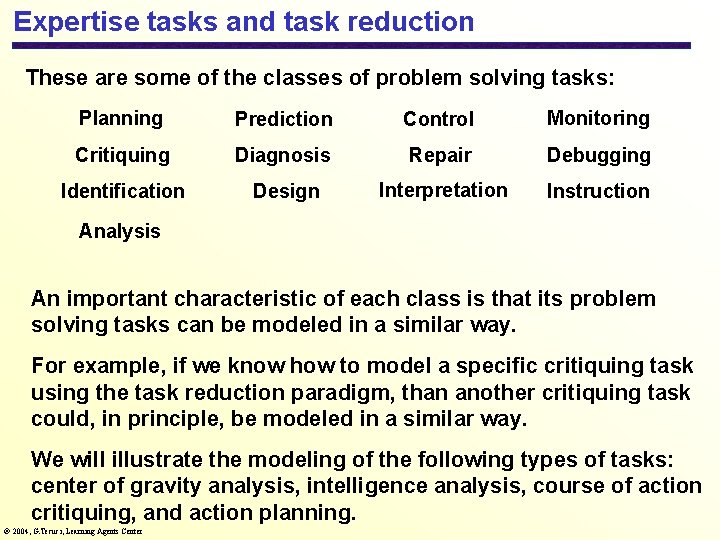
Expertise tasks and task reduction These are some of the classes of problem solving tasks: Planning Prediction Control Monitoring Critiquing Diagnosis Repair Debugging Identification Design Interpretation Instruction Analysis An important characteristic of each class is that its problem solving tasks can be modeled in a similar way. For example, if we know how to model a specific critiquing task using the task reduction paradigm, than another critiquing task could, in principle, be modeled in a similar way. We will illustrate the modeling of the following types of tasks: center of gravity analysis, intelligence analysis, course of action critiquing, and action planning. 2004, G. Tecuci, Learning Agents Center
Overview Modeling based on the task reduction paradigm COG analysis through task reduction Intelligence analysis through task reduction COA critiquing through task reduction Workaround planning through task reduction Guidelines for the modeling process 2004, G. Tecuci, Learning Agents Center
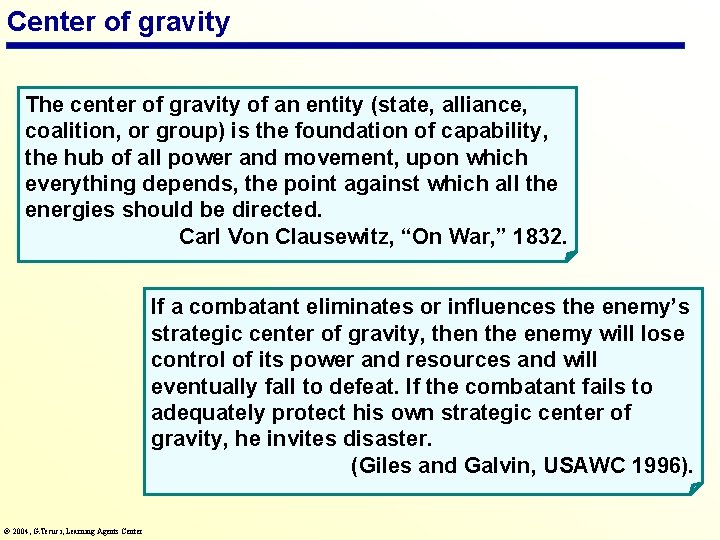
Center of gravity The center of gravity of an entity (state, alliance, coalition, or group) is the foundation of capability, the hub of all power and movement, upon which everything depends, the point against which all the energies should be directed. Carl Von Clausewitz, “On War, ” 1832. If a combatant eliminates or influences the enemy’s strategic center of gravity, then the enemy will lose control of its power and resources and will eventually fall to defeat. If the combatant fails to adequately protect his own strategic center of gravity, he invites disaster. (Giles and Galvin, USAWC 1996). 2004, G. Tecuci, Learning Agents Center
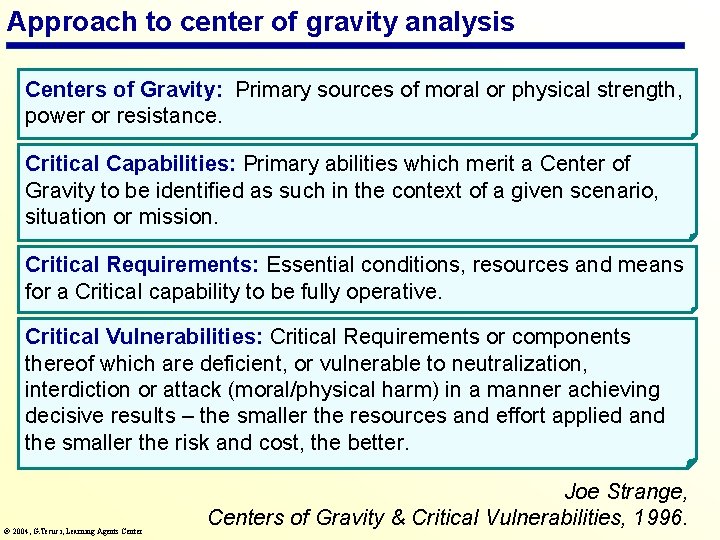
Approach to center of gravity analysis Centers of Gravity: Primary sources of moral or physical strength, power or resistance. Critical Capabilities: Primary abilities which merit a Center of Gravity to be identified as such in the context of a given scenario, situation or mission. Critical Requirements: Essential conditions, resources and means for a Critical capability to be fully operative. Critical Vulnerabilities: Critical Requirements or components thereof which are deficient, or vulnerable to neutralization, interdiction or attack (moral/physical harm) in a manner achieving decisive results – the smaller the resources and effort applied and the smaller the risk and cost, the better. 2004, G. Tecuci, Learning Agents Center Joe Strange, Centers of Gravity & Critical Vulnerabilities, 1996.
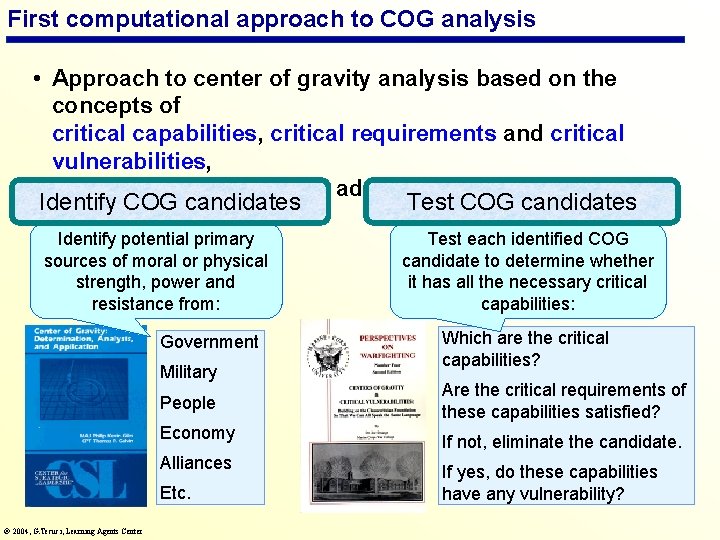
First computational approach to COG analysis • Approach to center of gravity analysis based on the concepts of critical capabilities, critical requirements and critical vulnerabilities, which have been recently adopted into the joint military Identify COG candidates Test COG candidates doctrine. Identify potential primary sources of moral or physical strength, power and resistance from: Government Military Which are the critical capabilities? People Are the critical requirements of these capabilities satisfied? Economy If not, eliminate the candidate. Alliances If yes, do these capabilities have any vulnerability? Etc. 2004, G. Tecuci, Learning Agents Center Test each identified COG candidate to determine whether it has all the necessary critical capabilities:
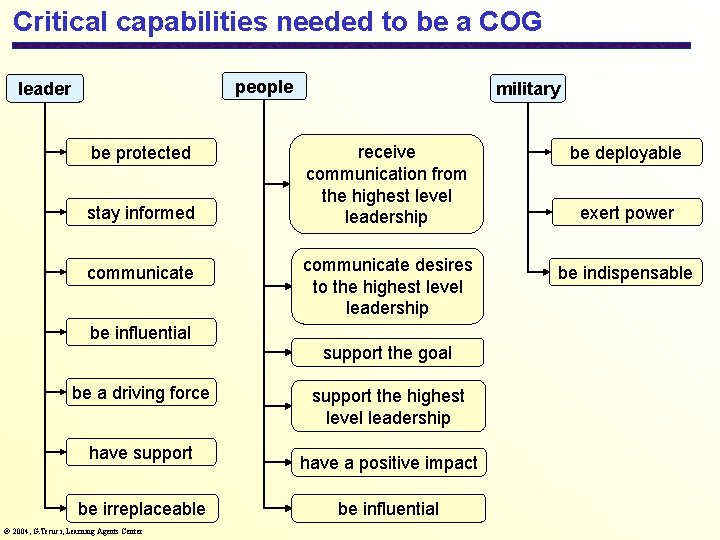
Critical capabilities needed to be a COG people leader be protected stay informed communicate military receive communication from the highest level leadership be deployable communicate desires to the highest level leadership be indispensable be influential support the goal be a driving force have support be irreplaceable 2004, G. Tecuci, Learning Agents Center support the highest level leadership have a positive impact be influential exert power
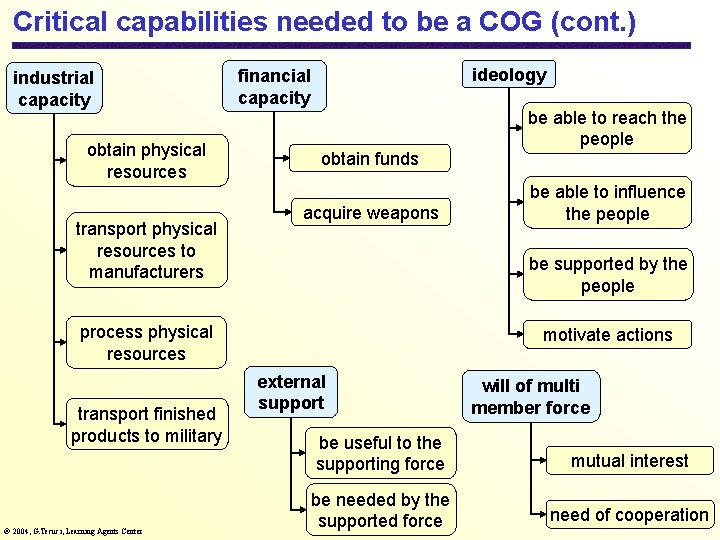
Critical capabilities needed to be a COG (cont. ) industrial capacity obtain physical resources transport physical resources to manufacturers ideology financial capacity obtain funds acquire weapons 2004, G. Tecuci, Learning Agents Center be able to influence the people be supported by the people process physical resources transport finished products to military be able to reach the people motivate actions external support will of multi member force be useful to the supporting force mutual interest be needed by the supported force need of cooperation
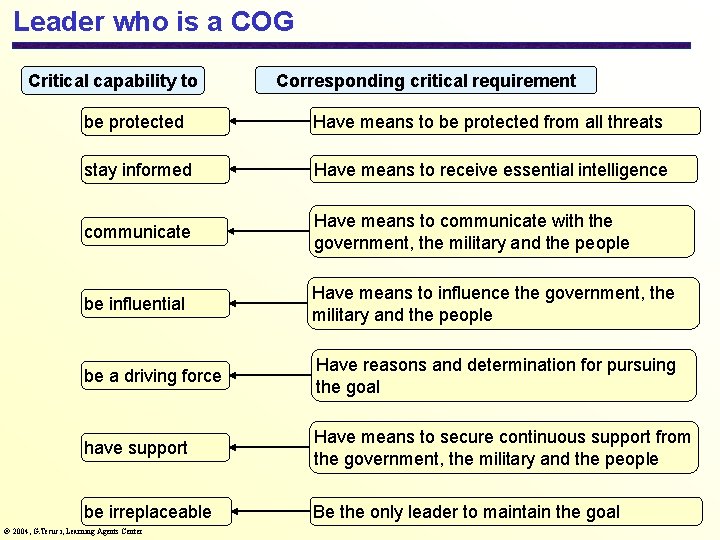
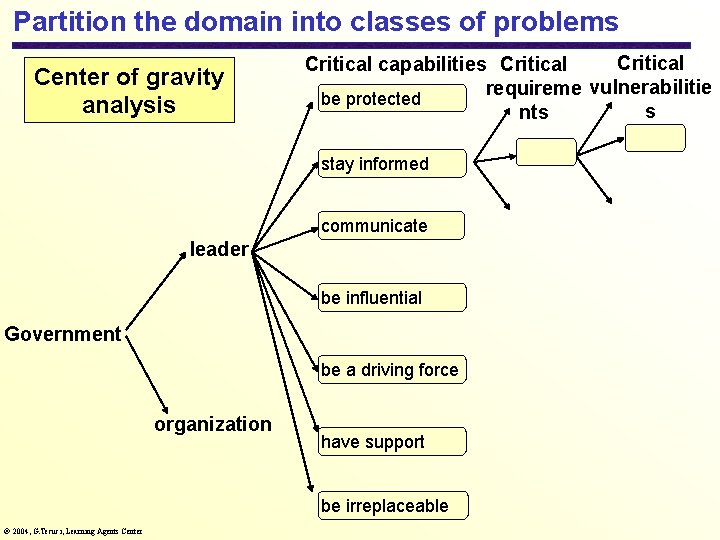
Leader who is a COG Critical capability to Corresponding critical requirement be protected Have means to be protected from all threats stay informed Have means to receive essential intelligence communicate Have means to communicate with the government, the military and the people be influential Have means to influence the government, the military and the people be a driving force Have reasons and determination for pursuing the goal have support Have means to secure continuous support from the government, the military and the people be irreplaceable Be the only leader to maintain the goal 2004, G. Tecuci, Learning Agents Center
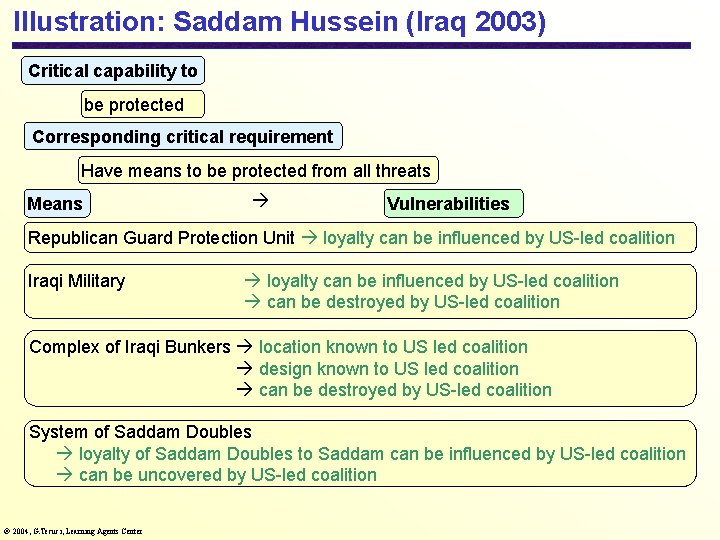
Illustration: Saddam Hussein (Iraq 2003) Critical capability to be protected Corresponding critical requirement Have means to be protected from all threats Means Vulnerabilities Republican Guard Protection Unit loyalty can be influenced by US-led coalition Iraqi Military loyalty can be influenced by US-led coalition can be destroyed by US-led coalition Complex of Iraqi Bunkers location known to US led coalition design known to US led coalition can be destroyed by US-led coalition System of Saddam Doubles loyalty of Saddam Doubles to Saddam can be influenced by US-led coalition can be uncovered by US-led coalition 2004, G. Tecuci, Learning Agents Center
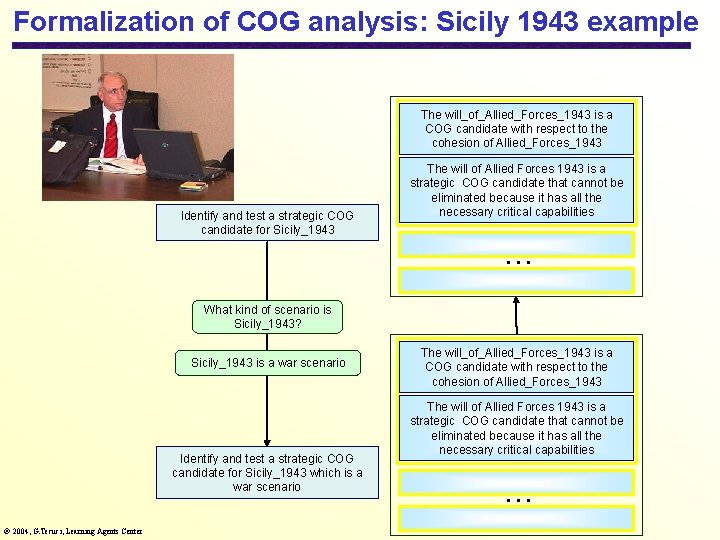
Formalization of COG analysis: Sicily 1943 example The will_of_Allied_Forces_1943 is a COG candidate with respect to the cohesion of Allied_Forces_1943 Identify and test a strategic COG candidate for Sicily_1943 The will of Allied Forces 1943 is a strategic COG candidate that cannot be eliminated because it has all the necessary critical capabilities . . . What kind of scenario is Sicily_1943? Sicily_1943 is a war scenario Identify and test a strategic COG candidate for Sicily_1943 which is a war scenario 2004, G. Tecuci, Learning Agents Center The will_of_Allied_Forces_1943 is a COG candidate with respect to the cohesion of Allied_Forces_1943 The will of Allied Forces 1943 is a strategic COG candidate that cannot be eliminated because it has all the necessary critical capabilities . . .
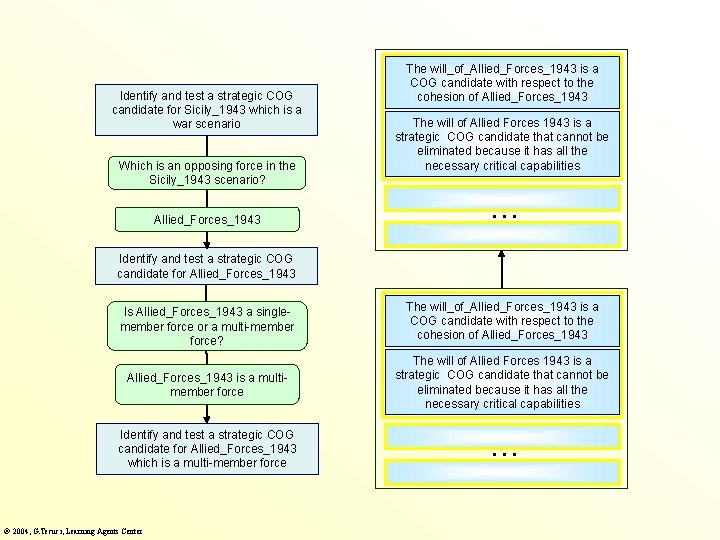
Identify and test a strategic COG candidate for Sicily_1943 which is a war scenario Which is an opposing force in the Sicily_1943 scenario? Allied_Forces_1943 The will_of_Allied_Forces_1943 is a COG candidate with respect to the cohesion of Allied_Forces_1943 The will of Allied Forces 1943 is a strategic COG candidate that cannot be eliminated because it has all the necessary critical capabilities . . . Identify and test a strategic COG candidate for Allied_Forces_1943 Is Allied_Forces_1943 a singlemember force or a multi-member force? The will_of_Allied_Forces_1943 is a COG candidate with respect to the cohesion of Allied_Forces_1943 is a multimember force The will of Allied Forces 1943 is a strategic COG candidate that cannot be eliminated because it has all the necessary critical capabilities Identify and test a strategic COG candidate for Allied_Forces_1943 which is a multi-member force . . . 2004, G. Tecuci, Learning Agents Center
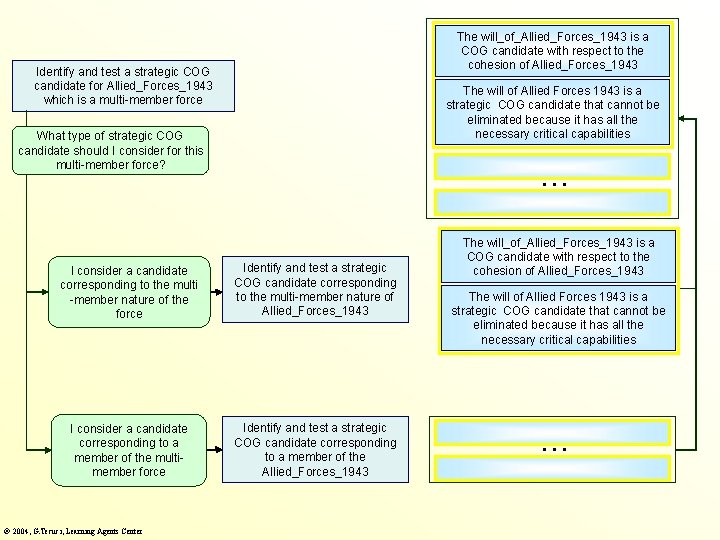
The will_of_Allied_Forces_1943 is a COG candidate with respect to the cohesion of Allied_Forces_1943 Identify and test a strategic COG candidate for Allied_Forces_1943 which is a multi-member force The will of Allied Forces 1943 is a strategic COG candidate that cannot be eliminated because it has all the necessary critical capabilities What type of strategic COG candidate should I consider for this multi-member force? . . . I consider a candidate corresponding to the multi -member nature of the force Identify and test a strategic COG candidate corresponding to the multi-member nature of Allied_Forces_1943 I consider a candidate corresponding to a member of the multimember force Identify and test a strategic COG candidate corresponding to a member of the Allied_Forces_1943 2004, G. Tecuci, Learning Agents Center The will_of_Allied_Forces_1943 is a COG candidate with respect to the cohesion of Allied_Forces_1943 The will of Allied Forces 1943 is a strategic COG candidate that cannot be eliminated because it has all the necessary critical capabilities . . .
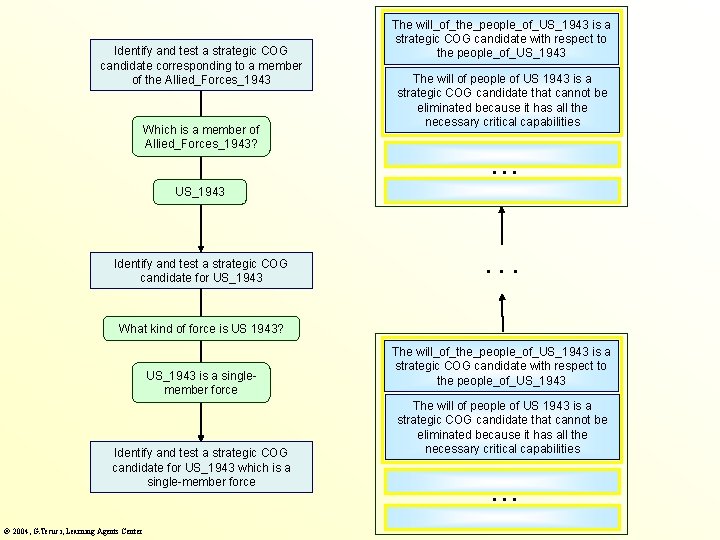
Identify and test a strategic COG candidate corresponding to a member of the Allied_Forces_1943 Which is a member of Allied_Forces_1943? The will_of_the_people_of_US_1943 is a strategic COG candidate with respect to the people_of_US_1943 The will of people of US 1943 is a strategic COG candidate that cannot be eliminated because it has all the necessary critical capabilities . . . US_1943 Identify and test a strategic COG candidate for US_1943 . . . What kind of force is US 1943? US_1943 is a singlemember force Identify and test a strategic COG candidate for US_1943 which is a single-member force 2004, G. Tecuci, Learning Agents Center The will_of_the_people_of_US_1943 is a strategic COG candidate with respect to the people_of_US_1943 The will of people of US 1943 is a strategic COG candidate that cannot be eliminated because it has all the necessary critical capabilities . . .
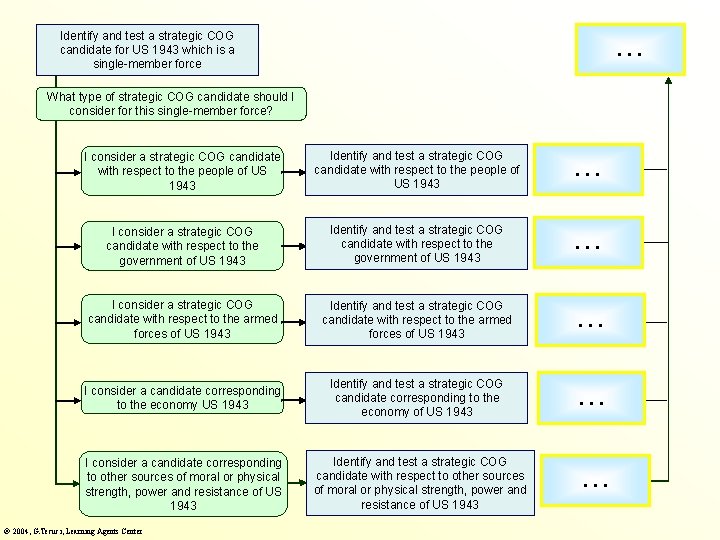
Identify and test a strategic COG candidate for US 1943 which is a single-member force . . . What type of strategic COG candidate should I consider for this single-member force? I consider a strategic COG candidate with respect to the people of US 1943 Identify and test a strategic COG candidate with respect to the people of US 1943 . . . I consider a strategic COG candidate with respect to the government of US 1943 Identify and test a strategic COG candidate with respect to the government of US 1943 . . . I consider a strategic COG candidate with respect to the armed forces of US 1943 Identify and test a strategic COG candidate with respect to the armed forces of US 1943 . . . I consider a candidate corresponding to the economy US 1943 Identify and test a strategic COG candidate corresponding to the economy of US 1943 . . . I consider a candidate corresponding to other sources of moral or physical strength, power and resistance of US 1943 Identify and test a strategic COG candidate with respect to other sources of moral or physical strength, power and resistance of US 1943 2004, G. Tecuci, Learning Agents Center . . .
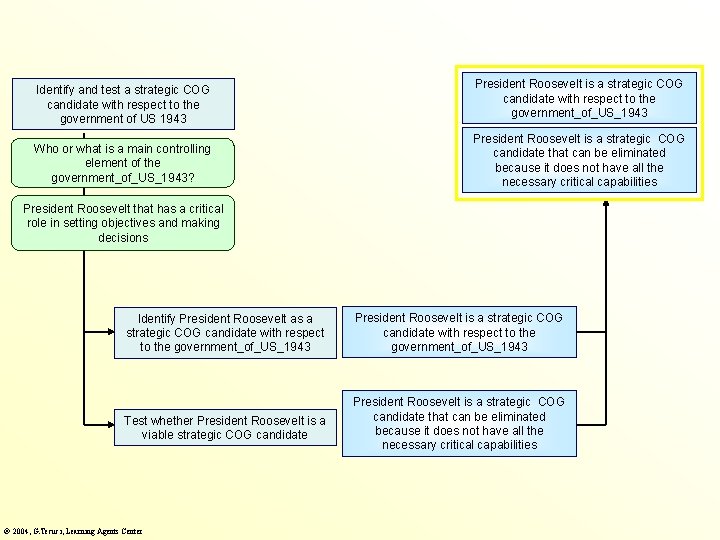
Identify and test a strategic COG candidate with respect to the government of US 1943 President Roosevelt is a strategic COG candidate with respect to the government_of_US_1943 Who or what is a main controlling element of the government_of_US_1943? President Roosevelt is a strategic COG candidate that can be eliminated because it does not have all the necessary critical capabilities President Roosevelt that has a critical role in setting objectives and making decisions Identify President Roosevelt as a strategic COG candidate with respect to the government_of_US_1943 President Roosevelt is a strategic COG candidate with respect to the government_of_US_1943 Test whether President Roosevelt is a viable strategic COG candidate President Roosevelt is a strategic COG candidate that can be eliminated because it does not have all the necessary critical capabilities 2004, G. Tecuci, Learning Agents Center
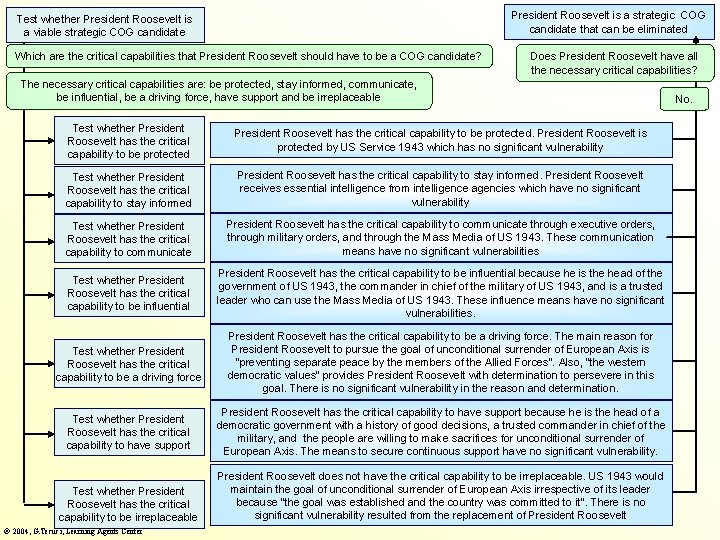
President Roosevelt is a strategic COG candidate that can be eliminated Test whether President Roosevelt is a viable strategic COG candidate Which are the critical capabilities that President Roosevelt should have to be a COG candidate? Does President Roosevelt have all the necessary critical capabilities? The necessary critical capabilities are: be protected, stay informed, communicate, be influential, be a driving force, have support and be irreplaceable Test whether President Roosevelt has the critical capability to be protected. President Roosevelt is protected by US Service 1943 which has no significant vulnerability Test whether President Roosevelt has the critical capability to stay informed. President Roosevelt receives essential intelligence from intelligence agencies which have no significant vulnerability Test whether President Roosevelt has the critical capability to communicate through executive orders, through military orders, and through the Mass Media of US 1943. These communication means have no significant vulnerabilities Test whether President Roosevelt has the critical capability to be influential because he is the head of the government of US 1943, the commander in chief of the military of US 1943, and is a trusted leader who can use the Mass Media of US 1943. These influence means have no significant vulnerabilities. Test whether President Roosevelt has the critical capability to be a driving force. The main reason for President Roosevelt to pursue the goal of unconditional surrender of European Axis is “preventing separate peace by the members of the Allied Forces”. Also, “the western democratic values” provides President Roosevelt with determination to persevere in this goal. There is no significant vulnerability in the reason and determination. Test whether President Roosevelt has the critical capability to have support because he is the head of a democratic government with a history of good decisions, a trusted commander in chief of the military, and the people are willing to make sacrifices for unconditional surrender of European Axis. The means to secure continuous support have no significant vulnerability. Test whether President Roosevelt has the critical capability to be irreplaceable 2004, G. Tecuci, Learning Agents Center President Roosevelt does not have the critical capability to be irreplaceable. US 1943 would maintain the goal of unconditional surrender of European Axis irrespective of its leader because “the goal was established and the country was committed to it”. There is no significant vulnerability resulted from the replacement of President Roosevelt No.
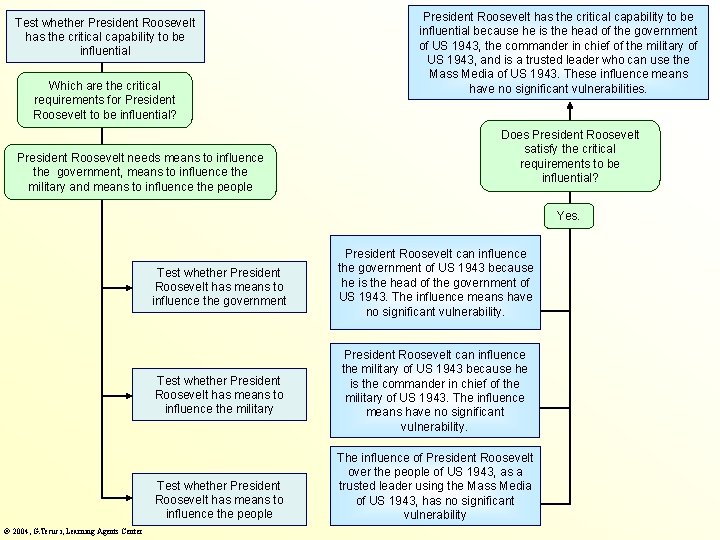
Test whether President Roosevelt has the critical capability to be influential Which are the critical requirements for President Roosevelt to be influential? President Roosevelt needs means to influence the government, means to influence the military and means to influence the people President Roosevelt has the critical capability to be influential because he is the head of the government of US 1943, the commander in chief of the military of US 1943, and is a trusted leader who can use the Mass Media of US 1943. These influence means have no significant vulnerabilities. Does President Roosevelt satisfy the critical requirements to be influential? Yes. Test whether President Roosevelt has means to influence the government President Roosevelt can influence the government of US 1943 because he is the head of the government of US 1943. The influence means have no significant vulnerability. Test whether President Roosevelt has means to influence the military President Roosevelt can influence the military of US 1943 because he is the commander in chief of the military of US 1943. The influence means have no significant vulnerability. Test whether President Roosevelt has means to influence the people 2004, G. Tecuci, Learning Agents Center The influence of President Roosevelt over the people of US 1943, as a trusted leader using the Mass Media of US 1943, has no significant vulnerability
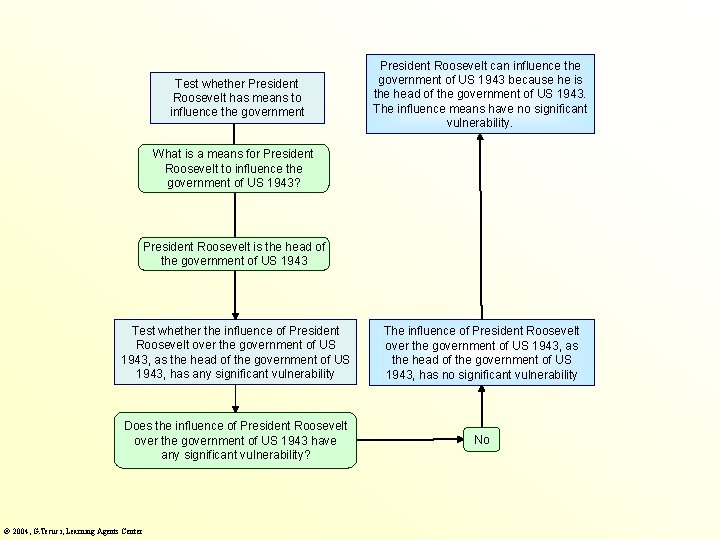
Test whether President Roosevelt has means to influence the government President Roosevelt can influence the government of US 1943 because he is the head of the government of US 1943. The influence means have no significant vulnerability. What is a means for President Roosevelt to influence the government of US 1943? President Roosevelt is the head of the government of US 1943 Test whether the influence of President Roosevelt over the government of US 1943, as the head of the government of US 1943, has any significant vulnerability The influence of President Roosevelt over the government of US 1943, as the head of the government of US 1943, has no significant vulnerability Does the influence of President Roosevelt over the government of US 1943 have any significant vulnerability? No 2004, G. Tecuci, Learning Agents Center
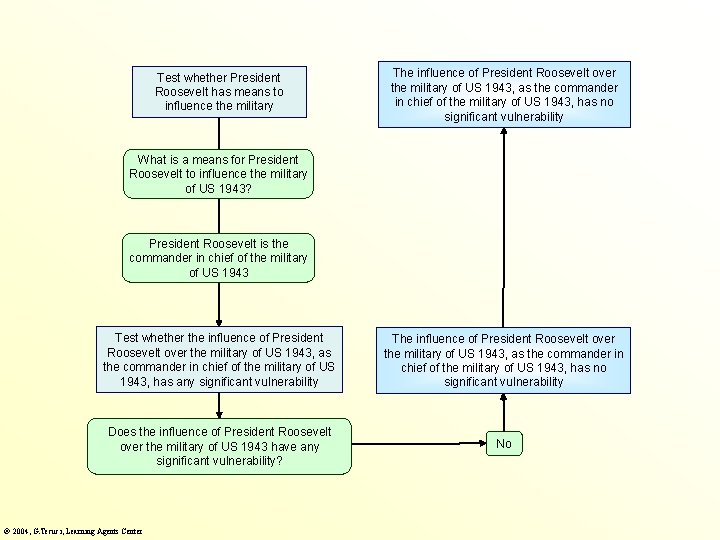
Test whether President Roosevelt has means to influence the military The influence of President Roosevelt over the military of US 1943, as the commander in chief of the military of US 1943, has no significant vulnerability What is a means for President Roosevelt to influence the military of US 1943? President Roosevelt is the commander in chief of the military of US 1943 Test whether the influence of President Roosevelt over the military of US 1943, as the commander in chief of the military of US 1943, has any significant vulnerability The influence of President Roosevelt over the military of US 1943, as the commander in chief of the military of US 1943, has no significant vulnerability Does the influence of President Roosevelt over the military of US 1943 have any significant vulnerability? No 2004, G. Tecuci, Learning Agents Center
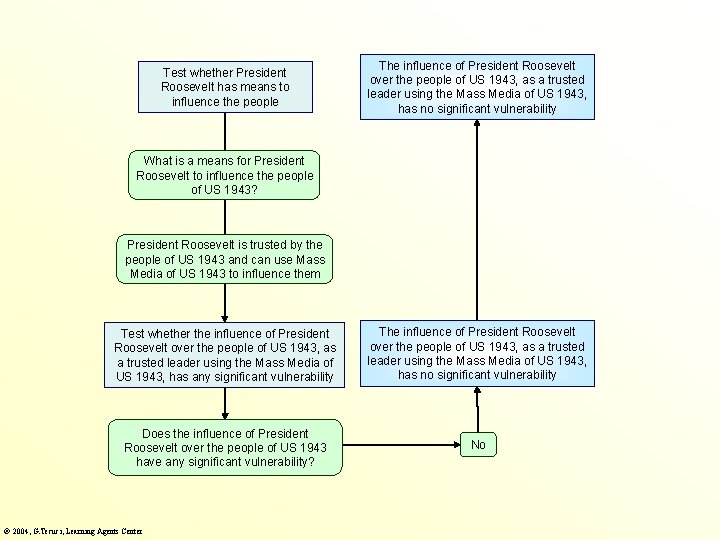
Test whether President Roosevelt has means to influence the people The influence of President Roosevelt over the people of US 1943, as a trusted leader using the Mass Media of US 1943, has no significant vulnerability What is a means for President Roosevelt to influence the people of US 1943? President Roosevelt is trusted by the people of US 1943 and can use Mass Media of US 1943 to influence them Test whether the influence of President Roosevelt over the people of US 1943, as a trusted leader using the Mass Media of US 1943, has any significant vulnerability The influence of President Roosevelt over the people of US 1943, as a trusted leader using the Mass Media of US 1943, has no significant vulnerability Does the influence of President Roosevelt over the people of US 1943 have any significant vulnerability? No 2004, G. Tecuci, Learning Agents Center
Overview Modeling based on the task reduction paradigm COG analysis through task reduction Intelligence analysis through task reduction COA critiquing through task reduction Workaround planning through task reduction Guidelines for the modeling process 2004, G. Tecuci, Learning Agents Center
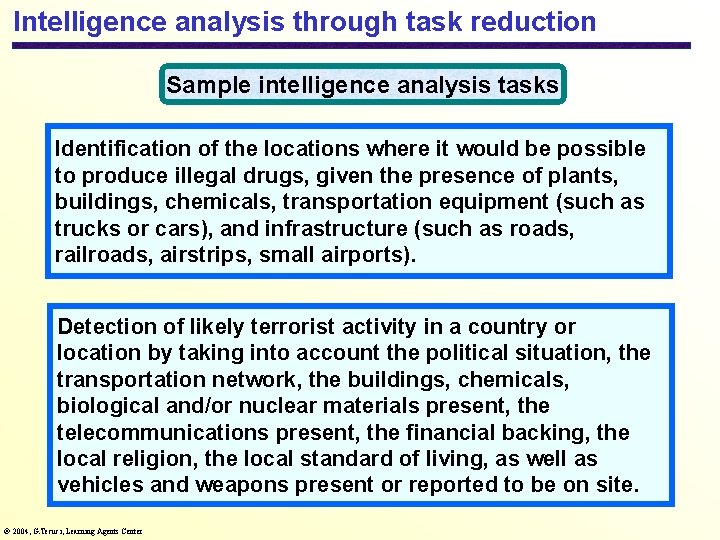
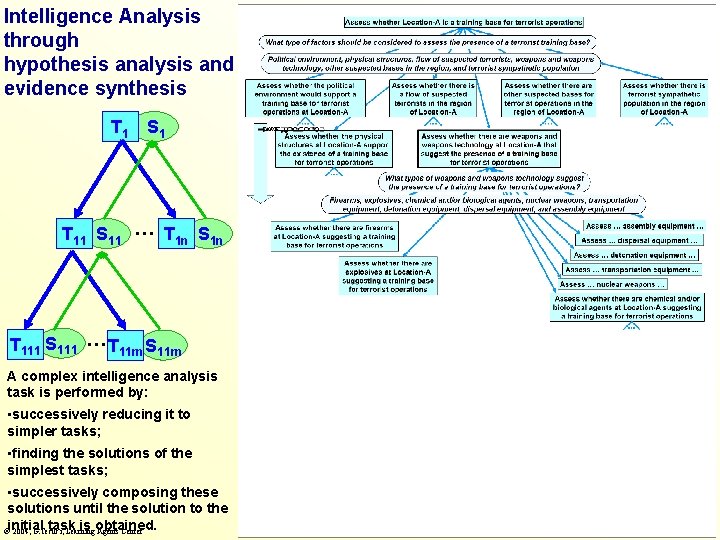
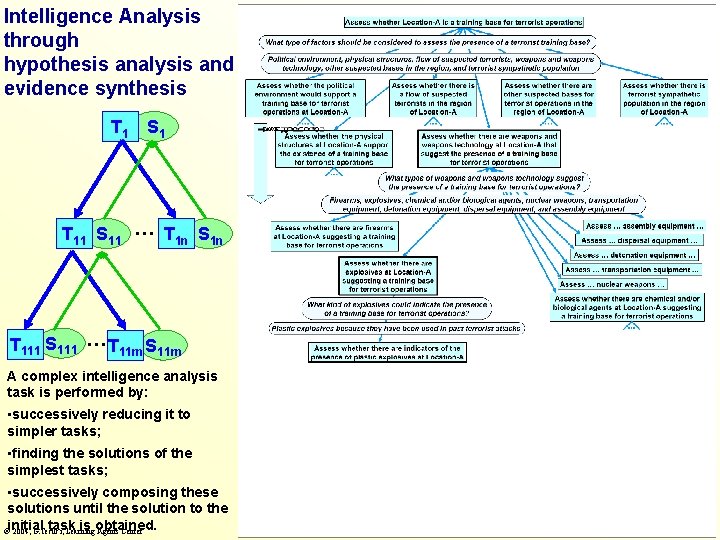
Intelligence analysis through task reduction Sample intelligence analysis tasks Identification of the locations where it would be possible to produce illegal drugs, given the presence of plants, buildings, chemicals, transportation equipment (such as trucks or cars), and infrastructure (such as roads, railroads, airstrips, small airports). Detection of likely terrorist activity in a country or location by taking into account the political situation, the transportation network, the buildings, chemicals, biological and/or nuclear materials present, the telecommunications present, the financial backing, the local religion, the local standard of living, as well as vehicles and weapons present or reported to be on site. 2004, G. Tecuci, Learning Agents Center
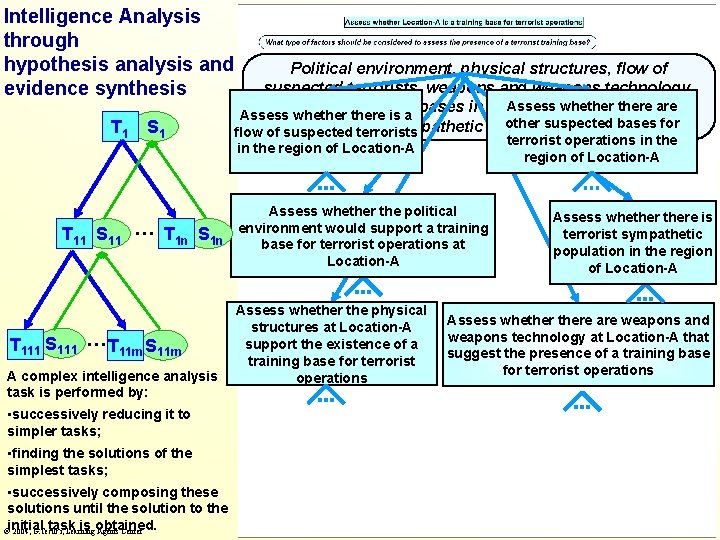
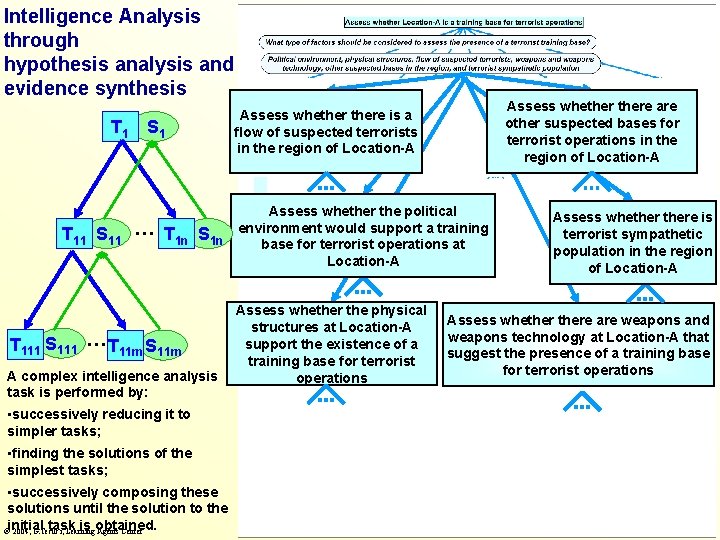
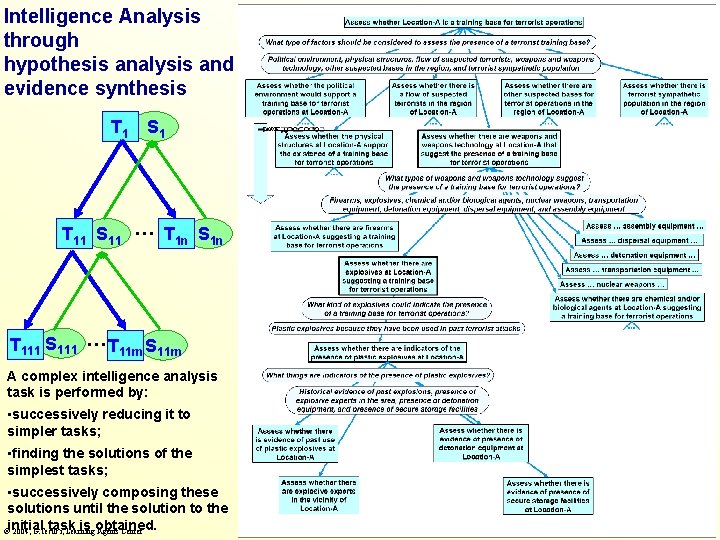
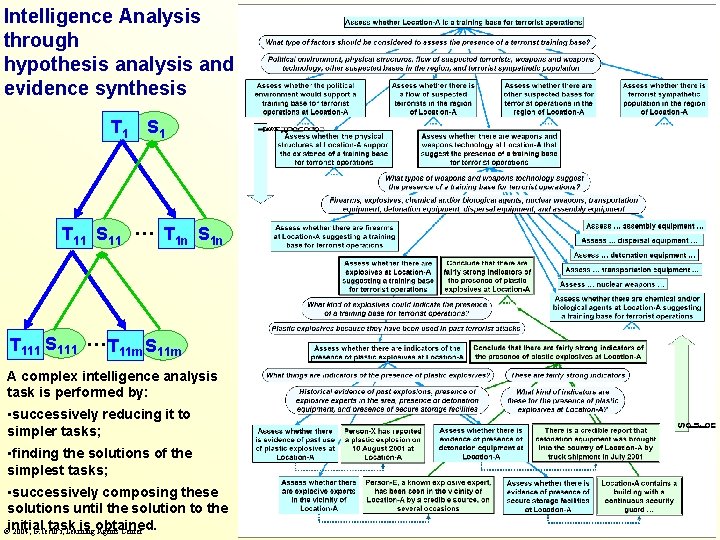
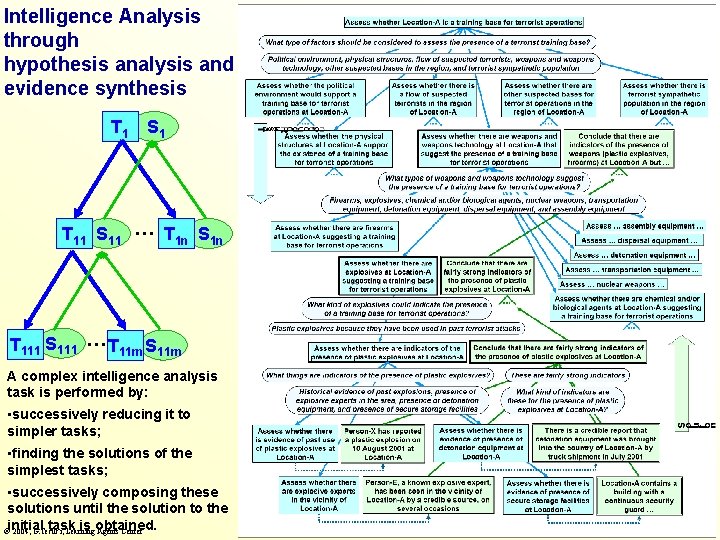
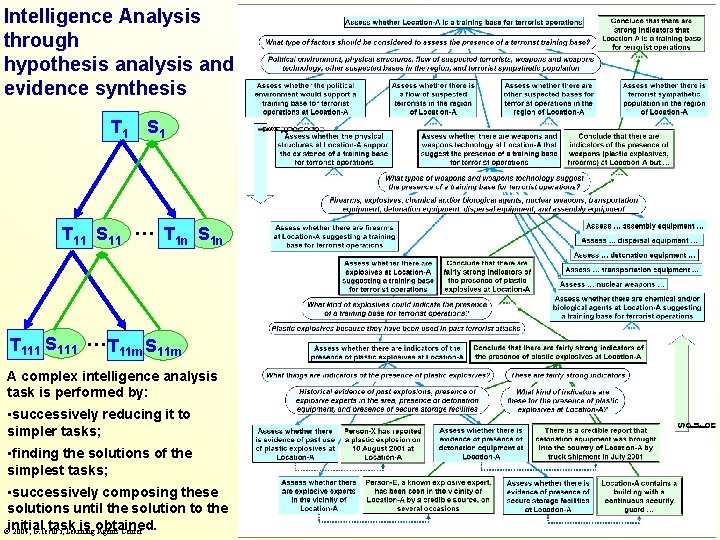
Intelligence Analysis through hypothesis analysis and evidence synthesis T 1 S 1 T 11 S 11 … T 1 n S 1 n T 111 S 111 … T 11 m S 11 m A complex intelligence analysis task is performed by: • successively reducing it to simpler tasks; • finding the solutions of the simplest tasks; • successively composing these solutions until the solution to the initial task is obtained. 2004, G. Tecuci, Learning Agents Center
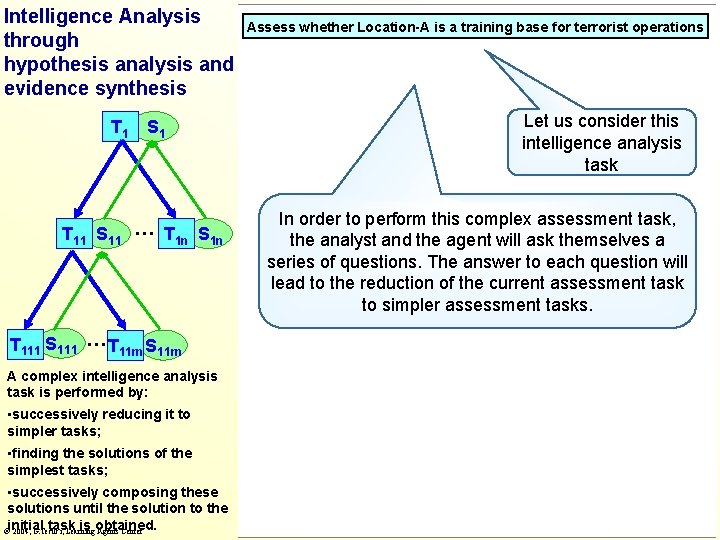
Intelligence Analysis through hypothesis analysis and evidence synthesis T 11 S 1 … T S 1 n 1 n T 111 S 111 … T 11 m S 11 m A complex intelligence analysis task is performed by: • successively reducing it to simpler tasks; • finding the solutions of the simplest tasks; • successively composing these solutions until the solution to the initial task is obtained. 2004, G. Tecuci, Learning Agents Center Assess whether Location-A is a training base for terrorist operations Let us consider this intelligence analysis task In order to perform this complex assessment task, the analyst and the agent will ask themselves a series of questions. The answer to each question will lead to the reduction of the current assessment task to simpler assessment tasks.
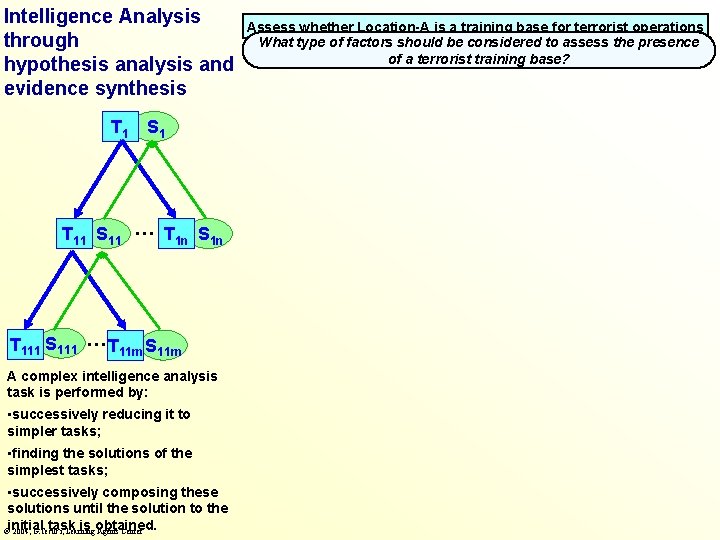
Intelligence Analysis through hypothesis analysis and evidence synthesis T 1 S 1 T 11 S 11 … T 1 n S 1 n T 111 S 111 … T 11 m S 11 m A complex intelligence analysis task is performed by: • successively reducing it to simpler tasks; • finding the solutions of the simplest tasks; • successively composing these solutions until the solution to the initial task is obtained. 2004, G. Tecuci, Learning Agents Center Assess whether Location-A is a training base for terrorist operations What type of factors should be considered to assess the presence of a terrorist training base?
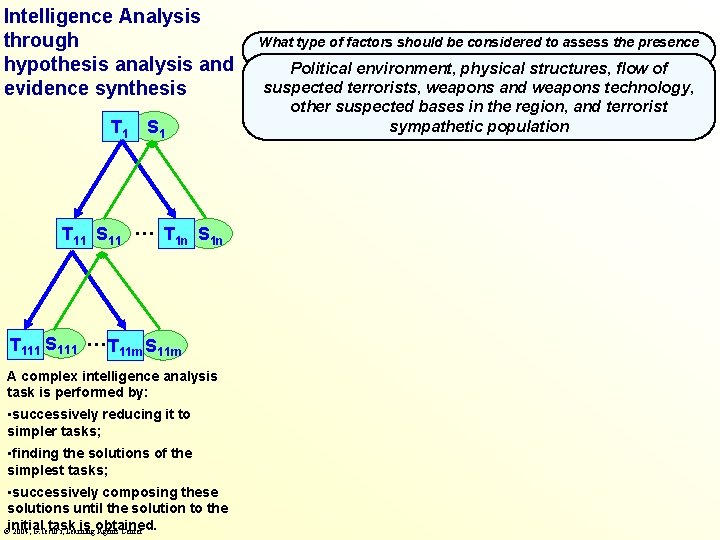
Intelligence Analysis through hypothesis analysis and evidence synthesis T 1 S 1 T 11 S 11 … T 1 n S 1 n T 111 S 111 … T 11 m S 11 m A complex intelligence analysis task is performed by: • successively reducing it to simpler tasks; • finding the solutions of the simplest tasks; • successively composing these solutions until the solution to the initial task is obtained. 2004, G. Tecuci, Learning Agents Center What type of factors should be considered to assess the presence of a terrorist training base? Political environment, physical structures, flow of suspected terrorists, weapons and weapons technology, other suspected bases in the region, and terrorist sympathetic population
Intelligence Analysis through hypothesis analysis and evidence synthesis T 1 S 1 Political environment, physical structures, flow of suspected terrorists, weapons and weapons technology, whethere are other suspected bases in the. Assess region, and terrorist Assess whethere is a other suspected bases for sympathetic population flow of suspected terrorists terrorist operations in the region of Location-A T 11 S 11 … Assess whether the political T 1 n S 1 n environment would support a training base for terrorist operations at Location-A T 111 S 111 … T 11 m S 11 m A complex intelligence analysis task is performed by: • successively reducing it to simpler tasks; • finding the solutions of the simplest tasks; • successively composing these solutions until the solution to the initial task is obtained. 2004, G. Tecuci, Learning Agents Center Assess whether the physical structures at Location-A support the existence of a training base for terrorist operations Assess whethere is terrorist sympathetic population in the region of Location-A Assess whethere are weapons and weapons technology at Location-A that suggest the presence of a training base for terrorist operations
Intelligence Analysis through hypothesis analysis and evidence synthesis T 11 S 1 … Assess whethere are other suspected bases for terrorist operations in the region of Location-A Assess whethere is a flow of suspected terrorists in the region of Location-A Assess whether the political T 1 n S 1 n environment would support a training base for terrorist operations at Location-A T 111 S 111 … T 11 m S 11 m A complex intelligence analysis task is performed by: • successively reducing it to simpler tasks; • finding the solutions of the simplest tasks; • successively composing these solutions until the solution to the initial task is obtained. 2004, G. Tecuci, Learning Agents Center Assess whether the physical structures at Location-A support the existence of a training base for terrorist operations Assess whethere is terrorist sympathetic population in the region of Location-A Assess whethere are weapons and weapons technology at Location-A that suggest the presence of a training base for terrorist operations
Intelligence Analysis through hypothesis analysis and evidence synthesis T 1 S 1 T 11 S 11 … T 1 n S 1 n T 111 S 111 … T 11 m S 11 m A complex intelligence analysis task is performed by: • successively reducing it to simpler tasks; • finding the solutions of the simplest tasks; • successively composing these solutions until the solution to the initial task is obtained. 2004, G. Tecuci, Learning Agents Center
Intelligence Analysis through hypothesis analysis and evidence synthesis T 1 S 1 T 11 S 11 … T 1 n S 1 n T 111 S 111 … T 11 m S 11 m A complex intelligence analysis task is performed by: • successively reducing it to simpler tasks; • finding the solutions of the simplest tasks; • successively composing these solutions until the solution to the initial task is obtained. 2004, G. Tecuci, Learning Agents Center
Intelligence Analysis through hypothesis analysis and evidence synthesis T 1 S 1 T 11 S 11 … T 1 n S 1 n T 111 S 111 … T 11 m S 11 m A complex intelligence analysis task is performed by: • successively reducing it to simpler tasks; • finding the solutions of the simplest tasks; • successively composing these solutions until the solution to the initial task is obtained. 2004, G. Tecuci, Learning Agents Center
Intelligence Analysis through hypothesis analysis and evidence synthesis T 1 S 1 T 11 S 11 … T 1 n S 1 n T 111 S 111 … T 11 m S 11 m A complex intelligence analysis task is performed by: • successively reducing it to simpler tasks; • finding the solutions of the simplest tasks; • successively composing these solutions until the solution to the initial task is obtained. 2004, G. Tecuci, Learning Agents Center
Intelligence Analysis through hypothesis analysis and evidence synthesis T 1 S 1 T 11 S 11 … T 1 n S 1 n T 111 S 111 … T 11 m S 11 m A complex intelligence analysis task is performed by: • successively reducing it to simpler tasks; • finding the solutions of the simplest tasks; • successively composing these solutions until the solution to the initial task is obtained. 2004, G. Tecuci, Learning Agents Center
Intelligence Analysis through hypothesis analysis and evidence synthesis T 1 S 1 T 11 S 11 … T 1 n S 1 n T 111 S 111 … T 11 m S 11 m A complex intelligence analysis task is performed by: • successively reducing it to simpler tasks; • finding the solutions of the simplest tasks; • successively composing these solutions until the solution to the initial task is obtained. 2004, G. Tecuci, Learning Agents Center
Intelligence Analysis through hypothesis analysis and evidence synthesis T 1 S 1 T 11 S 11 … T 1 n S 1 n T 111 S 111 … T 11 m S 11 m A complex intelligence analysis task is performed by: • successively reducing it to simpler tasks; • finding the solutions of the simplest tasks; • successively composing these solutions until the solution to the initial task is obtained. 2004, G. Tecuci, Learning Agents Center
Intelligence Analysis through hypothesis analysis and evidence synthesis T 1 S 1 T 11 S 11 … T 1 n S 1 n T 111 S 111 … T 11 m S 11 m A complex intelligence analysis task is performed by: • successively reducing it to simpler tasks; • finding the solutions of the simplest tasks; • successively composing these solutions until the solution to the initial task is obtained. 2004, G. Tecuci, Learning Agents Center
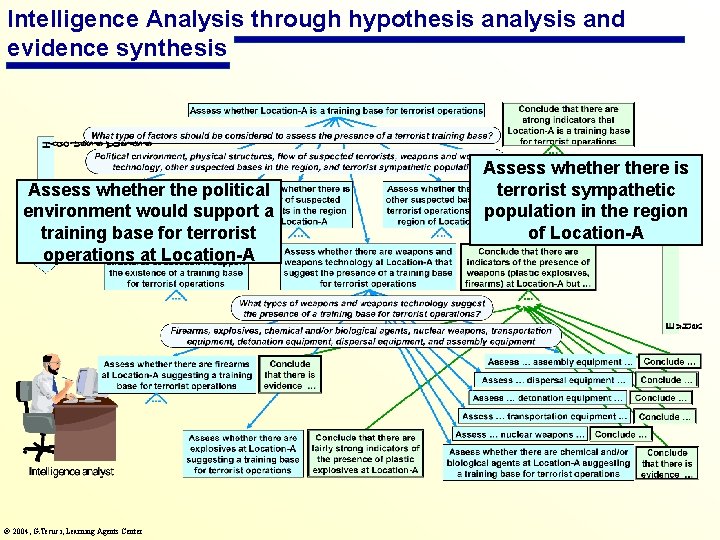
Intelligence Analysis through hypothesis analysis and evidence synthesis Assess whether the political environment would support a training base for terrorist operations at Location-A 2004, G. Tecuci, Learning Agents Center Assess whethere is terrorist sympathetic population in the region of Location-A
Overview Modeling based on the task reduction paradigm COG analysis through task reduction Intelligence analysis through task reduction COA critiquing through task reduction Workaround planning through task reduction Guidelines for the modeling process 2004, G. Tecuci, Learning Agents Center
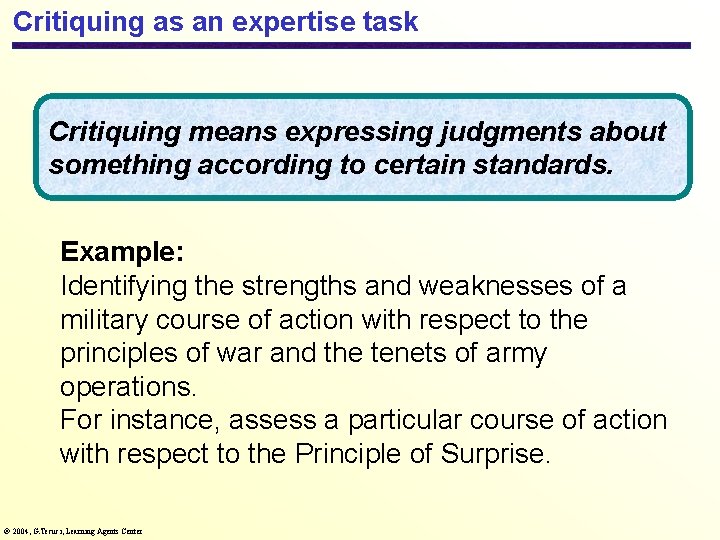
Critiquing as an expertise task Critiquing means expressing judgments about something according to certain standards. Example: Identifying the strengths and weaknesses of a military course of action with respect to the principles of war and the tenets of army operations. For instance, assess a particular course of action with respect to the Principle of Surprise. 2004, G. Tecuci, Learning Agents Center
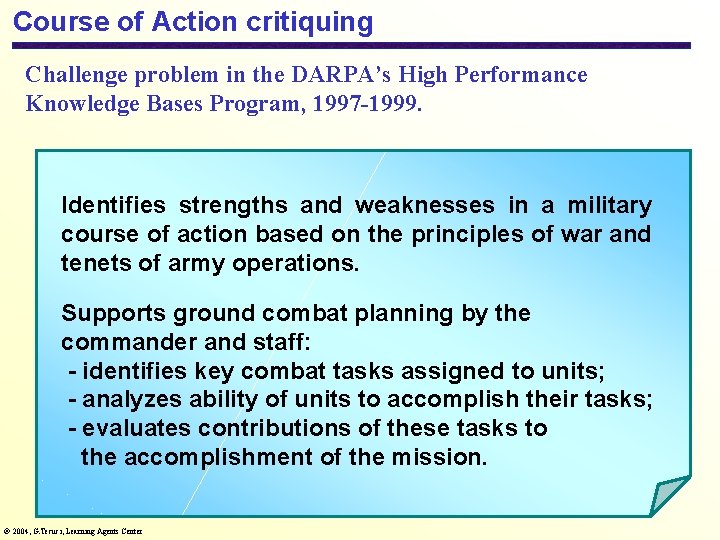
Course of Action critiquing Challenge problem in the DARPA’s High Performance Knowledge Bases Program, 1997 -1999. Identifies strengths and weaknesses in a military course of action based on the principles of war and tenets of army operations. Supports ground combat planning by the commander and staff: - identifies key combat tasks assigned to units; - analyzes ability of units to accomplish their tasks; - evaluates contributions of these tasks to the accomplishment of the mission. 2004, G. Tecuci, Learning Agents Center
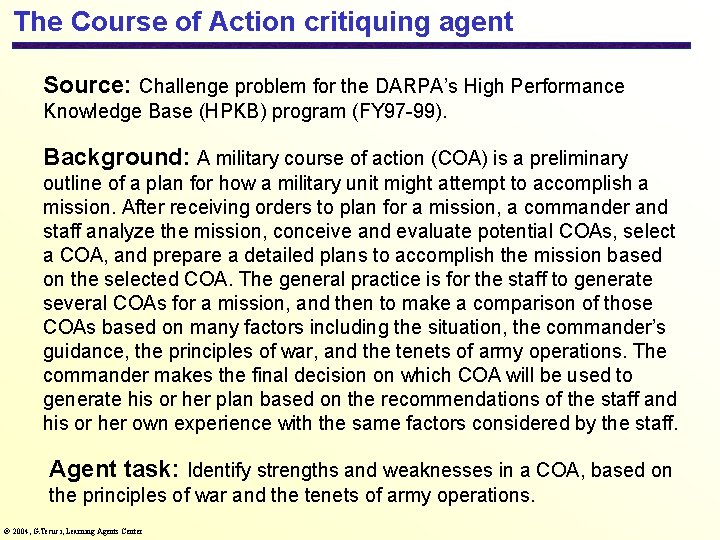
The Course of Action critiquing agent Source: Challenge problem for the DARPA’s High Performance Knowledge Base (HPKB) program (FY 97 -99). Background: A military course of action (COA) is a preliminary outline of a plan for how a military unit might attempt to accomplish a mission. After receiving orders to plan for a mission, a commander and staff analyze the mission, conceive and evaluate potential COAs, select a COA, and prepare a detailed plans to accomplish the mission based on the selected COA. The general practice is for the staff to generate several COAs for a mission, and then to make a comparison of those COAs based on many factors including the situation, the commander’s guidance, the principles of war, and the tenets of army operations. The commander makes the final decision on which COA will be used to generate his or her plan based on the recommendations of the staff and his or her own experience with the same factors considered by the staff. Agent task: Identify strengths and weaknesses in a COA, based on the principles of war and the tenets of army operations. 2004, G. Tecuci, Learning Agents Center
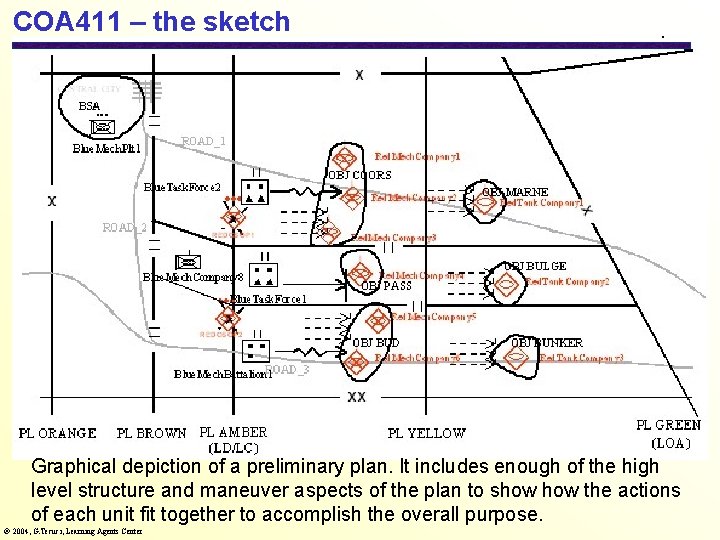
COA 411 – the sketch Graphical depiction of a preliminary plan. It includes enough of the high level structure and maneuver aspects of the plan to show the actions of each unit fit together to accomplish the overall purpose. 2004, G. Tecuci, Learning Agents Center
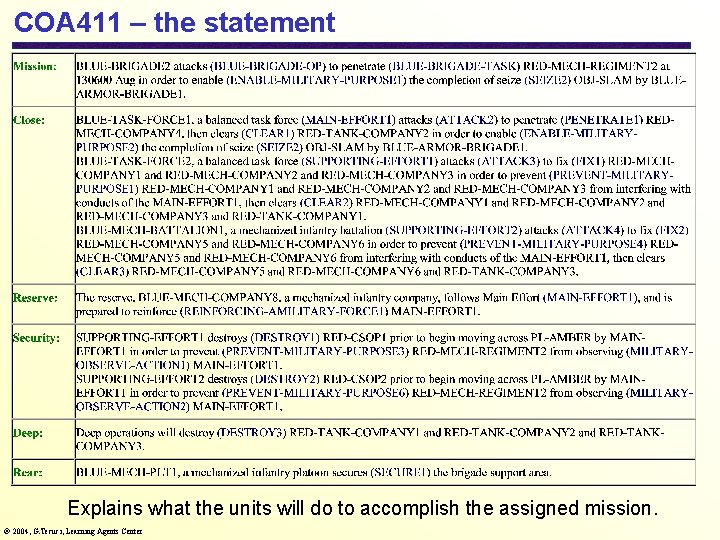
COA 411 – the statement Explains what the units will do to accomplish the assigned mission. 2004, G. Tecuci, Learning Agents Center
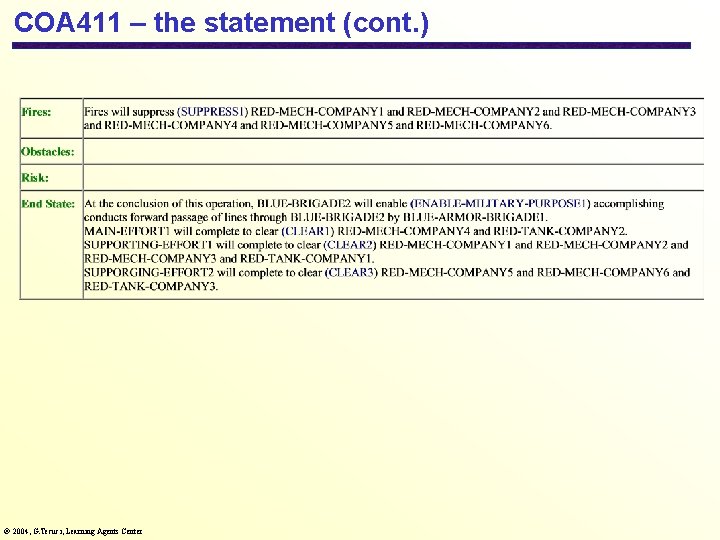
COA 411 – the statement (cont. ) 2004, G. Tecuci, Learning Agents Center
COA critiquing task Answer each of the following questions: 2004, G. Tecuci, Learning Agents Center
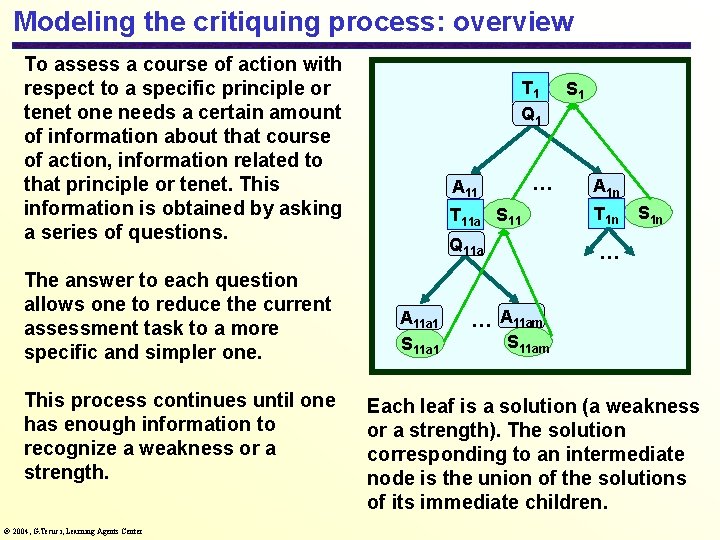
Modeling the critiquing process: overview To assess a course of action with respect to a specific principle or tenet one needs a certain amount of information about that course of action, information related to that principle or tenet. This information is obtained by asking a series of questions. The answer to each question allows one to reduce the current assessment task to a more specific and simpler one. This process continues until one has enough information to recognize a weakness or a strength. 2004, G. Tecuci, Learning Agents Center T 1 Q 1 A 11 a 1 S 11 a 1 … S 1 A 1 n T 11 a S 11 T 1 n Q 11 a … S 1 n … A 11 am S 11 am Each leaf is a solution (a weakness or a strength). The solution corresponding to an intermediate node is the union of the solutions of its immediate children.
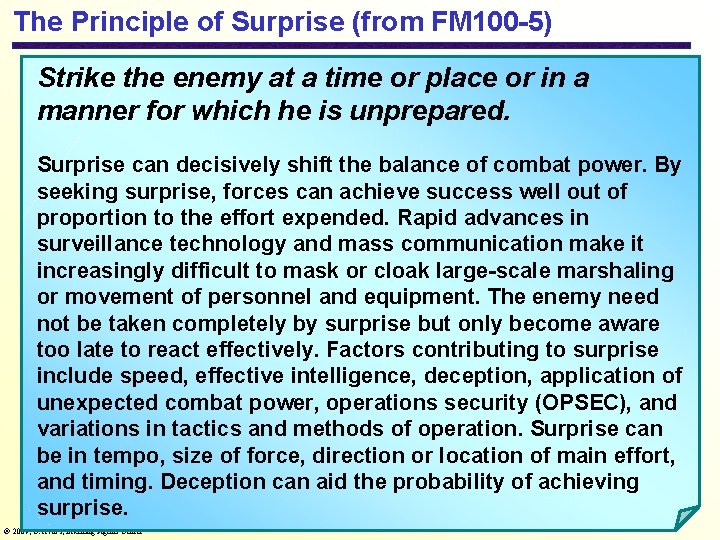
The Principle of Surprise (from FM 100 -5) Strike the enemy at a time or place or in a manner for which he is unprepared. Surprise can decisively shift the balance of combat power. By seeking surprise, forces can achieve success well out of proportion to the effort expended. Rapid advances in surveillance technology and mass communication make it increasingly difficult to mask or cloak large-scale marshaling or movement of personnel and equipment. The enemy need not be taken completely by surprise but only become aware too late to react effectively. Factors contributing to surprise include speed, effective intelligence, deception, application of unexpected combat power, operations security (OPSEC), and variations in tactics and methods of operation. Surprise can be in tempo, size of force, direction or location of main effort, and timing. Deception can aid the probability of achieving surprise. 2004, G. Tecuci, Learning Agents Center
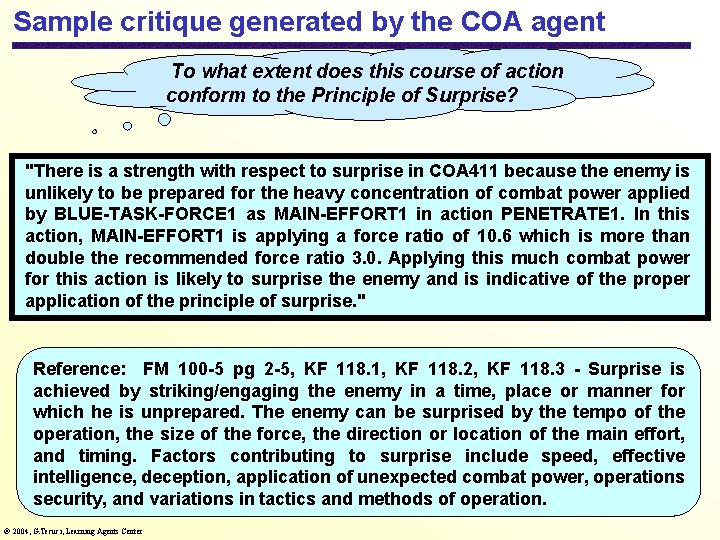
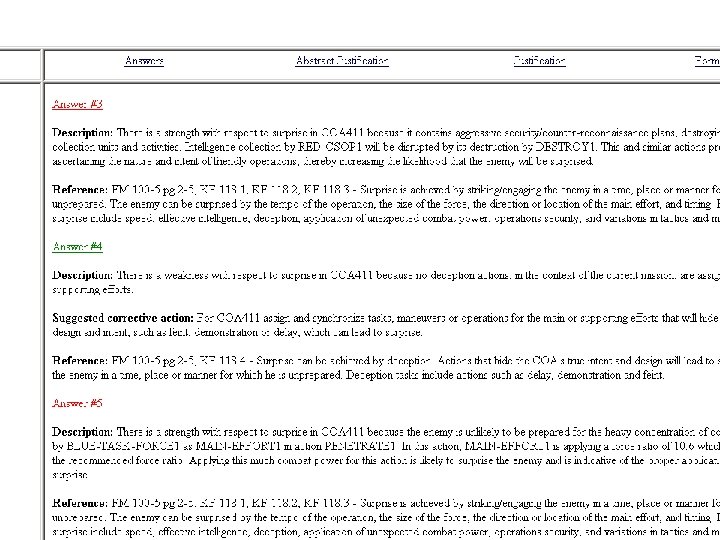
Sample critique generated by the COA agent To what extent does this course of action conform to the Principle of Surprise? "There is a strength with respect to surprise in COA 411 because the enemy is unlikely to be prepared for the heavy concentration of combat power applied by BLUE-TASK-FORCE 1 as MAIN-EFFORT 1 in action PENETRATE 1. In this action, MAIN-EFFORT 1 is applying a force ratio of 10. 6 which is more than double the recommended force ratio 3. 0. Applying this much combat power for this action is likely to surprise the enemy and is indicative of the proper application of the principle of surprise. " Reference: FM 100 -5 pg 2 -5, KF 118. 1, KF 118. 2, KF 118. 3 - Surprise is achieved by striking/engaging the enemy in a time, place or manner for which he is unprepared. The enemy can be surprised by the tempo of the operation, the size of the force, the direction or location of the main effort, and timing. Factors contributing to surprise include speed, effective intelligence, deception, application of unexpected combat power, operations security, and variations in tactics and methods of operation. 2004, G. Tecuci, Learning Agents Center
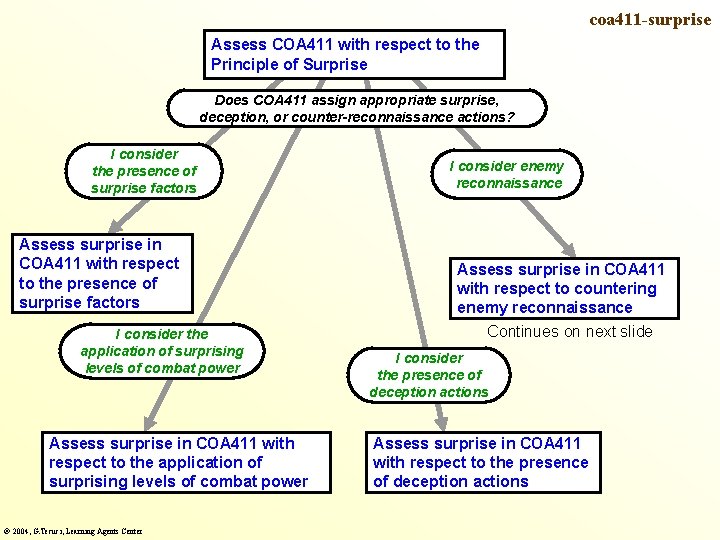
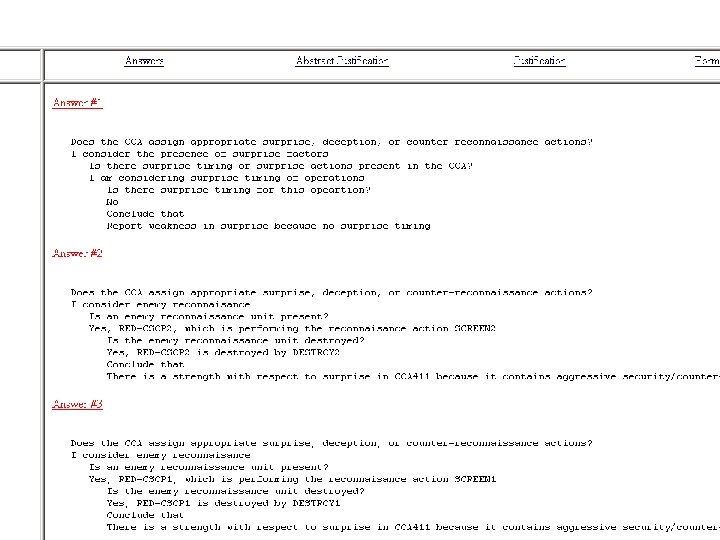
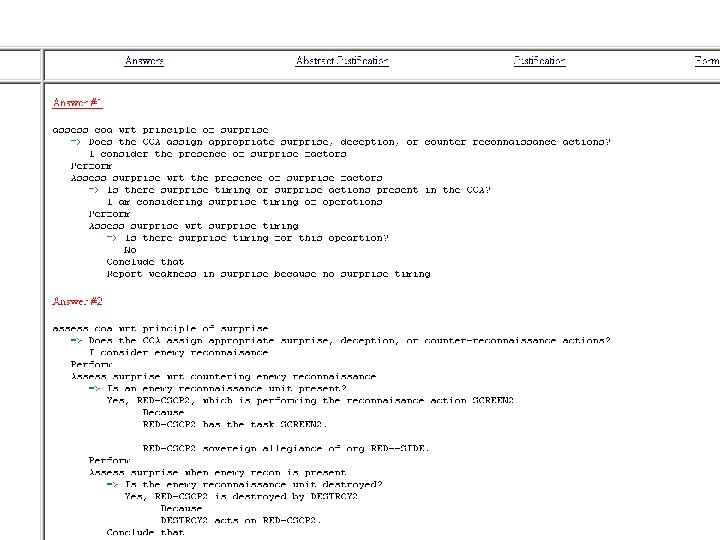
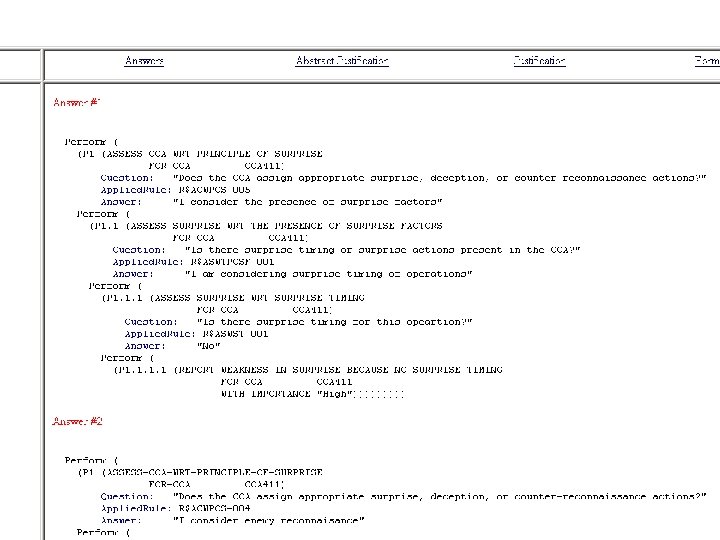
coa 411 -surprise Assess COA 411 with respect to the Principle of Surprise Does COA 411 assign appropriate surprise, deception, or counter-reconnaissance actions? I consider the presence of surprise factors Assess surprise in COA 411 with respect to the presence of surprise factors I consider the application of surprising levels of combat power Assess surprise in COA 411 with respect to the application of surprising levels of combat power 2004, G. Tecuci, Learning Agents Center I consider enemy reconnaissance Assess surprise in COA 411 with respect to countering enemy reconnaissance Continues on next slide I consider the presence of deception actions Assess surprise in COA 411 with respect to the presence of deception actions
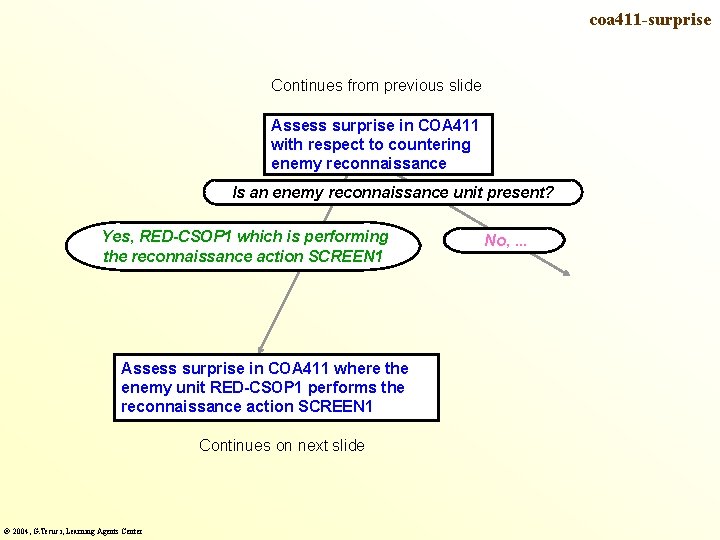
coa 411 -surprise Continues from previous slide Assess surprise in COA 411 with respect to countering enemy reconnaissance Is an enemy reconnaissance unit present? Yes, RED-CSOP 1 which is performing the reconnaissance action SCREEN 1 Assess surprise in COA 411 where the enemy unit RED-CSOP 1 performs the reconnaissance action SCREEN 1 Continues on next slide 2004, G. Tecuci, Learning Agents Center No, . . .
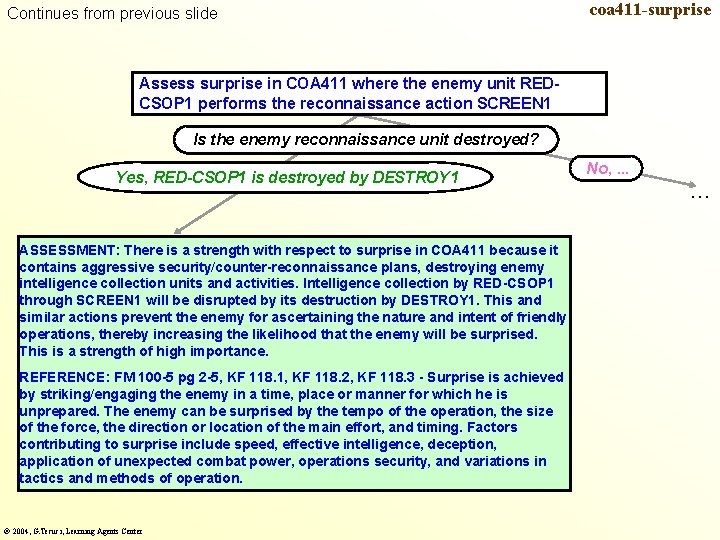
Continues from previous slide coa 411 -surprise Assess surprise in COA 411 where the enemy unit REDCSOP 1 performs the reconnaissance action SCREEN 1 Is the enemy reconnaissance unit destroyed? Yes, RED-CSOP 1 is destroyed by DESTROY 1 ASSESSMENT: There is a strength with respect to surprise in COA 411 because it contains aggressive security/counter-reconnaissance plans, destroying enemy intelligence collection units and activities. Intelligence collection by RED-CSOP 1 through SCREEN 1 will be disrupted by its destruction by DESTROY 1. This and similar actions prevent the enemy for ascertaining the nature and intent of friendly operations, thereby increasing the likelihood that the enemy will be surprised. This is a strength of high importance. REFERENCE: FM 100 -5 pg 2 -5, KF 118. 1, KF 118. 2, KF 118. 3 - Surprise is achieved by striking/engaging the enemy in a time, place or manner for which he is unprepared. The enemy can be surprised by the tempo of the operation, the size of the force, the direction or location of the main effort, and timing. Factors contributing to surprise include speed, effective intelligence, deception, application of unexpected combat power, operations security, and variations in tactics and methods of operation. 2004, G. Tecuci, Learning Agents Center No, . . . …
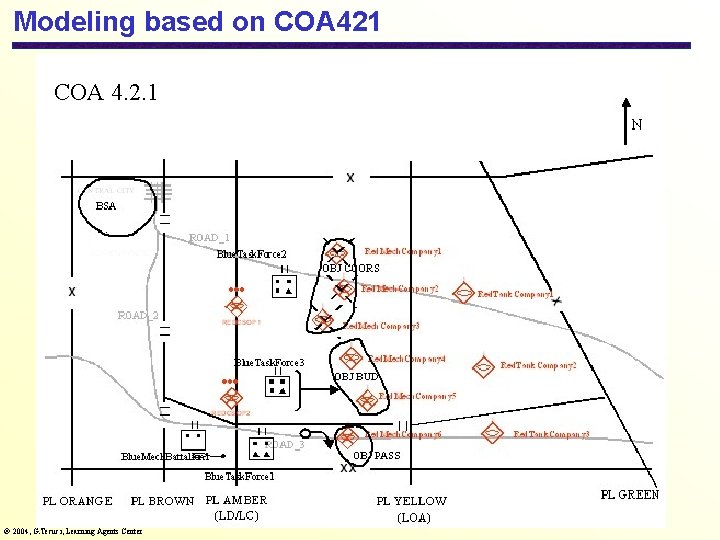
Modeling based on COA 421 COA 4. 2. 1 2004, G. Tecuci, Learning Agents Center
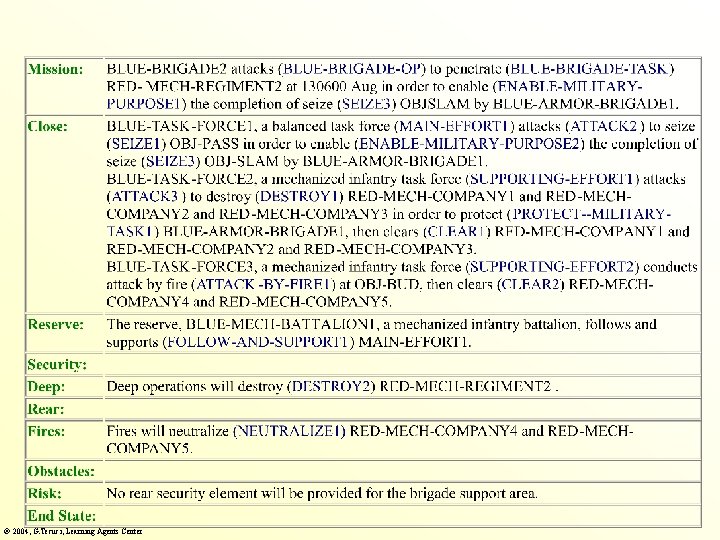
2004, G. Tecuci, Learning Agents Center
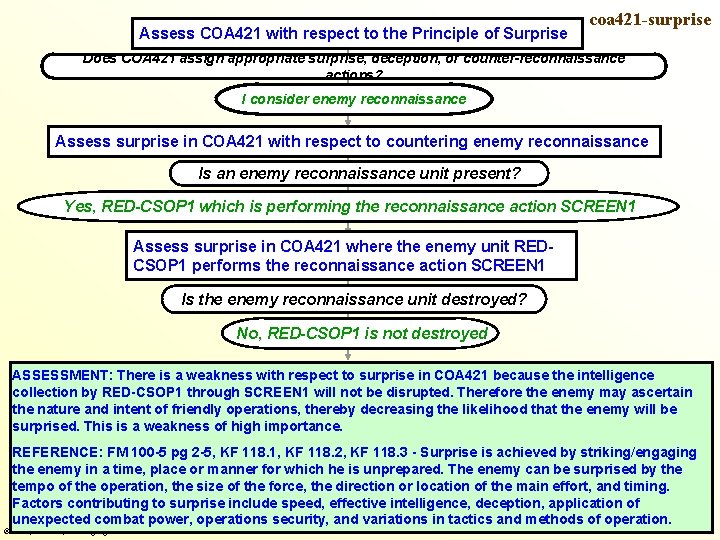
Assess COA 421 with respect to the Principle of Surprise coa 421 -surprise Does COA 421 assign appropriate surprise, deception, or counter-reconnaissance actions? I consider enemy reconnaissance Assess surprise in COA 421 with respect to countering enemy reconnaissance Is an enemy reconnaissance unit present? Yes, RED-CSOP 1 which is performing the reconnaissance action SCREEN 1 Assess surprise in COA 421 where the enemy unit REDCSOP 1 performs the reconnaissance action SCREEN 1 Is the enemy reconnaissance unit destroyed? No, RED-CSOP 1 is not destroyed ASSESSMENT: There is a weakness with respect to surprise in COA 421 because the intelligence collection by RED-CSOP 1 through SCREEN 1 will not be disrupted. Therefore the enemy may ascertain the nature and intent of friendly operations, thereby decreasing the likelihood that the enemy will be surprised. This is a weakness of high importance. REFERENCE: FM 100 -5 pg 2 -5, KF 118. 1, KF 118. 2, KF 118. 3 - Surprise is achieved by striking/engaging the enemy in a time, place or manner for which he is unprepared. The enemy can be surprised by the tempo of the operation, the size of the force, the direction or location of the main effort, and timing. Factors contributing to surprise include speed, effective intelligence, deception, application of unexpected combat power, operations security, and variations in tactics and methods of operation. 2004, G. Tecuci, Learning Agents Center
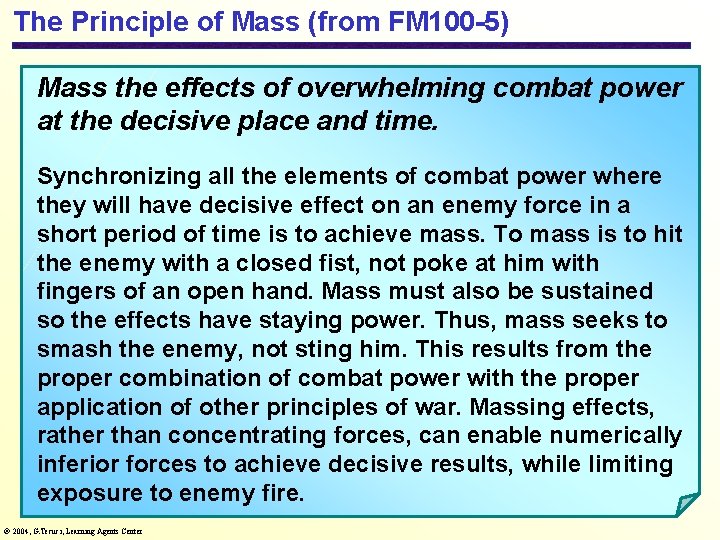
The Principle of Mass (from FM 100 -5) Mass the effects of overwhelming combat power at the decisive place and time. Synchronizing all the elements of combat power where they will have decisive effect on an enemy force in a short period of time is to achieve mass. To mass is to hit the enemy with a closed fist, not poke at him with fingers of an open hand. Mass must also be sustained so the effects have staying power. Thus, mass seeks to smash the enemy, not sting him. This results from the proper combination of combat power with the proper application of other principles of war. Massing effects, rather than concentrating forces, can enable numerically inferior forces to achieve decisive results, while limiting exposure to enemy fire. 2004, G. Tecuci, Learning Agents Center
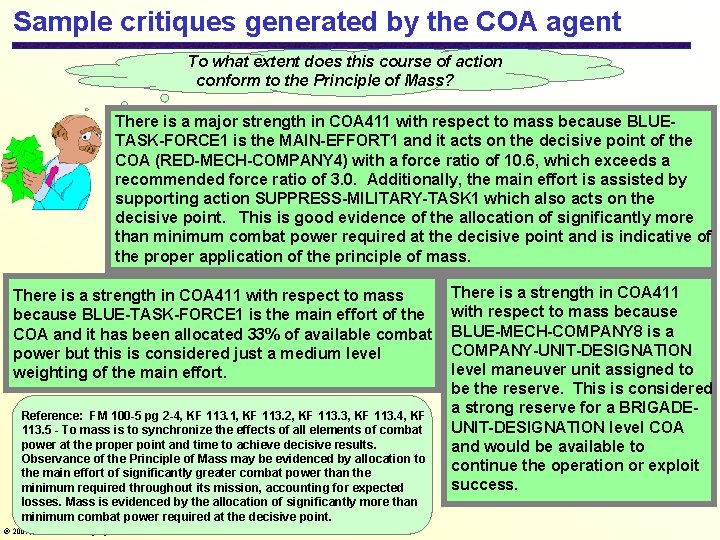
Sample critiques generated by the COA agent To what extent does this course of action conform to the Principle of Mass? There is a major strength in COA 411 with respect to mass because BLUETASK-FORCE 1 is the MAIN-EFFORT 1 and it acts on the decisive point of the COA (RED-MECH-COMPANY 4) with a force ratio of 10. 6, which exceeds a recommended force ratio of 3. 0. Additionally, the main effort is assisted by supporting action SUPPRESS-MILITARY-TASK 1 which also acts on the decisive point. This is good evidence of the allocation of significantly more than minimum combat power required at the decisive point and is indicative of the proper application of the principle of mass. There is a strength in COA 411 with respect to mass because BLUE-TASK-FORCE 1 is the main effort of the COA and it has been allocated 33% of available combat power but this is considered just a medium level weighting of the main effort. Reference: FM 100 -5 pg 2 -4, KF 113. 1, KF 113. 2, KF 113. 3, KF 113. 4, KF 113. 5 - To mass is to synchronize the effects of all elements of combat power at the proper point and time to achieve decisive results. Observance of the Principle of Mass may be evidenced by allocation to the main effort of significantly greater combat power than the minimum required throughout its mission, accounting for expected losses. Mass is evidenced by the allocation of significantly more than minimum combat power required at the decisive point. 2004, G. Tecuci, Learning Agents Center There is a strength in COA 411 with respect to mass because BLUE-MECH-COMPANY 8 is a COMPANY-UNIT-DESIGNATION level maneuver unit assigned to be the reserve. This is considered a strong reserve for a BRIGADEUNIT-DESIGNATION level COA and would be available to continue the operation or exploit success.
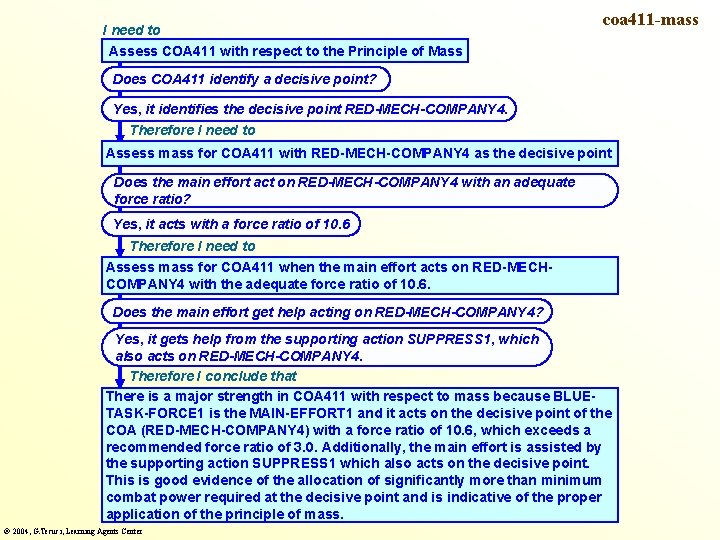
I need to Assess COA 411 with respect to the Principle of Mass coa 411 -mass Does COA 411 identify a decisive point? Yes, it identifies the decisive point RED-MECH-COMPANY 4. Therefore I need to Assess mass for COA 411 with RED-MECH-COMPANY 4 as the decisive point Does the main effort act on RED-MECH-COMPANY 4 with an adequate force ratio? Yes, it acts with a force ratio of 10. 6 Therefore I need to Assess mass for COA 411 when the main effort acts on RED-MECHCOMPANY 4 with the adequate force ratio of 10. 6. Does the main effort get help acting on RED-MECH-COMPANY 4? Yes, it gets help from the supporting action SUPPRESS 1, which also acts on RED-MECH-COMPANY 4. Therefore I conclude that There is a major strength in COA 411 with respect to mass because BLUETASK-FORCE 1 is the MAIN-EFFORT 1 and it acts on the decisive point of the COA (RED-MECH-COMPANY 4) with a force ratio of 10. 6, which exceeds a recommended force ratio of 3. 0. Additionally, the main effort is assisted by the supporting action SUPPRESS 1 which also acts on the decisive point. This is good evidence of the allocation of significantly more than minimum combat power required at the decisive point and is indicative of the proper application of the principle of mass. 2004, G. Tecuci, Learning Agents Center
The Disciple-COA agent Disciple COA 2004, G. Tecuci, Learning Agents Center
2004, G. Tecuci, Learning Agents Center
2004, G. Tecuci, Learning Agents Center
2004, G. Tecuci, Learning Agents Center
2004, G. Tecuci, Learning Agents Center
Overview Modeling based on the task reduction paradigm COG analysis through task reduction Intelligence analysis through task reduction COA critiquing through task reduction Workaround planning through task reduction Guidelines for the modeling process 2004, G. Tecuci, Learning Agents Center
Planning as an expertise task Planning means developing a sequence of actions that achieve a desired goal. Examples: Develop a plan for a military unit to reconstitute or bypass damage to an infrastructure, such as a damaged bridge, tunnel or road. Develop a plan of how to manufacture a loudspeaker. Develop a plan of how to travel from one location to another. 2004, G. Tecuci, Learning Agents Center
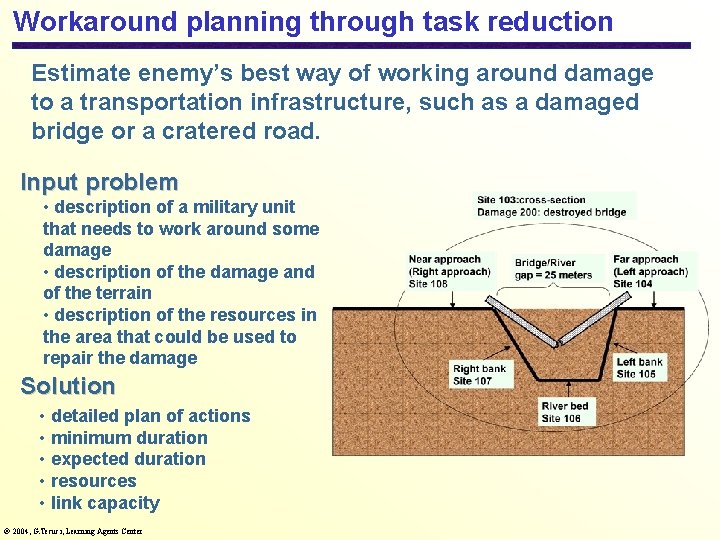
Workaround planning through task reduction Estimate enemy’s best way of working around damage to a transportation infrastructure, such as a damaged bridge or a cratered road. Input problem • description of a military unit that needs to work around some damage • description of the damage and of the terrain • description of the resources in the area that could be used to repair the damage Solution • detailed plan of actions • minimum duration • expected duration • resources • link capacity 2004, G. Tecuci, Learning Agents Center
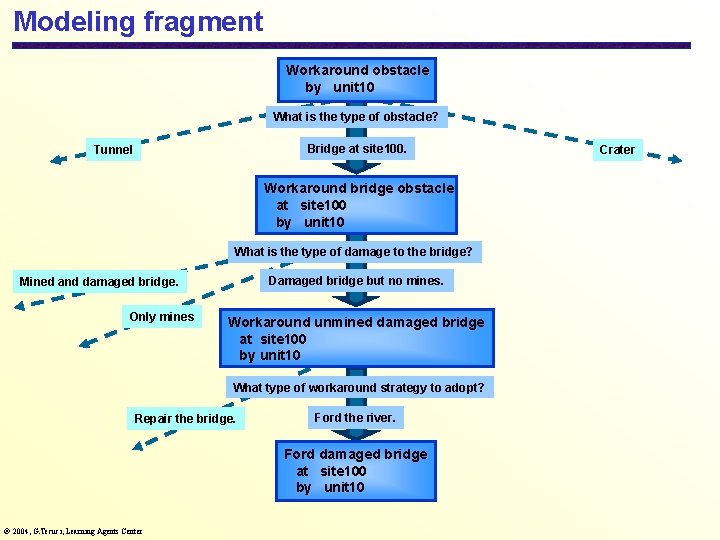
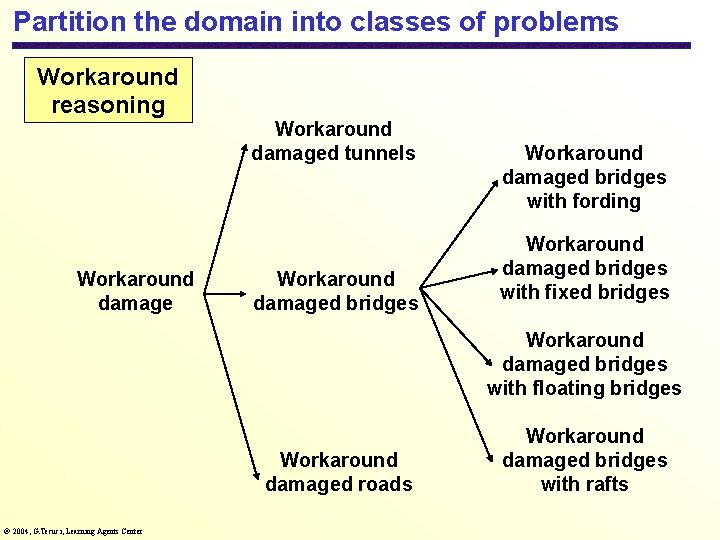
Modeling fragment Workaround obstacle by unit 10 What is the type of obstacle? Bridge at site 100. Tunnel Workaround bridge obstacle at site 100 by unit 10 What is the type of damage to the bridge? Damaged bridge but no mines. Mined and damaged bridge. Only mines Workaround unmined damaged bridge at site 100 by unit 10 What type of workaround strategy to adopt? Repair the bridge. Ford the river. Ford damaged bridge at site 100 by unit 10 2004, G. Tecuci, Learning Agents Center Crater
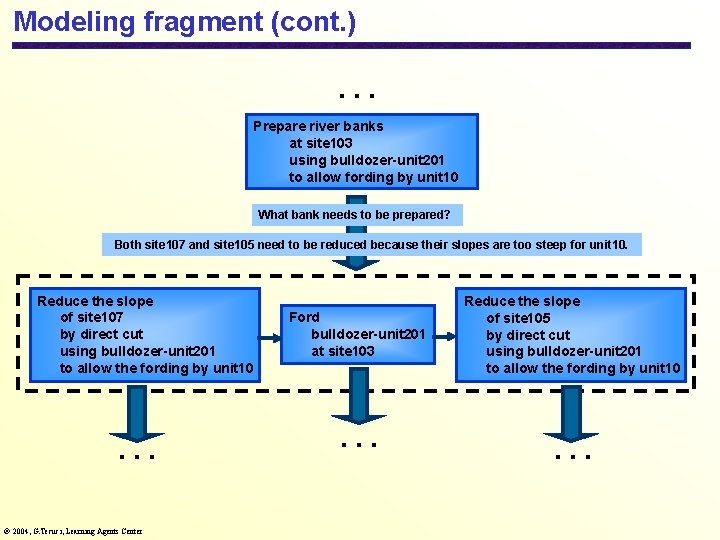
Modeling fragment (cont. ) … Prepare river banks at site 103 using bulldozer-unit 201 to allow fording by unit 10 What bank needs to be prepared? Both site 107 and site 105 need to be reduced because their slopes are too steep for unit 10. Reduce the slope of site 107 by direct cut using bulldozer-unit 201 to allow the fording by unit 10 … 2004, G. Tecuci, Learning Agents Center Ford bulldozer-unit 201 at site 103 … Reduce the slope of site 105 by direct cut using bulldozer-unit 201 to allow the fording by unit 10 …
Overview Modeling based on the task reduction paradigm COG analysis through task reduction Intelligence analysis through task reduction COA critiquing through task reduction Workaround planning through task reduction Guidelines for the modeling process 2004, G. Tecuci, Learning Agents Center
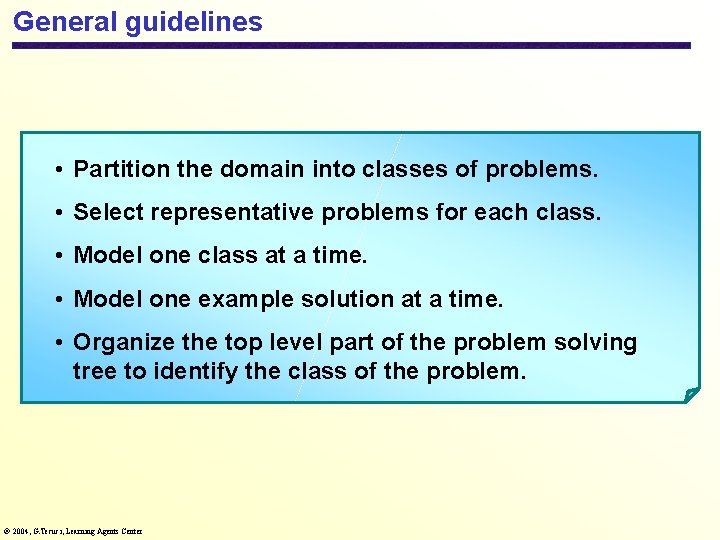
General guidelines • Partition the domain into classes of problems. • Select representative problems for each class. • Model one class at a time. • Model one example solution at a time. • Organize the top level part of the problem solving tree to identify the class of the problem. 2004, G. Tecuci, Learning Agents Center
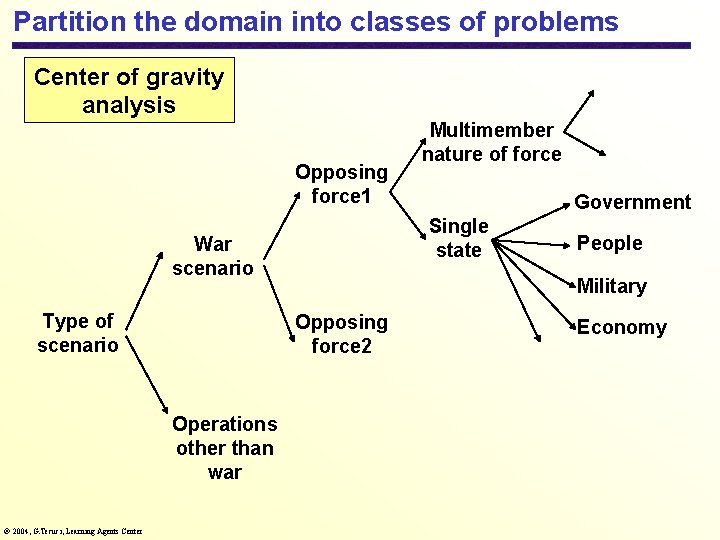
Partition the domain into classes of problems Center of gravity analysis Opposing force 1 2004, G. Tecuci, Learning Agents Center People Military Opposing force 2 Operations other than war Government Single state War scenario Type of scenario Multimember nature of force Economy
Partition the domain into classes of problems Center of gravity analysis Critical capabilities Critical requireme vulnerabilitie be protected s nts stay informed communicate leader be influential Government be a driving force organization have support be irreplaceable 2004, G. Tecuci, Learning Agents Center
Partition the domain into classes of problems Course of action critiquing Each principle and tenet leads to a different class of critiquing task. 2004, G. Tecuci, Learning Agents Center
Partition the domain into classes of problems Workaround reasoning Workaround damaged tunnels Workaround damaged bridges with fording Workaround damaged bridges with fixed bridges Workaround damaged bridges with floating bridges Workaround damaged roads 2004, G. Tecuci, Learning Agents Center Workaround damaged bridges with rafts
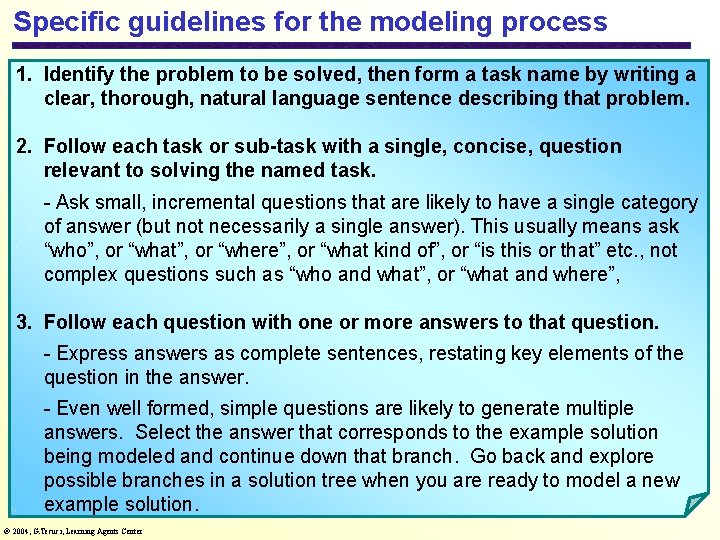
Specific guidelines for the modeling process 1. Identify the problem to be solved, then form a task name by writing a clear, thorough, natural language sentence describing that problem. 2. Follow each task or sub-task with a single, concise, question relevant to solving the named task. - Ask small, incremental questions that are likely to have a single category of answer (but not necessarily a single answer). This usually means ask “who”, or “what”, or “where”, or “what kind of”, or “is this or that” etc. , not complex questions such as “who and what”, or “what and where”, 3. Follow each question with one or more answers to that question. - Express answers as complete sentences, restating key elements of the question in the answer. - Even well formed, simple questions are likely to generate multiple answers. Select the answer that corresponds to the example solution being modeled and continue down that branch. Go back and explore possible branches in a solution tree when you are ready to model a new example solution. 2004, G. Tecuci, Learning Agents Center
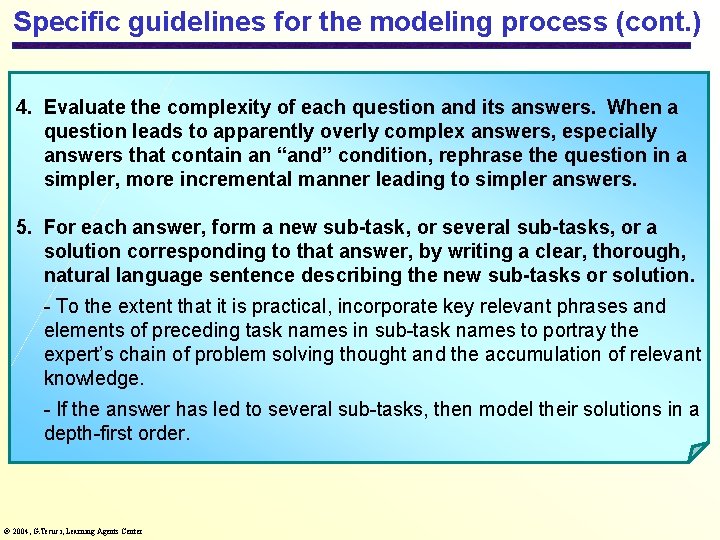
Specific guidelines for the modeling process (cont. ) 4. Evaluate the complexity of each question and its answers. When a question leads to apparently overly complex answers, especially answers that contain an “and” condition, rephrase the question in a simpler, more incremental manner leading to simpler answers. 5. For each answer, form a new sub-task, or several sub-tasks, or a solution corresponding to that answer, by writing a clear, thorough, natural language sentence describing the new sub-tasks or solution. - To the extent that it is practical, incorporate key relevant phrases and elements of preceding task names in sub-task names to portray the expert’s chain of problem solving thought and the accumulation of relevant knowledge. - If the answer has led to several sub-tasks, then model their solutions in a depth-first order. 2004, G. Tecuci, Learning Agents Center
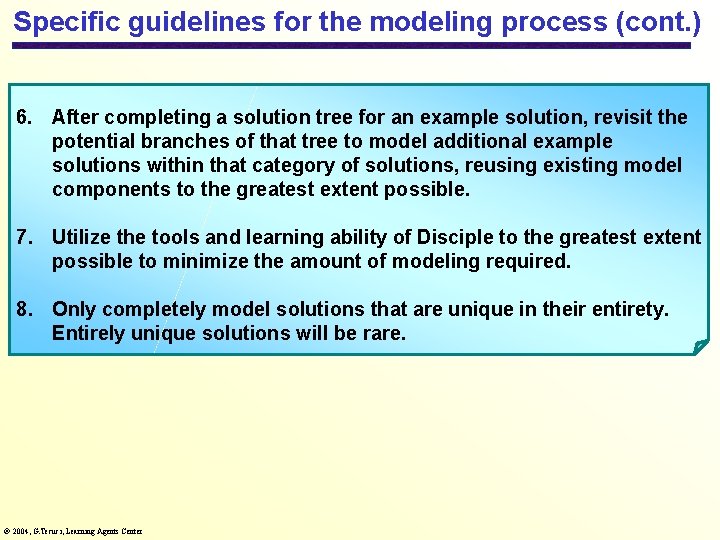
Specific guidelines for the modeling process (cont. ) 6. After completing a solution tree for an example solution, revisit the potential branches of that tree to model additional example solutions within that category of solutions, reusing existing model components to the greatest extent possible. 7. Utilize the tools and learning ability of Disciple to the greatest extent possible to minimize the amount of modeling required. 8. Only completely model solutions that are unique in their entirety. Entirely unique solutions will be rare. 2004, G. Tecuci, Learning Agents Center