
CULTURE AND ITS INFLUENCE ON INDIVIDUAL IB Psychology

CULTURE AND ITS INFLUENCE ON INDIVIDUAL IB Psychology LAJM

Please note! • IB Psychology syllabus topics ”Cultural origins of behaviour and cognition” and ”Cultural influences on individual behaviour” with their contents are combined in this Power. Point

TASK • Do a mind map of culture – Don’t use any assistive devices or materials – Write the word culture in the middle of the map – Try to compile a comprehensive map – What kind of things are related to culture? – How can you define culture?
TASK • Read pages 202 -203 • Compare your mind map to the information presented in your textbook – Pay close attention to surface and deep culture

Culture • There is no definitive definition of culture – “Common rules that regulate interactions and behaviour in a group as well as a number of shared values in a group” (Lonner, 1995) – ”Everything learned”

Culture • Cultural norms – Attitudes, beliefs and behaviour patterns that are typical for a specific cultural group • Cultural groups are characterized by different norms and conventions. What is the meaning of cultural norms to an individual?
TASK • Study the gist of Chiu (1972) and Briley, Morris and Simonson (2005) from teacher’s additional materials – How do these studies exemplify the influence of culture on behaviour and cognition?
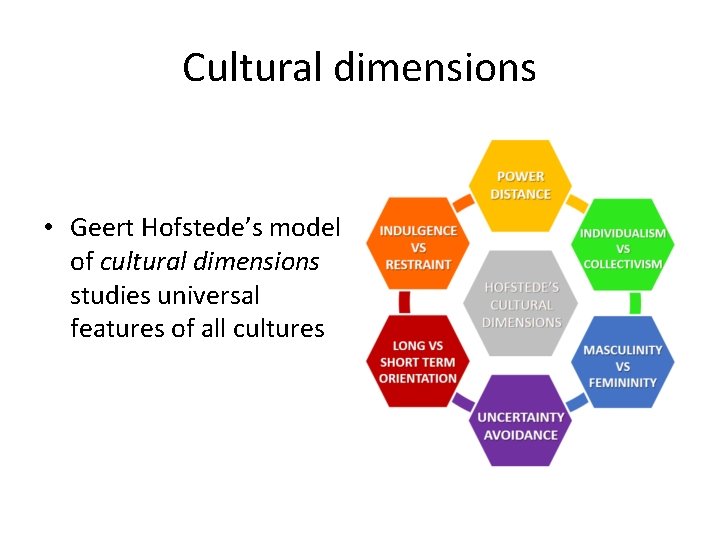
Cultural dimensions • Geert Hofstede’s model of cultural dimensions studies universal features of all cultures
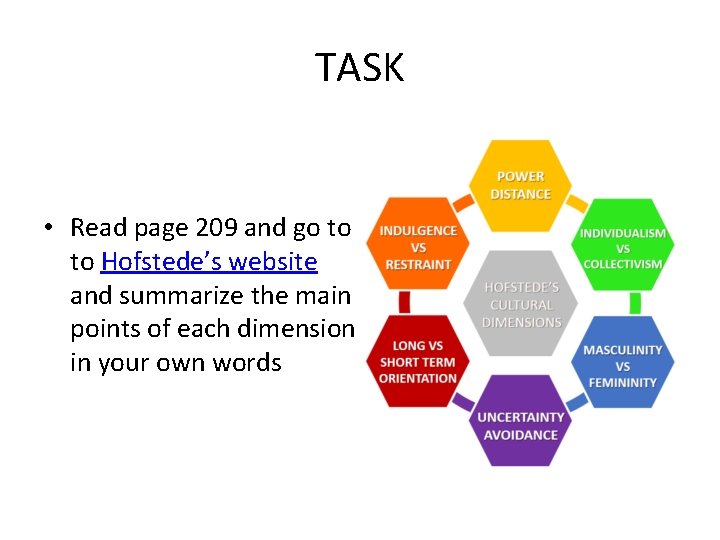
TASK • Read page 209 and go to to Hofstede’s website and summarize the main points of each dimension in your own words
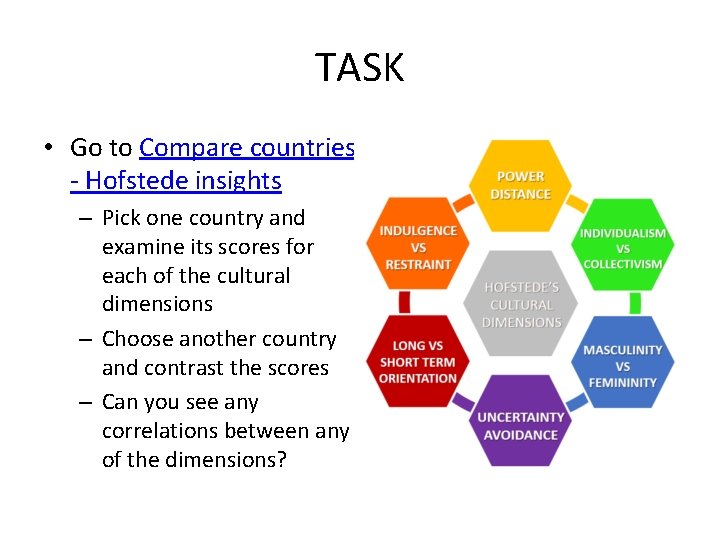
TASK • Go to Compare countries - Hofstede insights – Pick one country and examine its scores for each of the cultural dimensions – Choose another country and contrast the scores – Can you see any correlations between any of the dimensions?
TASK • Watch ” 10 minutes with Geert Hofstede on individualism vs. collectivism” • Pay attention to the correlations between dimensions!
TASK • Read pages 210 -212 • What were the aim, procedure and results of Berry and Katz’s (1967) and Finkelstein (2010) studies? – How do the studies relate to the Hofstede’s individualism vs. collectivism dimension? • Study the gist of Wei et al. (2001) from teacher’s additional materials – Did this study provide an additional perspective to the Hofstede’s individualism vs. collectivism dimension?
TASK • Critical thinking hub: – Do MAGEC/GRENADE analysis of Berry and Katz (1967), Finkelstein (2010) and Wei et al. (2001) studies – How do the studies provide support for Hofstede’s model? – Aim for holistic approach
EXTRA TASK • If you want to study another cultural dimension, do the following: • (1) Watch ” 10 minutes with Geert Hofstede on power distance index” • (2) Study the following studies from pages 213– 214 – Meeuwesen, van den Brink-Muinen and Hofstede (2009) – Eylon and Au (1999)
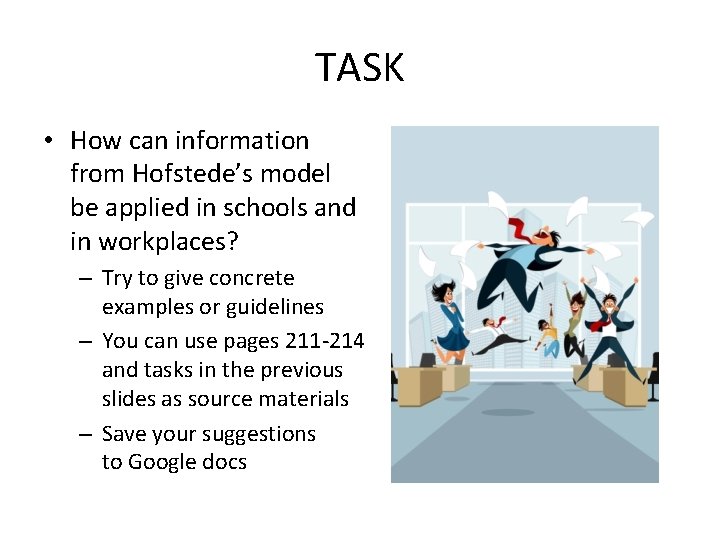
TASK • How can information from Hofstede’s model be applied in schools and in workplaces? – Try to give concrete examples or guidelines – You can use pages 211 -214 and tasks in the previous slides as source materials – Save your suggestions to Google docs

ENCULTURATION • The process by which individuals learn their culture in order to fully function within it ACCULTURATION • The process of psychological and cultural change as a result of contact and interaction between cultures The individual and the culture are in bidirectional relationship

TASK • Read pages 204 -207 • How can the culture of honour be used as an example of both enculturation and acculturation? • What were the aim, procedure and results of Cohen et al (1996) and how does it relate to enculturation and acculturation?
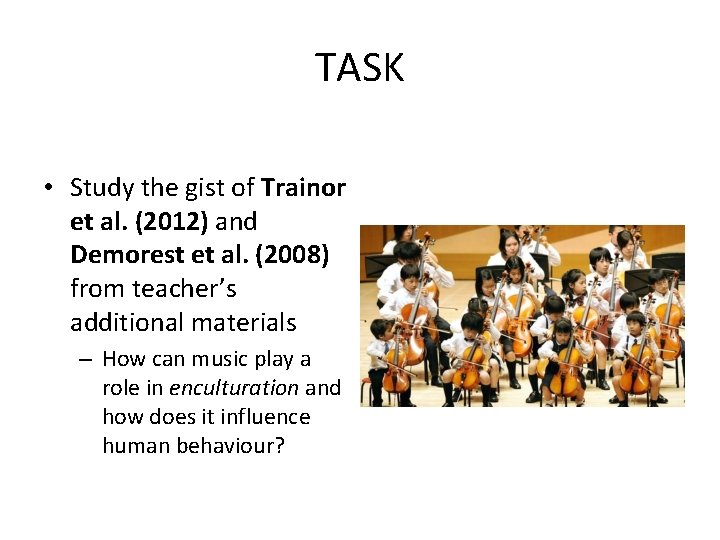
TASK • Study the gist of Trainor et al. (2012) and Demorest et al. (2008) from teacher’s additional materials – How can music play a role in enculturation and how does it influence human behaviour?
TASK • Watch the Anita Collins TED-talk ”The benefits of music education” – How does music education connect to other approaches in human behaviour in addition to the sociocultural one?
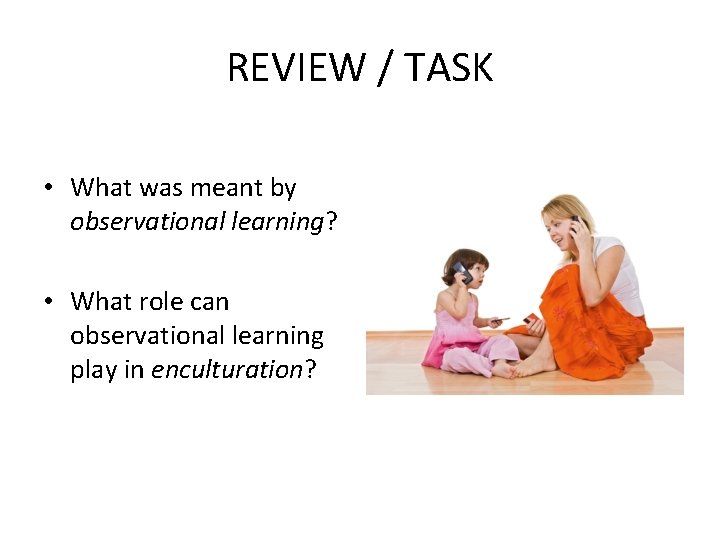
REVIEW / TASK • What was meant by observational learning? • What role can observational learning play in enculturation?
TASK • Study the gist of Odden and Rochat (2004) from teacher’s additional materials – What role does observational learning play in enculturation?

Acculturation and cultural change • Acculturation is one type of cultural change – Usually takes place between dominant and non-dominant cultures
TASK • Watch Shereen El Feki’s TED-talk ”Pop culture in the Arab world” • How can globalization be a driving force in acculturation?

Acculturation Two-dimensional model of acculturation (Berry, 1997, 2008) • Individuals can adopt four strategies of cultural change – – (1) Assimilation (2) Integration (3) Separation (4) Marginalization
TASK • Study the gist of Kim and Omizo (2006) from teacher’s additional materials – How do both enculturation and acculturation contribute to the development of identity? – How can this study be related to Berry’s model?
Acculturation • The healthy migrant effect – Migrants tend to be healthier than their nativeborn counterparts at first • The negative acculturation effect – Migrants tend to be less healthy than their nativeborn counterparts over time
TASK • There are descriptions of four studies on pages 246– 247: – Shah et al. (2015) – Delavario et al. (2013) – Ishizawa and Jones (2016) – Da Costa, Dias and Martins (2017) • Choose TWO of the studies and find the aim, procedure and results of them – How does acculturation influence health? – How is obesity related to acculturation?

Acculturation • Acculturative stress – Stress caused by coping with conflicting cultural norms (Sullivan, 2009) – Integration strategies result in the lowest level of acculturative stress (Berry, 2005) Have you experienced acculturative stress?
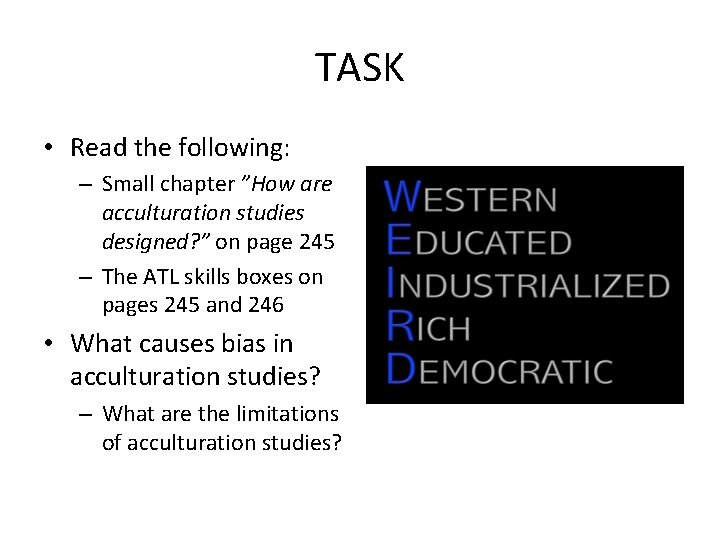
TASK • Read the following: – Small chapter ”How are acculturation studies designed? ” on page 245 – The ATL skills boxes on pages 245 and 246 • What causes bias in acculturation studies? – What are the limitations of acculturation studies?

Approaches to culture • Etic approach – Studies universal features of all cultures – Examines cultures from an outside perspective • Emic approach – Studies culturally specific features of a culture – Understanding a culture from within

TASK • Find examples of etic and emic approaches – What are universal features of cultures? – What are examples of culturally specific features?
Approaches to culture • Kashima and Triandis (1986) – Americans tend to explain their own success by dispositional attribution and Japanese by situational attribution – Etic approach • Bartlett (1932) – Swazi herdsmen have extraordinary ability to recall individual characteristics of their cattle – Emic approach

Approaches to culture • Universalist perspective • Relativist perspective – Psychological mechanism are largely the same across cultures, but experiences and behaviours can differ – Psychological mechanisms are so different across cultures that they cannot be compared What evidence do we have to support either of these perspectives?
TASK • Critical thinking hub: – Review the whole sociocultural approach and try to provide content, theories and studies related to the topics on the right – Aim for holistic approach – Write your responses in Google docs • Contribution of research methods used in the sociocultural approach • Ethical considerations in the investigation of the sociocultural approach
Picture sources • • • Please note <> Accessed 11 th of September 2018. Grain field 1 <http: //www. raahenseurakunta. fi/wp-content/uploads/2016/09/> Accessed 6 th of September 2017. Grain field 2 <http: //www. earthtimes. org/going-green/food-agriculture-reorganisation/1515/> Accessed 11 th of August 2015. Grain field 3 <https: //wallup. net/morning-nature-sun-rays-landscape-sunlight-field/> Accessed 11 th of September 2018. Woman eating with sticks <http: //www. travelbeijing. com/beijing-china-travel-tips/beijing-socialand-cultural-customs. html> Accessed 6 th of September 2017. Me and group <https: //fi. pinterest. com/pin/734720126679711913/> Accessed 27 th of April 2020. Hofstede’s cultural dimensions <https: //www. business-to-you. com/hofstedes-culturaldimensions/> Accessed 12 th of September 2018. Geert Hofstede <https: //www. toolshero. com/toolsheroes/geert-hofstede/> Accessed 18 th of September 2018. Critical thinking puzzle <https: //www. chronicle. com/article/Beyond-Critical-Thinking/63288> Accessed 10 th of February 2019. Happy workplace <https: //www. shrm. org/hr-today/news/hr-magazine/0917/pages/how-to-build-a -better-workplace. aspx> Accessed 14 th of September 2018.
Picture sources • • • Bushido <https: //decalgremlins. com/products/bushido-kanji-sticker-vinyl-decal-feudal-japanese-warrior-shintokatana> Accessed 17 th of September 2018. Musical education <https: //www. francemusique. fr/en/music-education-japan-model-follow-15697> Accessed 4 th of May 2020. Anita Collins <https: //www. moravian. edu/news/releases/anita-collins#. Xr. PP 1 C 8 v. HOQ> Accessed 7 th of May 2020. Enculturation head <http: //dpgsulo. com/english-and-language-acquisition/> Accessed 4 th of May 2020. Identity <https: //www. paymentscardsandmobile. com/the-problem-with-self-sovereign-identity/> Accessed 4 th of May 2020. Acculturation <https: //www. lifepersona. com/the-5 -most-resulting-acculturation-examples> Accessed 19 th of September 2018. Shereen El Feki <http: //evirtualsummits. com/member/3603/> Accessed 19 th of September 2018. Migrants <https: //blogit. metropolia. fi/variousvariables/2017/12/08/highly-skilled-immigrants-aboard-buildfinland/> Accessed 5 th of May 2020. WEIRD <http: //davidbrin. blogspot. com/2016/08/> Accessed 5 th of May 2020. Acculturative group <http: //www. trendingrealtors. com/Features. aspx> Accessed 19 th of September 2018. Wheat field with crows – van Gogh <http: //www. vggallery. com/painting/p_0779. ht> Accessed 6 th of September 2017. Wheat fields – van Gogh <https: //en. wikipedia. org/wiki/Wheat_Fields_(Van_Gogh_series)> Accessed 6 th of September 2017.
- Slides: 36