Cornell CS 6410 1052017 Todays Theme Consistency in
- Slides: 77
Cornell CS 6410, 10/5/2017 Today’s Theme: Consistency in a Distributed System Papers: ● Time, Clocks, and the Ordering of Events in a Distributed System, Leslie Lamport, Communications of ACM, Volume 27 Issue 7, July 1978. ● Distributed Snapshots: Determining Global States of Distributed Systems, K. Mani Chandy, Leslie Lamport. ACM Transactions on Computer Systems (TOCS), Volume 3 Issue 1, Feb. 1985.
Why should we care about this theme? • How can we make a consistent global state of an asynchronous system? • What even is our synchronous protocol? • Who today is asking/using these questions? • How can we coordinate in a distributed system? • If an (airline) reservation database system is replicated and distributed and people can purchase tickets locally, how can we order the purchasing of tickets (e. g. two people want to buy a seat, but only one seat is left)?
Why should we care about these papers? ● Why to care about the set ● Time, Clocks, and the Ordering of Events in a Distributed System, Leslie Lamport, Communications of ACM, Volume 27 Issue 7, July 1978. ● Distributed Snapshots: Determining Global States of Distributed Systems, K. Mani Chandy, Leslie Lamport. ACM Transactions on Computer Systems (TOCS), Volume 3 Issue 1, Feb. 1985. ● 5414?
Initial thoughts?
Today’s Goals ● Time, Clocks, and the Ordering of Events in a Distributed System, Leslie Lamport, Communications of ACM, Volume 27 Issue 7, July 1978. o Understand: § The “happened before” relation § How to establish partial/total order and what to do with it § Physical, logical, local/global clocks ● Distributed Snapshots: Determining Global States of Distributed Systems, K. Mani Chandy, Leslie Lamport. ACM Transactions on Computer Systems (TOCS), Volume 3 Issue 1, Feb. 1985. o Understand: § Global Snapshot
Time, Clocks, and the Ordering of Events in a Distributed System Leslie Lamport Massachusetts Computer Associates, Inc. Communications of the ACM - July 1978
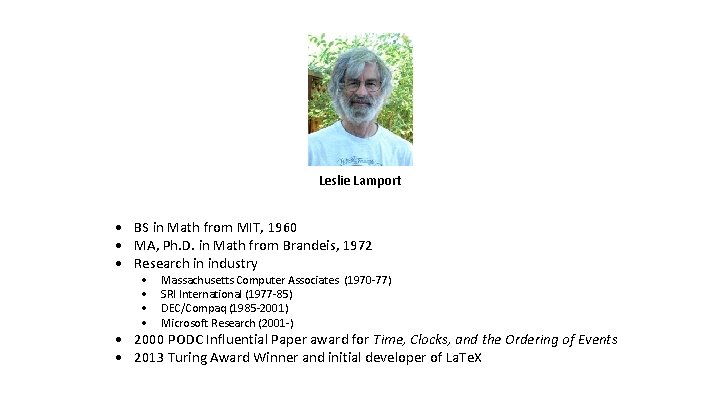
Leslie Lamport • BS in Math from MIT, 1960 • MA, Ph. D. in Math from Brandeis, 1972 • Research in industry • • Massachusetts Computer Associates (1970 -77) SRI International (1977 -85) DEC/Compaq (1985 -2001) Microsoft Research (2001 -) • 2000 PODC Influential Paper award for Time, Clocks, and the Ordering of Events • 2013 Turing Award Winner and initial developer of La. Te. X
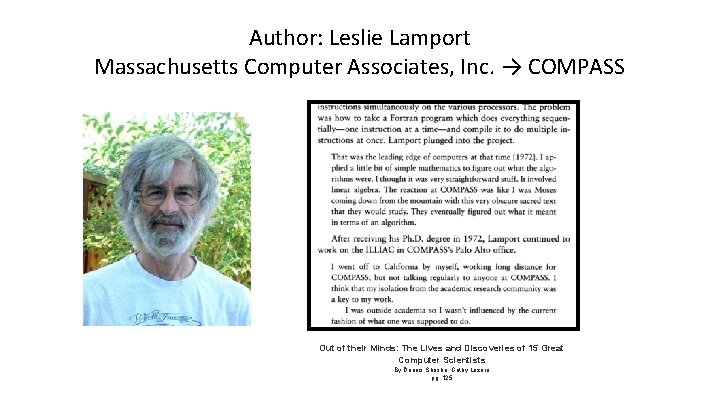
Author: Leslie Lamport Massachusetts Computer Associates, Inc. → COMPASS Out of their Minds: The Lives and Discoveries of 15 Great Computer Scientists By Dennis Shasha, Cathy Lazere pg. 125
Outline ● Partial Ordering of Events ● Logical Clocks ● Total Ordering of Events ● Anomalous Behaviour ● Physical Clocks
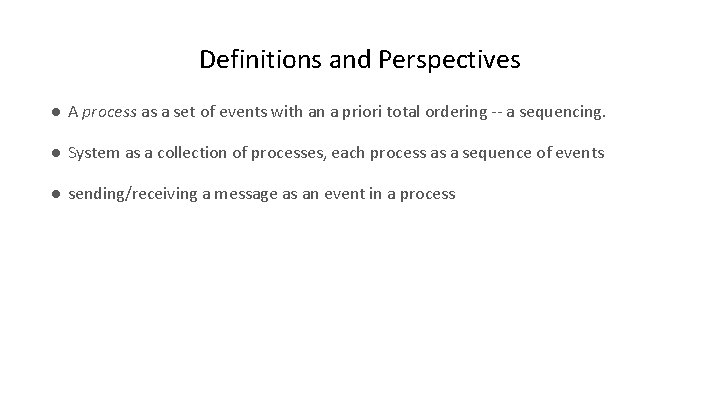
Definitions and Perspectives ● A process as a set of events with an a priori total ordering -- a sequencing. ● System as a collection of processes, each process as a sequence of events ● sending/receiving a message as an event in a process
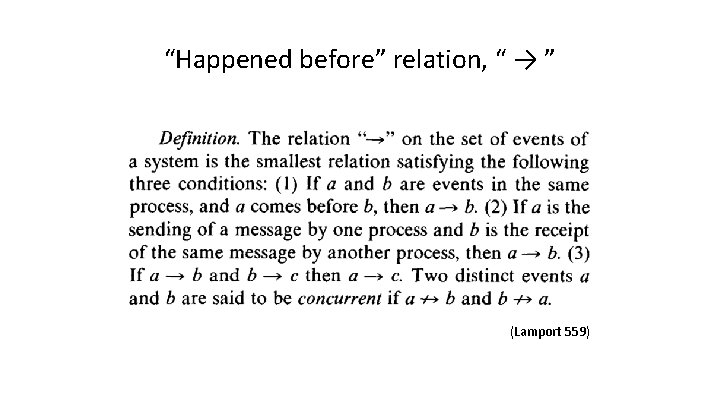
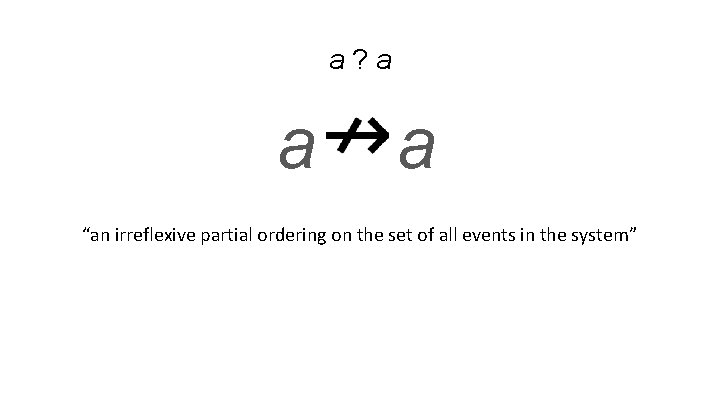
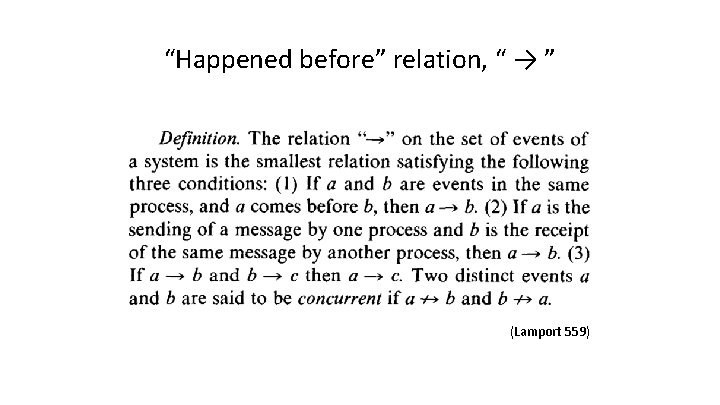
“Happened before” relation, “ → ” (Lamport 559)
a? a a a “an irreflexive partial ordering on the set of all events in the system”
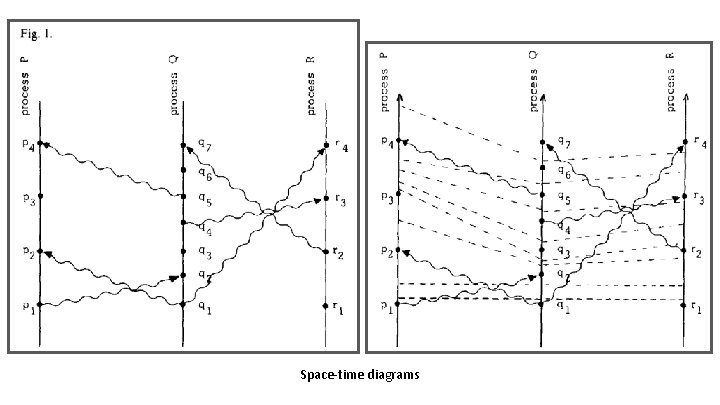
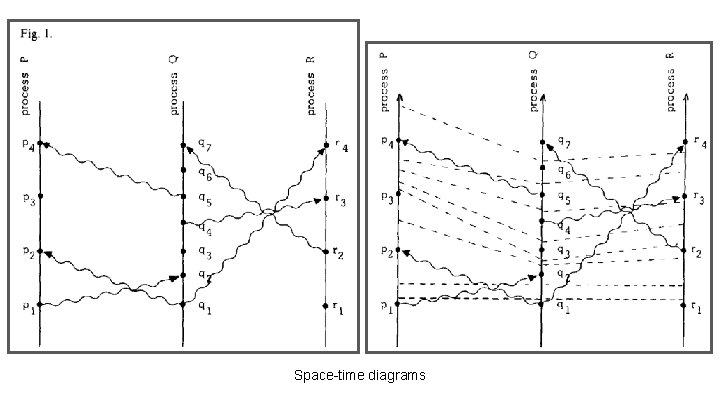
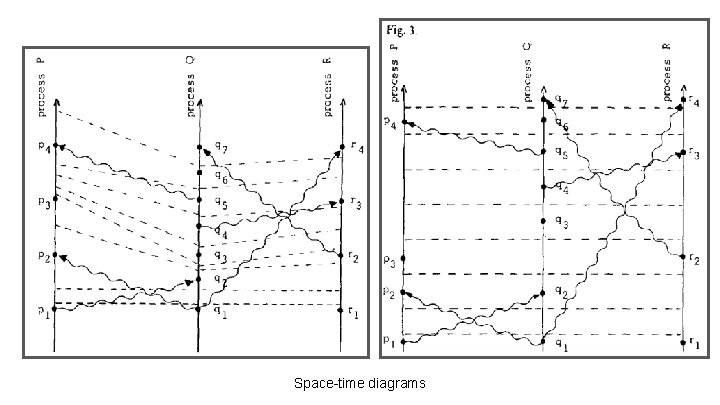
Space-time diagrams
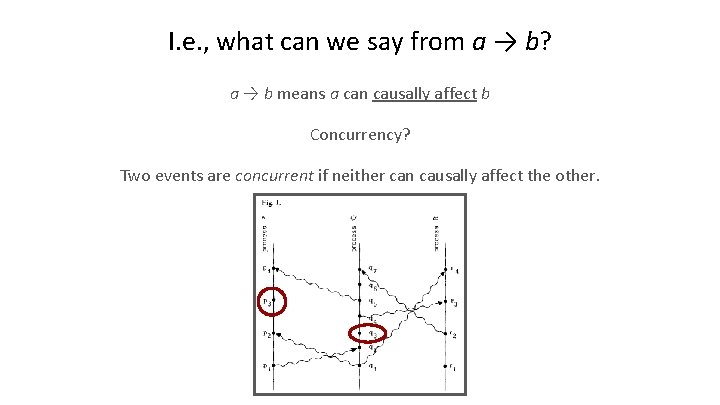
I. e. , what can we say from a → b? a → b means a can causally affect b Concurrency? Two events are concurrent if neither can causally affect the other.
Outline ● Partial Ordering of Events ● Logical Clocks ● Total Ordering of Events ● Anomalous Behaviour ● Physical Clocks
Logical Clocks ● How might we begin thinking about clocks? ● “We begin with an abstract point of view in which a clock is just a way of assigning a number to an event, where the number is thought of as the time at which the event occurred” (Lampson 559) ● a clock Ci, for each process Pi, as a function assigning a number Ci(a) to any event a in Pi ● system of clocks as a function C assigning to any event b the number C(b) such that C(b) =Cj(b) if b is an event in Pj ● yet relating numbers Ci(a) to physical time, instead regarding Ci as logical clocks
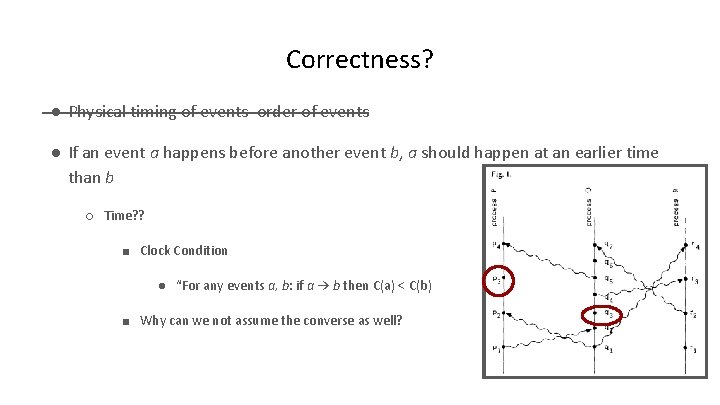
Correctness? ● Physical timing of events order of events ● If an event a happens before another event b, a should happen at an earlier time than b ○ Time? ? ■ Clock Condition ● “For any events a, b: if a → b then C(a) < C(b) ■ Why can we not assume the converse as well?
“Happened before” relation, “ → ” (Lamport 559)
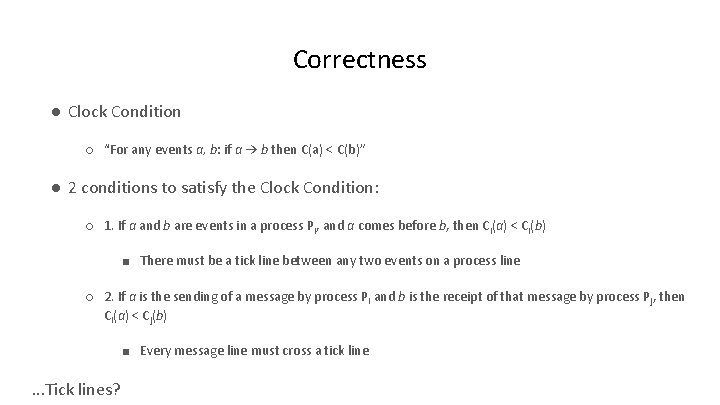
Correctness ● Clock Condition ○ “For any events a, b: if a → b then C(a) < C(b)” ● 2 conditions to satisfy the Clock Condition: ○ 1. If a and b are events in a process Pi, and a comes before b, then Ci(a) < Ci(b) ■ There must be a tick line between any two events on a process line ○ 2. If a is the sending of a message by process Pi and b is the receipt of that message by process Pj, then Ci(a) < Cj(b) ■ Every message line must cross a tick line . . . Tick lines?
Space-time diagrams
Space-time diagrams
Problem with Partial Order ● A single resource ● Processes must synchronize to avoid conflicts ● Requests must be granted in order
Problem with Partial Order ● A single resource ● Processes must synchronize to avoid conflicts ● Requests must be granted in order Partial order is not helpful in solving this problem as partial order cannot resolve concurrent requests Total ordering required…. .
Outline ● Partial Ordering of Events ● Logical Clocks ● Total Ordering of Events ● Anomalous Behaviour ● Physical Clocks
Total Ordering of Events • Total ordering eliminates concurrency • Identify message with event sending it
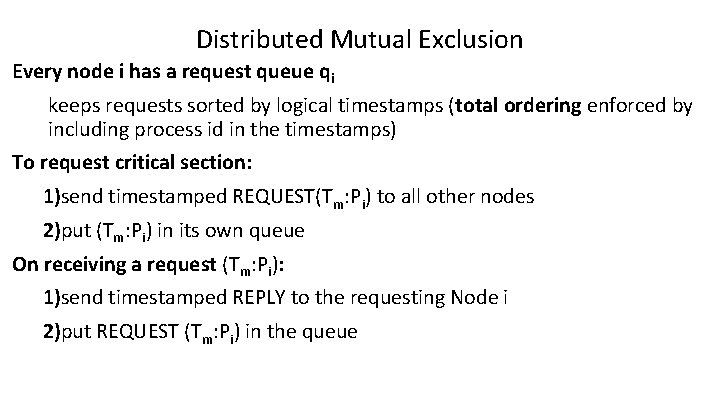
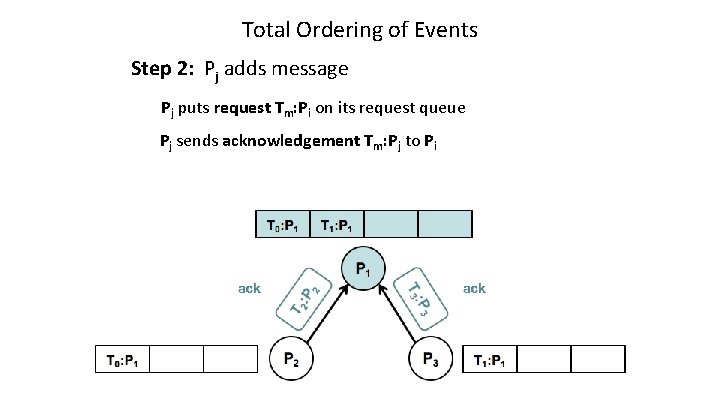
Distributed Mutual Exclusion Every node i has a request queue qi keeps requests sorted by logical timestamps (total ordering enforced by including process id in the timestamps) To request critical section: 1)send timestamped REQUEST(Tm: Pi) to all other nodes 2)put (Tm: Pi) in its own queue On receiving a request (Tm: Pi): 1)send timestamped REPLY to the requesting Node i 2)put REQUEST (Tm: Pi) in the queue
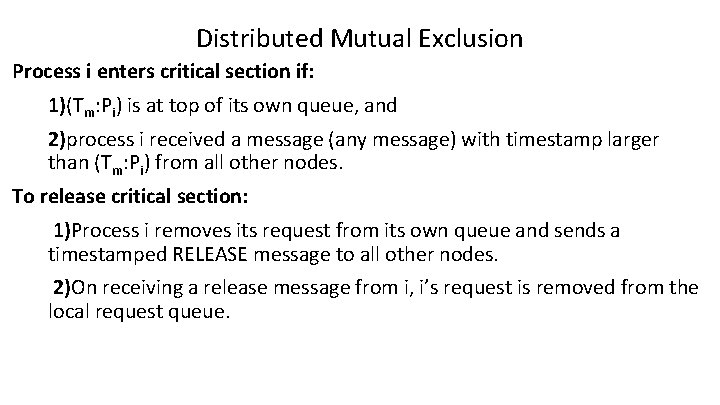
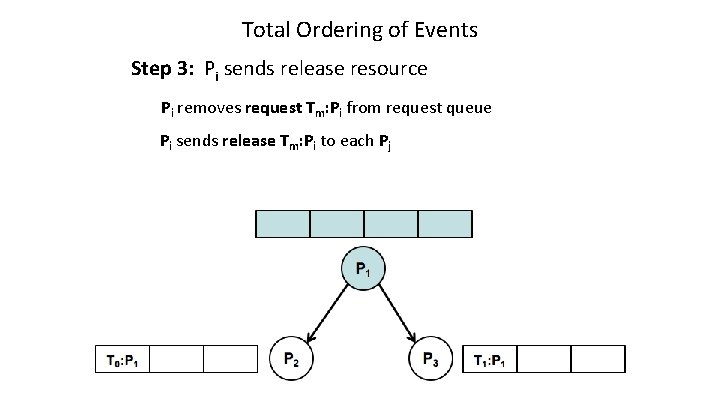
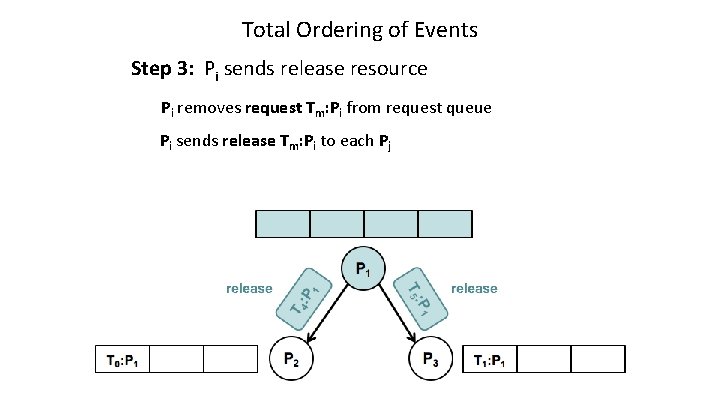
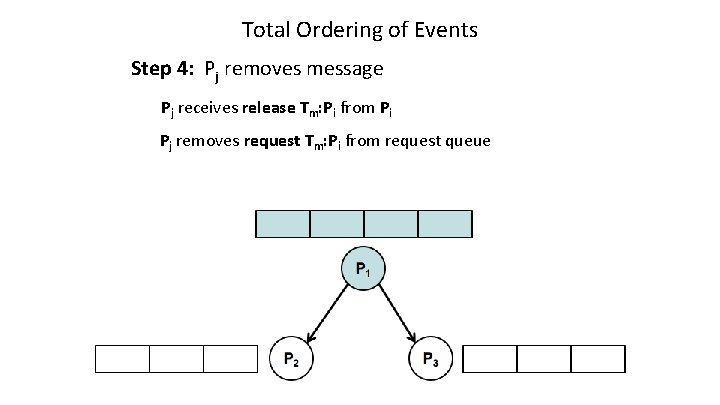
Distributed Mutual Exclusion Process i enters critical section if: 1)(Tm: Pi) is at top of its own queue, and 2)process i received a message (any message) with timestamp larger than (Tm: Pi) from all other nodes. To release critical section: 1)Process i removes its request from its own queue and sends a timestamped RELEASE message to all other nodes. 2)On receiving a release message from i, i’s request is removed from the local request queue.
Distributed Mutual Exclusion Process i enters critical section if: 1)(Tm: Pi) is at top of its own queue, and 2)process i received a message (any message) with timestamp larger than (Tm: Pi) from all other nodes. Why is this condition required? To release critical section: 1)Process i removes its request from its own queue and sends a timestamped RELEASE message to all other nodes. 2)On receiving a release message from i, i’s request is removed from the local request queue.
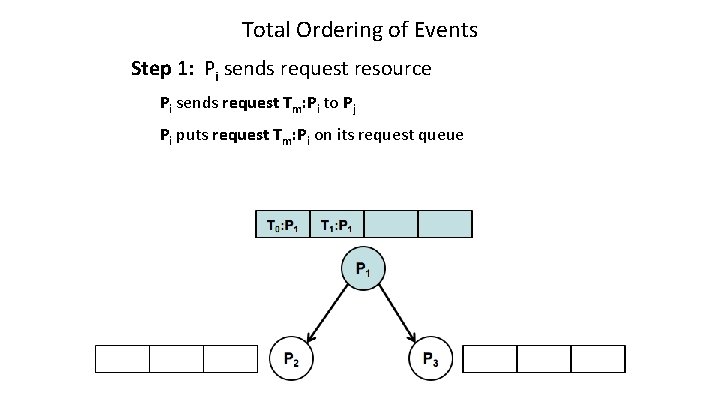
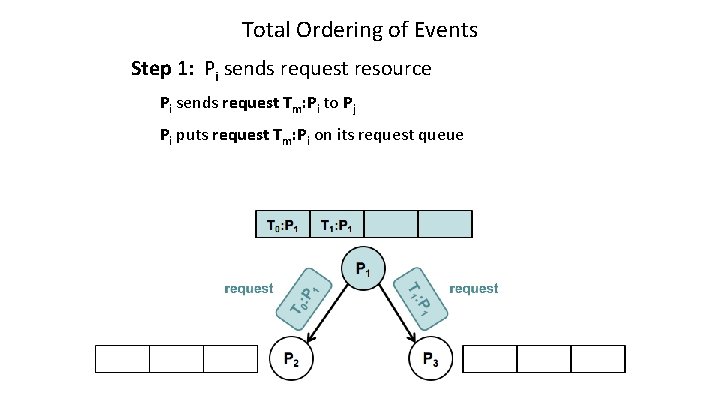
Total Ordering of Events Step 1: Pi sends request resource Pi sends request Tm: Pi to Pj Pi puts request Tm: Pi on its request queue
Total Ordering of Events Step 1: Pi sends request resource Pi sends request Tm: Pi to Pj Pi puts request Tm: Pi on its request queue
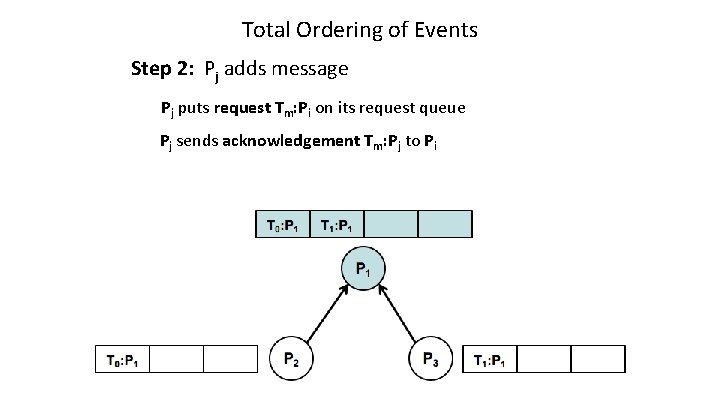
Total Ordering of Events Step 2: Pj adds message Pj puts request Tm: Pi on its request queue Pj sends acknowledgement Tm: Pj to Pi
Total Ordering of Events Step 2: Pj adds message Pj puts request Tm: Pi on its request queue Pj sends acknowledgement Tm: Pj to Pi
Total Ordering of Events Step 3: Pi sends release resource Pi removes request Tm: Pi from request queue Pi sends release Tm: Pi to each Pj
Total Ordering of Events Step 3: Pi sends release resource Pi removes request Tm: Pi from request queue Pi sends release Tm: Pi to each Pj
Total Ordering of Events Step 4: Pj removes message Pj receives release Tm: Pi from Pi Pj removes request Tm: Pi from request queue
Message Complexity?
Message Complexity? • 3(n – 1) messages per critical section invocation • Requests are granted in the increasing order of timestamps
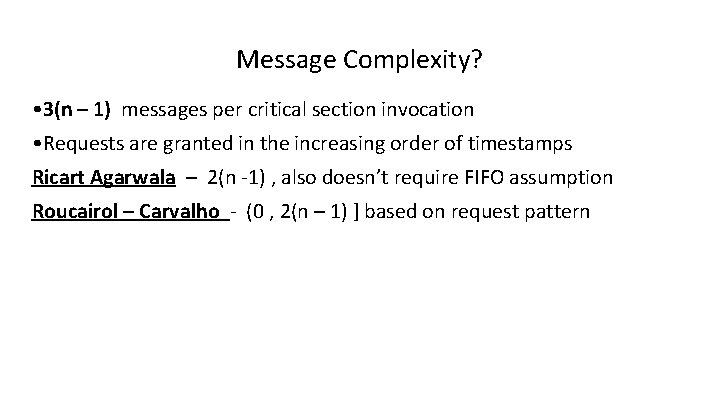
Message Complexity? • 3(n – 1) messages per critical section invocation • Requests are granted in the increasing order of timestamps Ricart Agarwala – 2(n -1) , also doesn’t require FIFO assumption Roucairol – Carvalho - (0 , 2(n – 1) ] based on request pattern
Outline ● Partial Ordering of Events ● Logical Clocks ● Total Ordering of Events ● Anomalous Behaviour ● Physical Clocks
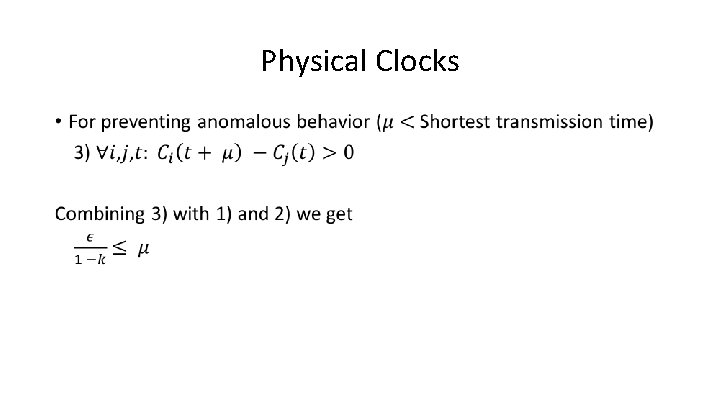
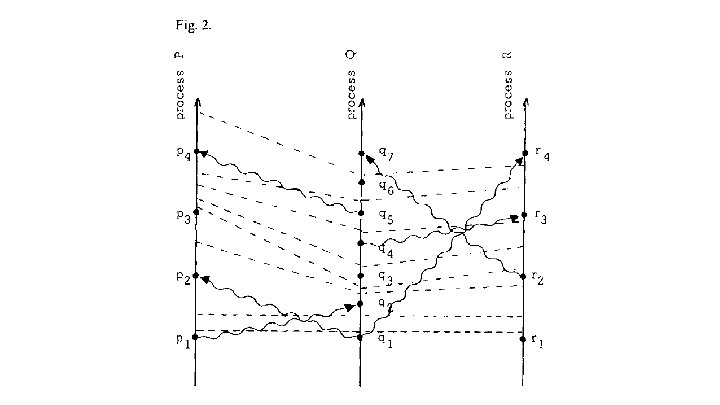
Anomalous Behavior
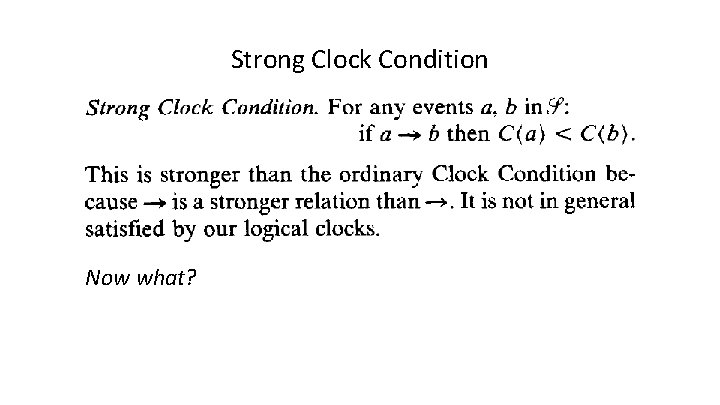
Strong Clock Condition Now what?
Outline ● Partial Ordering of Events ● Logical Clocks ● Total Ordering of Events ● Anomalous Behaviour ● Physical Clocks
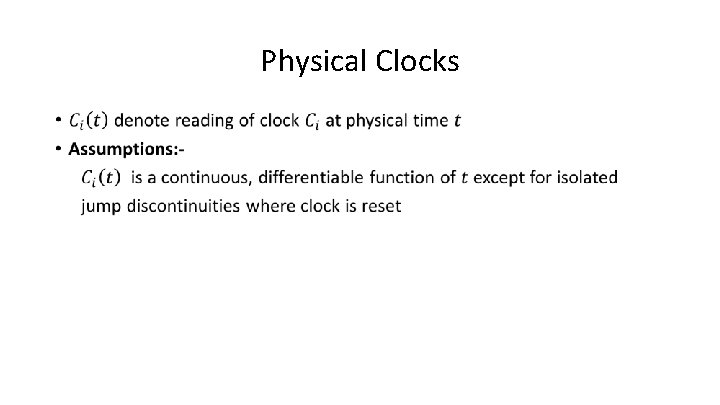
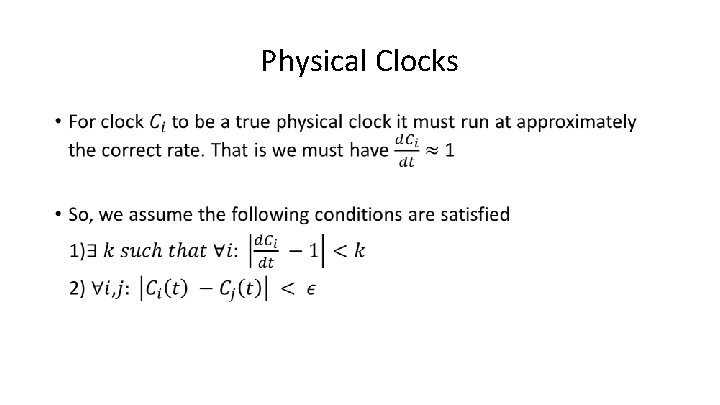
Physical Clocks “One of the mysteries of the universe is that it is possible to construct a system of physical clocks which, running quite independently of one another, will satisfy the Strong Clock Condition” (Lamport 562)
Physical Clocks
Physical Clocks
Physical Clocks
Summary ● Partial Ordering of Events ● Logical Clocks ● Total Ordering of Events ● Anomalous Behaviour ● Physical Clocks
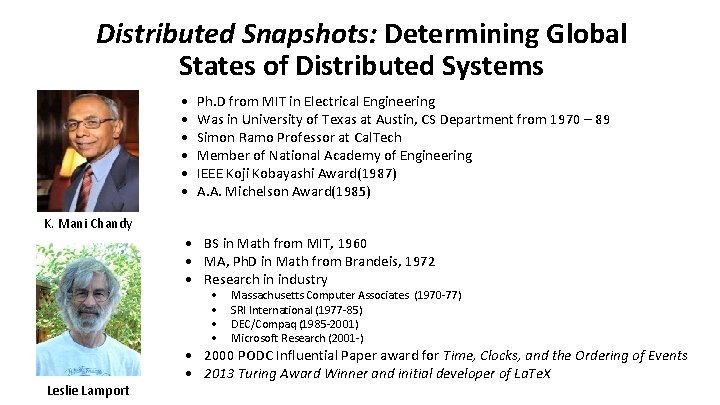
Distributed Snapshots: Determining Global States of Distributed Systems • • • Ph. D from MIT in Electrical Engineering Was in University of Texas at Austin, CS Department from 1970 – 89 Simon Ramo Professor at Cal. Tech Member of National Academy of Engineering IEEE Koji Kobayashi Award(1987) A. A. Michelson Award(1985) K. Mani Chandy • BS in Math from MIT, 1960 • MA, Ph. D in Math from Brandeis, 1972 • Research in industry • • Massachusetts Computer Associates (1970 -77) SRI International (1977 -85) DEC/Compaq (1985 -2001) Microsoft Research (2001 -) • 2000 PODC Influential Paper award for Time, Clocks, and the Ordering of Events • 2013 Turing Award Winner and initial developer of La. Te. X Leslie Lamport
What is a Snapshot? • Just a collection of local states of processes and channels!
Why do we need Snapshots?
Why do we need Snapshots? • Garbage collection : - Removing objects that do not have any references • Deadlocks: - Detecting deadlocks in distributed system • Checkpointing: - Helps in rolling back in case of failure
Challenges in recording Global State • Processes do not share clocks or memory (or) there is no universal clock. • So, no way to ensure that all nodes record state at exactly the same time…
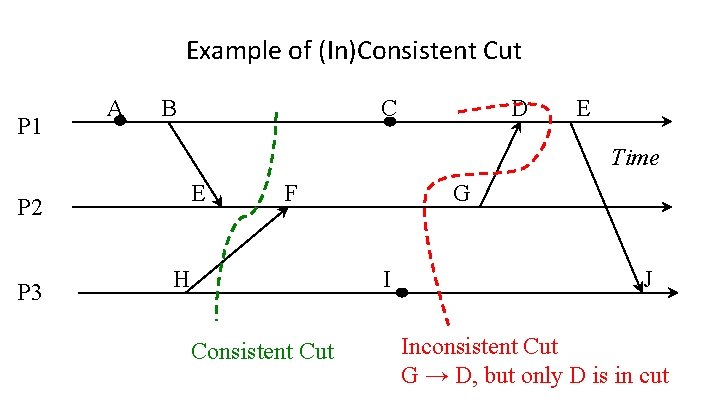
Challenges in recording Global State • Processes do not share clocks or memory (or) there is no universal clock. • So, no way to ensure that all nodes record state at exactly the same time. • Global snapshot is all about finding a consistent cut! • so what is a consistent cut?
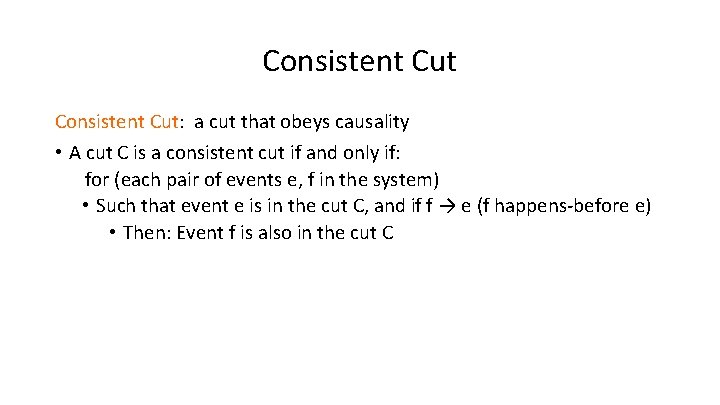
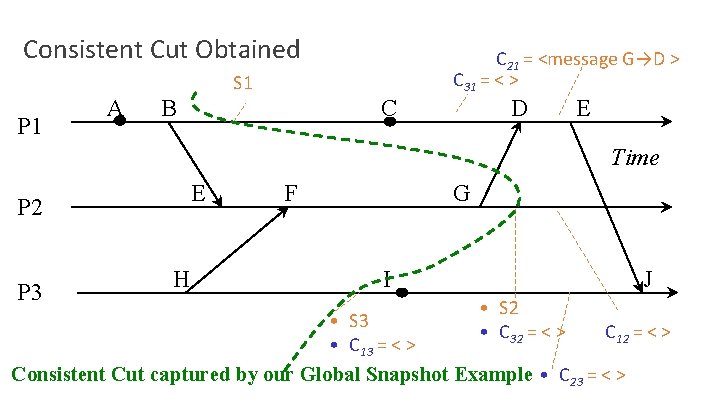
Consistent Cut: a cut that obeys causality • A cut C is a consistent cut if and only if: for (each pair of events e, f in the system) • Such that event e is in the cut C, and if f → e (f happens-before e) • Then: Event f is also in the cut C
Example of (In)Consistent Cut P 1 A B C D E Time E P 2 P 3 F H G I Consistent Cut J Inconsistent Cut G → D, but only D is in cut
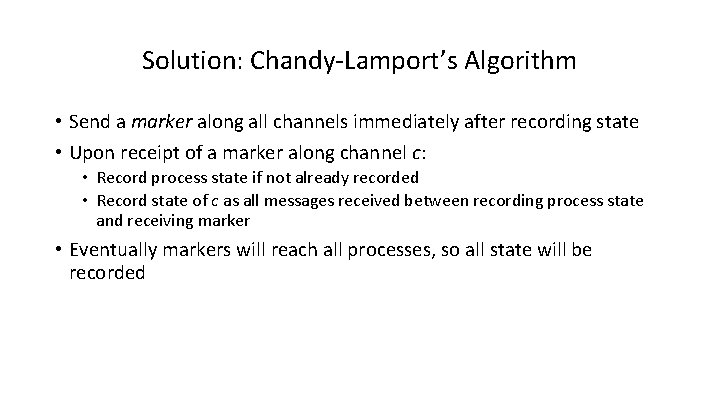
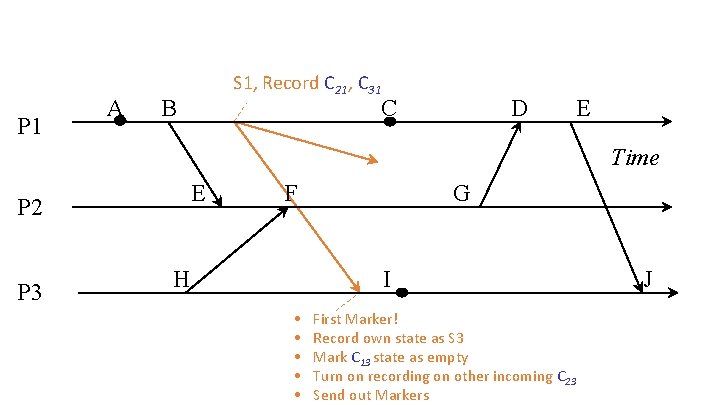
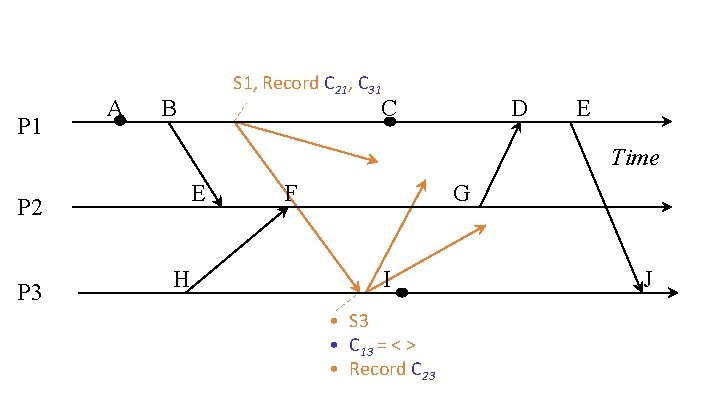
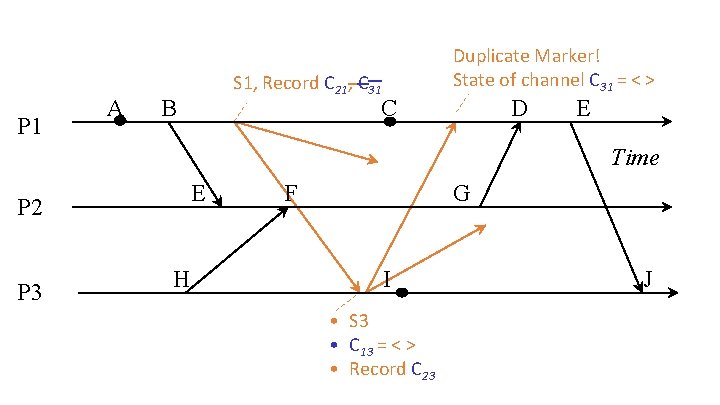
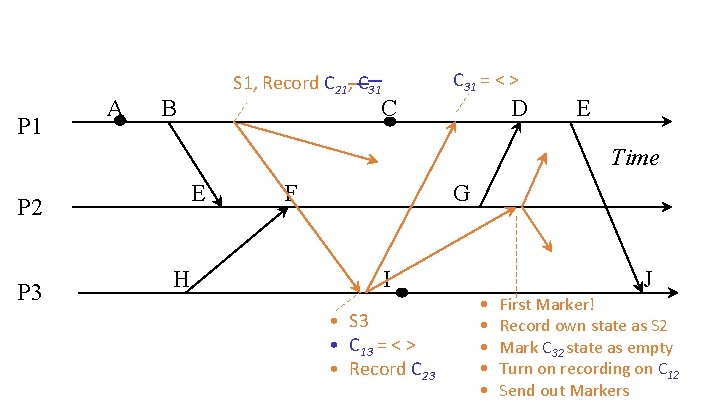
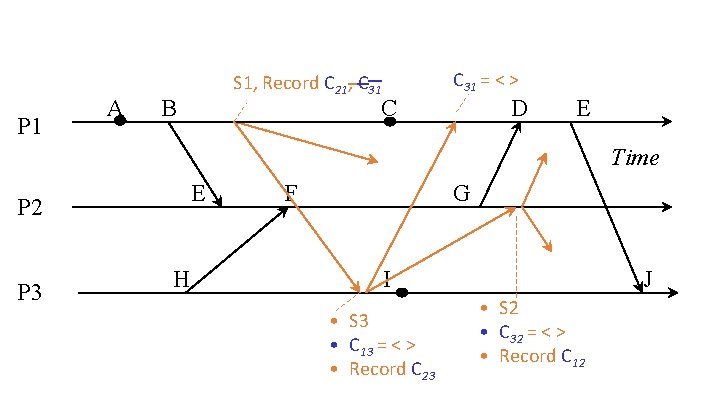
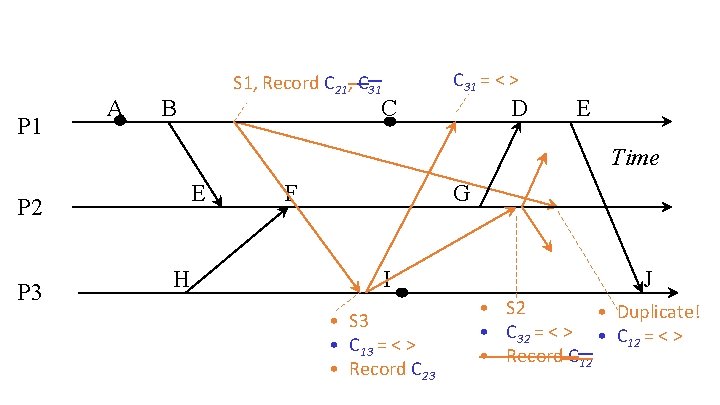
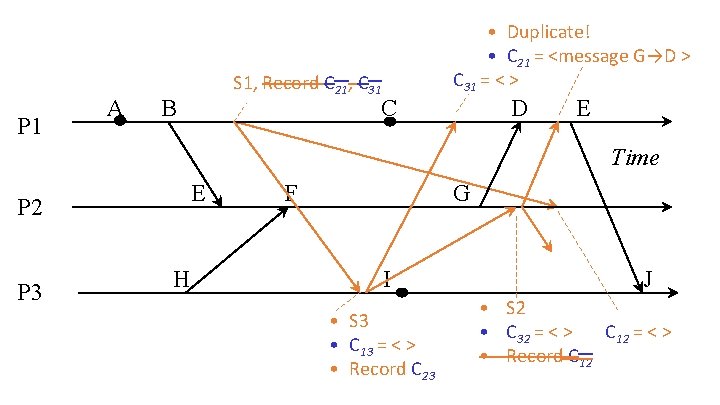
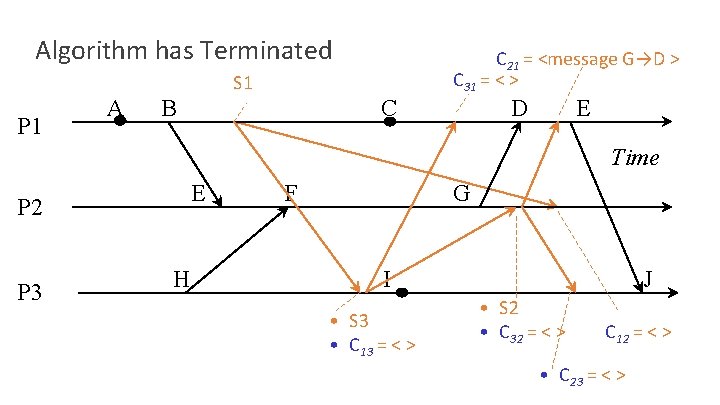
Solution: Chandy-Lamport’s Algorithm • Send a marker along all channels immediately after recording state • Upon receipt of a marker along channel c: • Record process state if not already recorded • Record state of c as all messages received between recording process state and receiving marker • Eventually markers will reach all processes, so all state will be recorded
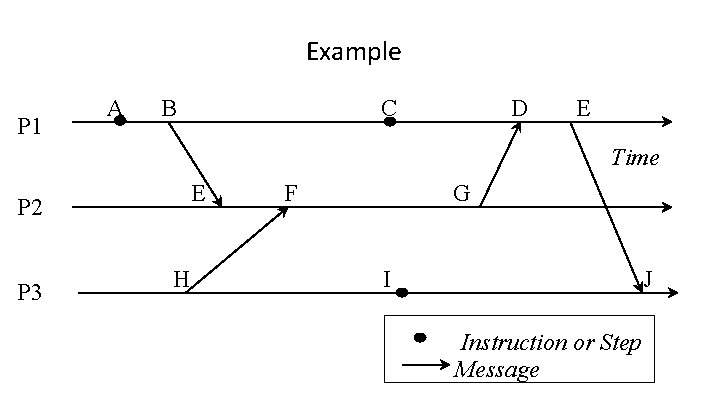
Example P 1 A B C D E Time E P 2 P 3 H F G I J Instruction or Step Message
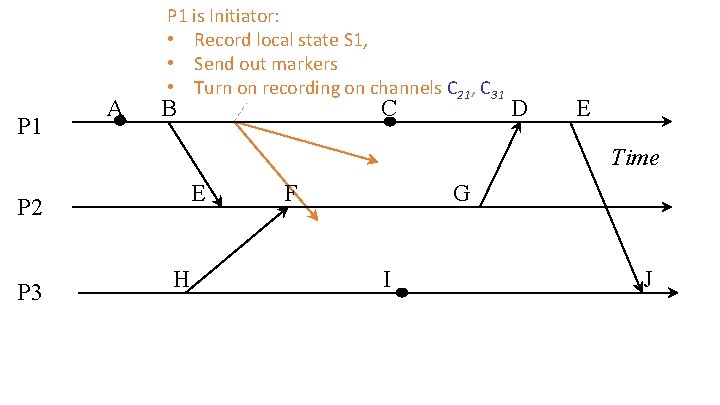
P 1 A P 1 is Initiator: • Record local state S 1, • Send out markers • Turn on recording on channels C 21, C 31 B C D E Time E P 2 P 3 H F G I J
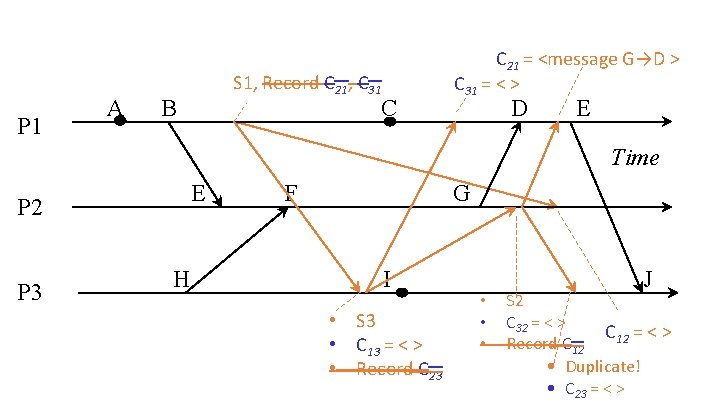
P 1 A S 1, Record C 21, C 31 C B D E Time E P 2 P 3 F H G I • • • First Marker! Record own state as S 3 Mark C 13 state as empty Turn on recording on other incoming C 23 Send out Markers J
P 1 A S 1, Record C 21, C 31 B C D E Time E P 2 P 3 H F G I • S 3 • C 13 = < > • Record C 23 J
P 1 A Duplicate Marker! State of channel C 31 = < > S 1, Record C 21, C 31 B C D E Time E P 2 P 3 H F G I • S 3 • C 13 = < > • Record C 23 J
P 1 A C 31 = < > S 1, Record C 21, C 31 B C D E Time E P 2 P 3 H F G I • S 3 • C 13 = < > • Record C 23 • • • J First Marker! Record own state as S 2 Mark C 32 state as empty Turn on recording on C 12 Send out Markers
P 1 A C 31 = < > S 1, Record C 21, C 31 B C D E Time E P 2 P 3 H F G I • S 3 • C 13 = < > • Record C 23 J • S 2 • C 32 = < > • Record C 12
P 1 A C 31 = < > S 1, Record C 21, C 31 B C D E Time E P 2 P 3 H F G I • S 3 • C 13 = < > • Record C 23 J • S 2 • Duplicate! • C 32 = < > • C 12 = < > • Record C 12
P 1 A • Duplicate! • C 21 = <message G→D > C 31 = < > S 1, Record C 21, C 31 B C D E Time E P 2 P 3 H F G I • S 3 • C 13 = < > • Record C 23 J • S 2 C 12 = < > • C 32 = < > • Record C 12
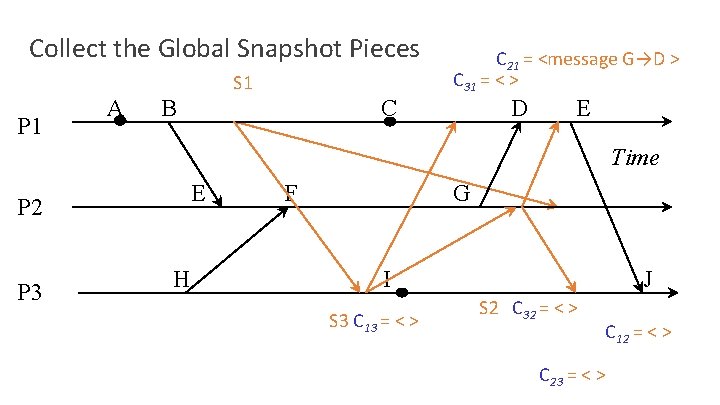
Algorithm has Terminated C 21 = <message G→D > C 31 = < > S 1 P 1 A B C D E Time E P 2 P 3 H F G I • S 3 • C 13 = < > J • S 2 • C 32 = < > C 12 = < > • C 23 = < >
P 1 A S 1, Record C 21, C 31 B C C 21 = <message G→D > C 31 = < > D E Time E P 2 P 3 H F G I • S 3 • C 13 = < > • Record C 23 • • • J S 2 C 32 = < > C 12 = < > Record C 12 • Duplicate! • C 23 = < >
Collect the Global Snapshot Pieces S 1 P 1 A B C 21 = <message G→D > C 31 = < > C D E Time E P 2 P 3 H F G I S 3 C 13 = < > J S 2 C 32 = < > C 12 = < > C 23 = < >
Consistent Cut Obtained C 21 = <message G→D > C 31 = < > S 1 P 1 A B C D E Time E P 2 P 3 H F G I J • S 2 • S 3 • C 32 = < > C 12 = < > • C 13 = < > Consistent Cut captured by our Global Snapshot Example • C 23 = < >
Summary ● Global Snapshot definition ● Uses of collecting a Global Snapshot ● Consistent Cuts ● Chandy-Lamport’s Algorithm
Parting Thoughts & Questions: Ours ● What does Lamport bring from the first paper into the second? ● Why might we want to cover these papers before Map. Reduce? ● What assumptions have been made? ○ FIFO - “The assumption that all messages sent from process Pi to Pj are received in the same order as they are sent is also too strong. ”
Parting Thoughts & Questions: Yours ● “The idea is very novel in the time when it published as distributed systems were not so much relevant in those days. ” ○ “I want to highlight [the first paper’s] elegance. We often take for granted that computing problems didn't come logically into the minds of our predecessors. ” ● “The paper also didn’t consider the scenario of process and message delivery failure. ” ○ ● “unreasonable assumptions about reliability, such as nodes cannot fail and messages cannot be dropped and must have predictable delay. ” “The ideas presented were quite complex. . . This paper presented the formalisms needed quite well and established a clear language. ” ● “The biggest weakness of this paper is that the system cannot inherently capture noncomputational events such as phone calls, and also that there's no sense of the physical feasibility of this synchronization approach. How does propogation delay affect the
Parting Thoughts & Questions: Yours, Cont’d ● “The strong point of this paper is a novel algorithm to guarantee synchronization of distributed system that does not rely on a central authority to perform the synchronization. A total ordering of events can be obtained even when only a partial ordering is available from the space-time diagram. However, in order to achieve this result, all processes must be aware of every other processes messages, which assume that all processes are not anomalous. This is an assumption that can be easily violated by a rogue process. The next logical step for this work is to be resilient to rogue processes which could be purposefully providing incorrect timestamps, or even collaborate to fool the synchronization algorithm. ”
A Nice Review to Consider Together : ) “Lamport's paper on Time, Clocks and Ordering in a distributed system does an excellent job of defining a problem in distributed systems and proposing several solutions along with their requirements and drawbacks. It also omits a number of details for the sake of brevity and readability; it is outside of my expertise to be able to identify if any/all of these details are essential to his argument. For example, he omits details on ensuring eventual message delivery and message delivery order. Obviously TCP can be used to ensure order between any two processes, but it's not clear to me what algorithm Lamport would use do ensure eventual delivery; is it simply timeout based along with a known assumption of max delivery time? I assume it is since he says elsewhere that failures and faulttolerance are not considered in this paper; but since he omits this small detail it's hard for me to know for sure. This is a minor point to pick as most of the paper is very clear, especially thanks to his decision to omit agonizingly small details. However, there a few places where he introduces details for reasons that are unclear to me; he mentions 'unpredictable message delay', denotes a symbol for it and then never mentions it again. It seems like a waste and a bit confusing since it gave me the feeling that measurement was meaningful and necessary for some part of the proof, even though it was not. Overall, the paper's structure is clear, addresses practical issues in distributed systems with a very practical theoretical approach (e. g. considering the fidelity of modern clocks in his error calculations) and is not overly burdened with complex proofs (but does provide them where necessary as footnotes and in the appendix. ) N. B. I don't have anywhere near the experience reading theoretical papers, so it's very likely that I'm missing some critical angles of assessment and/or giving him some free passes (e. g. I don't expect much more than a motivating example on how one might actually build or use a system that a theoretical paper describes)”
Further Reading Suggested by Prof. Alvisi Dijkstra’s Take on Chandy-Lamport: https: //www. cs. utexas. edu/users/EWD/transcriptions/EWD 08 xx/EWD 864. html
Acknowledgements ● Time, Clocks, and the Ordering of Events in a Distributed System, Leslie Lamport, Communications of ACM, Volume 27 Issue 7, July 1978. ● Distributed Snapshots: Determining Global States of Distributed Systems, K. Mani Chandy, Leslie Lamport. ACM Transactions on Computer Systems (TOCS), Volume 3 Issue 1, Feb. 1985. ● Previous years’ slides ● CS 4410 Lecture Slides ● Professor Hakim Weatherspoon and Professor Lorenzo Alvisi for presentation advice